EP1968094A2 - Système de faisceau à particules chargées non symétrique par rapport à un axe - Google Patents
Système de faisceau à particules chargées non symétrique par rapport à un axe Download PDFInfo
- Publication number
- EP1968094A2 EP1968094A2 EP08157418A EP08157418A EP1968094A2 EP 1968094 A2 EP1968094 A2 EP 1968094A2 EP 08157418 A EP08157418 A EP 08157418A EP 08157418 A EP08157418 A EP 08157418A EP 1968094 A2 EP1968094 A2 EP 1968094A2
- Authority
- EP
- European Patent Office
- Prior art keywords
- magnetic field
- axisymmetric
- charged
- particle beam
- beam system
- Prior art date
- Legal status (The legal status is an assumption and is not a legal conclusion. Google has not performed a legal analysis and makes no representation as to the accuracy of the status listed.)
- Withdrawn
Links
Images






Classifications
-
- H—ELECTRICITY
- H01—ELECTRIC ELEMENTS
- H01J—ELECTRIC DISCHARGE TUBES OR DISCHARGE LAMPS
- H01J37/00—Discharge tubes with provision for introducing objects or material to be exposed to the discharge, e.g. for the purpose of examination or processing thereof
- H01J37/02—Details
-
- H—ELECTRICITY
- H01—ELECTRIC ELEMENTS
- H01J—ELECTRIC DISCHARGE TUBES OR DISCHARGE LAMPS
- H01J27/00—Ion beam tubes
- H01J27/02—Ion sources; Ion guns
-
- G—PHYSICS
- G21—NUCLEAR PHYSICS; NUCLEAR ENGINEERING
- G21K—HANDLING OF PARTICLES OR IONISING RADIATION NOT OTHERWISE PROVIDED FOR; IRRADIATION DEVICES; GAMMA RAY OR X-RAY MICROSCOPES
- G21K1/00—Arrangements for handling particles or ionising radiation, e.g. focusing or moderating
- G21K1/08—Deviation, concentration or focusing of the beam by electric or magnetic means
- G21K1/093—Deviation, concentration or focusing of the beam by electric or magnetic means by magnetic means
-
- H—ELECTRICITY
- H01—ELECTRIC ELEMENTS
- H01J—ELECTRIC DISCHARGE TUBES OR DISCHARGE LAMPS
- H01J1/00—Details of electrodes, of magnetic control means, of screens, or of the mounting or spacing thereof, common to two or more basic types of discharge tubes or lamps
- H01J1/50—Magnetic means for controlling the discharge
-
- H—ELECTRICITY
- H01—ELECTRIC ELEMENTS
- H01J—ELECTRIC DISCHARGE TUBES OR DISCHARGE LAMPS
- H01J29/00—Details of cathode-ray tubes or of electron-beam tubes of the types covered by group H01J31/00
- H01J29/46—Arrangements of electrodes and associated parts for generating or controlling the ray or beam, e.g. electron-optical arrangement
- H01J29/58—Arrangements for focusing or reflecting ray or beam
- H01J29/64—Magnetic lenses
-
- H—ELECTRICITY
- H01—ELECTRIC ELEMENTS
- H01J—ELECTRIC DISCHARGE TUBES OR DISCHARGE LAMPS
- H01J3/00—Details of electron-optical or ion-optical arrangements common to two or more basic types of discharge tubes or lamps
- H01J3/02—Electron guns
-
- H—ELECTRICITY
- H01—ELECTRIC ELEMENTS
- H01J—ELECTRIC DISCHARGE TUBES OR DISCHARGE LAMPS
- H01J3/00—Details of electron-optical or ion-optical arrangements common to two or more basic types of discharge tubes or lamps
- H01J3/10—Arrangements for centring ray or beam
-
- H—ELECTRICITY
- H01—ELECTRIC ELEMENTS
- H01J—ELECTRIC DISCHARGE TUBES OR DISCHARGE LAMPS
- H01J3/00—Details of electron-optical or ion-optical arrangements common to two or more basic types of discharge tubes or lamps
- H01J3/12—Arrangements for controlling cross-section of ray or beam; Arrangements for correcting aberration of beam, e.g. due to lenses
-
- H—ELECTRICITY
- H01—ELECTRIC ELEMENTS
- H01J—ELECTRIC DISCHARGE TUBES OR DISCHARGE LAMPS
- H01J3/00—Details of electron-optical or ion-optical arrangements common to two or more basic types of discharge tubes or lamps
- H01J3/14—Arrangements for focusing or reflecting ray or beam
- H01J3/20—Magnetic lenses
Definitions
- the invention relates to the field of charged-particle systems, and in particular to a non-axisymmmetric charged-particle system.
- a beam is said to be space-charge-dominated if its self-electric and self-magnetic field energy is greater than its thermal energy. Because the beam brightness is proportional to the beam current and inversely proportional to the product of the beam cross-sectional area and the beam temperature, generating and maintaining a beam at a low temperature is most critical in the design of a high-brightness beam. If a beam is designed not to reside in an equilibrium state, a sizable exchange occurs between the field and mean-flow energy and thermal energy in the beam. When the beam is space-charge-dominated, the energy exchange results in an increase in the beam temperature (or degradation in the beam brightness) as it propagates.
- RF radio-frequency
- the equilibrium state from the Pierce diode in round two dimensional (2D) geometry cannot be matched into a periodic quadrupole magnetic field to create a Kapachinskij-Vladimirskij (KV) beam equilibrium.
- KV Kapachinskij-Vladimirskij
- a charged-particle beam system includes a non-axisymmetric diode which forms a non-axisymmetric beam having an elliptic cross-section.
- a focusing channel utilizes a magnetic field for focusing and transporting a non-axisymmetric beam,.
- a non-axisymmetric diode comprises at least one electrical terminal for emitting charged-particles and at least one electrical terminal for establishing an electric field and accelerating charged-particles to form a charged-particle beam. These terminals are arranged such that the charged-particle beam possesses an elliptic cross-section.
- a method of forming a non-axisymmetric diode comprising forming at least one electrical terminal for emitting charged-particles, forming at least one electrical terminal for establishing an electric field and accelerating charged-particles to form a charged-particle beam, and arranging said terminals such that the charged-particle beam possesses an elliptic cross-section.
- a charged-particle focusing and transport channel wherein a non-axisymmetric magnetic field is used to focus and transport a charged-particle beam of elliptic cross-section.
- a method of designing a charged-particle focusing and transport channel wherein a non-axisymmetric magnetic field is used to focus and transport a charged-particle beam of elliptic cross-section.
- a method of designing an interface for matching a charged-particle beam of elliptic-cross section between a non-axisymmetric diode and a non-axisymmetric magnetic focusing and transport channel is provided.
- a method of forming a charged-particle beam system includes forming a non-axisymmetric diode that includes a non-axisymmetric beam having an elliptic cross-section. Also, the method includes forming a focusing channel that utilizes a magnetic field for focusing and transporting the elliptic cross-section beam.
- the invention comprises a non-axisymmetric charged-particle beam system having a novel design and method of design for non-axisymmetric charged-particle diodes.
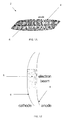
- FIG. 1A shows the non-axisymmetric diode 2 with a Child-Langmuir electron beam 8 with an elliptic cross-section having an anode 4 and cathode 6.
- FIG. 1B is a vertical cross-sectional view of the non-axisymmetric diode 2 and
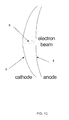
- FIG. 1C is a horizontal cross-sectional view of the non-axisymmetric diode 2 showing an electron beam 8 and the cathode 6 and anode 4 electrodes.
- the electron beam 8 has an elliptic cross section and the characteristics of Child-Langmuir flow.
- the particles are emitted from the cathode 6, and accelerated by the electric field between the cathode 6 and anode 4.
- the roles of cathode and anode are reversed.
- this forms an elliptic Cauchy problem, for which standard analytic and numerical solution methods fail due to the exponential growth of errors which is characteristic of all elliptic Cauchy problems.
- the present technique builds on the 2-dimensional technique of Radley in order to formulate a method of solution for the full 3D problem of determining the electrostatic potential outside a Child-Langmuir charged-particle beam of elliptic cross-section.
- the Angular Mathieu Functions ⁇ ⁇ ( ⁇ ) are not periodic. Indeed, a periodic solution arises only for certain characteristic eigenwalues of the separation constant a .
- the set of solutions ce 2 n is orthogonal and complete over the space of functions with the desired symmetry and periodicity properties.
- a number of methods may be used to evaluate the characteristic values a 2 n and the corresponding Angular Mathieu Functions ce 2 n . These can be integrated by standard methods. In practice, only the first few terms of the infinite series need be retained in order to reduce fractional errors to below 10 -5 .
- the integral along the contour C can be transformed into definite integrals of complex-valued functions along the real line, and thus it, too, can be evaluated using standard methods.
- the 3-dimensional charged-particle optics tool Omni-Trak has been used to simulate the emission and transport of charge particles in the geometry of FIGs. 3 and 4 .
- the resulting particle trajectories, shown in FIG. 5 are indeed parallel, as predicted by the theory.
- the results of the Omni-Trak simulation also provide a validation of the analytical method presented above.
- additional electrodes intermediate in potential between the cathode and anode, may be added in order to aid the enforcement of the Child-Langmuir flow condition.
- the above prescription allows for their design.
- neither the cathode electrode nor the intermediate electrodes need be extended arbitrarily close to the beam edge in order to enforce the Child-Langmuir flow condition.
- the portion of these electrodes nearest the beam may be excised without substantially affecting the beam solution.
- the analytically-prescribed electrodes correspond to the surfaces of conductors separated by vacuum and/or other insulating materials and (in some region distant from the beam) deviating from the analytically-prescribed profiles. Nevertheless, as the influence of distant portions of the electrodes diminish exponentially with distance from the beam edge, these deviations will have a negligible effect on the beam profile, provided that they occur at a sufficient distance from the beam edge.
- FIG. 5 depicts an Omni-Trak simulation in which the finiteness of the electrodes is evident without affecting the parallel-flow of the charged particle beam.
- FIG. 5 illustrates the charge collection surface 10, charge emitting surface 14, parallel particle trajectories 12, and analytically designed electrodes 16.
- the analytic method of electrode design detailed herein specifies the precise geometry of the charge-emitting 14 and charge-collecting 10 surfaces as well as the precise geometry of external conductors 16.
- These external conductors may be held at any potential, however, generally, two external conductors are used - one held at the emitter potential and the other at the collector potential.
- a charged-particle system designed conformally to this geometry will generate a high-quality, laminar, parallel-flow, Child-Langmuir beam of elliptic cross-section as shown in FIG 5 .
- FIG. 6 shows the iron pole pieces 18 and magnets 19 used to form the periodic magnetic field.
- the iron pole pieces are optional and may be omitted in other embodiments.
- the period of the magnetic field is defined by the line 20.
- the field distribution is illustrated FIG. 7 . Note FIG. 7 illustrates the field lines form by the iron pole pieces 18 and magnets 19 of FIG. 6 .
- ⁇ ( s ) is the angle of rotation of the ellipse with respect to the laboratory frame;
- the functions a ( s ), b ( s ), ⁇ x ( s ), ⁇ y ( s ), ⁇ x ( s ), ⁇ y ( s ) and ⁇ ( s ) are to be determined self-consistently [see Eqs. (2.11)-(2.15)].
- B ext x B 0 ⁇ k 0 ⁇ x k 0 ⁇ sinh k 0 ⁇ x ⁇ x ⁇ cosh k 0 ⁇ y ⁇ y ⁇ cos k 0 ⁇ s ⁇ e ⁇ x + k 0 ⁇ y k 0 ⁇ cosh k 0 ⁇ x ⁇ x ⁇ sinh k 0 ⁇ y ⁇ y ⁇ cos k 0 ⁇ s ⁇ e ⁇ y - cosh k 0 ⁇ x ⁇ x ⁇ cosh k 0 ⁇ y ⁇ y ⁇ sin k 0 ⁇ s ⁇ ⁇ e ⁇ z , and further expand it to the lowest order in the transverse dimension to obtain B ext x ⁇ B 0 ⁇
- the 3D magnetic field is specified by the three parameters B 0 , S and k 0 x / k 0 y .
- Equations (2.11)-(2.15) have the time reversal symmetry under the transformations (s, a,b,a',b', ⁇ x , ⁇ y , ⁇ ) ⁇ ( -s,a,b,-a',-b',- ⁇ x , ⁇ y , ⁇ ). This implies that the dynamical system described by Eqs. (2.11)-(2.15) has the hyper symmetry plane ( a',b', ⁇ x , ⁇ y ).
- a numerical module was developed to solve the generalized envelope equations (2.11)-(2.15). There are, in total, seven functions a ( s ) , b ( s ) , a' ( s ) , b' ( s ) , ⁇ x ( s ), ⁇ x ( s ) and ⁇ ( s ) to be solved.
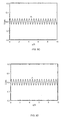
- FIGs. 9A demonstrates the envelopes associated with the functions a ( s ) and b ( s ).
- FIG. 9B is graphical representation of rotating angle ⁇ ( s ).
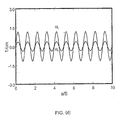
- FIG. 9E is a graph demonstrating velocities ⁇ x ( s ) and ⁇ y ( s ) versus the axial distance s for a flat, ellipse-shaped, uniform-density charged-particle beam in a 3D non-axisymmetric magnetic field.
- the matching from the charged-particle diode to the focusing channel might not be perfect in experiments. If a mismatch is unstable, it might ruin the beam. However, investigations of small-mismatch beams show that the envelopes are stable against small mismatch.
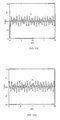
- FIGs. 10A demonstrates the envelopes associated with the functions a ( s ) and b ( s ).
- FIG. 10B is graphical representation of rotating angle ⁇ ( s ).
- FIG. 10E is a graph demonstrating velocities ⁇ x ( s ) and ⁇ y ( s ) versus the axial distance s for a flat, ellipse-shaped, uniform-density charged-particle beam in a 3D non-axisymmetric magnetic field.
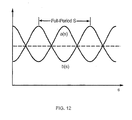
- FIG. 12 shows the envelopes for pulsating elliptic beam equilibrium in the periodic quadrupole magnetic field, as described previously.
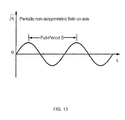
- FIG. 13 shows an example of the magnetic focusing parameter ⁇ z s ⁇ q ⁇ B z s 2 ⁇ ⁇ b ⁇ ⁇ b ⁇ m ⁇ c 2 associated with the non-axisymmetric periodic permanent magnetic field (presented for a beam of charged particles with charge q , rest mass m, and axial momentum ⁇ b ⁇ b mc.
- FIG. 14 shows the envelopes for a flat, elliptic beam equilibrium state in the non-axisymmetric periodic permanent magnetic field.
- the angle of the ellipse exhibits slight oscillations. However, these oscillations can be corrected by utilizing higher longitudinal harmonics of the magnetic field profile.
- the matching procedure discussed herein illustrates a high quality interface between a non-axisymmetric diode and a non-axisymmetric magnetic focusing channel for charged-particle beam.
- This beam system will find application in vacuum electron devices and particle accelerators where high brightness, low emittance, low temperature beams are desired.
Landscapes
- Engineering & Computer Science (AREA)
- Physics & Mathematics (AREA)
- Chemical & Material Sciences (AREA)
- Combustion & Propulsion (AREA)
- Spectroscopy & Molecular Physics (AREA)
- General Engineering & Computer Science (AREA)
- High Energy & Nuclear Physics (AREA)
- Analytical Chemistry (AREA)
- Particle Accelerators (AREA)
- Electron Beam Exposure (AREA)
Applications Claiming Priority (2)
| Application Number | Priority Date | Filing Date | Title |
|---|---|---|---|
| US57713204P | 2004-06-04 | 2004-06-04 | |
| EP05758447A EP1766652A2 (fr) | 2004-06-04 | 2005-06-06 | Systeme a faisceau de particules chargees non- axisymetrique |
Related Parent Applications (1)
| Application Number | Title | Priority Date | Filing Date |
|---|---|---|---|
| EP05758447A Division EP1766652A2 (fr) | 2004-06-04 | 2005-06-06 | Systeme a faisceau de particules chargees non- axisymetrique |
Publications (2)
| Publication Number | Publication Date |
|---|---|
| EP1968094A2 true EP1968094A2 (fr) | 2008-09-10 |
| EP1968094A3 EP1968094A3 (fr) | 2010-01-06 |
Family
ID=35262203
Family Applications (2)
| Application Number | Title | Priority Date | Filing Date |
|---|---|---|---|
| EP08157418A Withdrawn EP1968094A3 (fr) | 2004-06-04 | 2005-06-06 | Système de faisceau à particules chargées non symétrique par rapport à un axe |
| EP05758447A Withdrawn EP1766652A2 (fr) | 2004-06-04 | 2005-06-06 | Systeme a faisceau de particules chargees non- axisymetrique |
Family Applications After (1)
| Application Number | Title | Priority Date | Filing Date |
|---|---|---|---|
| EP05758447A Withdrawn EP1766652A2 (fr) | 2004-06-04 | 2005-06-06 | Systeme a faisceau de particules chargees non- axisymetrique |
Country Status (6)
| Country | Link |
|---|---|
| US (2) | US7381967B2 (fr) |
| EP (2) | EP1968094A3 (fr) |
| JP (1) | JP2008502110A (fr) |
| KR (1) | KR20070034569A (fr) |
| CN (1) | CN1998059A (fr) |
| WO (1) | WO2005119732A2 (fr) |
Families Citing this family (5)
| Publication number | Priority date | Publication date | Assignee | Title |
|---|---|---|---|---|
| EP1625851A4 (fr) | 2003-05-16 | 2007-12-26 | Bbk Bio Corp | Preparation servant a empecher le contact de substances pathogenes avec des organismes vivants |
| EP1968094A3 (fr) * | 2004-06-04 | 2010-01-06 | Massachusetts Institute of Technology | Système de faisceau à particules chargées non symétrique par rapport à un axe |
| WO2008130436A2 (fr) * | 2006-10-16 | 2008-10-30 | Massachusetts Institute Of Technology | Système de transport commandé pour un faisceau elliptique à particule chargée |
| WO2008061173A2 (fr) * | 2006-11-15 | 2008-05-22 | Massachusetts Institute Of Technology | Création, accélération, focalisation et recueil d'un faisceau de particules chargées de haute luminosité, domine par charge spatiale, et circulaire |
| CN102598195B (zh) * | 2009-09-18 | 2015-09-16 | Fei公司 | 分布式离子源加速镜筒 |
Family Cites Families (4)
| Publication number | Priority date | Publication date | Assignee | Title |
|---|---|---|---|---|
| GB574512A (en) * | 1940-03-05 | 1946-01-09 | Leonard Francis Broadway | Improvements in or relating to electron discharge devices |
| DE69424880T2 (de) * | 1993-01-11 | 2001-01-18 | Bernard Horowitz | Hochfrequenz-abtastumsetzer |
| US6326861B1 (en) * | 1999-07-16 | 2001-12-04 | Feltech Corporation | Method for generating a train of fast electrical pulses and application to the acceleration of particles |
| EP1968094A3 (fr) * | 2004-06-04 | 2010-01-06 | Massachusetts Institute of Technology | Système de faisceau à particules chargées non symétrique par rapport à un axe |
-
2005
- 2005-06-06 EP EP08157418A patent/EP1968094A3/fr not_active Withdrawn
- 2005-06-06 JP JP2007515673A patent/JP2008502110A/ja not_active Withdrawn
- 2005-06-06 EP EP05758447A patent/EP1766652A2/fr not_active Withdrawn
- 2005-06-06 US US11/145,804 patent/US7381967B2/en not_active Expired - Fee Related
- 2005-06-06 WO PCT/US2005/019794 patent/WO2005119732A2/fr not_active Ceased
- 2005-06-06 CN CNA2005800229310A patent/CN1998059A/zh active Pending
- 2005-06-06 KR KR1020077000133A patent/KR20070034569A/ko not_active Ceased
-
2008
- 2008-01-03 US US11/968,833 patent/US7612346B2/en not_active Expired - Fee Related
Also Published As
| Publication number | Publication date |
|---|---|
| US20060017002A1 (en) | 2006-01-26 |
| EP1968094A3 (fr) | 2010-01-06 |
| US7612346B2 (en) | 2009-11-03 |
| US7381967B2 (en) | 2008-06-03 |
| EP1766652A2 (fr) | 2007-03-28 |
| KR20070034569A (ko) | 2007-03-28 |
| US20080191144A1 (en) | 2008-08-14 |
| WO2005119732A2 (fr) | 2005-12-15 |
| WO2005119732A3 (fr) | 2006-02-09 |
| JP2008502110A (ja) | 2008-01-24 |
| CN1998059A (zh) | 2007-07-11 |
Similar Documents
| Publication | Publication Date | Title |
|---|---|---|
| Joshi et al. | Plasma wakefield acceleration experiments at FACET II | |
| Wang et al. | Electron beam transport analysis of W-band sheet beam klystron | |
| US7612346B2 (en) | Non-axisymmetric charged-particle beam system | |
| Staples | RFQ's-An Introduction | |
| Basten et al. | Magnetic quadrupole formation of elliptical sheet electron beams for high-power microwave devices | |
| Mamontov et al. | Numerical Analysis of Runaway Electron Beam Focusing with a Homogeneous Longitudinal Magnetic Field | |
| Panda et al. | Pole-piece with stepped hole for stable sheet electron beam transport under uniform magnetic field | |
| Lindqvist et al. | Sensitivity of the negative ion beam extraction to initial plasma parameters by 3D particle modelling | |
| US7663327B2 (en) | Non-axisymmetric periodic permanent magnet focusing system | |
| US20110121194A1 (en) | Controlled transport system for an elliptic charged-particle beam | |
| Weinberg et al. | Beam-line optimization based on realistic electron-optics 3D field-maps implementation provides high-quality e-beam via a dogleg section | |
| Naab et al. | Ion beam transport simulations for the 1.7 MV tandem accelerator at the Michigan ion beam laboratory | |
| Zhang et al. | Two-dimensional numerical simulation of the splitting and uniting of current-carrying zones in a dielectric barrier discharge | |
| Harris et al. | Transport of electron beams with initial transverse-longitudinal correlation | |
| Harris et al. | Solenoid transport of beams with current-dependent initial conditions | |
| Nichols et al. | Analysis of quadrupole focusing lattices for electron beam transport in traveling-wave tubes | |
| Ikeda et al. | Simulation study of high-current 7Li3+ beam acceleration with laser ion source and RFQ linac using direct plasma injection | |
| Hong et al. | Preliminary physical and electromagnetic design for the injector of the heavy ion superconducting linac | |
| Harris et al. | Generation and focusing of electron beams with initial transverse-longitudinal correlation | |
| Grigoreva et al. | Energy loss reduction of a charge moving through an anisotropic plasma-like medium | |
| Levchenko | Fields of an ultra-relativistic beam of charged particles between parallel plates. Exact 2D solutions by the method of images and applications to the HL-LHC | |
| Martinez et al. | Classical trajectory Monte Carlo simulation of plasma fueling using magnetic plasma expulsion | |
| Slayton et al. | Micron-Scale Electrostatic Charged-Particle Guides: Analysis and Simulation | |
| Todd et al. | Comparison of particle-in-cell simulation with experiment for the transport system of the superconducting electron cyclotron resonance ion source VENUS | |
| Stratakis | Emittance preservation during bunch compression with a magnetized beam |
Legal Events
| Date | Code | Title | Description |
|---|---|---|---|
| PUAI | Public reference made under article 153(3) epc to a published international application that has entered the european phase |
Free format text: ORIGINAL CODE: 0009012 |
|
| AC | Divisional application: reference to earlier application |
Ref document number: 1766652 Country of ref document: EP Kind code of ref document: P |
|
| AK | Designated contracting states |
Kind code of ref document: A2 Designated state(s): AT BE BG CH CY CZ DE DK EE ES FI FR GB GR HU IE IS IT LI LT LU MC NL PL PT RO SE SI SK TR |
|
| RIN1 | Information on inventor provided before grant (corrected) |
Inventor name: BHATT, RHONAK, J Inventor name: ZHOU, JING Inventor name: CHEN, CHIPING |
|
| RIN1 | Information on inventor provided before grant (corrected) |
Inventor name: CHEN, CHIPING Inventor name: ZHOU, JING Inventor name: BHATT, RHONAK, J |
|
| PUAL | Search report despatched |
Free format text: ORIGINAL CODE: 0009013 |
|
| AK | Designated contracting states |
Kind code of ref document: A3 Designated state(s): AT BE BG CH CY CZ DE DK EE ES FI FR GB GR HU IE IS IT LI LT LU MC NL PL PT RO SE SI SK TR |
|
| RIC1 | Information provided on ipc code assigned before grant |
Ipc: H01J 3/12 20060101AFI20091201BHEP Ipc: H01J 3/14 20060101ALI20091201BHEP |
|
| STAA | Information on the status of an ep patent application or granted ep patent |
Free format text: STATUS: THE APPLICATION IS DEEMED TO BE WITHDRAWN |
|
| 18D | Application deemed to be withdrawn |
Effective date: 20100105 |