EP1968722B1 - Verfahren zur abtrennung von proteinen aus flüssigen medien - Google Patents
Verfahren zur abtrennung von proteinen aus flüssigen medien Download PDFInfo
- Publication number
- EP1968722B1 EP1968722B1 EP06829663A EP06829663A EP1968722B1 EP 1968722 B1 EP1968722 B1 EP 1968722B1 EP 06829663 A EP06829663 A EP 06829663A EP 06829663 A EP06829663 A EP 06829663A EP 1968722 B1 EP1968722 B1 EP 1968722B1
- Authority
- EP
- European Patent Office
- Prior art keywords
- clay material
- proteins
- protein
- clay
- previous
- Prior art date
- Legal status (The legal status is an assumption and is not a legal conclusion. Google has not performed a legal analysis and makes no representation as to the accuracy of the status listed.)
- Not-in-force
Links
- 102000004169 proteins and genes Human genes 0.000 title claims abstract description 143
- 108090000623 proteins and genes Proteins 0.000 title claims abstract description 143
- 238000000034 method Methods 0.000 title claims abstract description 68
- 239000007788 liquid Substances 0.000 title claims abstract description 48
- 239000011148 porous material Substances 0.000 claims abstract description 43
- XLYOFNOQVPJJNP-UHFFFAOYSA-N water Substances O XLYOFNOQVPJJNP-UHFFFAOYSA-N 0.000 claims abstract description 28
- 239000013049 sediment Substances 0.000 claims abstract description 12
- 238000005342 ion exchange Methods 0.000 claims abstract description 8
- 239000000463 material Substances 0.000 claims description 169
- 239000004927 clay Substances 0.000 claims description 157
- 239000000872 buffer Substances 0.000 claims description 38
- 238000001179 sorption measurement Methods 0.000 claims description 25
- 238000000926 separation method Methods 0.000 claims description 23
- VYPSYNLAJGMNEJ-UHFFFAOYSA-N Silicium dioxide Chemical compound O=[Si]=O VYPSYNLAJGMNEJ-UHFFFAOYSA-N 0.000 claims description 20
- 238000004587 chromatography analysis Methods 0.000 claims description 8
- 239000002245 particle Substances 0.000 claims description 8
- 239000000741 silica gel Substances 0.000 claims description 8
- 229910002027 silica gel Inorganic materials 0.000 claims description 8
- 239000011734 sodium Substances 0.000 claims description 8
- 150000001875 compounds Chemical class 0.000 claims description 6
- 239000003480 eluent Substances 0.000 claims description 6
- 239000002253 acid Substances 0.000 claims description 5
- 230000004913 activation Effects 0.000 claims description 5
- 239000000377 silicon dioxide Substances 0.000 claims description 5
- 238000012856 packing Methods 0.000 claims description 4
- DGAQECJNVWCQMB-PUAWFVPOSA-M Ilexoside XXIX Chemical compound C[C@@H]1CC[C@@]2(CC[C@@]3(C(=CC[C@H]4[C@]3(CC[C@@H]5[C@@]4(CC[C@@H](C5(C)C)OS(=O)(=O)[O-])C)C)[C@@H]2[C@]1(C)O)C)C(=O)O[C@H]6[C@@H]([C@H]([C@@H]([C@H](O6)CO)O)O)O.[Na+] DGAQECJNVWCQMB-PUAWFVPOSA-M 0.000 claims description 3
- 229910052708 sodium Inorganic materials 0.000 claims description 3
- 239000001913 cellulose Substances 0.000 claims description 2
- 229920002678 cellulose Polymers 0.000 claims description 2
- 239000001267 polyvinylpyrrolidone Substances 0.000 claims description 2
- 229920000036 polyvinylpyrrolidone Polymers 0.000 claims description 2
- 235000013855 polyvinylpyrrolidone Nutrition 0.000 claims description 2
- PNEYBMLMFCGWSK-UHFFFAOYSA-N aluminium oxide Inorganic materials [O-2].[O-2].[O-2].[Al+3].[Al+3] PNEYBMLMFCGWSK-UHFFFAOYSA-N 0.000 claims 2
- 229910052593 corundum Inorganic materials 0.000 claims 2
- 229910001845 yogo sapphire Inorganic materials 0.000 claims 2
- 229910052783 alkali metal Inorganic materials 0.000 claims 1
- 150000001340 alkali metals Chemical class 0.000 claims 1
- 229910052681 coesite Inorganic materials 0.000 claims 1
- 229910052906 cristobalite Inorganic materials 0.000 claims 1
- 229910052682 stishovite Inorganic materials 0.000 claims 1
- 229910052905 tridymite Inorganic materials 0.000 claims 1
- 239000002734 clay mineral Substances 0.000 abstract description 4
- 239000002609 medium Substances 0.000 description 33
- 230000008569 process Effects 0.000 description 23
- 239000000243 solution Substances 0.000 description 19
- 238000010828 elution Methods 0.000 description 13
- 239000007979 citrate buffer Substances 0.000 description 12
- 238000011067 equilibration Methods 0.000 description 11
- 102000008100 Human Serum Albumin Human genes 0.000 description 10
- 108091006905 Human Serum Albumin Proteins 0.000 description 10
- 235000012216 bentonite Nutrition 0.000 description 10
- 238000001914 filtration Methods 0.000 description 10
- 239000012149 elution buffer Substances 0.000 description 9
- 102000004190 Enzymes Human genes 0.000 description 8
- 108090000790 Enzymes Proteins 0.000 description 8
- 239000003463 adsorbent Substances 0.000 description 8
- ONCZQWJXONKSMM-UHFFFAOYSA-N dialuminum;disodium;oxygen(2-);silicon(4+);hydrate Chemical compound O.[O-2].[O-2].[O-2].[O-2].[O-2].[O-2].[O-2].[O-2].[O-2].[O-2].[O-2].[O-2].[Na+].[Na+].[Al+3].[Al+3].[Si+4].[Si+4].[Si+4].[Si+4] ONCZQWJXONKSMM-UHFFFAOYSA-N 0.000 description 8
- 229940088598 enzyme Drugs 0.000 description 8
- 229910052500 inorganic mineral Inorganic materials 0.000 description 8
- NOESYZHRGYRDHS-UHFFFAOYSA-N insulin Chemical compound N1C(=O)C(NC(=O)C(CCC(N)=O)NC(=O)C(CCC(O)=O)NC(=O)C(C(C)C)NC(=O)C(NC(=O)CN)C(C)CC)CSSCC(C(NC(CO)C(=O)NC(CC(C)C)C(=O)NC(CC=2C=CC(O)=CC=2)C(=O)NC(CCC(N)=O)C(=O)NC(CC(C)C)C(=O)NC(CCC(O)=O)C(=O)NC(CC(N)=O)C(=O)NC(CC=2C=CC(O)=CC=2)C(=O)NC(CSSCC(NC(=O)C(C(C)C)NC(=O)C(CC(C)C)NC(=O)C(CC=2C=CC(O)=CC=2)NC(=O)C(CC(C)C)NC(=O)C(C)NC(=O)C(CCC(O)=O)NC(=O)C(C(C)C)NC(=O)C(CC(C)C)NC(=O)C(CC=2NC=NC=2)NC(=O)C(CO)NC(=O)CNC2=O)C(=O)NCC(=O)NC(CCC(O)=O)C(=O)NC(CCCNC(N)=N)C(=O)NCC(=O)NC(CC=3C=CC=CC=3)C(=O)NC(CC=3C=CC=CC=3)C(=O)NC(CC=3C=CC(O)=CC=3)C(=O)NC(C(C)O)C(=O)N3C(CCC3)C(=O)NC(CCCCN)C(=O)NC(C)C(O)=O)C(=O)NC(CC(N)=O)C(O)=O)=O)NC(=O)C(C(C)CC)NC(=O)C(CO)NC(=O)C(C(C)O)NC(=O)C1CSSCC2NC(=O)C(CC(C)C)NC(=O)C(NC(=O)C(CCC(N)=O)NC(=O)C(CC(N)=O)NC(=O)C(NC(=O)C(N)CC=1C=CC=CC=1)C(C)C)CC1=CN=CN1 NOESYZHRGYRDHS-UHFFFAOYSA-N 0.000 description 8
- 238000011068 loading method Methods 0.000 description 8
- 238000004519 manufacturing process Methods 0.000 description 8
- 239000011707 mineral Substances 0.000 description 8
- 229940080314 sodium bentonite Drugs 0.000 description 8
- 229910000280 sodium bentonite Inorganic materials 0.000 description 8
- 239000000725 suspension Substances 0.000 description 8
- 239000000203 mixture Substances 0.000 description 7
- 239000000523 sample Substances 0.000 description 7
- 239000006228 supernatant Substances 0.000 description 7
- 230000008961 swelling Effects 0.000 description 7
- 229910018072 Al 2 O 3 Inorganic materials 0.000 description 6
- IJGRMHOSHXDMSA-UHFFFAOYSA-N Atomic nitrogen Chemical compound N#N IJGRMHOSHXDMSA-UHFFFAOYSA-N 0.000 description 6
- 239000007983 Tris buffer Substances 0.000 description 6
- 150000001413 amino acids Chemical class 0.000 description 6
- 238000004458 analytical method Methods 0.000 description 6
- 239000007864 aqueous solution Substances 0.000 description 6
- 229910000278 bentonite Inorganic materials 0.000 description 6
- 229940092782 bentonite Drugs 0.000 description 6
- 239000000440 bentonite Substances 0.000 description 6
- SVPXDRXYRYOSEX-UHFFFAOYSA-N bentoquatam Chemical compound O.O=[Si]=O.O=[Al]O[Al]=O SVPXDRXYRYOSEX-UHFFFAOYSA-N 0.000 description 6
- 238000005341 cation exchange Methods 0.000 description 6
- 239000012535 impurity Substances 0.000 description 6
- LENZDBCJOHFCAS-UHFFFAOYSA-N tris Chemical compound OCC(N)(CO)CO LENZDBCJOHFCAS-UHFFFAOYSA-N 0.000 description 6
- 102000002260 Alkaline Phosphatase Human genes 0.000 description 5
- 108020004774 Alkaline Phosphatase Proteins 0.000 description 5
- CDBYLPFSWZWCQE-UHFFFAOYSA-L Sodium Carbonate Chemical compound [Na+].[Na+].[O-]C([O-])=O CDBYLPFSWZWCQE-UHFFFAOYSA-L 0.000 description 5
- 150000001768 cations Chemical class 0.000 description 5
- 150000002500 ions Chemical class 0.000 description 5
- 239000000126 substance Substances 0.000 description 5
- LFQSCWFLJHTTHZ-UHFFFAOYSA-N Ethanol Chemical compound CCO LFQSCWFLJHTTHZ-UHFFFAOYSA-N 0.000 description 4
- 102000004877 Insulin Human genes 0.000 description 4
- 108090001061 Insulin Proteins 0.000 description 4
- BPQQTUXANYXVAA-UHFFFAOYSA-N Orthosilicate Chemical compound [O-][Si]([O-])([O-])[O-] BPQQTUXANYXVAA-UHFFFAOYSA-N 0.000 description 4
- 229910004298 SiO 2 Inorganic materials 0.000 description 4
- FAPWRFPIFSIZLT-UHFFFAOYSA-M Sodium chloride Chemical compound [Na+].[Cl-] FAPWRFPIFSIZLT-UHFFFAOYSA-M 0.000 description 4
- 238000010521 absorption reaction Methods 0.000 description 4
- 229910052782 aluminium Inorganic materials 0.000 description 4
- XAGFODPZIPBFFR-UHFFFAOYSA-N aluminium Chemical compound [Al] XAGFODPZIPBFFR-UHFFFAOYSA-N 0.000 description 4
- 235000013405 beer Nutrition 0.000 description 4
- 230000000694 effects Effects 0.000 description 4
- 108010074605 gamma-Globulins Proteins 0.000 description 4
- 229940125396 insulin Drugs 0.000 description 4
- -1 organometallic cations Chemical class 0.000 description 4
- 239000012071 phase Substances 0.000 description 4
- 229910052615 phyllosilicate Inorganic materials 0.000 description 4
- 229920000642 polymer Polymers 0.000 description 4
- 235000019624 protein content Nutrition 0.000 description 4
- 238000000746 purification Methods 0.000 description 4
- 150000004760 silicates Chemical class 0.000 description 4
- 239000011550 stock solution Substances 0.000 description 4
- OKKJLVBELUTLKV-UHFFFAOYSA-N Methanol Chemical compound OC OKKJLVBELUTLKV-UHFFFAOYSA-N 0.000 description 3
- 108010027597 alpha-chymotrypsin Proteins 0.000 description 3
- 210000001124 body fluid Anatomy 0.000 description 3
- 239000010839 body fluid Substances 0.000 description 3
- 239000007853 buffer solution Substances 0.000 description 3
- 238000011088 calibration curve Methods 0.000 description 3
- 238000006243 chemical reaction Methods 0.000 description 3
- 239000000356 contaminant Substances 0.000 description 3
- 238000000921 elemental analysis Methods 0.000 description 3
- 239000012065 filter cake Substances 0.000 description 3
- 238000011534 incubation Methods 0.000 description 3
- 230000002452 interceptive effect Effects 0.000 description 3
- NLYAJNPCOHFWQQ-UHFFFAOYSA-N kaolin Chemical compound O.O.O=[Al]O[Si](=O)O[Si](=O)O[Al]=O NLYAJNPCOHFWQQ-UHFFFAOYSA-N 0.000 description 3
- 238000005259 measurement Methods 0.000 description 3
- 238000002156 mixing Methods 0.000 description 3
- 229910052757 nitrogen Inorganic materials 0.000 description 3
- 239000000047 product Substances 0.000 description 3
- 150000003839 salts Chemical class 0.000 description 3
- PEDCQBHIVMGVHV-UHFFFAOYSA-N Glycerine Chemical compound OCC(O)CO PEDCQBHIVMGVHV-UHFFFAOYSA-N 0.000 description 2
- 102000014150 Interferons Human genes 0.000 description 2
- 108010050904 Interferons Proteins 0.000 description 2
- KFZMGEQAYNKOFK-UHFFFAOYSA-N Isopropanol Chemical compound CC(C)O KFZMGEQAYNKOFK-UHFFFAOYSA-N 0.000 description 2
- 239000007987 MES buffer Substances 0.000 description 2
- 241000294754 Macroptilium atropurpureum Species 0.000 description 2
- NBIIXXVUZAFLBC-UHFFFAOYSA-N Phosphoric acid Chemical compound OP(O)(O)=O NBIIXXVUZAFLBC-UHFFFAOYSA-N 0.000 description 2
- XUIMIQQOPSSXEZ-UHFFFAOYSA-N Silicon Chemical compound [Si] XUIMIQQOPSSXEZ-UHFFFAOYSA-N 0.000 description 2
- 229910010413 TiO 2 Inorganic materials 0.000 description 2
- 101710100170 Unknown protein Proteins 0.000 description 2
- 238000009825 accumulation Methods 0.000 description 2
- 230000002378 acidificating effect Effects 0.000 description 2
- 239000013543 active substance Substances 0.000 description 2
- 230000008901 benefit Effects 0.000 description 2
- 230000008033 biological extinction Effects 0.000 description 2
- 239000000648 calcium alginate Substances 0.000 description 2
- 235000010410 calcium alginate Nutrition 0.000 description 2
- 229960002681 calcium alginate Drugs 0.000 description 2
- OKHHGHGGPDJQHR-YMOPUZKJSA-L calcium;(2s,3s,4s,5s,6r)-6-[(2r,3s,4r,5s,6r)-2-carboxy-6-[(2r,3s,4r,5s,6r)-2-carboxylato-4,5,6-trihydroxyoxan-3-yl]oxy-4,5-dihydroxyoxan-3-yl]oxy-3,4,5-trihydroxyoxane-2-carboxylate Chemical compound [Ca+2].O[C@@H]1[C@H](O)[C@H](O)O[C@@H](C([O-])=O)[C@H]1O[C@H]1[C@@H](O)[C@@H](O)[C@H](O[C@H]2[C@H]([C@@H](O)[C@H](O)[C@H](O2)C([O-])=O)O)[C@H](C(O)=O)O1 OKHHGHGGPDJQHR-YMOPUZKJSA-L 0.000 description 2
- 238000005119 centrifugation Methods 0.000 description 2
- 238000004140 cleaning Methods 0.000 description 2
- 230000001186 cumulative effect Effects 0.000 description 2
- 230000009849 deactivation Effects 0.000 description 2
- 238000004925 denaturation Methods 0.000 description 2
- 230000036425 denaturation Effects 0.000 description 2
- 230000001419 dependent effect Effects 0.000 description 2
- 239000000539 dimer Substances 0.000 description 2
- 239000012153 distilled water Substances 0.000 description 2
- 238000009826 distribution Methods 0.000 description 2
- 238000011156 evaluation Methods 0.000 description 2
- 238000002474 experimental method Methods 0.000 description 2
- 230000003993 interaction Effects 0.000 description 2
- 238000011835 investigation Methods 0.000 description 2
- 229910052622 kaolinite Inorganic materials 0.000 description 2
- 239000003960 organic solvent Substances 0.000 description 2
- 229910052700 potassium Inorganic materials 0.000 description 2
- BWHMMNNQKKPAPP-UHFFFAOYSA-L potassium carbonate Chemical compound [K+].[K+].[O-]C([O-])=O BWHMMNNQKKPAPP-UHFFFAOYSA-L 0.000 description 2
- 239000002244 precipitate Substances 0.000 description 2
- 238000002360 preparation method Methods 0.000 description 2
- 239000012460 protein solution Substances 0.000 description 2
- 229910052710 silicon Inorganic materials 0.000 description 2
- 239000010703 silicon Substances 0.000 description 2
- 239000002002 slurry Substances 0.000 description 2
- 239000007974 sodium acetate buffer Substances 0.000 description 2
- 239000011780 sodium chloride Substances 0.000 description 2
- 239000001509 sodium citrate Substances 0.000 description 2
- NLJMYIDDQXHKNR-UHFFFAOYSA-K sodium citrate Chemical compound O.O.[Na+].[Na+].[Na+].[O-]C(=O)CC(O)(CC([O-])=O)C([O-])=O NLJMYIDDQXHKNR-UHFFFAOYSA-K 0.000 description 2
- 229910001415 sodium ion Inorganic materials 0.000 description 2
- 239000012064 sodium phosphate buffer Substances 0.000 description 2
- 239000007787 solid Substances 0.000 description 2
- 239000007790 solid phase Substances 0.000 description 2
- 239000002904 solvent Substances 0.000 description 2
- 238000000527 sonication Methods 0.000 description 2
- 239000008399 tap water Substances 0.000 description 2
- 235000020679 tap water Nutrition 0.000 description 2
- 239000010455 vermiculite Substances 0.000 description 2
- 229910052902 vermiculite Inorganic materials 0.000 description 2
- 235000019354 vermiculite Nutrition 0.000 description 2
- 238000005303 weighing Methods 0.000 description 2
- 235000014101 wine Nutrition 0.000 description 2
- JNYAEWCLZODPBN-JGWLITMVSA-N (2r,3r,4s)-2-[(1r)-1,2-dihydroxyethyl]oxolane-3,4-diol Chemical compound OC[C@@H](O)[C@H]1OC[C@H](O)[C@H]1O JNYAEWCLZODPBN-JGWLITMVSA-N 0.000 description 1
- 102000009027 Albumins Human genes 0.000 description 1
- 108010088751 Albumins Proteins 0.000 description 1
- 239000005995 Aluminium silicate Substances 0.000 description 1
- 239000004475 Arginine Substances 0.000 description 1
- 241000219310 Beta vulgaris subsp. vulgaris Species 0.000 description 1
- 241000283690 Bos taurus Species 0.000 description 1
- OYPRJOBELJOOCE-UHFFFAOYSA-N Calcium Chemical compound [Ca] OYPRJOBELJOOCE-UHFFFAOYSA-N 0.000 description 1
- 102000014914 Carrier Proteins Human genes 0.000 description 1
- 108010078791 Carrier Proteins Proteins 0.000 description 1
- KRKNYBCHXYNGOX-UHFFFAOYSA-K Citrate Chemical compound [O-]C(=O)CC(O)(CC([O-])=O)C([O-])=O KRKNYBCHXYNGOX-UHFFFAOYSA-K 0.000 description 1
- 241000588724 Escherichia coli Species 0.000 description 1
- 108010010803 Gelatin Proteins 0.000 description 1
- WQZGKKKJIJFFOK-GASJEMHNSA-N Glucose Natural products OC[C@H]1OC(O)[C@H](O)[C@@H](O)[C@@H]1O WQZGKKKJIJFFOK-GASJEMHNSA-N 0.000 description 1
- 241000282412 Homo Species 0.000 description 1
- 229920001612 Hydroxyethyl starch Polymers 0.000 description 1
- 239000005909 Kieselgur Substances 0.000 description 1
- ODKSFYDXXFIFQN-BYPYZUCNSA-P L-argininium(2+) Chemical compound NC(=[NH2+])NCCC[C@H]([NH3+])C(O)=O ODKSFYDXXFIFQN-BYPYZUCNSA-P 0.000 description 1
- HNDVDQJCIGZPNO-YFKPBYRVSA-N L-histidine Chemical compound OC(=O)[C@@H](N)CC1=CN=CN1 HNDVDQJCIGZPNO-YFKPBYRVSA-N 0.000 description 1
- KDXKERNSBIXSRK-YFKPBYRVSA-N L-lysine Chemical compound NCCCC[C@H](N)C(O)=O KDXKERNSBIXSRK-YFKPBYRVSA-N 0.000 description 1
- COLNVLDHVKWLRT-QMMMGPOBSA-N L-phenylalanine Chemical compound OC(=O)[C@@H](N)CC1=CC=CC=C1 COLNVLDHVKWLRT-QMMMGPOBSA-N 0.000 description 1
- QIVBCDIJIAJPQS-VIFPVBQESA-N L-tryptophane Chemical compound C1=CC=C2C(C[C@H](N)C(O)=O)=CNC2=C1 QIVBCDIJIAJPQS-VIFPVBQESA-N 0.000 description 1
- OUYCCCASQSFEME-QMMMGPOBSA-N L-tyrosine Chemical compound OC(=O)[C@@H](N)CC1=CC=C(O)C=C1 OUYCCCASQSFEME-QMMMGPOBSA-N 0.000 description 1
- KDXKERNSBIXSRK-UHFFFAOYSA-N Lysine Natural products NCCCCC(N)C(O)=O KDXKERNSBIXSRK-UHFFFAOYSA-N 0.000 description 1
- 239000004472 Lysine Substances 0.000 description 1
- 102000010750 Metalloproteins Human genes 0.000 description 1
- 108010063312 Metalloproteins Proteins 0.000 description 1
- 239000002202 Polyethylene glycol Substances 0.000 description 1
- ZLMJMSJWJFRBEC-UHFFFAOYSA-N Potassium Chemical compound [K] ZLMJMSJWJFRBEC-UHFFFAOYSA-N 0.000 description 1
- 102000007056 Recombinant Fusion Proteins Human genes 0.000 description 1
- 108010008281 Recombinant Fusion Proteins Proteins 0.000 description 1
- 229920002472 Starch Polymers 0.000 description 1
- 235000021536 Sugar beet Nutrition 0.000 description 1
- QIVBCDIJIAJPQS-UHFFFAOYSA-N Tryptophan Natural products C1=CC=C2C(CC(N)C(O)=O)=CNC2=C1 QIVBCDIJIAJPQS-UHFFFAOYSA-N 0.000 description 1
- 238000005411 Van der Waals force Methods 0.000 description 1
- 241000700605 Viruses Species 0.000 description 1
- 238000002441 X-ray diffraction Methods 0.000 description 1
- 150000007513 acids Chemical class 0.000 description 1
- 230000009471 action Effects 0.000 description 1
- 150000001298 alcohols Chemical class 0.000 description 1
- 239000003513 alkali Substances 0.000 description 1
- 229910000147 aluminium phosphate Inorganic materials 0.000 description 1
- 235000012211 aluminium silicate Nutrition 0.000 description 1
- SNAAJJQQZSMGQD-UHFFFAOYSA-N aluminum magnesium Chemical compound [Mg].[Al] SNAAJJQQZSMGQD-UHFFFAOYSA-N 0.000 description 1
- 125000000539 amino acid group Chemical group 0.000 description 1
- 238000004873 anchoring Methods 0.000 description 1
- 150000001450 anions Chemical class 0.000 description 1
- 239000007900 aqueous suspension Substances 0.000 description 1
- ODKSFYDXXFIFQN-UHFFFAOYSA-N arginine Natural products OC(=O)C(N)CCCNC(N)=N ODKSFYDXXFIFQN-UHFFFAOYSA-N 0.000 description 1
- 125000003118 aryl group Chemical group 0.000 description 1
- 239000011324 bead Substances 0.000 description 1
- 235000013361 beverage Nutrition 0.000 description 1
- 239000012472 biological sample Substances 0.000 description 1
- 210000004369 blood Anatomy 0.000 description 1
- 239000008280 blood Substances 0.000 description 1
- 239000011575 calcium Substances 0.000 description 1
- 229910052791 calcium Inorganic materials 0.000 description 1
- 244000309466 calf Species 0.000 description 1
- 125000002091 cationic group Chemical group 0.000 description 1
- 210000004027 cell Anatomy 0.000 description 1
- 238000004113 cell culture Methods 0.000 description 1
- 230000008859 change Effects 0.000 description 1
- 238000012512 characterization method Methods 0.000 description 1
- 238000007385 chemical modification Methods 0.000 description 1
- 239000003795 chemical substances by application Substances 0.000 description 1
- 238000011210 chromatographic step Methods 0.000 description 1
- 239000012141 concentrate Substances 0.000 description 1
- 238000011109 contamination Methods 0.000 description 1
- 238000004132 cross linking Methods 0.000 description 1
- 238000003795 desorption Methods 0.000 description 1
- 238000011161 development Methods 0.000 description 1
- 230000018109 developmental process Effects 0.000 description 1
- 239000008121 dextrose Substances 0.000 description 1
- GUJOJGAPFQRJSV-UHFFFAOYSA-N dialuminum;dioxosilane;oxygen(2-);hydrate Chemical compound O.[O-2].[O-2].[O-2].[Al+3].[Al+3].O=[Si]=O.O=[Si]=O.O=[Si]=O.O=[Si]=O GUJOJGAPFQRJSV-UHFFFAOYSA-N 0.000 description 1
- 235000014113 dietary fatty acids Nutrition 0.000 description 1
- 230000029087 digestion Effects 0.000 description 1
- 102000038379 digestive enzymes Human genes 0.000 description 1
- 108091007734 digestive enzymes Proteins 0.000 description 1
- 238000010790 dilution Methods 0.000 description 1
- 239000012895 dilution Substances 0.000 description 1
- BNIILDVGGAEEIG-UHFFFAOYSA-L disodium hydrogen phosphate Chemical compound [Na+].[Na+].OP([O-])([O-])=O BNIILDVGGAEEIG-UHFFFAOYSA-L 0.000 description 1
- 229910000397 disodium phosphate Inorganic materials 0.000 description 1
- 238000004090 dissolution Methods 0.000 description 1
- 239000008151 electrolyte solution Substances 0.000 description 1
- 230000009881 electrostatic interaction Effects 0.000 description 1
- 239000002158 endotoxin Substances 0.000 description 1
- 150000002148 esters Chemical class 0.000 description 1
- 150000002170 ethers Chemical class 0.000 description 1
- 238000000605 extraction Methods 0.000 description 1
- 239000000194 fatty acid Substances 0.000 description 1
- 229930195729 fatty acid Natural products 0.000 description 1
- 150000004665 fatty acids Chemical class 0.000 description 1
- 238000000855 fermentation Methods 0.000 description 1
- 230000004151 fermentation Effects 0.000 description 1
- 239000000706 filtrate Substances 0.000 description 1
- 230000009969 flowable effect Effects 0.000 description 1
- 235000013305 food Nutrition 0.000 description 1
- 238000005194 fractionation Methods 0.000 description 1
- 235000015203 fruit juice Nutrition 0.000 description 1
- 235000011389 fruit/vegetable juice Nutrition 0.000 description 1
- 239000000499 gel Substances 0.000 description 1
- 239000008273 gelatin Substances 0.000 description 1
- 229920000159 gelatin Polymers 0.000 description 1
- 235000019322 gelatine Nutrition 0.000 description 1
- 235000011852 gelatine desserts Nutrition 0.000 description 1
- ZDXPYRJPNDTMRX-UHFFFAOYSA-N glutamine Natural products OC(=O)C(N)CCC(N)=O ZDXPYRJPNDTMRX-UHFFFAOYSA-N 0.000 description 1
- 235000011187 glycerol Nutrition 0.000 description 1
- 239000001963 growth medium Substances 0.000 description 1
- KWLMIXQRALPRBC-UHFFFAOYSA-L hectorite Chemical compound [Li+].[OH-].[OH-].[Na+].[Mg+2].O1[Si]2([O-])O[Si]1([O-])O[Si]([O-])(O1)O[Si]1([O-])O2 KWLMIXQRALPRBC-UHFFFAOYSA-L 0.000 description 1
- 229910000271 hectorite Inorganic materials 0.000 description 1
- 239000012145 high-salt buffer Substances 0.000 description 1
- HNDVDQJCIGZPNO-UHFFFAOYSA-N histidine Natural products OC(=O)C(N)CC1=CN=CN1 HNDVDQJCIGZPNO-UHFFFAOYSA-N 0.000 description 1
- 239000000416 hydrocolloid Substances 0.000 description 1
- 230000002209 hydrophobic effect Effects 0.000 description 1
- 229940050526 hydroxyethylstarch Drugs 0.000 description 1
- 125000001041 indolyl group Chemical group 0.000 description 1
- 238000002354 inductively-coupled plasma atomic emission spectroscopy Methods 0.000 description 1
- 229940079322 interferon Drugs 0.000 description 1
- 229940047124 interferons Drugs 0.000 description 1
- 210000004347 intestinal mucosa Anatomy 0.000 description 1
- 230000002427 irreversible effect Effects 0.000 description 1
- 238000002955 isolation Methods 0.000 description 1
- 239000007791 liquid phase Substances 0.000 description 1
- 239000011777 magnesium Substances 0.000 description 1
- 210000004962 mammalian cell Anatomy 0.000 description 1
- 239000011159 matrix material Substances 0.000 description 1
- 238000011177 media preparation Methods 0.000 description 1
- 229910021645 metal ion Inorganic materials 0.000 description 1
- 230000000813 microbial effect Effects 0.000 description 1
- 244000005700 microbiome Species 0.000 description 1
- 229910052901 montmorillonite Inorganic materials 0.000 description 1
- 239000002736 nonionic surfactant Substances 0.000 description 1
- 150000004010 onium ions Chemical class 0.000 description 1
- 239000006174 pH buffer Substances 0.000 description 1
- 210000002741 palatine tonsil Anatomy 0.000 description 1
- 210000000496 pancreas Anatomy 0.000 description 1
- 239000010451 perlite Substances 0.000 description 1
- 235000019362 perlite Nutrition 0.000 description 1
- ISWSIDIOOBJBQZ-UHFFFAOYSA-N phenol group Chemical group C1(=CC=CC=C1)O ISWSIDIOOBJBQZ-UHFFFAOYSA-N 0.000 description 1
- COLNVLDHVKWLRT-UHFFFAOYSA-N phenylalanine Natural products OC(=O)C(N)CC1=CC=CC=C1 COLNVLDHVKWLRT-UHFFFAOYSA-N 0.000 description 1
- 210000002381 plasma Anatomy 0.000 description 1
- 239000004033 plastic Substances 0.000 description 1
- 229920003023 plastic Polymers 0.000 description 1
- 229920001223 polyethylene glycol Polymers 0.000 description 1
- 229920000151 polyglycol Polymers 0.000 description 1
- 239000010695 polyglycol Substances 0.000 description 1
- 229920002503 polyoxyethylene-polyoxypropylene Polymers 0.000 description 1
- 239000004810 polytetrafluoroethylene Substances 0.000 description 1
- 229920001343 polytetrafluoroethylene Polymers 0.000 description 1
- 229910052573 porcelain Inorganic materials 0.000 description 1
- 238000002459 porosimetry Methods 0.000 description 1
- 239000011591 potassium Substances 0.000 description 1
- 229910000027 potassium carbonate Inorganic materials 0.000 description 1
- 235000019353 potassium silicate Nutrition 0.000 description 1
- 239000000843 powder Substances 0.000 description 1
- 238000003825 pressing Methods 0.000 description 1
- 238000001742 protein purification Methods 0.000 description 1
- 238000011002 quantification Methods 0.000 description 1
- 238000011158 quantitative evaluation Methods 0.000 description 1
- 238000011084 recovery Methods 0.000 description 1
- 230000002829 reductive effect Effects 0.000 description 1
- 238000010992 reflux Methods 0.000 description 1
- 230000002441 reversible effect Effects 0.000 description 1
- 238000005464 sample preparation method Methods 0.000 description 1
- 238000012216 screening Methods 0.000 description 1
- 238000010008 shearing Methods 0.000 description 1
- 238000007873 sieving Methods 0.000 description 1
- 229910021647 smectite Inorganic materials 0.000 description 1
- NTHWMYGWWRZVTN-UHFFFAOYSA-N sodium silicate Chemical compound [Na+].[Na+].[O-][Si]([O-])=O NTHWMYGWWRZVTN-UHFFFAOYSA-N 0.000 description 1
- 241000894007 species Species 0.000 description 1
- 238000004611 spectroscopical analysis Methods 0.000 description 1
- 238000005507 spraying Methods 0.000 description 1
- 230000000087 stabilizing effect Effects 0.000 description 1
- 239000012086 standard solution Substances 0.000 description 1
- 235000019698 starch Nutrition 0.000 description 1
- 239000008107 starch Substances 0.000 description 1
- 230000003068 static effect Effects 0.000 description 1
- 238000003756 stirring Methods 0.000 description 1
- 238000003860 storage Methods 0.000 description 1
- 210000001519 tissue Anatomy 0.000 description 1
- OUYCCCASQSFEME-UHFFFAOYSA-N tyrosine Natural products OC(=O)C(N)CC1=CC=C(O)C=C1 OUYCCCASQSFEME-UHFFFAOYSA-N 0.000 description 1
- 238000011144 upstream manufacturing Methods 0.000 description 1
- 210000002700 urine Anatomy 0.000 description 1
- 238000010200 validation analysis Methods 0.000 description 1
- 238000005406 washing Methods 0.000 description 1
- 238000010626 work up procedure Methods 0.000 description 1
Images


Classifications
-
- C—CHEMISTRY; METALLURGY
- C07—ORGANIC CHEMISTRY
- C07K—PEPTIDES
- C07K1/00—General methods for the preparation of peptides, i.e. processes for the organic chemical preparation of peptides or proteins of any length
- C07K1/14—Extraction; Separation; Purification
- C07K1/16—Extraction; Separation; Purification by chromatography
-
- B—PERFORMING OPERATIONS; TRANSPORTING
- B01—PHYSICAL OR CHEMICAL PROCESSES OR APPARATUS IN GENERAL
- B01D—SEPARATION
- B01D15/00—Separating processes involving the treatment of liquids with solid sorbents; Apparatus therefor
- B01D15/08—Selective adsorption, e.g. chromatography
- B01D15/26—Selective adsorption, e.g. chromatography characterised by the separation mechanism
- B01D15/36—Selective adsorption, e.g. chromatography characterised by the separation mechanism involving ionic interaction, e.g. ion-exchange, ion-pair, ion-suppression or ion-exclusion
- B01D15/361—Ion-exchange
-
- B—PERFORMING OPERATIONS; TRANSPORTING
- B01—PHYSICAL OR CHEMICAL PROCESSES OR APPARATUS IN GENERAL
- B01J—CHEMICAL OR PHYSICAL PROCESSES, e.g. CATALYSIS OR COLLOID CHEMISTRY; THEIR RELEVANT APPARATUS
- B01J20/00—Solid sorbent compositions or filter aid compositions; Sorbents for chromatography; Processes for preparing, regenerating or reactivating thereof
- B01J20/02—Solid sorbent compositions or filter aid compositions; Sorbents for chromatography; Processes for preparing, regenerating or reactivating thereof comprising inorganic material
- B01J20/10—Solid sorbent compositions or filter aid compositions; Sorbents for chromatography; Processes for preparing, regenerating or reactivating thereof comprising inorganic material comprising silica or silicate
- B01J20/12—Naturally occurring clays or bleaching earth
-
- B—PERFORMING OPERATIONS; TRANSPORTING
- B01—PHYSICAL OR CHEMICAL PROCESSES OR APPARATUS IN GENERAL
- B01J—CHEMICAL OR PHYSICAL PROCESSES, e.g. CATALYSIS OR COLLOID CHEMISTRY; THEIR RELEVANT APPARATUS
- B01J20/00—Solid sorbent compositions or filter aid compositions; Sorbents for chromatography; Processes for preparing, regenerating or reactivating thereof
- B01J20/28—Solid sorbent compositions or filter aid compositions; Sorbents for chromatography; Processes for preparing, regenerating or reactivating thereof characterised by their form or physical properties
- B01J20/28054—Solid sorbent compositions or filter aid compositions; Sorbents for chromatography; Processes for preparing, regenerating or reactivating thereof characterised by their form or physical properties characterised by their surface properties or porosity
- B01J20/28057—Surface area, e.g. B.E.T specific surface area
-
- B—PERFORMING OPERATIONS; TRANSPORTING
- B01—PHYSICAL OR CHEMICAL PROCESSES OR APPARATUS IN GENERAL
- B01J—CHEMICAL OR PHYSICAL PROCESSES, e.g. CATALYSIS OR COLLOID CHEMISTRY; THEIR RELEVANT APPARATUS
- B01J20/00—Solid sorbent compositions or filter aid compositions; Sorbents for chromatography; Processes for preparing, regenerating or reactivating thereof
- B01J20/28—Solid sorbent compositions or filter aid compositions; Sorbents for chromatography; Processes for preparing, regenerating or reactivating thereof characterised by their form or physical properties
- B01J20/28054—Solid sorbent compositions or filter aid compositions; Sorbents for chromatography; Processes for preparing, regenerating or reactivating thereof characterised by their form or physical properties characterised by their surface properties or porosity
- B01J20/28069—Pore volume, e.g. total pore volume, mesopore volume, micropore volume
-
- B—PERFORMING OPERATIONS; TRANSPORTING
- B01—PHYSICAL OR CHEMICAL PROCESSES OR APPARATUS IN GENERAL
- B01J—CHEMICAL OR PHYSICAL PROCESSES, e.g. CATALYSIS OR COLLOID CHEMISTRY; THEIR RELEVANT APPARATUS
- B01J20/00—Solid sorbent compositions or filter aid compositions; Sorbents for chromatography; Processes for preparing, regenerating or reactivating thereof
- B01J20/281—Sorbents specially adapted for preparative, analytical or investigative chromatography
- B01J20/282—Porous sorbents
Definitions
- the invention relates to a process for the separation of proteins from liquid media.
- the production of biologically active substances is now possible on a large scale with the help of cell culture technology.
- the established methods allow both the production of enzymes for industrial application, such as food production, as well as the production of recombinant proteins of pharmaceutical importance.
- the target proteins of microorganisms or mammalian cells are produced and then isolated from the culture medium or the cells.
- This production process is subdivided into fermentation with upstream media preparation and into a subsequent process chain, which serves to purify the target protein.
- the cost of protein purification process steps often exceeds 80% of the total manufacturing cost.
- chromatographic methods are usually used, on the one hand the target protein in the process stream to enrich and on the other hand foreign proteins and other contaminants, such as endotoxins, viruses or DNA to separate.
- the chromatography materials are used repeatedly, they must be continually checked for their separation performance or any microbial contamination.
- the costs of validation and cleaning can be partially saved.
- For a successful use of such a disposable chromatography material must provide a reproducible high separation efficiency and require a low investment cost per unit consumption. It should have high binding capacities and fast binding kinetics for the target proteins of interest or interfering contaminants.
- Bentonites and in particular their mineral main component montmorillonite are suitable for the reversible binding of proteins.
- Bentonites and other comparable phyllosilicates act as natural cation exchangers and can adsorb proteins at pH values below their isoelectric point.
- sodium bentonite has the property to swell strongly in water. If a few grams of sodium bentonite are introduced into an aqueous solution, this leads to a sharp increase in the viscosity, which makes the handling of the liquid media very difficult.
- sodium bentonite can be used only with great effort as a filter medium or as a packing in a chromatography column, since the strong swelling, the volume of the filter pack or the column pack greatly increases and the filter or the column is thereby clogged.
- DE 1 160 812 A1 describes a method for increasing the protein stability of beer using a wide-pore silica gel as an adsorbent.
- the beer is treated with a finely ground silica gel having a surface area of 200 to 400 m 2 / g, a pore volume of more than 0.6 ml / g and a pore diameter of more than 60 ⁇ .
- GB 752,669 describes a process for the removal of silicon-containing impurities from solutions containing insulin.
- insulin In the production of insulin, it can be separated from organic solutions by adsorbing on silica or a clay so that the solvent can be separated. Subsequently, the insulin can be re-eluted with a strongly alkaline aqueous solution.
- the aqueous insulin solution is contaminated by silicon-containing contaminants that detach from the adsorbent.
- These impurities are in colloidal form, so their separation by filtration is difficult.
- it is proposed to adjust the aqueous solution to a pH of 6.5 to 9.0 and then leave it to stand. It forms a precipitate that can be easily separated by filtration.
- ⁇ -globulins wherein fractions of ⁇ -globulins recovered from blood plasma are further purified.
- the ⁇ -globulin is first taken up in an aqueous solution containing a hydrocolloid, such as hydroxyethyl starch, gelatin, dextrose or albumin and adjusted by a buffer to a pH in the range of 3.5 to 8.0.
- a hydrocolloid such as hydroxyethyl starch, gelatin, dextrose or albumin
- this solution may be mixed with a slurry of a clay mineral.
- clay minerals for example, bentonite or vermiculite can be used.
- a first fraction is precipitated, which contains substantially impurities. This can be separated, for example by centrifuging. At a pH of about 7.0 to 7.2 then further organic solvent is added to a level of 16 to 24 wt .-%. This precipitates a very pure fraction of ⁇ -globulins, which can then be separated by centrifugation, for example.
- a organic solvent for example, a polyethylene glycol
- the solution is mixed with a composition containing silica.
- a composition containing silica for example, bentonite, an acid clay, kaolin or a magnesium aluminum silicate may be used.
- the interferon is adsorbed by the composition and can be eluted with an aqueous solution containing a nonionic surfactant.
- Suitable surface-active compounds are, for example, sorbitan monoalkyl esters, polyalkyl ethers or polyoxyethylene-polyoxypropylene copolymers.
- the KR 2001 085 045 describes a process by which proteins can be concentrated and purified.
- the proteins dissolved in a buffer having a pH of 4 to 8 are bound to materials such as kaolinite, silica or silicates.
- a cleaning solution removes unbound proteins.
- the proteins are separated from the solid phase with an eluent.
- the elution solution has a pH in the range of 4 to 8 and contains 5 to 30% alcohol, preferably lower alcohols, such as methanol, ethanol and isopropanol.
- the eluate has a pH of 7 to 10 and contains 0.5 to 2% SDS.
- the materials used as solid phase kaolinite, silica and silicates have a particle size in the range of 0.1 to 10 microns.
- a process for the production of coarsely granular sheet silicates is described.
- a suspension of a phyllosilicate is prepared in an aqueous polymer solution and the resulting polymer solution is dripped into an electrolyte solution, so that crosslinking of the polymer occurs.
- the resulting grains or spheres are then separated.
- the coarsely granular sheet silicates encased in a polymer matrix can be used as adsorbents for proteins.
- WO 93/15832 describes an adsorbent and its use for clarifying aqueous liquids, in particular beverages, such as beer, wine and fruit juices.
- the adsorbent is prepared by extracting a natural clay with hot mineral acid until the SiO 2 content is at least 80 wt%, preferably at least 90 wt%, more preferably at least 95 wt%, and the material is X-ray amorphous is.
- the content of non-extractable aluminum is preferably at most 1% by weight, particularly preferably at most 2% by weight, calculated as Al 2 O 3 .
- a clay material which has the properties described above can bind proteins in quantities which are of interest for a technical application.
- the equilibration of the clay material to a pH of 3.5 to 9.0 prevents irreversible deactivation or denaturation of the proteins adsorbed on the clay material, so that they can be recovered, if necessary, without accepting a great loss of their activity must become.
- the equilibration is preferably carried out by treating the clay material with a buffer having a pH at which the protein of interest is also stable or does not undergo excessive deactivation.
- a buffer is used for the equilibration, which is then also used for the purification of the liquid medium or of the protein of interest.
- This buffer is preferably adjusted to about the same pH as it is also set in the liquid medium.
- the equilibration time depends, for example, on the amount of clay material or, if the clay material is provided in the form of a packing or column, on its dimensioning. With very small columns, the duration of the equilibration may possibly be only a few seconds, while with very large columns or filter packs even longer periods of time may be required.
- the equilibration is carried out for a period of at least 10 seconds, preferably at least 30 seconds, more preferably 1 to minutes.
- the equilibration is preferably carried out with a buffer solution to which the liquid medium to be purified or the protein to be purified has not yet been added.
- the clay material used in the process according to the invention has a low sediment volume of less than 15 ml / 2 g, preferably less than 10 ml / 2 g, ie, it swells only insignificantly in water. Because of its low swelling, the addition of the clay material to the liquid medium to be purified does not significantly increase the viscosity of the medium containing the proteins. Furthermore, relatively large amounts of the clay material can be introduced into the liquid medium, so that separation of these proteins is readily possible even from media which have a high concentration of the proteins of interest. The separation of the clay material used from the liquid medium is readily possible by filtration. Due to the low swelling capacity, the clay material does not block the filter. As a result, only a comparatively low pressure is required when filtering off the protein-depleted liquid medium.
- any liquid which originates from a biological source or contains proteins can be used per se.
- the method is suitable for working up bioreactor batches in order to separate and concentrate the biologically active substances of interest from large volumes of liquid.
- Another possible use is, for example, the separation of proteins from body fluids, such as urine, or other biological samples. This allows rapid separation and purification of proteins from samples of body fluids, for example.
- the sample for example a body fluid or another protein-containing sample, is added to the clay material previously equilibrated to a suitable pH. The proteins are adsorbed on the clay material, while the liquid phase can be separated.
- the clay material can be rinsed, for which purpose preferably a buffer solution is used, the pH of which corresponds approximately to the pH value at which the liquid medium containing proteins is adjusted to the clay material prior to the application has been.
- a buffer solution is used, the pH of which corresponds approximately to the pH value at which the liquid medium containing proteins is adjusted to the clay material prior to the application has been.
- impurities can be washed out, while the protein remains adsorbed on the clay material and is further purified in this way.
- the protein can be eluted and then present in an enriched form.
- the samples must be prepared in the usual way, for example, by a coarse filtration is performed, or the sample is buffered.
- the sample is buffered to a pH that was also adjusted upon equilibration of the clay material.
- Such sample preparations are known to the person skilled in the art.
- the clay material used in the process of the invention is believed to act as a cation exchanger, with alkali or alkaline earth ions being released from the clay material and exchanged for proteins. Proteins comprise charged amino acid residues on the protein surface which can interact with charged groups on the surface of the clay material. The net charge of a protein results from the pH of the solution surrounding the protein, as well as the pI value of the protein.
- the pI value of a protein corresponds to the pH at which the net charge of the protein is zero. It results from the amino acid composition as well as the tertiary structure of the protein.
- the amino acids preferably the starch basic amino acids arginine, lysine and histidine
- the protein shows cationic character.
- the basic pH range the acidic groups aspartin and glutamine carry negative charges, and the protein is present as an anion.
- the medium is adjusted to a pH which differs by at least one unit from the isoelectric point of the protein to be separated. For example, if the protein has a pI value from 5.5, the isolation of the protein is preferably carried out at pH values below about 4.5.
- the clay material used in the method according to the invention has a pore volume of more than 0.35 ml / g, preferably more than 0.5 ml / g (determined by the BJH method (cumulative pore volume for pores having a diameter in the range of 1.7 to 300 nm), a specific surface area (BET area) of more than 150 m 2 / g, preferably more than 180 m 2 / g, particularly preferably more than 200 m 2 / g, and an ion exchange capacity of more than 40 meq / 100g on.
- the clay material is characterized by a very low swelling capacity.
- the swelling volume preferably corresponds to the sediment volume. Suitable analytical methods for determining pore volume, specific surface area, ion exchange capacity and swelling volume are given below in the Examples.
- the clay material preferably has a specific surface area (BET) in the range from 150 to 280 m 2 / g, particularly preferably in the range from 170 to 260 m 2 / g.
- BET specific surface area
- the pore volume of the clay material used is preferably in the range of more than 0.35 ml / g, preferably more than 0.5 ml / g, particularly preferably in the range of 0.7 to 1.1 ml / g, and most preferably in Range of 0.80 to 1.0 ml / g.
- the clay material used in the process according to the invention swells only to a very small extent, as a result of which there are no problems with increasing the viscosity of an aqueous suspension, as is generally observed, for example, with sodium bentonite.
- the sediment volume is less after the clay material has been allowed to stand in water for three days at room temperature than 15 ml / 2 g, preferably less than 10 ml / 2 g.
- Room temperature is understood to mean a temperature of about 15 to 25 ° C, in particular about 20 ° C.
- clay materials naturally occurring naturally active or non-naturally active clay materials are preferably used, which preferably have not been subjected to any chemical modification, in particular have not been dealuminated with strong acids.
- the clay materials may optionally be dried and ground to a suitable grain size. The grain size results for the expert from the intended application.
- clay materials which have the abovementioned properties.
- Such clay materials can be made, for example, from waterglass and a suitable layered silicate, such as bentonite.
- a suitable layered silicate such as bentonite.
- the use of clay materials derived from natural sources is preferred.
- Clay materials are used whose aluminum content, based on the anhydrous clay material, calculated as Al 2 O 3 , is less than 11% by weight. Furthermore, the aluminum content is more than 4 wt .-%, more preferably more than 6 wt .-%. Particularly preferably, the aluminum content is in the range of 8 to 10 wt .-%. Clay materials obtained by extraction with strong acid show a lower Al 2 O 3 content than the clay material used in the process according to the invention.
- Particularly preferred clay materials are used, which have only a low crystallinity, so are not assigned to the class of layer silicates per se.
- the low crystallinity can be determined for example by X-ray diffractometry.
- the most preferred clay materials are largely amorphous, ie they show no sharp peaks in the X-ray diffractogram. They therefore do not belong to the class of pure attapulgites or smectites.
- the clay material used in the process according to the invention comprises a skeleton formed of silica gel.
- a layered silicate is incorporated.
- the layer mineral can swell strongly, without the mineral in its totality increasing in volume.
- the swollen layered silicate is then highly available for adsorption of proteins.
- the silica gel represents the main phase while the clay phase forms the smaller proportion of the clay material.
- the clay material is believed to be responsible for the cation exchange ability.
- the clay material used in the method according to the invention has a particular pore radius distribution in a preferred embodiment.
- the essential portion of the pore volume of the clay material is formed by pores, which have a diameter of at least 14 nm.
- At least 40% of the total pore volume is formed by pores having a diameter of more than 14 nm.
- more than 50%, and more preferably more than 60%, of the total pore volume is formed by pores having a diameter greater than 14 nm.
- the pore radius distribution or the total pore volume is determined by nitrogen porosimetry (DIN 66131) and evaluation of the adsorption isotherm according to the BJH method (see below).
- the clay material is at a pH before the liquid medium is discharged from about 3.5 to 9.0, especially preferably 4.0 to 6.0 equilibrated.
- the clay material is slurried in a suitable buffer, for example a citrate buffer, or, for example, a filter pack or column produced from the clay material is charged with such a buffer.
- the buffer preferably has a concentration in the range from 30 to 100 mmol / l.
- the clay material may also be activated prior to the separation of proteins by mixing it with a sodium-containing compound, for example soda, or a potassium-containing compound, e.g. Potassium carbonate, is treated.
- a sodium-containing compound for example soda
- a potassium-containing compound e.g. Potassium carbonate
- the exchange of the divalent ions for sodium ions is carried out in the usual manner, as it is also known from the activation of calcium bentonites.
- the wet clay material having a moisture content of preferably between 10 and 70% by weight, preferably 45 to 65% by weight is coated with an amount of soda corresponding to about 1.2 to 2.5 equivalents of the cation exchange capacity of the clay material , kneaded.
- the soda may also be sprayed onto the clay material as a solution.
- the clay material can then be dried and optionally ground. Through activation, the adsorption capacity of the clay material for proteins can be further increased.
- the treatment of the protein-containing liquid medium can take place in such a way that the clay material is added directly or in the form of a suspension to the liquid medium and after a contact time, preferably in the range from 1 to 30 minutes, particularly preferably 5 to 20 Minutes, by suitable methods, such as filtration or Centrifugation is separated from the liquid medium, which is thereby depleted of proteins.
- the liquid medium for separating the proteins can be passed through a filter pack, which is at least partially formed from the clay material.
- the filter pack can take on any form per se. Suitable filter cartridges, for example, which are filled with the clay material. After the capacity of the filter cartridge is exhausted, it can be replaced with a new cartridge.
- the loaded with the proteins filter cartridge can either be discarded or preferably be subjected to a work-up, in which the adsorbed on the clay material proteins are recovered.
- the filter pack is made by precoat filtration.
- the clay material is preferably mixed with a filter aid such as diatomaceous earth or perlite ®.
- the clay material may also be mixed with another adsorbent, such as silica gel.
- the clay material together with the filter aid and, if appropriate, further adsorbents forms a filter cake which forms the filtration-active medium for subsequent turbidity and filter aid particles. This embodiment is particularly suitable when proteins are to be removed as impurities from the liquid medium.
- a filter aid layer is applied as a primary layer to a filter medium before the direct filtration.
- filter means for example, a sieve with a suitably small mesh size can be used.
- kieselguhr can be used as filter aid for forming a primary layer. This process is also referred to as pre-flooding.
- the invention comprises the clay material described above. These filter aids form together with the Trbstoffbstoffchen a filter cake, which is referred to as a secondary layer.
- this is carried out in the form of a chromatography.
- the clay material is packed in a chromatography column and the liquid medium from which the proteins are to be separated is added to the column.
- the column can then be flowed through by an eluent, whereby a separation of the proteins into different fractions is possible by adsorption effects.
- This is of particular interest for the separation of proteins produced in bioreactors. This shows the advantages of the clay material used in the process according to the invention, which is characterized by a very low swelling capacity.
- the clay material according to the invention in a column packing, it is expedient to adjust this by screening to suitable particle sizes.
- the fines of the clay material are particularly preferably removed.
- the clay material is preferably adjusted to a particle size of> 10 ⁇ m, in particular> 20 ⁇ m, particularly preferably> 30 ⁇ m, in particular in a range from 40 to 300 ⁇ m. More preferably, the clay material on a sieve of mesh size 45 microns a dry sieve residue of> 95% of the weight, on a sieve of mesh 63 microns a dry sieve residue of> 80% and on a sieve of mesh size 150 microns a dry sieve residue of> 30%.
- the method of the invention for the recovery of proteins from liquid media for this, the protein, after it has been adsorbed on the clay material and possibly with other Rinsing steps was cleaned again eluted from the clay.
- the elution of the adsorbed on the clay material proteins can be done by various methods. For example, by increasing the salt concentration, the protein can be displaced from the binding sites of the clay material. It is also possible to adjust the pH of the solution used for the elution so that the charge of the adsorbed protein changes and thus it is no longer bound by the clay material.
- a salt gradient can be passed over the column for elution of the adsorbed protein, for example, so that different proteins are eluted at different salt concentrations , So a fractionation of the adsorbed proteins takes place.
- Proteins are bound to the clay material used in the process according to the invention, inter alia, by electrical interactions and / or van der Waals forces.
- the electrostatic interactions between the clay material acting as a cation exchanger and the protein are reduced. The protein can therefore be detached from the clay material and eluted.
- the elution of the bound proteins is effected by a change in the pH.
- the eluent has a different pH to the liquid medium.
- proteins can be delivered at a pH at which they are in charged form.
- the pH of the solution is preferably adjusted so that it is below the isoelectric point of the protein, so the protein has a positive total charge.
- the cation exchange effect of the clay material binds the proteins.
- the clay material used in the process of the invention thus acts as a cation exchange material. If the pH is raised so high that the isoelectric point of the protein is reached or exceeded, the protein has in most cases a negative total charge. The protein is therefore removed again from the clay material and can be eluted.
- glycerine or polyglycols may be added to the eluent. These compounds have a very high affinity for the clay material and can therefore facilitate the detachment of the protein from the clay material.
- the liquid medium preferably comprises water as a solvent.
- the clay material used in the process according to the invention can be used alone or in combination with another adsorption material.
- the further adsorption material is preferably selected from the group consisting of silica gel, cellulose and polyvinylpyrrolidone.
- the clay material and the further adsorption material are preferably present in a ratio of between 1:10 and 10: 1. However, depending on the intended application, ratios beyond the range specified may also be used.
- the clay material used in the process according to the invention has a very high carrying capacity for water, while still remaining flowable.
- the clay material has a water content of more than 30 wt .-%, in particular more than 40 wt .-%, particularly preferably more than 50 wt .-%, on.
- the surface of the clay materials was carried out on a fully automatic nitrogen porosimeter Micromeritics, type ASAP 2010, according to DIN 66131.
- the pore volume was determined using the BJH method ( IP Barrett, LG Joyner, PP Haienda, J. Am. Chem. Soc. 73 (1951), 373 ). Pore volumes of certain pore size ranges are determined by summing up incremental pore volumes, which are obtained from the evaluation of the adsorption isotherm according to BJH.
- the total pore volume according to the BJH method refers to pores with a diameter of 1.7-300 nm.
- the water content of the products at 105 ° C was determined using the method DIN / ISO 787/2.
- This analysis is based on the total digestion of the clay materials or the corresponding product. After dissolution of the solids, the individual components are treated with specific analytical methods, e.g. ICP, analyzed and quantified.
- specific analytical methods e.g. ICP
- the clay material to be examined is dried at 105 ° C. over a period of 2 hours. Thereafter, the dried clay material is reacted with an excess of aqueous 2N NH 4 Cl solution for one hour under reflux. After a service life of 16 hours at room temperature is filtered, whereupon the filter cake is washed, dried and ground and the NH 4 content in the clay material determined by nitrogen determination (CHN analyzer from Leco) according to the manufacturer. The proportion and the type of exchanged metal ions is determined in the filtrate by ICP-AES spectroscopy.
- the X-ray images were taken on a Phillips high-resolution powder diffractometer (X'-Pert-MPD (PW 3040)) equipped with a Cu anode.
- a graduated 100 ml graduated cylinder is filled with 100 ml of distilled water. 2 g of the substance to be measured are added slowly and in portions, each about 0.1 to 0.2 g, with a spatula on the surface of the water. After a drop of added portion, the next portion is added. After the 2 g of substance is added and to the bottom of the measuring cylinder The cylinder is allowed to stand for 1 hour at room temperature. Then the height of the sediment volume in ml / 2 g is read off the graduation of the measuring cylinder. To determine the sediment volume after storage in water for three days, the sample batch is sealed with Parafilm® and allowed to stand vibration-free for three days at room temperature. Then the sediment volume is read off the graduation of the measuring cylinder.
- a 5% suspension is prepared by stirring an appropriate amount of the clay material to be examined at about 930 rpm for about five minutes in water.
- the suspension is stirred for a further 15 minutes at about 1865 rpm and then poured through a sieve of the desired mesh size.
- the residue is washed with tap water until the wash water runs clear.
- the sieve with the residue is then placed in an ultrasonic bath for five minutes to remove residual fines.
- the remaining residue is briefly washed with tap water and the sonication is optionally repeated until fines no longer pass into the water during sonication.
- the sieve becomes then dried to constant weight. For weighing, the residue left on the sieve is transferred to a weighed porcelain dish.
- the silicate according to the invention was sieved to particle sizes> 45 ⁇ m.
- the screened material had a dry sieve residue of> 95% on a sieve of mesh size 45 microns.
- the dry sieve residue at 63 ⁇ m was 85%, that at 150 ⁇ m 30%.
- IUF total ion exchange capacity
- the clay material A characterized in Table 1 is first broken down into pieces of less than 3 cm in diameter. If necessary, the water content is adjusted to a water content of about 45 to 65% by weight by spraying the broken clay material with water. 350 g of the pre-broken clay material A are placed in a mixing device (eg Werner & Pfleiderer mixer) and kneaded for one minute. Then, while continuing to run the mixing device 2 wt .-% solid soda (based on anhydrous clay material A) was added and the mixture for kneaded for another 10 minutes. Unless the mixture is sufficiently supple, distilled water may be added to obtain a sufficiently intense shearing action.
- a mixing device eg Werner & Pfleiderer mixer
- the putty is divided into small pieces and dried in a convection oven at about 75 ° C for 2 to 4 hours to a water content of 10 ⁇ 2%.
- the dry material is then ground in a rotary rotor mill (e.g., a Retsch mill) over a 0.12 mm sieve.
- CHY ⁇ -chymotrypsin
- ⁇ -Chymotrypsin is a digestive enzyme derived from the pancreas of cattle.
- the enzyme has a mass of 25.3 kDa.
- the isoelectric point is between pH 8.1 and 8.6.
- HSA Human serum albumin
- HSA is a globular transport protein that serves as a carrier for fatty acids and amphiphiles from the blood into the surrounding tissue. HSA is composed of three domains, which in turn consist of 585 amino acids with a total weight of 66.4 kDa. The isoelectric point of the molecule is at pH 4.9.
- Alkaline phosphatase is a nonspecific phosphoric acid monoesterase found in all species of E. coli to humans as dimers of identical subunits.
- AP is a metalloprotein containing two Zn 2+ and one Mg 2+ ion.
- the AP used in the examples was from the intestinal mucosa of calves isolated.
- the isoelectric point is at pH 6.0.
- the molecular weight of the dimer is 140 kDa.
- each 25.0 mg of the above characterized clay material A are weighed in a 50 ml reaction vessel (Sarstedt AG & Co., Nümbrecht, DE).
- 10 ml of the sample preparation buffer indicated in Table 4 are added and the reaction vessel is treated for 30 minutes in an ultrasonic bath.
- the reaction vessel with the suspension is shaken for one hour on a shaking table at room temperature at 100 rpm.
- the samples are each centrifuged for 10 minutes at 4000 g and then the clear supernatant is pipetted off.
- the sediment is resuspended in 10 ml of bidistilled H 2 O and shaken for 5 minutes at 100 rpm.
- the photometric quantitation of proteins is based on the measurement of the UV absorption of the aromatic amino acids tyrosine (phenol group, 275 nm), tryptophan (indole group, 279 nm) and to a lesser extent phenylalanine (257 nm) at 280 nm.
- aromatic amino acids tyrosine phenol group, 275 nm
- tryptophan indole group, 279 nm
- phenylalanine 257 nm
- the absorption for a calibration series of solutions of known protein concentration at 280 nm is first determined. From the linear relationship between absorption and protein concentration, the unknown protein concentration can be calculated.
- Table 5 used 50 mM buffer Buffer pH 3.0 50 mM sodium phosphate buffer Buffer pH 4.0 50 mM sodium citrate buffer Buffer pH 5.0 50 mM sodium acetate buffer Buffer pH 6.0 50 mM MES buffer Buffer pH 7.0 50 mM Tris buffer Buffer pH 8.0 50 mM Tris buffer Buffer pH 9.0 50 mM Tris buffer
- each 25 mg of the equilibrated clay material is added 20 ml each of the prepared as described above solution of the model protein.
- the samples are incubated for 3 hours at 4 ° C and 100 rpm on a shaker table. After the incubation is complete, the samples are centrifuged for 10 minutes at 4000 g.
- the concentration of the model proteins in the sample supernatants is determined photometrically at 280 nm against the standard series of the protein in the respective buffer.
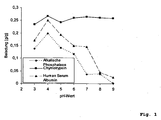
- the loading of the clay materials is calculated from the difference of the protein concentration in the supernatant before and after the incubation, as well as the mass of the clay material and the volume of the protein solution. The results of the measurements are given as mean values of a double determination in FIG. 1 plotted against the pH values.
- the loading of clay material A is highest for all model proteins at pH 4 in citrate buffer.
- the uptake of adsorption isotherms is investigated as a function of the equilibrium loading of the clay material A on the model protein concentration in the supernatant.
- a stock solution of the relevant model protein with a protein content of 3 mg / ml in 50 mM citrate buffer is first prepared.
- the protein stock solution is then diluted according to the protocol given in Table 6 with 50 mM citrate buffer.
- Table 6 Protocol for the dilution of protein stock solutions for the uptake of protein adsorption isotherms Experiment no. Volume of protein strain.
- a standard series in a 50 mM citrate buffer is prepared for each model protein.
- the samples and the standard solution are incubated for 3 hours at 4 ° C and 100 rpm on a shaker table and then centrifuged for 10 minutes at 4,000 g.
- the extinction is determined and a calibration curve is created from this.
- the loading of the clay materials is determined by photometric quantification of the proteins in the supernatant of the centrifuged samples. The measured values are mean values of a double determination in FIG. 2 shown.
- 100 mg of clay material A are suspended in each case with 1 ml of the 50 mM buffer indicated in Table 5 in a 1 ml Eppendorf cap, and the suspension is pipetted into a chromatography column (15 ⁇ 50 mm with 10 ⁇ m PTFE tube) which is closed at the bottom with a stamp. Plug) pipetted.
- the second column tail is placed and the column connected to an FPLC unit so that it is flowed through by the mobile phase from bottom to top.
- the FPLC pump is adjusted to the flow rate for which the capacity of the adsorber is to be determined.
- the mobile column of the column is slowly hand-tightened during equilibration with 20 ml of 50 mM buffer and then relieved by a quarter turn of the thread.
- 100 mg of the clay material A are loaded in the flow mode with 25 ml of an HSA solution which has a concentration of 1 mg / ml in 50 mM citrate buffer pH 4.
- the column is rinsed with 20 ml of 50 mM citrate buffer pH 4.
- 35 ml of elution buffer are passed through the column.
- the protein content of the run, the washing and the elution fraction is determined photometrically at 280 nm.
- the measurement results are reproduced for both elution buffers as mean values of a duplicate determination in Table 7.
Landscapes
- Chemical & Material Sciences (AREA)
- Analytical Chemistry (AREA)
- Organic Chemistry (AREA)
- Chemical Kinetics & Catalysis (AREA)
- Life Sciences & Earth Sciences (AREA)
- Dispersion Chemistry (AREA)
- Geochemistry & Mineralogy (AREA)
- Inorganic Chemistry (AREA)
- Health & Medical Sciences (AREA)
- Biochemistry (AREA)
- Biophysics (AREA)
- General Health & Medical Sciences (AREA)
- Genetics & Genomics (AREA)
- Medicinal Chemistry (AREA)
- Molecular Biology (AREA)
- Proteomics, Peptides & Aminoacids (AREA)
- Solid-Sorbent Or Filter-Aiding Compositions (AREA)
- Treatment Of Liquids With Adsorbents In General (AREA)
- Peptides Or Proteins (AREA)
- Enzymes And Modification Thereof (AREA)
Description
- Die Erfindung betrifft ein Verfahren zur Abtrennung von Proteinen aus flüssigen Medien.
- Die Produktion biologisch aktiver Substanzen gelingt heute mit Hilfe der Zellkulturtechnik in großem Maßstab. Die etablierten Verfahren ermöglichen sowohl die Produktion von Enzymen für die technische Anwendung, wie z.B. die Nahrungsmittelherstellung, als auch die Produktion rekombinanter Proteine mit pharmazeutischer Bedeutung. Dafür werden die Zielproteine von Mikroorganismen oder Säugetierzellen produziert und anschließend aus dem Kultivierungsmedium oder den Zellen isoliert. Dieser Herstellungsprozess gliedert sich in die Fermentation mit vorgelagerter Medienaufbereitung und in eine nachfolgende Prozesskette, welche zur Reindarstellung des Zielproteins dient. Die Kosten der Prozessschritte zur Proteinaufreinigung übertreffen häufig 80% der Gesamtherstellungskosten. Zur Aufreinigung werden meist chromatographische Methoden verwendet, um einerseits das Zielprotein im Prozessstrom anzureichern und um andererseits Fremdproteine und anderer Kontaminationen, wie Endotoxine, Viren oder DNA, abzutrennen. Werden die Chromatographiematerialien mehrfach verwendet, müssen sie fortwährend auf ihre Trennleistung oder eine eventuelle mikrobielle Kontamination überprüft werden. Durch Verwendung von Einmal-Materialien können die Kosten für Validierung und Reinigung teilweise eingespart werden. Für einen erfolgreichen Einsatz muss ein solches Einmal-Chromatographiematerial eine reproduzierbar hohe Trennleistung erbringen und einen niedrigen Investitionsaufwand pro Verbrauchseinheit erfordern. Es sollte hohe Bindungskapazitäten und eine schnelle Bindungskinetik für die interessierenden Zielproteine oder die störenden Kontaminationen aufweisen.
- Bentonite und insbesondere deren mineralische Hauptkomponente Montmorillonit eignen sich zur reversiblen Bindung von Proteinen. Bentonite und andere vergleichbare Schichtsilicate wirken dabei als natürliche Kationenaustauscher und können Proteine bei pH-Werten unterhalb ihres isoelektrischen Punktes adsorbieren. Natriumbentonit besitzt jedoch die Eigenschaft, in Wasser stark zu quellen. Werden wenige Gramm Natriumbentonit in eine wässrige Lösung eingebracht, führt dies zu einem starken Anstieg der Viskosität, was die Handhabung der flüssigen Medien stark erschwert. Ferner lässt sich Natriumbentonit nur mit hohem Aufwand als Filtermedium oder als Packung in einer Chromatographiesäule verwenden, da durch die starke Quellung das Volumen der Filterpackung bzw. der Säulenpackung stark zunimmt und der Filter bzw. die Säule dadurch verstopft wird. Für eine technische Anwendung besteht daher bisher nur die Möglichkeit, den Natriumbentonit jeweils batchweise zum zu reinigenden flüssigen Medium zu geben und nach der Adsorption der Proteine den Bentonit wieder abzufiltrieren bzw. das gereinigte flüssige Medium durch Abpressen vom Bentonit abzutrennen.
- Über die Verwendung von Schichtsilicaten zur Abtrennung von Enzymen aus dem filtrierten Saft homogenisierter Zuckerrüben berichten C. Buttersack, K. Novikow, A. Schaper und K. Buchholz (Zuckerind. 119 (1994), Nr. 4, S. 284-291). Durch Adsorption an Natriumbentonit und anschließende Desorption mit einem pH-Puffer konnten auf einfache Weise Enzyme in reiner Form abgetrennt werden. Die Arbeiten zeigen die gute Eignung von Schichtmineralien zur Abtrennung bzw. Anreicherung von Proteinen. Die Handhabung der Schichtmineralien ist jedoch kompliziert, da diese in Wasser zu einer starken Erhöhung der Viskosität der Aufschlämmung führen und die Schichtmineralien in sehr kleine Partikel zerfallen. Es ist daher sehr schwierig, die Anreicherung von Proteinen in der Weise durchzuführen, dass das Schichtmaterial in eine Säule gepackt wird, über welche dann die das Protein enthaltende Flüssigkeit geleitet wird. Ohne Hilfsmaßnahmen verstopft die Säule relativ rasch, da das Schichtmineral stark quillt. Um dennoch eine Abtrennung der Enzyme in einer Säule zu ermöglichen, schlagen die Autoren vor, den Natriumbentonit in ein Calciumalginat-Gel einzugießen. Das hydrierte Homogenat wird bei pH = 5,0 über die Säule gepumpt, die mit Perlen des immobilisierten Bentonits gefüllt ist. Nachdem die nicht adsorbierte Fraktion aus der Säule ausgetreten ist, wird mit einer auf pH = 8 eingestellten Pufferlösung das Enzym eluiert. Für die großtechnische Abtrennung von Proteinen ist die Verwendung von Natriumbentonit, welcher wie von den Autoren beschrieben in einem Calciumalginat fixiert ist, wegen der hohen anfallenden Kosten weniger geeignet.
- In der
DE 1 160 812 A1 wird ein Verfahren zur Erhöhung der Eiweißstabilität von Bier unter Verwendung eines weitporigen Kieselgels als Adsorptionsmittel beschrieben. Dabei wird das Bier mit einem feingemahlenen Kieselgel behandelt, das eine Oberfläche von 200 bis 400 m2/g, ein Porenvolumen von mehr als 0,6 ml/g und einen Porendurchmesser von mehr als 60 Å besitzt. - In der
GB 752,669 - In der
US 4,605,621 wird ein Verfahren zur Immobilisierung von Enzymen beschrieben, wobei das Enzym mit einem organisch modifizierten Ton umgesetzt wird. Als Ton wird ein Smektit, Hectorit oder Vermiculit verwendet, bei dem zumindest ein Teil der Kationen durch Oniumionen und/oder organometallische Kationen ersetzt wurde, sodass der Ton hydrophobe Eigenschaften erhält. - In der
US 4,126,605 wird ein Verfahren zur Herstellung von γ-Globulinen beschrieben, wobei Fraktionen von γ-Globulinen, die aus Blutplasma gewonnen wurden, weiter gereinigt werden. Dazu wird das γ-Globulin zunächst in einer wässrigen Lösung aufgenommen, die ein Hydrocolloid, wie Hydroxyethylstärke, Gelatine, Dextrose oder Albumin enthält und durch einen Puffer auf einen pH-Wert im Bereich von 3,5 bis 8,0 eingestellt ist. Zur weiteren Reinigung kann diese Lösung mit einer Aufschlämmung eines Tonminerals vermischt werden. Als Tonmineralien können beispielsweise Bentonit oder Vermiculit verwendet werden. Durch Zugabe eines organischen Lösungsmittels, beispielsweise eines Polyethylenglykols, in einer Menge von etwa 10 Gew.-% wird eine erste Fraktion ausgefällt, die im Wesentlichen Verunreinigungen enthält. Diese kann beispielsweise durch Zentrifugieren abgetrennt werden. Bei einem pH-Wert von etwa 7,0 bis 7,2 wird dann weiteres organisches Lösungsmittel bis zu einem Anteil von 16 bis 24 Gew.-% zugegeben. Dabei fällt eine sehr reine Fraktion von γ-Globulinen aus, die dann beispielsweise durch Zentrifugieren abgetrennt werden kann. - In der
EP 0 071 647 A1 wird ein Verfahren zur Abtrennung von Interferonen aus wässrigen Lösungen beschrieben. Dazu wird die Lösung mit einer Zusammensetzung vermischt, die Kieselsäure enthält. Als eine solche Zusammensetzung kann beispielsweise Bentonit, ein saurer Ton, Kaolin oder ein Magnesiumaluminiumsilikat verwendet werden. Das Interferon wird von der Zusammensetzung adsorbiert und kann mit einer wässrigen Lösung die eine nicht ionische oberflächenaktive Substanz enthält, eluiert werden. Geeignete oberflächenaktive Verbindungen sind beispielsweise Sorbitanmonoalkylester, Polyalkylether oder Polyoxyethylen-Polyoxypropylen-Copolymere. - In der
KR 2001 085 045 - In der
EP 0 180 934 A2 wird ein Verfahren zur Herstellung grob gekörnter Schichtsilikate beschrieben. Dazu wird eine Suspension eines Schichtsilikats in einer wässrigen Polymerlösung hergestellt und die erhaltene Polymerlösung in eine Elektrolytlösung eingetropft, sodass eine vernetzung des Polymers eintritt. Die entstandenen Körner oder Kugeln werden dann abgetrennt. Die grob gekörnten Schichtsilikate, die in einer Polymermatrix eingeschlossen sind, können als Adsorbentien für Proteine verwendet werden. - In der
WO 93/15832 - In der nachveröffentlichten
DE 10 2005 012 639 A1 wird ein Verfahren zur Abtrennung von Biomolekülen aus flüssigen Medien beschrieben, wobei als Adsorptionsmittel ein Tonmaterial eingesetzt wird. Das Verfahren dient zur Abtrennung störender Proteine aus Flüssigkeiten. - In jüngerer Zeit ist eine neue Klasse von Tonmaterialien aufgefunden worden, die sehr gute Eigenschaften bei der Adsorption von Biomolekülen aufweisen. Diese Materialien sind wie die bisher verwendeten Tone Verwitterungsprodukte. Sie zeigen jedoch keine kristallinen Eigenschaften mehr und sind daher röntgenamorph. Sie besitzen einen im Vergleich zu den bisher verwendeten Tonen sehr hohen Anteil an SiO2 und ein sehr hohes Porenvolumen. Im Gegensatz zu beispielsweise Natriumbentoniten quellen sie in Wasser nicht. In der
DE 10 2005 012 639 A1 , welche nach dem Zeitrang dieser Anmeldung veröffentlicht wurde, wird ein Verfahren beschrieben, bei welchem ein solches Tonmaterial für die Abtrennung störender Biomoleküle aus flüssigen Medien eingesetzt wird. So ist das Tonmaterial beispielsweise zum Klären von Wein oder zum Stabilisieren von Bier geeignet. - Der Erfindung lag die Aufgabe zugrunde, ein Verfahren bereitzustellen, mit welchem auch in großtechnischem Maßstab eine Abtrennung von Proteinen aus flüssigen Medien gelingt, wobei in einer bevorzugten Ausführungsform es auch möglich sein soll, die abgetrennten Proteine zurückzugewinnen, ohne dass diese einen übermäßigen Aktivitätsverlust erleiden.
- Die Aufgabe wird mit einem Verfahren mit den Merkmalen des Patentanspruchs 1 gelöst. Vorteilhafte Weiterbildungen des erfindungsgemäßen Verfahrens sind Gegenstand der abhängigen Ansprüche.
- Bei dem erfindungsgemäßen Verfahren wird zur Abtrennung von Proteinen aus flüssigen Medien:
- ein Proteine enthaltend flüssiges Medium bereitgestellt;
- ein Tonmaterial bereitgestellt, welches:
- eine spezifische Oberfläche von mehr als 150 m2/g,
- ein Porenvolumen von mehr als 0,35 ml/g,
- eine Ionenaustauschkapazität von mehr als 40 meq/100 g, und
- ein Sedimentvolumen in Wasser von weniger als 15 ml/2g, und
- bezogen auf das wasserfreie Tonmaterial (atro), einen Al2O3-Gehalt im Bereich von 4 bis 11 Gew.-% aufweist;
- das Tonmaterial auf einen pH-Wert von 3,5 bis 9,0 äquilibriert wird,
- das flüssige Medium mit dem äquilibrierten Tonmaterial behandelt wird, und
- das gereinigte, an Proteinen abgereicherte flüssige Medium von dem Tonmaterial abgetrennt.
- Überraschenderweise wurde gefunden, dass ein Tonmaterial, welches die oben beschriebenen Eigenschaften aufweist, Proteine in Mengen binden kann, welche für eine technische Anwendung interessant sind. Durch die Äquilibrierung des Tonmaterials auf einen pH-Wert von 3,5 bis 9,0 wird eine irreversible Deaktivierung bzw. Denaturierung der am Tonmaterial adsorbierten Proteine verhindert, sodass diese ggf. wiedergewonnen werden können, ohne dass ein starker Verlust ihrer Aktivität in Kauf genommen werden muss. Die Äquilibrierung wird bevorzugt in der Weise durchgeführt, dass das Tonmaterial mit einem Puffer behandelt wird, der einen pH-Wert aufweist, bei dem auch das interessierende Protein stabil ist bzw. keine übermäßige Deaktivierung erleidet. Bevorzugt wird für die Äquilibrierung ein Puffer verwendet, der anschließend auch für die Reinigung des flüssigen Mediums bzw. des interessierenden Proteins verwendet wird. Dieser Puffer ist vorzugsweise auf etwa den gleichen pH-Wert eingestellt, wie er auch beim flüssigen Medium eingestellt ist. Die Äquilibrierungsdauer hängt beispielsweise von der Menge des Tonmaterials ab, oder, falls das Tonmaterial in Form einer Packung oder Säule bereitgestellt wird, von deren Dimensionierung. Bei sehr kleinen Säulen, kann die Dauer der Äquilibrierung ggf. nur wenige Sekunden betragen während bei sehr großen Säulen oder Filterpackungen auch längere Zeiträume erforderlich sein können. Vorzugsweise wird die Äquilibrierung für eine Dauer von zumindest 10 Sekunden, bevorzugt zumindest 30 Sekunden, insbesondere bevorzugt 1 bis minuten durchgeführt. Die Äquilibrierung wird vorzugsweise mit einer Pufferlösung durchgeführt, der das zu reinigende flüssige Medium bzw. das zu reinigende Protein noch nicht zugesetzt ist.
- Als weiterer Vorteil weist das im erfindungsgemäßen Verfahren verwendete Tonmaterial ein geringes Sedimentvolumen von weniger als 15 ml/2 g, vorzugsweise weniger als 10 ml/2 g, auf, d.h. es quillt in Wasser nur unwesentlich. Wegen seiner geringen Quellung ist bei der Zugabe des Tonmaterials zum zu reinigenden flüssigen Medium keine wesentliche Zunahme der Viskosität des die Proteine enthaltenden Mediums zu beobachten. Ferner lassen sich relativ große Mengen des Tonmaterials in das flüssige Medium einbringen, so dass auch aus Medien, welche eine hohe Konzentration der interessierenden Proteine aufweisen, eine Abtrennung dieser Proteine ohne weiteres möglich ist. Auch die Abtrennung des eingesetzten Tonmaterials von dem flüssigen Medium ist ohne weiteres durch Filtration möglich. Wegen des geringen Quellvermögens bewirkt das Tonmaterial keine Verstopfung des Filters. Dadurch ist beim Abfiltrieren des an Proteinen abgereicherten flüssigen Mediums nur ein vergleichsweise niedriger Druck erforderlich.
- Als flüssiges Medium kann an sich jede Flüssigkeit verwendet werden, welche aus einer biologischen Quelle stammt bzw. Proteine enthält. Insbesondere eignet sich das Verfahren zur Aufarbeitung von Ansätzen aus Bioreaktoren, um die interessierenden biologisch wirksamen Stoffe aus großen Flüssigkeitsvolumina abzutrennen und aufzukonzentrieren. Eine andere Einsatzmöglichkeit ist beispielsweise die Abtrennung von Proteinen aus Körperflüssigkeiten, wie Harn, oder anderen biologischen Proben. Dies ermöglicht eine rasche Abtrennung und Reinigung von Proteinen beispielsweise aus Proben von Körperflüssigkeiten. Dazu wird die Probe, z.B. eine Körperflüssigkeit oder eine sonstige proteinhaltige Probe, auf das zuvor auf einen geeigneten pH-Wert äquilibrierte Tonmaterial gegeben. Die Proteine werden am Tonmaterial adsorbiert, während die flüssige Phase abgetrennt werden kann. Anschließend kann das Tonmaterial gespült werden, wozu bevorzugt eine Pufferlösung verwendet wird, deren pH-Wert in etwa dem pH-Wert entspricht, auf welchen das Proteine enthaltende flüssige Medium vor der Aufgabe auf das Tonmaterial eingestellt worden ist. Dadurch können Verunreinigungen ausgewaschen werden, während das Protein am Tonmaterial adsorbiert bleibt und auf diese Weise weiter gereinigt wird. Nach dem Spülschritt kann das Protein eluiert werden und liegt dann in einer angereicherten Form vor.
- Gegebenenfalls müssen die Proben in üblicher Weise vorbereitet werden, indem beispielsweise eine Grobfiltration durchgeführt wird, oder die Probe gepuffert wird. Vorzugsweise wird die Probe auf einen pH-Wert gepuffert, der auch bei der Äquilibrierung des Tonmaterials eingestellt wurde. Derartige Probenvorbereitungen sind dem Fachmann bekannt. Das im erfindungsgemäßen Verfahren verwendete Tonmaterial wirkt vermutlich als Kationenaustauscher, wobei Alkali- oder Erdalkaliionen aus dem Tonmaterial freigesetzt werden und gegen Proteine ausgetauscht werden. Proteine umfassen geladene Aminosäurereste an der Proteinoberfläche, welche mit geladenen Gruppen an der Oberfläche des Tonmaterials wechselwirken können. Die Nettoladung eines Proteins ergibt sich aus dem pH-Wert der das Protein umgebenden Lösung, sowie dem pI-Wert des Proteins. Der pI-Wert eines Proteins entspricht dem pH-Wert, bei dem die Nettoladung des Proteins Null ist. Er ergibt sich aus der Aminosäurenkomposition sowie der Tertiärstruktur des Proteins. Im sauren pH-Bereich sind die Aminosäuren (bevorzugt die stärken basischen Aminosäuren Arginin, Lysin und Histidin) protoniert, und das Protein zeigt kationischen Charakter. Im basischen pH-Bereich tragen die sauren Gruppen Aspargin und Glutamin negative Ladungen, und das Protein liegt als Anion vor. Nahe am isoelektrischen Punkt ist die Wechselwirkung zwischen Protein und dem Tonmaterial gering und sie nimmt zu, je mehr sich der pH-Wert vom pI-Wert unterscheidet. Bevorzugt wird daher das Medium auf einen pH-Wert eingestellt, der sich um mindestens eine Einheit vom isoelektrischen Punkt des abzutrennenden Proteins unterscheidet. Weist das Protein beispielsweise einen pI-Wert von 5,5 auf, so wird die Isolierung des Proteins vorzugsweise bei pH-Werten unterhalb von etwa 4,5 durchgeführt.
- Das im erfindungsgemäßen Verfahren verwendete Tonmaterial weist ein Porenvolumen von mehr als 0,35 ml/g, vorzugsweise mehr als 0,5 ml/g (bestimmt nach der BJH-Methode (kumulatives Porenvolumen für Poren mit einem Durchmesser im Bereich von 1,7 bis 300 nm)), eine spezifische Oberfläche (BET-Fläche) von mehr als 150 m2/g, vorzugsweise mehr als 180 m2/g, insbesondere bevorzugt mehr als 200 m2/g, und eine Ionenaustauschkapazität von mehr als 40 meq/100 g auf. Ferner zeichnet sich das Tonmaterial durch ein sehr geringes Quellvermögen aus. Das Quellvolumen entspricht vorzugsweise dem Sedimentvolumen. Geeignete analytische Methoden zur Bestimmung des Porenvolumens, der spezifischen Oberfläche, der Ionenaustauschkapazität sowie des Quellvolumens sind nachstehend bei den Beispielen angegeben.
- Besonders bevorzugt werden Tonmaterialien verwendet, deren Ionenaustauschkapazität über 40 meq/100 g, vorzugsweise im Bereiche von 45 bis 75 meq/100 g liegt. Vorzugsweise weist das Tonmaterial eine spezifische Oberfläche (BET) im Bereich von 150 bis 280 m2/g, insbesondere bevorzugt im Bereich von 170 bis 260 m2/g auf. Das Porenvolumen des verwendeten Tonmaterials liegt vorzugsweise im Bereich von mehr als 0,35 ml/g, bevorzugt mehr als 0,5 ml/g, insbesondere bevorzugt im Bereich von 0,7 bis 1,1 ml/g, und ganz besonders bevorzugt im Bereich von 0,80 bis 1,0 ml/g.
- Wie bereits weiter oben erläutert, quillt das im erfindungsgemäßen Verfahren verwendete Tonmaterial nur in sehr geringem Ausmaß, wodurch keine Probleme mit der Erhöhung der Viskosität einer wässrigen Suspension auftreten, wie dies beispielsweise bei Natriumbentonit im Allgemeinen beobachtet wird. Vorzugsweise beträgt das Sedimentvolumen, nachdem das Tonmaterial bei Raumtemperatur für drei Tage in Wasser stehen gelassen wurde, weniger als 15 ml/2 g, vorzugsweise weniger als 10 ml/2 g. Unter Raumtemperatur wird eine Temperatur von etwa 15 bis 25°C, insbesondere etwa 20°C, verstanden.
- Als Tonmaterialien werden bevorzugt natürlich vorkommende naturaktive oder nicht-naturaktive Tonmaterialien verwendet, die vorzugsweise noch keiner chemischen Modifikation unterworfen wurden, insbesondere nicht mit starken Säuren dealuminiert wurden. Die Tonmaterialien können gegebenenfalls getrocknet und auf eine geeignete Korngröße gemahlen werden. Die Korngröße ergibt sich für den Fachmann aus der beabsichtigten Anwendung.
- Neben den natürlich vorkommenden Tonmaterialien können an sich auch synthetisch hergestellte Tonmaterialien verwendet werden, welche die oben angegebenen Eigenschaften aufweisen. Solche Tonmaterialien können beispielsweise aus Wasserglas und einem geeigneten Schichtsilicat, wie Bentonit, hergestellt werden. Die Verwendung von Tonmaterialien, die aus natürlichen Quellen gewonnen wurden, ist jedoch bevorzugt.
- Es werden Tonmaterialien verwendet, deren Aluminiumgehalt, bezogen auf das wasserfreie Tonmaterial, berechnet als Al2O3, weniger als 11 Gew.-% beträgt. Weiter beträgt der Aluminiumgehalt mehr als 4 Gew.-%, besonders bevorzugt mehr als 6 Gew.-%. Insbesondere bevorzugt liegt der Aluminiumgehalt im Bereich von 8 bis 10 Gew.-%. Tonmaterialien, die durch Extraktion mit starker Säure gewonnen werden, zeigen einen niedrigeren Al2O3-Gehalt als das im erfindungsgemäßen Verfahren verwendete Tonmaterial.
- Besonders bevorzugt werden Tonmaterialien verwendet, welche nur eine geringe Kristallinität aufweisen, also an sich nicht der Klasse der Schichtsilicate zugeordnet werden. Die geringe Kristallinität lässt sich beispielsweise durch Röntgendiffraktometrie feststellen. Die besonders bevorzugten Tonmaterialien sind weitgehend amorph, d.h. sie zeigen im Röntgendiffraktogramm keine scharfen Peaks. Sie gehören daher nicht der Klasse der reinen Attapulgite oder Smektite an.
- Ohne an diese Theorie gebunden sein zu wollen, nehmen die Erfinder an, dass das im erfindungsgemäßen Verfahren verwendete Tonmaterial ein Gerüst umfasst, das aus Kieselgel gebildet ist. In dieses relativ starre Gerüst ist ein Schichtsilicat eingelagert. Durch die Verankerung im Gerüst des Kieselgels kann das Schichtmineral stark quellen, ohne dass dadurch das Mineral in seiner Gesamtheit stark in seinem Volumen zunimmt. Das aufgequollene Schichtsilicat steht dann in hohem Ausmaß für eine Adsorption von Proteinen zur Verfügung. Das Kieselgel stellt die Hauptphase dar während die Tonphase den geringeren Anteil am Tonmaterial bildet. Das Tonmaterial ist vermutlich für das Kationenaustauschvermögen verantwortlich.
- Das im erfindungsgemäßen Verfahren verwendete Tonmaterial weist in einer bevorzugten Ausführungsform eine besondere Porenradienverteilung auf. Der wesentliche Anteil des Porenvolumens des Tonmaterials wird dabei von Poren gebildet, welche einen Durchmesser von mindestens 14 nm aufweisen.
- Besonders bevorzugt sind mindestens 40% des Gesamtporenvolumens (bestimmt gemäß der BJH-Methode, vergleiche unten) von Poren gebildet, die einen Durchmesser von mehr als 14 nm aufweisen. Bevorzugt werden mehr als 50%, und insbesondere bevorzugt mehr als 60% des Gesamtporenvolumens von Poren gebildet, die einen Durchmesser von mehr als 14 nm aufweisen. Die Porenradienverteilung bzw. das Gesamtporenvolumen wird durch Stickstoffporosimetrie (DIN 66131) und Auswertung der Adsorptionsisotherme nach der BJH-Methode (vergleiche unten) bestimmt.
- Um eine Denaturierung des Proteins zu verhindern wird das Tonmaterial vor der Aufgabe des flüssigen Mediums auf einen pH-Wert von etwa 3,5 bis 9,0, insbesondere bevorzugt 4,0 bis 6,0 äquilibriert. Dazu wird das Tonmaterial in einem geeigneten Puffer, beispielsweise einem Citratpuffer, aufgeschlämmt oder beispielsweise eine aus dem Tonmaterial hergestellte Filterpackung oder Säule mit einem derartigen Puffer beaufschlagt. Der Puffer weist dabei vorzugsweise eine Konzentration im Bereich von 30 bis 100 mmol/l auf.
- Gemäß einer weiteren Ausführungsform kann das Tonmaterial auch vor der Abtrennung von Proteinen aktiviert werden, indem es mit einer natriumhaltigen Verbindung, beispielsweise Soda, oder einer kaliumhaltigen Verbindung, z.B. Kaliumcarbonat, behandelt wird. Dadurch werden die zweiwertigen Kationen des Tonmaterials teilweise oder vorzugsweise ganz durch Natriumionen ausgetauscht. Für den Austausch der zweiwertigen Ionen gegen Natriumionen wird in der üblichen Weise vorgegangen, wie sie auch aus der Aktivierung von Calciumbentoniten bekannt ist. Das feuchte Tonmaterial, welches einen Feuchtegehalt von vorzugsweise zwischen 10 und 70 Gew.-%, vorzugsweise 45 bis 65 Gew.-% aufweist, wird mit einer Menge an Soda, die etwa 1,2 bis 2,5 Äquivalenten der Kationenaustauschkapazität des Tonmaterials entspricht, verknetet. Alternativ kann das Soda auch als Lösung auf das Tonmaterial aufgesprüht werden. Das Tonmaterial kann anschließend getrocknet und ggf. gemahlen werden. Durch die Aktivierung kann die Adsorptionskapazität des Tonmaterials für Proteine weiter gesteigert werden.
- Die Behandlung des proteinhaltigen flüssigen Mediums kann im einfachsten Fall in.der Weise erfolgen, dass das Tonmaterial direkt oder in Form einer Suspension zu dem flüssigen Medium gegeben wird und nach einer Einwirkzeit, vorzugsweise im Bereich von 1 bis 30 Minuten, insbesondere bevorzugt 5 bis 20 Minuten, durch geeignete Verfahren, wie beispielsweise Filtration oder Zentrifugation, vom flüssigen Medium abgetrennt wird, welches dadurch an Proteinen abgereichert wird.
- Gemäß einer weiteren Ausführungsform kann das flüssige Medium zur Abtrennung der Proteine durch eine Filterpackung geleitet werden, welche zumindest anteilig aus dem Tonmaterial gebildet ist. Die Filterpackung kann dabei an sich jede beliebige Form annehmen. Geeignet sind beispielsweise Filterpatronen, welche mit dem Tonmaterial gefüllt sind. Nachdem die Aufnahmekapazität der Filterpatrone erschöpft ist, kann diese gegen eine neue Patrone ersetzt werden. Die mit den Proteinen beladene Filterpatrone kann entweder verworfen werden oder bevorzugt einer Aufarbeitung zugeführt werden, in welcher die auf dem Tonmaterial adsorbierten Proteine wiedergewonnen werden.
- Gemäß einer Ausführungsform wird die Filterpackung durch eine Anschwemmfiltration hergestellt. Das Tonmaterial wird dabei vorzugsweise mit einem Filterhilfsmittel, wie Kieselgur oder Perlit®, gemischt. Ferner kann das Tonmaterial auch noch mit einem weiteren Adsorbens, wie Kieselgel, gemischt sein. Bei der Filtration bildet das Tonmaterial zusammen mit dem Filterhilfsmittel und gegebenenfalls weiteren Adsorbentien einen Filterkuchen aus, der das filtrationswirksame Medium für nachfolgende Trübstoffe und Filterhilfsmittelteilchen bildet. Diese Ausführungsform ist insbesondere dann geeignet, wenn Proteine als Störstoffe aus dem flüssigen Medium entfernt werden sollen.
- Bevorzugt wird vor der direkten Filtration eine Filterhilfsmittelschicht als Primärschicht auf ein Filtermittel aufgebracht. Als Filtermittel kann beispielsweise ein Sieb mit einer geeignet geringen Maschenweite verwendet werden. Als Filterhilfsmittel zur Ausbildung einer Primärschicht kann beispielsweise Kieselgur verwendet werden. Dieser Prozess wird auch als Voranschwemmung bezeichnet. In der anschließenden Filtrationsphase wird der Suspension weiteres Filterhilfsmittel zugesetzt, das erfindungsgemäß das oben beschriebene Tonmaterial umfasst. Diese Filterhilfsmittel bilden gemeinsam mit den Trübstoffteilchen einen Filterkuchen aus, der als Sekundärschicht bezeichnet wird.
- Gemäß einer weiteren Ausführungsform des erfindungsgemäßen Verfahrens wird dieses in Form einer Chromatographie durchgeführt. Dabei wird das Tonmaterial in eine Chromatographiesäule gepackt und das flüssige Medium, aus welchem die Proteine abgetrennt werden sollen, auf die Säule gegeben. Die Säule kann dann von einem Elutionsmittel durchströmt werden, wobei durch Adsorptionseffekte eine Auftrennung der Proteine in unterschiedliche Fraktionen möglich ist. Dies ist insbesondere interessant für die Abtrennung von Proteinen, welche in Bioreaktoren erzeugt wurden. Hier zeigen sich die Vorteile des im erfindungsgemäßen Verfahren verwendeten Tonmaterials, das sich durch ein sehr geringes Quellvermögen auszeichnet.
- Um das Tonmaterial erfindungsgemäß in einer Säulenpackung einsetzen zu können, ist es zweckmäßig, dieses durch Absieben auf geeignete Teilchengrößen einzustellen. Besonders bevorzugt werden hierbei insbesondere die Feinanteile des Tonmaterials entfernt.
- Bevorzugt wird das Tonmaterial auf eine Teilchengröße von > 10 µm, insbesondere > 20 µm, besonders bevorzugt > 30 µm, insbesondere in einem Bereich von 40 bis 300 µm eingestellt. Insbesondere bevorzugt weist das Tonmaterial auf einem Sieb der Maschenweite 45 µm einen Trockensiebrückstand von > 95 % der Einwaage, auf einem Sieb der Maschenweite 63 µm einen Trockensiebrückstand von > 80 % und auf einem Sieb der Maschenweite 150 µm einen Trockensiebrückstand von > 30 % auf.
- Vorzugsweise dient das erfindungsgemäße Verfahren zur Gewinnung von Proteinen aus flüssigen Medien. Dazu wird das Protein, nachdem es auf dem Tonmaterial adsorbiert wurde und ggf. mit weiteren Spülschritten gereinigt wurde, wieder vom Tonmaterial eluiert. Die Eluierung der auf dem Tonmaterial adsorbierten Proteine kann nach verschiedenen Verfahren erfolgen. Beispielsweise kann das Protein durch eine Erhöhung der Salzkonzentration von den Bindungsstellen des Tonmaterials verdrängt werden. Weiter besteht die Möglichkeit, den pH-Wert der zur Elution verwendeten Lösung so einzustellen, dass sich die Ladung des adsorbierten Proteins ändert und es somit nicht mehr vom Tonmaterial gebunden wird. Wird für die Abtrennung des Proteins aus dem flüssigen Medium das Tonmaterial in Form eine Säule bereitgestellt, über die das flüssige Medium geleitet wird, kann zur Elution des adsorbierten Proteins beispielsweise ein Salzgradient über die Säule geleitet werden, so dass verschiedene Proteine bei unterschiedlicher Salzkonzentration eluiert werden, also eine Fraktionierung der adsorbierten Proteine erfolgt. Proteine werden unter anderem durch elektrische Wechselwirkungen und/oder van der Waals-Kräfte an das im erfindungsgemäßen Verfahren verwendete Tonmaterial gebunden. Bei der Eluierung mit einem Puffer mit hoher Salzkonzentration werden die elektrostatischen Wechselwirkungen zwischen dem Tonmaterial, welches als Kationenaustauscher wirkt, und dem Protein herabgesetzt. Das Protein kann daher vom Tonmaterial abgelöst und eluiert werden.
- Bei einer weiteren Ausführungsform erfolgt die Eluierung der gebundenen Proteine durch eine Änderung des pH-Wertes. Dabei weist das Elutionsmittel einen zum flüssigen Medium unterschiedlichen pH-Wert auf.
- Beispielsweise können Proteine bei einem pH aufgegeben werden, bei welchem sie in geladener Form vorliegen. Der pH-Wert der Lösung wird dabei vorzugsweise so eingestellt, dass er unterhalb des isoelektrischen Punktes des Proteins liegt, das Protein also eine positive Gesamtladung aufweist. Durch die Kationenaustauscherwirkung des Tonmaterials werden die Proteine gebunden. Das im erfindungsgemäßen Verfahren verwendete Tonmaterial wirkt also als Kationenaustauschermaterial. Wird nun der pH so weit angehoben, dass der isoelektrische Punkt des Proteins erreicht oder überschritten wird, weist das Protein in den meisten Fällen eine negative Gesamtladung auf. Das Protein wird daher wieder vom Tonmaterial abgelöst und kann eluiert werden.
- Gegebenenfalls können dem Elutionsmittel Glycerin oder Polyglykole beigegeben sein. Diese Verbindungen weisen eine sehr hohe Affinität zum Tonmaterial auf und können daher die Ablösung des Proteins vom Tonmaterial erleichtern.
- Das flüssige Medium umfasst bevorzugt Wasser als Lösungsmittel.
- Das im erfindungsgemäßen Verfahren verwendete Tonmaterial kann alleine oder auch in Kombination mit einem weiteren Adsorptionsmaterial verwendet werden. Das weitere Adsorptionsmaterial ist vorzugsweise aus der Gruppe ausgewählt, die gebildet ist aus Kieselgel, Cellulose und Polyvinylpyrrolidon.
- Das Tonmaterial und das weitere Adsorptionsmaterial liegen bevorzugt in einem Verhältnis zwischen 1:10 und 10:1 vor. In Abhängigkeit von der beabsichtigten Anwendung können jedoch auch Verhältnisse außerhalb des angegebenen Bereichs zur Anwendung gelangen.
- Das im erfindungsgemäßen Verfahren verwendete Tonmaterial weist ein sehr hohes Tragevermögen für Wasser auf, wobei es dennoch fließfähig bleibt. Bevorzugt weist das Tonmaterial einen Wassergehalt von mehr als 30 Gew.-%, insbesondere mehr als 40 Gew.-%, insbesondere bevorzugt mehr als 50 Gew.-%, auf.
- Das erfindungsgemäße Verfahren wird anhand der folgenden Beispiele sowie unter Bezugnahme auf die beigefügten Figuren näher erläutert. Dabei zeigt:
- Fig. 1:
- eine Grafik, in welcher die pH-Abhängigkeit der Adsorption von Modellproteinen an das im erfindungsgemäßen Verfahren verwendete Tonmaterial gezeigt ist;
- Fig. 2:
- Adsorptionsisothermen verschiedener Modellproteine an das im erfindungsgemäßen Verfahren verwendete Tonmaterial, aufgenommen in einem 50 mM Citrat-Puffer; und
- Fig. 3:
- eine Grafik, in welcher die Beladung des im erfindungsgemäßen Verfahren verwendeten Tonmaterials in Abhängigkeit von der Auftragungsgeschwindigkeit für verschiedene Modellproteine dargestellt ist.
- Die Oberfläche der Tonmaterialien wurde an einem vollautomatischen Stickstoffporosimeter der Firma Micromeritics, Typ ASAP 2010, gemäß DIN 66131 durchgeführt. Das Porenvolumen wurde unter Anwendung der BJH-Methode ermittelt (I.P. Barrett, L.G. Joyner, P.P. Haienda, J. Am. Chem. Soc. 73 (1951), 373). Porenvolumina bestimmter Porengrößenbereiche werden durch Aufsummieren inkrementeller Porenvolumina bestimmt, die aus der Auswertung der Adsorptionsisotherme nach BJH erhalten werden. Das Gesamtporenvolumen nach der BJH-Methode bezieht sich auf Poren mit einem Durchmesser von 1,7 - 300 nm.
- Der Wassergehalt der Produkte bei 105°C wurde unter Verwendung der Methode DIN/ISO 787/2 ermittelt.
- Diese Analyse beruht auf dem Totalaufschluss der Tonmaterialien bzw. des entsprechenden Produktes. Nach dem Auflösen der Feststoffe werden die Einzelkomponenten mit spezifischen Analysenmethoden, wie z.B. ICP, analysiert und quantifiziert.
- Zur Bestimmung der Kationenaustauschkapazität wird das zu untersuchende Tonmaterial über einen Zeitraum von 2 Stunden bei 105°C getrocknet. Danach wird das getrocknete Tonmaterial mit einem Überschuss an wässriger 2N NH4Cl-Lösung eine Stunde unter Rückfluss zur Reaktion gebracht. Nach einer Standzeit von 16 Stunden bei Raumtemperatur wird filtriert, worauf der Filterkuchen gewaschen, getrocknet und vermahlen wird und der NH4-Gehalt im Tonmaterial durch Stickstoffbestimmung (CHN-Analysator der Firma Leco) nach den Herstellerangaben ermittelt. Der Anteil und die Art der ausgetauschten Metallionen wird im Filtrat durch ICP-AES-Spektroskopie bestimmt.
- Die Röntgenaufnahmen wurden an einem hochauflösenden Pulverdiffraktometer der Firma Phillips (X'-Pert-MPD(PW 3040)) erstellt, das mit einer Cu-Anode ausgerüstet ist.
- Ein graduierter 100 ml-Messzylinder wird mit 100 ml destilliertem Wasser gefüllt. 2 g der zu vermessenden Substanz werden langsam und portionsweise, je etwa 0,1 bis 0,2 g, mit einem Spatel auf die Oberfläche des Wassers gegeben. Nach dem Absinken einer zugegebenen Portion wird die nächste Portion zugegeben. Nachdem die 2 g Substanz zugegeben und auf den Grund des Messzylinders abgesunken sind, wird der Zylinder für 1 Stunde bei Raumtemperatur stehen gelassen. Anschließend wird an der Graduierung des Messzylinders die Höhe des Sedimentvolumens in ml/2 g abgelesen. Für die Bestimmung des Sedimentvolumens nach dreitägiger Lagerung in Wasser wird der Probenansatz mit Parafilm® verschlossen und für drei Tage bei Raumtemperatur erschütterungsfrei stehen gelassen. Danach wird an der Graduierung des Messzylinders das Sedimentvolumen abgelesen.
- Etwa 50 g des zu untersuchenden lufttrockenen Tonmaterials werden auf einem Sieb der Maschenweite 45 µm eingewogen. Das Sieb wird an einen Staubsauger angeschlossen, der über einen unter dem Siebboden kreisenden Saugschlitz alle Anteile, die feiner als das Sieb sind, durch das Sieb heraussaugt. Das Sieb wird mit einem Plastikdeckel abgedeckt und der Staubsauger eingeschaltet. Nach fünf Minuten wird der Staubsauger abgeschaltet und die Menge der auf dem Sieb verbliebenen gröberen Anteile durch Differenzwägung ermittelt.
- Es wird zunächst eine 5%-ige Suspension hergestellt, indem eine entsprechende Menge des zu untersuchenden Tonmaterials bei ca. 930 UpM ca. fünf Minuten in Wasser eingerührt wird. Die Suspension wird für weitere 15 Minuten bei ca. 1865 UpM gerührt und dann durch ein Sieb der gewünschten Maschenweite gegossen. Der Rückstand wird solange mit Leitungswasser gewaschen, bis das Waschwasser klar abläuft. Das Sieb mit dem Rückstand wird dann für fünf Minuten in ein Ultraschallbad gesetzt, um restliche Feinanteile zu entfernen. Der verbliebene Rückstand wird kurz mit Leitungswasser gewaschen und die Ultraschallbehandlung gegebenenfalls wiederholt, bis während der Ultraschallbehandlung keine Feinstoffe mehr in das Wasser übertreten. Das Sieb wird dann bis zur Gewichtskonstanz getrocknet. Zum Auswiegen wird der auf dem Sieb verbliebene Rückstand in eine gewogene Porzellanschale überführt.
- Ein für das erfindungsgemäße Verfahren geeignetes Tonmaterial (Tonsil® EX 1221 I; Süd-Chemie AG, Moosburg, DE, (Rohtonlager Res. No.: 03051)) wurde hinsichtlich seiner physikalisch-chemischen Eigenschaften untersucht. Die hierbei erzielten Ergebnisse sind in Tabelle 1 zusammengefasst.
Tabelle 1: Physikalisch-chemische Analyse des Tonmaterials A Spezifische Oberfläche (m2/g) 219 Porenvolumen1 (ml/g) 0,881 IUF (meq/100g) 52 Elementaranalyse: SiO2 (Gew.-%) 70,6 Fe2O3 (Gew.-%) 2,8 Al2O3 (Gew.-%) 9, 8 CaO (Gew.-%) 1, 4 MgO (Gew.-%) 4, 1 Na2O (Gew.-%) 0,26 K2O (Gew.-%) 1,5 TiO2 (Gew.-%) 0,25 Glühverlust (2h 1000°C) 7, 9 Summe (Gew.-%) 98,6 1: kumulatives Porenvolumen nach BHJ für Poren mit einem Durchmesser zwischen 1,7 und 300 nm. - Damit das erfindungsgemäße Silicat in einer Form vorliegt, in der sich gut Säulen packen lassen, wurde es auf Teilchengrößen > 45 µm abgesiebt . Das abgesiebte Material wies einen Trockensiebrückstand von > 95 % auf einem Sieb der Maschenweite 45 µm auf. Der Trockensiebrückstand auf 63 µm betrug 85 %, der auf 150 µm 30 %.
- Weiter wurde das in Tabelle 1 charakterisierte Tonmaterial auf den Anteil am Porenvolumen untersucht, der von Poren mit bestimmten Radien gebildet wird. Die entsprechenden Daten sind in Tabelle 2 a bis c zusammengefasst.
Tabelle 2a Relative Anteile der Poren am Porenvolumen Bereich 0 - 75 Å 0 - 140 Å 0 - 250 Å 0 - 800 Å > 800 Å Anteil (%) 10,3 19,3 34,1 78,0 22,0 Tabelle 2b Relative Anteile der Poren am Porenvolumen Bereich 0 - 75 Å 75 - 140 Å 140 - 250 Å 250 - 800 Å > 800 Å Anteil (%) 10,3 9,0 14,8 43,9 22,0 Tabelle 2c Relative Anteile der Poren am Porenvolumen Bereich 0 - 75 Å 75 - 800 Å > 75 Å > 140 Å > 250 Å > 800 Å Anteil (%) 10,3 67,7 89,7 80,7 65,9 22,0 - Die physikalisch-chemischen Eigenschaften eines weiteren Tonmaterials, das für die Durchführung des erfindungsgemäßen Verfahrens geeignet ist, sind in Tabelle 3 zusammengefasst.
Tabelle 3 Physikalisch-chemische Analyse des Tonmaterials B Spezifische Oberfläche (m2/g) 198 - 206 Porenvolumen1 (ml/g) 0,402 IUF (meq/100g) 62 Elementaranalyse: SiO2 (Gew.-%) 35,2 Fe2O3 (Gew.-%) 0,93 Al2O3 (Gew.-%) 4,6 CaO (Gew.-%) 15,4 MgO (Gew.-%) 16,0 Na2O (Gew.-%) 0,47 K2O (Gew.-%) 0,66 TiO2 (Gew.-%) 0,1 Glühverlust (2h 1000°C) 25,4 Summe (Gew. -%) 98,76 - Bei der Bestimmung der Gesamtionenaustauschkapazität (IUF) kann aus den Konzentrationen der Ionen im Eluat bestimmt werden, dass der Anteil von Na+ und K+ an der Gesamtkationenaustauschkapazität 32 % (Na+: 23 %, K+: 9 %) beträgt. Daraus lässt sich berechnen, dass man eine Menge von 2 % Soda benötigt, um eine stöchiometrische Aktivierung mit einwertigen Ionen zu erzielen.
- Das in Tabelle 1 charakterisierte Tonmaterial A, wird zunächst in Stücke von weniger als 3 cm Durchmesser vorgebrochen. Der Wassergehalt wird ggf. durch Besprühen des gebrochenen Tonmaterials mit Wasser auf einen Wassergehalt von etwa 45 bis 65 Gew.-% eingestellt. 350 g des vorgebrochenen Tonmaterials A werden in eine Mischvorrichtung (z.B. einen Werner & Pfleiderer Mischer) gegeben und für eine Minute geknetet. Dann wird unter Weiterlaufen der Mischvorrichtung 2 Gew.-% festes Soda (bezogen auf wasserfreies Tonmaterial A) zugegeben und die Mischung für weitere 10 Minuten geknetet. Sofern die Mischung nicht ausreichend geschmeidig ist, kann destilliertes Wasser zugegeben werden, um eine ausreichend intensive Scherwirkung zu erhalten.
- Die Knetmasse wird in kleine Stücke zerteilt und diese in einem Umlufttrockenschrank bei etwa 75 °C 2 bis 4 Stunden auf einen Wassergehalt von 10 ± 2 % getrocknet. Das Trockengut wird anschließend in einer Schlagrotormühle (z.B. einer Retsch-Mühle) über einem 0,12 mm Sieb vermahlen.
- Für die Untersuchungen zur Adsorption von Proteinen wurden die folgenden Modellproteine verwendet:
- α-Chymotrypsin ist ein Verdauungsenzym, welches aus der Bauchspeicheldrüse von Rindern gewonnen wird. Das Enzym besitzt eine Masse von 25,3 kDa. Der isoelektrische Punkt liegt zwischen pH 8,1 und 8,6.
- HSA ist ein globuläres Transportprotein, das als Carrier für Fettsäuren und Amphiphile aus dem Blut ins umgebende Gewebe dient. HSA ist aus drei Domänen aufgebaut, die ihrerseits aus 585 Aminosäuren mit einem Gesamtgewicht von 66,4 kDa bestehen. Der isoelektrische Punkt des Moleküls liegt bei pH 4,9.
- Alkalische Phosphatase ist eine unspezifische Phosphorsäuremonoesterase, die in allen Spezies von E. coli bis zum Menschen als Dimer identischer Subeinheiten vorkommt. AP ist ein Metalloprotein, das zwei Zn2+- und ein Mg2+-Ion enthält. Das in den Beispielen verwendete AP wurde aus der Darmschleimhaut von Kälbern isoliert. Der isoelektrische Punkt liegt bei pH 6,0. Das Molekülgewicht des Dimers beträgt 140 kDa.
- Jeweils 25,0 mg des oben charakterisierten Tonmaterials A werden in einem 50 ml-Reaktionsgefäß (Sarstedt AG & Co., Nümbrecht, DE) eingewogen. Es werden jeweils 10 ml der in Tabelle 4 angegebenen Probenvorbereitungspuffer zugegeben und das Reaktionsgefäß 30 Minuten im Ultraschallbad behandelt. Anschließend wird das Reaktionsgefäß mit der Suspension für eine Stunde auf einem Schütteltisch bei Raumtemperatur bei 100 UpM geschüttelt. Die Proben werden jeweils für 10 Minuten bei 4000 g zentrifugiert und anschließend der klare Überstand abpipettiert. Das Sediment wird in 10 ml bidestilliertem H2O resuspendiert und 5 Minuten bei 100 UpM geschüttelt. Die Suspension wird dann für 10 Minuten bei 4.000 g zentrifugiert und der klare Überstand abpipettiert. Das äquilibrierte Tonmaterial wird anschließend für 16 Stunden bei 60°C getrocknet.
Tabelle 4: verwendete 100 mM Puffer Puffer pH 3, 0 100 mM Natriumphosphatpuffer Puffer pH 4,0 100 mM Natriumcitratpuffer Puffer pH 5,0 100 mM Natriumacetatpuffer Puffer pH 6,0 100 mM MES-Puffer Puffer pH 7,0 100 mM Trispuffer Puffer pH 8,0 100 mM Trispuffer Puffer pH 9,0 100 mM Trispuffer - Von den Modellproteinen werden jeweils Stammlösungen mit einer Konzentration von 2 mg / ml in bidest. H2O angesetzt. Die Proteinlösungen werden im Verhältnis 1:1 mit den in Tabelle 4 angegebenen 100 mM Puffern der pH-Werte 3 bis 8 zu einem Gesamtvolumen von 20 ml verdünnt.
- Die photometrische Quantifizierung von Proteinen basiert auf der Messung der UV-Absorption der aromatischen Aminosäuren Tyrosin (Phenolgruppe, 275 nm), Tryptophan (Indolgruppe, 279 nm) und in geringerem Maße Phenylalanin (257 nm) bei 280 nm. Es können je nach der Aminosäurezusammensetzung Konzentrationen zwischen 20 und 3000 µg·ml Protein nachgewiesen werden.
- Um eine unbekannte Proteinkonzentration zu ermitteln, wird zunächst die Absorption für eine Kalibrationsreihe von Lösungen bekannter Proteinkonzentration bei 280 nm bestimmt. Aus dem linearen Zusammenhang zwischen Absorption und Proteinkonzentration lässt sich die unbekannte Proteinkonzentration errechnen.
- Für die photometrische quantitative Auswertung werden von den Modellproteinen Standardreihen in den in Tabelle 5 angegebenen 50 mM Puffern der entsprechenden pH-Werte hergestellt. Die Standards werden 3 Stunden bei 4°C und 100 UpM auf einem Schütteltisch inkubiert. Nach beendeter Inkubation werden die Proben für 10 Minuten bei 4000 g zentrifugiert und die Extinktion des klaren Überstands bestimmt. Aus den ermittelten Werten wird eine Eichkurve erstellt.
Tabelle 5: verwendete 50 mM Puffer Puffer pH 3,0 50 mM Natriumphosphatpuffer Puffer pH 4,0 50 mM Natriumcitratpuffer Puffer pH 5,0 50 mM Natriumacetatpuffer Puffer pH 6,0 50 mM MES-Puffer Puffer pH 7,0 50 mM Trispuffer Puffer pH 8,0 50 mM Trispuffer Puffer pH 9,0 50 mM Trispuffer - Zu jeweils 25 mg des äquilibrierten Tonmaterials werden jeweils 20 ml der wie oben beschrieben vorbereiteten Lösung des Modellproteins gegeben. Die Proben werden 3 Stunden bei 4 °C und 100 UpM auf einem Schütteltisch inkubiert. Nach beendeter Inkubation werden die Proben für 10 Minuten bei 4000 g zentrifugiert. Die Konzentration der Modellproteine in den Probenüberständen wird photometrisch bei 280 nm gegen die Standardreihe des Proteins im jeweiligen Puffer bestimmt. Die Beladung der Tonmaterialien errechnet sich aus der Differenz der Proteinkonzentration im Überstand vor und nach der Inkubation, sowie der Masse des Tonmaterials und dem Volumen der Proteinlösung. Die Ergebnisse der Messungen sind als Mittelwerte einer Doppelbestimmung in
Figur 1 gegen die pH-Werte aufgetragen. Die Beladung des Tonmaterials A ist für alle Modellproteine bei pH 4 in Citratpuffer am höchsten. - Die Aufnahme von Adsorptionsisothermen wird in Abhängigkeit der Gleichgewichtsbeladung des Tonmaterials A von der Modellproteinkonzentration im Überstand untersucht.
- Die Versuche werden für die jeweiligen Modellproteine bei einem pH-Wert von 4 in einem 50 mM Citrat-Puffer durchgeführt. Dies entspricht den Bedingungen, bei welchen bei der Untersuchung der pH-Abhängigkeit der Proteinadsorption der maximale Wert ermittelt worden war.
- Für die Aufnahme der Adsorptionsisothermen wird zunächst eine Stammlösung des betreffenden Modellproteins mit einem Proteingehalt von 3 mg/ml in 50 mM Citrat-Puffer hergestellt. Die Proteinstammlösung wird dann gemäß der in Tabelle 6 angegebenen Vorschrift mit 50 mM Citrat-Puffer verdünnt.
Tabelle 6: Vorschrift zur Verdünnung von Proteinstammlösungen für die Aufnahme von Protein-Adsorptionsisothermen Versuchs-Nr. Volumen Proteinstammlsg. [ml] Volumen Puffer [ml] c(Protein) [mg·ml-1] Massenverhältnis Protein/Adsorber 1 2 33 0,17 0,24 2 5 30 0,43 0,60 3 8 27 0, 69 0,96 4 12 23 1,03 1,44 5 16 19 1,37 1,92 6 20 15 1, 71 2,40 7 24 11 2, 06 2,88 - Die verdünnten Lösungen der Modellproteine werden dann zu jeweils 25 mg Tonmaterial A gegeben, das wie oben beschrieben mit 50 mM Citrat-Puffer äquilibriert worden war.
- Für die Bestimmung der Konzentration der Modellproteine wird für jedes Modellprotein eine Standardreihe in einem 50 mM Citrat-Puffer angesetzt. Die Proben und die Standardlösung werden für 3 Stunden bei 4°C und 100 UpM auf einem Schütteltisch inkubiert und anschließend für 10 Minuten bei 4.000 g zentrifugiert.
- Für die Standardreihe der Proteine wird die Extinktion bestimmt und daraus eine Eichkurve erstellt. Die Beladung der Tonmaterialien wird durch photometrische Quantifizierung der Proteine im Überstand der zentrifugierten Proben ermittelt. Die Messwerte sind als Mittelwerte einer Doppelbestimmung in
Figur 2 dargestellt. - In einem 1 ml-Eppendorfhütchen werden jeweils 100 mg Tonmaterial A mit jeweils 1 ml der in Tabelle 5 angegebenen 50 mM Puffer suspendiert und die Suspension mit einer Pipette in eine mit einem Stempel nach unten abgeschlossene Chromatographiesäule (15 x 50 mm mit 10 µm PTFE-Stopfen) pipettiert. Das zweite Säulenendstück wird aufgesetzt und die Säule mit einer FPLC-Anlage so verbunden, dass sie von der mobilen Phase von unten nach oben durchströmt wird. Die FPLC-Pumpe wird auf die Flussrate eingeregelt, für welche die Kapazität des Adsorbers ermittelt werden soll. Der bewegliche Stempel der Säule wird während der Äquilibrierung mit 20 ml 50 mM Puffer langsam handfest angezogen und anschließend um eine viertel Gewindedrehung entlastet.
- 25 ml einer Lösung des jeweiligen Proteins in 50 mM Citrat-Puffer werden bei variablen Flussraten durch eine mit 100 mg Tonmaterial A gepackte Säule gepumpt. Der Proteingehalt im Durchlauf wird photometrisch bei 280 nm gegen eine Standardreihe des Modellproteins in einem 50 mM Citrat-Puffer ermittelt. Die für das Tonmaterial A ermittelten flussratenabhängigen Beladungen mit den Modellproteinen sind in
Figur 3 als Mittelwerte einer Doppelbestimmung dargestellt. - Zur Elution von an Tonmaterial A gebundenem HSA werden 2 verschiedene Puffer verwendet. Alle Chromatographieschritte werden bei einer Flussrate von 1 ml/min durchgeführt.
- Elutionspuffer 1: 50 mM Citrat, 1 M NaCl in bidest. H2O, pH 4
- Elutionspuffer 2: 50 mM Na2HPO4 in bidest. H2O, pH 7,2
- 100 mg des Tonmaterials A werden im Durchflussbetrieb mit 25 ml einer HSA-Lösung beladen, welche eine Konzentration von 1 mg/ml in 50 mM Citratpuffer pH 4 aufweist. Nach der Beladung wird die Säule mit 20 ml 50 mM Citratpuffer pH 4 gespült. Für die Elution des HSA werden 35 ml Elutionspuffer durch die Säule geleitet. Der Proteingehalt des Durchlaufs, der Wasch- und der Elutionsfraktion wird photometrisch bei 280 nm bestimmt. Die Messergebnisse sind für beide Elutionspuffer als Mittelwerte einer Doppelbestimmung in Tabelle 7 wiedergegeben.
Tabelle 7: Proteingehalte in Durchlauf, Wasch- und Elutionsfraktion bei der Elution von HSA vom Tonmaterial A mit 2 verschiedenen Elutionspuffern Puffer HSA-Gehalt [mg] Elution [% Beladung] Durchlauf Waschfraktion Elutionsfraktion Elutionspuffer 1 15,5 1, 7 2, 1 31 Elutionspuffer 2 15,4 1, 7 7,0 89 - Mit dem Elutionspuffer 2 konnte im Vergleich zum Elutionspuffer 1 die dreifache Menge Protein eluiert werden.
Claims (17)
- Verfahren zur Abtrennung von Proteinen aus flüssigen Medien, wobei- ein Proteine enthaltendes flüssiges Medium bereitgestellt- ein Tonmaterial bereitgestellt wird, welches:- eine spezifische Oberfläche von mehr als 150 m2/g,- ein Porenvolumen von mehr als 0,35 ml/g,- einen Ionenaustauschkapazität von mehr als 40 meq/100 g,- ein Sedimentvolumen in Wasser von weniger als 15 ml/2 g, und- bezogen auf das wasserfreie Tonmaterial (atro),einen Al2O3-Gehalt im Bereich von 4 bis 11 Gew.-% aufweist;- das Tonmaterial auf einen pH-Wert von 3,5 bis 9,0 äquilibriert wird,- das flüssige Medium mit dem äquilibrierten Tonmaterial behandelt wird, und- das gereinigte, an Proteinen abgereicherte flüssige Medium von dem Tonmaterial abgetrennt wird.
- Verfahren nach Anspruch 1, wobei das Tonmaterial, bezogen auf das wasserfreie Tonmaterial (atro), einen Al2O3-Gehalt von mehr als 6 Gew.-% aufweist.
- Verfahren nach Anspruch 1 oder 2, wobei das Tonmaterial, bezogen auf das wasserfreie Tonmaterial (atro), einen SiO2-Gehalt von mehr als 65 Gew.-% aufweist.
- Verfahren nach einem der vorhergehenden Ansprüche, wobei mindestens 40 % des Porenvolumens des Tonmaterials von Poren bereitgestellt werden, die einen Porendurchmesser von mindestens 14 nm aufweisen.
- Verfahren nach einem der vorhergehenden Ansprüche, wobei das Sedimentvolumen des Tonmaterials nach Stehenlassen bei Raumtemperatur für 3 Tage in Wasser weniger als 15 ml/2g, vorzugsweise weniger als 10 ml/2 g, beträgt.
- Verfahren nach einem der vorhergehenden Ansprüche, wobei das Tonmaterial keiner Oberflächenaktivierung mit Säure unterworfen worden ist.
- Verfahren nach einem der vorhergehenden Ansprüche, wobei das Tonmaterial mit einem Puffer äquilibriert wird.
- Verfahren nach Anspruch 7, wobei der Puffer eine Konzentration im Bereich von 30 bis 100 mmol aufweist.
- Verfahren nach einem der vorhergehenden Ansprüche, wobei das Tonmaterial durch Behandlung mit einer alkalimetallhaltigen Verbindung, insbesondere natriumhaltigen Verbindung, aktiviert worden ist.
- Verfahren nach einem der vorhergehenden Ansprüche, wobei das flüssige Medium zur Abtrennung der Proteine durch eine Filterpackung geleitet wird, welche zumindest anteilig aus dem Tonmaterial gebildet ist.
- Verfahren nach einem der vorhergehenden Ansprüche, wobei das flüssige Medium zur Abtrennung der Proteine über eine Chromatographiesäule geleitet wird, deren Packung im Wesentlichen aus dem Tonmaterial gebildet ist.
- Verfahren nach einem der vorhergehenden Ansprüche, wobei nach der Abtrennung des gereinigten, an Proteinen abgereicherten flüssigen Mediums die an das Tonmaterial gebundenen Proteine mit einem Elutionsmittel eluiert werden.
- Verfahren nach Anspruch 12, wobei das Elutionsmittel einen zum flüssigen Medium unterschiedlichen pH-Wert aufweist.
- Verfahren nach einem der vorhergehenden Ansprüche, wobei das Tonmaterial eine Korngröße von > 45 µm aufweist.
- Verfahren nach einem der vorhergehenden Ansprüche, wobei das Tonmaterial mit einem weiteren Adsorptionsmaterial verwendet wird.
- Verfahren nach Anspruch 15, wobei das weitere Adsorptionsmaterial ausgewählt ist aus der Gruppe, die gebildet ist aus Kieselgel, Cellulose und Polyvinylpyrrolidon.
- Verfahren nach Anspruch 15 oder 16, wobei das Tonmaterial und das weitere Adsorptionsmaterial bezogen auf das Gewicht in einem Verhältnis zwischen 1:10 und 10:1 vorliegen.
Applications Claiming Priority (2)
| Application Number | Priority Date | Filing Date | Title |
|---|---|---|---|
| DE102005060392A DE102005060392A1 (de) | 2005-12-16 | 2005-12-16 | Verfahren zur Abtrennung von Proteinen aus flüssigen Medien |
| PCT/EP2006/012130 WO2007073893A1 (de) | 2005-12-16 | 2006-12-15 | Verfahren zur abrennung von proteinen aus flüssigen medien |
Publications (2)
| Publication Number | Publication Date |
|---|---|
| EP1968722A1 EP1968722A1 (de) | 2008-09-17 |
| EP1968722B1 true EP1968722B1 (de) | 2012-02-15 |
Family
ID=37769339
Family Applications (1)
| Application Number | Title | Priority Date | Filing Date |
|---|---|---|---|
| EP06829663A Not-in-force EP1968722B1 (de) | 2005-12-16 | 2006-12-15 | Verfahren zur abtrennung von proteinen aus flüssigen medien |
Country Status (7)
| Country | Link |
|---|---|
| US (1) | US7897051B2 (de) |
| EP (1) | EP1968722B1 (de) |
| JP (1) | JP2009519285A (de) |
| CN (1) | CN101330951A (de) |
| AT (1) | ATE545453T1 (de) |
| DE (1) | DE102005060392A1 (de) |
| WO (1) | WO2007073893A1 (de) |
Families Citing this family (12)
| Publication number | Priority date | Publication date | Assignee | Title |
|---|---|---|---|---|
| DE102006023822A1 (de) * | 2006-05-20 | 2007-12-06 | Süd-Chemie AG | Verfahren zur Abtrennung von Proteinen aus flüssigen Medien unter Verwendung thermisch modifizierter Tonmaterialien |
| DE102007027195A1 (de) * | 2007-06-13 | 2008-12-18 | Süd-Chemie AG | Thermisch modifizierte Tonmineralien als Trägermaterialien für Enzyme |
| DE102009023740A1 (de) * | 2009-06-03 | 2011-07-21 | Süd-Chemie AG, 80333 | Verfahren zum Auftrennen von Pflanzenproteinen |
| US20140158619A1 (en) * | 2011-07-20 | 2014-06-12 | Qiagen Gmbh | Filtering devices comprising clay minerals |
| EP2812091B1 (de) | 2012-09-17 | 2021-03-10 | W.R. Grace & CO. - CONN. | Chromatographiemedien und -vorrichtungen |
| JP5973315B2 (ja) * | 2012-10-18 | 2016-08-23 | アサヒビール株式会社 | 刺激感が増強された発酵麦芽飲料の製造方法 |
| JP6147340B2 (ja) * | 2013-05-29 | 2017-06-14 | Jsr株式会社 | 洗浄用組成物、タンパク質精製方法、及びタンパク質 |
| PL3137209T3 (pl) | 2014-05-02 | 2023-01-02 | W.R. Grace & Co. - Conn. | Funkcjonalizowany materiał nośnikowy i sposoby wytwarzania oraz stosowania funkcjonalizowanego materiału nośnikowego |
| KR102566292B1 (ko) | 2015-06-05 | 2023-08-10 | 더블유.알. 그레이스 앤드 캄파니-콘. | 흡착성 바이오프로세싱 정화제와 이의 제조 및 사용 방법 |
| US10596487B2 (en) * | 2017-09-27 | 2020-03-24 | Rj Lee Group, Inc. | Methods and apparatus for clarification of pyrolysis oils |
| US10767115B2 (en) * | 2017-09-27 | 2020-09-08 | Rj Lee Group, Inc. | Methods and apparatus for clarification of pyrolysis oils |
| EP3791954A1 (de) * | 2019-09-11 | 2021-03-17 | Clariant Produkte (Deutschland) GmbH | Verfahren zur reinigung von flüssigzusammensetzungen, die mindestens ein sphingolipid enthalten |
Family Cites Families (40)
| Publication number | Priority date | Publication date | Assignee | Title |
|---|---|---|---|---|
| US2454942A (en) * | 1944-08-23 | 1948-11-30 | Standard Oil Dev Co | Preparation of spherical adsorbent particles |
| GB741663A (en) | 1951-08-16 | 1955-12-07 | Everett Griffin | Improvements in or relating to a process and compositions for treating wines to prevent clouding |
| US2769747A (en) * | 1953-02-18 | 1956-11-06 | Armour & Co | Process of separation of siliceous impurities from insulin solutions |
| GB752669A (en) * | 1953-02-18 | 1956-07-11 | Armour & Co | Improvements in or relating to the preparation of insulin |
| GB826706A (en) | 1956-08-06 | 1960-01-20 | American Tansul Company | Improvements in or relating to the treatment of beer |
| DE1160812C2 (de) * | 1961-04-29 | 1973-05-10 | Dr Karl Raible | Verfahren zur Erhoehung der Eiweissstabilitaet von Bier |
| CH407925A (de) | 1960-10-29 | 1966-02-28 | Brauereiindustrie Ag F | Verfahren zur Erhöhung der Eiweissstabilität von Bier |
| US4029583A (en) * | 1975-02-28 | 1977-06-14 | Purdue Research Foundation | Chromatographic supports and methods and apparatus for preparing the same |
| US4126605A (en) * | 1975-12-29 | 1978-11-21 | Plasmesco Ag | Process of improving the compatibility of gamma globulins |
| SU878785A1 (ru) | 1979-05-04 | 1981-11-07 | Краснодарский политехнический институт | Способ производства Советского шампанского бутылочным методом |
| DE3167533D1 (en) * | 1981-02-17 | 1985-01-17 | Green Cross Corp | Process for recovering interferon |
| DE3211309A1 (de) * | 1982-03-26 | 1983-09-29 | Metin Dipl.-Ing. 6100 Darmstadt Colpan | Chromatographisches verfahren zur isolierung von makromolekuelen |
| JPS6048931A (ja) * | 1983-08-29 | 1985-03-16 | Yoshio Sakagami | 新規蛋白質癌細胞増殖抑制因子 |
| DE3440444A1 (de) | 1984-11-06 | 1986-05-07 | Dechema Deutsche Gesellschaft für chemisches Apparatewesen e.V., 6000 Frankfurt | Verfahren zur herstellung grob gekoernter schichtsilikate und deren verwendung als adsorbentien fuer proteine |
| US4605621A (en) * | 1984-11-29 | 1986-08-12 | Michigan State University | Clay-enzyme complexes and method for preparing same |
| EP0281390B1 (de) | 1987-03-02 | 1994-06-22 | Gen-Probe Incorporated | Polykationische Träger zur Reinigung, Trennung und Hybridisierung von Nukleinsäure |
| JPH01284310A (ja) * | 1988-05-10 | 1989-11-15 | W R Grace & Co | 複合ゲルを用いる流体からの蛋白質の吸着 |
| US5008226A (en) * | 1989-05-16 | 1991-04-16 | Engelhard Corporation | Process for making acid activated bleaching earth using high susceptibility source clay and novel bleaching earth product |
| DE3935098C2 (de) | 1989-10-21 | 1995-05-24 | Macherey Nagel & Co Chem | Chromatographisches Trägermaterial sowie seine Verwendung in einem Verfahren zur chromatographischen Trennung von Nukleinsäuren |
| GB9202825D0 (en) | 1992-02-11 | 1992-03-25 | Laporte Industries Ltd | Clarification of aqueous liquids |
| US5389146A (en) * | 1993-04-12 | 1995-02-14 | Baroid Technology, Inc. | Grouting composition and method |
| JPH0735736A (ja) | 1993-07-19 | 1995-02-07 | Snow Brand Milk Prod Co Ltd | 液体クロマトグラフィー用分離剤並びにそれを使用する分離及び分析方法 |
| IT1269857B (it) | 1994-05-30 | 1997-04-15 | Esseco Spa | Bentonite selezionata attiva per la chiarifica e stabilizzazione di mosti, vini, succhi di frutta e verdura e simili |
| US5869415A (en) * | 1995-06-12 | 1999-02-09 | Sud-Chemie Ag | Process for activating layered silicates |
| BR9810572A (pt) | 1997-07-07 | 2000-09-19 | Oil Dri Corp Of America | Argila de branqueamento e método de fabricação. |
| KR100359716B1 (ko) | 1998-09-11 | 2003-04-21 | (주)나노하이브리드 | 유전자의보관및전달이가능한생-무기하이브리드복합체및그의제조방법 |
| JP2003519241A (ja) | 1999-12-30 | 2003-06-17 | アバンテイス・フアルマ・エス・アー | 二層型鉱物粒子に取り込まれた核酸を含む組成物 |
| US7351683B2 (en) * | 2000-02-17 | 2008-04-01 | The Procter & Gamble Company | Laundry additive sachet |
| JP2001236935A (ja) | 2000-02-24 | 2001-08-31 | Sony Corp | 電池パック及び携帯電話装置 |
| AU2001245602A1 (en) | 2000-03-13 | 2001-09-24 | Isp Investments Inc. | Wine stabilizer and clarifier |
| EP1162459A1 (de) | 2000-06-07 | 2001-12-12 | Corning Incorporated | Rauhe, geladene Festphase zur Aufbringung von Biomolekülen |
| US6689478B2 (en) * | 2001-06-21 | 2004-02-10 | Corning Incorporated | Polyanion/polycation multilayer film for DNA immobilization |
| KR100436655B1 (ko) | 2001-07-25 | 2004-06-22 | (주)엘피스바이오텍 | 광범위한 단백질에 적용할 수 있는 단백질의 농축 및정제 방법 |
| WO2003098731A1 (en) | 2002-05-20 | 2003-11-27 | Hitachi Maxell, Ltd. | Photoelectric conversion device |
| AU2004241700B2 (en) * | 2003-05-25 | 2008-03-13 | Sud-Chemie Ag | Agent for adsorbing protein from protein-containing liquids in the food sector |
| US7342065B2 (en) * | 2003-09-18 | 2008-03-11 | The Goodyear Tire & Rubber Company | Preparation of nanocomposite of elastomer and exfoliated clay platelets, rubber compositions comprised of said nanocomposite and articles of manufacture, including tires |
| DE10356894A1 (de) | 2003-12-05 | 2005-07-07 | Süd-Chemie AG | Oberflächenreiche Tone zur Herstellung von Bleicherden sowie Aktivierungsverfahren dieser Tone |
| DE102004028267A1 (de) | 2004-06-10 | 2005-12-29 | Süd-Chemie AG | Sorptionsmittel für Nukleinsäuren, enthaltend säureaktiviertes Schichtsilicat |
| DE102005012369A1 (de) * | 2005-03-09 | 2006-09-14 | Adc Gmbh | Anschlussdose für ein Datennetz |
| DE102005012639A1 (de) * | 2005-03-18 | 2006-09-21 | Süd-Chemie AG | Verfahren zur Abtrennung von Biomolekülen aus flüssigen Medien |
-
2005
- 2005-12-16 DE DE102005060392A patent/DE102005060392A1/de not_active Withdrawn
-
2006
- 2006-12-15 CN CNA2006800473719A patent/CN101330951A/zh active Pending
- 2006-12-15 JP JP2008544892A patent/JP2009519285A/ja active Pending
- 2006-12-15 US US12/095,784 patent/US7897051B2/en not_active Expired - Fee Related
- 2006-12-15 EP EP06829663A patent/EP1968722B1/de not_active Not-in-force
- 2006-12-15 AT AT06829663T patent/ATE545453T1/de active
- 2006-12-15 WO PCT/EP2006/012130 patent/WO2007073893A1/de not_active Ceased
Also Published As
| Publication number | Publication date |
|---|---|
| JP2009519285A (ja) | 2009-05-14 |
| US20090306346A1 (en) | 2009-12-10 |
| CN101330951A (zh) | 2008-12-24 |
| DE102005060392A1 (de) | 2007-06-21 |
| WO2007073893A1 (de) | 2007-07-05 |
| ATE545453T1 (de) | 2012-03-15 |
| US7897051B2 (en) | 2011-03-01 |
| EP1968722A1 (de) | 2008-09-17 |
Similar Documents
| Publication | Publication Date | Title |
|---|---|---|
| EP1968722B1 (de) | Verfahren zur abtrennung von proteinen aus flüssigen medien | |
| EP2214511B1 (de) | Entfernung unerwünschter begleitstoffe aus pflanzenproteinextrakten | |
| EP1402008B1 (de) | Verfahren zur aufreinigung eines enzyms und hiernach hergestelltes, aufgereinigtes enzym sowie verwendung des enzyms | |
| EP2648839B1 (de) | Granulierte zeolithe mit hoher adsorptionskapazität zur adsorption von organischen molekülen | |
| DE60118739T2 (de) | Verfahren zur isolierung eines proteins | |
| WO2006077074A2 (de) | Verfahren zur herstellung von kationisierten adsorbentien, danach erhältliche sorptionsmittel sowie deren bevorzugte verwendung | |
| EP2044992A1 (de) | Verwendung von Schichtdoppelhydroxiden zur An- bzw. Abreicherung von Biomolekülen aus flüssigen oder fluiden Medien | |
| EP2040562B1 (de) | Verfahren zur abtrennung von proteinen aus flüssigen medien unter verwendung thermisch modifizierter tonmaterialien | |
| EP1858639B1 (de) | Verfahren zur abtrennung von biomolekülen aus flüssigen medien | |
| DE102004028267A1 (de) | Sorptionsmittel für Nukleinsäuren, enthaltend säureaktiviertes Schichtsilicat | |
| EP2437618B1 (de) | Verfahren zum auftrennen von pflanzenproteinen | |
| EP1960519A1 (de) | Verfahren zur sorption von mindestens einem nukleinsäuremolekül unter verwendung säureaktivierter schichtsilicate | |
| DE10237518A1 (de) | Verwendung von Schichtdoppelhydroxiden zur An- bzw. Abreicherung von Biomolekülen aus flüssigen oder fluiden Medien | |
| DE102005019089B4 (de) | Adsorptionsmittel zur Adsorption von Eiweiß aus eiweißhaltigen Flüssigkeiten sowie dessen Verwendung | |
| DE2926640B2 (de) | Klärmittel für Bier | |
| WO2008151824A1 (de) | Immobilisierung von enzymen auf bleicherden | |
| DE102011105909A1 (de) | Prozess zur Herstellung eines Rapsproteinisolats | |
| WO2008151822A1 (de) | Thermisch modifizierte tonmineralien als trägermaterialien für enzyme | |
| DE102009032080A1 (de) | Verfahren zur Auftrennung von Alkohol-Keton-Gemischen |
Legal Events
| Date | Code | Title | Description |
|---|---|---|---|
| PUAI | Public reference made under article 153(3) epc to a published international application that has entered the european phase |
Free format text: ORIGINAL CODE: 0009012 |
|
| 17P | Request for examination filed |
Effective date: 20080714 |
|
| AK | Designated contracting states |
Kind code of ref document: A1 Designated state(s): AT BE BG CH CY CZ DE DK EE ES FI FR GB GR HU IE IS IT LI LT LU LV MC NL PL PT RO SE SI SK TR |
|
| RIN1 | Information on inventor provided before grant (corrected) |
Inventor name: SOHLING, ULRICH Inventor name: SCHEPER, THOMAS Inventor name: KASPER, CORNELIA Inventor name: BURZLAFF, ARNE Inventor name: RIECHERS, DANIEL |
|
| 17Q | First examination report despatched |
Effective date: 20090723 |
|
| GRAP | Despatch of communication of intention to grant a patent |
Free format text: ORIGINAL CODE: EPIDOSNIGR1 |
|
| GRAS | Grant fee paid |
Free format text: ORIGINAL CODE: EPIDOSNIGR3 |
|
| GRAA | (expected) grant |
Free format text: ORIGINAL CODE: 0009210 |
|
| DAX | Request for extension of the european patent (deleted) | ||
| AK | Designated contracting states |
Kind code of ref document: B1 Designated state(s): AT BE BG CH CY CZ DE DK EE ES FI FR GB GR HU IE IS IT LI LT LU LV MC NL PL PT RO SE SI SK TR |
|
| REG | Reference to a national code |
Ref country code: GB Ref legal event code: FG4D Free format text: NOT ENGLISH Ref country code: CH Ref legal event code: EP |
|
| REG | Reference to a national code |
Ref country code: IE Ref legal event code: FG4D Free format text: LANGUAGE OF EP DOCUMENT: GERMAN |
|
| REG | Reference to a national code |
Ref country code: AT Ref legal event code: REF Ref document number: 545453 Country of ref document: AT Kind code of ref document: T Effective date: 20120315 |
|
| REG | Reference to a national code |
Ref country code: DE Ref legal event code: R096 Ref document number: 502006010997 Country of ref document: DE Effective date: 20120412 |
|
| REG | Reference to a national code |
Ref country code: NL Ref legal event code: VDEP Effective date: 20120215 |
|
| LTIE | Lt: invalidation of european patent or patent extension |
Effective date: 20120215 |
|
| PG25 | Lapsed in a contracting state [announced via postgrant information from national office to epo] |
Ref country code: NL Free format text: LAPSE BECAUSE OF FAILURE TO SUBMIT A TRANSLATION OF THE DESCRIPTION OR TO PAY THE FEE WITHIN THE PRESCRIBED TIME-LIMIT Effective date: 20120215 Ref country code: IS Free format text: LAPSE BECAUSE OF FAILURE TO SUBMIT A TRANSLATION OF THE DESCRIPTION OR TO PAY THE FEE WITHIN THE PRESCRIBED TIME-LIMIT Effective date: 20120615 Ref country code: LT Free format text: LAPSE BECAUSE OF FAILURE TO SUBMIT A TRANSLATION OF THE DESCRIPTION OR TO PAY THE FEE WITHIN THE PRESCRIBED TIME-LIMIT Effective date: 20120215 |
|
| RAP2 | Party data changed (patent owner data changed or rights of a patent transferred) |
Owner name: SUED-CHEMIE IP GMBH & CO. KG |
|
| PG25 | Lapsed in a contracting state [announced via postgrant information from national office to epo] |
Ref country code: PL Free format text: LAPSE BECAUSE OF FAILURE TO SUBMIT A TRANSLATION OF THE DESCRIPTION OR TO PAY THE FEE WITHIN THE PRESCRIBED TIME-LIMIT Effective date: 20120215 Ref country code: LV Free format text: LAPSE BECAUSE OF FAILURE TO SUBMIT A TRANSLATION OF THE DESCRIPTION OR TO PAY THE FEE WITHIN THE PRESCRIBED TIME-LIMIT Effective date: 20120215 Ref country code: PT Free format text: LAPSE BECAUSE OF FAILURE TO SUBMIT A TRANSLATION OF THE DESCRIPTION OR TO PAY THE FEE WITHIN THE PRESCRIBED TIME-LIMIT Effective date: 20120615 Ref country code: FI Free format text: LAPSE BECAUSE OF FAILURE TO SUBMIT A TRANSLATION OF THE DESCRIPTION OR TO PAY THE FEE WITHIN THE PRESCRIBED TIME-LIMIT Effective date: 20120215 Ref country code: GR Free format text: LAPSE BECAUSE OF FAILURE TO SUBMIT A TRANSLATION OF THE DESCRIPTION OR TO PAY THE FEE WITHIN THE PRESCRIBED TIME-LIMIT Effective date: 20120516 |
|
| REG | Reference to a national code |
Ref country code: IE Ref legal event code: FD4D |
|
| PG25 | Lapsed in a contracting state [announced via postgrant information from national office to epo] |
Ref country code: CY Free format text: LAPSE BECAUSE OF FAILURE TO SUBMIT A TRANSLATION OF THE DESCRIPTION OR TO PAY THE FEE WITHIN THE PRESCRIBED TIME-LIMIT Effective date: 20120215 |
|
| PG25 | Lapsed in a contracting state [announced via postgrant information from national office to epo] |
Ref country code: DK Free format text: LAPSE BECAUSE OF FAILURE TO SUBMIT A TRANSLATION OF THE DESCRIPTION OR TO PAY THE FEE WITHIN THE PRESCRIBED TIME-LIMIT Effective date: 20120215 Ref country code: SE Free format text: LAPSE BECAUSE OF FAILURE TO SUBMIT A TRANSLATION OF THE DESCRIPTION OR TO PAY THE FEE WITHIN THE PRESCRIBED TIME-LIMIT Effective date: 20120215 Ref country code: RO Free format text: LAPSE BECAUSE OF FAILURE TO SUBMIT A TRANSLATION OF THE DESCRIPTION OR TO PAY THE FEE WITHIN THE PRESCRIBED TIME-LIMIT Effective date: 20120215 Ref country code: CZ Free format text: LAPSE BECAUSE OF FAILURE TO SUBMIT A TRANSLATION OF THE DESCRIPTION OR TO PAY THE FEE WITHIN THE PRESCRIBED TIME-LIMIT Effective date: 20120215 Ref country code: SI Free format text: LAPSE BECAUSE OF FAILURE TO SUBMIT A TRANSLATION OF THE DESCRIPTION OR TO PAY THE FEE WITHIN THE PRESCRIBED TIME-LIMIT Effective date: 20120215 Ref country code: EE Free format text: LAPSE BECAUSE OF FAILURE TO SUBMIT A TRANSLATION OF THE DESCRIPTION OR TO PAY THE FEE WITHIN THE PRESCRIBED TIME-LIMIT Effective date: 20120215 Ref country code: IE Free format text: LAPSE BECAUSE OF FAILURE TO SUBMIT A TRANSLATION OF THE DESCRIPTION OR TO PAY THE FEE WITHIN THE PRESCRIBED TIME-LIMIT Effective date: 20120215 |
|
| PG25 | Lapsed in a contracting state [announced via postgrant information from national office to epo] |
Ref country code: SK Free format text: LAPSE BECAUSE OF FAILURE TO SUBMIT A TRANSLATION OF THE DESCRIPTION OR TO PAY THE FEE WITHIN THE PRESCRIBED TIME-LIMIT Effective date: 20120215 Ref country code: IT Free format text: LAPSE BECAUSE OF FAILURE TO SUBMIT A TRANSLATION OF THE DESCRIPTION OR TO PAY THE FEE WITHIN THE PRESCRIBED TIME-LIMIT Effective date: 20120215 |
|
| REG | Reference to a national code |
Ref country code: DE Ref legal event code: R081 Ref document number: 502006010997 Country of ref document: DE Owner name: SUED-CHEMIE IP GMBH & CO. KG, DE Free format text: FORMER OWNER: SUED-CHEMIE AG, 80333 MUENCHEN, DE Effective date: 20121025 Ref country code: DE Ref legal event code: R082 Ref document number: 502006010997 Country of ref document: DE Representative=s name: STOLMAR & PARTNER, DE Effective date: 20121025 Ref country code: DE Ref legal event code: R082 Ref document number: 502006010997 Country of ref document: DE Representative=s name: PATENTANWAELTE STOLMAR & PARTNER, DE Effective date: 20121025 Ref country code: DE Ref legal event code: R082 Ref document number: 502006010997 Country of ref document: DE Representative=s name: STOLMAR & PARTNER PATENTANWAELTE PARTG MBB, DE Effective date: 20121025 Ref country code: DE Ref legal event code: R082 Ref document number: 502006010997 Country of ref document: DE Representative=s name: GRASER, KONSTANZE, DIPL.-ING. (UNIV.) B.SC., DE Effective date: 20121025 |
|
| PLBE | No opposition filed within time limit |
Free format text: ORIGINAL CODE: 0009261 |
|
| STAA | Information on the status of an ep patent application or granted ep patent |
Free format text: STATUS: NO OPPOSITION FILED WITHIN TIME LIMIT |
|
| 26N | No opposition filed |
Effective date: 20121116 |
|
| REG | Reference to a national code |
Ref country code: DE Ref legal event code: R097 Ref document number: 502006010997 Country of ref document: DE Effective date: 20121116 |
|
| PG25 | Lapsed in a contracting state [announced via postgrant information from national office to epo] |
Ref country code: ES Free format text: LAPSE BECAUSE OF FAILURE TO SUBMIT A TRANSLATION OF THE DESCRIPTION OR TO PAY THE FEE WITHIN THE PRESCRIBED TIME-LIMIT Effective date: 20120526 |
|
| BERE | Be: lapsed |
Owner name: SUD-CHEMIE A.G. Effective date: 20121231 |
|
| PG25 | Lapsed in a contracting state [announced via postgrant information from national office to epo] |
Ref country code: MC Free format text: LAPSE BECAUSE OF NON-PAYMENT OF DUE FEES Effective date: 20121231 Ref country code: BG Free format text: LAPSE BECAUSE OF FAILURE TO SUBMIT A TRANSLATION OF THE DESCRIPTION OR TO PAY THE FEE WITHIN THE PRESCRIBED TIME-LIMIT Effective date: 20120515 |
|
| REG | Reference to a national code |
Ref country code: CH Ref legal event code: PL |
|
| GBPC | Gb: european patent ceased through non-payment of renewal fee |
Effective date: 20121215 |
|
| REG | Reference to a national code |
Ref country code: FR Ref legal event code: ST Effective date: 20130830 |
|
| PG25 | Lapsed in a contracting state [announced via postgrant information from national office to epo] |
Ref country code: BE Free format text: LAPSE BECAUSE OF NON-PAYMENT OF DUE FEES Effective date: 20121231 |
|
| PG25 | Lapsed in a contracting state [announced via postgrant information from national office to epo] |
Ref country code: LI Free format text: LAPSE BECAUSE OF NON-PAYMENT OF DUE FEES Effective date: 20121231 Ref country code: CH Free format text: LAPSE BECAUSE OF NON-PAYMENT OF DUE FEES Effective date: 20121231 |
|
| PG25 | Lapsed in a contracting state [announced via postgrant information from national office to epo] |
Ref country code: FR Free format text: LAPSE BECAUSE OF NON-PAYMENT OF DUE FEES Effective date: 20130102 Ref country code: GB Free format text: LAPSE BECAUSE OF NON-PAYMENT OF DUE FEES Effective date: 20121215 |
|
| REG | Reference to a national code |
Ref country code: AT Ref legal event code: MM01 Ref document number: 545453 Country of ref document: AT Kind code of ref document: T Effective date: 20121215 |
|
| PG25 | Lapsed in a contracting state [announced via postgrant information from national office to epo] |
Ref country code: TR Free format text: LAPSE BECAUSE OF FAILURE TO SUBMIT A TRANSLATION OF THE DESCRIPTION OR TO PAY THE FEE WITHIN THE PRESCRIBED TIME-LIMIT Effective date: 20120215 |
|
| PG25 | Lapsed in a contracting state [announced via postgrant information from national office to epo] |
Ref country code: AT Free format text: LAPSE BECAUSE OF NON-PAYMENT OF DUE FEES Effective date: 20121215 Ref country code: LU Free format text: LAPSE BECAUSE OF NON-PAYMENT OF DUE FEES Effective date: 20121215 |
|
| PG25 | Lapsed in a contracting state [announced via postgrant information from national office to epo] |
Ref country code: HU Free format text: LAPSE BECAUSE OF FAILURE TO SUBMIT A TRANSLATION OF THE DESCRIPTION OR TO PAY THE FEE WITHIN THE PRESCRIBED TIME-LIMIT Effective date: 20061215 |
|
| REG | Reference to a national code |
Ref country code: DE Ref legal event code: R082 Ref document number: 502006010997 Country of ref document: DE Representative=s name: GRASER, KONSTANZE, DIPL.-ING. (UNIV.) B.SC., DE |
|
| PGFP | Annual fee paid to national office [announced via postgrant information from national office to epo] |
Ref country code: DE Payment date: 20180228 Year of fee payment: 12 |
|
| REG | Reference to a national code |
Ref country code: DE Ref legal event code: R119 Ref document number: 502006010997 Country of ref document: DE |
|
| PG25 | Lapsed in a contracting state [announced via postgrant information from national office to epo] |
Ref country code: DE Free format text: LAPSE BECAUSE OF NON-PAYMENT OF DUE FEES Effective date: 20190702 |