EP1978455A2 - Bibliothèque personnalisée pouvant être recherchée avec des capacités de mise en surbrillance et accès aux images électroniques de texte en fonction de la propriété de texte physique correspondant par l'utilisateur - Google Patents
Bibliothèque personnalisée pouvant être recherchée avec des capacités de mise en surbrillance et accès aux images électroniques de texte en fonction de la propriété de texte physique correspondant par l'utilisateur Download PDFInfo
- Publication number
- EP1978455A2 EP1978455A2 EP08011219A EP08011219A EP1978455A2 EP 1978455 A2 EP1978455 A2 EP 1978455A2 EP 08011219 A EP08011219 A EP 08011219A EP 08011219 A EP08011219 A EP 08011219A EP 1978455 A2 EP1978455 A2 EP 1978455A2
- Authority
- EP
- European Patent Office
- Prior art keywords
- user
- content
- text
- images
- library
- Prior art date
- Legal status (The legal status is an assumption and is not a legal conclusion. Google has not performed a legal analysis and makes no representation as to the accuracy of the status listed.)
- Ceased
Links
Images




Classifications
-
- G—PHYSICS
- G06—COMPUTING OR CALCULATING; COUNTING
- G06Q—INFORMATION AND COMMUNICATION TECHNOLOGY [ICT] SPECIALLY ADAPTED FOR ADMINISTRATIVE, COMMERCIAL, FINANCIAL, MANAGERIAL OR SUPERVISORY PURPOSES; SYSTEMS OR METHODS SPECIALLY ADAPTED FOR ADMINISTRATIVE, COMMERCIAL, FINANCIAL, MANAGERIAL OR SUPERVISORY PURPOSES, NOT OTHERWISE PROVIDED FOR
- G06Q30/00—Commerce
- G06Q30/06—Buying, selling or leasing transactions
- G06Q30/0601—Electronic shopping [e-shopping]
-
- G—PHYSICS
- G06—COMPUTING OR CALCULATING; COUNTING
- G06F—ELECTRIC DIGITAL DATA PROCESSING
- G06F16/00—Information retrieval; Database structures therefor; File system structures therefor
- G06F16/50—Information retrieval; Database structures therefor; File system structures therefor of still image data
- G06F16/58—Retrieval characterised by using metadata, e.g. metadata not derived from the content or metadata generated manually
- G06F16/583—Retrieval characterised by using metadata, e.g. metadata not derived from the content or metadata generated manually using metadata automatically derived from the content
- G06F16/5846—Retrieval characterised by using metadata, e.g. metadata not derived from the content or metadata generated manually using metadata automatically derived from the content using extracted text
-
- G—PHYSICS
- G06—COMPUTING OR CALCULATING; COUNTING
- G06F—ELECTRIC DIGITAL DATA PROCESSING
- G06F16/00—Information retrieval; Database structures therefor; File system structures therefor
- G06F16/90—Details of database functions independent of the retrieved data types
- G06F16/93—Document management systems
-
- G—PHYSICS
- G06—COMPUTING OR CALCULATING; COUNTING
- G06F—ELECTRIC DIGITAL DATA PROCESSING
- G06F16/00—Information retrieval; Database structures therefor; File system structures therefor
- G06F16/90—Details of database functions independent of the retrieved data types
- G06F16/95—Retrieval from the web
- G06F16/951—Indexing; Web crawling techniques
-
- G—PHYSICS
- G06—COMPUTING OR CALCULATING; COUNTING
- G06F—ELECTRIC DIGITAL DATA PROCESSING
- G06F16/00—Information retrieval; Database structures therefor; File system structures therefor
- G06F16/90—Details of database functions independent of the retrieved data types
- G06F16/95—Retrieval from the web
- G06F16/953—Querying, e.g. by the use of web search engines
- G06F16/9532—Query formulation
-
- G—PHYSICS
- G06—COMPUTING OR CALCULATING; COUNTING
- G06Q—INFORMATION AND COMMUNICATION TECHNOLOGY [ICT] SPECIALLY ADAPTED FOR ADMINISTRATIVE, COMMERCIAL, FINANCIAL, MANAGERIAL OR SUPERVISORY PURPOSES; SYSTEMS OR METHODS SPECIALLY ADAPTED FOR ADMINISTRATIVE, COMMERCIAL, FINANCIAL, MANAGERIAL OR SUPERVISORY PURPOSES, NOT OTHERWISE PROVIDED FOR
- G06Q30/00—Commerce
- G06Q30/02—Marketing; Price estimation or determination; Fundraising
-
- Y—GENERAL TAGGING OF NEW TECHNOLOGICAL DEVELOPMENTS; GENERAL TAGGING OF CROSS-SECTIONAL TECHNOLOGIES SPANNING OVER SEVERAL SECTIONS OF THE IPC; TECHNICAL SUBJECTS COVERED BY FORMER USPC CROSS-REFERENCE ART COLLECTIONS [XRACs] AND DIGESTS
- Y10—TECHNICAL SUBJECTS COVERED BY FORMER USPC
- Y10S—TECHNICAL SUBJECTS COVERED BY FORMER USPC CROSS-REFERENCE ART COLLECTIONS [XRACs] AND DIGESTS
- Y10S707/00—Data processing: database and file management or data structures
- Y10S707/99931—Database or file accessing
-
- Y—GENERAL TAGGING OF NEW TECHNOLOGICAL DEVELOPMENTS; GENERAL TAGGING OF CROSS-SECTIONAL TECHNOLOGIES SPANNING OVER SEVERAL SECTIONS OF THE IPC; TECHNICAL SUBJECTS COVERED BY FORMER USPC CROSS-REFERENCE ART COLLECTIONS [XRACs] AND DIGESTS
- Y10—TECHNICAL SUBJECTS COVERED BY FORMER USPC
- Y10S—TECHNICAL SUBJECTS COVERED BY FORMER USPC CROSS-REFERENCE ART COLLECTIONS [XRACs] AND DIGESTS
- Y10S707/00—Data processing: database and file management or data structures
- Y10S707/99941—Database schema or data structure
- Y10S707/99943—Generating database or data structure, e.g. via user interface
-
- Y—GENERAL TAGGING OF NEW TECHNOLOGICAL DEVELOPMENTS; GENERAL TAGGING OF CROSS-SECTIONAL TECHNOLOGIES SPANNING OVER SEVERAL SECTIONS OF THE IPC; TECHNICAL SUBJECTS COVERED BY FORMER USPC CROSS-REFERENCE ART COLLECTIONS [XRACs] AND DIGESTS
- Y10—TECHNICAL SUBJECTS COVERED BY FORMER USPC
- Y10S—TECHNICAL SUBJECTS COVERED BY FORMER USPC CROSS-REFERENCE ART COLLECTIONS [XRACs] AND DIGESTS
- Y10S707/00—Data processing: database and file management or data structures
- Y10S707/99941—Database schema or data structure
- Y10S707/99944—Object-oriented database structure
- Y10S707/99945—Object-oriented database structure processing
Definitions
- the present invention is directed to systems and methods of selecting and searching content in an electronic library of content, and providing access to physical textual content in electronic form.
- the information age has produced an explosion of content for people to read.
- This content includes traditional media such as books, magazines, newspapers, newsletters, manuals, guides, references, articles, reports, documents, etc. that exist in print, as well as electronic media in which the aforesaid works are provided in digital form.
- the Internet has further enabled an even wider publication of content in the form of document downloads, such as portable document files and e-books.
- Electronic searching of public library catalogs is also known, but such searching is limited to bibliographic information and other meta-information that describe the library content.
- Full text searching of public library content is not available, and even if it were, the search may produce results from sources that are not of interest to the user.
- a user owning a physical text may wish to have access to electronic images of one or more pages of the physical text (e.g., via a networked computer system).
- Existing systems have not provided users with the ability to access electronic images of a physical text at a centralized resource based on the users' ownership of the physical text.
- U.S. Patent No. 6,609,105 describes a system designed specifically to allow users to listen to electronic versions of music stored on compact discs, DVD's, cassette tapes, or records.
- provision of electronic music (e.g., via data streaming) presents a different set of challenges, and hence a different set of solutions, than providing user access of images of physical texts.
- What is needed is a method and apparatus that can receive a user's request to view an electronic image of a page of text, confirm the user's ownership of the physical text in which the page is found, and in accordance with appropriate access rules, provide access to the requested electronic image of the page of text.
- What is also needed is a system and method of providing a library of content that a user can personalize and search electronically, in which the location of specified search terms in the user's personalized library is reported. Desirably, images of some or all of the text, pictures, and other features surrounding the located search terms would be provided for immediate review by the user, consistent with permissions granted for providing such content to the user.
- the present invention addresses these needs and other shortcomings that currently exist.
- the present invention provides a system and method for preparing and searching an electronically-searchable library of content that is personalized by a user.
- a method is provided whereby individual users can prepare a user-personalized library of content This method comprises first generating a general library of content comprised of images of pages of content and electronically-searchable text corresponding to the text in the page images.
- the page images may be stored in a page image database while the corresponding text is stored in a text searchable database.
- the user prepares a personalized library of content by selecting content from the general library to include in the user's personalized library of content
- the user may then search the user's personalized library for pages matching one or more search terms.
- Content may be "selected" by a user and included in the user's personalized library in a variety of ways, including manual selection by the user or automatic selection based on other user activity, such as a purchase of content or selection of content for review ( e.g., prior to purchase).
- a personalized library may be prepared for any given search or set of searches, and further may be stored for searches to be conducted in later user sessions.
- One or more classes of content may be defined.
- Content in the user's personalized library of content may be assigned to one or more of the classes. This allows the user to organize his or her personalized library and limit a search of the personalized library to content in a specified class.
- a method for electronically searching a user-personalized library of content in which one or more search terms are received from a user having a personalized electronically-searchable library of content
- the full text of the user's personalized library is searched for pages of content that match the search terms.
- the results produced from this search are provided to the user, and the user is able to select one or more of the search results for further review.
- the method includes providing to the user an image of a page of content in the user's personalized library based on the user's selection of the search results.
- the search results may be provided to the user in the form of a list of content identifying pages with text that matches the search terms.
- the list of content in this regard, may be ranked according to one or more predetermined criteria prior to display to the user. Such criteria may include measures of relevance to the user.
- Another aspect of the invention is a highlighting capability in which highlighting of search terms in page images provided to the user is performed by the user device operated by the user.
- the user is provided information that (1) identifies the location of the search terms in the page image and (2) instructs electronic application of highlight to the page image according to the location information of the search terms.
- Such highlighting may comprise application of a layer of color on or near the search terms, or may comprise placement of a visual indicator next to the search terms.
- an access rights database that includes access rules that act to limit the content in a page image provided to the user.
- one or more access rules may limit the amount of content displayed to the user in a page image.
- the access rules may define an aggregate amount of content that is provided to the user over a time frame.
- the access rules may also define the amount of content to be provided to the user based on content-specific information or user-specific information. For example, in circumstances where the user owns the content, a greater amount or all of the content may be provided to the user for viewing. Purchase records pertaining to the user may be reviewed to validate user ownership of the content Moreover, different access rules may be written to apply based on the location of the user or the time at which the content is to be provided to the user.
- the "user" may constitute a group of persons, such as a family, fraternity, or roommates.
- the personalized library of content may include content selected by the group of persons. Persons in the group are then enabled to conduct searches of the library of content personalized by the group.
- This aspect of the invention provides a community building feature to persons that know each other and are willing to pool their respective content in a personalized library.
- the present invention is also directed to methods and apparatus for providing user access to electronic images of a physical text based on user ownership of the physical text
- a method in which users may submit a request to a central database for access to one or more electronic images of a physical text stored in the central database.
- the method further includes identifying the user and confirming user ownership of the physical text
- One or more access rules are consulted to determine an amount of content in the electronic images of the physical text that can be provided to the user.
- the user is provided access to the one or more electronic images of the physical text in accordance with the one or more access rules.
- the user is given access to a user-personalized library of electronic content and when the user requests access to one or more electronic images of a physical text, the provided electronic images are automatically included in the user's personalized library for later access.
- Including electronic images in the user's personalized library may comprise storing one or more links in the user's personalized library, in which accessing a link provides user access to the images stored in a centralized database of images.
- a flag associated with the images in the user's personalized library may be set to indicate that user ownership of the physical text has been confirmed.
- User ownership of a physical text may be confirmed by reviewing purchase information pertaining to the user and determining whether the user has purchased the physical text.
- the method may further include communication with a third party to confirm purchase information for a user.
- user ownership may be confirmed by receiving a receipt from the user evidencing purchase of the physical text.
- the user may provide an image of a page from the physical text to confirm ownership of the text
- Access rules consulted as part of the method may permit user access to electronic images of the entire physical text when ownership of the text is confirmed.
- user ownership of a physical text is achieved by purchasing the physical text itself.
- user ownership of the physical text may result from the user's purchase of an item that the physical text normally accompanies.
- user ownership of an operating manual may be established when the user purchases the item normally accompanied by the operating manual.
- the present invention provides a method for providing a central database with electronic images of physical texts and enabling access thereto by multiple users.
- the method includes acquiring images of pages of physical texts with information that identifies the physical texts from which the images are acquired.
- the page images and the associated identifying information are then stored, preferably in the central database.
- Page images of a physical text may be acquired by scanning printed pages of the text.
- page images and associated identifying information may be acquired from an upload of data received from a user.
- a user that has uploaded page images and associated identifying information may have the images and information automatically included in a personalized library of electronic content maintained at the central database for the user.
- the invention described and claimed herein further provides apparatus for providing user access to electronic images of a physical text based on user ownership of the physical text.
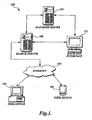
- FIGURE 1 illustrates one environment for implementing an embodiment of the present invention.
- the environment shown includes a library content search system 100 with an electronically-searchable library of content that can be personalized by multiple individual users.
- the environment also includes various electronic user devices, such as a computer system 102 and a PDA 104, that individual users can use to communicate with the search system 100.
- the user devices 102, 104 communicate with the search system 100 via one or more computer networks, such as the Internet 106. Protocols and components for communicating via the Internet are well known to those of ordinary skill in the art of computer network communications. Communication between user devices 102, 104 and the search system 100 may also be enabled by local wired or wireless computer network connections.
- the search system 100 depicted in FIGURE 1 operates in a distributed computing environment comprising several computer systems that are interconnected via communication links, e.g. , using one or more computer networks or direct connections.
- communication links e.g. , using one or more computer networks or direct connections.
- the system 100 could equally operate in a computer system having fewer or greater number of components than are illustrated in FIGURE 1 .
- the depiction of the search system 100 in FIGURE 1 should be taken as exemplary, and not limiting to the scope of the invention.
- the search system 100 as illustrated includes a search server 108, a database server 110, and a back-end interface 112. Each of the servers 108 and 110 are described below in more detail.
- the back-end interface 112 allows an operator of the search system 100 to monitor and adjust the operation of the servers 108 and 110 as needed.
- the search server 108 is generally responsible for providing front-end user communication with various user devices, such as devices 102 and 104, and back-end searching services in cooperation with the database server 110.
- the front-end communication provided by the search server 108 may include generating text and/or graphics, possibly organized as a Web page using hypertext transfer protocols, in response to information and search queries received from the various user devices 102, 104.
- the search server 108 also is generally responsible for conducting searches of the databases in the database server 110.
- the database server 110 maintains the databases that the search server 108 uses to respond to user search queries.
- the search system 100 enables a user to review an index that catalogs the general library of content in the databases stored in the database server 110.
- This general library of content may include various forms of publications, including (but not limited to) books, magazines, newspapers, newsletters, manuals, guides, references, articles, reports, documents, etc.
- various metadata may be associated with the content in the general library.
- This metadata may include internal attributes, such as title, author, subject, abstract publisher, publication date and place, publication type, characters, etc.
- External attributes may also be associated with the content, such as sales popularity, user reviews, publisher promotion, related media, events, etc.
- the index that catalogs the general library may be organized and presented to the user according to one or more of these attributes.
- the user may select the content from this general index of content to be included or otherwise associated in a personalized library for the user.
- the content in the user's personalized library, or "personal library,” is electronically-searchable in all respects, thus enabling the user to search the full text of the content for specified terms (e.g., words, phrases, graphics, charts, pictures, or other text or non-text objects).
- specified terms e.g., words, phrases, graphics, charts, pictures, or other text or non-text objects.
- the results of a search may include some, all, or none of the full-text content in which the specified terms are found.
- Images of one or more pages of content that include the search terms are delivered by the search server 108 to the user device 102, 104 for display to the user, e.g., in the form of a Web page, a portable document image, a raster-based image, a vector-based image, etc.
- Images of content may be stored and delivered in .jpg, .gif, and/or .tif formats, for example.
- the search terms as found in the image display may also be highlighted by the user device 102, 104 in accordance with the present invention, as described later herein.
- Selection of content to include in a user's personal library can be accomplished in a variety of ways. For example, a user may manually select content from a general library of content in a manner that specifically identifies the content that the user desires to include in his or her personal library. Automated selection of content based on other user actions may also be provided. For example, each time the user selects particular content for review or for purchase, that content may be added automatically to the user's personal library. Similarly, a content review or purchase history received from one or more sources may be used to automatically add content to the user's personal library.
- a personal library enables a user to define and search a particular set of content.
- the user establishes a personal library prior to executing a search so that the search algorithm has a limited universe of content on which to act.
- a personal library may be established in real time with the submission or execution of a search query or after the search has been executed on some broader library to define the scope of search results that are presented to the user.
- FIGURE 2 illustrates certain exemplary computing components that are responsible for the operation of the library content search system 100 shown in FIGURE 1 .
- the search server 108 for example, is shown including an operating system 114 that provides executable program instructions for the general administration and operation of the search server 108.
- the search server 108 further includes computer program instructions for implementing a search engine 115 that operates in cooperation with the database server 110 to respond to user search queries.
- Suitable implementations for the operating system 114 and algorithms for the search engine 115 are known or commercially available, and are readily implemented by persons having ordinary skill in the art, particularly in light of the disclosure herein.
- the database server 110 includes a page image database 116, a text searchable database 118, and an access rights database 120.
- the database server 110 is configured to receive search instructions from the search engine 115 and return search results from the page image database 116 and/or text searchable database 118.
- the access rights database 120 enables the search server 108 to control the scope and nature of the content that can be displayed to the user as a result of a search. For example, a user may be permitted to view an entire image of a page of content, such as a book, that the user already owns. For content not owned by the user, the user may be permitted to view only a selected portion of the page image located by the search, with the remaining portions of the page image being suppressed.
- search server 108 and database server 110 will typically employ a memory and main processor in which program instructions are stored and executed for operation of the servers.
- the database server 110 further includes executable program instructions for maintaining and updating the databases 116, 118, and 120, and responding to search instructions received from the search engine 115.
- the present invention is directed to searching a library of content that is personalized by a user.
- a user's personalized library, or "personal library,” includes only such content as selected by the user, either manually or automatically as a result of one or more user actions.
- libraries of content include both images of pages of content, as well as text searchable forms of the content Page images are stored in the page image database 116, while searchable text corresponding to the page images is stored in the text searchable database 118.
- Further embodiments of the invention may allow a user to upload and store page images that are specific to the user's personal library. When permissible, the user may also add the uploaded content to the general library of content for selection by other users.
- FIGURE 3 One embodiment of a process 122 by which pages of content can be prepared and stored in the databases 116 and 118 is shown in FIGURE 3 .
- images of each page of the content are acquired, as indicated at block 123.
- Image acquisition can be performed using methods known in the art, such as scanning printed pages, converting electronic text to document images, retrieving page images from memory, etc.
- a recognition routine such as an optical character recognition (OCR)
- OCR optical character recognition
- a "word” encompasses any grouping of one or more characters, numbers, or symbols.
- a word may stand alone or be associated with a non-text object, such as a picture or graphic.
- OCR routines are well known in the art of electronic document processing and do not require further discussion herein.
- the resulting text, position, and size information obtained from each page image is preferably stored in the text searchable database 118.
- the text searchable database 118 may be organized as desired, preferably using data structures optimized for full text searching.
- each word in the text searchable database 118 has associated therewith content identification numbers (e.g., SKU numbers) and page numbers corresponding to images in the page image database 116 where the particular word is found.
- the text searchable database 118 preferably includes information that identifies the position and size of the text (and possibly non-text objects associated with the text) as found on the respective page image.
- the position and size information is recorded as "quads," which include four numbers representing the X and Y position and the width and height of the text as it appears on a particular page image. All of this information may be heavily encoded in the text searchable database 118 to reduce the storage space required.
- a general library of content or personal library of content may be configured to include only that content for which the library owner has obtained valid rights to store, reproduce and distribute the content.
- Situations may arise in which a publisher of a book, for example, grants rights to a library owner to store and reproduce certain features as found in a book, but restricts the reproduction of one or more other features in the book, e.g., for copyright or contractual reasons.
- Such features may include, for example, photographs, graphics, charts, names, numbers, dates, formulae, equations, pictures, and other text or non-text objects, or portions thereof.
- Features may also be characterized by size, font, and/or location on a page image.
- a process is provided in which features in a page image can be suppressed so that when the page image is displayed to a user (e.g., as a result of a search), only the non-suppressed features of the page image are displayed.
- the process 122 determines for a page image whether the page has one or more features to be suppressed. If no features need to be suppressed, the originally-acquired page image is stored in the page image database 116, as indicated at block 127, for later retrieval.
- the process 122 proceeds to extract the non-suppressed features in the page image, as indicated at block 128, in order to prepare a substitute image that omits the features to be suppressed
- a substitute image that omits the features to be suppressed
- the resulting substitute page image is then stored in the page image database 116 in place of the originally-acquired page image, as indicated at block 127. In some circumstances, it may be permitted to separately store the original page image in anticipation of later receiving rights to reproduce more or all of the original page, including previously suppressed features.
- FIGURES 4-6 illustrate one exemplary process by which a feature (here, a picture) in a page image can be suppressed.
- FIGURE 4 depicts a page image 136 that includes both text 138 and a picture 140.
- a first task in this process is to identify each word on the page image 136, as well as the location and size of each word. Conveniently, this can be achieved as part of the OCR process described earlier with respect to block 124 in FIGURE 3 .
- OCR approximation can also be used in this regard, which is often faster and can be conducted in real time as opposed to typical OCR where each character of each word is independently and correctly recognized. OCR approximation returns the location and size of words, but does not necessarily recognize each individual character correctly.
- FIGURE 5 illustrates the page image 136 in which each of the words on the page have been located and identified, as represented by the boxes surrounding each word indicated by reference numeral 142.
- the word indicated at numeral 144 has also been located and identified, but the word 144 is separately noted herein because the background of the word includes a small portion of the picture 140.
- a substitute image 145 for the page image 136 is prepared by generating a blank image and then copying information for each identified word, such as pixel information, from the original page image 136 to the substitute image 145, as indicated generally by reference numeral 146.
- the words are placed on the substitute image 145 at the respective location that each word is found in the original image 136.
- the small part of the picture behind the word 148 may remain visible in the substitute image 145, though the picture 140 as a whole cannot be recognized.
- algorithms known in the art may be applied to the word image 144 to eliminate the background behind the letters. In any case, the amount of the picture 140 behind the word 148 represents only a small fraction of the original picture 140.
- a substitute image that suppresses a picture may be prepared by first identifying words in the original page image 136, e.g., as shown in FIGURE 5 , and then "erasing," or removing, all the pixel information in the page image outside the "boxes" that surround the identified words. The effect is the same as cutting and pasting the word images into a new (substitute) page image.
- the original page image 136 may have a background texture or color that is desired to be reproduced in the substitute image 145.
- One suitable method for preparing a substitute image 145 with a background similar to that of the original image 136 is to inspect one or more pixels in one or more corners of the original image 136 and reproduce the color and intensity of those pixels in the respective corners of the substitute page 145. The color and intensity from each corner may then be interpolated inward to the center of the page to complete a background for the substitute page 145 that simulates the background of the original image 136.
- the pixel information may be differentiated between foreground pixel information and background pixel information with only the foreground pixel information being erased, leaving the background information in its place.
- Feature suppression can vary depending on the type of content involved and the restrictions imposed. For example, a publisher of a recipe book may allow an ingredient list for a recipe to be shown to a user but not the amount of ingredients. Using OCR techniques, numbers such as "5" and "five," for example, can be identified and suppressed, as well as fractions, using one of the feature suppression methods described above. Allowing a user to see an ingredient list (and perhaps the cooking instructions) allows the user to identify desirable recipes. The user may then seek to acquire the entire recipe, e.g., by electronic download or printed recipe book purchase. Similar procedures may be used by publishers of technical treatises or texts where numbers and/or equations are central operative features of the texts.
- the user is afforded an opportunity to view surrounding text and at the same time may be invited to purchase the text to view the operative numbers or equations.
- Different classes of information may thus be suppressed from the page images that are stored in the page image data base 116 and/or shown to the user. Suppression of a picture, as illustrated in FIGURES 4-6 , is just one example of a class of information capable of suppression. Feature suppression may be performed prior to storing a (substitute) page image in the page image database or after retrieval of a page image from the database but before the page image is displayed to the user.
- a process 150 is described by which a user may establish or update a personal library of content that is selected from a general library of content, as stored in a page image database 116 and text searchable database 118.
- the user selects content from the general library and includes this content (or electronic link thereto) in the user's personal library.
- the content described in FIGURE 7 is in the form of a book, though the invention applies to other forms of content
- user-selection of content for a personal library may be accomplished by permitting the user to review an index of the content in the general library and manually select particular content (in this example, a book) to include in the user's personal library.
- the process 150 determines at a decision block 154 whether the user owns the book. If the user does not own the book, the particular book is identified as non-owned by the user, as indicated at block 156, and added to the user's personal library, as indicated at block 158. Non-ownership of a book in a user's personal library may be indicated by an electronic flag associated with the book in the personal library.
- the process 150 attempts to confirm the user's ownership.
- the personal library searching service is provided by an entity that sells books
- the entity may review its purchase information for the user to confirm that, in fact, the user owns the book, as indicated at reference numeral 160.
- the personal library searching service may also have partner agreements with other booksellers that can confirm purchase records for a user. Reviewing the user's purchase records may further be done automatically for books selected by the user in block 152, without querying the user whether he or she owns the book. Alternatively, a user's selection of a book for purchase may act to automatically add the book to the user's personal library.
- the process 150 proceeds to add the book to the user's personal library, as indicated at block 158.
- a flag may be associated with the book in the personal library to indicate that ownership of the book has been confirmed.
- the user may choose to store the personal library in a computer memory for later retrieval.
- the search system 100 may be configured to allow a user to establish and/or update multiple personal libraries in the computer memory.
- the process 150 may ask the user to undergo additional steps to validate ownership of the book, as indicated at block 162.
- the user may be asked to submit copies of receipts evidencing purchase of the selected book.
- the user may be asked to provide an image of one or more pages from the selected book to validate ownership of the book.
- a determination of ownership of content selected for a personal library is not critical or necessary to the invention, but is helpful in circumstances where the amount and scope of content displayed to a user in a search is restricted in accordance with established ownership of the content.
- the database server 110 may include an access rights database 120 that controls the scope and nature of the content that is displayed to a user as a result of a search.
- the access rights database 120 includes access rules that, when determined to be applicable, act to limit the content in the page images that are shown to the user. Limitations on viewing content may be established for each individual user (or groups or types of users), and may include, but are not limited to, one or more of the following: limits on the amount (e.g.
- Access rules may also serve to define the amount of content that can be provided to the user based on an identification of the user.
- a log in or registration routine may be employed to identify a user.
- the library content search system 100 may implement user verification procedures to inhibit users from establishing multiple accounts to circumvent access limitations in the access rights database 120. For example, entry of a valid credit card number may be required for verification of user identification.
- the search system 100 may further be set up to permit users to view content that is located only as a result of a search. In other words, the user is not permitted to access and view arbitrary pages, for example, in a browse mode (though the user may be able to browse one or more pages adjacent a page located in a search to give context to the located page).
- the search system 100 may be configured to track user activity for each user, including the identity of the page images (or portions thereof) that the user has viewed and the time frame in which the user has viewed the page images.
- Access rules in the access rights database 120 may further be configured to apply differently for each individual user (or groups of users) depending on content-specific information, such as the type of content at issue. For example, access rules may be written to permit unlimited viewing of tables of content and indexes of content but impose stricter limitations on viewing the body of the content itself.
- User location can also act as a factor that determines which access rules govern a user's access to content at the time the content is produced for display to the user. For instance, different access rules may be written to enable a student in a classroom to access an entire body of content that is being used in the class, while the same student, at home, is only able to view a limited portion of the content
- the domain of computer connection may be used to determine user location. Access rules may be written to apply differently based on the time the content is to be provided to the user, e.g. , on different days or at different times of day, as well.
- Access rules may also be prepared and stored in the access rights database 120 so that once a portion of a page image has been displayed to a user, the user can always come back to view that portion, without impacting other limits on viewing new page images.
- the access rules may be written in programming code that a computer can interpret and execute to implement the access rules. Systems for writing and executing such code are known in the art of computer programming.
- each user's personal library may be comprised of a listing of the content that the user has selected from the general library to include in his or her personal library.
- This personal listing of content may link to the actual content stored in the database server 110.
- the amount of storage space required for implementing a personal library searching service is reduced.
- providing a general library of content that is publicly accessible to users for defining personal libraries reduces or removes from users the burden of scanning content and creating searchable electronic copies of content for their personal libraries, not to mention obtaining legal clearance to produce copies of content, where such is necessary.
- a user that has established and/or updated a personal library is able to electronically search the personal library, e.g., for content having text that matches one or more search terms provided by the user.
- a search conducted in this manner has significant advantages including (1) limiting the user's search to the particular content in the user's personal library; (2) conducting a full text search that encompasses the entire body of content in the user's personal library which is more comprehensive than a search encompassing only bibliographic and abstract data or metadata associated with the content; and (3) producing for immediate review by the user the actual images or portions of images of content resulting from the search. Additional advantages are evident from the description herein.
- FIGURE 8 One embodiment of a process 170 for searching and viewing content in a personal library is described in reference to FIGURE 8 , with further reference to FIGURES 9-12 .
- a user initiates a search for specified text in the content in the user's personal library.
- FIGURE 9 one example of a Web page provided to the user for searching a personal library is illustrated in FIGURE 9 .
- FIGURE 9 illustrates a browser program 200 displaying a Web page in which the user is able to enter one or more search terms in a search entry box 202.
- the Web page may be generated by the search server 108 and delivered to the user's computing device 102, 104 via the Internet The user enters the desired search terms in the box 202 and uses a pointing device, keyboard, or other input device to initiate the search, e.g., by clicking on the button "GO" identified at reference numeral 204.
- the Web page in FIGURE 9 may include other hypertext links, such as an "Index" link 206 and "Frequently Accessed Titles" link 208, both providing additional information that can be assembled into one or more additional Web pages not illustrated.
- Clicking on the Index link 206 may produce a Web page for the user that lists bibliographic data for all of the content presently included in the user's personal library.
- the Frequently Accessed Titles link 208 may produce, for example, a listing of the content most frequently accessed by the user.
- Log in and log out routines may be employed by the search server 108 to provide users with secure access to their personal libraries. Suitable routines for verifying a user requesting access to a personal library (e . g., using a password) are well known in the art. In FIGURES 9-12 , it is assumed the user has already logged in. A Log Out link 210 is illustrated and, when initiated, enables the user to discontinue the user's current session and log out of his or her account
- the search server 108 receives the user's specified search terms and initiates a search of the text searchable database 118 to identify the pages of content in the user's personal library that include the text of the search query.
- the text searchable database 118 is preferably constructed to include information that identifies the corresponding images in the page image database 116 where the search terms can be found.
- the text searchable database 118 not only identifies the particular content in the user's personal library that contains the specified text, but also identifies the corresponding page images in the page image database 116.
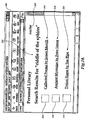
- FIGURE 10 illustrates the browser program 200 displaying a Web page in which search results for a sample phrase "riddle of the sphinx" are shown at reference numeral 212.
- the search results 212 may be displayed in a variety of different formats.
- the search results 212 in FIGURE 10 include a listing of title and author, as indicated at reference numeral 214, along with thumbnail images of the content, or portion thereof (such as a book cover), as indicated at reference numeral 216.
- the search results 212 are generated from a search of the content selected by the user to be included in the user's personal library.
- the search server 108 may execute program instructions that analyze the hits and rank the "best" pages for display to the user according to a predetermined criterion, such as which pages are most relevant Measures of relevance, for example, may include which pages have the most hits, which pages have hits in their title, which pages are drawn from best selling texts, etc.
- the user may select particular content in the search results, e.g ., identified by title and/or page number, for additional review.
- the search server 108 may immediately display images of the user-selected content to the user.
- the search server 108 at block 180 first reviews the access rights database 120 in the database server 110 to determine whether there are any access rules governing how much of, or even if, the content listed in the search results can be displayed to the user.
- the access rights database 120 is a repository for rules that control the ability of users to access and view the actual content in the library, e.g., beyond standard bibliographic information.
- different rules may be written to govern a user's access to content that is already owned by the user, as opposed to content not owned by the user.
- the user may be permitted to access the entire body of that content including page images that precede or follow the pages on which the user's search terms are located. This includes, for example, operating manuals for products that the user has purchased.
- FIGURE 11 illustrates a browser program 200 displaying a Web page for a particular title in the search results previously communicated to the user, such as shown in FIGURE 10 .
- the title of the search result, indicated at reference numeral 220, may be any of those in the search results 212, for example.
- a sample page image 222 from the selected result title 220 is depicted in FIGURE 11 .
- the page image 222 in this instance, is an image of "page 17" from the result title 220 but does not include all of the content of the original page image. This redaction, or suppression, of content can be the result of a circumstance in which a user has limited access rights to the actual content of the result title 220.
- the resulting page image 222 shows the actual page where the phrase "riddle of the Sphinx" is found, along with a limited number of words preceding and following the search terms.
- the number of words preceding and following the located search terms may vary according to user preferences and the access rules governing the particular content for the user. In this illustration, nine words are shown preceding and following the phrase "riddle of the Sphinx.”
- the access rules in the access rights database 120 may permit the user to view a greater portion or even the entire image of "Page 17" (i.e., page image 222) in FIGURE 11 .
- Methods for feature suppression described earlier may be used to suppress content in the page image to be displayed in accordance with the access rules in the access rights database.
- search terms specified by a user may be highlighted in the page images displayed to the user, as indicated at block 186.
- the present invention provides a process by which search terms.may.be highlighted in a manner that reduces the time and resources required for delivering the page image to the user for display.
- an embodiment of the present invention may proceed to immediately deliver the page image 222 to the user.
- the search server 108 determines the position and size of the search terms on the page image 222 (information that may be available in the text searchable database 118 as discussed earlier) and delivers that information to the user.
- the user device 102, 104 may then locally execute program instructions to place a visual indicator on the page image 222 to highlight the location of the search terms.
- the visual indicator may be an icon placed next to or an underline placed under the search terms. Alternatively, the visual indicator may be a change of font of the search terms as displayed.
- the visual indictor is provided by one or more blocks of transparent color that overlay the search terms, thus creating the effect of a colored highlight 224 ( FIGURE 12 ) when the page image 222 is displayed.
- the user device 102, 104 may be instructed to use DHTML layering or Java script technology to cause the user device 102, 104 to produce the highlight 224 on the page image 222.
- the only information that the search server 108 needs to communicate to the user device 102, 104 are the numeric "quads" for each word to be highlighted.
- a quad is a set of four numbers that describes the X and Y position as well as width and height of a word on a particular page image.
- only the X and Y position of search terms is communicated and a highlight of a standard thickness is layered over the search terms. Minimizing the amount of information that the search server 108 needs to communicate to the user device 102, 104 will reduce the amount of time that it takes to communicate from the search server 108 to the user device 102, 104.
- a user's personal library can also be divided as desired into classes of works, such as fiction and nonfiction works, and within such classes, subdivided into subclasses such as mystery, adventure, history, reference, etc.
- Classes and subclasses of works may be predefined or customized by the user. By restricting searches to particular classes or subclasses of books in the user's personal library, the searches performed by a user may be more focused and helpful to the user. For example, a medical student may define a personal "medical" library in which full text searches of medical texts in the student's personal library are conducted.
- an algorithm that identifies "related” text may also be used to aid a user's selection of content for the personal library to include content that may not be strictly classified in a particular class but nonetheless be related to a class that the user desires to search.
- "Related text” algorithms are known in the art and may use dictionary definitions and synonyms of certain words, for example, to identify related content to include in the personalized library that is searched.
- a personal library may be extended from a single person to a small group of persons (constituting a "user"), that know each other and choose to pool the content that they own.
- a small group of this type may be comprised of family members or persons living in the same apartment or in the same fraternity, etc.
- Each person in the group can determine the content to be included in the group's personal library.
- a single searchable set of content is provided to the group. The search results may also be configured to report who in the group owns the book and who currently is in possession of the book.
- searching non-text objects can be accomplished by searching data, such as visible text (e.g., legends or labels), hidden text, and/or metadata, that is associated with or otherwise describes the object at issue.
- the text searchable database 118 can be constructed to include such visible or hidden text or metadata, with position and size information pointing to the object in the page image at issue.
- an image of a page of content does not necessarily imply providing an image having the same dimensions as the original page content.
- An image of a page of content can be any size and may be adjusted in size to more closely conform to the particular portion of content that the access rules (if any) permit for display. Accordingly, depending on the search terms and the pages of content at issue, a user may receive an image that is only half of the original page, or one paragraph from the page, etc., with the page image being displayed having dimensions that match the portion of the page that is shown.
Landscapes
- Engineering & Computer Science (AREA)
- Theoretical Computer Science (AREA)
- Business, Economics & Management (AREA)
- Databases & Information Systems (AREA)
- Physics & Mathematics (AREA)
- General Physics & Mathematics (AREA)
- Accounting & Taxation (AREA)
- Finance (AREA)
- General Engineering & Computer Science (AREA)
- Data Mining & Analysis (AREA)
- General Business, Economics & Management (AREA)
- Strategic Management (AREA)
- Development Economics (AREA)
- Marketing (AREA)
- Library & Information Science (AREA)
- Economics (AREA)
- Entrepreneurship & Innovation (AREA)
- Game Theory and Decision Science (AREA)
- Mathematical Physics (AREA)
- Information Retrieval, Db Structures And Fs Structures Therefor (AREA)
- Storage Device Security (AREA)
Applications Claiming Priority (4)
| Application Number | Priority Date | Filing Date | Title |
|---|---|---|---|
| US10/669,088 US7496560B2 (en) | 2003-09-23 | 2003-09-23 | Personalized searchable library with highlighting capabilities |
| US10/668,690 US7149353B2 (en) | 2003-09-23 | 2003-09-23 | Method and system for suppression of features in digital images of content |
| US10/750,166 US7174054B2 (en) | 2003-09-23 | 2003-12-31 | Method and system for access to electronic images of text based on user ownership of corresponding physical text |
| EP04788999A EP1671235A4 (fr) | 2003-09-23 | 2004-09-23 | Banque de recherche personnalisee dotee de capacites de mise en evidence et permettant d'acceder a des images electroniques de texte sur la base de l'appartenance a l'utilisateur du texte physique correspondant |
Related Parent Applications (1)
| Application Number | Title | Priority Date | Filing Date |
|---|---|---|---|
| EP04788999A Division EP1671235A4 (fr) | 2003-09-23 | 2004-09-23 | Banque de recherche personnalisee dotee de capacites de mise en evidence et permettant d'acceder a des images electroniques de texte sur la base de l'appartenance a l'utilisateur du texte physique correspondant |
Publications (2)
| Publication Number | Publication Date |
|---|---|
| EP1978455A2 true EP1978455A2 (fr) | 2008-10-08 |
| EP1978455A3 EP1978455A3 (fr) | 2009-04-01 |
Family
ID=34316893
Family Applications (1)
| Application Number | Title | Priority Date | Filing Date |
|---|---|---|---|
| EP08011219A Ceased EP1978455A3 (fr) | 2003-09-23 | 2004-09-23 | Bibliothèque personnalisée pouvant être recherchée avec des capacités de mise en surbrillance et accès aux images électroniques de texte en fonction de la propriété de texte physique correspondant par l'utilisateur |
Country Status (3)
| Country | Link |
|---|---|
| US (1) | US7174054B2 (fr) |
| EP (1) | EP1978455A3 (fr) |
| JP (2) | JP4782683B2 (fr) |
Families Citing this family (69)
| Publication number | Priority date | Publication date | Assignee | Title |
|---|---|---|---|---|
| US8352400B2 (en) | 1991-12-23 | 2013-01-08 | Hoffberg Steven M | Adaptive pattern recognition based controller apparatus and method and human-factored interface therefore |
| US7904187B2 (en) | 1999-02-01 | 2011-03-08 | Hoffberg Steven M | Internet appliance system and method |
| AUPR399601A0 (en) * | 2001-03-27 | 2001-04-26 | Silverbrook Research Pty. Ltd. | An apparatus and method(ART108) |
| US7133879B1 (en) * | 2001-12-28 | 2006-11-07 | Cogentmedicine, Inc. | Personalized library interface for providing data to a user |
| US20050038711A1 (en) * | 2003-08-13 | 2005-02-17 | Merwin Marlelo | Method for advertising for sale classroom materials and services |
| US7496560B2 (en) * | 2003-09-23 | 2009-02-24 | Amazon Technologies, Inc. | Personalized searchable library with highlighting capabilities |
| EP1671235A4 (fr) * | 2003-09-23 | 2007-10-24 | Amazon Com Inc | Banque de recherche personnalisee dotee de capacites de mise en evidence et permettant d'acceder a des images electroniques de texte sur la base de l'appartenance a l'utilisateur du texte physique correspondant |
| US7174054B2 (en) * | 2003-09-23 | 2007-02-06 | Amazon Technologies, Inc. | Method and system for access to electronic images of text based on user ownership of corresponding physical text |
| US8442331B2 (en) | 2004-02-15 | 2013-05-14 | Google Inc. | Capturing text from rendered documents using supplemental information |
| US7707039B2 (en) | 2004-02-15 | 2010-04-27 | Exbiblio B.V. | Automatic modification of web pages |
| US20060136629A1 (en) * | 2004-08-18 | 2006-06-22 | King Martin T | Scanner having connected and unconnected operational behaviors |
| US10635723B2 (en) | 2004-02-15 | 2020-04-28 | Google Llc | Search engines and systems with handheld document data capture devices |
| US7812860B2 (en) | 2004-04-01 | 2010-10-12 | Exbiblio B.V. | Handheld device for capturing text from both a document printed on paper and a document displayed on a dynamic display device |
| US20060098900A1 (en) | 2004-09-27 | 2006-05-11 | King Martin T | Secure data gathering from rendered documents |
| US7990556B2 (en) | 2004-12-03 | 2011-08-02 | Google Inc. | Association of a portable scanner with input/output and storage devices |
| US8081849B2 (en) | 2004-12-03 | 2011-12-20 | Google Inc. | Portable scanning and memory device |
| US9143638B2 (en) | 2004-04-01 | 2015-09-22 | Google Inc. | Data capture from rendered documents using handheld device |
| US20070300142A1 (en) * | 2005-04-01 | 2007-12-27 | King Martin T | Contextual dynamic advertising based upon captured rendered text |
| US7894670B2 (en) | 2004-04-01 | 2011-02-22 | Exbiblio B.V. | Triggering actions in response to optically or acoustically capturing keywords from a rendered document |
| US8146156B2 (en) | 2004-04-01 | 2012-03-27 | Google Inc. | Archive of text captures from rendered documents |
| US9008447B2 (en) | 2004-04-01 | 2015-04-14 | Google Inc. | Method and system for character recognition |
| US9116890B2 (en) | 2004-04-01 | 2015-08-25 | Google Inc. | Triggering actions in response to optically or acoustically capturing keywords from a rendered document |
| US20080313172A1 (en) * | 2004-12-03 | 2008-12-18 | King Martin T | Determining actions involving captured information and electronic content associated with rendered documents |
| US20060081714A1 (en) | 2004-08-23 | 2006-04-20 | King Martin T | Portable scanning device |
| US8713418B2 (en) | 2004-04-12 | 2014-04-29 | Google Inc. | Adding value to a rendered document |
| US8489624B2 (en) | 2004-05-17 | 2013-07-16 | Google, Inc. | Processing techniques for text capture from a rendered document |
| US8874504B2 (en) | 2004-12-03 | 2014-10-28 | Google Inc. | Processing techniques for visual capture data from a rendered document |
| US8620083B2 (en) | 2004-12-03 | 2013-12-31 | Google Inc. | Method and system for character recognition |
| US8346620B2 (en) | 2004-07-19 | 2013-01-01 | Google Inc. | Automatic modification of web pages |
| US8099660B1 (en) | 2004-09-30 | 2012-01-17 | Google Inc. | Tool for managing online content |
| US7660488B2 (en) * | 2004-11-04 | 2010-02-09 | Dr Systems, Inc. | Systems and methods for viewing medical images |
| US7920152B2 (en) | 2004-11-04 | 2011-04-05 | Dr Systems, Inc. | Systems and methods for viewing medical 3D imaging volumes |
| US7787672B2 (en) | 2004-11-04 | 2010-08-31 | Dr Systems, Inc. | Systems and methods for matching, naming, and displaying medical images |
| US7885440B2 (en) | 2004-11-04 | 2011-02-08 | Dr Systems, Inc. | Systems and methods for interleaving series of medical images |
| US7970625B2 (en) | 2004-11-04 | 2011-06-28 | Dr Systems, Inc. | Systems and methods for retrieval of medical data |
| US20070043671A1 (en) * | 2005-08-17 | 2007-02-22 | Kurzweil Educational Systems, Inc. | Protected viewing of digital files |
| US20070226321A1 (en) * | 2006-03-23 | 2007-09-27 | R R Donnelley & Sons Company | Image based document access and related systems, methods, and devices |
| US7788272B2 (en) * | 2006-08-04 | 2010-08-31 | Xerox Corporation | Document catalog system |
| EP2067119A2 (fr) | 2006-09-08 | 2009-06-10 | Exbiblio B.V. | Scanners optiques, tels que des scanners optiques portables |
| US7953614B1 (en) | 2006-11-22 | 2011-05-31 | Dr Systems, Inc. | Smart placement rules |
| US20080140652A1 (en) * | 2006-12-07 | 2008-06-12 | Jonathan Travis Millman | Authoring tool |
| US20080228507A1 (en) * | 2007-03-14 | 2008-09-18 | Paul Larue | Retail publishing system, method, program, and apparatus |
| JP4889664B2 (ja) * | 2008-02-12 | 2012-03-07 | コニカミノルタビジネステクノロジーズ株式会社 | マニュアル提供方法、周辺装置、および制御用プログラム |
| WO2009114131A2 (fr) * | 2008-03-10 | 2009-09-17 | Searchme, Inc. | Systèmes et procédés pour traiter une pluralité de documents |
| US8380533B2 (en) * | 2008-11-19 | 2013-02-19 | DR Systems Inc. | System and method of providing dynamic and customizable medical examination forms |
| US10088976B2 (en) | 2009-01-15 | 2018-10-02 | Em Acquisition Corp., Inc. | Systems and methods for multiple voice document narration |
| WO2010096193A2 (fr) | 2009-02-18 | 2010-08-26 | Exbiblio B.V. | Identification d'un document en effectuant une analyse spectrale des contenus du document |
| EP2406767A4 (fr) | 2009-03-12 | 2016-03-16 | Google Inc | Fourniture automatique de contenu associé à des informations capturées, de type informations capturées en temps réel |
| US8447066B2 (en) | 2009-03-12 | 2013-05-21 | Google Inc. | Performing actions based on capturing information from rendered documents, such as documents under copyright |
| US20100306203A1 (en) * | 2009-06-02 | 2010-12-02 | Index Logic, Llc | Systematic presentation of the contents of one or more documents |
| US8255820B2 (en) | 2009-06-09 | 2012-08-28 | Skiff, Llc | Electronic paper display device event tracking |
| US20100315326A1 (en) * | 2009-06-10 | 2010-12-16 | Le Chevalier Vincent | Electronic paper display whitespace utilization |
| US8712120B1 (en) | 2009-09-28 | 2014-04-29 | Dr Systems, Inc. | Rules-based approach to transferring and/or viewing medical images |
| US20110088100A1 (en) * | 2009-10-14 | 2011-04-14 | Serge Rutman | Disabling electronic display devices |
| US9081799B2 (en) | 2009-12-04 | 2015-07-14 | Google Inc. | Using gestalt information to identify locations in printed information |
| US9323784B2 (en) | 2009-12-09 | 2016-04-26 | Google Inc. | Image search using text-based elements within the contents of images |
| US8903783B2 (en) | 2010-04-23 | 2014-12-02 | Bridgepoint Education | System and method for publishing and displaying digital materials |
| US8392186B2 (en) | 2010-05-18 | 2013-03-05 | K-Nfb Reading Technology, Inc. | Audio synchronization for document narration with user-selected playback |
| US20120131085A1 (en) * | 2010-11-18 | 2012-05-24 | At&T Intellectual Property I, L.P. | System and method for providing access to a work |
| WO2012082064A1 (fr) * | 2010-12-16 | 2012-06-21 | Signtrace Ab | Produit de divertissement, procédé de distribution d'un produit de divertissement et système de distribution d'un matériel protégé par des droits d'auteur |
| US20130007041A1 (en) * | 2011-06-29 | 2013-01-03 | The C-Factor Incorporated | Method and apparatus for determining targeted content to deliver in a collaborative social mobile platform |
| US9092727B1 (en) | 2011-08-11 | 2015-07-28 | D.R. Systems, Inc. | Exam type mapping |
| CA2843680C (fr) * | 2012-07-26 | 2014-12-16 | Bitlit Media Inc. | Procede, appareil et systeme pour etablir electroniquement la possession d'un support multimedia physique |
| US9495604B1 (en) | 2013-01-09 | 2016-11-15 | D.R. Systems, Inc. | Intelligent management of computerized advanced processing |
| US20150095192A1 (en) * | 2013-09-30 | 2015-04-02 | Kobo Incorporated | Utilizing an image for facilitating an ebook transaction |
| EP3164805B1 (fr) | 2014-07-02 | 2021-09-15 | Document Corporation IP Unit Trust | Procédé et système de révision sélective de documents |
| US10909168B2 (en) | 2015-04-30 | 2021-02-02 | Merge Healthcare Solutions Inc. | Database systems and interactive user interfaces for dynamic interaction with, and review of, digital medical image data |
| US20190027052A1 (en) * | 2016-01-04 | 2019-01-24 | Wellcoaches Digital Llc | Digital habit-making and coaching ecosystem |
| CN107403019B (zh) * | 2017-08-15 | 2020-08-18 | 重庆邮电大学 | 一种基于移动数据的车主身份识别方法 |
Citations (1)
| Publication number | Priority date | Publication date | Assignee | Title |
|---|---|---|---|---|
| US6609105B2 (en) | 2000-01-07 | 2003-08-19 | Mp3.Com, Inc. | System and method for providing access to electronic works |
Family Cites Families (29)
| Publication number | Priority date | Publication date | Assignee | Title |
|---|---|---|---|---|
| JPH05134957A (ja) * | 1990-10-10 | 1993-06-01 | Fuji Xerox Co Ltd | データ管理システム |
| EP0596247A3 (fr) * | 1992-11-02 | 1994-10-12 | Motorola Inc | Procédé pour la création d'un index de documents complets, ainsi que pour la recherche, le recouvrement et la visualisation. |
| JPH08263438A (ja) * | 1994-11-23 | 1996-10-11 | Xerox Corp | ディジタルワークの配給及び使用制御システム並びにディジタルワークへのアクセス制御方法 |
| US5761485A (en) * | 1995-12-01 | 1998-06-02 | Munyan; Daniel E. | Personal electronic book system |
| US7437351B2 (en) * | 1997-01-10 | 2008-10-14 | Google Inc. | Method for searching media |
| US6076166A (en) * | 1997-01-17 | 2000-06-13 | Philips Electronics North America Corporation | Personalizing hospital intranet web sites |
| US5987448A (en) * | 1997-07-25 | 1999-11-16 | Claritech Corporation | Methodology for displaying search results using character recognition |
| US5957697A (en) * | 1997-08-20 | 1999-09-28 | Ithaca Media Corporation | Printed book augmented with an electronic virtual book and associated electronic data |
| US6562077B2 (en) * | 1997-11-14 | 2003-05-13 | Xerox Corporation | Sorting image segments into clusters based on a distance measurement |
| US6385614B1 (en) * | 1998-01-14 | 2002-05-07 | Netlibrary Inc. | Electronic bookshelf with multi-user features |
| US6331865B1 (en) * | 1998-10-16 | 2001-12-18 | Softbook Press, Inc. | Method and apparatus for electronically distributing and viewing digital contents |
| US6353831B1 (en) * | 1998-11-02 | 2002-03-05 | Survivors Of The Shoah Visual History Foundation | Digital library system |
| JP4101384B2 (ja) * | 1998-12-28 | 2008-06-18 | 株式会社日立製作所 | デジタルコンテンツ販売方法及びその実施装置並びにその処理プログラムを記録した媒体 |
| US6809741B1 (en) * | 1999-06-09 | 2004-10-26 | International Business Machines Corporation | Automatic color contrast adjuster |
| US6449636B1 (en) * | 1999-09-08 | 2002-09-10 | Nortel Networks Limited | System and method for creating a dynamic data file from collected and filtered web pages |
| US6802000B1 (en) * | 1999-10-28 | 2004-10-05 | Xerox Corporation | System for authenticating access to online content referenced in hardcopy documents |
| JP2001195412A (ja) * | 2000-01-12 | 2001-07-19 | Hitachi Ltd | 電子書籍システム及びそのコンテンツ表示方法 |
| US6961905B1 (en) * | 2000-06-23 | 2005-11-01 | Microsoft Corporation | Method and system for modifying an image on a web page |
| JP2002023628A (ja) * | 2000-07-07 | 2002-01-23 | Fujitsu Ltd | 電子的貿易取引サーバ、売主用クライアント、買主用クライアント及び電子的貿易取引方法 |
| JP2002116834A (ja) * | 2000-10-05 | 2002-04-19 | Ricoh Co Ltd | ソフトウェアの使用許諾方法と使用許諾システム及びコンピュータ読み取り可能な記録媒体 |
| JP2002269093A (ja) * | 2001-03-13 | 2002-09-20 | Minolta Co Ltd | 画像処理システム、画像処理装置、画像処理方法ならびに画像処理プログラムおよびこれを記録したコンピュータ読み取り可能な記録媒体 |
| JP2002279045A (ja) * | 2001-03-19 | 2002-09-27 | Nissay Information Technology Co Ltd | 不動産情報管理システム |
| US6728731B2 (en) * | 2001-05-15 | 2004-04-27 | Yahoo!, Inc. | Method and apparatus for accessing targeted, personalized voice/audio web content through wireless devices |
| JP2002351877A (ja) * | 2001-05-29 | 2002-12-06 | Canon Inc | 情報処理装置、情報処理システム、コンテンツ管理方法、記憶媒体、及びプログラム |
| US7020663B2 (en) * | 2001-05-30 | 2006-03-28 | George M. Hay | System and method for the delivery of electronic books |
| JP2003157334A (ja) * | 2001-07-31 | 2003-05-30 | Matsushita Electric Ind Co Ltd | コンテンツ配信システム及びその装置、方法、プログラム及びプログラム記録媒体 |
| JP2003150813A (ja) * | 2001-11-13 | 2003-05-23 | Sony Corp | 情報処理装置および方法、情報処理システムおよび方法、並びにプログラム |
| US7174054B2 (en) * | 2003-09-23 | 2007-02-06 | Amazon Technologies, Inc. | Method and system for access to electronic images of text based on user ownership of corresponding physical text |
| US20050096938A1 (en) * | 2003-10-30 | 2005-05-05 | Zurimedia, Inc. | System and method for providing and access-controlling electronic content complementary to a printed book |
-
2003
- 2003-12-31 US US10/750,166 patent/US7174054B2/en not_active Expired - Lifetime
-
2004
- 2004-09-23 JP JP2006528200A patent/JP4782683B2/ja not_active Expired - Lifetime
- 2004-09-23 EP EP08011219A patent/EP1978455A3/fr not_active Ceased
-
2011
- 2011-04-05 JP JP2011083957A patent/JP5323880B2/ja not_active Expired - Lifetime
Patent Citations (1)
| Publication number | Priority date | Publication date | Assignee | Title |
|---|---|---|---|---|
| US6609105B2 (en) | 2000-01-07 | 2003-08-19 | Mp3.Com, Inc. | System and method for providing access to electronic works |
Also Published As
| Publication number | Publication date |
|---|---|
| JP2007507043A (ja) | 2007-03-22 |
| EP1978455A3 (fr) | 2009-04-01 |
| JP2011175658A (ja) | 2011-09-08 |
| US20050063612A1 (en) | 2005-03-24 |
| JP5323880B2 (ja) | 2013-10-23 |
| US7174054B2 (en) | 2007-02-06 |
| JP4782683B2 (ja) | 2011-09-28 |
Similar Documents
| Publication | Publication Date | Title |
|---|---|---|
| US7174054B2 (en) | Method and system for access to electronic images of text based on user ownership of corresponding physical text | |
| CA2539431C (fr) | Banque de recherche personnalisee dotee de capacites de mise en evidence | |
| US7496560B2 (en) | Personalized searchable library with highlighting capabilities | |
| US7149353B2 (en) | Method and system for suppression of features in digital images of content | |
| US8745477B1 (en) | Tool for managing online content | |
| WO2001080101A1 (fr) | Publication d'informations sur l'internet | |
| Duff et al. | Use of historical documents in a digital world: comparisons with original materials and microfiche | |
| Rich et al. | How Libraries Are Providing Access to Electronic Serials | |
| US20060053105A1 (en) | Method for information retrieval | |
| Metcalf | Good stewards in trying times: Benchmarking peer collections of sociology reference sources using LibGuides | |
| Higgins et al. | Implementing EAD: the experience of the NAHSTE project | |
| Zawadzki | The methodological problems of creating a digital thematic repository of historical cartographic and textual sources. Case study | |
| JP2003108796A (ja) | 文書販売システム | |
| Da Sylva et al. | Using ancillary text to index web-based multimedia objects | |
| Barber | Internet-accessible Full-text Electronic Journal & Periodical Collections for Libraries | |
| WO2002025514A2 (fr) | Systeme en ligne de depot de marques, et procedes de presentation, de recherche et de gestion associes | |
| Kim | Myongji University digital library project: implementing a KORMARC/EAD integrated system | |
| Hawkins et al. | Refinement of cataloging tools | |
| O’Brien | Large-Scale Book and Journal Digitization Projects and Interlibrary Service: Opening the Discussion | |
| Whiting | Naked in Cyberspace: How to Find Personal Information Online | |
| O’Bryant | Resources for the History of Science, Technology and Mathematics | |
| WO2002050709A2 (fr) | Gestion d'une base de donnees du type multimedia | |
| AU2001250166A1 (en) | Publishing information on the internet |
Legal Events
| Date | Code | Title | Description |
|---|---|---|---|
| PUAI | Public reference made under article 153(3) epc to a published international application that has entered the european phase |
Free format text: ORIGINAL CODE: 0009012 |
|
| AC | Divisional application: reference to earlier application |
Ref document number: 1671235 Country of ref document: EP Kind code of ref document: P |
|
| AK | Designated contracting states |
Kind code of ref document: A2 Designated state(s): AT BE BG CH CY CZ DE DK EE ES FI FR GB GR HU IE IT LI LU MC NL PL PT RO SE SI SK TR |
|
| PUAL | Search report despatched |
Free format text: ORIGINAL CODE: 0009013 |
|
| AK | Designated contracting states |
Kind code of ref document: A3 Designated state(s): AT BE BG CH CY CZ DE DK EE ES FI FR GB GR HU IE IT LI LU MC NL PL PT RO SE SI SK TR |
|
| 17P | Request for examination filed |
Effective date: 20090928 |
|
| 17Q | First examination report despatched |
Effective date: 20091020 |
|
| AKX | Designation fees paid |
Designated state(s): AT BE BG CH CY CZ DE DK EE ES FI FR GB GR HU IE IT LI LU MC NL PL PT RO SE SI SK TR |
|
| STAA | Information on the status of an ep patent application or granted ep patent |
Free format text: STATUS: THE APPLICATION HAS BEEN REFUSED |
|
| 18R | Application refused |
Effective date: 20150321 |