EP1983207A2 - Unité d'entraînement pour un agencement d'embrayage, en particulier pour agencement de double embrayage humide - Google Patents
Unité d'entraînement pour un agencement d'embrayage, en particulier pour agencement de double embrayage humide Download PDFInfo
- Publication number
- EP1983207A2 EP1983207A2 EP08006769A EP08006769A EP1983207A2 EP 1983207 A2 EP1983207 A2 EP 1983207A2 EP 08006769 A EP08006769 A EP 08006769A EP 08006769 A EP08006769 A EP 08006769A EP 1983207 A2 EP1983207 A2 EP 1983207A2
- Authority
- EP
- European Patent Office
- Prior art keywords
- cover
- circumferential direction
- mitnehmerbaueinheit
- connecting ring
- elements
- Prior art date
- Legal status (The legal status is an assumption and is not a legal conclusion. Google has not performed a legal analysis and makes no representation as to the accuracy of the status listed.)
- Granted
Links
- 230000008878 coupling Effects 0.000 claims description 77
- 238000010168 coupling process Methods 0.000 claims description 77
- 238000005859 coupling reaction Methods 0.000 claims description 77
- 230000000295 complement effect Effects 0.000 claims description 8
- 230000009977 dual effect Effects 0.000 claims description 5
- 230000000712 assembly Effects 0.000 claims description 4
- 238000000429 assembly Methods 0.000 claims description 4
- 238000009434 installation Methods 0.000 claims 1
- 230000015572 biosynthetic process Effects 0.000 description 4
- 238000004519 manufacturing process Methods 0.000 description 3
- 238000013016 damping Methods 0.000 description 2
- 230000005540 biological transmission Effects 0.000 description 1
- 150000001875 compounds Chemical class 0.000 description 1
- 238000010586 diagram Methods 0.000 description 1
- 238000006073 displacement reaction Methods 0.000 description 1
- 230000000694 effects Effects 0.000 description 1
- 230000008030 elimination Effects 0.000 description 1
- 238000003379 elimination reaction Methods 0.000 description 1
- 230000036316 preload Effects 0.000 description 1
Images



Classifications
-
- F—MECHANICAL ENGINEERING; LIGHTING; HEATING; WEAPONS; BLASTING
- F16—ENGINEERING ELEMENTS AND UNITS; GENERAL MEASURES FOR PRODUCING AND MAINTAINING EFFECTIVE FUNCTIONING OF MACHINES OR INSTALLATIONS; THERMAL INSULATION IN GENERAL
- F16D—COUPLINGS FOR TRANSMITTING ROTATION; CLUTCHES; BRAKES
- F16D13/00—Friction clutches
- F16D13/58—Details
- F16D13/60—Clutching elements
- F16D13/64—Clutch-plates; Clutch-lamellae
- F16D13/68—Attachments of plates or lamellae to their supports
- F16D13/683—Attachments of plates or lamellae to their supports for clutches with multiple lamellae
-
- F—MECHANICAL ENGINEERING; LIGHTING; HEATING; WEAPONS; BLASTING
- F16—ENGINEERING ELEMENTS AND UNITS; GENERAL MEASURES FOR PRODUCING AND MAINTAINING EFFECTIVE FUNCTIONING OF MACHINES OR INSTALLATIONS; THERMAL INSULATION IN GENERAL
- F16D—COUPLINGS FOR TRANSMITTING ROTATION; CLUTCHES; BRAKES
- F16D13/00—Friction clutches
- F16D13/58—Details
-
- Y—GENERAL TAGGING OF NEW TECHNOLOGICAL DEVELOPMENTS; GENERAL TAGGING OF CROSS-SECTIONAL TECHNOLOGIES SPANNING OVER SEVERAL SECTIONS OF THE IPC; TECHNICAL SUBJECTS COVERED BY FORMER USPC CROSS-REFERENCE ART COLLECTIONS [XRACs] AND DIGESTS
- Y10—TECHNICAL SUBJECTS COVERED BY FORMER USPC
- Y10T—TECHNICAL SUBJECTS COVERED BY FORMER US CLASSIFICATION
- Y10T403/00—Joints and connections
- Y10T403/70—Interfitted members
- Y10T403/7005—Lugged member, rotary engagement
- Y10T403/7007—Bayonet joint
Definitions
- the invention relates to a Mit psychology for a clutch assembly, in particular a wet-running dual clutch assembly having a clutch housing and a lid, which are connected to each other while enclosing an inner space for receiving the clutch assembly.
- a Mitauerbautician for a multi-plate clutch system is from the document US Pat. No. 6,883,656 B2 previously known.
- the Mitzigtician comprises a coupling housing and a lid which are rotatably coupled to each other.
- the coupling takes place to form an interior space for receiving the clutch assembly.
- Clutch housing and clutch cover are arranged coaxially with each other and have a common axis of rotation.
- the rotationally fixed connection via mutually complementary teeth, which are engaged with each other in the radial direction.
- the lid expands substantially radially relative to the clutch housing. As a result, this leads at high speeds to play between the inner and outer teeth, which increases with increasing speed further. This leads to a disturbing rattle noise.
- the invention is therefore based on the object, a Mitschbautician for a clutch assembly, in particular for wet-running dual clutches of the type mentioned in such a way that it is subject to lower manufacturing requirements in terms of manufacturing accuracy, a strong noise reduction, especially in idle is present, and also easy to assemble and disassemble is.
- the coupling between the cover and the coupling housing is rotationally fixed and is secured by a connecting ring.
- the rotationally fixed connection between the cover and the coupling housing is preferably completely free of play in the axial direction, so that there is no play between the elements even in the event that the coupling is not actuated and thus no support against the cover or the housing occurs.
- the rotationally fixed connection takes place in the circumferential direction with limited rotatability between the cover and coupling housing, preferably via an elastic damping member and with a torque limiter, so that to some extent a relative movement in the circumferential direction is allowed, which is limited by a fixed stop.
- said bayonet connection between the coupling housing, cover and connecting ring is formed in the axial direction and this positive connection is fixed or secured via a snap connection in the circumferential direction.
- This snap connection allows easy assembly and disassembly of the entire unit by removing the connecting ring.
- means for realizing a form fit in the axial direction or circumferential direction are provided between the cover and the housing, via the connecting ring via Means for realizing a snap connection and a positive connection between the cover and housing and connecting ring in the axial direction, preferably in the form of a bayonet connection is secured.
- the individual options can be performed arbitrarily, but are to be matched in terms of their function during assembly in terms of their dimensions to each other.
- the coupling housing driving elements which are arranged in the circumferential direction at a uniform distance from each other and interact with complementarily executed recesses in the lid.
- the recesses in the cover extend in the circumferential direction and are larger in size than the extension of the driving elements in the end region in the circumferential direction, but smaller than the total distance between a circumferentially oriented side surface to the same circumferentially oriented side surface of the adjacent driving element. Due to the different end portions first driving elements and second driving elements are formed. All entrainment elements have arranged on an aligned in the same direction in the circumferential direction side surface open-edged recesses to form a stop acting in the axial direction of the cover.
- the first and the second driving elements differ with regard to the formation of the respective second opposing side surface.
- the first driving elements are characterized by the formation of a circumferentially facing stop surface for the recess on the lid, while the second driving elements have an open-edged recess to form again an axial stop surface for the lid.
- the width of the open-edged recess on the first side surface corresponds at least to the thickness of the lid.
- the width of the recess on the second side surface corresponds at least to the thickness of the connecting ring.
- the connecting ring has in the first embodiment in the circumferential direction in the region of the outer circumference arranged recesses, which are arranged at regular intervals from each other and are complementary to the recesses on the cover and the driving elements are executed on.
- the driving elements can extend through the recesses and the connecting ring.
- the size of the extension in the circumferential direction of the recesses on the connecting ring is smaller than the sum of the distance between the driving element and the distance to the next driving element, but larger than the extent in the circumferential direction of a driving element.
- different types of recesses are provided at the connecting ring.
- a first type of recess means for realizing a snap connection are provided, which engage in the recess on the cover between the cover and driving element of the housing.
- the second embodiment of the recess is characterized by that it is free of additional elements and only forms a stop for the driving elements and thus braces the lid with the coupling housing in the axial direction.
- the third embodiment of the recesses is characterized in that it is provided with a torque limiter.
- the torque limiting is formed in the simplest case of a projection oriented in the axial direction, which also extends into the recess in the lid and forms a stop surface formed in the circumferential direction, which can come into operative connection with the lid.
- the arrangement of the means for implementing the snap connection and the torque limiter at the corresponding recesses is spaced differently with respect to the position of the recess on the cover opposite the driving elements, so that the stop surface of the torque limiter at the realization of the snap connection spaced from the corresponding stop surface on the lid is arranged and only under increased load in idle mode, canceling the spring preload in the snap connection in the recess of the lid is effective.
- the recesses on the cover element form a stop in the circumferential direction.
- all are arranged on a common diameter.
- the first embodiment is characterized by securing two bayonet connections, a first bayonet connection acting in the circumferential direction between the cover and the coupling housing and a second bayonet connection produced in the axial direction between cover, coupling housing and connecting ring by means of a snap connection in the circumferential direction between cover and coupling housing and connecting ring.
- the means for the realization of the snap connection are an integral part of the connecting ring and also serve to dampen vibrations between the clutch housing and cover during idling operation.
- the end regions each extend in the axial direction.
- a particularly simple embodiment is possible.
- the assembly and disassembly in the axial direction is much easier.
- the driving elements extend in the same way as in the first embodiment in the axial direction.
- the lid has recesses in the circumferential direction.
- the driving elements are designed differently.
- a first type of entrainment elements is characterized in that they each have on their two side surfaces a stop in combination with the circumferentially aligned surface areas form the recesses on the lid and thus form virtually a positive connection in the circumferential direction and in the radial direction.
- the second driving elements are characterized on one side by a stop surface and on the other by a recess in which radially oriented projections of the connecting ring are inserted, so that a tension in the axial direction between the cover and the coupling housing is realized.
- the connecting ring On a same diameter or a different diameter means for realizing a snap connection are provided on the connecting ring, in particular at least one elastically resilient projection which can engage in a slot on the lid, wherein the engagement in the slot on the cover, the fixation is realized in the circumferential direction and simultaneously at least one projection in the radial direction is brought to the connecting ring in a position in which this partially engages in the recess on the second driving elements and thereby clamps the coupling housing with the lid.
- the snap connection secures the positive connection in the circumferential direction between the cover and the coupling housing and the bayonet connection for realizing a positive connection in the axial direction between the coupling housing and cover.
- a damping of vibrations between the clutch housing and cover can be achieved via the snap connection, in particular the elastic elements of the snap connection.
- the solution according to the invention is suitable for coupling arrangements of various kinds. These may be clutch arrangements with a clutch or a particularly preferred embodiment in the form of double clutches.
- FIG. 1a illustrates an exploded view of an embodiment of an inventively designed Mitschaubautician 1 for clutch assemblies, in particular wet-running dual clutch assemblies, according to a first embodiment of the inventive solution.
- the Mitzigbautician 1 is designed in three parts. This comprises a clutch housing 2, which is also referred to as a clutch cage, and a cover 3, which enclose an interior I for receiving the clutch assembly in the mounted state. Further, a connecting ring 4 is provided, which is involved in the coupling between the coupling housing 2 and the lid 3 and serves to secure the lid 3 on the coupling housing 2 in the axial direction and in the circumferential direction.
- the coupling housing 2 and the lid 3 carried out such that when connecting them free from the connecting ring 4 is a fixation in the axial direction with clearance and under load conditions, especially when supporting a pressure fluid-actuated piston assembly on the cover 3 free of play by a positive connection between the clutch housing 2 and the in the axial direction Cover 3 is generated with play, and a driving of the lid in the load direction, ie when actuated clutch about the axis of rotation R, which corresponds to the center axis M of the individual components clutch housing 2, cover 3 and connecting ring 4, while after assembly of the connecting ring 4 of this the fuse between the clutch housing 2 and the cover 3 takes over in the circumferential direction and in the axial direction.
- connection between the cover 3 and the coupling housing 2 in the secured state via the connecting ring 4 is rotationally fixed in both directions, wherein the rotationally fixed connection in the axial direction without play and preferably also in the circumferential direction is free of play.
- the cover 3 and the housing 2 are positively coupled by a bayonet connection 52, while the connecting ring 4 via a bayonet connection 5 and a snap mechanism 53 secures the connection between the cover 3 and housing 2 in the circumferential direction and at least indirectly fixed in the axial direction.
- FIGS. 1a to 1g illustrate a particularly advantageous embodiment.
- the individual components cover 3, coupling housing 2 and connecting ring 4 are arranged coaxially with each other.
- the directions, in particular with regard to the circumferential direction, relate to the axis of rotation R, which corresponds to the center axis M of these components in the installed position.
- the clutch housing 2 is designed shell-shaped and encloses a possible Clutch assembly in the radial and at least partially axial direction to form the inner space I.
- the clutch housing 2 is essentially formed by a disc-shaped or cup-shaped element on the outer circumference d
- a circumferentially distributed driving elements 11 are arranged in the axial direction, that is parallel to the rotation axis R, and are preferably arranged in the circumferential direction at a uniform distance from each other.
- the uniform arrangement has the advantage that no special positional relationships between the clutch housing 2 and the cover 3 must be made, since uniform configurations can be used to make the connection.
- the entrainment elements 11 are also referred to as fingers.
- the coupling housing at least two types of different driving elements 11.1 and 11.2.
- the driving elements 11.1 and 11.2 form in their arrangement to each other in the circumferential direction spaced intermediate spaces 12, which are aligned in the axial direction relative to the rotation axis R and the center axis M parallel thereto.
- the configuration of the driving elements 11.1 and 11.2 differs in the formation of their end portions 13.1 and 13.2.
- driving elements 11.1 and 11.2 can be arranged alternately in the circumferential direction or driving elements 11.1 are provided in larger numbers than the driving elements 11.2, wherein the arrangement is preferably symmetrical.
- the carrier elements 11.1 and 11.2 form hook-shaped ends in their end regions 13.1 and 13.2. These hook-shaped ends allow the formation of the stops 6 in the circumferential direction.
- the stop 6 is in one direction in the circumferential direction, that is, based on the axis of rotation R, which corresponds to the center axis M of the elements, effective in one direction.
- the individual entrainment elements 11.1 and 11.2 at their in the same direction in the circumferential direction-oriented side surface 14.11 and 14.21 open-edged recesses 15.1 and 15.2.
- the open-edged recesses 15.1 and 15.2 extend in the circumferential direction and form with their pointing in the circumferential direction of the inner surface of the stop 6 in the circumferential direction for a direction of rotation.
- At each of the driving elements 11.1 and 11.2 such recesses 15.1 and 15.2 are preferably provided.
- the end region 13.1 of the entraining elements 11.1 on the side surface 14.12 is characterized by a circumferentially aligned surface in the end region of the entrainment element 11.2, which can also act as a stop surface 54 in the circumferential direction.
- On the side surface 4.22 of the driving elements 11.2 also open-edged recesses 16 are provided, which are aligned in the circumferential direction, but opposite to the recesses 15.2. These second open-edge recesses 16 serve for Cooperation with the connecting ring 4, while the first edge-open recesses 15.1 and 15.2 of the coupling between the cover 3 and the coupling housing 2 are used.
- the cover 3 has passage openings 17, which extend in the circumferential direction over a portion of the arcuate extent, wherein a plurality of such passage openings 17 is provided.
- the passage openings 17 are arranged on a diameter corresponding to the diameter of the arrangement of the driving elements 11.1 and 11.2, wherein preferably the driving elements 11.1 and 11.2 are arranged on a diameter and Accordingly, all through holes 17.
- the driving elements 11.1 and 11.2 are passed through the through holes 17 ,
- the extent of the passage openings 17 in the circumferential direction is chosen such that it is in any case greater than the extension of the driving elements 11.1, 11.2 in the circumferential direction.
- the entrainment elements 11.1, 11.2 with the recesses 15.1, 15.2 and the through holes 17 on the cover thereby form the means 7 for realizing a positive connection in the axial direction between the cover 3 and the coupling housing 2 with a game.
- the width b of the open-edged recess 15.1 or 15.2 is greater than the thickness d of the lid 3 in the connection area.
- the cover 3 and the coupling housing 2 are arranged coaxially with each other and pushed into each other, so that the driving elements 11.1 and 11.2 extend through the through holes 17.
- the displacement in each other in the axial direction from the outset be limited by the fact that the design of the driving elements 11.1 and 11.2 before the end portion 13.1, 13.2 with correspondingly greater extent in the circumferential direction to form stops in the axial direction, which prevent further pushing the lid 3 ,
- the cover 3 is inserted so far that it lies in the circumferential direction with the open-edged recesses 15.1 and 15.2 on the driving elements 11.1 and 11.2 in a plane.
- the cover 3 is then rotated relative to the coupling housing 2 or the coupling housing 2 relative to the cover 3, so that the cover 3 is inserted with the space between the through holes 17 in the open-edge recesses 15.1 and 15.2 and with a circumferential direction of the through hole 17th trained stop surface 18, which is opposite to the stop 6 in the open-edge recess 15.1 and 15.2 executed, comes to rest.
- the stop in a rotational direction is ensured in the circumferential direction, while due to the inclusion of the lid 3 in the open-edge Recess 15.1 and 15.2 a fixation in the axial direction is possible and depending on the width of the recess with respect to the thickness d of the lid 3 here is a game exists.
- the stop 6 forming surface 19 is designed as a flat surface that should always be in contact with the stop surface 18 in order to reduce the surface contact pressure due to the introduced engine torque. Furthermore, the contact between the cover 3 and the coupling housing 2 in the region of the abutment surfaces 18 and 6 reduces the axial mobility between them. That is, between these quasi a frictional connection is generated.
- the stop surface 18 opposite to the passage opening 17, the stop surface 19 is formed. If the clutch is actuated within the Mit Siemens 1, the actuating force acts against the clutch cover 3, which in turn acts against the aligned in the axial direction surface 20 of the open-edge recess 15.1 and 15.2, that is, the surface 20 which is directed to the cover 3 and of the Coupling housing 2 is directed away.
- the connecting ring 4 is additionally provided, the mobility in the opposite direction, that is opposite to the output from the engine torque, ie in the idle direction, reduced or completely stopped.
- This is an annular element with recesses 21, which are provided in the circumferential direction, preferably at uniform intervals on the lid 3.
- the recesses 21 are passage openings 21, which extend in the circumferential direction over part of the circumference and are complementary to passage openings 21 or to the carrier elements 11.1 and 11.2.
- the connecting ring 4 connects in the axial direction of the lid 3, which the cover 3 with respect to the coupling housing 2 in the other second direction of rotation in the circumferential direction, which is aligned opposite to the first, ensures.
- the passage openings 21 are part of the means 10 for realizing an axial securing between the cover 3 and the housing 2, in particular by positive locking, which is produced by a bayonet connection 5 between the cover 3, connecting ring 4 and coupling housing 2.
- means 22 for realizing a snap connection are provided. These comprise at least a first spring element 23, which is arranged on the facing in the installed position to the cover 3 end face 24 of the connecting ring 4.
- means 25 are provided for limiting the torque.
- the spring element 23 and the means 25 are preferably an integral part of the connecting ring 4. If the connecting ring 4 is pressed against the clutch cover 3, the connecting ring 4 is guided between the driving elements 11.1 and 11.2 on the clutch housing 2.
- the driving elements 11.1 and 11.2 enforce quasi also with their end portions 13.1 and 13.2, the recesses or through holes 21.
- the spring element 23 acts against the surface 26 and slides into the recess or through hole 17 on the lid 3 and acts against the circumferentially facing surface 19 of the through hole 17th which is opposite to the abutment surface 18.
- the connecting ring 4 If the connecting ring 4 is pushed further in and reaches the bottom of the lid 3, the force generated by the spring bias causes the adjacent passage opening 21, viewed in the circumferential direction, to slide into the recess 16 on the entrainment element 11.2 and, as it were, to provide a locking between the lid 3 and the housing 2 makes in the axial direction.
- the connecting ring 4 thus causes via the bayonet connection 52 between the connecting ring 4 and the cover 3 of the resulting position assignment in the circumferential direction between the adjacent recesses or through holes 21 against the driving elements, in particular the driving elements 11.2, a backup in the axial direction.
- the individual driving elements 11.1 and 11.2 are to be matched in width to this type of connection.
- FIG. 1a the design of the individual elements in exploded view.
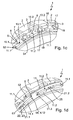
- FIG. 1b illustrates a section of a connecting ring 4. It can be seen here in the circumferential direction of the ring passing through recesses 21 and through holes.
- through holes 21.1 with the means 22, through holes 21.2, which are provided with means 25, and further a further type of through holes 21.3, which is preferably carried out with respect to the other through holes 21.2 and 21.1 with lesser extent in the circumferential direction and for receiving the Carrier elements 11.2 is designed in terms of design.
- the arrangement takes place across the entire circumference between the different types according to symmetrical.
- the passage openings 21.3 cooperate only with the entrainment elements 11.2, while the passage openings 21.1 and 21.2 interact with the entrainment elements 11.1. It is important to ensure that the design of the coupling housing 2 with driving elements 11.1 and 11.2 is matched to the configuration of the connecting ring 4, that here the individual driving elements 11.1 and the corresponding through holes 21.1 and 21.2 and the driving element 11.2 a corresponding through hole 21.3 on Ring 4 is opposite.
- a single spring element 23 may be provided, wherein preferably a symmetrical design is distributed over the circumference and at least two spring elements 23 are provided as a means for realizing a bayonet connection, which are arranged symmetrically on the connecting ring 4.
- the means 25 for limiting the torque in the form of a ramp 28 can be assigned to a plurality of driving elements 11.1.
- the ramp on the connecting ring 4 is formed such that it extends to the through hole 21.2 in the axial direction of this as a projection and a stop surface 29 in the circumferential direction, which upon rotation of the connecting ring 4 in the circumferential direction or an element of the coupling between the lid 3 and Clutch housing 2 is effective or is effective on the cover 3 on the stop surfaces 19.
- the ramp 28 may, but does not necessarily have to be provided. However, this has the advantage that it comes to bear at elevated idle moments and here a relative movement between the individual elements cover 3 and coupling housing 2 avoids it.
- the Figure 1c illustrated by a section of a perspective view of the connection between the cover 3 and the coupling housing 2, the positive connection between them. Visible are the two different driving elements 11.1 and 11.2 with different end portions 13.1 and 13.2, which extend through the through holes 17 and secure after rotation of the lid 3 against the edge-open in the circumferential direction recesses 15.1 and 15.2 the cover 3 in the circumferential direction in one direction by the abutment surface 6 comes into operative connection with the surface 18 or the abutment surface 18 makes contact with the abutment surface 6 on the respective carrier element 11.1, 11.2. Furthermore, the driving element 11.1 or 11.2 surrounds with its end portion 13.1 and 13.2 hook-shaped, or in full view the pliers 3 in the area between the passage openings 17.
- a torque transmission is possible here only in one direction, that is in the direction of rotation of the housing 2 in the direction of Alignment of the stop surface 6.
- axial securing between the cover 3 and housing 2 would no longer be given.
- This axial securing is preferably realized with play, but also conceivable without clearance or only with a clearance fit for assembly purposes between the cover 3 and the coupling housing 2 over the different widths of the recess 15.1 and 15.2 in the axial direction and the thickness d of the lid 3.
- the Figure 1c illustrates the view after merging of the cover 3 and coupling housing 2, in which a rotation in the stop position in the circumferential direction has already taken place.
- the Figure 1d clarified by means of a perspective intention a section of an assembly of coupling housing 2, cover 3 and connecting ring 4 the assembled state.
- the Figure 1e illustrates a representation of a view from above according to Figure 1d
- FIG. 1f illustrates a section A in an enlarged view Figure 1e the Mit Sprint 11 in the assembled state.
- Recognizable here are the driving elements 11. 1 and 11.2, which enforce the corresponding through holes 21.1 to 21.3.
- the entrainment element 11.1 is located with its side facing away from the open-edge recess 15.1 side surface 4.12 as a stop surface 54 on the surface 27 of the passage opening 21.1, which points in the circumferential direction and is aligned to.
- the spring element 23 is supported in the axial direction in an aligned in the circumferential direction surface of the recess 17 on the lid 3.
- the ramps 28 extending in the installed position in the axial direction can be seen.
- these have with their stop surface 29 at a distance from the recess 17 and the corresponding circumferentially oriented surface 19 on the lid 3.
- the ramp 28 becomes effective by acting against the cover 3 or forms a stop for this.
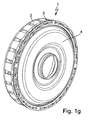
- the Figure 1g illustrates an assembly diagram of the entire Mitschbautician. 1
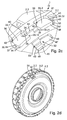
- FIGS. 2a to 2d illustrate a further second embodiment of a Mitauerbauech 1.2 according to the invention for the realization of a connection between a cover 3.2 and a coupling housing 2.2 via a connecting ring 4.2. Also in this a positive connection between the clutch housing 2.2 and the lid 3.2 is realized, which is secured via a connecting ring 4.2 in the axial and circumferential direction. Again, means 30 for realizing a positive connection in the circumferential direction between the cover 3.2 and coupling housing 2.2 are provided. The fixation in the axial direction is realized essentially via a bayonet connection 31 between coupling housing 2.2, cover 3.2 and the connecting ring 4.4. The fixation in circumferential and axial direction via the snap connection 32nd
- FIG. 2a illustrates the execution of the individual components in an exploded view.
- the coupling housing 2.2 which essentially as a disk-shaped Element arranged with the region of the outer periphery and extending in the axial direction driving elements.
- the driving elements are formed by protruding projections in the axial direction, which are arranged spaced from each other in the circumferential direction.
- the driving elements have an end portion which serves to realize the positive connection with the lid 3.2.
- the coupling housing 2.2 has two different types of driving elements 33.1 and 33.2, which differ substantially by the configuration of their end portions 34.1 and 34.2.
- a first end portion 34.1 of the entrainment elements 33.1 is designed such that this analogous as in FIG.
- edge-open recesses 36 are provided on a side surface 35.12 which extend in the circumferential direction and only one abutment surface 37 is provided on the opposite side surface 35.11 of the entrainment element 33.1.
- the second driving element 33.2 is characterized in that it has a preferably symmetrical projection 38 at the end portion 34.2, that is quasi two stop surfaces 39 and 40 viewed in the circumferential direction, which are aligned in the circumferential direction opposite to each other on the side surfaces 35.21 and 35.22.
- the lid 3.2 has a complementary number of recesses 41 through which the end portions 34.1 and 34.2 of the driving elements 33.1 and 33.2 can be passed through. Unlike in FIG.
- the width of the end portion 34.2 corresponds to the width of the recess 41 viewed in the circumferential direction, so that a flat application, if possible with a fit accuracy in the range of a maximum clearance fit .
- the stop surface 37 on the driving element 33.1 acts only in one direction of rotation.
- the drive torque is introduced via the driving elements 33.1 and 33.2 for the abutment surfaces 37 and 39 in the contact surfaces 42 on the cover 3.2, while the idling torque is registered via the driving elements 33.2 on the abutment surface 40 in cooperation with the contact surface 43 in the lid 3.2 and reverses.
- the fixation of the positive connection 30 in the circumferential direction takes place in the axial direction via the connecting ring 4.2.
- This has radially oriented projections 44, which are arranged at a uniform distance from each other in the circumferential direction and are smaller in width than the distances in the circumferential direction between two consecutive recesses 41 on the lid 4.2.
- the recesses 36 on the driving elements 33.1 which extend on the side surface 35.12 of these in the circumferential direction, with respect to their dimensions in the axial direction relative to the axis of rotation R dimensioned such that it corresponds at least to the width of the lid 3.2 and the connecting ring 4.2 in the axial direction , so that the connecting ring 4.2 can be rotated into the recess 36 and thus allows a fixation in the axial direction between the cover and housing 3.2 and 2.2 by a bayonet connection 31.
- a spring element 45 is provided in the region of such a projection, which serves to realize a snap connection 55.
- the slot 46 is characterized by two regions, a first region 47 and a second region 48, wherein the second region 48 forms a stop 49 in the circumferential direction for the spring element 45.
- FIG. 2b illustrates a perspective view in the assembled state of Mitschbautechnik 1 reference to a section of this. Further, further spring elements 50 are provided on the ring 4.4, which serve to eliminate noise during operation, especially at idle.
- the arrangement of the spring elements 45 and the associated slots 46 is preferably symmetrical with respect to the connecting ring 4.2.
- at least two such spring elements 45 and two such slots 46 are provided in the lid 3.2.
- a plurality of such spring elements would also be conceivable, but in particular they are limited in number for easy disassembly.
- these statements also apply to the other spring elements 50.
- These are also arranged on the outer circumference of the connecting ring 4.2, wherein the arrangement is such that they form a stop surface 51 in the circumferential direction for the driving element 33.2 with the stop surface 40, that is in the idle direction.
- the Figure 2d illustrates a Mitauerbauech 1.2 according to the second embodiment in the assembled state.
- the number of entrainment elements 33.1 and 33.2 with corresponding recesses 36 or free from them for realizing one-sided contact or circumferential contact with the cover 3.2 is preferably determined on the basis of the required surface pressures and torque calculations to determine the performance and availability requirements to fulfill.
- the connecting ring 4.2 is used to fix the components in the axial direction to apply a counterforce to the clutch actuation force and to avoid noise and rattling between the clutch housing 2.2 and the lid 3.2.
- this connecting ring has a plurality of features that help to achieve this function.
- the cover is brought into connection with the coupling housing 2.2, in which case the connecting ring 4.2 is then added in the axial direction.
- the projections 44 in the radial direction are spent between the individual coupling housing and driving elements and the spring element 45 is inserted into the slot, which is arranged in the cover element 3.2.
- the connecting ring 4.2 is then pressed against the front side facing away from the coupling housing 2.2 and twisted, so that the projections 44 move into the recesses 36 between the cover 3.2 and the coupling housing 2.2.
- the spring element 45 widens into the larger area 48 of the slot 46 on the clutch cover 3.2. This locks the connecting ring 4.2 in its position and prevents further rotation. If the clutch is actuated, the actuation force acts against the cover 3.2, then through the connecting ring contact surface to the coupling housing capturing elements 33.1.
- Another spring element 50 eliminates the noise between the lid 3.2 and the clutch housing 2.2 by generating a counterforce against the driving elements 33.2 between the lid 3.2 and the clutch housing 2.2, as soon as the ring is 4.2 locked in the slot and thereby a bias between the clutch housing 2.2 and the Lid 3.2 realized.
Landscapes
- Engineering & Computer Science (AREA)
- General Engineering & Computer Science (AREA)
- Mechanical Engineering (AREA)
- Mechanical Operated Clutches (AREA)
- Hydraulic Clutches, Magnetic Clutches, Fluid Clutches, And Fluid Joints (AREA)
Applications Claiming Priority (1)
| Application Number | Priority Date | Filing Date | Title |
|---|---|---|---|
| US92381207P | 2007-04-16 | 2007-04-16 |
Publications (3)
| Publication Number | Publication Date |
|---|---|
| EP1983207A2 true EP1983207A2 (fr) | 2008-10-22 |
| EP1983207A3 EP1983207A3 (fr) | 2010-09-01 |
| EP1983207B1 EP1983207B1 (fr) | 2012-06-20 |
Family
ID=39627403
Family Applications (1)
| Application Number | Title | Priority Date | Filing Date |
|---|---|---|---|
| EP08006769A Not-in-force EP1983207B1 (fr) | 2007-04-16 | 2008-04-03 | Unité d'entraînement pour un agencement d'embrayage, en particulier pour agencement de double embrayage humide |
Country Status (3)
| Country | Link |
|---|---|
| US (1) | US8091697B2 (fr) |
| EP (1) | EP1983207B1 (fr) |
| DE (1) | DE102008017143A1 (fr) |
Cited By (3)
| Publication number | Priority date | Publication date | Assignee | Title |
|---|---|---|---|---|
| CN102003528A (zh) * | 2009-08-26 | 2011-04-06 | 通用汽车环球科技运作公司 | 用于具有多个输入轴的变速器的双离合器 |
| WO2014090250A1 (fr) * | 2012-12-14 | 2014-06-19 | Schaeffler Technologies AG & Co. KG | Cloche intérieure pour embrayage à disques |
| WO2015139697A3 (fr) * | 2014-03-17 | 2016-01-14 | Schaeffler Technologies AG & Co. KG | Porte-lamelles et dispositif d'accouplement équipé d'un tel porte-lamelles |
Families Citing this family (18)
| Publication number | Priority date | Publication date | Assignee | Title |
|---|---|---|---|---|
| ATE482345T1 (de) * | 2006-07-28 | 2010-10-15 | Hoerbiger & Co | Lamellenträger einer reibkupplung |
| EP2019224B1 (fr) * | 2007-07-26 | 2012-06-13 | Hoerbiger Antriebstechnik GmbH | Support à lamelles d'un embrayage à friction |
| DE102009047165A1 (de) * | 2009-11-26 | 2011-06-01 | Zf Friedrichshafen Ag | Axiale Abstützung für ein Lamellenpaket in einer Kupplungsanordnung und Kupplungsanordnung |
| DE102009060351A1 (de) | 2009-12-24 | 2011-06-30 | Volkswagen AG, 38440 | Kupplung |
| US8757344B2 (en) * | 2010-02-25 | 2014-06-24 | Borgwarner Inc. | Corrugated strip for splined clutch housing and hub |
| DE102011003824A1 (de) * | 2010-02-25 | 2011-08-25 | BorgWarner Inc., Mich. | Wellband für Kupplungsgehäuse und -nabe mit Keilverzahnung |
| DE102012011819A1 (de) * | 2012-06-14 | 2013-12-19 | Hoerbiger Antriebstechnik Holding Gmbh | Baugruppe aus einem Lamellenträger-Zahnkranz und einem Anschlussteil sowie Verfahren zur Befestigung des Zahnkranzes am Anschlussteil |
| DE102013008954A1 (de) * | 2013-05-27 | 2014-11-27 | Volkswagen Aktiengesellschaft | Lamellenträgeranordnung für eine Lamellenkupplung |
| CN106062401B (zh) * | 2014-02-24 | 2019-04-12 | 舍弗勒技术股份两合公司 | 具有法兰连接结构的离合器 |
| DE102015204822A1 (de) * | 2014-03-27 | 2015-10-01 | Schaeffler Technologies AG & Co. KG | Rotationsbaugruppe mit mechanischer Steckverbindung sowie Drehmomentübertragungseinrichtung |
| US20150362021A1 (en) * | 2014-06-13 | 2015-12-17 | GM Global Technology Operations LLC | Aluminum clutch components with ferrous surface |
| DE102014224011A1 (de) * | 2014-11-25 | 2016-05-25 | Volkswagen Aktiengesellschaft | Kupplung |
| CN105889351B (zh) * | 2015-02-12 | 2020-05-19 | 舍弗勒技术股份两合公司 | 离合器装置 |
| DE102015215817B4 (de) | 2015-08-19 | 2024-06-13 | Schaeffler Technologies AG & Co. KG | Mitnehmereinheit für eine Kupplungseinrichtung |
| DE102015225479A1 (de) * | 2015-12-16 | 2017-06-22 | Zf Friedrichshafen Ag | Anordnung zum axialen und drehfesten Fixieren von Bauteilen |
| DE112019000436T5 (de) * | 2018-01-16 | 2020-10-01 | Schaeffler Technologies AG & Co. KG | Kupplungsträger für ein Getriebe |
| US10989252B2 (en) * | 2019-03-29 | 2021-04-27 | Schaeffler Technologies AG & Co. KG | Clutch carrier assembly for a transmission |
| DE102021205555A1 (de) | 2021-06-01 | 2022-12-01 | Zf Friedrichshafen Ag | Verbindungsanordnung und Verfahren zum Herstellen derselben |
Citations (1)
| Publication number | Priority date | Publication date | Assignee | Title |
|---|---|---|---|---|
| US6883656B2 (en) | 2002-07-16 | 2005-04-26 | Borgwarner, Inc. | Driver unit for multi-disk clutch systems |
Family Cites Families (9)
| Publication number | Priority date | Publication date | Assignee | Title |
|---|---|---|---|---|
| DE10004190B4 (de) * | 1999-09-30 | 2013-02-07 | Volkswagen Ag | Mehrfach-Kupplungseinrichtung |
| DE50213480D1 (de) * | 2002-06-15 | 2009-06-04 | Borgwarner Inc | Mitnehmerscheibe für Lamellenkupplungssysteme |
| DE50301795D1 (de) * | 2002-11-19 | 2006-01-05 | Volkswagen Ag | Kfz-Getriebe mit Lamellenkupplung |
| FR2875873B1 (fr) * | 2004-09-29 | 2006-12-15 | Renault Sas | Double embrayage humide pour moteur de vehicule automobile |
| US7188467B2 (en) | 2004-09-30 | 2007-03-13 | General Electric Company | Methods and apparatus for assembling a gas turbine engine |
| EP1645765B1 (fr) * | 2004-10-06 | 2018-09-12 | BorgWarner, Inc. | Ensemble de transmission |
| DE102005025979A1 (de) * | 2005-06-03 | 2006-12-14 | Zf Friedrichshafen Ag | Doppelkupplungseinrichtung und Radiallagerungskonzept hierfür |
| US7854306B2 (en) * | 2006-02-22 | 2010-12-21 | Schaeffler Technologies Gmbh & Co. Kg | Clutch assembly with an oil pump clutch housing and a carrier engaged with a clutch pack outer circumference |
| DE102007009964A1 (de) * | 2006-03-22 | 2007-09-27 | Luk Lamellen Und Kupplungsbau Beteiligungs Kg | Hydraulische betätigte Doppelkupplung |
-
2008
- 2008-04-03 EP EP08006769A patent/EP1983207B1/fr not_active Not-in-force
- 2008-04-03 DE DE102008017143A patent/DE102008017143A1/de not_active Withdrawn
- 2008-04-11 US US12/082,466 patent/US8091697B2/en not_active Expired - Fee Related
Patent Citations (1)
| Publication number | Priority date | Publication date | Assignee | Title |
|---|---|---|---|---|
| US6883656B2 (en) | 2002-07-16 | 2005-04-26 | Borgwarner, Inc. | Driver unit for multi-disk clutch systems |
Cited By (4)
| Publication number | Priority date | Publication date | Assignee | Title |
|---|---|---|---|---|
| CN102003528A (zh) * | 2009-08-26 | 2011-04-06 | 通用汽车环球科技运作公司 | 用于具有多个输入轴的变速器的双离合器 |
| CN102003528B (zh) * | 2009-08-26 | 2013-09-25 | 通用汽车环球科技运作公司 | 用于具有多个输入轴的变速器的双离合器 |
| WO2014090250A1 (fr) * | 2012-12-14 | 2014-06-19 | Schaeffler Technologies AG & Co. KG | Cloche intérieure pour embrayage à disques |
| WO2015139697A3 (fr) * | 2014-03-17 | 2016-01-14 | Schaeffler Technologies AG & Co. KG | Porte-lamelles et dispositif d'accouplement équipé d'un tel porte-lamelles |
Also Published As
| Publication number | Publication date |
|---|---|
| EP1983207B1 (fr) | 2012-06-20 |
| US8091697B2 (en) | 2012-01-10 |
| US20080257678A1 (en) | 2008-10-23 |
| DE102008017143A1 (de) | 2008-10-23 |
| EP1983207A3 (fr) | 2010-09-01 |
Similar Documents
| Publication | Publication Date | Title |
|---|---|---|
| EP1983207B1 (fr) | Unité d'entraînement pour un agencement d'embrayage, en particulier pour agencement de double embrayage humide | |
| EP1645765B1 (fr) | Ensemble de transmission | |
| EP2268939B1 (fr) | Train épicycloïdal sans jeu doté de satellites divisés qui sont préchargés par des barres de torsion disposées parallèlement à l'axe de rotation des satellites | |
| EP2076682B1 (fr) | Dispositif d'accouplement | |
| EP2015958B1 (fr) | Ferrure de reglage pour un composant d'un vehicule automobile, et procede de blocage de l'arret d'une ferrure de reglage | |
| EP2012036A2 (fr) | Arrêt | |
| EP0502527A2 (fr) | Disque pour embrayage à friction de véhicule automobile | |
| DE102008000263B4 (de) | Parksperrenrad für eine Parksperrenanordnung | |
| EP2097657A1 (fr) | Amortisseur des vibrations torsionnelles présentant un élément primaire multicomposant | |
| WO2007022745A1 (fr) | Liaison amelioree par rainures de clavetage | |
| EP1381788A1 (fr) | Engrenage avec liaison sans cliquetis entre cloche d'embrayage et plateau d'entrainement | |
| EP1371867B1 (fr) | Plateau d'entraînement pour embrayage multi-disques | |
| DE102008028371B4 (de) | Toleranzring | |
| EP3181932B1 (fr) | Systeme de couplage a montage ameliore | |
| WO2014037370A1 (fr) | Dispositif d'accouplement élastique en rotation pour la transmission de couple ainsi que procédé de montage du dispositif d'accouplement | |
| DE102014102008B4 (de) | Schaltbaugruppe für ein Schaltgetriebe eines Kraftfahrzeugs | |
| WO2005103519A1 (fr) | Ensemble de transfert de force a bague d'arret ondulee | |
| DE102021213313B4 (de) | Welle-Nabe-Verbindung | |
| WO2016096909A1 (fr) | Dispositif de transmission d'un couple d'un moteur à combustion interne vers un groupe auxiliaire | |
| EP2886402B1 (fr) | Support d'entraînement pour une unité d'entraînement et verrouillage électrique de direction doté d'un tel support d'entraînement | |
| EP1657472B1 (fr) | Connexion enfichable axiale | |
| DE102005049433A1 (de) | Axiale Steckverbindungsanordnung | |
| DE102019101958A1 (de) | Kupplungsbetätigungseinrichtung und Kupplungseinrichtung | |
| EP4655515A1 (fr) | Ensemble frein et moteur électrique comprenant un ensemble frein | |
| DE10115629A1 (de) | Anordnung zur Ankoppelung einer Gehäuseanordnung einer hydrodynamischen Kopplungseinrichtung, insbesondere Drehmomentwandler oder Fluidkupplung, an eine Antriebswelle |
Legal Events
| Date | Code | Title | Description |
|---|---|---|---|
| PUAI | Public reference made under article 153(3) epc to a published international application that has entered the european phase |
Free format text: ORIGINAL CODE: 0009012 |
|
| AK | Designated contracting states |
Kind code of ref document: A2 Designated state(s): AT BE BG CH CY CZ DE DK EE ES FI FR GB GR HR HU IE IS IT LI LT LU LV MC MT NL NO PL PT RO SE SI SK TR |
|
| AX | Request for extension of the european patent |
Extension state: AL BA MK RS |
|
| PUAL | Search report despatched |
Free format text: ORIGINAL CODE: 0009013 |
|
| AK | Designated contracting states |
Kind code of ref document: A3 Designated state(s): AT BE BG CH CY CZ DE DK EE ES FI FR GB GR HR HU IE IS IT LI LT LU LV MC MT NL NO PL PT RO SE SI SK TR |
|
| AX | Request for extension of the european patent |
Extension state: AL BA MK RS |
|
| 17P | Request for examination filed |
Effective date: 20110301 |
|
| RAP1 | Party data changed (applicant data changed or rights of an application transferred) |
Owner name: SCHAEFFLER TECHNOLOGIES GMBH & CO. KG |
|
| AKX | Designation fees paid |
Designated state(s): AT BE BG CH CY CZ DE DK EE ES FI FR GB GR HR HU IE IS IT LI LT LU LV MC MT NL NO PL PT RO SE SI SK TR |
|
| GRAP | Despatch of communication of intention to grant a patent |
Free format text: ORIGINAL CODE: EPIDOSNIGR1 |
|
| RAP1 | Party data changed (applicant data changed or rights of an application transferred) |
Owner name: SCHAEFFLER TECHNOLOGIES AG & CO. KG |
|
| GRAS | Grant fee paid |
Free format text: ORIGINAL CODE: EPIDOSNIGR3 |
|
| GRAA | (expected) grant |
Free format text: ORIGINAL CODE: 0009210 |
|
| AK | Designated contracting states |
Kind code of ref document: B1 Designated state(s): AT BE BG CH CY CZ DE DK EE ES FI FR GB GR HR HU IE IS IT LI LT LU LV MC MT NL NO PL PT RO SE SI SK TR |
|
| REG | Reference to a national code |
Ref country code: GB Ref legal event code: FG4D Free format text: NOT ENGLISH |
|
| REG | Reference to a national code |
Ref country code: CH Ref legal event code: EP |
|
| REG | Reference to a national code |
Ref country code: AT Ref legal event code: REF Ref document number: 563242 Country of ref document: AT Kind code of ref document: T Effective date: 20120715 |
|
| REG | Reference to a national code |
Ref country code: IE Ref legal event code: FG4D Free format text: LANGUAGE OF EP DOCUMENT: GERMAN |
|
| REG | Reference to a national code |
Ref country code: DE Ref legal event code: R096 Ref document number: 502008007438 Country of ref document: DE Effective date: 20120816 |
|
| PG25 | Lapsed in a contracting state [announced via postgrant information from national office to epo] |
Ref country code: SE Free format text: LAPSE BECAUSE OF FAILURE TO SUBMIT A TRANSLATION OF THE DESCRIPTION OR TO PAY THE FEE WITHIN THE PRESCRIBED TIME-LIMIT Effective date: 20120620 Ref country code: FI Free format text: LAPSE BECAUSE OF FAILURE TO SUBMIT A TRANSLATION OF THE DESCRIPTION OR TO PAY THE FEE WITHIN THE PRESCRIBED TIME-LIMIT Effective date: 20120620 Ref country code: LT Free format text: LAPSE BECAUSE OF FAILURE TO SUBMIT A TRANSLATION OF THE DESCRIPTION OR TO PAY THE FEE WITHIN THE PRESCRIBED TIME-LIMIT Effective date: 20120620 Ref country code: NO Free format text: LAPSE BECAUSE OF FAILURE TO SUBMIT A TRANSLATION OF THE DESCRIPTION OR TO PAY THE FEE WITHIN THE PRESCRIBED TIME-LIMIT Effective date: 20120920 |
|
| REG | Reference to a national code |
Ref country code: NL Ref legal event code: VDEP Effective date: 20120620 |
|
| REG | Reference to a national code |
Ref country code: LT Ref legal event code: MG4D Effective date: 20120606 |
|
| PG25 | Lapsed in a contracting state [announced via postgrant information from national office to epo] |
Ref country code: GR Free format text: LAPSE BECAUSE OF FAILURE TO SUBMIT A TRANSLATION OF THE DESCRIPTION OR TO PAY THE FEE WITHIN THE PRESCRIBED TIME-LIMIT Effective date: 20120921 Ref country code: HR Free format text: LAPSE BECAUSE OF FAILURE TO SUBMIT A TRANSLATION OF THE DESCRIPTION OR TO PAY THE FEE WITHIN THE PRESCRIBED TIME-LIMIT Effective date: 20120620 Ref country code: SI Free format text: LAPSE BECAUSE OF FAILURE TO SUBMIT A TRANSLATION OF THE DESCRIPTION OR TO PAY THE FEE WITHIN THE PRESCRIBED TIME-LIMIT Effective date: 20120620 Ref country code: LV Free format text: LAPSE BECAUSE OF FAILURE TO SUBMIT A TRANSLATION OF THE DESCRIPTION OR TO PAY THE FEE WITHIN THE PRESCRIBED TIME-LIMIT Effective date: 20120620 |
|
| PG25 | Lapsed in a contracting state [announced via postgrant information from national office to epo] |
Ref country code: SK Free format text: LAPSE BECAUSE OF FAILURE TO SUBMIT A TRANSLATION OF THE DESCRIPTION OR TO PAY THE FEE WITHIN THE PRESCRIBED TIME-LIMIT Effective date: 20120620 Ref country code: CY Free format text: LAPSE BECAUSE OF FAILURE TO SUBMIT A TRANSLATION OF THE DESCRIPTION OR TO PAY THE FEE WITHIN THE PRESCRIBED TIME-LIMIT Effective date: 20120620 Ref country code: EE Free format text: LAPSE BECAUSE OF FAILURE TO SUBMIT A TRANSLATION OF THE DESCRIPTION OR TO PAY THE FEE WITHIN THE PRESCRIBED TIME-LIMIT Effective date: 20120620 Ref country code: CZ Free format text: LAPSE BECAUSE OF FAILURE TO SUBMIT A TRANSLATION OF THE DESCRIPTION OR TO PAY THE FEE WITHIN THE PRESCRIBED TIME-LIMIT Effective date: 20120620 Ref country code: RO Free format text: LAPSE BECAUSE OF FAILURE TO SUBMIT A TRANSLATION OF THE DESCRIPTION OR TO PAY THE FEE WITHIN THE PRESCRIBED TIME-LIMIT Effective date: 20120620 Ref country code: IS Free format text: LAPSE BECAUSE OF FAILURE TO SUBMIT A TRANSLATION OF THE DESCRIPTION OR TO PAY THE FEE WITHIN THE PRESCRIBED TIME-LIMIT Effective date: 20121020 |
|
| PG25 | Lapsed in a contracting state [announced via postgrant information from national office to epo] |
Ref country code: IT Free format text: LAPSE BECAUSE OF FAILURE TO SUBMIT A TRANSLATION OF THE DESCRIPTION OR TO PAY THE FEE WITHIN THE PRESCRIBED TIME-LIMIT Effective date: 20120620 Ref country code: PL Free format text: LAPSE BECAUSE OF FAILURE TO SUBMIT A TRANSLATION OF THE DESCRIPTION OR TO PAY THE FEE WITHIN THE PRESCRIBED TIME-LIMIT Effective date: 20120620 Ref country code: PT Free format text: LAPSE BECAUSE OF FAILURE TO SUBMIT A TRANSLATION OF THE DESCRIPTION OR TO PAY THE FEE WITHIN THE PRESCRIBED TIME-LIMIT Effective date: 20121022 |
|
| PG25 | Lapsed in a contracting state [announced via postgrant information from national office to epo] |
Ref country code: NL Free format text: LAPSE BECAUSE OF FAILURE TO SUBMIT A TRANSLATION OF THE DESCRIPTION OR TO PAY THE FEE WITHIN THE PRESCRIBED TIME-LIMIT Effective date: 20120620 |
|
| PLBE | No opposition filed within time limit |
Free format text: ORIGINAL CODE: 0009261 |
|
| STAA | Information on the status of an ep patent application or granted ep patent |
Free format text: STATUS: NO OPPOSITION FILED WITHIN TIME LIMIT |
|
| PG25 | Lapsed in a contracting state [announced via postgrant information from national office to epo] |
Ref country code: ES Free format text: LAPSE BECAUSE OF FAILURE TO SUBMIT A TRANSLATION OF THE DESCRIPTION OR TO PAY THE FEE WITHIN THE PRESCRIBED TIME-LIMIT Effective date: 20121001 Ref country code: DK Free format text: LAPSE BECAUSE OF FAILURE TO SUBMIT A TRANSLATION OF THE DESCRIPTION OR TO PAY THE FEE WITHIN THE PRESCRIBED TIME-LIMIT Effective date: 20120620 |
|
| 26N | No opposition filed |
Effective date: 20130321 |
|
| REG | Reference to a national code |
Ref country code: DE Ref legal event code: R097 Ref document number: 502008007438 Country of ref document: DE Effective date: 20130321 |
|
| PG25 | Lapsed in a contracting state [announced via postgrant information from national office to epo] |
Ref country code: BG Free format text: LAPSE BECAUSE OF FAILURE TO SUBMIT A TRANSLATION OF THE DESCRIPTION OR TO PAY THE FEE WITHIN THE PRESCRIBED TIME-LIMIT Effective date: 20120920 |
|
| BERE | Be: lapsed |
Owner name: SCHAEFFLER TECHNOLOGIES A.G. & CO. KG Effective date: 20130430 |
|
| PG25 | Lapsed in a contracting state [announced via postgrant information from national office to epo] |
Ref country code: MC Free format text: LAPSE BECAUSE OF FAILURE TO SUBMIT A TRANSLATION OF THE DESCRIPTION OR TO PAY THE FEE WITHIN THE PRESCRIBED TIME-LIMIT Effective date: 20120620 |
|
| REG | Reference to a national code |
Ref country code: CH Ref legal event code: PL |
|
| GBPC | Gb: european patent ceased through non-payment of renewal fee |
Effective date: 20130403 |
|
| REG | Reference to a national code |
Ref country code: IE Ref legal event code: MM4A |
|
| PG25 | Lapsed in a contracting state [announced via postgrant information from national office to epo] |
Ref country code: CH Free format text: LAPSE BECAUSE OF NON-PAYMENT OF DUE FEES Effective date: 20130430 Ref country code: GB Free format text: LAPSE BECAUSE OF NON-PAYMENT OF DUE FEES Effective date: 20130403 Ref country code: LI Free format text: LAPSE BECAUSE OF NON-PAYMENT OF DUE FEES Effective date: 20130430 Ref country code: BE Free format text: LAPSE BECAUSE OF NON-PAYMENT OF DUE FEES Effective date: 20130430 |
|
| REG | Reference to a national code |
Ref country code: DE Ref legal event code: R081 Ref document number: 502008007438 Country of ref document: DE Owner name: SCHAEFFLER TECHNOLOGIES GMBH & CO. KG, DE Free format text: FORMER OWNER: SCHAEFFLER TECHNOLOGIES AG & CO. KG, 91074 HERZOGENAURACH, DE Effective date: 20140218 Ref country code: DE Ref legal event code: R081 Ref document number: 502008007438 Country of ref document: DE Owner name: SCHAEFFLER TECHNOLOGIES AG & CO. KG, DE Free format text: FORMER OWNER: SCHAEFFLER TECHNOLOGIES AG & CO. KG, 91074 HERZOGENAURACH, DE Effective date: 20140218 |
|
| PG25 | Lapsed in a contracting state [announced via postgrant information from national office to epo] |
Ref country code: IE Free format text: LAPSE BECAUSE OF NON-PAYMENT OF DUE FEES Effective date: 20130403 |
|
| REG | Reference to a national code |
Ref country code: AT Ref legal event code: MM01 Ref document number: 563242 Country of ref document: AT Kind code of ref document: T Effective date: 20130403 |
|
| PG25 | Lapsed in a contracting state [announced via postgrant information from national office to epo] |
Ref country code: AT Free format text: LAPSE BECAUSE OF NON-PAYMENT OF DUE FEES Effective date: 20130403 |
|
| PG25 | Lapsed in a contracting state [announced via postgrant information from national office to epo] |
Ref country code: MT Free format text: LAPSE BECAUSE OF FAILURE TO SUBMIT A TRANSLATION OF THE DESCRIPTION OR TO PAY THE FEE WITHIN THE PRESCRIBED TIME-LIMIT Effective date: 20120620 |
|
| REG | Reference to a national code |
Ref country code: DE Ref legal event code: R081 Ref document number: 502008007438 Country of ref document: DE Owner name: SCHAEFFLER TECHNOLOGIES AG & CO. KG, DE Free format text: FORMER OWNER: SCHAEFFLER TECHNOLOGIES GMBH & CO. KG, 91074 HERZOGENAURACH, DE Effective date: 20150223 |
|
| PG25 | Lapsed in a contracting state [announced via postgrant information from national office to epo] |
Ref country code: TR Free format text: LAPSE BECAUSE OF FAILURE TO SUBMIT A TRANSLATION OF THE DESCRIPTION OR TO PAY THE FEE WITHIN THE PRESCRIBED TIME-LIMIT Effective date: 20120620 |
|
| PG25 | Lapsed in a contracting state [announced via postgrant information from national office to epo] |
Ref country code: LU Free format text: LAPSE BECAUSE OF NON-PAYMENT OF DUE FEES Effective date: 20130403 Ref country code: HU Free format text: LAPSE BECAUSE OF FAILURE TO SUBMIT A TRANSLATION OF THE DESCRIPTION OR TO PAY THE FEE WITHIN THE PRESCRIBED TIME-LIMIT; INVALID AB INITIO Effective date: 20080403 |
|
| REG | Reference to a national code |
Ref country code: FR Ref legal event code: PLFP Year of fee payment: 9 |
|
| REG | Reference to a national code |
Ref country code: FR Ref legal event code: PLFP Year of fee payment: 10 |
|
| REG | Reference to a national code |
Ref country code: FR Ref legal event code: PLFP Year of fee payment: 11 |
|
| PGFP | Annual fee paid to national office [announced via postgrant information from national office to epo] |
Ref country code: FR Payment date: 20210423 Year of fee payment: 14 Ref country code: DE Payment date: 20210618 Year of fee payment: 14 |
|
| REG | Reference to a national code |
Ref country code: DE Ref legal event code: R119 Ref document number: 502008007438 Country of ref document: DE |
|
| PG25 | Lapsed in a contracting state [announced via postgrant information from national office to epo] |
Ref country code: FR Free format text: LAPSE BECAUSE OF NON-PAYMENT OF DUE FEES Effective date: 20220430 Ref country code: DE Free format text: LAPSE BECAUSE OF NON-PAYMENT OF DUE FEES Effective date: 20221103 |
|
| P01 | Opt-out of the competence of the unified patent court (upc) registered |
Effective date: 20230522 |