EP1984372B1 - Organische verbindung, anisotroper optischer film und verfahren zu dessen herstellung - Google Patents
Organische verbindung, anisotroper optischer film und verfahren zu dessen herstellung Download PDFInfo
- Publication number
- EP1984372B1 EP1984372B1 EP07704907A EP07704907A EP1984372B1 EP 1984372 B1 EP1984372 B1 EP 1984372B1 EP 07704907 A EP07704907 A EP 07704907A EP 07704907 A EP07704907 A EP 07704907A EP 1984372 B1 EP1984372 B1 EP 1984372B1
- Authority
- EP
- European Patent Office
- Prior art keywords
- dihydrobenzimidazo
- quinazolin
- optical film
- list
- anisotropic optical
- Prior art date
- Legal status (The legal status is an assumption and is not a legal conclusion. Google has not performed a legal analysis and makes no representation as to the accuracy of the status listed.)
- Not-in-force
Links
- 239000012788 optical film Substances 0.000 title claims abstract description 68
- 238000000034 method Methods 0.000 title claims abstract description 28
- 238000004519 manufacturing process Methods 0.000 title description 12
- 150000002894 organic compounds Chemical class 0.000 title description 2
- FXLMBSXEKAGOTM-UHFFFAOYSA-N chembl1972047 Chemical class C1=CC=C2N3C(=O)NC4=CC=CC=C4C3=NC2=C1 FXLMBSXEKAGOTM-UHFFFAOYSA-N 0.000 claims abstract description 52
- 125000001424 substituent group Chemical group 0.000 claims abstract description 21
- 125000000896 monocarboxylic acid group Chemical group 0.000 claims abstract description 14
- 229910006069 SO3H Inorganic materials 0.000 claims abstract description 13
- 230000007935 neutral effect Effects 0.000 claims abstract description 13
- 125000000020 sulfo group Chemical group O=S(=O)([*])O[H] 0.000 claims abstract description 13
- DFPAKSUCGFBDDF-UHFFFAOYSA-N Nicotinamide Chemical group NC(=O)C1=CC=CN=C1 DFPAKSUCGFBDDF-UHFFFAOYSA-N 0.000 claims abstract description 11
- 125000000956 methoxy group Chemical group [H]C([H])([H])O* 0.000 claims abstract description 11
- 125000005647 linker group Chemical group 0.000 claims abstract description 10
- 125000004108 n-butyl group Chemical group [H]C([H])([H])C([H])([H])C([H])([H])C([H])([H])* 0.000 claims abstract description 10
- 125000001436 propyl group Chemical group [H]C([*])([H])C([H])([H])C([H])([H])[H] 0.000 claims abstract description 10
- 125000002914 sec-butyl group Chemical group [H]C([H])([H])C([H])([H])C([H])(*)C([H])([H])[H] 0.000 claims abstract description 10
- 125000000999 tert-butyl group Chemical group [H]C([H])([H])C(*)(C([H])([H])[H])C([H])([H])[H] 0.000 claims abstract description 10
- 239000012044 organic layer Substances 0.000 claims description 53
- 239000000758 substrate Substances 0.000 claims description 43
- 230000003595 spectral effect Effects 0.000 claims description 36
- 239000007864 aqueous solution Substances 0.000 claims description 27
- XLYOFNOQVPJJNP-UHFFFAOYSA-N water Substances O XLYOFNOQVPJJNP-UHFFFAOYSA-N 0.000 claims description 27
- 239000010410 layer Substances 0.000 claims description 26
- 238000010521 absorption reaction Methods 0.000 claims description 25
- 230000005670 electromagnetic radiation Effects 0.000 claims description 24
- 239000000463 material Substances 0.000 claims description 21
- 239000011521 glass Substances 0.000 claims description 11
- 239000012790 adhesive layer Substances 0.000 claims description 10
- 150000001875 compounds Chemical class 0.000 claims description 8
- 238000001035 drying Methods 0.000 claims description 7
- 238000000151 deposition Methods 0.000 claims description 6
- 239000007787 solid Substances 0.000 claims description 6
- 229920000642 polymer Polymers 0.000 claims description 5
- LOCUSLPCLOLITF-UHFFFAOYSA-N NS(=O)(=O)S(O)(=O)=O.C1=CC=C2N3C(=O)NC4=CC=CC=C4C3=NC2=C1 Chemical class NS(=O)(=O)S(O)(=O)=O.C1=CC=C2N3C(=O)NC4=CC=CC=C4C3=NC2=C1 LOCUSLPCLOLITF-UHFFFAOYSA-N 0.000 claims description 3
- 239000002904 solvent Substances 0.000 claims description 3
- 239000011253 protective coating Substances 0.000 claims description 2
- 125000003368 amide group Chemical group 0.000 claims 1
- 239000010408 film Substances 0.000 description 57
- 239000000203 mixture Substances 0.000 description 45
- 230000003287 optical effect Effects 0.000 description 39
- 239000000243 solution Substances 0.000 description 37
- 239000004973 liquid crystal related substance Substances 0.000 description 27
- 230000015572 biosynthetic process Effects 0.000 description 18
- HEMHJVSKTPXQMS-UHFFFAOYSA-M Sodium hydroxide Chemical compound [OH-].[Na+] HEMHJVSKTPXQMS-UHFFFAOYSA-M 0.000 description 15
- 239000000975 dye Substances 0.000 description 15
- 239000002244 precipitate Substances 0.000 description 15
- 239000000047 product Substances 0.000 description 15
- VEXZGXHMUGYJMC-UHFFFAOYSA-N Hydrochloric acid Chemical compound Cl VEXZGXHMUGYJMC-UHFFFAOYSA-N 0.000 description 13
- 238000003786 synthesis reaction Methods 0.000 description 12
- 0 *N1c2ccccc2-c2nc3ccccc3[n]2C1O Chemical compound *N1c2ccccc2-c2nc3ccccc3[n]2C1O 0.000 description 10
- 230000005540 biological transmission Effects 0.000 description 10
- 210000004027 cell Anatomy 0.000 description 10
- QTBSBXVTEAMEQO-UHFFFAOYSA-N Acetic acid Chemical compound CC(O)=O QTBSBXVTEAMEQO-UHFFFAOYSA-N 0.000 description 8
- 238000006243 chemical reaction Methods 0.000 description 8
- 238000000576 coating method Methods 0.000 description 8
- 239000004976 Lyotropic liquid crystal Substances 0.000 description 7
- -1 Poly(vinyl alcohol) Polymers 0.000 description 7
- 125000002843 carboxylic acid group Chemical group 0.000 description 7
- 239000011248 coating agent Substances 0.000 description 7
- WSZVLAGLCLEMPO-UHFFFAOYSA-N 6-oxo-5H-benzimidazolo[1,2-c]quinazoline-9-carboxylic acid Chemical compound C12=CC=CC=C2NC(=O)N2C1=NC1=CC=C(C(=O)O)C=C12 WSZVLAGLCLEMPO-UHFFFAOYSA-N 0.000 description 6
- NLXLAEXVIDQMFP-UHFFFAOYSA-N Ammonium chloride Substances [NH4+].[Cl-] NLXLAEXVIDQMFP-UHFFFAOYSA-N 0.000 description 6
- VHUUQVKOLVNVRT-UHFFFAOYSA-N Ammonium hydroxide Chemical compound [NH4+].[OH-] VHUUQVKOLVNVRT-UHFFFAOYSA-N 0.000 description 6
- KXDHJXZQYSOELW-UHFFFAOYSA-N Carbamic acid Chemical group NC(O)=O KXDHJXZQYSOELW-UHFFFAOYSA-N 0.000 description 6
- 235000011114 ammonium hydroxide Nutrition 0.000 description 6
- 238000001663 electronic absorption spectrum Methods 0.000 description 6
- 238000000921 elemental analysis Methods 0.000 description 6
- JXDYKVIHCLTXOP-UHFFFAOYSA-N isatin Chemical group C1=CC=C2C(=O)C(=O)NC2=C1 JXDYKVIHCLTXOP-UHFFFAOYSA-N 0.000 description 6
- 238000001819 mass spectrum Methods 0.000 description 6
- 125000000565 sulfonamide group Chemical group 0.000 description 6
- 125000000542 sulfonic acid group Chemical group 0.000 description 6
- YHPRBENIBVDYGV-UHFFFAOYSA-N 6-oxo-5H-benzimidazolo[1,2-c]quinazoline-10-carboxylic acid Chemical compound OC(=O)c1ccc2c(c1)nc1c3ccccc3[nH]c(=O)n21 YHPRBENIBVDYGV-UHFFFAOYSA-N 0.000 description 5
- QGZKDVFQNNGYKY-UHFFFAOYSA-N ammonia Natural products N QGZKDVFQNNGYKY-UHFFFAOYSA-N 0.000 description 5
- 239000013078 crystal Substances 0.000 description 5
- 238000005516 engineering process Methods 0.000 description 5
- 238000002360 preparation method Methods 0.000 description 5
- VYPSYNLAJGMNEJ-UHFFFAOYSA-N Silicium dioxide Chemical compound O=[Si]=O VYPSYNLAJGMNEJ-UHFFFAOYSA-N 0.000 description 4
- 239000008367 deionised water Substances 0.000 description 4
- 238000010586 diagram Methods 0.000 description 4
- 238000001914 filtration Methods 0.000 description 4
- 239000007788 liquid Substances 0.000 description 4
- 238000005259 measurement Methods 0.000 description 4
- 238000000255 optical extinction spectrum Methods 0.000 description 4
- 230000010287 polarization Effects 0.000 description 4
- 229920002451 polyvinyl alcohol Polymers 0.000 description 4
- 239000011241 protective layer Substances 0.000 description 4
- ZINHHOVNRCDQHU-UHFFFAOYSA-N 6-oxo-5H-benzimidazolo[1,2-c]quinazoline-10-carboxamide Chemical compound NC(=O)c1ccc2c(c1)nc1c3ccccc3[nH]c(=O)n21 ZINHHOVNRCDQHU-UHFFFAOYSA-N 0.000 description 3
- IBJQJBKCTSPZLW-UHFFFAOYSA-N 6-oxo-5H-benzimidazolo[1,2-c]quinazoline-9-carboxamide Chemical compound NC(=O)c1ccc2nc3c4ccccc4[nH]c(=O)n3c2c1 IBJQJBKCTSPZLW-UHFFFAOYSA-N 0.000 description 3
- 229960000583 acetic acid Drugs 0.000 description 3
- 239000002253 acid Substances 0.000 description 3
- 230000009471 action Effects 0.000 description 3
- 150000001732 carboxylic acid derivatives Chemical class 0.000 description 3
- 230000015556 catabolic process Effects 0.000 description 3
- 238000006731 degradation reaction Methods 0.000 description 3
- 150000002500 ions Chemical class 0.000 description 3
- 230000002535 lyotropic effect Effects 0.000 description 3
- 229920000139 polyethylene terephthalate Polymers 0.000 description 3
- 239000005020 polyethylene terephthalate Substances 0.000 description 3
- DIORMHZUUKOISG-UHFFFAOYSA-N sulfoformic acid Chemical class OC(=O)S(O)(=O)=O DIORMHZUUKOISG-UHFFFAOYSA-N 0.000 description 3
- 238000006277 sulfonation reaction Methods 0.000 description 3
- 239000000725 suspension Substances 0.000 description 3
- KEQGZUUPPQEDPF-UHFFFAOYSA-N 1,3-dichloro-5,5-dimethylimidazolidine-2,4-dione Chemical compound CC1(C)N(Cl)C(=O)N(Cl)C1=O KEQGZUUPPQEDPF-UHFFFAOYSA-N 0.000 description 2
- HEMGYNNCNNODNX-UHFFFAOYSA-N 3,4-diaminobenzoic acid Chemical compound NC1=CC=C(C(O)=O)C=C1N HEMGYNNCNNODNX-UHFFFAOYSA-N 0.000 description 2
- IQBNEMGVIOSBRA-UHFFFAOYSA-N 6-oxo-5H-benzimidazolo[1,2-c]quinazoline-1-sulfonamide Chemical class C=1(C=2C=3N(C(NC=2C=CC=1)=O)C1=C(N=3)C=CC=C1)S(=O)(=O)N IQBNEMGVIOSBRA-UHFFFAOYSA-N 0.000 description 2
- IAZDPXIOMUYVGZ-WFGJKAKNSA-N Dimethyl sulfoxide Chemical compound [2H]C([2H])([2H])S(=O)C([2H])([2H])[2H] IAZDPXIOMUYVGZ-WFGJKAKNSA-N 0.000 description 2
- KFSLWBXXFJQRDL-UHFFFAOYSA-N Peracetic acid Chemical compound CC(=O)OO KFSLWBXXFJQRDL-UHFFFAOYSA-N 0.000 description 2
- QAOWNCQODCNURD-UHFFFAOYSA-N Sulfuric acid Chemical compound OS(O)(=O)=O QAOWNCQODCNURD-UHFFFAOYSA-N 0.000 description 2
- XLOMVQKBTHCTTD-UHFFFAOYSA-N Zinc monoxide Chemical compound [Zn]=O XLOMVQKBTHCTTD-UHFFFAOYSA-N 0.000 description 2
- 230000001070 adhesive effect Effects 0.000 description 2
- VSCWAEJMTAWNJL-UHFFFAOYSA-K aluminium trichloride Chemical compound Cl[Al](Cl)Cl VSCWAEJMTAWNJL-UHFFFAOYSA-K 0.000 description 2
- XTHPWXDJESJLNJ-UHFFFAOYSA-N chlorosulfonic acid Substances OS(Cl)(=O)=O XTHPWXDJESJLNJ-UHFFFAOYSA-N 0.000 description 2
- 239000000084 colloidal system Substances 0.000 description 2
- 210000002858 crystal cell Anatomy 0.000 description 2
- 230000001419 dependent effect Effects 0.000 description 2
- 230000008021 deposition Effects 0.000 description 2
- 238000011161 development Methods 0.000 description 2
- 230000000694 effects Effects 0.000 description 2
- 230000001747 exhibiting effect Effects 0.000 description 2
- 238000004128 high performance liquid chromatography Methods 0.000 description 2
- 238000002156 mixing Methods 0.000 description 2
- 230000008569 process Effects 0.000 description 2
- 239000011541 reaction mixture Substances 0.000 description 2
- 238000001953 recrystallisation Methods 0.000 description 2
- 230000002441 reversible effect Effects 0.000 description 2
- 239000000377 silicon dioxide Substances 0.000 description 2
- 238000001228 spectrum Methods 0.000 description 2
- 229940124530 sulfonamide Drugs 0.000 description 2
- VZGDMQKNWNREIO-UHFFFAOYSA-N tetrachloromethane Chemical compound ClC(Cl)(Cl)Cl VZGDMQKNWNREIO-UHFFFAOYSA-N 0.000 description 2
- 239000010409 thin film Substances 0.000 description 2
- FYSNRJHAOHDILO-UHFFFAOYSA-N thionyl chloride Chemical compound ClS(Cl)=O FYSNRJHAOHDILO-UHFFFAOYSA-N 0.000 description 2
- DYLIWHYUXAJDOJ-OWOJBTEDSA-N (e)-4-(6-aminopurin-9-yl)but-2-en-1-ol Chemical compound NC1=NC=NC2=C1N=CN2C\C=C\CO DYLIWHYUXAJDOJ-OWOJBTEDSA-N 0.000 description 1
- GEYOCULIXLDCMW-UHFFFAOYSA-N 1,2-phenylenediamine Chemical group NC1=CC=CC=C1N GEYOCULIXLDCMW-UHFFFAOYSA-N 0.000 description 1
- 238000005160 1H NMR spectroscopy Methods 0.000 description 1
- ZCYVEMRRCGMTRW-UHFFFAOYSA-N 7553-56-2 Chemical compound [I] ZCYVEMRRCGMTRW-UHFFFAOYSA-N 0.000 description 1
- VWORJBCWRNMNIJ-UHFFFAOYSA-N CC(C=C1)(C=Cc(nc2-c(cccc3)c3N3)c1[n]2C3=O)C(N)=O Chemical compound CC(C=C1)(C=Cc(nc2-c(cccc3)c3N3)c1[n]2C3=O)C(N)=O VWORJBCWRNMNIJ-UHFFFAOYSA-N 0.000 description 1
- KKJCIJDNEUBMKV-UHFFFAOYSA-N CC(CC1)(C=Cc(nc2-c(cccc3)c3N3)c1[n]2C3=O)C(O)=O Chemical compound CC(CC1)(C=Cc(nc2-c(cccc3)c3N3)c1[n]2C3=O)C(O)=O KKJCIJDNEUBMKV-UHFFFAOYSA-N 0.000 description 1
- QXNVGIXVLWOKEQ-UHFFFAOYSA-N Disodium Chemical compound [Na][Na] QXNVGIXVLWOKEQ-UHFFFAOYSA-N 0.000 description 1
- 208000001613 Gambling Diseases 0.000 description 1
- SOWBFZRMHSNYGE-UHFFFAOYSA-N Monoamide-Oxalic acid Natural products NC(=O)C(O)=O SOWBFZRMHSNYGE-UHFFFAOYSA-N 0.000 description 1
- 229910006074 SO2NH2 Inorganic materials 0.000 description 1
- VRSLSEDOBUYIMM-UHFFFAOYSA-N acenaphthyleno[1,2-b]quinoxaline Chemical compound C1=CC(C=2C3=NC4=CC=CC=C4N=2)=C2C3=CC=CC2=C1 VRSLSEDOBUYIMM-UHFFFAOYSA-N 0.000 description 1
- 239000000654 additive Substances 0.000 description 1
- 239000000853 adhesive Substances 0.000 description 1
- XAGFODPZIPBFFR-UHFFFAOYSA-N aluminium Chemical compound [Al] XAGFODPZIPBFFR-UHFFFAOYSA-N 0.000 description 1
- 229910052782 aluminium Inorganic materials 0.000 description 1
- 239000004411 aluminium Substances 0.000 description 1
- 230000009435 amidation Effects 0.000 description 1
- 238000007112 amidation reaction Methods 0.000 description 1
- 238000013459 approach Methods 0.000 description 1
- 238000000149 argon plasma sintering Methods 0.000 description 1
- 150000001491 aromatic compounds Chemical class 0.000 description 1
- 125000003118 aryl group Chemical group 0.000 description 1
- 125000003917 carbamoyl group Chemical group [H]N([H])C(*)=O 0.000 description 1
- 150000001735 carboxylic acids Chemical class 0.000 description 1
- 230000008859 change Effects 0.000 description 1
- 238000009833 condensation Methods 0.000 description 1
- 230000005494 condensation Effects 0.000 description 1
- 238000011109 contamination Methods 0.000 description 1
- 238000001816 cooling Methods 0.000 description 1
- 238000005336 cracking Methods 0.000 description 1
- IMZMKUWMOSJXDT-UHFFFAOYSA-N cromoglycic acid Chemical compound O1C(C(O)=O)=CC(=O)C2=C1C=CC=C2OCC(O)COC1=CC=CC2=C1C(=O)C=C(C(O)=O)O2 IMZMKUWMOSJXDT-UHFFFAOYSA-N 0.000 description 1
- 239000002178 crystalline material Substances 0.000 description 1
- 238000002425 crystallisation Methods 0.000 description 1
- 230000008025 crystallization Effects 0.000 description 1
- 125000001651 cyanato group Chemical group [*]OC#N 0.000 description 1
- 230000007423 decrease Effects 0.000 description 1
- 238000002265 electronic spectrum Methods 0.000 description 1
- 230000009881 electrostatic interaction Effects 0.000 description 1
- 238000001704 evaporation Methods 0.000 description 1
- 230000008020 evaporation Effects 0.000 description 1
- 238000004299 exfoliation Methods 0.000 description 1
- 239000012065 filter cake Substances 0.000 description 1
- 239000012634 fragment Substances 0.000 description 1
- 125000000524 functional group Chemical group 0.000 description 1
- 239000012362 glacial acetic acid Substances 0.000 description 1
- 150000002391 heterocyclic compounds Chemical class 0.000 description 1
- 230000002209 hydrophobic effect Effects 0.000 description 1
- 238000003384 imaging method Methods 0.000 description 1
- 229910017053 inorganic salt Inorganic materials 0.000 description 1
- 238000011835 investigation Methods 0.000 description 1
- 229910052740 iodine Inorganic materials 0.000 description 1
- 239000011630 iodine Substances 0.000 description 1
- 230000031700 light absorption Effects 0.000 description 1
- MZYHMUONCNKCHE-UHFFFAOYSA-N naphthalene-1,2,3,4-tetracarboxylic acid Chemical compound C1=CC=CC2=C(C(O)=O)C(C(=O)O)=C(C(O)=O)C(C(O)=O)=C21 MZYHMUONCNKCHE-UHFFFAOYSA-N 0.000 description 1
- 230000008520 organization Effects 0.000 description 1
- 230000002093 peripheral effect Effects 0.000 description 1
- 238000010587 phase diagram Methods 0.000 description 1
- 229920000058 polyacrylate Polymers 0.000 description 1
- 229920002635 polyurethane Polymers 0.000 description 1
- 239000004814 polyurethane Substances 0.000 description 1
- 230000001902 propagating effect Effects 0.000 description 1
- 230000005855 radiation Effects 0.000 description 1
- 239000001044 red dye Substances 0.000 description 1
- 238000009877 rendering Methods 0.000 description 1
- 238000011160 research Methods 0.000 description 1
- 238000000518 rheometry Methods 0.000 description 1
- 238000001338 self-assembly Methods 0.000 description 1
- 235000012239 silicon dioxide Nutrition 0.000 description 1
- JBJWASZNUJCEKT-UHFFFAOYSA-M sodium;hydroxide;hydrate Chemical compound O.[OH-].[Na+] JBJWASZNUJCEKT-UHFFFAOYSA-M 0.000 description 1
- 230000000087 stabilizing effect Effects 0.000 description 1
- 150000003456 sulfonamides Chemical class 0.000 description 1
- 239000004094 surface-active agent Substances 0.000 description 1
- ZMZDMBWJUHKJPS-UHFFFAOYSA-N thiocyanic acid Chemical compound SC#N ZMZDMBWJUHKJPS-UHFFFAOYSA-N 0.000 description 1
- 230000009466 transformation Effects 0.000 description 1
- 238000001291 vacuum drying Methods 0.000 description 1
- BMZAOXGPXCPSTH-UHFFFAOYSA-N vatred14 Chemical compound C12=NC3=CC=CC=C3N2C(=O)C2=CC=C3C4=C2C1=CC=C4C(=O)N1C2=CC=CC=C2N=C13.C1=CC=C2N(C(C3=CC=C4C(N5C6=CC=CC=C6N=C5C=5C=CC6=C3C4=5)=O)=O)C6=NC2=C1 BMZAOXGPXCPSTH-UHFFFAOYSA-N 0.000 description 1
- 230000000007 visual effect Effects 0.000 description 1
- 239000011787 zinc oxide Substances 0.000 description 1
Images


Classifications
-
- G—PHYSICS
- G02—OPTICS
- G02B—OPTICAL ELEMENTS, SYSTEMS OR APPARATUS
- G02B5/00—Optical elements other than lenses
- G02B5/30—Polarising elements
- G02B5/3025—Polarisers, i.e. arrangements capable of producing a definite output polarisation state from an unpolarised input state
- G02B5/3033—Polarisers, i.e. arrangements capable of producing a definite output polarisation state from an unpolarised input state in the form of a thin sheet or foil, e.g. Polaroid
- G02B5/3041—Polarisers, i.e. arrangements capable of producing a definite output polarisation state from an unpolarised input state in the form of a thin sheet or foil, e.g. Polaroid comprising multiple thin layers, e.g. multilayer stacks
- G02B5/305—Polarisers, i.e. arrangements capable of producing a definite output polarisation state from an unpolarised input state in the form of a thin sheet or foil, e.g. Polaroid comprising multiple thin layers, e.g. multilayer stacks including organic materials, e.g. polymeric layers
-
- C—CHEMISTRY; METALLURGY
- C07—ORGANIC CHEMISTRY
- C07D—HETEROCYCLIC COMPOUNDS
- C07D487/00—Heterocyclic compounds containing nitrogen atoms as the only ring hetero atoms in the condensed system, not provided for by groups C07D451/00 - C07D477/00
- C07D487/02—Heterocyclic compounds containing nitrogen atoms as the only ring hetero atoms in the condensed system, not provided for by groups C07D451/00 - C07D477/00 in which the condensed system contains two hetero rings
- C07D487/04—Ortho-condensed systems
-
- G—PHYSICS
- G02—OPTICS
- G02B—OPTICAL ELEMENTS, SYSTEMS OR APPARATUS
- G02B1/00—Optical elements characterised by the material of which they are made; Optical coatings for optical elements
- G02B1/08—Optical elements characterised by the material of which they are made; Optical coatings for optical elements made of polarising materials
-
- G—PHYSICS
- G02—OPTICS
- G02B—OPTICAL ELEMENTS, SYSTEMS OR APPARATUS
- G02B5/00—Optical elements other than lenses
- G02B5/30—Polarising elements
- G02B5/3083—Birefringent or phase retarding elements
- G02B5/3091—Birefringent or phase retarding elements for use in the UV
-
- C—CHEMISTRY; METALLURGY
- C09—DYES; PAINTS; POLISHES; NATURAL RESINS; ADHESIVES; COMPOSITIONS NOT OTHERWISE PROVIDED FOR; APPLICATIONS OF MATERIALS NOT OTHERWISE PROVIDED FOR
- C09K—MATERIALS FOR MISCELLANEOUS APPLICATIONS, NOT PROVIDED FOR ELSEWHERE
- C09K2323/00—Functional layers of liquid crystal optical display excluding electroactive liquid crystal layer characterised by chemical composition
- C09K2323/03—Viewing layer characterised by chemical composition
- C09K2323/031—Polarizer or dye
-
- G—PHYSICS
- G02—OPTICS
- G02B—OPTICAL ELEMENTS, SYSTEMS OR APPARATUS
- G02B5/00—Optical elements other than lenses
- G02B5/30—Polarising elements
-
- G—PHYSICS
- G02—OPTICS
- G02B—OPTICAL ELEMENTS, SYSTEMS OR APPARATUS
- G02B5/00—Optical elements other than lenses
- G02B5/30—Polarising elements
- G02B5/3083—Birefringent or phase retarding elements
-
- G—PHYSICS
- G02—OPTICS
- G02F—OPTICAL DEVICES OR ARRANGEMENTS FOR THE CONTROL OF LIGHT BY MODIFICATION OF THE OPTICAL PROPERTIES OF THE MEDIA OF THE ELEMENTS INVOLVED THEREIN; NON-LINEAR OPTICS; FREQUENCY-CHANGING OF LIGHT; OPTICAL LOGIC ELEMENTS; OPTICAL ANALOGUE/DIGITAL CONVERTERS
- G02F1/00—Devices or arrangements for the control of the intensity, colour, phase, polarisation or direction of light arriving from an independent light source, e.g. switching, gating or modulating; Non-linear optics
- G02F1/01—Devices or arrangements for the control of the intensity, colour, phase, polarisation or direction of light arriving from an independent light source, e.g. switching, gating or modulating; Non-linear optics for the control of the intensity, phase, polarisation or colour
- G02F1/13—Devices or arrangements for the control of the intensity, colour, phase, polarisation or direction of light arriving from an independent light source, e.g. switching, gating or modulating; Non-linear optics for the control of the intensity, phase, polarisation or colour based on liquid crystals, e.g. single liquid crystal display cells
- G02F1/133—Constructional arrangements; Operation of liquid crystal cells; Circuit arrangements
- G02F1/1333—Constructional arrangements; Manufacturing methods
- G02F1/1335—Structural association of cells with optical devices, e.g. polarisers or reflectors
- G02F1/13363—Birefringent elements, e.g. for optical compensation
- G02F1/133633—Birefringent elements, e.g. for optical compensation using mesogenic materials
-
- G—PHYSICS
- G02—OPTICS
- G02F—OPTICAL DEVICES OR ARRANGEMENTS FOR THE CONTROL OF LIGHT BY MODIFICATION OF THE OPTICAL PROPERTIES OF THE MEDIA OF THE ELEMENTS INVOLVED THEREIN; NON-LINEAR OPTICS; FREQUENCY-CHANGING OF LIGHT; OPTICAL LOGIC ELEMENTS; OPTICAL ANALOGUE/DIGITAL CONVERTERS
- G02F1/00—Devices or arrangements for the control of the intensity, colour, phase, polarisation or direction of light arriving from an independent light source, e.g. switching, gating or modulating; Non-linear optics
- G02F1/01—Devices or arrangements for the control of the intensity, colour, phase, polarisation or direction of light arriving from an independent light source, e.g. switching, gating or modulating; Non-linear optics for the control of the intensity, phase, polarisation or colour
- G02F1/13—Devices or arrangements for the control of the intensity, colour, phase, polarisation or direction of light arriving from an independent light source, e.g. switching, gating or modulating; Non-linear optics for the control of the intensity, phase, polarisation or colour based on liquid crystals, e.g. single liquid crystal display cells
- G02F1/133—Constructional arrangements; Operation of liquid crystal cells; Circuit arrangements
- G02F1/1333—Constructional arrangements; Manufacturing methods
- G02F1/1335—Structural association of cells with optical devices, e.g. polarisers or reflectors
- G02F1/13363—Birefringent elements, e.g. for optical compensation
- G02F1/133634—Birefringent elements, e.g. for optical compensation the refractive index Nz perpendicular to the element surface being different from in-plane refractive indices Nx and Ny, e.g. biaxial or with normal optical axis
Definitions
- the present invention relates generally to the field of organic chemistry and particularly to organic anisotropic optical films with phase-retarding properties for displays. More specifically, the present invention is related to the synthesis of 6,7-dihydrobenzimidazo[1,2-c]quinazolin-6-one derivatives and the manufacture of anisotropic optical films based on these compounds.
- a thin optical film is that having a thickness comparable with a half of the wavelength of light in the working interval of optical spectrum.
- optical axis refers to a direction in which the propagating light does not exhibit birefringence.
- the optical properties of an optical compensation film are described by the refractive index ellipsoid, with the refractive indices nx, ny, and nz in the directions of x, y and z axes, respectively.
- the in-plane x and y axes are mutually orthogonal and are both orthogonal to the vertical z axis.
- Liquid crystals are widely used in electronics as optical display elements.
- a liquid crystal cell is typically situated between a pair of polarizer and analyzer plates.
- the incident light is polarized by the polarizer and transmitted through a liquid crystal cell, where it is affected by the molecular orientation of the liquid crystal that can be controlled by applying a bias voltage across the cell.
- the thus altered light passes through the second (output) polarizer that is called analyzer.
- analyzer the transmission of light from any external source, including ambient light, can be controlled.
- the energy required to provide for this control is generally much lower than that required for controlling the emission from luminescent materials used in other types of displays such as cathode ray tubes (CRTs).
- liquid crystal technology is used in a number of electronic imaging devices, including (but not limited to) digital watches, calculators, portable computers, and electronic games, for which small weight, low power consumption, and long working life are important.
- the contrast, colour reproduction (colour rendering), and stable grey scale intensity gradation are important quality characteristics of electronic displays employing liquid crystal technology.
- the primary factor determining the contrast of a liquid crystal display (LCD) is the propensity for light to "leak” through liquid crystal elements or cells, which are in the dark or “black” pixel state.
- the optical leakage and, hence, the contrast of an LCD also depend on the direction from which the display screen is viewed.
- the viewing direction herein is defined as a set of the polar viewing angle ( ⁇ ) and the azimuthal viewing angle ( ⁇ ) as shown in Figure 1 with respect to a liquid crystal display 1.
- the polar viewing angle ⁇ is measured from the display normal direction 2 and the azimuthal viewing angle ⁇ spans between an appropriate reference direction 3 in the plane of the display surface 4 and the projection 5 of viewing arrow 6 onto the display surface 4.
- Various display image properties such as the contrast ratio, color reproduction, and image brightness are functions of the angles ⁇ and ⁇ . In colour displays, the leakage problem not only decreases the contrast but also causes colour or hue shifts with the resulting degradation of colour reproduction.
- LCDs are now replacing CRTs as monitors for television (TV) sets, computers (especially in notebook computers and desktop computers), central control units, and various devices, for example, gambling machines, electro-optical displays, (e.g., in watches, pocket calculators, electronic pocket games), portable data banks (such as personal digital assistants or mobile telephones). It is expected that the proportion of LCD television monitors with a larger screen size will also sharply increase in the nearest future. However, unless problems related to the effect of viewing angle on the colour reproduction, contrast degradation, and brightness inversion are solved, the replacement of traditional CRTs by LCDs will be limited.
- the type of optical compensation required depends on the type of display used in each particular system.
- a normally black display the twisted nematic cell is placed between polarizers whose transmission axes are parallel to one another and to the orientation of the liquid crystal director at the rear surface of the cell (i.e., at the cell side that is away from the viewer).
- normally incident light from the backlight system is polarized by the first polarizer and transmitted through the cell with the polarization direction rotated by the twist angle of the cell.
- the twist angle is set to 90 DEG so that the output polarizer (analyzer) blocks this light. Patterns can be written in the display by selectively applying a voltage to the portions of the display that are to appear illuminated.
- the dark (unenergized) areas of a normally black display will appear bright because of the angle-dependent retardation effect for the light rays passing through the liquid crystal layer at such angles, whereby off-normal incident light exhibits an angle-dependent change in the polarization.
- the contrast can be restored by using a compensating element, which has an optical symmetry similar to that of a twist cell but produces the reverse effect.
- One method consists in introducing an active liquid crystal layer containing a twist cell of the reverse helicity. Another method is to use one or more uniaxial compensators.
- optical elements based on new materials with desired controllable properties.
- important optical elements in modern visual display systems are optically anisotropic films with optical characteristics optimised for use in a particular display module.
- Organic dichroic dyes constitute a new class of materials currently gaining prominence in the manufacture of optically anisotropic films with desirable optical and working characteristics. Films based on these materials can be obtained by applying an aqueous liquid crystal (LC) solution of supramolecules containing dye molecules onto a substrate surface, with the subsequent evaporation of water.
- LC liquid crystal
- a hydrophobic-hydrophilic balance of molecules of polycyclic organic compounds makes them soluble in water and stimulates their self-assembly into supramolecules.
- Organic compounds in water form a colloid system or lyotropic liquid crystal, where molecules aggregate into supramolecules and these supramolecules represent kinetic units of the colloidal system (see, P.I. Lazarev, M.V. Paukshto, "Multilayer optical coating," U.S. 2004/0233528 (2004 )).
- Spectral characteristics and rheological properties of materials see, V. Nazarov, L. Ignatov, K.
- Kienskaya "Electronic Spectra of Aqueous Solutions and Films Made of Liquid Crystal Ink for Thin Film Polarizers," Molecular Materials, Vol. 14, No. 2, pp. 153-163 (2001 ); S. Remizov, A. Krivoshchepov, V. Nazarov, A. Grodsky, "Rheology of The Lyotropic Liquid Crystalline Material for Thin Film Polarizers," Molecular Materials, Vol. 14, No. 2, pp. 179-190 (2001 )) indicate strong tendency of these molecules to aggregate, even in diluted aqueous solutions, with formation of supramolecules with columnar structure.
- the applied films are rendered anisotropic either by preliminary mechanical orientation of the substrate surface or by post-treatment using external mechanical, electromagnetic, or other orienting forces applied to the LC film material on the substrate.
- Dye supramolecules form lyotropic liquid crystals (LLCs). Substantial molecular ordering or organization of dye molecules in the form of columns allows such supramolecular LC mesophases to be used for obtaining oriented, strongly dichroic films.
- Dye molecules forming supramolecular LC mesophases possess unique properties. These dye molecules contain functional groups located at the periphery, which render these molecules soluble in water. Organic dye mesophases are characterized by specific structures, phase diagrams, optical properties, and solubility as described in greater detail in: J. Lydon, Chromonics, in Handbook of Liquid Crystals, Wiley VCH, Weinheim (1998), Vol. 2B, p. 981-1007 (see also references therein).
- Anisotropic films characterized by high optical anisotropy can be formed from LLC systems based on dichroic dyes. Such films exhibit the properties of so-called E-type polarizers (due to the absorption of light by supramolecular complexes). Organic conjugated compounds with the general molecular structure similar to that of dye molecules, but exhibiting no absorption in the visible spectral range, can be used as retarders and compensators.
- Retarders and compensators are the films possessing phase-retarding properties in the spectral regions where the optical absorption is absent.
- the n e and n o values vary depending on the orientation of molecules in a medium and on the direction of light propagation. For example, if this direction coincides with the optical or crystallographic axis, the ordinary polarization is predominantly observed. If the light propagates in the perpendicular direction or at some angle to the optical axis, the light emerging from the medium will separate into extraordinary and ordinary components.
- the films based on organic aromatic compounds are characterized by a high thermal stability and radiation resistance (photostability).
- ultrathin birefringent films can be fabricated using the known methods and technologies developed for the production of optically anisotropic films based on organic dye LLC systems.
- the manufacture of thin, optically anisotropic crystalline films based on disulfoacids of the red dye Vat Red 14 has been described by P. Lazarev and M. Paukshto, Thin Crystal Film Retarders (in: Proceeding of the 7th International Display VVorkshops, Materials and Components, Kobe, Japan, november 29 - December 1 (2000), pp. 1159-1160 )
- such films can be obtained using cis- and trans isomer mixtures of naphthalenetetracarboxylic acid dibenzimidazole:
- This technology makes it possible to control the direction of the crystallographic axis of a film during the deposition and crystallization of LC molecules on a substrate (e.g., on a glass plate).
- the obtained films have uniform compositions and are characterized by high molecular and/or crystal ordering, with a dichroic ratio of approximately K d ⁇ 28, which makes them useful optical materials, in particular, for polarizers, retarders, and birefringent films or compensators.
- the anisotropy of oriented films made of DSCG is not very high: a difference in the refractive indices ⁇ n is in the visible range is approximately 0.1 to 0.13.
- the thicknesses of films based on DSCG can be varied over a wide range, thus making possible the preparation of films with desired phase-retarding properties despite low specific anisotropy characteristics of the material.
- These films are considered in greater detail in T. Fiske et al., Molecular Alignment in Crystal Polarizers and Retarders: Society for Information Display Int Symp.(Boston, MA, May 19-24 (2002), Digest of Technical Papers), pp. 566-569 .
- the main disadvantage of many of these films is their dynamic instability, which leads to gradual recrystallization of the LC molecules and the resulting degradation of the optical anisotropy.
- anisotropic film materials based on water-soluble organic dyes, have been also obtained using the aforementioned technology; see, for example, U.S. Patent Nos. 5,739,296 and 6,174,394 and European patent EP 0961138 .
- such materials exhibit high optical absorption in the visible spectral range, which limits their use in applications requiring transparent birefringent films.
- X and Y are molecular fragments individually selected from the list including CH 3 , C 2 H 5 , OCH 3 , OC 2 H s , Cl, Br, OH, OCOCH 3 , NH 2 , NHCOCH 3 , NO 2 , F, CF 3 , CN, OCN, SCN, COOH, and CONH 2 ;
- the present invention provides a 6,7-dihydrobenzimidazo[1,2-c]quinazolin-6-one derivative of the general structural formula where X is a carboxylic group COOH, m is 0, 1, 2 or 3; Y is a sulfonic group SO 3 H, n is 0, 1, 2 or 3; Z is an acid amide group L-NH 2 ; p is an integer in the range from 0, 1, 2 or 3; K is a counterion selected from the list comprising H + , NH 4 + , Na + , K + , Li + , Mg 2+ , Ca 2+ , Zn 2+ and Al 3+ ; s is the number of counterions providing neutral state of the molecule; R is a substituent selected from the list comprising CH 3 , C 2 H 5 , NO 2 , Cl, Br, F, CF 3 , CN, OH, OCH 3 , OC 2 H 5 , OCOCH 3 , OCN, SCN,
- the values of at least two of said integers m , n and p are not equal to 0 and said derivative consequently comprises at least two different groups selected from the list comprising X, Y, and Z.
- Said 6,7-dihydrobenzimidazo[1,2-c]quinazolin-6-one derivative does not substantially absorb incident electromagnetic radiation in the visible spectral range.
- the visible range is considered as the wavelength range with a lower boundary of approximately 400 nm, and an upper boundary of approximately 700 nm. It is also supposed that the upper boundary of UV spectral range is approximately equal or lower that the lower boundary of the visible range.
- the present invention provides an anisotropic optical film comprising a substrate having front and rear surfaces, and at least one organic layer applied on the front surface of the substrate and comprising at least one 6,7-dihydrobenzimidazo[1,2-c]quinazolin-6-one derivative with the general structural formula where X is a carboxylic group COOH, m is 0, 1, 2 or 3; Y is a sulfonic group SO 3 H, n is 0, 1, 2 or 3; Z is an acid amide group L-NH 2 ; p is 0, 1, 2 or 3; K is a counterion selected from the list comprising H + , NH 4 + , Na + , K + , Li + , Mg 2+ , Ca 2+ , Zn 2+ , Al 3+ and Ba 2+ , s is the number of counterions providing neutral state of the molecule; R is a substituent selected from the list comprising CH 3 , C 2 H 5 , NO 2 , Cl, Br, F,
- the values of at least two of said integers m, n and p are not equal to 0 and said derivative comprises at least two different groups selected from the list comprising X, Y, and Z. Said organic layer does not substantially absorb incident electromagnetic radiation in the visible spectral range.
- the anisotropic optical film may be an anisotropic optical crystal film.
- the present invention provides a method of manufacturing anisotropic optical films comprising the following steps: (a) depositing an aqueous solution of supramolecules, formed from one or more 6,7-dihydrobenzimidazo[1,2-c]quinazolin-6-one derivatives on a substrate, and (b) drying said aqueous solution of supramolecules to form a solid layer.
- Said 6,7-dihydrobenzimidazo[1,2-c]quinazolin-6-one derivative has the general structural formula where X is a carboxylic group COOH, m is 0, 1, 2 or 3; Y is a sulfonic group SO 3 H, n is 0, 1, 2 or 3; Z is an acid amide group L-NH 2 ; p is 0, 1, 2 or 3; K is a counterion selected from the list comprising H + , NH 4 + , Na + , K + , Li + , Mg 2+ , Ca 2+ , Zn 2+ and Al 3+ ; s is the number of counterions providing neutral state of the molecule; R is a substituent selected from the list comprising CH 3 , C 2 H 5 , NO 2 , Cl, Br, F, CF 3 , CN, OH, OCH 3 , OC 2 H 5 , OCOCH 3 , OCN, SCN, NH 2 , and NHCOCH 3 ; w
- the values of at least two of said integers m , n and p are not equal to 0 and said derivative comprises at least two different groups selected from the list comprising X, Y, and Z.
- the method of manufacturing an anisotropic optical film may be a method of manufacturing an anisotropic optical crystal film.
- the present invention provides 6,7-dihydrobenzimidazo[1,2-c]quinazolin-6-one derivatives of the general structural formula where X is a carboxylic group COOH, m is 0, 1, 2 or 3; Y is a sulfonic group SO 3 H, n is 0, 1, 2 or 3; Z is an acid amide group L-NH 2 p is 0, 1, 2 or 3; K is a counterion selected from the list comprising H + , NH 4 + , Na + , K + , Li + , Mg 2+ , Ca 2+ , Zn 2+ and Al 3+ ; s is the number of counterions providing neutral state of the molecule; R is a substituent selected from the list comprising CH 3 , C 2 H 5 , NO 2 Cl, Br, F, CF 3 , CN, OH, OCH 3 , OC 2 H 5 , OCOCH 3 , OCN, SCN, NH 2 , and NHCOCH 3
- the values of at least two of said integers m, n and p are not equal to 0 and said derivative comprises at least two different groups selected from the list comprising X, Y, and Z.
- Said 6,7-dihydrobenzimidazo[1,2-c]quinazolin-6-one derivative does not substantially absorb the incident electromagnetic radiation in the visible spectral range.
- the number of counterions s may equal zero. In this case the molecule is in the neutral state.
- the counterion may be selected from the group consisting of H + , NH 4 + , Na + , K + , Li + , Mg 2+ , Ca 2+ , Zn 2+ and Al 3+ or from the group consisting of H + , NH 4 + , Na + , K + , and Li + .
- L is preferably CO or SO 2 .
- the 6,7-dihydrobenzimidazo[1,2-c]quinazolin-6-one derivatives further ensure the absorption of electromagnetic radiation in at least one predetermined wavelength subrange of the UV spectral range.
- the molecules of such 6,7-dihydrobenzimidazo[1,2-c]quinazolin-6-one derivatives can absorb electromagnetic radiation only in a part of the UV spectral range, rather than in the entire range, and this part of the UV range will be called subrange.
- This subrange can be determined experimentally for each particular 6,7-dihydrobenzimidazo[1,2-c]quinazolin-6-one derivative.
- at least one said acid amide group is carboxyamide CONH 2 .
- At least one said acid amide group is sulfonamide SO 2 NH 2 .
- said acid group providing solubility in water
- said acid group is a sulfonic group.
- the derivative comprises one or more carboxylic acid groups and one or more sulfonic groups. In another preferred embodiment of the present invention, the derivative comprises one or more carboxylic acid group and one or more sulfonamide groups. In still another preferred embodiment of the present invention, the derivative comprises one or more carboxylic acid groups and one or more carboxyamide groups. In yet another preferred embodiment of the present invention, the derivative comprises one or more sulfonic acid groups and one or more carboxyamide groups. In a possible preferred embodiment of the present invention, the derivative comprises one or more sulfonic acid groups and one or more sulfonamide groups.
- the derivative comprises one or more sulfonic acid groups and one or more sulfonamide groups and one or more carboxyamide groups. In one preferred embodiment of the present invention, the derivative comprises one or more carboxylic acid groups and one or more sulfonamide groups and one or more carboxyamide groups. In another preferred embodiment of the present invention, the derivative comprises one or more carboxylic acid groups and one or more sulfonic acid groups and one or more carboxyamide groups. In still another preferred embodiment of the present invention, the derivative ' comprises one or more carboxylic acid groups and one or more sulfonic acid groups and one or more sulfonamide groups. In yet another preferred embodiment of the present invention, the derivative comprises one or more carboxylic acid groups and one or more sulfonic acid groups and one or more sulfonamide groups and one or more carboxyamide groups.
- Preferred 6,7-dihydrobenzimidazo[1,2-c]quinazolin-6-one derivatives include 2(3)-sulfo-6,7-dihydrobenzimidazo[1,2-c]quinazolin-6-one-9-carboxylic acid; 2(3)-sulfo-6,7-dihydrobenzimidazo[1,2-c]quinazolin-6-one-10-carboxylic acid; 2(3)-sulfonamide-6,7-dihydrobenzimidazo[1,2-c]quinazolin-6-one-9-carboxylic acid; 2(3)-sulfonamide-6,7-dihydrobenzimidazo[1,2-c]quinazolin-6-one-10-carboxylic acid; 2(3)-sulfo-6,7-dihydrobenzimidazo[1,2-c]quinazolin-6-one-9-carboxylic acid amide; 2(3)-sulfo-6,7-dihydrobenzimidazo[1,
- the present invention provides an anisotropic optical film comprising a substrate having the front and rear surfaces and at least one organic layer applied on the front surface of the substrate and comprising at least one 6,7-dihydrobenzimidazo[1,2-c]quinazolin-6-one derivative with the general structural formula where X is a carboxylic group COOH; m is 0, 1, 2 or 3; Y is a sulfonic group SO 3 H; n is 0, 1, 2 or 3; Z is an acid amide group L-NH 2 ; p is 0, 1, 2 or 3; K is a counterion selected from the list comprising H + ; NH 4 + , Na + , K + , Li + , Mg 2+ , Ca 2+ , Zn 2+ , Al 3+ and Ba 2+ , s is the number of counterions providing neutral state of the molecule; R is a substituent selected from the list comprising CH 3 , C 2 H 5 , NO 2 , Cl, Br, F,
- the values of at least two of said integers m , n and p are not equal to 0 and said derivative comprises at least two different groups selected from the list comprising X, Y, and Z.
- Said organic layer does not substantially absorb incident electromagnetic radiation in the visible spectral range.
- the counterion may be selected from the group consisting of H + , NH 4 + , Na + , K + , Li + , Mg 2+ , Ca 2+ , Zn 2+ , Ba 2+ and Al 3+ or from the group consisting of H + , NH 4 + , Na + , K + , Li + , Mg 2+ , Ca 2+ , Zn 2+ , Ba 2+ and Sr 2+ .
- said organic layer absorbs electromagnetic radiation in at least one predetermined spectral subrange of the UV range.
- Such anisotropic optical films can absorb electromagnetic radiation only in a part of the UV spectral range, rather than in the entire range, and this part of the UV range is called the subrange.
- This subrange can be determined experimentally for each particular aqueous solution of an 6,7-dihydrobenzimidazo[1,2-c]quinazolin-6-one derivative used for the formation of the anisotropic optical film.
- the absorption subrange can be experimentally determined for a mixture of 6,7-dihydrobenzimidazo[1,2-c]quinazolin-6-one derivatives used for the formation of said film.
- such experimentally determined absorption subrange electromagnetic radiation can be considered as the predetermined subrange.
- said organic layer is substantially insoluble in water and/or in water-miscible solvents.
- the 6,7-dihydrobenzimidazo[1,2-c]quinazolin-6-one derivative used in the anisotropic optical film is preferably as described above with regard to the first aspect of the present invention.
- Examples of the 6,7-dihydrobenzimidazo[1,2-c]quinazolin-6-one derivative comprising at least one carboxylic group COOH and having the general structural formula from the group comprising structures 1 to 11 are given in Table 1 wherein integer m is between 1 and 3.
- 6,7-dihydrobenzimidazo[1,2-c]quinazolin-6-one derivatives comprising at least one said sulfonic groups SO 3 H and having the general structural formula from the group comprising structures 12 to 20 are given in Table 2 wherein integer n is between 1 and 3.
- said organic layer contains two or more 6,7-dihydrobenzimidazo[1,2-c]quinazolin-6-one derivatives with the general structural formula I, each ensuring the absorption of electromagnetic radiation in at least one predetermined wavelength subrange of the UV spectral range.
- said 6,7-dihydrobenzimidazo[1,2-c]quinazolin-6-one derivative forms supramolecules that are oriented predominantly parallel to the substrate surface.
- said organic layer is a biaxial retardation layer that is characterized by two in-plane refractive indices (nx and ny) and one refractive index ( nz ) in the normal direction.
- the refractive indices (nx, ny and nz) of biaxial retardation layer have different values.
- the refractive indices nx, ny, and nz meet the following condition: nx ⁇ ny ⁇ nz.
- the in-plane refractive indices (nx and ny) and the organic layer thickness d meet the following condition: d ⁇ (ny-nx) ⁇ 20 nm.
- the in-plane refractive indices (nx and ny ) and the organic layer thickness d meet the following condition: d ⁇ (ny - nx) ⁇ 10 nm.
- the in-plane refractive indices ( nx and ny ) and the organic layer thickness d meet the following condition: d ⁇ (ny- nx) ⁇ 5 nm.
- the refractive indices nx, ny, and nz meet the following condition: nx ⁇ nz ⁇ ny.
- the refractive indices ny and nz and the organic layer thickness d meet the following condition: d ⁇ (ny- nz) ⁇ 20 nm.
- the refractive indices ny and nz and the organic layer thickness d meet the following condition: d ⁇ (ny - nz) ⁇ 10 nm.
- the refractive indices ny and nz and the organic layer thickness d meet the following condition: d ⁇ (ny-nz) ⁇ 5 nm.
- nx ⁇ nz ⁇ ny are equivalent to nx >nz > ny.
- a refractive index nx is transformed into a refractive index ny when the Cartesian system of coordinates rotates about a vertical axis (Oz-axis) by 90 degrees.
- a refractive index ny is transformed into a refractive index nx.
- the in-plane refractive indices are not equal among themselves and refractive index in the normal direction has intermediate value between these in-plane refractive indices. This ratio of the refractive indexes disclosed in the invention is invariant relative to a transformation of Cartesian system of coordinates.
- the substrate is transparent for electromagnetic radiation in the visible spectral range.
- said substrate is made of a polymer.
- the substrate is made of a glass.
- the transmission coefficient of the substrate does not exceed 2% at any wavelength in the UV spectral range. In an embodiment of the disclosed anisotropic optical film, the transmission coefficient of the substrate in the visible spectral range is no less than 90%. In another embodiment of the anisotropic optical film, the rear surface of the substrate is covered with an additional antireflection or antiglare coating. In one preferred embodiment of the disclosed invention, the substrate further comprises a reflective layer that is applied onto the rear surface of the substrate.
- the anisotropic optical film further comprises an additional adhesive transparent layer deposited above said reflective layer.
- the substrate is a specular or diffusive reflector.
- the substrate is a reflective polarizer.
- the anisotropic optical film further comprises a planarization layer deposited onto the front surface of the substrate.
- the anisotropic optical film further comprises an additional transparent adhesive layer placed on top of the organic layer.
- the anisotropic optical film further comprises a protective coating formed on the transparent adhesive layer.
- the transmission coefficient of the adhesive layer does not exceed 2% at any wavelength in the UV spectral range.
- the transmission coefficient of the adhesive layer in the visible spectral range is no less than 90%.
- the anisotropic optical film comprises two or more organic layers, wherein each of these layers contains different 6,7-dihydrobenzimidazo[1,2-c]quinazolin-6-one derivatives with the general structural formula I, ensuring the absorption of electromagnetic radiation in at least one predetermined wavelength subrange of the UV spectral range.
- the present invention provides a method of manufacturing an anisotropic optical film, which comprises the following steps: (a) depositing an aqueous solution of supramolecules, formed from one or more 6,7-dihydrobenzimidazo[1,2-c]quinazolin-6-one derivatives on a substrate, and (b) drying of said aqueous solution of supramolecules to form a solid layer, wherein said 6,7-dihydrobenzimidazo[1,2-quinazolin-6-one derivative has the general structural formula
- the values of at least two of said integers m , n and p are not equal to 0 and said derivative comprises at least two different groups selected from the list comprising X, Y, and Z.
- the counterion may be selected from the group consisting of H + , NH4 + , Na + , K + , Li + , Mg 2+ , Ca 2+ , Zn 2+ , and Al 3+ or from the group consisting of H + , NH 4 + , Na + , K + and Li + .
- the method further includes the application of an external alignment action upon the aqueous solution of supramolecules prior to the drying step.
- said aqueous solution also ensures the absorption of electromagnetic radiation in at least one predetermined wavelength subrange of the UV spectral range.
- aqueous solutions absorb electromagnetic radiation only in a part of the UV spectral range, rather than in the entire range, and this part of the UV range is called the subrange.
- This subrange can be determined experimentally for each particular aqueous solution of an 6,7-dihydrobenzimidazo[1,2-c]quinazolin-6-one derivative used for the formation of the anisotropic optical film.
- the absorption subrange can be experimentally determined for a mixture of 6,7-dihydrobenzimidazo[1,2-c]quinazolin-6-one derivatives used for the formation of said film.
- such experimentally determined absorption subrange electromagnetic radiation can be considered as the predetermined subrange.
- the 6,7-dihydrobenzimidazo[1,2-c]quinazolin-6-one derivative used in the method of the present invention is preferably as described above with regard to the first aspect of the present invention.
- the acid group, providing solubility in water is a carboxylic group.
- examples of the 6,7-dihydrobenzimidazo[1,2-c]quinazolin-6-one derivatives comprising at least one carboxylic group COOH and having the general structural formula from the group comprising structures 1 to 11 are given in Table 1, wherein integer m is between 1 and 3.
- the acid group, providing solubility in water is a sulfonic group.
- examples of the 6,7-dihydrobenzimidazo[1,2-c]quinazolin-6-one derivatives comprising at least one sulfonic group SO 3 H and having the general structural formula from the group comprising structures 12 to 20 are given in Table 2 wherein said integer n is between 1 and 3.
- said aqueous solution is based on a water-miscible solvent.
- the drying step comprises treatment with an airflow.
- the drying step is performed with or without an airflow at an elevated temperature of 23 to 60 degrees centigrade. This temperature range reduces recrystallization and exfoliation (or cracking) of the solid layer.
- the substrate is pretreated so as to provide surface hydrophilization before application of said aqueous solution.
- the disclosed method further includes treatment of the formed solid layer having the sulfonic groups with a solution of a water-soluble inorganic salt with a Ba 2+ cation.
- an aqueous solution of supramolecules has a concentration selected from the range between 1% and 35% to produce the film having the predetermined properties.
- the application of said 6,7-dihydrobenzimidazo[1,2-c]quinazolin-6-one derivative solution onto the substrate is accompanied or followed by an external orienting action upon this solution.
- the cycle including the technological operations of solution application, alignment action, and drying is repeated two or more times, and sequential solid layers are formed using either the same of different aqueous solutions, which absorb electromagnetic radiation in at least one preset spectral subrange of the UV spectral range.
- the aqueous solution of supramolecules is a lyotropic liquid crystal solution. In another embodiment of the present invention the aqueous solution of supramolecules is a gel-like solution.
- This example describes the synthesis of a mixture of 2(3)-sulfo-6,7-dihydrobenzimidazo[1,2-c]quinazoline-6-one-9-carboxylic acid and 2(3)-sulfo-6,7-dihydrobenzimidazo[1,2-c]quinazoline-6-one-10-carboxylic acid
- the first stage is the synthesis of the mixture of 6,7-dihydrobenzimidazo[1,2-c]quinazoline-6-one-9-carboxylic acid and 6,7-dihydrobenzimidazo[1,2-c]quinazoline-6-one-10-carboxylic acid.
- 3,4-Diaminobenzoic acid (5.0 g) is dissolved in the mixture of water and hydrochloric acid (84.0 g of water and 3.4 g of 35%-solution of HCl) at 20°C.
- Isatin (4.8 g) is mixed with 70.0 g of glacial acetic acid and 30.0 g of water.
- the solution of 3,4-diaminobenzoic acid is added to the suspension of isatin and the resulting mixture is stirred for 5 min.
- peroxyacetic acid (6.4 g of 39%) is added.
- the reaction temperature is raised to 50°C and the rective mass is kept at this temperature for 20 min, whereupon the temperature is reduced to ambient temperature.
- this example describes the synthesis of the mixture of 2(3)-sulfo -6,7-dihydrobenzimidazo[1,2-c]quinazoline-6-one- 9-carboxylic acid and 2(3)-sulfo -6,7-dihydrobenzimidazo[1,2-c]quinazoline-6-one-10 carboxylic acid.
- a mixture of sulfo-carboxylic acids of 6,7-dihydrobenzimidazo[1,2-c]quinazoline-6-one is synthesized by sulfonation of the mixture of 9- and 10-carboxylic acids of 6,7-dihydrobenzimidazo[1,2-c]quinazoline-6-one.
- the mass spectrum of the product recorded using a Vision 2000 spectrometer is as follows: m / z , 359.4; mol. wt., 359.02.
- the elemental analyses gave the following results (%): C, 50.14; H, 2.52; N, 11.69; S, 8.92; (anal. calcd. for C 15 H 9 N 3 O 6 S); C, 50.44; H, 2.54; N, 11.87 (found).
- This residue is introduced by small portions into aqueous ammonia solution (50 ml), and the mixture is stirred for about one hour at room temperature. Then, the ammonia solution is acidified to pH 2.5 by adding sulfuric acid. The precipitate is filtered, suspended in 3% hydrochloric acid (100 ml), and filtered again. The residue is washed with water (60 ml).
- the mass spectrum of the product recorded using a Vision 2000 spectrometer is as follows: m / z , 358.6; mol. wt., 358.04.
- the elemental analyses gave the following results (%): C, 50.28; H, 2.81; N, 15.64; S, 8.95 (anal. calcd. for C 15 H 10 N 4 O 5 S); C, 50.63; H, 2.88; N, 16.01 (found).
- This example describes the synthesis of a mixture of 2(3)-sulfo-6,7-dihydrobenzimidazo[1,2-c]quinazoline-6-one-9-carboxylic acid amide and 2(3)-sulfo-6,7-dihydrobenzimidazo[1,2-c]quinazoline-6-one-10-carboxylic acid amide.
- this example describes the synthesis of a mixture of 6,7-dihydrobenzimidazo[1,2-c]quinazoline-6-one-9-carboxylic acid amide and 6,7-dihydrobenzimidazo[1,2-c]quinazoline-6-one-10-carboxylic acid amide, which is performed according to the following scheme:
- the mass spectrum of the product recorded using a Vision 2000 spectrometer is as follows: m / z , 278.2; mol. wt., 278.08.
- the elemental analyses gave the following results (%): C, 64.74; H, 3.62; N, 20.13; (anal. calcd. for C 15 H 10 N 4 O 2 ); C, 64.53; H, 3.86; N, 20.01 (found).
- this example describes the synthesis of a mixture of 2(3)-sulfo-6,7-dihydrobenzimidazo[1,2-c]quinazoline-6-one-9-carboxylic acid amide and 2(3)-sulfo-6,7-dihydrobenzimidazo[1,2-c]quinazofine-6-one-10-carboxylic acid amide.
- the mass spectrum of the product recorded using a Vision 2000 UV/VIS spectrometer (negative ion reflection mode) is as follows: m / z , 358.6; mol. wt., 358.04.
- the elemental analyses gave the following results (%): C 50.28; H 2.81; N 15.64; (anal. calcd. for C 15 H 10 N 4 O 5 S); C 49.94; H 2.93; N 16.00 (found).
- the first stage is the synthesis of a mixture of sutfonamide-sulfonic acids of 6,7-dihydrobenzimidazo[1,2-c]quinazoline-6-one.
- a mixture of 6,7-dihydrobenzimidazo[1,2-c]quinazolin-6-one (3 g) and chlorosulfonic acid (18 ml) is stirred for 2 hours at 45-50°C.
- the reaction mass is poured into ice (100 g).
- the precipitate is separated by filtration and washed on the filter with ice-cold water (100 ml) until neutral reaction of the wash water.
- This precipitate is introduced into aqueous ammonia solution (60 ml) and stirred for 30 min at room temperature and then for 30 min at 40°C. Then, the solution is filtered from insoluble contaminations and acidified to pH 6.7with hydrochloric acid. The precipitate is separated by filtration and washed with water (120 ml). The yield of the intermediate sulfonamide mixture is 2.1 g.
- the mass spectrum of the product recorded using a Vision 2000 spectrometer is as follows: m / z , 394.4; mol. wt., 394.00.
- the elemental analyses gave the following results (%): C, 42.64; H, 2.56; N, 14.21; (anal. calcd. for C 14 H 10 N 4 O 6 S 2 ); C, 42.45; H, 2.93; N, 14.44 (found).
- This example describes the preparation of an organic layer from a lyotropic liquid crystal solution.
- a mixture of 6,7-dihydrobenzimidazo[1,2-c]quinazoline-6-one-9-carboxylic acid and 6,7-dihydrobenzimidazo[1,2-c]quinazoline-6-one-10-carboxylic acid (2g) obtained as described in Example 1 is further stirred for 1 hour at a temperature of 20°C in a mixture of 9.0 ml of deionised water with 2.0 ml of a 10% aqueous ammonia solution until a lyotropic liquid crystal solution is formed.
- the obtained solution is applied onto a pretreated glass plate surface with a Mayer rod #2.5 moved at a linear velocity of 15 mm/s and dries.
- the optical transmission spectrum was measured in a wavelength range from 400 to 700 nm using a Cary 500 spectrophotometer.
- the optical transmission of the organic layer is measured using the light beams linearly polarized parallel and perpendicular to the coating direction (T par and T per , respectively).
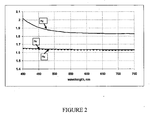
- the obtained data were used to calculate the refractive indices (nx, ny, and nz) presented in Figure 2 .
- the measurements showed essentially small values of the absorption coefficients of the organic layer.
- This example describes the preparation of an organic layer from a lyotropic liquid crystal solution.
- a mixture of 2(3)-sulfo -6,7-dihydrobenzimidazo[1,2-c]quinazoline-6-one- 9-carboxylic acid and 2(3)-sulfo -6,7-dihydrobenzimidazo[1,2-c]quinazoline-6-one-10 carboxylic acid (2g) obtained as described in Example 1 is stirred for 1 hour at a temperature of 20°C in a mixture of 9.0 ml of deionised water with 2.0 mi of a 10% aqueous ammonia solution until a lyotropic liquid crystal solution is formed.
- the obtained solution is applied onto a pre-treated glass plate surface with a Mayer rod #2.5 moved at a linear velocity of 15 mm/s and is dried after that.
- the optical transmission spectrum is measured in a wavelength range from 400 to 700 nm using a Cary 500 spectrophotometer.
- the optical transmission of the organic layer is measured using the light beams linearly polarized parallel and perpendicular to the coating direction - T par and T per , respectively.
- the obtained data were used to calculate the refractive indices (nx, ny, and nz) presented in Figure 3 .
- the measurements showed essentially small values of the absorption coefficients of the organic layer.
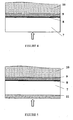
- FIG. 4 shows the cross section of anisotropic an optical film formed on substrate 7.
- the film comprises organic layer 8, adhesive layer 9, and protective layer 10.
- Substrate 7 is made of poly(ethylene terephthalate) (PET) (e.g., Toray QT34/QT10/QT40, or Hostaphan 4607, or Dupont Teijin Film MT582).
- PET poly(ethylene terephthalate)
- the organic layer can be manufactured using the methods described in Example 6.
- the polymer layer 10 protects the anisotropic optical film from damage in the course of its transportation.
- This anisotropic optical film is a semiproduct, which can be used as an external retarder, for example, in LCDs.
- the remaining film is applied onto an LCD glass with adhesive layer 9.
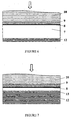
- An anisotropic optical film with an organic layer 11 ( Figure 5 ) and otherwise identical to the film described above can be applied to the LCD front surface.
- an antireflection layer of silicon dioxide (SiO 2 ) reduces by 30% the fraction of light reflected from the LCD front surface.
- an additional reflective layer 12 can be formed on the rear substrate surface ( Figure 6 ).
- the reflective layer can be obtained, for example, by depositing an aluminium film.
- Figure 7 shows the organic layer 8 is applied onto the diffuse or specular semitransparent reflector 12 that serves as a substrate ( Figure 7 ).
- the reflector layer 12 may be also covered with planarization layer 13 (optional), which can be made of polyurethane, an acrylic polymer, or any other material.
- the substrate 12 can be made of PET (e.g., Toray QT34/QT10/QT40, Hostaphan 4607, or Dupont Teijin Film MT582).
- the organic layer can be manufactured using the method described in Example 6.
- the adhesive layer 9 and the protective layer 10 are applied on top of the organic layer.
- This example describes the preparation of an organic layer from a gel-like aqueous solution of supramolecules.
- a mixture of sulfo-carboxy derivative of 6,7-dihydrobenzimidazo[1,2-c]quinazoline-6-one (1.3 g) obtained as described in Example 1 is stirred for 1 hour at temperature of 40°C in a mixture of 22.0 ml of deionised water with 1.0 g of anhydrous Zinc oxide plus 2.0 ml of a 10% aqueous sodium hydroxide until a clear solution is formed.
- Solution 1 is set to pH level 7.0 by adding a few drops of 1% aqueous Sodium hydroxide solution with simultaneous mixing with use of a magnetic stirrer with a pH-meter electrode immersed into liquid.
- the obtained solution (Solution 2) is concentrated on a rotary evaporator until concentration of sutfo-carboxy derivative of 6,7-dihydrobenzimidazo[1,2-c]quinazoline-6-one equal to 7% (w/w%) is reached.
- concentration of sutfo-carboxy derivative of 6,7-dihydrobenzimidazo[1,2-c]quinazoline-6-one equal to 7% (w/w%) is reached.
- the obtained solution (Solution 3) is applied onto a pretreated glass plate surface with a Mayer rod #4 moved at a linear velocity of 10 mm/s, and then is dried in an airflow.
- the optical transmission spectrum is measured in a wavelength range from 400 to 700 nm using a Cary 500 spectrophotometer.
- the optical transmission of the organic layer is measured using the light beams linearly polarized parallel and perpendicular to the coating direction - T par and T per , respectively.
- the obtained data were used to calculate the refractive indices (nx, ny, and nz ).
- the measurements showed essentially small values of the absorption coefficients of the organic layer.
- This example describes the preparation an organic layer from a gel-like aqueous solution of supramolecules.
- a mixture of sulfo-carboxy derivative of 6,7-dihydrobenzimidazo[1,2-c]quinazoline-6-one (1 g) obtained as described in Example 1 is stirred for 1 hour at temperature of 40°C in a mixture of 39.0 ml of deionised water with 0.3 g of anhydrous Aluminium chloride plus 2.0 ml of a 10% aqueous sodium hydroxide until a clear solution is formed.
- the pH of the obtained solution (Solution 1) is controlled by an additional amount of 1% water Sodium hydroxide solution.
- Solution 1 is set to pH level 6.54 by means of adding few drops of 1 % aqueous Sodium hydroxide solution while mixed on a magnetic stirrer with a pH-meter electrode immersed into liquid.
- the obtained solution (Solution 2) is applied onto a pretreated glass plate surface with a Mayer rod #4 moved at a linear velocity of 10 mm/s, and is then dried in an airflow.
- the optical transmission spectrum is measured in a wavelength range from 400 to 700 nm using a Cary 500 spectrophotometer.
- the optical transmission of the organic layer is measured using the light beams linearly polarized parallel and perpendicular to the coating direction - T par and T per , respectively.
- the obtained data were used to calculate the refractive indices (nx, ny, and nz ).
- the measurements showed essentially small values of the absorption coefficients of the organic layer.
Landscapes
- Physics & Mathematics (AREA)
- Chemical & Material Sciences (AREA)
- Organic Chemistry (AREA)
- General Physics & Mathematics (AREA)
- Optics & Photonics (AREA)
- Polarising Elements (AREA)
- Liquid Crystal Substances (AREA)
Claims (18)
- Ein 6,7-dihydrobenzimidazo-[1,2-c]-quinazolin-6-one-Derivat der allgemeinen Strukturformel
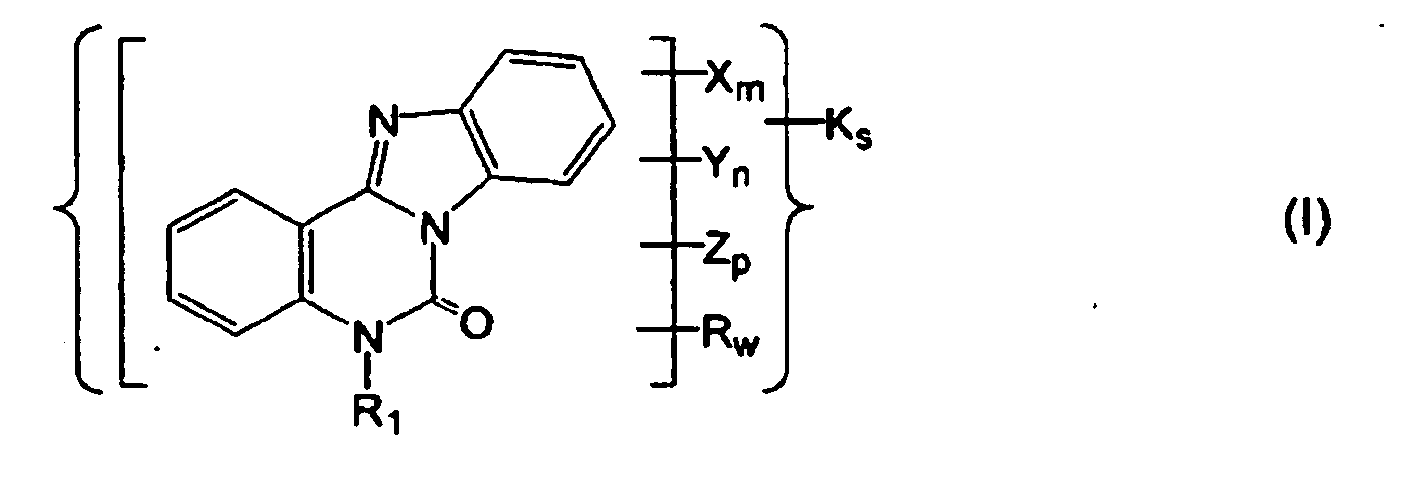 wobei X eine Carbongruppe COOH ist,m 0, 1, 2, oder 3 ist,Y eine Sulfongruppe SO3H ist,n 0, 1, 2 oder 3 ist,Z eine Amidgruppe L-NH2 ist,p 0, 1, 2 oder 3 ist;K ein Gegenion ist, das aus der Liste bestehend aus H+, NH4 +, Na+, K+, Li+, Mg2+, Ca2+, Zn2+ und Al3+ ausgewählt wird,s die Anzahl der Gegenionen ist, die für den neutralen Zustand des Moleküls sorgen,R ein Substituent ist, das aus der Liste bestehend aus CH3, C2H5, NO2, Cl, Br, F, CF3, CN, OH, OCH3, OC2H5, OCOCH3, OCN, SCN, NH2 und NHCOCH3 ausgewählt wird;w 0, 1, 2, 3 oder 4 ist,R1 ein Substituent ist, das aus der Liste bestehend aus H, CH3, C2H5, C3H7, i-C3H7, CH2CH2CH2CH3, CH(CH3)CH2CH3, CH2CH(CH3)CH3 und C(CH3)3 ausgewählt wird, undL eine Verbindungsgruppe ist, wobei die Werte von mindestens zwei der genannten Ganzahlen m, n und p nicht gleich 0 sind und das genannte Derivat sich aus mindestens zwei verschiedenen Gruppen der Listen, die sich aus X, Y und Z zusammensetzen, zusammensetzt, undwobei das genannte Derivat auftretende elektromagnetische Strahlung im sichtbaren Spektralbereich nicht erheblich absorbiert.
 - Ein 6,7-dihydrobenzimidazo-[1,2-c]-quinazolin-6-one-Derivat nach Anspruch 1, wobei die Absorption elektromagnetischer Strahlung weiterhin in mindestens einem vorbestimmten Wellenlängenunterbereich des UV-Spektralbereichs gewährleistet wird.
- Ein 6,7-dihydrobenzimidazo-[1,2-c]-quinazolin-6-one-Derivat nach Anspruch 1 oder 2, wobei L CO oder SO2 ist.
- Ein 6,7-dihydrobenzimidazo-[1,2-c]-quinazolin-6-one-Derivat nach einem der Ansprüche 1 bis 3, wobei das genannte Derivat die allgemeine Strukturformel aus der Gruppe bestehend aus den Strukturformeln 1 bis 20 hat:


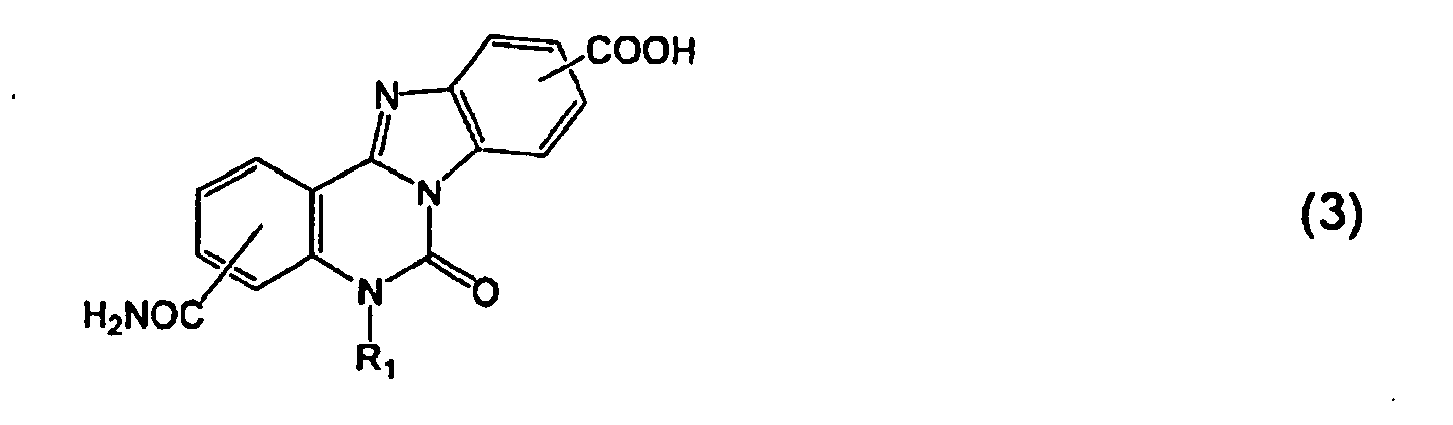


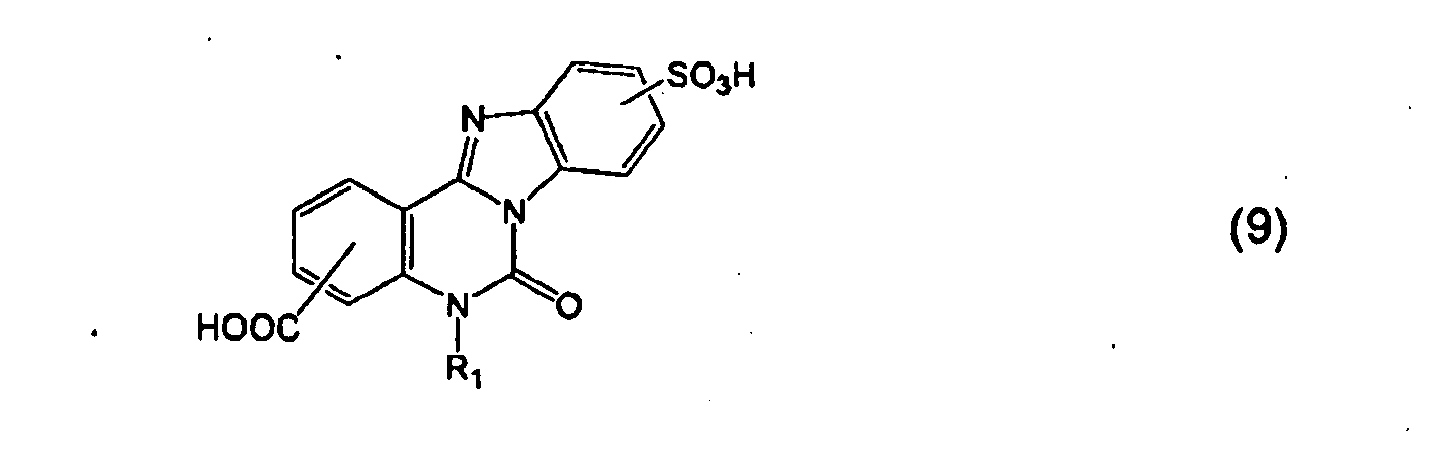


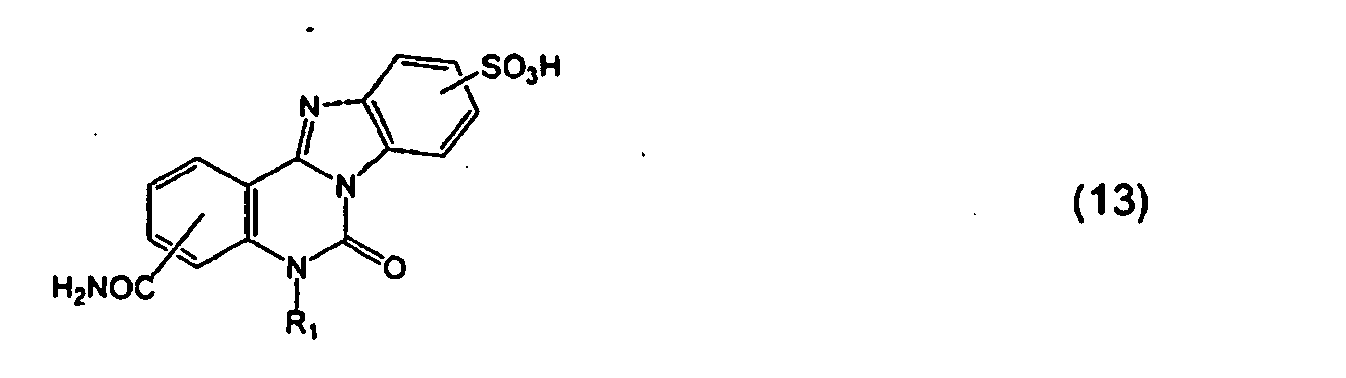


- Ein 6,7-dihydrobenzimidazo-[1,2-c]-quinazolin-6-one-Derivat, das aus den folgenden Verbindungen ausgewählt wird:2(3)-sulfo-6,7-dihydrobenzimidazo[1,2-c]-quinazolin-6-one-9-Carbonsäure2(3)-sulfo-6,7-dihydrobenzimidazo[1,2-c]-quinazolin-6-one-10-Carbonsäure2(3)-sulfonamid-6,7-dihydrobenzimidazo[1,2-c]-quinazolin-6-one-9-Carbonsäure2(3)-sulfonamid-6,7-dihydrobenzimidazo[1,2-c]-quinazolin-6-one-10-Carbonsäure2(3)-sulfo-6,7-dihydrobenzimidazo[1,2-c]-quinazolin-6-one-9-Carbonsäureamid2(3)-sulfo-6,7-dihydrobenzimidazo[1,2-c]-quinazolin-6-one-10-Carbonsäureamid,6,7-dihydrobenzimidazo[1,2-c]-quinazolin-6-one-sulfo-Sulfonamide.
- Eine anisotrope optische Folie bestehend aus
einem Trägermaterial mit einer Vorder- und Rückfläche, und
mindestens einer organischen Schicht, die auf die vordere Oberfläche des Trägermaterials aufgetragen wird, wobei sich die organische Schicht aus mindestens einem 6,7-dihydrobenzimidazo-[1,2-c]-quinazolin-6-one-Derivat der allgemeinen Strukturformel wobei X eine Carbongruppe COOH ist,m 0, 1, 2, oder 3 ist,Y eine Sulfongruppe SO3H ist,n 0, 1, 2 oder 3 ist,Z eine Säureamidgruppe L-NH2 ist,p 0, 1, 2 oder 3 ist;K ein Gegenion ist, das aus der Liste bestehend aus H+, NH4 +, Na+, K+, Li+, Mg2+, Ca2+, Zn2+, Al3+ und Ba2+ ausgewählt wird,s die Anzahl der Gegenionen ist, die für den neutralen Zustand des Moleküls sorgen,R ein Substituent ist, das aus der Liste bestehend aus CH3, C2H5, NO2, Cl, Br, F, CF3, CN, OH, OCH3, OC2H5, OCOCH3, OCN, SCN, NH2 und NHCOCH3 ausgewählt wird;w 0, 1, 2, 3 oder 4 ist,R1 ein Substituent ist, das aus der Liste bestehend aus H, CH3, C2H5, C3H7, i-C3H7, CH2CH2CH2CH3, CH(CH3)CH2CH3, CH2CH(CH3)CH3 und C(CH3)3 ausgewählt wird, undL eine Verbindungsgruppe ist,wobei die Werte von mindestens zwei der genannten Ganzahlen m, n und p nicht gleich 0 sind und das genannte Derivat sich aus mindestens zwei verschiedenen Gruppen der Listen, die sich aus X, Y und Z zusammensetzen, zusammensetzt, undwobei die genannte organische Schicht auftretende elektromagnetische Strahlung im sichtbaren Spektralbereich nicht erheblich absorbiert.
 - Eine anisotrope optische Folie nach Anspruch 6, wobei die genannte organische Schicht im Wesentlichen nicht in Wasser und/oder mit Wasser mischbaren Lösungsmitteln ist.
- Eine anisotrope optische Folie nach Anspruch 6 oder 7, bei der die genannte organische Schicht zwei oder mehr verschiedene 6,7-dihydrobenzimidazo-[1,2-c]-quinazolin-6-one-Derivate der allgemeinen Strukturformel I enthält, die jeweils die Absorption elektromagnetischer Strahlung in mindestens einem vorbestimmten Wellenlängenunterbereich des UV-Spektralbereichs gewährleisten.
- Eine anisotrope optische Folie nach einem der Ansprüche 6 bis 8, wobei die Brechzahlen auf den Ebenen nx und ny und die Brechzahl in der normalen Richtung nz die folgende Bedingung für elektromagnetische Strahlung im sichtbaren Spektralbereich erfüllen:

- Eine anisotrope optische Folie nach Anspruch 9, wobei die Brechzahlen auf den gleichen Ebenen (nx und ny) und die Dicke der organischen Schicht d die folgende Bedingung erfüllen:

- Eine anisotrope optische Folie nach Anspruch 8, wobei die Brechzahlen auf den Ebenen nx und ny und die Brechzahl in der normalen Richtung nz die folgende Bedingungen für elektromagnetische Strahlung im sichtbaren Spektralbereich erfüllen:

- Eine anisotrope optische Folie nach Anspruch 11, wobei die Brechzahlen ny und nz und die Dicke der organischen Schicht d die folgende Bedingung erfüllen:

- Eine anisotrope optische Folie nach einem der Ansprüche 6 bis 12, wobei das Trägermaterial für elektromagnetische Strahlung im sichtbaren Spektralbereich transparent ist und sich aus Material zusammensetzt, das aus der Liste, die sich aus einem Polymer und einem Glas zusammensetzt, gewählt wird.
- Eine anisotrope optische Folie nach einem der Ansprüche 6 bis 13, wobei das Trägermaterial ein Glas enthält.
- Eine anisotrope optische Folie nach einem der Ansprüche 6 bis 14, die zudem eine oder mehrere Schichten aus der Liste enthält, die eine reflexive Schicht, die auf die hintere Oberfläche des Trägermaterials aufgetragen wird, eine Planarisationsschicht, die auf die vordere Oberfläche des Trägermaterials aufgetragen wird, und eine zusätzliche transparente Haftschicht, die auf die organische Schicht aufgetragen wird, sowie eine Schutzschicht, die auf die transparente Haftschicht aufgetragen wird, enthält.
- Eine anisotrope optische Folie nach einem der Ansprüche 6 bis 15, wobei das Trägermaterial eine Spiegelreflektor, ein diffuser Reflektor oder reflexiver Polarisator ist.
- Eine anisotrope optische Folie nach einem der Ansprüche 6 bis 16, bestehend aus einer oder mehreren organischen Schichten, die verschiedene 6,7-dihydrobenzimidazo-[1,2-c]-quinazolin-6-one-Derivate der allgemeinen Strukturformel I enthält, die jeweils die Absorption elektromagnetischer Strahlung in mindestens einem vorbestimmten Wellenlängenunterbereich des UV-Spektralbereichs gewährleisten.
- Eine Methode für die Herstellung einer anisotropen optischen Folie, die sich aus den folgenden Schritten zusammensetzt:(a) Auftragen einer wässrigen Lösung von Supramolekülen, die aus einem oder mehreren 6,7-dihydrobenzimidazo-[1,2-c]-quinazolin-6-one-Derivate gebildet werden, auf einem Trägermaterial und(b) Trocknen der genannten wässrigen Lösung an Supramolekülen zwecks Bildung einer soliden Schicht, wobei das genannte 6,7-dihydrobenzimidazo-[1,2-c]-quinazolin-6-one-Derivat die folgende allgemeines Strukturformel hat:
 wobei X eine Carbongruppe COOH ist,m 0, 1, 2, oder 3 ist,Y eine Sulfongruppe S03H ist,n 0, 1, 2 oder 3 ist,Z eine Säureamidgruppe L-NH2 ist,p 0, 1,2 oder 3 ist;K ein Gegenion ist, das aus der Liste bestehend aus H+, NH4 +, Na+, K+, Li+, Mg2+, Ca2+, Zn2+ und Al3+ ausgewählt wird,s die Anzahl der Gegenionen ist, die für den neutralen Zustand des Moleküls sorgen,R ein Substituent ist, das aus der Liste bestehend aus CH3, C2H5, NO2, Cl, Br, F, CF3, CN, OH, OCH3, OC2H5, OCOCH3, OCN, SCN, NH2 und NHCOCH3 ausgewählt wird;w 0,1, 2, 3 oder 4 ist,R1 ein Substituent ist, das aus der Liste bestehend aus H, CH3, C2H5, C3H7, i-C3H7, CH2CH2CH2CH3, CH(CH3)CH2CH3, CH2CH(CH3)CH3 und C(CH3)3 ausgewählt wird, undL eine Verbindungsgruppe ist,wobei die Werte von mindestens zwei der genannten Ganzahlen m, n und p nicht gleich 0 sind und das genannte Derivat sich aus mindestens zwei verschiedenen Gruppen der Listen, die sich aus X, Y und Z zusammensetzen, zusammensetzt.
Applications Claiming Priority (2)
| Application Number | Priority Date | Filing Date | Title |
|---|---|---|---|
| GBGB0600764.5A GB0600764D0 (en) | 2006-01-13 | 2006-01-13 | Organic compound, optical crystal film and method of production thereof |
| PCT/GB2007/000101 WO2007080419A1 (en) | 2006-01-13 | 2007-01-15 | Organic compound, anisotropic optical film and method of production thereof |
Publications (2)
| Publication Number | Publication Date |
|---|---|
| EP1984372A1 EP1984372A1 (de) | 2008-10-29 |
| EP1984372B1 true EP1984372B1 (de) | 2009-07-22 |
Family
ID=35998064
Family Applications (1)
| Application Number | Title | Priority Date | Filing Date |
|---|---|---|---|
| EP07704907A Not-in-force EP1984372B1 (de) | 2006-01-13 | 2007-01-15 | Organische verbindung, anisotroper optischer film und verfahren zu dessen herstellung |
Country Status (8)
| Country | Link |
|---|---|
| US (2) | US8865895B2 (de) |
| EP (1) | EP1984372B1 (de) |
| JP (1) | JP2009523256A (de) |
| CN (1) | CN101384598A (de) |
| DE (1) | DE602007001677D1 (de) |
| ES (1) | ES2326758T3 (de) |
| GB (1) | GB0600764D0 (de) |
| WO (1) | WO2007080419A1 (de) |
Families Citing this family (19)
| Publication number | Priority date | Publication date | Assignee | Title |
|---|---|---|---|---|
| GB0600764D0 (en) | 2006-01-13 | 2006-02-22 | Crysoptix Ltd | Organic compound, optical crystal film and method of production thereof |
| GB0709606D0 (en) | 2007-05-18 | 2007-06-27 | Crysoptix Ltd | Compensated in-Plane switching mode liquid crystal display |
| GB0718154D0 (en) * | 2007-09-17 | 2007-10-24 | Crysoptix Ltd | Colour liquid crystal display and patterned compensation panel |
| US8142863B2 (en) * | 2008-04-25 | 2012-03-27 | Crysoptix, KK | Color liquid crystal display and compensation panel |
| US8895118B2 (en) * | 2010-11-09 | 2014-11-25 | Crysoptix K.K. | Negative dispersion retardation plate and achromatic circular polarizer |
| US9730943B2 (en) * | 2010-11-11 | 2017-08-15 | Bayer Intellectual Property Gmbh | Alkoxy-substituted 2,3-dihydroimidazo[1,2-C]quinazolines |
| WO2012120897A1 (ja) * | 2011-03-10 | 2012-09-13 | コニカミノルタアドバンストレイヤー株式会社 | 位相差フィルム、偏光板、液晶表示装置及び化合物 |
| US9360596B2 (en) | 2013-04-24 | 2016-06-07 | Light Polymers Holding | Depositing polymer solutions to form optical devices |
| WO2015162495A1 (en) | 2014-04-23 | 2015-10-29 | Light Polymers B.V. | Liquid crystal article and fabrication thereof |
| CN107592939B (zh) | 2014-11-04 | 2020-05-05 | 电容器科学股份公司 | 储能器件及其生产方法 |
| US9829617B2 (en) | 2014-11-10 | 2017-11-28 | Light Polymers Holding | Polymer-small molecule film or coating having reverse or flat dispersion of retardation |
| US9941051B2 (en) | 2015-06-26 | 2018-04-10 | Capactor Sciences Incorporated | Coiled capacitor |
| US9856172B2 (en) | 2015-08-25 | 2018-01-02 | Light Polymers Holding | Concrete formulation and methods of making |
| US10026553B2 (en) | 2015-10-21 | 2018-07-17 | Capacitor Sciences Incorporated | Organic compound, crystal dielectric layer and capacitor |
| US10403435B2 (en) | 2017-12-15 | 2019-09-03 | Capacitor Sciences Incorporated | Edder compound and capacitor thereof |
| US10962696B2 (en) | 2018-01-31 | 2021-03-30 | Light Polymers Holding | Coatable grey polarizer |
| US11370914B2 (en) | 2018-07-24 | 2022-06-28 | Light Polymers Holding | Methods of forming polymeric polarizers from lyotropic liquid crystals and polymeric polarizers formed thereby |
| CA3109809A1 (en) * | 2018-08-20 | 2020-02-27 | Duke University | Methods and compositions for drugs to treat ophthalmic diseases |
| US12072520B2 (en) | 2021-11-11 | 2024-08-27 | Light Polymers Holding | Linear polarizers and methods of forming a linear polarizer |
Family Cites Families (11)
| Publication number | Priority date | Publication date | Assignee | Title |
|---|---|---|---|---|
| RU2047643C1 (ru) | 1993-05-21 | 1995-11-10 | Хан Ир Гвон | Материал для поляризующих покрытий |
| US6767594B1 (en) | 1997-12-16 | 2004-07-27 | Gosudarstvenny Nauchny Tsentr Rossiiskoi | Polarizer and liquid crystal display element |
| US7113337B2 (en) | 2001-07-10 | 2006-09-26 | Nitto Denko Corporation | Multilayer optical coating |
| RU2002117253A (ru) | 2002-06-28 | 2003-12-20 | ООО "Оптива-Технологи " | Сульфопроизводные 1,8-нафтоилен-1',2'-бензимидазола, лиотропная жидкокристаллическая система и анизотропная пленка на их основе |
| US20040028839A1 (en) * | 2002-08-07 | 2004-02-12 | Paukshto Michael V. | Optical anisotropic film |
| GB0600763D0 (en) * | 2006-01-13 | 2006-02-22 | Crysoptix Ltd | 6, 7-dihydrobenzimidazo[1,2-C]quininazolin-6-one carboxylic acid, its esters and method of synthesis thereof |
| GB0600764D0 (en) | 2006-01-13 | 2006-02-22 | Crysoptix Ltd | Organic compound, optical crystal film and method of production thereof |
| GB0607573D0 (en) * | 2006-04-13 | 2006-05-24 | Crysoptix Ltd | Backlight module and liquid crystal display incorporating the same |
| GB0611184D0 (en) * | 2006-06-06 | 2006-07-19 | Crysoptix Ltd | Liquid crystal display operating in a vertically aligned mode |
| GB0709606D0 (en) * | 2007-05-18 | 2007-06-27 | Crysoptix Ltd | Compensated in-Plane switching mode liquid crystal display |
| US8142863B2 (en) * | 2008-04-25 | 2012-03-27 | Crysoptix, KK | Color liquid crystal display and compensation panel |
-
2006
- 2006-01-13 GB GBGB0600764.5A patent/GB0600764D0/en not_active Ceased
-
2007
- 2007-01-15 CN CNA200780005351XA patent/CN101384598A/zh active Pending
- 2007-01-15 DE DE602007001677T patent/DE602007001677D1/de active Active
- 2007-01-15 WO PCT/GB2007/000101 patent/WO2007080419A1/en not_active Ceased
- 2007-01-15 ES ES07704907T patent/ES2326758T3/es active Active
- 2007-01-15 EP EP07704907A patent/EP1984372B1/de not_active Not-in-force
- 2007-01-15 JP JP2008549931A patent/JP2009523256A/ja not_active Withdrawn
- 2007-01-15 US US12/160,404 patent/US8865895B2/en active Active
-
2014
- 2014-09-16 US US14/488,045 patent/US9733406B2/en active Active
Also Published As
| Publication number | Publication date |
|---|---|
| JP2009523256A (ja) | 2009-06-18 |
| US20100039705A1 (en) | 2010-02-18 |
| US20150062694A1 (en) | 2015-03-05 |
| WO2007080419A1 (en) | 2007-07-19 |
| US9733406B2 (en) | 2017-08-15 |
| EP1984372A1 (de) | 2008-10-29 |
| DE602007001677D1 (de) | 2009-09-03 |
| ES2326758T3 (es) | 2009-10-19 |
| US8865895B2 (en) | 2014-10-21 |
| CN101384598A (zh) | 2009-03-11 |
| GB0600764D0 (en) | 2006-02-22 |
Similar Documents
| Publication | Publication Date | Title |
|---|---|---|
| EP1984372B1 (de) | Organische verbindung, anisotroper optischer film und verfahren zu dessen herstellung | |
| US7045177B2 (en) | Sulfoderivatives of acenaphtho[1,2-b]quinoxaline, lyotropic liquid crystal and anisotropic film on their base | |
| TW555836B (en) | Liquid crystal materials and alignment structures and optical devices containing same | |
| EP1984373B1 (de) | 6,7-dihydrobenzimidazo[1,2-c]chinazolin-6-oncarbonsäuren, ihre ester und verfahren zu ihrer synthese | |
| EP2044483B1 (de) | In einem vertikal ausgerichteten modus arbeitende flüssigkristallanzeige | |
| US9488763B2 (en) | Polycyclic organic compound, optically anisotropic film and method of production thereof | |
| US20090191394A1 (en) | Oarganic Compound, Optical Crystal Film and Method of Production Thereof | |
| WO2008142635A2 (en) | Compensated in-plane switching mode liquid crystal display | |
| EP1551902A2 (de) | Anisotrope filme auf basis von 1,8-naphthoylen-1,2-benzimidazolsulfonaten und lyotropen flüssigkristallsystemen und herstellungsverfahren | |
| JP2010026024A (ja) | 異方性膜用組成物、異方性膜、偏光素子及びアゾ化合物 | |
| JP2006330710A (ja) | フィルム及びその製造方法 | |
| WO2009037565A2 (en) | Colour liquid crystal display and patterned compensation panel | |
| WO2021200987A1 (ja) | 光学異方性膜、円偏光板、表示装置 |
Legal Events
| Date | Code | Title | Description |
|---|---|---|---|
| PUAI | Public reference made under article 153(3) epc to a published international application that has entered the european phase |
Free format text: ORIGINAL CODE: 0009012 |
|
| 17P | Request for examination filed |
Effective date: 20080813 |
|
| AK | Designated contracting states |
Kind code of ref document: A1 Designated state(s): AT BE BG CH CY CZ DE DK EE ES FI FR GB GR HU IE IS IT LI LT LU LV MC NL PL PT RO SE SI SK TR |
|
| GRAP | Despatch of communication of intention to grant a patent |
Free format text: ORIGINAL CODE: EPIDOSNIGR1 |
|
| GRAS | Grant fee paid |
Free format text: ORIGINAL CODE: EPIDOSNIGR3 |
|
| GRAA | (expected) grant |
Free format text: ORIGINAL CODE: 0009210 |
|
| DAX | Request for extension of the european patent (deleted) | ||
| AK | Designated contracting states |
Kind code of ref document: B1 Designated state(s): AT BE BG CH CY CZ DE DK EE ES FI FR GB GR HU IE IS IT LI LT LU LV MC NL PL PT RO SE SI SK TR |
|
| REG | Reference to a national code |
Ref country code: GB Ref legal event code: FG4D |
|
| REG | Reference to a national code |
Ref country code: CH Ref legal event code: EP |
|
| REG | Reference to a national code |
Ref country code: IE Ref legal event code: FG4D |
|
| REF | Corresponds to: |
Ref document number: 602007001677 Country of ref document: DE Date of ref document: 20090903 Kind code of ref document: P |
|
| REG | Reference to a national code |
Ref country code: ES Ref legal event code: FG2A Ref document number: 2326758 Country of ref document: ES Kind code of ref document: T3 |
|
| NLV1 | Nl: lapsed or annulled due to failure to fulfill the requirements of art. 29p and 29m of the patents act | ||
| PG25 | Lapsed in a contracting state [announced via postgrant information from national office to epo] |
Ref country code: SE Free format text: LAPSE BECAUSE OF FAILURE TO SUBMIT A TRANSLATION OF THE DESCRIPTION OR TO PAY THE FEE WITHIN THE PRESCRIBED TIME-LIMIT Effective date: 20090722 Ref country code: LT Free format text: LAPSE BECAUSE OF FAILURE TO SUBMIT A TRANSLATION OF THE DESCRIPTION OR TO PAY THE FEE WITHIN THE PRESCRIBED TIME-LIMIT Effective date: 20090722 Ref country code: AT Free format text: LAPSE BECAUSE OF FAILURE TO SUBMIT A TRANSLATION OF THE DESCRIPTION OR TO PAY THE FEE WITHIN THE PRESCRIBED TIME-LIMIT Effective date: 20090722 Ref country code: IS Free format text: LAPSE BECAUSE OF FAILURE TO SUBMIT A TRANSLATION OF THE DESCRIPTION OR TO PAY THE FEE WITHIN THE PRESCRIBED TIME-LIMIT Effective date: 20091122 Ref country code: FI Free format text: LAPSE BECAUSE OF FAILURE TO SUBMIT A TRANSLATION OF THE DESCRIPTION OR TO PAY THE FEE WITHIN THE PRESCRIBED TIME-LIMIT Effective date: 20090722 |
|
| PG25 | Lapsed in a contracting state [announced via postgrant information from national office to epo] |
Ref country code: LV Free format text: LAPSE BECAUSE OF FAILURE TO SUBMIT A TRANSLATION OF THE DESCRIPTION OR TO PAY THE FEE WITHIN THE PRESCRIBED TIME-LIMIT Effective date: 20090722 Ref country code: PL Free format text: LAPSE BECAUSE OF FAILURE TO SUBMIT A TRANSLATION OF THE DESCRIPTION OR TO PAY THE FEE WITHIN THE PRESCRIBED TIME-LIMIT Effective date: 20090722 Ref country code: SI Free format text: LAPSE BECAUSE OF FAILURE TO SUBMIT A TRANSLATION OF THE DESCRIPTION OR TO PAY THE FEE WITHIN THE PRESCRIBED TIME-LIMIT Effective date: 20090722 Ref country code: NL Free format text: LAPSE BECAUSE OF FAILURE TO SUBMIT A TRANSLATION OF THE DESCRIPTION OR TO PAY THE FEE WITHIN THE PRESCRIBED TIME-LIMIT Effective date: 20090722 |
|
| PG25 | Lapsed in a contracting state [announced via postgrant information from national office to epo] |
Ref country code: PT Free format text: LAPSE BECAUSE OF FAILURE TO SUBMIT A TRANSLATION OF THE DESCRIPTION OR TO PAY THE FEE WITHIN THE PRESCRIBED TIME-LIMIT Effective date: 20091122 Ref country code: BG Free format text: LAPSE BECAUSE OF FAILURE TO SUBMIT A TRANSLATION OF THE DESCRIPTION OR TO PAY THE FEE WITHIN THE PRESCRIBED TIME-LIMIT Effective date: 20091022 |
|
| PG25 | Lapsed in a contracting state [announced via postgrant information from national office to epo] |
Ref country code: DK Free format text: LAPSE BECAUSE OF FAILURE TO SUBMIT A TRANSLATION OF THE DESCRIPTION OR TO PAY THE FEE WITHIN THE PRESCRIBED TIME-LIMIT Effective date: 20090722 Ref country code: CZ Free format text: LAPSE BECAUSE OF FAILURE TO SUBMIT A TRANSLATION OF THE DESCRIPTION OR TO PAY THE FEE WITHIN THE PRESCRIBED TIME-LIMIT Effective date: 20090722 Ref country code: RO Free format text: LAPSE BECAUSE OF FAILURE TO SUBMIT A TRANSLATION OF THE DESCRIPTION OR TO PAY THE FEE WITHIN THE PRESCRIBED TIME-LIMIT Effective date: 20090722 Ref country code: EE Free format text: LAPSE BECAUSE OF FAILURE TO SUBMIT A TRANSLATION OF THE DESCRIPTION OR TO PAY THE FEE WITHIN THE PRESCRIBED TIME-LIMIT Effective date: 20090722 |
|
| PLBE | No opposition filed within time limit |
Free format text: ORIGINAL CODE: 0009261 |
|
| STAA | Information on the status of an ep patent application or granted ep patent |
Free format text: STATUS: NO OPPOSITION FILED WITHIN TIME LIMIT |
|
| PG25 | Lapsed in a contracting state [announced via postgrant information from national office to epo] |
Ref country code: SK Free format text: LAPSE BECAUSE OF FAILURE TO SUBMIT A TRANSLATION OF THE DESCRIPTION OR TO PAY THE FEE WITHIN THE PRESCRIBED TIME-LIMIT Effective date: 20090722 Ref country code: BE Free format text: LAPSE BECAUSE OF FAILURE TO SUBMIT A TRANSLATION OF THE DESCRIPTION OR TO PAY THE FEE WITHIN THE PRESCRIBED TIME-LIMIT Effective date: 20090722 |
|
| 26N | No opposition filed |
Effective date: 20100423 |
|
| PG25 | Lapsed in a contracting state [announced via postgrant information from national office to epo] |
Ref country code: MC Free format text: LAPSE BECAUSE OF NON-PAYMENT OF DUE FEES Effective date: 20100131 |
|
| PG25 | Lapsed in a contracting state [announced via postgrant information from national office to epo] |
Ref country code: GR Free format text: LAPSE BECAUSE OF FAILURE TO SUBMIT A TRANSLATION OF THE DESCRIPTION OR TO PAY THE FEE WITHIN THE PRESCRIBED TIME-LIMIT Effective date: 20091023 |
|
| PG25 | Lapsed in a contracting state [announced via postgrant information from national office to epo] |
Ref country code: IE Free format text: LAPSE BECAUSE OF NON-PAYMENT OF DUE FEES Effective date: 20100115 |
|
| REG | Reference to a national code |
Ref country code: CH Ref legal event code: PL |
|
| PG25 | Lapsed in a contracting state [announced via postgrant information from national office to epo] |
Ref country code: LI Free format text: LAPSE BECAUSE OF NON-PAYMENT OF DUE FEES Effective date: 20110131 Ref country code: CH Free format text: LAPSE BECAUSE OF NON-PAYMENT OF DUE FEES Effective date: 20110131 |
|
| PG25 | Lapsed in a contracting state [announced via postgrant information from national office to epo] |
Ref country code: CY Free format text: LAPSE BECAUSE OF FAILURE TO SUBMIT A TRANSLATION OF THE DESCRIPTION OR TO PAY THE FEE WITHIN THE PRESCRIBED TIME-LIMIT Effective date: 20090722 |
|
| PG25 | Lapsed in a contracting state [announced via postgrant information from national office to epo] |
Ref country code: LU Free format text: LAPSE BECAUSE OF NON-PAYMENT OF DUE FEES Effective date: 20100115 Ref country code: HU Free format text: LAPSE BECAUSE OF FAILURE TO SUBMIT A TRANSLATION OF THE DESCRIPTION OR TO PAY THE FEE WITHIN THE PRESCRIBED TIME-LIMIT Effective date: 20100123 |
|
| PG25 | Lapsed in a contracting state [announced via postgrant information from national office to epo] |
Ref country code: TR Free format text: LAPSE BECAUSE OF FAILURE TO SUBMIT A TRANSLATION OF THE DESCRIPTION OR TO PAY THE FEE WITHIN THE PRESCRIBED TIME-LIMIT Effective date: 20090722 |
|
| PGFP | Annual fee paid to national office [announced via postgrant information from national office to epo] |
Ref country code: IT Payment date: 20150126 Year of fee payment: 9 Ref country code: ES Payment date: 20150123 Year of fee payment: 9 |
|
| REG | Reference to a national code |
Ref country code: FR Ref legal event code: PLFP Year of fee payment: 10 |
|
| PG25 | Lapsed in a contracting state [announced via postgrant information from national office to epo] |
Ref country code: IT Free format text: LAPSE BECAUSE OF NON-PAYMENT OF DUE FEES Effective date: 20160115 |
|
| REG | Reference to a national code |
Ref country code: FR Ref legal event code: PLFP Year of fee payment: 11 |
|
| REG | Reference to a national code |
Ref country code: FR Ref legal event code: PLFP Year of fee payment: 12 |
|
| PGFP | Annual fee paid to national office [announced via postgrant information from national office to epo] |
Ref country code: DE Payment date: 20180116 Year of fee payment: 12 Ref country code: GB Payment date: 20180116 Year of fee payment: 12 |
|
| PG25 | Lapsed in a contracting state [announced via postgrant information from national office to epo] |
Ref country code: ES Free format text: LAPSE BECAUSE OF NON-PAYMENT OF DUE FEES Effective date: 20160116 |
|
| PGFP | Annual fee paid to national office [announced via postgrant information from national office to epo] |
Ref country code: FR Payment date: 20180116 Year of fee payment: 12 |
|
| REG | Reference to a national code |
Ref country code: ES Ref legal event code: FD2A Effective date: 20181207 |
|
| REG | Reference to a national code |
Ref country code: DE Ref legal event code: R119 Ref document number: 602007001677 Country of ref document: DE |
|
| GBPC | Gb: european patent ceased through non-payment of renewal fee |
Effective date: 20190115 |
|
| PG25 | Lapsed in a contracting state [announced via postgrant information from national office to epo] |
Ref country code: DE Free format text: LAPSE BECAUSE OF NON-PAYMENT OF DUE FEES Effective date: 20190801 Ref country code: FR Free format text: LAPSE BECAUSE OF NON-PAYMENT OF DUE FEES Effective date: 20190131 |
|
| PG25 | Lapsed in a contracting state [announced via postgrant information from national office to epo] |
Ref country code: GB Free format text: LAPSE BECAUSE OF NON-PAYMENT OF DUE FEES Effective date: 20190115 |