EP1987131B1 - Apparatus and method for monitoring cultures - Google Patents
Apparatus and method for monitoring cultures Download PDFInfo
- Publication number
- EP1987131B1 EP1987131B1 EP07705249A EP07705249A EP1987131B1 EP 1987131 B1 EP1987131 B1 EP 1987131B1 EP 07705249 A EP07705249 A EP 07705249A EP 07705249 A EP07705249 A EP 07705249A EP 1987131 B1 EP1987131 B1 EP 1987131B1
- Authority
- EP
- European Patent Office
- Prior art keywords
- probe
- bubble
- excluder device
- bubble excluder
- accordance
- Prior art date
- Legal status (The legal status is an assumption and is not a legal conclusion. Google has not performed a legal analysis and makes no representation as to the accuracy of the status listed.)
- Not-in-force
Links
- 238000000034 method Methods 0.000 title claims description 15
- 238000012544 monitoring process Methods 0.000 title claims description 5
- 239000000523 sample Substances 0.000 claims abstract description 152
- 238000005259 measurement Methods 0.000 claims abstract description 41
- 239000007788 liquid Substances 0.000 claims abstract description 30
- 230000007717 exclusion Effects 0.000 claims abstract description 21
- 230000003287 optical effect Effects 0.000 claims description 65
- 239000001963 growth medium Substances 0.000 claims description 42
- 238000005070 sampling Methods 0.000 claims description 29
- 239000002609 medium Substances 0.000 claims description 26
- 239000012530 fluid Substances 0.000 claims description 21
- 238000010564 aerobic fermentation Methods 0.000 claims description 5
- WYTGDNHDOZPMIW-RCBQFDQVSA-N alstonine Natural products C1=CC2=C3C=CC=CC3=NC2=C2N1C[C@H]1[C@H](C)OC=C(C(=O)OC)[C@H]1C2 WYTGDNHDOZPMIW-RCBQFDQVSA-N 0.000 claims description 4
- 210000004027 cell Anatomy 0.000 description 47
- 239000007789 gas Substances 0.000 description 28
- 230000012010 growth Effects 0.000 description 16
- 238000000855 fermentation Methods 0.000 description 14
- 230000004151 fermentation Effects 0.000 description 14
- 230000000694 effects Effects 0.000 description 7
- 238000013019 agitation Methods 0.000 description 6
- 238000003780 insertion Methods 0.000 description 5
- 230000037431 insertion Effects 0.000 description 5
- 108090000623 proteins and genes Proteins 0.000 description 5
- 102000004169 proteins and genes Human genes 0.000 description 5
- 238000011065 in-situ storage Methods 0.000 description 4
- 238000004519 manufacturing process Methods 0.000 description 4
- 229910052751 metal Inorganic materials 0.000 description 4
- 239000002184 metal Substances 0.000 description 4
- 244000005700 microbiome Species 0.000 description 4
- PEDCQBHIVMGVHV-UHFFFAOYSA-N Glycerine Chemical compound OCC(O)CO PEDCQBHIVMGVHV-UHFFFAOYSA-N 0.000 description 3
- HEMHJVSKTPXQMS-UHFFFAOYSA-M Sodium hydroxide Chemical compound [OH-].[Na+] HEMHJVSKTPXQMS-UHFFFAOYSA-M 0.000 description 3
- 230000001580 bacterial effect Effects 0.000 description 3
- 230000008901 benefit Effects 0.000 description 3
- 230000010261 cell growth Effects 0.000 description 3
- 238000004891 communication Methods 0.000 description 3
- 238000002474 experimental method Methods 0.000 description 3
- 230000007246 mechanism Effects 0.000 description 3
- 239000013612 plasmid Substances 0.000 description 3
- CURLTUGMZLYLDI-UHFFFAOYSA-N Carbon dioxide Chemical compound O=C=O CURLTUGMZLYLDI-UHFFFAOYSA-N 0.000 description 2
- LFQSCWFLJHTTHZ-UHFFFAOYSA-N Ethanol Chemical compound CCO LFQSCWFLJHTTHZ-UHFFFAOYSA-N 0.000 description 2
- NBIIXXVUZAFLBC-UHFFFAOYSA-N Phosphoric acid Chemical compound OP(O)(O)=O NBIIXXVUZAFLBC-UHFFFAOYSA-N 0.000 description 2
- 240000004808 Saccharomyces cerevisiae Species 0.000 description 2
- 235000014680 Saccharomyces cerevisiae Nutrition 0.000 description 2
- 238000005273 aeration Methods 0.000 description 2
- 238000011109 contamination Methods 0.000 description 2
- 230000008878 coupling Effects 0.000 description 2
- 238000010168 coupling process Methods 0.000 description 2
- 238000005859 coupling reaction Methods 0.000 description 2
- 238000001739 density measurement Methods 0.000 description 2
- 238000010790 dilution Methods 0.000 description 2
- 239000012895 dilution Substances 0.000 description 2
- 125000000487 histidyl group Chemical group [H]N([H])C(C(=O)O*)C([H])([H])C1=C([H])N([H])C([H])=N1 0.000 description 2
- 210000004962 mammalian cell Anatomy 0.000 description 2
- 238000000424 optical density measurement Methods 0.000 description 2
- 230000002018 overexpression Effects 0.000 description 2
- 230000037361 pathway Effects 0.000 description 2
- 229920001296 polysiloxane Polymers 0.000 description 2
- 238000000926 separation method Methods 0.000 description 2
- 238000004659 sterilization and disinfection Methods 0.000 description 2
- 238000012360 testing method Methods 0.000 description 2
- 210000005253 yeast cell Anatomy 0.000 description 2
- 229930024421 Adenine Natural products 0.000 description 1
- GFFGJBXGBJISGV-UHFFFAOYSA-N Adenine Chemical compound NC1=NC=NC2=C1N=CN2 GFFGJBXGBJISGV-UHFFFAOYSA-N 0.000 description 1
- 241000212384 Bifora Species 0.000 description 1
- 108090000790 Enzymes Proteins 0.000 description 1
- 102000004190 Enzymes Human genes 0.000 description 1
- 241000588724 Escherichia coli Species 0.000 description 1
- 241000238631 Hexapoda Species 0.000 description 1
- 101000775238 Myceliophthora thermophila (strain ATCC 42464 / BCRC 31852 / DSM 1799) ADP/ATP translocase Proteins 0.000 description 1
- 239000001888 Peptone Substances 0.000 description 1
- 108010080698 Peptones Proteins 0.000 description 1
- 101100228833 Saccharomyces cerevisiae (strain ATCC 204508 / S288c) GGC1 gene Proteins 0.000 description 1
- 239000004809 Teflon Substances 0.000 description 1
- 229920006362 Teflon® Polymers 0.000 description 1
- 238000002835 absorbance Methods 0.000 description 1
- 229960000643 adenine Drugs 0.000 description 1
- 229910000147 aluminium phosphate Inorganic materials 0.000 description 1
- 239000003242 anti bacterial agent Substances 0.000 description 1
- 229940088710 antibiotic agent Drugs 0.000 description 1
- 239000002518 antifoaming agent Substances 0.000 description 1
- 238000000149 argon plasma sintering Methods 0.000 description 1
- QVGXLLKOCUKJST-UHFFFAOYSA-N atomic oxygen Chemical compound [O] QVGXLLKOCUKJST-UHFFFAOYSA-N 0.000 description 1
- 230000008033 biological extinction Effects 0.000 description 1
- 230000015572 biosynthetic process Effects 0.000 description 1
- 230000001914 calming effect Effects 0.000 description 1
- 229940041514 candida albicans extract Drugs 0.000 description 1
- 239000001569 carbon dioxide Substances 0.000 description 1
- 229910002092 carbon dioxide Inorganic materials 0.000 description 1
- 238000004113 cell culture Methods 0.000 description 1
- 230000008859 change Effects 0.000 description 1
- 238000004140 cleaning Methods 0.000 description 1
- 238000004581 coalescence Methods 0.000 description 1
- 210000001520 comb Anatomy 0.000 description 1
- 238000007796 conventional method Methods 0.000 description 1
- 230000007423 decrease Effects 0.000 description 1
- 230000001419 dependent effect Effects 0.000 description 1
- 239000012153 distilled water Substances 0.000 description 1
- 238000009826 distribution Methods 0.000 description 1
- 239000003814 drug Substances 0.000 description 1
- 239000000839 emulsion Substances 0.000 description 1
- 239000000835 fiber Substances 0.000 description 1
- 230000002538 fungal effect Effects 0.000 description 1
- 230000014509 gene expression Effects 0.000 description 1
- HNDVDQJCIGZPNO-UHFFFAOYSA-N histidine Natural products OC(=O)C(N)CC1=CN=CN1 HNDVDQJCIGZPNO-UHFFFAOYSA-N 0.000 description 1
- 238000007654 immersion Methods 0.000 description 1
- 239000000411 inducer Substances 0.000 description 1
- 239000004615 ingredient Substances 0.000 description 1
- 230000003993 interaction Effects 0.000 description 1
- 238000002955 isolation Methods 0.000 description 1
- 238000009629 microbiological culture Methods 0.000 description 1
- 230000002438 mitochondrial effect Effects 0.000 description 1
- 238000002156 mixing Methods 0.000 description 1
- 229910052760 oxygen Inorganic materials 0.000 description 1
- 239000001301 oxygen Substances 0.000 description 1
- 230000036284 oxygen consumption Effects 0.000 description 1
- 235000019319 peptone Nutrition 0.000 description 1
- 230000008569 process Effects 0.000 description 1
- 230000001737 promoting effect Effects 0.000 description 1
- 230000009467 reduction Effects 0.000 description 1
- 230000001105 regulatory effect Effects 0.000 description 1
- 230000004044 response Effects 0.000 description 1
- 230000000630 rising effect Effects 0.000 description 1
- 230000035945 sensitivity Effects 0.000 description 1
- 239000000243 solution Substances 0.000 description 1
- 229910001220 stainless steel Inorganic materials 0.000 description 1
- 239000010935 stainless steel Substances 0.000 description 1
- 239000007858 starting material Substances 0.000 description 1
- 230000003068 static effect Effects 0.000 description 1
- 239000000126 substance Substances 0.000 description 1
- 238000002834 transmittance Methods 0.000 description 1
- XLYOFNOQVPJJNP-UHFFFAOYSA-N water Chemical compound O XLYOFNOQVPJJNP-UHFFFAOYSA-N 0.000 description 1
- 239000012138 yeast extract Substances 0.000 description 1
Images

Classifications
-
- C—CHEMISTRY; METALLURGY
- C12—BIOCHEMISTRY; BEER; SPIRITS; WINE; VINEGAR; MICROBIOLOGY; ENZYMOLOGY; MUTATION OR GENETIC ENGINEERING
- C12M—APPARATUS FOR ENZYMOLOGY OR MICROBIOLOGY; APPARATUS FOR CULTURING MICROORGANISMS FOR PRODUCING BIOMASS, FOR GROWING CELLS OR FOR OBTAINING FERMENTATION OR METABOLIC PRODUCTS, i.e. BIOREACTORS OR FERMENTERS
- C12M41/00—Means for regulation, monitoring, measurement or control, e.g. flow regulation
- C12M41/30—Means for regulation, monitoring, measurement or control, e.g. flow regulation of concentration
- C12M41/36—Means for regulation, monitoring, measurement or control, e.g. flow regulation of concentration of biomass, e.g. colony counters or by turbidity measurements
-
- B—PERFORMING OPERATIONS; TRANSPORTING
- B01—PHYSICAL OR CHEMICAL PROCESSES OR APPARATUS IN GENERAL
- B01D—SEPARATION
- B01D19/00—Degasification of liquids
- B01D19/0042—Degasification of liquids modifying the liquid flow
-
- G—PHYSICS
- G01—MEASURING; TESTING
- G01N—INVESTIGATING OR ANALYSING MATERIALS BY DETERMINING THEIR CHEMICAL OR PHYSICAL PROPERTIES
- G01N21/00—Investigating or analysing materials by the use of optical means, i.e. using sub-millimetre waves, infrared, visible or ultraviolet light
- G01N21/84—Systems specially adapted for particular applications
- G01N21/85—Investigating moving fluids or granular solids
- G01N21/8507—Probe photometers, i.e. with optical measuring part dipped into fluid sample
-
- G—PHYSICS
- G01—MEASURING; TESTING
- G01N—INVESTIGATING OR ANALYSING MATERIALS BY DETERMINING THEIR CHEMICAL OR PHYSICAL PROPERTIES
- G01N21/00—Investigating or analysing materials by the use of optical means, i.e. using sub-millimetre waves, infrared, visible or ultraviolet light
- G01N21/01—Arrangements or apparatus for facilitating the optical investigation
- G01N21/03—Cuvette constructions
- G01N21/05—Flow-through cuvettes
- G01N2021/054—Bubble trap; Debubbling
-
- Y—GENERAL TAGGING OF NEW TECHNOLOGICAL DEVELOPMENTS; GENERAL TAGGING OF CROSS-SECTIONAL TECHNOLOGIES SPANNING OVER SEVERAL SECTIONS OF THE IPC; TECHNICAL SUBJECTS COVERED BY FORMER USPC CROSS-REFERENCE ART COLLECTIONS [XRACs] AND DIGESTS
- Y10—TECHNICAL SUBJECTS COVERED BY FORMER USPC
- Y10T—TECHNICAL SUBJECTS COVERED BY FORMER US CLASSIFICATION
- Y10T29/00—Metal working
- Y10T29/49—Method of mechanical manufacture
- Y10T29/49826—Assembling or joining
-
- Y—GENERAL TAGGING OF NEW TECHNOLOGICAL DEVELOPMENTS; GENERAL TAGGING OF CROSS-SECTIONAL TECHNOLOGIES SPANNING OVER SEVERAL SECTIONS OF THE IPC; TECHNICAL SUBJECTS COVERED BY FORMER USPC CROSS-REFERENCE ART COLLECTIONS [XRACs] AND DIGESTS
- Y10—TECHNICAL SUBJECTS COVERED BY FORMER USPC
- Y10T—TECHNICAL SUBJECTS COVERED BY FORMER US CLASSIFICATION
- Y10T436/00—Chemistry: analytical and immunological testing
- Y10T436/11—Automated chemical analysis
- Y10T436/117497—Automated chemical analysis with a continuously flowing sample or carrier stream
Definitions
- the present invention relates to apparatus for, and a method of, continuous monitoring of the cell density of a cell culture within an aerated fermenter.
- the process of aerobic fermentation provides an important mechanism for the formation of certain products, such as enzymes, antibiotics, diagnostics and therapeutics.
- products are typically produced by the overexpression of a protein in cells of a microorganism, such as E. coli or S . cerevisiae.
- such substances of interest are typically produced by preparing a "starter" culture which is then used to inoculate a larger volume of culture medium.
- the culture medium is contained within a conical flask and is placed in an incubator at a desired temperature.
- the growth of cells in the culture medium is monitored by intermittent sampling of small amounts of the culture and measurements of the optical density of the culture medium with the use of an external spectrophotometer.
- measuring the optical density at approximately 600nm detects scattering of light by microorganisms and the resulting OD reading is proportional to the cell density.
- the cells grow and divide and, typically, when the optical density of the culture has reached a desired value, the overexpression of a protein of interest is induced, for example, by a change in temperature or the addition of an inducer, etc.
- Aerobic fermentation is routinely carried out on an industrial scale in stirred tanks.
- aerated liquid volume of the culture medium may comprise gas bubbles dispersed in the liquid.
- Good liquid mixing of aerated medium means that many of these gas bubbles are small enough to pass through the light path of the optical probe used to measure the cell density of the culture.
- the presence of gas bubbles in the culture medium may have an effect on the apparent cell density of the medium, because gas bubbles have different light-scattering properties compared to the culture medium and the cells that are suspended therein.
- the preferred method involves measurement of the cell density of a culture because it is less sensitive to culture conditions, such as temperature and pH.
- the measurement of the culture's optical density is carried out 'off-line' using a spectrophotometer, typically in the region of 600nm.
- a spectrophotometer typically in the region of 600nm.
- 'off-line' measurement of the optical density of a culture involves removing a sample of medium and measuring the optical density of the sample using an external spectrophotometer.
- such 'off-line' measurement typically has the disadvantages that it may increase the time, cost, and loss of culture volume and also increases the risk of contamination of the fermenter.
- the cell density of a culture may only be directly measured accurately for values below 0.8, preferably below 0.7 optical density (OD) units. This is due to the fact that above these values the relationship between the cell density and optical density is no longer linear.
- OD optical density
- the samples In order to measure OD values above 0.7-0.8, the samples must be diluted and the resulting measurements multiplied by a dilution factor, such that the OD value does not exceed 0.8 units and preferably does not exceed 0.7 units.
- dilution may introduce errors in the determination of cell density and renders on-line measurements of OD impossible.
- the 'on-line' measurement of the optical density of a culture involves the use of an in situ probe immersed in a culture medium to monitor changes in the cell density of a culture during fermentation.
- such methods have the added complication that air bubbles must be removed from the culture medium prior to measurement, in order to produce an accurate and reliable determination of the optical density.
- such methods typically require the addition of a separate device to degas the medium and consequently do not provide a method for a continuous measurement of the optical density of the medium.
- an on-line probe for monitoring concentration changes in a culture is known in the art.
- Shiloach and Bahar disclose the use of a sterilisable, on-line sensor (Cerex Corporation) that is capable of following changes in culture turbidity.
- the probe is based on light emission from a culture and provides a good correlation to off-line turbidity measurements.
- the probe can be interfaced to a data acquisition and control system such that it can provide direct measurements during the fermentation process.
- a teflon plunger with an embedded magnet moves up and down as a result of an alternating magnetic field.
- the plunger movement allows culture medium to flow into a sampling chamber provided within the probe and facilitates removal of air bubbles from the culture medium.
- the plunger movement cycles such that it is open for one minute and closed for one minute providing a new optical density value every two minutes.
- the on-line sensor overcomes the requirement associated with off-line systems wherein a sample of culture medium is removed from the fermenter in order to measure the optical density externally using a spectrophotometer, the probe disclosed by Shiloach and Bahar does not allow continuous measurement of the optical density.
- US-A-4725148 describes bubble exclusion means placed at the inlet of a conduit.
- the bubble exclusion means comprises a metal net and can be used in an aereated fermenter.
- the invention provides a bubble excluder device adapted for use with, and attachment to, a probe for continuons measurement of the cell density of a culture in a liquid medium in an aereated fermenter; the bubble excluder device comprising an inlet and an outlet to allow flow of liquid through the device; and bubble exclusion means to reduce or prevent the ingress of bubbles from the liquid medium outside the device.
- the inlet has a conduit which, in use, is substantially vertical and comprises bubble exclusion means which creates a serpentine flow path within the conduit.
- the device will comprise a sleeve which fits around the probe, the inlet and outlet allowing the liquid medium to communicate with the probe and, more especially, with a sampling aperture of the probe.
- the inlet and the outlet may be provided with a shared or common channel in the device or, more preferably, may be discrete components at different locations on the device.
- the bubble exclusion means may comprise, for example, a one-way valve or other flow restriction mechanism.
- the bubble exclusion means comprises a plurality of baffles, or perforated plates, or other mechanism of forcing a serpentine flow path.
- the bubble exclusion means may conveniently be located in the inlet and/or the outlet of the bubble excluder device.
- the bubble exclusion means may act to exclude bubbles on the basis of size, or the relative buoyancy of bubbles (relative to the liquid of the culture medium), or both size and buoyancy.
- the device comprises a channel with a cross-sectional area which is smaller than the diameter of the majority of the bubbles in the liquid medium, which will therefore be excluded from the channel.
- the bubble excluder device comprises a conduit, which conduit comprises bubble exclusion means.
- the bubble exclusion means comprises a structural feature or features which create a serpentine flow path within the conduit.
- a serpentine flow path within the conduit may be created by a plurality of overlapping baffles or perforated plates.
- Each perforated plate may comprise a single or a few relatively large perforations, or may comprise a plurality (say five or more) of relatively small perforations. Where a large number of perforations are provided, each perforation may be fairly small, such that the majority of bubbles present in the liquid medium are unable to pass through the perforated plates (note that, in such an embodiment, there is no requirement for the flow path to be serpentine) - the large number of perforations nevertheless allows for only modest resistance to flow of liquid. Where only one or two perforations are provided in each plate these must necessarily be of relatively large size (e.g. a circular hole of 4-6mm diameter) in order not to severely restrict flow of liquid, and are preferably positioned towards alternate sides of successive plates, in order to create a serpentine flow path.
- relatively large size e.g. a circular hole of 4-6mm diameter
- the conduit constitutes the inlet of the bubble excluder device, but the direction of flow of liquid through the device may vary according to localised conditions within the fermenter, such that the conduit may occasionally act as the liquid outlet, or even simultaneously as an outlet and an inlet.
- the present invention provides a bubble excluder device in accordance with the first aspect, of the invention, in combination with a probe for continuous measurement of the cell density of a culture, the probe comprising a sampling aperture exposed to the culture within the bubble excluder device to allow the probe to measure a characteristic of the culture.
- the bubble excluder device/probe combination of the present invention allows the on-line measurement of the cell density of a culture.
- the term 'on-line' refers to a bubble excluder device/probe combination which is in continuous fluid communication with the culture medium.
- the bubble excluder device/probe combination is provided in situ, i.e. in the fermenter.
- the bubble excluder device/probe combination is provided outside the fermenter, but is in continuous fluid communication with the culture medium by means of, e.g. a pipe, tube or other fluid flow channel.
- the term 'off-line' refers to the intermittent measurement of cell density of a culture.
- the provision of a conduit and an inlet means eliminates the requirement associated with the prior art wherein the culture medium must be degassed prior to measurement of the cell density.
- the present invention advantageously allows the continuous measurement of the cell density of a culture throughout fermentation.
- the measurement of the cell density of the culture medium may be made by either taking a direct reading of the transmittance of the culture or calculating an optical density value.
- the bubble excluder device/probe combination may be used to measure a characteristic of a culture such as resistance or electrical conductivity.
- the characteristic of the culture that is measured is an optical characteristic. More preferably, the characteristic measured is the optical density of a culture, such as the optical density of a culture in the range of 500-700nm. Most preferably, the characteristic measured is the optical density of a culture which is approximately 600nm or is the colour or fluorescence of a protein expressed by the cells that are cultivated in the fermenter.
- the measurement of optical density of a culture is not restricted to the range of 500-700nm and the bubble excluder device/probe combination of the present invention may be used to measure the optical density of a culture across the full waveband of a spectrophotometer, including measurement in the UV range.
- the probe which may be used in combination with the bubble excluder device of the present invention is an optical probe. More preferably, the probe of the present invention uses fibre optics to measure the optical density of the culture medium at one or more selected wavelengths. Typically, a tube or sleeve is placed around the optical fibres of the optical probe. Most preferably, the optical probe comprises two parallel optical fibres which form a light path and transmit light in opposite directions. In one embodiment, the light path passes through the sampling aperture and is reflected, for example, by means of two prisms provided at the end of the optical probe, such that the direction of the light path is reversed.
- a spectrophotometer is coupled to the optical probe, e.g. by means of optical fibres.
- the spectrophotometer measures the optical density of the culture medium at a desired wavelength or a range of wavelengths.
- the probe which may be used in combination with the bubble excluder device of the present invention allows continuous optical density measurements to be made by the spectrophotometer. Direct attachment of the spectrophotometer to the bubble excluder device/probe combination is preferred, as this avoids the requirement for external optical fibres to connect the probe to the spectrophotometer.
- a sampling aperture is provided within the light path of the optical probe. More preferably, the culture medium is continuously in fluid communication with the sampling aperture in order to allow continuous measurement of the optical density of the culture medium.
- the optical probe uses a 2mm light path.
- the optical probe uses a 1mm light path.
- the use of a 1mm light path facilitates exclusion of gas bubbles from the sampling aperture.
- the presence of gas bubbles in the culture medium may have an effect on the apparent cell density of the culture medium, because gas bubbles scatter light and displace cells.
- the use of a 1mm light path improves the accuracy of the cell density measurement and allows linear measurement of the growth of a culture at higher cell densities.
- a short light path increases the sensitivity of measurements made at higher cell densities.
- the bubble excluder device/probe combination of the invention is made by attaching a suitable bubble excluder device to a suitable probe.
- the probe may be, for example, an otherwise conventional, or substantially conventional, optical probe suitable for measuring cell density, of the sort known in the prior art.
- the bubble excluder device/probe combination is made by sliding a sleeve of the bubble excluder device over a probe.
- a channel between the outlet and the inlet of the bubble excluder device is formed such that the channel is substantially in line with the sampling aperture of the probe.
- the dimensions of the bubble excluder device are such that, when connected to the probe, a fluid path is formed which is substantially linear from the inlet of the bubble excluder device, and which fluid path flows across the sampling aperture of the probe.
- the dimensions of the bubble excluder device are such that, when the probe is positioned as far as possible within the sleeve, this brings about the correct relative positioning of the bubble excluder device and probe.
- biased engagement means provided within a channel present in the bubble excluder device are received within a correspondingly shaped and dimensioned recess within the probe when the bubble excluder device and probe are aligned in the correct position.
- insertion of the probe compresses a spring provided within the channel of the bubble excluder device.
- all parts of the bubble excluder device are biocompatible and able to withstand the conditions of sterilisation in place.
- the metal components of the bubble excluder device comprise stainless steel.
- a sleeve of the bubble excluder is attached to the outer surface of the body of a probe.
- the bubble excluder device attaches to the probe so that in situ the conduit is substantially vertical, such that any gas bubbles (being less dense than the culture medium) will tend to rise up the conduit, away from the sampling aperture.
- the conduit is attached at a position above sampling aperture of the probe.
- the bubble exclusion means in the conduit comprises a series of overlapping baffles. More preferably, the baffles are provided at an angle such that they slope in an upward direction.
- the provision of a series of overlapping baffles has the advantage that the upward movement of gas bubbles from the culture medium within the fermenter and through the conduit is relatively unrestricted when compared with the ingress of bubbles from the medium into the interior of the bubble excluder, thus facilitating the removal of gas bubbles from the culture medium within the device, whilst preventing the downward movement of gas bubbles from the external medium.
- a relatively calm environment is created within the conduit such that any gas bubbles present within the culture medium are encouraged to move in an upward direction, because gas bubbles have a lower density than culture medium, such that they will rise towards the surface of the culture medium.
- physical exclusion sufficient calming of fluid flow to promote coalescence and the Bernoulli effect all promote the exclusion of gas bubbles from the interior of the bubble excluder device.
- the Bernoulli effect describes the situation wherein, for horizontal fluid flow, an increase in the velocity of fluid flow results in a reduction in the static pressure of the liquid.
- rapid movement of the external culture medium across the top of the conduit generates a suction effect, thus promoting egress of gas bubbles and also facilitating replenishment of the culture medium at the sampling aperture.
- the diameter of the conduit is partly determined by typical bubble size distributions found in microbial culture vessels.
- the minimum separation between the overlapping baffles is greater or equal to 4mm. More preferably, the dimensions of the conduit give a minimum baffle separation of 4.6mm. Therefore, the internal diameter of a cylindrical conduit should be at least 12mm to allow a minimum clearance of 4mm for the bubbles as they rise through the conduit.
- the number of baffles required was the subject of much work.
- the only limit to the maximum number of baffles is the delay time to the first reading.
- the delay time is equivalent to the internal volume of the probe divided by the flow rate through the probe. In practice it is not usually important to measure the cell density within the first minute or so of commencing a fermentation, so delay times of this order of magnitude are generally acceptable.
- the conduit comprises 4-10 baffles, preferably 4-8 baffles, most preferably 4-6 baffles.
- the baffles are preferably arranged to overlap, so as to create a sinuous or serpentine fluid flow path within the conduit.
- the baffles are generally elliptical in shape, with a width substantially equivalent to the internal diameter of the tubing.
- the conduit is essentially cylindrical with a circular cross-section, and each of the one or more of the baffles extend across between 55 and 75% of the internal diameter of the conduit.
- the baffles are positioned at 45° to the walls of the conduit.
- a fluid tight seal is preferably provided between the sleeve of the bubble excluder device and the outer surface of a probe.
- the provision of a fluid tight seal is important in regulating the flow of fluids within the bubble excluder device and prevents the entrance of gas bubbles from the external medium into the probe by unregulated means.
- the fluid tight seal is provided by means of a silicone or rubber O-ring, a jubilee clip, or by a metal weld or the like.
- the outlet of the bubble excluder device may typically be provided as a non-water-tight seal or a self-contained integral feature.
- the flow of liquid through the bubble excluder device will be from top to bottom, the direction of flow could be reversed depending on the precise localised conditions around the device in the fermenter. Accordingly, the "outlet" may actually function as the inlet on occasion.
- the outlet is provided on the underside of the bubble excluder device. More preferably, the outlet is substantially aligned vertically with the conduit. Most preferably, the outlet is substantially aligned in the vertical plane with the conduit. In one embodiment, the outlet is defined and surrounded by an angled cover, which serves to deflect the bubbles in the liquid away from the outlet. Preferably, the angle of the cover with respect to the outlet is between 30 and 60°, more preferably between 40 and 50°, and most preferably about 45 °.. As a result, any rising bubbles will tend to be deflected away from the opening, rather than through it.
- the outlet comprises an opening and, for cleaning and draining purposes, it is desirable to provide the opening at the lowest point of the bubble excluder device. In the absence of the opening being provided at the lowest point of the bubble excluder device, fluid may become trapped in the device which may result in contamination.
- the opening of the outlet is small. However, the smaller the opening, the greater the resistance to flow through the bubble excluder device and probe combination. It is desirable to attain a reasonable , rate of flow of liquid medium through the excluder device/probe combination, so that the probe is in contact with regularly changing medium, representative of the culture as a whole outside the bubble excluder device.
- the opening of the outlet is circular and has a radius of between 0.5 and 1.5mm, more preferably between 0.8 and 1.2mm, and most preferably about 1mm. This provides a cross-sectional area of around 0.80 - 7.07mm 2 , preferably around 2.01-4.43mm 2 , most preferably about 3.14mm 2 . Other shaped openings of equivalent cross-sectional area may be provided.
- the outlet comprises a cylindrical tube below the sampling aperture of the probe.
- the length of the tube is kept to a minimum, thus minimising resistance to flow through the bubble excluder device.
- the tube has a length of between 1 and 2mm, more preferably between 1.2 and 1.8mm, and most preferably about 1.4mm, and is wider in cross-section than the opening of the outlet, so as to minimise resistance to flow.
- liquid flow through the bubble excluder device should preferably only be via the conduit and the outlet positioned above and below the sampling aperture, respectfully.
- a seal is provided on both sides of the sampling aperture between the probe and the sleeve of the bubble excluder, such that liquid and gas bubbles cannot enter by this route.
- the fluid tight seal is provided by means of a silicone or rubber O-ring at either side of the sampling aperture. Around the sampling aperture, between the O-rings, there must be sufficient space for liquid to flow, with minimal frictional losses.
- a space is provided between the first baffle within the conduit and the sleeve. This has the advantage of allowing the gas bubbles entering the conduit to gain upward velocity before encountering the baffles.
- fermenters may be produced comprising means for the inclusion of an optical probe. Normally this takes the form of a bore or aperture provided through the wall of the fermenter.
- the dimensions of the bubble excluder/probe combination of the present invention are typically too great to permit passage of the combination through such a bore or aperture.
- the bubble excluder device is attached to the probe after insertion of the probe into the fermenter.
- the sleeve of the bubble excluder device may be attached to the probe prior to insertion into the fermenter, and the conduit attached subsequently.
- the inlet means is attached to the probe after insertion of the probe into the fermenter.
- the aperture or bore permitting insertion of a bubble excluder device/probe combination into the fermenter is generally horizontal, such that a conduit and/or outlet attached to a probe in a perpendicular fashion will be substantially vertical and in the optimal orientation to allow egress of gas bubbles from the bubble excluder.
- the conduit and outlet should ideally be provided at an angle to the axis of the probe, so that when the bubble excluder device/probe combination is in situ in the fermenter the conduit and outlet are substantially aligned in a vertical plane.
- a bubble excluder device/probe combination comprising a conduit and/or outlet which is attachable to the body of the probe in a plurality of orientations, each being at a different angle to the axis of the probe, such that the conduit and outlet can be placed in a substantially vertical orientation regardless of the position of the probe.
- the bubble excluder device/probe combination of the present invention may be used to monitor the growth of mammalian, yeast, fungal, bacterial or insect cells.
- the invention provides a fermenter vessel comprising a bubble excluder device/probe combination in accordance with the second aspect of the invention defined above.
- the fermenter of the present invention comprises a stirred tank.
- the speed at which the medium within the fermenter is stirred may be adjusted in a manner dependent on the type of cells that are grown.
- the stirrer speed is set at between 500 and 800rpm during growth of yeast cells; 100 to 500rpm during growth of bacterial cells; and less than 100rpm during growth of mammalian cells. Higher speeds are required during growth of yeast cells in order to maintain oxygen saturation. In contrast, much lower speeds are used during growth of mammalian cells, as these cells are very sensitive to shear forces.
- the present invention is accurate over a range of 0.1 to 20 optical density (OD) units, depending on the size of the light path in the probe.
- the present invention provides a bubble excluder device/probe combination for continuous, on-line measurement of the cell density of a culture.
- a bubble excluder device/probe combination for continuous, on-line measurement of the cell density of a culture. This avoids the requirement associated with the prior art wherein aliquots of medium must be removed during growth of the culture in order to test the samples off-line or wherein the sample must be degassed intermittently such that measurement of the optical density is not continuous.
- the conduit and inlet means continuously excludes gas bubbles from the probe which would otherwise interfere with the accuracy of the optical density measurements.
- the bubble excluder device/probe combination of the present invention provides a reliable and accurate measurement of the growth of a culture of cells.
- that portion of the bubble excluder device/probe combination of the present invention within the fermenter does not comprise moving parts and/or electronic components.
- the present invention provides a method of monitoring the cell density of a culture during aerobic fermentation, using a bubble excluder device/probe combination in accordance with the second aspect of the invention.
- the present invention provides a method of excluding bubbles from a probe, the method comprising the step of attaching a bubble excluder device in operable relationship with a probe in the form of a bubble excluder device/probe combination and using said combination within a liquid medium containing bubbles.
- the present invention provides a method of making a bubble excluder device in accordance with the first aspect or a bubble excluder device/probe combination in accordance with the second aspect, the method of making a bubble excluder device comprising the step of coupling a suitable conduit and a suitable outlet to a sleeve, and the method of making a bubble excluder/probe combination comprising the step of coupling a suitable conduit and a suitable outlet in operable relationship to a suitable cell density measuring probe.
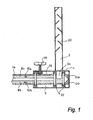
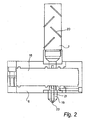
- Figures 1 and 2 illustrate schematically some of the components of the bubble excluder device/probe combination, in accordance with the preferred embodiment of the invention.
- Figure 1 shows an inlet conduit (2) attached to the outer surface (4) of an optical probe (6).
- the optical probe (6) comprises two parallel light paths (8a and 8b) which transmit light in opposite directions, as denoted by the arrows (10a and 10b).
- Two prisms (12a and 12b) are provided at one end of the optical probe (6) and reflect the light such that the direction of the light path (8a) is reversed.
- a tube or sleeve (14) is provided around the optical fibres (8a and 8b), and the optical probe (6) and prisms (12a and 12b) are secured within a casing (16) which is held in place by a clamp (18).
- the conduit (2) comprises a plurality of baffles (20) which are positioned at an angle so as to slope in an upward direction.
- the conduit (2) is attached to the optical probe (6) by means of a fluid tight seal, provided by two rubber O-rings (22), and is positioned in a substantially vertical orientation, generally perpendicular to the axis of the probe.
- Figure 2 shows an outlet (19) attached to the lower surface of the outer region of the optical probe (6).
- a channel (21) is provided within the outlet (19) and extends from the outer surface of the probe to the bottom of the outlet (19).
- An opening (23) is provided at the bottom of the outlet (19).
- the bubble excluder device/probe combination is positioned within a fermenter, and culture medium is free to enter the sampling aperture (24 in Figure 1 ) of the probe via the inlet of the bubble excluder device.
- the sampling aperture (24) is positioned such that the light path passes through the sample of culture medium.
- the optical probe (6) is coupled to a spectrophotometer (not shown) which measures the optical density of the culture medium, thus providing a measurement of the concentration of cells within the culture medium.
- the optical density of the culture medium is measured over a period of time, thus allowing the continuous on-line, measurement of the cell density of a culture.
- the inlet conduit (2) is positioned above the sampling aperture (24 in Figure 1 ) to allow any gas bubbles in the vicinity of the light path of the optical probe (6) to escape, due to their natural tendency to rise, being less dense than the surrounding medium.
- the series of baffles (20) provides a pathway for the upward movement of gas bubbles, whilst restricting the undesirable introduction of gas from the culture medium into the sampling aperture. The statistical chance that gas bubbles will enter the sampling aperture decreases with a corresponding increase in the number of baffles present within the conduit (2).
- the hydrodynamics of the system are sufficient to replenish the sampling aperture in real time (without significant lag).
- conduit and outlet of the bubble excluder serve to prevent or reduce the interaction of bubbles with the probe, thus allowing accurate measurement of the optical density during growth of cells within an aerated fermenter.
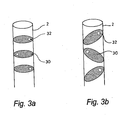
- bubble exclusion means are illustrated in Figures 3a and 3b .
- a cylindrical inlet conduit (2) is provided with a plurality of perforated metal plates (30) arranged horizontally within the conduit.
- Each plate (30) is circular, and comprises a single, relatively large perforation (32).
- the perforations (32) are also circular and of 4-6mm diameter.
- the perforations (32) are disposed towards alternate sides of the successive plates (30), thereby establishing a serpentine flow path within the conduit.
- the arrangement illustrated in Figure 3b is essentially similar, except in this embodiment the plates (30) are disposed at an angle.
- the plates (30) are thus necessarily elliptical in shape.
- the sloping arrangement of the plates (30) is to be preferred to the horizontal arrangement illustrated in Figure 3a , since the slope should encourage the upward movement of any buoyant gas bubbles trapped against the underside of the plates (30).
- Saccharomyces cerevisiae strain WB12 transformed with either plasmid pYES3-Paac2-N6His-aac3 or plasmid pYES3-Paac2-N9His-aac3 were determined in two separate fermentation experiments. In both cases, the same protein was expressed, i.e. a mitochondrial ADP/ATP carrier, but having a different length of histidine tag, comprising either six or nine histidine residues respectively.
- the precise nature of the strains is of no importance to the invention: the purpose of the example is to illustrate typical results, and the high accuracy, that can be obtained using a bubble excluder device/ probe combination in accordance with the invention.
- the S . cerevisiae cells were grown in media containing the following ingredients and under conditions specified below.
- Media 2g/l bacterial peptone, 1g/l yeast extract, 0.2g/l adenine, 3g/l glycerol, 20ml/l ethanol (added after sterilisation), and 2-3 ml antifoam A emulsion, all made up to 1 litre with distilled water.
- Fermentation conditions 30°C, pH5.0, dO 2 80%, agitation 100-800rpm, and air flowrate 0-151/min (0-0.5vvm).
- the agitation and air flow rate were varied using a control loop to maintain dO 2 at approximately 80%.
- a control loop to maintain dO 2 at approximately 80%.
- aliquots of solutions of 5M sodium hydroxide and 10% phosphoric acid were added as necessary.
- the fermenter used was a 401 Applikon ADI 1075 (having a working volume of 301) with an ADI 1030 Bio Controller.
- the fibre-optic Modular Spectrometer used was a Zeiss MCS500, using Zeiss ASPECT plus software v.1.62, connected to a computer via a PCI interface card.
- the probe used was a Hellma 661.760-UV Immersion Probe (having a 1mm optical light path at 660nm), fitted with a bubble escape conduit essentially as illustrated in Figure 1 , so as to conform with the present invention.
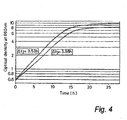
- Figure 4 shows the growth curves of S . cerevisiae WB 12 transformed with either plasmid. From the results, it can be seen that the addition of three histidine residues causes a difference in the doubling time, ⁇ t 2 , value observed for the cells. In particular, the cells transformed with pYES3-Paac2-N6His-aac3 had a ⁇ t 2 value of 3.53 hours, whereas the cells transformed with pYES3-Paac2-N9His-aac3 had a ⁇ t 2 value of 3.98 hours. This demonstrates the accuracy of the probe of the present invention when assessing the growth of cells in response to the expression of a protein. During fermentation, measurements were taken continuously. However, the values obtained are displayed on the graph at 1 minute intervals.
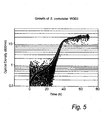
- Figures 5 and 6 are graphs of Optical Density (at 600nm) against time (in hours), and show the growth curves of S . cerevisiae strain W303 and S . cerevisiae strain YHM1 respectively, obtained under similar conditions. Readings were taken using an optical probe fitted with (dark plot) or without (light plot) a bubble excluder device in accordance with the invention. It is readily apparent that use of the bubble excluder device allows far more accurate and reproducible readings of OD, especially within the first 24 hours or so of fermentation.
Landscapes
- Chemical & Material Sciences (AREA)
- Health & Medical Sciences (AREA)
- Life Sciences & Earth Sciences (AREA)
- Zoology (AREA)
- Wood Science & Technology (AREA)
- Engineering & Computer Science (AREA)
- Bioinformatics & Cheminformatics (AREA)
- Organic Chemistry (AREA)
- General Health & Medical Sciences (AREA)
- Analytical Chemistry (AREA)
- Biochemistry (AREA)
- General Engineering & Computer Science (AREA)
- Physics & Mathematics (AREA)
- Sustainable Development (AREA)
- Microbiology (AREA)
- Biotechnology (AREA)
- Genetics & Genomics (AREA)
- Biomedical Technology (AREA)
- Chemical Kinetics & Catalysis (AREA)
- General Physics & Mathematics (AREA)
- Immunology (AREA)
- Pathology (AREA)
- Apparatus Associated With Microorganisms And Enzymes (AREA)
- Automatic Analysis And Handling Materials Therefor (AREA)
- Measuring Or Testing Involving Enzymes Or Micro-Organisms (AREA)
Applications Claiming Priority (2)
| Application Number | Priority Date | Filing Date | Title |
|---|---|---|---|
| GBGB0603589.3A GB0603589D0 (en) | 2006-02-23 | 2006-02-23 | Apparatus and method for monitoring cultures |
| PCT/GB2007/000618 WO2007096626A1 (en) | 2006-02-23 | 2007-02-23 | Apparatus and method for monitoring cultures |
Publications (2)
| Publication Number | Publication Date |
|---|---|
| EP1987131A1 EP1987131A1 (en) | 2008-11-05 |
| EP1987131B1 true EP1987131B1 (en) | 2009-10-21 |
Family
ID=36178586
Family Applications (1)
| Application Number | Title | Priority Date | Filing Date |
|---|---|---|---|
| EP07705249A Not-in-force EP1987131B1 (en) | 2006-02-23 | 2007-02-23 | Apparatus and method for monitoring cultures |
Country Status (11)
| Country | Link |
|---|---|
| US (1) | US8507262B2 (da) |
| EP (1) | EP1987131B1 (da) |
| JP (1) | JP2009527244A (da) |
| AT (1) | ATE446358T1 (da) |
| AU (1) | AU2007217208B2 (da) |
| CA (1) | CA2637776C (da) |
| DE (1) | DE602007002882D1 (da) |
| DK (1) | DK1987131T3 (da) |
| ES (1) | ES2334948T3 (da) |
| GB (1) | GB0603589D0 (da) |
| WO (1) | WO2007096626A1 (da) |
Cited By (1)
| Publication number | Priority date | Publication date | Assignee | Title |
|---|---|---|---|---|
| EP4474469A3 (en) * | 2023-06-05 | 2025-01-01 | Cubick | Bubble separating apparatus for spectrometer and bioreactor including the same |
Families Citing this family (1)
| Publication number | Priority date | Publication date | Assignee | Title |
|---|---|---|---|---|
| EP3805360A4 (en) * | 2018-05-29 | 2022-02-09 | Hitachi High-Tech Corporation | CELL RECOGNITION DEVICE AND CELL RECOGNITION METHOD |
Family Cites Families (11)
| Publication number | Priority date | Publication date | Assignee | Title |
|---|---|---|---|---|
| DK117739B (da) * | 1968-07-10 | 1970-05-25 | Inst Produktudvikling | Bolbleudskillende gennemstrømningskuvette. |
| US3849002A (en) * | 1973-05-11 | 1974-11-19 | Hach Chemical Co | Method and apparatus for eliminating air during fluid turbidity measurement |
| US4361539A (en) * | 1980-05-05 | 1982-11-30 | Instrumentation Laboratory Inc. | Analysis system |
| US4361540A (en) * | 1980-05-05 | 1982-11-30 | Instrumentation Laboratory Inc. | Analysis system |
| US4443407A (en) * | 1981-04-02 | 1984-04-17 | Instrumentation Laboratory Inc. | Analysis system |
| US4398930A (en) | 1981-08-07 | 1983-08-16 | Caterpillar Tractor Co. | Fluid deaeration apparatus |
| JPS60259935A (ja) * | 1984-06-07 | 1985-12-23 | Komatsugawa Kakoki Kk | 濁度計 |
| US4595561A (en) | 1984-11-19 | 1986-06-17 | Martin Marietta Corporation | Liquid sample holder |
| US5335067A (en) * | 1992-09-29 | 1994-08-02 | The United States Of America As Represented By The United States Department Of Energy | Spectrophotometric probe |
| JPH09313165A (ja) * | 1996-05-30 | 1997-12-09 | Rikagaku Kenkyusho | バイオリアクタ汎用検出装置 |
| US5831727A (en) * | 1997-04-29 | 1998-11-03 | Hach Company | Bubble elimination from liquid |
-
2006
- 2006-02-23 GB GBGB0603589.3A patent/GB0603589D0/en not_active Ceased
-
2007
- 2007-02-23 US US12/161,389 patent/US8507262B2/en not_active Expired - Fee Related
- 2007-02-23 DE DE602007002882T patent/DE602007002882D1/de active Active
- 2007-02-23 CA CA2637776A patent/CA2637776C/en not_active Expired - Fee Related
- 2007-02-23 ES ES07705249T patent/ES2334948T3/es active Active
- 2007-02-23 DK DK07705249T patent/DK1987131T3/da active
- 2007-02-23 EP EP07705249A patent/EP1987131B1/en not_active Not-in-force
- 2007-02-23 JP JP2008555872A patent/JP2009527244A/ja not_active Withdrawn
- 2007-02-23 WO PCT/GB2007/000618 patent/WO2007096626A1/en not_active Ceased
- 2007-02-23 AT AT07705249T patent/ATE446358T1/de not_active IP Right Cessation
- 2007-02-23 AU AU2007217208A patent/AU2007217208B2/en not_active Expired - Fee Related
Cited By (1)
| Publication number | Priority date | Publication date | Assignee | Title |
|---|---|---|---|---|
| EP4474469A3 (en) * | 2023-06-05 | 2025-01-01 | Cubick | Bubble separating apparatus for spectrometer and bioreactor including the same |
Also Published As
| Publication number | Publication date |
|---|---|
| AU2007217208B2 (en) | 2012-06-28 |
| US20100233751A1 (en) | 2010-09-16 |
| DK1987131T3 (da) | 2009-11-30 |
| ATE446358T1 (de) | 2009-11-15 |
| CA2637776A1 (en) | 2007-08-30 |
| US8507262B2 (en) | 2013-08-13 |
| GB0603589D0 (en) | 2006-04-05 |
| WO2007096626A1 (en) | 2007-08-30 |
| JP2009527244A (ja) | 2009-07-30 |
| CA2637776C (en) | 2015-11-24 |
| EP1987131A1 (en) | 2008-11-05 |
| ES2334948T3 (es) | 2010-03-17 |
| DE602007002882D1 (de) | 2009-12-03 |
| AU2007217208A1 (en) | 2007-08-30 |
Similar Documents
| Publication | Publication Date | Title |
|---|---|---|
| EP3628999B1 (en) | Field-deployable multiplexed sampling and monitoring device and bacterial contamination measurement method | |
| EP3246393B1 (en) | Improved disposable bioreactor vessel port | |
| US20080293091A1 (en) | Apparatus and methods for automated diffusion filtration, culturing and photometric detection and enumeration of microbiological parameters in fluid samples | |
| US6723554B1 (en) | Apparatus and method for measuring optical properties by feedback control | |
| US5483080A (en) | Method and device for measuring and controlling cell density in microbiological culture | |
| EP1987131B1 (en) | Apparatus and method for monitoring cultures | |
| CN102109512A (zh) | 一种检测水质毒性的装置及方法 | |
| CN109470672A (zh) | 多光强激发检测单个微藻细胞活性的装置与方法 | |
| Stoodley et al. | reactors to study biofilms | |
| DE102012109026A1 (de) | Detektionsvorrichtung und Detektionsverfahren zur automatischen Bestimmung von Biomasse | |
| CN1343888A (zh) | 发光菌水质毒性监测传感装置 | |
| Schügerl | Bioreaction engineering, bioprocess monitoring | |
| EP0232939B1 (en) | Method and device for determining the quantity of dispersed solid material in a liquid | |
| TR2022020411A1 (tr) | Tek bir şırınga hareketi ile sabit oranlarla sürdürülebilir bir sıvı karışımı sağlayan mikroakışkan sistemi. | |
| CN101762678A (zh) | 反应器式bod快速测定方法及其测定仪 | |
| US12595447B2 (en) | Field-deployable multiplexed sampling and monitoring device and bacterial contamination measurement method | |
| Sonnleitner | Real‐time measurement and monitoring of bioprocesses | |
| US20250135451A1 (en) | Electrode cartridge and device for the detection of total viable microorganisms (tvm), and related methods | |
| Schügerl | Bioreactor Instrumentation and Biosensors | |
| US20120156711A1 (en) | System and method that allows the joined performance of optoelectric and respirometric sensors for instant and accurate ascertainment of biochemical oxygen demand (BOD) in liquid industrial wastes | |
| Guenneugues et al. | Application of NADH fluorosensor for on-line biomass measurements in yeast fermentation on whey substrates | |
| JPS6210670Y2 (da) |
Legal Events
| Date | Code | Title | Description |
|---|---|---|---|
| PUAI | Public reference made under article 153(3) epc to a published international application that has entered the european phase |
Free format text: ORIGINAL CODE: 0009012 |
|
| 17P | Request for examination filed |
Effective date: 20080717 |
|
| AK | Designated contracting states |
Kind code of ref document: A1 Designated state(s): AT BE BG CH CY CZ DE DK EE ES FI FR GB GR HU IE IS IT LI LT LU LV MC NL PL PT RO SE SI SK TR |
|
| GRAP | Despatch of communication of intention to grant a patent |
Free format text: ORIGINAL CODE: EPIDOSNIGR1 |
|
| DAX | Request for extension of the european patent (deleted) | ||
| GRAS | Grant fee paid |
Free format text: ORIGINAL CODE: EPIDOSNIGR3 |
|
| GRAA | (expected) grant |
Free format text: ORIGINAL CODE: 0009210 |
|
| RIN1 | Information on inventor provided before grant (corrected) |
Inventor name: PALMER, SHANE Inventor name: KUNJI, EDMUND |
|
| AK | Designated contracting states |
Kind code of ref document: B1 Designated state(s): AT BE BG CH CY CZ DE DK EE ES FI FR GB GR HU IE IS IT LI LT LU LV MC NL PL PT RO SE SI SK TR |
|
| REG | Reference to a national code |
Ref country code: GB Ref legal event code: FG4D |
|
| REG | Reference to a national code |
Ref country code: CH Ref legal event code: EP |
|
| REG | Reference to a national code |
Ref country code: IE Ref legal event code: FG4D |
|
| REG | Reference to a national code |
Ref country code: CH Ref legal event code: NV Representative=s name: FREI PATENTANWALTSBUERO AG Ref country code: DK Ref legal event code: T3 |
|
| REF | Corresponds to: |
Ref document number: 602007002882 Country of ref document: DE Date of ref document: 20091203 Kind code of ref document: P |
|
| REG | Reference to a national code |
Ref country code: SE Ref legal event code: TRGR |
|
| REG | Reference to a national code |
Ref country code: ES Ref legal event code: FG2A Ref document number: 2334948 Country of ref document: ES Kind code of ref document: T3 |
|
| LTIE | Lt: invalidation of european patent or patent extension |
Effective date: 20091021 |
|
| PG25 | Lapsed in a contracting state [announced via postgrant information from national office to epo] |
Ref country code: LT Free format text: LAPSE BECAUSE OF FAILURE TO SUBMIT A TRANSLATION OF THE DESCRIPTION OR TO PAY THE FEE WITHIN THE PRESCRIBED TIME-LIMIT Effective date: 20091021 Ref country code: IS Free format text: LAPSE BECAUSE OF FAILURE TO SUBMIT A TRANSLATION OF THE DESCRIPTION OR TO PAY THE FEE WITHIN THE PRESCRIBED TIME-LIMIT Effective date: 20100221 Ref country code: FI Free format text: LAPSE BECAUSE OF FAILURE TO SUBMIT A TRANSLATION OF THE DESCRIPTION OR TO PAY THE FEE WITHIN THE PRESCRIBED TIME-LIMIT Effective date: 20091021 Ref country code: PT Free format text: LAPSE BECAUSE OF FAILURE TO SUBMIT A TRANSLATION OF THE DESCRIPTION OR TO PAY THE FEE WITHIN THE PRESCRIBED TIME-LIMIT Effective date: 20100222 |
|
| PG25 | Lapsed in a contracting state [announced via postgrant information from national office to epo] |
Ref country code: LV Free format text: LAPSE BECAUSE OF FAILURE TO SUBMIT A TRANSLATION OF THE DESCRIPTION OR TO PAY THE FEE WITHIN THE PRESCRIBED TIME-LIMIT Effective date: 20091021 Ref country code: PL Free format text: LAPSE BECAUSE OF FAILURE TO SUBMIT A TRANSLATION OF THE DESCRIPTION OR TO PAY THE FEE WITHIN THE PRESCRIBED TIME-LIMIT Effective date: 20091021 Ref country code: SI Free format text: LAPSE BECAUSE OF FAILURE TO SUBMIT A TRANSLATION OF THE DESCRIPTION OR TO PAY THE FEE WITHIN THE PRESCRIBED TIME-LIMIT Effective date: 20091021 Ref country code: CY Free format text: LAPSE BECAUSE OF FAILURE TO SUBMIT A TRANSLATION OF THE DESCRIPTION OR TO PAY THE FEE WITHIN THE PRESCRIBED TIME-LIMIT Effective date: 20091021 |
|
| PG25 | Lapsed in a contracting state [announced via postgrant information from national office to epo] |
Ref country code: AT Free format text: LAPSE BECAUSE OF FAILURE TO SUBMIT A TRANSLATION OF THE DESCRIPTION OR TO PAY THE FEE WITHIN THE PRESCRIBED TIME-LIMIT Effective date: 20091021 |
|
| PG25 | Lapsed in a contracting state [announced via postgrant information from national office to epo] |
Ref country code: RO Free format text: LAPSE BECAUSE OF FAILURE TO SUBMIT A TRANSLATION OF THE DESCRIPTION OR TO PAY THE FEE WITHIN THE PRESCRIBED TIME-LIMIT Effective date: 20091021 Ref country code: BG Free format text: LAPSE BECAUSE OF FAILURE TO SUBMIT A TRANSLATION OF THE DESCRIPTION OR TO PAY THE FEE WITHIN THE PRESCRIBED TIME-LIMIT Effective date: 20100121 Ref country code: EE Free format text: LAPSE BECAUSE OF FAILURE TO SUBMIT A TRANSLATION OF THE DESCRIPTION OR TO PAY THE FEE WITHIN THE PRESCRIBED TIME-LIMIT Effective date: 20091021 |
|
| PLBE | No opposition filed within time limit |
Free format text: ORIGINAL CODE: 0009261 |
|
| STAA | Information on the status of an ep patent application or granted ep patent |
Free format text: STATUS: NO OPPOSITION FILED WITHIN TIME LIMIT |
|
| PG25 | Lapsed in a contracting state [announced via postgrant information from national office to epo] |
Ref country code: CZ Free format text: LAPSE BECAUSE OF FAILURE TO SUBMIT A TRANSLATION OF THE DESCRIPTION OR TO PAY THE FEE WITHIN THE PRESCRIBED TIME-LIMIT Effective date: 20091021 Ref country code: SK Free format text: LAPSE BECAUSE OF FAILURE TO SUBMIT A TRANSLATION OF THE DESCRIPTION OR TO PAY THE FEE WITHIN THE PRESCRIBED TIME-LIMIT Effective date: 20091021 |
|
| 26N | No opposition filed |
Effective date: 20100722 |
|
| PG25 | Lapsed in a contracting state [announced via postgrant information from national office to epo] |
Ref country code: GR Free format text: LAPSE BECAUSE OF FAILURE TO SUBMIT A TRANSLATION OF THE DESCRIPTION OR TO PAY THE FEE WITHIN THE PRESCRIBED TIME-LIMIT Effective date: 20100122 Ref country code: MC Free format text: LAPSE BECAUSE OF NON-PAYMENT OF DUE FEES Effective date: 20100301 |
|
| PG25 | Lapsed in a contracting state [announced via postgrant information from national office to epo] |
Ref country code: IE Free format text: LAPSE BECAUSE OF NON-PAYMENT OF DUE FEES Effective date: 20100223 |
|
| PGFP | Annual fee paid to national office [announced via postgrant information from national office to epo] |
Ref country code: DK Payment date: 20110825 Year of fee payment: 5 |
|
| PGFP | Annual fee paid to national office [announced via postgrant information from national office to epo] |
Ref country code: IT Payment date: 20120221 Year of fee payment: 6 Ref country code: BE Payment date: 20120330 Year of fee payment: 6 |
|
| PG25 | Lapsed in a contracting state [announced via postgrant information from national office to epo] |
Ref country code: LU Free format text: LAPSE BECAUSE OF NON-PAYMENT OF DUE FEES Effective date: 20100223 Ref country code: HU Free format text: LAPSE BECAUSE OF FAILURE TO SUBMIT A TRANSLATION OF THE DESCRIPTION OR TO PAY THE FEE WITHIN THE PRESCRIBED TIME-LIMIT Effective date: 20100422 |
|
| PG25 | Lapsed in a contracting state [announced via postgrant information from national office to epo] |
Ref country code: TR Free format text: LAPSE BECAUSE OF FAILURE TO SUBMIT A TRANSLATION OF THE DESCRIPTION OR TO PAY THE FEE WITHIN THE PRESCRIBED TIME-LIMIT Effective date: 20091021 |
|
| PGFP | Annual fee paid to national office [announced via postgrant information from national office to epo] |
Ref country code: SE Payment date: 20120831 Year of fee payment: 6 |
|
| REG | Reference to a national code |
Ref country code: FR Ref legal event code: ST Effective date: 20121031 |
|
| REG | Reference to a national code |
Ref country code: FR Ref legal event code: RN Effective date: 20121204 |
|
| REG | Reference to a national code |
Ref country code: FR Ref legal event code: FC Effective date: 20121217 |
|
| PG25 | Lapsed in a contracting state [announced via postgrant information from national office to epo] |
Ref country code: FR Free format text: LAPSE BECAUSE OF NON-PAYMENT OF DUE FEES Effective date: 20120229 |
|
| PGFP | Annual fee paid to national office [announced via postgrant information from national office to epo] |
Ref country code: ES Payment date: 20120904 Year of fee payment: 6 |
|
| PGRI | Patent reinstated in contracting state [announced from national office to epo] |
Ref country code: FR Effective date: 20130221 |
|
| BERE | Be: lapsed |
Owner name: MEDICAL RESEARCH COUNCIL Effective date: 20130228 |
|
| REG | Reference to a national code |
Ref country code: DK Ref legal event code: EBP |
|
| REG | Reference to a national code |
Ref country code: SE Ref legal event code: EUG |
|
| PG25 | Lapsed in a contracting state [announced via postgrant information from national office to epo] |
Ref country code: SE Free format text: LAPSE BECAUSE OF NON-PAYMENT OF DUE FEES Effective date: 20130224 |
|
| PG25 | Lapsed in a contracting state [announced via postgrant information from national office to epo] |
Ref country code: IT Free format text: LAPSE BECAUSE OF NON-PAYMENT OF DUE FEES Effective date: 20130223 |
|
| PG25 | Lapsed in a contracting state [announced via postgrant information from national office to epo] |
Ref country code: DK Free format text: LAPSE BECAUSE OF NON-PAYMENT OF DUE FEES Effective date: 20130228 Ref country code: BE Free format text: LAPSE BECAUSE OF NON-PAYMENT OF DUE FEES Effective date: 20130228 |
|
| REG | Reference to a national code |
Ref country code: ES Ref legal event code: FD2A Effective date: 20140606 |
|
| PG25 | Lapsed in a contracting state [announced via postgrant information from national office to epo] |
Ref country code: ES Free format text: LAPSE BECAUSE OF NON-PAYMENT OF DUE FEES Effective date: 20130224 |
|
| REG | Reference to a national code |
Ref country code: FR Ref legal event code: PLFP Year of fee payment: 10 |
|
| REG | Reference to a national code |
Ref country code: FR Ref legal event code: PLFP Year of fee payment: 11 |
|
| PGFP | Annual fee paid to national office [announced via postgrant information from national office to epo] |
Ref country code: FR Payment date: 20170223 Year of fee payment: 11 |
|
| PGFP | Annual fee paid to national office [announced via postgrant information from national office to epo] |
Ref country code: NL Payment date: 20170223 Year of fee payment: 11 |
|
| PGFP | Annual fee paid to national office [announced via postgrant information from national office to epo] |
Ref country code: DE Payment date: 20170831 Year of fee payment: 11 Ref country code: CH Payment date: 20170831 Year of fee payment: 11 Ref country code: GB Payment date: 20170831 Year of fee payment: 11 |
|
| REG | Reference to a national code |
Ref country code: DE Ref legal event code: R119 Ref document number: 602007002882 Country of ref document: DE |
|
| REG | Reference to a national code |
Ref country code: CH Ref legal event code: PL |
|
| REG | Reference to a national code |
Ref country code: NL Ref legal event code: MM Effective date: 20180301 |
|
| GBPC | Gb: european patent ceased through non-payment of renewal fee |
Effective date: 20180223 |
|
| PG25 | Lapsed in a contracting state [announced via postgrant information from national office to epo] |
Ref country code: CH Free format text: LAPSE BECAUSE OF NON-PAYMENT OF DUE FEES Effective date: 20180228 Ref country code: LI Free format text: LAPSE BECAUSE OF NON-PAYMENT OF DUE FEES Effective date: 20180228 |
|
| REG | Reference to a national code |
Ref country code: FR Ref legal event code: ST Effective date: 20181031 |
|
| PG25 | Lapsed in a contracting state [announced via postgrant information from national office to epo] |
Ref country code: NL Free format text: LAPSE BECAUSE OF NON-PAYMENT OF DUE FEES Effective date: 20180301 |
|
| PG25 | Lapsed in a contracting state [announced via postgrant information from national office to epo] |
Ref country code: DE Free format text: LAPSE BECAUSE OF NON-PAYMENT OF DUE FEES Effective date: 20180901 |
|
| PG25 | Lapsed in a contracting state [announced via postgrant information from national office to epo] |
Ref country code: GB Free format text: LAPSE BECAUSE OF NON-PAYMENT OF DUE FEES Effective date: 20180223 Ref country code: FR Free format text: LAPSE BECAUSE OF NON-PAYMENT OF DUE FEES Effective date: 20180228 |