EP1987682B1 - Système et procédé pour la manipulation sélective du trafic de contrôle pour ameliorer les performances d'un réseau - Google Patents
Système et procédé pour la manipulation sélective du trafic de contrôle pour ameliorer les performances d'un réseau Download PDFInfo
- Publication number
- EP1987682B1 EP1987682B1 EP07716963.9A EP07716963A EP1987682B1 EP 1987682 B1 EP1987682 B1 EP 1987682B1 EP 07716963 A EP07716963 A EP 07716963A EP 1987682 B1 EP1987682 B1 EP 1987682B1
- Authority
- EP
- European Patent Office
- Prior art keywords
- control
- traffic
- qos
- control signals
- network
- Prior art date
- Legal status (The legal status is an assumption and is not a legal conclusion. Google has not performed a legal analysis and makes no representation as to the accuracy of the status listed.)
- Active
Links
Images


Classifications
-
- H—ELECTRICITY
- H04—ELECTRIC COMMUNICATION TECHNIQUE
- H04W—WIRELESS COMMUNICATION NETWORKS
- H04W28/00—Network traffic management; Network resource management
- H04W28/16—Central resource management; Negotiation of resources or communication parameters, e.g. negotiating bandwidth or QoS [Quality of Service]
- H04W28/24—Negotiating SLA [Service Level Agreement]; Negotiating QoS [Quality of Service]
-
- H—ELECTRICITY
- H04—ELECTRIC COMMUNICATION TECHNIQUE
- H04L—TRANSMISSION OF DIGITAL INFORMATION, e.g. TELEGRAPHIC COMMUNICATION
- H04L47/00—Traffic control in data switching networks
- H04L47/10—Flow control; Congestion control
- H04L47/24—Traffic characterised by specific attributes, e.g. priority or QoS
- H04L47/2425—Traffic characterised by specific attributes, e.g. priority or QoS for supporting services specification, e.g. SLA
- H04L47/2433—Allocation of priorities to traffic types
-
- H—ELECTRICITY
- H04—ELECTRIC COMMUNICATION TECHNIQUE
- H04L—TRANSMISSION OF DIGITAL INFORMATION, e.g. TELEGRAPHIC COMMUNICATION
- H04L47/00—Traffic control in data switching networks
- H04L47/10—Flow control; Congestion control
- H04L47/24—Traffic characterised by specific attributes, e.g. priority or QoS
- H04L47/2466—Traffic characterised by specific attributes, e.g. priority or QoS using signalling traffic
-
- H—ELECTRICITY
- H04—ELECTRIC COMMUNICATION TECHNIQUE
- H04W—WIRELESS COMMUNICATION NETWORKS
- H04W28/00—Network traffic management; Network resource management
- H04W28/02—Traffic management, e.g. flow control or congestion control
-
- H—ELECTRICITY
- H04—ELECTRIC COMMUNICATION TECHNIQUE
- H04W—WIRELESS COMMUNICATION NETWORKS
- H04W8/00—Network data management
- H04W8/02—Processing of mobility data, e.g. registration information at HLR [Home Location Register] or VLR [Visitor Location Register]; Transfer of mobility data, e.g. between HLR, VLR or external networks
- H04W8/04—Registration at HLR or HSS [Home Subscriber Server]
-
- H—ELECTRICITY
- H04—ELECTRIC COMMUNICATION TECHNIQUE
- H04L—TRANSMISSION OF DIGITAL INFORMATION, e.g. TELEGRAPHIC COMMUNICATION
- H04L65/00—Network arrangements, protocols or services for supporting real-time applications in data packet communication
- H04L65/80—Responding to QoS
-
- H—ELECTRICITY
- H04—ELECTRIC COMMUNICATION TECHNIQUE
- H04W—WIRELESS COMMUNICATION NETWORKS
- H04W4/00—Services specially adapted for wireless communication networks; Facilities therefor
- H04W4/16—Communication-related supplementary services, e.g. call-transfer or call-hold
-
- H—ELECTRICITY
- H04—ELECTRIC COMMUNICATION TECHNIQUE
- H04W—WIRELESS COMMUNICATION NETWORKS
- H04W72/00—Local resource management
- H04W72/50—Allocation or scheduling criteria for wireless resources
- H04W72/56—Allocation or scheduling criteria for wireless resources based on priority criteria
- H04W72/566—Allocation or scheduling criteria for wireless resources based on priority criteria of the information or information source or recipient
- H04W72/569—Allocation or scheduling criteria for wireless resources based on priority criteria of the information or information source or recipient of the traffic information
-
- H—ELECTRICITY
- H04—ELECTRIC COMMUNICATION TECHNIQUE
- H04W—WIRELESS COMMUNICATION NETWORKS
- H04W84/00—Network topologies
- H04W84/02—Hierarchically pre-organised networks, e.g. paging networks, cellular networks, WLAN [Wireless Local Area Network] or WLL [Wireless Local Loop]
- H04W84/10—Small scale networks; Flat hierarchical networks
- H04W84/12—WLAN [Wireless Local Area Networks]
-
- H—ELECTRICITY
- H04—ELECTRIC COMMUNICATION TECHNIQUE
- H04W—WIRELESS COMMUNICATION NETWORKS
- H04W88/00—Devices specially adapted for wireless communication networks, e.g. terminals, base stations or access point devices
- H04W88/08—Access point devices
Definitions
- This invention is related in general to networks and more specifically to systems and methods for manipulating traffic in networks, such as wireless networks, to improve network performance.
- Systems and methods for improving network performance and ensuring QOS in wireless networks are employed in various demanding applications, including cellular networks and Wireless Local Area Networks (WLANs). Such applications often demand systems for manipulating traffic that can ensure communications quality and QOS for high-priority communications.
- WLANs Wireless Local Area Networks
- An exemplary WLAN includes mobile clients, such as laptops employing wireless network cards, that communicate with a network AP.
- An AP typically includes a transceiver for communicating with the wireless network cards by converting between wired and wireless signals.
- the AP often acts as a switch or router that facilitates connecting the clients into a broader network and may further facilitate connecting the clients to outside networks, such as the Internet.
- a WLAN often includes a central controller that communicates with plural APs. Each AP is associated with a particular coverage area based on the range of the AP transceiver and the range of client transceivers that are communicating the AP.
- a client device that traverses several coverage areas within a given WLAN is the to roam between the APs.
- the client connection to the network is handed off between APs as needed to maintain the client connectivity.
- the central WLAN controller may facilitate handoff between APs and manage WLAN traffic.
- the controller may separate data and control traffic, and send control traffic to a processor and data traffic to a traffic-forwarding device.
- a WLAN controller may prioritize data traffic according to predetermined Access Categories (ACs) to facilitate QOS guarantees in accordance with Wireless Multimedia Extensions (WME) techniques.
- WME also known as Wireless-Fidelity (Wi-Fi) Multimedia (WMM)
- IEEE Institute of Electrical and Electronics Engineers 802.11e draft standard.
- WME provides basic QOS features to IEE 802.11 (Wi-Fi) networks.
- Wi-Fi Wi-Fi
- existing WLAN controllers often lack sufficient mechanisms to prevent one type of control traffic from overrunning another. Consequently" a faulty AP or an AP that is infected with a virus or worm may generate control messages that can overwhelm a central controller. An overwhelmed controller may compromise client- roaming, authentication, and/or other behaviors that require control signaling. Furthermore, an overwhelmed controller may have reduced ability to manage radio resources, which may degrade overall network QOS. Accordingly, the WLAN may drop data packets or delay connections when clients roam between APs of a WLAN that receives excess roam requests. Consequently, existing WLANs are often undesirably susceptible to dropped Voice-Over Internet Protocol (VOIP) phone calls, poor audio and video quality, and so on.
- VOIP Voice-Over Internet Protocol
- US 2004/049570 A1 discloses a method for network management in a hybrid wired/wireless local area network that include receiving from a first access point and/or a first switch, a first messaging protocol message containing quality of service (QoS) information. Responsive to the first messaging protocol message, at least a minimum QoS level for operation of the first switch, the first access point, a second access point and/or a second switch, may be determined. QoS information corresponding to at least the minimum QoS level may be distributed to the first switch, the first access point, the second access point and the second switch, using a second messaging protocol message.
- EP 1 408 653 discloses a process of controlling a flow of data in a wireless network providing wireless access to the wireless network by wireless devices is disclosed.
- Data is received from a wireless device by a network device, through one access point of a plurality of access points in communication with the network device, indicating a client identifier for the wireless device.
- the client identifier is forwarded to an authentication server and the network device mediated authentication of the wireless device with the authentication server.
- data packets received from portions of the wireless network and from the plurality of access points are evaluated and the received data packets are passed to portions of the wireless network and to the plurality of access points, based on the evaluation of the received data packets.
- a preferred embodiment of the present invention implements a system and method for selectively controlling traffic in a wireless network.
- the system includes a network controller that includes a first control-traffic prioritizer.
- a wireless Access Point (AP) includes a second control-traffic prioritizer and communicates with the network controller.
- One or more clients communicate with the wireless AP. The communications behavior of the client is affected by operations of the first control-traffic prioritizer and the second control-traffic prioritizer.
- a control-traffic prioritizer may be any device and/or software that can distinguish between different types of control signals and then selectively prioritize and/or use the control signals based on type.
- a control signal may be any signal that is employed to affect or control a component or characteristic of a network, such as network performance or behavior.
- Fig. 1 is a diagram illustrating key functional blocks of system 12 for handling control traffic 14, 16 in wireless network 10 according to an embodiment of the present invention.
- network 10 is shown including central switch 18, which includes Wireless Local Area Network (WLAN) controller 20.
- Central switch 18 communicates with first wireless access point 22 and second wireless access point 24, which are associated with first wireless coverage area 26 and second wireless coverage area 28, respectively.
- WLAN Wireless Local Area Network
- the WLAN controller 20 includes control plane 30, which includes control applications 32 in communication with central control-traffic prioritizer 34.
- User interface 36 may be employed to communicate with central control-traffic prioritizer 34, which includes session Quality Of Service (QOS) value table 38 in communication with packet-marking module 40.
- QOS session Quality Of Service
- a control plane may represent functionality of the WLAN controller that pertains to the processing of control signals and/or associated network-control functionality and/or operations.
- Functions and operations of a WLAN controller are often logically and/or physically partitioned into a control plane, a data plane, and a management plane based on control, data, and management functions and/or operations.
- First wireless AP 22 includes AP-switch module 42, which communicates with central switch 18 and AP transceiver 44.
- the range of transceiver 44 corresponds to size of first coverage area 26.
- Transceiver 44 facilitates wireless communications with clients, such as client 52 within first coverage area 26.
- Client 52 communicates with transceiver 44 via first wireless link 54, which is also called an Over-The-Air (OTA) link.
- OTA Over-The-Air
- Wireless AP further includes AP control-traffic prioritizer 46.
- AP control-traffic prioritizer 46 includes AP packet-marking module 48 in communication with AP session-QOS-value table 50.
- Second wireless AP 24 is constructed similarly to first wireless AP 22. However, for clarity, components of second AP 24 are not shown, since the operation of system 12 will be discussed primarily with reference to first wireless AP 26 and central switch 18.
- a packet may be any grouping of information, such as a frame, message, and so on.
- a QOS value may be any parameter or other value representative of a priority. For example, on an increasing scale of 1-10 in terms of priority, a packet with a QOS value of 10 exhibits the highest priority.
- a QOS tag may be any identifier that is appended to, inserted in, or otherwise associated with a message or other data.
- first client 52 is wirelessly connected to network 10 via the wireless communications link 54 between first client 52 and wireless AP 22.
- Various types of network comminations and behaviors such as client roaming behaviors, power levels associated with transceiver 44, and so on, may require exchange of control signals, such as roam-request messages, between wireless APs 22, 24 and central switch 18.
- AP control-traffic prioritizer 46 implements one or more routines that monitor communications passing through AP switch module 42.
- AP control-traffic prioritizer 46 separates control signals from data signals passing through AP switch module 42 and then employs AP packet-marking module 48 to selectively mark control signals based on the type of control signal detected by AP control-traffic prioritizer 46.
- AP packet-marking module 48 references AP session-QOS-value table 50, which defines QOS values which are to be assigned to specific types of control messages. For example, control messages pertaining to roam-requests may be marked with high QOS values, while control messages that are potentially produced by a faulty access point may be assigned low QOS values or may be otherwise discarded by AP control-traffic prioritizer 46.
- Values within AP session-QOS-value table 40 and session QOS-value table 38 in central switch 18 maintain all QOS values for each current session for all OTA communication links 54, 56, in network 10.
- Marked control packets or messages destined for central switch 18 are then forwarded from AP switch module 42 to central switch 18.
- Various control applications 32 running on the control-plane 30 of central WLAN controller 20 then process the marked, i.e., prioritized messages 14 received from wireless APs 22, 24 in accordance with the priorities, i.e., QOS values of the messages.
- the control applications may include radio-resource-management applications for controlling operation of transceiver 44 of wireless AP 22, mobility-management applications, security applications, QOS schemes, intrusion detection applications, and so on, as discussed more fully below.
- Control applications 32 may employ one or more queues to facilitate handing control messages based on QOS values associated with the messages.
- control applications 32 may provide new control signals to the central control-traffic prioritizer 34.
- the central control-traffic prioritizer 34 employs the session QOS-value table 38 to selectively mark or control messages with QOS values based on control-message priority as determined via entries in the session QOS-value table 38.
- the entries in the session QOS-value table 38 include control-signal types, which are paired with QOS values. Consequently, a control message of a given type is assigned a given QOS value based on entries in the session QOS-value table 38.
- Contents of the session QOS-value table 38 may be forwarded, i.e. pushed to AP session QOS-value table 50 to maintain consistent control-signal priorities.
- Entries in AP session QOS-value table 50 are periodically populated via pushes from the session QOS-value table 38 running on central switch 18, to maintain similarities between QOS-value tables 38, 50.
- control traffic is selectively differentiated and prioritized, i.e., marked with appropriate QOS values, the resulting marked control traffic 16 is forwarded to wireless APs 22, 24 for further handling.
- the exact rules or relationships that determine which types of control traffic are assigned which priority values are application-specific.
- such rules are embodied by entries in session QOS-value tables 38, 50.
- the entries may be adjusted via the user interface 36.
- the entries may be automatically determined based on a predetermined rule.
- central control-traffic prioritizer 34 may be configured to automatically assign priorities to control messages based on roam-request backlogs in accordance with an overall network QOS scheme that mandates that roaming clients will be guaranteed a certain QOS.
- central control-traffic prioritizer 34 may prioritize roam-requests above other types of control signals if needed to maintain session persistence for mobile client 52, in accordance with a QOS policy, as client 52 roams between coverage areas 26, 28.
- wireless link 54 is terminated, and second wireless link 56 is established between client 52 and second wireless AP 24 in process called handoff, In a soft handoff, first wireless link 54 is maintained until second wireless link 56 is established. In a hard handoff, first wireless link 54 is terminated before or when the second link 56 is established.
- client 52 transitions between coverage areas 26,28, client 52 is the to roam between coverage areas.
- various types of control signaling such as roam-request messages, may occur between wireless APs 22, 24 and central switch 18 to facilitate roaming behavior, such as by implementing handoffs.
- roam-request messages and other control messages employed by a network to facilitate handoffs were not prioritized.
- Control messages were treated similarly to other types of control messages. Consequently, control signals generated from Web-browsing behavior or other types of network communications, such as from a compromised or faulty AP or a mis-configured QOS scheme, could overrun roam-request messages or other desirable control messages, preventing acceptable QOS for a specific type of communication operation.
- An overwhelmed controller will compromise the ability of a client to roam, authenticate, and/or further compromise performance of other network operations that require control signaling, and further degrade overall network QOS.
- network administrators lacked a mechanism enable QOS guarantees for different types of communications, such as Voice-Over-Internet-Protocol (VOIP) and/or video communications.
- VOIP Voice-Over-Internet-Protocol
- Certain embodiments of the present may enable selective prioritization of different types of control messages, preventing a controller from being overwhelmed by certain control messages, and thereby enabling an administrator to establish QOS guarantees for different types of network communications.
- embodiments of the present invention may be employed to detect undesirable or questionable control traffic and either discard or assign low priorities to the less desirable control traffic. This prevents undesirable traffic, such as traffic from faulty APs, APs infected with malicious code, and so on, from destabilizing network 10 and compromising network QOS guarantees.
- System 12 which includes central control-traffic prioritizer 34 and AP control-traffic prioritizer 46, is particularly useful for differentiating between different types of control traffic and then prioritizing the different types of control traffic based on application-specific requirements.
- the ability to prioritize traffic in control-plane 30 may enhance network capabilities. For example, a network administrator may decide to prioritize client reconnection requests based upon application, client, and roaming-behavior types to ensure QOS for a client while roaming.
- system 12 may be employed to thwart Denial-Of-Service (DOS) attacks wherein malicious control signals are sent to central witch 18 in an attempt to overrun central switch 18. Consequently, use of system 12 may improve network reliability, stability, and performance.
- system 12 may be employed to enhance the ability of network 10 to provide QOS guarantees for different types of network traffic and/or processes, such as handoff operations.
- DOS Denial-Of-Service
- Networks may be affected by control traffic.
- networks cannot prioritize for example, voice traffic over web traffic, and consequently cannot guarantee network functionality, such as seamless roaming functionality, that employs control signals.
- Prioritizing traffic may enable network 10 to guarantee seamless roaming and other functionality as required for a given application.
- an additional traffic separator may be employed to separate data traffic and different types of control traffic.
- the traffic separator may send control traffic to control-plane 30 data traffic to a data-plane and/or forwarding engine so that the data traffic is unencumbered by control decisions.
- Modules such as traffic separators and control-traffic prioritizers 34, 46 may be implemented via hardware and/or software modifications to existing network infrastructure.
- central switch 18 may be implemented by those skilled in the art with access to the present teachings, via software and/or hardware modifications to a Cisco 4404 wireless LAN controller without undue experimentation.
- System 12 may provide various additional benefits to network 10, including permitting greater centralization of WLAN switches without resulting in excessive control-plane delays that might be caused by one type of control traffic overrunning another; minimizing delays for high priority control signaling; and reducing cost and complexity of centralized WLAN solutions by enabling wireless infrastructure to effectively accommodate voice and data traffic on shared media.
- voice and/or video communications did not have sufficient priority in WLANs to adequately ensure QOS for certain voice and/or multimedia applications.
- control traffic While in network 10 of Fig. 1 , control traffic is tagged before egress from wireless APs 22, 24 and central switch 18, control traffic may be tagged and handled internally to APs 22, 24 and central switch 18 so that tags are not appended to messages sent Over The Air (OTA) as discussed more fully below.
- OTA Over The Air
- Fig. 2 is a more detailed diagram of alternative embodiment 70 of network 10 of Fig. 1 .
- Network 70 includes alternative system 72 for selectively prioritizing and handling control traffic in network 70.
- Network 70 includes alternative WLAN central switch 74 in communication with alternative wireless AP 76.
- control signals are prioritized and marked with QOS values before sending between central switch 18 and access points 22, 24, alternative central switch 74 and alternative wireless AP 76 mark control signals before processing.
- control signals exchanged between alternative wireless AP 76 and alternative central switch 74 lack priority tags, i.e., QOS marks.
- Network 10 of Fig. 1 is adapted to mark controls signals with QOS values indicative of control-signal priority upon egress from central switch 18 and/or wireless AP s 22, 24 of Fig. 1 .
- control signals are prioritized and marked at alternative wireless AP 76 and alternative central switch 74 before processing at alternative wireless AP 76 and alternative central switch 74.
- Alternative central switch 74 includes control-signal classification engine 80, which receives control signals from alternative wireless AP 76 and communicates classified control signals to QOS-assignment module 82 included in control-traffic prioritizing module 78.
- QOS-assignment module 82 includes QOS-assignment controller 84 in communication with priority table 86.
- QOS-assignment controller 84 communicates with user interface 90 via wireless control system 88, which may be implemented via a Cisco Wireless Control System.
- QOS-assignment module 82 further communicates with message-tagging module 92, which provides tagged messages to queuing module 94.
- Queuing module 94 implements various message queues 96 in which control messages are selectively placed based on tags, such as QOS tags, associated with the control messages.
- Control-plane-processing applications 100 communicate with the queuing module 94 and selectively pull messages off the queues 96 for processing. Control-plane-processing applications 100 may forward signals to alternative wireless AP 76, which are received by AP control-signal classification engine 102.
- Alternative wireless AP 76 further includes AP QOS-assignment module 104, which receives classified control signals from the AP classification engine 102.
- AP QOS-assignment module 104 communicates with AP marking-and-queuing module 106, which communicates with AP control-signal processing module 108.
- AP control-signal processing module 108 may implement various applications, such as resource management applications, for controlling behavior of accompanying wireless AP transceiver 110.
- AP control-signal processing module 108 may further communicate with alternative central switch 74.
- control-signal classification engine 80 In operation, control signals received by central switch 74 from alternative wireless AP 76 are classified by control-signal classification engine 80.
- control-signal classification engine 80 separates and classifies control signals by type. Exact classifications are application specific and may be determined to meet the needs of a given application by those skilled in the art without undue experimentation. Examples of possible control-signal classifications include roaming-type, rogue, and radio-resource control messages.
- a control message may be a control signal.
- the terms control signal and control message are employed interchangeably.
- a signal may be any information conveyed from one location or module to another, where the location or module may be physical or logical.
- Control-signal classification engine 80 then forwards separated control traffic to QOS-assignment module 82, where messages of the control traffic are associated with priorities with reference to priority table 86.
- QOS-assignment controller 84 may automatically adjust the priority table 86 based on predetermined criteria, such as whether session persistence is required for roaming client 52 or the number of current roam requests currently being processed by central switch 74.
- Prioritized messages are subsequently tagged with QOS values representative of message priority via message-tagging module 92.
- Tagging may involve inserting a QOS value in an existing message header; appending a QOS value to the message; or otherwise marking a message with a priority value.
- Marked messages are then selectively placed in queues 96 via queuing module 94 based on the QOS tags associated with each message.
- Control-plane-processing applications 100 then remove messages from queues 96 based on priority values associated with each of queues 96. For example, control-plane-processing applications 100 may remove control messages from queues with high priority messages before removing control messages from queues with lower priority control messages. Exact details pertaining to methods by which control-plane-processing applications 100 remove control messages from queues 96 for processing are application specific. Such details may be readily determined to meet the needs of a given application by those skilled in the art with access to the present teachings.
- Control-plane-processing applications 100 may include various applications that utilize control-plane traffic.
- Control-plane-processing applications 100 may include various hardware and/or software modules for implementing various functionality, such as radio-resource management, transmit-power control for wireless AP transceiver 110, and so on.
- Additional exemplary control-plane-processing applications include client-load management, mobility management, interference-detection and avoidance, rogue detection and containment, intrusion detection, QOS control, and QOS-dependent Internet Protocol (IP) application-services processing applications, such as for voice and video.
- System 72 of Fig. 2 may improve the operation of control-plane-processing applications 100 by helping to ensure that control traffic for one application does not overrun control traffic for a higher priority application.
- control-plane-processing applications After the prioritized control signals are processed by the control-plane-processing applications, newly generated control signals from control-plane-processing applications 100 are forwarded, unmarked, to alternative wireless AP 76.
- modules 80-96 of control-traffic prioritizer 78 are shown as individual modules, modules 80-96 may be implemented via more or fewer modules without departing from the scope of the present invention.
- modules 80-96 may be replaced with a single module implemented via a software modification to existing software running on a Cisco 4404 WLAN Controller.
- Alternative wireless AP 76 communicates with client 52 and is associated with a general coverage area 114, which is affected by transceiver 110.
- AP QOS-assignment module 104 associates certain classifications of control signals received from central switch 74 with certain priorities. The priorities are reflected in QOS values or other priority tags, which are assigned to the control signals via the AP marking-and-queuing nodule 106.
- Tagged and prioritized control signals i.e., control-plane messages or backets, are processed by AP control-signal-processing module 108 in accordance with QOS values associated with each message, packet, or signal.
- Processed control signals and/or other control signals that are generated based on processed control signals may be returned to central switch 74 by AP control-signal-processing module 108 or employed to control wireless AP transceiver 110 and associated communication link 112 between client 52 and alternative wireless AP 76.
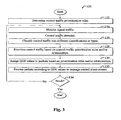
- Fig. 3 is a flow diagram of method 120 adapted for use with systems of Fig. 1 and 2 .
- Method 120 includes initial priority-rule-determining step 122, wherein control-traffic prioritization rules are determined. For example, rules defining how types or classes of control signals are mapped to specific QOS values are determined. The rules may be automatically determined or manually determined, such as via a user interface. Subsequently, traffic-monitoring step 124 is performed.
- Traffic-monitoring step 124 includes monitoring traffic, such as traffic occurring between alternative wireless AP 76 and alternative central switch 74 of Fig. 2 .
- classifying step 126 is then performed.
- Classifying step 126 involves categorizing received control signals based on predetermined types or classes.
- control signals and/or associated classes are prioritized based on the control-traffic prioritization rules determined in initial priority-rule-determining step 122.
- the control traffic is prioritized, it is tagged with corresponding priority values in assigning step 130.
- the priority values assigned to different control signals and/or messages which maybe implemented via QOS tags, which hare employed to mark control signals based on control-traffic priority as determined in prioritization step 128.
- Subsequent processing step 132 involves processing control signals and corresponding packets according to the priority values, i.e., QOS values assigned to the control packets.
- the processing of the control signals based on QOS values may ensure that high-priority control-plane events are handled before low priority control-plane events.
- Processing step 132 may occur an AP or at a centralized controller upon receipt of marked control messages.
- break-checking step 134 determines if a system break has occurred.
- a system break may occur if the accompanying network is disconnected or modules implementing method 120 are otherwise disabled. If a system break occurs, method 120 completes. Otherwise, traffic-monitoring step 124 continues.
- method 120 may be replaced with a more generalized method without departing from the scope of the present invention.
- An exemplary more generalized method involves detecting control traffic and then marking different types of control traffic to facilitate differentiating between types of control traffic.
- An alternative generalized method involves classifying control traffic in accordance with one or more predetermined rules and providing control-traffic priorities in response thereto and then adjusting behavior of an accompanying wireless network in accordance with the control-traffic priorities.
- An alternative more detailed method includes identifying control-plane traffic and then determining if the control-plane traffic has a QOS dependency such that the control-plane traffic pertains to a WLAN control event requiring prioritized handling.
- WLAN control events may include roaming; pre-authentication exchanges associated with roaming, radio performance measurements; security control-plane communications, such as IDS, and TIDP; obtaining location-beaconing information; managing, adjusting, and selecting radio channel frequencies; managing, reporting, and detecting Institute of Electrical and Electronics Engineers (IEEE) 802.11 and non-802.11 interfaces; managing guest-access traffic separation and service selection; designating clients that process real-time IP applications, such as voice or video; determining state conditions of clients including power-on, power-off, sleep-mode, and roaming-mode states; setting roaming-time-reconnection requirements; and so on.
- IEEE Institute of Electrical and Electronics Engineers
- the event When a control-plane event with a QOS dependency is sent from an AP to a corresponding central switch, the event may inherits QOS values from a session QOS-value table. All upstream and downstream QOS-dependent control events may be associated with QOS values and control signal classifications maintained in a session QOS-value table.
- various embodiments of the present invention may facilitate determining a network QOS policy behavior in response to certain events or and/or guarantees, such as such as roaming events and whether a need exists for session persistence, wherein a client communication session is maintained as the client roams across AP coverage areas; events involving client reauthorizations to APs; guarantees for seamless roaming with session persistence based upon the number of concurrent roaming requests or backlogs of roam requests; and so on.
- Various embodiments of the present invention may be employed to enable granular QOS classification and marking for control-plane traffic between an AP and a controller to facilitate avoidance of QOS policy-configuration mistakes. For example, prioritizing control-plane messages so that different priorities are assigned to control messages based on roaming types, may prevent certain QOS policy configuration mistakes that may otherwise result in mis-configured QOS schemes being applied to a WLAN switch deployment.
- Certain embodiments of the present invention may provide logical and/or physical separation of data traffic and various types of control traffic in a central WLAN switch.
- Various QOS-value-assignment schemes may be applied in a control-plane to differentiate and prioritize various control messages, such as reconnection requests based on various traffic types.
- processes of the present invention and the hardware executing the processes may be characterized by language common to a discussion of the Internet (e.g., "client,” “access point,” and so on), it should be apparent that operations of the present invention can execute on any type of suitable hardware in any communication relationship to another device on any type of link or network.
- a process of the present invention may be presented as a single entity, such as software executing on a single machine, such software can readily be executed on multiple machines. That is, there may be multiple instances of a given software program, a single program may be executing on two or more processors in a distributed processing environment, parts of a single program may be executing on different physical machines, etc. Furthermore, two different programs, such as a client and server program, can be executing in a single machine, or in different machines. A single program can be operating as a client for one information transaction and as a server for a different information transaction.
- processing device can be used as a client.
- portable computing devices such as a Personal Digital Assistant (PDA), cell phone, laptop computer, or other devices can be employed.
- PDA Personal Digital Assistant
- cell phone cell phone
- laptop computer or other devices
- the devices and manner of specific processing are not critical to practicing important features of the present invention.
- Embodiments of the present invention can operate between any two processes or entities including users, devices, functional systems, or combinations of hardware and software.
- Peer-to-peer networks and any other networks or systems where the roles of client and server are switched, change dynamically, or are not even present are within the scope of the invention.
- routines or other instructions employed by various network entities can be implemented using any suitable programming language.
- Exemplary programming languages include C, C++, Java, assembly language, etc.
- Different programming techniques can be employed such as procedural or object oriented.
- the routines can execute on a single processing device or multiple processors. Although the steps, operations or computations may be presented in a specific order, this order may be changed in different embodiments. In some embodiments, multiple steps shown as sequential in this specification can be performed at the same time.
- the sequence of operations described herein can be interrupted, suspended, or otherwise controlled by another process, such as an operating system, kernel, etc.
- the routines can operate in an operating system environment or as stand-alone routines occupying all, or a substantial part, of the system processing.
- a “machine-readable medium” or “computer-readable medium” for purposes of embodiments of the present invention may be any medium that can contain, store, communicate, propagate, or transport the program for use by or in connection with the instruction execution system, apparatus, system or device.
- the computer readable medium can be, by way of example only but not by limitation, an electronic, magnetic, optical, electromagnetic, infrared, or semiconductor system, apparatus, system, device, propagation medium, or computer memory.
- a “processor” or “process” includes any human, hardware and/or software system, mechanism or component that processes data, signals or other information.
- a processor can include a system with a general-purpose central processing unit, multiple processing units, dedicated circuitry for achieving functionality, or other systems. Processing need not be limited to a geographic location, or have temporal limitations. For example, a processor can perform its functions in "real time,” “offline,” in a “batch mode,” etc. Portions of processing can be performed at different times and at different locations, by different (or the same) processing systems.
- a computer may be any processor in communication with a memory.
- Embodiments of the invention may be implemented in whole or in part by using one or more programmed general purpose digital computers; by using application specific integrated circuits, programmable logic devices, field programmable gate arrays, optical, chemical, biological, quantum or nanoengineered systems or mechanisms; and so on.
- the functions of the present invention can be achieved by any means as is known in the art.
- Distributed or networked systems, components, and/or circuits can be used. Communication, or transfer of data may be wired, wireless, or by any other means.
Landscapes
- Engineering & Computer Science (AREA)
- Computer Networks & Wireless Communication (AREA)
- Signal Processing (AREA)
- Quality & Reliability (AREA)
- Databases & Information Systems (AREA)
- Mobile Radio Communication Systems (AREA)
- Small-Scale Networks (AREA)
Claims (27)
- Commutateur de réseau (18, 22) destiné à l'optimisation du comportement d'un réseau, comprenant .
un dispositif d'attribution de priorité au trafic de commande (34, 46) destiné à classer le trafic de commande comprenant une pluralité de différents types de signaux de commande, dont un type de signal de commande d'itinérance, conformément à une ou plusieurs règles prédéterminées ;
une table de valeurs de qualité de service, QoS, de session (40 ,50), définissant des valeurs de QoS pour les différents types de signaux de commande, les valeurs de QoS indiquant différentes priorités de trafic de commande ;
un module de repérage (38, 48) se référant à la table de valeurs de QoS (40, 50) et configuré pour assigner des valeurs de QoS aux signaux de commande du trafic de commande en fonction des types de signaux de commande et des valeurs de QoS définies pour ceux-ci dans la table de QoS (40, 50) en fonction du nombre de requêtes d'itinérance simultanées ou d'arriérés de requêtes d'itinérance, et repérer les signaux de commande ayant les valeurs de QoS assignées ; et
un moyen de réglage du comportement du réseau conformément aux signaux de commande repérés. - Commutateur de réseau selon la revendication 1, lequel comprend un contrôleur de réseau central (18) d'un réseau.
- Commutateur de réseau selon la revendication 1 ou la revendication 2, lequel comprend un point d'accès sans fil (22) dans un réseau.
- Système comprenant :un réseau ;un contrôleur de réseau central (18) couplé au réseau et comprenant un premier commutateur de réseau selon la revendication 1, dans lequel le dispositif d'attribution de priorité au trafic de commande comprend un premier dispositif d'attribution de priorité au trafic de commande (34) ;un point d'accès sans fil (22) couplé au réseau et comprenant un second commutateur de réseau selon la revendication 1, dans lequel le dispositif d'attribution de priorité au trafic de commande comprend un second dispositif d'attribution de priorité au trafic de commande (46).
- Système selon la revendication 4, dans lequel le réseau comporte un réseau sans fil.
- Système selon la revendication 4 ou la revendication 5, dans lequel les différents types de signaux de commande sont caractérisés par différentes classifications.
- Système selon l'une quelconque des revendications 4 à 6, dans lequel le type de signal de commande d'itinérance concerne des événements d'itinérance.
- Système selon l'une quelconque des revendications 4 à 7, dans lequel les différents types de signaux de commande comprennent au moins l'un de :signaux de commande concernant des mesures de performance radio ;signaux de commande concernant des communications de sécurité ;signaux de commande concernant la gestion de la séparation du trafic et de la sélection de services des accès d'invités ; etsignaux de commande concernant un balisage de position.
- Système selon l'une quelconque des revendications 4 à 8, dans lequel le module de repérage du contrôleur de réseau central et le module de repérage du point d'accès sans fil sont configurés pour repérer sélectivement les signaux de commande ayant les valeurs de QoS assignées avant que les signaux de commande soient échangés entre le premier dispositif d'attribution de priorité au trafic de commande et le second dispositif d'attribution de priorité au trafic de commande.
- Système selon l'une quelconque des revendications 4 à 8, dans lequel le module de repérage du contrôleur de réseau central et le module de repérage du point d'accès sans fil sont configurés pour repérer sélectivement les signaux de commande avec les valeurs de QoS avant que les signaux de commande soient traités par des applications employant le trafic de commande.
- Système selon la revendication 10, dans lequel les applications employant le trafic de commande comportent en outre une ou plusieurs des applications suivantes :Applications de services d'application de protocole Internet, IP, gestion de ressources radio, gestion de charge d'utilisateur, gestion de mobilité, détection et évitement d'intrus, détection et confinement d'intrus, commande de puissance d'émission, gestion des radiofréquences, QOS, sécurité, mobilité, transfert.
- Système selon l'une quelconque des revendications 4 à 11, dans lequel l'état d'itinérance du réseau comprend au moins l'un :d'arriérés de requêtes d'itinérance ; etd'occurrence d'événements d'itinérance particuliers.
- Système selon l'une quelconque des revendications 4 à 12, dans lequel les priorités de trafic de commande comportent des priorités associées à certains événements dans le plan de commande.
- Système selon la revendication 13, dans lequel les priorités de trafic de commande comportent des renouvellements d'autorisations de clients en itinérance d'une zone de couverture de premier point d'accès couverte par le point d'accès sans fil à une zone de couverture de second point d'accès couverte par un second point d'accès, dans lequel les renouvellements d'autorisations sont inclus dans les événements de plan de commande, et dans lequel le point d'accès et le second point d'accès communiquent avec le contrôleur de réseau central.
- Système selon l'une quelconque des revendications 4 à 13, dans lequel la table de valeurs de QoS de session du contrôleur de réseau central est transmise au point d'accès sans fil et utilisée pour actualiser la table de valeurs de QoS de session du point d'accès sans fil.
- Procédé d'optimisation du comportement d'un réseau sans fil, le procédé comprenant :la classification (126) d'un trafic de commande comprenant une pluralité de différents types de signaux de commande, dont un type de signal de commande d'itinérance, conformément à une ou plusieurs règles prédéterminée ;la fourniture d'une table de valeurs de qualité de service, QoS, de session, définissant des valeurs de QoS pour les différents types de signaux de commande, les valeurs de QoS indiquant différentes priorités de trafic de commande ;la référence à la table de valeurs de QoS et l'assignation (130) de valeurs de QoS aux signaux de commande du trafic de commande en fonction des types de signaux de commande des signaux de commande et des valeurs de QoS définies pour ceux-ci dans la table de QoS en fonction du nombre de requêtes d'itinérance simultanées ou d'arriérés de requêtes d'itinérance ;le repérage des signaux de commande ayant les valeurs de QoS assignées ; etle réglage du comportement du réseau conformément aux signaux de commande repérés.
- Procédé selon la revendication 16, dans lequel les différents types de signaux de commande sont caractérisés par différentes classifications.
- Procédé selon la revendication 16 ou la revendication 17, dans lequel le type de signal de commande d'itinérance concerne des événements d'itinérance.
- Procédé selon l'une quelconque des revendications 16 à 18, dans lequel les différents types de signaux de commande comprennent au moins l'un de :signaux de commande concernant des mesures de performance radio ;signaux de commande concernant des communications de sécurité ;signaux de commande concernant la gestion de la séparation du trafic et de la sélection de services des accès d'invités ; etsignaux de commande concernant un balisage de position.
- Procédé selon l'une quelconque des revendications 16 à 19, comprenant en outre le repérage sélectif des signaux de commande ayant les valeurs de QoS assignées avant que les signaux de commande soient envoyés sur le réseau.
- Procédé selon l'une quelconque des revendications 16 à 19, comprenant en outre le repérage sélectif des signaux de commande ayant les valeurs de QoS avant que les signaux de commande soient traités par des applications employant le trafic de commande.
- Procédé selon la revendication 21, dans lequel les applications employant le trafic de commande comportent en outre une ou plusieurs des applications suivantes :applications de services d'application de protocole Internet, IP, gestion de ressources radio, gestion de charge d'utilisateur, gestion de mobilité, détection et évitement d'intrus, détection et confinement d'intrus, commande de puissance d'émission, gestion des radiofréquences, QOS, sécurité, mobilité, transfert.
- Procédé selon l'une quelconque des revendications 16 à 22, dans lequel l'état d'itinérance du réseau comprend au moins l'un :d'arriérés de requêtes d'itinérance ; etd'occurrence d'événements d'itinérance particuliers.
- Procédé selon l'une quelconque des revendications 16 à 23, dans lequel les priorités de trafic de commande comportent des priorités associées à certains événements dans le plan de commande.
- Procédé selon la revendication 24, dans lequel les priorités de trafic de commande comportent des renouvellements d'autorisations de clients en itinérance d'une zone de couverture de premier point d'accès couverte par le point d'accès sans fil à une zone de couverture de second point d'accès couverte par un second point d'accès, dans lequel les renouvellements d'autorisations sont inclus dans les événements de plan de commande, et dans lequel le point d'accès et le second point d'accès communiquent avec un contrôleur de réseau central.
- Procédé selon l'une quelconque des revendications 16 à 24, comprenant en outre la transmission de la table de valeurs de QoS depuis un contrôleur de réseau central à un point d'accès sans fil et l'actualisation des valeurs de QoS dans une table de valeurs de QoS de session du point d'accès sans fil avec les valeurs de QoS de la table de valeurs de QoS provenant du contrôleur de réseau central.
- Programme informatique, produit de programme informatique ou support lisible par machine comprenant des instructions pour exécuter un procédé selon l'une quelconque des revendications 16 à 26.
Applications Claiming Priority (2)
| Application Number | Priority Date | Filing Date | Title |
|---|---|---|---|
| US11/359,753 US8483191B2 (en) | 2006-02-21 | 2006-02-21 | System and method for selectively manipulating control traffic to improve network performance |
| PCT/US2007/001842 WO2007097864A2 (fr) | 2006-02-21 | 2007-01-23 | Systeme et procede pour la manipulation selective du controle de trafic pour ameliorer les performances d'un reseau |
Publications (3)
| Publication Number | Publication Date |
|---|---|
| EP1987682A2 EP1987682A2 (fr) | 2008-11-05 |
| EP1987682A4 EP1987682A4 (fr) | 2011-01-05 |
| EP1987682B1 true EP1987682B1 (fr) | 2015-11-18 |
Family
ID=38428090
Family Applications (1)
| Application Number | Title | Priority Date | Filing Date |
|---|---|---|---|
| EP07716963.9A Active EP1987682B1 (fr) | 2006-02-21 | 2007-01-23 | Système et procédé pour la manipulation sélective du trafic de contrôle pour ameliorer les performances d'un réseau |
Country Status (4)
| Country | Link |
|---|---|
| US (1) | US8483191B2 (fr) |
| EP (1) | EP1987682B1 (fr) |
| CN (1) | CN101427528B (fr) |
| WO (1) | WO2007097864A2 (fr) |
Families Citing this family (28)
| Publication number | Priority date | Publication date | Assignee | Title |
|---|---|---|---|---|
| CN100527682C (zh) * | 2003-11-12 | 2009-08-12 | 株式会社日立制作所 | 会话QoS控制装置 |
| US8565773B2 (en) * | 2006-03-17 | 2013-10-22 | Futurewei Technologies, Inc. | Method and apparatus for enabling soft handoff in an OFDMA-based communication system |
| US8085711B2 (en) * | 2006-08-24 | 2011-12-27 | Futurewei Technologies, Inc. | Method and system for managing radio resources for soft handoff in an OFDMA-based communication system |
| US20080076429A1 (en) * | 2006-09-08 | 2008-03-27 | Futurewei Technologies, Inc. | System for control, management, and transmission for soft handoff in an ofdma-based communication system |
| FR2917937B1 (fr) * | 2007-06-25 | 2009-10-16 | Alcatel Lucent Sas | Procede de communication avec interception de messages de controle |
| US8180029B2 (en) | 2007-06-28 | 2012-05-15 | Voxer Ip Llc | Telecommunication and multimedia management method and apparatus |
| US9178916B2 (en) | 2007-06-28 | 2015-11-03 | Voxer Ip Llc | Real-time messaging method and apparatus |
| US20110019662A1 (en) | 2007-06-28 | 2011-01-27 | Rebelvox Llc | Method for downloading and using a communication application through a web browser |
| US11095583B2 (en) | 2007-06-28 | 2021-08-17 | Voxer Ip Llc | Real-time messaging method and apparatus |
| US8799648B1 (en) * | 2007-08-15 | 2014-08-05 | Meru Networks | Wireless network controller certification authority |
| US8325617B2 (en) * | 2007-11-13 | 2012-12-04 | Siemens Enterprise Communications, Inc. | Method and apparatus for selective recovery from branch isolation in very large VoIP networks |
| US8023504B2 (en) * | 2008-08-27 | 2011-09-20 | Cisco Technology, Inc. | Integrating security server policies with optimized routing control |
| US8908564B2 (en) * | 2010-06-28 | 2014-12-09 | Avaya Inc. | Method for Media Access Control address learning and learning rate suppression |
| US9503323B2 (en) * | 2012-09-07 | 2016-11-22 | At&T Intellectual Property I, L.P. | Facilitation of connectivity and content management in mobile environments |
| CN103813336B (zh) * | 2012-11-07 | 2017-08-18 | 华为技术有限公司 | 无线局域网络传输控制方法、设备及系统 |
| US9674099B2 (en) * | 2014-09-25 | 2017-06-06 | Microsoft Technology Licensing, Llc | Network classification for applications |
| MX373213B (es) * | 2015-03-24 | 2020-05-07 | One Media Llc | Sistema y método de notificación de alta prioridad. |
| WO2016208787A1 (fr) * | 2015-06-25 | 2016-12-29 | 주식회사 쏠리드시스템스 | Système de communication de données de bande de base mobile par intervention de ftq |
| US9942747B2 (en) | 2015-08-07 | 2018-04-10 | At&T Mobility Ii Llc | Dynamic utilization of services by a temporary device |
| US10171537B2 (en) | 2015-08-07 | 2019-01-01 | At&T Intellectual Property I, L.P. | Segregation of electronic personal health information |
| US10631192B2 (en) | 2015-08-14 | 2020-04-21 | At&T Intellectual Property I, L.P. | Policy enforced intelligent persona manager |
| US10044780B2 (en) | 2015-08-26 | 2018-08-07 | At&T Intellectual Property I, L.P. | Dynamic segregated secure data connection |
| US10785666B2 (en) * | 2016-02-12 | 2020-09-22 | Jason P. ORGILL | Wireless raw packet sensing and injection systems and methods for targeted communications |
| CN105898751A (zh) * | 2016-04-14 | 2016-08-24 | 惠州Tcl移动通信有限公司 | 一种基于ap的应用验证方法及系统 |
| US11805077B2 (en) * | 2017-09-29 | 2023-10-31 | Arista Networks, Inc. | System and method of processing control plane data |
| US20230308939A1 (en) * | 2020-08-20 | 2023-09-28 | Telefonaktiebolaget Lm Ericsson (Publ) | Technique for controlling performance management depending on network load |
| US11246055B1 (en) | 2020-09-17 | 2022-02-08 | Hewlett Packard Enterprise Development Lp | Consistent quality of service policy in a software defined enterprise network |
| WO2022076098A1 (fr) * | 2020-10-08 | 2022-04-14 | Arris Enterprises Llc | Messagerie à protocole priorisé |
Family Cites Families (17)
| Publication number | Priority date | Publication date | Assignee | Title |
|---|---|---|---|---|
| FI95984C (fi) * | 1994-04-08 | 1996-04-10 | Nokia Telecommunications Oy | Menetelmä ja järjestely sijainninhallintaa varten pakettidatasiirron yhteydessä matkaviestinjärjestelmässä |
| US5982761A (en) * | 1996-09-30 | 1999-11-09 | Amsc Subsidiary Corporation | Methods of communicating over time-division multiple-access (TDMA) communication systems with distinct non-time-critical and time-critical network management information transmission rates |
| US6069882A (en) * | 1997-07-30 | 2000-05-30 | Bellsouth Intellectual Property Corporation | System and method for providing data services using idle cell resources |
| US20020042875A1 (en) * | 2000-10-11 | 2002-04-11 | Jayant Shukla | Method and apparatus for end-to-end secure data communication |
| US6760386B2 (en) * | 2001-07-27 | 2004-07-06 | Motorola, Inc. | Receiver and method therefor |
| JP2003110574A (ja) * | 2001-09-27 | 2003-04-11 | Matsushita Electric Ind Co Ltd | 無線通信システム、それに用いるパケット伝送装置及びアクセスポイント |
| US7224679B2 (en) * | 2002-05-10 | 2007-05-29 | Texas Instruments Incorporated | Dynamic update of quality of service (Qos) parameter set |
| US20040049570A1 (en) * | 2002-09-17 | 2004-03-11 | Frank Ed H. | Method and system for network management in a hybrid wired/wireless network |
| US7440573B2 (en) | 2002-10-08 | 2008-10-21 | Broadcom Corporation | Enterprise wireless local area network switching system |
| ATE494695T1 (de) * | 2002-10-15 | 2011-01-15 | Ericsson Telefon Ab L M | System zur bereitstellung flexibler gebührenberechnung in einem netzwerk |
| JP3694000B2 (ja) * | 2003-02-24 | 2005-09-14 | 日本電気株式会社 | 通信システム及び通信方法並びにそのシステムに用いる移動ノード及びゲートウェイ |
| TWI290682B (en) * | 2003-09-10 | 2007-12-01 | Delta Networks Inc | QoS based load-balance policy for WLAN |
| JP2005176021A (ja) * | 2003-12-12 | 2005-06-30 | Toshiba Corp | 情報処理装置およびプログラム |
| FI20040583A0 (fi) * | 2004-04-26 | 2004-04-26 | Nokia Corp | Sijainninseurantatiedon toimittaminen palvelujen valvontaa varten datapakettitietoon perustuvassa tietoliikenneverkossa |
| US7408931B2 (en) * | 2004-12-29 | 2008-08-05 | Motorola, Inc. | Methods for delivery in a wireless communications network |
| US20060146825A1 (en) * | 2004-12-30 | 2006-07-06 | Padcom, Inc. | Network based quality of service |
| US20070002868A1 (en) * | 2005-06-29 | 2007-01-04 | Haibo Qian | Location based quality of service (QoS) control |
-
2006
- 2006-02-21 US US11/359,753 patent/US8483191B2/en not_active Expired - Fee Related
-
2007
- 2007-01-23 WO PCT/US2007/001842 patent/WO2007097864A2/fr not_active Ceased
- 2007-01-23 CN CN2007800016578A patent/CN101427528B/zh not_active Expired - Fee Related
- 2007-01-23 EP EP07716963.9A patent/EP1987682B1/fr active Active
Also Published As
| Publication number | Publication date |
|---|---|
| US8483191B2 (en) | 2013-07-09 |
| US20070195742A1 (en) | 2007-08-23 |
| WO2007097864A2 (fr) | 2007-08-30 |
| CN101427528B (zh) | 2013-09-18 |
| EP1987682A2 (fr) | 2008-11-05 |
| CN101427528A (zh) | 2009-05-06 |
| EP1987682A4 (fr) | 2011-01-05 |
| WO2007097864A3 (fr) | 2008-11-13 |
Similar Documents
| Publication | Publication Date | Title |
|---|---|---|
| EP1987682B1 (fr) | Système et procédé pour la manipulation sélective du trafic de contrôle pour ameliorer les performances d'un réseau | |
| US20070002736A1 (en) | System and method for improving network resource utilization | |
| CN113206814B (zh) | 一种网络事件处理方法、装置及可读存储介质 | |
| US9143956B2 (en) | System and method for monitoring and enforcing policy within a wireless network | |
| CN113079535B (zh) | 多接入点环境中wlan用户体验质量控制的方法和装置 | |
| US9516624B2 (en) | Communication terminal, network component, base station and method for communicating | |
| AU2020270237B2 (en) | Terminal information processing method and apparatus, and system | |
| US10945167B2 (en) | Controlling transitions between access points with dynamic RSSI (received signal strength indicator) thresholds for sticky-client stations of cloud-controlled Wi-Fi networks | |
| US9125130B2 (en) | Blacklisting based on a traffic rule violation | |
| US20140328187A1 (en) | Network Connectivity Management in Wireless Apparatus | |
| CN102084688A (zh) | 用于频间或rat间小区重选的方法和系统 | |
| US8718678B2 (en) | Selective delivery of presence messages for wireless communication devices | |
| Gupta et al. | Detecting MS initiated signaling DDoS attacks in 3G/4G wireless networks | |
| US20050159167A1 (en) | Data routing | |
| WO2021148152A1 (fr) | Mécanisme pour commander le transfert de flux de données déterministes | |
| EP3777461A1 (fr) | Gestion de supports dédiés | |
| US20060294246A1 (en) | Element designations for network optimization | |
| EP4005166B1 (fr) | Surveillance de trafic dans un noeud de réseau | |
| US9246817B1 (en) | System and method of managing traffic flow in a communication network | |
| US20080037484A1 (en) | Access Point, Access Point Controller and Wireless Lan System | |
| US12610415B2 (en) | Management of multicast traffic using multi-link operation (MLO) in Wi-Fi 7 | |
| CN103139843A (zh) | 一种优先级扩展队列实现方法及系统 | |
| CN119449712A (zh) | 流特定的拥塞处理 | |
| CN108810977B (zh) | 一种通信方法、通信设备及具有存储功能的设备 | |
| CN121264020A (zh) | 装置、方法和计算机程序 |
Legal Events
| Date | Code | Title | Description |
|---|---|---|---|
| PUAI | Public reference made under article 153(3) epc to a published international application that has entered the european phase |
Free format text: ORIGINAL CODE: 0009012 |
|
| 17P | Request for examination filed |
Effective date: 20080327 |
|
| AK | Designated contracting states |
Kind code of ref document: A2 Designated state(s): AT BE BG CH CY CZ DE DK EE ES FI FR GB GR HU IE IS IT LI LT LU LV MC NL PL PT RO SE SI SK TR |
|
| AX | Request for extension of the european patent |
Extension state: AL BA HR MK RS |
|
| R17D | Deferred search report published (corrected) |
Effective date: 20081113 |
|
| RIC1 | Information provided on ipc code assigned before grant |
Ipc: H04L 12/56 20060101AFI20081118BHEP |
|
| A4 | Supplementary search report drawn up and despatched |
Effective date: 20101207 |
|
| RIC1 | Information provided on ipc code assigned before grant |
Ipc: H04L 12/28 20060101ALI20101201BHEP Ipc: H04L 12/56 20060101AFI20081118BHEP |
|
| 17Q | First examination report despatched |
Effective date: 20111017 |
|
| DAX | Request for extension of the european patent (deleted) | ||
| REG | Reference to a national code |
Ref country code: DE Ref legal event code: R079 Ref document number: 602007043963 Country of ref document: DE Free format text: PREVIOUS MAIN CLASS: H04Q0007240000 Ipc: H04L0012280000 |
|
| GRAP | Despatch of communication of intention to grant a patent |
Free format text: ORIGINAL CODE: EPIDOSNIGR1 |
|
| RIC1 | Information provided on ipc code assigned before grant |
Ipc: H04W 4/16 20090101ALI20150526BHEP Ipc: H04L 12/851 20130101ALI20150526BHEP Ipc: H04W 84/12 20090101ALI20150526BHEP Ipc: H04L 12/801 20130101ALI20150526BHEP Ipc: H04W 28/24 20090101ALI20150526BHEP Ipc: H04L 12/28 20060101AFI20150526BHEP Ipc: H04L 12/855 20130101ALI20150526BHEP Ipc: H04W 88/08 20090101ALI20150526BHEP Ipc: H04W 72/12 20090101ALI20150526BHEP Ipc: H04L 29/06 20060101ALI20150526BHEP |
|
| INTG | Intention to grant announced |
Effective date: 20150617 |
|
| GRAS | Grant fee paid |
Free format text: ORIGINAL CODE: EPIDOSNIGR3 |
|
| GRAA | (expected) grant |
Free format text: ORIGINAL CODE: 0009210 |
|
| AK | Designated contracting states |
Kind code of ref document: B1 Designated state(s): AT BE BG CH CY CZ DE DK EE ES FI FR GB GR HU IE IS IT LI LT LU LV MC NL PL PT RO SE SI SK TR |
|
| REG | Reference to a national code |
Ref country code: GB Ref legal event code: FG4D |
|
| REG | Reference to a national code |
Ref country code: CH Ref legal event code: EP |
|
| REG | Reference to a national code |
Ref country code: AT Ref legal event code: REF Ref document number: 762022 Country of ref document: AT Kind code of ref document: T Effective date: 20151215 |
|
| REG | Reference to a national code |
Ref country code: IE Ref legal event code: FG4D |
|
| REG | Reference to a national code |
Ref country code: DE Ref legal event code: R096 Ref document number: 602007043963 Country of ref document: DE |
|
| REG | Reference to a national code |
Ref country code: FR Ref legal event code: PLFP Year of fee payment: 10 |
|
| REG | Reference to a national code |
Ref country code: NL Ref legal event code: MP Effective date: 20160218 |
|
| REG | Reference to a national code |
Ref country code: LT Ref legal event code: MG4D |
|
| REG | Reference to a national code |
Ref country code: AT Ref legal event code: MK05 Ref document number: 762022 Country of ref document: AT Kind code of ref document: T Effective date: 20151118 |
|
| PG25 | Lapsed in a contracting state [announced via postgrant information from national office to epo] |
Ref country code: IS Free format text: LAPSE BECAUSE OF FAILURE TO SUBMIT A TRANSLATION OF THE DESCRIPTION OR TO PAY THE FEE WITHIN THE PRESCRIBED TIME-LIMIT Effective date: 20160318 Ref country code: IT Free format text: LAPSE BECAUSE OF FAILURE TO SUBMIT A TRANSLATION OF THE DESCRIPTION OR TO PAY THE FEE WITHIN THE PRESCRIBED TIME-LIMIT Effective date: 20151118 Ref country code: NL Free format text: LAPSE BECAUSE OF FAILURE TO SUBMIT A TRANSLATION OF THE DESCRIPTION OR TO PAY THE FEE WITHIN THE PRESCRIBED TIME-LIMIT Effective date: 20151118 Ref country code: LT Free format text: LAPSE BECAUSE OF FAILURE TO SUBMIT A TRANSLATION OF THE DESCRIPTION OR TO PAY THE FEE WITHIN THE PRESCRIBED TIME-LIMIT Effective date: 20151118 Ref country code: ES Free format text: LAPSE BECAUSE OF FAILURE TO SUBMIT A TRANSLATION OF THE DESCRIPTION OR TO PAY THE FEE WITHIN THE PRESCRIBED TIME-LIMIT Effective date: 20151118 |
|
| PG25 | Lapsed in a contracting state [announced via postgrant information from national office to epo] |
Ref country code: PL Free format text: LAPSE BECAUSE OF FAILURE TO SUBMIT A TRANSLATION OF THE DESCRIPTION OR TO PAY THE FEE WITHIN THE PRESCRIBED TIME-LIMIT Effective date: 20151118 Ref country code: GR Free format text: LAPSE BECAUSE OF FAILURE TO SUBMIT A TRANSLATION OF THE DESCRIPTION OR TO PAY THE FEE WITHIN THE PRESCRIBED TIME-LIMIT Effective date: 20160219 Ref country code: BE Free format text: LAPSE BECAUSE OF NON-PAYMENT OF DUE FEES Effective date: 20160131 Ref country code: PT Free format text: LAPSE BECAUSE OF FAILURE TO SUBMIT A TRANSLATION OF THE DESCRIPTION OR TO PAY THE FEE WITHIN THE PRESCRIBED TIME-LIMIT Effective date: 20160318 Ref country code: SE Free format text: LAPSE BECAUSE OF FAILURE TO SUBMIT A TRANSLATION OF THE DESCRIPTION OR TO PAY THE FEE WITHIN THE PRESCRIBED TIME-LIMIT Effective date: 20151118 Ref country code: AT Free format text: LAPSE BECAUSE OF FAILURE TO SUBMIT A TRANSLATION OF THE DESCRIPTION OR TO PAY THE FEE WITHIN THE PRESCRIBED TIME-LIMIT Effective date: 20151118 Ref country code: LV Free format text: LAPSE BECAUSE OF FAILURE TO SUBMIT A TRANSLATION OF THE DESCRIPTION OR TO PAY THE FEE WITHIN THE PRESCRIBED TIME-LIMIT Effective date: 20151118 Ref country code: FI Free format text: LAPSE BECAUSE OF FAILURE TO SUBMIT A TRANSLATION OF THE DESCRIPTION OR TO PAY THE FEE WITHIN THE PRESCRIBED TIME-LIMIT Effective date: 20151118 |
|
| PG25 | Lapsed in a contracting state [announced via postgrant information from national office to epo] |
Ref country code: CZ Free format text: LAPSE BECAUSE OF FAILURE TO SUBMIT A TRANSLATION OF THE DESCRIPTION OR TO PAY THE FEE WITHIN THE PRESCRIBED TIME-LIMIT Effective date: 20151118 |
|
| REG | Reference to a national code |
Ref country code: DE Ref legal event code: R097 Ref document number: 602007043963 Country of ref document: DE |
|
| PG25 | Lapsed in a contracting state [announced via postgrant information from national office to epo] |
Ref country code: LU Free format text: LAPSE BECAUSE OF FAILURE TO SUBMIT A TRANSLATION OF THE DESCRIPTION OR TO PAY THE FEE WITHIN THE PRESCRIBED TIME-LIMIT Effective date: 20160123 Ref country code: DK Free format text: LAPSE BECAUSE OF FAILURE TO SUBMIT A TRANSLATION OF THE DESCRIPTION OR TO PAY THE FEE WITHIN THE PRESCRIBED TIME-LIMIT Effective date: 20151118 Ref country code: RO Free format text: LAPSE BECAUSE OF FAILURE TO SUBMIT A TRANSLATION OF THE DESCRIPTION OR TO PAY THE FEE WITHIN THE PRESCRIBED TIME-LIMIT Effective date: 20151118 Ref country code: EE Free format text: LAPSE BECAUSE OF FAILURE TO SUBMIT A TRANSLATION OF THE DESCRIPTION OR TO PAY THE FEE WITHIN THE PRESCRIBED TIME-LIMIT Effective date: 20151118 Ref country code: SK Free format text: LAPSE BECAUSE OF FAILURE TO SUBMIT A TRANSLATION OF THE DESCRIPTION OR TO PAY THE FEE WITHIN THE PRESCRIBED TIME-LIMIT Effective date: 20151118 |
|
| REG | Reference to a national code |
Ref country code: CH Ref legal event code: PL |
|
| PLBE | No opposition filed within time limit |
Free format text: ORIGINAL CODE: 0009261 |
|
| STAA | Information on the status of an ep patent application or granted ep patent |
Free format text: STATUS: NO OPPOSITION FILED WITHIN TIME LIMIT |
|
| PG25 | Lapsed in a contracting state [announced via postgrant information from national office to epo] |
Ref country code: MC Free format text: LAPSE BECAUSE OF FAILURE TO SUBMIT A TRANSLATION OF THE DESCRIPTION OR TO PAY THE FEE WITHIN THE PRESCRIBED TIME-LIMIT Effective date: 20151118 |
|
| 26N | No opposition filed |
Effective date: 20160819 |
|
| PG25 | Lapsed in a contracting state [announced via postgrant information from national office to epo] |
Ref country code: LI Free format text: LAPSE BECAUSE OF NON-PAYMENT OF DUE FEES Effective date: 20160131 Ref country code: CH Free format text: LAPSE BECAUSE OF NON-PAYMENT OF DUE FEES Effective date: 20160131 |
|
| REG | Reference to a national code |
Ref country code: IE Ref legal event code: MM4A |
|
| PG25 | Lapsed in a contracting state [announced via postgrant information from national office to epo] |
Ref country code: SI Free format text: LAPSE BECAUSE OF FAILURE TO SUBMIT A TRANSLATION OF THE DESCRIPTION OR TO PAY THE FEE WITHIN THE PRESCRIBED TIME-LIMIT Effective date: 20151118 |
|
| PG25 | Lapsed in a contracting state [announced via postgrant information from national office to epo] |
Ref country code: BE Free format text: LAPSE BECAUSE OF FAILURE TO SUBMIT A TRANSLATION OF THE DESCRIPTION OR TO PAY THE FEE WITHIN THE PRESCRIBED TIME-LIMIT Effective date: 20151118 |
|
| REG | Reference to a national code |
Ref country code: FR Ref legal event code: PLFP Year of fee payment: 11 |
|
| PG25 | Lapsed in a contracting state [announced via postgrant information from national office to epo] |
Ref country code: IE Free format text: LAPSE BECAUSE OF NON-PAYMENT OF DUE FEES Effective date: 20160123 |
|
| REG | Reference to a national code |
Ref country code: FR Ref legal event code: PLFP Year of fee payment: 12 |
|
| PG25 | Lapsed in a contracting state [announced via postgrant information from national office to epo] |
Ref country code: HU Free format text: LAPSE BECAUSE OF FAILURE TO SUBMIT A TRANSLATION OF THE DESCRIPTION OR TO PAY THE FEE WITHIN THE PRESCRIBED TIME-LIMIT; INVALID AB INITIO Effective date: 20070123 Ref country code: CY Free format text: LAPSE BECAUSE OF FAILURE TO SUBMIT A TRANSLATION OF THE DESCRIPTION OR TO PAY THE FEE WITHIN THE PRESCRIBED TIME-LIMIT Effective date: 20151118 |
|
| PG25 | Lapsed in a contracting state [announced via postgrant information from national office to epo] |
Ref country code: TR Free format text: LAPSE BECAUSE OF FAILURE TO SUBMIT A TRANSLATION OF THE DESCRIPTION OR TO PAY THE FEE WITHIN THE PRESCRIBED TIME-LIMIT Effective date: 20151118 |
|
| PG25 | Lapsed in a contracting state [announced via postgrant information from national office to epo] |
Ref country code: BG Free format text: LAPSE BECAUSE OF FAILURE TO SUBMIT A TRANSLATION OF THE DESCRIPTION OR TO PAY THE FEE WITHIN THE PRESCRIBED TIME-LIMIT Effective date: 20151118 |
|
| P01 | Opt-out of the competence of the unified patent court (upc) registered |
Effective date: 20230525 |
|
| PGFP | Annual fee paid to national office [announced via postgrant information from national office to epo] |
Ref country code: GB Payment date: 20260107 Year of fee payment: 20 |
|
| PGFP | Annual fee paid to national office [announced via postgrant information from national office to epo] |
Ref country code: DE Payment date: 20251211 Year of fee payment: 20 |
|
| PGFP | Annual fee paid to national office [announced via postgrant information from national office to epo] |
Ref country code: FR Payment date: 20260106 Year of fee payment: 20 |