EP4005166B1 - Surveillance de trafic dans un noeud de réseau - Google Patents
Surveillance de trafic dans un noeud de réseau Download PDFInfo
- Publication number
- EP4005166B1 EP4005166B1 EP19765755.4A EP19765755A EP4005166B1 EP 4005166 B1 EP4005166 B1 EP 4005166B1 EP 19765755 A EP19765755 A EP 19765755A EP 4005166 B1 EP4005166 B1 EP 4005166B1
- Authority
- EP
- European Patent Office
- Prior art keywords
- network node
- packet
- indication
- packet detection
- detection rules
- Prior art date
- Legal status (The legal status is an assumption and is not a legal conclusion. Google has not performed a legal analysis and makes no representation as to the accuracy of the status listed.)
- Active
Links
Images


Classifications
-
- H—ELECTRICITY
- H04—ELECTRIC COMMUNICATION TECHNIQUE
- H04L—TRANSMISSION OF DIGITAL INFORMATION, e.g. TELEGRAPHIC COMMUNICATION
- H04L43/00—Arrangements for monitoring or testing data switching networks
- H04L43/06—Generation of reports
- H04L43/065—Generation of reports related to network devices
-
- H—ELECTRICITY
- H04—ELECTRIC COMMUNICATION TECHNIQUE
- H04L—TRANSMISSION OF DIGITAL INFORMATION, e.g. TELEGRAPHIC COMMUNICATION
- H04L43/00—Arrangements for monitoring or testing data switching networks
- H04L43/08—Monitoring or testing based on specific metrics, e.g. QoS, energy consumption or environmental parameters
- H04L43/0823—Errors, e.g. transmission errors
-
- H—ELECTRICITY
- H04—ELECTRIC COMMUNICATION TECHNIQUE
- H04L—TRANSMISSION OF DIGITAL INFORMATION, e.g. TELEGRAPHIC COMMUNICATION
- H04L45/00—Routing or path finding of packets in data switching networks
- H04L45/38—Flow based routing
-
- H—ELECTRICITY
- H04—ELECTRIC COMMUNICATION TECHNIQUE
- H04L—TRANSMISSION OF DIGITAL INFORMATION, e.g. TELEGRAPHIC COMMUNICATION
- H04L45/00—Routing or path finding of packets in data switching networks
- H04L45/70—Routing based on monitoring results
Definitions
- Examples of the present disclosure relate to traffic monitoring in a network node.
- FIG. 1 shows an example of a 5G network architecture 100.
- the 5G network architecture 100 includes the following entities and interfaces.
- Packet Flow Description Function (PFDF) 102 in the 5G architecture 100, this is included within a Network Exposure Function (NEF) 104, for example to reduce the number of network functions in 5G.
- the PFDF 102 handles Packet Flow Descriptions (PFDs) associated with application identifier(s) and transfers them to the Session Management Function (SMF) 106 via a NG GW interface.
- SMF Session Management Function
- the SMF 106 transfers these PFDs towards the User Plane Function (UPF) 108 through a N4 interface and PFD Management Procedure to enable the UPF 108 to perform accurate application detection when the PFDs are managed by a 3rd party service provider.
- UPF User Plane Function
- a Policy and Charging Rules Function (PCF) 112 is a functional element that performs policy control decision and flow-based charging control.
- the PCF provides network control regarding the service data flow detection.
- the Session Management Function (SMF) 106 performs NAS handling for SM, User Equipment (UE) IP address allocation and management, sending Quality of Service (QoS) and policy NG2 information to the AN via an Access and Mobility Management Function (AMF) 114, Idle/Active aware, Policy & Offline/Online Charging i/f termination, Policy enforcement control part, Lawful intercept (CP and interface to LI System), UP selection and termination of NG4 interface.
- SMF Session Management Function
- AMF Access and Mobility Management Function
- a User Plane Function (UPF) 108 (e.g. Policy Control Enforcement Function) encompasses service data flow detection, policy enforcement and flow-based charging functionalities.
- Anchor point for Intra-/Inter-RAT mobility when applicable
- External IP point of interconnect Packet routing & forwarding
- QoS handling for User plane Packet inspection and PCC rule enforcement
- Lawful intercept UP collection
- Roaming interface UP
- Traffic counting and reporting Deep Packet Inspection (DPI) technology, embedded in the UPF 108, supports packet inspection and service classification, which may classify IP packets according to a configured tree of rules so that they are assigned to a service session. DPI technology offers two types of analysis.
- Deep Packet Inspection provides application awareness. This is achieved by analyzing the content in both the packet header and the payload over a series of packet transactions.
- signatures There are several possible methods of analysis used to identify and classify applications and protocols that are grouped into signatures.
- One of them is heuristic signatures which is related to the behavioral analysis of the user traffic.
- a heuristic traffic analyzer makes a best guess classification, but identification accuracy is not guaranteed to be 100%. This limitation is inherent in the heuristic approach. This type of analysis that considers the behavioral analysis of the packets may consume considerable processing resources because more than one packet may be taken into account for the analysis.
- 3GPP TS 29.244 is defined an interface between the user plane and the control plane in a network.
- UPF 108 may exchange some information such as for example Packet Detection Rules (PDRs).
- PDRs Packet Detection Rules
- the UPF on receipt of a user plane packet, the UPF shall perform a lookup of the provisioned PDRs and:
- the UPF classifies traffic according to the precedence parameter of the PDRs. It defines the relative precedence of a PDR among all the PDRs provisioned within an PFCP session, and matches a packet with the first matching PDR in order of preference of the PDRs.
- CUPS Control and User Plane Separation
- DPI technology uses heuristic analyzers that detect and identify protocols used by UEs (e.g. applications within those UEs) based on for example binary signature patterns, metrics or connectivity patterns.
- the difficulty of correctly identifying this type of traffic means that the protocol identification accuracy cannot be guaranteed.
- content providers e.g. Over The Top, OTT, providers
- OTT Over The Top
- a content provider can send to the operator, for example using a T8 interface, the rules (e.g. PDRs) for matching the traffic that corresponds to that content provider.
- the rules e.g. PDRs
- US 2017/0171362 A1 discloses a system comprises logic to receive a data packet and identify, based on the data packet, a plurality of candidate rules. The logic is further to select a rule from among the plurality of candidate rules based on a priority associated with the rule and a determination that the rule matches the data packet.
- Hardware implementation may include or encompass, without limitation, digital signal processor (DSP) hardware, a reduced instruction set processor, hardware (e.g., digital or analogue) circuitry including but not limited to application specific integrated circuit(s) (ASIC) and/or field programmable gate array(s) (FPGA(s)), and (where appropriate) state machines capable of performing such functions.
- DSP digital signal processor
- ASIC application specific integrated circuit
- FPGA field programmable gate array
- PDRs must comply with the following rules:
- a packet may be matched in a first network node (e.g. UPF) to multiple PDRs, and this may be reported to a second network node (e.g. SMF).
- the SMF may take appropriate action, such as for example updating the PDRs in the UPF. This may be done in some examples by the SMF consulting a third network node (e.g. PCF).
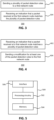
- FIG. 2 is a flow chart of an example of a method 200 of traffic monitoring in a first network node, such as for example a UPF, Packet Gateway (PGW) or Packet Gateway-User Plane (PGW-U).
- the first network node (and other nodes as described herein) may be a node in a 5G network, though the node may be in another network such as an LTE network or a network with a mixture of standard types.
- the method comprises, in step 202, receiving a packet (e.g. an IP packet).
- the packet may be received from the internet (e.g. downlink) or from a UE (e.g. uplink).
- Step 204 of the method 200 comprises determining that the packet matches a plurality of packet detection rules. That is, for example, once it is determined that the packet matches one PDR, the method 100 may continue to determine whether the packet matches any more PDRs. Determining that a packet matches a PDR may comprise for example determining that the packet matches respective Packet Detection Information (PDI) associated with the PDR. If the packet matches a plurality in PDRs, step 206 of the method 200 comprises sending an indication to a second network node (e.g. SMF or a Packet Gateway-Control Plane, PGW-C) that the packet matches a plurality of packet detection rules. Thus for example the first node may report to the second network node that there is a conflict in the PDRs configured in the first network node, as the packet matches multiple PDRs.
- a second network node e.g. SMF or a Packet Gateway-Control Plane, PGW-C
- the indication sent to the second network node contains the plurality of packet detection rules, such that for example the second network node (or any other network node) may identify the PDRs that are conflicting.
- the indication sent to the second network node may identify the PDRs (e.g. using a PDR ID).
- the method 100 may in some examples comprise, in response to determining that the packet matches the plurality of packet detection rules, sending the packet to the second network node.
- the second network node (or any other network node) may identify the packet that has resulted in or identified the conflict in the PDRs.
- the method 100 comprises, after sending the indication to the second network node, receiving (e.g. from the second network node) a modification for one or more of the packet detection rules, and modifying the one or more of the packet detection rules according to the modification to produce modified packet detection rules. Therefore, for example, the PDRs may be modified such that the packet does not match all of the modified packet detection rules (although there may already have been other PDRs configured in the first network node that did not match the packet in step 104). In some cases, the packet may match only one of the modified PDRs. In some examples, the method 100 may also include performing a respective action associated with each of the modified packet detection rules that the packet matches.
- the respective action may be one or more of a forwarding action rule, FAR, buffering action rule, BAR, quality enforcement rule, QER, usage reporting rule, URR, and/or policy control and charging, PCC, rule.
- the action may be undertaken regarding the packet after the PDRs have been modified.
- the action may be taken before the modification - e.g. action associated with the highest precedence matching PDR, or the actions associated with all of the matching PDRs.
- the modification may comprise, for example, one or more of addition of one or more new PDRs, deletion of one or more existing PDRs, and/or changes to one or more parameters of one or more existing PDRs.
- sending the indication to the second network node comprises sending an indication that a threshold number of packets or bytes have matched a plurality of packet detection rules.
- each of the packet detection rules is associated with a respective further indication that indicates whether a packet matching that packet detection rule is permitted to match one or more other packet detection rules.
- sending the indication to the second network node comprises sending an indication that the packet matches at least one packet detection rule associated with a further indication that the packet is not permitted to match any other packet detection rule.
- the indication is not sent to the second network node if all of the multiple matching PDRs are allowed to be multiple matching PDRs, i.e. the packet matches these multiple PDRs.
- the further indication (that the PDR(s) may be allowed to match a packet that also matches other PDR(s)) may be received from the second network node.
- the packet detection rules may be additionally or alternatively received from the second network node.
- FIG. 3 is a flow chart of an example of a method 300 of traffic monitoring in a second network node, such as for example a Session Management Function, SMF, or a Packet Gateway-Control Plane, PGW-C.
- the method 300 comprises, in step 302, sending a plurality of packet detection rules to a first network node, such as for example a User Plane Function, UPF, Packet Gateway, PGW, or Packet Gateway-User Plane, PGW-U.
- the first network node may implement the method 200 described above.
- Step 304 of the method 300 comprises receiving an indication (e.g. from the first network node) that a packet received at the first network node matches the plurality of packet detection rules. Therefore, for example, the second network node may determine that there is a conflict in the PDRs configured in the first network node.
- the indication identifies or contains the plurality of packet detection rules.
- the method 300 comprises receiving the packet from the first network node.
- the second network node (or another network node, if this information is forwarded to another network node) may determine the PDRs that are conflicting.
- the method 300 comprises sending the indication to a third network node, such as for example a PCF, receiving a modification for one or more of the packet detection rules (e.g. from the third network node), and sending the modification to the first network node.
- a third network node such as for example a PCF
- receiving a modification for one or more of the packet detection rules e.g. from the third network node
- sending the modification to the first network node e.g. from the third network node
- the PDRs configured in the first network node may be modified such that the packet matches fewer (e.g. only one) of the modified PDRs.
- each of the packet detection rules is associated with a respective further indication that indicates whether a packet matching that packet detection rule is permitted to match one or more other packet detection rules.
- receiving the indication comprises receiving an indication that the packet matches at least one packet detection rule associated with a further indication that the packet is not permitted to match any other packet detection rule.
- the indication is only received if one or more of the conflicting PDRs are not permitted to be a multiple-matching PDR, that is, a PDR in a group that matches the packet.
- the second network node may send the packet detection rules to the first network node before receiving the indication.
- Figure 4 is a flow chart of an example of a method 400 of traffic monitoring.
- the method 400 may be implemented in a PCF.
- the method 400 comprises, in step 402, receiving an indication that a packet received at a first network node matches a plurality of packet detection rules.
- the indication is received from a second network node, e.g. a Session Management Function, SMF, or a Packet Gateway-Control Plane, PGW-C.
- Step 404 of the method 400 comprises sending a modification for at least one of the packet detection rules to the first network node.
- the modification is sent via the second network node.
- the first network node may in some examples comprise a UPF, PGW or PGW-U.
- the first network node may perform the method 200 described above, and/or the second network node may perform the method 300 described above.
- FIG. 5 is a schematic of an example of apparatus 500 for traffic monitoring in a first network node.
- the apparatus 500 comprises processing circuitry 502 (e.g. one or more processors) and a memory 504 in communication with the processing circuitry 502.
- the memory 504 contains instructions executable by the processing circuitry 502.
- the apparatus 500 also comprises an interface 506 in communication with the processing circuitry 502. Although the interface 506, processing circuitry 502 and memory 504 are shown connected in series, these may alternatively be interconnected in any other way, for example via a bus.
- the memory 504 contains instructions executable by the processing circuitry 502 such that the apparatus 500 is operable to receive a packet, determine that the packet matches a plurality of packet detection rules, and send an indication to a second network node that the packet matches a plurality of packet detection rules. In some examples, the memory 504 contains instructions executable by the processing circuitry 502 such that the apparatus 500 is operable to carry out the method 200 described above.
- FIG. 6 is a schematic of an example of apparatus 600 for traffic monitoring in a second network node.
- the apparatus 600 comprises processing circuitry 602 (e.g. one or more processors) and a memory 604 in communication with the processing circuitry 602.
- the memory 604 contains instructions executable by the processing circuitry 602.
- the apparatus 600 also comprises an interface 606 in communication with the processing circuitry 602. Although the interface 606, processing circuitry 602 and memory 604 are shown connected in series, these may alternatively be interconnected in any other way, for example via a bus.
- the memory 604 contains instructions executable by the processing circuitry 602 such that the apparatus 600 is operable to send a plurality of packet detection rules to a first network node, and receive an indication that a packet received at the first network node matches the plurality of packet detection rules. In some examples, the memory 604 contains instructions executable by the processing circuitry 602 such that the apparatus 600 is operable to carry out the method 300 described above.
- FIG. 7 is a schematic of an example of apparatus 700 for traffic monitoring (e.g. in a third network node such as a PCF).
- the apparatus 700 comprises processing circuitry 702 (e.g. one or more processors) and a memory 704 in communication with the processing circuitry 702.
- the memory 704 contains instructions executable by the processing circuitry 702.
- the apparatus 700 also comprises an interface 706 in communication with the processing circuitry 702. Although the interface 706, processing circuitry 702 and memory 704 are shown connected in series, these may alternatively be interconnected in any other way, for example via a bus.
- the memory 704 contains instructions executable by the processing circuitry 702 such that the apparatus 700 is operable to receive an indication that a packet received at a first network node matches a plurality of packet detection rules, and send a modification for at least one of the packet detection rules to the first network node.
- Embodiments of this disclosure may be based on a scenario composed by a UE properly connected to a mobile network, in which there will be a node (a UPF) with deep packet inspection and service classification functionality, and an SMF sending PDR rules to the UPF.
- a UPF node
- SMF sending PDR rules to the UPF.
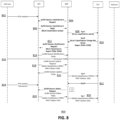
- Figure 8 shows an example of communications 800 between network entities, for example in embodiments where PCF does not support multi-classification in real time (i.e. the PCF does not support cases where a packet matches multiple PDRs), for example when establishing and/or performing traffic monitoring.
- the communications include the following (which may also be the steps of a method).
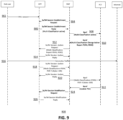
- Figure 9 shows another example of communications 900 between network entities, in a scenario where the PCF can modify the PDRs configured in the UPF, for example in real time), for example when establishing and/or performing traffic monitoring.
- the communications include the following (which may also be the steps of a method).
Landscapes
- Engineering & Computer Science (AREA)
- Computer Networks & Wireless Communication (AREA)
- Signal Processing (AREA)
- Environmental & Geological Engineering (AREA)
- Data Exchanges In Wide-Area Networks (AREA)
Claims (15)
- Procédé (200) de surveillance du trafic dans un premier nœud de réseau, le procédé comprenant :la réception d'une pluralité de règles de détection de paquets à partir d'un deuxième nœud de réseau ;la réception (202) d'un paquet ;la détermination (204) que le paquet correspond à une pluralité de règles de détection de paquets ;l'envoie (206) d'une indication au deuxième nœud de réseau que le paquet correspond à une pluralité de règles de détection de paquets ; etaprès l'envoie de l'indication au second nœud de réseau, la réception à partir du second nœud de réseau ou à partir d'un troisième nœud de réseau d'une modification pour une ou plusieurs des règles de détection de paquets, et la modification de la ou des règles de détection de paquets selon la modification pour produire des règles de détection de paquets modifiées.
- Procédé selon la revendication 1, dans lequel le paquet ne correspond pas à toutes les règles de détection de paquets modifiées.
- Procédé selon la revendication 2, comprenant l'exécution d'une action respective associée à chacune des règles de détection de paquets modifiées auxquelles le paquet correspond.
- Procédé selon l'une quelconque des revendications précédentes, dans lequel l'envoi (206) de l'indication au deuxième nœud de réseau comprend l'envoi d'une indication qu'un nombre seuil de paquets ou d'octets a correspondu à une pluralité de règles de détection de paquets.
- Procédé selon l'une quelconque des revendications précédentes, dans lequel chacune des règles de détection de paquets est associée à une indication respective qui indique si un paquet correspondant à cette règle de détection de paquets est autorisé à correspondre à une ou plusieurs autres règles de détection de paquets, et l'envoi de l'indication au deuxième nœud de réseau comprend l'envoi d'une indication que le paquet correspond à au moins une règle de détection de paquets associée à une indication que le paquet n'est pas autorisé à correspondre à une quelconque autre règle de détection de paquets.
- Procédé (300) de surveillance du trafic dans un deuxième nœud de réseau, le procédé comprenant :l'envoi d'une pluralité de règles de détection de paquets à un premier nœud de réseau ;la réception (304) à partir du premier nœud de réseau d'une indication qu'un paquet reçu au premier nœud de réseau correspond à la pluralité de règles de détection de paquets ;L'envoie de l'indication à un troisième nœud de réseau ;après l'envoie de l'indication au troisième nœud de réseau, la réception à partir d'un troisième nœud de réseau d'une modification pour une ou plusieurs des règles de détection de paquets ; etL'envoie de la modification au premier nœud de réseau.
- Procédé selon la revendication 6, dans lequel le paquet ne correspond pas à toutes les règles de détection de paquets avec la modification appliquée.
- Procédé selon la revendication 6 ou 7, dans lequel la réception de l'indication comprend la réception d'une indication qu'un nombre seuil de paquets ou d'octets a correspondu à une pluralité de règles de détection de paquets au niveau du premier nœud de réseau.
- Procédé selon l'une quelconque des revendications 6 à 8, dans lequel chacune des règles de détection de paquets est associée à une indication respective qui indique si un paquet correspondant à cette règle de détection de paquets est autorisé à correspondre à une ou plusieurs autres règles de détection de paquets, et la réception de l'indication comprend la réception d'une indication que le paquet correspond à au moins une règle de détection de paquets associée à une indication que le paquet n'est pas autorisé à correspondre à une quelconque autre règle de détection de paquets.
- Procédé (400) de surveillance du trafic dans un troisième nœud de réseau, le procédé comprenant :la réception (402) à partir d'un deuxième nœud de réseaud'une indication qu'un paquet reçu à un premier nœud de réseau correspond à une pluralité de règles de détection de paquets ; etaprès la réception de l'indication à partir du deuxième nœud de réseau, l'envoie (404) d'une modification pour au moins une des règles de détection de paquets au premier ou au deuxième nœud de réseau.
- Procédé selon la revendication 10, dans lequel le paquet ne correspond pas à toutes les règles de détection de paquets avec la modification appliquée.
- Appareil (500) pour la surveillance du trafic dans un premier nœud de réseau, l'appareil comprenant un processeur (502) et une mémoire (504), la mémoire contenant des instructions exécutables par le processeur de telle sorte que l'appareil puisse fonctionner pour :recevoir une pluralité de règles de détection de paquets à partir d'un deuxième nœud de réseau ;recevoir (202) un paquet ;déterminer (204) que le paquet correspond à une pluralité de règles de détection de paquets ;envoyer (206) une indication au deuxième nœud de réseau que le paquet correspond à une pluralité de règles de détection de paquets ; etaprès l'envoie de l'indication au deuxième nœud de réseau, recevoir à partir du deuxième nœud de réseau ou à partir d'un troisième nœud de réseau une modification pour une ou plusieurs des règles de détection de paquets, et modifier la ou les règles de détection de paquets selon la modification pour produire des règles de détection de paquets modifiées.
- Appareil (600) pour la surveillance du trafic dans un deuxième nœud de réseau, l'appareil comprenant un processeur (602) et une mémoire (604), la mémoire contenant des instructions exécutables par le processeur de telle sorte que l'appareil puisse fonctionner pour :envoyer une pluralité de règles de détection de paquets à un premier nœud de réseau ; etrecevoir (304) à partir du premier nœud de réseauune indication qu'un paquet reçu au premier nœud de réseau correspond à la pluralité de règles de détection de paquets ;envoyer l'indication à un troisième nœud du réseau ;après avoir envoyé l'indication au troisième nœud de réseau, recevoir à partir d'un troisième nœud de réseau une modification pour une ou plusieurs des règles de détection de paquets ; etenvoyer la modification au premier nœud de réseau.
- Appareil (700) pour la surveillance du trafic dans un troisième nœud de réseau, l'appareil comprenant un processeur (702)
et une mémoire (704), la mémoire contenant des instructions exécutables par le processeur de telle sorte que l'appareil puisse fonctionner pour :recevoir (402) à partir d'un deuxième nœud de réseauune indication qu'un paquet reçu à un premier nœud de réseau correspond à une pluralité de règles de détection de paquets ; etaprès avoir reçu l'indication à partir du deuxième nœud de réseau, envoyer (404) une modification pour au moins une des règles de détection de paquets au premier ou au deuxième nœud de réseau. - Appareil (500) selon la revendication 12, dans lequel la mémoire contient des instructions exécutables par le processeur, de telle sorte que l'appareil puisse fonctionner pour mettre en œuvre le procédé (200) selon l'une quelconque des revendications 2 à 5 ; ouAppareil (600) selon la revendication 13, dans lequel la mémoire contient des instructions exécutables par le processeur, de telle sorte que l'appareil puisse fonctionner pour mettre en œuvre le procédé (300) selon l'une quelconque des revendications 7 à 9 ; ouAppareil (700) selon la revendication 14, dans lequel la mémoire contient des instructions exécutables par le processeur, de telle sorte que l'appareil puisse fonctionner pour mettre en œuvre le procédé (400) selon la revendication 11.
Applications Claiming Priority (2)
| Application Number | Priority Date | Filing Date | Title |
|---|---|---|---|
| EP19382643 | 2019-07-26 | ||
| PCT/EP2019/074509 WO2021018406A1 (fr) | 2019-07-26 | 2019-09-13 | Surveillance de trafic dans un nœud de réseau |
Publications (2)
| Publication Number | Publication Date |
|---|---|
| EP4005166A1 EP4005166A1 (fr) | 2022-06-01 |
| EP4005166B1 true EP4005166B1 (fr) | 2025-02-19 |
Family
ID=67658277
Family Applications (1)
| Application Number | Title | Priority Date | Filing Date |
|---|---|---|---|
| EP19765755.4A Active EP4005166B1 (fr) | 2019-07-26 | 2019-09-13 | Surveillance de trafic dans un noeud de réseau |
Country Status (4)
| Country | Link |
|---|---|
| US (1) | US12132629B2 (fr) |
| EP (1) | EP4005166B1 (fr) |
| CN (1) | CN114270788B (fr) |
| WO (1) | WO2021018406A1 (fr) |
Families Citing this family (2)
| Publication number | Priority date | Publication date | Assignee | Title |
|---|---|---|---|---|
| CN112969194B (zh) * | 2021-02-19 | 2023-04-07 | 浪潮软件科技有限公司 | 一种基于反向包处理的urr统计方法 |
| US11765087B1 (en) * | 2021-08-19 | 2023-09-19 | T-Mobile Innovations Llc | Rapid packet processing at user plane function |
Citations (1)
| Publication number | Priority date | Publication date | Assignee | Title |
|---|---|---|---|---|
| US20180309724A1 (en) * | 2017-04-24 | 2018-10-25 | Radiflow Ltd. | Control plane network security |
Family Cites Families (6)
| Publication number | Priority date | Publication date | Assignee | Title |
|---|---|---|---|---|
| US8352391B1 (en) * | 2008-08-20 | 2013-01-08 | Juniper Networks, Inc. | Fast update filter |
| US10229139B2 (en) | 2011-08-02 | 2019-03-12 | Cavium, Llc | Incremental update heuristics |
| US11418632B2 (en) | 2015-12-15 | 2022-08-16 | Intel Corporation | High speed flexible packet classification using network processors |
| US10542454B2 (en) | 2017-02-10 | 2020-01-21 | Mediatek Inc. | Control and management of reflective QoS |
| US11070589B2 (en) | 2017-06-29 | 2021-07-20 | Juniper Networks, Inc. | Dynamic implementation of a security rule |
| CN112152923B (zh) * | 2019-06-28 | 2021-12-28 | 北京华为数字技术有限公司 | 用户面重路由方法及装置 |
-
2019
- 2019-09-13 WO PCT/EP2019/074509 patent/WO2021018406A1/fr not_active Ceased
- 2019-09-13 EP EP19765755.4A patent/EP4005166B1/fr active Active
- 2019-09-13 US US17/629,945 patent/US12132629B2/en active Active
- 2019-09-13 CN CN201980099085.4A patent/CN114270788B/zh active Active
Patent Citations (1)
| Publication number | Priority date | Publication date | Assignee | Title |
|---|---|---|---|---|
| US20180309724A1 (en) * | 2017-04-24 | 2018-10-25 | Radiflow Ltd. | Control plane network security |
Also Published As
| Publication number | Publication date |
|---|---|
| WO2021018406A1 (fr) | 2021-02-04 |
| US20220303201A1 (en) | 2022-09-22 |
| EP4005166A1 (fr) | 2022-06-01 |
| CN114270788A (zh) | 2022-04-01 |
| CN114270788B (zh) | 2025-05-13 |
| US12132629B2 (en) | 2024-10-29 |
Similar Documents
| Publication | Publication Date | Title |
|---|---|---|
| US11812307B2 (en) | Monitoring and reporting quality of service occurrences in a wireless network | |
| EP1987682B1 (fr) | Système et procédé pour la manipulation sélective du trafic de contrôle pour ameliorer les performances d'un réseau | |
| US8412160B2 (en) | Method for discarding all segments corresponding to the same packet in a buffer | |
| US11516118B2 (en) | Methods and nodes for enabling management of traffic | |
| EP4101126B1 (fr) | Gestion de chaînes de fonctionnement de services | |
| EP2670189B1 (fr) | Commande de flux de données sur des réseaux de transport | |
| US12557151B2 (en) | Improving classification accuracy in user plane function re-selection scenarios | |
| US12237985B2 (en) | Technique for dynamically classifying and re-classifying a data packet flow | |
| US20230336432A1 (en) | Traffic classification rules based on analytics | |
| EP4005166B1 (fr) | Surveillance de trafic dans un noeud de réseau | |
| US8958336B2 (en) | Condition detection by a call session control function (CSCF) | |
| WO2021018420A1 (fr) | Détection de paquets | |
| WO2023117153A1 (fr) | Service de classification de trafic basée sur un service |
Legal Events
| Date | Code | Title | Description |
|---|---|---|---|
| STAA | Information on the status of an ep patent application or granted ep patent |
Free format text: STATUS: UNKNOWN |
|
| STAA | Information on the status of an ep patent application or granted ep patent |
Free format text: STATUS: THE INTERNATIONAL PUBLICATION HAS BEEN MADE |
|
| PUAI | Public reference made under article 153(3) epc to a published international application that has entered the european phase |
Free format text: ORIGINAL CODE: 0009012 |
|
| STAA | Information on the status of an ep patent application or granted ep patent |
Free format text: STATUS: REQUEST FOR EXAMINATION WAS MADE |
|
| 17P | Request for examination filed |
Effective date: 20220214 |
|
| AK | Designated contracting states |
Kind code of ref document: A1 Designated state(s): AL AT BE BG CH CY CZ DE DK EE ES FI FR GB GR HR HU IE IS IT LI LT LU LV MC MK MT NL NO PL PT RO RS SE SI SK SM TR |
|
| DAV | Request for validation of the european patent (deleted) | ||
| DAX | Request for extension of the european patent (deleted) | ||
| STAA | Information on the status of an ep patent application or granted ep patent |
Free format text: STATUS: EXAMINATION IS IN PROGRESS |
|
| 17Q | First examination report despatched |
Effective date: 20230901 |
|
| REG | Reference to a national code |
Ref country code: DE Ref legal event code: R079 Free format text: PREVIOUS MAIN CLASS: H04L0012741000 Ipc: H04L0043065000 Ref document number: 602019066181 Country of ref document: DE |
|
| GRAP | Despatch of communication of intention to grant a patent |
Free format text: ORIGINAL CODE: EPIDOSNIGR1 |
|
| STAA | Information on the status of an ep patent application or granted ep patent |
Free format text: STATUS: GRANT OF PATENT IS INTENDED |
|
| RIC1 | Information provided on ipc code assigned before grant |
Ipc: H04L 45/00 20220101ALI20240806BHEP Ipc: H04L 43/065 20220101AFI20240806BHEP |
|
| INTG | Intention to grant announced |
Effective date: 20240816 |
|
| GRAS | Grant fee paid |
Free format text: ORIGINAL CODE: EPIDOSNIGR3 |
|
| GRAA | (expected) grant |
Free format text: ORIGINAL CODE: 0009210 |
|
| STAA | Information on the status of an ep patent application or granted ep patent |
Free format text: STATUS: THE PATENT HAS BEEN GRANTED |
|
| AK | Designated contracting states |
Kind code of ref document: B1 Designated state(s): AL AT BE BG CH CY CZ DE DK EE ES FI FR GB GR HR HU IE IS IT LI LT LU LV MC MK MT NL NO PL PT RO RS SE SI SK SM TR |
|
| REG | Reference to a national code |
Ref country code: GB Ref legal event code: FG4D |
|
| REG | Reference to a national code |
Ref country code: CH Ref legal event code: EP |
|
| REG | Reference to a national code |
Ref country code: DE Ref legal event code: R096 Ref document number: 602019066181 Country of ref document: DE |
|
| REG | Reference to a national code |
Ref country code: IE Ref legal event code: FG4D |
|
| REG | Reference to a national code |
Ref country code: NL Ref legal event code: MP Effective date: 20250219 |
|
| PG25 | Lapsed in a contracting state [announced via postgrant information from national office to epo] |
Ref country code: RS Free format text: LAPSE BECAUSE OF FAILURE TO SUBMIT A TRANSLATION OF THE DESCRIPTION OR TO PAY THE FEE WITHIN THE PRESCRIBED TIME-LIMIT Effective date: 20250519 |
|
| PG25 | Lapsed in a contracting state [announced via postgrant information from national office to epo] |
Ref country code: FI Free format text: LAPSE BECAUSE OF FAILURE TO SUBMIT A TRANSLATION OF THE DESCRIPTION OR TO PAY THE FEE WITHIN THE PRESCRIBED TIME-LIMIT Effective date: 20250219 |
|
| PG25 | Lapsed in a contracting state [announced via postgrant information from national office to epo] |
Ref country code: PL Free format text: LAPSE BECAUSE OF FAILURE TO SUBMIT A TRANSLATION OF THE DESCRIPTION OR TO PAY THE FEE WITHIN THE PRESCRIBED TIME-LIMIT Effective date: 20250219 |
|
| PG25 | Lapsed in a contracting state [announced via postgrant information from national office to epo] |
Ref country code: ES Free format text: LAPSE BECAUSE OF FAILURE TO SUBMIT A TRANSLATION OF THE DESCRIPTION OR TO PAY THE FEE WITHIN THE PRESCRIBED TIME-LIMIT Effective date: 20250219 |
|
| REG | Reference to a national code |
Ref country code: LT Ref legal event code: MG9D |
|
| PG25 | Lapsed in a contracting state [announced via postgrant information from national office to epo] |
Ref country code: NO Free format text: LAPSE BECAUSE OF FAILURE TO SUBMIT A TRANSLATION OF THE DESCRIPTION OR TO PAY THE FEE WITHIN THE PRESCRIBED TIME-LIMIT Effective date: 20250519 Ref country code: IS Free format text: LAPSE BECAUSE OF FAILURE TO SUBMIT A TRANSLATION OF THE DESCRIPTION OR TO PAY THE FEE WITHIN THE PRESCRIBED TIME-LIMIT Effective date: 20250619 |
|
| PG25 | Lapsed in a contracting state [announced via postgrant information from national office to epo] |
Ref country code: NL Free format text: LAPSE BECAUSE OF FAILURE TO SUBMIT A TRANSLATION OF THE DESCRIPTION OR TO PAY THE FEE WITHIN THE PRESCRIBED TIME-LIMIT Effective date: 20250219 |
|
| PG25 | Lapsed in a contracting state [announced via postgrant information from national office to epo] |
Ref country code: HR Free format text: LAPSE BECAUSE OF FAILURE TO SUBMIT A TRANSLATION OF THE DESCRIPTION OR TO PAY THE FEE WITHIN THE PRESCRIBED TIME-LIMIT Effective date: 20250219 |
|
| PG25 | Lapsed in a contracting state [announced via postgrant information from national office to epo] |
Ref country code: LV Free format text: LAPSE BECAUSE OF FAILURE TO SUBMIT A TRANSLATION OF THE DESCRIPTION OR TO PAY THE FEE WITHIN THE PRESCRIBED TIME-LIMIT Effective date: 20250219 Ref country code: PT Free format text: LAPSE BECAUSE OF FAILURE TO SUBMIT A TRANSLATION OF THE DESCRIPTION OR TO PAY THE FEE WITHIN THE PRESCRIBED TIME-LIMIT Effective date: 20250620 |
|
| PG25 | Lapsed in a contracting state [announced via postgrant information from national office to epo] |
Ref country code: GR Free format text: LAPSE BECAUSE OF FAILURE TO SUBMIT A TRANSLATION OF THE DESCRIPTION OR TO PAY THE FEE WITHIN THE PRESCRIBED TIME-LIMIT Effective date: 20250520 Ref country code: BG Free format text: LAPSE BECAUSE OF FAILURE TO SUBMIT A TRANSLATION OF THE DESCRIPTION OR TO PAY THE FEE WITHIN THE PRESCRIBED TIME-LIMIT Effective date: 20250219 |
|
| REG | Reference to a national code |
Ref country code: AT Ref legal event code: MK05 Ref document number: 1769417 Country of ref document: AT Kind code of ref document: T Effective date: 20250219 |
|
| PG25 | Lapsed in a contracting state [announced via postgrant information from national office to epo] |
Ref country code: SE Free format text: LAPSE BECAUSE OF FAILURE TO SUBMIT A TRANSLATION OF THE DESCRIPTION OR TO PAY THE FEE WITHIN THE PRESCRIBED TIME-LIMIT Effective date: 20250219 |
|
| PG25 | Lapsed in a contracting state [announced via postgrant information from national office to epo] |
Ref country code: SM Free format text: LAPSE BECAUSE OF FAILURE TO SUBMIT A TRANSLATION OF THE DESCRIPTION OR TO PAY THE FEE WITHIN THE PRESCRIBED TIME-LIMIT Effective date: 20250219 |
|
| PG25 | Lapsed in a contracting state [announced via postgrant information from national office to epo] |
Ref country code: DK Free format text: LAPSE BECAUSE OF FAILURE TO SUBMIT A TRANSLATION OF THE DESCRIPTION OR TO PAY THE FEE WITHIN THE PRESCRIBED TIME-LIMIT Effective date: 20250219 |
|
| PGFP | Annual fee paid to national office [announced via postgrant information from national office to epo] |
Ref country code: DE Payment date: 20250929 Year of fee payment: 7 |
|
| PG25 | Lapsed in a contracting state [announced via postgrant information from national office to epo] |
Ref country code: IT Free format text: LAPSE BECAUSE OF FAILURE TO SUBMIT A TRANSLATION OF THE DESCRIPTION OR TO PAY THE FEE WITHIN THE PRESCRIBED TIME-LIMIT Effective date: 20250219 |
|
| PGFP | Annual fee paid to national office [announced via postgrant information from national office to epo] |
Ref country code: GB Payment date: 20250929 Year of fee payment: 7 |
|
| PG25 | Lapsed in a contracting state [announced via postgrant information from national office to epo] |
Ref country code: AT Free format text: LAPSE BECAUSE OF FAILURE TO SUBMIT A TRANSLATION OF THE DESCRIPTION OR TO PAY THE FEE WITHIN THE PRESCRIBED TIME-LIMIT Effective date: 20250219 |
|
| PG25 | Lapsed in a contracting state [announced via postgrant information from national office to epo] |
Ref country code: EE Free format text: LAPSE BECAUSE OF FAILURE TO SUBMIT A TRANSLATION OF THE DESCRIPTION OR TO PAY THE FEE WITHIN THE PRESCRIBED TIME-LIMIT Effective date: 20250219 Ref country code: CZ Free format text: LAPSE BECAUSE OF FAILURE TO SUBMIT A TRANSLATION OF THE DESCRIPTION OR TO PAY THE FEE WITHIN THE PRESCRIBED TIME-LIMIT Effective date: 20250219 |
|
| PG25 | Lapsed in a contracting state [announced via postgrant information from national office to epo] |
Ref country code: RO Free format text: LAPSE BECAUSE OF FAILURE TO SUBMIT A TRANSLATION OF THE DESCRIPTION OR TO PAY THE FEE WITHIN THE PRESCRIBED TIME-LIMIT Effective date: 20250219 |
|
| PG25 | Lapsed in a contracting state [announced via postgrant information from national office to epo] |
Ref country code: SK Free format text: LAPSE BECAUSE OF FAILURE TO SUBMIT A TRANSLATION OF THE DESCRIPTION OR TO PAY THE FEE WITHIN THE PRESCRIBED TIME-LIMIT Effective date: 20250219 |
|
| REG | Reference to a national code |
Ref country code: DE Ref legal event code: R097 Ref document number: 602019066181 Country of ref document: DE |
|
| PLBE | No opposition filed within time limit |
Free format text: ORIGINAL CODE: 0009261 |
|
| STAA | Information on the status of an ep patent application or granted ep patent |
Free format text: STATUS: NO OPPOSITION FILED WITHIN TIME LIMIT |
|
| 26N | No opposition filed |
Effective date: 20251120 |