EP1988115A2 - Procédé de fabrication de bicellules adhésives à électrodes - Google Patents
Procédé de fabrication de bicellules adhésives à électrodes Download PDFInfo
- Publication number
- EP1988115A2 EP1988115A2 EP08154914A EP08154914A EP1988115A2 EP 1988115 A2 EP1988115 A2 EP 1988115A2 EP 08154914 A EP08154914 A EP 08154914A EP 08154914 A EP08154914 A EP 08154914A EP 1988115 A2 EP1988115 A2 EP 1988115A2
- Authority
- EP
- European Patent Office
- Prior art keywords
- optionally
- reaction
- aminoalkyl
- catalyst
- organopolysiloxanes
- Prior art date
- Legal status (The legal status is an assumption and is not a legal conclusion. Google has not performed a legal analysis and makes no representation as to the accuracy of the status listed.)
- Granted
Links
Images
Classifications
-
- C—CHEMISTRY; METALLURGY
- C08—ORGANIC MACROMOLECULAR COMPOUNDS; THEIR PREPARATION OR CHEMICAL WORKING-UP; COMPOSITIONS BASED THEREON
- C08G—MACROMOLECULAR COMPOUNDS OBTAINED OTHERWISE THAN BY REACTIONS ONLY INVOLVING UNSATURATED CARBON-TO-CARBON BONDS
- C08G77/00—Macromolecular compounds obtained by reactions forming a linkage containing silicon with or without sulfur, nitrogen, oxygen or carbon in the main chain of the macromolecule
- C08G77/04—Polysiloxanes
- C08G77/06—Preparatory processes
-
- C—CHEMISTRY; METALLURGY
- C07—ORGANIC CHEMISTRY
- C07F—ACYCLIC, CARBOCYCLIC OR HETEROCYCLIC COMPOUNDS CONTAINING ELEMENTS OTHER THAN CARBON, HYDROGEN, HALOGEN, OXYGEN, NITROGEN, SULFUR, SELENIUM OR TELLURIUM
- C07F7/00—Compounds containing elements of Groups 4 or 14 of the Periodic Table
- C07F7/02—Silicon compounds
- C07F7/08—Compounds having one or more C—Si linkages
- C07F7/0834—Compounds having one or more O-Si linkage
- C07F7/0838—Compounds with one or more Si-O-Si sequences
- C07F7/0872—Preparation and treatment thereof
- C07F7/0874—Reactions involving a bond of the Si-O-Si linkage
-
- C—CHEMISTRY; METALLURGY
- C08—ORGANIC MACROMOLECULAR COMPOUNDS; THEIR PREPARATION OR CHEMICAL WORKING-UP; COMPOSITIONS BASED THEREON
- C08G—MACROMOLECULAR COMPOUNDS OBTAINED OTHERWISE THAN BY REACTIONS ONLY INVOLVING UNSATURATED CARBON-TO-CARBON BONDS
- C08G77/00—Macromolecular compounds obtained by reactions forming a linkage containing silicon with or without sulfur, nitrogen, oxygen or carbon in the main chain of the macromolecule
- C08G77/04—Polysiloxanes
-
- C—CHEMISTRY; METALLURGY
- C08—ORGANIC MACROMOLECULAR COMPOUNDS; THEIR PREPARATION OR CHEMICAL WORKING-UP; COMPOSITIONS BASED THEREON
- C08G—MACROMOLECULAR COMPOUNDS OBTAINED OTHERWISE THAN BY REACTIONS ONLY INVOLVING UNSATURATED CARBON-TO-CARBON BONDS
- C08G77/00—Macromolecular compounds obtained by reactions forming a linkage containing silicon with or without sulfur, nitrogen, oxygen or carbon in the main chain of the macromolecule
- C08G77/04—Polysiloxanes
- C08G77/06—Preparatory processes
- C08G77/08—Preparatory processes characterised by the catalysts used
-
- C—CHEMISTRY; METALLURGY
- C08—ORGANIC MACROMOLECULAR COMPOUNDS; THEIR PREPARATION OR CHEMICAL WORKING-UP; COMPOSITIONS BASED THEREON
- C08G—MACROMOLECULAR COMPOUNDS OBTAINED OTHERWISE THAN BY REACTIONS ONLY INVOLVING UNSATURATED CARBON-TO-CARBON BONDS
- C08G77/00—Macromolecular compounds obtained by reactions forming a linkage containing silicon with or without sulfur, nitrogen, oxygen or carbon in the main chain of the macromolecule
- C08G77/04—Polysiloxanes
- C08G77/38—Polysiloxanes modified by chemical after-treatment
- C08G77/382—Polysiloxanes modified by chemical after-treatment containing atoms other than carbon, hydrogen, oxygen or silicon
- C08G77/388—Polysiloxanes modified by chemical after-treatment containing atoms other than carbon, hydrogen, oxygen or silicon containing nitrogen
-
- C—CHEMISTRY; METALLURGY
- C08—ORGANIC MACROMOLECULAR COMPOUNDS; THEIR PREPARATION OR CHEMICAL WORKING-UP; COMPOSITIONS BASED THEREON
- C08G—MACROMOLECULAR COMPOUNDS OBTAINED OTHERWISE THAN BY REACTIONS ONLY INVOLVING UNSATURATED CARBON-TO-CARBON BONDS
- C08G77/00—Macromolecular compounds obtained by reactions forming a linkage containing silicon with or without sulfur, nitrogen, oxygen or carbon in the main chain of the macromolecule
- C08G77/04—Polysiloxanes
- C08G77/14—Polysiloxanes containing silicon bound to oxygen-containing groups
- C08G77/16—Polysiloxanes containing silicon bound to oxygen-containing groups to hydroxyl groups
Definitions
- the invention relates to a process for the preparation of aminoalkyl-containing organopolysiloxanes.
- amine oils are among the most important organically functionalized organopolysiloxanes and are used successfully in many different fields of application. These include u. a. Textile equipment, building protection, cosmetic formulations or the treatment of surfaces. For most applications in these areas, it is important to use high quality amine oils.
- the corresponding quality features include a) a constant and lowest possible residual volatility (eg caused by short-chain alcohols, short-chain and / or cyclic siloxane components or amines), b) a constant viscosity, c) an optimal statistical distribution of the aminoalkyl groups in the copolymer, and, where possible and necessary, d) optical clarity (turbidity free).
- the quality features b) and c) can usually be achieved only by an effective equilibration of the polymer mixture, optionally coupled to a condensation reaction, but depending on the set reaction conditions, different amounts of volatile compounds incurred.
- Amine oils are usually produced by condensation and / or equilibration reactions between linear or cyclic organopolysiloxanes and aminoalkyl-functionalized alkoxysilanes or their partial or full hydrolyzates, usually under the action of catalytic amounts of basic inorganic or organic compounds.
- amine oils are produced in the so-called batch process, ie on a campaign basis in discontinuous stirring processes. Agitators are very flexible due to the variety of chemical reactions that can be carried out in them, but become uneconomical in comparison with continuous processes in the case of very large production campaigns and high mass throughputs.
- US 4,128,568 (corresponding DE-A 2705563 ) describes a continuous process for the preparation of unfunctionalized organopolysiloxanes.
- the alkali metal hydroxides used must be deactivated by addition of trimethylchlorosilane.
- the organopolysiloxanes thus obtained must therefore be subjected to a subsequent filtration and distillation step in order to remove the volatile disiloxanes produced by the deactivation and thus to achieve the desired low residual volatility.
- EP-A 1723193 describes a catalyst-free continuous process for the continuous preparation of terminal aminoalkyl-functional siloxanes from terminally SiOH-bearing siloxanes and cyclic silazanes.
- the process starts with cyclic silazanes from a special and expensive amine precursor, inter alia with the aim of keeping the resulting amine oil free of volatile alcohols resulting from condensation reactions.
- the siloxanes bearing SiOH groups necessary for pendant amine oils produced by this process are not readily and readily available.
- EP-A 0982347 describes a continuous process for the preparation of silicone polymers from siloxanes or siloxane cycles bearing SiOH groups by means of catalytic amounts of basic phosphazenes. However, apart from end group functionalization with various SiC-bonded hydrocarbon radicals, no heteroatom-substituted organically functionalized copolymers, such as amine oils, are described.
- a very special continuous reactor for the preparation of siloxane polymers from siloxane mono- and oligomers is disclosed in US Pat EP-A 0522776 described.
- the reaction mixture is foamed and passes through a porous wall in the reaction space. Due to the high generated interface between the reaction mixture and the gas space, volatilities from thin media can be removed well.
- the process is limited to condensation reactions of monomers or low-viscosity oligomers, an explicit equilibration of the polymers produced or the preparation of highly viscous silicone oils is not described.
- a conventional neutralization of the catalysts is described which i. A. leads to cloudy products by salt formation.
- the compounds (A), (B), optionally (C) and optionally (D) are preferably passed continuously through the reaction space and there are the compounds (A), (B) and optionally (D) optionally in the presence of the catalyst (C) is reacted, and from the reaction space, the resulting aminoalkyl-containing organopolysiloxanes are continuously removed.
- reaction (i) takes place in the presence of basic catalysts (C).
- the neutralization of the basic catalysts (C) is preferably carried out continuously.
- the reaction space has a length to diameter ratio of 4 to 1000, preferably 5 to 100, more preferably 6 to 10.
- organopolysiloxanes is intended in the context of the present invention to include dimeric as well as oligomeric as well as polymeric siloxanes.
- amine oils of any desired amine number can be produced.
- the amine number corresponds to the number of ml of 1M HCl required to neutralize 1 g of the substance and is given in millimoles of amine groups per gram of substance.
- the amine number range is between 0.001 and 12.5, preferably the range between 0.01 and 5, more preferably the range between 0.1 and 3 mmol amine groups per gram of substance.
- the viscosities of the amine oils prepared by the process according to the invention can be between water-stable and stable consistency.
- the viscosity is preferably 1 mPa ⁇ s to 10,000,000 mPa ⁇ s, preferably 100 mPa ⁇ s to 100,000 mPa ⁇ s, more preferably 500 mPa ⁇ s to 50,000 mPa ⁇ s.
- the starting compounds (A), (B) and, if appropriate, (D) used for the preparation of the amine oils are passed through a chamber whose length / diameter ratio is four or higher.
- a chamber may be included, for example, in loop reactors, kneaders, extruders, flow tubes, tubular reactors, microreactors or centrifugal pumps, as well as in any combination thereof.
- the procedure in the extruder or kneader for producing highly viscous or stable amine oils is therefore preferred, the procedure in the tubular reactor for Generation of flowable amine oils (measured at 25 ° C viscosity less than 50,000 mPa ⁇ s) particularly preferred.
- the educts and, if appropriate, the catalyst are preferably conveyed or pumped continuously into the reaction space and mixed therein, it being possible to preheat the educts and, if appropriate, the catalyst before reaching the reaction space or the union in the reaction space.
- electrical heating jackets and wires are suitable for preheating, which surround the educt feed lines and either double-walled educt feed lines through which a heated medium flows or single-wall educt feed lines which run through the bath of a heated medium.
- the catalyst is not brought into the reaction space with the educts, it may possibly be a basic catalyst immobilized in the reaction space or applied to an optionally polymeric support.
- the individual volume flows of the educts with one another are adjusted appropriately in order to obtain the desired statistical distribution of functional groups in the polymer and the desired product molecular weight distribution.
- the total volume flow in the entire reactor depends on the desired residence time in the reactor.
- the reaction space can be heated and mixed or kneaded as a whole or even partially.
- Electric heating jackets and wires, which surround the reaction space, or a double-walled reaction space, through which a heated medium flows, are suitable for heating.
- Suitable mixers include so-called static mixers, which can be mounted in the reaction space, or mechanically driven stirrers (power transmission directly eg via a shaft or a combination of magnetic coupling and shaft) or gas streams (eg nitrogen), the turbulence cause.
- the material of the reactor can vary from metal, such as chromium-vanadium-steel reactors, enamelled steel reactors, to glass reactors.
- the reactions in the reaction space are preferably carried out at a temperature of 50 to 180 ° C, preferably 80 to 130 ° C.
- the reaction times and thus the average residence times are preferably 1 to 180 minutes, preferably 10 to 120 minutes and more preferably 20 to 90 minutes.
- the pressure in the reaction space can be adjusted to any value adapted to the respective reactor type, with values between the atmospheric pressure surrounding the reactor (about 1013 mbar) and 0.1 mbar being preferred, values between 100 and 1 mbar being particularly preferred to remove the volatile components which may occur during the reaction continuously via the gas phase by distillation.
- a so-called purge gas stream may additionally be passed through the reaction space, the inert nitrogen gas being preferred.
- the catalyst (C) which may be present in the reaction mixture is deactivated.
- This can be z. B. by chemical reaction of the catalyst with a deactivator - usually a neutralizing agent or inhibitor - done or by thermal deactivation, by the reaction mixture passes through a specially brought to the necessary temperature zone of the reactor. If there are solids in the conveyed reaction product as a result of the reaction procedure or the catalyst deactivation, these can be removed, if appropriate, by downstream processes. at such downstream processes may be a continuous filtration or a continuous extraction with a suitable solvent or a continuous adsorptive process on a suitable adsorbent.
- reaction product After passing through a cooling zone in which the reaction product has been cooled by the heat exchange principle to a desired temperature, the reaction product can be continuously filled into storage tanks or end containers or continuously fed to other parts of the system, such.
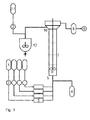
- a preferred embodiment of the method according to the invention (numbers in parentheses refer to Fig. 1 ) are the starting compounds (A), (B) and optionally (D) and the catalyst (C) from respective containers (1) via pump or pump / balance combinations (2) continuously through preheater (3) and then by a heated reactor (5) passed.
- a nitrogen supply line (4) may optionally be switched on a purge gas stream to remove low-boiling components.
- the reactor are one or more stirrers or static mixing elements (6) and one or more perforated or sieve plates (7).
- low-boiling components can be condensed with the aid of a regulated vacuum pump (9).
- the deactivator of the catalyst is continuously metered from the deactivator vessel (11) and the product is collected in a stirred product collection tank (12) and cooled.
- siloxane units may be present in addition to the diorganosiloxane units R 2 SiO.
- examples of such other, mostly only as impurity present siloxane units are those of the formulas RSiO 3/2 , R 3 SiO 1/2 and SiO 2 , wherein R has the meaning given.
- hydrocarbon radicals R, R 1 or R ' are alkyl radicals, such as the methyl, ethyl, n-propyl, iso-propyl, 1-n-butyl, 2-n-butyl, isobutyl, tert-butyl, n-pentyl, iso-pentyl, neo-pentyl, tert-pentyl, hexyl, such as the n-hexyl, heptyl, such as the n-heptyl, octyl, such as the n-octyl radical and iso-octyl radicals, such as the 2,2,4-trimethylpentyl radical, nonyl radicals, such as the n-nonyl radical, decyl radicals, such as the n-decyl radical, dodecyl radicals, such as the n-dodecyl radical, and octa
- the hydrocarbon radicals R, R 1 or R ' optionally contain an aliphatic double bond.
- alkenyl radicals such as the vinyl, allyl, 5-hexen-1-yl, E-4-hexen-1-yl, Z-4-hexen-1-yl, 2- (3-cyclohexenyl) ethyl and cyclododeca-4,8-dienyl.
- Preferred radicals R having an aliphatic double bond are the vinyl, allyl, and 5-hexen-1-yl radicals.
- at most 1% of the hydrocarbon radicals R contain one double bond.
- halogenated radicals R are haloalkyl radicals, such as the 3,3,3-trifluoro-n-propyl radical, the 2,2,2,2 ', 2', 2'-hexafluoroisopropyl radical, the heptafluoroisopropyl radical and haloaryl radicals, such as the o-, m- and p-chlorophenyl.
- the radical R is preferably a monovalent hydrocarbon radical having 1 to 18 carbon atoms, the methyl radical being particularly preferred.
- R 1 are CH 3 -, CH 3 CH 2 -, (CH 3 ) 2 CH-, CH 3 CH 2 CH 2 -, CH 3 CH 2 CH 2 CH 2 -, CH 3 CH 2 OCH 2 CH 2 - , CH 3 CH 2 OCH 2 - and CH 3 OCH 2 CH 2 - radicals.
- the aminoalkylsilane hydrolysates (B) are preferably selected from aminoalkyl-functional dialkoxysilanes, such as (3-aminopropyl) dimethoxymethylsilane or [N- (2-aminoethyl) -3-aminopropyl] dimethoxymethylsilane, produced by hydrolysis in water.
- Aminoalkylsilanhydrolysate (B) are therefore preferably those of the general formula HO (ZRSiO) m H (VI) used where R and Z have the meaning given above and m is an integer from 2 to 50.
- Aminoalkylsilanes (B) or their partial or full hydrolysates are preferably used in amounts of 0.01 to 99.9%, preferably 0.1 to 82% and particularly preferably 1 to 49%, in each case based on the total weight of the polysiloxanes used ( A) and if necessary (D).
- condensation and equilibration catalysts can be used in the process according to the invention.
- Preference is given to using alkali metal or alkaline earth metal hydroxides, oxides, alkoxides or siloxanolates as basic catalysts (C) which have previously been dissolved, if appropriate, in a suitable solvent.
- Preference is given to using alkali metal hydroxides, alkali metal alkoxides, alkali metal siloxanolates and mixtures thereof as basic catalysts (C).
- alkali metal hydroxides are potassium hydroxide and sodium hydroxide.
- alkali metal alcoholates are sodium methoxide and sodium ethanolate.
- Examples of alkali siloxanolates are sodium siloxanolates.
- Preference is given to using potassium hydroxide or sodium hydroxide (if appropriate in the solvent methanol or water) and sodium methoxide (if appropriate in the solvent methanol).
- the basic catalysts (C) are preferably used in amounts of from 1 to 1000 ppm by weight, preferably from 10 to 400 ppm by weight, particularly preferably from 30 to 200 ppm by weight, based in each case on the total weight of the reaction mixture from (A), (B), (C) and optionally (D) used.
- a chain terminating reagent D
- stopper or stopper siloxane a chain terminating reagent
- all compounds are suitable which can react with Si-OH groups and are monofunctional with respect to their reactivity with Si-OH groups or can form such monofunctional groups.
- these chain termination reagents may carry other functional groups which do not react with the Si-OH groups or the aminoalkyl groups and which are reacted in an optional further reaction of the amine oil prepared by the process according to the invention to obtain additional effects.
- chain terminating reagent (D) those selected from the group of monoalkoxysilanes, aminomonoalkoxysilanes, linear and cyclic silazanes, alcohols, short-chain linear diorganopolysiloxanes and mixtures thereof are preferably used in the process according to the invention.
- monoalkoxytrialkylsilanes (aminoalkyl) monoalkoxydialkylsilane, linear or cyclic silazanes, alcohols, short-chain linear polydiorganosiloxanes or mixtures thereof.
- monoalkoxytrialkylsilanes are those of the formula R 3 Si (OR 1 ) (VII) and
- Examples of (aminoalkyl) monoalkoxydialkylsilanes are those of the formula R 2 ZSi (OR 1 ) (VIII) wherein R, R 1 and Z have the meaning given above.
- a stopper or stop siloxane (D) is used as the chain terminating reagent in the process according to the invention, this is preferably used in amounts of 0.01 to 50%, preferably 0.05 to 30% and particularly preferably 1 and 20%, in each case based on the total weight the reaction mixture of (A), (B), (C) and (D) used.
- the deactivation of the basic catalyst (C) can be carried out by the addition of neutralizing agents (E) which form salts with the basic catalysts.
- neutralizing agents may, for.
- carboxylic acids or mineral acids Preference is given to carboxylic acids, such as methane (formic acid), ethane (acetic acid), propionic acid.
- the deactivation of the basic catalyst (C) is preferably carried out by the addition of neutralizing agents (E), which form salts with the basic catalysts, which are soluble in the resulting amine oils and thus produce no turbidity.
- neutralizing agents (E) are long-chain carboxylic acids which are liquid at room temperature, such as n-octanoic acid, 2-ethylhexanoic acid, n-nonanoic acid and oleic acid, hexadecanoic and octadecanoic acid, carbonic acid esters, such as propylene carbonate, or carboxylic anhydrides, such as octenylsuccinic anhydride.
- the aminoalkyl-containing organopolysiloxanes (amine oils) obtained by the process according to the invention have a residual volatility of preferably less than 4% by weight, preferably less than 2% by weight, particularly preferably less than 1% by weight.
- Residual volatility is a thermally determined value and is defined as the amount of volatiles in wt% when heating a 5 g sample amount at 120 ° C for 60 min (120 ° C / 5 g / 60 min).
- a large part of the volatile constituents are cyclic siloxanes, which in addition to higher cycles octamethyltetrasiloxane (D 4 ) is included.
- a particularly preferred embodiment of the process according to the invention provides amine oils with extremely low residual volatilities, preferably less than 2%, preferably less than 1 wt .-%, with particularly low average residence times, preferably between 1 and 50 minutes, without a reduced pressure compared to the Reactor surrounding atmospheric pressure must be applied to the reactor.
- the aminoalkylsilanes (B) used are partial and full hydrolysates of the aminoalkylsilanes (B), preferably aminoalkylsilane hydrolyzates of the formula (VI).
- Organopolysiloxanes (A) of the formulas (I) and / or (II) are preferably used together with the aminoalkylsilane hydrolyzates (B), preferably of the formula (VI), in this process.
- the process according to the invention has the advantage that aminoalkyl-containing organopolysiloxanes (amine oils) having a constant product quality, in particular a low and constant residual volatility, a constant desired viscosity and a good and constant equilibrium quality (avoidance of block structures of the aminoalkyl groups in the aminoalkyl-containing organopolysiloxanes) are obtained.
- suitable neutralizing agents (E) if desired, in particular haze-free amine oils can be obtained.
- the aminoalkyl-containing organopolysiloxanes obtained by the process according to the invention can be used, inter alia, as agents for the treatment of porous or non-porous, absorbent or non-absorbent substrates such as leather, nonwovens, cellulosic materials (Pulp & Paper), textiles, non-wovens and tissues, natural and artificial Fibers, glasses and ceramics, porous mineral building materials, building coatings and wood and as part of polishing and coating compositions for z.
- porous or non-porous, absorbent or non-absorbent substrates such as leather, nonwovens, cellulosic materials (Pulp & Paper), textiles, non-wovens and tissues, natural and artificial Fibers, glasses and ceramics, porous mineral building materials, building coatings and wood and as part of polishing and coating compositions for z.
- aminoalkyl-bearing organopolysiloxanes are given principal properties such as hydrophobicity and / or soft feel.
- the organopolysiloxanes having aminoalkyl groups obtained by the process according to the invention may also be used, inter alia, as constituents of defoamer formulations, for paper sizing and plasterboard coating, as care agents for lacquered and non-lacquered metals, plastics, laminates, rubbers and rubbers, as dispersing aids, as wetting agents Separating (auxiliary) agents, as paint additives, as PU foam stabilizers and in the field of personal care as active ingredients in hair treatments, hair shampoos and skin care products.
- the organopolysiloxanes bearing aminoalkyl groups obtained by the process according to the invention can be used dissolved in organic solvents or dispersed in water, preferably in the form of aqueous emulsions.
- aminoalkyl-containing organopolysiloxanes in the free amine form or in salt form such as ammonium chloride salt or Ammoniumcarboxylatsalz by addition of hydrochloric acid or the corresponding carboxylic acid are used.
- Compositions containing the aminoalkyl group-containing organopolysiloxanes may contain other ingredients such as surfactants, thickeners, rheology-modifying additives, perfumes, waxes, plasticizers, detergents, lubricating oils, electrolytes, flavoring agents, biocides, pharmaceutical or cosmetic agents.
- the reactor was divided into several zones separated by PTFE perforated plates and equipped with a stirrer.
- the educts and the catalyst (for reaction parameters and quantitative ratios, see the following tables of the respective examples) were heated by passing through tempering to the specified temperatures and continuously conveyed in the specified ratios via pump systems in the set to reactor temperature and reactor pressure reaction zone. Termination of the reaction was accomplished by continuously dosing a deactivator at a fixed position in the reactor Reached tubular reactor. This position was in the product flow after leaving the heated reaction zone.
- the average residence time of the reaction mixture in the reaction zone is determined by the total throughput of promoted educts. From the volume of the reactor of about 2.5 L results, for example, at a throughput of 2.5 L / h, an average residence time of 1 h, with a throughput of 1.25 L, an average residence time of 2 h.
- the product was discharged into a cooled and stirred receiver to evenly distribute the deactivator in the product and to cool the product.
- Table 1c summarizes the analytical data of experiments carried out independently of each other according to the previous procedure, using the same batches of starting materials.
- Table 1c attempt 1 2 3 4 Std. Residual volatility of the product [%] 4.6 5.3 5.4 4.3 12:46 Viscosity [mPa.s] 238 183 155 220 32.2
- Table 2a Flow rate polydimethylsiloxane 80.83 Vol .-% Flow rate (aminoalkyl) silane 2.31 Vol .-% Flow rate stopper 16.59 Vol .-% Flow rate of catalyst 0.08 vol.% Flow rate deactivator 0.18% by volume Reactor temperature 80 ° C Temperature tempering unit polydimethylsiloxane and (aminoalkyl) silane 80 ° C Temperature temperature control stopper 50 ° C reactor pressure 50 mbar
- Table 4a Polydimethylsiloxane of the type HO-SiMe 2 - (O-SiMe 2 ) 40 -OH (Aminoalkyl) silane [N- (2-aminoethyl) -3-aminopropyl] dimethoxy-methyl-silane stopper n-hexyl glycol catalyst Sodium methoxide in methanol (30% by weight) deoxidator Tris (trimethylsilyl) phosphate
- Table 4b Flow rate polydimethylsiloxane 95.0 vol.% Flow rate (aminoalkyl) silane 2.7% by volume Flow rate stopper 2.0 vol.% Flow rate of catalyst 0.1 vol.% Flow rate deactivator 0.2 vol.% Internal temperature of the reactor Temperature of the temperature control unit polydimethylsiloxane 85 ° C and (aminoalkyl) silane 85 ° C Temperature temperature control stopper 50 ° C reactor pressure 50 mbar
- Table 5a Polydimethylsiloxane of the type HO-SiMe 2 - (O-SiMe 2 ) 40 -OH (Aminoalkyl) silane [N- (2-aminoethyl) -3-aminopropyl] dimethoxy-methyl-silane catalyst Sodium methoxide in methanol (30% by weight) deoxidator Hordaphos ® MDIT
- Table 5b Flow rate polydimethylsiloxane 97.1% by volume Flow rate (aminoalkyl) silane 2.9 vol.% Flow rate of catalyst 0.02 vol.% Flow rate deactivator 0.03 vol.% Reactor temperature 80 ° C Temperature tempering unit polydimethylsiloxane and (aminoalkyl) silane 80 ° C reactor pressure 250 mbar
- Table 6a Polydimethylsiloxane of the type HO-SiMe 2 - (O-SiMe 2 ) 245 -OH (Aminoalkyl) silane hydrolyzate (3-aminopropyl) dimethoxy-methyl-silane hydrolyzate catalyst Potassium hydroxide in ethanol (20% by weight) deoxidator acetic acid
- Table 6b Flow rate polydimethylsiloxane 98.1% by volume Flow rate (aminoalkyl) silane hydrolyzate 1.8% by volume Flow rate of catalyst 0.1 vol.% Flow rate deactivator 0.01% by volume Reactor temperature 100 ° C Temperature control unit polydimethylsiloxane and (aminoalkyl) silane hydrolyzate 100 ° C reactor pressure no vacuum
- Table 7a Polydimethylsiloxane of the type Me 3 Si (O-SiMe 2 ) 310 -OSiMe 3 (Aminoalkyl) silane hydrolyzate (3-aminopropyl) dimethoxy-methyl-silane hydrolyzate catalyst Potassium hydroxide in ethanol (20% by weight) deoxidator acetic acid
- Table 7b Flow rate polydimethylsiloxane 97.6% by volume Flow rate (aminoalkyl) silane hydrolyzate 2.3% by volume Flow rate of catalyst 0.1 vol.% Flow rate deactivator 0.01% by volume Reactor temperature 100 ° C Temperature control unit polydimethylsiloxane and (aminoalkyl) silane hydrolyzate 100 ° C reactor pressure no vacuum
- Table 8a Polydimethylsiloxane of the type HO-SiMe 2 - (O-SiMe 2 ) 245 -OH (Aminoalkyl) silane hydrolyzate (3-aminopropyl) dimethoxy-methyl-silane hydrolyzate catalyst Sodium methoxide in methanol (30% by weight) deoxidator acetic acid
- Table 8b Flow rate polydimethylsiloxane 98.8% by volume Flow rate (aminoalkyl) silane hydrolyzate 1.2 vol.% Flow rate of catalyst 0.02 vol.% Flow rate deactivator 0.01% by volume Reactor temperature 80 ° C Temperature control unit polydimethylsiloxane and (aminoalkyl) silane hydrolyzate 80 ° C reactor pressure no vacuum
- Table 9a Polydimethylsiloxane of the type HO-SiMe 2 - (O-SiMe 2 ) 40 -OH (Aminoalkyl) silane hydrolyzate (3-aminopropyl) dimethoxy-methyl-silane hydrolyzate stopper Me 3 Si (O-SiMe 2 ) 140 -OSiMe 3 catalyst Sodium methoxide in methanol (30% by weight) deoxidator Tris (trimethylsilyl) phosphate
- Table 9b Flow rate polydimethylsiloxane 80.0 vol.% Flow rate (aminoalkyl) silane hydrolyzate 8.8 Vol .-% Flow rate stopper 10.8 vol.% Flow rate of catalyst 0.1 vol.% Flow rate deactivator 0.3% by volume Reactor temperature 130 ° C Temperature control unit polydimethylsiloxane and (aminoalkyl) silane hydrolyzate 110 ° C Temperature tempering unit Me 3 Si (O-SiMe 2 ) 140 -OSiMe 3 50 ° C reactor pressure 200 mbar
Landscapes
- Chemical & Material Sciences (AREA)
- Organic Chemistry (AREA)
- Chemical Kinetics & Catalysis (AREA)
- Health & Medical Sciences (AREA)
- Medicinal Chemistry (AREA)
- Polymers & Plastics (AREA)
- General Chemical & Material Sciences (AREA)
- Silicon Polymers (AREA)
Applications Claiming Priority (1)
| Application Number | Priority Date | Filing Date | Title |
|---|---|---|---|
| DE102007020568A DE102007020568A1 (de) | 2007-05-02 | 2007-05-02 | Verfahren zur kontinuierlichen Herstellung von Aminoalkylgruppen aufweisenden Organopolysiloxanen |
Publications (3)
| Publication Number | Publication Date |
|---|---|
| EP1988115A2 true EP1988115A2 (fr) | 2008-11-05 |
| EP1988115A3 EP1988115A3 (fr) | 2008-11-26 |
| EP1988115B1 EP1988115B1 (fr) | 2010-01-13 |
Family
ID=39739290
Family Applications (1)
| Application Number | Title | Priority Date | Filing Date |
|---|---|---|---|
| EP08154914A Not-in-force EP1988115B1 (fr) | 2007-05-02 | 2008-04-22 | Procédé continu de fabrication de polyorganosiloxanes portant des fonctions aminoalkyles |
Country Status (6)
| Country | Link |
|---|---|
| US (1) | US7939618B2 (fr) |
| EP (1) | EP1988115B1 (fr) |
| JP (1) | JP5225742B2 (fr) |
| KR (1) | KR101031575B1 (fr) |
| CN (1) | CN101298500B (fr) |
| DE (2) | DE102007020568A1 (fr) |
Cited By (1)
| Publication number | Priority date | Publication date | Assignee | Title |
|---|---|---|---|---|
| EP4345121A1 (fr) | 2022-09-29 | 2024-04-03 | Rudolf GmbH | Polymérisation anionique de siloxanes |
Families Citing this family (15)
| Publication number | Priority date | Publication date | Assignee | Title |
|---|---|---|---|---|
| DE102007020569A1 (de) * | 2007-05-02 | 2008-11-06 | Wacker Chemie Ag | Verfahren zur Herstellung von Aminoalkylpolysiloxanen |
| DE102008040783A1 (de) * | 2008-07-28 | 2010-02-04 | Evonik Degussa Gmbh | Zusammensetzung für Bautenschutzanwendungen basierend auf Alkylalkoxysiloxanen mit verbesserten Abperleigenschaften |
| EP2409982A3 (fr) * | 2010-02-25 | 2012-02-08 | Corning Incorporated | Procédés chimiques générant des solides réalisés en continu dans des microréacteurs |
| CN103119146B (zh) | 2010-09-28 | 2015-07-22 | 荷兰联合利华有限公司 | 含水漂洗处理组合物 |
| CN102757562B (zh) * | 2012-07-26 | 2014-03-26 | 广州市爱易迪新材料科技有限公司 | 氨烷基封端的聚有机硅氧烷的制备方法 |
| US9284413B2 (en) | 2013-11-15 | 2016-03-15 | Wacker Chemical Corporation | Process to produce stable alkoxy terminated aminofunctional silicone fluids |
| EP3415469B1 (fr) * | 2017-06-14 | 2019-09-11 | Evonik Degussa GmbH | Synthèse de composite de silicium/carbone dans un réacteur à phase gazeuse |
| EP3713992B1 (fr) * | 2018-08-24 | 2021-04-21 | Wacker Chemie AG | Procédé de production d'organopolysiloxanes ramifiés |
| CN110734552B (zh) * | 2019-10-31 | 2021-12-14 | 哈尔滨工业大学 | 一种高纯碳化硅多晶粉源前驱体的制备方法 |
| CN112372365B (zh) * | 2020-10-29 | 2022-07-15 | 惠州市特创电子科技股份有限公司 | 线路板铣切去毛刺方法 |
| CN115895461A (zh) * | 2023-01-09 | 2023-04-04 | 浙江祥邦科技股份有限公司 | 一种非立体网状结构预交联白色电池封装胶膜及制备方法 |
| KR102710785B1 (ko) * | 2024-03-13 | 2024-09-26 | 주식회사 링크솔루텍 | 내시경 보호를 위한 코팅용 조성물 |
| KR102730798B1 (ko) * | 2024-04-16 | 2024-11-15 | 주식회사 링크솔루텍 | 이물질 부착 방지를 위한 의료용 체내 삽입물 코팅용 조성물 |
| KR102730799B1 (ko) * | 2024-04-16 | 2024-11-15 | 주식회사 링크솔루텍 | 이물질 부착 방지를 위한 봉합사 코팅용 조성물 |
| CN120590630B (zh) * | 2025-08-07 | 2025-12-12 | 浙江润禾有机硅新材料有限公司 | 一种高纯度支链硅油及其制备方法和应用 |
Citations (4)
| Publication number | Priority date | Publication date | Assignee | Title |
|---|---|---|---|---|
| DE2705563A1 (de) | 1977-02-10 | 1978-08-17 | Bayer Ag | Verfahren zur kontinuierlichen herstellung von polydiorganosiloxanen |
| DE3418358A1 (de) | 1984-05-17 | 1985-11-21 | Wacker-Chemie GmbH, 8000 München | Verfahren zur herstellung organofunktioneller organopolysiloxane |
| EP0950680A1 (fr) | 1998-04-16 | 1999-10-20 | Wacker-Chemie GmbH | Réactions polymèreanalogue en continu |
| EP1580215A1 (fr) | 2004-03-23 | 2005-09-28 | Wacker-Chemie GmbH | Procédé de préparation d'organopolysiloxanes aminofonctionnels |
Family Cites Families (18)
| Publication number | Priority date | Publication date | Assignee | Title |
|---|---|---|---|---|
| US3853934A (en) | 1974-01-14 | 1974-12-10 | Gen Electric | Continuous process for producing polysiloxane oils |
| AU5900880A (en) * | 1979-06-18 | 1981-01-08 | General Electric Company | Continuous manufacture of siloxane polymers |
| US4496705A (en) * | 1984-01-04 | 1985-01-29 | General Electric Company | Synthesis of zwitterionic siloxane polymers |
| US4565889A (en) * | 1984-03-12 | 1986-01-21 | Texaco Inc. | Process for the production of N-(3-dimethylaminopropyl)methacrylamide |
| DE3637837A1 (de) * | 1986-11-06 | 1988-05-19 | Wacker Chemie Gmbh | Verfahren zur herstellung von organopolysiloxanen mit basischen stickstoff aufweisenden, sic-gebundenen organischen resten |
| GB8902935D0 (en) * | 1989-02-09 | 1989-03-30 | Dow Corning | Process for producing organosilicon products |
| US5077421A (en) | 1990-06-08 | 1991-12-31 | Ppg Industries, Inc. | Process for preparing aminofunctional silicone acid |
| GB9115170D0 (en) * | 1991-07-12 | 1991-08-28 | Dow Corning Sa | Process and apparatus for the production of organosilicon compounds |
| JP3224862B2 (ja) * | 1992-06-25 | 2001-11-05 | 東レ・ダウコーニング・シリコーン株式会社 | アミノ基含有オルガノポリシロキサンおよびその製造方法 |
| DE4405851A1 (de) * | 1994-02-23 | 1995-08-31 | Wacker Chemie Gmbh | Verfahren zur Herstellung von Organyloxygruppen aufweisenden Organopolysiloxanen |
| JPH10182827A (ja) * | 1996-12-25 | 1998-07-07 | Toshiba Silicone Co Ltd | アミノ基含有オルガノポリシロキサンの製造方法 |
| GB9818541D0 (en) | 1998-08-26 | 1998-10-21 | Dow Corning | Continuous process for producing a silicone polymer |
| JP4587551B2 (ja) * | 1999-10-29 | 2010-11-24 | 東レ・ダウコーニング株式会社 | ポリエステル繊維処理剤組成物 |
| JP4597316B2 (ja) * | 2000-05-31 | 2010-12-15 | 東レ・ダウコーニング株式会社 | 合成繊維処理剤組成物 |
| GB0018162D0 (en) * | 2000-07-26 | 2000-09-13 | Dow Corning Sa | Polymerisation reactor and process |
| DE10297566B4 (de) * | 2002-11-01 | 2007-08-16 | Nippon Unicar Co. Ltd. | Verfahren zur Herstellung von Polyorganosiloxan unter Verwendung eines festen, sauren Zirkoniumoxidkatalysators |
| DE102004011992A1 (de) | 2004-03-11 | 2005-09-22 | Consortium für elektrochemische Industrie GmbH | Kontinuierliche Herstellung von aminofunktionellen Siloxanen |
| DE102007020569A1 (de) * | 2007-05-02 | 2008-11-06 | Wacker Chemie Ag | Verfahren zur Herstellung von Aminoalkylpolysiloxanen |
-
2007
- 2007-05-02 DE DE102007020568A patent/DE102007020568A1/de not_active Withdrawn
-
2008
- 2008-04-22 DE DE502008000313T patent/DE502008000313D1/de active Active
- 2008-04-22 EP EP08154914A patent/EP1988115B1/fr not_active Not-in-force
- 2008-04-28 CN CN2008100948278A patent/CN101298500B/zh not_active Expired - Fee Related
- 2008-04-29 US US12/111,293 patent/US7939618B2/en not_active Expired - Fee Related
- 2008-04-30 JP JP2008118449A patent/JP5225742B2/ja not_active Expired - Fee Related
- 2008-05-02 KR KR1020080041231A patent/KR101031575B1/ko not_active Expired - Fee Related
Patent Citations (7)
| Publication number | Priority date | Publication date | Assignee | Title |
|---|---|---|---|---|
| DE2705563A1 (de) | 1977-02-10 | 1978-08-17 | Bayer Ag | Verfahren zur kontinuierlichen herstellung von polydiorganosiloxanen |
| US4128568A (en) | 1977-02-10 | 1978-12-05 | Bayer Aktiengesellschaft | Process for the continuous preparation of polydiorganosiloxanes |
| DE3418358A1 (de) | 1984-05-17 | 1985-11-21 | Wacker-Chemie GmbH, 8000 München | Verfahren zur herstellung organofunktioneller organopolysiloxane |
| US4652662A (en) | 1984-05-17 | 1987-03-24 | Wacker-Chemie Gmbh | Process for preparing organofunctional organopolysiloxanes |
| EP0950680A1 (fr) | 1998-04-16 | 1999-10-20 | Wacker-Chemie GmbH | Réactions polymèreanalogue en continu |
| EP1580215A1 (fr) | 2004-03-23 | 2005-09-28 | Wacker-Chemie GmbH | Procédé de préparation d'organopolysiloxanes aminofonctionnels |
| US7129369B2 (en) | 2004-03-23 | 2006-10-31 | Wacker Chemie Ag | Preparation of amino-functional organopolysiloxanes |
Cited By (2)
| Publication number | Priority date | Publication date | Assignee | Title |
|---|---|---|---|---|
| EP4345121A1 (fr) | 2022-09-29 | 2024-04-03 | Rudolf GmbH | Polymérisation anionique de siloxanes |
| EP4345120A1 (fr) | 2022-09-29 | 2024-04-03 | Rudolf GmbH | Polymérisation anionique de siloxanes |
Also Published As
| Publication number | Publication date |
|---|---|
| CN101298500A (zh) | 2008-11-05 |
| JP5225742B2 (ja) | 2013-07-03 |
| CN101298500B (zh) | 2011-12-28 |
| DE502008000313D1 (de) | 2010-03-04 |
| KR101031575B1 (ko) | 2011-04-27 |
| EP1988115A3 (fr) | 2008-11-26 |
| JP2008274281A (ja) | 2008-11-13 |
| US7939618B2 (en) | 2011-05-10 |
| KR20080097945A (ko) | 2008-11-06 |
| US20080275194A1 (en) | 2008-11-06 |
| EP1988115B1 (fr) | 2010-01-13 |
| DE102007020568A1 (de) | 2008-11-06 |
Similar Documents
| Publication | Publication Date | Title |
|---|---|---|
| EP1988115B1 (fr) | Procédé continu de fabrication de polyorganosiloxanes portant des fonctions aminoalkyles | |
| DE69020175T2 (de) | Verfahren zur Herstellung von Organosiliciumverbindungen. | |
| EP2050777B1 (fr) | Méthode multi-étapes de préparation de polysiloxanes organiques portant des fonctions aminoalkyles | |
| EP1717260B1 (fr) | Procédé de préparation d'organopolysiloxanes contenant des groupes triorganosiloxy | |
| EP2365021A1 (fr) | Procédé de fabrication de siloxanes amine-amide fonctionnels | |
| DE69013710T2 (de) | Verfahren zur Herstellung von Organosiliciumverbindungen. | |
| DE3041296A1 (de) | Verfahren zur synthese fluessiger fluorsiloxane mit als silanol endender kette | |
| DE69119249T2 (de) | Schnell vulkanisierbare extrudierbare Organosiloxanmassen | |
| DE69903705T2 (de) | Polymerisation von Siloxanen | |
| DE69314897T2 (de) | Verfahren zur Herstellung von Organosiloxanen | |
| EP1876198B1 (fr) | Procédé de préparation de siloxanes aminofunctionels | |
| EP1714995B1 (fr) | Méthode de preparation des organopolysiloxanes comprenant des groupes silanol | |
| DE2133105A1 (de) | Haertbare Fluorkohlenstoffsiloxanharze | |
| EP1988116B1 (fr) | Procédé de synthèse d'organopolysiloxanes à terminaisons amine | |
| EP2536779A1 (fr) | Procédé d'hydrosilylation continue | |
| EP2872545A1 (fr) | Procédé de production d'organopolysiloxanes | |
| WO2007023084A2 (fr) | Organopolysiloxanes et procede de production de ces composes | |
| EP1498457B1 (fr) | Compositions de polysiloxanes stables au stockage | |
| EP3411426B1 (fr) | Procédé de production d'organopolysiloxanes contenant des groupes amino |
Legal Events
| Date | Code | Title | Description |
|---|---|---|---|
| PUAI | Public reference made under article 153(3) epc to a published international application that has entered the european phase |
Free format text: ORIGINAL CODE: 0009012 |
|
| PUAL | Search report despatched |
Free format text: ORIGINAL CODE: 0009013 |
|
| 17P | Request for examination filed |
Effective date: 20080422 |
|
| AK | Designated contracting states |
Kind code of ref document: A2 Designated state(s): AT BE BG CH CY CZ DE DK EE ES FI FR GB GR HR HU IE IS IT LI LT LU LV MC MT NL NO PL PT RO SE SI SK TR |
|
| AX | Request for extension of the european patent |
Extension state: AL BA MK RS |
|
| AK | Designated contracting states |
Kind code of ref document: A3 Designated state(s): AT BE BG CH CY CZ DE DK EE ES FI FR GB GR HR HU IE IS IT LI LT LU LV MC MT NL NO PL PT RO SE SI SK TR |
|
| AX | Request for extension of the european patent |
Extension state: AL BA MK RS |
|
| RIC1 | Information provided on ipc code assigned before grant |
Ipc: C08G 77/388 20060101ALI20081022BHEP Ipc: C07F 7/18 20060101ALI20081022BHEP Ipc: C08G 77/06 20060101ALI20081022BHEP Ipc: C08G 77/26 20060101AFI20080917BHEP |
|
| 17Q | First examination report despatched |
Effective date: 20081208 |
|
| AKX | Designation fees paid |
Designated state(s): BE DE FR GB NL |
|
| GRAP | Despatch of communication of intention to grant a patent |
Free format text: ORIGINAL CODE: EPIDOSNIGR1 |
|
| GRAS | Grant fee paid |
Free format text: ORIGINAL CODE: EPIDOSNIGR3 |
|
| GRAA | (expected) grant |
Free format text: ORIGINAL CODE: 0009210 |
|
| AK | Designated contracting states |
Kind code of ref document: B1 Designated state(s): BE DE FR GB NL |
|
| REG | Reference to a national code |
Ref country code: GB Ref legal event code: FG4D Free format text: NOT ENGLISH |
|
| REF | Corresponds to: |
Ref document number: 502008000313 Country of ref document: DE Date of ref document: 20100304 Kind code of ref document: P |
|
| REG | Reference to a national code |
Ref country code: NL Ref legal event code: T3 |
|
| PLBE | No opposition filed within time limit |
Free format text: ORIGINAL CODE: 0009261 |
|
| STAA | Information on the status of an ep patent application or granted ep patent |
Free format text: STATUS: NO OPPOSITION FILED WITHIN TIME LIMIT |
|
| 26N | No opposition filed |
Effective date: 20101014 |
|
| REG | Reference to a national code |
Ref country code: FR Ref legal event code: PLFP Year of fee payment: 9 |
|
| REG | Reference to a national code |
Ref country code: FR Ref legal event code: PLFP Year of fee payment: 10 |
|
| REG | Reference to a national code |
Ref country code: FR Ref legal event code: PLFP Year of fee payment: 11 |
|
| PGFP | Annual fee paid to national office [announced via postgrant information from national office to epo] |
Ref country code: NL Payment date: 20220420 Year of fee payment: 15 |
|
| PGFP | Annual fee paid to national office [announced via postgrant information from national office to epo] |
Ref country code: GB Payment date: 20220425 Year of fee payment: 15 Ref country code: FR Payment date: 20220421 Year of fee payment: 15 Ref country code: DE Payment date: 20220420 Year of fee payment: 15 |
|
| PGFP | Annual fee paid to national office [announced via postgrant information from national office to epo] |
Ref country code: BE Payment date: 20220421 Year of fee payment: 15 |
|
| P01 | Opt-out of the competence of the unified patent court (upc) registered |
Effective date: 20230502 |
|
| REG | Reference to a national code |
Ref country code: DE Ref legal event code: R119 Ref document number: 502008000313 Country of ref document: DE |
|
| REG | Reference to a national code |
Ref country code: NL Ref legal event code: MM Effective date: 20230501 |
|
| GBPC | Gb: european patent ceased through non-payment of renewal fee |
Effective date: 20230422 |
|
| REG | Reference to a national code |
Ref country code: BE Ref legal event code: MM Effective date: 20230430 |
|
| PG25 | Lapsed in a contracting state [announced via postgrant information from national office to epo] |
Ref country code: GB Free format text: LAPSE BECAUSE OF NON-PAYMENT OF DUE FEES Effective date: 20230422 |
|
| PG25 | Lapsed in a contracting state [announced via postgrant information from national office to epo] |
Ref country code: NL Free format text: LAPSE BECAUSE OF NON-PAYMENT OF DUE FEES Effective date: 20230501 Ref country code: GB Free format text: LAPSE BECAUSE OF NON-PAYMENT OF DUE FEES Effective date: 20230422 Ref country code: FR Free format text: LAPSE BECAUSE OF NON-PAYMENT OF DUE FEES Effective date: 20230430 Ref country code: DE Free format text: LAPSE BECAUSE OF NON-PAYMENT OF DUE FEES Effective date: 20231103 |
|
| PG25 | Lapsed in a contracting state [announced via postgrant information from national office to epo] |
Ref country code: BE Free format text: LAPSE BECAUSE OF NON-PAYMENT OF DUE FEES Effective date: 20230430 |