EP1988176A1 - Procédé de détection de bactérie acido-alcoolo-résistante utilisant un ARN ribosomale en tant que cible - Google Patents
Procédé de détection de bactérie acido-alcoolo-résistante utilisant un ARN ribosomale en tant que cible Download PDFInfo
- Publication number
- EP1988176A1 EP1988176A1 EP08011877A EP08011877A EP1988176A1 EP 1988176 A1 EP1988176 A1 EP 1988176A1 EP 08011877 A EP08011877 A EP 08011877A EP 08011877 A EP08011877 A EP 08011877A EP 1988176 A1 EP1988176 A1 EP 1988176A1
- Authority
- EP
- European Patent Office
- Prior art keywords
- rna
- sequence
- seq
- rrna
- oligonucleotide
- Prior art date
- Legal status (The legal status is an assumption and is not a legal conclusion. Google has not performed a legal analysis and makes no representation as to the accuracy of the status listed.)
- Granted
Links
Images


Classifications
-
- C—CHEMISTRY; METALLURGY
- C12—BIOCHEMISTRY; BEER; SPIRITS; WINE; VINEGAR; MICROBIOLOGY; ENZYMOLOGY; MUTATION OR GENETIC ENGINEERING
- C12Q—MEASURING OR TESTING PROCESSES INVOLVING ENZYMES, NUCLEIC ACIDS OR MICROORGANISMS; COMPOSITIONS OR TEST PAPERS THEREFOR; PROCESSES OF PREPARING SUCH COMPOSITIONS; CONDITION-RESPONSIVE CONTROL IN MICROBIOLOGICAL OR ENZYMOLOGICAL PROCESSES
- C12Q1/00—Measuring or testing processes involving enzymes, nucleic acids or microorganisms; Compositions therefor; Processes of preparing such compositions
- C12Q1/68—Measuring or testing processes involving enzymes, nucleic acids or microorganisms; Compositions therefor; Processes of preparing such compositions involving nucleic acids
-
- C—CHEMISTRY; METALLURGY
- C12—BIOCHEMISTRY; BEER; SPIRITS; WINE; VINEGAR; MICROBIOLOGY; ENZYMOLOGY; MUTATION OR GENETIC ENGINEERING
- C12Q—MEASURING OR TESTING PROCESSES INVOLVING ENZYMES, NUCLEIC ACIDS OR MICROORGANISMS; COMPOSITIONS OR TEST PAPERS THEREFOR; PROCESSES OF PREPARING SUCH COMPOSITIONS; CONDITION-RESPONSIVE CONTROL IN MICROBIOLOGICAL OR ENZYMOLOGICAL PROCESSES
- C12Q1/00—Measuring or testing processes involving enzymes, nucleic acids or microorganisms; Compositions therefor; Processes of preparing such compositions
- C12Q1/68—Measuring or testing processes involving enzymes, nucleic acids or microorganisms; Compositions therefor; Processes of preparing such compositions involving nucleic acids
- C12Q1/6876—Nucleic acid products used in the analysis of nucleic acids, e.g. primers or probes
- C12Q1/6888—Nucleic acid products used in the analysis of nucleic acids, e.g. primers or probes for detection or identification of organisms
- C12Q1/689—Nucleic acid products used in the analysis of nucleic acids, e.g. primers or probes for detection or identification of organisms for bacteria
-
- A—HUMAN NECESSITIES
- A61—MEDICAL OR VETERINARY SCIENCE; HYGIENE
- A61P—SPECIFIC THERAPEUTIC ACTIVITY OF CHEMICAL COMPOUNDS OR MEDICINAL PREPARATIONS
- A61P31/00—Antiinfectives, i.e. antibiotics, antiseptics, chemotherapeutics
- A61P31/04—Antibacterial agents
Definitions
- the present invention relates to a method for detection of the ribosomal RNA (rRNA) from a specific acid-fast bacterium.
- rRNA ribosomal RNA
- the rRNAs are the RNAs constituting the ribosome particles and present both in bacteria and in higher organisms.
- Bacteria have three rRNAs (the 23S rRNA, the 16S rRNA and the 5S RNA). Among them, the 16S rRNA is used as a taxonomic mark for classification of bacteria.
- the sequences of the 16S rRNAs from many bacteria have been determined and stored in databases. Many test kits using the 16S rRNA as the mark have been developed on the basis of these sequence data.
- the object of the present invention is to provide a sensitive genetic test for detection of a specific acid-fast bacterium.
- the present inventors conducted extensive research to construct a detection method based on the 16S rRNA and revealed that the use of primers which bind to regions common to acid-fast bacteria accounts for the low sensitivity because they also allow nontarget acid-fast bacteria to amplify competitively.
- the present inventors demonstrated that the use of primers specific for a target acid-fast bacterium allows only the target acid-fast bacterium to amplify and therefore makes it possible to specifically detect the target bacteria with a probe which binds to a region common to acid-fast bacteria.
- the invention defined in Claim 1 of the present application as filed provides a method of detecting a specific acid-fast bacterium, wherein primers having nucleotide sequences homologous or complementary to the specific regions in the rRNAs of the specific acid-fast bacterium are used to specifically amplify only the rRNAs of the specific acid-fast bacterium.
- the invention defined in Claim 2 of the present application as filed provides an oligonucleotide for DNA elongation which binds to a specific region of the 16S rRNA of Mycobacterium tuberculosis and consists of at least 10 preferably consecutive nucleotides in either SEQ ID NO:1 or SEQ ID NO:2.
- the invention defined in Claim 3 of the present application as filed provides an oligonucleotide for DNA elongation which binds to a specific region of the 16S rRNA of a nontuberculous acid-fast bacterium, Mycobacterium avium, and consists of at least 10 preferably consecutive nucleotides in either SEQ ID NO:3 or SEQ ID NO:4.
- the invention defined in Claim 4 of the present application as filed provides an oligonucleotide for DNA elongation which binds to a specific region of the 16S rRNA of a nontuberculous acid-fast bacterium, Mycobacterium intracellulare, and consists of at least 10 preferably consecutive nucleotides in either SEQ ID NO:5 or SEQ ID NO:6.
- the invention defined in Claim 5 of the present application as filed provides an oligonucleotide for DNA elongation which binds to a specific region of the 16S rRNA of a nontuberculous bacterium, Mycobacterium kansasii, and consists of at least 10 preferably consecutive nucleotides in either SEQ ID NO:7 or SEQ ID NO:8.
- the invention defined in Claim 6 of the present application as filed provides a detection method using an RNA amplification step for amplifying the 16S rRNA from a specific acid-fast bacterium which comprises synthesizing a cDNA by the action of an RNA-dependent DNA polymerase by using a specific sequence in the 16S rRNA from the specific acid-fast bacterium present in a sample as a template, degrading the RNA strand in the resulting RNA-DNA double strand by an enzyme having a ribonuclease activity, preferably a ribonuclease H activity to give a single-stranded DNA, forming a double-stranded DNA having a promoter sequence which can be transcribed into an RNA homologous or complementary to the specific sequence by using the single-stranded DNA as a template by the action of a DNA-dependent DNA polymerase, and then transcribing the double-stranded DNA into an RNA transcript, which acts a as a template in the subsequent
- the invention defined in Claim 7 of the present application as filed provides the method according to Claim 6, wherein the specific acid-fast bacteria is Mycobacterium tuberculosis, the first primer consists of at least 10 consecutive nucleotides in SEQ ID NO:1 or in the sequence complementary to SEQ ID NO:1, and the second primer consists of at least 10 consecutive nucleotides in SEQ ID NO':2 or in the sequence complementary to SEQ ID NO:2.
- the invention defined in Claim 8 of the present application as filed provides the method according to Claim 6, wherein the specific acid-fast bacterium is Mycobacterium avium, the first primer consists of at least 10 consecutive nucleotides in SEQ ID NO:3 or in the sequence complementary to SEQ ID NO:3, and the second primer consists of at least 10 consecutive nucleotides in SEQ ID NO:4 or in the sequence complementary to SEQ ID NO:4.
- the invention defined in Claim 9 of the present application as filed provides the method according to Claim 6, wherein the specific acid-fast bacterium is Mycobacterium intracellulare, the first primer consists of at least 10 consecutive nucleotides in SEQ ID NO:5 or in the sequence complementary to SEQ ID NO:5, and the second primer consists of at least 10 consecutive nucleotides in SEQ ID NO:6 or in the sequence complementary to SEQ ID NO:6.
- the invention defined in Claim 10 of the present application as filed provides the method according to Claim 6, wherein the specific acid-fast bacterium is Mycobacterium kansasii, the first primer consists of at least 10 consecutive nucleotides in SEQ ID NO:7or in the sequence complementary to SEQ ID NO:7, and the second primer consists of at least 10 consecutive nucleotides in SEQ ID NO:8 or in the sequence complementary to SEQ ID NO:8.
- the invention defined in Claim 11 of the present application as filed provides the method according to any of Claims 6 to 10, which comprises conducting the RNA amplification step in the presence of an oligonucleotide probe (having a sequence different from those of the first primer and the second primer) which can specifically bind to the RNA transcript resulting from the amplification and is labeled with an fluorescent intercalative dye, and measuring the change in the fluorescence from the reaction solution.
- an oligonucleotide probe having a sequence different from those of the first primer and the second primer
- the invention defined in Claim 12 of the present application as filed provides the method according to Claim 11, wherein the oligonucleotide labeled with a fluorescent intercalative dye is designed to hybridize with at least part of the RNA transcript and alters its fluorescence upon hybridization.
- the invention defined in Claim 13 of the present application as filed provides the method according to Claim 12, wherein the oligonucleotide labeled with a fluorescent intercalative dye has a sequence consisting of or complementary to at least 10 consecutive nucleotides in SEQ ID NO:9.
- the present invention may be applied to any of the 5S rRNA, the 16S rRNA and the 23S rRNA, preferably to the 16S rRNA, because 16S rRNA sequences have been reported most in terms of the number of species of acid-fast bacteria.
- the regions of the 16S rRNA distinctive of a specific acid-fast bacterium can be identified by investigating the base sequence obtained from a genetic data bank or the like, though, and they are preferably the regions between base 70 and base 200 (in the base sequence of the 16S rRNA from Mycobacterium tuberculosis (GenBank No. Z83862)), more preferably the region between base 7 and base 92 which corresponds to SEQ ID NOS:1, 3, 5 and 7 and the region between base 183 and base 200 which corresponds to SEQ ID NOS:2, 4, 6 and 8 (wherein the bases are numbered from the starting position of the 16S rRNA from Mycobacterium tuberculosis in the sequence Z83862).
- the amplification step in the present invention includes PCR, NASBA, 3SR and TRC (for example, JP-A-2000-14400 ).
- an isothermal nucleic acid amplification method such as NASBA, 3SR or TRC which allows a 16S rRNA sequence by the cooperative, action of a reverse transcriptase and an RNA polymerase (under such conditions that the reverse transcriptase and the RNA polymerase act cooperatively).
- the temperature is preferably from 35. to 50°C, though there is no particular restriction.
- the 16S rRNA can be amplified by adding an oligonucleotide complementary to a region of the 16S rRNA of the specific acid-fast bacterium which flanks the 5' end of the specific sequence with an overlap (of from 1 to 10 bases) with the specific sequence to cleave the 16S rRNA at the 5' end of the specific sequence (by the action of an enzyme having a ribonuclease H activity) before it is used as the template in the initial stage of the nucleic acid amplification.
- an oligonucleotide of SEQ ID NO:10 may be used.
- the scissor oligonucleotide for the cleavage is preferred to have a chemically modified hydroxyl group (for example, an aminated hydroxyl group) at the 3' end so as not to elongate from the 3' end.
- Detection of the amplification product obtained in the nucleic acid amplification step is preferably carried out by measuring the change in the fluorescence of the reaction solution during the amplification step in the presence of an oligonucleotide labeled with a fluorescent intercalative dye, though it can be detected by conventional methods for detection of nucleic acid.
- the oligonucleotide may be, for example, an oligonucleotide having a fluorescent intercalative dye linked to a phosphorus atom in it via a linker.
- Such an oligonucleotide alters its fluorescence upon formation of a double strand with the target nucleic acid (a complementary nucleic acid) through intercalation of the intercalator moiety into the double strand and is characterized in that it obviates the need for separation analysis ( Ishiguro, T. et al., (1996) Nucleic Acids Res. 24 (24) 4992-4997 ).
- the sequence of the oligonucleotide is a sequence distinctive of a specific acid-fast bacterium or common to acid-fast bacteria without particular restrictions. But, it is preferably a sequence consisting of or complementary to at least 10 consecutive bases in SEQ ID NO:9. It is also preferred to chemically modify the hydroxyl group at the 3' end of the oligonucleotide (for example, by adding glycolic acid) to prevent elongation reaction using the oligonucleotide as a primer.
- amplification and detection of an RNA having the same sequence as the specific sequence in the 16S rRNA of the specific acid-fast bacterium can be carried out in one tube at constant temperature in one step and can be automated easily.
- Table 1 shows the combinations of the first, second and third oligonucleotides and the intercalative dye-labeled oligonucleotide used in Examples 1 and 2 and the lengths of the amplification products obtained by using them as specific bands.
- the regions of the respective combinations of oligonucleotides and the amplified regions are located on the 16S rRNA from Mycobacterium tuberculosis as shown in Fig. 1 .
- the base sequences of the first oligonucleotides had aminated hydroxyl groups at the 3' end.
- the second oligonucleotides had base sequences which additionally had the T7 promoter region at the 5' end from “A" at position 1 from the 5' end to "A” at position 22 and the subsequent enhancer sequence from "G" at position 23 to "A” at position 28.
- YO-MT 16S-S-G (SEQ ID NO:15) had an intercalative dye as the label between "C” at position 16 from the 5'end and "C” at position 17, and YO-MYR-S-G (SEQ ID NO:9) had an intercalative dye as the label between "A” at position 7 from the 5'end and "G” at position 8, and they had hydroxyl groups modified with glycolic acid at the 3' end.
- Table 2 shows the results of the analyses of the nucleotide extracts from acid-fast bacteria using the respective oligonucleotide combinations. The results are represented in terms of rise time. N.D. in the table indicates that the sample gave no rise (was not detected) within 60 minutes with the combination (a) or within 20 minutes with the combination (b). With the combination (a), tuberculous acid-fast bacteria (Mycobacterium tuberculosis, M. africanum and M. microti) were detected, and with the combination (b), tuberculous acid-fast bacteria (Mycobacterium tuberculosis, M. africanum and M. microti) and M. marinum.were detected.
- tuberculous acid-fast bacteria Mycobacterium tuberculosis, M. africanum and M. microti
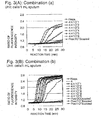
- Mycobacterium tuberculosis at various cell concentrations in sputum were detected with the combination (a) using an oligonucleotide labeled with a fluorescent intercalative dye for recognizing the specificity and the combination (b) of the present invention.
- Mycobacterium tuberculosis suspensions containing from 4 to 4 ⁇ 10 6 cells in 1 mL of control sputum were used as samples for measurement of the sensitivity limit for Mycobacterium tuberculosis in sputum. The samples were treated with NALC, and then with guanidine isocyanate and glass beads (from 150 to 212 ⁇ m, Sigma), and nucleic acid was extracted from the resulting solutions with Extragen (Tosoh).
- the composition of the reaction solution (in terms of the concentrations in the final volume of 30 ⁇ L) 60 mM Tris-HCl buffer (pH 8.6) 17 mM Magnesium chloride 120 mM Potassium chloride 6 U RNase Inhibitor (Takara Bio) 1 mM DTT 0.25 mM each of dATP, dCTP, dGTP and dTTP 3.6 mM ITP 3.0 mM each of ATP, CTP, GTP and UTP 0.16 ⁇ M First oligonucleotide 1.0 ⁇ M Third oligonucleotide 25 nM Oligonucleotide labeled with a fluorescent intercalative dye 13% DMSO Distilled water for volume adjustment (3) The reaction solutions were incubated at 44°C for 5 minutes, and 5 ⁇ L of an enzyme solution of the following composition which was pre-incubated at 44°C for 2 minutes was added.
- the composition of the enzyme solution (in terms of the concentrations in the final volume of 30 ⁇ L) 2.0% Sorbitol 3.6 ⁇ g Bovine serum albumin 142 U T7 RNA polymerase (Invitrogen) 6.4 U AMV reverse transcriptase (Takara Bio) Distilled water for volume adjustment (4) Subsequently, the reaction solutions in the PCR tubes were directly monitored at 44°C in a thermostatic fluorescent spectrophotometer at an excitation wavelength of 470 nm and an emission wavelength of 520 nm. (5) The time courses of the ratio of fluorescence intensities of the samples (fluorescence intensity at a certain time/background fluorescence intensity) from addition of the enzyme solution at 0 minute were shown in Fig.
- Table 3 shows the results of the measurements of the Mycobacterium tuberculosis cells in sputum using the respective oligonucleotide combinations [the combinations (a) and (b)] and a commercially available kit (product name: Amplicore Mycobacterium tuberculosis).
- the combinations (a) and (b) are considered to have succeeded in detection when they gave a rise within 30 minutes.
- the sensitivity limit was 4 ⁇ 10 3 cells/1 mL (sputum) for the combination (a), 4 cells/ 1 mL (sputum) for the combination (b) and 4 ⁇ 10 2 cells/1 mL (sputum) for the commercially available kit.
- Table 4 shows the results of the measurements of the nucleic acid extracts from acid-fast bacteria using the oligonucleotide combination of the present invention. The results are'represented in terms of rise time. N.D. in the table indicates that the sample gave no rise (was not detected) within 20 minutes. With the oligonucleotide combination of the present invention, M. avium was detected specifically.
- Table 5 shows the results of the measurements of the nucleic acid extracts from acid-fast bacteria using the oligonucleotide combination of the present invention. The results are represented in terms of rise time. N.D. in the table that the sample gave no rise (was not detected) within 20 minutes. With the oligonucleotide combination of the present invention, M. intracellulare was detected specifically.
- Table 6 shows the results of the measurements of the nucleic acid extracts from acid-fast bacteria using the oligonucleotide combination of the present invention. The represented in terms of rise time. N.D. in the table that the sample gave no rise (was not detected) within 20 minutes. With the oligonucleotide combination of the present invention, M. kansasii and M. gastri were detected specifically.
- the detection method of the present invention is useful for specific and high-sensitive detection of the 16S rRNAs from specific acid-fast bacteria.
- the oligonucleotides of the present invention are not restricted to the base sequences (consisting of 18 bases to 23 bases) shown in the Sequence Listing and may be oligonucleotides consisting of at least 10 consecutive bases in these sequences and have extremely high specificity for the target nucleic acid. These oligonucleotides or oligonucleotides consisting of at least 10 consecutive bases in them have enough specificity for the target nucleic acid as primers or probes at relatively low temperatures (preferably 44°C) and the use of the oligonucleotides of the present invention obviously enables isothermal amplification and detection of the rRNA (at relatively low temperatures).
- the invention furthermore comprises the following items:
Landscapes
- Chemical & Material Sciences (AREA)
- Life Sciences & Earth Sciences (AREA)
- Organic Chemistry (AREA)
- Health & Medical Sciences (AREA)
- Proteomics, Peptides & Aminoacids (AREA)
- Analytical Chemistry (AREA)
- Zoology (AREA)
- Wood Science & Technology (AREA)
- Engineering & Computer Science (AREA)
- General Health & Medical Sciences (AREA)
- Genetics & Genomics (AREA)
- Molecular Biology (AREA)
- Biophysics (AREA)
- Microbiology (AREA)
- Physics & Mathematics (AREA)
- Biochemistry (AREA)
- Bioinformatics & Cheminformatics (AREA)
- General Engineering & Computer Science (AREA)
- Immunology (AREA)
- Biotechnology (AREA)
- Oncology (AREA)
- Communicable Diseases (AREA)
- Chemical Kinetics & Catalysis (AREA)
- General Chemical & Material Sciences (AREA)
- Medicinal Chemistry (AREA)
- Nuclear Medicine, Radiotherapy & Molecular Imaging (AREA)
- Pharmacology & Pharmacy (AREA)
- Animal Behavior & Ethology (AREA)
- Public Health (AREA)
- Veterinary Medicine (AREA)
- Measuring Or Testing Involving Enzymes Or Micro-Organisms (AREA)
Applications Claiming Priority (2)
| Application Number | Priority Date | Filing Date | Title |
|---|---|---|---|
| JP2002368230A JP4304976B2 (ja) | 2002-12-19 | 2002-12-19 | リボゾームrnaを標的とした抗酸菌の検出法 |
| EP03029496A EP1431400A3 (fr) | 2002-12-19 | 2003-12-19 | Procédé pour détecter des bactéries acido-résistantes utilisant d'ARN ribosomique comme cible |
Related Parent Applications (2)
| Application Number | Title | Priority Date | Filing Date |
|---|---|---|---|
| EP03029496.1 Division | 2003-12-19 | ||
| EP03029496A Division EP1431400A3 (fr) | 2002-12-19 | 2003-12-19 | Procédé pour détecter des bactéries acido-résistantes utilisant d'ARN ribosomique comme cible |
Publications (2)
| Publication Number | Publication Date |
|---|---|
| EP1988176A1 true EP1988176A1 (fr) | 2008-11-05 |
| EP1988176B1 EP1988176B1 (fr) | 2011-02-09 |
Family
ID=32376295
Family Applications (2)
| Application Number | Title | Priority Date | Filing Date |
|---|---|---|---|
| EP03029496A Withdrawn EP1431400A3 (fr) | 2002-12-19 | 2003-12-19 | Procédé pour détecter des bactéries acido-résistantes utilisant d'ARN ribosomique comme cible |
| EP08011877A Expired - Lifetime EP1988176B1 (fr) | 2002-12-19 | 2003-12-19 | Procédé de détection de bactérie acido-alcoolo-résistante utilisant un ARN ribosomale en tant que cible |
Family Applications Before (1)
| Application Number | Title | Priority Date | Filing Date |
|---|---|---|---|
| EP03029496A Withdrawn EP1431400A3 (fr) | 2002-12-19 | 2003-12-19 | Procédé pour détecter des bactéries acido-résistantes utilisant d'ARN ribosomique comme cible |
Country Status (8)
| Country | Link |
|---|---|
| US (1) | US7090980B2 (fr) |
| EP (2) | EP1431400A3 (fr) |
| JP (1) | JP4304976B2 (fr) |
| KR (1) | KR20040054537A (fr) |
| CN (1) | CN100569953C (fr) |
| DE (1) | DE60336029D1 (fr) |
| SG (1) | SG169223A1 (fr) |
| TW (1) | TWI319436B (fr) |
Families Citing this family (10)
| Publication number | Priority date | Publication date | Assignee | Title |
|---|---|---|---|---|
| JP2006217909A (ja) * | 2005-01-11 | 2006-08-24 | Fuji Photo Film Co Ltd | 抗酸菌属細菌の検出方法およびそのキット |
| US10174386B2 (en) * | 2005-01-31 | 2019-01-08 | Kabushiki Kaisha Yakult Honsha | Method of quantitatively analyzing microorganism targeting rRNA |
| EP2623597B1 (fr) * | 2005-05-13 | 2014-10-01 | Wako Pure Chemical Industries, Ltd. | Amorce et sonde pour la détection de Mycobacterium kansasii et procédé les utilisant pour la détection de Mycobacterium kansasii |
| KR101066179B1 (ko) | 2006-02-15 | 2011-09-21 | 토소가부시키가이샤 | 생물재료로부터의 핵산 추출법 |
| ATE522608T1 (de) * | 2006-12-18 | 2011-09-15 | Wako Pure Chem Ind Ltd | Primer und sonde zum nachweis von mycobacterium avium sowie verfahren zum nachweis von mycobacterium avium unter verwendung des primers bzw. der sonde |
| DE102010047891A1 (de) | 2010-10-11 | 2012-04-12 | Hans-Rainer Lindheim | Schrauber |
| JP5838550B2 (ja) * | 2010-12-22 | 2016-01-06 | 東ソー株式会社 | クラミジア・トラコマチスrnaの検出方法及び検出試薬 |
| KR101370140B1 (ko) * | 2012-06-08 | 2014-03-04 | 포항공과대학교 산학협력단 | 항산균 검출장치 및 그 검출방법 |
| CN103555828B (zh) * | 2013-10-10 | 2016-04-06 | 上海市肺科医院 | 分枝杆菌快速药敏检测方法及检测靶标 |
| CN117568446A (zh) * | 2022-08-08 | 2024-02-20 | 台达电子国际(新加坡)私人有限公司 | 检测病毒感染性的样本前处理试剂盒及方法 |
Citations (16)
| Publication number | Priority date | Publication date | Assignee | Title |
|---|---|---|---|---|
| EP0528306A2 (fr) * | 1991-08-15 | 1993-02-24 | F. Hoffmann-La Roche Ag | Amorce et sonde pour la détection de mycobactérium |
| EP0529985A1 (fr) * | 1991-08-23 | 1993-03-03 | Hernan Robert Chang Pinares | Dépistage moléculaire et identification d'une nouvelle mycobacterie, qui provoque l'infection chez les patients atteints du sida |
| FR2701961A1 (fr) * | 1993-02-24 | 1994-09-02 | Bio Merieux | Procédé de destabilisation d'une structure secondaire intracaténaire d'un polynucléotide simple brin, et de capture dudit nucléotide. |
| JPH07155200A (ja) * | 1993-12-10 | 1995-06-20 | Toyobo Co Ltd | 抗酸菌属細菌の検出及び菌種同定用オリゴヌクレオチド |
| US5712095A (en) * | 1994-06-16 | 1998-01-27 | Becton Dickinson And Company | Rapid and sensitive detection of antibiotic-resistant mycobacteria using oligonucleotide probes specific for ribosomal RNA precursors |
| JPH10323189A (ja) * | 1997-05-23 | 1998-12-08 | Toyobo Co Ltd | 抗酸菌属細菌の検出または菌種同定用オリゴヌクレオチドおよびその用途 |
| US5908744A (en) * | 1989-07-11 | 1999-06-01 | Gen-Probe Incorporated | Detecting Mycobacterium tuberculosis by nucleic acid sequence amplification |
| US5925518A (en) * | 1995-05-19 | 1999-07-20 | Akzo Nobel N.V. | Nucleic acid primers for amplification of a mycobacteria RNA template |
| EP0969101A1 (fr) * | 1998-07-01 | 2000-01-05 | Tosoh Corporation | Procédé de détermination de séquences d'acides nucléiques |
| JP3116353B2 (ja) | 1986-11-24 | 2000-12-11 | ジエン‐プローブ・インコーポレイテツド | 非ウイルス微生物の検出及び/又は定量用核酸プローブ |
| JP2001013139A (ja) * | 1999-06-28 | 2001-01-19 | Toyobo Co Ltd | 免疫学的測定法 |
| EP1076099A2 (fr) * | 1999-08-03 | 2001-02-14 | Nisshinbo Industries, Inc. | Trousse pour la diagnose des bacilles de tubercule |
| WO2001044510A2 (fr) * | 1999-12-17 | 2001-06-21 | Gen-Probe Incorporated | Amplification d'acides nucleiques et detection d'especes de mycobacteries |
| WO2001066797A2 (fr) * | 2000-03-03 | 2001-09-13 | The Government Of The United States Of America As Represented By The Secretary Of The Department Of Health And Human Services | Systeme d'hybridation multiplex destine a l'identification de mycobacterium pathogene et procede d'utilisation |
| WO2002022872A1 (fr) * | 2000-09-15 | 2002-03-21 | Sjhightech Co., Ltd. | Procede et kit de pcr multiplexe et oligonucleotides destines a la detection et l'identification de mycobacterium au moyen dudit procede |
| JP2002368230A (ja) | 2001-05-14 | 2002-12-20 | Sharp Corp | 絶縁体上シリコン基板上に歪Si/SiGe層を用いた良好な移動度を有するNMOSおよびPMOSトランジスタ |
Family Cites Families (1)
| Publication number | Priority date | Publication date | Assignee | Title |
|---|---|---|---|---|
| US5422242A (en) * | 1991-08-15 | 1995-06-06 | Hoffmann-La Roche Inc. | Mycobacterium primers and probes |
-
2002
- 2002-12-19 JP JP2002368230A patent/JP4304976B2/ja not_active Expired - Fee Related
-
2003
- 2003-12-16 SG SG200307492-9A patent/SG169223A1/en unknown
- 2003-12-17 KR KR1020030092433A patent/KR20040054537A/ko not_active Ceased
- 2003-12-18 CN CNB2003101215479A patent/CN100569953C/zh not_active Expired - Fee Related
- 2003-12-18 US US10/737,894 patent/US7090980B2/en not_active Expired - Fee Related
- 2003-12-18 TW TW092136033A patent/TWI319436B/zh not_active IP Right Cessation
- 2003-12-19 EP EP03029496A patent/EP1431400A3/fr not_active Withdrawn
- 2003-12-19 EP EP08011877A patent/EP1988176B1/fr not_active Expired - Lifetime
- 2003-12-19 DE DE60336029T patent/DE60336029D1/de not_active Expired - Lifetime
Patent Citations (19)
| Publication number | Priority date | Publication date | Assignee | Title |
|---|---|---|---|---|
| JP3116353B2 (ja) | 1986-11-24 | 2000-12-11 | ジエン‐プローブ・インコーポレイテツド | 非ウイルス微生物の検出及び/又は定量用核酸プローブ |
| US5908744A (en) * | 1989-07-11 | 1999-06-01 | Gen-Probe Incorporated | Detecting Mycobacterium tuberculosis by nucleic acid sequence amplification |
| JP2675723B2 (ja) | 1991-08-15 | 1997-11-12 | エフ・ホフマン−ラ ロシユ アーゲー | マイコバクテリア属細菌の核酸の検出およびマイコバクテリア属細菌の同定のための試薬および方法 |
| EP0528306A2 (fr) * | 1991-08-15 | 1993-02-24 | F. Hoffmann-La Roche Ag | Amorce et sonde pour la détection de mycobactérium |
| EP0529985A1 (fr) * | 1991-08-23 | 1993-03-03 | Hernan Robert Chang Pinares | Dépistage moléculaire et identification d'une nouvelle mycobacterie, qui provoque l'infection chez les patients atteints du sida |
| FR2701961A1 (fr) * | 1993-02-24 | 1994-09-02 | Bio Merieux | Procédé de destabilisation d'une structure secondaire intracaténaire d'un polynucléotide simple brin, et de capture dudit nucléotide. |
| JPH07155200A (ja) * | 1993-12-10 | 1995-06-20 | Toyobo Co Ltd | 抗酸菌属細菌の検出及び菌種同定用オリゴヌクレオチド |
| US5712095A (en) * | 1994-06-16 | 1998-01-27 | Becton Dickinson And Company | Rapid and sensitive detection of antibiotic-resistant mycobacteria using oligonucleotide probes specific for ribosomal RNA precursors |
| US5770373A (en) * | 1994-06-16 | 1998-06-23 | Becton Dickinson And Company | Rapid and sensitive detection of antibiotic-resistant mycobacteria using oligonucleotide probe specific for ribosomal RNA precursors |
| US5925518A (en) * | 1995-05-19 | 1999-07-20 | Akzo Nobel N.V. | Nucleic acid primers for amplification of a mycobacteria RNA template |
| JPH10323189A (ja) * | 1997-05-23 | 1998-12-08 | Toyobo Co Ltd | 抗酸菌属細菌の検出または菌種同定用オリゴヌクレオチドおよびその用途 |
| JP2000014400A (ja) | 1998-07-01 | 2000-01-18 | Tosoh Corp | 標的核酸の定量方法 |
| EP0969101A1 (fr) * | 1998-07-01 | 2000-01-05 | Tosoh Corporation | Procédé de détermination de séquences d'acides nucléiques |
| JP2001013139A (ja) * | 1999-06-28 | 2001-01-19 | Toyobo Co Ltd | 免疫学的測定法 |
| EP1076099A2 (fr) * | 1999-08-03 | 2001-02-14 | Nisshinbo Industries, Inc. | Trousse pour la diagnose des bacilles de tubercule |
| WO2001044510A2 (fr) * | 1999-12-17 | 2001-06-21 | Gen-Probe Incorporated | Amplification d'acides nucleiques et detection d'especes de mycobacteries |
| WO2001066797A2 (fr) * | 2000-03-03 | 2001-09-13 | The Government Of The United States Of America As Represented By The Secretary Of The Department Of Health And Human Services | Systeme d'hybridation multiplex destine a l'identification de mycobacterium pathogene et procede d'utilisation |
| WO2002022872A1 (fr) * | 2000-09-15 | 2002-03-21 | Sjhightech Co., Ltd. | Procede et kit de pcr multiplexe et oligonucleotides destines a la detection et l'identification de mycobacterium au moyen dudit procede |
| JP2002368230A (ja) | 2001-05-14 | 2002-12-20 | Sharp Corp | 絶縁体上シリコン基板上に歪Si/SiGe層を用いた良好な移動度を有するNMOSおよびPMOSトランジスタ |
Non-Patent Citations (3)
| Title |
|---|
| DATABASE EMBL [online] 23 May 2001 (2001-05-23), TOYOBO KK.: "M Tuberculosis 16srRNA gene PCR primer #2", XP002279274, retrieved from EBI Database accession no. AAF77540 * |
| HUGHES M S ET AL: "Identification by 16S rRNA Gene Analyses of a Potential Novel Mycobacterial Species as an Etiological Agent of Canine Leproid Granuloma Syndrome", JOURNAL OF CLINICAL MICROBIOLOGY, WASHINGTON, DC, US, vol. 38, no. 3, March 2000 (2000-03-01), pages 953 - 959, XP002190512, ISSN: 0095-1137 * |
| ISHIGURO, T. ET AL., NUCLEIC ACIDS RES., vol. 24, no. 24, 1996, pages 4992 - 4997 |
Also Published As
| Publication number | Publication date |
|---|---|
| CN1508546A (zh) | 2004-06-30 |
| SG169223A1 (en) | 2011-03-30 |
| TW200427840A (en) | 2004-12-16 |
| EP1988176B1 (fr) | 2011-02-09 |
| EP1431400A3 (fr) | 2004-07-07 |
| TWI319436B (en) | 2010-01-11 |
| EP1431400A2 (fr) | 2004-06-23 |
| US7090980B2 (en) | 2006-08-15 |
| CN100569953C (zh) | 2009-12-16 |
| JP4304976B2 (ja) | 2009-07-29 |
| DE60336029D1 (de) | 2011-03-24 |
| JP2004194583A (ja) | 2004-07-15 |
| KR20040054537A (ko) | 2004-06-25 |
| US20040161783A1 (en) | 2004-08-19 |
Similar Documents
| Publication | Publication Date | Title |
|---|---|---|
| US5561044A (en) | Detection of mycobacteria by multiplex strand displacement nucleic acid amplification | |
| JP3070529B2 (ja) | ミコバクテリウム・カンサシイの種特異的検出 | |
| JP4905130B2 (ja) | 結核菌検出用プライマー及びプローブ、並びにこれを用いたヒト型結核菌の検出方法 | |
| EP1988176B1 (fr) | Procédé de détection de bactérie acido-alcoolo-résistante utilisant un ARN ribosomale en tant que cible | |
| US5811269A (en) | Detection of mycobacteria by multiplex nucleic acid amplification | |
| CA2142156C (fr) | Sequences d'acide nucleique specifique a mycobacterium kansasii | |
| US7495094B2 (en) | Detection reagent for thermostable direct hemolysin-related hemolysin gene of Vibrio parahaemolyticus | |
| AU710996B2 (en) | Compositions and methods for the detection of mycobacterium kansasii | |
| CA2389523A1 (fr) | Amplification d'acides nucleiques et detection de l'adn ou de l'arn ribosomal (arnr) 16s de mycobacterium xenopia codant l'arnr 16s dans un echantillon biologique | |
| US5723296A (en) | Amplification and detection of mycobacterial DNA K nucleic acids | |
| US7345161B2 (en) | Detection reagent for shiga toxin family gene of entero-hemorrhagic Escherichia coli | |
| US7105319B2 (en) | Oligonucleotides for detecting tubercle bacillus and method therefor | |
| EP2009116A2 (fr) | Oligonucléotide pour la détection de salmonelles et procédé pour la détection de salmonelles | |
| EP1512754B1 (fr) | Réactif de détection pour le géne TDH de vibrio parahaemolyticus | |
| JP2012135234A (ja) | 結核菌検出オリゴヌクレオチドプローブ及びそれを利用した検出方法 | |
| US20030219811A1 (en) | Oligonucleotide for detection of atypical mycobacteria mycobacterium avium and detection method | |
| KR20230095540A (ko) | 바실러스 균주 구별용 프라이머 세트 및 이를 이용하는 방법 | |
| US9518290B2 (en) | Method for detecting nucleic acids by amplification of a circularized nucleic acid |
Legal Events
| Date | Code | Title | Description |
|---|---|---|---|
| PUAI | Public reference made under article 153(3) epc to a published international application that has entered the european phase |
Free format text: ORIGINAL CODE: 0009012 |
|
| AC | Divisional application: reference to earlier application |
Ref document number: 1431400 Country of ref document: EP Kind code of ref document: P |
|
| AK | Designated contracting states |
Kind code of ref document: A1 Designated state(s): DE FR GB IT |
|
| 17P | Request for examination filed |
Effective date: 20090505 |
|
| AKX | Designation fees paid |
Designated state(s): DE FR GB IT |
|
| 17Q | First examination report despatched |
Effective date: 20090814 |
|
| GRAP | Despatch of communication of intention to grant a patent |
Free format text: ORIGINAL CODE: EPIDOSNIGR1 |
|
| GRAS | Grant fee paid |
Free format text: ORIGINAL CODE: EPIDOSNIGR3 |
|
| GRAA | (expected) grant |
Free format text: ORIGINAL CODE: 0009210 |
|
| AC | Divisional application: reference to earlier application |
Ref document number: 1431400 Country of ref document: EP Kind code of ref document: P |
|
| AK | Designated contracting states |
Kind code of ref document: B1 Designated state(s): DE FR GB IT |
|
| REG | Reference to a national code |
Ref country code: GB Ref legal event code: FG4D |
|
| REF | Corresponds to: |
Ref document number: 60336029 Country of ref document: DE Date of ref document: 20110324 Kind code of ref document: P |
|
| REG | Reference to a national code |
Ref country code: DE Ref legal event code: R096 Ref document number: 60336029 Country of ref document: DE Effective date: 20110324 |
|
| PLBE | No opposition filed within time limit |
Free format text: ORIGINAL CODE: 0009261 |
|
| STAA | Information on the status of an ep patent application or granted ep patent |
Free format text: STATUS: NO OPPOSITION FILED WITHIN TIME LIMIT |
|
| 26N | No opposition filed |
Effective date: 20111110 |
|
| REG | Reference to a national code |
Ref country code: DE Ref legal event code: R097 Ref document number: 60336029 Country of ref document: DE Effective date: 20111110 |
|
| REG | Reference to a national code |
Ref country code: FR Ref legal event code: PLFP Year of fee payment: 13 |
|
| REG | Reference to a national code |
Ref country code: FR Ref legal event code: PLFP Year of fee payment: 14 |
|
| REG | Reference to a national code |
Ref country code: FR Ref legal event code: PLFP Year of fee payment: 15 |
|
| PGFP | Annual fee paid to national office [announced via postgrant information from national office to epo] |
Ref country code: IT Payment date: 20201110 Year of fee payment: 18 Ref country code: FR Payment date: 20201112 Year of fee payment: 18 Ref country code: DE Payment date: 20201208 Year of fee payment: 18 Ref country code: GB Payment date: 20201210 Year of fee payment: 18 |
|
| REG | Reference to a national code |
Ref country code: DE Ref legal event code: R119 Ref document number: 60336029 Country of ref document: DE |
|
| GBPC | Gb: european patent ceased through non-payment of renewal fee |
Effective date: 20211219 |
|
| PG25 | Lapsed in a contracting state [announced via postgrant information from national office to epo] |
Ref country code: GB Free format text: LAPSE BECAUSE OF NON-PAYMENT OF DUE FEES Effective date: 20211219 Ref country code: DE Free format text: LAPSE BECAUSE OF NON-PAYMENT OF DUE FEES Effective date: 20220701 |
|
| PG25 | Lapsed in a contracting state [announced via postgrant information from national office to epo] |
Ref country code: FR Free format text: LAPSE BECAUSE OF NON-PAYMENT OF DUE FEES Effective date: 20211231 |
|
| PG25 | Lapsed in a contracting state [announced via postgrant information from national office to epo] |
Ref country code: IT Free format text: LAPSE BECAUSE OF NON-PAYMENT OF DUE FEES Effective date: 20211219 |
|
| P01 | Opt-out of the competence of the unified patent court (upc) registered |
Effective date: 20230523 |