EP1988228A2 - Blocs et systèmes de construction avec isolation thermique hydrophobe et microporeuse - Google Patents
Blocs et systèmes de construction avec isolation thermique hydrophobe et microporeuse Download PDFInfo
- Publication number
- EP1988228A2 EP1988228A2 EP08155583A EP08155583A EP1988228A2 EP 1988228 A2 EP1988228 A2 EP 1988228A2 EP 08155583 A EP08155583 A EP 08155583A EP 08155583 A EP08155583 A EP 08155583A EP 1988228 A2 EP1988228 A2 EP 1988228A2
- Authority
- EP
- European Patent Office
- Prior art keywords
- thermal insulation
- building
- hydrophobic
- microporous
- shell
- Prior art date
- Legal status (The legal status is an assumption and is not a legal conclusion. Google has not performed a legal analysis and makes no representation as to the accuracy of the status listed.)
- Granted
Links
Images






Classifications
-
- E—FIXED CONSTRUCTIONS
- E04—BUILDING
- E04C—STRUCTURAL ELEMENTS; BUILDING MATERIALS
- E04C1/00—Building elements of block or other shape for the construction of parts of buildings
- E04C1/40—Building elements of block or other shape for the construction of parts of buildings built-up from parts of different materials, e.g. composed of layers of different materials or stones with filling material or with insulating inserts
- E04C1/41—Building elements of block or other shape for the construction of parts of buildings built-up from parts of different materials, e.g. composed of layers of different materials or stones with filling material or with insulating inserts composed of insulating material and load-bearing concrete, stone or stone-like material
-
- B—PERFORMING OPERATIONS; TRANSPORTING
- B28—WORKING CEMENT, CLAY, OR STONE
- B28B—SHAPING CLAY OR OTHER CERAMIC COMPOSITIONS; SHAPING SLAG; SHAPING MIXTURES CONTAINING CEMENTITIOUS MATERIAL, e.g. PLASTER
- B28B1/00—Producing shaped prefabricated articles from the material
- B28B1/002—Producing shaped prefabricated articles from the material assembled from preformed elements
-
- B—PERFORMING OPERATIONS; TRANSPORTING
- B28—WORKING CEMENT, CLAY, OR STONE
- B28B—SHAPING CLAY OR OTHER CERAMIC COMPOSITIONS; SHAPING SLAG; SHAPING MIXTURES CONTAINING CEMENTITIOUS MATERIAL, e.g. PLASTER
- B28B11/00—Apparatus or processes for treating or working the shaped or preshaped articles
- B28B11/04—Apparatus or processes for treating or working the shaped or preshaped articles for coating or applying engobing layers
- B28B11/042—Apparatus or processes for treating or working the shaped or preshaped articles for coating or applying engobing layers with insulating material
-
- B—PERFORMING OPERATIONS; TRANSPORTING
- B28—WORKING CEMENT, CLAY, OR STONE
- B28B—SHAPING CLAY OR OTHER CERAMIC COMPOSITIONS; SHAPING SLAG; SHAPING MIXTURES CONTAINING CEMENTITIOUS MATERIAL, e.g. PLASTER
- B28B11/00—Apparatus or processes for treating or working the shaped or preshaped articles
- B28B11/04—Apparatus or processes for treating or working the shaped or preshaped articles for coating or applying engobing layers
- B28B11/042—Apparatus or processes for treating or working the shaped or preshaped articles for coating or applying engobing layers with insulating material
- B28B11/043—Apparatus or processes for treating or working the shaped or preshaped articles for coating or applying engobing layers with insulating material filling cavities or chambers of hollow blocks
-
- C—CHEMISTRY; METALLURGY
- C04—CEMENTS; CONCRETE; ARTIFICIAL STONE; CERAMICS; REFRACTORIES
- C04B—LIME, MAGNESIA; SLAG; CEMENTS; COMPOSITIONS THEREOF, e.g. MORTARS, CONCRETE OR LIKE BUILDING MATERIALS; ARTIFICIAL STONE; CERAMICS; REFRACTORIES; TREATMENT OF NATURAL STONE
- C04B30/00—Compositions for artificial stone, not containing binders
-
- E—FIXED CONSTRUCTIONS
- E04—BUILDING
- E04B—GENERAL BUILDING CONSTRUCTIONS; WALLS, e.g. PARTITIONS; ROOFS; FLOORS; CEILINGS; INSULATION OR OTHER PROTECTION OF BUILDINGS
- E04B2/00—Walls, e.g. partitions, for buildings; Wall construction with regard to insulation; Connections specially adapted to walls
- E04B2/02—Walls, e.g. partitions, for buildings; Wall construction with regard to insulation; Connections specially adapted to walls built-up from layers of building elements
- E04B2/14—Walls having cavities in, but not between, the elements, i.e. each cavity being enclosed by at least four sides forming part of one single element
- E04B2/16—Walls having cavities in, but not between, the elements, i.e. each cavity being enclosed by at least four sides forming part of one single element using elements having specially-designed means for stabilising the position
-
- E—FIXED CONSTRUCTIONS
- E04—BUILDING
- E04C—STRUCTURAL ELEMENTS; BUILDING MATERIALS
- E04C2/00—Building elements of relatively thin form for the construction of parts of buildings, e.g. sheet materials, slabs, or panels
- E04C2/02—Building elements of relatively thin form for the construction of parts of buildings, e.g. sheet materials, slabs, or panels characterised by specified materials
- E04C2/26—Building elements of relatively thin form for the construction of parts of buildings, e.g. sheet materials, slabs, or panels characterised by specified materials composed of materials covered by two or more of groups E04C2/04, E04C2/08, E04C2/10 or of materials covered by one of these groups with a material not specified in one of the groups
- E04C2/284—Building elements of relatively thin form for the construction of parts of buildings, e.g. sheet materials, slabs, or panels characterised by specified materials composed of materials covered by two or more of groups E04C2/04, E04C2/08, E04C2/10 or of materials covered by one of these groups with a material not specified in one of the groups at least one of the materials being insulating
-
- B—PERFORMING OPERATIONS; TRANSPORTING
- B29—WORKING OF PLASTICS; WORKING OF SUBSTANCES IN A PLASTIC STATE IN GENERAL
- B29C—SHAPING OR JOINING OF PLASTICS; SHAPING OF MATERIAL IN A PLASTIC STATE, NOT OTHERWISE PROVIDED FOR; AFTER-TREATMENT OF THE SHAPED PRODUCTS, e.g. REPAIRING
- B29C44/00—Shaping by internal pressure generated in the material, e.g. swelling or foaming ; Producing porous or cellular expanded plastics articles
- B29C44/02—Shaping by internal pressure generated in the material, e.g. swelling or foaming ; Producing porous or cellular expanded plastics articles for articles of definite length, i.e. discrete articles
- B29C44/12—Incorporating or moulding on preformed parts, e.g. inserts or reinforcements
- B29C44/18—Filling preformed cavities
- B29C44/186—Filling multiple cavities
-
- B—PERFORMING OPERATIONS; TRANSPORTING
- B29—WORKING OF PLASTICS; WORKING OF SUBSTANCES IN A PLASTIC STATE IN GENERAL
- B29C—SHAPING OR JOINING OF PLASTICS; SHAPING OF MATERIAL IN A PLASTIC STATE, NOT OTHERWISE PROVIDED FOR; AFTER-TREATMENT OF THE SHAPED PRODUCTS, e.g. REPAIRING
- B29C44/00—Shaping by internal pressure generated in the material, e.g. swelling or foaming ; Producing porous or cellular expanded plastics articles
- B29C44/34—Auxiliary operations
- B29C44/36—Feeding the material to be shaped
- B29C44/38—Feeding the material to be shaped into a closed space, i.e. to make articles of definite length
- B29C44/44—Feeding the material to be shaped into a closed space, i.e. to make articles of definite length in solid form
- B29C44/445—Feeding the material to be shaped into a closed space, i.e. to make articles of definite length in solid form in the form of expandable granules, particles or beads
-
- B—PERFORMING OPERATIONS; TRANSPORTING
- B29—WORKING OF PLASTICS; WORKING OF SUBSTANCES IN A PLASTIC STATE IN GENERAL
- B29K—INDEXING SCHEME ASSOCIATED WITH SUBCLASSES B29B, B29C OR B29D, RELATING TO MOULDING MATERIALS OR TO MATERIALS FOR MOULDS, REINFORCEMENTS, FILLERS OR PREFORMED PARTS, e.g. INSERTS
- B29K2025/00—Use of polymers of vinyl-aromatic compounds or derivatives thereof as moulding material
- B29K2025/04—Polymers of styrene
- B29K2025/06—PS, i.e. polystyrene
-
- B—PERFORMING OPERATIONS; TRANSPORTING
- B29—WORKING OF PLASTICS; WORKING OF SUBSTANCES IN A PLASTIC STATE IN GENERAL
- B29L—INDEXING SCHEME ASSOCIATED WITH SUBCLASS B29C, RELATING TO PARTICULAR ARTICLES
- B29L2031/00—Other particular articles
- B29L2031/10—Building elements, e.g. bricks, blocks, tiles, panels, posts, beams
- B29L2031/102—Bricks
-
- E—FIXED CONSTRUCTIONS
- E04—BUILDING
- E04B—GENERAL BUILDING CONSTRUCTIONS; WALLS, e.g. PARTITIONS; ROOFS; FLOORS; CEILINGS; INSULATION OR OTHER PROTECTION OF BUILDINGS
- E04B2/00—Walls, e.g. partitions, for buildings; Wall construction with regard to insulation; Connections specially adapted to walls
- E04B2/02—Walls, e.g. partitions, for buildings; Wall construction with regard to insulation; Connections specially adapted to walls built-up from layers of building elements
- E04B2002/0202—Details of connections
- E04B2002/0204—Non-undercut connections, e.g. tongue and groove connections
- E04B2002/0206—Non-undercut connections, e.g. tongue and groove connections of rectangular shape
-
- E—FIXED CONSTRUCTIONS
- E04—BUILDING
- E04B—GENERAL BUILDING CONSTRUCTIONS; WALLS, e.g. PARTITIONS; ROOFS; FLOORS; CEILINGS; INSULATION OR OTHER PROTECTION OF BUILDINGS
- E04B2/00—Walls, e.g. partitions, for buildings; Wall construction with regard to insulation; Connections specially adapted to walls
- E04B2/02—Walls, e.g. partitions, for buildings; Wall construction with regard to insulation; Connections specially adapted to walls built-up from layers of building elements
- E04B2002/0202—Details of connections
- E04B2002/0204—Non-undercut connections, e.g. tongue and groove connections
- E04B2002/0208—Non-undercut connections, e.g. tongue and groove connections of trapezoidal shape
-
- E—FIXED CONSTRUCTIONS
- E04—BUILDING
- E04B—GENERAL BUILDING CONSTRUCTIONS; WALLS, e.g. PARTITIONS; ROOFS; FLOORS; CEILINGS; INSULATION OR OTHER PROTECTION OF BUILDINGS
- E04B2/00—Walls, e.g. partitions, for buildings; Wall construction with regard to insulation; Connections specially adapted to walls
- E04B2/02—Walls, e.g. partitions, for buildings; Wall construction with regard to insulation; Connections specially adapted to walls built-up from layers of building elements
- E04B2002/0202—Details of connections
- E04B2002/0204—Non-undercut connections, e.g. tongue and groove connections
- E04B2002/0228—Non-undercut connections, e.g. tongue and groove connections with tongues next to each other on one end surface and grooves next to each other on opposite end surface
-
- E—FIXED CONSTRUCTIONS
- E04—BUILDING
- E04B—GENERAL BUILDING CONSTRUCTIONS; WALLS, e.g. PARTITIONS; ROOFS; FLOORS; CEILINGS; INSULATION OR OTHER PROTECTION OF BUILDINGS
- E04B2/00—Walls, e.g. partitions, for buildings; Wall construction with regard to insulation; Connections specially adapted to walls
- E04B2/02—Walls, e.g. partitions, for buildings; Wall construction with regard to insulation; Connections specially adapted to walls built-up from layers of building elements
- E04B2002/0256—Special features of building elements
- E04B2002/0289—Building elements with holes filled with insulating material
- E04B2002/0293—Building elements with holes filled with insulating material solid material
-
- Y—GENERAL TAGGING OF NEW TECHNOLOGICAL DEVELOPMENTS; GENERAL TAGGING OF CROSS-SECTIONAL TECHNOLOGIES SPANNING OVER SEVERAL SECTIONS OF THE IPC; TECHNICAL SUBJECTS COVERED BY FORMER USPC CROSS-REFERENCE ART COLLECTIONS [XRACs] AND DIGESTS
- Y02—TECHNOLOGIES OR APPLICATIONS FOR MITIGATION OR ADAPTATION AGAINST CLIMATE CHANGE
- Y02A—TECHNOLOGIES FOR ADAPTATION TO CLIMATE CHANGE
- Y02A30/00—Adapting or protecting infrastructure or their operation
- Y02A30/24—Structural elements or technologies for improving thermal insulation
-
- Y—GENERAL TAGGING OF NEW TECHNOLOGICAL DEVELOPMENTS; GENERAL TAGGING OF CROSS-SECTIONAL TECHNOLOGIES SPANNING OVER SEVERAL SECTIONS OF THE IPC; TECHNICAL SUBJECTS COVERED BY FORMER USPC CROSS-REFERENCE ART COLLECTIONS [XRACs] AND DIGESTS
- Y02—TECHNOLOGIES OR APPLICATIONS FOR MITIGATION OR ADAPTATION AGAINST CLIMATE CHANGE
- Y02B—CLIMATE CHANGE MITIGATION TECHNOLOGIES RELATED TO BUILDINGS, e.g. HOUSING, HOUSE APPLIANCES OR RELATED END-USER APPLICATIONS
- Y02B80/00—Architectural or constructional elements improving the thermal performance of buildings
- Y02B80/10—Insulation, e.g. vacuum or aerogel insulation
-
- Y—GENERAL TAGGING OF NEW TECHNOLOGICAL DEVELOPMENTS; GENERAL TAGGING OF CROSS-SECTIONAL TECHNOLOGIES SPANNING OVER SEVERAL SECTIONS OF THE IPC; TECHNICAL SUBJECTS COVERED BY FORMER USPC CROSS-REFERENCE ART COLLECTIONS [XRACs] AND DIGESTS
- Y02—TECHNOLOGIES OR APPLICATIONS FOR MITIGATION OR ADAPTATION AGAINST CLIMATE CHANGE
- Y02W—CLIMATE CHANGE MITIGATION TECHNOLOGIES RELATED TO WASTEWATER TREATMENT OR WASTE MANAGEMENT
- Y02W30/00—Technologies for solid waste management
- Y02W30/50—Reuse, recycling or recovery technologies
- Y02W30/91—Use of waste materials as fillers for mortars or concrete
Definitions
- the invention relates to a hydrophobic microporous thermal insulation and their use in building blocks and a method for producing such blocks.
- Thermal insulation to save energy has been given high priority in the context of awareness of sustainable development and increased energy prices. Thermal insulation is becoming more and more important against the backdrop of rising energy prices, dwindling resources, the search for a reduction in CO 2 emissions, the need for sustained reduction of energy requirements, and future requirements for heat and cold protection.
- Building materials such as steel, concrete, brickwork and glass, as well as natural stones are relatively good heat conductors, so that the outer walls of buildings built from it in cold weather very quickly release the heat from the inside to the outside.
- the development is therefore on the one hand to improve the insulation properties by increasing the porosity these building materials, such as in concrete and brickwork, and on the other to cover the outer walls with thermal insulation materials.
- Pyrogenic silicas are produced by flame hydrolysis of volatile silicon compounds such as organic and inorganic chlorosilanes. These pyrogenic silicas thus prepared have a high porous structure and are hydrophilic.
- the invention is based on the object to significantly improve the thermal insulation properties of thermal insulation materials based on microporous insulating materials, sustainably maintain a high level and bring by compression or compression in practical application forms.
- microporous thermal insulation materials essentially consist of highly dispersed, nanoscale silicas, preferably pyrogenic silicas, opacifiers and fibers.
- the reaction of the organosilanes with the silanol groups of the silica takes place during the pressing process or immediately thereafter.
- the reaction can, depending on requirements, by heat or heat removal (cooling) and by so-called.
- Accelerator which are polar substances such as water, alcohols or hydrogen chloride, optionally accelerated or delayed under slight overpressure, so controlled. Excess shares or cleavage products of the hydrophobing process are then baked at temperatures of 70 ° C to 130 ° C.
- binders with the negative properties described below can be completely dispensed with.
- the core material according to the invention consists of microporous thermal insulation materials which preferably contain pyrogenic silicic acids and silica airgel as the base material. Added to this are so-called opacifiers, fibers and / or other fillers.
- Pyrogenic silicas are produced by flame hydrolysis of volatile silicon compounds such as organic and inorganic chlorosilanes. These fumed silicas are characterized by a high porous structure. Silica aerogels are made by special drying methods of aqueous silica gels produced and have a very high pore structure and are therefore highly effective insulation materials.
- opacifiers compounds that can adsorb, scatter and reflect heat rays in the infrared range. They are commonly referred to as opacifiers. Preferably, these opacifiers in the infrared spectral range have a maximum between 1.5 and 10 microns.
- the particle size of these particles is preferably between 0.5 and 15 .mu.m. Examples of such substances are titanium oxides, zirconium oxides, ilmenite, iron titanate, iron oxide, zirconium silicate, silicon carbide, manganese oxide and carbon black.
- fibers are used for reinforcement or reinforcement, ie for mechanical reinforcement. These fibers may be of inorganic or organic origin.
- inorganic fibers are glass wool, rock wool, basalt fibers, slag wool and ceramic fibers which consist of melts of aluminum and / or silicon dioxide and other inorganic metal oxides.
- Pure silica fibers are, for example, silica fibers.
- Organic fibers are e.g. Cellulose fibers, textile fibers or plastic fibers.
- inorganic filler materials can be added to the mixture.
- the core material not only has to repel water, but also prevent the accumulation and absorption of moisture.
- the cause of this moisture absorption are silanol groups placed on the silica, where the water accumulates.
- Core materials consisting of foamed perlites to make water repellent with alkali and / or alkaline earth metal stearates, siliconates, waxes and fats. With these substances, especially a surface occupancy, which is common under the name "coating" takes place.
- the core materials thus treated are repugnant to liquid water, they absorb water vapor, in the form of atmospheric moisture, and thus lead to a deterioration of the insulating properties. From the DE 4221716 A1 For example, it is known to react fumed silicas with organosilanes and thus make them hydrophobic, ie water-repellent.
- hydrophobic silicic acids can not be sufficiently densified and are not compressible, since interleaving of the silicic acid particles of the silanol groups by saturation with organic groups is no longer possible.
- a compression of a mixture provided with hydrophobic silica is not possible.
- a compression is absolutely necessary for the solidification and thus for anchoring in the cavities of the hollow building blocks.
- a chemical aftertreatment of the insulating material with organosilanes after compression in the cavities is very complicated, since a penetration of the core material can be done only very slowly with high pressure (autoclave). In addition, this method partially destroys the structure of the core material.
- Such compounds are, for example (CH 3 ) 3 SiCl [trimethylchlorosilane]; ( CH 3 ) 2 SiCl 2 [dimethyldichlorosilane]; CH 3 SiCl 3 [monomethyltrichlorosilane] or (CH 3 ) 3 SiOC 2 H 5 [trimethylethoxysilane]; (CH 3 ) 2 Si (OC 2 H 5 ) 2 [dimethyldiethoxysilane]; CH 3 Si (OC 2 H 5 ) 3 [methyltriethoxysilane] and (CH 3 ) 3 SiNHSi (CH 3 ) 3 [hexamethyldisilazan
- the additional amounts of silanes depend on the specific surface area (BET surface area) of the silicic acids, their proportion of the mixture, and the type of silanes.
- the amount added is between 0.5 and 10% by weight, preferably between 1 and 6% by weight.
- the addition of the silanes takes place during the preparation of the mixture in liquid form, it is necessary that an intimate mixing of the individual components takes place.
- the production of the microporous insulation mixture can generally take place in various mixing units.
- planetary mixers are preferably used.
- the last step in the mixing sequence is the addition of the liquid silanes.
- the bulk density of the mixture depending on the type and amount of the components between 40 - 180 g / l, preferably 40 - 90 g / l, amount.
- the flowability of the resulting microporous mixture is very good, making it smooth and homogeneous to plates pressed including, for. B. can be filled in the cavities of hollow bricks and pressed.
- a use of the hydrophobic, microporous thermal insulation materials described above in the invention takes place in building cavities.
- Hollow blocks are devices that have one or more cavities. They can consist of inorganic, ceramic materials, such as fired clay (brick), concrete, glass, gypsum and natural products such as natural stone, such as limestone. Preferably, hollow bricks made of brick, concrete and lightweight concrete are used.
- Hollow blocks with integrated thermal insulation have the advantage that the brick house character is retained during construction.
- foamed perlites and vermiculites are used as inorganic materials for hollow building blocks with integrated thermal insulation.
- Foamed perlites are preferably used, which are bound and solidified with binders such as aqueous dispersions based on vinyl acetate and acrylic vinyl acetate copolymers. These fillings have the necessary binding agents a high proportion of combustible components, and the resulting heat insulation is not optimal.
- thermo insulation properties of these stones are substantially improved and sustainably maintained at a high level.
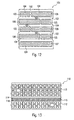
- FIG. 12 shows Fig. 12 in plan view of a building block 101, for example made of baked brick material, with vertical holes in the installed state according to a predetermined hole pattern.
- the individual holes 104, 105 and 106 are separated from each other by webs, of which run in the installed state wider webs 102 in the wall direction and at least in some rows of holes narrower webs 103 in the installed state in the direction from inside to outside, the narrower webs 103rd in the different rows of holes are offset from each other.
- the narrower webs 103 are provided in the regions of the building block 101, which are intended to exert a supporting function in the installed state.
- the narrow webs 103 may be dispensable, as in one of Rows of holes through the hole 106 is shown. At least one of the holes, in the exemplary embodiment all holes 105, 106, 107 of the module 101, are filled with a thermal insulation material 104. As shown, the building block 101 known per se in the installed state vertically extending ribs and depressions, which allow a simplified installation, as is known per se and therefore not further explained.
- Fig. 14 shows, for example, a block 121 in which the two brick parts 122 and 123 are firmly connected to each other by ceramic continuous webs 124, whence the thus formed cavity 126 is filled with the inventively manufactured thermal insulation material 125.
- Fig. 13 shows another block, namely a clam shell 111 with an outer shell 112 and an inner shell 113, which are separated by a continuous gap 114.
- inner shell 113 and outer shell 112 each hole patterns, that is, in the installed state vertically extending holes, hereby significantly different dimensions than in Fig. 12 , which are separated by extending in the wall direction and transverse to the wall direction webs.
- the gap 114 is filled with a thermal insulation material 115, wherein expedient edge or otherwise inner shell and outer shell 112, 113, in the region of the gap 114 are firmly connected and the connection, not shown, has the lowest possible thermal conductivity.
- This is a non-ceramic compound, for example a compound formed by brackets, as is known in principle.
- the Thermal insulation 115 to be formed intrinsically stiff and with the gap 114 defining surfaces of the two shells 112, 113 is firmly connected.
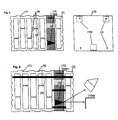
- makeshift metal anchors or brackets 13 (FIG. Fig. 7 ) are used, which connect the individual shells, past the insulation. These anchors or brackets prove to be thermal bridges that affect the effect of thermal insulation very adversely.
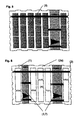
- Inventive elements 5 found that connect the individual shells of the block frictionally. They have here, in addition to a small cross-section, especially a lower thermal conductivity thereby reducing energy drainage and at the same time providing sufficiently stable anchoring. According to these requirements are achieved by Gratnuten in the building blocks and ridge strips on the connecting elements 5.
- Gratnuten in the building blocks and ridge strips on the connecting elements 5.
- dovetail, T, L, spherical profile possible.
- the strip material consists of stable, mechanically stressable materials with a lower thermal conductivity than the brick shards.
- the above-mentioned technology for frictional connection of the individual building shell shells over the core insulation, according to the invention is suitable for combining hydrophobic, microporous thermal insulation panels with other conventional thermal insulation materials.
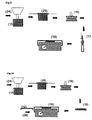
- a multi-shell hollow brick with integrated thermal insulation between the shells is carried out according to the invention in such a way that the respective Dämmmaterialen be recognized on a shell of the block and a counter shell of the block is pressed to the desired overall size.
- spacers (10, 10a) serve to exactly observe the final dimensions of the modular system and to prevent loosening or slippage of the thermal insulation between the shells.
- VIP insulation it is also possible here to fix a bond with adhesives.
- the strapping material (6, 11) for the non-positive connection of the building block shells, including insulating material, are used according to the invention, e.g. Tapes, wires or cords of plastic or metal, preferably plastic tapes of PP or PPT.
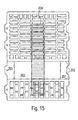
- the non-positive connection of the two individual shells high-strength glass fiber fleece, which is placed over part of the stone length and glued or mortared becomes possible. If necessary, the module receives a milled groove for receiving the fabric strips. On the sides of the block receives brackets for transport and Processing safety assurance ( Fig.15-1 ), which are removed after the module has been installed.
- the core insulation materials used are the hydrophobic, microporous thermal insulation materials according to the invention which have already been described.
- the insulation boards are placed in a vacuum chamber and evacuated to the intended final pressure ( ⁇ 100 mbar, preferably 0.01 to 10 mbar).
- an equilibrium state (partial water vapor pressure environment and core material) is reached only after several years. Once the equilibrium environment / core material is reached, no more water vapor can be tracked into the system. At an expected water vapor partial pressure in the equilibrium state of 10-15 hPa, the thermal conductivity of the nanoscale core material is not affected. It is thus to be expected with no pressure increase in the core material by water vapor and thus not with an increase in the thermal conductivity of the overall system by increasing the pressure or water absorption of the core material
- thermal insulation composite systems in the construction sector.
- the hydrophobic microporous panels are provided with sheaths consisting of a pressed, rolled, extruded foam or fibrous material, the core being able to be kept both under normal pressure and under reduced pressure.
- the wrapper may be one or two-face for normal printing conditions or may wrap all the faces of the panel but may as well be designed multi-layered and may consist of the same or different wrapping material on the different panel pages.
- Under vacuum conditions of course, the enclosure comprises all areas of the panel. They have already been described under the section vacuum insulation panels (VIP), but they can also be used in thermal insulation composite systems.
- the reinforcing cladding may consist of:
- GRP glass fiber reinforced plastics
- Adhesive is used for the frictional connection of the sheathings, primarily in the case of multiple layers. These are preferably selected from inorganic components such as water glasses, silica sols and phosphates, as well as from organic compounds such as reaction resins, plastic dispersions or thermoplastics.
- a two-shell masonry is a masonry with two wall shells with a gap. To ensure that the individual shells are more stable, they are connected at regular intervals by masonry anchors or composite tiles. The space between the two walls should be as narrow as possible and should not exceed 15cm.
- the panels described in the invention with microporous, hydrophobic thermal insulation core inserted between the two wall shells for heat insulation.
- the panels can be used both without wrapping, as well as with enclosures such as thermal insulation composite systems (ETICS) or as a vacuum insulation panels (VIP), but preferably with a fleece cover.
- the gap between the two wall shells can be adapted to the respective thickness of the insulating material, but can also be provided with an air gap before the insulation as a rear ventilation.
- the area size of the thermal insulation panels used depends on the brick size used and the number of building blocks per area to be laid down beforehand. Ideally, the panel surface size can be chosen so that always after a certain wall height (3 or 4 bricks), a series of composite tiles, with integrated thermal insulation core to avoid larger thermal bridges, walled can. Ideally, it would be possible to use a thermal insulation panel of approx. 100 x 75 cm surface area per area of 4 x 3 bricks (size per tile approx. 25 x 25 cm).
- the strength of the overall system - bivalve wall including thermal insulation - can be chosen so that a composite brick thickness is equal to the total wall thickness.
- the panels according to the invention may come into contact with wet mortar and water without a water absorption in the insulating material takes place and thus a deterioration of the insulation effect occurs.
- the panels are easy to handle during installation and can be reworked to the required dimension and configuration.
- the bivalve composite thermal barrier masonry system of the present invention is breathable and does not result in moisture retention and resulting mold growth.
- the finished mixture 187.5 g were removed and pressed to a solid body of external dimensions 250 x 250 x 25 mm. This shaped body was then heated for 3 min at 80 ° C and then baked for 60 min at 125 ° C.
Landscapes
- Engineering & Computer Science (AREA)
- Chemical & Material Sciences (AREA)
- Structural Engineering (AREA)
- Architecture (AREA)
- Ceramic Engineering (AREA)
- Civil Engineering (AREA)
- Mechanical Engineering (AREA)
- Materials Engineering (AREA)
- Organic Chemistry (AREA)
- Physics & Mathematics (AREA)
- Electromagnetism (AREA)
- Manufacturing & Machinery (AREA)
- Building Environments (AREA)
- Thermal Insulation (AREA)
Applications Claiming Priority (5)
| Application Number | Priority Date | Filing Date | Title |
|---|---|---|---|
| DE200710020716 DE102007020716A1 (de) | 2007-05-03 | 2007-05-03 | Hohlbausteine mit integrierter mikroporöser Wärmedämmung |
| DE102007042000.7A DE102007042000B4 (de) | 2007-09-04 | 2007-09-04 | Zweischaliges Mauerwerk mit integrierter hydrophober, mikroporöser Wärmedämmung |
| DE202007013074U DE202007013074U1 (de) | 2007-09-18 | 2007-09-18 | Mauerwerk mit integrierter Vakuumisolation auf Basis mikroporöser Wärmedämmung |
| DE102007051830A DE102007051830A1 (de) | 2007-10-30 | 2007-10-30 | Wärmedämmmaterialaufweisender Baustein sowie Verfahren zu seiner Herstellung |
| DE200810005548 DE102008005548A1 (de) | 2008-01-23 | 2008-01-23 | Mehrschalige Hohlbausteine mit integrierter Wärmedämmung |
Publications (3)
| Publication Number | Publication Date |
|---|---|
| EP1988228A2 true EP1988228A2 (fr) | 2008-11-05 |
| EP1988228A3 EP1988228A3 (fr) | 2009-08-26 |
| EP1988228B1 EP1988228B1 (fr) | 2020-04-15 |
Family
ID=39745326
Family Applications (1)
| Application Number | Title | Priority Date | Filing Date |
|---|---|---|---|
| EP08155583.1A Active EP1988228B1 (fr) | 2007-05-03 | 2008-05-02 | Blocs et systèmes de construction avec isolation thermique hydrophobe et microporeuse et méthode de fabrication |
Country Status (2)
| Country | Link |
|---|---|
| EP (1) | EP1988228B1 (fr) |
| DK (1) | DK1988228T3 (fr) |
Cited By (40)
| Publication number | Priority date | Publication date | Assignee | Title |
|---|---|---|---|---|
| WO2009067727A1 (fr) * | 2007-11-26 | 2009-06-04 | Michael Kogler | Brique moulée et procédé de réalisation d'une brique moulée |
| EP2180111A1 (fr) * | 2008-10-21 | 2010-04-28 | Rockwool International A/S | Brique de construction à isolation thermique |
| DE102008064572A1 (de) * | 2008-12-30 | 2010-07-08 | Alsecco Gmbh & Co Kg | Mehrschichtige Wärmedämmplatte und Verfahren zum Aufbau einer Wärmedämmfassade |
| CN102051948A (zh) * | 2011-01-04 | 2011-05-11 | 钟琪 | 建筑外墙用组合隔热砖 |
| WO2011069923A1 (fr) * | 2009-12-11 | 2011-06-16 | Wacker Chemie Ag | Isolation thermique hydrophobe |
| WO2012034724A1 (fr) | 2010-09-16 | 2012-03-22 | Creabeton Matériaux Sa | Matériau de construction et élément d'un système de construction et procédé pour les fabriquer |
| DE102010046678A1 (de) | 2010-09-27 | 2012-03-29 | Günter Kratel | Mikroporöser, hydrophober Dämmformkörper mit hygrisch aktiver, oberflächennaher Schicht |
| DE102010046684A1 (de) | 2010-09-27 | 2012-03-29 | Günter Kratel | Stabilisierter Wärmedämmformkörper mit hydrophoben, mikroporösem Dämmstoffkern und hydrophiler Oberfläche |
| WO2012015369A3 (fr) * | 2010-07-30 | 2012-06-14 | Hueseyin Lueleci | Brique isolée et calibrée et son procédé de production |
| CN102561536A (zh) * | 2012-01-14 | 2012-07-11 | 杨永全 | 一种超疏水自清洁保温板 |
| CN102677815A (zh) * | 2011-03-07 | 2012-09-19 | 彭昊 | 四排孔自保温隔音砌块墙体 |
| FR2973054A1 (fr) * | 2011-03-24 | 2012-09-28 | Jacques Lagarrigue | Module de construction rapide et assemblage compose d'au moins deux tels modules superposes |
| DE102011100652B3 (de) * | 2011-05-05 | 2012-11-08 | Kronos International, Inc. | Bauelement und Verfahren zur Herstellung eines Bauelements |
| WO2013013714A1 (fr) | 2011-07-27 | 2013-01-31 | Evonik Degussa Gmbh | Procédé pour produire des corps moulés hydrophobles thermo-isolants |
| EP2660406A1 (fr) * | 2012-05-03 | 2013-11-06 | Saint-Gobain Weber | Bloc de construction thermiquement isolant |
| CN103628580A (zh) * | 2012-08-23 | 2014-03-12 | 陕西亿丰绿色建筑材料有限公司 | 五级阻热传导真空保温板生产工艺 |
| DE102012018793A1 (de) | 2012-09-22 | 2014-03-27 | Günter Kratel | Wandaufbau für Innendämmungssysteme mit verlegten Wärmedämmplatten bei variablen Fugenabständen |
| WO2014044709A1 (fr) | 2012-09-22 | 2014-03-27 | Evonik Industries Ag | Structure murale pour systèmes d'isolation intérieure comportant des plaques d'isolation thermique avec des écarts de joints variables |
| EP2724780A1 (fr) | 2012-10-26 | 2014-04-30 | Evonik Degussa GmbH | Procédé de fabrication d'un mélange d'isolation thermique |
| DE102013006179A1 (de) | 2013-04-10 | 2014-10-16 | Günter Kratel | Wandaufbau für Innendämmungssysteme mit verlegten Wärmedämmplatten bei variablen Fugenabständen |
| EP2982660A1 (fr) | 2014-08-08 | 2016-02-10 | Evonik Degussa GmbH | Procédé de fabrication d'un corps de moulage d'isolation thermique hydrophobe |
| CN107299694A (zh) * | 2015-10-10 | 2017-10-27 | 董晓娜 | 一种保温建筑墙体结构 |
| WO2018019599A1 (fr) | 2016-07-29 | 2018-02-01 | Evonik Degussa Gmbh | Procédé pour la fabrication d'un matériau hydrophobe, thermo-isolant |
| EP3403818A1 (fr) | 2017-05-15 | 2018-11-21 | Evonik Degussa GmbH | Corps moulé thermo-isolant contenant un substrat poreux |
| WO2018210605A1 (fr) | 2017-05-17 | 2018-11-22 | Evonik Degussa Gmbh | Plaque d'isolation thermique à noyau hydrophobe présentant une surface durcie |
| CN110446692A (zh) * | 2017-01-18 | 2019-11-12 | 赢创德固赛有限公司 | 颗粒状绝热材料及其制备方法 |
| WO2020016036A1 (fr) | 2018-07-18 | 2020-01-23 | Evonik Operations Gmbh | Procédé d'hydrophobisation de corps en matériau isolant façonnés à base de silice à pression ambiante |
| CN111715181A (zh) * | 2020-05-06 | 2020-09-29 | 安徽紫荆花壁纸股份有限公司 | 一种环保墙面装饰材料生产系统及方法 |
| WO2021069351A1 (fr) | 2019-10-07 | 2021-04-15 | Evonik Operations Gmbh | Feuille d'isolation thermique à base de silice revêtue d'une composition intumescente |
| WO2021170435A1 (fr) | 2020-02-28 | 2021-09-02 | Evonik Operations Gmbh | Corps moulé d'isolation thermique à base de silice |
| EP3960948A1 (fr) * | 2020-08-27 | 2022-03-02 | va-Q-tec AG | Élément d'isolation sous vide stable en température |
| CN115257040A (zh) * | 2022-05-25 | 2022-11-01 | 灵石县晋源建材有限公司 | 一种改善热胀冷缩变化率的可拆卸式地板模块制作方法 |
| EP4177231A1 (fr) * | 2021-11-03 | 2023-05-10 | Evonik Operations GmbH | Systèmes d'isolation thermique à rapport coût-efficacité amélioré |
| WO2023148082A1 (fr) | 2022-02-03 | 2023-08-10 | Empa Eidgenössische Materialprüfungs- Und Forschungsanstalt | Matériau d'aérogel de silice en vrac exempt de liant, son procédé de production et ses utilisations |
| CN116690762A (zh) * | 2023-07-10 | 2023-09-05 | 浙江乐邦节能科技有限公司 | 一种外墙新型自保温夹心保温砖工艺 |
| CN117304648A (zh) * | 2023-08-25 | 2023-12-29 | 长春盛达化工制品有限公司 | 一种超疏水断路绝缘器主绝缘板的制备方法 |
| US11920735B2 (en) | 2017-06-09 | 2024-03-05 | Evonik Operations Gmbh | Method for thermally insulating an evacuable container |
| EP4382498A1 (fr) | 2022-12-09 | 2024-06-12 | EMPA Eidgenössische Materialprüfungs- und Forschungsanstalt | Materiau en aerogel de silice en vrac exempt de liant, procede de production et utilisations |
| US12030810B2 (en) | 2018-07-17 | 2024-07-09 | Evonik Operations Gmbh | Thermal insulating composition based on fumed silica granulates, processes for its preparation and uses thereof |
| CN120902085A (zh) * | 2025-08-06 | 2025-11-07 | 台州市广天构件有限公司 | 一种蒸压加气混凝土保温墙体加工工艺 |
Families Citing this family (1)
| Publication number | Priority date | Publication date | Assignee | Title |
|---|---|---|---|---|
| DE202024107038U1 (de) | 2024-12-04 | 2025-01-13 | Cartaga Ag | Modularer Schutz mindestens eines Objektes vor Witterungseinflüssen, insbesondere zum Schutz für Pflanzen im Außenbereich sowie Formstein und Abdeckung für den modularen Schutz |
Citations (6)
| Publication number | Priority date | Publication date | Assignee | Title |
|---|---|---|---|---|
| DE2825508A1 (de) | 1978-06-10 | 1979-12-13 | Dennert Kg Veit | Hohlblockstein mit kunststoff- fuellung nebst verfahren und anlage zu dessen herstellung |
| DE3037409A1 (de) | 1980-10-03 | 1982-05-19 | Dr. Carl Riffer Baustoffwerke KG, 5403 Mülheim-Klärlich | Hohlblockstein mit integrierter waermedaemmung, mittel zum verfuellen und verfahren zu seiner herstellung sowie vorrichtung zur durchfuehrung des verfahrens |
| DE8504737U1 (de) | 1985-02-20 | 1985-05-09 | Schlepps, geb. Podlesch, Gertrud, 4790 Paderborn | Hohl-Baustein |
| DE4221716A1 (de) | 1992-07-02 | 1994-01-05 | Wacker Chemie Gmbh | Verfahren zur Hydrophobierung von pyrogen hergestelltem Siliciumdioxid |
| DE10217548A1 (de) | 2002-04-19 | 2003-11-13 | Stefan Geyer | Vorrichtung und Maschine zum Einbringen von Mineralwolle in die Hohlräume stranggepresster Lochziegel |
| DE10229856B4 (de) | 2002-07-03 | 2005-06-09 | Kramer, Paul, Dipl.-Ing. | Hochlochwärmedämmstein |
Family Cites Families (7)
| Publication number | Priority date | Publication date | Assignee | Title |
|---|---|---|---|---|
| DE2754956A1 (de) * | 1977-12-09 | 1979-06-13 | Gruenzweig Hartmann Glasfaser | Waermedaemmplatte |
| DE3000542A1 (de) * | 1980-01-09 | 1981-08-27 | Degussa Ag, 6000 Frankfurt | Waermeisolationsmischung und verfahren zu deren herstellung |
| DE4432387A1 (de) * | 1993-07-23 | 1996-03-14 | Hans Herberger | Bauelement |
| DE10151479A1 (de) * | 2001-10-18 | 2003-05-08 | Wacker Chemie Gmbh | Mikroporöser Wärmedämmformkörper enthaltend Lichtbogenkieselsäure |
| DE10315649A1 (de) * | 2003-04-04 | 2004-10-28 | Manfred Niedermeyer | Ziegelstein und Verfahren zur Herstellung eines Ziegelsteins |
| DE102004003602A1 (de) * | 2004-01-23 | 2005-08-18 | Woschko Winlite Gmbh | Verfahren zum Herstellen eines wärmedämmenden mehrschaligen Mauersteins sowie solcher Mauerstein |
| DE102006002826B4 (de) * | 2005-07-21 | 2008-07-10 | Deutsche Rockwool Mineralwoll Gmbh & Co. Ohg | Verfahren zur Herstellung von Mauersteinen sowie mit dem Verfahren hergestellter Mauerstein |
-
2008
- 2008-05-02 EP EP08155583.1A patent/EP1988228B1/fr active Active
- 2008-05-02 DK DK08155583.1T patent/DK1988228T3/da active
Patent Citations (6)
| Publication number | Priority date | Publication date | Assignee | Title |
|---|---|---|---|---|
| DE2825508A1 (de) | 1978-06-10 | 1979-12-13 | Dennert Kg Veit | Hohlblockstein mit kunststoff- fuellung nebst verfahren und anlage zu dessen herstellung |
| DE3037409A1 (de) | 1980-10-03 | 1982-05-19 | Dr. Carl Riffer Baustoffwerke KG, 5403 Mülheim-Klärlich | Hohlblockstein mit integrierter waermedaemmung, mittel zum verfuellen und verfahren zu seiner herstellung sowie vorrichtung zur durchfuehrung des verfahrens |
| DE8504737U1 (de) | 1985-02-20 | 1985-05-09 | Schlepps, geb. Podlesch, Gertrud, 4790 Paderborn | Hohl-Baustein |
| DE4221716A1 (de) | 1992-07-02 | 1994-01-05 | Wacker Chemie Gmbh | Verfahren zur Hydrophobierung von pyrogen hergestelltem Siliciumdioxid |
| DE10217548A1 (de) | 2002-04-19 | 2003-11-13 | Stefan Geyer | Vorrichtung und Maschine zum Einbringen von Mineralwolle in die Hohlräume stranggepresster Lochziegel |
| DE10229856B4 (de) | 2002-07-03 | 2005-06-09 | Kramer, Paul, Dipl.-Ing. | Hochlochwärmedämmstein |
Cited By (56)
| Publication number | Priority date | Publication date | Assignee | Title |
|---|---|---|---|---|
| WO2009067727A1 (fr) * | 2007-11-26 | 2009-06-04 | Michael Kogler | Brique moulée et procédé de réalisation d'une brique moulée |
| EP2180111A1 (fr) * | 2008-10-21 | 2010-04-28 | Rockwool International A/S | Brique de construction à isolation thermique |
| DE102008064572A1 (de) * | 2008-12-30 | 2010-07-08 | Alsecco Gmbh & Co Kg | Mehrschichtige Wärmedämmplatte und Verfahren zum Aufbau einer Wärmedämmfassade |
| WO2011069923A1 (fr) * | 2009-12-11 | 2011-06-16 | Wacker Chemie Ag | Isolation thermique hydrophobe |
| WO2012015369A3 (fr) * | 2010-07-30 | 2012-06-14 | Hueseyin Lueleci | Brique isolée et calibrée et son procédé de production |
| WO2012034724A1 (fr) | 2010-09-16 | 2012-03-22 | Creabeton Matériaux Sa | Matériau de construction et élément d'un système de construction et procédé pour les fabriquer |
| DE102010046678A1 (de) | 2010-09-27 | 2012-03-29 | Günter Kratel | Mikroporöser, hydrophober Dämmformkörper mit hygrisch aktiver, oberflächennaher Schicht |
| DE102010046684A1 (de) | 2010-09-27 | 2012-03-29 | Günter Kratel | Stabilisierter Wärmedämmformkörper mit hydrophoben, mikroporösem Dämmstoffkern und hydrophiler Oberfläche |
| WO2012041823A1 (fr) | 2010-09-27 | 2012-04-05 | Evonik Degussa Gmbh | Corps moulé calorifuge microporeux, hydrophobisé avec des organosilanes, à surface hydrophile |
| WO2012049018A1 (fr) | 2010-09-27 | 2012-04-19 | Evonik Degussa Gmbh | Procédé pour produire une couche à pores ouverts, mouillable par des systèmes aqueux, proche de la surface, dans un corps moulé calorifuge hydrophobe microporeux |
| CN102051948A (zh) * | 2011-01-04 | 2011-05-11 | 钟琪 | 建筑外墙用组合隔热砖 |
| CN102051948B (zh) * | 2011-01-04 | 2012-10-10 | 钟琪 | 建筑外墙用组合隔热砖 |
| CN102677815A (zh) * | 2011-03-07 | 2012-09-19 | 彭昊 | 四排孔自保温隔音砌块墙体 |
| FR2973054A1 (fr) * | 2011-03-24 | 2012-09-28 | Jacques Lagarrigue | Module de construction rapide et assemblage compose d'au moins deux tels modules superposes |
| FR2973053A1 (fr) * | 2011-03-24 | 2012-09-28 | Jacques Lagarrigue | Module de construction rapide |
| DE102011100652B3 (de) * | 2011-05-05 | 2012-11-08 | Kronos International, Inc. | Bauelement und Verfahren zur Herstellung eines Bauelements |
| WO2013013714A1 (fr) | 2011-07-27 | 2013-01-31 | Evonik Degussa Gmbh | Procédé pour produire des corps moulés hydrophobles thermo-isolants |
| CN102561536A (zh) * | 2012-01-14 | 2012-07-11 | 杨永全 | 一种超疏水自清洁保温板 |
| CN102561536B (zh) * | 2012-01-14 | 2014-06-25 | 杨永全 | 一种超疏水自清洁保温板 |
| FR2990223A1 (fr) * | 2012-05-03 | 2013-11-08 | Saint Gobain Weber | Bloc de construction thermiquement isolant |
| EP2660406A1 (fr) * | 2012-05-03 | 2013-11-06 | Saint-Gobain Weber | Bloc de construction thermiquement isolant |
| CN103628580A (zh) * | 2012-08-23 | 2014-03-12 | 陕西亿丰绿色建筑材料有限公司 | 五级阻热传导真空保温板生产工艺 |
| DE102012018793A1 (de) | 2012-09-22 | 2014-03-27 | Günter Kratel | Wandaufbau für Innendämmungssysteme mit verlegten Wärmedämmplatten bei variablen Fugenabständen |
| WO2014044709A1 (fr) | 2012-09-22 | 2014-03-27 | Evonik Industries Ag | Structure murale pour systèmes d'isolation intérieure comportant des plaques d'isolation thermique avec des écarts de joints variables |
| EP2724780A1 (fr) | 2012-10-26 | 2014-04-30 | Evonik Degussa GmbH | Procédé de fabrication d'un mélange d'isolation thermique |
| WO2014063949A1 (fr) | 2012-10-26 | 2014-05-01 | Evonik Degussa Gmbh | Procédé de fabrication d'un mélange thermo-isolant |
| DE102013006179A1 (de) | 2013-04-10 | 2014-10-16 | Günter Kratel | Wandaufbau für Innendämmungssysteme mit verlegten Wärmedämmplatten bei variablen Fugenabständen |
| WO2016020215A1 (fr) * | 2014-08-08 | 2016-02-11 | Evonik Degussa Gmbh | Procédé de préparation d'un corps moulé calorifuge hydrophobe |
| EP2982660A1 (fr) | 2014-08-08 | 2016-02-10 | Evonik Degussa GmbH | Procédé de fabrication d'un corps de moulage d'isolation thermique hydrophobe |
| KR20170040313A (ko) * | 2014-08-08 | 2017-04-12 | 에보니크 데구사 게엠베하 | 소수성 단열 성형물의 제조 방법 |
| JP2017530306A (ja) * | 2014-08-08 | 2017-10-12 | エボニック デグサ ゲーエムベーハーEvonik Degussa GmbH | 疎水性断熱成形体の製造方法 |
| US10618849B2 (en) | 2014-08-08 | 2020-04-14 | Evonik Operations Gmbh | Method for producing a hydrophobic heat-insulating molded body |
| CN107299694A (zh) * | 2015-10-10 | 2017-10-27 | 董晓娜 | 一种保温建筑墙体结构 |
| WO2018019599A1 (fr) | 2016-07-29 | 2018-02-01 | Evonik Degussa Gmbh | Procédé pour la fabrication d'un matériau hydrophobe, thermo-isolant |
| US11427506B2 (en) | 2016-07-29 | 2022-08-30 | Evonik Operations Gmbh | Method for producing hydrophobic heat insulation material |
| CN110446692A (zh) * | 2017-01-18 | 2019-11-12 | 赢创德固赛有限公司 | 颗粒状绝热材料及其制备方法 |
| EP3403818A1 (fr) | 2017-05-15 | 2018-11-21 | Evonik Degussa GmbH | Corps moulé thermo-isolant contenant un substrat poreux |
| WO2018210605A1 (fr) | 2017-05-17 | 2018-11-22 | Evonik Degussa Gmbh | Plaque d'isolation thermique à noyau hydrophobe présentant une surface durcie |
| US11920735B2 (en) | 2017-06-09 | 2024-03-05 | Evonik Operations Gmbh | Method for thermally insulating an evacuable container |
| US12030810B2 (en) | 2018-07-17 | 2024-07-09 | Evonik Operations Gmbh | Thermal insulating composition based on fumed silica granulates, processes for its preparation and uses thereof |
| US20210292238A1 (en) * | 2018-07-18 | 2021-09-23 | Evonik Operations Gmbh | Process for hydrophobizing shaped insulation-material bodies based on silica at ambient pressure |
| WO2020016036A1 (fr) | 2018-07-18 | 2020-01-23 | Evonik Operations Gmbh | Procédé d'hydrophobisation de corps en matériau isolant façonnés à base de silice à pression ambiante |
| KR20210033008A (ko) * | 2018-07-18 | 2021-03-25 | 에보니크 오퍼레이션즈 게엠베하 | 주위 압력에서 실리카를 기재로 하는 절연-재료 성형체를 소수성화시키는 방법 |
| US11987528B2 (en) | 2018-07-18 | 2024-05-21 | Kingspan Insulation Limited | Process for hydrophobizing shaped insulation-material bodies based on silica at ambient pressure |
| WO2021069351A1 (fr) | 2019-10-07 | 2021-04-15 | Evonik Operations Gmbh | Feuille d'isolation thermique à base de silice revêtue d'une composition intumescente |
| WO2021170435A1 (fr) | 2020-02-28 | 2021-09-02 | Evonik Operations Gmbh | Corps moulé d'isolation thermique à base de silice |
| CN111715181A (zh) * | 2020-05-06 | 2020-09-29 | 安徽紫荆花壁纸股份有限公司 | 一种环保墙面装饰材料生产系统及方法 |
| EP3960948A1 (fr) * | 2020-08-27 | 2022-03-02 | va-Q-tec AG | Élément d'isolation sous vide stable en température |
| EP4177231A1 (fr) * | 2021-11-03 | 2023-05-10 | Evonik Operations GmbH | Systèmes d'isolation thermique à rapport coût-efficacité amélioré |
| WO2023148082A1 (fr) | 2022-02-03 | 2023-08-10 | Empa Eidgenössische Materialprüfungs- Und Forschungsanstalt | Matériau d'aérogel de silice en vrac exempt de liant, son procédé de production et ses utilisations |
| CN115257040A (zh) * | 2022-05-25 | 2022-11-01 | 灵石县晋源建材有限公司 | 一种改善热胀冷缩变化率的可拆卸式地板模块制作方法 |
| EP4382498A1 (fr) | 2022-12-09 | 2024-06-12 | EMPA Eidgenössische Materialprüfungs- und Forschungsanstalt | Materiau en aerogel de silice en vrac exempt de liant, procede de production et utilisations |
| CN116690762A (zh) * | 2023-07-10 | 2023-09-05 | 浙江乐邦节能科技有限公司 | 一种外墙新型自保温夹心保温砖工艺 |
| CN117304648A (zh) * | 2023-08-25 | 2023-12-29 | 长春盛达化工制品有限公司 | 一种超疏水断路绝缘器主绝缘板的制备方法 |
| CN117304648B (zh) * | 2023-08-25 | 2024-06-04 | 长春盛达化工制品有限公司 | 一种超疏水断路绝缘器主绝缘板的制备方法 |
| CN120902085A (zh) * | 2025-08-06 | 2025-11-07 | 台州市广天构件有限公司 | 一种蒸压加气混凝土保温墙体加工工艺 |
Also Published As
| Publication number | Publication date |
|---|---|
| EP1988228B1 (fr) | 2020-04-15 |
| DK1988228T3 (da) | 2020-07-13 |
| EP1988228A3 (fr) | 2009-08-26 |
Similar Documents
| Publication | Publication Date | Title |
|---|---|---|
| EP1988228B1 (fr) | Blocs et systèmes de construction avec isolation thermique hydrophobe et microporeuse et méthode de fabrication | |
| EP2576929B1 (fr) | Isolant et procede pour sa fabrication | |
| DE102007042000B4 (de) | Zweischaliges Mauerwerk mit integrierter hydrophober, mikroporöser Wärmedämmung | |
| DE202007013074U1 (de) | Mauerwerk mit integrierter Vakuumisolation auf Basis mikroporöser Wärmedämmung | |
| DE102009054566A1 (de) | Hydrophobe Wärmedämmung | |
| EP3084091B1 (fr) | Panneau d'isolation thermique | |
| DE102007020716A1 (de) | Hohlbausteine mit integrierter mikroporöser Wärmedämmung | |
| DE202007013688U1 (de) | Wärmedämmstoffverbundsysteme mit hydrophobem, mikroporösem Wärmedämmstoffkern | |
| DE102010046684A1 (de) | Stabilisierter Wärmedämmformkörper mit hydrophoben, mikroporösem Dämmstoffkern und hydrophiler Oberfläche | |
| DE202011050486U1 (de) | Dämmstoffelement | |
| WO2015090615A1 (fr) | Mélange sec de matériau de construction et enduit d'isolation thermique résultant | |
| DE102008036430A1 (de) | Baustein mit integrierter hydrophober, mikroporöser Kieselsäure als Wärmedämmung | |
| CH708688B1 (de) | Stabiler Formkörper als Brandschutz und/oder Wärmedämmung und Leichtbauplatte mit einem solchen, Herstellverfahren und Verwendung davon sowie Bauwerk enthaltend einen stabilen Formkörper oder eine Leichtbauplatte. | |
| DE102008005548A1 (de) | Mehrschalige Hohlbausteine mit integrierter Wärmedämmung | |
| DE102010005800A1 (de) | Behandlung von mikroporösen Wärmedämmstoffen zu hydrophoben Wärmedämmstoffen im Unterdruckverfahren mit siliciumorganischen Verbindungen | |
| DE202011050485U1 (de) | Dämmelement | |
| EP2460945B1 (fr) | Plaque isolante dotée d'éléments d'isolation thermique à faible conduction thermique et ensemble associé | |
| DE19706492A1 (de) | Porosierter Mauerziegel | |
| EP2257506A1 (fr) | Procédé de fabrication d'un élément de construction en forme de plaque ou de profilé et élément de construction en forme de plaque ou de profilé | |
| DE10360749B3 (de) | Anorganische Brand- und Wärmedämmpaste und ihre Herstellung | |
| DE102004043494B4 (de) | Vorsatzschale als wärmedämmende Außenschale für ein mehrschaliges Mauerwerk | |
| DE202011050489U1 (de) | Wärmedämmender Mauerlochbaustein | |
| DE102009029746A1 (de) | Baustein, wie Ziegelstein für die Errichtung eines Vorsatzmauerwerkes | |
| DE102004031967B4 (de) | Verfahren zur Herstellung eines Vakuumisolationsformkörpers | |
| DE102006019796A1 (de) | Mauerwerksandwichelement und Verfahren zu seiner Herstellung |
Legal Events
| Date | Code | Title | Description |
|---|---|---|---|
| PUAI | Public reference made under article 153(3) epc to a published international application that has entered the european phase |
Free format text: ORIGINAL CODE: 0009012 |
|
| AK | Designated contracting states |
Kind code of ref document: A2 Designated state(s): AT BE BG CH CY CZ DE DK EE ES FI FR GB GR HR HU IE IS IT LI LT LU LV MC MT NL NO PL PT RO SE SI SK TR |
|
| AX | Request for extension of the european patent |
Extension state: AL BA MK RS |
|
| PUAL | Search report despatched |
Free format text: ORIGINAL CODE: 0009013 |
|
| AK | Designated contracting states |
Kind code of ref document: A3 Designated state(s): AT BE BG CH CY CZ DE DK EE ES FI FR GB GR HR HU IE IS IT LI LT LU LV MC MT NL NO PL PT RO SE SI SK TR |
|
| AX | Request for extension of the european patent |
Extension state: AL BA MK RS |
|
| RIC1 | Information provided on ipc code assigned before grant |
Ipc: C04B 30/00 20060101ALI20090723BHEP Ipc: E04C 1/41 20060101AFI20080923BHEP Ipc: E04C 2/284 20060101ALI20090723BHEP Ipc: E04B 1/80 20060101ALI20090723BHEP |
|
| 17P | Request for examination filed |
Effective date: 20100226 |
|
| 17Q | First examination report despatched |
Effective date: 20100326 |
|
| AKX | Designation fees paid |
Designated state(s): AT BE BG CH CY CZ DE DK EE ES FI FR GB GR HR HU IE IS IT LI LT LU LV MC MT NL NO PL PT RO SE SI SK TR |
|
| RAP1 | Party data changed (applicant data changed or rights of an application transferred) |
Owner name: KRATEL, GUENTER |
|
| RAP1 | Party data changed (applicant data changed or rights of an application transferred) |
Owner name: EVONIK DEGUSSA GMBH |
|
| STAA | Information on the status of an ep patent application or granted ep patent |
Free format text: STATUS: EXAMINATION IS IN PROGRESS |
|
| REG | Reference to a national code |
Ref country code: DE Ref legal event code: R079 Ref document number: 502008017061 Country of ref document: DE Free format text: PREVIOUS MAIN CLASS: E04C0001410000 Ipc: E04B0002160000 |
|
| RIC1 | Information provided on ipc code assigned before grant |
Ipc: C04B 30/00 20060101ALI20190521BHEP Ipc: E04C 1/41 20060101ALI20190521BHEP Ipc: B28B 1/00 20060101ALI20190521BHEP Ipc: E04C 2/284 20060101ALI20190521BHEP Ipc: B29C 44/44 20060101ALI20190521BHEP Ipc: E04B 2/02 20060101ALI20190521BHEP Ipc: B29L 31/10 20060101ALI20190521BHEP Ipc: B28B 11/04 20060101ALI20190521BHEP Ipc: B29K 25/00 20060101ALI20190521BHEP Ipc: B29C 44/18 20060101ALI20190521BHEP Ipc: E04B 2/16 20060101AFI20190521BHEP |
|
| GRAP | Despatch of communication of intention to grant a patent |
Free format text: ORIGINAL CODE: EPIDOSNIGR1 |
|
| STAA | Information on the status of an ep patent application or granted ep patent |
Free format text: STATUS: GRANT OF PATENT IS INTENDED |
|
| INTG | Intention to grant announced |
Effective date: 20190930 |
|
| RIN1 | Information on inventor provided before grant (corrected) |
Inventor name: BORCHERT, GERD Inventor name: KRATEL, GUENTER, DR. Inventor name: RIMMELE, MATTHIAS |
|
| RAP1 | Party data changed (applicant data changed or rights of an application transferred) |
Owner name: EVONIK OPERATIONS GMBH |
|
| GRAJ | Information related to disapproval of communication of intention to grant by the applicant or resumption of examination proceedings by the epo deleted |
Free format text: ORIGINAL CODE: EPIDOSDIGR1 |
|
| STAA | Information on the status of an ep patent application or granted ep patent |
Free format text: STATUS: EXAMINATION IS IN PROGRESS |
|
| GRAR | Information related to intention to grant a patent recorded |
Free format text: ORIGINAL CODE: EPIDOSNIGR71 |
|
| GRAS | Grant fee paid |
Free format text: ORIGINAL CODE: EPIDOSNIGR3 |
|
| INTC | Intention to grant announced (deleted) | ||
| STAA | Information on the status of an ep patent application or granted ep patent |
Free format text: STATUS: GRANT OF PATENT IS INTENDED |
|
| GRAA | (expected) grant |
Free format text: ORIGINAL CODE: 0009210 |
|
| STAA | Information on the status of an ep patent application or granted ep patent |
Free format text: STATUS: THE PATENT HAS BEEN GRANTED |
|
| INTG | Intention to grant announced |
Effective date: 20200304 |
|
| AK | Designated contracting states |
Kind code of ref document: B1 Designated state(s): AT BE BG CH CY CZ DE DK EE ES FI FR GB GR HR HU IE IS IT LI LT LU LV MC MT NL NO PL PT RO SE SI SK TR |
|
| REG | Reference to a national code |
Ref country code: CH Ref legal event code: EP Ref country code: GB Ref legal event code: FG4D Free format text: NOT ENGLISH |
|
| REG | Reference to a national code |
Ref country code: DE Ref legal event code: R096 Ref document number: 502008017061 Country of ref document: DE |
|
| REG | Reference to a national code |
Ref country code: IE Ref legal event code: FG4D Free format text: LANGUAGE OF EP DOCUMENT: GERMAN |
|
| REG | Reference to a national code |
Ref country code: AT Ref legal event code: REF Ref document number: 1257444 Country of ref document: AT Kind code of ref document: T Effective date: 20200515 |
|
| REG | Reference to a national code |
Ref country code: DK Ref legal event code: T3 Effective date: 20200708 |
|
| REG | Reference to a national code |
Ref country code: NL Ref legal event code: FP |
|
| REG | Reference to a national code |
Ref country code: LT Ref legal event code: MG4D |
|
| PG25 | Lapsed in a contracting state [announced via postgrant information from national office to epo] |
Ref country code: IS Free format text: LAPSE BECAUSE OF FAILURE TO SUBMIT A TRANSLATION OF THE DESCRIPTION OR TO PAY THE FEE WITHIN THE PRESCRIBED TIME-LIMIT Effective date: 20200815 Ref country code: NO Free format text: LAPSE BECAUSE OF FAILURE TO SUBMIT A TRANSLATION OF THE DESCRIPTION OR TO PAY THE FEE WITHIN THE PRESCRIBED TIME-LIMIT Effective date: 20200715 Ref country code: GR Free format text: LAPSE BECAUSE OF FAILURE TO SUBMIT A TRANSLATION OF THE DESCRIPTION OR TO PAY THE FEE WITHIN THE PRESCRIBED TIME-LIMIT Effective date: 20200716 Ref country code: FI Free format text: LAPSE BECAUSE OF FAILURE TO SUBMIT A TRANSLATION OF THE DESCRIPTION OR TO PAY THE FEE WITHIN THE PRESCRIBED TIME-LIMIT Effective date: 20200415 Ref country code: SE Free format text: LAPSE BECAUSE OF FAILURE TO SUBMIT A TRANSLATION OF THE DESCRIPTION OR TO PAY THE FEE WITHIN THE PRESCRIBED TIME-LIMIT Effective date: 20200415 Ref country code: PT Free format text: LAPSE BECAUSE OF FAILURE TO SUBMIT A TRANSLATION OF THE DESCRIPTION OR TO PAY THE FEE WITHIN THE PRESCRIBED TIME-LIMIT Effective date: 20200817 Ref country code: LT Free format text: LAPSE BECAUSE OF FAILURE TO SUBMIT A TRANSLATION OF THE DESCRIPTION OR TO PAY THE FEE WITHIN THE PRESCRIBED TIME-LIMIT Effective date: 20200415 |
|
| PG25 | Lapsed in a contracting state [announced via postgrant information from national office to epo] |
Ref country code: BG Free format text: LAPSE BECAUSE OF FAILURE TO SUBMIT A TRANSLATION OF THE DESCRIPTION OR TO PAY THE FEE WITHIN THE PRESCRIBED TIME-LIMIT Effective date: 20200715 Ref country code: LV Free format text: LAPSE BECAUSE OF FAILURE TO SUBMIT A TRANSLATION OF THE DESCRIPTION OR TO PAY THE FEE WITHIN THE PRESCRIBED TIME-LIMIT Effective date: 20200415 Ref country code: HR Free format text: LAPSE BECAUSE OF FAILURE TO SUBMIT A TRANSLATION OF THE DESCRIPTION OR TO PAY THE FEE WITHIN THE PRESCRIBED TIME-LIMIT Effective date: 20200415 |
|
| REG | Reference to a national code |
Ref country code: DE Ref legal event code: R097 Ref document number: 502008017061 Country of ref document: DE |
|
| PG25 | Lapsed in a contracting state [announced via postgrant information from national office to epo] |
Ref country code: MC Free format text: LAPSE BECAUSE OF FAILURE TO SUBMIT A TRANSLATION OF THE DESCRIPTION OR TO PAY THE FEE WITHIN THE PRESCRIBED TIME-LIMIT Effective date: 20200415 Ref country code: EE Free format text: LAPSE BECAUSE OF FAILURE TO SUBMIT A TRANSLATION OF THE DESCRIPTION OR TO PAY THE FEE WITHIN THE PRESCRIBED TIME-LIMIT Effective date: 20200415 Ref country code: IT Free format text: LAPSE BECAUSE OF FAILURE TO SUBMIT A TRANSLATION OF THE DESCRIPTION OR TO PAY THE FEE WITHIN THE PRESCRIBED TIME-LIMIT Effective date: 20200415 Ref country code: RO Free format text: LAPSE BECAUSE OF FAILURE TO SUBMIT A TRANSLATION OF THE DESCRIPTION OR TO PAY THE FEE WITHIN THE PRESCRIBED TIME-LIMIT Effective date: 20200415 Ref country code: CZ Free format text: LAPSE BECAUSE OF FAILURE TO SUBMIT A TRANSLATION OF THE DESCRIPTION OR TO PAY THE FEE WITHIN THE PRESCRIBED TIME-LIMIT Effective date: 20200415 Ref country code: ES Free format text: LAPSE BECAUSE OF FAILURE TO SUBMIT A TRANSLATION OF THE DESCRIPTION OR TO PAY THE FEE WITHIN THE PRESCRIBED TIME-LIMIT Effective date: 20200415 |
|
| PLBE | No opposition filed within time limit |
Free format text: ORIGINAL CODE: 0009261 |
|
| STAA | Information on the status of an ep patent application or granted ep patent |
Free format text: STATUS: NO OPPOSITION FILED WITHIN TIME LIMIT |
|
| PG25 | Lapsed in a contracting state [announced via postgrant information from national office to epo] |
Ref country code: PL Free format text: LAPSE BECAUSE OF FAILURE TO SUBMIT A TRANSLATION OF THE DESCRIPTION OR TO PAY THE FEE WITHIN THE PRESCRIBED TIME-LIMIT Effective date: 20200415 Ref country code: SK Free format text: LAPSE BECAUSE OF FAILURE TO SUBMIT A TRANSLATION OF THE DESCRIPTION OR TO PAY THE FEE WITHIN THE PRESCRIBED TIME-LIMIT Effective date: 20200415 |
|
| 26N | No opposition filed |
Effective date: 20210118 |
|
| PG25 | Lapsed in a contracting state [announced via postgrant information from national office to epo] |
Ref country code: IE Free format text: LAPSE BECAUSE OF NON-PAYMENT OF DUE FEES Effective date: 20200502 |
|
| PG25 | Lapsed in a contracting state [announced via postgrant information from national office to epo] |
Ref country code: SI Free format text: LAPSE BECAUSE OF FAILURE TO SUBMIT A TRANSLATION OF THE DESCRIPTION OR TO PAY THE FEE WITHIN THE PRESCRIBED TIME-LIMIT Effective date: 20200415 |
|
| PG25 | Lapsed in a contracting state [announced via postgrant information from national office to epo] |
Ref country code: TR Free format text: LAPSE BECAUSE OF FAILURE TO SUBMIT A TRANSLATION OF THE DESCRIPTION OR TO PAY THE FEE WITHIN THE PRESCRIBED TIME-LIMIT Effective date: 20200415 Ref country code: MT Free format text: LAPSE BECAUSE OF FAILURE TO SUBMIT A TRANSLATION OF THE DESCRIPTION OR TO PAY THE FEE WITHIN THE PRESCRIBED TIME-LIMIT Effective date: 20200415 Ref country code: CY Free format text: LAPSE BECAUSE OF FAILURE TO SUBMIT A TRANSLATION OF THE DESCRIPTION OR TO PAY THE FEE WITHIN THE PRESCRIBED TIME-LIMIT Effective date: 20200415 |
|
| REG | Reference to a national code |
Ref country code: GB Ref legal event code: 732E Free format text: REGISTERED BETWEEN 20230525 AND 20230601 |
|
| P01 | Opt-out of the competence of the unified patent court (upc) registered |
Effective date: 20230818 |
|
| REG | Reference to a national code |
Ref country code: DE Ref legal event code: R081 Ref document number: 502008017061 Country of ref document: DE Owner name: KINGSPAN INSULATION LIMITED, LEOMINSTER, GB Free format text: FORMER OWNER: EVONIK OPERATIONS GMBH, 45128 ESSEN, DE |
|
| PGFP | Annual fee paid to national office [announced via postgrant information from national office to epo] |
Ref country code: NL Payment date: 20250526 Year of fee payment: 18 |
|
| PGFP | Annual fee paid to national office [announced via postgrant information from national office to epo] |
Ref country code: DE Payment date: 20250305 Year of fee payment: 18 |
|
| PGFP | Annual fee paid to national office [announced via postgrant information from national office to epo] |
Ref country code: DK Payment date: 20250404 Year of fee payment: 18 |
|
| PGFP | Annual fee paid to national office [announced via postgrant information from national office to epo] |
Ref country code: LU Payment date: 20250526 Year of fee payment: 18 Ref country code: BE Payment date: 20250526 Year of fee payment: 18 |
|
| PGFP | Annual fee paid to national office [announced via postgrant information from national office to epo] |
Ref country code: CH Payment date: 20250601 Year of fee payment: 18 |
|
| PGFP | Annual fee paid to national office [announced via postgrant information from national office to epo] |
Ref country code: AT Payment date: 20250520 Year of fee payment: 18 |
|
| REG | Reference to a national code |
Ref country code: CH Ref legal event code: R17 Free format text: ST27 STATUS EVENT CODE: U-0-0-R10-R17 (AS PROVIDED BY THE NATIONAL OFFICE) Effective date: 20251022 |
|
| PGFP | Annual fee paid to national office [announced via postgrant information from national office to epo] |
Ref country code: GB Payment date: 20260331 Year of fee payment: 19 |
|
| PGFP | Annual fee paid to national office [announced via postgrant information from national office to epo] |
Ref country code: FR Payment date: 20260331 Year of fee payment: 19 |