EP2660406A1 - Bloc de construction thermiquement isolant - Google Patents
Bloc de construction thermiquement isolant Download PDFInfo
- Publication number
- EP2660406A1 EP2660406A1 EP20130166195 EP13166195A EP2660406A1 EP 2660406 A1 EP2660406 A1 EP 2660406A1 EP 20130166195 EP20130166195 EP 20130166195 EP 13166195 A EP13166195 A EP 13166195A EP 2660406 A1 EP2660406 A1 EP 2660406A1
- Authority
- EP
- European Patent Office
- Prior art keywords
- blocks
- mold
- faces
- insulating panel
- vacuum
- Prior art date
- Legal status (The legal status is an assumption and is not a legal conclusion. Google has not performed a legal analysis and makes no representation as to the accuracy of the status listed.)
- Granted
Links
- 239000006260 foam Substances 0.000 claims abstract description 68
- 238000004519 manufacturing process Methods 0.000 claims abstract description 23
- 239000004567 concrete Substances 0.000 claims abstract description 22
- 230000001154 acute effect Effects 0.000 claims abstract description 12
- 239000004927 clay Substances 0.000 claims abstract description 9
- 238000000034 method Methods 0.000 claims abstract description 9
- 229920005830 Polyurethane Foam Polymers 0.000 claims abstract description 7
- 239000011496 polyurethane foam Substances 0.000 claims abstract description 7
- 229920000582 polyisocyanurate Polymers 0.000 claims abstract description 6
- 239000011495 polyisocyanurate Substances 0.000 claims abstract description 6
- 238000010276 construction Methods 0.000 claims abstract description 5
- ISWSIDIOOBJBQZ-UHFFFAOYSA-N phenol group Chemical group C1(=CC=CC=C1)O ISWSIDIOOBJBQZ-UHFFFAOYSA-N 0.000 claims abstract description 3
- 238000009413 insulation Methods 0.000 claims description 15
- 238000005538 encapsulation Methods 0.000 claims description 14
- 239000008187 granular material Substances 0.000 claims description 6
- 239000012790 adhesive layer Substances 0.000 claims description 4
- 239000002243 precursor Substances 0.000 claims description 4
- 241000195940 Bryophyta Species 0.000 description 9
- 235000011929 mousse Nutrition 0.000 description 9
- 241001080024 Telles Species 0.000 description 5
- 238000011065 in-situ storage Methods 0.000 description 5
- 239000010410 layer Substances 0.000 description 5
- 229920002635 polyurethane Polymers 0.000 description 5
- 239000004814 polyurethane Substances 0.000 description 5
- 239000000853 adhesive Substances 0.000 description 4
- 230000001070 adhesive effect Effects 0.000 description 4
- 239000000470 constituent Substances 0.000 description 4
- 230000000295 complement effect Effects 0.000 description 3
- 239000012948 isocyanate Substances 0.000 description 3
- 150000002513 isocyanates Chemical class 0.000 description 3
- 229920005862 polyol Polymers 0.000 description 3
- OFBQJSOFQDEBGM-UHFFFAOYSA-N Pentane Chemical compound CCCCC OFBQJSOFQDEBGM-UHFFFAOYSA-N 0.000 description 2
- VYPSYNLAJGMNEJ-UHFFFAOYSA-N Silicium dioxide Chemical compound O=[Si]=O VYPSYNLAJGMNEJ-UHFFFAOYSA-N 0.000 description 2
- XAGFODPZIPBFFR-UHFFFAOYSA-N aluminium Chemical compound [Al] XAGFODPZIPBFFR-UHFFFAOYSA-N 0.000 description 2
- 229910052782 aluminium Inorganic materials 0.000 description 2
- 150000003077 polyols Chemical class 0.000 description 2
- 238000007493 shaping process Methods 0.000 description 2
- UPMLOUAZCHDJJD-UHFFFAOYSA-N 4,4'-Diphenylmethane Diisocyanate Chemical compound C1=CC(N=C=O)=CC=C1CC1=CC=C(N=C=O)C=C1 UPMLOUAZCHDJJD-UHFFFAOYSA-N 0.000 description 1
- 239000004793 Polystyrene Substances 0.000 description 1
- 230000032683 aging Effects 0.000 description 1
- 239000011324 bead Substances 0.000 description 1
- 230000015572 biosynthetic process Effects 0.000 description 1
- 239000011449 brick Substances 0.000 description 1
- 239000004568 cement Substances 0.000 description 1
- 239000002131 composite material Substances 0.000 description 1
- 230000000994 depressogenic effect Effects 0.000 description 1
- 230000001627 detrimental effect Effects 0.000 description 1
- 239000004794 expanded polystyrene Substances 0.000 description 1
- 238000005187 foaming Methods 0.000 description 1
- 239000011464 hollow brick Substances 0.000 description 1
- 239000011810 insulating material Substances 0.000 description 1
- 239000012212 insulator Substances 0.000 description 1
- 238000012423 maintenance Methods 0.000 description 1
- 239000000463 material Substances 0.000 description 1
- 239000002557 mineral fiber Substances 0.000 description 1
- 239000011490 mineral wool Substances 0.000 description 1
- -1 polyol alcohols Chemical class 0.000 description 1
- 229920002223 polystyrene Polymers 0.000 description 1
- 230000001681 protective effect Effects 0.000 description 1
- 239000000377 silicon dioxide Substances 0.000 description 1
- 230000008961 swelling Effects 0.000 description 1
- 238000002834 transmittance Methods 0.000 description 1
- XLYOFNOQVPJJNP-UHFFFAOYSA-N water Substances O XLYOFNOQVPJJNP-UHFFFAOYSA-N 0.000 description 1
Images
Classifications
-
- E—FIXED CONSTRUCTIONS
- E04—BUILDING
- E04B—GENERAL BUILDING CONSTRUCTIONS; WALLS, e.g. PARTITIONS; ROOFS; FLOORS; CEILINGS; INSULATION OR OTHER PROTECTION OF BUILDINGS
- E04B1/00—Constructions in general; Structures which are not restricted either to walls, e.g. partitions, or floors or ceilings or roofs
- E04B1/62—Insulation or other protection; Elements or use of specified material therefor
- E04B1/74—Heat, sound or noise insulation, absorption, or reflection; Other building methods affording favourable thermal or acoustical conditions, e.g. accumulating of heat within walls
- E04B1/76—Heat, sound or noise insulation, absorption, or reflection; Other building methods affording favourable thermal or acoustical conditions, e.g. accumulating of heat within walls specifically with respect to heat only
- E04B1/78—Heat insulating elements
- E04B1/80—Heat insulating elements slab-shaped
- E04B1/803—Heat insulating elements slab-shaped with vacuum spaces included in the slab
-
- E—FIXED CONSTRUCTIONS
- E04—BUILDING
- E04C—STRUCTURAL ELEMENTS; BUILDING MATERIALS
- E04C1/00—Building elements of block or other shape for the construction of parts of buildings
- E04C1/40—Building elements of block or other shape for the construction of parts of buildings built-up from parts of different materials, e.g. composed of layers of different materials or stones with filling material or with insulating inserts
- E04C1/41—Building elements of block or other shape for the construction of parts of buildings built-up from parts of different materials, e.g. composed of layers of different materials or stones with filling material or with insulating inserts composed of insulating material and load-bearing concrete, stone or stone-like material
-
- Y—GENERAL TAGGING OF NEW TECHNOLOGICAL DEVELOPMENTS; GENERAL TAGGING OF CROSS-SECTIONAL TECHNOLOGIES SPANNING OVER SEVERAL SECTIONS OF THE IPC; TECHNICAL SUBJECTS COVERED BY FORMER USPC CROSS-REFERENCE ART COLLECTIONS [XRACs] AND DIGESTS
- Y02—TECHNOLOGIES OR APPLICATIONS FOR MITIGATION OR ADAPTATION AGAINST CLIMATE CHANGE
- Y02A—TECHNOLOGIES FOR ADAPTATION TO CLIMATE CHANGE
- Y02A30/00—Adapting or protecting infrastructure or their operation
- Y02A30/24—Structural elements or technologies for improving thermal insulation
- Y02A30/242—Slab shaped vacuum insulation
-
- Y—GENERAL TAGGING OF NEW TECHNOLOGICAL DEVELOPMENTS; GENERAL TAGGING OF CROSS-SECTIONAL TECHNOLOGIES SPANNING OVER SEVERAL SECTIONS OF THE IPC; TECHNICAL SUBJECTS COVERED BY FORMER USPC CROSS-REFERENCE ART COLLECTIONS [XRACs] AND DIGESTS
- Y02—TECHNOLOGIES OR APPLICATIONS FOR MITIGATION OR ADAPTATION AGAINST CLIMATE CHANGE
- Y02B—CLIMATE CHANGE MITIGATION TECHNOLOGIES RELATED TO BUILDINGS, e.g. HOUSING, HOUSE APPLIANCES OR RELATED END-USER APPLICATIONS
- Y02B80/00—Architectural or constructional elements improving the thermal performance of buildings
- Y02B80/10—Insulation, e.g. vacuum or aerogel insulation
Definitions
- the invention relates to a thermally insulating building block, more particularly a light insulating block comprising a vacuum insulating panel, and its manufacturing method.
- Blocks such as bricks or lightweight blocks often have cavities, which, on the one hand, makes them lighter and therefore easier to handle and on the other hand, gives them insulating properties slightly improved. When these cavities are filled with air, the insulating performances of the block remain rather mediocre.
- patent application EP 2 180 111 discloses an insulating building block comprising one or more cavities filled with thermal insulation based on mineral fibers and silica.
- Requirement DE 20 2007 013 074 describes vacuum insulating panels, known for their excellent properties of thermal insulators, placed in the cavities of a hollow brick, the dimensions of which are adapted to the size of the vacuum panels. If the dimensions of the vacuum panel are not perfectly adapted to those of the cavities, the thermal performance is considerably reduced.
- the present invention provides a thermally insulating building block comprising two agglomerated concrete half-blocks comprising expanded clay granules each having an inner face and an outer face, a vacuum insulating panel being placed between the inner faces of each of the two half -blocks and encapsulated in an expanded organic foam.
- the building block consists solely of the assembly of two agglomerated concrete half-blocks comprising expanded clay granules with a vacuum insulating panel encapsulated in an expanded organic foam.
- the vacuum insulating panels consist of an insulating core trapped between two reflective waterproof films, the insulating core being then depressed under vacuum.
- Waterproof films comprise very thin aluminum layers (of the order of 10 nm) and are generally polymeric / aluminum composite multilayers. These panels are of low thickness and can significantly reduce the amount of insulating material required. For example, equivalent heat resistance requires 1 cm of vacuum panel against 6 cm of expanded polystyrene or 6 to 9 cm of mineral wool. However, these panels are very fragile because damage to the waterproof film leads to a loss of vacuum and therefore an immediate reduction in insulating performance. The joint between two vacuum panels can, however, constitute a thermal bridge and therefore be detrimental to the desired insulating properties.
- the building block according to the present invention has the advantage of having excellent insulating properties, due to the presence of a vacuum panel in the structure.
- This panel is encapsulated in an organic foam on the one hand to ensure the protection of the vacuum panel and on the other hand to improve its resistance to aging, while limiting the presence of thermal bridges at the joints .
- Such a building block is used in particular for the production of walls and / or walls as a carrier element and both as an insulating element.
- the building block according to the present invention is of parallelepipedal shape whose dimensions can vary typically between 250 and 350 mm for the width, 190 and 300 mm for the height and 400 and 600 mm for the length.
- the block according to the invention has for example the following dimensions: 300 ⁇ 250 ⁇ 500, the dimensions corresponding respectively to the width, the height and the length being given in mm.
- the vacuum insulating panel used in the insulating block according to the present invention conventionally has a thickness of between 20 and 50 mm. Its other dimensions depend on the size of the desired building block and are slightly lower than those given above so that the organic foam can encapsulate the entire vacuum insulation panel.
- the organic foam used to encapsulate the vacuum insulating board is an expanded, ie polyurethane, polyisocyanurate or phenolic, expanded organic foam. Preferred foams are polyurethane or polyisocyanurate foams.
- Polyurethane foams are made from isocyanates and polyol alcohols. Polyurethane foam conventionally has a coefficient of thermal conductivity in the range of 0.021 to 0.025 W / (m.K).
- Polyisocyanurate foams are made directly from isocyanates, without polyol. However, it is possible to obtain a product having improved fire resistance by controlling a large excess of isocyanates (methylene diphenyl diisocyanate) with polyols. Polyisocyanurate can therefore be considered as an improvement of the polyurethane. It has at room temperature a coefficient of thermal conductivity of the order of 0.023 W / (m.K).
- a swelling product or water ensures the formation of gas bubbles.
- the expansion gas commonly used is pentane. It therefore remains trapped in the bubbles formed in the foam and has the advantage of having a lower thermal conductivity than air.
- the density of a polyurethane foam surrounding the vacuum panel is typically between 30 and 50 kg / m 3 .
- the thickness of organic foam surrounding the vacuum insulation board is generally between 10 and 25 mm.
- These blocks are made from expanded clay balls having a porous internal structure and also known under the trademark Leca®. These beads are mixed with cement and additional constituents to form blocks.
- the thermal conductivity of this type of agglomerated concrete is typically about 0.11 to 0.23 W / (m.K).
- each of the half-blocks is preferably between 60 and 150 mm.
- the surface of the agglomerated concrete half-blocks has a certain roughness, which, without the presence of a certain thickness of organic foam, could damage the protective film of the vacuum insulating panel and consequently cause leaks.
- each of the half-blocks can have different shapes: they can be flat or grooved in the form of crenellated acute angles (also often called "fishtail” in English).
- the vacuum insulating panel is placed equidistant from the internal faces of the two half-blocks.
- the invention also relates to various methods of manufacturing the building blocks described above in which the various constituent parts of the block are assembled.
- the encapsulation of the vacuum insulating panel in the organic foam is made during the manufacture of the insulating block, directly in the mold for assembling the different parts of the block according to the invention.
- Maintaining the mold under pressure is maintained until the organic foam has a stable consistency.
- the mold is kept closed for about 3 minutes. This time depends in particular on the type of foam, as well as the thickness of the layer layer surrounding the vacuum insulating panel.
- the spacing means placed on each of the faces of the vacuum insulating panel makes it possible to leave an empty space around said panel. This empty space will be filled by organic foam precursors and after expansion and curing will form the protection around the vacuum insulation board.
- the spacing means may be a shim placed on each side of the vacuum insulating panel, for example placed in the corners of the faces.
- the spacing means may also be in the form of a frame placed on part or all of the edge of the vacuum insulating panel.
- the spacing means is polystyrene or polyurethane.
- the spacing means are shims or a polyurethane frame.
- the assembly between the different parts, constituted by the vacuum insulating panel and the two half-blocks of agglomerated concrete, is directly made during the expansion and hardening of the organic foam that allows the adhesion of the vacuum panel encapsulated in the foam with the two half-blocks.
- the entire insulating block is, according to this embodiment, manufactured in-situ in a single mold.
- the entire block is made in the same mold: the adhesion between the different constituent parts of the block (two half-blocks and vacuum insulating panel) is achieved by foaming situate organic foam.
- the method of manufacturing the thermally insulating block according to the present invention comprises a first step of encapsulating the vacuum insulating panel in an organic foam, produced in a device different from that used for the manufacture of the insulating block. himself.
- the encapsulation can be carried out by any method known to those skilled in the art: the vacuum insulating panel is placed in a mold and the organic precursors of the foam forming the encapsulation are poured into the mold, and kept under pressure in the closed mold during the expansion and hardening thereof.
- the vacuum insulation panel obtained after this step is thus encapsulated in an organic foam.
- the encapsulation step is carried out in a mold which may have flat internal faces or internal faces in the form of crenellations with acute angles.
- the foam once expanded and cured can have the desired shape, for example in the form of slots acute angles.
- the cured organic foam can be shaped by cutting to the desired shape.
- the method of manufacturing the insulating block may further comprise a step of shaping the foam once cured by cutting.
- the cured foam may have either flat vertical faces or vertical faces in the form of crenellations with acute angles.
- the so-called "vertical" faces of the foam are those that are parallel to the vertical faces of the vacuum insulating panel.
- the method of manufacturing the thermally insulating block according to the present invention is carried out in two different ways depending on whether the cured foam surrounding the vacuum insulating board has flat faces or sharply angled crenellated faces.
- the adhesive layer is a layer of adhesive deposited on the surface or surfaces to be contacted by any means known to those skilled in the art.
- the parallelepiped shaped mold used has dimensions corresponding to those desired for the thermal insulation block.
- the fixing of the different parts of the insulating block is carried out directly by the hardening of the agglomerated concrete, without the need to add an adhesive.
- the two agglomerated concrete half-blocks are formed directly in the mold where the vacuum insulation board is encapsulated in a hardened foam having the shape of acute angle slots.
- the internal faces of the two half-blocks in contact with the encapsulated vacuum insulating panel therefore take directly the desired shape, in acute eagle slots, with patterns complementary to those of the hardened foam.
- the building blocks according to the present invention have a thermal transmittance of between 0.05 and 0.15 W / m 2 .K.
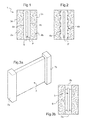
- the block (1) of thermally insulating construction consists of two half-blocks (2a, 2b) of agglomerated concrete comprising expanded clay granules, each of the blocks having external faces (3a, 3b) and faces internal (4a, 4b).
- a vacuum insulating panel (5) is included in the block structure between the inner faces (4a, 4b) of the two half-blocks.
- the space (6) between the half-blocks (2a, 2b) and the vacuum insulating panel is filled with organic foam, which, once cured, advantageously allows the insulating panel to be protected under vacuum while retaining good thermal insulation properties.
- the inner faces (4a, 4b) of the half-blocks (2a, 2b) are planar.
- the organic foam is formed in situ, during the manufacture of the insulating block (1), it is not necessary to provide an adhesive layer to assemble the various elements of the block (1).
- the organic foam filling the spaces (6) located around the vacuum insulating panel (5) will play the role of adhesive and will allow, after expansion and hardening, the different constituent parts of the block (1) hold together.
- the vacuum insulating panel assembly (5) encapsulated in organic foam is prepared independently of the manufacture of the block (1), it is necessary to provide the application of a layer of adhesive deposited on the flat internal faces (4a, 4b) of the two half-blocks and / or on the faces of the vacuum insulating panel encapsulated in the organic foam.
- the inner faces (4a, 4b) of the half-blocks have a notched shape.
- the assembly of the portion of the block corresponding to the vacuum panel (5) encapsulated in organic foam and the two half-blocks is made mechanically, by maintaining the two parts having complementary geometries. To do this, the hardened organic foam must have the proper shape to be held together with the half-blocks. It is therefore necessarily notched.
- the shaping of the organic foam can be done in different ways. If the encapsulation of the vacuum insulation board (5) in the organic foam is carried out independently of the manufacture of the block (1), that is to say that it is made in a mold dedicated to encapsulation , the mold can have the form of complementary crenellations. In this case, the encapsulated vacuum panel (5) can be directly placed in the mold for the manufacture of the two half-blocks (2a, 2b), the maintenance being done by a system of mortise tenons.
- the mold does not have the appropriate shape to obtain a hardened foam directly to the form that can be incorporated between the two half-blocks, it is possible to provide for cutting the foam with the geometry allowing the assembly of the different pieces, before placing the vacuum insulating board encapsulated in the mold for manufacturing the two half-blocks (2a, 2b).
- the half-blocks (2a, 2b) are placed in a mold, the outer faces (3a, 3b) of the half-blocks being placed against the inner walls of the mold.
- the panel (5) is equipped with spacing means which allow it to be held in place in the mold. These spacing means may be wedges placed on each of the surfaces of the vacuum insulating panel (5). These wedges are not shown in the figures.
- the spacing means may also be in the form of a frame surrounding part or all of each of the slices of the vacuum insulating panel (5).
- the figure 3a gives a view of a vacuum insulating panel (5) each of which slices are placed in frames (7a, 7b). In this way the vacuum insulating panel can be stabilized in the mold at the desired distance between the two half-blocks (2a, 2b).
- the frame (7a, 7b) is placed on the whole of the vertical section of the panel (5). It is also possible to place a frame on only a portion of the slices of the panel (5).
- the figure 3b represents a section of an insulating block (1) according to the present invention, manufactured by a process in which the encapsulation is in-situ.
- the parts 7a and 7b of the holding frame of the insulating vacuum panel (5) are therefore integrated into the structure of the insulating block (1).
Landscapes
- Engineering & Computer Science (AREA)
- Architecture (AREA)
- Civil Engineering (AREA)
- Structural Engineering (AREA)
- Physics & Mathematics (AREA)
- Acoustics & Sound (AREA)
- Electromagnetism (AREA)
- Building Environments (AREA)
- Thermal Insulation (AREA)
Abstract
Description
- L'invention concerne un bloc de construction thermiquement isolant, plus particulièrement un bloc isolant léger comprenant un panneau isolant sous vide, et son procédé de fabrication.
- De nombreux travaux actuels portent sur la recherche de nouveaux matériaux, utilisables dans le domaine de la construction et dont les performances isolantes sont améliorées. Des blocs tels que les briques ou les parpaings allégés comportent souvent des cavités, ce qui, d'une part, les rend plus légers et donc plus faciles à manipuler et d'autre part, leur confère des propriétés isolantes légèrement améliorées. Lorsque ces cavités sont remplies avec de l'air, les performances isolantes du bloc restent assez médiocres.
- Afin de palier à ce problème, la demande de brevet
EP 2 180 111 décrit un bloc de construction isolant comprenant une ou plusieurs cavités remplies d'isolant thermique à base de fibres minérales et de silice. - La demande
DE 20 2007 013 074 décrit des panneaux isolants sous vide, connus pour leurs excellentes propriétés d'isolants thermiques, placés dans les cavités d'une brique creuse, dont les dimensions sont adaptées à la taille des panneaux sous vide. Si les dimensions du panneau sous vide ne sont pas parfaitement bien adaptées à celles des cavités, les performances thermiques sont considérablement diminuées. - Il subsiste un besoin pour un bloc de construction présentant une excellente isolation thermique.
- La présente invention propose un bloc de construction isolant thermiquement comprenant deux demi-blocs en béton aggloméré comprenant des granulats en argile expansée ayant chacun une face interne et une face externe, un panneau isolant sous vide étant placé entre les faces internes de chacun des deux demi-blocs et encapsulé dans une mousse organique expansée.
- Avantageusement, selon la présente invention, le bloc de construction est constitué uniquement de l'assemblage de deux demi-blocs en béton aggloméré comprenant des granulats en argile expansé avec un panneau isolant sous vide encapsulé dans une mousse organique expansée.
- Les panneaux isolants sous vide sont constitués d'un noyau isolant emprisonné entre deux pellicules étanches réflectrices, le coeur isolant étant ensuite mise en dépression, sous vide. Les pellicules étanches comprennent des couches d'aluminium très fines (de l'ordre de 10 nm) et sont en général des multicouches composites polymère/aluminium.
Ces panneaux sont de faibles épaisseurs et permettent de réduire considérablement la quantité de matériau isolant nécessaire. A titre d'exemple, à résistance thermique équivalente, il faut 1 cm de panneau sous vide contre 6 cm de polystyrène expansé ou 6 à 9 cm de laines minérales. Toutefois, ces panneaux sont très fragiles puisqu'un endommagement de la pellicule étanche entraîne une perte du vide et par conséquent une diminution immédiate des performances isolantes.
La jointure entre deux panneaux sous vide peut toutefois constituer un pont thermique et donc être néfaste aux propriétés isolantes recherchées. - Le bloc de construction selon la présente invention présente l'avantage d'avoir d'excellentes propriétés isolantes, en raison de la présence d'un panneau sous vide dans la structure. Le fait que ce panneau soit encapsulé dans une mousse organique permet d'une part d'assurer la protection du panneau sous vide et d'autre part d'améliorer sa tenue au vieillissement, tout en limitant la présence de ponts thermiques au niveau des jointures.
Un tel bloc de construction est notamment utilisé pour la réalisation de murs et/ou de parois comme élément porteur et à la fois comme élément isolant. - Le bloc de construction selon la présente invention est de forme parallélépipédique dont les dimensions peuvent varier typiquement entre 250 et 350 mm pour la largeur, 190 et 300 mm pour la hauteur et 400 et 600 mm pour la longueur. Le bloc selon l'invention a par exemple les dimensions suivantes : 300x250x500, les dimensions correspondant respectivement à la largeur, la hauteur et la longueur étant données en mm.
- Le panneau isolant sous vide utilisé dans le bloc isolant selon la présente invention a classiquement une épaisseur comprise entre 20 et 50 mm. Ses autres dimensions sont fonction de la taille du bloc de construction souhaité et sont légèrement inférieures à celles données ci-dessus de façon à ce que la mousse organique puisse encapsuler la totalité panneau isolant sous vide.
La mousse organique utilisée pour encapsuler le panneau isolant sous vide est une mousse organique expansée, c'est-à dire qui gonfle en séchant, de type polyuréthane, polyisocyanurate ou phénolique.
Les mousses préférées sont les mousses en polyuréthane ou en polyisocyanurate. - Les mousses de polyuréthanes sont fabriquées à partir d'isocyanates et d'alcools de type polyols. Une mousse de polyuréthane a classiquement un coefficient de conductivité thermique de l'ordre de 0,021 à 0,025 W/(m.K).
- Les mousses de polyisocyanurates sont fabriquées directement à partir d'isocyanates, sans polyol. Toutefois, il est possible d'obtenir un produit ayant une résistance au feu améliorée, en faisant régir un large excès d'isocyanates (méthylène diphényl diisocyanate) avec des polyols. Le polyisocyanurate peut donc être considéré comme une amélioration du polyuréthane. Il possède à température ambiante un coefficient de conductivité thermique de l'ordre de 0,023 W/(m.K).
- L'addition d'un produit de gonflement ou d'eau assure la formation de bulles de gaz. Dans le cas d'une mousse de polyuréthane, le gaz d'expansion utilisé couramment est du pentane. Il reste donc prisonnier dans les bulles formées dans la mousse et présente l'avantage d'avoir une conductivité thermique plus faible que l'air.
- Tout procédé connu par l'homme de l'art pour la fabrication de la mousse organique peut être utilisé dans le cadre de la présente invention.
- La densité d'une mousse de polyuréthane entourant le panneau sous vide est typiquement comprise entre 30 et 50 kg/m3.
- L'épaisseur de mousse organique entourant le panneau isolant sous vide est généralement comprise entre 10 et 25 mm.
- Ces blocs sont fabriqués à partir de billes d'argile expansée comportant une structure interne poreuse et également connu sous la marque Leca®. Ces billes sont mélangées à du ciment et aux constituants additionnels pour former des blocs. La conductivité thermique de ce type de béton aggloméré est classiquement d'environ 0,11 à 0.23 W/(m.K).
- L'épaisseur de chacun des demi-blocs est préférentiellement comprise entre 60 et 150 mm.
La surface des demi-blocs en béton aggloméré présente une certaine rugosité, qui, sans la présence d'une certaine épaisseur de mousse organique, risquerait d'endommager le film protecteur du panneau isolant sous vide et par conséquent de provoquer des fuites. - Les faces internes de chacun des demi-blocs peuvent avoir des formes différentes : elles peuvent être planes ou rainurées en forme de créneaux à angles aigus (également souvent appelés « fishtail » en anglais).
- De façon préférée, le panneau isolant sous vide est placé à équidistance des faces internes des deux demi-blocs.
- L'invention porte également sur différents procédés de fabrication des blocs de construction décrits ci-dessus au cours desquels les différentes parties constitutives du bloc sont assemblées.
- Selon un premier mode de réalisation, l'encapsulation du panneau isolant sous vide dans la mousse organique est faite lors de la fabrication du bloc isolant, directement dans le moule permettant l'assemblage des différentes parties du bloc selon l'invention.
- Le procédé de fabrication d'un bloc de construction isolant thermiquement selon la présente invention comprend les étapes suivantes :
- positionnement de deux demi-blocs dans un moule de telle sorte que les deux faces externes de chacun des demi-blocs soient placées contre les parois internes du moule,
- maintien dans le moule du panneau isolant sous vide sur lequel au moins un moyen d'espacement a été placé sur chacune de ses faces de telle sorte que des espaces vides soient créés entre les faces du panneau isolant sous vide et les faces internes de deux demi-blocs,
- remplissage desdits espaces vides par un ou plus plusieurs précurseurs de la mousse organique,
- maintien du moule fermé sous pression pendant l'expansion et le durcissement de la mousse organique, de telle sorte que la mousse organique, en durcissant, permette l'assemblage des deux demi-blocs et du panneau isolant sous vide et,
- retrait du moule du bloc assemblé ainsi obtenu.
- Le maintien du moule sous pression est conservé jusqu'à ce que la mousse organique obtienne une consistance stable. Classiquement pour une mousse en polyuréthane, le moule est maintenu fermé pendant environ 3 minutes.
Cette durée dépend notamment du type de mousse, ainsi que de l'épaisseur de la couche de couche entourant le panneau isolant sous vide. - Le moyen d'espacement placé sur chacune des faces du panneau isolant sous vide permet de laisser un espace vide autour dudit panneau. Cet espace vide sera rempli par les précurseurs de mousse organique et après expansion et durcissement formera la protection autour du panneau isolant sous vide.
Le moyen d'espacement peut être une cale placée sur chaque face du panneau isolant sous vide, par exemple placée dans les coins des faces.
Le moyen d'espacement peut également avoir la forme d'un cadre placé sur une partie ou sur la totalité de la tranche du panneau isolant sous vide. - Avantageusement, le moyen d'espacement est en polystyrène ou en polyuréthane. De façon préférée, les moyens d'espacement sont des cales ou un cadre en polyuréthane.
- Selon le mode de réalisation du procédé de fabrication d'un bloc selon la présente invention décrit ci-dessus, l'assemblage entre les différentes parties, constituées par le panneau isolant sous vide et les deux demi-blocs en béton aggloméré, est directement faite lors de l'expansion et du durcissement de la mousse organique qui permet l'adhésion du panneau sous vide encapsulé dans la mousse avec les deux demi-blocs.
- La totalité du bloc isolant est, selon ce mode de réalisation, fabriqué in-situ dans un moule unique.
- Sous le terme « in situ », on comprend que la totalité du bloc est fait dans un même moule : l'adhésion entre les différentes parties constitutives du bloc (deux demi-blocs et panneau isolant sous vide) est réalisée par le moussage in-situ de la mousse organique.
- Selon un deuxième mode de réalisation, le procédé de fabrication du bloc isolant thermiquement selon la présente invention comprend une première étape d'encapsulation du panneau isolant sous vide dans une mousse organique, réalisée dans un dispositif différent de celui utilisé pour la fabrication du bloc isolant lui-même. L'encapsulation peut être effectuée par toute méthode connue de l'homme de l'art : le panneau isolant sous vide est placé dans un moule et les précurseurs organiques de la mousse formant l'encapsulation sont versés dans le moule, et maintenus sous pression dans le moule fermé pendant l'expansion et le durcissement de celle-ci.
- Le panneau isolant sous vide obtenu après cette étape est ainsi encapsulé dans une mousse organique.
- L'étape d'encapsulation est réalisée dans un moule qui peut avoir des faces internes planes ou des faces internes en forme de créneaux à angles aigus.
- Ainsi, la mousse une fois expansée et durcie peut avoir directement la forme recherchée, par exemple en forme de créneaux à angles aigus.
- Si le moule est de forme différente, la mousse organique durcie peut être mise en forme par découpe à la forme souhaitée. Ainsi, si l'étape d'encapsulation est réalisée dans un moule de forme quelconque, le procédé de fabrication du bloc isolant peut comprendre en outre une étape de mise en forme de la mousse une fois durcie par découpe.
- Ainsi, à l'issue de l'étape d'encapsulation du panneau isolant sous vide, la mousse durcie peut avoir soit des faces verticales planes, soit des faces verticales en forme de créneaux à angles aigus.
Les faces dites « verticales » de la mousse sont celles qui sont parallèles aux faces verticales du panneau isolant sous vide. - Le procédé de fabrication du bloc isolant thermiquement selon la présente invention est mis en oeuvre de deux façons différentes selon que la mousse durcie entourant le panneau isolant sous vide a des faces planes ou des faces en forme de créneaux à angles aigus.
- Selon un mode de réalisation, le procédé de fabrication du bloc isolant thermiquement selon la présente invention comprend :
- une première étape d'encapsulation du panneau isolant sous vide dans une mousse organique de telle sorte que la mousse organique durcie entourant ledit panneau a des faces verticales planes,
- une étape d'application d'une couche d'adhésif sur les faces internes des demi-blocs et/ou sur la mousse organique durcie protégeant le panneau isolant sous vide,
- une étape de positionnement du panneau isolant sous vide encapsulé préalablement dans une mousse organique entre deux demi-blocs en béton aggloméré, et
- une étape de fixation par adhésion de l'ensemble constitué par le panneau isolant sous vide encapsulé et les demi-blocs.
- De façon classique, la couche d'adhésif est une couche de colle, déposée sur la ou les surfaces à mettre en contact par tout moyen connu de l'homme de l'art.
- Selon un autre mode de réalisation, le procédé de fabrication du bloc isolant thermiquement selon la présente invention comprend :
- une première étape d'encapsulation du panneau isolant sous vide dans une mousse organique de telle sorte que la mousse organique durcie entourant ledit panneau a des faces verticales en forme de créneaux à angles aigus,
- une étape de positionnement et maintien du panneau isolant sous vide encapsulé dans un moule de forme parallélépipédique, de préférence au centre du moule, de sorte à laisser des espaces vides entre le panneau isolant sous vide encapsulé et les faces internes du moule,
- une étape de remplissage des espaces laissés vide par coulage dans le moule, autour du panneau isolant sous vide encapsulé, de béton aggloméré pour former les deux demi-blocs,
- une étape de retrait du moule du bloc isolant ainsi formé comprenant le panneau isolant sous vide, après durcissement du béton aggloméré.
- Le moule de forme parallélépipédique utilisé a des dimensions correspondantes à celles souhaitées pour le bloc isolant thermique.
- Ainsi, selon ce mode de réalisation, la fixation des différentes parties composant le bloc isolant est réalisée directement par le durcissement du béton aggloméré, sans nécessiter l'ajout d'un adhésif. Les deux demi-blocs en béton aggloméré sont formés directement dans le moule où se trouve le panneau isolant sous vide encapsulé dans une mousse durcie ayant une forme de créneaux à angles aigus. Lors du remplissage du moule, les faces internes des deux demi-blocs en contact avec le panneau isolant sous vide encapsulé prennent donc directement la forme souhaitée, en créneaux à aigles aigus, avec des motifs complémentaires de ceux de la mousse durcie.
- Les blocs de construction selon la présente invention ont un coefficient de transmission thermique compris entre 0,05 et 0,15 W/m2.K.
-
- La
figure 1 représente une coupe d'un bloc isolant thermiquement selon la présente invention, dans lequel les faces internes des demi-blocs en béton aggloméré sont planes. - La
figure 2 représente une coupe d'un bloc isolant thermiquement selon la présente invention, dans lequel les faces internes des demi-blocs en béton aggloméré sont en forme de créneaux à angles aigus. - La
figure 3a représente une vue d'un panneau isolant sous vide placé dans des moyens d'espacement, pour la fabrication du bloc isolant thermiquement selon la présente invention. - La
figure 3b représente une coupe d'un bloc isolant thermiquement selon la présente invention comprenant un panneau isolant sous vide placé dans un cadre. - Le bloc (1) de construction isolant thermiquement selon la présente invention est constitué de deux demi-blocs (2a, 2b) en béton aggloméré comprenant des granulats en argile expansée, chacun des blocs ayant des faces externes (3a, 3b) et des faces internes (4a, 4b).
Un panneau isolant sous vide (5) est compris dans la structure du bloc entre les faces internes (4a, 4b) des deux demi-blocs.
L'espace (6) situé entre les demi-blocs (2a, 2b) et le panneau isolant sous vide est rempli par de la mousse organique, qui, une fois durcie, permet avantageusement de protéger le panneau isolant sous vide tout en gardant de bonnes propriétés d'isolant thermique. - Dans le mode de réalisation représenté sur la
Figure 1 , les faces internes (4a, 4b) des demi-blocs (2a, 2b) sont planes.
Dans cette configuration, si la mousse organique est formée in-situ, pendant la fabrication du bloc isolant (1), il n'est pas nécessaire de prévoir une couche d'adhésif pour assembler les différents éléments du bloc (1). La mousse organique remplissant les espaces (6) situés autour du panneau isolant sous vide (5) va jouer le rôle d'adhésif et va permettre, après expansion et durcissement, que les différentes parties constitutives du bloc (1) tiennent ensemble.
En revanche, si l'ensemble panneau isolant sous vide (5) encapsulé dans de la mousse organique est préparé de façon indépendante de la fabrication du bloc (1), il est nécessaire de prévoir l'application d'une couche d'adhésif déposée sur les faces internes planes (4a, 4b) des deux demi-blocs et/ou sur les faces du panneau isolant sous vide encapsulé dans la mousse organique. - Dans le mode de réalisation représenté sur la
Figure 2 , les faces internes (4a, 4b) des demi-blocs ont une forme crantée. - L'assemblage de la partie du bloc correspondant au panneau sous vide (5) encapsulé dans de la mousse organique et des deux demi-blocs est fait de façon mécanique, par maintien des deux parties ayant des géométries complémentaires. Pour se faire, la mousse organique durcie doit avoir la forme adéquate pour être maintenue assemblée avec les demi-blocs. Elle est donc nécessairement crantée.
- La mise en forme de la mousse organique peut être faite de différentes façons. Si l'encapsulation du panneau isolant sous vide (5) dans la mousse organique est effectuée de façon indépendante de la fabrication du bloc (1), c'est-à-dire qu'elle est faite dans un moule dédié à l'encapsulation, le moule peut avoir la forme de créneaux complémentaires. Dans ce cas, le panneau sous vide (5) encapsulé peut être directement placé dans le moule servant à la fabrication des deux demi-blocs (2a, 2b), le maintien se faisant par un système de tenons-mortaises.
- Si le moule n'a pas la forme adéquate permettant d'obtenir une mousse durcie directement à la forme incorporable entre les deux demi-blocs, il est possible de prévoir de découper la mousse avec la géométrie permettant l'assemblage des différentes pièces, avant le placement du panneau isolant sous vide encapsulé dans le moule servant à la fabrication des deux demi-blocs (2a, 2b).
- Lorsque l'encapsulation du panneau sous vide (5) est réalisée in-situ, les demi-blocs (2a, 2b) sont placés dans un moule, les faces externes (3a, 3b) des demi-blocs étant placées contre les parois internes du moule.
Afin de positionner dans le moule le panneau sous vide (5), de préférence à équidistance des faces internes (4a, 4b) des demi-blocs, le panneau (5) est équipé de moyens d'espacement qui permettent de le maintenir en place dans le moule. Ces moyens d'espacement peuvent être des cales placées sur chacune des surfaces du panneau isolant sous vide (5). Ces cales ne sont pas représentées sur les figures.
Les moyens d'espacement peuvent également se présenter sous la forme d'un cadre entourant une partie ou la totalité de chacune des tranches du panneau isolant sous vide (5).
Lafigure 3a donne une vue d'un panneau isolant sous vide (5) dont chacune des tranches sont placées dans des cadres (7a, 7b). De cette façon le panneau isolant sous vide peut être stabilisé dans le moule à la distance souhaitée entre les deux demi-blocs (2a, 2b). Sur lafigure 3a , le cadre (7a, 7b) est placé sur la totalité de la tranche verticale du panneau (5). Il est également possible de placer un cadre sur seulement une partie des tranches du panneau (5).
Lafigure 3b représente une coupe d'un bloc isolant (1) selon la présente invention, fabriqué par un procédé dans lequel l'encapsulation se fait in-situ. Les parties 7a et 7b du cadre de maintien du panneau sous vide isolant (5) sont donc intégrées dans la structure du bloc isolant(1).
Claims (13)
- Bloc (1) de construction isolant thermiquement comprenant deux demi-blocs (2a, 2b) en béton aggloméré ayant chacun une face interne (4a, 4b) et une face externe (3a, 3b), caractérisé en ce les demi-blocs (2a, 2b) sont en béton aggloméré comprenant des granulats en argile expansée et en ce qu'un panneau isolant sous vide (5) est placé entre les faces internes (4a, 4b) de chacun des deux demi-blocs (2a, 2b) et encapsulé dans une mousse organique expansée.
- Bloc selon la revendication précédente caractérisé en ce que la mousse organique est une mousse de polyuréthane, une mousse de polyisocyanurate ou une mousse phénolique.
- Bloc selon l'une des revendications précédentes caractérisé en ce que les faces internes (4a, 4b) des demi-blocs (2a, 2b) sont planes.
- Bloc selon l'une des revendications 1 à 2 caractérisé en ce que les faces internes (4a, 4b) des demi-blocs (2a, 2b) sont rainurées en forme de créneaux à angles aigus.
- Bloc selon l'une des revendications précédentes caractérisé en ce que le panneau isolant sous vide (5) est placé à équidistance des faces internes (4a, 4b) des deux demi-blocs (2a, 2b).
- Bloc selon l'une des revendications précédentes caractérisé en ce qu'il est de forme parallélépipédique, de préférence avec une largeur comprise entre 250 et 350 mm, une hauteur entre 190 et 300 mm et une longueur entre 400 et 600 mm.
- Procédé de fabrication d'un bloc (1) de construction isolant thermiquement comprenant deux demi-blocs (2a, 2b) en béton aggloméré comprenant des granulats en argile expansée et ayant chacun
une face interne (4a, 4b) et une face externe (3a, 3b) selon l'une des revendications 1 à 6 caractérisé en ce qu'il comprend les étapes suivantes :- positionnement de deux demi-blocs dans un moule de telle sorte que les deux faces externes de chacun des demi-blocs soient placées contre les parois internes du moule,- maintien dans le moule du panneau isolant sous vide sur lequel au moins un moyen d'espacement a été placé sur chacune de ses faces de telle sorte que des espaces vides soient créées entre les faces du panneau isolant sous vide et les faces internes de deux demi-blocs,- remplissage desdits espaces vides par un ou plus plusieurs précurseurs organiques de la mousse,- maintien du moule fermé sous pression pendant l'expansion et le durcissement de la mousse organique, de telle sorte que la mousse organique permette l'assemblage des deux demi-blocs et du panneau isolant sous vide et,- retrait du moule du bloc assemblé ainsi obtenu. - Procédé selon la revendication 7 caractérisé en ce que le moyen d'espacement (7a, 7b) est une cale placée sur chaque face du panneau isolant (5).
- Procédé selon la revendication 7 caractérisé en ce que le moyen d'espacement (7a, 7b) est un cadre placé sur une partie ou sur la totalité de la tranche du panneau isolant sous vide (5).
- Procédé de fabrication d'un bloc (1) de construction isolant thermiquement comprenant deux demi-blocs (2a, 2b) en béton aggloméré comprenant des granulats en argile expansée et ayant chacun une face interne (4a, 4b) et une face externe (3a, 3b) selon l'une des revendications 1 à 6 caractérisé en ce qu'il comprend :- une première étape d'encapsulation du panneau isolant sous vide dans une mousse organique de telle sorte que la mousse organique durcie entourant ledit panneau a des faces verticales planes,- une étape d'application d'une couche d'adhésif sur les faces internes des demi-blocs et/ou sur la mousse organique durcie protégeant le panneau isolant sous vide,- une étape de positionnement du panneau isolant sous vide encapsulé préalablement dans une mousse organique entre deux demi-blocs en béton aggloméré, et- une étape de fixation par adhésion de l'ensemble panneau isolant sous vide encapsulé et demi-blocs.
- Procédé de fabrication d'un bloc (1) de construction isolant thermiquement comprenant deux demi-blocs (2a, 2b) en béton aggloméré comprenant des granulats en argile expansée et ayant chacun une face interne (4a, 4b) et une face externe (3a, 3b) selon l'une des revendications 1 à 6 caractérisé en ce qu'il comprend :- une première étape d'encapsulation du panneau isolant sous vide dans une mousse organique de telle sorte que la mousse organique durcie entourant ledit panneau a des faces verticales ayant une forme de créneaux à angles aigus,- une étape de positionnement et maintien du panneau isolant sous vide encapsulé dans un moule de forme parallélépipédique, de préférence au centre du moule, de sorte à laisser des espaces vides entre le panneau isolant sous vide encapsulé et les faces internes du moule,- une étape de remplissage des espaces laissés vide par coulage dans le moule, autour du panneau isolant sous vide encapsulé, de béton aggloméré pour former les deux demi-blocs,- une étape de retrait du moule du bloc isolant ainsi formé comprenant le panneau isolant sous vide, après durcissement du béton aggloméré.
- Procédé selon la revendication 11, caractérisé en ce que l'étape d'encapsulation est réalisée dans un moule en forme de créneaux à angles aigus.
- Procédé selon la revendication 11, caractérisé en ce que l'étape d'encapsulation est réalisée dans un moule de forme quelconque, et comprend en outre une étape de mise en forme de la mousse une fois durcie par découpe.
Priority Applications (1)
| Application Number | Priority Date | Filing Date | Title |
|---|---|---|---|
| PL13166195T PL2660406T3 (pl) | 2012-05-03 | 2013-05-02 | Bloczek budowlany izolujący termicznie |
Applications Claiming Priority (1)
| Application Number | Priority Date | Filing Date | Title |
|---|---|---|---|
| FR1254055A FR2990223B1 (fr) | 2012-05-03 | 2012-05-03 | Bloc de construction thermiquement isolant |
Publications (2)
| Publication Number | Publication Date |
|---|---|
| EP2660406A1 true EP2660406A1 (fr) | 2013-11-06 |
| EP2660406B1 EP2660406B1 (fr) | 2015-11-04 |
Family
ID=47227882
Family Applications (1)
| Application Number | Title | Priority Date | Filing Date |
|---|---|---|---|
| EP13166195.1A Not-in-force EP2660406B1 (fr) | 2012-05-03 | 2013-05-02 | Bloc de construction thermiquement isolant |
Country Status (6)
| Country | Link |
|---|---|
| EP (1) | EP2660406B1 (fr) |
| DK (1) | DK2660406T3 (fr) |
| ES (1) | ES2559022T3 (fr) |
| FR (1) | FR2990223B1 (fr) |
| PL (1) | PL2660406T3 (fr) |
| PT (1) | PT2660406E (fr) |
Cited By (4)
| Publication number | Priority date | Publication date | Assignee | Title |
|---|---|---|---|---|
| CN106223499A (zh) * | 2016-07-15 | 2016-12-14 | 北京奥克森节能环保科技有限公司 | 一种复合建筑保温模板的制造方法 |
| EP3141370A1 (fr) * | 2015-09-11 | 2017-03-15 | Mitsubishi Electric Corporation | Procédé de fabrication d'un isolateur thermique composite, procédé de fabrication d'un chauffe-eau et isolateur thermique composite |
| CN107630522A (zh) * | 2017-09-15 | 2018-01-26 | 山东省建设发展研究院 | 高性能蒸压加气混凝土复合自保温砌块及其制备方法 |
| WO2022167878A1 (fr) * | 2021-02-02 | 2022-08-11 | Moayed Pouya | Briques d'argile isolées utilisant des couches d'air et de mousse de polyuréthane souple |
Citations (11)
| Publication number | Priority date | Publication date | Assignee | Title |
|---|---|---|---|---|
| EP1544367A2 (fr) * | 2003-12-15 | 2005-06-22 | Va-Q-tec AG | Panneau isolant thermique stratifié |
| DE102005032557A1 (de) * | 2005-07-11 | 2007-02-01 | Albert Bruno Rapp | Bauelement, insbesondere für Hochbauwerke |
| DE202007013074U1 (de) | 2007-09-18 | 2008-02-14 | Kratel, Günter, Dr. | Mauerwerk mit integrierter Vakuumisolation auf Basis mikroporöser Wärmedämmung |
| EP1988228A2 (fr) * | 2007-05-03 | 2008-11-05 | Matthias Rimmele | Blocs et systèmes de construction avec isolation thermique hydrophobe et microporeuse |
| DE102007028950A1 (de) * | 2007-06-22 | 2008-12-24 | Iveda Davtyan-Mayer | Vakuumisolierung für Bausteine und Bauelemente |
| DE202009002697U1 (de) * | 2009-03-05 | 2009-05-20 | Baustoffwerke Gebhart & Söhne GmbH & Co. KG | Baustein |
| EP2180111A1 (fr) | 2008-10-21 | 2010-04-28 | Rockwool International A/S | Brique de construction à isolation thermique |
| DE202010009060U1 (de) * | 2010-06-15 | 2010-09-02 | Microtherm N.V. | Wärmedämmverbundwerkstoff |
| WO2011016961A2 (fr) * | 2009-07-29 | 2011-02-10 | Dow Global Technologies Inc. | Composite pour panneau disolation thermique |
| DE202011103069U1 (de) * | 2011-03-30 | 2011-11-08 | Bisotherm Gmbh | Mauerstein |
| AT12147U1 (de) * | 2009-06-10 | 2011-11-15 | Monai Bernhard Dipl Ing | Wandelement |
-
2012
- 2012-05-03 FR FR1254055A patent/FR2990223B1/fr not_active Expired - Fee Related
-
2013
- 2013-05-02 PL PL13166195T patent/PL2660406T3/pl unknown
- 2013-05-02 PT PT131661951T patent/PT2660406E/pt unknown
- 2013-05-02 DK DK13166195.1T patent/DK2660406T3/da active
- 2013-05-02 ES ES13166195.1T patent/ES2559022T3/es active Active
- 2013-05-02 EP EP13166195.1A patent/EP2660406B1/fr not_active Not-in-force
Patent Citations (11)
| Publication number | Priority date | Publication date | Assignee | Title |
|---|---|---|---|---|
| EP1544367A2 (fr) * | 2003-12-15 | 2005-06-22 | Va-Q-tec AG | Panneau isolant thermique stratifié |
| DE102005032557A1 (de) * | 2005-07-11 | 2007-02-01 | Albert Bruno Rapp | Bauelement, insbesondere für Hochbauwerke |
| EP1988228A2 (fr) * | 2007-05-03 | 2008-11-05 | Matthias Rimmele | Blocs et systèmes de construction avec isolation thermique hydrophobe et microporeuse |
| DE102007028950A1 (de) * | 2007-06-22 | 2008-12-24 | Iveda Davtyan-Mayer | Vakuumisolierung für Bausteine und Bauelemente |
| DE202007013074U1 (de) | 2007-09-18 | 2008-02-14 | Kratel, Günter, Dr. | Mauerwerk mit integrierter Vakuumisolation auf Basis mikroporöser Wärmedämmung |
| EP2180111A1 (fr) | 2008-10-21 | 2010-04-28 | Rockwool International A/S | Brique de construction à isolation thermique |
| DE202009002697U1 (de) * | 2009-03-05 | 2009-05-20 | Baustoffwerke Gebhart & Söhne GmbH & Co. KG | Baustein |
| AT12147U1 (de) * | 2009-06-10 | 2011-11-15 | Monai Bernhard Dipl Ing | Wandelement |
| WO2011016961A2 (fr) * | 2009-07-29 | 2011-02-10 | Dow Global Technologies Inc. | Composite pour panneau disolation thermique |
| DE202010009060U1 (de) * | 2010-06-15 | 2010-09-02 | Microtherm N.V. | Wärmedämmverbundwerkstoff |
| DE202011103069U1 (de) * | 2011-03-30 | 2011-11-08 | Bisotherm Gmbh | Mauerstein |
Cited By (4)
| Publication number | Priority date | Publication date | Assignee | Title |
|---|---|---|---|---|
| EP3141370A1 (fr) * | 2015-09-11 | 2017-03-15 | Mitsubishi Electric Corporation | Procédé de fabrication d'un isolateur thermique composite, procédé de fabrication d'un chauffe-eau et isolateur thermique composite |
| CN106223499A (zh) * | 2016-07-15 | 2016-12-14 | 北京奥克森节能环保科技有限公司 | 一种复合建筑保温模板的制造方法 |
| CN107630522A (zh) * | 2017-09-15 | 2018-01-26 | 山东省建设发展研究院 | 高性能蒸压加气混凝土复合自保温砌块及其制备方法 |
| WO2022167878A1 (fr) * | 2021-02-02 | 2022-08-11 | Moayed Pouya | Briques d'argile isolées utilisant des couches d'air et de mousse de polyuréthane souple |
Also Published As
| Publication number | Publication date |
|---|---|
| ES2559022T3 (es) | 2016-02-10 |
| DK2660406T3 (da) | 2016-02-01 |
| EP2660406B1 (fr) | 2015-11-04 |
| PL2660406T3 (pl) | 2016-04-29 |
| FR2990223A1 (fr) | 2013-11-08 |
| PT2660406E (pt) | 2016-02-29 |
| FR2990223B1 (fr) | 2015-10-30 |
Similar Documents
| Publication | Publication Date | Title |
|---|---|---|
| EP2295666B1 (fr) | Procédé de fabrication de panneaux avec isolation integrée et d'un tel panneau | |
| EP2660406B1 (fr) | Bloc de construction thermiquement isolant | |
| WO2021229088A1 (fr) | Panneau pour plancher ou paroi et procédé de fabrication d'un tel panneau | |
| EP2775056A1 (fr) | Bloc de construction hybride structural/isolant | |
| EP3205788A1 (fr) | Bloc de construction isolé avec l'isolation entre parois externes avec une structure de maintien des parois | |
| EP2392741B1 (fr) | Plaque de parement isolante et son procédé de fabrication | |
| FR2943082A1 (fr) | Bloc de coffrage d'un chainage peripherique de batiment | |
| FR2507647A1 (fr) | Panneau de construction prefabrique et procede pour la realisation d'un tel panneau | |
| FR2984932A1 (fr) | Mur composite bois-beton | |
| EP2984270B1 (fr) | Dispositif d'encadrement monobloc pour ouverture de type fenêtre, son procédé d'installation et son procédé de fabrication | |
| FR2501753A1 (fr) | Procede de fabrication d'un bloc de construction isolant thermiquement avec ou sans support de charge, et bloc ainsi realise. | |
| BE1025884B1 (fr) | Procede de fabrication d'un mur interieur et mur interieur obtenu | |
| EP4372168B1 (fr) | Kit pour coffrage isolant de mur de bâtiment et procédé de construction d'un mur de bâtiment à coffrage isolant | |
| EP2473684B1 (fr) | Mur de bâtiment et procede pour realiser ce mur. | |
| EP1207241B1 (fr) | Elément de paroi | |
| EP4405535B1 (fr) | Construction munie de panneaux de façades et procédé de fabrication d'une telle construction | |
| FR3026760A1 (fr) | Panneau monobloc prefabrique | |
| FR2953872A1 (fr) | Panneau monobloc prefabrique multi-couche | |
| FR3159402A1 (fr) | Panneau de construction préfabriqué avec un cadre de réservation, batiment et procédé de fabrication d’un panneau de construction préfabriqué | |
| FR3075837A1 (fr) | Procede de fabrication d'un plancher a rupture de pont thermique, support de reception pour rupteur thermique et plancher a rupture de pont thermique obtenu | |
| EP2464798B1 (fr) | Element prefabrique pour la construction de batiments, permettant la suppression des ponts thermiques | |
| FR3031532A1 (fr) | Systemes d'isolation thermique utilises en particulier pour realiser des murs/parois de batiments isoles thermiquement. | |
| FR3005080A1 (fr) | Bloc de construction a isolation thermique | |
| FR2990707A1 (fr) | Bloc de construction isolant | |
| FR2549120A1 (fr) | Procede de construction de parois raidies coulees dans un coffrage filtrant. dispositif pour la constitution du coffrage. application au batiment |
Legal Events
| Date | Code | Title | Description |
|---|---|---|---|
| PUAI | Public reference made under article 153(3) epc to a published international application that has entered the european phase |
Free format text: ORIGINAL CODE: 0009012 |
|
| AK | Designated contracting states |
Kind code of ref document: A1 Designated state(s): AL AT BE BG CH CY CZ DE DK EE ES FI FR GB GR HR HU IE IS IT LI LT LU LV MC MK MT NL NO PL PT RO RS SE SI SK SM TR |
|
| AX | Request for extension of the european patent |
Extension state: BA ME |
|
| 17P | Request for examination filed |
Effective date: 20140506 |
|
| RBV | Designated contracting states (corrected) |
Designated state(s): AL AT BE BG CH CY CZ DE DK EE ES FI FR GB GR HR HU IE IS IT LI LT LU LV MC MK MT NL NO PL PT RO RS SE SI SK SM TR |
|
| 17Q | First examination report despatched |
Effective date: 20141215 |
|
| GRAP | Despatch of communication of intention to grant a patent |
Free format text: ORIGINAL CODE: EPIDOSNIGR1 |
|
| INTG | Intention to grant announced |
Effective date: 20150608 |
|
| GRAS | Grant fee paid |
Free format text: ORIGINAL CODE: EPIDOSNIGR3 |
|
| GRAA | (expected) grant |
Free format text: ORIGINAL CODE: 0009210 |
|
| AK | Designated contracting states |
Kind code of ref document: B1 Designated state(s): AL AT BE BG CH CY CZ DE DK EE ES FI FR GB GR HR HU IE IS IT LI LT LU LV MC MK MT NL NO PL PT RO RS SE SI SK SM TR |
|
| REG | Reference to a national code |
Ref country code: GB Ref legal event code: FG4D Free format text: NOT ENGLISH |
|
| REG | Reference to a national code |
Ref country code: CH Ref legal event code: EP |
|
| REG | Reference to a national code |
Ref country code: AT Ref legal event code: REF Ref document number: 759300 Country of ref document: AT Kind code of ref document: T Effective date: 20151115 |
|
| REG | Reference to a national code |
Ref country code: IE Ref legal event code: FG4D Free format text: LANGUAGE OF EP DOCUMENT: FRENCH |
|
| REG | Reference to a national code |
Ref country code: DE Ref legal event code: R096 Ref document number: 602013003712 Country of ref document: DE |
|
| REG | Reference to a national code |
Ref country code: DK Ref legal event code: T3 Effective date: 20160127 |
|
| REG | Reference to a national code |
Ref country code: ES Ref legal event code: FG2A Ref document number: 2559022 Country of ref document: ES Kind code of ref document: T3 Effective date: 20160210 |
|
| REG | Reference to a national code |
Ref country code: SE Ref legal event code: TRGR |
|
| REG | Reference to a national code |
Ref country code: PT Ref legal event code: SC4A Free format text: AVAILABILITY OF NATIONAL TRANSLATION Effective date: 20160125 |
|
| REG | Reference to a national code |
Ref country code: AT Ref legal event code: MK05 Ref document number: 759300 Country of ref document: AT Kind code of ref document: T Effective date: 20151104 Ref country code: EE Ref legal event code: FG4A Ref document number: E011542 Country of ref document: EE Effective date: 20160202 |
|
| REG | Reference to a national code |
Ref country code: NO Ref legal event code: T2 Effective date: 20151104 |
|
| REG | Reference to a national code |
Ref country code: NL Ref legal event code: FP |
|
| PG25 | Lapsed in a contracting state [announced via postgrant information from national office to epo] |
Ref country code: IS Free format text: LAPSE BECAUSE OF FAILURE TO SUBMIT A TRANSLATION OF THE DESCRIPTION OR TO PAY THE FEE WITHIN THE PRESCRIBED TIME-LIMIT Effective date: 20160304 Ref country code: HR Free format text: LAPSE BECAUSE OF FAILURE TO SUBMIT A TRANSLATION OF THE DESCRIPTION OR TO PAY THE FEE WITHIN THE PRESCRIBED TIME-LIMIT Effective date: 20151104 |
|
| PG25 | Lapsed in a contracting state [announced via postgrant information from national office to epo] |
Ref country code: RS Free format text: LAPSE BECAUSE OF FAILURE TO SUBMIT A TRANSLATION OF THE DESCRIPTION OR TO PAY THE FEE WITHIN THE PRESCRIBED TIME-LIMIT Effective date: 20151104 Ref country code: GR Free format text: LAPSE BECAUSE OF FAILURE TO SUBMIT A TRANSLATION OF THE DESCRIPTION OR TO PAY THE FEE WITHIN THE PRESCRIBED TIME-LIMIT Effective date: 20160205 Ref country code: LV Free format text: LAPSE BECAUSE OF FAILURE TO SUBMIT A TRANSLATION OF THE DESCRIPTION OR TO PAY THE FEE WITHIN THE PRESCRIBED TIME-LIMIT Effective date: 20151104 Ref country code: AT Free format text: LAPSE BECAUSE OF FAILURE TO SUBMIT A TRANSLATION OF THE DESCRIPTION OR TO PAY THE FEE WITHIN THE PRESCRIBED TIME-LIMIT Effective date: 20151104 |
|
| PG25 | Lapsed in a contracting state [announced via postgrant information from national office to epo] |
Ref country code: CZ Free format text: LAPSE BECAUSE OF FAILURE TO SUBMIT A TRANSLATION OF THE DESCRIPTION OR TO PAY THE FEE WITHIN THE PRESCRIBED TIME-LIMIT Effective date: 20151104 |
|
| PGFP | Annual fee paid to national office [announced via postgrant information from national office to epo] |
Ref country code: DE Payment date: 20160426 Year of fee payment: 4 Ref country code: ES Payment date: 20160414 Year of fee payment: 4 |
|
| REG | Reference to a national code |
Ref country code: DE Ref legal event code: R097 Ref document number: 602013003712 Country of ref document: DE |
|
| PG25 | Lapsed in a contracting state [announced via postgrant information from national office to epo] |
Ref country code: RO Free format text: LAPSE BECAUSE OF FAILURE TO SUBMIT A TRANSLATION OF THE DESCRIPTION OR TO PAY THE FEE WITHIN THE PRESCRIBED TIME-LIMIT Effective date: 20151104 Ref country code: SM Free format text: LAPSE BECAUSE OF FAILURE TO SUBMIT A TRANSLATION OF THE DESCRIPTION OR TO PAY THE FEE WITHIN THE PRESCRIBED TIME-LIMIT Effective date: 20151104 Ref country code: SK Free format text: LAPSE BECAUSE OF FAILURE TO SUBMIT A TRANSLATION OF THE DESCRIPTION OR TO PAY THE FEE WITHIN THE PRESCRIBED TIME-LIMIT Effective date: 20151104 Ref country code: BE Free format text: LAPSE BECAUSE OF NON-PAYMENT OF DUE FEES Effective date: 20160531 |
|
| PGFP | Annual fee paid to national office [announced via postgrant information from national office to epo] |
Ref country code: LT Payment date: 20160419 Year of fee payment: 4 Ref country code: PL Payment date: 20160401 Year of fee payment: 4 Ref country code: IT Payment date: 20160531 Year of fee payment: 4 Ref country code: LV Payment date: 20160427 Year of fee payment: 4 Ref country code: EE Payment date: 20160425 Year of fee payment: 4 |
|
| PLBE | No opposition filed within time limit |
Free format text: ORIGINAL CODE: 0009261 |
|
| STAA | Information on the status of an ep patent application or granted ep patent |
Free format text: STATUS: NO OPPOSITION FILED WITHIN TIME LIMIT |
|
| 26N | No opposition filed |
Effective date: 20160805 |
|
| PG25 | Lapsed in a contracting state [announced via postgrant information from national office to epo] |
Ref country code: SI Free format text: LAPSE BECAUSE OF FAILURE TO SUBMIT A TRANSLATION OF THE DESCRIPTION OR TO PAY THE FEE WITHIN THE PRESCRIBED TIME-LIMIT Effective date: 20151104 |
|
| PG25 | Lapsed in a contracting state [announced via postgrant information from national office to epo] |
Ref country code: LU Free format text: LAPSE BECAUSE OF FAILURE TO SUBMIT A TRANSLATION OF THE DESCRIPTION OR TO PAY THE FEE WITHIN THE PRESCRIBED TIME-LIMIT Effective date: 20160502 |
|
| REG | Reference to a national code |
Ref country code: CH Ref legal event code: PL |
|
| REG | Reference to a national code |
Ref country code: NL Ref legal event code: MM Effective date: 20160601 |
|
| PG25 | Lapsed in a contracting state [announced via postgrant information from national office to epo] |
Ref country code: CH Free format text: LAPSE BECAUSE OF NON-PAYMENT OF DUE FEES Effective date: 20160531 Ref country code: LI Free format text: LAPSE BECAUSE OF NON-PAYMENT OF DUE FEES Effective date: 20160531 |
|
| REG | Reference to a national code |
Ref country code: IE Ref legal event code: MM4A |
|
| PG25 | Lapsed in a contracting state [announced via postgrant information from national office to epo] |
Ref country code: NL Free format text: LAPSE BECAUSE OF NON-PAYMENT OF DUE FEES Effective date: 20160601 |
|
| REG | Reference to a national code |
Ref country code: FR Ref legal event code: ST Effective date: 20170131 |
|
| PG25 | Lapsed in a contracting state [announced via postgrant information from national office to epo] |
Ref country code: FR Free format text: LAPSE BECAUSE OF NON-PAYMENT OF DUE FEES Effective date: 20160531 |
|
| PG25 | Lapsed in a contracting state [announced via postgrant information from national office to epo] |
Ref country code: IE Free format text: LAPSE BECAUSE OF NON-PAYMENT OF DUE FEES Effective date: 20160502 Ref country code: PT Free format text: LAPSE BECAUSE OF NON-PAYMENT OF DUE FEES Effective date: 20170202 |
|
| REG | Reference to a national code |
Ref country code: DE Ref legal event code: R119 Ref document number: 602013003712 Country of ref document: DE |
|
| REG | Reference to a national code |
Ref country code: LT Ref legal event code: MM4D Effective date: 20170502 |
|
| REG | Reference to a national code |
Ref country code: EE Ref legal event code: MM4A Ref document number: E011542 Country of ref document: EE Effective date: 20170531 |
|
| GBPC | Gb: european patent ceased through non-payment of renewal fee |
Effective date: 20170502 |
|
| PG25 | Lapsed in a contracting state [announced via postgrant information from national office to epo] |
Ref country code: EE Free format text: LAPSE BECAUSE OF NON-PAYMENT OF DUE FEES Effective date: 20170531 Ref country code: LT Free format text: LAPSE BECAUSE OF NON-PAYMENT OF DUE FEES Effective date: 20170502 |
|
| PG25 | Lapsed in a contracting state [announced via postgrant information from national office to epo] |
Ref country code: LV Free format text: LAPSE BECAUSE OF NON-PAYMENT OF DUE FEES Effective date: 20170502 |
|
| PG25 | Lapsed in a contracting state [announced via postgrant information from national office to epo] |
Ref country code: DE Free format text: LAPSE BECAUSE OF NON-PAYMENT OF DUE FEES Effective date: 20171201 Ref country code: GB Free format text: LAPSE BECAUSE OF NON-PAYMENT OF DUE FEES Effective date: 20170502 |
|
| PG25 | Lapsed in a contracting state [announced via postgrant information from national office to epo] |
Ref country code: HU Free format text: LAPSE BECAUSE OF FAILURE TO SUBMIT A TRANSLATION OF THE DESCRIPTION OR TO PAY THE FEE WITHIN THE PRESCRIBED TIME-LIMIT; INVALID AB INITIO Effective date: 20130502 Ref country code: IT Free format text: LAPSE BECAUSE OF NON-PAYMENT OF DUE FEES Effective date: 20170502 Ref country code: CY Free format text: LAPSE BECAUSE OF FAILURE TO SUBMIT A TRANSLATION OF THE DESCRIPTION OR TO PAY THE FEE WITHIN THE PRESCRIBED TIME-LIMIT Effective date: 20151104 |
|
| REG | Reference to a national code |
Ref country code: ES Ref legal event code: FD2A Effective date: 20180628 |
|
| PG25 | Lapsed in a contracting state [announced via postgrant information from national office to epo] |
Ref country code: MC Free format text: LAPSE BECAUSE OF FAILURE TO SUBMIT A TRANSLATION OF THE DESCRIPTION OR TO PAY THE FEE WITHIN THE PRESCRIBED TIME-LIMIT Effective date: 20151104 Ref country code: MT Free format text: LAPSE BECAUSE OF FAILURE TO SUBMIT A TRANSLATION OF THE DESCRIPTION OR TO PAY THE FEE WITHIN THE PRESCRIBED TIME-LIMIT Effective date: 20151104 Ref country code: MK Free format text: LAPSE BECAUSE OF FAILURE TO SUBMIT A TRANSLATION OF THE DESCRIPTION OR TO PAY THE FEE WITHIN THE PRESCRIBED TIME-LIMIT Effective date: 20151104 Ref country code: TR Free format text: LAPSE BECAUSE OF FAILURE TO SUBMIT A TRANSLATION OF THE DESCRIPTION OR TO PAY THE FEE WITHIN THE PRESCRIBED TIME-LIMIT Effective date: 20151104 |
|
| PG25 | Lapsed in a contracting state [announced via postgrant information from national office to epo] |
Ref country code: BG Free format text: LAPSE BECAUSE OF FAILURE TO SUBMIT A TRANSLATION OF THE DESCRIPTION OR TO PAY THE FEE WITHIN THE PRESCRIBED TIME-LIMIT Effective date: 20151104 Ref country code: ES Free format text: LAPSE BECAUSE OF NON-PAYMENT OF DUE FEES Effective date: 20170503 |
|
| PG25 | Lapsed in a contracting state [announced via postgrant information from national office to epo] |
Ref country code: PL Free format text: LAPSE BECAUSE OF NON-PAYMENT OF DUE FEES Effective date: 20170502 Ref country code: AL Free format text: LAPSE BECAUSE OF FAILURE TO SUBMIT A TRANSLATION OF THE DESCRIPTION OR TO PAY THE FEE WITHIN THE PRESCRIBED TIME-LIMIT Effective date: 20151104 |
|
| PGFP | Annual fee paid to national office [announced via postgrant information from national office to epo] |
Ref country code: FI Payment date: 20210511 Year of fee payment: 9 Ref country code: NO Payment date: 20210511 Year of fee payment: 9 |
|
| PGFP | Annual fee paid to national office [announced via postgrant information from national office to epo] |
Ref country code: SE Payment date: 20210511 Year of fee payment: 9 Ref country code: DK Payment date: 20210511 Year of fee payment: 9 |
|
| REG | Reference to a national code |
Ref country code: DK Ref legal event code: EBP Effective date: 20220531 |
|
| REG | Reference to a national code |
Ref country code: NO Ref legal event code: MMEP |
|
| REG | Reference to a national code |
Ref country code: SE Ref legal event code: EUG |
|
| PG25 | Lapsed in a contracting state [announced via postgrant information from national office to epo] |
Ref country code: SE Free format text: LAPSE BECAUSE OF NON-PAYMENT OF DUE FEES Effective date: 20220503 Ref country code: NO Free format text: LAPSE BECAUSE OF NON-PAYMENT OF DUE FEES Effective date: 20220531 Ref country code: FI Free format text: LAPSE BECAUSE OF NON-PAYMENT OF DUE FEES Effective date: 20220502 |
|
| PG25 | Lapsed in a contracting state [announced via postgrant information from national office to epo] |
Ref country code: DK Free format text: LAPSE BECAUSE OF NON-PAYMENT OF DUE FEES Effective date: 20220531 |