EP1990382B1 - Tintensatz, Tintenstrahlaufzeichnungsverfahren, Tintenpatrone, Aufzeichnungseinheit, Tintenstrahlaufzeichnungsverfahren und wässrige Tinte - Google Patents
Tintensatz, Tintenstrahlaufzeichnungsverfahren, Tintenpatrone, Aufzeichnungseinheit, Tintenstrahlaufzeichnungsverfahren und wässrige Tinte Download PDFInfo
- Publication number
- EP1990382B1 EP1990382B1 EP08155981.7A EP08155981A EP1990382B1 EP 1990382 B1 EP1990382 B1 EP 1990382B1 EP 08155981 A EP08155981 A EP 08155981A EP 1990382 B1 EP1990382 B1 EP 1990382B1
- Authority
- EP
- European Patent Office
- Prior art keywords
- ink
- surface tension
- dynamic surface
- lifetime
- milliseconds
- Prior art date
- Legal status (The legal status is an assumption and is not a legal conclusion. Google has not performed a legal analysis and makes no representation as to the accuracy of the status listed.)
- Not-in-force
Links
- 238000000034 method Methods 0.000 title claims description 35
- 239000000976 ink Substances 0.000 claims description 898
- 239000004094 surface-active agent Substances 0.000 claims description 47
- 239000000463 material Substances 0.000 claims description 21
- 238000004040 coloring Methods 0.000 claims description 20
- 230000009471 action Effects 0.000 claims description 6
- 239000002736 nonionic surfactant Substances 0.000 claims description 4
- 239000002609 medium Substances 0.000 description 116
- 230000000740 bleeding effect Effects 0.000 description 77
- 239000000758 substrate Substances 0.000 description 32
- 239000000975 dye Substances 0.000 description 31
- -1 polyoxyethylene Polymers 0.000 description 27
- 238000011835 investigation Methods 0.000 description 17
- XLYOFNOQVPJJNP-UHFFFAOYSA-N water Substances O XLYOFNOQVPJJNP-UHFFFAOYSA-N 0.000 description 16
- MTHSVFCYNBDYFN-UHFFFAOYSA-N diethylene glycol Chemical compound OCCOCCO MTHSVFCYNBDYFN-UHFFFAOYSA-N 0.000 description 14
- 230000003068 static effect Effects 0.000 description 14
- 210000003128 head Anatomy 0.000 description 13
- 238000011156 evaluation Methods 0.000 description 12
- 229920003171 Poly (ethylene oxide) Polymers 0.000 description 11
- 239000012736 aqueous medium Substances 0.000 description 11
- 239000003086 colorant Substances 0.000 description 11
- RTZKZFJDLAIYFH-UHFFFAOYSA-N ether Substances CCOCC RTZKZFJDLAIYFH-UHFFFAOYSA-N 0.000 description 10
- LYCAIKOWRPUZTN-UHFFFAOYSA-N ethylene glycol Natural products OCCO LYCAIKOWRPUZTN-UHFFFAOYSA-N 0.000 description 10
- 150000002894 organic compounds Chemical class 0.000 description 10
- PEDCQBHIVMGVHV-UHFFFAOYSA-N Glycerine Chemical compound OCC(O)CO PEDCQBHIVMGVHV-UHFFFAOYSA-N 0.000 description 8
- KFZMGEQAYNKOFK-UHFFFAOYSA-N Isopropanol Chemical compound CC(C)O KFZMGEQAYNKOFK-UHFFFAOYSA-N 0.000 description 8
- 239000002253 acid Substances 0.000 description 7
- 150000005215 alkyl ethers Chemical class 0.000 description 7
- 238000005259 measurement Methods 0.000 description 7
- 230000015572 biosynthetic process Effects 0.000 description 6
- 230000035699 permeability Effects 0.000 description 6
- 239000011800 void material Substances 0.000 description 6
- LFQSCWFLJHTTHZ-UHFFFAOYSA-N Ethanol Chemical compound CCO LFQSCWFLJHTTHZ-UHFFFAOYSA-N 0.000 description 5
- 230000008859 change Effects 0.000 description 5
- 230000000052 comparative effect Effects 0.000 description 5
- 239000004148 curcumin Substances 0.000 description 5
- 239000007788 liquid Substances 0.000 description 5
- 230000007246 mechanism Effects 0.000 description 5
- 239000012466 permeate Substances 0.000 description 5
- HSFWRNGVRCDJHI-UHFFFAOYSA-N alpha-acetylene Natural products C#C HSFWRNGVRCDJHI-UHFFFAOYSA-N 0.000 description 4
- 238000004140 cleaning Methods 0.000 description 4
- QFXZANXYUCUTQH-UHFFFAOYSA-N ethynol Chemical compound OC#C QFXZANXYUCUTQH-UHFFFAOYSA-N 0.000 description 4
- 239000000835 fiber Substances 0.000 description 4
- 235000013305 food Nutrition 0.000 description 4
- 235000011187 glycerol Nutrition 0.000 description 4
- WGCNASOHLSPBMP-UHFFFAOYSA-N hydroxyacetaldehyde Natural products OCC=O WGCNASOHLSPBMP-UHFFFAOYSA-N 0.000 description 4
- 239000000203 mixture Substances 0.000 description 4
- 239000011148 porous material Substances 0.000 description 4
- HNJBEVLQSNELDL-UHFFFAOYSA-N pyrrolidin-2-one Chemical compound O=C1CCCN1 HNJBEVLQSNELDL-UHFFFAOYSA-N 0.000 description 4
- 230000001629 suppression Effects 0.000 description 4
- 229940015975 1,2-hexanediol Drugs 0.000 description 3
- ZWEHNKRNPOVVGH-UHFFFAOYSA-N 2-Butanone Chemical compound CCC(C)=O ZWEHNKRNPOVVGH-UHFFFAOYSA-N 0.000 description 3
- IAYPIBMASNFSPL-UHFFFAOYSA-N Ethylene oxide Chemical compound C1CO1 IAYPIBMASNFSPL-UHFFFAOYSA-N 0.000 description 3
- ZMXDDKWLCZADIW-UHFFFAOYSA-N N,N-Dimethylformamide Chemical compound CN(C)C=O ZMXDDKWLCZADIW-UHFFFAOYSA-N 0.000 description 3
- SJRJJKPEHAURKC-UHFFFAOYSA-N N-Methylmorpholine Chemical compound CN1CCOCC1 SJRJJKPEHAURKC-UHFFFAOYSA-N 0.000 description 3
- ALQSHHUCVQOPAS-UHFFFAOYSA-N Pentane-1,5-diol Chemical compound OCCCCCO ALQSHHUCVQOPAS-UHFFFAOYSA-N 0.000 description 3
- 238000009835 boiling Methods 0.000 description 3
- 150000001875 compounds Chemical class 0.000 description 3
- 230000000694 effects Effects 0.000 description 3
- 238000005516 engineering process Methods 0.000 description 3
- 238000001704 evaporation Methods 0.000 description 3
- FHKSXSQHXQEMOK-UHFFFAOYSA-N hexane-1,2-diol Chemical compound CCCCC(O)CO FHKSXSQHXQEMOK-UHFFFAOYSA-N 0.000 description 3
- 230000006872 improvement Effects 0.000 description 3
- 230000033001 locomotion Effects 0.000 description 3
- 230000000704 physical effect Effects 0.000 description 3
- 239000000523 sample Substances 0.000 description 3
- 239000007787 solid Substances 0.000 description 3
- PUPZLCDOIYMWBV-UHFFFAOYSA-N (+/-)-1,3-Butanediol Chemical compound CC(O)CCO PUPZLCDOIYMWBV-UHFFFAOYSA-N 0.000 description 2
- CSCPPACGZOOCGX-UHFFFAOYSA-N Acetone Chemical compound CC(C)=O CSCPPACGZOOCGX-UHFFFAOYSA-N 0.000 description 2
- IAZDPXIOMUYVGZ-UHFFFAOYSA-N Dimethylsulphoxide Chemical compound CS(C)=O IAZDPXIOMUYVGZ-UHFFFAOYSA-N 0.000 description 2
- LRHPLDYGYMQRHN-UHFFFAOYSA-N N-Butanol Chemical compound CCCCO LRHPLDYGYMQRHN-UHFFFAOYSA-N 0.000 description 2
- SECXISVLQFMRJM-UHFFFAOYSA-N N-Methylpyrrolidone Chemical compound CN1CCCC1=O SECXISVLQFMRJM-UHFFFAOYSA-N 0.000 description 2
- AMQJEAYHLZJPGS-UHFFFAOYSA-N N-Pentanol Chemical compound CCCCCO AMQJEAYHLZJPGS-UHFFFAOYSA-N 0.000 description 2
- WYURNTSHIVDZCO-UHFFFAOYSA-N Tetrahydrofuran Chemical compound C1CCOC1 WYURNTSHIVDZCO-UHFFFAOYSA-N 0.000 description 2
- 239000000654 additive Substances 0.000 description 2
- 150000001298 alcohols Chemical class 0.000 description 2
- 125000000217 alkyl group Chemical group 0.000 description 2
- 125000005037 alkyl phenyl group Chemical group 0.000 description 2
- 239000003093 cationic surfactant Substances 0.000 description 2
- ZBNARPCCDMHDDV-UHFFFAOYSA-N chembl1206040 Chemical compound C1=C(S(O)(=O)=O)C=C2C=C(S(O)(=O)=O)C(N=NC3=CC=C(C=C3C)C=3C=C(C(=CC=3)N=NC=3C(=CC4=CC(=CC(N)=C4C=3O)S(O)(=O)=O)S(O)(=O)=O)C)=C(O)C2=C1N ZBNARPCCDMHDDV-UHFFFAOYSA-N 0.000 description 2
- 239000003795 chemical substances by application Substances 0.000 description 2
- 230000008602 contraction Effects 0.000 description 2
- 235000014113 dietary fatty acids Nutrition 0.000 description 2
- 238000001035 drying Methods 0.000 description 2
- 125000001495 ethyl group Chemical group [H]C([H])([H])C([H])([H])* 0.000 description 2
- 230000008020 evaporation Effects 0.000 description 2
- 239000000194 fatty acid Substances 0.000 description 2
- 229930195729 fatty acid Natural products 0.000 description 2
- ZSIAUFGUXNUGDI-UHFFFAOYSA-N hexan-1-ol Chemical compound CCCCCCO ZSIAUFGUXNUGDI-UHFFFAOYSA-N 0.000 description 2
- XXMIOPMDWAUFGU-UHFFFAOYSA-N hexane-1,6-diol Chemical compound OCCCCCCO XXMIOPMDWAUFGU-UHFFFAOYSA-N 0.000 description 2
- 239000003960 organic solvent Substances 0.000 description 2
- 238000000206 photolithography Methods 0.000 description 2
- 239000000049 pigment Substances 0.000 description 2
- YPFDHNVEDLHUCE-UHFFFAOYSA-N propane-1,3-diol Chemical compound OCCCO YPFDHNVEDLHUCE-UHFFFAOYSA-N 0.000 description 2
- 230000009467 reduction Effects 0.000 description 2
- 239000000126 substance Substances 0.000 description 2
- 150000005846 sugar alcohols Polymers 0.000 description 2
- 230000032258 transport Effects 0.000 description 2
- VRVDFJOCCWSFLI-UHFFFAOYSA-K trisodium 3-[[4-[(6-anilino-1-hydroxy-3-sulfonatonaphthalen-2-yl)diazenyl]-5-methoxy-2-methylphenyl]diazenyl]naphthalene-1,5-disulfonate Chemical compound [Na+].[Na+].[Na+].COc1cc(N=Nc2cc(c3cccc(c3c2)S([O-])(=O)=O)S([O-])(=O)=O)c(C)cc1N=Nc1c(O)c2ccc(Nc3ccccc3)cc2cc1S([O-])(=O)=O VRVDFJOCCWSFLI-UHFFFAOYSA-K 0.000 description 2
- 238000009736 wetting Methods 0.000 description 2
- FFJCNSLCJOQHKM-CLFAGFIQSA-N (z)-1-[(z)-octadec-9-enoxy]octadec-9-ene Chemical compound CCCCCCCC\C=C/CCCCCCCCOCCCCCCCC\C=C/CCCCCCCC FFJCNSLCJOQHKM-CLFAGFIQSA-N 0.000 description 1
- ZWVMLYRJXORSEP-UHFFFAOYSA-N 1,2,6-Hexanetriol Chemical compound OCCCCC(O)CO ZWVMLYRJXORSEP-UHFFFAOYSA-N 0.000 description 1
- RYHBNJHYFVUHQT-UHFFFAOYSA-N 1,4-Dioxane Chemical compound C1COCCO1 RYHBNJHYFVUHQT-UHFFFAOYSA-N 0.000 description 1
- ZLCUIOWQYBYEBG-UHFFFAOYSA-N 1-Amino-2-methylanthraquinone Chemical compound C1=CC=C2C(=O)C3=C(N)C(C)=CC=C3C(=O)C2=C1 ZLCUIOWQYBYEBG-UHFFFAOYSA-N 0.000 description 1
- QWGRWMMWNDWRQN-UHFFFAOYSA-N 2-methylpropane-1,3-diol Chemical compound OCC(C)CO QWGRWMMWNDWRQN-UHFFFAOYSA-N 0.000 description 1
- IHZXTIBMKNSJCJ-UHFFFAOYSA-N 3-{[(4-{[4-(dimethylamino)phenyl](4-{ethyl[(3-sulfophenyl)methyl]amino}phenyl)methylidene}cyclohexa-2,5-dien-1-ylidene)(ethyl)azaniumyl]methyl}benzene-1-sulfonate Chemical compound C=1C=C(C(=C2C=CC(C=C2)=[N+](C)C)C=2C=CC(=CC=2)N(CC)CC=2C=C(C=CC=2)S([O-])(=O)=O)C=CC=1N(CC)CC1=CC=CC(S(O)(=O)=O)=C1 IHZXTIBMKNSJCJ-UHFFFAOYSA-N 0.000 description 1
- STOOUUMSJPLRNI-UHFFFAOYSA-N 5-amino-4-hydroxy-3-[[4-[4-[(4-hydroxyphenyl)diazenyl]phenyl]phenyl]diazenyl]-6-[(4-nitrophenyl)diazenyl]naphthalene-2,7-disulfonic acid Chemical compound OS(=O)(=O)C1=CC2=CC(S(O)(=O)=O)=C(N=NC=3C=CC(=CC=3)C=3C=CC(=CC=3)N=NC=3C=CC(O)=CC=3)C(O)=C2C(N)=C1N=NC1=CC=C([N+]([O-])=O)C=C1 STOOUUMSJPLRNI-UHFFFAOYSA-N 0.000 description 1
- INOIOAWTVPHTCJ-UHFFFAOYSA-N 6-acetamido-4-hydroxy-3-[[4-(2-sulfooxyethylsulfonyl)phenyl]diazenyl]naphthalene-2-sulfonic acid Chemical compound CC(=O)NC1=CC=C2C=C(C(N=NC3=CC=C(C=C3)S(=O)(=O)CCOS(O)(=O)=O)=C(O)C2=C1)S(O)(=O)=O INOIOAWTVPHTCJ-UHFFFAOYSA-N 0.000 description 1
- YCKRFDGAMUMZLT-UHFFFAOYSA-N Fluorine atom Chemical compound [F] YCKRFDGAMUMZLT-UHFFFAOYSA-N 0.000 description 1
- DGAQECJNVWCQMB-PUAWFVPOSA-M Ilexoside XXIX Chemical compound C[C@@H]1CC[C@@]2(CC[C@@]3(C(=CC[C@H]4[C@]3(CC[C@@H]5[C@@]4(CC[C@@H](C5(C)C)OS(=O)(=O)[O-])C)C)[C@@H]2[C@]1(C)O)C)C(=O)O[C@H]6[C@@H]([C@H]([C@@H]([C@H](O6)CO)O)O)O.[Na+] DGAQECJNVWCQMB-PUAWFVPOSA-M 0.000 description 1
- FXHOOIRPVKKKFG-UHFFFAOYSA-N N,N-Dimethylacetamide Chemical compound CN(C)C(C)=O FXHOOIRPVKKKFG-UHFFFAOYSA-N 0.000 description 1
- 239000002202 Polyethylene glycol Substances 0.000 description 1
- ULUAUXLGCMPNKK-UHFFFAOYSA-N Sulfobutanedioic acid Chemical compound OC(=O)CC(C(O)=O)S(O)(=O)=O ULUAUXLGCMPNKK-UHFFFAOYSA-N 0.000 description 1
- NINIDFKCEFEMDL-UHFFFAOYSA-N Sulfur Chemical compound [S] NINIDFKCEFEMDL-UHFFFAOYSA-N 0.000 description 1
- UWHCKJMYHZGTIT-UHFFFAOYSA-N Tetraethylene glycol, Natural products OCCOCCOCCOCCO UWHCKJMYHZGTIT-UHFFFAOYSA-N 0.000 description 1
- ZJCCRDAZUWHFQH-UHFFFAOYSA-N Trimethylolpropane Chemical compound CCC(CO)(CO)CO ZJCCRDAZUWHFQH-UHFFFAOYSA-N 0.000 description 1
- XSQUKJJJFZCRTK-UHFFFAOYSA-N Urea Chemical compound NC(N)=O XSQUKJJJFZCRTK-UHFFFAOYSA-N 0.000 description 1
- KXXFHLLUPUAVRY-UHFFFAOYSA-J [Na+].[Na+].[Na+].[Cu++].[O-]C(=O)C1=CC=C(C=C1N=N[C-](N=NC1=C([O-])C(NC2=NC(F)=NC(NCCOCCS(=O)(=O)C=C)=N2)=CC(=C1)S([O-])(=O)=O)C1=CC=CC=C1)S([O-])(=O)=O Chemical compound [Na+].[Na+].[Na+].[Cu++].[O-]C(=O)C1=CC=C(C=C1N=N[C-](N=NC1=C([O-])C(NC2=NC(F)=NC(NCCOCCS(=O)(=O)C=C)=N2)=CC(=C1)S([O-])(=O)=O)C1=CC=CC=C1)S([O-])(=O)=O KXXFHLLUPUAVRY-UHFFFAOYSA-J 0.000 description 1
- 239000006096 absorbing agent Substances 0.000 description 1
- 239000000980 acid dye Substances 0.000 description 1
- DGOBMKYRQHEFGQ-UHFFFAOYSA-L acid green 5 Chemical compound [Na+].[Na+].C=1C=C(C(=C2C=CC(C=C2)=[N+](CC)CC=2C=C(C=CC=2)S([O-])(=O)=O)C=2C=CC(=CC=2)S([O-])(=O)=O)C=CC=1N(CC)CC1=CC=CC(S([O-])(=O)=O)=C1 DGOBMKYRQHEFGQ-UHFFFAOYSA-L 0.000 description 1
- CQPFMGBJSMSXLP-UHFFFAOYSA-M acid orange 7 Chemical compound [Na+].OC1=CC=C2C=CC=CC2=C1N=NC1=CC=C(S([O-])(=O)=O)C=C1 CQPFMGBJSMSXLP-UHFFFAOYSA-M 0.000 description 1
- 230000003213 activating effect Effects 0.000 description 1
- 125000005211 alkyl trimethyl ammonium group Chemical group 0.000 description 1
- 150000001408 amides Chemical class 0.000 description 1
- 239000003945 anionic surfactant Substances 0.000 description 1
- 230000002421 anti-septic effect Effects 0.000 description 1
- 239000003963 antioxidant agent Substances 0.000 description 1
- 230000003078 antioxidant effect Effects 0.000 description 1
- 238000013459 approach Methods 0.000 description 1
- 239000008135 aqueous vehicle Substances 0.000 description 1
- 239000000981 basic dye Substances 0.000 description 1
- 229920001400 block copolymer Polymers 0.000 description 1
- WERYXYBDKMZEQL-UHFFFAOYSA-N butane-1,4-diol Chemical compound OCCCCO WERYXYBDKMZEQL-UHFFFAOYSA-N 0.000 description 1
- 125000000484 butyl group Chemical group [H]C([*])([H])C([H])([H])C([H])([H])C([H])([H])[H] 0.000 description 1
- 239000004202 carbamide Substances 0.000 description 1
- 125000004432 carbon atom Chemical group C* 0.000 description 1
- 125000002091 cationic group Chemical group 0.000 description 1
- 229920006317 cationic polymer Polymers 0.000 description 1
- 150000001768 cations Chemical class 0.000 description 1
- 239000002738 chelating agent Substances 0.000 description 1
- 239000004020 conductor Substances 0.000 description 1
- 150000004292 cyclic ethers Chemical class 0.000 description 1
- 230000003247 decreasing effect Effects 0.000 description 1
- 239000008367 deionised water Substances 0.000 description 1
- 229910021641 deionized water Inorganic materials 0.000 description 1
- 238000013461 design Methods 0.000 description 1
- 230000001627 detrimental effect Effects 0.000 description 1
- SWXVUIWOUIDPGS-UHFFFAOYSA-N diacetone alcohol Chemical compound CC(=O)CC(C)(C)O SWXVUIWOUIDPGS-UHFFFAOYSA-N 0.000 description 1
- IQDGSYLLQPDQDV-UHFFFAOYSA-N dimethylazanium;chloride Chemical compound Cl.CNC IQDGSYLLQPDQDV-UHFFFAOYSA-N 0.000 description 1
- 239000000982 direct dye Substances 0.000 description 1
- FPVGTPBMTFTMRT-UHFFFAOYSA-L disodium;2-amino-5-[(4-sulfonatophenyl)diazenyl]benzenesulfonate Chemical compound [Na+].[Na+].C1=C(S([O-])(=O)=O)C(N)=CC=C1N=NC1=CC=C(S([O-])(=O)=O)C=C1 FPVGTPBMTFTMRT-UHFFFAOYSA-L 0.000 description 1
- 239000000428 dust Substances 0.000 description 1
- 125000005677 ethinylene group Chemical group [*:2]C#C[*:1] 0.000 description 1
- 235000019233 fast yellow AB Nutrition 0.000 description 1
- 150000004665 fatty acids Chemical class 0.000 description 1
- 229910052731 fluorine Inorganic materials 0.000 description 1
- 239000011737 fluorine Substances 0.000 description 1
- 230000006870 function Effects 0.000 description 1
- 125000000623 heterocyclic group Chemical group 0.000 description 1
- YAMHXTCMCPHKLN-UHFFFAOYSA-N imidazolidin-2-one Chemical compound O=C1NCCN1 YAMHXTCMCPHKLN-UHFFFAOYSA-N 0.000 description 1
- 239000003112 inhibitor Substances 0.000 description 1
- 238000007641 inkjet printing Methods 0.000 description 1
- 229910017053 inorganic salt Inorganic materials 0.000 description 1
- 238000005342 ion exchange Methods 0.000 description 1
- 239000002563 ionic surfactant Substances 0.000 description 1
- JEIPFZHSYJVQDO-UHFFFAOYSA-N iron(III) oxide Inorganic materials O=[Fe]O[Fe]=O JEIPFZHSYJVQDO-UHFFFAOYSA-N 0.000 description 1
- 150000002576 ketones Chemical class 0.000 description 1
- 239000004611 light stabiliser Substances 0.000 description 1
- 230000005012 migration Effects 0.000 description 1
- 238000013508 migration Methods 0.000 description 1
- 239000012046 mixed solvent Substances 0.000 description 1
- 238000012986 modification Methods 0.000 description 1
- 230000004048 modification Effects 0.000 description 1
- 238000004806 packaging method and process Methods 0.000 description 1
- WCVRQHFDJLLWFE-UHFFFAOYSA-N pentane-1,2-diol Chemical compound CCCC(O)CO WCVRQHFDJLLWFE-UHFFFAOYSA-N 0.000 description 1
- 229940044652 phenolsulfonate Drugs 0.000 description 1
- 229920001223 polyethylene glycol Polymers 0.000 description 1
- 229920000259 polyoxyethylene lauryl ether Polymers 0.000 description 1
- 229920002503 polyoxyethylene-polyoxypropylene Polymers 0.000 description 1
- 229920001296 polysiloxane Polymers 0.000 description 1
- 238000002360 preparation method Methods 0.000 description 1
- 239000003755 preservative agent Substances 0.000 description 1
- 239000000985 reactive dye Substances 0.000 description 1
- 239000011347 resin Substances 0.000 description 1
- 229920005989 resin Polymers 0.000 description 1
- 230000004043 responsiveness Effects 0.000 description 1
- 150000003839 salts Chemical class 0.000 description 1
- 238000007789 sealing Methods 0.000 description 1
- 239000011734 sodium Substances 0.000 description 1
- 229910052708 sodium Inorganic materials 0.000 description 1
- 239000002904 solvent Substances 0.000 description 1
- 238000003860 storage Methods 0.000 description 1
- 229910052717 sulfur Inorganic materials 0.000 description 1
- 239000011593 sulfur Substances 0.000 description 1
- YLQBMQCUIZJEEH-UHFFFAOYSA-N tetrahydrofuran Natural products C=1C=COC=1 YLQBMQCUIZJEEH-UHFFFAOYSA-N 0.000 description 1
- YODZTKMDCQEPHD-UHFFFAOYSA-N thiodiglycol Chemical compound OCCSCCO YODZTKMDCQEPHD-UHFFFAOYSA-N 0.000 description 1
- 229950006389 thiodiglycol Drugs 0.000 description 1
- ZIBGPFATKBEMQZ-UHFFFAOYSA-N triethylene glycol Chemical compound OCCOCCOCCO ZIBGPFATKBEMQZ-UHFFFAOYSA-N 0.000 description 1
- QXJQHYBHAIHNGG-UHFFFAOYSA-N trimethylolethane Chemical compound OCC(C)(CO)CO QXJQHYBHAIHNGG-UHFFFAOYSA-N 0.000 description 1
- JSPLKZUTYZBBKA-UHFFFAOYSA-N trioxidane Chemical class OOO JSPLKZUTYZBBKA-UHFFFAOYSA-N 0.000 description 1
- UJMBCXLDXJUMFB-UHFFFAOYSA-K trisodium;5-oxo-1-(4-sulfonatophenyl)-4-[(4-sulfonatophenyl)diazenyl]-4h-pyrazole-3-carboxylate Chemical compound [Na+].[Na+].[Na+].[O-]C(=O)C1=NN(C=2C=CC(=CC=2)S([O-])(=O)=O)C(=O)C1N=NC1=CC=C(S([O-])(=O)=O)C=C1 UJMBCXLDXJUMFB-UHFFFAOYSA-K 0.000 description 1
- 238000003466 welding Methods 0.000 description 1
Images




Classifications
-
- C—CHEMISTRY; METALLURGY
- C09—DYES; PAINTS; POLISHES; NATURAL RESINS; ADHESIVES; COMPOSITIONS NOT OTHERWISE PROVIDED FOR; APPLICATIONS OF MATERIALS NOT OTHERWISE PROVIDED FOR
- C09D—COATING COMPOSITIONS, e.g. PAINTS, VARNISHES OR LACQUERS; FILLING PASTES; CHEMICAL PAINT OR INK REMOVERS; INKS; CORRECTING FLUIDS; WOODSTAINS; PASTES OR SOLIDS FOR COLOURING OR PRINTING; USE OF MATERIALS THEREFOR
- C09D11/00—Inks
- C09D11/30—Inkjet printing inks
- C09D11/40—Ink-sets specially adapted for multi-colour inkjet printing
Definitions
- the present invention relates to an aqueous ink, an ink set, an ink jet recording method, an ink cartridge, a recording unit, and an ink jet recording method.
- the gradation can be improved by reducing the area of one dot formed from ink on the recording medium.
- a plurality of dots are apt to link with each other, so it may be unable to strictly control the area of the surface of the recording medium coated with the ink even when the amount of the ink to be applied per unit area is increased or decreased.
- a plurality of dots is apt to link with each other, so the blurring of the ink is apt to occur on the recording medium in some cases.
- the blurring of ink is suppressed by setting the surface tension of the ink in a bubble period T (second/bubble) of 0.2 or less to be 40 mN/m or more, and the ejection reliability of the ink is improved by setting the surface tension of the ink in a bubble period T (second/bubble) of more than 1 to be less than 50 mN/m.
- the ejection reliability of ink is improved by setting the dry viscosity of the ink to be 100 mPa ⁇ s or less, and the dynamic surface tension characteristic of the ink at a specific lifetime is specified.
- the blurring of the ink is suppressed by setting the dynamic surface tension of the ink at a lifetime of 10 milliseconds to 45 mN/m or more, and the quick-drying property of the ink is improved by setting the dynamic surface tension of the ink at a lifetime of 1,000 milliseconds to be 35 mN/m or less.
- the dynamic surface tensions of the respective inks at a temperature of 25°C and the same lifetime in the lifetime range of 30 milliseconds to 1,000 milliseconds by a maximum bubble pressure method are specified as follows: (1) the dynamic surface tension of the yellow ink is equal to or larger than that of the black ink, (2) a difference in dynamic surface tension between the yellow ink and the black ink is 5 mN/m or less, (3) a difference in dynamic surface tension between the yellow ink and the magenta ink, and a difference in dynamic surface tension between the yellow ink and the cyan ink are each 3 mN/m or more, and (4) the dynamic surface tension of each of the magenta ink and the cyan ink is lower than that of the black ink.
- those specifications prevent different colors from mixing with each other at a boundary portion between them on plain paper.
- WO 2007/120703 A2 a document according to Art 54(3) EPC, pertains to an aqueous based magenta inkjet ink comprising a certain specified combination of soluble magenta colorants.
- EP-A-1 186 413 describes a recording unit comprising an ink housing part for housing an ink containing a coloring material and an aqueous medium.
- EP-A-1 085 062 describes a method of recording a multi-color image containing a plurality of image regions formed by applying an black ink and a color ink to overlap each other in different orders.
- US 2005/263035 A1 describes an ink set, an inkjet recording apparatus including the ink set, which include a black ink composition comprising a first colorant, water, and a first alkyl ether and a color ink composition comprising a second colorant, water, and a second alkyl ether.
- US-B1-6 641 257 describes an ink for thermal ink jet printing which contains at least an aqueous vehicle, a dye and a light stabilizer.
- US 2003/130374 A1 describes a set of inks comprising (1) a first ink having a first color and comprising water, a first colorant, and at least one of (a) a cationic polymer, (b) a cationic surfactant, or (c) an inorganic salt the cation of which has a tetraphenylboride salt that is substantially insoluble in water, and (2) a second ink having a second color different from the first color and comprising water, a second colorant, and sodium tetraphenylboride.
- EP-A-1 182 237 describes an ink set including red (or magenta) ink(s), blue (or cyan) ink(s), yellow ink(s) and optionally a black ink, where each ink contains water-soluble dye(s), water as solvent, drying retardant(s) and optionally preservatives and/or other additives.
- EP-A-1 004 641 describes an ink composition which comprises an alkali-soluble colorant, a water-soluble organic solvent, water, and a cationic water-soluble resin.
- 2006-63322 can improve the gradation of an image while maintaining color uniformity in the image when plain paper or the like is used as a recording medium.
- an ink capable of forming such ideal dots as described below has not been present in which, when plain paper or the like is used as a recording medium, the spread of the ink in a lateral direction (gradation) and color uniformity (the uniform wetting of the surface of the recording medium with the ink) are appropriately controlled.
- the inventors of the present invention have made investigation into an ink capable of solving the above problems by concentrating attention on the behavior of the ink during a period commencing on the application of the ink to a recording medium and ending on the completion of the permeation of the ink into the recording medium with the dynamic surface tension of the ink appropriately controlled when plain paper or the like is used as the recording medium.
- the first object of the present invention is to provide an ink set including inks with their dynamic surface tensions controlled, the ink set being capable of suppressing bleeding in, for example, a recording medium having an ink-receiving layer.
- the second object of the present invention is to provide an ink set including aqueous inks capable of improving gradation while maintaining color uniformity when plain paper or the like is used as a recording medium, the ink set being capable of suppressing bleeding in, for example, a recording medium having an ink-receiving layer.
- another object of the present invention is to provide an ink jet recording method, an ink cartridge, a recording unit, and an ink jet recording method each using the aqueous inks of which the ink set is composed.
- another object of the present invention is to provide aqueous inks for use in an ink set capable of suppressing bleeding in, for example, a recording medium having an ink-receiving layer.
- an ink set according to the first embodiment of the present invention is an ink set including a plurality of aqueous inks each containing a dye as a coloring material, in which: the ink set has at least a first aqueous ink containing a dye; the difference between dynamic surface tension of the first aqueous ink at a lifetime of 50 milliseconds and dynamic surface tension of the first aqueous ink at a lifetime of 500 milliseconds is 7 mN/m or more; and, between the first aqueous ink and at least one type of aqueous ink except the first aqueous ink included in the ink set, dynamic surface tension ⁇ a (mN/m) of an ink A having relatively higher lightness at a lifetime of 500 milliseconds and dynamic surface tension ⁇ b (mN/m) of an ink B having relatively lower lightness at a lifetime of 500 milliseconds satisfy a relationship of -5
- an ink set according to the second embodiment of the present invention includes a plurality of aqueous inks each containing a dye as a coloring material, in which: the ink set has at least a first aqueous ink containing a dye; the first aqueous ink satisfies the following conditions (1) to (3): (1) dynamic surface tension at a lifetime of 50 milliseconds is from 42 mN/m or more to less than 49 mN/m, (2) dynamic surface tension at a lifetime of 500 milliseconds is from 28 mN/m or more to 38 mN/m or less, and (3) the difference between dynamic surface tension at a lifetime of 50 milliseconds and dynamic surface tension at a lifetime of 500 milliseconds is 7 mN/m or more; and, between the first aqueous ink and at least one type of aqueous ink except the first aqueous ink included in the ink set, dynamic surface tension ⁇ a (mN/m) of an ink A having
- an ink set according to the third embodiment of the present invention includes at least three types of aqueous inks each containing a dye as a coloring material, in which: the ink set has at least a first aqueous ink containing a dye as a coloring material; the first aqueous ink satisfies the following conditions (1) to (3): (1) dynamic surface tension at a lifetime of 50 milliseconds is from 42 mN/m or more to less than 49 mN/m, (2) dynamic surface tension at a lifetime of 500 milliseconds is from 28 mN/m or more to 38 mN/m or less, and (3) the difference between dynamic surface tension at a lifetime of 50 milliseconds and dynamic surface tension at a lifetime of 500 milliseconds is 7 mN/m or more; and, among any two types of aqueous inks arbitrarily selected from the at least three types of aqueous inks included in the ink set, dynamic surface tension ⁇ a (mN/m) of an
- an ink jet recording method includes ejecting ink by an ink jet method, in which the ink includes the aqueous inks of which the ink set is composed.
- an ink cartridge includes an ink storing portion for storing ink, in which the ink contained in the ink storing portion is any one of the aqueous inks of which the ink set is composed.
- a recording unit includes an ink storing portion for storing ink and a recording head for ejecting the ink, in which the ink contained in the ink storing portion includes the aqueous inks of which the ink set is composed.
- an ink jet recording apparatus includes an ink storing portion for storing ink and a recording head for ejecting the ink, in which the ink contained in the ink storing portion includes the aqueous inks of which the ink set is composed.
- an ink according to still another embodiment of the present invention is a first aqueous ink which includes a dye and is used for an ink set having a plurality of aqueous inks each containing a dye, in which the difference between dynamic surface tension at a lifetime of 50 milliseconds of the first aqueous ink and dynamic surface tension at a lifetime of 500 milliseconds of the first aqueous ink is 7 mN/m or more; and, between the first aqueous ink and at least one type of aqueous ink except the first aqueous ink included in the ink set, dynamic surface tension ⁇ a (mN/m) of an ink A having a relatively higher lightness at a lifetime of 500 milliseconds and dynamic surface tension ⁇ b (mN/m) of an ink B having a relatively lower lightness at a lifetime of 500 milliseconds satisfy a relationship of -5 ⁇ ( ⁇ a - ⁇ b ) 3.
- an ink set can be provided including inks with their dynamic surface tensions controlled, the ink set being capable of suppressing bleeding in, for example, a recording medium having an ink-receiving layer.
- an ink set can be provided including aqueous inks capable of improving gradation while maintaining color uniformity when plain paper or the like is used as a recording medium, the ink set being capable of suppressing bleeding in, for example, a recording medium having an ink-receiving layer.
- the present invention can provide an ink cartridge, a recording unit, and an ink jet recording method each using the aqueous inks of which the ink set is composed.
- the present invention can provide aqueous inks for use in an ink set capable of suppressing bleeding in, for example, a recording medium having an ink-receiving layer.
- an aqueous ink is referred to also as “ink”
- a first aqueous ink is referred to also as “first ink”.
- the term "bleeding" as used in the present invention refers to unintended bleeding occurring at a boundary portion between images formed by using a plurality of inks each containing a dye in an aqueous ink set when these images are adjacent to each other.
- the maximum bubble pressure method used in the measurement of the dynamic surface tension in the present invention is a method described below.
- the maximum bubble pressure method is a method that a maximum pressure required to release a bubble formed at a tip portion of a probe (capillary) dipped in a liquid to be measured is measured, and a surface tension is found from this maximum pressure.
- the lifetime (surface age) means a time from a point of time a surface of a new bubble is formed after a bubble has been released from the tip portion to a point of time of a maximum bubble pressure (a point of time the curvature radius of the bubble becomes equal to the radius of the tip portion of the probe) upon the formation of the bubble at the tip portion of the probe in the maximum bubble pressure method.
- the dynamic surface tension in the present invention is a value measured at 25°C.
- the first object of the present invention i.e., the suppression of bleeding occurring remarkably when an image is formed on, for example, a recording medium having an ink-receiving layer by using an ink set including inks with their dynamic surface tensions controlled
- the inventors of the present invention have conducted investigation into the above bleeding by using various inks prepared so as to differ from each other in characteristic in which dynamic surface tension changes. As a result, the inventors have found that bleeding occurs remarkably when an image is formed on, for example, a recording medium having an ink-receiving layer by using an ink set including inks with some dynamic surface tension characteristics.
- the inventors have found that bleeding occurs in an unexpectedly conspicuous state in an ink set including an ink the dynamic surface tension of which changes to such a large extent that the difference between the dynamic surface tension of the ink at a lifetime of 50 milliseconds and the dynamic surface tension of the ink at a lifetime of 500 milliseconds is 7 mN/m or more.
- a recording medium having an ink-receiving layer has an extremely small void, and the void is present as a pore, so the permeation of ink into the recording medium having an ink-receiving layer occurs via a capillary action. Accordingly, the phenomenon occurring in this case is largely different from that occurring in the case where plain paper or the like is used as a recording medium.
- the inventors of the present invention have conducted investigation into the behavior of ink when, for example, a recording medium having an ink-receiving layer is used during a period commencing on the application of the ink to the recording medium and ending on the permeation of the ink into the recording medium.
- the permeation of the ink into the recording medium having an ink-receiving layer occurs via a capillary action.
- capillary force is proportional to the surface tension of the liquid.
- a site where the gas-liquid interface of the ink and the wall surface of the void in the recording medium are brought into contact with each other in other words, a site where capillary force is exerted is renewed at all times during movement of the ink. Accordingly, a surface tension that exerts the capillary force may correspond to not the static surface tension of the ink but the dynamic surface tension of the ink at a certain lifetime.
- the inventors of the present invention have conducted investigation into the lifetime of dynamic surface tension that affects capillary force during movement of an ink in a void in a recording medium having an ink-receiving layer by using various ink sets including inks different from each other in characteristic in which a dynamic surface tension changes.
- the inventors have found that the dynamic surface tension of the ink at a lifetime of 500 milliseconds rather than the static surface tension of the ink is dominant in an influence on the behavior of the ink at that time.
- an ink having lower dynamic surface tension at a lifetime of 500 milliseconds flows into an ink having higher dynamic surface tension at a lifetime of 500 milliseconds, with the result that bleeding occurs.
- an ideal approach to suppressing bleeding is to set the dynamic surface tensions of two types of inks at a lifetime of 500 milliseconds to be equal to each other.
- a difference in dynamic surface tension at a lifetime of 500 milliseconds between the two types of the inks is extremely small, no such bleeding as to be substantially observed with the eyes is considered to occur.
- the inventors of the present invention have conducted investigation into a relationship between the threshold value of a difference in dynamic surface tension at a lifetime of 500 milliseconds and the extent of bleeding by using various ink sets. As a result, the inventors have found that setting a difference in dynamic surface tension at a lifetime of 500 milliseconds between two types of inks to 3 mN/m or less suffices for the suppression of such bleeding as to be substantially observed with the eyes.
- ⁇ a and ⁇ b more preferably satisfy the condition of -3 ⁇ ( ⁇ a - ⁇ b ) ⁇ 3, or particularly preferably satisfy the condition of -3 ⁇ ( ⁇ a - ⁇ b ) ⁇ 3.
- the threshold value of the difference in dynamic surface tension at a lifetime of 500 milliseconds between two types of inks with which bleeding can be suppressed varies depending on a relative lightness relationship between the two types of the inks. This is due to the following reasons. Bleeding occurring when an ink having a relatively high lightness flows into an ink having relatively lower lightness is difficult to observe with the eyes, so some degree of increase in difference in dynamic surface tension at a lifetime of 500 milliseconds between the inks is accepted.
- the lightness of each of the inks of which the ink set is composed must be measured while the same recording medium and the same recording duty are adopted for the inks.
- Any recording medium can be used as the recording medium as long as the recording medium is applicable to an ordinary ink jet recording apparatus, and has an ink-receiving layer. Then, solid images in which the amounts of the respective inks of which the ink set is composed to be applied are uniformized are formed on the recording medium by using the inks, and the image portion is subjected to color measurement with, for example, a spectrophotometer, whereby a value for the lightness of each of the inks can be obtained.
- the inks are preferably applied in amounts enough to coat the entirety of the surface of the recording medium.
- a PR-101 manufactured by Canon Inc.
- the color measurement can be performed with, for example, a spectrophotometer (trade name: Spectrolino; manufactured by Gretag Macbeth).
- the amount of each ink to be applied is preferably, for example, about 10 ng per one pixel at a resolution of 600 ppi.
- the present invention is, of course, not limited to such a recording medium, a spectrophotometer, and amounts of inks to be applied as described above.
- the inventors of the present invention have conducted investigation into conditions specified for suppressing bleeding in the present invention. To be specific, the inventors have confirmed the following for a relative lightness relationship specified between two types of inks, the ink A and the ink B, of the a plurality of inks of which the ink set is composed, and a relative relationship specified between the dynamic surface tensions of the two types of the inks at a lifetime of 500 milliseconds.
- bleeding performance does not depend on: the amount of each of the ink A and the ink B to be applied per unit area; the order in which the ink A and the ink B are applied to a recording medium; or the number of recording paths of each of the inks.
- the two types of the inks are largely different from each other in amount to be applied, for example, when the amount of the ink B having relatively lower lightness to be applied is smaller than the amount of the ink A having relatively higher lightness to be applied, a lightness relationship between the images formed from the ink A and the ink B may be reversed as compared with that in the case where the two types of the inks are not largely different from each other in amount to be applied.
- the lightness relationship between the respective images formed under the above predetermined conditions is reversed depending on whether the amount of each ink to be applied is large or small despite the fact that inks corresponding to the ink A and the ink B are determined from the lightness relationship, no such bleeding as to be observed with the eyes occurs.
- a relationship between the dynamic surface tensions of a plurality of inks at a lifetime of 500 milliseconds and a lightness relationship between the inks are dominant in the occurrence of bleeding, so there is no need to take a hue or chroma relationship between the a plurality of inks into consideration.
- a relationship between the dynamic surface tensions of a plurality of inks at a lifetime of 500 milliseconds and a lightness relationship between the inks specified by the present invention for suppressing bleeding are similarly applicable to various inks.
- the specifications of the present invention are applicable to each of, for example, black, red, green, blue, light cyan, light magenta, and gray inks as well as each of cyan, magenta, and yellow inks used in an ordinary ink jet recording system. Further, the specifications of the present invention are applicable also to, for example, a clear ink used for improving, for example, the gloss and fastness of an image. Examples concerning those respective inks are not listed here, but are included in the present invention. In the present invention, it is more preferable that the ink A and the ink B described above are a magenta ink and a cyan ink, respectively. The present invention is, of course, not limited to the foregoing.
- An ink set according to the first embodiment of the present invention has the following constitution. That is, the ink set, which has a plurality of inks each containing a dye, has at least an ink in which the difference between the dynamic surface tension of the ink at a lifetime of 50 milliseconds and the dynamic surface tension of the ink at a lifetime of 500 milliseconds is 7 mN/m or more (hereinafter referred to as "first ink").
- an ink having relatively higher lightness between the first ink and at least one type of ink except the first aqueous ink included in the ink set is defined as an ink A
- an ink having relatively lower lightness between the first ink and the at least one type of ink is defined as an ink B.
- the dynamic surface tension ⁇ a (mN/m) of the ink A at a lifetime of 500 milliseconds and the dynamic surface tension ⁇ b (mN/m) of the ink B at a lifetime of 500 milliseconds must satisfy the relationship of -5 ⁇ ( ⁇ a - ⁇ b ) ⁇ 3.
- the inventors of the present invention have conducted further investigation into the first object of the present invention. As a result, the inventors have reached the conclusion that, based on the lightness of the ink, it is possible to technically settle the bleeding problem occurring when the first ink is used in which the difference between the dynamic surface tension of the ink at a lifetime of 50 milliseconds and the dynamic surface tension of the ink at a lifetime of 500 milliseconds is 7 mN/m or more.
- an ink according to another embodiment of the present invention has the following constitution. That is, the ink is a first ink which contains a dye and is used for an ink set having a plurality of inks each containing a dye, in which the difference between the dynamic surface tension of the ink at a lifetime of 50 milliseconds and the dynamic surface tension of the ink at a lifetime of 500 milliseconds is 7 mN/m or more.
- an ink having relatively higher lightness between the first ink and at least one type of ink except the first aqueous ink included in the ink set is defined as an ink A
- an ink having relatively lower lightness between the first ink and the at least one type of ink is defined as an ink B.
- the dynamic surface tension ⁇ a (mN/m) of the ink A at a lifetime of 500 milliseconds and the dynamic surface tension ⁇ b (mN/m) of the ink B at a lifetime of 500 milliseconds must satisfy the relationship of -5 ⁇ ( ⁇ a - ⁇ b ) ⁇ 3.
- the second object of the present invention that is, the suppression of the above bleeding and an improvement in gradation while color uniformity is maintained when plain paper or the like is used as a recording medium, will be described below.
- One technical idea for achieving the above second object is as follows: in order that the gradation of an image can be improved by controlling the area of one dot to be proper, the spread of ink immediately after application of the ink to a recording medium is suppressed, and, furthermore, the ink is caused to permeate quickly into the recording medium while the spread of the ink is suppressed.
- another technical idea for achieving the above second object is to impart to the ink wettability sufficient for voids present between fibers from which the recording medium is formed in order that color uniformity in the image can be improved.
- the inventors of the present invention have conducted the following investigation into a state that ink spreads on a recording medium.
- the inventors have prepared various inks different from each other in characteristic in which dynamic surface tension changes with a lifetime, and have recorded a one-dot ruled line on each of various recording media such as plain paper by using each of those inks.
- the inventors have investigated a relationship between the line width of the ruled line and each of the dynamic surface tension and static surface tension of each of the inks from a lifetime of 10 milliseconds to a lifetime of 5,000 milliseconds.
- the inventors have found that the line width of the ruled line and the dynamic surface tension of each of the inks at a lifetime of 50 milliseconds show the strongest correlation with each other in each of all types of investigated recording media.
- the correlation continuously weakens as a lifetime deviates forward or backward from a lifetime of 50 milliseconds as a center.
- the inventors of the present invention have gained the knowledge that investigation into the dynamic surface tension of each of the inks at a lifetime of 50 milliseconds enables the line width of the ruled line, that is, a state that the ink spreads on each of the recording media, to be specified.
- the line width of the ruled line is measured after a recorded matter has been left standing overnight.
- the inventors of the present invention have conducted further investigation while concentrating attention on the dynamic surface tension characteristic of each of the inks at a lifetime of 50 milliseconds.
- the inventors have prepared inks with their dynamic surface tensions at a lifetime of 50 milliseconds variously changed, have formed an image by using each of these inks, and have investigated a relationship between gradation in the resultant image and the dynamic surface tension of each of the inks at a lifetime of 50 milliseconds.
- the inventors have gained the knowledge that when setting the dynamic surface tension of each of the inks at a lifetime of 50 milliseconds to be 42 mN/m or more, the excessive spread of each of the inks on a recording medium can be suppressed.
- the inventors of the present invention consider the reason why there is a high correlation between a state where ink spreads on a recording medium and the dynamic surface tension of the ink at a lifetime of 50 milliseconds to be as described below. That is, at a time point of 50 milliseconds from the application of the ink to the recording medium, at least part of the ink permeates into a region near the surface of the recording medium, and the region is one important factor for determining the area of one dot formed from the ink on the recording medium.
- a change in the contact angle between the ink and the recording medium due to a change in the value of the dynamic surface tension of the ink after application of the ink to the recording medium is considered also to be a factor for determining the area of one dot formed of the ink on the recording medium.
- evaporation of, for example, moisture in the ink immediately after being applied onto the recording medium occurs relatively more frequently as compared with the ink permeating in the thickness direction of the recording medium.
- the amount in which the ink permeates in the thickness direction of the recording medium is considered to depend also on the dynamic surface tension of the ink at a lifetime of 50 milliseconds, and the dependence is considered also to be another important factor for determining the area of one dot formed of the ink on the recording medium.
- the area of one dot formed from the ink on the recording medium can be made appropriate.
- Investigation conducted by the inventors of the present invention has shown that, to be specific, a reduction in dynamic surface tension of the ink by 7 or more in the lifetime range of 50 milliseconds to 500 milliseconds suffices for the occurrence of such a phenomenon.
- an ink having the following characteristics provides excellent image gradation: the ink has a dynamic surface tension of 42 mN/m or more at a lifetime of 50 milliseconds, and the difference between the dynamic surface tension of the ink at a lifetime of 50 milliseconds and the dynamic surface tension of the ink at a lifetime of 500 milliseconds is 7 mN/m or more. Further, the gradation can be particularly improved when the difference between the dynamic surface tension of the ink at a lifetime of 50 milliseconds and the dynamic surface tension of the ink at a lifetime of 500 milliseconds is 10 mN/m or more.
- a dye in ink need be uniformly fixed to the recording medium.
- a state that the ink is uniformly fixed refers to not a state that the dye in the ink is taken in a relatively large void present in the plain paper or the like as a recording medium so as to localize but a state that fibers of which the recording medium is composed is uniformly dyed with the dye in the ink.
- the ink is required to exert wettability for pores such as voids between fibers.
- the inventors of the present invention have conducted investigation into physical properties needed for causing the ink to have wettability for the pore. As a result, the inventors have found that the dynamic surface tension of the ink at a lifetime of 500 milliseconds must be appropriately determined. To be specific, the inventors have found that the dynamic surface tension of the ink at a lifetime of 500 milliseconds must be 38 mN/m or less. That is, the inventors of the present invention have gained the knowledge that in order to simultaneously improve both of an improvement in color uniformity and an improvement in gradation, the ink is required to have the following dynamic surface tension characteristics.
- an ink having the following characteristics is preferable: the dynamic surface tension of the ink at a lifetime of 50 milliseconds is 42 mN/m or more, the difference between the dynamic surface tension of the ink at a lifetime of 50 milliseconds and the dynamic surface tension of the ink at a lifetime of 500 milliseconds is 7 mN/m or more, and the dynamic surface tension of the ink at a lifetime of 500 milliseconds is 38 mN/m or less.
- the dynamic surface tension of the ink at a lifetime of 50 milliseconds is 49 mN/m or more, even when the extent to which the dynamic surface tension of the ink is reduced after the lifetime is large, higher priority is placed on the spread of the ink on the surface of the recording medium than on the permeation of the ink in the thickness direction of the recording medium. As a result, the area of one dot increases, and gradation cannot be obtained in some cases. Accordingly, the dynamic surface tension of the ink at a lifetime of 50 milliseconds is preferably from 42 mN/m or more to less than 49 mN/m.
- the dynamic surface tension of the ink at a lifetime of 500 milliseconds is excessively low, specifically, less than 28 mN/m, higher priority is placed on the permeation of the ink into the recording medium than on the wetting of the voids between the fibers with the ink.
- the ink easily permeates into the recording medium (in the thickness direction of the recording medium), so a phenomenon in which the ink comes out of the back surface of the recording medium, that is, strike-through may occur.
- the dynamic surface tension of the ink at a lifetime of 500 milliseconds is preferably from 28 mN/m or more to 38 mN/m or less.
- the dynamic surface tension of the ink at a lifetime of 500 milliseconds is particularly preferably from 32 mN/m or more to 38 mN/m or less.
- the difference between the dynamic surface tension of the ink at a lifetime of 50 milliseconds and the dynamic surface tension of the ink at a lifetime of 500 milliseconds is preferably large from the viewpoint of the promotion of the permeation of the ink into the recording medium after a region where the ink permeates into the recording medium at a lifetime of 50 milliseconds has been determined to some extent.
- the dynamic surface tension of the ink at a lifetime of 500 milliseconds must be 28 mN/m or more.
- the difference between the dynamic surface tension of the ink at a lifetime of 50 milliseconds and the dynamic surface tension of the ink at a lifetime of 500 milliseconds is preferably equal to or lower than (the value of the dynamic surface tension of the ink at a lifetime of 50 milliseconds (mN/m) - 28 (mN/m)). Further, the difference between the dynamic surface tension of the ink at a lifetime of 50 milliseconds and the dynamic surface tension of the ink at a lifetime of 500 milliseconds is more preferably less than 21 mN/m.
- first ink an ink capable of improving gradation while maintaining color uniformity when plain paper or the like is used as a recording medium
- first ink must satisfy the following conditions (1) to (3): (1) the first ink has a dynamic surface tension of from 42 mN/m or more to less than 49 mN/m at a lifetime of 50 milliseconds, (2) the first ink has a dynamic surface tension of from 28 mN/m or more to 38 mN/m or less at a lifetime of 500 milliseconds, and (3) the difference between the dynamic surface tension of the first ink at a lifetime of 50 milliseconds and the dynamic surface tension of the first ink at a lifetime of 500 milliseconds is 7 mN/m or more.
- An ink set according to the second embodiment of the present invention has the following constitution. That is, the ink set, which has a plurality of inks each containing a dye, has at least a first ink satisfying the conditions (1) to (3) described above. In addition, between the first ink and at least one type of ink except the first aqueous ink included in the ink set, an ink having relatively higher lightness is defined as an ink A, and an ink having relatively lower lightness is defined as an ink B.
- the dynamic surface tension ⁇ a (mN/m) of the ink A at a lifetime of 500 milliseconds and the dynamic surface tension ⁇ b (mN/m) of the ink B at a lifetime of 500 milliseconds must satisfy the relationship of -5 ⁇ ( ⁇ a - ⁇ b ) ⁇ 3.
- an ink set according to the third embodiment of the present invention has the following constitution. That is, the ink set, which has at least three types of inks each containing a dye, has at least a first ink satisfying the conditions (1) to (3) described above. In addition, among two types of inks arbitrarily selected from the at least three types of inks included in the ink set, an ink having relatively higher lightness is defined as an ink A, and an ink having relatively lower lightness is defined as an ink B.
- the dynamic surface tension of the ink A at a lifetime of 500 milliseconds is represented by ⁇ a (mN/m)
- the dynamic surface tension of the ink B at a lifetime of 500 milliseconds is represented by ⁇ b (mN/m).
- the relationship of -5 ⁇ ( ⁇ a - ⁇ b ) ⁇ 3 must be valid.
- part of the combinations of two types of inks may be free of the first ink.
- the occurrence of bleeding can be suppressed by uniformizing the static surface tensions of the inks of the combination.
- the dynamic surface tensions of the inks of the combination at a lifetime of 500 milliseconds preferably satisfy the above relationship in order that the inks can be made identical to each other in permeability into a recording medium with improved accuracy.
- the ink set of the present invention described above is characterized in that the ink set has a plurality of inks each containing a dye, and has at least the first ink described above.
- the concept of the ink set in the present invention includes an ink set in the state of ink cartridges each independently containing one ink of a plurality of inks and an ink set in the state of an ink cartridge integrally formed by combining a plurality of ink storing portions containing respectively a plurality of inks.
- the ink cartridge may be formed integrally further with a recording head.
- a state that ink cartridges each independently containing one ink of a plurality of inks are so formed as to be detachable from an ink jet recording apparatus is also included in the concept of the ink set of the present invention.
- the ink set of the present invention has only to be formed so that at least the first ink and any other ink containing a dye can be used in combination, so the ink set is not limited to the above form, and may be in any form.
- the ink set of the present invention may contain an ink containing a pigment in addition to the inks each containing a dye.
- the ink containing a pigment is not used upon recording on a recording medium having an ink-receiving layer, so the ink may be free of any such dynamic surface tension characteristic as described above.
- the first ink In the first embodiment of the present invention, the first ink must be adjusted so as to have any such dynamic surface tension characteristic as described above. In addition, in each of the second and third embodiments of the present invention, the first ink must be adjusted so as to have the dynamic surface tension characteristics (1) to (3) described above. Further, in the present invention, the ink A and the ink B determined from the a plurality of inks of which the ink set is composed as described above must be adjusted so as to have the dynamic surface tension characteristics described above. A constitution as in a conventional ink may be adopted except for the foregoing. Each of the components of which the ink of the present invention is composed will be described below.
- Each of the inks of which the ink set of the present invention is composed preferably contains a surfactant as a penetrant.
- the prepared ink requires to be adjusted so as to have the above-described change in dynamic surface tension.
- the prepared ink requires to be adjusted so as to have the above-described change in dynamic surface tension.
- alkyl trimethylammonium salt a dialkyl dimethylammonium chloride, and the like.
- a fluorine-based compound a silicone-based compound, and the like.
- the first ink In the first embodiment of the present invention, the first ink must be adjusted so as to have such dynamic surface tension characteristic as described above. In addition, in each of the second and third embodiments of the present invention, the first ink must be adjusted so as to have the dynamic surface tension characteristics (1) to (3) described above.
- the first ink can achieve each of the dynamic surface tension characteristics described above by adjusting the dynamic surface tension of the ink with one or two or more types of surfactants listed above.
- the dynamic surface tension of the first ink is adjusted particularly preferably with a polyoxyethylene alkyl ether or an ethylene oxide adduct of acetylene glycol among the above surfactants.
- the polyoxyethylene alkyl ether is particularly preferably at least one selected from surfactants each represented by the following general formula (1) and surfactants each represented by the following general formula (2).
- An ink containing such a surfactant is particularly suitable for achieving the compatibility between gradation and color uniformity when plain paper or the like is used as a recording medium because its dynamic surface tension changes to a large extent as a lifetime changes.
- m, n, and a each independently represent an integer of 1 or more, and m + n represents an integer of from 14 to 20.
- x, y, and b each independently represent an integer of 1 or more, and x + y represents an integer of from 15 to 21.
- the HLB value of the above surfactant according to Griffin method is particularly preferably from 12.0 or more to 16.5 or less.
- the hydrophilicity of the surfactant is so low that, for example, when the ink is contained, a state that the surfactant is dissolved in the ink cannot be maintained in some cases.
- the hydrophilicity of the surfactant is so high that it is difficult to reduce the dynamic surface tension of the ink at a lifetime of 500 milliseconds.
- the content (% by mass) of the surfactant in the first ink is preferably from 0.30% by mass or more to 2.0% by mass or less, or more preferably from 0.30% by mass or more to 1.5% by mass or less with respect to the total mass of the ink.
- the content is less than 0.30% by mass, a member from which an ink flow path of an ink jet recording apparatus is formed is not sufficiently wet with the ink, and the discharge stability of the ink is lowered in some cases.
- the lower limit of the content (% by mass) of the surfactant in the first ink is preferably 0.30% by mass or more, or more preferably 0.75% by mass or more with respect to the total mass of the ink.
- the content is less than 0.30% by mass, the ink wettability of the plain paper cannot be sufficiently obtained, and color uniformity is reduced in some cases. Setting the content of the surfactant in the ink within the above range enables the ink to achieve the compatibility between excellent discharge stability and excellent image quality when plain paper or the like is used as a recording medium, in particular, excellent color uniformity.
- the content (% by mass) of a surfactant in any ink except the first ink included in the ink set is formed is preferably from 0.10% by mass or more to 2.0% by mass or less, or more preferably from 0.30% by mass or more to 1.5% by mass or less, with respect to the total mass of the ink.
- the preferable range of the content is, of course, not limited to the above range because the preferable range varies depending on the structure or HLB value of the surfactant.
- the ink A and the ink B determined as described above must be adjusted so as to have the dynamic surface tension characteristics at a lifetime of 500 milliseconds described above.
- the ink A and the ink B can achieve the dynamic surface tension characteristics described above by adjusting the dynamic surface tension of each of the inks with one or two or more types of surfactants listed above.
- the content (% by mass) of a surfactant in each of the ink A and the ink B is preferably from 0.10% by mass or more to 2.0% by mass or less, or more preferably from 0.30% by mass or more to 1.5% by mass or less, with respect to the total mass of the ink from the viewpoint of ejection stability.
- Each ink included in the ink set of the present invention preferably contains an aqueous medium as a mixed solvent of water and a water-soluble organic compound.
- Deionized water ion-exchange water
- the content (% by mass) of water in the ink is preferably from 30.0% by mass or more to 90.0% by mass or less with respect to the total mass of the ink in order that the ink can have suitable viscosity so as to be stably ejected, and clogging at the tip of a nozzle with the ink may be suppressed.
- any water-soluble organic compound can be used as the water-soluble organic compound as long as the ink of the present invention is adjusted so as to have such dynamic surface tension characteristics as described above.
- the content (% by mass) of the water-soluble organic solvent in the ink is preferably from 1.0% by mass or more to 50.0% by mass or less, and more preferably, from 3.0% by mass or more to 40.0% by mass or less, with respect to the total mass of the ink.
- any one of the following can be used as the water-soluble organic compound.
- Alcohols having 1 to 6 carbon atoms such as ethanol, isopropanol, 2-propanol, n-butanol, isobunanol, pentanol, and hexanol; carboxylic amides such as N,N-dimethylformamide and N,N-dimethylacetamide; ketones or ketoalcohols such as acetone, methylethylketone, and 2-methyl-2-hydroxypentane-4-one; cyclic ethers such as tetrahydrofuran and dioxane; alkylene glycols such as ethylene glycol, diethylene glycol, triethylene glycol, tetraethylene glycol, 1,2- or 1,3-propylene glycol, 1,2- or 1,4-butylene glycol, and polyethylene glycol; polyalcohols such as glycerin, 1,3-butanediol, 1,2- or 1,5-pentanediol, 1,2- or 1,6-hexan
- a water-soluble organic compound having high permeability is particularly preferably used in order that the surface tension of the aqueous medium can be appropriately adjusted.
- any one of the alcohols such as ethanol, 2-propanol, 1,2-pentanediol, 1,5-pentanediol, 1,2-hexanediol, and 1,6-hexanediol is particularly preferably used.
- the first ink must be adjusted so as to have such dynamic surface tension characteristics as described above.
- the first ink must be adjusted so as to have the dynamic surface tension characteristics (1) to (3) described above.
- the first ink can be allowed to have such dynamic surface tension characteristics as described above also by adjusting the dynamic surface tension of the ink with one or two or more types of water-soluble organic compounds listed above.
- the static surface tension of the aqueous medium in the first ink is preferably from 45 mN/m or more to 57 mN/m or less.
- aqueous medium in ink refers to an aqueous medium excluding the coloring material and surfactant in the ink, that is, water and the water-soluble organic compound.
- the static surface tension of the aqueous medium is higher than 57 mN/m, or is lower than 45 mN/m, in the case where plain paper having relatively large surface energy unevenness among various types of plain papers is used as a recording medium, gradation cannot be sufficiently obtained in some cases.
- the static surface tension of the aqueous medium is higher than 57 mN/m, between a portion with high surface energy and a portion with low surface energy present near a portion where the ink is applied in the recording medium, the ink is apt to flow selectively into the portion with high surface energy. As a result, feathering is apt to occur, and the variation in area between dots becomes large, so gradation cannot be sufficiently obtained in some cases.
- the static surface tension of the aqueous medium is lower than 45 mN/m, the surface tension of the aqueous medium in the ink is lower than that near the portion where the ink is applied in the recording medium, so the ink rapidly spreads, and, as a result, gradation is lowered in some cases.
- the ink A and the ink B determined as described above from the a plurality of inks included in the ink set must be adjusted so as to have the dynamic surface tension characteristics at a lifetime of 500 milliseconds described above.
- the ink A and the ink B can achieve the dynamic surface tension characteristics described above also by adjusting the dynamic surface tension of each of the inks with one or two or more types of water-soluble organic compounds listed above.
- the coloring material to be used in each ink included in the ink set of the present invention is a dye.
- the content (% by mass) of the dye in the ink is preferably from 0.1% by mass or more to 15.0% by mass or less, or more preferably from 1.0% by mass or more to 10.0% by mass or less, with respect to the total mass of the ink.
- the dye is not particularly limited as long as the dye can be used as a coloring material for a general ink jet ink, and, for example, any one of a direct dye, an acid dye, a reactive dye, and a basic dye can be used. Examples of the dye usable in the present invention are indicated below for each color tone by the use of color index numbers. In addition, even dyes not described in any color index can be used as long as they are water-soluble.
- C.I. Direct Yellow 8, 11, 12, 27, 28, 33, 39, 44, 50, 58, 85, 86, 87, 88, 89, 98, 100, 110, 132, 173, and the like.
- C.I. Acid Yellow 1, 3, 7, 11, 17, 23, 25, 29, 36, 38, 40, 42, 44, 76, 98, 99, and the like.
- C.I. Direct Red 2, 4, 9, 11, 20, 23, 24, 31, 39, 46, 62, 75, 79, 80, 83, 89, 95, 197, 201, 218, 220, 224, 225, 226, 227, 228, 229, 230, and the like.
- C.I. Acid Red 6, 8, 9, 13, 14, 18, 26, 27, 32, 35, 42, 51, 52, 80, 83, 87, 89, 92, 106, 114, 115, 133, 134, 145, 158, 198, 249, 265, 289, and the like.
- C.I. Food Red 87, 92, 94, and the like.
- C.I. Direct Violet 107 and the like.
- C.I. Direct Blue 1, 15, 22, 25, 41, 76, 77, 80, 86, 90, 98, 106, 108, 120, 158, 163, 168, 199, 226, 307, and the like.
- C.I. Acid Blue 1, 7, 9, 15, 22, 23, 25, 29, 40, 43, 59, 62, 74, 78, 80, 90, 100, 102, 104, 112, 117, 127, 138, 158, 161, 203, 204, 221, 244, and the like.
- C.I. Acid Orange 7, 8, 10, 12, 24, 33, 56, 67, 74, 88, 94, 116, 142, and the like.
- C.I. Acid Red 111, 114, 266, 374, and the like.
- C.I. Direct Orange 26, 29, 34, 39, 57, 102, 118, and the like.
- C.I. Food Orange 3 and the like.
- C.I. Reactive Orange 1, 4, 5, 7, 12, 13, 14, 15, 16, 20, 29, 30, 84, 107, and the like.
- C.I. Disperse Orange 1, 3, 11, 13, 20, 25, 29, 30, 31, 32, 47, 55, 56, and the like.
- C.I. Acid Green 1, 3, 5, 6, 9, 12, 15, 16, 19, 21, 25, 28, 81, 84, and the like.
- C.I. Direct Green 26, 59, 67, and the like.
- C.I. Food Green 3 and the like.
- C.I. Reactive Green 5, 6, 12, 19, 21, and the like.
- C.I. Disperse Green 6, 9, and the like.
- C.I. Acid Blue 62, 80, 83, 90, 104, 112, 113, 142, 203, 204, 221, 244, and the like.
- C.I. Reactive Blue 49 and the like.
- C.I. Acid Violet 17, 19, 48, 49, 54, 129, and the like.
- C.I. Direct Violet 9, 35, 47, 51, 66, 93, 95, 99, and the like.
- C.I. Reactive Violet 1, 2, 4, 5, 6, 8, 9, 22, 34, 36, and the like.
- C.I. Disperse Violet 1, 4, 8, 23, 26, 28, 31, 33, 35, 38, 48, 56, and the like.
- C.I. Direct Black 17, 19, 22, 31, 32, 51, 62, 71, 74, 112, 113, 154, 168, 195, and the like.
- C.I. Acid Black 2, 48, 51, 52, 110, 115, 156, and the like.
- C.I. Food Black 1, 2, and the like.
- Each ink included in the ink set of the present invention may contain an organic compound which is a solid at ordinary temperature, such as trimethylolethane or trimethylolpropane, or a nitrogen-containing compound such as urea or ethylene urea in addition to such components as described above as required.
- the ink of the present invention may contain any one of the various additives such as a pH adjustor, a rust inhibitor, an antiseptic, a mildewproofing agent, an antioxidant, an antireducing agent, an evaporation accelerator, and a chelating agent in addition to such components as described above in order that the ink may have desired physical property values.
- the ink of the present invention is particularly suitably used for an ink jet recording method in which recording is performed on a recording medium by ejecting the ink by an ink jet recording system.
- Examples of the ink jet recording method include a method involving applying mechanical energy to ink to eject the ink and a method involving applying thermal energy to ink to eject the ink.
- the ink of the present invention can exhibit outstanding meritorious effects when being used in the ink jet recording method involving the use of thermal energy.
- An ink cartridge of the present invention is characterized by including an ink storing portion for storing the ink of the present invention.
- a recording unit of the present invention is characterized by including: an ink storing portion for storing the ink of the present invention; and a recording head for ejecting the ink.
- a significant effect can be obtained particularly when the recording unit is such that the recording head ejects the ink by applying thermal energy to the ink.
- An ink jet recording apparatus of the present invention is characterized by including: an ink storing portion for storing the ink of the present invention; and a recording head for ejecting the ink.
- a significant effect can be obtained particularly when the ink jet recording apparatus is such that the recording head ejects the ink by applying thermal energy to the ink.
- An ink jet recording apparatus is constituted of a sheet feeding portion, a conveying portion, a carriage portion, a sheet delivery portion, a cleaning portion, and an external packaging portion for protecting them and providing the apparatus with a design to achieve a role of each mechanism.
- an external packaging portion for protecting them and providing the apparatus with a design to achieve a role of each mechanism.
- FIG. 2 is a perspective view of an ink jet recording apparatus.
- FIGS. 3 and 4 are views for illustrating the internal mechanism of an ink jet recording apparatus.
- FIG. 3 is a perspective view seen from an upper right portion, and
- FIG. 4 is a side sectional view of the ink jet recording apparatus.
- a sheet When a sheet is to be fed in the recording apparatus, only the predetermined number of recording media is sent to a nip portion composed of a sheet feeding roller M2080 and a separating roller M2041 in the sheet feeding portion including a sheet feeding tray M2060 (see FIGS. 2 and 4 ).
- the sent recording media are separated at the nip portion, and only the uppermost recording medium is conveyed.
- the recording medium sent to the sheet conveying portion is guided by a pinch roller holder M3000 and a paper guide flapper M3030 to be sent to a roller pair composed of a conveying roller M3060 and a pinch roller M3070.
- the roller pair composed of the conveying roller M3060 and the pinch roller M3070 are rotated by an LF motor E0002, and the rotation causes the recording medium to be conveyed on a platen M3040 (see FIGS. 3 and 4 ).
- a carriage portion Upon formation of an image, a carriage portion places a recording head H1001 (see FIG. 5 ) at a position where a target image is formed, and ink is ejected onto a recording medium in accordance with a signal from an electric substrate E0014 (see FIG. 3 ).
- the detailed constitution of the recording head H1001 will be described later. While recording is performed with the recording head H1001, an image is formed on the recording medium by alternately repeating primary scanning in which a carriage M4000 (see FIG. 3 ) scans the recording medium in a column direction and secondary scanning in which the transport roller M3060 (see FIGS. 3 and 4 ) transports the recording medium in a row direction.
- the recording medium is fastened at a nip between a first delivery roller M3110 and a spur M3120 in a delivery portion (see FIG. 4 ), and is transported so as to be discharged to a delivery tray M3160 (see FIG. 2 ).
- a cleaning portion cleans the recording head H1001.
- the cleaning portion sucks the ink or the like from the recording head H1001 by activating a pump M5000 (see FIG. 3 ) in a state that a cap M5010 (see FIG. 3 ) is brought into close contact with a ejection orifice of the recording head H1001.
- a pump M5000 see FIG. 3
- the cleaning portion sucks the ink remaining in the cap M5010 in a state that the cap M5010 is opened, the fixing of the ink or any other detrimental effects are prevented from occurring.
- the constitution of a head cartridge H1000 will be described (see FIG. 5 ).
- the head cartridge H1000 includes the recording head H1001, a means for mounting ink cartridge H1900, and a means for supplying ink from the ink cartridge H1900 to the recording head.
- the head cartridge H1000 is detachably mounted on the carriage M4000 (see FIG. 3 ).
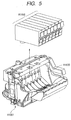
- FIG. 5 shows how the ink cartridges H1900 are mounted on the head cartridge H1000.
- the ink jet recording apparatus forms an image by means of, for example, each of yellow, magenta, cyan, black, light magenta, light cyan, and green inks, so the ink cartridges H1900 is independently prepared for each of the seven colors.
- each ink cartridge H1900 is detachable from the head cartridge H1000.
- the ink cartridge H1900 can be detached in a state that the head cartridge H1000 is mounted on the carriage M4000 (see FIG. 3 ).
- FIG. 6 shows an exploded perspective view of the head cartridge H1000.
- the head cartridge H1000 is constituted of a recording element substrate, a plate, an electric wiring substrate H1300, a cartridge holder H1500, a flow path forming member H1600, a filter H1700, and a seal rubber H1800.
- the recording element substrate is composed of a first recording element substrate H1100 and a second recording element substrate H1101, and the plate is composed of a first plate H1200 and a second plate H1400.
- Each of the first recording element substrate H1100 and the second recording element substrate H1101 is an Si substrate having a plurality of recording elements (nozzles) for ejecting ink which are formed on one side thereof by means of photolithography.
- Electric wiring formed of Al or the like for supplying power to each recording element is formed by means of a film formation technology or the like, and a plurality of ink flow paths corresponding respectively to the recording elements are also formed by means of photolithography. Further, ink supply orifices for supplying ink to the plurality of ink flow paths are formed so as to open on the rear surface.
- FIG. 7 is an enlarged front view for illustrating the constitution of each of the first recording element substrate H1100 and the second recording element substrate H1101.
- Reference characters H2000 to H2600 denote recording element trains (hereinafter referred to also as nozzle trains) each supplying a different ink color.
- the first recording element substrate H1100 has nozzle trains for three colors: the nozzle train H2000 for yellow ink; the nozzle train H2100 for magenta ink; and the nozzle train H2200 for cyan ink.
- the second recording element substrate H1101 has nozzle trains for four colors: the nozzle train H2300 for light cyan ink; the nozzle train H2400 for black ink; the nozzle train H2500 for green ink; and the nozzle train H2600 for light magenta ink.
- Each nozzle train includes 768 nozzles arranged at intervals of 1,200 dpi (dot/inch; reference value) in the direction in which a recording medium is conveyed, and each nozzle ejects about 2 pl of ink.
- An opening area in each ejection orifice is set to be about 100 ⁇ m 2 .
- the first recording element substrate H1100 and the second recording element substrate H1101 are bonded and fixed to the first plate H1200, and ink supply orifices H1201 for supplying ink to the first recording element substrate H1100 and the second recording element substrate H1101 are formed on the first plate H1200.
- the second plate H1400 having openings is also bonded and fixed to the first plate H1200.
- the second plate H1400 holds the electric wiring substrate H1300 in such a manner that the electric wiring substrate H1300, the first recording element substrate H1100, and the second recording element substrate H1101 are electrically connected.
- the electric wiring substrate H1300 applies an electrical signal for causing each of the nozzles formed on the first recording element substrate H1100 and the second recording element substrate H1101 to eject ink.
- the electric wiring substrate H1300 has: electric wiring corresponding to each of the first recording element substrate H1100 and the second recording element substrate H1101; and an external signal input terminal H1301 which is positioned at an end portion of the electric wiring to receive an electrical signal from the ink jet recording apparatus.
- the external signal input terminal H1301 is positioned and fixed to the back surface side of the cartridge holder H1500.
- the flow path forming member H1600 is fixed by means of, for example, ultrasonic welding to the cartridge holder H1500 for holding the ink cartridge H1900.
- an ink flow path H1501 passing from the ink cartridge H1900 to the first plate H1200 is formed.
- the filter H1700 is provided at an end portion on the ink cartridge side of the ink flow path H1501 engaged with the ink cartridge H1900, so the filter H1700 prevents dust from entering from the outside.
- the seal rubber H1800 is mounted on the portion at which the ink flow path H1501 is engaged with the ink cartridge H1900 to prevent ink from evaporating from the portion.
- the head cartridge H1000 is formed by, for example, causing a cartridge holder portion and the recording head H1001 to adhere to each other.
- the cartridge holder portion is composed of the cartridge holder H1500, the flow path forming member H1600, the filter H1700, and the sealing rubber H1800.
- the recording head H1001 is composed of the first recording element substrate H1100 and the second recording element substrate H1101, the first plate H1200, the electric wiring substrate H1300, and the second plate H1400.
- the thermal ink jet system is particularly applicable to the on-demand type.
- at least one driving signal which corresponds to recording information and triggers a rapid temperature rise exceeding nucleate boiling is applied to electrothermal transducers arranged corresponding to liquid paths holding ink, to thereby cause the electrothermal transducer to generate thermal energy.
- the ink is caused to generate film boiling.
- an air bubble in the ink can be formed so as to be in one-to-one correspondence with the driving signal.
- the growth and contraction of the air bubble cause the ink to be ejected through an opening for ejection, thereby forming at least one droplet.
- the driving signal is more preferably of a pulse shape because the growth and contraction of an air bubble can be performed immediately and appropriately, and hence ink can be discharged with excellent responsiveness.
- the ink of the present invention can be preferably used not only in a recording head according to the thermal ink jet system but also in such an ink jet recording apparatus utilizing mechanical energy as described below.
- the ink jet recording apparatus in such a form includes: a nozzle-forming substrate having a plurality of nozzles; a pressure-generating element placed opposite to the nozzles and composed of a piezoelectric material and a conductive material; and ink with which the periphery of the pressure-generating element is filled.
- the pressure-generating element is displaced by an applied voltage to eject the ink from the nozzles.
- the ink jet recording apparatus is not limited to such apparatuses as described above in which a recording head and an ink cartridge are separated, and may be one in which a head and an ink cartridge are so integrated as to be inseparable. Further, the ink cartridge may be separably or inseparably unified with the recording head to be mounted on a carriage, or may be mounted on a fixing portion of an ink jet recording apparatus to supply ink to a recording head through an ink supply member such as a tube.
- the ink cartridge When the ink cartridge is provided with a constitution for applying a preferable negative pressure to the recording head, it may be configured as follows.
- an absorber may be placed in an ink storing portion of the ink cartridge, or the ink cartridge may have a flexible ink storage bag and a spring portion for exerting biasing power in the direction of expanding the internal volume of the bag.
- the ink jet recording apparatus may adopt a serial recording system, or may be in the form of a line printer in which recording elements are aligned over the range corresponding to the entire width of a recording medium.
- HLB 20 ⁇ formula weight of hydrophilic group of surfactant / molecular weight of surfactant
- Table 1 collectively shows the structure of the main component of each surfactant, and, when the structure of the surfactant corresponded to the general formula (1) or the general formula (2), values of m, n, a, and m + n, or values of x, y, b, and x + y.
- EMALEX 1615 is a surfactant manufactured by NIHON EMULSION Co., Ltd.
- Acetylenol E100 is a surfactant manufactured by Kawaken Fine Chemicals Co., Ltd.
- EMULMIN CO-50 and EMULMIN NL90 are each a surfactant manufactured by Sanyo Chemical Industries Ltd.
- NIKKOL BT-7 is a surfactant manufactured by Nikko Chemicals co., ltd.
- Polyoxyethylene oleyl ether - - - - - - - - - EMULMIN NL90 1.0
- EMULMIN CO-50 and EMULMIN NL90 are each a surfactant manufactured by Sanyo Chemical Industries Ltd.
- NIKKOL BT-7 is a surfactant manufactured by Nikko Chemicals co., ltd. Table 2 (Unit: %) Cyan ink C1 C2 C3 C4 C5 C.I.
- the (1) dynamic surface tension of each of the inks obtained above at a lifetime of 50 milliseconds, and the (2) dynamic surface tension of each of the inks at a lifetime of 500 milliseconds were measured.
- the difference ⁇ ⁇ [(1) - (2)] between the dynamic surface tensions (1) and (2) was determined.
- An apparatus for measuring a dynamic surface tension by a maximum bubble pressure method (Bubble Pressure Tensiometer BP2; manufactured by KRUSS) was used in the measurement.
- the dynamic surface tensions were each measured at 25°C. Table 5 shows the results of the evaluation for dynamic surface tensions.
- An ink cartridge was filled with each of the inks obtained above, and was mounted on a modified apparatus of an ink jet recording apparatus iP3100 (manufactured by Canon Inc.) in which ink is ejected from a recording head by the action of thermal energy. After that, recording was performed on a recording medium (PR-101; manufactured by Canon Inc.) so that the amount of applied ink per one pixel at a resolution of 600 ppi was 10 ng.
- the lightness of the resultant image was measured with a Spectrolino (manufactured by Gretag Macbeth) by using a D65 as a light source at a field of view of 2°. Table 5 shows the results of the measurement of the lightness.
- an ink corresponding to the first ink in the present invention is each of the inks C1 to C5, M2, and Y1.
- the image formed by using each of the inks corresponding to the first ink in the present invention at a recording duty of 100% on a plain paper had good color uniformity.
- the recording apparatus and recording medium used in the above image formation was an ink jet recording apparatus iP3100 and PPC paper Office Planner (each manufactured by Canon Inc.).
- Ink sets were obtained by using in combination two types of inks selected from the inks C1 to C5, M1 to M8, and Y1 to Y3 obtained above as shown in Table 6 below. Then, as shown in Table 6, between two types of inks included in the ink set, an ink having relatively higher lightness was defined as an ink A, and an ink having relatively lower lightness was defined as an ink B.
- Table 6 showed the value of lightness of each of the ink A and the ink B, the dynamic surface tension ⁇ a of the ink A at a lifetime of 500 milliseconds, the dynamic surface tension ⁇ b of the ink B at a lifetime of 500 milliseconds, and the difference ( ⁇ a - ⁇ b ) between the dynamic surface tensions.
- An ink cartridge was filled with each of the ink A and the ink B of the a plurality of inks included in the ink set, and was mounted on a modified apparatus of an ink jet recording apparatus iP3100 (manufactured by Canon Inc.) in which ink was ejected from a recording head by the action of thermal energy. After that, an image shown in FIG. 1 was formed on a recording medium (PR-101; manufactured by Canon Inc.) in four paths. The resulting recorded matter was visually observed and evaluated for bleeding. Criteria for the evaluation for bleeding are as described below. Table 6 shows the results of the evaluation.
- the ink M8 has a dynamic surface tension of 41 mN/m at 500 milliseconds while each of the inks C1 and Y1 has a dynamic surface tension of 37 mN/m at 500 milliseconds.
- an image was at an unpreferable level because bleeding was observed over the entirety of the image.
- an image was at an acceptable level, though bleeding was slightly observed on part of the image.
- the absolute values of the differences in dynamic surface tension at 500 milliseconds between the inks were 4 for both of them, but the extents to which bleeding occurred owing to a lightness relationship between the inks were different from each other.
- An ink set was obtained by using in combination three types of inks selected from the inks C1, C2, M1, M2, M4, and Y1 to Y3 obtained above as shown in Table 7 below. Then, as shown in Table 7, for each of all (three) combinations of two types of inks selected from the three types of inks included in the ink set, an ink having relatively higher lightness was defined as an ink A, and an ink having relatively lower lightness was defined as an ink B.
- An ink cartridge was filled with each of the ink A and the ink B of the a plurality of inks included in the ink set, and was mounted on a modified apparatus of an ink jet recording apparatus iP3100 (manufactured by Canon Inc.) in which ink was ejected from a recording head by the action of thermal energy. After that, an image shown in FIG. 1 was formed on a recording medium (PR-101; manufactured by Canon Inc.) in four paths. A recorded matter obtained by using each of all (three) combinations of two types of inks selected from the three types of the inks included in the ink set, was visually observed and evaluated for bleeding. Criteria for the evaluation for bleeding are as described below. Table 7 shows the results of the evaluation.
- Example 25 including a combination of two types of inks among the three types of inks included in an ink set where the value of ⁇ a - ⁇ b was -4, the following bleeding performance was exhibited. That is, in a combination of two types of inks where the value of ⁇ a - ⁇ b was -4, an image was at an acceptable level while bleeding was slightly observed on part of the image; and, in the other combinations of two types of inks, no bleeding was observed over the entirety of an image. Accordingly, in Example 25, bleeding was comprehensively at an acceptable level.
- Reference Example 1 including a combination of two types of inks among three types of inks included in an ink set where the value of ⁇ a - ⁇ b was 6, bleeding was observed over the entirety of an image in that combination, and the bleeding was comprehensively at an unacceptable level.
- the ink set includes a plurality of aqueous inks each containing a dye, and has at least a first aqueous ink containing a dye, wherein the difference between the dynamic surface tension of the first aqueous ink at a lifetime of 50 milliseconds and the dynamic surface tension of the first aqueous ink at a lifetime of 500 milliseconds is 7 mN/m or more; and, between the first aqueous ink and at least one type of aqueous ink except the first aqueous ink included in the ink set, dynamic surface tension ⁇ a (mN/m) of an ink A having relatively higher lightness at a lifetime of 500 milliseconds and dynamic surface tension ⁇ b (mN/m) of an ink B having relatively lower lightness at a lifetime of 500 milliseconds satisfy -5 ⁇ ( ⁇ a - ⁇ b ) ⁇ 3.
Landscapes
- Chemical & Material Sciences (AREA)
- Life Sciences & Earth Sciences (AREA)
- Engineering & Computer Science (AREA)
- Materials Engineering (AREA)
- Wood Science & Technology (AREA)
- Organic Chemistry (AREA)
- Ink Jet Recording Methods And Recording Media Thereof (AREA)
- Ink Jet (AREA)
- Inks, Pencil-Leads, Or Crayons (AREA)
Claims (13)
- Tintensatz umfassend eine Mehrzahl wässriger Tinten, wobei jede Tinte einen Farbstoff als ein färbendes Material umfasst, wobei:der Tintensatz wenigstens eine erste wässrige Tinte aufweist, die einen Farbstoff als ein färbendes Material umfasst;ein Unterschied zwischen der dynamischen Oberflächenspannung der ersten wässrigen Tinte bei einer Lebenszeit von 50 Millisekunden und der dynamischen Oberflächenspannung der ersten wässrigen Tinte bei einer Lebenszeit von 500 Millisekunden 7 mN/m oder mehr ist; undzwischen der ersten wässrigen Tinte und wenigstens einem Typ der in dem Tintensatz beinhalteten wässrigen Tinte ausgenommen der ersten wässrigen Tinte, die dynamische Oberflächenspannung Ya (mN/m) einer Tinte A mit einer relativ höheren Helligkeit bei einer Lebenszeit von 500 Millisekunden und der dynamischen Oberflächenspannung Yb (mN/m) einer Tinte B mit einer relativ geringeren Helligkeit bei einer Lebenszeit von 500 Millisekunden eine Beziehung von -5 ≤ (Ya - Yb) ≤ 3 erfüllen.
- Tintensatz nach Anspruch 1, wobei:die erste wässrige Tinte zusätzlich die folgenden Bedingungen (1) und (2) erfüllt:(1) die dynamische Oberflächenspannung bei einer Lebenszeit von 50 Millisekunden ist von 42 mN/m oder mehr bis weniger als 49 mN/m, und(2) die dynamische Oberflächenspannung bei einer Lebenszeit von 500 Millisekunden ist von 28 mN/m oder mehr bis 38 mN/m oder weniger.
- Tintensatz nach Anspruch 2, wobei der Tintensatz wenigstens drei Typen wässriger Tinten umfasst, wobei jede Tinte einen Farbstoff als ein färbendes Material umfasst; und
von zwei Typen der wässrigen Tinte, die willkürlich aus den wenigstens drei Typen der in dem Tintensatz beinhalteten wässrigen Tinten ausgewählt werden, die dynamische Oberflächenspannung Ya (mN/m) einer Tinte A mit einer relativ höheren Helligkeit bei einer Lebenszeit von 500 Millisekunden und der dynamischen Oberflächenspannung Yb (mN/m) einer Tinte B mit einer relativ geringeren Helligkeit bei einer Lebenszeit von 500 Millisekunden eine Beziehung von -5 ≤ (Ya - Yb) ≤ 3 erfüllen. - Tintensatz nach einem der Ansprüche 1 bis 3, wobei jede der Tinten einen nichtionischen oberflächenaktiven Stoff enthält.
- Tintensatz nach Anspruch 4, wobei der nichtionische oberflächenaktive Stoff wenigstens einer ausgewählt aus der Gruppe bestehend aus den oberflächenaktiven Stoffen dargestellt durch die folgenden allgemeinen Formeln (1) und (2) ist:


- Tintensatz nach Anspruch 4 oder 5, wobei der HLB-Wert jeder der nichtionischen oberflächenaktiven Stoffe gemäß dem Griffin-Verfahren 12,0 oder mehr und 16,5 oder weniger ist.
- Tintensatz nach einem der Ansprüche 4 bis 6, wobei der Gehalt des oberflächenaktiven Stoffs in der ersten wässrigen Tinte basierend auf der gesamten Masse der Tinte 0,30 Massen-% oder mehr und 2,0 Massen-% oder weniger ist, der Gehalt des oberflächenaktiven Stoffs in der Tinte A basierend auf der gesamten Masse der Tinte 0,10 Massen-% oder mehr und 2,0 Massen-% oder weniger ist, und der Gehalt des oberflächenaktiven Stoffs in der Tinte B basierend auf der gesamten Masse der Tinte 0,10 Massen-% oder mehr und 2,0 Massen-% oder weniger ist.
- Tintenstrahlaufzeichnungsverfahren umfassend das Ausstoßen von Tinte durch ein Tintenstrahlverfahren, wobei die Tinte wässrige Tinten umfasst, aus welchen der Tintensatz gemäß einem der Ansprüche 1 bis 7 zusammengesetzt ist.
- Tintenstrahlaufzeichnungsverfahren nach Anspruch 8, wobei das Tintenstrahlverfahren ein Tintenstrahlaufzeichnungsverfahren ist, in welchem die Tinte aus einem Aufzeichnungskopf durch die Wirkung thermischer Energie ausgestoßen wird.
- Tintenkartusche umfassend einen Tintenspeicherabschnitt für die Speicherung von Tinte, wobei die Tinte, die in dem Tintenspeicherabschnitt enthalten ist, eine der wässrigen Tinten ist, welche den Tintensatz gemäß einem der Ansprüche 1 bis 7 aufbaut.
- Aufzeichnungseinheit umfassend:einen Tintenspeicherabschnitt für die Speicherung von Tinte; undeinen Aufzeichnungskopf für den Ausstoß der Tinte,wobei die Tinte, die in dem Tintenspeicherungsabschnitt enthalten ist, die wässrigen Tinten umfasst, aus welchen der Tintensatz gemäß einem der Ansprüche 1 bis 7 aufgebaut ist.
- Tintenstrahlaufzeichnungsgerät umfassend:einen Tintenspeicherabschnitt für die Speicherung von Tinte; undeinen Aufzeichnungskopf für den Ausstoß der Tinte,wobei die Tinte, die in dem Tintenspeicherabschnitt enthalten ist, die wässrigen Tinten umfasst, aus welchen der Tintensatz gemäß einem der Ansprüche 1 bis 7 aufgebaut ist.
- Verwendung einer ersten wässrigen Tinte mit einem Farbstoff in einem Tintensatz, der eine Mehrzahl von wässrigen Tinten aufweist, die jeweils einen Farbstoff umfassen, wobei:ein Unterschied zwischen der dynamischen Oberflächenspannung der ersten wässrigen Tinte bei einer Lebenszeit von 50 Millisekunden und der dynamischen Oberflächenspannung der ersten wässrigen Tinte bei einer Lebenszeit von 500 Millisekunden 7 mN/m oder mehr ist; undzwischen der ersten wässrigen Tinte und wenigstens einem Typ der in dem Tintensatz beinhalteten wässrigen Tinte ausgenommen der ersten wässrigen Tinte, die dynamische Oberflächenspannung Ya (mN/m) einer Tinte A mit einer relativ höheren Helligkeit bei einer Lebenszeit von 500 Millisekunden und der dynamischen Oberflächenspannung Yb (mN/m) einer Tinte B mit einer relativ geringeren Helligkeit bei einer Lebenszeit von 500 Millisekunden eine Beziehung von -5 ≤ (Ya - Yb) ≤ 3 erfüllen.
Applications Claiming Priority (2)
| Application Number | Priority Date | Filing Date | Title |
|---|---|---|---|
| JP2007126633 | 2007-05-11 | ||
| JP2008112758A JP5932199B2 (ja) | 2007-05-11 | 2008-04-23 | インクセット、インクジェット記録方法、インクカートリッジ、記録ユニット、インクジェット記録方法、及び水性インク |
Publications (2)
| Publication Number | Publication Date |
|---|---|
| EP1990382A1 EP1990382A1 (de) | 2008-11-12 |
| EP1990382B1 true EP1990382B1 (de) | 2016-06-08 |
Family
ID=39651050
Family Applications (1)
| Application Number | Title | Priority Date | Filing Date |
|---|---|---|---|
| EP08155981.7A Not-in-force EP1990382B1 (de) | 2007-05-11 | 2008-05-09 | Tintensatz, Tintenstrahlaufzeichnungsverfahren, Tintenpatrone, Aufzeichnungseinheit, Tintenstrahlaufzeichnungsverfahren und wässrige Tinte |
Country Status (2)
| Country | Link |
|---|---|
| US (1) | US7988277B2 (de) |
| EP (1) | EP1990382B1 (de) |
Families Citing this family (24)
| Publication number | Priority date | Publication date | Assignee | Title |
|---|---|---|---|---|
| JP5020700B2 (ja) * | 2007-05-11 | 2012-09-05 | キヤノン株式会社 | インクジェット記録用インクタンク |
| JP5383238B2 (ja) * | 2008-03-19 | 2014-01-08 | キヤノン株式会社 | インクジェット用インク、インクジェット記録方法、インクカートリッジ、及びインクジェット記録装置 |
| JP4859256B2 (ja) * | 2008-03-19 | 2012-01-25 | キヤノン株式会社 | インクジェット用インク、インクジェット記録方法、インクカートリッジ、記録ユニット、及びインクジェット記録装置 |
| JP5605993B2 (ja) * | 2008-03-19 | 2014-10-15 | キヤノン株式会社 | インクジェット用インク、インクジェット記録方法、インクカートリッジ、及びインクジェット記録装置 |
| JP5709474B2 (ja) * | 2009-12-11 | 2015-04-30 | キヤノン株式会社 | 反応液とインクとのセット、及び画像形成方法 |
| US8764178B2 (en) | 2010-06-22 | 2014-07-01 | Canon Kabushiki Kaisha | Ink jet recording method and ink jet recording apparatus |
| JP5791242B2 (ja) | 2010-07-21 | 2015-10-07 | キヤノン株式会社 | インクジェット記録装置、インクジェット記録方法及びインクジェット記録ヘッド |
| JP6000597B2 (ja) | 2011-04-19 | 2016-09-28 | キヤノン株式会社 | インク、インクカートリッジ及びインクジェット記録方法 |
| JP6029304B2 (ja) | 2011-04-19 | 2016-11-24 | キヤノン株式会社 | インクと反応液とのセット、及び画像形成方法 |
| JP6029303B2 (ja) | 2011-04-19 | 2016-11-24 | キヤノン株式会社 | インクと反応液とのセット、及び画像形成方法 |
| US8871013B2 (en) | 2012-04-13 | 2014-10-28 | Canon Kabushiki Kaisha | Ink, ink cartridge and ink jet recording method |
| US8814341B2 (en) | 2012-06-15 | 2014-08-26 | Canon Kabushiki Kaisha | Ink, ink cartridge and ink jet recording method |
| JP6161434B2 (ja) | 2012-08-09 | 2017-07-12 | キヤノン株式会社 | インク、インクカートリッジ、及びインクジェット記録方法 |
| GB201214552D0 (en) * | 2012-08-15 | 2012-09-26 | Fujifilm Imaging Colorants Inc | Inks for ink-jet printing |
| JP6050998B2 (ja) * | 2012-09-28 | 2016-12-21 | 株式会社Screenホールディングス | 画像形成装置および画像形成方法 |
| JP6079318B2 (ja) * | 2013-03-06 | 2017-02-15 | セイコーエプソン株式会社 | インクセット、記録方法および記録装置 |
| JP6558974B2 (ja) | 2014-06-30 | 2019-08-14 | キヤノン株式会社 | 水性インク、水性インクの製造方法、インクカートリッジ、及びインクジェット記録方法 |
| JP2017534478A (ja) | 2014-09-03 | 2017-11-24 | オセ−テクノロジーズ・ベー・ヴエーOce’−Nederland Besloten Vennootshap | 印刷方法 |
| US10414932B2 (en) * | 2015-10-20 | 2019-09-17 | Ricoh Company, Ltd. | Ink, ink container, and inkjet recording device |
| JP6860315B2 (ja) * | 2015-10-30 | 2021-04-14 | キヤノン株式会社 | インクジェット記録方法及びインクジェット記録装置 |
| US10196532B2 (en) | 2016-01-22 | 2019-02-05 | Canon Kabushiki Kaisha | Ink, ink cartridge, and image recording method |
| US11001080B2 (en) | 2018-04-06 | 2021-05-11 | Canon Kabushiki Kaisha | Ink jet recording method of ejecting an aqueous ink having a certain dynamic surface tension |
| US12215240B2 (en) | 2019-11-12 | 2025-02-04 | Canon Kabushiki Kaisha | Aqueous ink, ink cartridge and ink jet recording method |
| US20250050646A1 (en) * | 2023-08-07 | 2025-02-13 | Canon Kabushiki Kaisha | Ink jet recording method and ink jet recording apparatus |
Family Cites Families (47)
| Publication number | Priority date | Publication date | Assignee | Title |
|---|---|---|---|---|
| CA1127227A (en) | 1977-10-03 | 1982-07-06 | Ichiro Endo | Liquid jet recording process and apparatus therefor |
| JPH0715074B2 (ja) | 1988-01-14 | 1995-02-22 | セイコーエプソン株式会社 | インクジェット記録方法 |
| US5451251A (en) | 1993-02-26 | 1995-09-19 | Canon Kabushiki Kaisha | Ink, and ink-jet recording method and instrument using the same |
| EP0699723A3 (de) | 1994-08-31 | 1997-07-02 | Canon Kk | Tintenstrahl-Tinte |
| JP3320292B2 (ja) | 1995-02-13 | 2002-09-03 | キヤノン株式会社 | インクジェットプリント装置およびインクジェットプリント方法 |
| US6174354B1 (en) | 1995-04-07 | 2001-01-16 | Canon Kabushiki Kaisha | Ink, ink-jet recording process and apparatus using the same |
| US5911815A (en) | 1995-11-30 | 1999-06-15 | Canon Kabushiki Kaisha | Ink set and ink-jet recording method using the same |
| JP3500484B2 (ja) | 1996-04-30 | 2004-02-23 | 株式会社リコー | 水性インク及びこれを用いたインクジェット記録方法 |
| US5972082A (en) * | 1996-04-30 | 1999-10-26 | Ricoh Company, Ltd. | Aqueous ink composition and ink-jet printing method using the same |
| US6027210A (en) | 1996-08-02 | 2000-02-22 | Canon Kabushiki Kaisha | Ink-jet recording process using liquid formulation and ink in combination |
| JP3862441B2 (ja) | 1998-03-20 | 2006-12-27 | キヤノン株式会社 | インクジェット記録用インク、インクセット、インクカートリッジ、記録ユニット、画像記録装置、画像記録方法、カラー画像の形成方法および画像の光学濃度向上方法 |
| US6641257B1 (en) | 1998-05-29 | 2003-11-04 | American Ink Jet Corporation | Lightfast ink jet inks |
| US6221141B1 (en) | 1998-06-23 | 2001-04-24 | Canon Kabushiki Kaisha | Ink, ink-jet recording process, recording unit, ink cartridge and ink-jet recording apparatus |
| US6375317B1 (en) | 1998-10-27 | 2002-04-23 | Canon Kabushiki Kaisha | Ink, ink-jet recording process, recording unit, ink cartridge and ink-jet recording apparatus |
| JP3581605B2 (ja) | 1998-10-27 | 2004-10-27 | キヤノン株式会社 | インクセット、インクジェット記録方法、記録ユニット、インクカートリッジ、インクジェット記録装置および共通化回復系ユニット内の固形物の生成を緩和する方法 |
| US6809128B2 (en) | 1998-11-27 | 2004-10-26 | Seiko Epson Corporation | Ink composition comprising cationic water-soluble resin, and ink set |
| JP4027027B2 (ja) | 1999-09-17 | 2007-12-26 | キヤノン株式会社 | インク、インクセット、インクカートリッジ、記録ユニット、画像記録装置およびインクジェット記録方法 |
| JP4683585B2 (ja) | 1999-09-17 | 2011-05-18 | キヤノン株式会社 | インクセット |
| DE10041982B4 (de) | 2000-08-26 | 2008-09-04 | J. S. Staedtler Gmbh & Co. Kg | Verwendung vom Tintensätzen auf wässriger Basis |
| US6582070B2 (en) | 2000-09-04 | 2003-06-24 | Canon Kabushiki Kaisha | Recording unit and image recording apparatus |
| US6706105B2 (en) | 2000-09-29 | 2004-03-16 | Canon Kabushiki Kaisha | Aqueous ink, ink-jet recording method, recording unit, ink cartridge, ink set, and ink-jet recording apparatus |
| US6777462B2 (en) | 2001-11-23 | 2004-08-17 | Xerox Corporation | Ink compositions containing sodium tetraphenylboride |
| EP1333068B1 (de) | 2002-02-04 | 2011-12-21 | Canon Kabushiki Kaisha | Wässrige Tinte, Tintenstrahlaufzeichnungsverfahren, Tintenpatrone, Aufzeichnungseinheit, und Tintenstrahlaufzeichnungsgerät |
| JP2003231838A (ja) | 2002-02-08 | 2003-08-19 | Sony Corp | インクジェット記録用水性インク |
| JP2004083621A (ja) | 2002-08-22 | 2004-03-18 | Brother Ind Ltd | インクジェット記録用水性インク |
| KR100795614B1 (ko) | 2002-12-27 | 2008-01-17 | 캐논 가부시끼가이샤 | 수성 잉크, 잉크젯 기록 방법, 잉크 카트리지, 기록 유닛,잉크젯 기록 장치 및 상 형성 방법 |
| US7160376B2 (en) | 2003-05-02 | 2007-01-09 | Canon Kabushiki Kaisha | Aqueous ink, and ink-jet recording method, ink-jet recording apparatus, and image forming method using the same |
| WO2005097922A1 (ja) | 2004-04-08 | 2005-10-20 | Canon Kabushiki Kaisha | インク、インクジェット記録方法、インクカートリッジ、及びインクジェット記録装置 |
| DE602005023982D1 (de) | 2004-04-08 | 2010-11-18 | Canon Kk | Tinte für tintenstrahlaufzeichnung, tintenstrahlaurahlaufzeichnungsvorrichtung |
| WO2005108511A1 (ja) | 2004-05-10 | 2005-11-17 | Canon Kabushiki Kaisha | インクセット、インクジェット記録方法、インクカートリッジ、記録ユニット、インクジェット記録装置及び画像形成方法 |
| KR100584599B1 (ko) | 2004-05-25 | 2006-05-30 | 삼성전자주식회사 | 잉크 세트, 이를 구비한 잉크젯 기록 장치 및 이를 이용한화상 형성 방법 |
| WO2006001508A1 (ja) | 2004-06-24 | 2006-01-05 | Canon Kabushiki Kaisha | 水性インク、インクタンク、インクジェット記録装置、インクジェット記録方法、及びインクジェット記録画像 |
| EP1726449B1 (de) | 2004-06-28 | 2016-06-29 | Canon Kabushiki Kaisha | Aufzeichnungsverfahren, tintenpatrone und bilderzeugungsverfahren |
| WO2006001540A1 (ja) | 2004-06-28 | 2006-01-05 | Canon Kabushiki Kaisha | シアンインク、インクセット、インクと反応液のセット、及び画像形成方法 |
| AU2005257524B2 (en) | 2004-06-28 | 2009-07-30 | Canon Kabushiki Kaisha | Aqueous ink, ink set, and image forming method |
| CN1973005B (zh) | 2004-06-28 | 2010-09-29 | 佳能株式会社 | 青色墨水及成套墨水 |
| ATE486107T1 (de) | 2004-06-28 | 2010-11-15 | Canon Kk | Wässrige tinte, wässriger tintensatz, tintenpatrone, tintenstrahlaufzeichner, tintenstrahlaufzeichnungsverfahren und bilderzeugungsverfahren |
| CN1977004B (zh) | 2004-06-28 | 2010-05-05 | 佳能株式会社 | 水性墨水、喷墨记录方法、墨盒、记录单元、喷墨记录装置和图像形成方法 |
| JP5130612B2 (ja) | 2004-07-27 | 2013-01-30 | ブラザー工業株式会社 | インクジェット記録用水性インクセット |
| JP4812078B2 (ja) | 2004-12-28 | 2011-11-09 | キヤノン株式会社 | インクジェット記録装置 |
| JP4808418B2 (ja) * | 2005-02-28 | 2011-11-02 | キヤノンファインテック株式会社 | インクジェット用水系インク、インクジェット記録方法、インクカートリッジおよびインクジェット記録装置 |
| ES2386376T3 (es) | 2005-09-14 | 2012-08-20 | Canon Kabushiki Kaisha | Tinta para efectos de correo, depósito de tinta para efectos de correo que usa dicha tinta, método de impresión por chorros de tinta para efectos de correo y aparato de impresión por chorros de tinta para efectos de correo |
| JP4971754B2 (ja) | 2005-11-16 | 2012-07-11 | キヤノン株式会社 | 水性インク、インクジェット記録方法、インクカートリッジ、記録ユニット、及びインクジェット記録装置 |
| US7387665B2 (en) | 2006-04-12 | 2008-06-17 | E.I. Du Pont De Nemours And Company | Inkjet ink and ink set |
| JP5938815B2 (ja) | 2006-05-25 | 2016-06-22 | キヤノン株式会社 | 水性インク、インクジェット記録方法、インクカートリッジ、記録ユニット、及びインクジェット記録装置 |
| EP1935949B1 (de) | 2006-12-22 | 2014-07-16 | Canon Kabushiki Kaisha | Thermotintenstrahltinte und Tintenpatrone dafür |
| JP5932200B2 (ja) * | 2007-05-11 | 2016-06-08 | キヤノン株式会社 | 水性インク、インクジェット記録方法、インクカートリッジ、記録ユニット、及びインクジェット記録装置 |
-
2008
- 2008-05-07 US US12/116,343 patent/US7988277B2/en active Active
- 2008-05-09 EP EP08155981.7A patent/EP1990382B1/de not_active Not-in-force
Also Published As
| Publication number | Publication date |
|---|---|
| EP1990382A1 (de) | 2008-11-12 |
| US7988277B2 (en) | 2011-08-02 |
| US20080280043A1 (en) | 2008-11-13 |
Similar Documents
| Publication | Publication Date | Title |
|---|---|---|
| EP1990382A1 (de) | Tintensatz, Tintenstrahlaufzeichnungsverfahren, Tintenpatrone, Aufzeichnungseinheit, Tintenstrahlaufzeichnungsverfahren und wässrige Tinte | |
| EP2147064B1 (de) | Wässrige tinte, tintenstrahlaufzeichnungsverfahren, tintenpatrone, aufzeichnungseinheit und tintenstrahlaufzeichnungsgerät | |
| EP1995287B1 (de) | Tintensatz, Tintenstrahlaufzeichnungsverfahren, Tintenpatrone, Aufzeichnungseinheit und Tintenstrahlaufzeichnungsvorrichtung | |
| EP1990383B1 (de) | Tintensatz, Tintenstrahlaufzeichnungsverfahren, Tintenpatrone, Aufzeichnungseinheit und Tintenstrahlaufzeichnungsvorrichtung | |
| EP1167467B1 (de) | Magenta-Tintengemisch und Aufzeichnungsverfahren damit | |
| AU748191B2 (en) | Ink, ink set, ink cartridge, recording unit, image recording apparatus and image recording method | |
| EP2878642B1 (de) | Tintenstrahltinte, Tintenstrahlaufzeichnungsverfahren, Tintenpatrone, Aufzeichnungseinheit und Tintenstrahlaufzeichnungsvorrichtung | |
| EP2103660B1 (de) | Tintenstrahldrucktinte, Tintenpatrone, Tintenstrahlaufzeichnungeinheit, -gerät und -verfahren | |
| EP1788043B1 (de) | Gelbe tinte für tintenstrahlaufzeichnung, helle tinte für tintenstrahlaufzeichnung, tintensatz, tintenstrahlaufzeichnungsverfahren, tintenpatrone, aufzeichnungseinheit und tintenstrahlaufzeichnungsgerät | |
| US7909449B2 (en) | Ink jet recording apparatus and ink jet recording method | |
| US6733120B2 (en) | Ink set for ink-jet recording, recording method, ink cartridge, recording unit, and ink-jet recording apparatus | |
| EP1964897B1 (de) | Tintensatz für Tintenstrahlaufzeichnung und Tintenstrahlaufzeichnungsverfahren | |
| JP5932199B2 (ja) | インクセット、インクジェット記録方法、インクカートリッジ、記録ユニット、インクジェット記録方法、及び水性インク | |
| JP5783665B2 (ja) | インクジェット記録用インクセット及びインクジェット記録方法 | |
| JP4273104B2 (ja) | 水性インク、インクジェット記録方法、インクカートリッジ、記録ユニット、インクジェット記録方法及び画像形成方法 | |
| JP2007231191A (ja) | インクジェット用インク、これを用いたインクカートリッジ、画像形成体および画像形成方法 | |
| JP2010121034A (ja) | インク、インクジェット記録方法、インクカートリッジ、記録ユニット、及びインクジェット記録装置 | |
| JP5089190B2 (ja) | 水性インク、インクセット、インクジェット記録方法、インクカートリッジ、記録ユニット、及びインクジェット記録装置 | |
| JP2006169289A (ja) | シアンインク、インクジェット記録方法、記録ユニット、インクカートリッジ及びインクジェット記録装置 | |
| JP2010138352A (ja) | 着色インクと液体組成物とのセット、インクジェット記録方法、及びインクジェット記録装置 |
Legal Events
| Date | Code | Title | Description |
|---|---|---|---|
| PUAI | Public reference made under article 153(3) epc to a published international application that has entered the european phase |
Free format text: ORIGINAL CODE: 0009012 |
|
| AK | Designated contracting states |
Kind code of ref document: A1 Designated state(s): AT BE BG CH CY CZ DE DK EE ES FI FR GB GR HR HU IE IS IT LI LT LU LV MC MT NL NO PL PT RO SE SI SK TR |
|
| AX | Request for extension of the european patent |
Extension state: AL BA MK RS |
|
| 17P | Request for examination filed |
Effective date: 20090512 |
|
| 17Q | First examination report despatched |
Effective date: 20090604 |
|
| AKX | Designation fees paid |
Designated state(s): DE FR GB IT |
|
| GRAP | Despatch of communication of intention to grant a patent |
Free format text: ORIGINAL CODE: EPIDOSNIGR1 |
|
| INTG | Intention to grant announced |
Effective date: 20151221 |
|
| GRAS | Grant fee paid |
Free format text: ORIGINAL CODE: EPIDOSNIGR3 |
|
| GRAA | (expected) grant |
Free format text: ORIGINAL CODE: 0009210 |
|
| AK | Designated contracting states |
Kind code of ref document: B1 Designated state(s): DE FR GB IT |
|
| REG | Reference to a national code |
Ref country code: GB Ref legal event code: FG4D |
|
| REG | Reference to a national code |
Ref country code: DE Ref legal event code: R096 Ref document number: 602008044591 Country of ref document: DE |
|
| PG25 | Lapsed in a contracting state [announced via postgrant information from national office to epo] |
Ref country code: IT Free format text: LAPSE BECAUSE OF FAILURE TO SUBMIT A TRANSLATION OF THE DESCRIPTION OR TO PAY THE FEE WITHIN THE PRESCRIBED TIME-LIMIT Effective date: 20160608 |
|
| REG | Reference to a national code |
Ref country code: DE Ref legal event code: R097 Ref document number: 602008044591 Country of ref document: DE |
|
| PLBE | No opposition filed within time limit |
Free format text: ORIGINAL CODE: 0009261 |
|
| STAA | Information on the status of an ep patent application or granted ep patent |
Free format text: STATUS: NO OPPOSITION FILED WITHIN TIME LIMIT |
|
| 26N | No opposition filed |
Effective date: 20170309 |
|
| REG | Reference to a national code |
Ref country code: FR Ref legal event code: ST Effective date: 20180131 |
|
| PG25 | Lapsed in a contracting state [announced via postgrant information from national office to epo] |
Ref country code: FR Free format text: LAPSE BECAUSE OF NON-PAYMENT OF DUE FEES Effective date: 20170531 |
|
| PGFP | Annual fee paid to national office [announced via postgrant information from national office to epo] |
Ref country code: DE Payment date: 20210421 Year of fee payment: 14 |
|
| PGFP | Annual fee paid to national office [announced via postgrant information from national office to epo] |
Ref country code: GB Payment date: 20210422 Year of fee payment: 14 |
|
| REG | Reference to a national code |
Ref country code: DE Ref legal event code: R119 Ref document number: 602008044591 Country of ref document: DE |
|
| GBPC | Gb: european patent ceased through non-payment of renewal fee |
Effective date: 20220509 |
|
| PG25 | Lapsed in a contracting state [announced via postgrant information from national office to epo] |
Ref country code: GB Free format text: LAPSE BECAUSE OF NON-PAYMENT OF DUE FEES Effective date: 20220509 Ref country code: DE Free format text: LAPSE BECAUSE OF NON-PAYMENT OF DUE FEES Effective date: 20221201 |