EP1990966A2 - System und Verfahren zum Senden und Empfangen von digitalen Satellitenfunksignalen über eine ungerade Zahl von Frequenzschlitzen - Google Patents
System und Verfahren zum Senden und Empfangen von digitalen Satellitenfunksignalen über eine ungerade Zahl von Frequenzschlitzen Download PDFInfo
- Publication number
- EP1990966A2 EP1990966A2 EP08154280A EP08154280A EP1990966A2 EP 1990966 A2 EP1990966 A2 EP 1990966A2 EP 08154280 A EP08154280 A EP 08154280A EP 08154280 A EP08154280 A EP 08154280A EP 1990966 A2 EP1990966 A2 EP 1990966A2
- Authority
- EP
- European Patent Office
- Prior art keywords
- satellite
- modulated
- signal
- receiver
- modulated signal
- Prior art date
- Legal status (The legal status is an assumption and is not a legal conclusion. Google has not performed a legal analysis and makes no representation as to the accuracy of the status listed.)
- Withdrawn
Links
- 238000000034 method Methods 0.000 title claims abstract description 27
- 238000004891 communication Methods 0.000 claims abstract description 29
- 230000005540 biological transmission Effects 0.000 description 3
- 238000010586 diagram Methods 0.000 description 2
- 238000012986 modification Methods 0.000 description 1
- 230000004048 modification Effects 0.000 description 1
- 238000001228 spectrum Methods 0.000 description 1
Images


Classifications
-
- H—ELECTRICITY
- H04—ELECTRIC COMMUNICATION TECHNIQUE
- H04B—TRANSMISSION
- H04B7/00—Radio transmission systems, i.e. using radiation field
- H04B7/14—Relay systems
- H04B7/15—Active relay systems
- H04B7/185—Space-based or airborne stations; Stations for satellite systems
- H04B7/1853—Satellite systems for providing telephony service to a mobile station, i.e. mobile satellite service
- H04B7/18532—Arrangements for managing transmission, i.e. for transporting data or a signalling message
- H04B7/18534—Arrangements for managing transmission, i.e. for transporting data or a signalling message for enhancing link reliablility, e.g. satellites diversity
-
- H—ELECTRICITY
- H04—ELECTRIC COMMUNICATION TECHNIQUE
- H04L—TRANSMISSION OF DIGITAL INFORMATION, e.g. TELEGRAPHIC COMMUNICATION
- H04L1/00—Arrangements for detecting or preventing errors in the information received
- H04L1/004—Arrangements for detecting or preventing errors in the information received by using forward error control
- H04L1/0041—Arrangements at the transmitter end
-
- H—ELECTRICITY
- H04—ELECTRIC COMMUNICATION TECHNIQUE
- H04L—TRANSMISSION OF DIGITAL INFORMATION, e.g. TELEGRAPHIC COMMUNICATION
- H04L27/00—Modulated-carrier systems
- H04L27/0008—Modulated-carrier systems arrangements for allowing a transmitter or receiver to use more than one type of modulation
-
- H—ELECTRICITY
- H04—ELECTRIC COMMUNICATION TECHNIQUE
- H04L—TRANSMISSION OF DIGITAL INFORMATION, e.g. TELEGRAPHIC COMMUNICATION
- H04L27/00—Modulated-carrier systems
- H04L27/18—Phase-modulated carrier systems, i.e. using phase-shift keying
-
- H—ELECTRICITY
- H04—ELECTRIC COMMUNICATION TECHNIQUE
- H04L—TRANSMISSION OF DIGITAL INFORMATION, e.g. TELEGRAPHIC COMMUNICATION
- H04L27/00—Modulated-carrier systems
- H04L27/26—Systems using multi-frequency codes
- H04L27/2601—Multicarrier modulation systems
-
- H—ELECTRICITY
- H04—ELECTRIC COMMUNICATION TECHNIQUE
- H04L—TRANSMISSION OF DIGITAL INFORMATION, e.g. TELEGRAPHIC COMMUNICATION
- H04L1/00—Arrangements for detecting or preventing errors in the information received
- H04L1/02—Arrangements for detecting or preventing errors in the information received by diversity reception
- H04L1/06—Arrangements for detecting or preventing errors in the information received by diversity reception using space diversity
-
- H—ELECTRICITY
- H04—ELECTRIC COMMUNICATION TECHNIQUE
- H04L—TRANSMISSION OF DIGITAL INFORMATION, e.g. TELEGRAPHIC COMMUNICATION
- H04L1/00—Arrangements for detecting or preventing errors in the information received
- H04L2001/0098—Unequal error protection
Definitions
- the present invention generally relates to a system and method of transmitting and receiving signals, and more particularly, relates to a system and method for transmitting and receiving satellite digital radio signals.
- Vehicles can be equipped with satellite radio receivers as an alternative, or in combination with, traditional terrestrial radio receivers. Additionally, satellite radio receivers can be used in places other than vehicles, such as handheld devices or devices used in one's home.
- the satellite radio systems are generally designed such that the receiver receives a signal from a satellite and a terrestrial radio frequency (RF), which is typically referred to as a terrestrial repeater.
- RF terrestrial radio frequency
- the frequency spectrum is divided into specific frequency slots where certain devices typically operate within a certain frequency band. Due to current European regulations, the European satellite radio system currently has twenty-three (23) contiguous frequencies across forty megahertz (40 MHz). Generally, there are seven (7) frequencies that are designated for hybrid only systems, which include satellite radios that transmit a signal from the satellite and the terrestrial repeater. Typically, the present European satellite radio system is constrained to frequency bandwidths of 1.712 MHz.
- satellite systems are constrained by the available radio frequency (RF) power.
- the constraints of the available RF power are typically related to the limitations to the size and power dissipation of the satellites.
- RF radio frequency
- One such system uses transmitted signals that have the same symbol rate or frequency bandwidth to achieve and increase the received signal power. In such a system, half the information is transmitted over one signal and the other half of the information is transmitted over another signal, and the two signals are received and combined by the receiver.
- These systems generally function properly when the signals are transmitted over an even number of frequency slots because half of the power of the source data is on one predetermined number of frequency slots and the other half of the power of the source data is on another equal number of frequency slots. Additionally, by transmitting half of the power of the source data at a time allows for the source data to be transmitted in a time diversity format. Thus, these systems typically have not been designed for an odd number of frequency slots.
- a communications system includes at least one satellite, at least one transmitter in communication with the at least one satellite, and at least one receiver in communication with the at least one satellite.
- the transmitter modulates source data into at least a first modulated signal using a first modulation and a second modulated signal using a second modulation.
- the transmitter transmits the first and second modulated signals over an odd number of frequency slots to the at least one satellite.
- the receiver receives the first and second modulated signals and demodulates at least one of the first and second modulated signals.
- a method of transmitting data using different modulations includes the steps of obtaining source data and modulating the source data into at least a first modulated signal using a first modulation and a second modulated signal using a second modulation by a transmitter. The method also includes the steps of transmitting the first and second modulated signals from the transmitter to at least one satellite over an odd number of frequency slots, transmitting the first and second modulated signals from the satellite, receiving the first and second modulated signals by the receiver, and demodulating at least one of the first and second modulated signals by the receiver.
- the communications system 10 generally includes at least one transmitter generally indicated at reference indicator 12, at least one satellite generally indicated at reference indicator 14, and at least one receiver generally indicated at reference indicator 16.
- the satellite(s) 14 is located in space elevated from the earth, and the receiver(s) 16 and transmitter(s) 12 are located on or near earth, according to one embodiment.
- the transmitter 12 is in communication with the satellite 14, and the transmitter 12 obtains and modulates source data into at least a first modulated signal and a second modulated signal.
- the transmitter 12 transmits the first and second modulated signals over an odd number of frequency slots to at least one satellite 14, as described in greater detail below.
- the receiver 16 is in communication with the satellite 14, and receives the first and second modulated signals.
- the receiver 16 demodulates at least one of the first and second modulated signals.
- the transmitter 12 obtains source data 18 from a source provider.
- the transmitter 12 includes a device 20 to configure the source data 18 into a time diversity format in order for the first and second modulated signals to be transmitted in time diversity.
- the time diversity format includes a forward error correction (FEC) system of error control.
- FEC forward error correction
- signals transmitted in a time diversity format have redundant data added to the transmitted signals in order for the receiver 16 to receive the redundant data so that the receiver 16 can detect and correct errors. Thus, if the receiver 16 detects an error, the receiver 16 can correct the error without having to transmit back to the transmitter 12, which results in efficient use of the bandwidth.
- the first and second modulated signals can also be transmitted in a spatial diversity format or in time and spatial diversity format.
- signals transmitted in a spatial diversity format are transmitted along multiple signal paths, by multiple satellites or a single satellite and a terrestrial transponder or terrestrial repeater.
- one signal can be transmitted at a high-elevation angle with respect to the receiver 16
- a second signal may be transmitted at a low-elevation angle with respect to the receiver 16 by another satellite at a low-elevation angle or a terrestrial repeater.
- the probability of the receiver 16 receiving at least one of the high-elevation signal and/or the low-elevation signal is greater than if only one of the low-elevation signal and the high-elevation signal is transmitted.
- the transmitter 12 modulates the source data 18 that has been formatted by the time diversity device 20 into a first modulated signal and a second modulated signal.
- a first modulator 22A modulates the first signal
- a second modulator 22B modulates the second signal.
- the first signal can be modulated into a QPSK format or modulation and the second signal can be modulated into an 8-PSK format or modulation, as described in greater detail below.
- other suitable modulations can be used for modulating the signals according to other embodiments.
- the satellite 14 receives the first and second modulated signals that are transmitted by the transmitter 12, such that the first and second modulated signals are uplinked to the satellite 14 by an uplink device 24.
- the satellite 14 then transmits the first and second modulated signals to the receiver 16, such that the first and second modulated signals are downlinked from the satellite 14 by a downlink device 26.
- a single satellite path is used since both the first and second modulated signals are transmitted from the transmitter 12 to a single satellite 14 and received by the receiver 16.
- the receiver 16 receives the first and second modulated signals from the satellite 14 by an antenna 28.
- the receiver 16 includes a first demodulator 30A and a second demodulator 30B.
- the first and second signals are then time aligned and combined by the device 32 to detect and correct any errors, and produce a single output from the first and second modulated signals that were transmitted in the time diversity and/or spatial diversity format.
- the first and second signals are decoded by a channel decoder 34 and a source decoder 36.
- the communications system 110 includes the transmitter 12, satellite 14, and receiver 16.
- the transmitter 12 obtains high priority source data 118A and low priority source data 118B from the source provider. Both the high priority source data 118A and the low priority source data 118B can be transmitted in the time diversity and/or spatial diversity format.
- the first modulator 22A modulates the high priority source data 118A into the first modulated signal.
- the second modulator 22B modulates the low priority source data 118B into the second modulated signal.
- the first modulator 22A modulates the high priority source data using a QPSK modulation
- the second modulator 22B modulates the low priority data using an 8-PSK modulation.
- other suitable modulations can be used according to other embodiments.
- the high priority source data 118A has a greater probability of reception than the low priority source data 118B due to the smaller probability of the signal from the high-elevation satellite being blocked than the signal from the low-elevation satellite.
- the high priority source data 118A can have a different link margin than the low priority source data 118B.
- the link margin of the high priority source data 118A and low priority source data 118B is the amount of power received by the receiver 16 compared to the minimum power of the high priority source data 118A and low priority source data 118B in order for the receiver 16 to receive the data 118A,118B.
- the high priority source data 118A can be transmitted with a greater power than the low priority source data 118B.
- the first modulated signal is transmitted by the transmitter 12 and uplinked by the uplink device 24 to a first satellite 114A.
- the second modulated signal is transmitted by the transmitter 12 and uplinked by the uplink device 24 to a second satellite 114B.
- the first satellite 114A is a high elevation satellite
- the second satellite 114B is a low elevation satellite, and multiple satellite paths are used.
- the first and second modulated signals are transmitted from the first and second satellites 114A,114B, such that the first and second modulated signals are downlinked by the downlink devices 26 from the first and second satellites 114A,114B.
- the receiver 16 receives the first and second modulated signals by the antenna 28. Typically, the receiver 16 selects either the first or second modulated signal to be demodulated by a demodulator 130. The selected signal is then time aligned by a time align and combine device 132, decoded by the channel decoder 34, and decoded by the source decoder 36.
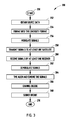
- a method of transmitting data using different modulations is generally shown in Fig. 3 at reference indicator 200.
- the method 200 starts at step 250, and proceeds to step 252, where source data is obtained.
- the source data is then formatted into the time diversity format by the time diversity device 20, at step 254.
- the method 200 modulates the signals at step 256.
- the transmitter 12 transmits the signals along a single satellite path to the at least one satellite 14, at step 258.
- the signals are received by the receiver 16 from the satellite 14, at step 260.
- the receiver 16 demodulates the received first and second signals at step 262.
- the receiver 16 then time aligns and combines the first and second signals at step 264.
- the signals must be time aligned due to being formatted in the time diversity format and the signals must be combined from being transmitted separately in the time diversity format and/or spatial diversity format.
- the receiver 16 then channel decodes the first and second signals at step 266, and source decodes the first and second signals at step 268.
- the method 200 ends at step 270.
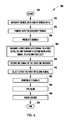
- a method of transmitting data using different modulations is generally shown in Fig. 4 at reference indicator 300, wherein like reference numerals represent like elements and/or steps.
- the method 300 includes the steps of formatting the source data into a time diversity format by the time diversity device 20, at step 254, modulating signals at step 256, demodulating signals at step 262, time aligning the signals at step 264, channel decoding the signals at step 266, and source decoding the signals at step 268, as described in method 200.
- the method 300 starts at step 250, and proceeds to step 352, where the transmitter 12 obtains high priority source data 118A and low priority source data 118B.
- the high priority source data 118A and low priority source data 118B are formatted into time diversity format by the time diversity device 20, at step 254, and modulated at step 256.
- the transmitter 12 then transmits a first modulated signal to a first satellite 114A, and transmits a second modulated signal to a second satellite 114B, such that two satellite signal paths are used, at step 358.
- the receiver 16 receives at least one of the first and second modulated signals from the first and second satellites 114A,114B, at step 360. If the receiver 16 receives both the first and second modulated signals, then the receiver 16 selects either the first or second modulated signal at step 372. Thus, both the first and second modulated signals can be processed or selected by the receiver 16, but the first and second modulated signals will not be combined when the source data of the first modulated signal differs from the source data of the second modulated signal, such as when the high priority source data 118A that differs from the low priority source data 118B is being transmitted.
- the receiver 16 then demodulates the signal at step 262, time aligns the signal at step 264, channel decodes the signal at step 266, and source decodes the signal at step 268.
- the method 300 ends at step 270.
- the communications system 10,110 and method 200,300 shown in Figs. 1-4 can be used to transmit signals over an odd number of frequency slots.
- a different modulation is used for the different signals, such as QPSK and 8-PSK modulations.
- QPSK modulations have two bits per frequency slot
- 8-PSK modulations have three bits per frequency slot.
- the receiver 16 can then demodulate and combine the QPSK and the 8-PSK modulated signals when the source data of the QPSK modulated signal is the same as the source data of the 8-PSK modulated signal. However, if the source data of the QPSK modulated signal differs from the source data of the 8-PSK modulated signal, then the signals are not combined by the receiver 16.
- the FEC rate must be altered for transmitting signals that are modulated differently from one another.
- the FEC rate for the 8-PSK modulated signal is 8/9 the FEC rate of the QPSK modulated signal. This allows each signal to transmit a similar energy bit per noise power (Eb/No) for one-half of the usable data bits.
- Another example of data transmission with the communication system 10,110 and method 200,300 is where the first signal is modulated in the 8-PSK modulation and transmitted over four frequency slots, such that twelve bits of data are being transmitted over four frequency slots.
- the second signal can also be modulated using the 8-PSK modulation and transmitted over three frequency slots, such that nine bits of data are being transmitted over three frequency slots.
- the FEC rate of the second modulated signal is then 4/3 the FEC rate of the first modulated signal in order to maintain the similar Eb/No for all usable data bits.
- any number of satellites, satellite signal paths, and/or terrestrial repeaters can be used in order to transmit the signals from the transmitter 12 to the receiver 16.
- the QPSK modulated signals can be transmitted to the first satellite 114A along a first satellite path and the 8-PSK modulated signals can be transmitted to the second satellite 114B along a second satellite path.
- a single satellite 14 can be used where both the QPSK modulated signals and the 8-PSK modulated signals are transmitted to the satellite 14 along a single satellite path.
- one satellite can be a high elevation satellite 114A and the second satellite can be a low elevation satellite 114B so that the signals are transmitted in a spatial diversity format.
- the satellites are highly elliptical orbit (HEO) satellites, then at some point during the orbital path, the satellites 114A,114B change from being the high elevation satellite to the low elevation satellite with respect to the receiver 16.
- high priority source data 118A is modulated using the QPSK modulation and transmitted to the high elevation satellite 114A
- low priority source data 118B is modulated using the 8-PSK modulation and transmitted to the low elevation satellite 114B.
- An example of high priority source data 118A is time sensitive data, such as streaming music being broadcast by the source provider. Thus, if the high priority source data 118A is not received, then the receiver 16 cannot produce the desired output, such as the output contains a mute or dropout.
- An example of low priority source data 118B is less time sensitive data that does not need to be broadcast immediately, such as, but not limited to, reports about the weather or traffic. Thus, the low priority source data 118B can be transmitted in a carousel format, such that the data is repeatedly transmitted, and the low priority source data 118B can be received by the receiver 16 during a repeated transmission.
- the low priority source data 118B is still relevant ten minutes after transmission, whereas high priority source data 118A, such as streaming music, is not recoverable if the receiver 16 does not receive the data as it is being broadcast by the source provider. Therefore, the high priority source data 118A is transmitted with a greater probability of reception to prevent the receiver 16 from emitting an undesirable output.
- the receiver 16 can be either a mobile device mounted in a vehicle, a mobile handheld device, or a stationary device. Typically, mobile devices and stationary devices can have increased received signal power when the data is transmitted from multiple sources, such as satellites 114A,114B. Further, transmitting the data in the time diversity format, spatial diversity format, or a combination thereof increases the probability of reception by the receiver 16.
- source data can be broadcast or transmitted by the source provider using an odd number of frequency slots.
- the source data can be transmitted in both a time diversity and spatial diversity format, and maintain a similar energy bit per noise power for the usable data bits.
- the data can be transmitted using different signal modulations by altering the time diversity or FEC rate.
- the source provider efficiently uses the frequency band.
- the received signal power increases by transmitting the signal from multiple sources when compared to systems that transmit the data from a single source.
Landscapes
- Engineering & Computer Science (AREA)
- Signal Processing (AREA)
- Computer Networks & Wireless Communication (AREA)
- Physics & Mathematics (AREA)
- Astronomy & Astrophysics (AREA)
- Aviation & Aerospace Engineering (AREA)
- General Physics & Mathematics (AREA)
- Radio Relay Systems (AREA)
- Radio Transmission System (AREA)
- Mobile Radio Communication Systems (AREA)
Applications Claiming Priority (1)
| Application Number | Priority Date | Filing Date | Title |
|---|---|---|---|
| US11/801,530 US20080279300A1 (en) | 2007-05-10 | 2007-05-10 | System and method of transmitting and receiving satellite digital radio signals over an odd number of frequency slots |
Publications (2)
| Publication Number | Publication Date |
|---|---|
| EP1990966A2 true EP1990966A2 (de) | 2008-11-12 |
| EP1990966A3 EP1990966A3 (de) | 2010-01-06 |
Family
ID=39590994
Family Applications (1)
| Application Number | Title | Priority Date | Filing Date |
|---|---|---|---|
| EP08154280A Withdrawn EP1990966A3 (de) | 2007-05-10 | 2008-04-09 | System und Verfahren zum Senden und Empfangen von digitalen Satellitenfunksignalen über eine ungerade Zahl von Frequenzschlitzen |
Country Status (2)
| Country | Link |
|---|---|
| US (1) | US20080279300A1 (de) |
| EP (1) | EP1990966A3 (de) |
Families Citing this family (13)
| Publication number | Priority date | Publication date | Assignee | Title |
|---|---|---|---|---|
| US9465097B2 (en) * | 2008-04-17 | 2016-10-11 | Aviation Communication & Surveillance Systems Llc | Systems and methods for providing ADS-B mode control through data overlay |
| US8270522B2 (en) * | 2009-04-13 | 2012-09-18 | Altobridge Limited | Joint channel estimation and modulation detection |
| GB201015801D0 (en) * | 2010-09-21 | 2010-10-27 | Newtec Cy Nv | Multiple access transmission scheme for a wireless system |
| US9659333B2 (en) | 2012-10-26 | 2017-05-23 | Disney Enterprises, Inc. | Dining experience management |
| US20140122170A1 (en) * | 2012-10-26 | 2014-05-01 | Disney Enterprises, Inc. | Detection of guest position |
| US9813262B2 (en) * | 2012-12-03 | 2017-11-07 | Google Technology Holdings LLC | Method and apparatus for selectively transmitting data using spatial diversity |
| US9591508B2 (en) | 2012-12-20 | 2017-03-07 | Google Technology Holdings LLC | Methods and apparatus for transmitting data between different peer-to-peer communication groups |
| US9979531B2 (en) | 2013-01-03 | 2018-05-22 | Google Technology Holdings LLC | Method and apparatus for tuning a communication device for multi band operation |
| US20140198717A1 (en) * | 2013-01-17 | 2014-07-17 | Delphi Technologies, Inc. | System and method for controlling ground transceiver communications with a satellite transceiver |
| US10229697B2 (en) | 2013-03-12 | 2019-03-12 | Google Technology Holdings LLC | Apparatus and method for beamforming to obtain voice and noise signals |
| US9549290B2 (en) | 2013-12-19 | 2017-01-17 | Google Technology Holdings LLC | Method and apparatus for determining direction information for a wireless device |
| US9491007B2 (en) | 2014-04-28 | 2016-11-08 | Google Technology Holdings LLC | Apparatus and method for antenna matching |
| US9478847B2 (en) | 2014-06-02 | 2016-10-25 | Google Technology Holdings LLC | Antenna system and method of assembly for a wearable electronic device |
Family Cites Families (6)
| Publication number | Priority date | Publication date | Assignee | Title |
|---|---|---|---|---|
| US5278863A (en) * | 1992-04-10 | 1994-01-11 | Cd Radio Incorporated | Radio frequency broadcasting systems and methods using two low-cost geosynchronous satellites |
| US6823169B2 (en) * | 1999-05-25 | 2004-11-23 | Xm Satellite Radio, Inc. | Low cost interoperable satellite digital audio radio service (SDARS) receiver architecture |
| US6580705B1 (en) * | 1999-10-28 | 2003-06-17 | Lucent Technologies Inc. | Signal combining scheme for wireless transmission systems having multiple modulation schemes |
| US7230998B2 (en) * | 2003-11-26 | 2007-06-12 | Delphi Technologies, Inc. | Method to increase performance of secondary data in a hierarchical modulation scheme |
| US20060285607A1 (en) * | 2005-06-16 | 2006-12-21 | The Boeing Company | High availability narrowband channel for bandwidth efficient modulation applications |
| US7904034B2 (en) * | 2006-12-18 | 2011-03-08 | Samsung Electronics Co., Ltd. | Method and system for providing an interference cancellation in a wireless communication system |
-
2007
- 2007-05-10 US US11/801,530 patent/US20080279300A1/en not_active Abandoned
-
2008
- 2008-04-09 EP EP08154280A patent/EP1990966A3/de not_active Withdrawn
Non-Patent Citations (1)
| Title |
|---|
| None |
Also Published As
| Publication number | Publication date |
|---|---|
| US20080279300A1 (en) | 2008-11-13 |
| EP1990966A3 (de) | 2010-01-06 |
Similar Documents
| Publication | Publication Date | Title |
|---|---|---|
| US20080279300A1 (en) | System and method of transmitting and receiving satellite digital radio signals over an odd number of frequency slots | |
| US6519262B1 (en) | Time division multiplex approach for multiple transmitter broadcasting | |
| EP2127408B1 (de) | Verfahren zur bereitstellung von rundfunkdiensten auf spotbeam-satelliten | |
| US20060285607A1 (en) | High availability narrowband channel for bandwidth efficient modulation applications | |
| CA2605444C (en) | Method and system for hierarchical modulation and demodulation for digital radio | |
| US20050276239A1 (en) | Antenna diversity system | |
| US7835692B2 (en) | Communication system and method of receiving high priority signals and low priority signals | |
| EP2031770B1 (de) | Kommunikationsanordnung und Verfahren zum Empfang von Signalen mit höherem und niedrigem Vorrang | |
| EP2031769B1 (de) | Kommunikationsanordnung und Verfahren zum Übertragen von Signalen zu einer Mehrheit von Endgeräten verschiedener Art | |
| EP2190134B1 (de) | Kommunikationssystem und Verfahren zur Signalkommunikation | |
| EP2738954A2 (de) | Empfänger für die Wiederherstellung von universellen Diensten in einem Spotbeam-Satellitenübertragungssystem und Verfahren | |
| KR102339244B1 (ko) | 위성 IoT 단말 및 이를 이용한 단방향 데이터 송신 방법 | |
| US20080293359A1 (en) | System and method of communicating and re-using frequencies within terrestrial and satellite signal paths | |
| US20060160486A1 (en) | Method and system for converting streaming digital data to FM modulated data | |
| EP2161861A2 (de) | Empfängervorrichtung und Verfahren zum Empfangen mehrerer Signale | |
| US7512159B2 (en) | Method for variable performance in communication systems | |
| Sallam et al. | A geo satellite system for broadcast audio and multimedia services targeting mobile users in europe | |
| Kikuchi et al. | Digital DBS system for new multimedia era | |
| Chandrasekhar et al. | Developments in the Global Satellite/Terrestrial Hybrid Mobile Audio and Multimedia Broadcasting System | |
| EP2387164A2 (de) | Satelliten Kommunikationssystem und entsprechendes Verfahren |
Legal Events
| Date | Code | Title | Description |
|---|---|---|---|
| PUAI | Public reference made under article 153(3) epc to a published international application that has entered the european phase |
Free format text: ORIGINAL CODE: 0009012 |
|
| AK | Designated contracting states |
Kind code of ref document: A2 Designated state(s): AT BE BG CH CY CZ DE DK EE ES FI FR GB GR HR HU IE IS IT LI LT LU LV MC MT NL NO PL PT RO SE SI SK TR |
|
| AX | Request for extension of the european patent |
Extension state: AL BA MK RS |
|
| PUAL | Search report despatched |
Free format text: ORIGINAL CODE: 0009013 |
|
| AK | Designated contracting states |
Kind code of ref document: A3 Designated state(s): AT BE BG CH CY CZ DE DK EE ES FI FR GB GR HR HU IE IS IT LI LT LU LV MC MT NL NO PL PT RO SE SI SK TR |
|
| AX | Request for extension of the european patent |
Extension state: AL BA MK RS |
|
| RIC1 | Information provided on ipc code assigned before grant |
Ipc: H04L 27/34 20060101ALI20091130BHEP Ipc: H04B 7/185 20060101ALI20091130BHEP Ipc: H04L 27/36 20060101AFI20080716BHEP |
|
| 17P | Request for examination filed |
Effective date: 20100706 |
|
| AKX | Designation fees paid |
Designated state(s): AT BE BG CH CY CZ DE DK EE ES FI FR GB GR HR HU IE IS IT LI LT LU LV MC MT NL NO PL PT RO SE SI SK TR |
|
| 17Q | First examination report despatched |
Effective date: 20100730 |
|
| STAA | Information on the status of an ep patent application or granted ep patent |
Free format text: STATUS: THE APPLICATION IS DEEMED TO BE WITHDRAWN |
|
| 18D | Application deemed to be withdrawn |
Effective date: 20111101 |