EP1992309B1 - Système de réduction d'usure d'une surface articulaire à implant - Google Patents
Système de réduction d'usure d'une surface articulaire à implant Download PDFInfo
- Publication number
- EP1992309B1 EP1992309B1 EP08005749A EP08005749A EP1992309B1 EP 1992309 B1 EP1992309 B1 EP 1992309B1 EP 08005749 A EP08005749 A EP 08005749A EP 08005749 A EP08005749 A EP 08005749A EP 1992309 B1 EP1992309 B1 EP 1992309B1
- Authority
- EP
- European Patent Office
- Prior art keywords
- implant component
- wear layer
- metallic
- hard
- polymeric
- Prior art date
- Legal status (The legal status is an assumption and is not a legal conclusion. Google has not performed a legal analysis and makes no representation as to the accuracy of the status listed.)
- Ceased
Links
Images


Classifications
-
- A—HUMAN NECESSITIES
- A61—MEDICAL OR VETERINARY SCIENCE; HYGIENE
- A61F—FILTERS IMPLANTABLE INTO BLOOD VESSELS; PROSTHESES; DEVICES PROVIDING PATENCY TO, OR PREVENTING COLLAPSING OF, TUBULAR STRUCTURES OF THE BODY, e.g. STENTS; ORTHOPAEDIC, NURSING OR CONTRACEPTIVE DEVICES; FOMENTATION; TREATMENT OR PROTECTION OF EYES OR EARS; BANDAGES, DRESSINGS OR ABSORBENT PADS; FIRST-AID KITS
- A61F2/00—Filters implantable into blood vessels; Prostheses, i.e. artificial substitutes or replacements for parts of the body; Appliances for connecting them with the body; Devices providing patency to, or preventing collapsing of, tubular structures of the body, e.g. stents
- A61F2/02—Prostheses implantable into the body
- A61F2/30—Joints
- A61F2/38—Joints for elbows or knees
-
- A—HUMAN NECESSITIES
- A61—MEDICAL OR VETERINARY SCIENCE; HYGIENE
- A61F—FILTERS IMPLANTABLE INTO BLOOD VESSELS; PROSTHESES; DEVICES PROVIDING PATENCY TO, OR PREVENTING COLLAPSING OF, TUBULAR STRUCTURES OF THE BODY, e.g. STENTS; ORTHOPAEDIC, NURSING OR CONTRACEPTIVE DEVICES; FOMENTATION; TREATMENT OR PROTECTION OF EYES OR EARS; BANDAGES, DRESSINGS OR ABSORBENT PADS; FIRST-AID KITS
- A61F2/00—Filters implantable into blood vessels; Prostheses, i.e. artificial substitutes or replacements for parts of the body; Appliances for connecting them with the body; Devices providing patency to, or preventing collapsing of, tubular structures of the body, e.g. stents
- A61F2/02—Prostheses implantable into the body
- A61F2/30—Joints
- A61F2/3094—Designing or manufacturing processes
-
- A—HUMAN NECESSITIES
- A61—MEDICAL OR VETERINARY SCIENCE; HYGIENE
- A61F—FILTERS IMPLANTABLE INTO BLOOD VESSELS; PROSTHESES; DEVICES PROVIDING PATENCY TO, OR PREVENTING COLLAPSING OF, TUBULAR STRUCTURES OF THE BODY, e.g. STENTS; ORTHOPAEDIC, NURSING OR CONTRACEPTIVE DEVICES; FOMENTATION; TREATMENT OR PROTECTION OF EYES OR EARS; BANDAGES, DRESSINGS OR ABSORBENT PADS; FIRST-AID KITS
- A61F2/00—Filters implantable into blood vessels; Prostheses, i.e. artificial substitutes or replacements for parts of the body; Appliances for connecting them with the body; Devices providing patency to, or preventing collapsing of, tubular structures of the body, e.g. stents
- A61F2/02—Prostheses implantable into the body
- A61F2/30—Joints
- A61F2/38—Joints for elbows or knees
- A61F2/3859—Femoral components
-
- A—HUMAN NECESSITIES
- A61—MEDICAL OR VETERINARY SCIENCE; HYGIENE
- A61F—FILTERS IMPLANTABLE INTO BLOOD VESSELS; PROSTHESES; DEVICES PROVIDING PATENCY TO, OR PREVENTING COLLAPSING OF, TUBULAR STRUCTURES OF THE BODY, e.g. STENTS; ORTHOPAEDIC, NURSING OR CONTRACEPTIVE DEVICES; FOMENTATION; TREATMENT OR PROTECTION OF EYES OR EARS; BANDAGES, DRESSINGS OR ABSORBENT PADS; FIRST-AID KITS
- A61F2/00—Filters implantable into blood vessels; Prostheses, i.e. artificial substitutes or replacements for parts of the body; Appliances for connecting them with the body; Devices providing patency to, or preventing collapsing of, tubular structures of the body, e.g. stents
- A61F2/02—Prostheses implantable into the body
- A61F2/30—Joints
- A61F2/38—Joints for elbows or knees
- A61F2/389—Tibial components
-
- A—HUMAN NECESSITIES
- A61—MEDICAL OR VETERINARY SCIENCE; HYGIENE
- A61F—FILTERS IMPLANTABLE INTO BLOOD VESSELS; PROSTHESES; DEVICES PROVIDING PATENCY TO, OR PREVENTING COLLAPSING OF, TUBULAR STRUCTURES OF THE BODY, e.g. STENTS; ORTHOPAEDIC, NURSING OR CONTRACEPTIVE DEVICES; FOMENTATION; TREATMENT OR PROTECTION OF EYES OR EARS; BANDAGES, DRESSINGS OR ABSORBENT PADS; FIRST-AID KITS
- A61F2/00—Filters implantable into blood vessels; Prostheses, i.e. artificial substitutes or replacements for parts of the body; Appliances for connecting them with the body; Devices providing patency to, or preventing collapsing of, tubular structures of the body, e.g. stents
- A61F2/02—Prostheses implantable into the body
- A61F2/30—Joints
- A61F2002/30001—Additional features of subject-matter classified in A61F2/28, A61F2/30 and subgroups thereof
- A61F2002/30003—Material related properties of the prosthesis or of a coating on the prosthesis
- A61F2002/30004—Material related properties of the prosthesis or of a coating on the prosthesis the prosthesis being made from materials having different values of a given property at different locations within the same prosthesis
- A61F2002/30014—Material related properties of the prosthesis or of a coating on the prosthesis the prosthesis being made from materials having different values of a given property at different locations within the same prosthesis differing in elasticity, stiffness or compressibility
-
- A—HUMAN NECESSITIES
- A61—MEDICAL OR VETERINARY SCIENCE; HYGIENE
- A61F—FILTERS IMPLANTABLE INTO BLOOD VESSELS; PROSTHESES; DEVICES PROVIDING PATENCY TO, OR PREVENTING COLLAPSING OF, TUBULAR STRUCTURES OF THE BODY, e.g. STENTS; ORTHOPAEDIC, NURSING OR CONTRACEPTIVE DEVICES; FOMENTATION; TREATMENT OR PROTECTION OF EYES OR EARS; BANDAGES, DRESSINGS OR ABSORBENT PADS; FIRST-AID KITS
- A61F2/00—Filters implantable into blood vessels; Prostheses, i.e. artificial substitutes or replacements for parts of the body; Appliances for connecting them with the body; Devices providing patency to, or preventing collapsing of, tubular structures of the body, e.g. stents
- A61F2/02—Prostheses implantable into the body
- A61F2/30—Joints
- A61F2002/30001—Additional features of subject-matter classified in A61F2/28, A61F2/30 and subgroups thereof
- A61F2002/30003—Material related properties of the prosthesis or of a coating on the prosthesis
- A61F2002/30004—Material related properties of the prosthesis or of a coating on the prosthesis the prosthesis being made from materials having different values of a given property at different locations within the same prosthesis
- A61F2002/30016—Material related properties of the prosthesis or of a coating on the prosthesis the prosthesis being made from materials having different values of a given property at different locations within the same prosthesis differing in hardness, e.g. Vickers, Shore, Brinell
-
- A—HUMAN NECESSITIES
- A61—MEDICAL OR VETERINARY SCIENCE; HYGIENE
- A61F—FILTERS IMPLANTABLE INTO BLOOD VESSELS; PROSTHESES; DEVICES PROVIDING PATENCY TO, OR PREVENTING COLLAPSING OF, TUBULAR STRUCTURES OF THE BODY, e.g. STENTS; ORTHOPAEDIC, NURSING OR CONTRACEPTIVE DEVICES; FOMENTATION; TREATMENT OR PROTECTION OF EYES OR EARS; BANDAGES, DRESSINGS OR ABSORBENT PADS; FIRST-AID KITS
- A61F2/00—Filters implantable into blood vessels; Prostheses, i.e. artificial substitutes or replacements for parts of the body; Appliances for connecting them with the body; Devices providing patency to, or preventing collapsing of, tubular structures of the body, e.g. stents
- A61F2/02—Prostheses implantable into the body
- A61F2/30—Joints
- A61F2/30767—Special external or bone-contacting surface, e.g. coating for improving bone ingrowth
- A61F2002/30934—Special articulating surfaces
-
- A—HUMAN NECESSITIES
- A61—MEDICAL OR VETERINARY SCIENCE; HYGIENE
- A61F—FILTERS IMPLANTABLE INTO BLOOD VESSELS; PROSTHESES; DEVICES PROVIDING PATENCY TO, OR PREVENTING COLLAPSING OF, TUBULAR STRUCTURES OF THE BODY, e.g. STENTS; ORTHOPAEDIC, NURSING OR CONTRACEPTIVE DEVICES; FOMENTATION; TREATMENT OR PROTECTION OF EYES OR EARS; BANDAGES, DRESSINGS OR ABSORBENT PADS; FIRST-AID KITS
- A61F2250/00—Special features of prostheses classified in groups A61F2/00 - A61F2/26 or A61F2/82 or A61F9/00 or A61F11/00 or subgroups thereof
- A61F2250/0014—Special features of prostheses classified in groups A61F2/00 - A61F2/26 or A61F2/82 or A61F9/00 or A61F11/00 or subgroups thereof having different values of a given property or geometrical feature, e.g. mechanical property or material property, at different locations within the same prosthesis
- A61F2250/0018—Special features of prostheses classified in groups A61F2/00 - A61F2/26 or A61F2/82 or A61F9/00 or A61F11/00 or subgroups thereof having different values of a given property or geometrical feature, e.g. mechanical property or material property, at different locations within the same prosthesis differing in elasticity, stiffness or compressibility
-
- A—HUMAN NECESSITIES
- A61—MEDICAL OR VETERINARY SCIENCE; HYGIENE
- A61F—FILTERS IMPLANTABLE INTO BLOOD VESSELS; PROSTHESES; DEVICES PROVIDING PATENCY TO, OR PREVENTING COLLAPSING OF, TUBULAR STRUCTURES OF THE BODY, e.g. STENTS; ORTHOPAEDIC, NURSING OR CONTRACEPTIVE DEVICES; FOMENTATION; TREATMENT OR PROTECTION OF EYES OR EARS; BANDAGES, DRESSINGS OR ABSORBENT PADS; FIRST-AID KITS
- A61F2250/00—Special features of prostheses classified in groups A61F2/00 - A61F2/26 or A61F2/82 or A61F9/00 or A61F11/00 or subgroups thereof
- A61F2250/0014—Special features of prostheses classified in groups A61F2/00 - A61F2/26 or A61F2/82 or A61F9/00 or A61F11/00 or subgroups thereof having different values of a given property or geometrical feature, e.g. mechanical property or material property, at different locations within the same prosthesis
- A61F2250/0019—Special features of prostheses classified in groups A61F2/00 - A61F2/26 or A61F2/82 or A61F9/00 or A61F11/00 or subgroups thereof having different values of a given property or geometrical feature, e.g. mechanical property or material property, at different locations within the same prosthesis differing in hardness, e.g. Vickers, Shore, Brinell
-
- A—HUMAN NECESSITIES
- A61—MEDICAL OR VETERINARY SCIENCE; HYGIENE
- A61F—FILTERS IMPLANTABLE INTO BLOOD VESSELS; PROSTHESES; DEVICES PROVIDING PATENCY TO, OR PREVENTING COLLAPSING OF, TUBULAR STRUCTURES OF THE BODY, e.g. STENTS; ORTHOPAEDIC, NURSING OR CONTRACEPTIVE DEVICES; FOMENTATION; TREATMENT OR PROTECTION OF EYES OR EARS; BANDAGES, DRESSINGS OR ABSORBENT PADS; FIRST-AID KITS
- A61F2310/00—Prostheses classified in A61F2/28 or A61F2/30 - A61F2/44 being constructed from or coated with a particular material
- A61F2310/00005—The prosthesis being constructed from a particular material
- A61F2310/00011—Metals or alloys
- A61F2310/00017—Iron- or Fe-based alloys, e.g. stainless steel
-
- A—HUMAN NECESSITIES
- A61—MEDICAL OR VETERINARY SCIENCE; HYGIENE
- A61F—FILTERS IMPLANTABLE INTO BLOOD VESSELS; PROSTHESES; DEVICES PROVIDING PATENCY TO, OR PREVENTING COLLAPSING OF, TUBULAR STRUCTURES OF THE BODY, e.g. STENTS; ORTHOPAEDIC, NURSING OR CONTRACEPTIVE DEVICES; FOMENTATION; TREATMENT OR PROTECTION OF EYES OR EARS; BANDAGES, DRESSINGS OR ABSORBENT PADS; FIRST-AID KITS
- A61F2310/00—Prostheses classified in A61F2/28 or A61F2/30 - A61F2/44 being constructed from or coated with a particular material
- A61F2310/00005—The prosthesis being constructed from a particular material
- A61F2310/00011—Metals or alloys
- A61F2310/00023—Titanium or titanium-based alloys, e.g. Ti-Ni alloys
-
- A—HUMAN NECESSITIES
- A61—MEDICAL OR VETERINARY SCIENCE; HYGIENE
- A61F—FILTERS IMPLANTABLE INTO BLOOD VESSELS; PROSTHESES; DEVICES PROVIDING PATENCY TO, OR PREVENTING COLLAPSING OF, TUBULAR STRUCTURES OF THE BODY, e.g. STENTS; ORTHOPAEDIC, NURSING OR CONTRACEPTIVE DEVICES; FOMENTATION; TREATMENT OR PROTECTION OF EYES OR EARS; BANDAGES, DRESSINGS OR ABSORBENT PADS; FIRST-AID KITS
- A61F2310/00—Prostheses classified in A61F2/28 or A61F2/30 - A61F2/44 being constructed from or coated with a particular material
- A61F2310/00005—The prosthesis being constructed from a particular material
- A61F2310/00011—Metals or alloys
- A61F2310/00029—Cobalt-based alloys, e.g. Co-Cr alloys or Vitallium
-
- A—HUMAN NECESSITIES
- A61—MEDICAL OR VETERINARY SCIENCE; HYGIENE
- A61F—FILTERS IMPLANTABLE INTO BLOOD VESSELS; PROSTHESES; DEVICES PROVIDING PATENCY TO, OR PREVENTING COLLAPSING OF, TUBULAR STRUCTURES OF THE BODY, e.g. STENTS; ORTHOPAEDIC, NURSING OR CONTRACEPTIVE DEVICES; FOMENTATION; TREATMENT OR PROTECTION OF EYES OR EARS; BANDAGES, DRESSINGS OR ABSORBENT PADS; FIRST-AID KITS
- A61F2310/00—Prostheses classified in A61F2/28 or A61F2/30 - A61F2/44 being constructed from or coated with a particular material
- A61F2310/00005—The prosthesis being constructed from a particular material
- A61F2310/00179—Ceramics or ceramic-like structures
- A61F2310/00185—Ceramics or ceramic-like structures based on metal oxides
- A61F2310/00203—Ceramics or ceramic-like structures based on metal oxides containing alumina or aluminium oxide
-
- A—HUMAN NECESSITIES
- A61—MEDICAL OR VETERINARY SCIENCE; HYGIENE
- A61F—FILTERS IMPLANTABLE INTO BLOOD VESSELS; PROSTHESES; DEVICES PROVIDING PATENCY TO, OR PREVENTING COLLAPSING OF, TUBULAR STRUCTURES OF THE BODY, e.g. STENTS; ORTHOPAEDIC, NURSING OR CONTRACEPTIVE DEVICES; FOMENTATION; TREATMENT OR PROTECTION OF EYES OR EARS; BANDAGES, DRESSINGS OR ABSORBENT PADS; FIRST-AID KITS
- A61F2310/00—Prostheses classified in A61F2/28 or A61F2/30 - A61F2/44 being constructed from or coated with a particular material
- A61F2310/00005—The prosthesis being constructed from a particular material
- A61F2310/00179—Ceramics or ceramic-like structures
- A61F2310/00185—Ceramics or ceramic-like structures based on metal oxides
- A61F2310/00239—Ceramics or ceramic-like structures based on metal oxides containing zirconia or zirconium oxide ZrO2
-
- A—HUMAN NECESSITIES
- A61—MEDICAL OR VETERINARY SCIENCE; HYGIENE
- A61F—FILTERS IMPLANTABLE INTO BLOOD VESSELS; PROSTHESES; DEVICES PROVIDING PATENCY TO, OR PREVENTING COLLAPSING OF, TUBULAR STRUCTURES OF THE BODY, e.g. STENTS; ORTHOPAEDIC, NURSING OR CONTRACEPTIVE DEVICES; FOMENTATION; TREATMENT OR PROTECTION OF EYES OR EARS; BANDAGES, DRESSINGS OR ABSORBENT PADS; FIRST-AID KITS
- A61F2310/00—Prostheses classified in A61F2/28 or A61F2/30 - A61F2/44 being constructed from or coated with a particular material
- A61F2310/00005—The prosthesis being constructed from a particular material
- A61F2310/00179—Ceramics or ceramic-like structures
- A61F2310/00269—Ceramics or ceramic-like structures based on metal carbides
- A61F2310/00281—Ceramics or ceramic-like structures based on metal carbides containing silicon carbide
-
- A—HUMAN NECESSITIES
- A61—MEDICAL OR VETERINARY SCIENCE; HYGIENE
- A61F—FILTERS IMPLANTABLE INTO BLOOD VESSELS; PROSTHESES; DEVICES PROVIDING PATENCY TO, OR PREVENTING COLLAPSING OF, TUBULAR STRUCTURES OF THE BODY, e.g. STENTS; ORTHOPAEDIC, NURSING OR CONTRACEPTIVE DEVICES; FOMENTATION; TREATMENT OR PROTECTION OF EYES OR EARS; BANDAGES, DRESSINGS OR ABSORBENT PADS; FIRST-AID KITS
- A61F2310/00—Prostheses classified in A61F2/28 or A61F2/30 - A61F2/44 being constructed from or coated with a particular material
- A61F2310/00005—The prosthesis being constructed from a particular material
- A61F2310/00179—Ceramics or ceramic-like structures
- A61F2310/00299—Ceramics or ceramic-like structures based on metal nitrides
- A61F2310/00317—Ceramics or ceramic-like structures based on metal nitrides containing silicon nitride
-
- A—HUMAN NECESSITIES
- A61—MEDICAL OR VETERINARY SCIENCE; HYGIENE
- A61F—FILTERS IMPLANTABLE INTO BLOOD VESSELS; PROSTHESES; DEVICES PROVIDING PATENCY TO, OR PREVENTING COLLAPSING OF, TUBULAR STRUCTURES OF THE BODY, e.g. STENTS; ORTHOPAEDIC, NURSING OR CONTRACEPTIVE DEVICES; FOMENTATION; TREATMENT OR PROTECTION OF EYES OR EARS; BANDAGES, DRESSINGS OR ABSORBENT PADS; FIRST-AID KITS
- A61F2310/00—Prostheses classified in A61F2/28 or A61F2/30 - A61F2/44 being constructed from or coated with a particular material
- A61F2310/00389—The prosthesis being coated or covered with a particular material
- A61F2310/00574—Coating or prosthesis-covering structure made of carbon, e.g. of pyrocarbon
- A61F2310/0058—Coating made of diamond or of diamond-like carbon DLC
-
- A—HUMAN NECESSITIES
- A61—MEDICAL OR VETERINARY SCIENCE; HYGIENE
- A61F—FILTERS IMPLANTABLE INTO BLOOD VESSELS; PROSTHESES; DEVICES PROVIDING PATENCY TO, OR PREVENTING COLLAPSING OF, TUBULAR STRUCTURES OF THE BODY, e.g. STENTS; ORTHOPAEDIC, NURSING OR CONTRACEPTIVE DEVICES; FOMENTATION; TREATMENT OR PROTECTION OF EYES OR EARS; BANDAGES, DRESSINGS OR ABSORBENT PADS; FIRST-AID KITS
- A61F2310/00—Prostheses classified in A61F2/28 or A61F2/30 - A61F2/44 being constructed from or coated with a particular material
- A61F2310/00389—The prosthesis being coated or covered with a particular material
- A61F2310/00592—Coating or prosthesis-covering structure made of ceramics or of ceramic-like compounds
- A61F2310/00856—Coating or prosthesis-covering structure made of compounds based on metal nitrides
- A61F2310/0088—Coating made of titanium nitride
-
- A—HUMAN NECESSITIES
- A61—MEDICAL OR VETERINARY SCIENCE; HYGIENE
- A61F—FILTERS IMPLANTABLE INTO BLOOD VESSELS; PROSTHESES; DEVICES PROVIDING PATENCY TO, OR PREVENTING COLLAPSING OF, TUBULAR STRUCTURES OF THE BODY, e.g. STENTS; ORTHOPAEDIC, NURSING OR CONTRACEPTIVE DEVICES; FOMENTATION; TREATMENT OR PROTECTION OF EYES OR EARS; BANDAGES, DRESSINGS OR ABSORBENT PADS; FIRST-AID KITS
- A61F2310/00—Prostheses classified in A61F2/28 or A61F2/30 - A61F2/44 being constructed from or coated with a particular material
- A61F2310/00389—The prosthesis being coated or covered with a particular material
- A61F2310/00592—Coating or prosthesis-covering structure made of ceramics or of ceramic-like compounds
- A61F2310/00856—Coating or prosthesis-covering structure made of compounds based on metal nitrides
- A61F2310/00886—Coating made of chromium nitride
Definitions
- This invention relates to implant devices, and, more particularly, to an implant articular surface wear reduction system comprising a polymeric implant component, a rigid implant component, and a hard wear layer.
- prosthetic implant depends on the resistance that the implant has to the extreme conditions found in the human body. Proper material selection is paramount in preventing premature implant failure. In addition to the chemical and biological imposed material challenges, articulating surfaces on orthopedic implants have an additional abrasion resistance requirement. Prosthetic implants must be designed to meet these challenges.
- Prosthetic implants such as those used in a total joint arthroplasty, generally have multiple articulating surfaces that slide and rotate in contact with one another, often while under a load. So, the articulating surface must first resist degradation from attack by the biological fluids, and second, the surfaces must resist wear due to continuous frictional contact with an opposing articulating surface.
- a prosthetic implant replaces a femoro-tibial joint, commonly called a knee.
- the knee is a complex joint between multiple bones and a group of ligaments. Two of the primary bones are a femur and a tibia. The knee exists at a junction between the ends of those two bones.
- the prosthetic implant replaces a portion of each of the femur and the tibia.
- the synthetic materials of the prosthesis specifically replace the condylar surfaces of the femur and condylar surfaces of a tibia.
- the prosthetic joint also replaces the two meniscuses (i.e. the medial and lateral meniscuses) situated between the condylar surfaces of the femur and the tibia.
- the meniscuses are made of fibrocartilage, which gives them elastic properties.
- the meniscuses function to improve the fit between the condyles of the femur and the tibia, to absorb shock and distribute load in the knee, and to help move lubricating fluid around the knee.
- the prosthetic implant must mimic the natural kinematics of the original knee component including the function of the meniscuses.
- Knee flexion/extension involves a combination of rolling and sliding called femoral rollback.
- the condyles are specially adapted to perform this asymmetrical motion. Because of asymmetry between the lateral and medial femoral condyles, the lateral condyle rolls a greater distance than the medial condyle during knee flexion.
- the sliding and rolling motions in conjunction with complex loading conditions, creates a unique and a demanding problem for any knee prosthesis.
- the first goal is to eliminate the dysfunctional joint, whether due to arthritis, disease, or injury.
- Another goal is to achieve an optimum level of performance.
- the prosthetic implant plant must provide nearly the same kinematic motion as the natural joint.
- the prosthesis should be durable because total joint arthroplasty is a serious surgical procedure. It is preferable that the joint should outlast its host.
- the performance of a prosthetic implant is also assessed by its resistance to wear. The biological cellular reactions to wear particles have been found to cause bone resorption which results in implant loosening and, consequently, corrective surgeries.
- Traditional metal or polyethylene knee implants consist of metallic femoral components and polymeric monoblocks or tibial trays.
- US-A-5 180 398 relates to an implant wear reduction system as set out in the pre-characterising portion of claim 1.
- this document does not disclose a mounting surface including a first recess and a hard wear layer positioned in the recess.
- DE 100 51 437 A1 describes a tibial component of a knee prosthesis which is made of a graded polymer material.
- the polymer material has a hard surface and elastic structures located under the surface.
- US-B1-6 203 844 relates to a polymeric prosthesis pre-coated with a bone cement compatible polymer.
- WO 03/049781 A describes a surface for a prosthesis comprising a metallic material with a textured surface and oxidation layer coating.
- DE 20 2006 012902 U1 relates to an implant comprising an implant material, an artificial joint surface and a wear-reducing hard coating.
- EP-A-0 519 872 relates to a wear-reducing knee prosthesis.
- US 2007/032877 A1 describes a prosthetic joint having first and second bearing members, at least one of which has a ceramic substrate and a carbon coating.
- WO 2007/103714 A describes prosthetic joints comprising a metal, ceramic or polymer substrate and a protection coating of tetrahedral bonded carbon. None of these documents a disclose a mounting surface including a first recess and a hard wear layer positioned in the recess.
- the implant articular surface wear reduction system must reduce wear between implant articulation surfaces, and thus improve the longevity of the prosthetic implant.
- the implant articular surface wear reduction system must permit natural kinematic motion and provide a low-friction, durable prosthetic joint.
- the present invention provides an implant articular surface wear reduction system which improves orthopedic prosthetic joint longevity by reducing frictional abrasive wear.
- the system includes a rigid implant component and a polymeric implant component.
- the rigid implant component has a working surface.
- the working surface is one opposing articular surface of a joint.
- the polymeric plant component has a mounting surface to which a hard wear layer is attached.
- the hard wear layer represents the other opposing articular surface of the joint.
- motion of the rigid implant component may cause the working surface of the rigid implant component to move while in contact with the opposing articular surface on the hard wear layer.
- the mounting surface on the polymeric implant component has a first recess such that the hard wear layer is positioned within the first recess.
- the rigid implant component and the hard wear layer comprise ceramic material.
- the rigid implant component comprises a metal, and a non-metallic wear layer is attached to the working surface.
- the non-metallic wear layer represents an opposing articular surface of a joint.
- the working surface on the rigid implant component has a second recess such that the non-metallic wear layer is positioned within the second recess.
- the polymeric implant component is a tibial implant and the hard wear layer is a metal or a ceramic
- the rigid implant component is a femoral implant and the non-metallic wear layer is a polymer, such as polyethylene, PEEK, PEKK, polypropylene, or PrimoSpireTM self-reinforced polyphenylene (SRP).
- the opposing articular surfaces retain fluid interposed between the two articular surfaces.
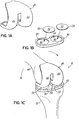
- FIG. 1A is a perspective view of one embodiment of a rigid implant component
- FIG. 1B is a disassembled perspective view of one embodiment of a polymeric implant component and a hard wear layer positioned for attachment to the component;
- FIG. 1C is an assembled perspective view of the embodiment of the invention depicting the rigid implant component from FIG. 1A attached to a femur and the polymeric implant component from FIG. 1B attached to a tibia.
- FIG. 2 is a disassembled view of one embodiment of the rigid implant component and a non-metallic wear layer positioned for attachment to the component;
- FIG. 2A is a partial perspective view of an encircled area 1A of FIG. 2 of one embodiment of a non-metallic wear layer including a ceramic coating;
- FIG. 3 is an assembled perspective view of the embodiment of the invention depicting the rigid implant component from FIG. 2 attached to a femur and the polymeric implant component from FIG. 1B attached to a tibia.
- an implant articular surface wear reduction system 10 has a rigid implant component 20 and a polymeric implant component 40.
- FIG. 1A illustrates one embodiment of the rigid implant component 20.
- the rigid implant component 20 has a working surface 22.
- the rigid implant component 20 comprises a ceramic.
- the ceramic may be an oxide ceramic, such as alumina or zirconia; non-oxide ceramic, such as silicon nitride or silicon carbide; or other ceramic materials that are biologically inert, and yet are sufficiently hard and abrasion resistant.
- the ceramic may be a monolith or, alternatively, the ceramic may be a plurality of discrete micro- or macroscopic particles held in a matrix.
- the rigid implant component 20 comprises a metal with a ceramic coating (not shown) on the working surface 22.
- the ceramic coating may be sprayed onto the working surface 22 by, for example, plasma spray, flame spray, HVOF spray, cold spray, or other spray coating technique that provides bonding to the working surface 22.
- FIG. 1B illustrates an embodiment of the polymeric implant component 40.
- the polymeric implant component 40 has a mounting surface 42.
- a hard wear layer 50 is attached to the mounting surface 42, and the hard wear layer 50 has a hard articular surface 52.
- the hard wear layer 50 may be attached to the polymeric implant component 40 with an appropriate adhesive, welding, or other biologically inert and resistant means.
- the polymeric implant component 40 may comprise polyethylene, including ultra high weight molecular weight polyethylene (UHMW PE); polyetheretherketone (PEEK); polyetherketoneketone (PEKK); polycarbonate urethane (PCU); or PrimoSpire TM self-reinforced polyphenylene (SRP), available from SOLVAY Advanced Polymers, LLC, Alpharetta, Georgia; or other biologically inert or compatible polymers.
- UHMW PE ultra high weight molecular weight polyethylene
- PEEK polyetheretherketone
- PEKK polyetherketoneketone
- PCU polycarbonate urethane
- SRP PrimoSpire TM self-reinforced polyphenylene
- the polymeric implant component 40 may have a first recess 44.
- the mounting surface 42 may reside within the first recess 44.
- the hard wear layer 50 may be secured within the first recess 44. Shear stresses on a hard wear layer-to-polymeric implant component interface may be borne, in part, by the first recess 44.
- the first recess 44 may substantially prevent the hard wear layer 50 from detaching from the polymeric implant component 40.
- the polymeric implant component 40 may be formed around the hard wear layer 50 by injection molding, or the like, to create an intimate, load-bearing interface between the polymeric implant component 40 and the hard wear layer 50.
- the hard wear layer 50 attached to the polymeric implant component 40 is a ceramic insert.
- the ceramic insert may be attached within the first recess 44 in the polymeric implant component 40.
- the ceramic insert may be an oxide ceramic, such as alumina or zirconia; non-oxide ceramic, such as silicon nitride or silicon carbide; or other ceramic materials that are biologically inert, and yet are sufficiently hard and abrasion resistant.
- the ceramic insert may be a monolith or, alternatively, the ceramic insert may be a plurality of discrete micro- or macroscopic particles held in a matrix.
- FIG. 1C illustrates the system 10 where the rigid implant component 20 is adapted to be attached to a first bone 60, and the polymeric implant component 40 is adapted to be attached to a second bone 70 where the first and second bones 60, 70 meet to form a natural articular joint.
- the rigid implant component 20 is adapted to rotate and slide against the hard wear layer 50.
- the polymeric implant component 40 may exhibit some elasticity during loading to allow axial deflection or deformation of the polymeric implant component 40 between the bone 70 and the hard wear layer 50.
- loads may pass from the first bone 60 to the rigid implant component 20, through the hard wear layer 50, through the polymeric implant component 40 and into the second bone 70.
- Pressures exerted on the bones 60, 70 may be partially absorbed and dispersed by the polymeric implant component 40 with little or no wear of the working surface 22 or the hard wear layer 50.
- a lubricating fluid (not shown) may be retained between the working surface 22 and the hard articular surface 52.
- Each of the working and hard articular surfaces 22, 52 individually or in combination may be treated, honed, dimpled, or otherwise provided with surface topography which retain the lubricating fluid between the working and hard articular surfaces 22, 52.
- FIG. 2 Another embodiment of the rigid implant component 20 is illustrated in FIG. 2 .
- a non-metallic wear layer 30 is attached to the working surface 22.
- the non-metallic wear layer 30 has a non-metallic articular surface 32.
- the non-metallic wear layer 30 may be attached to the rigid implant component 20 with an appropriate adhesive, welding, or other biologically inert and resistant means.
- the rigid implant component 20 may comprise titanium, a titanium alloy, a cobalt chromium alloy, a zirconium alloy, a stainless steel, or other biocompatible metal.
- the non-metallic wear layer 30, which is attached to the:rigid implant component 20, is adapted to rotate and slide against the hard wear layer 50.
- the polymeric implant component 40 may exhibit some elasticity during loading to allow axial deflection or deformation of the polymeric implant component 40 between the bone 70 and the hard wear layer 50.
- the non-metallic wear layer 30 may provide elasticity or flexibility between hard wear layer 50 and the rigid implant component 20. Therefore, pressures exerted on the bones 60, 70 may be partially absorbed during elastic motion of the polymeric implant component 40 and the non-metallic wear layer 30.
- deformation of the non-metallic wear layer 30 at the hard wear layer-to-non-metallic wear layer interface may distribute applied loads across a greater area, which will lessen the pressures at this interface.
- the hard wear layer 50 attached to the polymeric implant component 40 is a metal insert. Similar to the ceramic insert, as discussed above, the metal insert may be attached within the first recess 44 in the polymeric implant component 40.
- the metal insert is adapted to articulate against the non-metallic wear layer 30.
- the metal insert may comprise titanium, a titanium alloy, a cobalt chromium alloy, stainless steel, or other biocompatible metal having sufficient hardness and resistance to the in vivo environment.
- the metal insert may be configured as a single component or may be multiple metallic pieces arranged within the first recess 44 of the polymeric implant component 40.
- the hard wear layer 50 may be provided with coatings, such as TiN, Cr 2 N, and Diamond-Like Coatings (DLC), as are known in the art, to further enhance their durability.
- DLC Diamond-Like Coatings
- the system 10 is implanted in vivo and replaces the natural articular joint. Specifically, and as shown in FIGS. 1C and 3 , the rigid implant component 40 is attached to a portion of the first bone 60, and the polymeric implant component 20 is attached to a portion of the second bone 70. Any cartilage between the first and second bones 60, 70 is removed.
- the rigid implant component 20 and the polymeric implant component 40 are positioned substantially adjacent to one another. The system 10, therefore, replaces portions of the first and the second bone surfaces of the natural articular joint with the non-metallic articular surface 32 and hard articular surface 52.
- the non-metallic articular surface 32 and the hard articular surface 52 permit the sliding and rotating motion similar to the natural articular joint.
- activity such as running, throwing, lifting, swimming, or pulling
- the pressures exerted are transferred through the system 10 causing the non-metallic wear layer 30 to articulate against the hard wear layer 50.
- loads may pass from the first bone 60 to the rigid implant component 20 through the non-metallic wear layer 30, through the hard wear layer 50, through the polymeric implant component 40 and into the second bone 70.
- Pressures exerted on the bones 60, 70 may be partially absorbed and dispersed by the polymeric implant component 40 and the non-metallic wear layer 30 due to their elasticity.
- the system 10 may act to distribute the pressures across a larger area and lessen the pressures at the hard wear layer-to-non-metallic wear layer interface.
- the non-metallic wear layer 30 and the hard wear layer 50 slide and rotate against one another and yet substantially little wear is observed.
- the lubricating fluid (not shown) may be retained between the non-metallic articular surface 32 and the hard articular surface 52.
- Each of the non-metallic and hard articular surfaces 32, 52 individually or in combination may be treated, honed, dimpled, or otherwise provided with surface topography which retain the lubricating fluid between the non-metallic and hard articular surfaces 32, 52.
- the rigid implant component 20 may be characterized as occupying a volume that is substantially greater than a volume of the non-metallic wear layer 30.
- the rigid implant component 20 may not substantially deflect while under load.
- Rigidity of the rigid implant component 20 may permit uniform, predictable, and consistent loading of the non-metallic wear layer 30. Consequently, when loaded, the non-metallic articular surface 32 receives substantially uniform frictional contact with the hard wear layer 50, and thus, rigidity of the rigid implant component 20 may limit abrasion along any specific portion of the non-metallic articular surface 32.
- the rigid implant component 20 has a second recess 24.
- the second recess 24 is formed such that the working surface 22 is positioned within the second recess 24.
- the second recess 24 may cooperate with the non-metallic wear layer 30 such that the non-metallic wear layer 30 may be inserted therein.
- the second recess 24 may then structurally support the non-metallic wear layer 30 during use.
- shear stresses on the non-metallic wear layer-to-rigid implant component interface may be distributed to the second recess 24, and at least partially to the rigid implant component 20.
- detachment of the non-metallic wear layer 30 may be avoided by more fully supporting the non-metallic wear layer 30 with the second recess 24.
- the non-metallic wear layer 30 may be formed within the second recess 24, such as, by injection molding or other forming technique such that the non-metallic wear layer 30 substantially fills the second recess 24 and is bonded to the rigid implant component 20.
- the non-metallic wear layer 30 attached to the rigid implant component 20 may be a polymeric insert.
- the polymeric insert may be attached within the second recess 24 in the rigid implant component 20.
- the polymer of the polymeric insert may comprise polyethylene (PE) or any one of a number of other biocompatible polymeric materials that generally exhibit sufficient elastic properties at pressures observed in the natural articular joint.
- the polymeric insert may comprise a polyetheretherketone (PEEK), a polyetherketoneketone (PEKK), a polyetherketoneetherketoneketone (PEKEKK), or a polymethylmethacrylate (PMMA).
- the polymeric insert may comprise a single polymer, a co-polymer, PrimoSpire TM self-reinforced polyphenylene (SRP), or a polymer blend.
- the polymer selection may depend upon the joint in question. For example, joints in an arm experience different overall loading levels under different motions, thus justifying a different material for the non-metallic wear layer 30 than for a knee joint.
- the non-metallic wear layer 30 may also or alternatively comprise another non-metallic, synthetic material that has material properties similar to a healthy meniscus or one that absorbs or distributes stresses, particularly when loaded with compressive stress or shear stress, and that resists degradation due to continuous frictional contact with the hard wear layer 50.
- the non-metallic wear layer 30' includes a ceramic coating 30b at the non-metallic articular surface 32, which is applied on a non-metallic substrate 30a, for example, a polymer substrate.
- the pressures exerted on the bone 70 are passed to the polymeric implant component 40, the hard wear layer 50, the ceramic coating 30b, the non-metallic substrate 30a, and the rigid implant component 20.
- the ceramic coating 30b is therefore adapted to articulate against the hard wear layer 50.
- the system 10 absorbs and distributes loads.
- the ceramic coating 30b may be formed on the non-metallic substrate 30a by methods known by those skilled in the art, for example, by plasma spray, flame spray, HVOF spray, cold spray, or other spray coating technique that provides bonding without substantial degradation to the non-metallic substrate 30a.
- the ceramic coating 30b may also be formed by ion implantation, ion beam assisted deposition, CVD, or PVD as is known in the art.
- the system 10 is a prosthetic implant used in total knee arthroscopy, as is known in the art for replacing the knee joint due to osteoarthritis, rheumatoid arthritis, traumatic arthritis, or other condition causing pain or limiting the functionality of the knee. While FIGS. 1C and 3 depict a prosthetic used in total knee arthroscopy, the system 10 is not limited solely to knee replacement. Other joints in humans, as well as is quadrupeds, may be replaced with the system 10.
- the system 10 may replace a deteriorated femoral head and acetabulum, or the system 10 may replace other joints such as those in a digit or a shoulder, or a stifle in a quadraped.
- the rigid implant component 20 may be attached to the femur and thus referred to as a femoral implant. Consequently, the polymeric implant component 40 may be attached to the tibia and thus referred to as a tibial implant.
- the system 10 replaces the knee joint and may substantially mimic the motion of the natural knee. More specifically, as shown in FIG. 3 , the non-metallic articular surface 32 and the hard articular surface 52 are in frictional contact during femoral rollback, such as while walking, running, and jumping. While FIG.
- the system 10 is not limited to this physiological configuration.
- the non-metallic articular surface 32 may be a single surface in frictional contact with the hard articular surface 52 configured as a single surface.
- the femoral implant may comprise a metal, for example, titanium, a cobalt chrome alloy, or stainless steel.
- the tibial implant may comprise polyethylene or polyetheretherketone (PEEK), polyetherketoneketone, polypropylene, or PrimoSpire TM self-reinforced polyphenylene (SRP).
- the hard wear layer 50 is a ceramic insert. Therefore, in FIG. 1C , the working surface 22 articulates against the ceramic insert, and, in FIG. 3 , the non-metallic wear layer 30 articulates against the ceramic insert.
- the system 10 bears and transmits pressures from longitudinal and lateral loading by absorbing and distributing those loads through the polymeric implant component 40, the ceramic insert, the non-metallic wear layer 30, shown in FIG. 3 , and the rigid implant component 20. Loads which cause motion of the femur with respect to the tibia may also cause the hard articular surface 52 to articulate against the non-metallic articular surface 32. In summary, little or no wear is observed on either the ceramic insert or non-metallic wear layer 30.
Landscapes
- Health & Medical Sciences (AREA)
- Orthopedic Medicine & Surgery (AREA)
- Physical Education & Sports Medicine (AREA)
- Cardiology (AREA)
- Oral & Maxillofacial Surgery (AREA)
- Transplantation (AREA)
- Engineering & Computer Science (AREA)
- Biomedical Technology (AREA)
- Heart & Thoracic Surgery (AREA)
- Vascular Medicine (AREA)
- Life Sciences & Earth Sciences (AREA)
- Animal Behavior & Ethology (AREA)
- General Health & Medical Sciences (AREA)
- Public Health (AREA)
- Veterinary Medicine (AREA)
- Prostheses (AREA)
- Materials For Medical Uses (AREA)
Claims (20)
- Système (10) de réduction de l'usure d'une surface articulaire d'un implant comprenant :un composant (20) d'implant rigide ayant une surface de travail (22) ;un composant (40) d'implant polymère ayant une surface de montage (42) ; etune couche d'usure dure (50) ayant une surface articulaire dure (52), moyennant quoi la couche d'usure dure (50) est fixée à la surface de montage (42), de façon à ce que la surface articulaire dure (52) soit adaptée pour s'articuler contre la surface de travail (22) lorsque le composant (20) d'implant rigide pivote par rapport au composant (40) d'implant polymère, caractérisé en ce que la surface de montage (42) comporte en outre un premier évidement (44), et la couche d'usure dure (50) est positionnée dans le premier évidement (44).
- Système (10) de la revendication 1 caractérisé en ce qu'un volume de matériau polymère comprenant le composant (40) d'implant polymère est supérieur à un volume de matériau d'usure dur comprenant la couche d'usure dure (50).
- Système (10) de la revendication 1 caractérisé en ce que le composant (40) d'implant polymère comprend du polyétheréthercétone.
- Système (10) de la revendication 1 caractérisé en ce que le composant (20) d'implant rigide comprend de la céramique.
- Système (10) de la revendication 1 caractérisé en ce que le composant (40) d'implant polymère est un implant tibial et le composant (20) d'implant rigide est un implant fémoral.
- Système (10) de la revendication 1 caractérisé en ce que la couche d'usure dure (50) comprend de la céramique.
- Système (10) de la revendication 1 caractérisé en ce que la surface articulaire dure (52) a un moyen destiné à retenir un fluide de lubrification sur la couche d'usure dure (50).
- Système (10) de la revendication 1 caractérisé en ce que le composant (20) d'implant rigide est un métal.
- Système (10) de la revendication 8 caractérisé en ce qu'il comporte en outre un revêtement en céramique positionné sur la surface de travail (42), moyen par lequel la couche d'usure dure (50) est adaptée pour s'articuler contre le revêtement en céramique lorsque le composant (20) d'implant rigide pivote contre le composant (40) d'implant polymère.
- Système (10) de la revendication 8 caractérisé en ce qu'une couche d'usure non-métallique (30) ayant une surface articulaire non-métallique (32) est fixée à la surface de travail (22).
- Système (10) de la revendication 10 caractérisé en ce que la surface de travail (22) comporte en outre un deuxième évidement (24), et la couche d'usure non-métallique (30) est positionnée dans le deuxième évidement (24).
- Système (10) de la revendication 10 caractérisé en ce qu'un volume d'un matériau métallique comprenant le composant (20) d'implant rigide est supérieur à un volume d'un matériau non-métallique comprenant la couche d'usure non-métallique (30).
- Système (10) de la revendication 10 caractérisé en ce que la couche d'usure non-métallique (30) comprend de la céramique.
- Système (10) de la revendication 10 caractérisé en ce que la couche d'usure non-métallique (30) comprend un polymère choisi parmi du polyétheréthercétone, polyéthercétonecétone, polyphénylène auto-renforcé, polyéthercétoneéthercétonecétone, ou polyméthacrylate de méthyle, ou leur combinaison.
- Système (10) de la revendication 10 caractérisé en ce qu'il comporte en outre un revêtement (30b) en céramique positionné sur la surface articulaire non-métallique (32) de la couche d'usure non-métallique (30), moyen par lequel la couche d'usure dure (50) est adaptée pour articuler contre le revêtement (30b) en céramique lorsque le composant (20) d'implant rigide pivote contre le composant (40) d'implant polymère.
- Système (10) de la revendication 10 caractérisé en ce que la couche d'usure dure (50) comporte un métal.
- Système (10) de la revendication 8 caractérisé en ce que le composant (20) d'implant rigide comprend un alliage de titane.
- Système (10) de la revendication 8 caractérisé en ce que le composant (20) d'implant rigide comprend un alliage cobalt-chrome.
- Système (10) de la revendication 8 caractérisé en ce que le composant (20) d'implant rigide comprend un alliage de zirconium.
- Système (10) de la revendication 8 caractérisé en ce que la surface de travail (22) a un moyen destiné à retenir un fluide de lubrification sur le composant (20) d'implant rigide.
Applications Claiming Priority (1)
| Application Number | Priority Date | Filing Date | Title |
|---|---|---|---|
| US11/749,598 US20080288081A1 (en) | 2007-05-16 | 2007-05-16 | Implant articular surface wear reduction system |
Publications (2)
| Publication Number | Publication Date |
|---|---|
| EP1992309A1 EP1992309A1 (fr) | 2008-11-19 |
| EP1992309B1 true EP1992309B1 (fr) | 2011-04-20 |
Family
ID=39683758
Family Applications (1)
| Application Number | Title | Priority Date | Filing Date |
|---|---|---|---|
| EP08005749A Ceased EP1992309B1 (fr) | 2007-05-16 | 2008-03-27 | Système de réduction d'usure d'une surface articulaire à implant |
Country Status (5)
| Country | Link |
|---|---|
| US (1) | US20080288081A1 (fr) |
| EP (1) | EP1992309B1 (fr) |
| JP (1) | JP2008284348A (fr) |
| CA (1) | CA2625392A1 (fr) |
| DE (1) | DE602008006293D1 (fr) |
Cited By (1)
| Publication number | Priority date | Publication date | Assignee | Title |
|---|---|---|---|---|
| US12569347B2 (en) | 2023-03-29 | 2026-03-10 | Depuy Ireland Unlimited Company | Metal-reinforced polymer femoral component of an orthopaedic knee prosthesis and associated method of making the same |
Families Citing this family (49)
| Publication number | Priority date | Publication date | Assignee | Title |
|---|---|---|---|---|
| US8388684B2 (en) | 2002-05-23 | 2013-03-05 | Pioneer Signal Technology, Inc. | Artificial disc device |
| EP2063817A4 (fr) * | 2006-09-15 | 2012-04-18 | Pioneer Surgical Technology Inc | Dispositifs d'arthroplastie articulaire pourvus d'éléments d'articulation |
| US8715350B2 (en) | 2006-09-15 | 2014-05-06 | Pioneer Surgical Technology, Inc. | Systems and methods for securing an implant in intervertebral space |
| US7833274B2 (en) * | 2007-05-16 | 2010-11-16 | Zimmer, Inc. | Knee system and method of making same |
| US8828088B2 (en) * | 2007-11-08 | 2014-09-09 | Linares Medical Devices, Llc | Joint assembly incorporating undercut surface design to entrap accumulating wear debris from plastic joint assembly |
| US9539097B2 (en) | 2007-11-08 | 2017-01-10 | Linares Medical Devices, Llc | Hip and knee joint assemblies incorporating debris collection architecture between the ball and seat interface |
| US8979938B2 (en) * | 2007-11-08 | 2015-03-17 | Linares Medical Devices, Llc | Artificial knee implant including liquid ballast supporting / rotating surfaces and incorporating flexible multi-material and natural lubricant retaining matrix applied to a joint surface |
| WO2009091802A2 (fr) * | 2008-01-14 | 2009-07-23 | Zimmer, Inc. | Système du genou et son procédé de fabrication |
| CN102026591A (zh) * | 2008-02-25 | 2011-04-20 | 利纳雷斯医疗设备有限责任公司 | 用于安装至原有关节骨骼的人造耐磨栓 |
| WO2009120776A2 (fr) * | 2008-03-26 | 2009-10-01 | Linares Medical Devices, Llc | Construction d'une articulation, telle que destinée à être utilisée par des athlètes |
| US8642112B2 (en) * | 2008-07-16 | 2014-02-04 | Zimmer, Inc. | Thermally treated ceramic coating for implants |
| US8123815B2 (en) | 2008-11-24 | 2012-02-28 | Biomet Manufacturing Corp. | Multiple bearing acetabular prosthesis |
| FR2940760B1 (fr) | 2009-01-08 | 2010-12-31 | Memometal Technologies | Implant orthopedique pour arthroplastie digitale |
| CA2706233C (fr) | 2009-06-04 | 2015-05-05 | Howmedica Osteonics Corp. | Surfaces de protheses orthopediques en polymere peek |
| GB2471508A (en) * | 2009-07-02 | 2011-01-05 | Invibio Ltd | Composite enclosure with specific WVTR and impact strength, used in an implantable device |
| US8308810B2 (en) | 2009-07-14 | 2012-11-13 | Biomet Manufacturing Corp. | Multiple bearing acetabular prosthesis |
| US8123813B2 (en) * | 2009-07-14 | 2012-02-28 | Biomet Manufacturing Corp. | Pyrocarbon orthopedic implant |
| EP2482763A4 (fr) * | 2009-10-02 | 2013-02-27 | Said G Osman | Diarthrose biologique |
| WO2014015309A1 (fr) | 2012-07-20 | 2014-01-23 | Jcbd, Llc | Système d'ancrage orthopédique et procédés |
| US9421109B2 (en) | 2010-01-13 | 2016-08-23 | Jcbd, Llc | Systems and methods of fusing a sacroiliac joint |
| CA3002234C (fr) | 2010-01-13 | 2020-07-28 | Jcbd, Llc | Systeme de fusion de fixation d'articulation sacro-iliaque |
| US9381045B2 (en) | 2010-01-13 | 2016-07-05 | Jcbd, Llc | Sacroiliac joint implant and sacroiliac joint instrument for fusing a sacroiliac joint |
| US9788961B2 (en) | 2010-01-13 | 2017-10-17 | Jcbd, Llc | Sacroiliac joint implant system |
| US9333090B2 (en) | 2010-01-13 | 2016-05-10 | Jcbd, Llc | Systems for and methods of fusing a sacroiliac joint |
| US8142511B2 (en) | 2010-04-19 | 2012-03-27 | Zimmer, Inc. | Bi-material prosthesis component |
| US8926705B2 (en) | 2010-05-10 | 2015-01-06 | Linares Medical Devices, Llc | Implantable joint assembly featuring debris entrapment chamber subassemblies along with opposing magnetic fields generated between articulating implant components in order to minimize frictional force and associated wear |
| DE102011015300A1 (de) * | 2011-03-21 | 2012-09-27 | Zm Präzisionsdentaltechnik Gmbh | Keramik-Einsatz für Knieendoprothesen |
| EP2750726B1 (fr) * | 2011-08-30 | 2019-03-13 | IHI Ionbond AG | Implants ayant des revêtements résistant à l'usure et procédés associés |
| JP5904485B2 (ja) * | 2011-12-15 | 2016-04-13 | 学校法人中部大学 | 人工関節部材の製造方法 |
| US9241807B2 (en) | 2011-12-23 | 2016-01-26 | Pioneer Surgical Technology, Inc. | Systems and methods for inserting a spinal device |
| US9763791B2 (en) * | 2013-02-06 | 2017-09-19 | Howmedica Osteonics Corp. | Femoral prosthesis head |
| US10245087B2 (en) | 2013-03-15 | 2019-04-02 | Jcbd, Llc | Systems and methods for fusing a sacroiliac joint and anchoring an orthopedic appliance |
| US9717539B2 (en) | 2013-07-30 | 2017-08-01 | Jcbd, Llc | Implants, systems, and methods for fusing a sacroiliac joint |
| US9826986B2 (en) | 2013-07-30 | 2017-11-28 | Jcbd, Llc | Systems for and methods of preparing a sacroiliac joint for fusion |
| US9510872B2 (en) | 2013-03-15 | 2016-12-06 | Jcbd, Llc | Spinal stabilization system |
| WO2015017593A1 (fr) | 2013-07-30 | 2015-02-05 | Jcbd, Llc | Systèmes et procédés pour la fusion d'une articulation sacro-iliaque |
| DE102013227136B4 (de) * | 2013-12-23 | 2020-12-31 | Mathys Ag Bettlach | Beschichtetes Hemiprothesen-Implantat |
| US9801546B2 (en) | 2014-05-27 | 2017-10-31 | Jcbd, Llc | Systems for and methods of diagnosing and treating a sacroiliac joint disorder |
| BR202014024100U2 (pt) * | 2014-09-29 | 2020-02-27 | Universidade Federal Do Rio Grande Do Sul | Haste isoelástica femoral fabricada em polímero |
| CN104887354B (zh) * | 2015-02-10 | 2017-06-30 | 江苏奥康尼医疗科技发展有限公司 | 一种组合式有机高分子材料人工膝关节 |
| EP3310308B1 (fr) * | 2015-06-18 | 2020-09-02 | Testa, Nicholas | Éléments de support de paupière |
| EP3400912B1 (fr) * | 2017-05-10 | 2019-11-20 | Howmedica Osteonics Corporation | Remplacement du genou composite spécifique d'un patient |
| JP7521152B2 (ja) | 2017-09-08 | 2024-07-24 | エクスタント メディカル ホールディングス,インコーポレイテッド. | 椎間インプラント、器具、及び方法 |
| US10603055B2 (en) | 2017-09-15 | 2020-03-31 | Jcbd, Llc | Systems for and methods of preparing and fusing a sacroiliac joint |
| USD907771S1 (en) | 2017-10-09 | 2021-01-12 | Pioneer Surgical Technology, Inc. | Intervertebral implant |
| US10918487B2 (en) * | 2018-07-25 | 2021-02-16 | Orthopedix, Inc. | Prosthetic implant caps |
| US10925746B2 (en) * | 2018-07-25 | 2021-02-23 | Orthopedix, Inc. | Patient specific carpal implant |
| CN109662810A (zh) * | 2019-03-01 | 2019-04-23 | 安徽工程大学 | 一种人工膝关节 |
| EP4427707A4 (fr) * | 2021-11-02 | 2025-11-05 | Univ Miyazaki | Dispositif de support d'articulation de genou |
Family Cites Families (17)
| Publication number | Priority date | Publication date | Assignee | Title |
|---|---|---|---|---|
| DE2961661D1 (en) * | 1978-05-12 | 1982-02-18 | Nat Res Dev | Endoprosthetic joint devices |
| US4207627A (en) * | 1979-01-18 | 1980-06-17 | Cloutier Jean Marie | Knee prosthesis |
| CA2021814C (fr) * | 1989-07-25 | 2002-04-02 | James A. Davidson | Prothese a base d'un alliage de zirconium avec un revetement a base d'oxide ou de nitrure de zirconium |
| US5180398A (en) | 1990-12-20 | 1993-01-19 | Johnson & Johnson Medical, Inc. | Cellulose oxidation by a perfluorinated hydrocarbon solution of nitrogen dioxide |
| US5282868A (en) * | 1991-06-17 | 1994-02-01 | Andre Bahler | Prosthetic arrangement for a complex joint, especially knee joint |
| US5358529A (en) * | 1993-03-05 | 1994-10-25 | Smith & Nephew Richards Inc. | Plastic knee femoral implants |
| US6045581A (en) * | 1997-12-12 | 2000-04-04 | Sulzer Orthopedics Inc. | Implantable prosthesis having textured bearing surfaces |
| DE19816984A1 (de) * | 1998-04-17 | 1999-10-21 | Ceramtec Ag | Kniegelenkprothese mit verschleißarmer Bahnführung der patellaren Komponente |
| US6203844B1 (en) * | 1999-04-01 | 2001-03-20 | Joon B. Park | Precoated polymeric prosthesis and process for making same |
| DE10051437B4 (de) | 2000-10-17 | 2006-04-06 | Tutech Innovation Gmbh | Tibiale Lagerkomponente einer Knieendoprothese mit gradiertem Werkstoffaufbau |
| US7258810B2 (en) | 2001-12-06 | 2007-08-21 | Smith & Nephew, Inc. | In-situ oxidized textured surfaces for prosthetic devices and method of making same |
| US7186364B2 (en) * | 2002-01-28 | 2007-03-06 | Depuy Products, Inc. | Composite prosthetic bearing constructed of polyethylene and an ethylene-acrylate copolymer and method for making the same |
| EP1912595A2 (fr) * | 2005-08-05 | 2008-04-23 | Whiteside Biomechanics, Inc. | Systeme d'arthroplastie d'articulation en ceramique revetue en carbone |
| MX2008011063A (es) | 2006-03-01 | 2009-01-27 | Tag Llc | Metodo para seleccion de prescripcion competitiva de farmacos y/o proveedor de servicios de licitacion. |
| US8333805B2 (en) * | 2006-03-20 | 2012-12-18 | Howmedica Osteonics Corp. | Composite joint implant |
| US20070224242A1 (en) * | 2006-03-21 | 2007-09-27 | Jet Engineering, Inc. | Tetrahedral Amorphous Carbon Coated Medical Devices |
| DE102006039329B3 (de) | 2006-08-16 | 2008-02-07 | Aesculap Ag & Co. Kg | Implantat und Verfahren zum Herstellen eines Implantats |
-
2007
- 2007-05-16 US US11/749,598 patent/US20080288081A1/en not_active Abandoned
-
2008
- 2008-03-12 CA CA002625392A patent/CA2625392A1/fr not_active Abandoned
- 2008-03-27 EP EP08005749A patent/EP1992309B1/fr not_active Ceased
- 2008-03-27 DE DE602008006293T patent/DE602008006293D1/de active Active
- 2008-04-15 JP JP2008105585A patent/JP2008284348A/ja not_active Withdrawn
Cited By (1)
| Publication number | Priority date | Publication date | Assignee | Title |
|---|---|---|---|---|
| US12569347B2 (en) | 2023-03-29 | 2026-03-10 | Depuy Ireland Unlimited Company | Metal-reinforced polymer femoral component of an orthopaedic knee prosthesis and associated method of making the same |
Also Published As
| Publication number | Publication date |
|---|---|
| CA2625392A1 (fr) | 2008-11-16 |
| US20080288081A1 (en) | 2008-11-20 |
| JP2008284348A (ja) | 2008-11-27 |
| DE602008006293D1 (de) | 2011-06-01 |
| EP1992309A1 (fr) | 2008-11-19 |
Similar Documents
| Publication | Publication Date | Title |
|---|---|---|
| EP1992309B1 (fr) | Système de réduction d'usure d'une surface articulaire à implant | |
| EP1974693B1 (fr) | Ensemble mobile d'appui tibial | |
| JP5410027B2 (ja) | 可動式支持アセンブリ | |
| JP5265372B2 (ja) | モジュラー固定式および可動式ベアリングプロテーゼシステム | |
| EP2247266B1 (fr) | Dispositif de remplacement d'articulation | |
| US8961613B2 (en) | Low friction resurfacing implant | |
| EP3400912B1 (fr) | Remplacement du genou composite spécifique d'un patient | |
| US9707093B2 (en) | Elastomeric artificial joints and intervertebral prosthesis systems | |
| US20050171604A1 (en) | Unicondylar knee implant | |
| US20070255412A1 (en) | Prosthetic device | |
| EP2042132A1 (fr) | Prothèse du tibia comprenant un support mobile | |
| US20100042225A1 (en) | Knee prosthesis | |
| JP2011514193A (ja) | 関節人工器官 | |
| WO2010088263A1 (fr) | Condyle latéral avec point d'inflexion à localisation postérieure pour un implant de genou complet | |
| WO1994009724A1 (fr) | Prothese a faible facteur de rigidite | |
| CN101347359A (zh) | 具有多个关节界面的活动支承组件 | |
| WO2005070350A2 (fr) | Structure de support et procede associe | |
| Derar et al. | Recent patents and designs on hip replacement prostheses | |
| AU2005206119B2 (en) | Support structure device and method | |
| US20220409379A1 (en) | Medical implant and anchoring system for a medical implant | |
| WO2009091802A2 (fr) | Système du genou et son procédé de fabrication | |
| NL9500256A (nl) | Prothese. | |
| Greenwald et al. | Modular UHMWPE Insert Design Characteristics |
Legal Events
| Date | Code | Title | Description |
|---|---|---|---|
| PUAI | Public reference made under article 153(3) epc to a published international application that has entered the european phase |
Free format text: ORIGINAL CODE: 0009012 |
|
| AK | Designated contracting states |
Kind code of ref document: A1 Designated state(s): AT BE BG CH CY CZ DE DK EE ES FI FR GB GR HR HU IE IS IT LI LT LU LV MC MT NL NO PL PT RO SE SI SK TR |
|
| AX | Request for extension of the european patent |
Extension state: AL BA MK RS |
|
| 17P | Request for examination filed |
Effective date: 20090507 |
|
| AKX | Designation fees paid |
Designated state(s): CH DE FR GB LI |
|
| 17Q | First examination report despatched |
Effective date: 20090715 |
|
| GRAP | Despatch of communication of intention to grant a patent |
Free format text: ORIGINAL CODE: EPIDOSNIGR1 |
|
| GRAS | Grant fee paid |
Free format text: ORIGINAL CODE: EPIDOSNIGR3 |
|
| GRAA | (expected) grant |
Free format text: ORIGINAL CODE: 0009210 |
|
| AK | Designated contracting states |
Kind code of ref document: B1 Designated state(s): CH DE FR GB LI |
|
| REG | Reference to a national code |
Ref country code: GB Ref legal event code: FG4D |
|
| REG | Reference to a national code |
Ref country code: CH Ref legal event code: EP |
|
| REG | Reference to a national code |
Ref country code: CH Ref legal event code: NV Representative=s name: NOVAGRAAF INTERNATIONAL SA |
|
| REF | Corresponds to: |
Ref document number: 602008006293 Country of ref document: DE Date of ref document: 20110601 Kind code of ref document: P |
|
| REG | Reference to a national code |
Ref country code: DE Ref legal event code: R096 Ref document number: 602008006293 Country of ref document: DE Effective date: 20110601 |
|
| PLBE | No opposition filed within time limit |
Free format text: ORIGINAL CODE: 0009261 |
|
| STAA | Information on the status of an ep patent application or granted ep patent |
Free format text: STATUS: NO OPPOSITION FILED WITHIN TIME LIMIT |
|
| 26N | No opposition filed |
Effective date: 20120123 |
|
| REG | Reference to a national code |
Ref country code: DE Ref legal event code: R097 Ref document number: 602008006293 Country of ref document: DE Effective date: 20120123 |
|
| REG | Reference to a national code |
Ref country code: FR Ref legal event code: PLFP Year of fee payment: 9 |
|
| REG | Reference to a national code |
Ref country code: FR Ref legal event code: PLFP Year of fee payment: 10 |
|
| REG | Reference to a national code |
Ref country code: FR Ref legal event code: PLFP Year of fee payment: 11 |
|
| PGFP | Annual fee paid to national office [announced via postgrant information from national office to epo] |
Ref country code: GB Payment date: 20200212 Year of fee payment: 13 Ref country code: DE Payment date: 20200207 Year of fee payment: 13 |
|
| PGFP | Annual fee paid to national office [announced via postgrant information from national office to epo] |
Ref country code: CH Payment date: 20200210 Year of fee payment: 13 |
|
| PGFP | Annual fee paid to national office [announced via postgrant information from national office to epo] |
Ref country code: FR Payment date: 20200210 Year of fee payment: 13 |
|
| REG | Reference to a national code |
Ref country code: DE Ref legal event code: R119 Ref document number: 602008006293 Country of ref document: DE |
|
| REG | Reference to a national code |
Ref country code: CH Ref legal event code: PL |
|
| GBPC | Gb: european patent ceased through non-payment of renewal fee |
Effective date: 20210327 |
|
| PG25 | Lapsed in a contracting state [announced via postgrant information from national office to epo] |
Ref country code: LI Free format text: LAPSE BECAUSE OF NON-PAYMENT OF DUE FEES Effective date: 20210331 Ref country code: CH Free format text: LAPSE BECAUSE OF NON-PAYMENT OF DUE FEES Effective date: 20210331 Ref country code: GB Free format text: LAPSE BECAUSE OF NON-PAYMENT OF DUE FEES Effective date: 20210327 Ref country code: FR Free format text: LAPSE BECAUSE OF NON-PAYMENT OF DUE FEES Effective date: 20210331 Ref country code: DE Free format text: LAPSE BECAUSE OF NON-PAYMENT OF DUE FEES Effective date: 20211001 |
|
| P01 | Opt-out of the competence of the unified patent court (upc) registered |
Effective date: 20230525 |