EP1992420A1 - Procédé pour la formation d'un récipient doté de propriétés de libération améliorées - Google Patents
Procédé pour la formation d'un récipient doté de propriétés de libération améliorées Download PDFInfo
- Publication number
- EP1992420A1 EP1992420A1 EP08155979A EP08155979A EP1992420A1 EP 1992420 A1 EP1992420 A1 EP 1992420A1 EP 08155979 A EP08155979 A EP 08155979A EP 08155979 A EP08155979 A EP 08155979A EP 1992420 A1 EP1992420 A1 EP 1992420A1
- Authority
- EP
- European Patent Office
- Prior art keywords
- container
- coating
- coverage area
- product
- predetermined coverage
- Prior art date
- Legal status (The legal status is an assumption and is not a legal conclusion. Google has not performed a legal analysis and makes no representation as to the accuracy of the status listed.)
- Withdrawn
Links
- 238000000034 method Methods 0.000 title claims abstract description 48
- 238000000576 coating method Methods 0.000 claims abstract description 166
- 239000011248 coating agent Substances 0.000 claims abstract description 146
- 239000007921 spray Substances 0.000 claims description 59
- 239000000203 mixture Substances 0.000 claims description 37
- 150000002632 lipids Chemical class 0.000 claims description 26
- 235000010746 mayonnaise Nutrition 0.000 claims description 21
- 239000008268 mayonnaise Substances 0.000 claims description 21
- 239000012530 fluid Substances 0.000 claims description 20
- 238000005057 refrigeration Methods 0.000 claims description 15
- 238000005507 spraying Methods 0.000 claims description 13
- BGNXCDMCOKJUMV-UHFFFAOYSA-N Tert-Butylhydroquinone Chemical compound CC(C)(C)C1=CC(O)=CC=C1O BGNXCDMCOKJUMV-UHFFFAOYSA-N 0.000 claims description 6
- 239000003963 antioxidant agent Substances 0.000 claims description 6
- 235000006708 antioxidants Nutrition 0.000 claims description 6
- -1 gallates Natural products 0.000 claims description 5
- 230000003078 antioxidant effect Effects 0.000 claims description 4
- 125000004432 carbon atom Chemical group C* 0.000 claims description 4
- 239000006210 lotion Substances 0.000 claims description 4
- UFTFJSFQGQCHQW-UHFFFAOYSA-N triformin Chemical compound O=COCC(OC=O)COC=O UFTFJSFQGQCHQW-UHFFFAOYSA-N 0.000 claims description 4
- GJJVAFUKOBZPCB-ZGRPYONQSA-N (r)-3,4-dihydro-2-methyl-2-(4,8,12-trimethyl-3,7,11-tridecatrienyl)-2h-1-benzopyran-6-ol Chemical class OC1=CC=C2OC(CC/C=C(C)/CC/C=C(C)/CCC=C(C)C)(C)CCC2=C1 GJJVAFUKOBZPCB-ZGRPYONQSA-N 0.000 claims description 3
- 125000003289 ascorbyl group Chemical group [H]O[C@@]([H])(C([H])([H])O*)[C@@]1([H])OC(=O)C(O*)=C1O* 0.000 claims description 3
- 239000004250 tert-Butylhydroquinone Substances 0.000 claims description 3
- 235000019281 tert-butylhydroquinone Nutrition 0.000 claims description 3
- 229930003799 tocopherol Natural products 0.000 claims description 3
- 239000011732 tocopherol Substances 0.000 claims description 3
- 125000002640 tocopherol group Chemical class 0.000 claims description 3
- 235000019149 tocopherols Nutrition 0.000 claims description 3
- 229930003802 tocotrienol Natural products 0.000 claims description 3
- 239000011731 tocotrienol Substances 0.000 claims description 3
- 235000019148 tocotrienols Nutrition 0.000 claims description 3
- 229940068778 tocotrienols Drugs 0.000 claims description 3
- 235000015112 vegetable and seed oil Nutrition 0.000 claims description 3
- 239000008158 vegetable oil Substances 0.000 claims description 3
- 235000014438 salad dressings Nutrition 0.000 claims description 2
- 235000015067 sauces Nutrition 0.000 claims description 2
- 239000007788 liquid Substances 0.000 claims 1
- 125000005471 saturated fatty acid group Chemical group 0.000 claims 1
- 239000011345 viscous material Substances 0.000 abstract description 42
- 239000000463 material Substances 0.000 abstract description 34
- 239000003921 oil Substances 0.000 description 28
- 235000019198 oils Nutrition 0.000 description 28
- 239000003549 soybean oil Substances 0.000 description 24
- 235000012424 soybean oil Nutrition 0.000 description 24
- 239000004006 olive oil Substances 0.000 description 11
- 235000008390 olive oil Nutrition 0.000 description 11
- 239000008199 coating composition Substances 0.000 description 9
- 230000007704 transition Effects 0.000 description 8
- 230000032258 transport Effects 0.000 description 7
- 244000068988 Glycine max Species 0.000 description 6
- 230000008859 change Effects 0.000 description 6
- 239000011800 void material Substances 0.000 description 6
- 239000000828 canola oil Substances 0.000 description 5
- 235000019519 canola oil Nutrition 0.000 description 5
- 239000000839 emulsion Substances 0.000 description 5
- 230000000694 effects Effects 0.000 description 4
- 235000013305 food Nutrition 0.000 description 4
- 239000003595 mist Substances 0.000 description 4
- 230000003647 oxidation Effects 0.000 description 4
- 238000007254 oxidation reaction Methods 0.000 description 4
- 239000004033 plastic Substances 0.000 description 4
- 229920003023 plastic Polymers 0.000 description 4
- 239000000126 substance Substances 0.000 description 4
- 235000019486 Sunflower oil Nutrition 0.000 description 3
- 150000004665 fatty acids Chemical group 0.000 description 3
- 239000000945 filler Substances 0.000 description 3
- 230000000873 masking effect Effects 0.000 description 3
- WWZKQHOCKIZLMA-UHFFFAOYSA-N octanoic acid Chemical group CCCCCCCC(O)=O WWZKQHOCKIZLMA-UHFFFAOYSA-N 0.000 description 3
- 229920000728 polyester Polymers 0.000 description 3
- 229920006395 saturated elastomer Polymers 0.000 description 3
- 239000002600 sunflower oil Substances 0.000 description 3
- 238000004381 surface treatment Methods 0.000 description 3
- IIZPXYDJLKNOIY-JXPKJXOSSA-N 1-palmitoyl-2-arachidonoyl-sn-glycero-3-phosphocholine Chemical compound CCCCCCCCCCCCCCCC(=O)OC[C@H](COP([O-])(=O)OCC[N+](C)(C)C)OC(=O)CCC\C=C/C\C=C/C\C=C/C\C=C/CCCCC IIZPXYDJLKNOIY-JXPKJXOSSA-N 0.000 description 2
- 235000019483 Peanut oil Nutrition 0.000 description 2
- 150000001298 alcohols Chemical class 0.000 description 2
- 238000000889 atomisation Methods 0.000 description 2
- 235000013351 cheese Nutrition 0.000 description 2
- 239000002537 cosmetic Substances 0.000 description 2
- GHVNFZFCNZKVNT-UHFFFAOYSA-N decanoic acid Chemical group CCCCCCCCCC(O)=O GHVNFZFCNZKVNT-UHFFFAOYSA-N 0.000 description 2
- 239000010462 extra virgin olive oil Substances 0.000 description 2
- 235000021010 extra-virgin olive oil Nutrition 0.000 description 2
- 150000002314 glycerols Chemical class 0.000 description 2
- 239000002655 kraft paper Substances 0.000 description 2
- 239000000787 lecithin Substances 0.000 description 2
- 235000010445 lecithin Nutrition 0.000 description 2
- 229940067606 lecithin Drugs 0.000 description 2
- 238000004519 manufacturing process Methods 0.000 description 2
- 150000004667 medium chain fatty acids Chemical group 0.000 description 2
- 230000003278 mimic effect Effects 0.000 description 2
- 239000003973 paint Substances 0.000 description 2
- 239000006072 paste Substances 0.000 description 2
- 239000000312 peanut oil Substances 0.000 description 2
- 239000000606 toothpaste Substances 0.000 description 2
- 150000004670 unsaturated fatty acids Chemical class 0.000 description 2
- 235000021122 unsaturated fatty acids Nutrition 0.000 description 2
- 230000000007 visual effect Effects 0.000 description 2
- 238000011179 visual inspection Methods 0.000 description 2
- 241000219198 Brassica Species 0.000 description 1
- 235000003351 Brassica cretica Nutrition 0.000 description 1
- 235000003343 Brassica rupestris Nutrition 0.000 description 1
- 230000003213 activating effect Effects 0.000 description 1
- 239000000853 adhesive Substances 0.000 description 1
- 230000001070 adhesive effect Effects 0.000 description 1
- 230000003466 anti-cipated effect Effects 0.000 description 1
- 239000002199 base oil Substances 0.000 description 1
- QKSKPIVNLNLAAV-UHFFFAOYSA-N bis(2-chloroethyl) sulfide Chemical compound ClCCSCCCl QKSKPIVNLNLAAV-UHFFFAOYSA-N 0.000 description 1
- 230000000903 blocking effect Effects 0.000 description 1
- 238000004140 cleaning Methods 0.000 description 1
- 239000003086 colorant Substances 0.000 description 1
- 230000000052 comparative effect Effects 0.000 description 1
- 230000000295 complement effect Effects 0.000 description 1
- 238000011109 contamination Methods 0.000 description 1
- 239000002285 corn oil Substances 0.000 description 1
- 235000005687 corn oil Nutrition 0.000 description 1
- POULHZVOKOAJMA-UHFFFAOYSA-N dodecanoic acid ester group Chemical group C(CCCCCCCCCCC)(=O)O POULHZVOKOAJMA-UHFFFAOYSA-N 0.000 description 1
- 239000003814 drug Substances 0.000 description 1
- 239000000975 dye Substances 0.000 description 1
- 239000010408 film Substances 0.000 description 1
- 239000011888 foil Substances 0.000 description 1
- 238000009472 formulation Methods 0.000 description 1
- 239000011521 glass Substances 0.000 description 1
- 125000005456 glyceride group Chemical group 0.000 description 1
- 235000012907 honey Nutrition 0.000 description 1
- 230000003116 impacting effect Effects 0.000 description 1
- 230000006872 improvement Effects 0.000 description 1
- 239000004615 ingredient Substances 0.000 description 1
- 235000015110 jellies Nutrition 0.000 description 1
- 235000015090 marinades Nutrition 0.000 description 1
- 230000007246 mechanism Effects 0.000 description 1
- 229940057917 medium chain triglycerides Drugs 0.000 description 1
- 235000010460 mustard Nutrition 0.000 description 1
- 239000007764 o/w emulsion Substances 0.000 description 1
- 239000002674 ointment Substances 0.000 description 1
- 239000005022 packaging material Substances 0.000 description 1
- 238000004806 packaging method and process Methods 0.000 description 1
- 235000021400 peanut butter Nutrition 0.000 description 1
- 230000008447 perception Effects 0.000 description 1
- 230000008569 process Effects 0.000 description 1
- 239000000047 product Substances 0.000 description 1
- 238000010079 rubber tapping Methods 0.000 description 1
- 235000019141 sandwich spread Nutrition 0.000 description 1
- GABUSZPTCJGKGB-UHFFFAOYSA-M sodium;4-(4-chloro-2-methylphenoxy)butanoate Chemical compound [Na+].CC1=CC(Cl)=CC=C1OCCCC([O-])=O GABUSZPTCJGKGB-UHFFFAOYSA-M 0.000 description 1
- 230000007480 spreading Effects 0.000 description 1
- 238000003892 spreading Methods 0.000 description 1
- 235000020357 syrup Nutrition 0.000 description 1
- 239000006188 syrup Substances 0.000 description 1
- 229940034610 toothpaste Drugs 0.000 description 1
- 150000003626 triacylglycerols Chemical class 0.000 description 1
- XLYOFNOQVPJJNP-UHFFFAOYSA-N water Substances O XLYOFNOQVPJJNP-UHFFFAOYSA-N 0.000 description 1
- 238000009736 wetting Methods 0.000 description 1
Images




Classifications
-
- B—PERFORMING OPERATIONS; TRANSPORTING
- B65—CONVEYING; PACKING; STORING; HANDLING THIN OR FILAMENTARY MATERIAL
- B65D—CONTAINERS FOR STORAGE OR TRANSPORT OF ARTICLES OR MATERIALS, e.g. BAGS, BARRELS, BOTTLES, BOXES, CANS, CARTONS, CRATES, DRUMS, JARS, TANKS, HOPPERS, FORWARDING CONTAINERS; ACCESSORIES, CLOSURES, OR FITTINGS THEREFOR; PACKAGING ELEMENTS; PACKAGES
- B65D23/00—Details of bottles or jars not otherwise provided for
- B65D23/02—Linings or internal coatings
-
- B—PERFORMING OPERATIONS; TRANSPORTING
- B65—CONVEYING; PACKING; STORING; HANDLING THIN OR FILAMENTARY MATERIAL
- B65B—MACHINES, APPARATUS OR DEVICES FOR, OR METHODS OF, PACKAGING ARTICLES OR MATERIALS; UNPACKING
- B65B61/00—Auxiliary devices, not otherwise provided for, for operating on sheets, blanks, webs, binding material, containers or packages
-
- B—PERFORMING OPERATIONS; TRANSPORTING
- B05—SPRAYING OR ATOMISING IN GENERAL; APPLYING FLUENT MATERIALS TO SURFACES, IN GENERAL
- B05D—PROCESSES FOR APPLYING FLUENT MATERIALS TO SURFACES, IN GENERAL
- B05D5/00—Processes for applying liquids or other fluent materials to surfaces to obtain special surface effects, finishes or structures
- B05D5/08—Processes for applying liquids or other fluent materials to surfaces to obtain special surface effects, finishes or structures to obtain an anti-friction or anti-adhesive surface
-
- B—PERFORMING OPERATIONS; TRANSPORTING
- B05—SPRAYING OR ATOMISING IN GENERAL; APPLYING FLUENT MATERIALS TO SURFACES, IN GENERAL
- B05D—PROCESSES FOR APPLYING FLUENT MATERIALS TO SURFACES, IN GENERAL
- B05D7/00—Processes, other than flocking, specially adapted for applying liquids or other fluent materials to particular surfaces or for applying particular liquids or other fluent materials
- B05D7/22—Processes, other than flocking, specially adapted for applying liquids or other fluent materials to particular surfaces or for applying particular liquids or other fluent materials to internal surfaces, e.g. of tubes
- B05D7/227—Processes, other than flocking, specially adapted for applying liquids or other fluent materials to particular surfaces or for applying particular liquids or other fluent materials to internal surfaces, e.g. of tubes of containers, cans or the like
Definitions
- the invention generally relates to containers and, more particularly, to containers effective to facilitate improved product release and stability.
- Viscous products such as comestibles, paints, toothpastes, lotions, cosmetics, or cleaning products to suggest but a few are often stored and dispensed from a container, jar, tube, or other packaging with a relatively narrow dispensing opening or mouth. Due to the viscous nature of these products, a residual amount may be left in the bottom or corners of the container during normal use. In many cases, due to the particular geometry of the container, the consumer is unable to retrieve such residual product even with the use of an extra utensil to scrape the inside of the container.
- the container may have a small dispensing nozzle that is not sized for receipt of a utensil or, even if a utensil can be inserted through the mouth, the container may have regions that cannot be accessed by the utensil. This unused, residual product often remains in the container and is disposed of along with the container.
- the container can be redesigned to improve product evacuation, but such redesigns can be costly and may not result in a significant decrease in the amount of residual product left in the container after normal use.
- product release from a container can, in some cases, be improved by modifying the container shape or geometry to have shoulder portions that minimize the amount of residual product that remains in such areas.
- redesigning a container shape is costly because new molds are typically required.
- a surface treatment or coating applied to the entire inner surface of a container may affect the stability of some viscous materials.
- the viscous material is an emulsion or aerated material
- the surface treatment or release coating applied to the entire inner surface of the container can result in oiling-off or overrun collapse of the product. It is believed that such instability results from the viscous material not being able to stick to the container walls adjacent a product/ container interface at the top surface of the material because of the coating or surface treatment. As a result, during shipment of the container, the material adjacent this interface moves or slides about the container wall.
- the resulting mechanical energy from this product motion may cause the emulsion to separate, forming a layer of oil on the surface of the material, or may cause a portion of the overrun to collapse, resulting in a decrease in product volume. Such instability is most apparent after vibration of the container encountered during product shipping.
- the '603 patent discloses a coating of either soybean oil or olive oil. These oils have undesired physical characteristics that render them less desirable for use as a release coating-especially when the coating is applied to a clear or transparent container. These oils typically have a yellowish and/or greenish tint. Therefore, when coated on the inner surfaces of a transparent container, the soybean or olive oil coatings will potentially alter the physical appearance of the product within the container. For example, if the product is a generally white mayonnaise-type material, toothpaste, or lotion, then a yellowish or greenish oil coating on the inner surfaces of a transparent container may impart a color change to the white product.
- Soybean and olive oil also have a viscosity profile that substantially changes between room and refrigeration temperatures, such that evacuation of viscous materials that have been stored in refrigerators may be substantially reduced.
- Coatings that use soybean oil or olive oil are also subject to oxidation. These oils comprise substantial amounts of unsaturated fatty acids that tend to be unstable and prone to oxidation. Soybean and olive oil, for example, may contain greater than 70 percent unsaturated fatty acids. Once the container is opened, these soybean and olive oil coatings may become rancid over time if not properly stored due to oxidation. Such chemical changes to the coating may also create the perception to a consumer that the viscous material in the container is no longer usable.
- a container having the entire inner surfaces coated may also be perceived by a consumer as being less desirable because such a container would appear to have less product than a traditional, uncoated container-even if filled with the same amount or volume of product.
- the traditional, uncoated container holding a viscous material the container generally appears completely full even though the product volume may be slightly less than a full container.
- the viscous material is allowed to generally adhere to the container walls and, therefore, the container appears to a consumer to be completely full without any unsightly bubbles or void areas of the product being visible.
- a container completely coated or surface treated on its inner walls to form a release surface may appear less full than a corresponding uncoated container or have unwanted void areas or bubbles because the viscous material is no longer capable of adhering to the container inner surfaces and slides off from such surfaces.
- visible empty areas may be present in various portions of the container depending on the container's orientation. Such a container may be less desirable to the consumer.
- a container is provided that is configured for improved product release and usage efficiency of a viscous material.
- the container includes a first or holding portion having at least a side wall defining a cavity for containing the viscous material and an outlet portion defining an opening into the cavity for dispensing the viscous material.
- the container has both a side wall and a bottom wall to define the cavity.
- Each of the side wall, the bottom wall, the outlet portion has inner surfaces.
- the container has a coating selected and applied in an amount effective to maintain product stability and provide increased evacuation of a viscous material from the container at both room and refrigeration temperatures.
- the coating is applied to a predetermined coverage area that is preferably only a portion of the side wall inner surface and, most preferably, a portion of the side wall inner surface and the bottom wall inner surface.
- the predetermined coverage area includes about 70 to about 90 percent of the container side wall.
- the outlet portions of the container are substantially free of the coating. Therefore, with the coating applied to only portions of the container inner surfaces, the viscous material generally does not adhere to these coated portions but generally adheres to the uncoated portions.
- the containers described herein exhibit enhanced product stability (i.e., little or no oiling off or overrun collapse prior to consumer use), but still permit better evacuation performance than prior containers at both room and refrigeration temperatures.
- the containers herein maintain the physical stability of the viscous material contained therein, but still are effective to dispense greater than about 90 percent, preferably greater than about 95 percent, and most preferably greater than about 98 percent of the viscous material upon normal use thereof at both temperature ranges.
- Such levels of product evacuation are achieved even with the coating applied only to a portion of the container side wall as described above.
- the container is at least about 5 fluid ounces (preferably at least about 18 fluid ounces or at least about 24 fluid ounces) and generally has a height greater than its width.
- the container also preferably includes a transition portion between the cavity and the outlet portions, such as a shoulder extending between the relatively narrow outlet portion and the generally larger cavity of the holding portion.
- the transition portion is also substantially free of the coating such that the viscous material is permitted to adhere to an inner surface of the transition portion. While one form of the container is described above, it will be appreciated that other forms of the container may also be used, such as tubes, jars, bottles, and the like that are both squeezable, flexible, rigid, and the like.
- the coating is a saturated and substantially colorless lipid composition having a viscosity of less than about 25 cp at room temperature and a viscosity of less than about 60 cp at refrigeration temperatures.
- a preferred coating is a lipid composition comprising glycerol esters having about 70 to about 100 percent medium chain fatty acid residues between 6 and 12 carbon atoms inclusive.
- Such coating material provides improved product release and product usage efficiency due to its low viscosity at both room and refrigeration temperatures as compared to prior coatings (i.e., olive oil and soybean oil have viscosities generally between about 50 to about 60 cp at room temperature and between about 120 and about 560 cp at refrigeration temperatures).
- the preferred coatings are substantially colorless, they also do not substantially alter the appearance of the material within the container. Therefore, the coatings described herein may be used with light colored substances even in a clear or transparent container with little or no effect on the material's appearance.
- the container has about 3.5 mg/in 2 or less of the coating applied to the predetermined coverage area in the container.
- the coating applied to the predetermined coverage area in the container.
- the container has a coating applied to the predetermined coverage area having a thickness of about 0.003 inches or less.
- Such amounts of the above described coatings are generally effective to provide improved product evacuation of a viscous material over prior containers even when only applied to a portion of the container inner surfaces as described above.
- the coating may also comprise other suitable release-type materials applied to a portion of the container side wall.
- the coating may also be a vegetable oil blended with a lipid soluble antioxidant. Suitable antioxidants may include TBHQ, BHT, BHA, gallates, tocopherols, tocotrienols, ascorbyl palmiate, and mixtures thereof.
- Other coatings may include mixtures of soybean or canola oil together with small amounts of lecithin and food grade alcohols. Such coatings are expected to provide similar results when applied to a portion of the container side walls, but are less desired in some cases because they may impart a slight color change to the product or have other potential unwanted effects on the viscous material in the container.
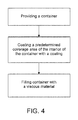
- the method includes the steps of (1) coating a predetermined coverage area (such as about 70 to about 90 percent of the container sidewall height) of the interior of the container up to a first elevation with a lipid composition; and (2) filling the container with a viscous material to a second elevation above the first elevation.
- a predetermined coverage area such as about 70 to about 90 percent of the container sidewall height
- the predetermined coverage area is sprayed with the lipid composition.
- the method further includes the step of inserting a spray nozzle a predetermined distance (i.e., about 0.125 to about 1.5 inches) into the container to dispense the lipid composition onto the predetermined coverage area.
- a spray nozzle a predetermined distance (i.e., about 0.125 to about 1.5 inches) into the container to dispense the lipid composition onto the predetermined coverage area.
- the spray nozzle has a particular spray pattern configured to spray the coating onto the predetermined coverage area with substantially no coating outside this area.
- the spray nozzle includes a spray tip configured to project a spray field less than about 60°, preferably between about 5° to about 50°, and most preferably about 45° to provide the coating onto the predetermined coverage area with minimal, and essentially no overspray.
- the method may also include a step of coating the predetermined coverage area under a slight negative pressure (i.e., achieved via a reverse airflow of about 500 to about 1000 cfm and, preferably, about 800 to about 1000 cfm; however, other methods to achieve negative pressures may also be employed), which is generally sufficient to remove any residual or random coating from the interior of the container.
- This negative pressure helps minimize the lipid composition from accumulating onto unwanted areas.
- FIG. 1 is a schematic view of a container having a coating on a portion of a side wall inner surface
- FIG. 2 is a schematic view of a exemplary spray nozzle applying the coating to the container inner surface
- FIG. 3 is a plan view of an exemplary automatic spraying apparatus for applying the coating to inner surfaces of the container
- FIG. 4 is a flow chart of an exemplary method
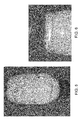
- FIGS. 5 and 6 are photographs of a 18 fluid ounce container having nearly 100 percent of its inner surface coated with a medium chain lipid composition, filled with mayonnaise, and inverted;
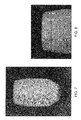
- FIGS. 7 and 8 are photographs of a 18 fluid ounce container having only a portion of its inner surfaces coated with a medium chain lipid composition via a spray nozzle having about a 45° spray field, filled with Miracle Whip, and inverted;
- FIGS. 9 and 10 are photographs of a 18 fluid ounce container having only a portion of their inner surfaces coated with a medium chain lipid composition by shielding portions of the container adjacent the opening, filled with mayonnaise, and inverted;
- FIGS. 11 and 12 are photographs of a 24 fluid ounce container having nearly 100 percent of its inner surface coated with a medium chain lipid composition, filled with mayonnaise, and inverted;
- FIGS.13 and 14 are photographs of a 24 fluid ounce container having only a portion of its inner surfaces coated with a medium chain lipid composition via a spray nozzle having about a 45° spray field, filled with mayonnaise, and inverted.
- a container 10 for holding and dispensing a viscous material 12.
- the container 10 provides improved product release at both room and refrigeration temperatures without substantially impacting the appearance or physical stability of the viscous material 12 in the container prior to consumer use thereof.
- Such enhancements are generally achieved by selecting a coating 14 and applying that coating in effective amounts to inner surfaces of the container 10 to maintain product stability and to provide increased product evacuation.
- the coating is applied to a predetermined coverage area 16 that is less than the entire inner surface area of the container 10. In this manner, only a portion of inner surfaces 18 of the container 10 have the coating 14 thereon.
- the container inner surface 18 preferably has a first portion 20 with the coating 14 thereon, and a second portion 22 with little or substantially no coating thereon.
- the coating 14 applied to the container inner surfaces 18 in such a manner may provide several advantages over prior containers.
- the coating 14 applied to the predetermined coverage area 16, which is less than the entire inner surface area, may generally maintain the physical stability of the material 12 at an interface 24 between a material upper surface 25 and the container 10 during shipment and other movements of the container prior to consumer use. That is, with a coating 14 applied to the predetermined coverage area 16, it has been discovered that in some cases where the viscous material 12 is an emulsion or aerated product, there is minimal and, preferably, no oiling-off or product collapse prior to consumer use.
- the preferred coatings herein have properties to provide enhanced product evacuations over a wider temperature range than prior coated containers.
- Preferred coatings 14 provide improved product evacuation at both room and refrigeration temperatures.
- the containers herein evacuate greater than 90 percent, preferably greater than 95 percent, and most preferably, greater than 98 percent of the viscous material at both temperatures ranges independent of container geometry.
- the preferred coatings 14 are also substantially clear so that they impart minimal and, preferably, no appearance changes to any material within the container. As a result, the coating 14 can even be applied to transparent containers so that an expected consumer appearance of the viscous material 12 is generally maintained.
- a "viscous" material, substance, or product generally refers to a material having a viscosity greater than about 5,000 cp, preferably greater than about 100,000 cp, and most preferably greater than about 200,000 cp. Viscosity is measured using a Brookfield viscometer with a spindle appropriate for the material at room temperatures; however, other methods and equipment may also be used to determine viscosity as needed.
- viscous products suitable for use in the containers described herein include but are not limited to, comestibles (e.g., mayonnaise, mayonnaise-type products, catsup, mustard, salad dressings, sandwich spreads, sauces, marinades, cheese, cheese products, peanut butter, spreads, pastes, jams, jellies, honey, syrups to suggest but a few), paints, coatings, dyes, cosmetics, lotions, pastes, ointments, pharmaceuticals, adhesives, and the like.
- comestibles e.g., mayonnaise, mayonnaise-type products, catsup, mustard, salad dressings, sandwich spreads, sauces, marinades, cheese, cheese products, peanut butter, spreads, pastes, jams, jellies, honey, syrups to suggest but a few
- paints, coatings, dyes, cosmetics, lotions, pastes, ointments, pharmaceuticals, adhesives, and the like are, of course, many other examples of viscous materials suitable for use in the containers described
- normal use of the container means evacuation of the viscous product through the container opening without using a supplementary utensil, such as a knife or spoon, to scrape interior surfaces of the container to remove residual product. Normal use generally involves dispensing the viscous product from the container by pouring, squeezing, shaking, hitting, pounding, or any combination of such actions.
- substantially free of the coating means the coating is not intentionally applied to such container areas and only includes negligible or trace amounts of the coating, such as less than about 0.3 mg/in 2 .
- the container 10 generally includes a first or material holding portion 26 having a side wall 28 and a bottom wall 30 defining a cavity 32 for containing the viscous material 12 therein.
- the container 10 also includes an outlet portion 34 defining an opening 36 into the cavity 32.
- the outlet portion 34 is for dispensing the viscous product from the cavitv 32.
- Each of the side wall 28, the bottom wall 30, and the outlet portion 34 has an inner surface 36, 38, and 40, respectively.
- the container 10 also preferably includes a transition portion or shoulder region 42, which extends between the generally wider holding portion 26 and the generally narrower outlet portion 34.
- the transition portion 42 also includes an inner surface 44.
- the container 10 may be formed from a variety of different shapes, sizes, configurations, and materials, including but not limited to jars, tubes, squeeze bottles, and the like.
- the container 10 is preferably formed from a plastic material, such as PET, but may also be formed from other plastics, glass, films, foils, and other materials suitable for forming containers as well as combinations thereof.
- the container may include a dispensing opening about 1 to about 5 inches wide onto which a cap or cover may be applied.
- the cap or cover may further include a small dispensing aperture so that the viscous material may be poured through the small aperture by tilting the container or may be squirted out through the aperture by squeezing the sides of the container.
- the dispensing opening may also include a hand-pump.
- the container 10 is also generically illustrated with the dispensing outlet 34 at the top of the container 10 (i.e., a cap up configuration).
- the container 10 may also include a configuration with the dispensing outlet 34 at the bottom of the container 10, such as a container configuration that is adapted to sit on a cover (not shown) enclosing the dispensing outlet (i.e., a cap down configuration).
- the concepts described herein are generally applicable independent of a particular container configuration or geometry.
- the coating 14 is applied to the predetermined coverage area 16 of the container inner surface 18.
- this predetermined coverage area 16 is a portion 20 of the side wall inner surface 36 and, preferably, the side wall portion 20 and the bottom wall inner surface 38.
- the first coated portion 20 include about 70 to about 90 percent of the side wall inner surface 36 and substantially all of the bottom wall inner surface 38.
- an uncoated second portion 22 is formed that generally includes the areas adjacent the container outlet 36, such as the inner surfaces of the transition portion 42 and the outlet portion 34. In other words, it is preferred that the inner surface 44 of the transition portion 42 and the inner surface 40 of the outlet portion 34 are substantially free of the coating.
- a suitable container has a height of about 7 inches, a width of about 3 to about 4 inches, and a depth of about 1.5 to about 2.5 inches.
- Such a container preferably has a predetermined coverage area 16 of about 48 to about 92 square inches that covers the bottom surface 38 and about 70 to about 90 percent of each side surface (i.e., left and right) and about 70 to about 90 percent of each of the front and back faces of the container.
- the container 10 By applying the coating 14 to substantially only the predetermined coverage area 16, which is less than the entire container inner surface area, the container 10 provides an environment that generally does not effect the stability of the material 12 in the container (i.e., such as emulsion stability or overrun stability). Because the container 10 has the portions 22 adjacent the outlet substantially free of the coating, a layer of viscous material 43 ( FIG.1 ) is permitted to generally adhere to these uncoated inner surfaces (i.e., surfaces 44 and 40). As a result, when the container is filled to a level extending beyond the predetermined coverage area 16 (i.e., product fill distance 52 in FIG.1 ), it has been discovered there is a more stable interface 24 formed between the viscous material 12 and the container 10.
- viscous material 12 While not wishing to be limited by theory, it is believed that providing a surface that the viscous material 12 can generally adhere allows less movement of the material at the interface 24 during any vibration or motion of the container (such as during shipment or other movement prior to consumer use). Less movement of the material at this interface results in less mechanical energy imparted to the product, which permits the product to generally remain in its desired physical form, such as emulsified or aerated.
- “stability” or “physical stability” of the viscous material generally refers to little or substantially no oiling-off or overrun collapse of the viscous product.
- the coating 14 is a lipid composition that includes a mixture of glycerol esters having a predetermined composition of fatty acid residues.
- the coating 14 is a saturated and substantially clear lipid composition that has a viscosity less than about 25 cp, and preferably a viscosity between about 15 and about 25 cp at room temperature.
- the lipid composition also preferably has a viscosity at refrigeration temperatures of less than about 60 cp. While not wishing to be limited by theory, it is believed that such low viscosity enables the coating 14 to provide the improved product evacuation even when applied to less than the inner entire surface area of the container.
- a coating with such low viscosity is also advantageous because it is easier to apply a uniform application to the predetermined coverage area through atomization or spray coating techniques.
- the coating has the appearance of water, such that when applied to the container it generally does not alter the appearance of the viscous product in the container. Because the coating comprises a saturated lipid composition, it is also generally stable to oxidation.
- a preferred coating is a medium chain triglyceride mixture formed from triglycerides having between about 70 and about 100 percent fatty acid residues with between 6 and 12 carbon atoms inclusive (i.e., medium chain triglycerides or "MCT").
- MCT medium chain triglycerides
- Suitable coating compositions can be obtained from Stepan Company (Northfield, Illinois).
- Preferred examples includes Neobee® M5 or Neobee® 1053, which are medium chain triglyceride mixtures having between about 98 to about 99 percent fatty acid residues with between 6 and 12 carbon atoms inclusive. These compositions further include about 32 to about 44 percent capric acid residues and about 55 to about 66 percent caprylic acid residues.
- the preferred MCT coating compositions may also include other glyceride mixtures including caproic, caprylic, capric, lauric acids residues, and/or mixtures thereof.
- the coating 14 is a vegetable oil, such as olive oil, soybean oil, sunflower oil, canola oil and the like having a lipid soluble antioxidant blended therein. Suitable antioxidants include, but are not limited to, TBHQ. BHT, BHA, gallates, tocopherols, tocotrienols, ascorbyl palmiate, and mixtures thereof. It is expected that about 0.01 to about 0.5 percent antioxidant is suitable for the coating 14.
- the coating 14 may include mixtures of soybean or canola oil combined with small amounts of lecithin (i.e., about 20 percent or less) and food grade alcohols (i.e., about 20 percent or less).
- Such alternative coatings are expected to provide similar results when applied to a portion of the container side walls at room temperature, but are generally less desired in some cases because they may impart a slight color change to the product due to the tint of the base oils used for the coatings, or have other potential unwanted effects of the viscous material within the container.
- the predetermined coverage area 16 has about 3.5 mg/in 2 or less of the coating composition substantially uniformly applied thereto.
- the predetermined coverage areas has about 0.15 to about 0.2 grams of the coating.
- the coating composition is uniformly applied to the predetermined coverage area in a thickness of about 0.003 inches or less. Applying more coating 14 to the predetermined coverage area 16 is generally undesired because it is difficult to prevent the coating from spreading, flowing, or migrating to the uncoated portions.
- such low amounts of the coating applied to less than the entire inner surfaces of the container is still sufficient to achieve product evacuation from the container during normal use of greater than about 90 percent, preferably greater than about 95 percent, and most preferably greater than about 98 percent at room temperature and also preferably at refrigeration temperatures.
- the viscous product generally slides of the coated portions and generally adheres to the uncoated portions. While preferred amounts of the coating are described above, it will be appreciated that different amounts may be applied depending on the particular size of the predetermined coverage area, the configuration, size, material, or shape of the container 10, and the characteristics of the viscous material.
- the container 10 has the coating applied along its side walls 28 a first distance or elevation 50.
- the container 10 is filled with the viscous material 12
- the viscous material 12 contacts both the coated portions 20 and uncoated portions 22 of the container.
- a head space 54 is formed between the viscous material upper surface 25 and the outlet portion opening 36.
- the headspace 54 is a portion of the cavity that is generally free of or not filled with the viscous material 12 (except for the thin layer of material 43 adhering to the uncoated portions).
- the headspace 54 includes portions of the transition portion 42 and the outlet portion 36; however, the cavity 32 may also be filled with more or less material 12 so that the headspace 54 comprises a larger or smaller volume.
- the viscous material filling distance 52 may extend into the outlet portion 36 so that the headspace 54 may be confined just to the outlet portion 34 if so desired.
- the headspace 54 is able to substantially remain intact and not float around the container 10 even if the container 10 is repositioned, inverted, or placed on its side. While not wishing to be limited by theory, it is believed that the cohesiveness of the viscous material 12 and the lack of coating 14 on the inner surfaces 22 of the container adjacent the headspace 54 (which permits the layer 43 to substantially surround the headspace 54) allows the headspace 54 to remain stable relative to and adjacent the outlet portion 36 and not float around the container regardless of the orientation of the container. Consequently, even if the container 10 is inverted after filling, no visible void areas or bubbles are formed in the upper areas of the container 10 because the headspace 54 remains substantially constant relative to the opening 36 independent of container orientation.
- the method includes (1) coating a predetermined coverage area of the interior of the container 10 up to the first elevation 50 with the coating, and (2) then filling the container 10 with the viscous product 12 to the second elevation 52 above the first elevation 50.
- the method is preferably configured to provide a commercially-viable, high-speed method to uniformly coat substantially only the predetermined coating area 16 of the container inner surfaces 36 with a relatively thin layer of a low-viscosity fluid or coating.
- the preferred methods allow the container inner surfaces to be coated through a relatively narrow container outlet portion (i.e., about 1 to about 5 inches wide, but other sizes are also suitable) with minimal, and preferably no contamination of the coating on the outside of the container or on unwanted portions of the inner surface (i.e., the uncoated portions 22) in a continuous and high speed manner.
- the method is advantageous because it provides for applying the coating only to a portion of the inner surfaces without requiring masking, blocking, or covering the unwanted container portions or applying an excess amount of the coating and allowing the excess coating to drain from the container.
- the predetermined coverage area 16 is preferably coated by spraying the coating 14 thereto.
- the spraying operation is arranged and configured to provide the coating composition to substantially only the predetermined coverage area and minimize, and preferably prevent coating from being applied to unintended areas.
- the method further includes inserting a spray nozzle 104 a predetermined distance 106 into the container 10 so that a single spray 108 of the coating composition is sufficient to apply the coating only to the predetermined coverage area 16.
- the spray nozzle is inserted less than about 1.5 inches into the container, and preferably about 0.125 to about 1.5 inches into the container; however, the distance the spray nozzle 104 is inserted into the container 10 may vary depending on the container size/geometry, size of the outlet opening, and the configuration of the spray nozzle 104.
- the spray nozzle 104 is selected so that the spray pattern 108 has a predetermined spray field a that is configured to spray the coating 14 substantially only onto the predetermined coverage area 16 with substantially no coating outside the predetermined coverage area (i.e., uncoated areas 22 or container outer surfaces).
- the spray nozzle 104 has a nozzle configuration to project the spray pattern 108 with a spray field a less than about 60° to provide the coating only onto the predetermined coverage area 16.
- the spray pattern 108 has a spray field a of about 15 to about 50°, and most preferably about 45°. Spray fields 108 greater than about 60° are undesired because they tend to apply the coating 14 to the entire inner surface area of the container.
- Suitable spray nozzles 104 may be obtained from Spraying Systems Company (Wheaton, Illinois) and include a twin fluid manifold with 1 channel for the fluid to be sprayed and between 2 and 8 air apertures (between 0.03 and 0.1 inches in diameter). Preferably, such nozzles spray about 2 to about 10 gph fluid using about 2 to about 20 psi air pressure.
- the method to apply the coating may further include coating the predetermined coverage area under a slight negative pressure sufficient to remove any residual coating from the interior of the container.
- the negative pressure is expected to evacuate any residual atomized coating from the atmosphere in the cavity to help minimize the coating from being applied to the unwanted areas.
- this negative pressure is achieved with a reverse airflow rate applied to the container of at least about 500 cfm and, preferably, about 800 to about 1000 cfm, which is sufficient airflow to evacuate any residual coating.
- a reverse airflow rate applied to the container of at least about 500 cfm and, preferably, about 800 to about 1000 cfm, which is sufficient airflow to evacuate any residual coating.
- other methods to achieve negative pressures may also be employed.
- the coating station 200 employs a rotary spindle 202 to transport and coat the containers 10 as they are rotated in the spindle 202.
- the coating station 202 requires a relatively small footprint in a manufacturing area and can be easily combined with a typical bottle filling line, such as at a side location along a common conveyor belt 204 prior to a filling station 216.
- the coating station 200 includes a grabber spindle 210 (or other suitable transport device) that transports the empty and uncoated container 10 from the conveyor belt 204 into the spindle 202 at a receiving location 212 or rotary spindle position #1.
- a grabber spindle 210 or other suitable transport device that transports the empty and uncoated container 10 from the conveyor belt 204 into the spindle 202 at a receiving location 212 or rotary spindle position #1.
- the container 10 is raised vertically into a spraying position as the container rotates through spindle positions #1, #2, and #3.
- spindle position #3 the container has been raised a vertical distance so that the spray nozzle 104 is positioned the predetermined distance 106 within the container 10 ( FIG. 2 ). In this manner, the spraying of the coating by the spray nozzle 10 is completely contained within the interior of the container to minimize overspray to unwanted areas.
- the container 10 reaches spindle position #4 where the spraying of the coating is commenced.
- the spraying is completed in a single burst or spritz of the coating composition before the container 10 reaches spindle position #5, where an additional spray or other application may be added to the container if desired.
- the container 10 traverses spindle positions #6, #7, and #8 where the coating may be allowed to relax and generally adhere to the container side wall if needed.
- spindle positions #6 to #8 may be used to apply additional coatings, materials, or substances into the container.
- Spindle positions #9, #10, and #11 are used to vertically lower the container 10 from the nozzle 104 so that a return grabber 214 (or other suitable transport device) may transport the container 10 from position #11 back to the conveyor belt 204 for further transport to the filling station 216 downstream of the coating station 200.
- a return grabber 214 or other suitable transport device
- the spindle 202 may have more or less positions as needed.
- the coating station 200 is illustrated and described with various positions, it will be appreciated that these positions are only exemplary. It will also be appreciated that such positions need not be individual or discrete positions, but can be approximate locations along a continuously moving device or station.
- the coating station 200 is sized to complement the desired production line speed to be attained.
- the rotary spindle 202 has a number of positions that can be used for other purposes. For example, various positions can be used to evacuate or exhaust any coating mist from the atmosphere within the container or be used draw as much air as possible from the container prior to, during, or after activating the spray nozzle. It is anticipated that a container with air withdrawn from its cavity (i.e., generally at lower pressure or even in a vacuum) prior to coating may enable the spray nozzle to operate with less air pressure, spray with smaller sizes of coating droplets, and/or provide a more uniform coating to the coverage area 16.
- Each container was a plastic rectangular bottle made from PET approximately 7 inches high by 3 inches wide by 1.5 inches deep having about 18 fluid ounce capacity.
- the lipid composition was a medium chain triglyceride (MCT) oil having about 99 percent medium chain fatty acid residues (Neobee 1053, Stepan Company, Northfield, Illinois).
- MCT medium chain triglyceride
- the lipid composition included about 55 percent caprylic acid residues and about 44 percent capric acid residues and had a viscosity of about 15.9 cp at 40°C, about 26 cp at 20°C, and about 61 cp at 5°C.
- Containers B For the uncoated containers (Containers B), they were also filled with either about 525 grams of Miracle Whip Light or about 475 grams of Kraft Real Mayonnaise. In each case, the product was filled to approximately a constant volume. Both sets of containers were capped and then placed in a cardboard box and placed on a vibration table (Lansmont Corp, Manderville, Connecticut) for approximately one hour to mimic vibrations encountered during shipping.
- Example 1 The empty containers of Example 1 were coated using two different types of spray nozzles having different geometries of spray fields.
- the spray nozzles tested were Nozzle A, which provided a 45° spray field (Nozzle SUE-15-SS45, Spray Systems, Wheaton, Illinois) and Nozzle B, which provided a 60° spray field (Nozzle SU-HTE61d, Spray Systems, Wheaton, Illinois). Both nozzles were operated with an atomization air pressure at 5 psi and a fluid flow rate of about 2 gph. Each spray nozzle was inserted into the container about 10 percent of its height (i.e., about 0.7 inches), and about 0.15 grams of the MCT oil from Example 1 was sprayed into each container from the particular spray nozzle.
- containers coated with MCT oil from Example 1 were compared to containers coated with soybean oil (Cargill, Minneapolis, Minnesota) and containers with no coating (cantrol).
- containers having a height of about 7 inches, a width of about 3.5 inches, and a depth of about 2.5 having about a 24 fluid ounce capacity were studied.
- about 0.18 grams of each coating solution (either MCT oil or soybean oil) was applied as a very fine mist using a spray nozzle (Spraying Systems, Wheaton, Illinois) to the entire inner surface of empty containers to achieved nearly 100 percent coating of the container inner surfaces.
- about 720 grams of Miracle Whip was added to each container (MCT coated, soybean oil coated, and no coating) using a piston-pump driven filler.
- each container was then emptied through squeezing and tapping the bottles onto a table to force the maximum amount of product out of the container as described in Example 1.
- Each container was weighed full and after being emptied to determine the residual amount of product remaining. Results are provided in Table 3 below:
- Container A was filled with mayonnaise and the Container C was filled with Miracle Whip.
- Container H was filled with a similar amount of mayonnaise.
- Each container was filled with a similar product volume.
- Each container was originally filled in an upright position and then capped so as to form a headspace of empty product between the top surface of the material and the cap when in the upright position. Thereafter, each container was inverted into a cap down position to study the ability to maintain the original position of the headspace adjacent the cap.
- Container H (100% coating) when inverted to a cap down position, formed bubbles on the upper portions of the container indicating that container H could not maintain the original positioning of the headspace, which floated from adjacent the cap to other portions of the container. These containers would not be as desirable to a consumer.
- Containers A and C (partially coated) were able to maintain the positioning of the headspace adjacent the cap and not form any bubbles or void areas at the opposite and now upper portions of the container.
- Example 4 The study of Example 4 was repeated using a 24 fluid ounce capacity container.
- plastic, generally rectangular shaped containers with dimensions of approximately about 7 inches high by about 3.5 wide by about 2.5 deep were used. Similar results were obtained as in Example 4 regarding the ability of the containers to maintain the positioning of the headspace.
- a 24 ounce container coated 100 percent with Neobee 1053 (Stepan, Northbrook, Illinois) and filled with mayonnaise when inverted had bubbles and void areas formed at the upper surfaces of the cavity indicating that the headspace had floated about the container cavity (Container I).
- the 24 ounce container with mayonnaise and only partial coating with Neobee 1053 to the inner surfaces exhibited no movement of the headspace and no void areas or bubbles in the cavity upper surfaces when the container was inverted (Container J).
- Examples 4 and 5 demonstrate the ability of a partially coated container to maintain the original position of the headspace relative to the outlet independent of container geometry and independent of container orientation. Containers coated on their entire inner surfaces do not exhibit such behavior.
- Containers A and C from Examples 1 and 2 were packed in cardboard boxes, stacked on a wooden pallet and shipped approximately 2000 miles in a semi-truck over about 4 days. At the end of the trip, the samples were visually inspected. Upon visual inspection, there were no signs of oiling off nor were there any noticeable increase in headspace in the top of the container.
- Example 1 A variety of different coating oils were tested to compare the amount of residual product left in the container after normal use compared to the MCT oil from Example 1.
- Three empty containers of Example 1 were each sprayed on the interior with about 0.3 grams of the oils listed in Table 4 to coat about 100 % of the container inner surfaces.
- the containers were sprayed using a Misto® spray bottle.
- the coated containers were then filled with about 475 grams of mayonnaise and then stored at room temperature for three days.
- the product was evacuated using the procedure of Example 1. The containers were weighed before and after evacuation to determine the amount of residual product remaining.
- the evacuation performance of containers coated with the MCT coating of Example 1 was compared to containers coated with soybean oil (Cargill, Minneapolis, Minnesota) and containers with no coating (control) at refrigeration temperatures (about 5°C).
- Containers having a capacity of either 24 oz (7 inches high, 3.5 inches wide, and 2.5 inches deep) or 18 fluid ounces (7 inches high, 3 inches wide, and 1.5 inches deep) were coated on their entire inner surfaces with either the MCT coating or soybean oil as shown in Table 6 below.
- the containers were filled either with Miracle Whip or mayonnaise (to achieve consistent product volumes) and then stored for one week in a refrigerator at 5°C.
- the samples were weighed and then evacuated using the procedures of Example 1.
- the containers were reweighed to determine the amount of residual product left in the container. Results are provided in Table 6 below.
Landscapes
- Engineering & Computer Science (AREA)
- Mechanical Engineering (AREA)
- Details Of Rigid Or Semi-Rigid Containers (AREA)
- Containers And Packaging Bodies Having A Special Means To Remove Contents (AREA)
- Basic Packing Technique (AREA)
- Application Of Or Painting With Fluid Materials (AREA)
- Confectionery (AREA)
Applications Claiming Priority (1)
| Application Number | Priority Date | Filing Date | Title |
|---|---|---|---|
| US11/748,750 US7877968B2 (en) | 2007-05-15 | 2007-05-15 | Method for forming a container with improved release properties |
Publications (1)
| Publication Number | Publication Date |
|---|---|
| EP1992420A1 true EP1992420A1 (fr) | 2008-11-19 |
Family
ID=39665853
Family Applications (1)
| Application Number | Title | Priority Date | Filing Date |
|---|---|---|---|
| EP08155979A Withdrawn EP1992420A1 (fr) | 2007-05-15 | 2008-05-09 | Procédé pour la formation d'un récipient doté de propriétés de libération améliorées |
Country Status (8)
| Country | Link |
|---|---|
| US (1) | US7877968B2 (fr) |
| EP (1) | EP1992420A1 (fr) |
| AU (1) | AU2008202045A1 (fr) |
| BR (1) | BRPI0801870A2 (fr) |
| CA (1) | CA2631081C (fr) |
| MX (1) | MX2008006075A (fr) |
| RU (1) | RU2008118383A (fr) |
| ZA (1) | ZA200804015B (fr) |
Cited By (6)
| Publication number | Priority date | Publication date | Assignee | Title |
|---|---|---|---|---|
| WO2015042118A1 (fr) | 2013-09-17 | 2015-03-26 | LiquiGlide Inc. | Articles et procédés de formation de films liquides sur des surfaces d'articles |
| WO2015097079A1 (fr) * | 2013-12-23 | 2015-07-02 | Dupont Nutrition Biosciences Aps | Surface et composition |
| WO2015170198A1 (fr) | 2014-05-09 | 2015-11-12 | Wab Societa' A Responsabilita' Limitata | Procédé de revêtement d'une paroi interne d'un récipient |
| CN106232501A (zh) * | 2014-04-18 | 2016-12-14 | 东洋制罐株式会社 | 粘稠内容物的填充方法 |
| EP3150497A4 (fr) * | 2014-05-27 | 2018-05-09 | Toyo Seikan Group Holdings, Ltd. | Procédé de remplissage de contenus fluides, et récipient d'emballage rempli de contenus fluides |
| WO2025176373A1 (fr) * | 2024-02-22 | 2025-08-28 | Unilever Ip Holdings B.V. | Récipient à surface intérieure revêtue d'huile avec tensioactif |
Families Citing this family (16)
| Publication number | Priority date | Publication date | Assignee | Title |
|---|---|---|---|---|
| US8003178B2 (en) * | 2007-05-15 | 2011-08-23 | Kraft Foods Global Brands Llc | Container with improved release properties |
| EP2098458A1 (fr) * | 2008-03-03 | 2009-09-09 | Superfos a/s | Conteneur comprenant une doublure interne, procédé d'application d'une telle doublure sur un conteneur et utilisation d'un revêtement pelable en tant que doublure interne dans un conteneur |
| FR2930121B1 (fr) * | 2008-04-18 | 2010-05-21 | Shiseido Int France | Flacon de parfum |
| US9932484B2 (en) | 2011-01-19 | 2018-04-03 | President And Fellows Of Harvard College | Slippery liquid-infused porous surfaces and biological applications thereof |
| CN103649240B (zh) | 2011-01-19 | 2016-09-14 | 哈佛学院院长等 | 具有高压稳定性、光学透明性以及自修复特征的光滑表面 |
| US9963597B2 (en) | 2012-07-12 | 2018-05-08 | President And Fellows Of Harvard College | Slippery self-lubricating polymer surfaces |
| KR101660886B1 (ko) * | 2012-07-13 | 2016-09-28 | 도요세이칸 그룹 홀딩스 가부시키가이샤 | 내용물에 대한 미끄러짐성이 뛰어난 포장용기 |
| WO2014209441A2 (fr) | 2013-03-13 | 2014-12-31 | President And Fellows Of Harvard College | Composition pouvant être solidifiée pour la préparation de surfaces glissantes infusées par un liquide, et procédés d'application |
| EP2999551B1 (fr) | 2013-05-20 | 2017-10-11 | Unilever PLC | Procédé d'application de revêtement sur des contenants |
| JP5673905B1 (ja) * | 2013-05-23 | 2015-02-18 | 東洋製罐グループホールディングス株式会社 | 液層を表面に有する多層構造体 |
| PH12017500995B1 (en) * | 2014-12-22 | 2023-03-17 | Unilever Ip Holdings B V | Container for viscous liquids internally coated with oil with emulsifier |
| US10626047B2 (en) | 2016-10-18 | 2020-04-21 | Owens-Brockway Glass Container Inc. | Glass container coating process |
| WO2020077161A1 (fr) | 2018-10-11 | 2020-04-16 | Freeflow Medical Devices Llc | Emballage pour dispositifs médicaux revêtus de liquides perfluorés ou de dispersions de ceux-ci |
| WO2020077160A1 (fr) | 2018-10-11 | 2020-04-16 | Freeflow Medical Devices Llc | Revêtements anti-thrombotiques à base de fluoropolymère |
| JP7738976B2 (ja) * | 2019-04-04 | 2025-09-16 | 大日本印刷株式会社 | 包装材料の製造方法 |
| JP7144589B1 (ja) | 2021-11-19 | 2022-09-29 | ハウス食品グループ本社株式会社 | ペースト状食品入り容器の製造方法 |
Citations (9)
| Publication number | Priority date | Publication date | Assignee | Title |
|---|---|---|---|---|
| US2504482A (en) | 1949-06-17 | 1950-04-18 | Premo Pharmaceutical Lab Inc | Drain-clear container for aqueous-vehicle liquid pharmaceutical preparations |
| US2832701A (en) | 1953-09-25 | 1958-04-29 | Pfizer & Co C | Method of making drain-clear containers |
| FR2507449A1 (fr) * | 1981-06-12 | 1982-12-17 | Oreal | Flacon a paroi transparente pour liquide colore, notamment pour vernis a ongles |
| WO1998043886A2 (fr) * | 1997-03-31 | 1998-10-08 | The Procter & Gamble Company | Contenant assurant un bon ecoulement de contenus visqueux |
| WO1998047773A1 (fr) * | 1997-04-22 | 1998-10-29 | The Procter & Gamble Company | Contenant permettant un ecoulement ameliore de produits visqueux, composition et procede correspondant |
| US6247603B1 (en) | 1999-08-20 | 2001-06-19 | Continental Plastic Containers, Inc. | Container coating for increasing product outage |
| WO2001051222A1 (fr) * | 2000-01-14 | 2001-07-19 | Astrazeneca Ab | Procede d'application d'un revetement polymere sur la surface interne d'un recipient |
| US6599594B1 (en) | 1999-05-07 | 2003-07-29 | Schott Glas | Glass container for medicinal purposes |
| FR2851940A1 (fr) * | 2003-03-03 | 2004-09-10 | Lotoise D Evaporation Soc | Procede de decoration d'un flacon |
Family Cites Families (21)
| Publication number | Priority date | Publication date | Assignee | Title |
|---|---|---|---|---|
| US2120640A (en) * | 1935-04-20 | 1938-06-14 | Richard A Craemer | Dispensing congealed foodstuffs |
| US2611499A (en) * | 1950-08-25 | 1952-09-23 | Joseph Solomon | Double container |
| US3498799A (en) * | 1966-11-18 | 1970-03-03 | Foster Poultry Farms | Refrigerated poultry package and method of making same |
| US3688682A (en) * | 1970-05-28 | 1972-09-05 | Speedco Inc | Machine for filling luncheon dough into mold cans |
| US4393106A (en) * | 1980-10-31 | 1983-07-12 | Toyo Seikan Kaisha Ltd. | Laminated plastic container and process for preparation thereof |
| JPS59143636A (ja) * | 1983-02-08 | 1984-08-17 | 東洋製罐株式会社 | 多層プラスチツク容器 |
| US4606942A (en) * | 1984-12-21 | 1986-08-19 | Adolph Coors Company | Spray coating apparatus |
| US4883198A (en) * | 1987-10-06 | 1989-11-28 | Manska Wayne E | Container and method for dispensing semi-solid substances |
| US5096746A (en) * | 1990-10-15 | 1992-03-17 | Ball Corporation | Dual orifice nozzle and method for interally coating containers |
| US5186979A (en) * | 1991-03-25 | 1993-02-16 | Asphalt Control Systems Inc. | Method of prevention of adhesion of hot-mix asphalt to containers and equipment |
| MX9303141A (es) * | 1992-05-28 | 1994-04-29 | Polar Materials Inc | Metodos y aparatos para depositar recubrimientos de barrera. |
| US5494502A (en) * | 1994-10-03 | 1996-02-27 | The Chemmark Corporation | Asphalt release agent |
| US5660691A (en) * | 1995-11-13 | 1997-08-26 | Eastman Chemical Company | Process for the production of tocotrienol/tocopherol blend concentrates |
| US5707691A (en) * | 1996-08-27 | 1998-01-13 | The Coca-Cola Company | Coating hollow containers by in-situ polymerization of monomers in bi-axially orientated form |
| CN1108960C (zh) * | 1997-03-31 | 2003-05-21 | 普罗克特和甘保尔公司 | 提供良好产品排出的多层塑料容器 |
| US6099923A (en) * | 1998-03-24 | 2000-08-08 | Kitei; Robert | Non-stick coating for the threads of a storage container of a liquid which hardens when dry |
| JP4304756B2 (ja) | 1999-04-07 | 2009-07-29 | 東洋製罐株式会社 | アルギン酸塩皮膜を有する容器の製造方法 |
| ATE288387T1 (de) * | 1999-08-16 | 2005-02-15 | Ecolab Inc | Verfahren zum schmieren von auf förderband transportieten gebinden |
| US7247334B2 (en) * | 2002-03-18 | 2007-07-24 | Bunge Oils, Inc. | Low-residue, easy-cleaning and low-viscosity structured lipid pan release compositions and methods |
| US7261913B2 (en) * | 2003-07-07 | 2007-08-28 | Dreyer's Ice Cream, Inc. | Aerated frozen suspension with adjusted creaminess and scoop ability based on stress-controlled generation of superfine microstructures |
| US20050127105A1 (en) * | 2003-12-10 | 2005-06-16 | Kay George W. | Method and apparatus to supply a viscous liquid |
-
2007
- 2007-05-15 US US11/748,750 patent/US7877968B2/en active Active
-
2008
- 2008-05-08 RU RU2008118383/12A patent/RU2008118383A/ru not_active Application Discontinuation
- 2008-05-08 AU AU2008202045A patent/AU2008202045A1/en not_active Abandoned
- 2008-05-09 ZA ZA200804015A patent/ZA200804015B/xx unknown
- 2008-05-09 MX MX2008006075A patent/MX2008006075A/es not_active Application Discontinuation
- 2008-05-09 BR BRPI0801870-7A patent/BRPI0801870A2/pt not_active IP Right Cessation
- 2008-05-09 EP EP08155979A patent/EP1992420A1/fr not_active Withdrawn
- 2008-05-12 CA CA2631081A patent/CA2631081C/fr active Active
Patent Citations (9)
| Publication number | Priority date | Publication date | Assignee | Title |
|---|---|---|---|---|
| US2504482A (en) | 1949-06-17 | 1950-04-18 | Premo Pharmaceutical Lab Inc | Drain-clear container for aqueous-vehicle liquid pharmaceutical preparations |
| US2832701A (en) | 1953-09-25 | 1958-04-29 | Pfizer & Co C | Method of making drain-clear containers |
| FR2507449A1 (fr) * | 1981-06-12 | 1982-12-17 | Oreal | Flacon a paroi transparente pour liquide colore, notamment pour vernis a ongles |
| WO1998043886A2 (fr) * | 1997-03-31 | 1998-10-08 | The Procter & Gamble Company | Contenant assurant un bon ecoulement de contenus visqueux |
| WO1998047773A1 (fr) * | 1997-04-22 | 1998-10-29 | The Procter & Gamble Company | Contenant permettant un ecoulement ameliore de produits visqueux, composition et procede correspondant |
| US6599594B1 (en) | 1999-05-07 | 2003-07-29 | Schott Glas | Glass container for medicinal purposes |
| US6247603B1 (en) | 1999-08-20 | 2001-06-19 | Continental Plastic Containers, Inc. | Container coating for increasing product outage |
| WO2001051222A1 (fr) * | 2000-01-14 | 2001-07-19 | Astrazeneca Ab | Procede d'application d'un revetement polymere sur la surface interne d'un recipient |
| FR2851940A1 (fr) * | 2003-03-03 | 2004-09-10 | Lotoise D Evaporation Soc | Procede de decoration d'un flacon |
Cited By (19)
| Publication number | Priority date | Publication date | Assignee | Title |
|---|---|---|---|---|
| EP3046763A4 (fr) * | 2013-09-17 | 2017-07-26 | Liquiglide Inc. | Articles et procédés de formation de films liquides sur des surfaces d'articles |
| WO2015042118A1 (fr) | 2013-09-17 | 2015-03-26 | LiquiGlide Inc. | Articles et procédés de formation de films liquides sur des surfaces d'articles |
| US11603222B2 (en) | 2013-09-17 | 2023-03-14 | LiquiGlide Inc. | Articles and methods for forming liquid films on surfaces, in devices incorporating the same |
| US10870505B2 (en) | 2013-09-17 | 2020-12-22 | LiquiGlide Inc. | Articles and methods for forming liquid films on surfaces, in devices incorporating the same |
| WO2015097079A1 (fr) * | 2013-12-23 | 2015-07-02 | Dupont Nutrition Biosciences Aps | Surface et composition |
| CN105829413A (zh) * | 2013-12-23 | 2016-08-03 | 杜邦营养生物科学有限公司 | 表面与组合物 |
| RU2674122C2 (ru) * | 2013-12-23 | 2018-12-04 | ДюПон НЬЮТРИШН БАЙОСАЙЕНСИЗ АпС | Поверхность и композиция |
| US10392138B2 (en) | 2014-04-18 | 2019-08-27 | Toyo Seikan Co., Ltd. | Method of filling viscous content |
| CN106232501A (zh) * | 2014-04-18 | 2016-12-14 | 东洋制罐株式会社 | 粘稠内容物的填充方法 |
| JPWO2015159643A1 (ja) * | 2014-04-18 | 2017-04-13 | 東洋製罐株式会社 | 粘稠内容物の充填方法 |
| EP3133032A4 (fr) * | 2014-04-18 | 2017-12-13 | Toyo Seikan Co., Ltd. | Procédé pour le remplissage avec un contenu visqueux |
| WO2015170198A1 (fr) | 2014-05-09 | 2015-11-12 | Wab Societa' A Responsabilita' Limitata | Procédé de revêtement d'une paroi interne d'un récipient |
| EP3150497A4 (fr) * | 2014-05-27 | 2018-05-09 | Toyo Seikan Group Holdings, Ltd. | Procédé de remplissage de contenus fluides, et récipient d'emballage rempli de contenus fluides |
| EP3505453A1 (fr) * | 2014-05-27 | 2019-07-03 | Toyo Seikan Group Holdings, Ltd. | Récipient d'emballage rempli de contenus fluides |
| US10625903B2 (en) | 2014-05-27 | 2020-04-21 | Toyo Seikan Group Holdings, Ltd. | Method of filling liquid content and packing container filled with liquid content |
| AU2018274965B2 (en) * | 2014-05-27 | 2020-06-11 | Toyo Seikan Group Holdings, Ltd. | Method of filling liquid content and packing container filled with liquid content |
| AU2015265081B2 (en) * | 2014-05-27 | 2018-11-08 | Toyo Seikan Group Holdings, Ltd. | Method of Filling Liquid Content and Packing Container Filled with Liquid Content |
| KR20180095950A (ko) * | 2014-05-27 | 2018-08-28 | 도요세이칸 그룹 홀딩스 가부시키가이샤 | 유동성 내용물이 충전된 포장 용기 |
| WO2025176373A1 (fr) * | 2024-02-22 | 2025-08-28 | Unilever Ip Holdings B.V. | Récipient à surface intérieure revêtue d'huile avec tensioactif |
Also Published As
| Publication number | Publication date |
|---|---|
| RU2008118383A (ru) | 2009-11-20 |
| BRPI0801870A2 (pt) | 2009-09-15 |
| CA2631081C (fr) | 2016-08-02 |
| MX2008006075A (es) | 2009-02-19 |
| US20080286480A1 (en) | 2008-11-20 |
| ZA200804015B (en) | 2009-01-28 |
| AU2008202045A1 (en) | 2008-12-04 |
| CA2631081A1 (fr) | 2008-11-15 |
| US7877968B2 (en) | 2011-02-01 |
Similar Documents
| Publication | Publication Date | Title |
|---|---|---|
| EP1992567B1 (fr) | Récipient à vidange améliorée | |
| US7877968B2 (en) | Method for forming a container with improved release properties | |
| EP2955120B1 (fr) | Récipient ayant d'excellentes propriétés de glissement pour contenu fluide | |
| EP3159165B1 (fr) | Structure avec formation de film liquide en surface, et liquide de revêtement pour formation de film liquide | |
| EP3133032A1 (fr) | Procédé pour le remplissage avec un contenu visqueux | |
| CA2866829A1 (fr) | Surfaces autolubrifiantes pour conditionnement alimentaire et equipement de transformation de produits alimentaires | |
| EA029657B1 (ru) | Способ нанесения покрытия на контейнеры | |
| US11603222B2 (en) | Articles and methods for forming liquid films on surfaces, in devices incorporating the same | |
| AU2016252725B2 (en) | Structure having a liquid film and method of producing the same | |
| EP3299311A1 (fr) | Structure à revêtement de surface de type gel | |
| AU2018274965A1 (en) | Method of filling liquid content and packing container filled with liquid content | |
| EP3087124B1 (fr) | Surface et composition | |
| EP3339208A1 (fr) | Structure ayant un film liquide et son procédé de production | |
| EP3385194A1 (fr) | Emballage devant être stocké dans un environnement à basse température et procédé d'utilisation pour ce dernier |
Legal Events
| Date | Code | Title | Description |
|---|---|---|---|
| PUAI | Public reference made under article 153(3) epc to a published international application that has entered the european phase |
Free format text: ORIGINAL CODE: 0009012 |
|
| AK | Designated contracting states |
Kind code of ref document: A1 Designated state(s): AT BE BG CH CY CZ DE DK EE ES FI FR GB GR HR HU IE IS IT LI LT LU LV MC MT NL NO PL PT RO SE SI SK TR |
|
| AX | Request for extension of the european patent |
Extension state: AL BA MK RS |
|
| 17P | Request for examination filed |
Effective date: 20090424 |
|
| 17Q | First examination report despatched |
Effective date: 20090528 |
|
| AKX | Designation fees paid |
Designated state(s): AT BE BG CH CY CZ DE DK EE ES FI FR GB GR HR HU IE IS IT LI LT LU LV MC MT NL NO PL PT RO SE SI SK TR |
|
| RAP1 | Party data changed (applicant data changed or rights of an application transferred) |
Owner name: KRAFT FOODS GLOBAL BRANDS LLC |
|
| GRAP | Despatch of communication of intention to grant a patent |
Free format text: ORIGINAL CODE: EPIDOSNIGR1 |
|
| STAA | Information on the status of an ep patent application or granted ep patent |
Free format text: STATUS: THE APPLICATION IS DEEMED TO BE WITHDRAWN |
|
| 18D | Application deemed to be withdrawn |
Effective date: 20110804 |