EP1995015B1 - Procede pour assembler des materiaux - Google Patents
Procede pour assembler des materiaux Download PDFInfo
- Publication number
- EP1995015B1 EP1995015B1 EP07736886A EP07736886A EP1995015B1 EP 1995015 B1 EP1995015 B1 EP 1995015B1 EP 07736886 A EP07736886 A EP 07736886A EP 07736886 A EP07736886 A EP 07736886A EP 1995015 B1 EP1995015 B1 EP 1995015B1
- Authority
- EP
- European Patent Office
- Prior art keywords
- joint
- materials
- metal material
- joining
- auxiliary metal
- Prior art date
- Legal status (The legal status is an assumption and is not a legal conclusion. Google has not performed a legal analysis and makes no representation as to the accuracy of the status listed.)
- Ceased
Links
Images

Classifications
-
- B—PERFORMING OPERATIONS; TRANSPORTING
- B23—MACHINE TOOLS; METAL-WORKING NOT OTHERWISE PROVIDED FOR
- B23K—SOLDERING OR UNSOLDERING; WELDING; CLADDING OR PLATING BY SOLDERING OR WELDING; CUTTING BY APPLYING HEAT LOCALLY, e.g. FLAME CUTTING; WORKING BY LASER BEAM
- B23K20/00—Non-electric welding by applying impact or other pressure, with or without the application of heat, e.g. cladding or plating
- B23K20/12—Non-electric welding by applying impact or other pressure, with or without the application of heat, e.g. cladding or plating the heat being generated by friction; Friction welding
-
- B—PERFORMING OPERATIONS; TRANSPORTING
- B21—MECHANICAL METAL-WORKING WITHOUT ESSENTIALLY REMOVING MATERIAL; PUNCHING METAL
- B21J—FORGING; HAMMERING; PRESSING METAL; RIVETING; FORGE FURNACES
- B21J15/00—Riveting
- B21J15/02—Riveting procedures
- B21J15/027—Setting rivets by friction heating
-
- B—PERFORMING OPERATIONS; TRANSPORTING
- B21—MECHANICAL METAL-WORKING WITHOUT ESSENTIALLY REMOVING MATERIAL; PUNCHING METAL
- B21J—FORGING; HAMMERING; PRESSING METAL; RIVETING; FORGE FURNACES
- B21J15/00—Riveting
-
- B—PERFORMING OPERATIONS; TRANSPORTING
- B21—MECHANICAL METAL-WORKING WITHOUT ESSENTIALLY REMOVING MATERIAL; PUNCHING METAL
- B21J—FORGING; HAMMERING; PRESSING METAL; RIVETING; FORGE FURNACES
- B21J15/00—Riveting
- B21J15/02—Riveting procedures
-
- B—PERFORMING OPERATIONS; TRANSPORTING
- B23—MACHINE TOOLS; METAL-WORKING NOT OTHERWISE PROVIDED FOR
- B23K—SOLDERING OR UNSOLDERING; WELDING; CLADDING OR PLATING BY SOLDERING OR WELDING; CUTTING BY APPLYING HEAT LOCALLY, e.g. FLAME CUTTING; WORKING BY LASER BEAM
- B23K20/00—Non-electric welding by applying impact or other pressure, with or without the application of heat, e.g. cladding or plating
- B23K20/12—Non-electric welding by applying impact or other pressure, with or without the application of heat, e.g. cladding or plating the heat being generated by friction; Friction welding
- B23K20/122—Non-electric welding by applying impact or other pressure, with or without the application of heat, e.g. cladding or plating the heat being generated by friction; Friction welding using a non-consumable tool, e.g. friction stir welding
- B23K20/1265—Non-butt welded joints, e.g. overlap-joints, T-joints or spot welds
-
- B—PERFORMING OPERATIONS; TRANSPORTING
- B23—MACHINE TOOLS; METAL-WORKING NOT OTHERWISE PROVIDED FOR
- B23K—SOLDERING OR UNSOLDERING; WELDING; CLADDING OR PLATING BY SOLDERING OR WELDING; CUTTING BY APPLYING HEAT LOCALLY, e.g. FLAME CUTTING; WORKING BY LASER BEAM
- B23K20/00—Non-electric welding by applying impact or other pressure, with or without the application of heat, e.g. cladding or plating
- B23K20/12—Non-electric welding by applying impact or other pressure, with or without the application of heat, e.g. cladding or plating the heat being generated by friction; Friction welding
- B23K20/122—Non-electric welding by applying impact or other pressure, with or without the application of heat, e.g. cladding or plating the heat being generated by friction; Friction welding using a non-consumable tool, e.g. friction stir welding
- B23K20/127—Friction stir welding involving a mechanical connection
-
- Y—GENERAL TAGGING OF NEW TECHNOLOGICAL DEVELOPMENTS; GENERAL TAGGING OF CROSS-SECTIONAL TECHNOLOGIES SPANNING OVER SEVERAL SECTIONS OF THE IPC; TECHNICAL SUBJECTS COVERED BY FORMER USPC CROSS-REFERENCE ART COLLECTIONS [XRACs] AND DIGESTS
- Y10—TECHNICAL SUBJECTS COVERED BY FORMER USPC
- Y10T—TECHNICAL SUBJECTS COVERED BY FORMER US CLASSIFICATION
- Y10T29/00—Metal working
- Y10T29/49—Method of mechanical manufacture
- Y10T29/49826—Assembling or joining
Definitions
- the present invention relates to methods for joining materials.
- JP 2003-266183 A on the figures 7-12 of which the preamble of claims 1 and 6 is based concerns the provision of enabling a friction stir welding method in which friction stir welding is possible for a hardly plastic flow material and the welding in combination of materials for which welding is usually impossible.
- members to be joined on one end are composed of hardly plastic flow materials, and a first and second recesses that assist the welding are formed on the joining surface.
- An intermediate member which is a member to be joined on the other end is composed of a material that is easily plastic-flowable.
- the probe of the tool is pushed against the intermediate member for friction stirring.
- the material of the intermediate member is subjected to plastic flow along the recesses of the members to be joined, so that the members to be joined on both ends are firmly welded together.
- the invention was made in view of the above and has its object to provide a method for joining materials which is free from projections accompanying a design restriction as well as loosening and dropout, which enables joining of materials widely ranging from thinner sheets to thicker plates while preventing quality defects such as cracks and deformation from occurring and which can conduct joining with excellent recyclability while maintaining excellent workability and working environment.
- a first aspect of the invention is directed to a method for joining materials according to claim 1.
- the mechanical engaging part provided by the auxiliary material tightly fitted into the joint holes with respect to the respective materials brings about anti-dropout and ant-rotation effects, whereby the respective materials are firmly joined together through the auxiliary material.
- the respective materials are joined together through the auxiliary material fitted into the joint holes of the respective materials, which enables joining of the respective materials widely ranging from thinner sheets to thicker plates without unreasonable pressing force and with frictional heat applied to the auxiliary material by the joint tool to soften the auxiliary material, so that quality defects such as cracks and deformation can be prevented from occurring.
- the respective materials are mechanically joined together through the engaging part without intermediate such as adhesive agent, so that the joining is free from aggravated workability and working environment unlike use of adhesive agent and has excellent recyclability since separation is readily performed upon recycling of the materials.
- flanges are formed on axially opposite ends of the auxiliary material to pinchingly hold the respective materials in an overlapped direction may serve as engaging part, at least one of said flanges being formed upon immersion of the joint tool to be completed as engaging part.
- According aspect of the invention is directed to a method for joining materials according to claim 6.
- the holes formed into the respective materials may be have aspot-like shape, the joint tool being aligned with the joint holes so as to conduct spot joining; alternatively, the holes formed into the respective materials may have a slot-like shape , the joint tool being moved longitudinally of the joint holes so as to conduct continuous joining.
- a method for joining materials of the invention as mentioned above can exhibit various excellent effects and advantages. Because of no large projections such as a bolt and a nut being protruded unlike bolt-on fastening, a design restriction can be substantially relieved and there is no fear of loosening and dropout unlike bolt-on fastening. Moreover, joining is enabled for materials widely ranging from thinner sheets to thicker plates while preventing quality defects such as cracks and deformation from occurring. Joining with excellent recyclability can be conducted while maintaining excellent workability and working environment.
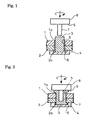
- Figs. 1-4 show an embodiment of the invention which exemplifies spot joining of mutually overlapped iron and aluminum materials 1 and 2.
- the materials 1 and 2 are formed with spot-like joint holes 1a and 2a extending through the materials in a direction of their thicknesses, respectively, and are overlapped with their joint holes 1a and 2a being aligned.
- Joint auxiliary material 3 made of aluminum is fitted into the aligned holes 1a and 2a and a backing member 4 is arranged underneath the overlapped materials 1 and 2.
- the backing member 4 has an upper surface formed with a concave 6 which confronts the joint holes 1a and 2a of the materials 1 and 2a and which has plane section greater than the joint holes 1a and 2a.
- a cylindrical joint tool 8 Arranged above the respective materials 1 and 2 and coaxially of the joint holes 1a and 2a is a cylindrical joint tool 8 with a pin 7 on its lower end adapted to be inserted into the joint holes 1a and 2a, the joint tool being supported rotatably and vertically movably by a joining device (not shown).
- the overlapped materials 1 and 2 are joined together by the joint tool 8 which is lowered, while being rotated, to be pressed onto the auxiliary material 3 in the joint holes 1a and 2a as shown in Fig. 2 .
- the joint tool 8 is lowered into the state shown in Fig. 3 where the auxiliary material 3 softened by frictional heat is tightly fitted, due to plastic flow, into the joint holes 1a and 2a to provide a spiral (threaded) ridge 5' fitted with the groove 5, and is fitted with the concave 6 on the backing member 4 to provide a lower end of the auxiliary material 3 with a flange 6' which has plane section greater than the joint holes 1a and 2a, the auxiliary material 3 being projected into a gap between a shoulder 9 of the joint tool 8 around a base end of the pin 7 and an upper surface of the material 1 to provide an upper end of the auxiliary material 3 with a flange 6" which has plane section greater than the joint holes 1a and 2a.
- These ridge 5' and flanges 6' and 6" provide mechanical engaging parts with respect to the respective materials 1 and 2.
- the lower material 2 is of the same kind as the auxiliary material 3, so that when the pin 7 of the joint tool 8 is rotated and immersed into the auxiliary material 3, a boundary between the material 2 and the auxiliary material 3 which are of the same kind is stirred by rotation of the joint tool 8 to provide a friction stir weld or joint 10.
- the joint tool 8 is extracted upward and the ridge 5' and the flanges 6' and 6" and the friction stir weld 10 are allowed to harden.
- the ridge 5' and flanges 6' and 6" provided by the auxiliary material 3 with respect to the respective materials 1 and 2 bring about anti-dropout and anti-rotation effects, whereby the respective materials 1 and 2 are firmly joined together through the auxiliary material 3.
- the friction stir weld or joint 10 formed between the material 2 and the auxiliary material 3 further enhances the firm joining.
- the iron material 1 and the aluminum auxiliary material 3 afforded between the iron material 1 and the aluminum auxiliary material 3 is an effect of diffusion bonding or joint due to diffusion of atoms generated between them since the joint auxiliary material 3 softened in solid phase due to the frictional heat generated is fitted with and pressed on the material 1 in a temperature condition of lower than a melting point.
- the respective materials 1 and 2 are firmly joined together with no large projections such as a bolt and a nut unlike bolt-on fastening, so that there is no design restriction of ensuring occupation space required for such projections.
- the auxiliary material 3 is tightly fitted into the joint holes 1a and 2a, so that there are no fears on loosening and dropout unlike bolt-on fastening.
- the flanges 6' and 6" are slightly protruded out of the upper and lower surfaces of the respective materials 1 and 2.
- the upper and lower surfaces of the materials 1 and 2, respectively may be countersunk to provide concaves contiguous with the joint holes 1a and 2a and having plane sections greater than the joint holes 1a and 2a such that the flanges 6' and 6" are fitted into the upper and lower countersunk concaves, respectively. This makes flat the final contour of the upper and lower surfaces of the materials 1 and 2, respectively.
- the respective materials 1 and 2 are joined together through the auxiliary material 3 fitted into the joint holes 1a and 2a of the respective materials 1 and 2, which enables joining of the respective materials 1 and 2 widely ranging from thinner sheets to thicker plates without unreasonable pressing force and with frictional heat applied to the auxiliary material 3 by the joint tool 8 to soften the auxiliary material, so that quality defects such as cracks and deformation can be prevented from occurring.
- the respective materials 1 and 2 are mechanically joined together through the engaging part without intermediate such as adhesive agent, so that the joining is free from aggravated workability and working environment unlike use of adhesive agent and has excellent recyclability since separation is readily performed upon recycling of the materials.
- design restrictions can be substantially relieved since there are no large projections such as a bolt and a nut unlike bolt-on fastening and fears on loosening and dropout are released unlike bolt-on fastening.
- joining is enabled over wide variety of materials widely ranging from thin sheets to thicker plates while preventing quality defects such as cracks and deformation from occurring. Further, joining can be made with excellent recyclability while maintaining workability and working environment good.
- the spiral groove 5 threaded on the inner periphery of the joint hole 1a; however, the groove 5 is not always limited to that formed spirally.
- a combination of ring- and spline-shaped grooves 5 may attain the anti-dropout and anti-rotation effects without using the flanges 6' and 6".
- the respective materials 1 and 2 and the auxiliary material 3 may be of different kinds so as not to form a friction stir weld or joint 10 between them.
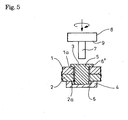
- the flanges 6' and 6" formed on axially opposite ends of the auxiliary material 3 to pinchingly hold the respective materials 1 and 2 in an overlapped direction serves as engaging parts, these flanges 6' and 6" being concurrently formed upon immersion of the joint tool 8; alternatively, as shown in Fig. 5 , the auxiliary material 3 with a flange 6" at its upper end in advance may be employed, only the flange 6" at the lower end being formed by the concave 6 on the backing member 4 upon immersion of the joint tool 8 and completed as engaging part.
- the auxiliary material 3 When the auxiliary material 3 with the flange 6" at its upper end in advance is employed, the auxiliary material 3 may be manually set in the joint holes 1a and 2a before the joining device is installed, so that a device such as a feeder for locating the auxiliary material 3 in the joint holes 1a and 2a becomes unnecessary.
- the above-mentioned embodiment is exemplified with the spot-like joint holes 1a and 2a formed on the materials 1 and 2, the joint tool 8 being aligned with the joining holes 1a and 2a so as to conduct spot joining; alternatively, the joining holes 1a and 2a may be formed in a slot form so as to conduct continuous joining by the joining tool 8 moved longitudinally of the joining holes 1a and 2a.
- a method for joining materials according to the invention is not limited to the above-mentioned embodiment and that various changes and modifications may be made without departing from the scope of the invention as defined by the claims.
- the respective materials are not always different materials.
- the auxiliary material may be preliminarily formed with a guide bore for guiding immersion of a joint tool.
- the sectional configuration of the joint holes are not limited to rectangular as shown; the joint holes with various different sections may be appropriately employed so as to attain greater joint area for the purpose of improving strength.
Landscapes
- Engineering & Computer Science (AREA)
- Mechanical Engineering (AREA)
- Pressure Welding/Diffusion-Bonding (AREA)
- Connection Of Plates (AREA)
Claims (9)
- Procédé de jonction de matériaux métalliques comprenant la superposition de la pluralité de matériaux métalliques (1, 2), chacun comportant un trou de jonction (1a, 2a), de manière à aligner les trous de jonction (1a, 2a), l'insertion d'un matériau métallique auxiliaire de jonction (3) dans lesdits trous de jonction (1a, 2a) alignés, la rotation et la pression d'un outil de jonction (8) à partir d'un côté dans une direction de superposition desdits matériaux métalliques (1, 2) respectifs sur le matériau métallique auxiliaire (3) pour ramollir ledit matériau métallique auxiliaire (3) en phase solide par la chaleur de frottement générée de manière à immerger l'outil de jonction (8) dans le matériau métallique auxiliaire (3), moyennant quoi le matériau métallique auxiliaire (3) est inséré étroitement dans les trous de jonction (1a, 2a) pour réaliser une partie de mise en prise mécanique (5', 6', 6") pour les matériaux métalliques (1, 2) respectifs, l'extraction dudit outil de jonction (8), la solidification de ladite partie de mise en prise (5', 6', 6"), moyennant quoi les matériaux métalliques (1, 2) respectifs sont joints les uns aux autres par l'intermédiaire du matériau métallique auxiliaire (3), caractérisé en ce que
une nervure (5') formée sur le matériau métallique auxiliaire (3) assemblée à une rainure (5) formée au préalable sur une surface côté intérieur du trou de jonction (1 a, 2a) sert de partie de mise en prise. - Procédé de jonction de matériaux selon la revendication 1,
dans lequel des rebords (6', 6") formés sur les extrémités axialement opposées du matériau métallique auxiliaire (3) pour maintenir par pincement les matériaux métalliques (1, 2) respectifs dans une direction de superposition servent de parties de mise en prise, au moins l'un des rebords (6', 6") étant formé lors de l'immersion de l'outil de jonction (8) et achevé en tant que partie de mise en prise. - Procédé de jonction de matériaux selon l'une quelconque des revendications 1 et 2, dans lequel au moins l'un des matériaux métalliques (1, 2) respectifs est du même type que le matériau métallique auxiliaire (3), une frontière entre ce même matériau et le matériau métallique auxiliaire (3) étant agitée par la rotation de l'outil de jonction (8) pour réaliser une soudure ou une jonction par agitation par frottement (10).
- Procédé de jonction de matériaux selon l'une quelconque des revendications 1 à 3, dans lequel les trous de jonction (1 a, 2a) formés dans lesdits matériaux (1, 2) respectifs sont en forme de points ; et l'outil de jonction (8) est aligné avec lesdits trous de jonction (1 a, 2a) pour effectuer une jonction par points.
- Procédé de jonction de matériaux selon l'une quelconque des revendications 1 à 3, dans lequel les trous de jonction (1 a, 2a) formés dans lesdits matériaux (1, 2) respectifs sont en forme de fentes ; et l'outil de jonction (8) est déplacé longitudinalement auxdits trous de jonction (1a, 2a) pour effectuer une jonction continue.
- Procédé de jonction de matériaux métalliques comprenant la superposition de la pluralité de matériaux métalliques (1, 2), chacun comportant un trou de jonction (1a, 2a), de manière à aligner les trous de jonction (1a, 2a), l'insertion d'un matériau métallique auxiliaire de jonction (3) dans lesdits trous de jonction (1a, 2a) alignés, la rotation et la pression d'un outil de jonction (8) à partir d'un côté dans une direction de superposition desdits matériaux métalliques (1, 2) respectifs sur le matériau métallique auxiliaire (3) pour ramollir ledit matériau métallique auxiliaire (3) en phase solide par la chaleur de frottement générée de manière à immerger l'outil de jonction (8) dans le matériau métallique auxiliaire (3), moyennant quoi le matériau métallique auxiliaire (3) est inséré étroitement dans les trous de jonction (1a, 2a) pour réaliser une partie de mise en prise mécanique (5', 6', 6") pour les matériaux métalliques (1, 2) respectifs, l'extraction dudit outil de jonction (8), la solidification de ladite partie de mise en prise (5', 6', 6"), moyennant quoi les matériaux métalliques (1, 2) respectifs sont joints les uns aux autres par l'intermédiaire du matériau métallique auxiliaire (3), caractérisé en ce que au moins l'un des matériaux métalliques (1, 2) respectifs est du même type que le matériau métallique auxiliaire (3), une frontière entre ce même matériau métallique et le matériau métallique auxiliaire (3) étant agitée par la rotation de l'outil de jonction (8) pour réaliser une soudure ou une jonction par agitation par frottement (10).
- Procédé de jonction de matériaux métalliques selon la revendication 6, dans lequel des rebords (6', 6") formés sur les extrémités axialement opposées du matériau métallique auxiliaire (3) pour maintenir par pincement les matériaux métalliques (1, 2) respectifs dans une direction de superposition servent de parties de mise en prise, au moins l'un des rebords (6', 6") étant formé lors de l'immersion de l'outil de jonction (8) et achevé en tant que partie de mise en prise.
- Procédé de jonction de matériaux selon l'une quelconque des revendications 6 et 7, dans lequel les trous de jonction (1a, 2a) formés dans lesdits matériaux (1, 2) respectifs sont en forme de points ; et l'outil de jonction (8) est aligné avec lesdits trous de jonction (1a, 2a) pour effectuer une jonction par points.
- Procédé de jonction de matériaux selon l'une quelconque des revendications 6 et 7, dans lequel les trous de jonction (1a, 2a) formés dans lesdits matériaux (1, 2) respectifs sont en forme de fentes ; et l'outil de jonction (8) est déplacé longitudinalement auxdits trous de jonction (1 a, 2a) pour effectuer une jonction continue.
Applications Claiming Priority (2)
| Application Number | Priority Date | Filing Date | Title |
|---|---|---|---|
| JP2006072697A JP2007245198A (ja) | 2006-03-16 | 2006-03-16 | 材料の接合方法 |
| PCT/JP2007/000229 WO2007108208A1 (fr) | 2006-03-16 | 2007-03-15 | Procede pour assembler des materiaux |
Publications (3)
| Publication Number | Publication Date |
|---|---|
| EP1995015A1 EP1995015A1 (fr) | 2008-11-26 |
| EP1995015A4 EP1995015A4 (fr) | 2009-09-09 |
| EP1995015B1 true EP1995015B1 (fr) | 2012-12-26 |
Family
ID=38522244
Family Applications (1)
| Application Number | Title | Priority Date | Filing Date |
|---|---|---|---|
| EP07736886A Ceased EP1995015B1 (fr) | 2006-03-16 | 2007-03-15 | Procede pour assembler des materiaux |
Country Status (6)
| Country | Link |
|---|---|
| US (1) | US20090094813A1 (fr) |
| EP (1) | EP1995015B1 (fr) |
| JP (1) | JP2007245198A (fr) |
| KR (1) | KR20090003290A (fr) |
| CN (1) | CN101443152B (fr) |
| WO (1) | WO2007108208A1 (fr) |
Families Citing this family (13)
| Publication number | Priority date | Publication date | Assignee | Title |
|---|---|---|---|---|
| JP4972417B2 (ja) | 2006-12-15 | 2012-07-11 | 日野自動車株式会社 | 部材接合方法及び構造 |
| JP4951430B2 (ja) * | 2007-07-19 | 2012-06-13 | 光生アルミニューム工業株式会社 | パイプ部材の内面摩擦圧接法 |
| JP5272165B2 (ja) * | 2009-03-29 | 2013-08-28 | 独立行政法人国立高等専門学校機構 | 木質材の接合方法、木質材の接合機、及び木質具 |
| CH702672A1 (de) * | 2010-02-10 | 2011-08-15 | Alstom Technology Ltd | Verfahren zum verbinden von schaufeln einer turbine mit einem deckbandelement. |
| CN102091861B (zh) * | 2010-12-21 | 2013-03-13 | 南京工程学院 | 一种复合摩擦热源的金属螺柱焊接系统 |
| JP6022402B2 (ja) * | 2013-05-22 | 2016-11-09 | 株式会社神戸製鋼所 | リベット接合構造体及びその製造方法 |
| JP5590206B2 (ja) * | 2013-09-20 | 2014-09-17 | 日本軽金属株式会社 | 伝熱板の製造方法 |
| CN103769521B (zh) * | 2014-02-13 | 2016-06-22 | 中国北方车辆研究所 | 一种提高制动摩擦块冲击强度的翻面旋铆方法 |
| DE102016217581A1 (de) * | 2016-09-15 | 2018-03-15 | Schaeffler Technologies AG & Co. KG | Verfahren zur Ausbildung eines Nietkopfes aus einem spröden metallischen Werkstoff |
| CN106513555A (zh) * | 2016-09-28 | 2017-03-22 | 哈尔滨建成集团有限公司 | 一种使用铆接专用夹具进行铆接的方法 |
| US12269113B2 (en) * | 2019-04-12 | 2025-04-08 | Nippon Light Metal Company, Ltd. | Joining method |
| CN114378421B (zh) * | 2020-10-21 | 2023-05-19 | 上海汽车集团股份有限公司 | 不同硬度金属件的焊接方法和不同硬度金属件的焊接产品 |
| CN120394759B (zh) * | 2025-07-01 | 2025-08-29 | 天津大学 | 摩擦铆接设备及方法 |
Family Cites Families (24)
| Publication number | Priority date | Publication date | Assignee | Title |
|---|---|---|---|---|
| US2779998A (en) * | 1952-01-30 | 1957-02-05 | Lockheed Aircraft Corp | Method of forming a mechanical and electrical connection |
| US3495321A (en) * | 1965-07-07 | 1970-02-17 | Walker Mfg Co | Method of making a connection |
| US3848389A (en) * | 1969-12-29 | 1974-11-19 | Textron Inc | Bimetal rivets |
| US4087038A (en) * | 1975-12-19 | 1978-05-02 | Harima Sargyo Kabushiki Kaisha | Frictional welding method |
| GB9119022D0 (en) * | 1991-09-05 | 1991-10-23 | Welding Inst | Friction forming |
| JP2827621B2 (ja) * | 1991-10-23 | 1998-11-25 | 三菱電機株式会社 | 大電流基板及びその製造方法 |
| JP4092794B2 (ja) * | 1998-11-02 | 2008-05-28 | 日本軽金属株式会社 | 接合方法 |
| US6230958B1 (en) * | 1999-09-30 | 2001-05-15 | Lockheed Martin Corporation | Friction pull plug welding: dual chamfered plate hole |
| US6769595B2 (en) * | 2000-12-20 | 2004-08-03 | Alcoa Inc. | Friction plunge riveting |
| JP3861719B2 (ja) * | 2002-03-12 | 2006-12-20 | 株式会社デンソー | 摩擦撹拌接合法 |
| JP4199952B2 (ja) * | 2002-03-15 | 2008-12-24 | 新明和工業株式会社 | 中空の組立構造物及び航空機の動翼 |
| US6854634B2 (en) * | 2002-05-14 | 2005-02-15 | The Boeing Company | Method of manufacturing rivets having high strength and formability |
| JP2004106037A (ja) * | 2002-09-20 | 2004-04-08 | Hitachi Ltd | 金属材料の結合方法 |
| WO2005018866A1 (fr) * | 2003-08-22 | 2005-03-03 | Honda Motor Co., Ltd. | Procede de soudage par friction malaxage, element de gabarit a partie soudee par friction malaxage et outil de soudage par friction malaxage |
| US7398911B2 (en) * | 2003-12-16 | 2008-07-15 | The Boeing Company | Structural assemblies and preforms therefor formed by friction welding |
| US7347641B2 (en) * | 2004-03-31 | 2008-03-25 | The Boeing Company | Methods and systems for joining structures |
| JP2006316964A (ja) * | 2005-05-16 | 2006-11-24 | Toyota Motor Corp | ボルトの固定方法及びボルトの固定構造 |
| US7624910B2 (en) * | 2006-04-17 | 2009-12-01 | Lockheed Martin Corporation | Perforated composites for joining of metallic and composite materials |
| JP4886277B2 (ja) * | 2005-11-17 | 2012-02-29 | 日野自動車株式会社 | 材料の接合方法 |
| JP5094140B2 (ja) * | 2006-11-09 | 2012-12-12 | 日野自動車株式会社 | 部材接合構造 |
| JP4966034B2 (ja) * | 2006-11-10 | 2012-07-04 | 日野自動車株式会社 | 部材接合構造 |
| JP5094141B2 (ja) * | 2006-11-10 | 2012-12-12 | 日野自動車株式会社 | 部材接合構造 |
| JP4972417B2 (ja) * | 2006-12-15 | 2012-07-11 | 日野自動車株式会社 | 部材接合方法及び構造 |
| JP4591547B2 (ja) * | 2008-05-26 | 2010-12-01 | 株式会社豊田中央研究所 | 接合体およびその製造方法 |
-
2006
- 2006-03-16 JP JP2006072697A patent/JP2007245198A/ja active Pending
-
2007
- 2007-03-15 KR KR1020087023913A patent/KR20090003290A/ko not_active Withdrawn
- 2007-03-15 EP EP07736886A patent/EP1995015B1/fr not_active Ceased
- 2007-03-15 US US12/282,453 patent/US20090094813A1/en not_active Abandoned
- 2007-03-15 CN CN2007800171291A patent/CN101443152B/zh not_active Expired - Fee Related
- 2007-03-15 WO PCT/JP2007/000229 patent/WO2007108208A1/fr not_active Ceased
Also Published As
| Publication number | Publication date |
|---|---|
| US20090094813A1 (en) | 2009-04-16 |
| KR20090003290A (ko) | 2009-01-09 |
| CN101443152A (zh) | 2009-05-27 |
| WO2007108208A1 (fr) | 2007-09-27 |
| JP2007245198A (ja) | 2007-09-27 |
| EP1995015A1 (fr) | 2008-11-26 |
| CN101443152B (zh) | 2011-12-14 |
| EP1995015A4 (fr) | 2009-09-09 |
Similar Documents
| Publication | Publication Date | Title |
|---|---|---|
| EP1995015B1 (fr) | Procede pour assembler des materiaux | |
| US7909229B2 (en) | Method for joining material | |
| CN205629649U (zh) | 用于接合同种和异种材料的电阻焊接紧固件和设备 | |
| JP7426564B2 (ja) | 溶接方法 | |
| JP7012205B2 (ja) | 接合構造 | |
| JP6998513B2 (ja) | 接合構造 | |
| JP7015998B2 (ja) | レーザ溶接方法 | |
| CN104249215A (zh) | 电阻焊接紧固件、装置和方法 | |
| CN112996623A (zh) | 异种材料接合用焊接法、接合辅助构件和异种材料焊接接头 | |
| JP5315207B2 (ja) | 異材接合体及び異材抵抗スポット溶接方法 | |
| JP4998027B2 (ja) | 摩擦点接合方法 | |
| US20170166261A1 (en) | Vehicle Body Component | |
| CN106994554A (zh) | 用于将包含钢的构件与包含铝的构件相接合的方法 | |
| CN110114186A (zh) | 用于制造工件复合体的方法和工件复合体 | |
| CN113828920B (zh) | 接合结构 | |
| JP4755887B2 (ja) | 材料の接合方法 | |
| JP7557676B2 (ja) | 接合構造 | |
| CN107262911B (zh) | 产生混合连接的方法和用于该方法的装置 | |
| JP2007301578A (ja) | 材料の接合方法 | |
| JP7131927B2 (ja) | 異材接合法、接合補助部材、及び、異材接合継手 | |
| Suzuki et al. | Dissimilar metals Joining Process using GMAW has High strength and One side access characteristic, and the Automation robot system | |
| JP7475484B2 (ja) | 締結方法 | |
| JP2003245783A (ja) | スポット接合ツール | |
| JP2006095585A (ja) | 摩擦点接合方法 | |
| KR20260062487A (ko) | Few용 접합요소 및 이를 이용한 이종소재 접합 방법 |
Legal Events
| Date | Code | Title | Description |
|---|---|---|---|
| PUAI | Public reference made under article 153(3) epc to a published international application that has entered the european phase |
Free format text: ORIGINAL CODE: 0009012 |
|
| 17P | Request for examination filed |
Effective date: 20080924 |
|
| AK | Designated contracting states |
Kind code of ref document: A1 Designated state(s): DE GB |
|
| DAX | Request for extension of the european patent (deleted) | ||
| RBV | Designated contracting states (corrected) |
Designated state(s): DE GB |
|
| A4 | Supplementary search report drawn up and despatched |
Effective date: 20090811 |
|
| 17Q | First examination report despatched |
Effective date: 20100127 |
|
| GRAJ | Information related to disapproval of communication of intention to grant by the applicant or resumption of examination proceedings by the epo deleted |
Free format text: ORIGINAL CODE: EPIDOSDIGR1 |
|
| GRAP | Despatch of communication of intention to grant a patent |
Free format text: ORIGINAL CODE: EPIDOSNIGR1 |
|
| GRAP | Despatch of communication of intention to grant a patent |
Free format text: ORIGINAL CODE: EPIDOSNIGR1 |
|
| GRAS | Grant fee paid |
Free format text: ORIGINAL CODE: EPIDOSNIGR3 |
|
| GRAA | (expected) grant |
Free format text: ORIGINAL CODE: 0009210 |
|
| AK | Designated contracting states |
Kind code of ref document: B1 Designated state(s): DE GB |
|
| REG | Reference to a national code |
Ref country code: GB Ref legal event code: FG4D |
|
| REG | Reference to a national code |
Ref country code: DE Ref legal event code: R096 Ref document number: 602007027627 Country of ref document: DE Effective date: 20130228 |
|
| PLBE | No opposition filed within time limit |
Free format text: ORIGINAL CODE: 0009261 |
|
| STAA | Information on the status of an ep patent application or granted ep patent |
Free format text: STATUS: NO OPPOSITION FILED WITHIN TIME LIMIT |
|
| 26N | No opposition filed |
Effective date: 20130927 |
|
| REG | Reference to a national code |
Ref country code: DE Ref legal event code: R097 Ref document number: 602007027627 Country of ref document: DE Effective date: 20130927 |
|
| PGFP | Annual fee paid to national office [announced via postgrant information from national office to epo] |
Ref country code: DE Payment date: 20140222 Year of fee payment: 8 |
|
| PGFP | Annual fee paid to national office [announced via postgrant information from national office to epo] |
Ref country code: GB Payment date: 20140312 Year of fee payment: 8 |
|
| REG | Reference to a national code |
Ref country code: DE Ref legal event code: R119 Ref document number: 602007027627 Country of ref document: DE |
|
| GBPC | Gb: european patent ceased through non-payment of renewal fee |
Effective date: 20150315 |
|
| PG25 | Lapsed in a contracting state [announced via postgrant information from national office to epo] |
Ref country code: GB Free format text: LAPSE BECAUSE OF NON-PAYMENT OF DUE FEES Effective date: 20150315 Ref country code: DE Free format text: LAPSE BECAUSE OF NON-PAYMENT OF DUE FEES Effective date: 20151001 |