EP1995930A2 - Verfahren zur Transkodierung von Sitzungen vom Typ SIP - Google Patents
Verfahren zur Transkodierung von Sitzungen vom Typ SIP Download PDFInfo
- Publication number
- EP1995930A2 EP1995930A2 EP08103823A EP08103823A EP1995930A2 EP 1995930 A2 EP1995930 A2 EP 1995930A2 EP 08103823 A EP08103823 A EP 08103823A EP 08103823 A EP08103823 A EP 08103823A EP 1995930 A2 EP1995930 A2 EP 1995930A2
- Authority
- EP
- European Patent Office
- Prior art keywords
- sip
- transcoding
- client
- client device
- server
- Prior art date
- Legal status (The legal status is an assumption and is not a legal conclusion. Google has not performed a legal analysis and makes no representation as to the accuracy of the status listed.)
- Granted
Links
Images

Classifications
-
- H—ELECTRICITY
- H04—ELECTRIC COMMUNICATION TECHNIQUE
- H04L—TRANSMISSION OF DIGITAL INFORMATION, e.g. TELEGRAPHIC COMMUNICATION
- H04L63/00—Network architectures or network communication protocols for network security
- H04L63/08—Network architectures or network communication protocols for network security for authentication of entities
-
- H—ELECTRICITY
- H04—ELECTRIC COMMUNICATION TECHNIQUE
- H04L—TRANSMISSION OF DIGITAL INFORMATION, e.g. TELEGRAPHIC COMMUNICATION
- H04L65/00—Network arrangements, protocols or services for supporting real-time applications in data packet communication
- H04L65/1066—Session management
-
- H—ELECTRICITY
- H04—ELECTRIC COMMUNICATION TECHNIQUE
- H04L—TRANSMISSION OF DIGITAL INFORMATION, e.g. TELEGRAPHIC COMMUNICATION
- H04L65/00—Network arrangements, protocols or services for supporting real-time applications in data packet communication
- H04L65/1066—Session management
- H04L65/1101—Session protocols
- H04L65/1104—Session initiation protocol [SIP]
Definitions
- the subject of the invention is a method for transcoding SIP-type sessions.
- the field of the invention is that of telecommunications and more particularly that of access to services via a telecommunications network.
- IMS IP Multimedia Subsystem
- the IMS architecture is built on the standards and recommendations published by 3GPP for the 3rd Generation Partnership Project or Partnership for a 3rd Generation Project. This is a working group of ETSI, which defined 3G (3rd generation of mobile networks) and its evolutions.
- the IMS architecture is based, among other things, on the SIP protocol.
- SIP for Session Initiation Protocol or SIT defined by the IEFT standards group
- SIP is a new signaling language suitable for multimedia sessions and suitable for establishing and managing third-party to third party connections or third party to servers.
- This architecture is also based on one or more CSCF servers (Call Session Control Function) for managing SIP requests between terminals and application servers, this function comprises three major modules: P-CSCF (proxy, proxy), S-CSCF (serving, server) and I-CSCF (interrogating, query server).
- P-CSCF proxy, proxy
- S-CSCF serving, server
- I-CSCF interrogating, query server
- a CSCF server is itself connected to an HSS Home Subscriber Server, a database that contains subscriber profiles. It intervenes in their authentication and authorization of access to services. It is the counterpart of an HLR server in a pre-R5 3GPP mobile network.
- This architecture has become independent of the access network that is to say the physical medium allowing access.
- any device compatible with a version of the IP protocol can connect and interact with an IMS architecture.
- an IMS architecture is based on the SIP protocol as envisaged by the 3GPP (that is to say as envisaged by the ETSI) while the devices SIP compatible with the SIP IETF protocol.
- Another problem of the state of the art is that a SIP application is installed on a device with its own SIP driver. So two applications of "Smartphone” type (softphone) installed on the same device will come into conflict. If they do not conflict they will in any case be unable to interact with each other within the same SIP session.
- the second Smartphone application will manage the second communication by sending a ringing tone without indicating to the caller that the called party is already in communication (busy). This is a non-functional operation.
- the method according to the invention behaves therefore seen from the network as a SIP client, and seen from the client device as a Web server.
- a web server is a server that bases its communications primarily on the HTTP protocol. This greatly simplifies the access of client devices to IMS architectures.
- the method according to the invention is also characterized in that, when strong authentication is desired, between the step of authenticating the client with the transcoding device and the step of authenticating the transcoding device of the SIP-type sessions with the SIP server, it also comprises the next step in which a gateway device between the client device and the network, which in this case comprises an integrated SIM card, establishes an IP tunnel to access the operator's IMS access infrastructure using said integrated SIM card to authenticate with the operator.
- a gateway device between the client device and the network which in this case comprises an integrated SIM card, establishes an IP tunnel to access the operator's IMS access infrastructure using said integrated SIM card to authenticate with the operator.
- the method according to the invention is also characterized in that the content of an interface message depends on data received by the transcoding device via the SIP type connection, the data received via this connection being stored in a state memory, the contents of this state memory being associated with the client device.
- an interface message comprises instruction codes corresponding to the description of an option to be proposed to the selection of a user via an interface of the client device. , the selection of this option causing the transmission of an activation message of the option to the transcoding device.
- the method according to the invention is also characterized in that the queries issued by the client device and the processing of the responses to these queries are performed by an Internet browser type application.
- the transcoding device realizes a data formatting received from the application servers and a modular composition of these services within a single dynamic web page, the transcoding device then storing the service profile of the user and also giving the user the ability to share this profile with a community of users.
- the method according to the invention is also characterized in that the Internet browser type application comprises natively or in the form of extension modules at least one data interpreter capable of interpreting the data transcoded by the transcoding device .
- the transcoding device located between the client and the SIP server provides protection of the latter
- the latter in the same way, interferes in the middle of a media stream without Transcode it to hide the IP address of the client and protect it, thus acting as a proxy server.
- the transcoding device marks the streams in order to indicate to the networks the priority in terms of "quality of service” of said streams.
- the client device 102 is, for example, a mobile telephone connected to the gateway device 103 via an over-the-air (OTA) connection of the Wi-Fi type.
- the client device 102 is an individual computer. (PC) connected to the gateway device 103 via an OTA link or an Ethernet cable link.
- PC personal computer
- the device 103 is the "box" of an operator providing access to the Internet or any other communication network supporting the IP protocols (Internet Protocol currently existing in versions 4 and 6).
- IP protocols Internet Protocol currently existing in versions 4 and 6
- Such a box provides the electrical and logical interfaces between the network 101 and a network 104 of the Internet type.
- This is the Internet itself.
- An Internet-like network is an open network providing access to a large number of devices and services. This type of network is opposed to private networks of companies or households with a limited number of devices and to which only authorized personnel can connect.
- the figure 1 shows that the network 104 provides access to a network 105, which is mostly part of the network 104, organized according to an IMS architecture.
- the elements 106 to 110 are interconnected by a bus 111.
- this action corresponds to the implementation of instruction codes corresponding to the action by a microprocessor of a device comprising a program memory itself comprising the instruction codes corresponding to the program in which we lend the action.
- the memory 107 comprises at least one zone 107a comprising instruction codes corresponding to an Internet browser.
- a browser makes it possible to produce and send requests to an HTTP server and to interpret the response of the HTTP server to produce a web page, that is to say an image optionally comprising one or more active, displayable elements. on a screen (not shown) of the device 102.
- An active element is, for example, code according to a language known to the browser. Such languages are, for example, Ecma Script, Javascript, Jscript or Java.
- a web page also includes "hypertext" links whose selection by a pointing device (not shown) of the device 102 makes it possible to control the transmission of a new request to an HTTP server.
- HTTP servers are also known as Web servers or the Internet.
- the interface 110 includes electronic circuits for connecting the device 102 to a network.
- the interface 110 makes it possible to connect the device 102 to the network 101 and is of the Wi-Fi or Ethernet type according to the structure of the network 101.
- the interface 110 is a Wi-Fi interface if the network 101 comprises a Wi-Fi access point.
- the interface 110 is an Ethernet connector if the network 101 includes an Ethernet switch type device.
- the interface 110 makes it possible to integrate the device 102 with the network 101. This allows the device 102 to communicate with the other devices of the network 101.
- the elements 111 to 117 are interconnected via a bus 118.
- the memory 103 makes it possible to associate HTTP authentication parameters with SIP authentication parameters.
- An identifier and a password HTTP are thus transcoded by identifier and password SIP by means of this memory.
- this memory is a table comprising two columns. The first column contains pairs [identifier, password] HTTP, which are matched in the second column with pairs [identifier, password] SIP.
- the memory 113 includes transcoders, that is to say, transcoding programs flow.
- a stream transcoding program accepts data formatted according to a stream type and outputs data formatted according to another stream type.
- the known types of streams at least all those acceptable for the "Content-Type" parameter of the HTTP protocol and more particularly the types and sub-types defined in the RFC2046 and the related RFCs are cited. All these types are not taken into account by a reasonable implementation of the invention. Only the most used are transcoded.
- the memory 114 is a session memory in which the parameters F1 to Fn of a SIP session are recorded. These parameters are in fact the response contents and the contents of the warning messages received from the IMS architecture following the opening of a SIP session.
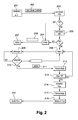
- the figure 2 shows a step 201 implemented by the device connection device 102 103.
- step 201 a user of the device 102 selects a connection command in a menu. The selection of this command causes the device 201 to produce a connection request according to the parameters stored in the configuration memory 109.
- the device 102 invokes the default application designated to handle the HTTP protocol.
- This application is, by configuration of the device 102, an Internet browser.
- the content of the memory 109 is a URL (Universal Resource Locator for universal location of a resource) whose protocol is the HTTP protocol.
- this type of URL is associated by default with an Internet browser.
- the invoked Internet browser issues a connection request 202 in accordance with the contents of the configuration memory 109.
- the request 202 comprises at least one "action” field and in a preferred variant of the "log” and "pass” fields.
- the request 202 is routed through the network 101 to the device 103 using the HTTP protocol.
- the device 103 receives the request 202.
- the protocol used by the request allows the device 203 to determine that the request must be processed by the HTTP server application.
- the content of the "action” field allows the HTTP server application to determine what action should be taken.
- the request 202 it is an action of connection to an IMS architecture and more particularly to a CSCF server. Since the request 202 also has a "log" field and a "pass" field, the server application does not need any more information to perform the action.
- the request 202 does not include the "log" and "pass” fields.
- the HTTP server application puts the request processing on hold and issues a request for authentication elements. The processing of the request 202 is put on hold until the authentication elements have been submitted.
- Authentication elements that is, the contents of the "log" and "pass" fields, allow the HTTP server application to search table 112 to determine if a row in table 112 matches to the HTTP authentication elements submitted via the request 202. If such a line is not found, then the HTTP server application proceeds to a step 204 of producing and sending an error message. Otherwise the HTTP server application goes to a SIP connection step 205.
- the error message produced in step 204 is a message 206 according to the HTTP protocol indicating that access to the requested action is denied.
- a step 207 the device 102, and more particularly the Internet browser application, receives a response to the request 202.
- This response is an error message that is interpreted by the Internet browser application, a result of the interpretation being displayed on a screen of the device 102.
- the process stops there, except to submit new HTTP authentication data.
- step 205 the application uses the SIP authentication elements found in step 203 to generate and issue a SIP connection request.
- the SIP authentication elements comprise at least one address of a connection opening server of an IMS architecture, that is to say a CSCF server, a SIP identifier and a SIP password associated with this identifier. SIP.
- the HTTP server application uses the instruction codes of the zone 112b to try to open a SIP session. If the SIP logon attempt fails then the HTTP server application proceeds to step 204. If successful, the HTTP server application proceeds to a step 208 of producing and transmitting an HTTP server. menu.
- the device 103 has a configuration enabling it to secure its exchanges with the CSCF server.
- This configuration comprises for example an encryption key for the establishment of a so-called IpSec tunnel between the device 103 and the CSCF server.
- This configuration is, for example, recorded in a SIM card (microcircuit card). Such a microcircuit card is then distributed by the operator to which the CSCF server belongs.
- the HTTP server application stores in memory 114 a new line corresponding to the information received in response to the SIP login.
- This new line is associated by a session identifier to the Internet browser application that issued the request 202.
- Each new request from the Internet browser application must include this identifier to allow the HTTP server application to associate the request with a request. This result is achieved, for example, by a "cookie" exchange between the HTTP server application and the Internet browser application.
- the information stored in the memory 114 is also called session data. In the following example, we consider that the session identifier is S1. We then speak of the session S1 and the data of the session S1. This session S1 is also associated with the SIP connection.
- step 208 in addition to issuing a "cookie" having a session identifier, the HTTP server application produces instruction codes corresponding to a menu according to the data of the session S1. This data depends on the rights associated with SIP authentication information by the IMS architecture.
- Such a menu includes links to access multimedia broadcasts (text, audio, video), telephony services, video telephony services, real-time information services. not being exhaustive.
- the user of the device 103 has the ability to share the content of his profile with other users, or groups of users, specified by him. This set of users is then called a community.
- This profile is used to modulate the production of the dynamic "WEB” page representing the menu. This profile also gives a unique character to this "WEB" page.
- this menu product is sent to the device 102 as a response to the request 202.
- the Internet browser application receives a response to a previously issued request.
- the content of this query is interpreted and rendered / played according to the content of the answer. This results in the modification of the display on the screen of the device 101 and / or in the sound broadcasting by the device 101.
- the device 102 issues HTTP requests and interprets the responses to these requests. This interpretation causes at least the display of a menu with links activatable by a user of the device 102.
- connection request 202 also includes information relating to the rendering capabilities of the Internet browser implemented. This allows the HTTP server application to know which media streams can be interpreted by the Internet browser application.
- the IMS architecture sees the device 103 as a SIP client and behaves vis-à-vis it as vis-à-vis a SIP client.
- This connection corresponds to a permanent resource allocation as long as the connection lasts, we speak of persistent connection.
- These persistent connections are opposed to temporary connections that only last for the time required to resolve a transaction, ie the time required for the exchange of a question and its answer, the transmission of the answer ending the connection.
- a persistent connection is terminated by the user initiated transmission of a disconnect message.
- This pushed data is, for example, the signal of an incoming voice call, information corresponding to a service. information in real time, the list is not exhaustive. This data is saved as session data.
- step 209 the internet browser application proceeds to a step 210 waiting for an event.
- the Internet browser application sends the HTTP server application the same request that would cause the current display on the screen of the device 102.
- This request is the one that would be sent if the user of the device 102 used the update functionality of the Internet browser application.
- this update is performed via AJAX technologies to update only part of the web page. This allows a better visual rendering for the user by preventing a blinking impression of the display.
- the update request is processed as in step 208 taking into account the current state of session data that may have evolved through the persistent SIP connection.
- the Internet browser application sends to the device 103 a request corresponding to the parameters of the activated link.
- These parameters include at least one action information.
- these parameters also include an identifier of the multimedia stream.
- the HTTP server application receives the request 211 comprising action information relating to the viewing of a multimedia content.
- the HTTP server application initiates a SIP negotiation on the multimedia content. To do this, it transcodes the HTTP request into a SIP request that is sent to the IMS infrastructure via the persistent connection. Then it goes to a step 213 in which it waits for the response to the SIP request.
- the HTTP server application passes at a step 214 of receiving multimedia streams corresponding to the SIP request.
- These multimedia streams are described in the response of the IMS architecture to the SIP request.
- the SIP OK response includes a description of the multimedia streams required to satisfy the request 211.
- the HTTP server application sets to S1 session data based on this response and proceeds to step 208.
- the HTTP server application uses the information contained in the SIP OK request to connect to a media stream server.
- This information includes the description of at least one multimedia stream.
- This description includes at least one URL of the feed.
- this information includes the type of flow. If this information does not include the type of the stream then issuing a request using the URL of the stream will result in receiving messages corresponding to this stream, the headers of these messages including the type of the stream.
- the HTTP server application determines whether it is useful to transcode the stream.
- the Internet server application chooses a type of stream equivalent to the type of the stream to be transcribed among the types of streams supported by the Internet browser application. Once the equivalent type has been selected, the server application uses, in a step 215, the instruction codes Tx of the memory 113 corresponding to the transcoding of the stream to be transcribed to the equivalent stream to transcode the stream to be transcoded. The result of transcoding by Tx is sent, in a step 216, to the Internet client application in response to the request 211.
- the Internet browser application receives a response to the request 211.
- This response according to the HTTP protocol, includes a header describing the type of data that the response comprises.
- each particular data type is associated with an extension of the application. Since when connecting the Internet browser application said the types of flows it could handle, the extension corresponding to the received stream is necessarily, it is invoked to manage this flow.
- all services and SIP connections are managed by the same device that does not require installation of a particular application.
- a pair [identifier, password] HTTP there is only one SIP connection and therefore only one SIP manager that has an overview of all SIP services via the data. session. It is therefore entirely possible to have two SIP services interact via the same manager.
- each SIP service corresponds to an application, each application having its own connection manager.
- the invention also makes it possible to manage several users simultaneously, each having his SIP session and thus his session data.
- the device 103 acts as a proxy server on behalf of the user of the device 102. This role enables it to protect this user from all attacks coming from the network 104. This protection is more efficient than it is managed by the provider operator providing the device 103. This operator has the ability to update dynamically, that is to say here whenever required, the protection means.
- the device 103 acts on the data flows, in particular on the headers of the data packets constituting these flows, to ensure a good quality of service as a function of the types of flows processed.
- the various services corresponding to these different streams are therefore rendered under optimal conditions.
- This action on the flows also makes it possible to manage the quality of service according to a type of contract subscribed by the user of the device, or of a particular global network situation that the operator providing the service must provide. device 103.
- This operator thus has the ability to finely manage the services, and the interaction of these services, on the network 104.
Landscapes
- Engineering & Computer Science (AREA)
- Computer Networks & Wireless Communication (AREA)
- Signal Processing (AREA)
- Computer Hardware Design (AREA)
- Multimedia (AREA)
- General Business, Economics & Management (AREA)
- Business, Economics & Management (AREA)
- Computer Security & Cryptography (AREA)
- Computing Systems (AREA)
- General Engineering & Computer Science (AREA)
- Telephonic Communication Services (AREA)
- Use Of Switch Circuits For Exchanges And Methods Of Control Of Multiplex Exchanges (AREA)
- Exchange Systems With Centralized Control (AREA)
- Mobile Radio Communication Systems (AREA)
Applications Claiming Priority (1)
| Application Number | Priority Date | Filing Date | Title |
|---|---|---|---|
| FR0755161A FR2916552B1 (fr) | 2007-05-21 | 2007-05-21 | Procede de transcodage de sessions de type sip. |
Publications (3)
| Publication Number | Publication Date |
|---|---|
| EP1995930A2 true EP1995930A2 (de) | 2008-11-26 |
| EP1995930A3 EP1995930A3 (de) | 2009-11-18 |
| EP1995930B1 EP1995930B1 (de) | 2010-09-15 |
Family
ID=38871898
Family Applications (1)
| Application Number | Title | Priority Date | Filing Date |
|---|---|---|---|
| EP08103823A Active EP1995930B1 (de) | 2007-05-21 | 2008-05-05 | Verfahren zur Transkodierung von Sitzungen vom Typ SIP |
Country Status (5)
| Country | Link |
|---|---|
| EP (1) | EP1995930B1 (de) |
| AT (1) | ATE481810T1 (de) |
| DE (1) | DE602008002468D1 (de) |
| ES (1) | ES2352164T3 (de) |
| FR (1) | FR2916552B1 (de) |
Cited By (1)
| Publication number | Priority date | Publication date | Assignee | Title |
|---|---|---|---|---|
| CN101945027A (zh) * | 2010-08-30 | 2011-01-12 | 中兴通讯股份有限公司 | 一种家庭有线物联网关获取uim卡号的方法及系统 |
Family Cites Families (2)
| Publication number | Priority date | Publication date | Assignee | Title |
|---|---|---|---|---|
| JP4277621B2 (ja) * | 2003-08-20 | 2009-06-10 | 沖電気工業株式会社 | サービス提供システムおよびその方法ならびにサービス提供プログラムおよび記録媒体 |
| US7979519B2 (en) * | 2003-10-09 | 2011-07-12 | Oki Electric Industry Co., Ltd. | System for providing information between different protocol environments cooperative with each other and a method therefor |
-
2007
- 2007-05-21 FR FR0755161A patent/FR2916552B1/fr active Active
-
2008
- 2008-05-05 AT AT08103823T patent/ATE481810T1/de active
- 2008-05-05 DE DE602008002468T patent/DE602008002468D1/de active Active
- 2008-05-05 ES ES08103823T patent/ES2352164T3/es active Active
- 2008-05-05 EP EP08103823A patent/EP1995930B1/de active Active
Cited By (3)
| Publication number | Priority date | Publication date | Assignee | Title |
|---|---|---|---|---|
| CN101945027A (zh) * | 2010-08-30 | 2011-01-12 | 中兴通讯股份有限公司 | 一种家庭有线物联网关获取uim卡号的方法及系统 |
| WO2012027984A1 (zh) * | 2010-08-30 | 2012-03-08 | 中兴通讯股份有限公司 | 一种家庭有线物联网关获取uim卡号的方法及系统 |
| CN101945027B (zh) * | 2010-08-30 | 2014-03-19 | 中兴通讯股份有限公司 | 一种家庭有线物联网关获取uim卡号的方法及系统 |
Also Published As
| Publication number | Publication date |
|---|---|
| ATE481810T1 (de) | 2010-10-15 |
| EP1995930A3 (de) | 2009-11-18 |
| FR2916552A1 (fr) | 2008-11-28 |
| DE602008002468D1 (de) | 2010-10-28 |
| ES2352164T3 (es) | 2011-02-16 |
| EP1995930B1 (de) | 2010-09-15 |
| FR2916552B1 (fr) | 2015-02-13 |
Similar Documents
| Publication | Publication Date | Title |
|---|---|---|
| US10165015B2 (en) | System and method for real-time communication by using a client application communication protocol | |
| US9648006B2 (en) | System and method for communicating with a client application | |
| US20080152101A1 (en) | Web-based telephony system and method | |
| EP3020179B1 (de) | Verteiltes programmierbares verbindungsverfahren zur herstellung von peer-to-peer-interaktionen | |
| CN104704795A (zh) | 通过使用具有webRTC功能的网络浏览器创建虚拟SIP用户代理的方法和系统 | |
| US12477064B2 (en) | Call processing method, call processing apparatus, and related device | |
| EP3155791B1 (de) | Verfahren zur einrichtung einer webrtc-sitzung | |
| US20090316688A1 (en) | Method for controlling advanced multimedia features and supplemtary services in sip-based phones and a system employing thereof | |
| WO2016156256A1 (en) | Data communications | |
| EP2556646B1 (de) | Verfahren zum zugriff auf einem ausgestrahlten datenflusses | |
| WO2016083751A1 (fr) | Procede de communication entre un terminal equipe d'un client webrtc et un terminal accessible via un cœur de reseau ims | |
| EP1995930B1 (de) | Verfahren zur Transkodierung von Sitzungen vom Typ SIP | |
| EP2266279B1 (de) | Gemeinsame nutzung von multimedia-inhalten über eine audio-video-kommunikation | |
| FR3081655A1 (fr) | Procede de traitement de messages par un dispositif d'un reseau de voix sur ip | |
| EP3661161B1 (de) | Verfahren und system zum sprachfernzugriff auf persönliche sprachassistenzdienste | |
| Schneps-Schneppe et al. | About Home Gateway Mashups | |
| EP3053306B1 (de) | Verfahren zur fernverwaltung einer zu einem privaten netzwerk gehörenden vorrichtung | |
| EP2614630B1 (de) | Verarbeitung von daten zur benachrichtung einer vorrichtung | |
| EP2100430B1 (de) | Telekommunikationsverfahren und System mit Zugang zum selben Informationssatz für mindestens zwei verschiedene Benutzer | |
| KR20260047936A (ko) | 웹브라우저 기반 sip 통화 환경에서 ai 서비스를 제공하는 방법, 장치 및 컴퓨터 프로그램 | |
| HK | Analysis and testing of voip-subsystems of Ip Brick | |
| FR2842681A1 (fr) | Procede et systeme d'avertissement et de diffusion d'informations par un reseau public de transmission de donnees numeriques | |
| FR3000357A1 (fr) | Procede de transfert de communication audio et/ou video depuis un premier terminal vers un deuxieme terminal | |
| Manfred et al. | About Home gateway mashups | |
| SWAMY | Analysis and Testing Of Voip-Subsystems of IpBrick |
Legal Events
| Date | Code | Title | Description |
|---|---|---|---|
| PUAI | Public reference made under article 153(3) epc to a published international application that has entered the european phase |
Free format text: ORIGINAL CODE: 0009012 |
|
| AK | Designated contracting states |
Kind code of ref document: A2 Designated state(s): AT BE BG CH CY CZ DE DK EE ES FI FR GB GR HR HU IE IS IT LI LT LU LV MC MT NL NO PL PT RO SE SI SK TR |
|
| AX | Request for extension of the european patent |
Extension state: AL BA MK RS |
|
| PUAL | Search report despatched |
Free format text: ORIGINAL CODE: 0009013 |
|
| AK | Designated contracting states |
Kind code of ref document: A3 Designated state(s): AT BE BG CH CY CZ DE DK EE ES FI FR GB GR HR HU IE IS IT LI LT LU LV MC MT NL NO PL PT RO SE SI SK TR |
|
| AX | Request for extension of the european patent |
Extension state: AL BA MK RS |
|
| 17P | Request for examination filed |
Effective date: 20091126 |
|
| GRAP | Despatch of communication of intention to grant a patent |
Free format text: ORIGINAL CODE: EPIDOSNIGR1 |
|
| AKX | Designation fees paid |
Designated state(s): AT BE BG CH CY CZ DE DK EE ES FI FR GB GR HR HU IE IS IT LI LT LU LV MC MT NL NO PL PT RO SE SI SK TR |
|
| GRAS | Grant fee paid |
Free format text: ORIGINAL CODE: EPIDOSNIGR3 |
|
| GRAA | (expected) grant |
Free format text: ORIGINAL CODE: 0009210 |
|
| AK | Designated contracting states |
Kind code of ref document: B1 Designated state(s): AT BE BG CH CY CZ DE DK EE ES FI FR GB GR HR HU IE IS IT LI LT LU LV MC MT NL NO PL PT RO SE SI SK TR |
|
| REG | Reference to a national code |
Ref country code: CH Ref legal event code: EP Ref country code: GB Ref legal event code: FG4D Free format text: NOT ENGLISH |
|
| REG | Reference to a national code |
Ref country code: IE Ref legal event code: FG4D Free format text: LANGUAGE OF EP DOCUMENT: FRENCH |
|
| REF | Corresponds to: |
Ref document number: 602008002468 Country of ref document: DE Date of ref document: 20101028 Kind code of ref document: P |
|
| REG | Reference to a national code |
Ref country code: NL Ref legal event code: VDEP Effective date: 20100915 |
|
| PG25 | Lapsed in a contracting state [announced via postgrant information from national office to epo] |
Ref country code: LT Free format text: LAPSE BECAUSE OF FAILURE TO SUBMIT A TRANSLATION OF THE DESCRIPTION OR TO PAY THE FEE WITHIN THE PRESCRIBED TIME-LIMIT Effective date: 20100915 Ref country code: FI Free format text: LAPSE BECAUSE OF FAILURE TO SUBMIT A TRANSLATION OF THE DESCRIPTION OR TO PAY THE FEE WITHIN THE PRESCRIBED TIME-LIMIT Effective date: 20100915 Ref country code: NO Free format text: LAPSE BECAUSE OF FAILURE TO SUBMIT A TRANSLATION OF THE DESCRIPTION OR TO PAY THE FEE WITHIN THE PRESCRIBED TIME-LIMIT Effective date: 20101215 |
|
| REG | Reference to a national code |
Ref country code: ES Ref legal event code: FG2A Effective date: 20110204 |
|
| LTIE | Lt: invalidation of european patent or patent extension |
Effective date: 20100915 |
|
| PG25 | Lapsed in a contracting state [announced via postgrant information from national office to epo] |
Ref country code: SI Free format text: LAPSE BECAUSE OF FAILURE TO SUBMIT A TRANSLATION OF THE DESCRIPTION OR TO PAY THE FEE WITHIN THE PRESCRIBED TIME-LIMIT Effective date: 20100915 Ref country code: PL Free format text: LAPSE BECAUSE OF FAILURE TO SUBMIT A TRANSLATION OF THE DESCRIPTION OR TO PAY THE FEE WITHIN THE PRESCRIBED TIME-LIMIT Effective date: 20100915 Ref country code: HR Free format text: LAPSE BECAUSE OF FAILURE TO SUBMIT A TRANSLATION OF THE DESCRIPTION OR TO PAY THE FEE WITHIN THE PRESCRIBED TIME-LIMIT Effective date: 20100915 Ref country code: CY Free format text: LAPSE BECAUSE OF FAILURE TO SUBMIT A TRANSLATION OF THE DESCRIPTION OR TO PAY THE FEE WITHIN THE PRESCRIBED TIME-LIMIT Effective date: 20100915 |
|
| PG25 | Lapsed in a contracting state [announced via postgrant information from national office to epo] |
Ref country code: GR Free format text: LAPSE BECAUSE OF FAILURE TO SUBMIT A TRANSLATION OF THE DESCRIPTION OR TO PAY THE FEE WITHIN THE PRESCRIBED TIME-LIMIT Effective date: 20101216 Ref country code: LV Free format text: LAPSE BECAUSE OF FAILURE TO SUBMIT A TRANSLATION OF THE DESCRIPTION OR TO PAY THE FEE WITHIN THE PRESCRIBED TIME-LIMIT Effective date: 20100915 Ref country code: SE Free format text: LAPSE BECAUSE OF FAILURE TO SUBMIT A TRANSLATION OF THE DESCRIPTION OR TO PAY THE FEE WITHIN THE PRESCRIBED TIME-LIMIT Effective date: 20100915 |
|
| PG25 | Lapsed in a contracting state [announced via postgrant information from national office to epo] |
Ref country code: NL Free format text: LAPSE BECAUSE OF FAILURE TO SUBMIT A TRANSLATION OF THE DESCRIPTION OR TO PAY THE FEE WITHIN THE PRESCRIBED TIME-LIMIT Effective date: 20100915 Ref country code: EE Free format text: LAPSE BECAUSE OF FAILURE TO SUBMIT A TRANSLATION OF THE DESCRIPTION OR TO PAY THE FEE WITHIN THE PRESCRIBED TIME-LIMIT Effective date: 20100915 Ref country code: IS Free format text: LAPSE BECAUSE OF FAILURE TO SUBMIT A TRANSLATION OF THE DESCRIPTION OR TO PAY THE FEE WITHIN THE PRESCRIBED TIME-LIMIT Effective date: 20110115 Ref country code: CZ Free format text: LAPSE BECAUSE OF FAILURE TO SUBMIT A TRANSLATION OF THE DESCRIPTION OR TO PAY THE FEE WITHIN THE PRESCRIBED TIME-LIMIT Effective date: 20100915 Ref country code: PT Free format text: LAPSE BECAUSE OF FAILURE TO SUBMIT A TRANSLATION OF THE DESCRIPTION OR TO PAY THE FEE WITHIN THE PRESCRIBED TIME-LIMIT Effective date: 20110117 Ref country code: RO Free format text: LAPSE BECAUSE OF FAILURE TO SUBMIT A TRANSLATION OF THE DESCRIPTION OR TO PAY THE FEE WITHIN THE PRESCRIBED TIME-LIMIT Effective date: 20100915 Ref country code: SK Free format text: LAPSE BECAUSE OF FAILURE TO SUBMIT A TRANSLATION OF THE DESCRIPTION OR TO PAY THE FEE WITHIN THE PRESCRIBED TIME-LIMIT Effective date: 20100915 |
|
| PLBE | No opposition filed within time limit |
Free format text: ORIGINAL CODE: 0009261 |
|
| STAA | Information on the status of an ep patent application or granted ep patent |
Free format text: STATUS: NO OPPOSITION FILED WITHIN TIME LIMIT |
|
| PGFP | Annual fee paid to national office [announced via postgrant information from national office to epo] |
Ref country code: IE Payment date: 20110426 Year of fee payment: 4 |
|
| 26N | No opposition filed |
Effective date: 20110616 |
|
| PG25 | Lapsed in a contracting state [announced via postgrant information from national office to epo] |
Ref country code: DK Free format text: LAPSE BECAUSE OF FAILURE TO SUBMIT A TRANSLATION OF THE DESCRIPTION OR TO PAY THE FEE WITHIN THE PRESCRIBED TIME-LIMIT Effective date: 20100915 |
|
| REG | Reference to a national code |
Ref country code: DE Ref legal event code: R097 Ref document number: 602008002468 Country of ref document: DE Effective date: 20110616 |
|
| PG25 | Lapsed in a contracting state [announced via postgrant information from national office to epo] |
Ref country code: MT Free format text: LAPSE BECAUSE OF FAILURE TO SUBMIT A TRANSLATION OF THE DESCRIPTION OR TO PAY THE FEE WITHIN THE PRESCRIBED TIME-LIMIT Effective date: 20100915 |
|
| REG | Reference to a national code |
Ref country code: IE Ref legal event code: MM4A |
|
| PG25 | Lapsed in a contracting state [announced via postgrant information from national office to epo] |
Ref country code: IE Free format text: LAPSE BECAUSE OF NON-PAYMENT OF DUE FEES Effective date: 20120505 |
|
| PG25 | Lapsed in a contracting state [announced via postgrant information from national office to epo] |
Ref country code: TR Free format text: LAPSE BECAUSE OF FAILURE TO SUBMIT A TRANSLATION OF THE DESCRIPTION OR TO PAY THE FEE WITHIN THE PRESCRIBED TIME-LIMIT Effective date: 20100915 Ref country code: BG Free format text: LAPSE BECAUSE OF FAILURE TO SUBMIT A TRANSLATION OF THE DESCRIPTION OR TO PAY THE FEE WITHIN THE PRESCRIBED TIME-LIMIT Effective date: 20101215 |
|
| PG25 | Lapsed in a contracting state [announced via postgrant information from national office to epo] |
Ref country code: HU Free format text: LAPSE BECAUSE OF FAILURE TO SUBMIT A TRANSLATION OF THE DESCRIPTION OR TO PAY THE FEE WITHIN THE PRESCRIBED TIME-LIMIT Effective date: 20100915 |
|
| REG | Reference to a national code |
Ref country code: AT Ref legal event code: MM01 Ref document number: 481810 Country of ref document: AT Kind code of ref document: T Effective date: 20140505 |
|
| PG25 | Lapsed in a contracting state [announced via postgrant information from national office to epo] |
Ref country code: AT Free format text: LAPSE BECAUSE OF NON-PAYMENT OF DUE FEES Effective date: 20140505 |
|
| REG | Reference to a national code |
Ref country code: FR Ref legal event code: GC Effective date: 20150310 |
|
| REG | Reference to a national code |
Ref country code: FR Ref legal event code: PLFP Year of fee payment: 9 |
|
| REG | Reference to a national code |
Ref country code: FR Ref legal event code: PLFP Year of fee payment: 10 |
|
| REG | Reference to a national code |
Ref country code: FR Ref legal event code: PLFP Year of fee payment: 11 |
|
| REG | Reference to a national code |
Ref country code: FR Ref legal event code: GC Effective date: 20180111 |
|
| REG | Reference to a national code |
Ref country code: DE Ref legal event code: R079 Ref document number: 602008002468 Country of ref document: DE Free format text: PREVIOUS MAIN CLASS: H04L0029060000 Ipc: H04L0065000000 |
|
| PGFP | Annual fee paid to national office [announced via postgrant information from national office to epo] |
Ref country code: LU Payment date: 20250423 Year of fee payment: 18 |
|
| PGFP | Annual fee paid to national office [announced via postgrant information from national office to epo] |
Ref country code: MC Payment date: 20250429 Year of fee payment: 18 |
|
| PGFP | Annual fee paid to national office [announced via postgrant information from national office to epo] |
Ref country code: DE Payment date: 20250423 Year of fee payment: 18 |
|
| PGFP | Annual fee paid to national office [announced via postgrant information from national office to epo] |
Ref country code: GB Payment date: 20250423 Year of fee payment: 18 Ref country code: ES Payment date: 20250602 Year of fee payment: 18 |
|
| PGFP | Annual fee paid to national office [announced via postgrant information from national office to epo] |
Ref country code: BE Payment date: 20250423 Year of fee payment: 18 Ref country code: IT Payment date: 20250423 Year of fee payment: 18 |
|
| PGFP | Annual fee paid to national office [announced via postgrant information from national office to epo] |
Ref country code: FR Payment date: 20250423 Year of fee payment: 18 |
|
| PGFP | Annual fee paid to national office [announced via postgrant information from national office to epo] |
Ref country code: CH Payment date: 20250601 Year of fee payment: 18 |