EP1996831B1 - Treibriemen und verfahren zu seiner herstellung - Google Patents
Treibriemen und verfahren zu seiner herstellung Download PDFInfo
- Publication number
- EP1996831B1 EP1996831B1 EP07731068A EP07731068A EP1996831B1 EP 1996831 B1 EP1996831 B1 EP 1996831B1 EP 07731068 A EP07731068 A EP 07731068A EP 07731068 A EP07731068 A EP 07731068A EP 1996831 B1 EP1996831 B1 EP 1996831B1
- Authority
- EP
- European Patent Office
- Prior art keywords
- belt
- film
- fibers
- particles
- density polyethylene
- Prior art date
- Legal status (The legal status is an assumption and is not a legal conclusion. Google has not performed a legal analysis and makes no representation as to the accuracy of the status listed.)
- Active
Links
Images

Classifications
-
- F—MECHANICAL ENGINEERING; LIGHTING; HEATING; WEAPONS; BLASTING
- F16—ENGINEERING ELEMENTS AND UNITS; GENERAL MEASURES FOR PRODUCING AND MAINTAINING EFFECTIVE FUNCTIONING OF MACHINES OR INSTALLATIONS; THERMAL INSULATION IN GENERAL
- F16G—BELTS, CABLES, OR ROPES, PREDOMINANTLY USED FOR DRIVING PURPOSES; CHAINS; FITTINGS PREDOMINANTLY USED THEREFOR
- F16G5/00—V-belts, i.e. belts of tapered cross-section
- F16G5/04—V-belts, i.e. belts of tapered cross-section made of rubber
- F16G5/06—V-belts, i.e. belts of tapered cross-section made of rubber with reinforcement bonded by the rubber
-
- C—CHEMISTRY; METALLURGY
- C08—ORGANIC MACROMOLECULAR COMPOUNDS; THEIR PREPARATION OR CHEMICAL WORKING-UP; COMPOSITIONS BASED THEREON
- C08L—COMPOSITIONS OF MACROMOLECULAR COMPOUNDS
- C08L23/00—Compositions of homopolymers or copolymers of unsaturated aliphatic hydrocarbons having only one carbon-to-carbon double bond; Compositions of derivatives of such polymers
- C08L23/02—Compositions of homopolymers or copolymers of unsaturated aliphatic hydrocarbons having only one carbon-to-carbon double bond; Compositions of derivatives of such polymers not modified by chemical after-treatment
- C08L23/16—Ethylene-propylene or ethylene-propylene-diene copolymers
-
- F—MECHANICAL ENGINEERING; LIGHTING; HEATING; WEAPONS; BLASTING
- F16—ENGINEERING ELEMENTS AND UNITS; GENERAL MEASURES FOR PRODUCING AND MAINTAINING EFFECTIVE FUNCTIONING OF MACHINES OR INSTALLATIONS; THERMAL INSULATION IN GENERAL
- F16G—BELTS, CABLES, OR ROPES, PREDOMINANTLY USED FOR DRIVING PURPOSES; CHAINS; FITTINGS PREDOMINANTLY USED THEREFOR
- F16G1/00—Driving-belts
- F16G1/06—Driving-belts made of rubber
- F16G1/08—Driving-belts made of rubber with reinforcement bonded by the rubber
-
- F—MECHANICAL ENGINEERING; LIGHTING; HEATING; WEAPONS; BLASTING
- F16—ENGINEERING ELEMENTS AND UNITS; GENERAL MEASURES FOR PRODUCING AND MAINTAINING EFFECTIVE FUNCTIONING OF MACHINES OR INSTALLATIONS; THERMAL INSULATION IN GENERAL
- F16G—BELTS, CABLES, OR ROPES, PREDOMINANTLY USED FOR DRIVING PURPOSES; CHAINS; FITTINGS PREDOMINANTLY USED THEREFOR
- F16G5/00—V-belts, i.e. belts of tapered cross-section
- F16G5/20—V-belts, i.e. belts of tapered cross-section with a contact surface of special shape, e.g. toothed
Definitions
- the present invention relates to a power transmission belt, namely a V-shaped belt or V-shaped ribs, in particular of type K for automotive applications, and a method of manufacturing the belt.
- the ribs of such belts which are made of vulcanized rubber, have faces in direct contact with the crankshaft pulley and with the pulleys of the driven accessories.
- a charging alternator have high inertia, which generates dynamic torque levels all the more important that the acyclism is high. These variations in the torque level are in turn reflected by belt tension deviations that are important or very important.
- the belt must therefore have a coefficient of friction sufficient to prevent this phenomenon.
- a third possible cause of noise is the relative misalignment of two pulleys, which also generates a phenomenon of hooking-stall ("stick-slip") generating noise all the more important that the coefficient of friction is important. This phenomenon also depends on the length of strand, the dimensions of the belt, and the nature of the materials that compose it.
- the proposed surface deposits do not have a sufficiently strong adhesion to ensure a coefficient of friction sufficiently stable during the life of the belt. Because of the abrasion, the coefficient of friction increases gradually, resulting in a progressive phenomenon of noisiness.
- the present invention aims to provide a belt whose performance is improved with respect to the noisiness phenomenon.
- the invention thus relates to a ribbed power transmission belt having an ethylene alpha olefin elastomer toothing, in particular EPDM or EPM, characterized in that at least the flanks of the toothing are at least portion coated with a film of a thermoplastic material at least partially crosslinked and containing at least 30% of at least one low density polyethylene, for example 30% and 90% of low density polyethylene, in particular between 50% and 90% of low density polyethylene and more particularly between 80% and 90% of low density polyethylene.
- the low density polyethylene has a molecular weight between 50,000 g / mol and 200,000 g / mol, more particularly between 50,000 g / mol and 150,000 g / mol and preferably between 50,000 g / mol and 100,000 g / mol .
- the film may comprise a mixture of at least partially crosslinked polyolefins, or else a copolymer based on polyethylene, especially an ethylene-octene-polyethylene copolymer.
- the film has a thickness which is for example between 10 ⁇ and 500 ⁇ , and more particularly between 50 ⁇ and 200 ⁇ .
- the film may have a charge of carbon black particles, which allows it to provide a conductivity sufficient to prevent the accumulation of electrostatic charges.
- the film may advantageously comprise particles and / or fibers of graphite, molybdenum disulfide and / or containing fluorine (in particular PTFE and / or FEP and / or PFA and / or PVDF), which makes it possible to increase the properties slip.
- fluorine in particular PTFE and / or FEP and / or PFA and / or PVDF
- At least some particles and / or fibers are made of viscose and / or polyamide, more particularly aramid fibers, and / or polyester and / or polyimide, and / or polysulfone, and / or polyethersulfone, and / or polyether imide, and / or polyoxymethylene, and / or polyetherketone (PEK, PEKK, PEEK, etc.) and / or acrylic fibers.
- viscose and / or polyamide more particularly aramid fibers, and / or polyester and / or polyimide, and / or polysulfone, and / or polyethersulfone, and / or polyether imide, and / or polyoxymethylene, and / or polyetherketone (PEK, PEKK, PEEK, etc.) and / or acrylic fibers.
- the particle size of the particles or the length L of the fibers may be between 15 ⁇ and 200 ⁇ , in particular between 30 ⁇ and 100 ⁇ , and more particularly between 30 ⁇ and 90 ⁇ .
- the aspect ratio L / d between the length and the diameter of the fibers is between 1 and 100, and especially between 1 and 50.
- the invention also relates to a method of manufacturing a belt as defined above, characterized in that it sets the application of a film of thermoplastic material as defined above, in the uncrosslinked or at least partially crosslinked state (for example with a degree of crosslinking of 20% or more), on a gum surface teeth.
- This application is advantageously carried out before forming the toothing by molding in a hydromould and vulcanizing the belt.
- vulcanization of the belt around 180 ° C
- there is a change in the structure of the film which leads in particular in a first case, to a partial crosslinking of the non-crosslinked film in a second case, and to a increasing the degree of crosslinking of the partially crosslinked film, provided however that the film is crosslinkable during vulcanization, which is carried out for example with peroxide.
- a co-crosslinking is likely to occur between the film and the elastomer of the teeth of the belt (EPDM or EPM in particular), with inter alia for advantage a very good adhesion of the film on the toothing of the belt.
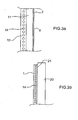
- the figure 1 illustrates a belt having one or more teeth 1 which are for example an elastomer of the family of alpha olefin ethenes, for example EPDM or EPM having flanks 3 and a vertex 4.
- the reference 10 designates the surface of the teeth 1.
- a coating consisting of a film 2 made of at least partially crosslinked thermoplastic material, comprising at least 30% of low density polyethylene having a molecular weight between 50,000 and 200,000 g / mol, and more particularly between 50,000 and 150,000 g / mol, and preferably between 50,000 and 100,000 g / mol.
- a film of non-crosslinked or at least partially cross-linked thermoplastic material is placed on the outer face of the sheet in the green state constituting the tooth gum of the blank. It is preferred that the film is not fully crosslinked to benefit from the improved adhesion that is due to the chemical affinity between the film and the tooth gum during crosslinking.
- the set is placed in a hydromoule to make the impression of the teeth and the vulcanization of the belt.
- the film is partially or completely crosslinked, and in particular it has a degree of crosslinking between 50% and 100%, which is greater than that of the film placed on the green sheet 11 of tooth gum.
- the blank After demolding, the blank is cut to form the individual belts. There is remarkable adhesion between the sheet of the at least partially crosslinked thermoplastic material and the vulcanized gum of teeth.
- the at least partially crosslinked thermoplastic film is in particular a polyolefin or a mixture of polyolefins which is at least partly crosslinked.
- the degree of crosslinking makes it possible to control the mechanical properties of the film and in particular to prevent its Young's modulus (which characterizes its stiffness) from being too high, but also its temperature resistance and its resistance to abrasion.
- the film is advantageous for the film to be a polyolefin mixture which contains low density polyethylene, for example between 50% and 90% of said polyethylene and more particularly between 80% and 90% of said polyethylene.
- Polyethylene co-crosslinks with EPDM or EPM due to the presence of peroxide or other crosslinking agent, as well as possibly the matrix of the film, which creates a bond with the ethylene alpha olefin which constitutes the denture of the belt and promotes the adhesion of the film to the elastomer of the toothing.
- the good compatibility of the polyethylene with the ethylene block contained in the elastomer of the toothing improves the adhesion of the two layers.
- Low density polyethylene (up to about 0.94 g / cm 3 ) is chosen, which makes it possible to approach the mechanical properties of the rubber constituting the teeth of the belt.
- the film After passing through a hydromould 20 having a toothing 21, and forming the teeth 1 with peroxide vulcanization of the belt, the film partially or totally reticules and it undergoes a medium stretch of the order of 100%, so that its thickness is between 5 ⁇ and 250 ⁇ , and more particularly between 25 ⁇ and 100 ⁇ .
- a film of 100 ⁇ gives a coating of the teeth whose thickness is about 50 ⁇ on the finished belt.
- the low density polyethylene film (curve II) does not show a flow threshold in the machine direction.
- the presence of a flow threshold results in a region of negative slope after the bend of the curve. It has a flow threshold in the direction perpendicular to the machine direction, but this threshold is less pronounced than for the other two films.
- this film which coats the vulcanized belt makes it possible to reduce the noise phenomenon and to preserve this advantage over time, since such a film at least partly cross-linked (preferably between 50% and 100%) presents very good resistance to abrasion wear.
- thermoplastic film it is possible to add to the at least partially cross-linked thermoplastic film an additive such as carbon black in the form of powder, which makes it possible to confer on the surface of the belt a sufficient conductivity to avoid the phenomena of accumulation of charges. electrostatic.
- the slip coefficient of the belt may also be improved by incorporating into the film particles and / or fibers of graphite, molybdenum disulfide and / or fluorine-containing particles or fibers ("fluorofibers") such as PTFE ( polytetrafluoroethylene), and / or FEP (ethylene, fluorinated propylene) and / or PVDF (polyvinylidene fluoride) and / or PFA (perfluoroalkoxy), which is favorable to the reduction of the noise.
- fluorofibers such as PTFE ( polytetrafluoroethylene), and / or FEP (ethylene, fluorinated propylene) and / or PVDF (polyvinylidene fluoride) and / or PFA (perfluoroalkoxy), which is favorable to the reduction of the noise.
- polyetherketones made of polyester and / or polyimide and / or polyamide, preferably aramid fibers, and / or even viscose, and / or polysulfone (PSU). ), and / or polyethersulfone (PES), and / or polyetherimide (PEI), and / or polyoxymethylene (POM) and / or acrylic fibers (PAN), and / or particles and / or fibers of the polyetherketone family.
- the family of polyetherketones comprises in particular polyetheretherketone (PEEK), polyetherketoneketone (PEKK) and polyetherketone (PEK).
- the incorporation of particles and / or fibers can be carried out during the manufacture of the film. Preferably, it is obtained by depositing the particles and / or the fibers 6 on the surface of the film, for example by spraying, before the vulcanization step in the hydromould 20. During the vulcanization of the belt, the film 2 is heated and deformed to form the teeth, and the particles and / or the fibers 6 are incorporated in the mass of the film 20, without exceeding the outside of the belt.
- the at least partially crosslinked thermoplastic film generally has good properties in the presence of hydrocarbons.
- the crosslinkable thermoplastic resins comprise one or more polymers such as polyolefins, polystyrenes, polyurethanes, polyamides and polyesters.
- a crosslinked film of a polyolefin containing a homo or a copolymer comprising ethylene is particularly advantageous to use a crosslinked film of a polyolefin containing a homo or a copolymer comprising ethylene.
- the copolymers of ethylene include, in particular, ethylene / alpha-olefin copolymers ("EAO"), ethylene / unsaturated ester copolymers, ethylene / acrylate / acrylic acid copolymers, copolymers ethylene / methacrylic acid and polyethylene-ethyleneocene copolymers.
- EAO alpha-olefin copolymers
- ethylene / unsaturated ester copolymers ethylene / unsaturated ester copolymers
- ethylene / acrylate / acrylic acid copolymers copolymers ethylene / methacrylic acid
- copolymers covers polymers derived from two or more types of monomer, and therefore includes ter
- a dose between 10 kGray and 300 kGray is used at a temperature between 0 ° C and 60 ° C and preferably at room temperature (20 ° C).
- the degree of crosslinking can be determined in particular by measuring the content of gel ("gel content") for example according to ASTMD 2765-95.
- Another test to determine the gel content (in%) is to dissolve the non-crosslinked fraction in a solvent that does not dissolve the crosslinked fraction ("gel") of the resin.
- the percentage obtained is the fraction of the insoluble (crosslinked) phase relative to the total mass of the resin.
- Another method is to determine the melt flow index according to ASTMD 1238-98.
- Type Test (Standard) terms Measured characteristic flocked standard EPDM belt belt with PE film UHMW belt with PE film according to the invention Diesel motor 4cyl engine. diesel, flow accessories, slow motion life time (h) cracking 800 65 1200 Heat resistance (SAE J2432A) 121 ° C / 20Nm / K6 life time (h) 600 910 920 Noise qualification (SAE J2432A) 25 ° C / 50% RH Angle (°) of appearance of loudness ⁇ 2 ⁇ 4.5 ⁇ 4.5
- the EPDM belt with PE film according to the invention tested comprises a polyethylene-ethyleneocene copolymer plastomer film which is a mixture of low density polyethylene and linear low density polyethylene.
- the test consists in applying axial misalignment and listening from which misalignment loudness appears. The larger the anal, the better the result.
Landscapes
- Engineering & Computer Science (AREA)
- General Engineering & Computer Science (AREA)
- Mechanical Engineering (AREA)
- Chemical & Material Sciences (AREA)
- Health & Medical Sciences (AREA)
- Chemical Kinetics & Catalysis (AREA)
- Medicinal Chemistry (AREA)
- Polymers & Plastics (AREA)
- Organic Chemistry (AREA)
- Compositions Of Macromolecular Compounds (AREA)
- Manufacture Of Macromolecular Shaped Articles (AREA)
- Coating Of Shaped Articles Made Of Macromolecular Substances (AREA)
Claims (20)
- Gerippter Treibriemen, nämlich Keilriemen oder Keilrippenriemen, welcher eine Zahnung aus Elastomer auf Basis von Ethylen/alpha-Olefin-Elastomer aufweist, dadurch gekennzeichnet, dass wenigstens die Flanken (3) der Zahnung mit einem Film (2) aus wenigstens teilweise vernetztem thermoplastischen Material beschichtet sind, das wenigstens 30 % wenigstens eines Polyethylens niedriger Dichte mit einer Molmasse zwischen 50.000 und 200.000 g/mol umfasst.
- Riemen nach Anspruch 1, dadurch gekennzeichnet, dass das Polyethylen niedriger Dichte eine Molmasse zwischen 50.000 und 150.000 g/mol und vorzugsweise zwischen 50.000 und 100.000 g/mol aufweist.
- Riemen nach Anspruch 1 oder 2, dadurch gekennzeichnet, dass der Vernetzungsgrad des thermoplastischen Materials zwischen 50 % und 100 % liegt.
- Riemen nach einem der vorhergehenden Ansprüche, dadurch gekennzeichnet, dadurch gekennzeichnet, dass der Film (2) 30 % bis 90 % des Polyethylens niedriger Dichte und insbesondere 50 % bis 90 % des Polyethylens niedriger Dichte umfasst.
- Riemen nach Anspruch 4, dadurch gekennzeichnet, dadurch gekennzeichnet, dass der Film 75 % bis 90 % des Polyethylens niedriger Dichte umfasst.
- Riemen nach einem der vorhergehenden Ansprüche, dadurch gekennzeichnet, dass der Film (2) aus einem Gemisch von Polyolefinen besteht, das das Polyethylen niedriger Dichte enthält.
- Riemen nach einem der Ansprüche 1 bis 5, dadurch gekennzeichnet, dass der Film (2) aus einem Copolymeren auf Basis des Polyethylens niedriger Dichte, insbesondere einem Ethylen/Octen-Polyethylencopolymer, besteht.
- Riemen nach einem der vorhergehenden Ansprüche, dadurch gekennzeichnet, dass das Ethylen/alpha-Olefin-Elastomer ein EPDM oder ein EPM ist.
- Riemen nach einem der vorhergehenden Ansprüche, dadurch gekennzeichnet, dass der Film (2) eine Dicke zwischen 10 µ und 500 µ und ganz besonders zwischen 50 µ und 200 µ aufweist.
- Riemen nach einem der vorhergehenden Ansprüche, dadurch gekennzeichnet, dass der Film (2) einen Füllstoff aus Rußpartikeln umfasst.
- Riemen nach einem der vorhergehenden Ansprüche, dadurch gekennzeichnet, dass er weiterhin Partikel und/oder Fasern umfasst, die in den Film (2) eingebettet sind.
- Riemen nach einem der vorhergehenden Ansprüche, dadurch gekennzeichnet, dass die Teilchen eine Teilchengröße und/oder die Fasern eine Länge zwischen 15 µ und 200 µ, insbesondere zwischen 30 µ und 100 µ, und ganz besonders zwischen 30 µ und 90 µ aufweisen, wobei die Fasern ein Querschnittsverhältnis zwischen 1 und 100 haben.
- Riemen nach einem der Ansprüche 11 oder 12, dadurch gekennzeichnet, dass wenigstens einige Teilchen und/oder Fasern aus Graphit und/oder Molybdändisulfid sind und/oder Fluor enthalten, und insbesondere aus PTFE und/oder FEP und/oder PFA und/oder PVDF sind.
- Riemen nach einem der Ansprüche 11 bis 13, dadurch gekennzeichnet, dass wenigstens einige Teilchen und/oder Fasern aus Viskose und/oder Polyamid sind, und ganz besonders aus Aramidfasern, und/oder aus Polyester und/oder Polyimid und/oder Polysulfon und/oder Polyethersulfon und/oder Polyetherimid und/oder Polyoxymethylen und/oder einem Polyetherketon und/oder aus Acrylfasern.
- Verfahren zur Herstellung eines Treibriemens nach einem der vorhergehenden Ansprüche, dadurch gekennzeichnet, dass es das Aufbringen eines Films (2) aus thermoplastischem Material im unvernetzten oder wenigstens teilvernetzten Zustand auf eine Oberfläche aus Zahnungsgummi umfasst, und dadurch, dass das Aufbringen auf den Zahnungsgummi im Rohzustand vor Bildung der Zahnung (1) durch Formen und Vulkanisation des Riemens erfolgt.
- Verfahren nach Anspruch 15, dadurch gekennzeichnet, dass der Film (2) während der Bildung der Zahnung eine Dehnung in Querrichtung senkrecht zur Maschinenrichtung erfährt, was dazu führt, dass seine Streckgrenze verringert oder aufgehoben wird.
- Verfahren nach Anspruch 16, dadurch gekennzeichnet, dass Teilchen und/oder Fasern in den Film (2) im unvernetzten oder wenigstens teilvernetzten Zustand eingearbeitet werden.
- Verfahren nach Anspruch 16, dadurch gekennzeichnet, dass Teilchen und/oder Fasern auf der Oberfläche des Films (2) im unvernetzten oder wenigstens teilvernetzten Zustand abgeschieden werden und sich in diesen während der Vulkanisation des Riemens in der Hydroform einlagern.
- Verfahren nach Anspruch 17, dadurch gekennzeichnet, dass wenigstens einige Teilchen und/oder Fasern aus Graphit und/oder Molybdändisulfid sind und/oder Fluor enthalten, und insbesondere aus PTFE und/oder FEP und/oder PVDF sind.
- Verfahren nach Anspruch 16, dadurch gekennzeichnet, dass wenigstens einige Teilchen und/oder Fasern aus Polyester und/oder Polyimid und/oder Polyamid sind, insbesondere aus Aramidfasern, und/oder aus Viskose und/oder Polysulfon und/oder Polyethersulfon und/oder Polyetherimid und/oder Polyoxymethylen und/oder einem Polyetherketon und/oder aus Acrylfasern.
Applications Claiming Priority (2)
| Application Number | Priority Date | Filing Date | Title |
|---|---|---|---|
| FR0601923A FR2898171B1 (fr) | 2006-03-03 | 2006-03-03 | Courroie de transmission de puissance. |
| PCT/FR2007/000368 WO2007099233A2 (fr) | 2006-03-03 | 2007-03-01 | Courroie de transmission de puissance |
Publications (2)
| Publication Number | Publication Date |
|---|---|
| EP1996831A2 EP1996831A2 (de) | 2008-12-03 |
| EP1996831B1 true EP1996831B1 (de) | 2013-01-16 |
Family
ID=37274008
Family Applications (1)
| Application Number | Title | Priority Date | Filing Date |
|---|---|---|---|
| EP07731068A Active EP1996831B1 (de) | 2006-03-03 | 2007-03-01 | Treibriemen und verfahren zu seiner herstellung |
Country Status (8)
| Country | Link |
|---|---|
| US (1) | US8262522B2 (de) |
| EP (1) | EP1996831B1 (de) |
| JP (1) | JP5191400B2 (de) |
| KR (1) | KR20080111462A (de) |
| BR (1) | BRPI0708532B1 (de) |
| ES (1) | ES2402421T3 (de) |
| FR (1) | FR2898171B1 (de) |
| WO (1) | WO2007099233A2 (de) |
Cited By (1)
| Publication number | Priority date | Publication date | Assignee | Title |
|---|---|---|---|---|
| DE102016116558A1 (de) | 2016-09-05 | 2018-03-08 | Arntz Beteiligungs Gmbh & Co. Kg | Kraftübertragungsriemen |
Families Citing this family (28)
| Publication number | Priority date | Publication date | Assignee | Title |
|---|---|---|---|---|
| FR2923494B1 (fr) * | 2007-11-09 | 2010-01-15 | Hutchinson | Membranes imper-respirantes et leur procede de fabrication |
| DE102008012044A1 (de) * | 2008-03-01 | 2009-09-03 | Contitech Antriebssysteme Gmbh | Elastischer Artikel, insbesondere Antriebsriemen, mit einer Folienschutzschicht und Verfahren zu seiner Herstellung |
| FR2936291B1 (fr) * | 2008-09-23 | 2011-06-03 | Hutchinson | Courroie de transmission de puissance. |
| DE102011002274A1 (de) | 2011-04-27 | 2012-10-31 | Contitech Antriebssysteme Gmbh | Elastischer Artikel, insbesondere Antriebsriemen, mit einer Beschichtung in Form eines Vlieses aus einem schmelzbaren Kunststoff |
| DE102011050483A1 (de) | 2011-05-19 | 2012-11-22 | Contitech Antriebssysteme Gmbh | Antriebsriemen mit einem Verstärkungsband oder einem Verstärkungsgeflecht oder mit zonenweise angeordneten Verstärkungselementen innerhalb des Unterbaus |
| JP5926543B2 (ja) * | 2011-11-25 | 2016-05-25 | 三ツ星ベルト株式会社 | 摩擦伝動ベルト及びその製造方法 |
| DE102011056071A1 (de) | 2011-12-06 | 2013-06-06 | Contitech Antriebssysteme Gmbh | Verfahren zur Oberflächenbeschichtung eines Artikels, insbesondere eines Keilrippenriemens, sowie Vorrichtung hierzu |
| EP2792904B1 (de) * | 2011-12-14 | 2016-08-10 | Bando Chemical Industries, Ltd. | Reibungsantriebsriemen und verfahren zu dessen herstellung |
| DE102012208091A1 (de) | 2011-12-16 | 2013-06-20 | Contitech Antriebssysteme Gmbh | Elastischer Artikel, insbesondere Antriebsriemen |
| JP5881409B2 (ja) * | 2011-12-26 | 2016-03-09 | バンドー化学株式会社 | 伝動ベルト |
| KR101992943B1 (ko) | 2012-01-11 | 2019-06-25 | 반도 카가쿠 가부시키가이샤 | 마찰 전동 벨트 및 그 제조방법, 그리고 벨트 전동장치 |
| JP5956162B2 (ja) * | 2012-01-16 | 2016-07-27 | 三ツ星ベルト株式会社 | 摩擦伝動ベルト及びその製造方法 |
| PL2664645T3 (pl) | 2012-05-15 | 2018-07-31 | Contitech Antriebssysteme Gmbh | Artykuł elastyczny, zwłaszcza pasek napędowy, z powłoką |
| FR2996617B1 (fr) * | 2012-10-08 | 2014-12-26 | Hutchinson | Courroie de transmission de puissance avec film thermoplastique comprenant un elastomere silicone. |
| JP6059111B2 (ja) * | 2012-10-31 | 2017-01-11 | 三ツ星ベルト株式会社 | 摩擦伝動ベルト |
| DE102012112637A1 (de) | 2012-12-19 | 2014-06-26 | Contitech Antriebssysteme Gmbh | Elastischer Artikel, insbesondere Antriebsriemen |
| DE102014210707A1 (de) | 2014-06-05 | 2015-12-17 | Contitech Antriebssysteme Gmbh | Elastischer Artikel, insbesondere Keilrippenriemen |
| DE102014008622A1 (de) * | 2014-06-17 | 2015-12-17 | Arntz Beteiligungs Gmbh & Co. Kg | Kraftübertragungsriemen mit einer Polyethylen-Beschichtung |
| KR102018452B1 (ko) | 2015-05-11 | 2019-09-04 | 게이츠 코포레이션 | Cvt 벨트 |
| WO2017057202A1 (ja) * | 2015-09-29 | 2017-04-06 | 三ツ星ベルト株式会社 | Vリブドベルト及びその製造方法 |
| JP6480392B2 (ja) * | 2015-09-29 | 2019-03-06 | 三ツ星ベルト株式会社 | Vリブドベルト及びその製造方法 |
| FR3042246B1 (fr) | 2015-10-09 | 2018-03-23 | Hutchinson | Courroie de transmission de puissance avec film thermoplastique comprenant un elastomere silicone et des nanotubes de carbone |
| JP6348136B2 (ja) * | 2016-03-23 | 2018-06-27 | バンドー化学株式会社 | 摩擦伝動ベルト及びその製造方法 |
| JP6348133B2 (ja) * | 2016-01-22 | 2018-06-27 | バンドー化学株式会社 | 摩擦伝動ベルト及びその製造方法 |
| CN108496024B (zh) | 2016-01-22 | 2020-07-28 | 阪东化学株式会社 | 摩擦传动带及其制造方法 |
| US10514083B2 (en) * | 2016-08-16 | 2019-12-24 | Contitech Antriebssysteme Gmbh | Cross-linked elastomeric low friction faced synchronous power transmission belt |
| US10708700B1 (en) | 2019-06-11 | 2020-07-07 | Ford Global Technologies, Llc | Vehicle external speaker system |
| JP7323560B2 (ja) | 2021-01-29 | 2023-08-08 | バンドー化学株式会社 | 摩擦伝動ベルト |
Family Cites Families (23)
| Publication number | Priority date | Publication date | Assignee | Title |
|---|---|---|---|---|
| GB917277A (en) * | 1959-01-02 | 1963-01-30 | Dunlop Rubber Co | Improvements in or relating to industrial belting |
| ZA738857B (en) | 1972-12-08 | 1974-10-30 | Uniroyal Inc | Toothed belts and method of making same |
| US3964328A (en) * | 1973-09-07 | 1976-06-22 | The Gates Rubber Company | Elastomer-free fabric surface for power transmission belt tooth facing |
| US4024773A (en) | 1976-06-01 | 1977-05-24 | Dayco Corporation | Endless power transmission belt structure |
| US4031768A (en) | 1976-06-18 | 1977-06-28 | Dayco Corporation | Endless power transmission belt structure |
| US4392842A (en) * | 1980-10-10 | 1983-07-12 | Uniroyal, Inc. | Toothed positive drive power transmission belt with a fabric reinforcement suspended within the belt teeth |
| US4892510A (en) | 1985-03-04 | 1990-01-09 | Bando Chemical Industries, Ltd. | V-ribbed belt and the method of manufacturing the same |
| ES2104140T3 (es) | 1992-03-02 | 1997-10-01 | Dayco Products Inc | Estructura de correa formada esencialmente de material termoplastico, y procedimiento de fabricacion de la misma. |
| JPH1163116A (ja) * | 1997-08-21 | 1999-03-05 | Izumi Kk | ポリオレフィン含有フィルム積層ベルト |
| US6770004B1 (en) * | 1999-03-26 | 2004-08-03 | The Goodyear Tire & Rubber Company | Electrically conductive timing belt |
| WO2000061662A1 (fr) * | 1999-04-13 | 2000-10-19 | Asahi Kasei Kogyo Kabushiki Kaisha | Procédé de production d'une composition à base de caoutchouc |
| US6409621B1 (en) * | 2000-05-12 | 2002-06-25 | The Goodyear Tire & Rubber Company | Power transmission belt |
| IT1320359B1 (it) * | 2000-05-23 | 2003-11-26 | Dayco Europe Srl | Cinghia dentata. |
| US6443866B1 (en) * | 2000-08-14 | 2002-09-03 | The Goodyear Tire & Rubber Company | Power transmission belt |
| JP3582486B2 (ja) * | 2000-12-22 | 2004-10-27 | 油化電子株式会社 | 成形部材、エンドレスベルト、画像形成装置用ベルト及び画像形成装置 |
| JP2002195353A (ja) * | 2000-12-26 | 2002-07-10 | Mitsuboshi Belting Ltd | 高負荷伝動ベルト |
| WO2002084144A1 (en) * | 2001-04-12 | 2002-10-24 | The Gates Corporation | Thermoplastic jacket belt |
| JP2002321228A (ja) * | 2001-04-26 | 2002-11-05 | Mitsuboshi Belting Ltd | ベルトスリーブの加硫用ジャケット |
| JP2003222195A (ja) * | 2002-01-28 | 2003-08-08 | Mitsuboshi Belting Ltd | 歯付ベルト |
| CA2494621A1 (en) | 2002-07-29 | 2004-02-05 | The Gates Corporation | Belt |
| US7025699B2 (en) * | 2003-04-23 | 2006-04-11 | Dayco Products, Llc | Elastomer composition for power transmission belt tooth facing |
| EP1696150A1 (de) * | 2005-02-28 | 2006-08-30 | Megadyne S.r.l. | Zahnriemen |
| JP4683470B2 (ja) * | 2005-04-15 | 2011-05-18 | バンドー化学株式会社 | 摩擦伝動ベルト及びその製造方法 |
-
2006
- 2006-03-03 FR FR0601923A patent/FR2898171B1/fr not_active Expired - Lifetime
-
2007
- 2007-03-01 US US11/576,737 patent/US8262522B2/en active Active
- 2007-03-01 JP JP2008556818A patent/JP5191400B2/ja active Active
- 2007-03-01 BR BRPI0708532-0A patent/BRPI0708532B1/pt active IP Right Grant
- 2007-03-01 ES ES07731068T patent/ES2402421T3/es active Active
- 2007-03-01 WO PCT/FR2007/000368 patent/WO2007099233A2/fr not_active Ceased
- 2007-03-01 EP EP07731068A patent/EP1996831B1/de active Active
- 2007-03-01 KR KR1020087023970A patent/KR20080111462A/ko not_active Withdrawn
Cited By (1)
| Publication number | Priority date | Publication date | Assignee | Title |
|---|---|---|---|---|
| DE102016116558A1 (de) | 2016-09-05 | 2018-03-08 | Arntz Beteiligungs Gmbh & Co. Kg | Kraftübertragungsriemen |
Also Published As
| Publication number | Publication date |
|---|---|
| EP1996831A2 (de) | 2008-12-03 |
| BRPI0708532B1 (pt) | 2019-03-19 |
| BRPI0708532A2 (pt) | 2011-05-31 |
| US20080207371A1 (en) | 2008-08-28 |
| WO2007099233A3 (fr) | 2007-10-18 |
| US8262522B2 (en) | 2012-09-11 |
| ES2402421T3 (es) | 2013-05-03 |
| WO2007099233A2 (fr) | 2007-09-07 |
| FR2898171B1 (fr) | 2009-02-27 |
| FR2898171A1 (fr) | 2007-09-07 |
| JP2009533606A (ja) | 2009-09-17 |
| KR20080111462A (ko) | 2008-12-23 |
| JP5191400B2 (ja) | 2013-05-08 |
Similar Documents
| Publication | Publication Date | Title |
|---|---|---|
| EP1996831A2 (de) | Treibriemen | |
| EP2516534B1 (de) | Flexibles unterwasserrohr mit einer schicht mit einem polymerharz mit einem polyedrischen oligomeren silsesquioxan | |
| EP2128486B1 (de) | Antriebsriemen | |
| CA2086292C (fr) | Courroie a denture, resistant a l'huile et a la chaleur par association d'elastomeres | |
| FR2732441A1 (fr) | Conduite tubulaire flexible a gaine d'etancheite interne polymerique | |
| FR2700292A1 (fr) | Article tubulaire composite formé d'un élastomère vulcanisé associé à un élastomère thermoplastique à séquences polyamide, notamment tuyau à essence et procédé de préparation d'un tel article. | |
| EP2643154B1 (de) | Flexibler schlauch für den einsatz am meeresboden mit einer schicht aus einem polymer-harz mit aluminium- oder magnesium-silikat nano-röhrchen | |
| WO2001060910A1 (fr) | Conduites contenant materiau pour l'isolation thermique | |
| EP2147780B1 (de) | Mehrschichtenstruktur, wie beispielsweise Entkoppelungsabschluss für Lufteinlasssystem eines Turbokompressors, und dieses System | |
| EP2533973B1 (de) | Flexibles unterwasserrohr mit einer schicht mit einem polymerharz mit oberflächenmodifizierten titan-nanopartikeln | |
| EP3206866B1 (de) | Flexible unterwasserröhre mit einer schicht mit vernetztem polyethylen mit hoher wärmebeständigkeit | |
| EP2904291B1 (de) | Antriebsriemen mit thermoplastischer folie mit einem silikonelastomer | |
| EP2981735B1 (de) | Treibriemen mit einer elastomerverzahnung mit stoff auf der oberfläche | |
| EP3078554B1 (de) | Scheibenwischerblatt für scheibenwischerarm | |
| EP0769518B1 (de) | Härtbare Vinylidenfluoridpolymerzusammensetzung, Verfahren zu ihrer Vernetzung und Formteile | |
| EP0671746A1 (de) | Ummantelter Kabel mit erhörter Flexibilität, Verfahren zu deren Herstellung | |
| EP0749546B1 (de) | Schläuche aus metall mit einer zurückziehbaren hülle aus polymer | |
| WO2009034269A1 (fr) | Support textile revetu d ' un elastomere de silicone et utilisations | |
| FR2776227A1 (fr) | Procede d'adhesion d'un polmere fluore et d'un elastomere, et tuyau de transfert de fluide obtenu par execution de ce procede | |
| FR3160180A1 (fr) | Composition élastomère thermoplastique et article l’incorporant, par exemple un tuyau. | |
| FR2958003A1 (fr) | Conduit de circulation de fluide, et procede de fabrication d'un tel conduit et un vehicule automobile integrant au moins un conduit de circulation de fluide. | |
| JP2009074575A (ja) | Vリブドベルトならびにvリブドベルト製造方法 | |
| WO2017060460A1 (fr) | Courroie de transmission de puissance avec film thermoplastique comprenant un elastomere silicone et des nanotubes de carbone. |
Legal Events
| Date | Code | Title | Description |
|---|---|---|---|
| PUAI | Public reference made under article 153(3) epc to a published international application that has entered the european phase |
Free format text: ORIGINAL CODE: 0009012 |
|
| 17P | Request for examination filed |
Effective date: 20080924 |
|
| AK | Designated contracting states |
Kind code of ref document: A2 Designated state(s): AT BE BG CH CY CZ DE DK EE ES FI FR GB GR HU IE IS IT LI LT LU LV MC NL PL PT RO SE SI SK TR |
|
| 17Q | First examination report despatched |
Effective date: 20091014 |
|
| DAX | Request for extension of the european patent (deleted) | ||
| GRAP | Despatch of communication of intention to grant a patent |
Free format text: ORIGINAL CODE: EPIDOSNIGR1 |
|
| GRAS | Grant fee paid |
Free format text: ORIGINAL CODE: EPIDOSNIGR3 |
|
| GRAA | (expected) grant |
Free format text: ORIGINAL CODE: 0009210 |
|
| AK | Designated contracting states |
Kind code of ref document: B1 Designated state(s): AT BE BG CH CY CZ DE DK EE ES FI FR GB GR HU IE IS IT LI LT LU LV MC NL PL PT RO SE SI SK TR |
|
| REG | Reference to a national code |
Ref country code: GB Ref legal event code: FG4D Free format text: NOT ENGLISH |
|
| REG | Reference to a national code |
Ref country code: CH Ref legal event code: EP |
|
| REG | Reference to a national code |
Ref country code: IE Ref legal event code: FG4D Free format text: LANGUAGE OF EP DOCUMENT: FRENCH |
|
| REG | Reference to a national code |
Ref country code: AT Ref legal event code: REF Ref document number: 594065 Country of ref document: AT Kind code of ref document: T Effective date: 20130215 Ref country code: CH Ref legal event code: EP |
|
| REG | Reference to a national code |
Ref country code: DE Ref legal event code: R096 Ref document number: 602007028074 Country of ref document: DE Effective date: 20130314 |
|
| REG | Reference to a national code |
Ref country code: ES Ref legal event code: FG2A Ref document number: 2402421 Country of ref document: ES Kind code of ref document: T3 Effective date: 20130503 |
|
| REG | Reference to a national code |
Ref country code: AT Ref legal event code: MK05 Ref document number: 594065 Country of ref document: AT Kind code of ref document: T Effective date: 20130116 |
|
| REG | Reference to a national code |
Ref country code: NL Ref legal event code: VDEP Effective date: 20130116 |
|
| REG | Reference to a national code |
Ref country code: LT Ref legal event code: MG4D |
|
| PG25 | Lapsed in a contracting state [announced via postgrant information from national office to epo] |
Ref country code: LT Free format text: LAPSE BECAUSE OF FAILURE TO SUBMIT A TRANSLATION OF THE DESCRIPTION OR TO PAY THE FEE WITHIN THE PRESCRIBED TIME-LIMIT Effective date: 20130116 Ref country code: CY Free format text: LAPSE BECAUSE OF FAILURE TO SUBMIT A TRANSLATION OF THE DESCRIPTION OR TO PAY THE FEE WITHIN THE PRESCRIBED TIME-LIMIT Effective date: 20130116 Ref country code: BG Free format text: LAPSE BECAUSE OF FAILURE TO SUBMIT A TRANSLATION OF THE DESCRIPTION OR TO PAY THE FEE WITHIN THE PRESCRIBED TIME-LIMIT Effective date: 20130416 Ref country code: SE Free format text: LAPSE BECAUSE OF FAILURE TO SUBMIT A TRANSLATION OF THE DESCRIPTION OR TO PAY THE FEE WITHIN THE PRESCRIBED TIME-LIMIT Effective date: 20130116 Ref country code: AT Free format text: LAPSE BECAUSE OF FAILURE TO SUBMIT A TRANSLATION OF THE DESCRIPTION OR TO PAY THE FEE WITHIN THE PRESCRIBED TIME-LIMIT Effective date: 20130116 Ref country code: IS Free format text: LAPSE BECAUSE OF FAILURE TO SUBMIT A TRANSLATION OF THE DESCRIPTION OR TO PAY THE FEE WITHIN THE PRESCRIBED TIME-LIMIT Effective date: 20130516 |
|
| PG25 | Lapsed in a contracting state [announced via postgrant information from national office to epo] |
Ref country code: NL Free format text: LAPSE BECAUSE OF FAILURE TO SUBMIT A TRANSLATION OF THE DESCRIPTION OR TO PAY THE FEE WITHIN THE PRESCRIBED TIME-LIMIT Effective date: 20130116 Ref country code: FI Free format text: LAPSE BECAUSE OF FAILURE TO SUBMIT A TRANSLATION OF THE DESCRIPTION OR TO PAY THE FEE WITHIN THE PRESCRIBED TIME-LIMIT Effective date: 20130116 Ref country code: SI Free format text: LAPSE BECAUSE OF FAILURE TO SUBMIT A TRANSLATION OF THE DESCRIPTION OR TO PAY THE FEE WITHIN THE PRESCRIBED TIME-LIMIT Effective date: 20130116 Ref country code: GR Free format text: LAPSE BECAUSE OF FAILURE TO SUBMIT A TRANSLATION OF THE DESCRIPTION OR TO PAY THE FEE WITHIN THE PRESCRIBED TIME-LIMIT Effective date: 20130417 Ref country code: LV Free format text: LAPSE BECAUSE OF FAILURE TO SUBMIT A TRANSLATION OF THE DESCRIPTION OR TO PAY THE FEE WITHIN THE PRESCRIBED TIME-LIMIT Effective date: 20130116 Ref country code: PL Free format text: LAPSE BECAUSE OF FAILURE TO SUBMIT A TRANSLATION OF THE DESCRIPTION OR TO PAY THE FEE WITHIN THE PRESCRIBED TIME-LIMIT Effective date: 20130116 Ref country code: PT Free format text: LAPSE BECAUSE OF FAILURE TO SUBMIT A TRANSLATION OF THE DESCRIPTION OR TO PAY THE FEE WITHIN THE PRESCRIBED TIME-LIMIT Effective date: 20130516 |
|
| PG25 | Lapsed in a contracting state [announced via postgrant information from national office to epo] |
Ref country code: EE Free format text: LAPSE BECAUSE OF FAILURE TO SUBMIT A TRANSLATION OF THE DESCRIPTION OR TO PAY THE FEE WITHIN THE PRESCRIBED TIME-LIMIT Effective date: 20130116 Ref country code: DK Free format text: LAPSE BECAUSE OF FAILURE TO SUBMIT A TRANSLATION OF THE DESCRIPTION OR TO PAY THE FEE WITHIN THE PRESCRIBED TIME-LIMIT Effective date: 20130116 Ref country code: RO Free format text: LAPSE BECAUSE OF FAILURE TO SUBMIT A TRANSLATION OF THE DESCRIPTION OR TO PAY THE FEE WITHIN THE PRESCRIBED TIME-LIMIT Effective date: 20130116 Ref country code: SK Free format text: LAPSE BECAUSE OF FAILURE TO SUBMIT A TRANSLATION OF THE DESCRIPTION OR TO PAY THE FEE WITHIN THE PRESCRIBED TIME-LIMIT Effective date: 20130116 Ref country code: CZ Free format text: LAPSE BECAUSE OF FAILURE TO SUBMIT A TRANSLATION OF THE DESCRIPTION OR TO PAY THE FEE WITHIN THE PRESCRIBED TIME-LIMIT Effective date: 20130116 Ref country code: MC Free format text: LAPSE BECAUSE OF NON-PAYMENT OF DUE FEES Effective date: 20130331 |
|
| REG | Reference to a national code |
Ref country code: CH Ref legal event code: PL |
|
| PLBE | No opposition filed within time limit |
Free format text: ORIGINAL CODE: 0009261 |
|
| STAA | Information on the status of an ep patent application or granted ep patent |
Free format text: STATUS: NO OPPOSITION FILED WITHIN TIME LIMIT |
|
| 26N | No opposition filed |
Effective date: 20131017 |
|
| REG | Reference to a national code |
Ref country code: IE Ref legal event code: MM4A |
|
| PG25 | Lapsed in a contracting state [announced via postgrant information from national office to epo] |
Ref country code: CH Free format text: LAPSE BECAUSE OF NON-PAYMENT OF DUE FEES Effective date: 20130331 Ref country code: IE Free format text: LAPSE BECAUSE OF NON-PAYMENT OF DUE FEES Effective date: 20130301 Ref country code: LI Free format text: LAPSE BECAUSE OF NON-PAYMENT OF DUE FEES Effective date: 20130331 |
|
| REG | Reference to a national code |
Ref country code: DE Ref legal event code: R097 Ref document number: 602007028074 Country of ref document: DE Effective date: 20131017 |
|
| REG | Reference to a national code |
Ref country code: FR Ref legal event code: PLFP Year of fee payment: 9 |
|
| PG25 | Lapsed in a contracting state [announced via postgrant information from national office to epo] |
Ref country code: TR Free format text: LAPSE BECAUSE OF FAILURE TO SUBMIT A TRANSLATION OF THE DESCRIPTION OR TO PAY THE FEE WITHIN THE PRESCRIBED TIME-LIMIT Effective date: 20130116 |
|
| PG25 | Lapsed in a contracting state [announced via postgrant information from national office to epo] |
Ref country code: HU Free format text: LAPSE BECAUSE OF FAILURE TO SUBMIT A TRANSLATION OF THE DESCRIPTION OR TO PAY THE FEE WITHIN THE PRESCRIBED TIME-LIMIT; INVALID AB INITIO Effective date: 20070301 Ref country code: LU Free format text: LAPSE BECAUSE OF NON-PAYMENT OF DUE FEES Effective date: 20130301 |
|
| REG | Reference to a national code |
Ref country code: FR Ref legal event code: PLFP Year of fee payment: 10 |
|
| REG | Reference to a national code |
Ref country code: FR Ref legal event code: PLFP Year of fee payment: 11 |
|
| REG | Reference to a national code |
Ref country code: FR Ref legal event code: PLFP Year of fee payment: 12 |
|
| P01 | Opt-out of the competence of the unified patent court (upc) registered |
Effective date: 20230526 |
|
| PGFP | Annual fee paid to national office [announced via postgrant information from national office to epo] |
Ref country code: DE Payment date: 20250319 Year of fee payment: 19 |
|
| PGFP | Annual fee paid to national office [announced via postgrant information from national office to epo] |
Ref country code: BE Payment date: 20250319 Year of fee payment: 19 |
|
| PGFP | Annual fee paid to national office [announced via postgrant information from national office to epo] |
Ref country code: FR Payment date: 20250325 Year of fee payment: 19 |
|
| PGFP | Annual fee paid to national office [announced via postgrant information from national office to epo] |
Ref country code: IT Payment date: 20250325 Year of fee payment: 19 Ref country code: GB Payment date: 20250319 Year of fee payment: 19 |
|
| PGFP | Annual fee paid to national office [announced via postgrant information from national office to epo] |
Ref country code: ES Payment date: 20250425 Year of fee payment: 19 |