EP1997584A2 - Schleifanordnung - Google Patents
Schleifanordnung Download PDFInfo
- Publication number
- EP1997584A2 EP1997584A2 EP08150994A EP08150994A EP1997584A2 EP 1997584 A2 EP1997584 A2 EP 1997584A2 EP 08150994 A EP08150994 A EP 08150994A EP 08150994 A EP08150994 A EP 08150994A EP 1997584 A2 EP1997584 A2 EP 1997584A2
- Authority
- EP
- European Patent Office
- Prior art keywords
- grinding
- arrangement according
- roll
- shell
- support strip
- Prior art date
- Legal status (The legal status is an assumption and is not a legal conclusion. Google has not performed a legal analysis and makes no representation as to the accuracy of the status listed.)
- Granted
Links
- 239000000428 dust Substances 0.000 claims description 3
- 230000003068 static effect Effects 0.000 claims description 3
- 239000000123 paper Substances 0.000 claims description 2
- 230000003746 surface roughness Effects 0.000 claims description 2
- 238000009499 grossing Methods 0.000 description 7
- 230000000694 effects Effects 0.000 description 4
- 238000001816 cooling Methods 0.000 description 2
- 239000000463 material Substances 0.000 description 2
- 230000015572 biosynthetic process Effects 0.000 description 1
- 238000003490 calendering Methods 0.000 description 1
- 238000006243 chemical reaction Methods 0.000 description 1
- 238000011109 contamination Methods 0.000 description 1
- 238000000605 extraction Methods 0.000 description 1
- 239000000945 filler Substances 0.000 description 1
- 239000012530 fluid Substances 0.000 description 1
- 238000003754 machining Methods 0.000 description 1
- 239000004575 stone Substances 0.000 description 1
Images
Classifications
-
- B—PERFORMING OPERATIONS; TRANSPORTING
- B24—GRINDING; POLISHING
- B24B—MACHINES, DEVICES, OR PROCESSES FOR GRINDING OR POLISHING; DRESSING OR CONDITIONING OF ABRADING SURFACES; FEEDING OF GRINDING, POLISHING, OR LAPPING AGENTS
- B24B5/00—Machines or devices designed for grinding surfaces of revolution on work, including those which also grind adjacent plane surfaces; Accessories therefor
- B24B5/36—Single-purpose machines or devices
- B24B5/363—Single-purpose machines or devices for grinding surfaces of revolution in situ
-
- B—PERFORMING OPERATIONS; TRANSPORTING
- B24—GRINDING; POLISHING
- B24B—MACHINES, DEVICES, OR PROCESSES FOR GRINDING OR POLISHING; DRESSING OR CONDITIONING OF ABRADING SURFACES; FEEDING OF GRINDING, POLISHING, OR LAPPING AGENTS
- B24B5/00—Machines or devices designed for grinding surfaces of revolution on work, including those which also grind adjacent plane surfaces; Accessories therefor
- B24B5/36—Single-purpose machines or devices
- B24B5/37—Single-purpose machines or devices for grinding rolls, e.g. barrel-shaped rolls
-
- B—PERFORMING OPERATIONS; TRANSPORTING
- B24—GRINDING; POLISHING
- B24B—MACHINES, DEVICES, OR PROCESSES FOR GRINDING OR POLISHING; DRESSING OR CONDITIONING OF ABRADING SURFACES; FEEDING OF GRINDING, POLISHING, OR LAPPING AGENTS
- B24B5/00—Machines or devices designed for grinding surfaces of revolution on work, including those which also grind adjacent plane surfaces; Accessories therefor
- B24B5/50—Machines or devices designed for grinding surfaces of revolution on work, including those which also grind adjacent plane surfaces; Accessories therefor characterised by a special design with respect to properties of the material of non-metallic articles to be ground, e.g. strings
Definitions
- the invention relates to an arrangement for grinding the outer shell surface of a shoe press roll of a machine for producing and / or finishing a paper, cardboard or other fibrous web, wherein the shoe press roll has a flexible roll shell, which is pressed by a pressing element with concave pressing surface to a counter roll ,
- shoe press rolls have been increasingly used for smoothing fibrous webs.
- roll shells made of polymeric materials used as in the dewatering of the fibrous web.
- the surface quality of the roll mantle is of crucial importance.
- the object of the invention is therefore to extend the life of the roll shell with the simplest possible means and while ensuring the highest possible smoothing effect.
- this object is achieved in that at least one grinding device with a, with the outer shell surface coming into contact grinding surface is axially traversable on the outer shell surface and the Roll shell on the inside opposite the grinding surface supported on a support bar.
- the roll shell can be ground in the machine. This extends the life and makes disassembly of the roll shell unnecessary.
- the support strip In order to enable a flexible contact pressure of the support strip over the length of the roll mantle, the support strip should be designed to be flexible at least in the radial direction (with respect to the roll mantle).
- the support strip also consist of several axially juxtaposed elements.
- the support strip should preferably be pressed by pneumatic actuators to the inside of the roll shell.
- the flexible contact pressure in particular with compressed air, is intended to prevent an overpressing of the roll mantle or a clamping of the roll mantle between the support strip and the grinding surface.
- the grinding surface should be pressed against the shell outer surface, which is possible because of the support strip.
- the contact pressure should be between 5 and 50 kPa, preferably between 10 and 30 kPa.
- the grinding device should be arranged in the 3 or 9 o'clock position of the roll shell.
- the grinding surface can be formed by at least one rotating grinding element, for example a grinding stone or a grinding belt.
- the abrasive surface should be formed by at least one static abrasive element, preferably a grid screen.
- a quasi-static grinding element in the form of an abrasive belt may also be advantageous, which is wound up very slowly, preferably continuously, in order to ensure as uniform a grinding sharpness as possible.
- the roll shell must be set in rotation at least during grinding by a drive.
- the grinding device has at least two grinding surfaces of different roughness. In this way, machining with the rough and the fine grinding surface without conversion can start from the same grinding device.
- the average surface roughness of the grinding surfaces should be between 0.1 and 1 .mu.m, preferably between 0.5 and 0.7 .mu.m.
- the outer surface should be machined one after another with sanding surfaces with grit levels of 80, 120, 220 and 400.
- the grinding device should have a discharge device for removing the grinding dust, preferably in the form of a suction device.
- the grinding head 10 of the grinding device 6 is force-controlled by a pressing element 12 against the outer circumferential surface of the roll shell 4.
- the grinding device 6 is arranged here in the 3 o'clock position of the roll mantle 4.
- the actuator 13 as well as the contact pressure element 8 are supported on the support 7 of the shoe press roll 3.
- the grinding device 6 is arranged axially traversable along the roll shell 4.
- the roll shell 4 Since the grinding surfaces 9 are fixed here in the form of a grid screen, the roll shell 4 must be driven at least during grinding.
- the rotation is to be chosen so that the speed of the outer circumferential surface of the roll shell 4 is between 800 and 1500 m / min.
Landscapes
- Engineering & Computer Science (AREA)
- Mechanical Engineering (AREA)
- Paper (AREA)
- Polishing Bodies And Polishing Tools (AREA)
- Polarising Elements (AREA)
- Disintegrating Or Milling (AREA)
Abstract
Description
- Die Erfindung betrifft eine Anordnung zum Schleifen der Mantelaußenfläche einer Schuhpresswalze einer Maschine zur Herstellung und/oder Veredlung einer Papier-, Karton- oder einer anderen Faserstoffbahn, wobei die Schuhpresswalze einen flexiblen Walzenmantel besitzt, welcher von einem Anpresselement mit konkaver Pressfläche zu einer Gegenwalze gedrückt wird.
- In den letzten Jahren wurden zunehmend auch Schuhpresswalzen zur Glättung von Faserstoffbahnen eingesetzt. Dabei werden, wie bei der Entwässerung der Faserstoffbahn, Walzenmäntel aus polymeren Werkstoffen verwendet.
- Für das Erreichen eines guten Glättergebnisses ist die Oberflächenqualität des Walzenmantels von entscheidender Bedeutung.
- Im Betrieb kann es jedoch vorkommen, dass Walzenmäntel über die Bahnbreite ungleichmäßig verschleißen, beispielsweise durch abrasive Füllstoffe in der Faserstoffbahn. Dies kann im weiteren Verlauf zu einem ungleichmäßigen Satinageergebnis hinsichtlich Glanz und Glätte führen.
- Überschreitet der ungleichmäßige Verschleiß ein bestimmtes Niveau, so muss gegenwärtig der Walzenmantel durch einen Neuen ersetzt werden, was kosten- und zeitintensiv ist.
- Die Aufgabe der Erfindung ist es daher, die Lebensdauer des Walzenmantels mit möglichst einfachen Mitteln und bei Gewährleistung einer möglichst hohen Glättwirkung zu verlängern.
- Erfindungsgemäß wurde die Aufgabe dadurch gelöst, dass wenigstens eine Schleifvorrichtung mit einer, mit der Mantelaußenfläche in Kontakt kommenden Schleiffläche axial an der Mantelaußenfläche traversierbar ist und sich der Walzenmantel auf der Innenseite gegenüber der Schleiffläche an einer Stützleiste abstützt.
- Auf diese Weise kann der Walzenmantel in der Maschine geschliffen werden. Dies verlängert die Lebensdauer und macht einen Ausbau des Walzenmantels überflüssig.
- Während die Traversierbarkeit der Schleifvorrichtung den Aufwand vermindert, ermöglicht die Abstützung des flexiblen Walzenmantels mit der Stützleiste erst das genaue Schleifen.
- Um über die Länge des Walzenmantels eine flexible Anpressung der Stützleiste zu ermöglichen, sollte die Stützleiste zumindest in radialer Richtung (bezüglich des Walzenmantels) flexibel ausgebildet sein. Hierzu kann die Stützleiste auch aus mehreren, axial nebeneinander angeordneten Elemente bestehen.
- Dabei sollte die Stützleiste vorzugsweise über pneumatische Stellglieder an die Innenseite des Walzenmantels anpressbar sein. Die flexible Anpressung, insbesondere mit Druckluft, soll eine Überpressung des Walzenmantels bzw. ein Festklemmen des Walzenmantels zwischen Stützleiste und Schleiffläche verhindern.
- Wegen der Flexibilität des Walzenmantels und zur Intensivierung der Schleifwirkung sollte die Schleiffläche an die Mantelaußenfläche anpressbar sein, was wegen der Stützleiste möglich ist. Dabei sollte der Anpressdruck zwischen 5 und 50 kPa, vorzugsweise zwischen 10 und 30 kPa liegen.
- Diese Anpressung der Schleiffläche kann weggesteuert oder kraftgesteuert erfolgen. Insbesondere die kraftgesteuerte Anpressung ist jedoch für einen gleichmäßigen Abtrag während des Schleifens von Vorteil.
- Damit sich die Durchbiegung des Walzenmantels auf Grund des Eigengewichts möglichst wenig auf das Schleifergebnis auswirkt, sollte die Schleifvorrichtung in der 3 oder 9 Uhr-Position des Walzenmantels angeordnet sein.
- Dabei kann die Schleiffläche von zumindest einem rotierenden Schleifelement, beispielsweise einem Schleifstein oder einem Schleifband, gebildet werden.
- Vorzugsweise sollte die Schleiffläche jedoch von wenigstens einem statischen Schleifelement, vorzugsweise einer Gitterleinwand gebildet werden. Vorteilhaft kann aber auch ein quasi-statisches Schleifelement in Form eines Schleifbandes sein, welches zur Gewährleistung einer möglichst gleichbleibenden Schleifschärfe sehr langsam, vorzugsweise kontinuierlich aufgewickelt wird.
- Zur Gewährleistung einer ausreichend hohen Relativgeschwindigkeit zwischen dem statischen Schleifelement und Walzenmantel muss jedoch der Walzenmantel zumindest während des Schleifens von einem Antrieb in Rotation versetzt werden.
- Der dafür nötige Antrieb sollte im Interesse der Kompaktheit innerhalb des Walzenmantels angeordnet werden. Eine optimale Schleifwirkung ergibt sich dabei, wenn die Geschwindigkeit der Mantelaußenfläche während des Schleifens zwischen 500 und 2000 m/min, vorzugsweise zwischen 800 und 1500 m/min liegt.
- Für das Erreichen der erforderlichen Oberflächengüte des Walzenmantels sollte dieser erst mit einer relativ rauen und danach mit einer feineren Schleiffläche bearbeitet werden. Dies kann in zwei Durchgängen mit verschiedenen Schleifflächen oder mit mehreren Schleifvorrichtungen erfolgen.
- Jedoch ist es von Vorteil, wenn die Schleifvorrichtung zumindest zwei Schleifflächen unterschiedlicher Rauhigkeit besitzt. Auf diese Weise kann von der gleichen Schleifvorrichtung eine Bearbeitung mit der rauen und der feinen Schleiffläche ohne Umrüsten ausgehen.
- Dabei sollte die mittlere Rautiefe der Schleifflächen zwischen 0,1 und 1 µm, vorzugsweise zwischen 0,5 und 0,7 µm liegen.
- Unabhängig davon, ob das Schleifen mit einem oder mehreren Schleifvorrichtungen erfolgt, sollte die Außenmantelfläche jedoch mit Schleifflächen mit Körnungsstufen von 80, 120, 220 und 400 nacheinander bearbeitet werden.
- Zur Gewährleistung einer möglichst hohen Glätte der Außenmantelfläche sollte eine Verschmutzung vermieden werden. Daher sollte die Schleifvorrichtung eine Abführeinrichtung zum Entfernen der Schleifstäube, vorzugsweise in Form einer Absaugeinrichtung besitzen.
- Außerdem ist es vorteilhaft, wenn die Schleifvorrichtung eine Kühleinrichtung für den Walzenmantel besitzt. Da der aus Kunststoff bestehende, flexible Walzenmantel relativ wärmeempfindlich ist, sollte die durch das Schleifen entstehende Wärme abführt werden, wobei die Kühlung vorzugsweise mit Luft oder einem Fluid erfolgen sollte.
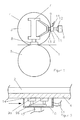
- Nachfolgend soll die Erfindung an einem Ausführungsbeispiel näher erläutert werden. In der beigefügten Zeichnung zeigt:
- Figur 1:
- einen schematischen Querschnitt durch eine Glättanordnung und
- Figur 2:
- einen Teilschnitt durch die Schleifvorrichtung 6.
- Zur Glättung wird die Faserstoffbahn 1 gemäß
Figur 1 durch einen, von einer oberen Schuhpresswalze 3 und einer unteren, zylindrischen Gegenwalze 5 gebildeten Glättspalt geführt. - Dabei besteht die Schuhpresswalze 3 einen flexiblen Walzenmantel 4, der von einem hydraulischen Anpresselement 8 mit konkaver Pressfläche zur Gegenwalze 5 hin gedrückt wird. Durch die konkave Pressfläche kommt es zur Bildung eines verlängerten Glättspaltes, was eine intensive, aber volumenschonende Glättung ermöglicht.
- Da die erreichbare Glätte bei der Faserstoffbahn 1 wesentlich von der Glätte der Außenmantelfläche des Walzenmantels 4 abhängt, wird diese bei Bedarf von einer Schleifvorrichtung 6 glatt geschliffen.
- Hierzu wird der Schleifkopf 10 der Schleifvorrichtung 6 von einem Presselement 12 kraftgesteuert gegen die Außenmantelfläche des Walzenmantels 4 gedrückt. Damit die Durchbiegung des Walzenmantels 4 das Schleifergebnis möglichst wenig beeinflusst, ist die Schleifvorrichtung 6 hier in der 3 Uhr-Position des Walzenmantels 4 angeordnet.
- Wegen der Flexibilität des Walzenmantels 4 stützt sich dieser an der Innenseite gegenüber dem Schleifkopf 10 auf einer Stützleiste 2 ab. Diese Stützleiste 2 besteht aus flexiblem Material und wird von einem pneumatischen Stellglied 13 über die Länge des Walzenmantels 4 flexibel zum Schleifkopf 10 gedrückt.
- Das Stellglied 13 wie auch das Anpresselement 8 stützen sich am Träger 7 der Schuhpresswalze 3 ab.
- Die Schleifvorrichtung 6 ist axial entlang dem Walzenmantel 4 traversierbar angeordnet.
- Bei der in
Figur 2 dargestellten Lösung besitzt der Schleifkopf 10 zwei zum Walzenmantel 4 gerichtete Schleifflächen 9a,9b mit unterschiedlicher Rauhigkeit. Zuerst wird der Mantelbereich mit der raueren 9b und anschließend mit der feineren 9a Schleiffläche bearbeitet. - Wenn, wie in
Figur 2 gezeigt, die beiden Schleifflächen 9a,9b axial nebeneinander angeordnet sind, so bewegt sich die Schleifvorrichtung 6 während des Schleifens in einer von der feineren Schleiffläche 9a zur raueren Schleiffläche 9b weisenden Richtung. - Unabhängig von der Art und Anzahl der Schleifflächen 9 sollte der Schleifkopf 10 den Raum mit den Schleifflächen 9 gegenüber der Umgebung abgrenzen, was durch elastische Dichtungen 14 zwischen dem Schleifkopf 10 und dem Walzenmantel 4 noch verbessert werden kann.
- Da die Schleifflächen 9 hier in Form einer Gitterleinwand feststehend sind, muss der Walzenmantel 4 zumindest während des Schleifens angetrieben werden. Dabei ist die Rotation so zu wählen, dass die Geschwindigkeit der Außenmantelfläche des Walzenmantels 4 zwischen 800 und 1500 m/min liegt.
- Die mittlere Rautiefe der Schleifflächen 9 beträgt zwischen 0,5 und 0,7 µm.
Der Schleifkopf 10 ist des Weiteren über einen Anschluss 11 mit einer Saugeinrichtung verbunden. Deren Unterdruck bewirkt die Absaugung der Schleifstäube und der vom Schleifen erwärmten Luft.
Claims (12)
- Anordnung zum Schleifen der Mantelaußenfläche einer Schuhpresswalze (3) einer Maschine zur Herstellung und/oder Veredlung einer Papier-, Karton- oder einer anderen Faserstoffbahn (1), wobei die Schuhpresswalze (3) einen flexiblen Walzenmantel (4) besitzt, welcher von einem Anpresselement (8) mit konkaver Pressfläche zu einer Gegenwalze (5) gedrückt wird, dadurch gekennzeichnet, dass
wenigstens eine Schleifvorrichtung (6) mit einer, mit der Mantelaußenfläche in Kontakt kommenden Schleiffläche (9) axial an der Mantelaußenfläche traversierbar ist und sich der Walzenmantel (4) auf der Innenseite gegenüber der Schleiffläche (9) an einer Stützleiste (2) abstützt. - Anordnung nach Anspruch 1, dadurch gekennzeichnet, dass
die Stützleiste (2) zumindest in radialer Richtung flexibel ausgebildet ist. - Anordnung nach Anspruch 1 oder 2, dadurch gekennzeichnet, dass
die Stützleiste (2) vorzugsweise über pneumatische Stellglieder (13) an die Innenseite des Walzenmantels (4) anpressbar ist. - Anordnung nach einem der vorhergehenden Ansprüche, dadurch gekennzeichnet, dass
die Schleiffläche (9) an die Mantelaußenfläche anpressbar ist. - Anordnung nach Anspruch 4, dadurch gekennzeichnet, dass
die Anpressung kraftgesteuert erfolgt. - Anordnung nach einem der vorhergehenden Ansprüche, dadurch gekennzeichnet, dass
die Schleifvorrichtung (6) in der 3 oder 9 Uhr-Position des Walzenmantels (4) angeordnet ist. - Anordnung nach einem der vorhergehenden Ansprüchen, dadurch gekennzeichnet, dass
die Schleiffläche (9) von zumindest einem rotierenden Schleifelement gebildet wird. - Anordnung nach einem der vorhergehenden Ansprüche, dadurch gekennzeichnet, dass
die Schleiffläche (9) von wenigstens einem statischen Schleifelement gebildet wird und der Walzenmantel (4) einen vorzugsweise innen liegenden Antrieb besitzt. - Anordnung nach Anspruch 8, dadurch gekennzeichnet, dass
die Geschwindigkeit der Mantelaußenfläche während des Schleifens zwischen 500 und 2000 m/min, vorzugsweise zwischen 800 und 1500 m/min liegt. - Anordnung nach einem der vorhergehenden Ansprüche, dadurch gekennzeichnet, dass
die Schleifvorrichtung (6) zumindest zwei Schleifflächen (9) unterschiedlicher Rauhigkeit besitzt. - Anordnung nach einem der vorhergehenden Ansprüche, dadurch gekennzeichnet, dass
die mittlere Rautiefe der Schleifflächen zwischen 0,1 und 1 µm, vorzugsweise zwischen 0,5 und 0,7 µm liegt. - Anordnung nach einem der vorhergehenden Ansprüche, dadurch gekennzeichnet, dass
die Schleifvorrichtung (6) eine Abführeinrichtung zum Entfernen der Schleifstäube, vorzugsweise in Form einer Absaugeinrichtung besitzt.
Priority Applications (1)
| Application Number | Priority Date | Filing Date | Title |
|---|---|---|---|
| PL08150994T PL1997584T3 (pl) | 2007-05-26 | 2008-02-04 | Układ do szlifowania |
Applications Claiming Priority (1)
| Application Number | Priority Date | Filing Date | Title |
|---|---|---|---|
| DE102007024810A DE102007024810A1 (de) | 2007-05-26 | 2007-05-26 | Schleifanordnung |
Publications (3)
| Publication Number | Publication Date |
|---|---|
| EP1997584A2 true EP1997584A2 (de) | 2008-12-03 |
| EP1997584A3 EP1997584A3 (de) | 2009-03-04 |
| EP1997584B1 EP1997584B1 (de) | 2010-05-05 |
Family
ID=39577864
Family Applications (1)
| Application Number | Title | Priority Date | Filing Date |
|---|---|---|---|
| EP08150994A Not-in-force EP1997584B1 (de) | 2007-05-26 | 2008-02-04 | Schleifanordnung |
Country Status (4)
| Country | Link |
|---|---|
| EP (1) | EP1997584B1 (de) |
| AT (1) | ATE466689T1 (de) |
| DE (2) | DE102007024810A1 (de) |
| PL (1) | PL1997584T3 (de) |
Cited By (2)
| Publication number | Priority date | Publication date | Assignee | Title |
|---|---|---|---|---|
| CN103949476A (zh) * | 2014-04-24 | 2014-07-30 | 邯钢集团邯宝钢铁有限公司 | 一种热轧板带轧机支撑辊磨削量快速预测方法 |
| WO2025242408A1 (de) * | 2024-05-23 | 2025-11-27 | Andritz Ag | Anordnung und verfahren zum betrieb eines belts in einer maschine |
Families Citing this family (1)
| Publication number | Priority date | Publication date | Assignee | Title |
|---|---|---|---|---|
| CN103358197A (zh) * | 2013-07-22 | 2013-10-23 | 天长市天力液压机械有限责任公司 | 一种胶辊磨床 |
Family Cites Families (4)
| Publication number | Priority date | Publication date | Assignee | Title |
|---|---|---|---|---|
| DE3102526C2 (de) * | 1981-01-27 | 1985-05-23 | J.M. Voith Gmbh, 7920 Heidenheim | Preßeinrichtung zum Entwässern von Bahnen, insbesondere Papierbahnen |
| DE29915022U1 (de) * | 1999-08-27 | 1999-10-21 | Schmötzer, Hubert, 74653 Ingelfingen | Vorrichtung zur materialabtragenden Bearbeitung der Mantelfläche von zylindrischen Walzen einer Druckmaschine |
| JP2003213590A (ja) * | 2001-11-12 | 2003-07-30 | Mitsubishi Heavy Ind Ltd | 紙シートのカレンダ装置 |
| FI117791B (fi) * | 2005-06-17 | 2007-02-28 | Metso Paper Inc | Menetelmä taipuma-aseteltava telan hiomiseksi |
-
2007
- 2007-05-26 DE DE102007024810A patent/DE102007024810A1/de not_active Withdrawn
-
2008
- 2008-02-04 AT AT08150994T patent/ATE466689T1/de active
- 2008-02-04 PL PL08150994T patent/PL1997584T3/pl unknown
- 2008-02-04 EP EP08150994A patent/EP1997584B1/de not_active Not-in-force
- 2008-02-04 DE DE502008000609T patent/DE502008000609D1/de active Active
Cited By (2)
| Publication number | Priority date | Publication date | Assignee | Title |
|---|---|---|---|---|
| CN103949476A (zh) * | 2014-04-24 | 2014-07-30 | 邯钢集团邯宝钢铁有限公司 | 一种热轧板带轧机支撑辊磨削量快速预测方法 |
| WO2025242408A1 (de) * | 2024-05-23 | 2025-11-27 | Andritz Ag | Anordnung und verfahren zum betrieb eines belts in einer maschine |
Also Published As
| Publication number | Publication date |
|---|---|
| DE502008000609D1 (de) | 2010-06-17 |
| ATE466689T1 (de) | 2010-05-15 |
| PL1997584T3 (pl) | 2010-10-29 |
| EP1997584A3 (de) | 2009-03-04 |
| DE102007024810A1 (de) | 2008-11-27 |
| EP1997584B1 (de) | 2010-05-05 |
Similar Documents
| Publication | Publication Date | Title |
|---|---|---|
| DE68904673T2 (de) | Tuch fuer breit-nip-presse. | |
| DE3805350C2 (de) | ||
| EP0405185A1 (de) | Einrichtung zum Schleifen der Oberfläche von Laminaten | |
| EP1997584B1 (de) | Schleifanordnung | |
| DE60008015T2 (de) | Schleifvorrichtung für drehende schneidwerkzeuge, sowie maschine mit einer solchen schleifvorrichtung | |
| DE4026021C2 (de) | Pressenpartie einer Papiermaschine | |
| EP0273093B1 (de) | Verfahren und Vorrichtung zur Herstellung von dehnungsstabilen, flüssigkeitsundurchlässigen, biegsamen Pressbändern, insbesondere für Nasspressen von Papiermaschinen | |
| EP1343612A2 (de) | Vorrichtung zum schleifen einer aussenmantelfläche | |
| DE2713464B2 (de) | Vorrichtung zum Herstellen von Wellpappe | |
| EP1146152B1 (de) | Stützscheibe mit Kautschukbelag für eine Stützscheibenlagerung für Spinnrotoren | |
| WO2022043036A1 (de) | Steuerung einer faserbehandlungsvorrichtung | |
| EP0826819B1 (de) | Vorrichtung zum Entwässern einer Faserstoffsuspension | |
| EP1362950A1 (de) | Verfahren und Vorrichtung zur Entwässerung einer Faserstoffbahn | |
| EP4110552B1 (de) | Polierwerkzeug | |
| EP1837438A2 (de) | Maschine zur Herstellung von Bahnmaterial, insbesondere Papier oder Karton, und Verfahren zur Behandlung einer Oberfläche eines Transportbands in einer Maschine zur Herstellung von Bahnmaterial | |
| DE102008042690B4 (de) | Breitstreckwalze mit aufgerauter, wendelförmiger Oberfläche | |
| DE102021105618A1 (de) | Schaberklinge und Walzenvorrichtung | |
| DE9011940U1 (de) | Pressenpartie einer Papiermaschine | |
| EP0779391B1 (de) | Verfahren zur Mahlung von Papierfasern | |
| WO2011098284A2 (de) | Verfahren und vorrichtung zum auftragen einer oberflächenschicht auf eine walze sowie deren anwendung | |
| DE60212494T2 (de) | Zylinder für Schmirgel- und Bürstmaschinen | |
| AT513550B1 (de) | Vorrichtung zum Behandeln einer Faserbahn | |
| AT405625B (de) | Verfahren und vorrichtung zur erstellung von zylindrizität einer presswalze mit weichstoffauflage | |
| WO2023088801A1 (de) | Streckvorrichtung und verfahren zum monoaxialen strecken einer folienbahn in deren transportrichtung | |
| EP1862588B1 (de) | Presswalze |
Legal Events
| Date | Code | Title | Description |
|---|---|---|---|
| PUAI | Public reference made under article 153(3) epc to a published international application that has entered the european phase |
Free format text: ORIGINAL CODE: 0009012 |
|
| AK | Designated contracting states |
Kind code of ref document: A2 Designated state(s): AT BE BG CH CY CZ DE DK EE ES FI FR GB GR HR HU IE IS IT LI LT LU LV MC MT NL NO PL PT RO SE SI SK TR |
|
| AX | Request for extension of the european patent |
Extension state: AL BA MK RS |
|
| PUAL | Search report despatched |
Free format text: ORIGINAL CODE: 0009013 |
|
| AK | Designated contracting states |
Kind code of ref document: A3 Designated state(s): AT BE BG CH CY CZ DE DK EE ES FI FR GB GR HR HU IE IS IT LI LT LU LV MC MT NL NO PL PT RO SE SI SK TR |
|
| AX | Request for extension of the european patent |
Extension state: AL BA MK RS |
|
| 17P | Request for examination filed |
Effective date: 20090904 |
|
| AKX | Designation fees paid |
Designated state(s): AT BE BG CH CY CZ DE DK EE ES FI FR GB GR HR HU IE IS IT LI LT LU LV MC MT NL NO PL PT RO SE SI SK TR |
|
| GRAP | Despatch of communication of intention to grant a patent |
Free format text: ORIGINAL CODE: EPIDOSNIGR1 |
|
| GRAS | Grant fee paid |
Free format text: ORIGINAL CODE: EPIDOSNIGR3 |
|
| GRAA | (expected) grant |
Free format text: ORIGINAL CODE: 0009210 |
|
| AK | Designated contracting states |
Kind code of ref document: B1 Designated state(s): AT BE BG CH CY CZ DE DK EE ES FI FR GB GR HR HU IE IS IT LI LT LU LV MC MT NL NO PL PT RO SE SI SK TR |
|
| REG | Reference to a national code |
Ref country code: GB Ref legal event code: FG4D Free format text: NOT ENGLISH |
|
| REG | Reference to a national code |
Ref country code: CH Ref legal event code: EP |
|
| REG | Reference to a national code |
Ref country code: IE Ref legal event code: FG4D Free format text: LANGUAGE OF EP DOCUMENT: GERMAN |
|
| REF | Corresponds to: |
Ref document number: 502008000609 Country of ref document: DE Date of ref document: 20100617 Kind code of ref document: P |
|
| REG | Reference to a national code |
Ref country code: SE Ref legal event code: TRGR |
|
| REG | Reference to a national code |
Ref country code: NL Ref legal event code: VDEP Effective date: 20100505 |
|
| LTIE | Lt: invalidation of european patent or patent extension |
Effective date: 20100505 |
|
| PG25 | Lapsed in a contracting state [announced via postgrant information from national office to epo] |
Ref country code: ES Free format text: LAPSE BECAUSE OF FAILURE TO SUBMIT A TRANSLATION OF THE DESCRIPTION OR TO PAY THE FEE WITHIN THE PRESCRIBED TIME-LIMIT Effective date: 20100816 Ref country code: NO Free format text: LAPSE BECAUSE OF FAILURE TO SUBMIT A TRANSLATION OF THE DESCRIPTION OR TO PAY THE FEE WITHIN THE PRESCRIBED TIME-LIMIT Effective date: 20100805 Ref country code: NL Free format text: LAPSE BECAUSE OF FAILURE TO SUBMIT A TRANSLATION OF THE DESCRIPTION OR TO PAY THE FEE WITHIN THE PRESCRIBED TIME-LIMIT Effective date: 20100505 Ref country code: LT Free format text: LAPSE BECAUSE OF FAILURE TO SUBMIT A TRANSLATION OF THE DESCRIPTION OR TO PAY THE FEE WITHIN THE PRESCRIBED TIME-LIMIT Effective date: 20100505 |
|
| REG | Reference to a national code |
Ref country code: PL Ref legal event code: T3 |
|
| PG25 | Lapsed in a contracting state [announced via postgrant information from national office to epo] |
Ref country code: IS Free format text: LAPSE BECAUSE OF FAILURE TO SUBMIT A TRANSLATION OF THE DESCRIPTION OR TO PAY THE FEE WITHIN THE PRESCRIBED TIME-LIMIT Effective date: 20100905 Ref country code: HR Free format text: LAPSE BECAUSE OF FAILURE TO SUBMIT A TRANSLATION OF THE DESCRIPTION OR TO PAY THE FEE WITHIN THE PRESCRIBED TIME-LIMIT Effective date: 20100505 Ref country code: SI Free format text: LAPSE BECAUSE OF FAILURE TO SUBMIT A TRANSLATION OF THE DESCRIPTION OR TO PAY THE FEE WITHIN THE PRESCRIBED TIME-LIMIT Effective date: 20100505 Ref country code: LV Free format text: LAPSE BECAUSE OF FAILURE TO SUBMIT A TRANSLATION OF THE DESCRIPTION OR TO PAY THE FEE WITHIN THE PRESCRIBED TIME-LIMIT Effective date: 20100505 |
|
| REG | Reference to a national code |
Ref country code: IE Ref legal event code: FD4D |
|
| PG25 | Lapsed in a contracting state [announced via postgrant information from national office to epo] |
Ref country code: CY Free format text: LAPSE BECAUSE OF FAILURE TO SUBMIT A TRANSLATION OF THE DESCRIPTION OR TO PAY THE FEE WITHIN THE PRESCRIBED TIME-LIMIT Effective date: 20100602 |
|
| PG25 | Lapsed in a contracting state [announced via postgrant information from national office to epo] |
Ref country code: IE Free format text: LAPSE BECAUSE OF FAILURE TO SUBMIT A TRANSLATION OF THE DESCRIPTION OR TO PAY THE FEE WITHIN THE PRESCRIBED TIME-LIMIT Effective date: 20100505 Ref country code: EE Free format text: LAPSE BECAUSE OF FAILURE TO SUBMIT A TRANSLATION OF THE DESCRIPTION OR TO PAY THE FEE WITHIN THE PRESCRIBED TIME-LIMIT Effective date: 20100505 Ref country code: DK Free format text: LAPSE BECAUSE OF FAILURE TO SUBMIT A TRANSLATION OF THE DESCRIPTION OR TO PAY THE FEE WITHIN THE PRESCRIBED TIME-LIMIT Effective date: 20100505 |
|
| PG25 | Lapsed in a contracting state [announced via postgrant information from national office to epo] |
Ref country code: CZ Free format text: LAPSE BECAUSE OF FAILURE TO SUBMIT A TRANSLATION OF THE DESCRIPTION OR TO PAY THE FEE WITHIN THE PRESCRIBED TIME-LIMIT Effective date: 20100505 Ref country code: SK Free format text: LAPSE BECAUSE OF FAILURE TO SUBMIT A TRANSLATION OF THE DESCRIPTION OR TO PAY THE FEE WITHIN THE PRESCRIBED TIME-LIMIT Effective date: 20100505 Ref country code: RO Free format text: LAPSE BECAUSE OF FAILURE TO SUBMIT A TRANSLATION OF THE DESCRIPTION OR TO PAY THE FEE WITHIN THE PRESCRIBED TIME-LIMIT Effective date: 20100505 |
|
| PLBE | No opposition filed within time limit |
Free format text: ORIGINAL CODE: 0009261 |
|
| STAA | Information on the status of an ep patent application or granted ep patent |
Free format text: STATUS: NO OPPOSITION FILED WITHIN TIME LIMIT |
|
| 26N | No opposition filed |
Effective date: 20110208 |
|
| REG | Reference to a national code |
Ref country code: DE Ref legal event code: R097 Ref document number: 502008000609 Country of ref document: DE Effective date: 20110207 |
|
| PG25 | Lapsed in a contracting state [announced via postgrant information from national office to epo] |
Ref country code: GR Free format text: LAPSE BECAUSE OF FAILURE TO SUBMIT A TRANSLATION OF THE DESCRIPTION OR TO PAY THE FEE WITHIN THE PRESCRIBED TIME-LIMIT Effective date: 20100806 |
|
| PGFP | Annual fee paid to national office [announced via postgrant information from national office to epo] |
Ref country code: SE Payment date: 20110214 Year of fee payment: 4 Ref country code: PL Payment date: 20110124 Year of fee payment: 4 Ref country code: FR Payment date: 20110302 Year of fee payment: 4 Ref country code: DE Payment date: 20110218 Year of fee payment: 4 Ref country code: FI Payment date: 20110214 Year of fee payment: 4 |
|
| BERE | Be: lapsed |
Owner name: VOITH PATENT G.M.B.H. Effective date: 20110228 |
|
| PG25 | Lapsed in a contracting state [announced via postgrant information from national office to epo] |
Ref country code: MC Free format text: LAPSE BECAUSE OF NON-PAYMENT OF DUE FEES Effective date: 20110228 |
|
| PG25 | Lapsed in a contracting state [announced via postgrant information from national office to epo] |
Ref country code: BE Free format text: LAPSE BECAUSE OF NON-PAYMENT OF DUE FEES Effective date: 20110228 |
|
| PG25 | Lapsed in a contracting state [announced via postgrant information from national office to epo] |
Ref country code: MT Free format text: LAPSE BECAUSE OF FAILURE TO SUBMIT A TRANSLATION OF THE DESCRIPTION OR TO PAY THE FEE WITHIN THE PRESCRIBED TIME-LIMIT Effective date: 20100505 |
|
| PGFP | Annual fee paid to national office [announced via postgrant information from national office to epo] |
Ref country code: IT Payment date: 20110228 Year of fee payment: 4 |
|
| REG | Reference to a national code |
Ref country code: CH Ref legal event code: PL |
|
| GBPC | Gb: european patent ceased through non-payment of renewal fee |
Effective date: 20120204 |
|
| PG25 | Lapsed in a contracting state [announced via postgrant information from national office to epo] |
Ref country code: CH Free format text: LAPSE BECAUSE OF NON-PAYMENT OF DUE FEES Effective date: 20120229 Ref country code: SE Free format text: LAPSE BECAUSE OF NON-PAYMENT OF DUE FEES Effective date: 20120205 Ref country code: LI Free format text: LAPSE BECAUSE OF NON-PAYMENT OF DUE FEES Effective date: 20120229 Ref country code: FI Free format text: LAPSE BECAUSE OF NON-PAYMENT OF DUE FEES Effective date: 20120204 |
|
| REG | Reference to a national code |
Ref country code: FR Ref legal event code: ST Effective date: 20121031 |
|
| PG25 | Lapsed in a contracting state [announced via postgrant information from national office to epo] |
Ref country code: IT Free format text: LAPSE BECAUSE OF NON-PAYMENT OF DUE FEES Effective date: 20120204 |
|
| REG | Reference to a national code |
Ref country code: DE Ref legal event code: R119 Ref document number: 502008000609 Country of ref document: DE Effective date: 20120901 |
|
| PG25 | Lapsed in a contracting state [announced via postgrant information from national office to epo] |
Ref country code: GB Free format text: LAPSE BECAUSE OF NON-PAYMENT OF DUE FEES Effective date: 20120204 Ref country code: FR Free format text: LAPSE BECAUSE OF NON-PAYMENT OF DUE FEES Effective date: 20120229 |
|
| PG25 | Lapsed in a contracting state [announced via postgrant information from national office to epo] |
Ref country code: LU Free format text: LAPSE BECAUSE OF NON-PAYMENT OF DUE FEES Effective date: 20110204 |
|
| PG25 | Lapsed in a contracting state [announced via postgrant information from national office to epo] |
Ref country code: DE Free format text: LAPSE BECAUSE OF NON-PAYMENT OF DUE FEES Effective date: 20120901 |
|
| PG25 | Lapsed in a contracting state [announced via postgrant information from national office to epo] |
Ref country code: PT Free format text: LAPSE BECAUSE OF NON-PAYMENT OF DUE FEES Effective date: 20100505 |
|
| PG25 | Lapsed in a contracting state [announced via postgrant information from national office to epo] |
Ref country code: TR Free format text: LAPSE BECAUSE OF FAILURE TO SUBMIT A TRANSLATION OF THE DESCRIPTION OR TO PAY THE FEE WITHIN THE PRESCRIBED TIME-LIMIT Effective date: 20100505 Ref country code: BG Free format text: LAPSE BECAUSE OF FAILURE TO SUBMIT A TRANSLATION OF THE DESCRIPTION OR TO PAY THE FEE WITHIN THE PRESCRIBED TIME-LIMIT Effective date: 20100805 |
|
| PG25 | Lapsed in a contracting state [announced via postgrant information from national office to epo] |
Ref country code: HU Free format text: LAPSE BECAUSE OF FAILURE TO SUBMIT A TRANSLATION OF THE DESCRIPTION OR TO PAY THE FEE WITHIN THE PRESCRIBED TIME-LIMIT Effective date: 20100505 |
|
| REG | Reference to a national code |
Ref country code: AT Ref legal event code: MM01 Ref document number: 466689 Country of ref document: AT Kind code of ref document: T Effective date: 20130204 |
|
| PG25 | Lapsed in a contracting state [announced via postgrant information from national office to epo] |
Ref country code: AT Free format text: LAPSE BECAUSE OF NON-PAYMENT OF DUE FEES Effective date: 20130204 Ref country code: PL Free format text: LAPSE BECAUSE OF NON-PAYMENT OF DUE FEES Effective date: 20130204 |
|
| REG | Reference to a national code |
Ref country code: PL Ref legal event code: LAPE |