EP1999139B1 - Esters de l'acide betulonique et ses derives polyalkyleneglycol pour le traitement d'infection virale et du cancer - Google Patents
Esters de l'acide betulonique et ses derives polyalkyleneglycol pour le traitement d'infection virale et du cancer Download PDFInfo
- Publication number
- EP1999139B1 EP1999139B1 EP07712472.5A EP07712472A EP1999139B1 EP 1999139 B1 EP1999139 B1 EP 1999139B1 EP 07712472 A EP07712472 A EP 07712472A EP 1999139 B1 EP1999139 B1 EP 1999139B1
- Authority
- EP
- European Patent Office
- Prior art keywords
- compound
- moiety
- pag
- poly
- linker
- Prior art date
- Legal status (The legal status is an assumption and is not a legal conclusion. Google has not performed a legal analysis and makes no representation as to the accuracy of the status listed.)
- Active
Links
- 0 CC(C)(C)C(CC[C@@](C)(CCC1)[C@@](CC2)[C@]1(C)[C@](C)(CC[C@@](CC1)(C3[C@@]1C(C)=*)C(O)=O)[C@]23[Tl])=O Chemical compound CC(C)(C)C(CC[C@@](C)(CCC1)[C@@](CC2)[C@]1(C)[C@](C)(CC[C@@](CC1)(C3[C@@]1C(C)=*)C(O)=O)[C@]23[Tl])=O 0.000 description 7
- HPUMSKGRUYKAKY-UDCPXFSDSA-N CC(C)CCC[C@@H](C)[C@@H](CC1)[C@@](C)(CC2)[C@@H]1[C@H]1[C@H]2[C@@](C)(CC[C@H](C2)OC([C@@](CC[C@H]3C(C)=C)(CC4)C3[C@@H](CC3)[C@]4(C)[C@](C)(CC4)[C@H]3[C@@](C)(CC3)C4C(C)(C)C3=O)=O)C2=CC1 Chemical compound CC(C)CCC[C@@H](C)[C@@H](CC1)[C@@](C)(CC2)[C@@H]1[C@H]1[C@H]2[C@@](C)(CC[C@H](C2)OC([C@@](CC[C@H]3C(C)=C)(CC4)C3[C@@H](CC3)[C@]4(C)[C@](C)(CC4)[C@H]3[C@@](C)(CC3)C4C(C)(C)C3=O)=O)C2=CC1 HPUMSKGRUYKAKY-UDCPXFSDSA-N 0.000 description 1
Images




Classifications
-
- C—CHEMISTRY; METALLURGY
- C07—ORGANIC CHEMISTRY
- C07J—STEROIDS
- C07J9/00—Normal steroids containing carbon, hydrogen, halogen or oxygen substituted in position 17 beta by a chain of more than two carbon atoms, e.g. cholane, cholestane, coprostane
- C07J9/005—Normal steroids containing carbon, hydrogen, halogen or oxygen substituted in position 17 beta by a chain of more than two carbon atoms, e.g. cholane, cholestane, coprostane containing a carboxylic function directly attached or attached by a chain containing only carbon atoms to the cyclopenta[a]hydrophenanthrene skeleton
-
- A—HUMAN NECESSITIES
- A61—MEDICAL OR VETERINARY SCIENCE; HYGIENE
- A61P—SPECIFIC THERAPEUTIC ACTIVITY OF CHEMICAL COMPOUNDS OR MEDICINAL PREPARATIONS
- A61P31/00—Antiinfectives, i.e. antibiotics, antiseptics, chemotherapeutics
- A61P31/12—Antivirals
-
- A—HUMAN NECESSITIES
- A61—MEDICAL OR VETERINARY SCIENCE; HYGIENE
- A61P—SPECIFIC THERAPEUTIC ACTIVITY OF CHEMICAL COMPOUNDS OR MEDICINAL PREPARATIONS
- A61P35/00—Antineoplastic agents
-
- A—HUMAN NECESSITIES
- A61—MEDICAL OR VETERINARY SCIENCE; HYGIENE
- A61P—SPECIFIC THERAPEUTIC ACTIVITY OF CHEMICAL COMPOUNDS OR MEDICINAL PREPARATIONS
- A61P35/00—Antineoplastic agents
- A61P35/02—Antineoplastic agents specific for leukemia
-
- A—HUMAN NECESSITIES
- A61—MEDICAL OR VETERINARY SCIENCE; HYGIENE
- A61P—SPECIFIC THERAPEUTIC ACTIVITY OF CHEMICAL COMPOUNDS OR MEDICINAL PREPARATIONS
- A61P35/00—Antineoplastic agents
- A61P35/04—Antineoplastic agents specific for metastasis
-
- C—CHEMISTRY; METALLURGY
- C07—ORGANIC CHEMISTRY
- C07J—STEROIDS
- C07J63/00—Steroids in which the cyclopenta(a)hydrophenanthrene skeleton has been modified by expansion of only one ring by one or two atoms
- C07J63/008—Expansion of ring D by one atom, e.g. D homo steroids
Definitions
- the present invention relates to betulonic and betulinic acid derivatives and, in particular, to C-28 and C-3 derivatives.
- the present invention relates to betulonic acid esters, dihydro-betulonic acid esters, PAG-modified betulinic acid derivatives, and PAG-modified dihydro-betulinic acid derivatives.
- Betulinic acid and derivatives thereof may be bound to a poly(alkylene glycol) (PAG) such as poly(ethylene glycol). Binding may be via a linker, such as a diamine, an amino acid, a peptide, an ester or a carbonate.
- PAG poly(alkylene glycol)
- Binding may be via a linker, such as a diamine, an amino acid, a peptide, an ester or a carbonate.
- the compounds of the present invention may be used for the treatment of cancer or a viral infection.
- the present invention also provides pharmaceutical compositions comprising the compounds of the present invention.
- the present invention further provides processes for the preparation of the compounds of the present invention, for example, from betulin.
- Betulinic acid (Bet ⁇ ) and betulin come from a variety of botanical sources such as bark from Betula alba , Platanus orientalis, Corylus avellana, Carpinus betulus, Alnus glutinosa as well as from Zizyphus sp . Rhamnaceae ( Jiri Patocka, Journal of Applied Biomedicine, 2003, 1, 7-12 . E.L. Ménard et al., Helvetica Chimica Acta, 1963, XLVI, 1801-1811 ).
- BetA is thus found in many plant species, although in a low concentration compared to betulin.
- the rare exception is the rich content of BetA in a clover species named Menyanthes trifoliate, which is a bog plant ( C. Huang et al., Yao Xue Xue Bao, 1995, 30, 621-626 ) .
- a cyclopropane derivative of betulin has been converted by oxidation into the corresponding BetA and betulonic acid derivatives.
- the 20,29-dihydro-20,29-dichloromethylene betulinic acid proved to be the most cytotoxic toward human melanoma and human ovarian carcinoma cell lines ( A.V. Symon et al. in Bioorg. Khim., 2005, 31, 320-325 ; and in Russian Journal of Bioorganic Chemistry, 2005, 31, 286-291 ).
- triterpenoids especially pentacyclic triterpenes like betulin and BetA
- in the induction of apoptosis in malignant tumour cells has been recognised for some years now ( Emily Pisha et al., Nature Medicine, 1995, 1, 1046-1451 . Simone Fulda et a/., in Cancer Res., 1997, 57, 4956-4964 ; in J. Biol. Chem., 1998, 273, 33942-33948 ; and in Int. J. Cancer, 1999, 82, 435-441 ).
- BetA demonstrates selective cytotoxicity against melanoma cells and other malignant cells of neuroectodermal origin ( Tino Galgon et al., Exp. Dermatol., 2005, 94, 736-743 ). Growth inhibition is evident in all neoplastic cell lines and is independent of the status of the apoptotic inducer protein, p53 ( Valentina Zuco et al., Cancer Lett., 2002, 175, 17-25 ).
- Tumoural tissue grows when the equilibrium between cell replication and cell death (apoptosis) is not maintained.
- the immunological mechanisms that control such cellular cycles are complex, being based on the activity of a variety of cytokines as well as on the expression of certain genes.
- cytokines that regulate apoptosis.
- cytokines are tumour necrosis factor (TNF) and nerve growth factor (NGF).
- TNF tumour necrosis factor
- NGF nerve growth factor
- PARP poly(ADP-ribose) polymerase
- PARP poly(ADP-ribose) polymerase
- Hydrolysis of PART induces apoptosis. It is important to note that this mechanism by-passes the proto-oncogene, Bcl-2 (the protein products of which inhibit caspase activities).
- the mitochondrion also plays an important role in apoptosis.
- S. Fulda et al. described BetA as a cytotoxic agent that triggers apoptosis by a direct effect at the mitochondrial membrane level, even when the caspases are chemically inhibited ( J. Biol. Chem., 273, 33942-33948 ).
- BetA directly induced loss of mitochondrial transmembrane potential; soluble cytochrome c excreted in the cytoplasm of the cell thus activated caspases 9 and 3 leading to apoptosis.
- Action of BetA is thus Bcl-2 independent ( V. Zuco et al., Cancer Lett., 2002, 175, 17-25 ).
- BetA was recognised as a selective inhibitor of human melanoma growth and was reported to induce apoptosis of these cells ( Darrick S.H.L. Kim et al., Bioorganic & Medicinal Chemistry Letters, 1998, 8,1707-1712 ; E. Pisha et al., Nature Medicine, 1995, 1, 1046-1051 ; S. Fulda et al., Cancer Res., 1997, 57, 4956-4964 ).
- the growth inhibitory action of BetA was more effective against melanoma cell lines than against normal melanocytes. This was recently confirmed in mice bearing human melanoma xenografts ( D.A. Eiznbamer and Z.Q. Xu, Drugs, 2004, 7, 359-373 ).
- BetA The anti-proliferative action of BetA seems to be independent of the p53 status and, despite the induction of apoptosis, the expression of the anti-apoptotic protein Mcl-1 is induced ( Edgar Selzer et a/., Journal of Investigative Dermatology, 2000, 114, 935-940 ).
- BetA activates the transcription factor NF-kappaB in a variety of tumour cell lines and induces apoptosis in a cell-type dependent manner ( Hubert Kasperczyk et al., Oncogene, 2005, 24, 6945-6956 ).
- BetA suppresses NF-kappaB activation as well as NF-kappaB regulated gene expression induced by carcinogens, TNF, interleukin-1 (IL-1) and oxidative stress ( Yasunari Takada, Bharat B. Aggarwal, J. Immunol., 2003, 171, 3278-3286 ).
- Boc-lysinated betulonic acid has been found to be useful in the treatment of cancer, in particular prostate cancer ( Brij B. Saxena, Bioorganic & Medicinal Chemistry Letters, 2006, 14, 6349-6358 ).
- betulonic acid derivatives in particular betulonic acid esters, dihydro-betulonic acid esters, PAG-modified betulinic acid derivatives, and PAG-modified dihydro-betulinic acid derivatives, are useful in the treatment of cancer and viral infections such as HIV, HSV and influenza infection.
- the ketone functionality of the betulonic acid esters and the dihydro-betulonic acid esters allows these esters to be derivatised and bound to a poly(alkylene glycol), for example, poly(ethylene glycol) or monomethoxy poly(ethylene glycol), which provides the esters with improved solubility and stability in vivo .
- the present invention provides a compound having the structure (I): wherein R is an alkyl, alkenyl, alkynyl, acryl, arylalkyl, arylalkenyl, arylalkynyl, alkylaryl, alkenylaryl or alkynylaryl group, which may optionally be substituted as indicated hereafter, which may optionally include one or more heteroatoms N, O or S in its carbon skeleton, and which may optionally include one or more -CO- groups in its carbon skeleton.
- the first aspect of the present invention also provides a compound having the structure (II): wherein R is an alkyl, alkenyl, alkynyl, acryl, arylalkyl, arylalkenyl, arylalkynyl, alkylaryl, alkenylaryl or alkynylaryl group, which may optionally be substituted as indicated hereafter, which may optionally include one or more heteroatoms N, O or S in its carbon skeleton, and which may optionally include one or more -CO- groups in its carbon skeleton.
- R is an alkyl, alkenyl, alkynyl, acryl, arylalkyl, arylalkenyl, arylalkynyl, alkylaryl, alkenylaryl or alkynylaryl group, which may optionally be substituted as indicated hereafter, which may optionally include one or more heteroatoms N, O or S in its carbon skeleton, and which may optionally include one or more -
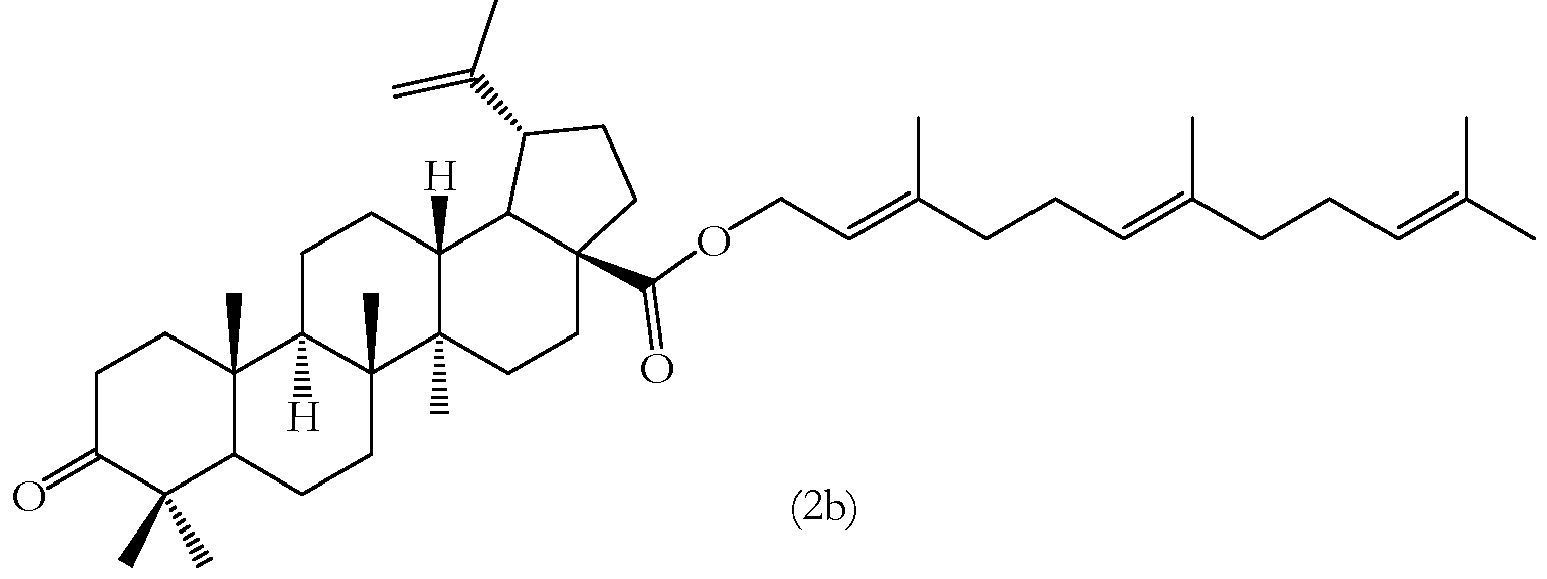
- the present invention also relates to compounds 2b, 2b-i and 2b-ii as defined in the claims.
- an "alkyl” group is defined as a monovalent saturated hydrocarbon, which may be straight-chained or branched, or be or include one or more cyclic groups.
- An alkyl group may optionally include one or more heteroatoms N, O or S in its carbon skeleton.
- an alkyl group includes 0, 1, 2, 3 or 4 nitrogen atoms in its carbon skeleton.
- an alkyl group includes 0, 1, 2, 3 or 4 oxygen atoms in its carbon skeleton.
- an alkyl group includes 0, 1, 2, 3 or 4 sulphur atoms in its carbon skeleton.
- An alkyl group may optionally include one or more -CO- groups in its carbon skeleton.
- an alkyl group includes 0, 1, 2, 3 or 4 -CO- groups in its carbon skeleton, more preferably an alkyl group does not include any -CO- groups in its carbon skeleton.
- alkyl groups are methyl, ethyl, cyclohexyl and decahydro-naphthalene groups.
- an alkyl group is a C 2 -C 30 alkyl group, which is defined as an alkyl group containing from 2 to 30 carbon atoms.
- An "alkylene” group is similarly defined as a divalent alkyl group.
- an alkyl group is or includes one or more cyclic groups and contains 17 to 25 carbon atoms.
- an alkyl group is straight-chained or branched and contains 2 to 10 carbon atoms.
- alkenyl is defined as a monovalent hydrocarbon, which comprises at least one carbon-carbon double bond, which may be straight-chained or branched, or be or include one or more cyclic groups.
- An alkenyl group may optionally include one or more heteroatoms N, O or S in its carbon skeleton.
- an alkenyl group includes 0, 1, 2, 3 or 4 nitrogen atoms in its carbon skeleton.
- an alkenyl group includes 0, 1, 2, 3 or 4 oxygen atoms in its carbon skeleton.
- an alkenyl group includes 0, 1, 2, 3 or 4 sulphur atoms in its carbon skeleton.
- An alkenyl, group may optionally include one or more -CO- groups in its carbon skeleton.
- an alkenyl, group includes 0, 1, 2, 3 or 4 -CO- groups in its carbon skeleton, more preferably an alkenyl group does not include any -CO- groups in its carbon skeleton.
- alkenyl groups are vinyl, allyl, cyclohexenyl and octahydro-naphthalene groups.
- an alkenyl group is a C 2 -C 30 alkenyl group, which is defined as an alkenyl group containing from 2 to 30 carbon atoms.
- An "alkenylene” group is similarly defined as a divalent alkenyl group.
- an alkenyl group is or includes one or more cyclic groups and contains 17 to 25 carbon atoms.
- an alkynyl group is straight-chained or branched and contains 2 to 10 carbon atoms.
- alkynyl is defined as a monovalent hydrocarbon, which comprises at least one carbon-carbon triple bond, which may be straight-chained or branched, or be or include one or more cyclic groups.
- An alkynyl group may optionally include one or more heteroatoms N, O or S in its carbon skeleton.
- an alkynyl group includes 0, 1, 2, 3 or 4 nitrogen atoms in its carbon skeleton.
- an alkynyl group includes 0, 1, 2, 3 or 4 oxygen atoms in its carbon skeleton.
- an alkynyl group includes 0, 1, 2, 3 or 4 sulphur atoms in its carbon skeleton.
- An alkynyl group may optionally include one or more -CO- groups in its carbon skeleton.
- an alkynyl group includes 0, 1, 2, 3 or 4 -CO- groups in its carbon skeleton, more preferably an alkynyl group does not include any -CO- groups in its carbon skeleton.
- Examples of alkynyl groups are ethynyl, propargyl, but-1-ynyl and but-2-ynyl groups.
- an alkynyl group is a C 2 -C 30 alkynyl group, which is defined as an alkynyl group containing from 2 to 30 carbon atoms.
- An "alkenylene” group is similarly defined as a divalent alkenyl group.
- An "aryl” group is defined as a monovalent aromatic hydrocarbon.
- An aryl group may optionally include one or more heteroatoms N, O or S in its carbon skeleton.
- an aryl group includes 0, 1, 2, 3 or 4 nitrogen atoms in its carbon skeleton.
- an aryl group includes 0, 1, 2, 3 or 4 oxygen atoms in its carbon skeleton.
- an aryl group includes 0, 1, 2, 3 or 4 sulphur atoms in its carbon skeleton.
- An aryl group may optionally include one or more -CO- groups in its carbon skeleton.
- an aryl group includes 0, 1, 2, 3 or 4 -CO- groups in its carbon skeleton, more preferably an aryl group does not include any -CO- groups in its carbon skeleton.
- aryl groups are phenyl, naphthyl, anthracenyl, phenanthrenyl, furanyl, pyrrolyl, thiophenyl (C 4 H 3 S), oxazolyl, imidazolyl, thiazolyl, isoxazolyl, pyrazolyl, isothiazolyl, pyridinyl, quinolinyl, isoquinolinyl, indolyl, pyridazinyl, pyrimidinyl, pyrazinyl and favonyl (C 15 H 9 O 2 ) groups.
- an aryl group is a C 4-30 aryl group, which is defined as an aryl group containing from 4 to 30 carbon atoms.
- arylalkyl arylalkenyl, arylalkynyl, alkylaryl, alkenylaryl or alkynylaryl
- the last mentioned group contains the atom by which the moiety is attached to the rest of the molecule.
- a typical example of an arylalkyl group is benzyl.
- an optionally substituted alkyl alkenyl, alkynyl, aryl, arylalkyl, arylalkenyl, arylalkynyl, alkylaryl, alkenylaryl or alkynylaryl group may be substituted with one or more of -F, -Cl, -Br, -I, -CF 3 , -CCl 3 , -CBr 3 , -CI 3 , -OH, -SH, -NH 2 , -CN, -NO 2 , -COOH, -R 1 -O-R 2 , -R 1 -S-R 2 , -R 1 -SO-R 2 , -R 1 -SO 2 -R 2 , -R 1 -SO 2 -OR 2 , -R 1 O-SO 2 -R 2 , -R 1 -SO 2 -N(R 2 ) 2 , -R
- -R 1 - is independently a chemical bond, a C 1-10 alkylene, C 1-10 alkenylene or C 1-10 alkenylene group.
- -R 2 is independently hydrogen, unsubstituted C 1-6 alkyl, unsubstituted C 1-6 alkenyl, unsubstituted C 1-6 alkenyl or unsubstituted C 6-10 aryl.
- Optional substituent(s) are not taken into account when calculating the total number of carbon atoms in the parent group substituted with the optional substituent(s).
- a substituted group comprises 1, 2 or 3 substituents, more preferably 1 or 2 substituents, and even more preferably 1 substituent.
- Any optional substituent may be protected.
- Suitable protecting groups for protecting optional substituents are known in the art, for example from “ Protective Groups in Organic Synthesis” by T.W. Greene and P.G.M. Wuts (Wiley-Interscience, 3rd edition, 1999 ).
- R comprises a fused ring system, which may comprise one or more double bonds, and which may optionally be substituted.
- the fused ring system has a sterane structure as shown: which may comprise one or more double bonds, and which may optionally be substituted as previously indicated.
- R is a steroid alcohol moiety.
- R is a cholesteryl moiety, such that the compound of the present invention is cholesteryl betulonate having the structure (Ia- ⁇ ) or (Ia- ⁇ ) or a saturated derivative thereof having the structure (IIa- ⁇ ) or (IIa- ⁇ ): or or or or
- R is a steroid hormone moiety or a steroid hormone metabolite moiety.
- R is an estrogen moiety such as an estradiol moiety, a progestogen moiety such as a progesterone moiety, an androgen moiety such as a testosterone moiety, or a dehydroepiandrosterone moiety.
- the compound of the present invention may be used in the preparation of derivatives as defined below.
- a derivative of a compound of the first aspect of the present invention may be bound to a poly(alkylene glycol), preferably via a linker.
- a derivatised ketone functionality of the compound is bound to the poly(alkylene glycol), preferably via a linker.
- a derivatised ketone functionality of the compound is bound to the linker, which is in turn bound to the poly(alkylene glycol).
- the derivatised ketone functionality is an amine, an alcohol or a thiol, more preferably an amine.
- the linker is preferably a diamine such as ornithine.
- the poly(alkylene glycol) is
- a poly(alkylene glycol) is a compound of the formula H-(O-alkyl) n -OH which is herein abbreviated to PAG-OH.
- the repeating alkyl group of a poly(alkylene glycol) may be straight-chained or branched, preferably the alkyl group is straight-chained.
- the poly(alkylene glycol) may be functionalised at one end, for example with a terminal -R, -NH 2 , -NHR, -NR 2 , -SH, -SR or -CO 2 H group, wherein R is an alkyl, alkenyl, alkenyl, aryl, arylalkyl, arylalkenyl, arylalkynyl, alkylaryl, alkenylaryl or alkynylaryl group, which may optionally be substituted and which may optionally include one or more heteroatoms N, O or S in its carbon skeleton, preferably wherein R is an unsubstituted alkyl group, more preferably wherein R is an unsubstituted C 1-6 alkyl group.
- the poly(alkylene glycol) may be functionalised at both ends, provided at least one end is functionalised with a terminal -NH 2 , -NHR or -SH group, wherein R is defined as immediately above.
- a poly(alkylene glycol) is of the formula HO-[(CH 2 ) m O n -H, wherein m is from 1 to 4, and n is from 1 to 1500.
- PAG-modified compounds exhibit increased stability, an increased metabolic half-life, decreased immunogenicity, and decreased toxicity.
- PAGs are linear, hydrophilic, uncharged and flexible polymers, which are commercially available in a variety of molecular weights. PAGs are not toxic and generally recognised as safe.
- monomethoxy poly(ethylene glycol) (mPEG) is approved by the FDA as a vehicle or base for a number of pharmaceutical preparations and has a low order of toxicity in oral, parenteral and epidermal applications.
- mPEGs When administrated intravenously to humans, mPEGs with a molecular weight of 1 to 6 kDa are readily excreted, mainly via the kidney.
- a hydroxyl end-group of the PAG polymer is converted into a reactive functional group.
- Methods of activating PAGs are known in the art.
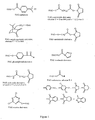
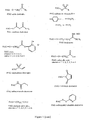
- European patent EP 0 632 082 which is incorporated herein by reference in its entirety, discusses a wide variety of methods of activating PAGs. Examples of activated PAGs are shown in Figure 1 . Methods of obtaining these activated PAGs are known to those skilled in the art.
- the activated PAGs may be isolated before coupling to the betulonic acid ester derivatives. Alternatively, the activated PAGs may be prepared in situ and coupled to the betulonic acid ester derivatives without isolating.
- a preferred method of activating PAGs for the purposes of the present invention is the use of phosgene (Cl 2 CO) or 1,1'-carbonyldiimidazole (CDI) to provide a PAG chloroformate or a PAG 1-carbonylimidazole, followed by the use of 4-dimethylaminopyridine (DMAP) to provide a PAG carbamate (see Scheme 1, DMAP carbamate methodology).
- phosgene Cl 2 CO
- CDI 1,1'-carbonyldiimidazole
- DMAP 4-dimethylaminopyridine
- An alternative preferred method of activating PAGs for the purposes of the present invention is the use of Mukaiyama's reagent (2-chloro-1-methylpyridinium iodide, CMPI) on a PAG carboxylic acid to provide a PAG ester (see Scheme 2, CMPI ester methodology).
- Mukaiyama's reagent (2-chloro-1-methylpyridinium iodide, CMPI)
- the betulonic acid ester derivatives of the present invention lack a suitable functional group for coupling to activated PAGs, the betulonic acid ester derivatives may be derivatised before coupling.
- the C-3 ketone functionality of a betulonic acid ester derivative is reduced to provide the corresponding betulinic acid ester derivative, which is coupled to an activated PAG via the C-3 hydroxyl group (see Scheme 3).
- the C-3 hydroxyl group of the betulinic acid ester derivative is converted into an amino group or a sulfhydryl group, which is coupled to an activated PAG via the C-3 amino or sulfhydryl group (see Scheme 4).
- a linker is, coupled to the C-3 ketone functionality of a betulonic acid ester derivative, and the linker is then coupled to an activated PAG (see Scheme 5).
- a preferred linker is a diamine, such as ornithine, which may be suitably protected, for example, with a Boc or an Fmoc group. Suitable protecting groups are known in the art, for example from " Protective Groups in Organic Synthesis” by T.W. Greene and P.G.M. Wuts (Wiley-Intcrscience, 3rd edition, 1999 ).
- a PAG may be covalently attached to a betulonic acid ester derivative without activating the PAG and without prior derivatisation of the betulonic acid ester derivative.
- PAG-OH, PAG-NH 2 , PAG-NHR or PAG-SH can be condensed with the C-3 ketone functionality of a betulonic acid ester derivative under reductive conditions (see Scheme 6).
- Coupling the betulonic acid ester derivatives of the present invention to PAGs renders the esters more soluble in aqueous medium and more stable in vivo .
- the present invention provides a compound having the structure (III): wherein R is hydrogen or an alkyl, alkenyl, alkynyl, aryl, arylalkyl, arylalkenyl, arylalkynyl, alkylaryl, alkenylaryl or alkynylaryl group, which may optionally be substituted, which may optionally include one or more heteroatoms N, O or S in its carbon skeleton, and which may optionally include one or more -CO- groups in its carbon skeleton, X is NH, O or S, L is a bond or a linker, A is a bond or -O-C(O)-, and PAG is a poly(alkylene glycol).
- the second aspect of the present invention also provides a compound having the structure (IV): wherein R is hydrogen or an alkyl, alkenyl, alkenyl, aryl, arylalkyl, arylalkenyl, arylalkynyl, alkylaryl, alkenylaryl or alkynylaryl group, which may optionally be substituted, which may optionally include one or more heteroatoms N, O or S in its carbon skeleton, and which may optionally include one or more -CO- groups in its carbon skeleton, X is NH, O or S, L is a bond or a linker, A is a bond or -O-C(O)-, and PAG is a poly(alkylene glycol).
- R is hydrogen or an alkyl, alkenyl, alkenyl, aryl, arylalkyl, arylalkenyl, arylalkynyl, alkylaryl, alkenylaryl or alkyny
- R comprises a fused ring system, which may comprise one or more double bonds, and which may optionally be substituted.
- the fused ring system has a sterane structure as shown: which may comprise one or more double bonds, and which may optionally be substituted.
- R comprises a steroid alcohol moiety.
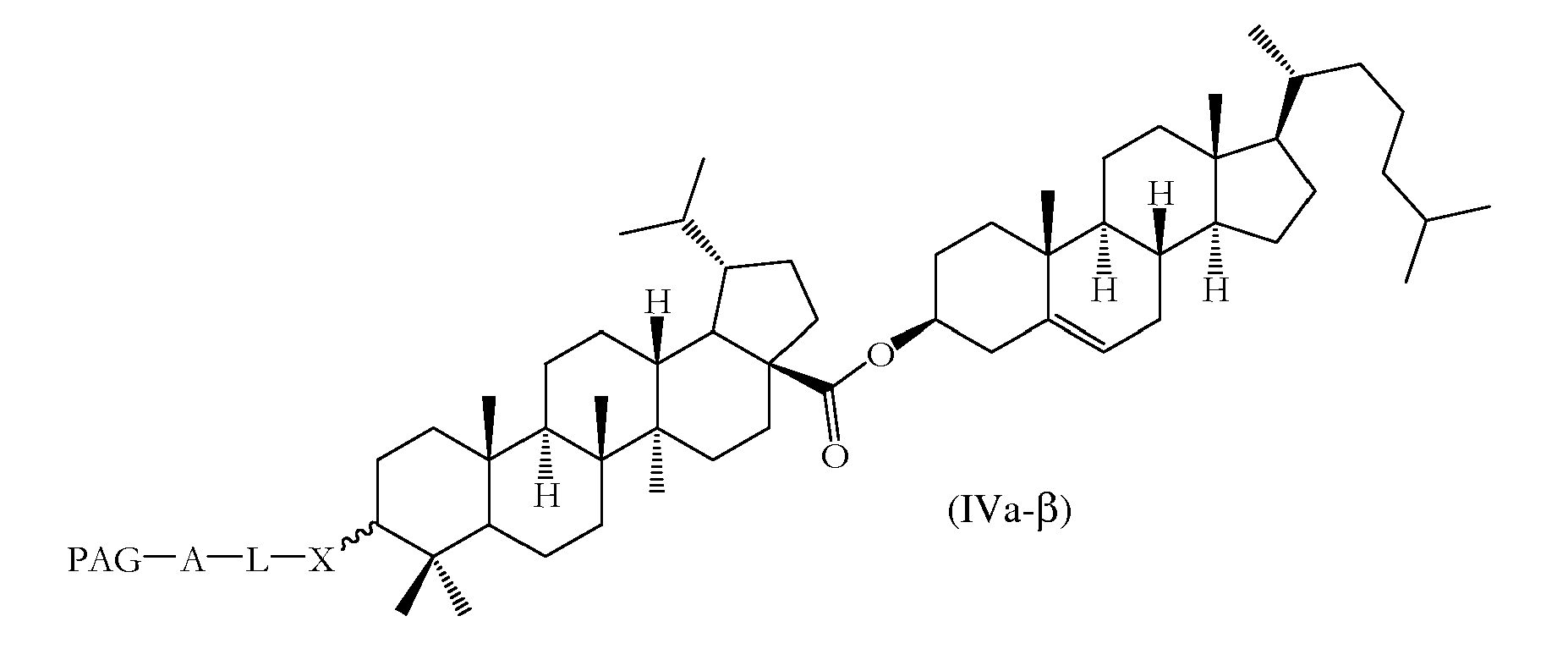
- the steroid alcohol moiety is a cholesteryl moiety, in which case the compound has the structure (IIIa- ⁇ ), IIIa- ⁇ ), (IVa- ⁇ ) or (IVa- ⁇ ): or or or or or
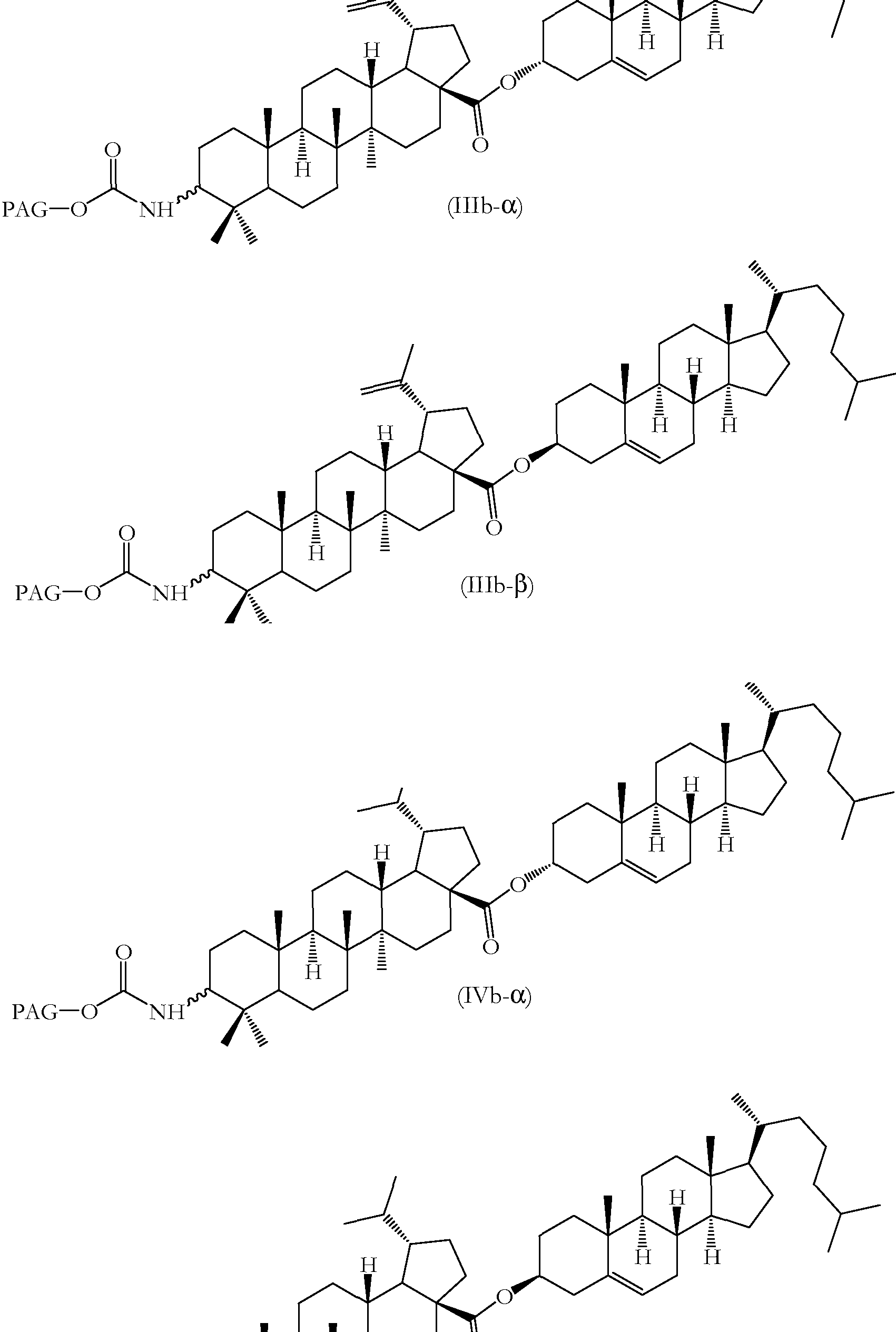
- the compound has the structure (IIIb- ⁇ ), (IIIb- ⁇ ), (IVb- ⁇ ), (IVb- ⁇ ), (IIIc- ⁇ ), (IIIc- ⁇ ), (IVc- ⁇ ) or (IVc- ⁇ ): or or or or or or or or or or or
- R is a steroid hormone moiety.
- the steroid hormone moiety is an estrogen moiety such as an estradiol moiety, a progestogen moiety such as a progesterone moiety, an androgen moiety such as a testosterone moiety, or a dehydroepiandrosterone moiety.
- X is NH. In another embodiment, X is O. In yet another embodiment, X is S. Preferably X is NH.
- L is a bond.
- L a linker.
- the linker may be derived from a diamine (such as ornithine) or an amino acid (such as lysine, glycine or ornithine).
- the linker may be, or form part of a peptide, an ester or a carbonate.
- a hydroxyl end-group of the PAG polymer may be converted into a reactive functional group.
- the group A is the remainder, if any, of such a reactive functional group. If a preferred activated PAG is used, the PAG carbamate shown in Scheme 1 above, then A is -O-CO-.
- the poly(alkylene glycol) is poly(ethylene glycol), such as monomethoxy poly(ethylene glycol).
- the -A-L- moiety is an alkyl, group, which may optionally be substituted, which may optionally include one or more heteroatoms N, O or S in its carbon skeleton, and which may optionally include one or more -CO- groups in its carbon skeleton.
- the -A-L-moiety is an unsubstituted alkyl, group, which optionally includes one or more heteroatoms N, O or S in its carbon skeleton, and which optionally includes one or more -CO- groups in its carbon skeleton.
- the -A-L- moiety is an unsubstituted alkyl group, which optionally includes one or more heteroatoms N or O in its carbon skeleton, and which optionally includes one or more -CO- groups in its carbon skeleton.
- the -A-L- moiety is an unsubstituted alkyl group, which includes 0, 1, 2, 3 or 4 nitrogen atoms, and 0, 1, 2, 3 or 4 oxygen atoms, and 0, 1, 2, 3 or 4 -CO- groups in its carbon skeleton.
- Preferred PAG-A-L-X- moieties are:
- PAG-A-L-X- moieties are: wherein PAG and X are as defined above.
- the compounds of the first and second aspect of the present invention may be used in medicine, preferably as an anticancer agent or an antiviral agent.
- the compounds of the first and second aspect of the present invention are generally non-toxic to non-cancerous cells, whilst being cytotoxic to a wide range of cancer cells.
- the anticancer agent of the present invention can be used in, for example, the treatment of brain cancer, colon cancer, liver cancer, ovarian cancer, breast cancer, skin cancer, lung cancer, prostate cancer, neuroblastoma, fibrosarcoma or leukaemia.
- the anticancer agent of the present invention can be used in the treatment of hormonally dependent cancers, such as ovarian cancer, breast cancer or prostate cancer.
- the antiviral agent of the present invention can be used in, for example, the treatment of HIV-1, HIV-2, HSV-1, HSV-2 or influenza infection.
- C-3 PAG-modified compounds are water soluble. This is advantageous, because it facilitates the administration of the compounds to patients.
- the present invention provides a pharmaceutical composition
- a pharmaceutical composition comprising a compound of the present invention and a pharmaceutically acceptable carrier or diluent.
- the pharmaceutical composition of the present invention may comprise PEG-albumin or a liposome.
- PEG-albumin can be prepared from bovine serum albumin or human serum albumin.
- PEG-albumin can be prepared by the pegylation methods described above in relation to the compounds of the present invention. Again, a preferred pegylation method activates the PAG using phosgene (Cl 2 CO) or 1,1'-carbonyldiimidazole (CDI) followed by 4-dimethylaminopyridine (DMAP) (see Scheme 1 above).
- An alternative preferred pegylation method activates a PAG carboxylic acid using Mukaiyama's reagent (2-chloro-1-methylpyridinium iodide, CMPI) (see Scheme 2 above).
- the present invention provides a use of a compound of the present invention in the manufacture of a medicament, preferably for the treatment of cancer or for the treatment of a viral infection.
- the medicament of the present invention can be used in, for example, the treatment of HIV-1, HIV-2, HSV-1, HSV-2 or influenza infection.
- the subject is a mammal, more preferably a human.
- the medicament of the present invention can also be used in, for example, the treatment of brain cancer, colon cancer, liver cancer, ovarian cancer, breast cancer, skin cancer, lung cancer, prostate cancer, neuroblastoma, fibrosarcoma or leukaemia.
- R is a steroid hormone moiety or a steroid hormone metabolite moiety
- the medicament of the present invention can be used in the treatment of hormonally dependent cancers, such as ovarian cancer, breast cancer or prostate cancer.
- composition or medicament according to the present invention can be administered by oral, parental (including intravenous, subcutaneous, intramuscular, intradermal, intratracheal, intraperitoneal, intraarticular and intraabdominal), transdermal, airway (aerosol), rectal, vaginal or topical (including buccal, mucosal and sublingual) administration.
- parental including intravenous, subcutaneous, intramuscular, intradermal, intratracheal, intraperitoneal, intraarticular and intraabdominal
- transdermal airway (aerosol)
- rectal including buccal, mucosal and sublingual) administration.
- the compounds of the invention will generally be provided in the form of tablets, capsules, hard or soft gelatine capsules, caplets, troches or lozenges, as a powder or granules, or as an aqueous solution, suspension or dispersion.
- Tablets for oral use may include the active ingredient mixed with pharmaceutically acceptable excipients such as inert diluents, disintegrating agents, binding agents, lubricating agents, sweetening agents, flavouring agents, colouring agents and preservatives. If desired, the tablets may be coated.
- pharmaceutically acceptable excipients such as inert diluents, disintegrating agents, binding agents, lubricating agents, sweetening agents, flavouring agents, colouring agents and preservatives. If desired, the tablets may be coated.
- Capsules for oral use include hard gelatine capsules in which the active ingredient is mixed with a solid diluent, and soft gelatine capsules wherein the active ingredient is mixed with water or an oil.
- Formulations for rectal administration may be presented as a suppository with a suitable base.
- Formulations suitable for vaginal administration may be presented as pessaries, tampons, creams, gels, pastes, foams or spray formulations containing in addition to the active ingredient such carriers as are known in the art to be appropriate.
- the compounds of the present invention will generally be provided in a sterile aqueous solution or suspension, buffered to an appropriate pH and isotonicity.
- Suitable aqueous vehicles include Ringer's solution and isotonic sodium chloride or glucose.
- Aqueous suspensions according to the invention may include suspending agents, wetting agents and preservatives.
- the compounds of the invention may also be presented as liposome formulations.
- the compounds of the invention will generally be provided in the form of ointments, cataplasms (poultices), pastes, powders, dressings, creams, plasters or patches.
- Suitable suspensions and solutions can be used in inhalers for airway (aerosol) administration.
- a suitable dose will be in the range of 0.01 to 10 mg per kilogram body weight of the recipient per day, preferably in the range of 0.1 to 5 mg per kilogram body weight per day.
- the desired dose is preferably presented once a day, but may be dosed as two, three, four, five, six or more sub-doses administered at appropriate intervals throughout the day. These sub-doses may be administered in unit dosage forms, for example, containing 1 to 1500 mg, preferably 10 to 1000 mg, and most preferably 20 to 500 mg of active ingredient per unit dosage form.
- the present invention provides a process for the preparation of a compound of the first or second aspect of the present invention, comprising the step of esterifying the C-28 carboxylic acid of betulonic acid or of a PAG-substituted betulinic acid derivative.
- the esterification may be carried out using triphenylphosphine and diethyl azodicarboxylate (DEAD) in a (Mitsunobu reaction, for example to prepare a cholesteryl or farnesyl ester.
- the esterification may be carried out using a base such as DBU in a nucleophilic substitution reaction.
- the betulonic acid may be obtained by oxidising betulin.
- the oxidation may be carried out using chromium trioxide and sulphuric acid as patented in 1998 by Pezzuto et al. (US 5 804 575 ) and modified in 2002 by N.I. Petrenko et al. (Chemistry of Natural Compounds, 38. 331-339 ).
- the process of the present invention may further comprise the steps of reducing the C-3 ketone of betulonic acid or a derivative thereof to an alcohol, amine or thiol functionality, and PAG-modifying the C-3 alcohol, amine or thiol functionality.
- the esterification of the C-28 carboxylic acid may be carried out before or after any of steps of oxidising betulin to betulonic acid, reducing the C-3 ketone of betulonic acid or a derivative thereof to an alcohol, amine or thiol functionality, and PAG-modifying the C-3 alcohol, amine or thiol functionality.
- an advantage of the process of the present invention is that it and any of its steps can be carried out on an industrial scale and in high yield.
- the term "industrial scale” means that the product of a reaction is obtained in batches of 1g, 20g, 50g, 100g, 500g, 1kg, 5kg, 10kg, 25kg or more.
- the term "high yield” means that the product of a reaction is obtained in a yield of 50%, 60%, 70%, 80%, 90% or more relative to the starting material.
- the present invention provides a use of a compound of the present invention for the preparation of a derivative, wherein the ketone functionality of the compound of the present invention is reduced to an alcohol functionality.
- the reduction may be carried out using NaBH 4 or M + BHR 3 - , wherein M + is Na + , Li + or K + , and R is independently a C 1-4 alkyl group, for example, s-butyl.
- the present invention provides a process for the preparation of a compound of the second aspect of the present invention, comprising the step of reducing the ketone functionality of a compound of the first aspect of the present invention to an alcohol functionality.
- the reduction may be carried out using NaBH 4 or M + BHR 3 - , wherein M + is Na + , Li + or K + , and R is independently a C 1-4 alkyl, group, for example, s-butyl.
- Example 7 synthesis of ⁇ -cholesteryl 3 ⁇ -(methoxypolyethylene glycol acetoxy)-lup-20(29)-en-28-oate 4a- ⁇ (via CMPI ester methodology)
- Example 8 synthesis of acetoxymethyl 3 ⁇ -(methoxypolyethylene glycol acetoxy)-lup-20(29)-en-28-oate 4c- ⁇ (via CMPI ester methodology)
- Example 14 synthesis of ⁇ -cholesteryl 3 ⁇ -(methoxypolyethylene glycol acetoxy)-lupan-28-oate 8a- ⁇
- Example 16 synthesis of ⁇ -cholesterol betulonate conjugated to mPEG (via DMAP carbamate methodology)
- ⁇ -Cholesteryl betulonate 2a can be reduced to ⁇ -cholesteryl betulinate 3a- ⁇ / ⁇ using, for example, sodium borohydride or M + BHR 3 - , wherein M + is Na + , Li + or K + , and R is independently a C 1-4 alkyl group such as s-butyl.
- M + is Na + , Li + or K +
- R is independently a C 1-4 alkyl group such as s-butyl.
- the hydroxyl group of ⁇ -cholesteryl betulinate 3a- ⁇ / ⁇ can then be converted into an azide group using sodium azide or (PhO) 2 -PO-N 3 or tosyl chloride followed by sodium azide.
- the azide group can be reduced to an amino group, which can then be coupled to mPEG using, for example, an mPEG carbamate.
- reaction conditions described such as reagents, solvents and temperatures, above and/or below an arrow in a graphical representation
- reaction conditions in particular solvents and temperatures, are not essential to the reaction being carried out and may be varied.
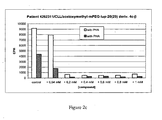
- PHA a lectin named phytoagglutine, which is a mitogen activating living cells
- PHA acts as a stimulating agent. All human lymphocytes have receptors for this type of lectin and all human lymphocytes undergo lymphoblastic transformation when stimulated by PHA
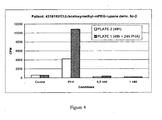
- CPM stands for counts per minute and measures the disintegration of the tritiated 3 H-thymidine. Thus, CPM reflects the radioactivity of the cells' DNA having incorporated the tritiated 3 H-thymidine after mitosis.
- test compound 4c- ⁇ were killed within 48 hours, their death being measured by CPM after addition of tritiated 3 H-thymidine, which is not incorporated into the cells' DNA, because the cells were unable to perform mitosis. As can be seen from the plate 1 experiments, the cells could no longer be activated by PHA.
- the lymphocytes of one patient (4308840) suffering from chronic lymphoid leukaemia were used in cell cultures.
- a multi-well plate was prepared, comprising 10° cells/well in a total volume of 1.5 ml.
- Cells, RPMI (cell growth medium), PHA and test compound 4a- ⁇ were added in accordance with table 3 (all experiments were triplicated).
- 125 ⁇ l 0.5 mM
- 250 ⁇ l 1 mM.
- the cells contacted with 0.5 mM and 1 mM of test compound 4a- ⁇ could not be activated by addition of PHA after 48 hours.
- cells contacted with 0.5 mM and 1 mM of the test compound were killed within 48 hours.
- the cells not in contact with the test compound (positive control in well 2) reacted to the addition of further PHA after 48 hours, showing that the cells were still alive.
- the lymphocytes of one patient (4316182) suffering from chronic lymphoid leukaemia were used in cell cultures.
- test compounds 8c- ⁇ killed the cells, they were unable to be reactivated by the addition of PHA. Only the cells, which were not in contact with the test compound, were still alive and could be reactivated with PHA.
- a multi-well plate was prepared per volunteer, each comprising 0.5 x 10 6 cells/well in a total volume of 1.5 ml.
- Cells, RPMI (cell growth medium), PHA, lipase and test compound 4a- ⁇ were added in accordance with table 5 (all experiments were triplicated).
- test compound 4a- ⁇ had no lethal effect on normal lymphocytes, since they remained alive even after 48 hours in contact with the test compound. The cells reacted positively to the addition of PHA, they remained thus alive.
Landscapes
- Health & Medical Sciences (AREA)
- Chemical & Material Sciences (AREA)
- Organic Chemistry (AREA)
- General Health & Medical Sciences (AREA)
- Life Sciences & Earth Sciences (AREA)
- Nuclear Medicine, Radiotherapy & Molecular Imaging (AREA)
- Veterinary Medicine (AREA)
- Pharmacology & Pharmacy (AREA)
- General Chemical & Material Sciences (AREA)
- Animal Behavior & Ethology (AREA)
- Chemical Kinetics & Catalysis (AREA)
- Public Health (AREA)
- Medicinal Chemistry (AREA)
- Oncology (AREA)
- Hematology (AREA)
- Virology (AREA)
- Communicable Diseases (AREA)
- Pharmaceuticals Containing Other Organic And Inorganic Compounds (AREA)
- Medicines That Contain Protein Lipid Enzymes And Other Medicines (AREA)
- Saccharide Compounds (AREA)
- Steroid Compounds (AREA)
Claims (18)
- Un composé ayant la structure (I), (II) ou (2b) :

R est un groupe alkyle, alcényle, alcynyle, aryle, arylalkyle, arylalcényle, arylalcynyle, alkylaryle, alcénylaryle ou alcynylaryle, qui peut optionnellement contenir un ou plusieurs hétéroatomes N, O ou S dans sa structure carbonée, et qui peut optionnellement inclure un ou plusieurs groupes - CO - dans sa structure carbonée, à condition que R comprenne un système cyclique condensé dans lequel le système cyclique condensé possède une structure stérane telle que présentée ci-dessous :
R et/ou le système cyclique condensé peut optionnellement être substitué par un ou plusieurs -F, - Cl, -Br, - I, -CF3, -CCl3, -CBr3, -CI3, -OH, -SH, -NH2, -CN, -NO2, -COOH, -R1-O-R2 -R1-S-R2 -R1-SO-R2 -R1-SO2-R2, -R1-SO2-OR 2, - R1O-SO2-R2, -R1-SO2-N(R2)2, -R1-NR2-SO2-R2, -R1O-SO2-OR2, -R1O-SO2-N(R2)2, -R1-NR2-SO2-OR2, -R1-NR2-SO2-N(R2)2, -R1-N(R2)2, -R1-N(R2)3 +, -R1-P(R2)2, -R1-Si(R2)3, -R1-CO-R2, -R1-CO-OR2, -R1O-CO-R2, -R1-CO-N(R2)2, -R1-NR2-CO-R2, - R1O-CO-OR2, -R1O-CO-N(R2)2, -R1-NR2-CO-OR2, -R1-NR2-CO-N(R2)2, -R1-CS-R2, -R1- CS-OR2, -R1O-CS-R2, -R1-CS-N(R2)2, -R1-NR2-CS-R2, -R1O-CS-OR2, -R1O-CS-N(R2)2, - R1-NR2-CS-OR2, -R1-NR2-CS-N(R2)2 or -R2;- R1- est indépendamment une liaison chimique, un C1-10 alkylène, C1-10 alkénylène ou un groupe C1-10 alkynylène ;- R2- est indépendamment hydrogène, C1-6 alkyl non substitué, C1-6 alkényl non substitué, C1-6 alkynyl ou C6-10 aryl non substitué ; et
tout alkyl, alkényl ou groupe alkynyl qui peut être en chaîne linéaire ou branchée, ou être ou incluant un ou plusieurs groupes cycliques. - Un composé ayant la structure (V), (VI) ou (2b-i) :


X est O, NH ou S ;
R est un groupe alkyl, alkényl, alkynyl, aryl, arylalkyl, arylalkényl, arylalkynyl, alkylaryl, alkénylaryl ou alkynylaryl, qui peut optionnellement contenir un ou plusieurs hétéroatomes N, O ou S dans son squelette carboné, et qui peut optionnellement inclure un ou plusieurs groupes - CO- dans son squelette carboné, à condition que R comprenne un système cyclique fusionné, dans lequel le système cyclique condensé possède une structure stérane telle que présentée ci-dessous:
R et/ou le système fusionné cyclique peut optionnellement être substitué par un ou plusieurs -F, -Cl, -Br, -I, -CF3, - CCl3, - CBr3, CI3, -OH, -SH, -NH2, -CN, -NO2, -COOH, -R1- O-R2, -R1-S-R2, -R1SO-R2, -R1-SO2-R2, -R1SO2-OR2, -R1-O-SO2-R2, -R1-SO2-N(R2)2, -R1-NR2-SO2-R2, -R1O-SO2-OR2, -R1O-SO2-N(R2)2, -R1-NR2-SO2-OR2, -R1-NR2-SO2-N(R2)2, - R1-N(R2)2, -R1-N(R2)3 +, -R1-P(R2)2, -R1-Si(R2)3, -R1-CO-R2, -R1-CO-OR2, -R1O-CO-R2, -R1-CO-N(R2)2, -R1-NR2-CO-R2, -R1O-CO-OR2, -R1O-CO-N(R2)2, -R1-NR2-CO-OR2, -R1-NR2-CO-N(R2)2, -R1-CS-R2, -R1-CS-OR2, -R1O-CS-R2, -R1-CS-N(R2)2, -R1-NR2-CS-R2, -R1O-CS-OR2, -R1O-CS-N(R2)2, -R1-NR2-CS-OR2, -R1-NR2-CS-N(R2)2 or -R2;- R1- est indépendamment une liaison chimique, un C1-10 alkylène, C1-10 alkénylène ou un groupe C1-10 alkynylène ;- R2- est indépendamment hydrogène, C1-6 alkyl non substitué, C1-6 alkényl non substitué, C1-6 alkynyl ou C6-10 aryl non substitué ; ettout alkyl, alkényl ou groupe alkynyl qui peut être en chaîne linéaire ou branchée, ou être ou incluant un ou plusieurs groupes cycliques. - Un composé tel que revendiqué dans les revendications 1 ou 2, dans lequel :(a) R est un résidu stéroïde alcool ; ou(b) R est un résidu cholestéryl ; ou(c) R est un résidu hormone stéroïde, ou(d) R est un résidu estrogène, un résidu progestogène ou un résidu androgène ; ou(e) R est un résidu estradiol, un résidu progestérone ou un résidu testostérone ; ou(f) R est un résidu déhydroépiandrostérone.
- Un composé tel que revendiqué dans la revendication 1, dans lequel le composé a la structure (1a-α), (1a-β), (IIa-α), (IIa -β) :


- Un dérivé du composé tel que décrit dans n'importe quelle revendication précédente, dans lequel :(a) un dérivé du composé est lié à un poly(alkylène glycol) ; ou(b) un dérivé du composé est lié à un poly(alkylène glycol) via un ligand ; ou(c) une fonction cétone dérivée du composé est liée à un poly(alkylène glycol) ; ou(d) une fonction cétone dérivée du composé est liée à un poly(alkylène glycol), dont la fonction cétone dérivée est une amine, un alcool ou un thiol ; ou(e) une fonction cétone dérivée du composé est liée à un poly(alkylène glycol) via un ligand ; ou(f) une fonction cétone dérivée du composé est liée à un poly(alkylène glycol) via un ligand, dans laquelle la fonction dérivée de la cétone est une amine, un alcool ou un thiol ; ou(g) une fonction cétone dérivée du composé est liée à un ligand, qui est à son tour lié à un poly(alkylène glycol) ; ou(h) une fonction cétone dérivée du composé est liée à un ligand, qui est à son tour lié à un poly(alkylène glycol), dont la fonction dérivée de la cétone est une amine, un alcool ou un thiol.
- Un composé tel que revendiqué en 5, dans lequel :(a) le ligand est une diamine ; ou(b) le ligand est l'ornithine ; ou(c) le poly(alkylène glycol) est poly(éthylène glycol) ; ou(d) le poly(alkylène glycol) est monométhoxy poly(éthylène glycol).
- Un composé ayant la structure (III), (IV) ou (2b-ii) :


X est NH, O ou S ;
L est une liaison ou un ligand ;
A est une liaison ou -O-CO- ;
PAG est un poly(alkylène glycol) ;
R est un alkyl, alkényl, alkynyl, aryl, arylalkyl, arylalkényl, arylalkynyl, alkylaryl, alkénylaryl ou un groupe alkynylaryl, qui peut optionnellement inclure un ou plusieurs hétéroatomes N, O ou S dans son squelette carboné, et qui peut optionnellement inclure un ou plusieurs groupes - CO- dans son squelette carboné, à condition que R comprenne un noyau fusionné, dans lequel le système cycle fusionné a une structure stérane telle que montrée :
R et/ou le système cycle fusionné peut être optionnellement substitué par un ou plusieurs -F, - Cl, -Br, - I, -CF3, -CCl3, -CBr3, -CI3, -OH, -SH, -NH2, -CN, -NO2, -COOH, - R1-O-R2, -R1-S-R2, -R1-SO-R2, -R1-SO2-R2, -R1-SO2-OR2, -R1O-SO2-R2, -R1-SO2-N(R2)2, - R1-NR2-SO2-R2, -R1O-SO2-OR2, -R1O-SO2-N(R2)2, -R1-NR2-SO2-OR2, -R1-NR2-SO2-N(R2)2, -R1N(R2)2, -R1-N(R2)3 +, -R1P(R2)2, -R1-Si(R2)3, -R1-CO-R2, -R1-CO-OR2, -R1O-CO-R2, -R1-CO-N(R2)2, -R1-NR2-CO-R2, -R1O-CO-OR2, -R1O-CO-N(R2)2, -R1-NR2-CO-OR2, -R1-NR2-CO-N(R2)2, -R1-CS-R2, -R1-CS-OR2, -R1O-CS-R2, -R1-CS-N(R2)2, -R1-NR2-CS-R2, -R1O-CS-OR2, -R1O-CS-N(R2)2, -R1-NR2-CS-OR2, -R1-NR2-CS-N(R2)2 or -R2;- R1- est indépendamment une liaison chimique, un C1-10 alkylène, un groupe C1-10 alkénylène ou un groupe C1-10 alkynylène.- R2- est indépendamment hydrogène, non substitué C1-6 alkyl, non substitué C1-6 alkényl, non substitué C1-6 alkynyl ou non substitué C1-6 aryl ; etTout alkyl, groupe alkényl ou alkynyl en chaîne linéaire ou branchée, ou être ou inclure un ou plusieurs groupes cycliques. - Un composé tel que revendiqué en 7, dans lequel:(a) R est un résidu stéroïde alcool; ou(b) R est un résidu cholestéryl(c) R est un résidu hormone stéroïde, ou(d) R est un résidu estrogène, un résidu progestogène ou un résidu androgène ; ou(e) R est un résidu estradiol, un résidu progestérone ou un résidu testostérone ; ou(f) R est un résidu déhydroépiandrostérone
- Un composé tel que revendiqué en 7, dans lequel:(a) le composé a la structure (IIIa-α), (IIIa-β), (Iva-α) ou (Iva-β) ;


 (b) le composé a la structure (IIIb-α), (IIIb-β), (IVb-α) ou (IVb-β) ;
 (c) le composé a la structure (IIIc-α), (IIIc-β), (IVc-α) ou (IVc-β) ;
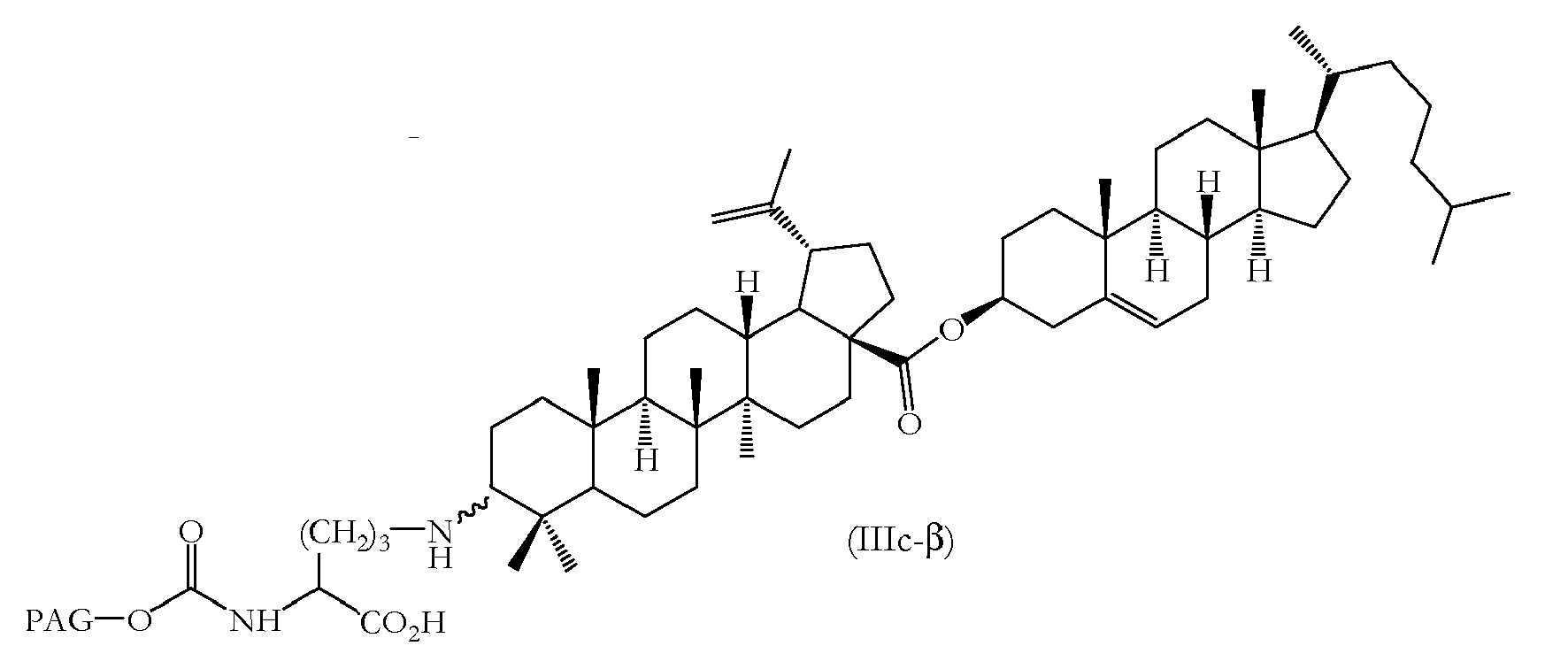


- Un composé tel que revendiqué dans n'importe quelles revendications 7 à 9, dans lequel :(a) L est une liaison, ou(b) L un ligand ; ou(c) L un ligand, dans lequel le ligand est dérivé d'une diamine ; ou(d) L un ligand, dans lequel le ligand est dérivé d'un acide aminé ; ou(e) L un ligand, dans lequel le ligand est dérivé d'une lysine, glycine ou ornithine ; ou(f) L un ligand, dans lequel le ligand est ou forme une partie d'un peptide, un ester ou un carbonate.
- Un composé tel que revendiqué dans n'importe quelles revendications 7 à 10, dans lequel :(a) le résidu PAG - A - L - X - est :
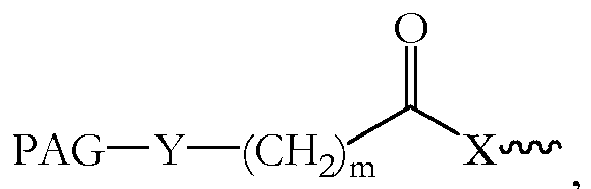 (b) le résidu PAG - A - L - X - est :
 (c) le résidu PAG - A - L - X - est :
 (d) le résidu PAG - A - L - X - est :
 (e) le résidu PAG - A - L - X - est :
 (f) le résidu PAG - A - L - X - est :
 (g) le résidu PAG - A - L - X - est :
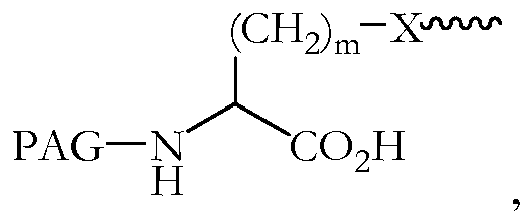 (h) le résidu PAG - A - L - X - est :
 (i) le résidu PAG - A - L - X - est :
 (j) le résidu PAG - A - L - X - est :
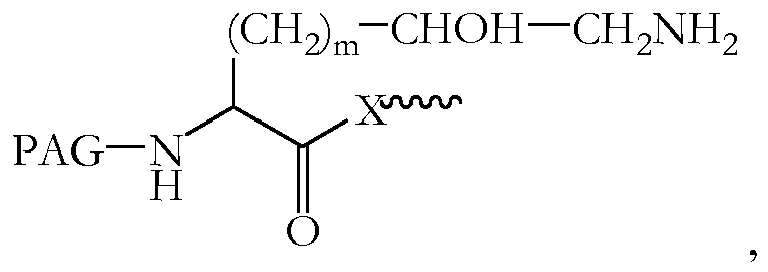 (k) le résidu PAG - A - L - X - est :
 (l) le résidu PAG - A - L - X - est :
 (m) le résidu PAG - A - L - X - est :dans lesquels PAG et X sont tels que définis plus haut.



- Un composé tel que revendiqué dans n'importe laquelle des revendications 7 à 11, dans lequel :a. le poly(alkylène glycol) est poly(éthylène glycol) ; oub. le poly(alkylène glycol) est monométhoxy poly(éthylène glycol).
- Un composé tel que revendiqué dans n'importe laquelle des revendications précédentes, pour l'usage :(a) en médecine ; ou(b) comme agent anti-cancer ; ou(c) comme un agent anti-cancer pour le traitement du cancer du cerveau, du cancer du colon, du cancer du foie, du cancer ovarien, du cancer du sein, du cancer de la peau, du cancer du poumon, du cancer de la prostate, des neuroblastomes, des fibrosarcomes ou des leucémies ; ou(d) comme agent antiviral ; ou(e) comme agent antiviral pour le traitement de HIV-1, HIV-2, HSV-1, HSV-2 ou infection influenza.
- Une composition pharmaceutique comprenant un composé tel que revendiqué dans n'importe laquelle des revendications précédentes et un transporteur ou diluant pharmaceutiquement acceptable, optionnellement comprenant en plus PEG-albumine ou un liposome.
- Utilisation d'un composé tel que revendiqué dans n'importe laquelle des revendications 1 à 12, dans la fabrication d'un médicament pour le traitement du :(a) cancer ; ou(b) cancer du cerveau, cancer du colon, du cancer du foie, du cancer ovarien, du cancer du sein, du cancer de la peau, du cancer du poumon, du cancer de la prostate, des neuroblastomes, des fibrosarcomes ou des leucémies ; ou(c) d'une infection virale ; ou(d) HIV-1, HIV-2, HSV-1, HSV-2 ou infection influenza.
- Un procédé pour la préparation d'un composé tel que revendiqué dans n'importe laquelle des revendications 1 à 13, comprenant l'étape d'estérification de l'acide carboxylique en C-28 de l'acide bétulonique ou d'un dérivé de l'acide bétulinique PAG-substitué, éventuellement dans lequel :(a) l'estérification est effectuée en utilisant triphénylphosphine et diéthylazodicarboxylate (DEAD) ; ou(b) l'estérification est effectuée en utilisant une base ; ou(c) l'estérification est effectuée en utilisant la base DBU ; ou(d) l'acide bétulonique est obtenu par oxydation de la bétuline ; ou(e) l'acide bétulonique est obtenu par oxydation de la bétuline en utilisant le chrome trioxyde et l'acide sulphurique.
- L'utilisation d'un composé tel que revendiqué dans n'importe laquelle des revendications 1 à 6, pour la préparation d'un dérivé, dans lequel :(a) la fonction cétone du composé tel que revendiqué dans la revendication 1, ou tel que revendiqué dans n'importe laquelle des revendications 3 à 6 lorsque dépendante de la revendication 1, est réduite en fonction alcool ; ou(b) la fonction cétone du composé tel que revendiqué dans la revendication 1, ou tel que revendiqué dans n'importe laquelle des revendications 3 à 6 lorsque dépendante de la revendication 1, est réduite en fonction alcool en utilisant NaBH4 ou M+ BHR3 -, dans lequel M+ est Na+, Li+ ou K+, et R est indépendamment un groupe C1-4 alkyl ; ou(c) la fonction cétone du composé tel que revendiqué dans la revendication 1, ou tel que revendiqué dans n'importe laquelle des revendications 3 à 6 lorsque dépendante de la revendication 1, est réduite en fonction alcool en utilisant NaBH4 ou M+ BHR3 -, dans lequel M+ est Na+, Li+ ou K+, et R est s-butyl.
- Un procédé pour la préparation d'un composé tel que revendiqué dans n'importe laquelle des revendications 7 à 13, comprenant l'étape de réduction de la fonction cétone d'un composé tel que revendiqué dans la revendication 1, ou tel que revendiqué dans n'importe laquelle des revendications 3 à 6 lorsque dépendante de la revendication 1, en fonction alcool, éventuellement dans lequel la réduction est effectuée en utilisant :(a) NaBH4 ou M+ BHR3 -, dans lequel M+ est Na+, Li+ ou K+, et R est indépendamment un groupe C1-4 alkyl ; ou(b) NaBH4 ou M+ BHR3 -, dans lequel M+ est Na+, Li+ ou K+, et R est s-butyl.
Applications Claiming Priority (2)
| Application Number | Priority Date | Filing Date | Title |
|---|---|---|---|
| GBGB0604535.5A GB0604535D0 (en) | 2006-03-07 | 2006-03-07 | Betulonic acid derivatives |
| PCT/EP2007/052154 WO2007101873A2 (fr) | 2006-03-07 | 2007-03-07 | Dérivés de l'acide bétulonique et de l'acide bétulinique |
Publications (2)
| Publication Number | Publication Date |
|---|---|
| EP1999139A2 EP1999139A2 (fr) | 2008-12-10 |
| EP1999139B1 true EP1999139B1 (fr) | 2014-08-20 |
Family
ID=36219262
Family Applications (1)
| Application Number | Title | Priority Date | Filing Date |
|---|---|---|---|
| EP07712472.5A Active EP1999139B1 (fr) | 2006-03-07 | 2007-03-07 | Esters de l'acide betulonique et ses derives polyalkyleneglycol pour le traitement d'infection virale et du cancer |
Country Status (6)
| Country | Link |
|---|---|
| US (2) | US8586569B2 (fr) |
| EP (1) | EP1999139B1 (fr) |
| DK (1) | DK1999139T3 (fr) |
| ES (1) | ES2524331T3 (fr) |
| GB (1) | GB0604535D0 (fr) |
| WO (1) | WO2007101873A2 (fr) |
Families Citing this family (34)
| Publication number | Priority date | Publication date | Assignee | Title |
|---|---|---|---|---|
| EP2260052A4 (fr) | 2008-02-26 | 2013-01-16 | Univ Emory | Analogues stéroïdiens utilisés en neuroprotection |
| KR100941595B1 (ko) | 2008-06-05 | 2010-02-11 | 주식회사 알앤엘바이오 | 바이러스 억제제로서 유용한 트리테르페노이드계 화합물 |
| CZ301158B6 (cs) * | 2008-09-01 | 2009-11-18 | Univerzita Karlova v Praze, Prírodovedecká fakulta | Deriváty triterpenoidu pro lécbu nádorových onemocnení a farmaceutická kompozice je obsahující |
| PL2335675T3 (pl) | 2009-12-10 | 2015-08-31 | Neubourg Skin Care Gmbh & Co Kg | Wolne od emulgatorów, stabilizowane polimerem formulacje pianki |
| US9238815B2 (en) | 2009-12-11 | 2016-01-19 | Icahn School of Medicine at Mounta Sinai | Compositions and methods for inhibiting human host factors required for influenza virus replication |
| US8435972B2 (en) * | 2010-09-02 | 2013-05-07 | Emory University | Method for the treatment of central nervous system cancers and compositions related thereto |
| CN102167720B (zh) * | 2011-03-11 | 2012-11-14 | 华东师范大学 | 抑制破骨细胞分化的桦木酮酸衍生物及其制备和应用 |
| US8633178B2 (en) | 2011-11-23 | 2014-01-21 | Therapeuticsmd, Inc. | Natural combination hormone replacement formulations and therapies |
| US9301920B2 (en) | 2012-06-18 | 2016-04-05 | Therapeuticsmd, Inc. | Natural combination hormone replacement formulations and therapies |
| US20150196640A1 (en) | 2012-06-18 | 2015-07-16 | Therapeuticsmd, Inc. | Progesterone formulations having a desirable pk profile |
| US10806740B2 (en) | 2012-06-18 | 2020-10-20 | Therapeuticsmd, Inc. | Natural combination hormone replacement formulations and therapies |
| US20130338122A1 (en) | 2012-06-18 | 2013-12-19 | Therapeuticsmd, Inc. | Transdermal hormone replacement therapies |
| US10806697B2 (en) | 2012-12-21 | 2020-10-20 | Therapeuticsmd, Inc. | Vaginal inserted estradiol pharmaceutical compositions and methods |
| WO2014071507A1 (fr) * | 2012-11-09 | 2014-05-15 | Bioniche Life Sciences Inc. | Compositions végétales et procédés et utilisations de celles-ci pour traiter des troubles associés à des niveaux de glucocorticoïdes élevés et l'anxiété |
| US9180091B2 (en) | 2012-12-21 | 2015-11-10 | Therapeuticsmd, Inc. | Soluble estradiol capsule for vaginal insertion |
| US10537581B2 (en) | 2012-12-21 | 2020-01-21 | Therapeuticsmd, Inc. | Vaginal inserted estradiol pharmaceutical compositions and methods |
| US11266661B2 (en) | 2012-12-21 | 2022-03-08 | Therapeuticsmd, Inc. | Vaginal inserted estradiol pharmaceutical compositions and methods |
| US10568891B2 (en) | 2012-12-21 | 2020-02-25 | Therapeuticsmd, Inc. | Vaginal inserted estradiol pharmaceutical compositions and methods |
| US10471072B2 (en) | 2012-12-21 | 2019-11-12 | Therapeuticsmd, Inc. | Vaginal inserted estradiol pharmaceutical compositions and methods |
| US11246875B2 (en) | 2012-12-21 | 2022-02-15 | Therapeuticsmd, Inc. | Vaginal inserted estradiol pharmaceutical compositions and methods |
| EP3145489A1 (fr) | 2014-05-22 | 2017-03-29 | TherapeuticsMD, Inc. | Formulations d'hormones substitutives combinées naturelles et traitement hormonal substitutif |
| US10328087B2 (en) | 2015-07-23 | 2019-06-25 | Therapeuticsmd, Inc. | Formulations for solubilizing hormones |
| WO2017173044A1 (fr) | 2016-04-01 | 2017-10-05 | Therapeuticsmd Inc. | Compositions d'hormones stéroïdes dans des huiles à chaîne moyenne |
| WO2017173071A1 (fr) | 2016-04-01 | 2017-10-05 | Therapeuticsmd, Inc. | Composition pharmaceutique d'hormone stéroïde |
| US10729735B1 (en) | 2016-09-14 | 2020-08-04 | Phoenix Biotechnology, Inc. | Method and compostitions for treating coronavirus infection |
| US10702567B2 (en) | 2016-09-14 | 2020-07-07 | Phoenix Biotechnology, Inc. | Method and compositions for treating viral infection |
| US10596186B2 (en) | 2016-09-14 | 2020-03-24 | Phoenix Biotechnology, Inc. | Method and compositions for treating viral infections |
| MX2020002884A (es) | 2017-09-14 | 2020-10-05 | Phoenix Biotechnology Inc | Método y composición neuroprotectora mejorada para tratar afecciones neurológicas. |
| CA3075729A1 (fr) | 2017-09-14 | 2019-03-21 | Phoenix Biotechnology, Inc. | Utilisation d'oleandrine pour traiter une infection virale |
| EP4295854A3 (fr) | 2020-03-31 | 2024-04-03 | Phoenix Biotechnology, Inc. | Méthode et compositions pour le traitement d'une infection à coronavirus |
| KR20220151038A (ko) | 2020-03-31 | 2022-11-11 | 피닉스 바이오테크놀러지 인코포레이티드. | 코로나바이러스 감염 예방를 위한 조성물 |
| US11806359B2 (en) | 2020-03-31 | 2023-11-07 | Phoenix Biotechnology, Inc. | Method and compositions for treating Coronavirus infection |
| US20240262860A1 (en) * | 2020-07-07 | 2024-08-08 | Shanghai Institute Of Materia Medica, Chinese Academy Of Sciences | Pentacyclic triterpenoid glycoside compound, and preparation method therefor and use thereof |
| CN114848652A (zh) * | 2022-05-31 | 2022-08-05 | 澳门大学 | 白桦脂醛在制备用于预防或治疗神经退行性疾病的药物中的应用 |
Family Cites Families (5)
| Publication number | Priority date | Publication date | Assignee | Title |
|---|---|---|---|---|
| US6403816B1 (en) * | 1997-09-30 | 2002-06-11 | Dabur Research Foundation | Betulinic acid derivatives having antiangiogenic activity, processes for producing such derivatives and their use for treating tumor associated angiogenesis |
| US6670345B1 (en) * | 1997-09-30 | 2003-12-30 | Dabur Research Foundation | Betulinic acid derivatives for inhabiting cancer growth and process for the manufacture of betulinic acid |
| WO2000046235A1 (fr) * | 1998-11-18 | 2000-08-10 | Dabur Research Foundation | Derives d'acide betulinique, procedes de preparations de tels derives et leurs utilisations comme inhibiteurs de developpement cancereux |
| ATE267837T1 (de) * | 1999-09-09 | 2004-06-15 | Dabur Res Foundation | Betulinsäure-derivate mit antiangiogener wirkung, verfahren zur herstellung solcher derivate und deren verwendung für die behandlung tumorassoziierter angiogenese |
| AU8494601A (en) * | 2000-08-18 | 2002-03-04 | Univ Illinois | Prodrugs of betulinic acid derivatives for the treatment of cancer and HIV |
-
2006
- 2006-03-07 GB GBGB0604535.5A patent/GB0604535D0/en not_active Ceased
-
2007
- 2007-03-07 DK DK07712472.5T patent/DK1999139T3/en active
- 2007-03-07 WO PCT/EP2007/052154 patent/WO2007101873A2/fr not_active Ceased
- 2007-03-07 ES ES07712472.5T patent/ES2524331T3/es active Active
- 2007-03-07 EP EP07712472.5A patent/EP1999139B1/fr active Active
-
2008
- 2008-09-04 US US12/204,354 patent/US8586569B2/en active Active
-
2013
- 2013-11-08 US US14/075,093 patent/US9303058B2/en active Active
Also Published As
| Publication number | Publication date |
|---|---|
| US9303058B2 (en) | 2016-04-05 |
| WO2007101873A2 (fr) | 2007-09-13 |
| GB0604535D0 (en) | 2006-04-12 |
| US20140066416A1 (en) | 2014-03-06 |
| US20090068257A1 (en) | 2009-03-12 |
| EP1999139A2 (fr) | 2008-12-10 |
| US8586569B2 (en) | 2013-11-19 |
| ES2524331T3 (es) | 2014-12-05 |
| DK1999139T3 (en) | 2014-12-01 |
| WO2007101873A3 (fr) | 2008-01-17 |
Similar Documents
| Publication | Publication Date | Title |
|---|---|---|
| EP1999139B1 (fr) | Esters de l'acide betulonique et ses derives polyalkyleneglycol pour le traitement d'infection virale et du cancer | |
| US5693769A (en) | Glycosylated steroid derivatives for transport across biological membranes and process for making and using same | |
| EP0618800B1 (fr) | Derives steroidiens glycosyles traversant des membranes biologiques et leur procede de production | |
| Gnoatto et al. | Evaluation of ursolic acid isolated from Ilex paraguariensis and derivatives on aromatase inhibition | |
| CA2418479C (fr) | Promedicaments de derives de l'acide betulinique pour le traitement du cancer et du vih | |
| EP0417725B1 (fr) | Dérivés des acides biliorés, leur procédé de préparation et leur usage comme médicaments | |
| EP0573848B1 (fr) | Dérivés d'acides biliaires, procédé de leur préparation et leur utilisation comme médicaments | |
| US20070232577A1 (en) | Synthetic pentacyclic triterpenoids and derivatives of betulinic acid and betulin | |
| RU2111212C1 (ru) | 22r- или 22s-эпимеры соединения, способ их получения, фармацевтическая композиция и способ лечения аллергических и воспалительных заболеваний | |
| CA2274779A1 (fr) | Composes aminosterol-esters | |
| US5627270A (en) | Glycosylated steroid derivatives for transport across biological membranes and process for making and using same | |
| JP3333210B2 (ja) | 新規プレドニソロン誘導体および該化合物を含有する薬剤 | |
| CZ289515B6 (cs) | Tetrazolové deriváty ľlučových kyselin a léčivo tyto deriváty obsahující | |
| Wang et al. | Semi-synthesis and anti-tumor evaluation of novel 25-hydroxyprotopanaxadiol derivatives | |
| CA2385096A1 (fr) | Conjugues d'estradiol et leurs utilisations | |
| JP2636208B2 (ja) | ステロイド性グリコシドおよびその使用 | |
| US20130005696A1 (en) | Bufadienolide derivatives, preparing process thereof, composition comprising the same and the use thereof | |
| CA2171740C (fr) | Derives de 1,3,5(10)-estratriene, actifs par voie orale | |
| Černá et al. | Oxime derivatives of betulonic acid and platanic acid as novel cytotoxic or antiviral agents | |
| CN116715706B (zh) | 一种延长茶氨酸体内半衰期的化学修饰方法 | |
| CN113956323B (zh) | 一种四环三萜衍生物及其制备方法和应用 | |
| CN119462816A (zh) | 具有抗肿瘤活性的海柯皂苷元衍生物及其制备方法和应用 | |
| AU781303B2 (en) | Estradiol conjugates and uses thereof | |
| CN117088772A (zh) | 一种甜菊醇衍生物及其制备方法和应用 | |
| CN114163491A (zh) | 一种乙酰化原人参二醇环内酯和乙酰化原人参三醇环内酯及其制备 |
Legal Events
| Date | Code | Title | Description |
|---|---|---|---|
| PUAI | Public reference made under article 153(3) epc to a published international application that has entered the european phase |
Free format text: ORIGINAL CODE: 0009012 |
|
| 17P | Request for examination filed |
Effective date: 20080910 |
|
| AK | Designated contracting states |
Kind code of ref document: A2 Designated state(s): AT BE BG CH CY CZ DE DK EE ES FI FR GB GR HU IE IS IT LI LT LU LV MC MT NL PL PT RO SE SI SK TR |
|
| DAX | Request for extension of the european patent (deleted) | ||
| 17Q | First examination report despatched |
Effective date: 20100614 |
|
| RAP1 | Party data changed (applicant data changed or rights of an application transferred) |
Owner name: LEUNIS, JEAN-CLAUDE |
|
| RIN1 | Information on inventor provided before grant (corrected) |
Inventor name: LEUNIS, JEAN-CLAUDE Inventor name: COUCHE, EMMANUEL |
|
| GRAP | Despatch of communication of intention to grant a patent |
Free format text: ORIGINAL CODE: EPIDOSNIGR1 |
|
| RIN1 | Information on inventor provided before grant (corrected) |
Inventor name: COUCHE, EMMANUEL Inventor name: LEUNIS, JEAN-CLAUDE |
|
| GRAP | Despatch of communication of intention to grant a patent |
Free format text: ORIGINAL CODE: EPIDOSNIGR1 |
|
| INTG | Intention to grant announced |
Effective date: 20140224 |
|
| GRAS | Grant fee paid |
Free format text: ORIGINAL CODE: EPIDOSNIGR3 |
|
| GRAA | (expected) grant |
Free format text: ORIGINAL CODE: 0009210 |
|
| AK | Designated contracting states |
Kind code of ref document: B1 Designated state(s): AT BE BG CH CY CZ DE DK EE ES FI FR GB GR HU IE IS IT LI LT LU LV MC MT NL PL PT RO SE SI SK TR |
|
| REG | Reference to a national code |
Ref country code: GB Ref legal event code: FG4D |
|
| RIN1 | Information on inventor provided before grant (corrected) |
Inventor name: LEUNIS, JEAN-CLAUDE Inventor name: COUCHE, EMMANUEL |
|
| REG | Reference to a national code |
Ref country code: CH Ref legal event code: EP |
|
| REG | Reference to a national code |
Ref country code: AT Ref legal event code: REF Ref document number: 683422 Country of ref document: AT Kind code of ref document: T Effective date: 20140915 |
|
| REG | Reference to a national code |
Ref country code: IE Ref legal event code: FG4D |
|
| REG | Reference to a national code |
Ref country code: DE Ref legal event code: R096 Ref document number: 602007038198 Country of ref document: DE Effective date: 20141002 |
|
| REG | Reference to a national code |
Ref country code: CH Ref legal event code: NV Representative=s name: MICHELI AND CIE SA, CH |
|
| REG | Reference to a national code |
Ref country code: DK Ref legal event code: T3 Effective date: 20141126 |
|
| REG | Reference to a national code |
Ref country code: ES Ref legal event code: FG2A Ref document number: 2524331 Country of ref document: ES Kind code of ref document: T3 Effective date: 20141205 |
|
| REG | Reference to a national code |
Ref country code: SE Ref legal event code: TRGR |
|
| REG | Reference to a national code |
Ref country code: NL Ref legal event code: T3 |
|
| REG | Reference to a national code |
Ref country code: LT Ref legal event code: MG4D |
|
| PG25 | Lapsed in a contracting state [announced via postgrant information from national office to epo] |
Ref country code: LT Free format text: LAPSE BECAUSE OF FAILURE TO SUBMIT A TRANSLATION OF THE DESCRIPTION OR TO PAY THE FEE WITHIN THE PRESCRIBED TIME-LIMIT Effective date: 20140820 Ref country code: BG Free format text: LAPSE BECAUSE OF FAILURE TO SUBMIT A TRANSLATION OF THE DESCRIPTION OR TO PAY THE FEE WITHIN THE PRESCRIBED TIME-LIMIT Effective date: 20141120 Ref country code: PT Free format text: LAPSE BECAUSE OF FAILURE TO SUBMIT A TRANSLATION OF THE DESCRIPTION OR TO PAY THE FEE WITHIN THE PRESCRIBED TIME-LIMIT Effective date: 20141222 Ref country code: FI Free format text: LAPSE BECAUSE OF FAILURE TO SUBMIT A TRANSLATION OF THE DESCRIPTION OR TO PAY THE FEE WITHIN THE PRESCRIBED TIME-LIMIT Effective date: 20140820 Ref country code: GR Free format text: LAPSE BECAUSE OF FAILURE TO SUBMIT A TRANSLATION OF THE DESCRIPTION OR TO PAY THE FEE WITHIN THE PRESCRIBED TIME-LIMIT Effective date: 20141121 |
|
| PG25 | Lapsed in a contracting state [announced via postgrant information from national office to epo] |
Ref country code: LV Free format text: LAPSE BECAUSE OF FAILURE TO SUBMIT A TRANSLATION OF THE DESCRIPTION OR TO PAY THE FEE WITHIN THE PRESCRIBED TIME-LIMIT Effective date: 20140820 Ref country code: IS Free format text: LAPSE BECAUSE OF FAILURE TO SUBMIT A TRANSLATION OF THE DESCRIPTION OR TO PAY THE FEE WITHIN THE PRESCRIBED TIME-LIMIT Effective date: 20141220 |
|
| PG25 | Lapsed in a contracting state [announced via postgrant information from national office to epo] |
Ref country code: RO Free format text: LAPSE BECAUSE OF FAILURE TO SUBMIT A TRANSLATION OF THE DESCRIPTION OR TO PAY THE FEE WITHIN THE PRESCRIBED TIME-LIMIT Effective date: 20140820 Ref country code: EE Free format text: LAPSE BECAUSE OF FAILURE TO SUBMIT A TRANSLATION OF THE DESCRIPTION OR TO PAY THE FEE WITHIN THE PRESCRIBED TIME-LIMIT Effective date: 20140820 Ref country code: SK Free format text: LAPSE BECAUSE OF FAILURE TO SUBMIT A TRANSLATION OF THE DESCRIPTION OR TO PAY THE FEE WITHIN THE PRESCRIBED TIME-LIMIT Effective date: 20140820 |
|
| REG | Reference to a national code |
Ref country code: DE Ref legal event code: R097 Ref document number: 602007038198 Country of ref document: DE |
|
| PG25 | Lapsed in a contracting state [announced via postgrant information from national office to epo] |
Ref country code: PL Free format text: LAPSE BECAUSE OF FAILURE TO SUBMIT A TRANSLATION OF THE DESCRIPTION OR TO PAY THE FEE WITHIN THE PRESCRIBED TIME-LIMIT Effective date: 20140820 |
|
| PLBE | No opposition filed within time limit |
Free format text: ORIGINAL CODE: 0009261 |
|
| STAA | Information on the status of an ep patent application or granted ep patent |
Free format text: STATUS: NO OPPOSITION FILED WITHIN TIME LIMIT |
|
| 26N | No opposition filed |
Effective date: 20150521 |
|
| PG25 | Lapsed in a contracting state [announced via postgrant information from national office to epo] |
Ref country code: MC Free format text: LAPSE BECAUSE OF FAILURE TO SUBMIT A TRANSLATION OF THE DESCRIPTION OR TO PAY THE FEE WITHIN THE PRESCRIBED TIME-LIMIT Effective date: 20140820 |
|
| PG25 | Lapsed in a contracting state [announced via postgrant information from national office to epo] |
Ref country code: SI Free format text: LAPSE BECAUSE OF FAILURE TO SUBMIT A TRANSLATION OF THE DESCRIPTION OR TO PAY THE FEE WITHIN THE PRESCRIBED TIME-LIMIT Effective date: 20140820 |
|
| REG | Reference to a national code |
Ref country code: HU Ref legal event code: AG4A Ref document number: E024052 Country of ref document: HU |
|
| REG | Reference to a national code |
Ref country code: FR Ref legal event code: PLFP Year of fee payment: 10 |
|
| PG25 | Lapsed in a contracting state [announced via postgrant information from national office to epo] |
Ref country code: MT Free format text: LAPSE BECAUSE OF FAILURE TO SUBMIT A TRANSLATION OF THE DESCRIPTION OR TO PAY THE FEE WITHIN THE PRESCRIBED TIME-LIMIT Effective date: 20140820 |
|
| REG | Reference to a national code |
Ref country code: FR Ref legal event code: PLFP Year of fee payment: 11 |
|
| PGFP | Annual fee paid to national office [announced via postgrant information from national office to epo] |
Ref country code: BG Payment date: 20170131 Year of fee payment: 13 Ref country code: IE Payment date: 20170331 Year of fee payment: 11 |
|
| PG25 | Lapsed in a contracting state [announced via postgrant information from national office to epo] |
Ref country code: CY Free format text: LAPSE BECAUSE OF FAILURE TO SUBMIT A TRANSLATION OF THE DESCRIPTION OR TO PAY THE FEE WITHIN THE PRESCRIBED TIME-LIMIT Effective date: 20140820 |
|
| PGFP | Annual fee paid to national office [announced via postgrant information from national office to epo] |
Ref country code: DK Payment date: 20170331 Year of fee payment: 11 |
|
| PG25 | Lapsed in a contracting state [announced via postgrant information from national office to epo] |
Ref country code: TR Free format text: LAPSE BECAUSE OF FAILURE TO SUBMIT A TRANSLATION OF THE DESCRIPTION OR TO PAY THE FEE WITHIN THE PRESCRIBED TIME-LIMIT Effective date: 20140820 |
|
| REG | Reference to a national code |
Ref country code: FR Ref legal event code: PLFP Year of fee payment: 12 |
|
| PGFP | Annual fee paid to national office [announced via postgrant information from national office to epo] |
Ref country code: NL Payment date: 20180329 Year of fee payment: 12 |
|
| PGFP | Annual fee paid to national office [announced via postgrant information from national office to epo] |
Ref country code: SE Payment date: 20180329 Year of fee payment: 12 |
|
| PGFP | Annual fee paid to national office [announced via postgrant information from national office to epo] |
Ref country code: HU Payment date: 20180413 Year of fee payment: 12 |
|
| REG | Reference to a national code |
Ref country code: DK Ref legal event code: EBP Effective date: 20180331 |
|
| PGFP | Annual fee paid to national office [announced via postgrant information from national office to epo] |
Ref country code: ES Payment date: 20180927 Year of fee payment: 12 |
|
| REG | Reference to a national code |
Ref country code: AT Ref legal event code: MM01 Ref document number: 683422 Country of ref document: AT Kind code of ref document: T Effective date: 20180307 |
|
| REG | Reference to a national code |
Ref country code: IE Ref legal event code: MM4A |
|
| PG25 | Lapsed in a contracting state [announced via postgrant information from national office to epo] |
Ref country code: AT Free format text: LAPSE BECAUSE OF NON-PAYMENT OF DUE FEES Effective date: 20180307 Ref country code: IE Free format text: LAPSE BECAUSE OF NON-PAYMENT OF DUE FEES Effective date: 20180307 |
|
| PG25 | Lapsed in a contracting state [announced via postgrant information from national office to epo] |
Ref country code: DK Free format text: LAPSE BECAUSE OF NON-PAYMENT OF DUE FEES Effective date: 20180331 |
|
| REG | Reference to a national code |
Ref country code: SE Ref legal event code: EUG |
|
| PG25 | Lapsed in a contracting state [announced via postgrant information from national office to epo] |
Ref country code: SE Free format text: LAPSE BECAUSE OF NON-PAYMENT OF DUE FEES Effective date: 20190308 |
|
| REG | Reference to a national code |
Ref country code: NL Ref legal event code: MM Effective date: 20190401 |
|
| PG25 | Lapsed in a contracting state [announced via postgrant information from national office to epo] |
Ref country code: HU Free format text: LAPSE BECAUSE OF NON-PAYMENT OF DUE FEES Effective date: 20190308 Ref country code: NL Free format text: LAPSE BECAUSE OF NON-PAYMENT OF DUE FEES Effective date: 20190401 |
|
| REG | Reference to a national code |
Ref country code: ES Ref legal event code: FD2A Effective date: 20200724 |
|
| REG | Reference to a national code |
Ref country code: DE Ref legal event code: R082 Ref document number: 602007038198 Country of ref document: DE Representative=s name: VENNER SHIPLEY GERMANY LLP, DE Ref country code: DE Ref legal event code: R082 Ref document number: 602007038198 Country of ref document: DE Representative=s name: VENNER SHIPLEY LLP, DE |
|
| PG25 | Lapsed in a contracting state [announced via postgrant information from national office to epo] |
Ref country code: ES Free format text: LAPSE BECAUSE OF NON-PAYMENT OF DUE FEES Effective date: 20190308 |
|
| PGFP | Annual fee paid to national office [announced via postgrant information from national office to epo] |
Ref country code: IT Payment date: 20250929 Year of fee payment: 19 Ref country code: LU Payment date: 20250930 Year of fee payment: 19 |
|
| PGFP | Annual fee paid to national office [announced via postgrant information from national office to epo] |
Ref country code: BE Payment date: 20250929 Year of fee payment: 19 Ref country code: GB Payment date: 20250922 Year of fee payment: 19 |
|
| PGFP | Annual fee paid to national office [announced via postgrant information from national office to epo] |
Ref country code: FR Payment date: 20250929 Year of fee payment: 19 |
|
| PGFP | Annual fee paid to national office [announced via postgrant information from national office to epo] |
Ref country code: CH Payment date: 20250924 Year of fee payment: 19 |
|
| PGFP | Annual fee paid to national office [announced via postgrant information from national office to epo] |
Ref country code: DE Payment date: 20250929 Year of fee payment: 19 |
|
| REG | Reference to a national code |
Ref country code: CH Ref legal event code: U11 Free format text: ST27 STATUS EVENT CODE: U-0-0-U10-U11 (AS PROVIDED BY THE NATIONAL OFFICE) Effective date: 20260410 |
|
| PGFP | Annual fee paid to national office [announced via postgrant information from national office to epo] |
Ref country code: CZ Payment date: 20260305 Year of fee payment: 20 |