EP1999314B1 - Verfahren zur herstellung von papier, pappe und karton mit hoher trockenfestigkeit - Google Patents
Verfahren zur herstellung von papier, pappe und karton mit hoher trockenfestigkeit Download PDFInfo
- Publication number
- EP1999314B1 EP1999314B1 EP07712497.2A EP07712497A EP1999314B1 EP 1999314 B1 EP1999314 B1 EP 1999314B1 EP 07712497 A EP07712497 A EP 07712497A EP 1999314 B1 EP1999314 B1 EP 1999314B1
- Authority
- EP
- European Patent Office
- Prior art keywords
- units
- cationic polymer
- process according
- acid
- paper
- Prior art date
- Legal status (The legal status is an assumption and is not a legal conclusion. Google has not performed a legal analysis and makes no representation as to the accuracy of the status listed.)
- Not-in-force
Links
- 239000000123 paper Substances 0.000 title claims description 59
- 238000004519 manufacturing process Methods 0.000 title claims description 18
- 239000011111 cardboard Substances 0.000 title claims description 6
- 239000011087 paperboard Substances 0.000 title description 5
- 239000000178 monomer Substances 0.000 claims description 46
- 229920000642 polymer Polymers 0.000 claims description 42
- UYMKPFRHYYNDTL-UHFFFAOYSA-N ethenamine Chemical group NC=C UYMKPFRHYYNDTL-UHFFFAOYSA-N 0.000 claims description 36
- 238000000034 method Methods 0.000 claims description 34
- ZQXSMRAEXCEDJD-UHFFFAOYSA-N n-ethenylformamide Chemical compound C=CNC=O ZQXSMRAEXCEDJD-UHFFFAOYSA-N 0.000 claims description 32
- 229920001732 Lignosulfonate Polymers 0.000 claims description 28
- 229920006317 cationic polymer Polymers 0.000 claims description 25
- 239000002253 acid Substances 0.000 claims description 24
- 229920001577 copolymer Polymers 0.000 claims description 23
- 150000001449 anionic compounds Chemical class 0.000 claims description 18
- 150000001875 compounds Chemical class 0.000 claims description 15
- 229910052783 alkali metal Inorganic materials 0.000 claims description 12
- 150000001340 alkali metals Chemical class 0.000 claims description 12
- 150000003863 ammonium salts Chemical class 0.000 claims description 12
- 229910052784 alkaline earth metal Inorganic materials 0.000 claims description 11
- 150000001342 alkaline earth metals Chemical class 0.000 claims description 11
- 238000007334 copolymerization reaction Methods 0.000 claims description 11
- 125000004051 hexyl group Chemical group [H]C([H])([H])C([H])([H])C([H])([H])C([H])([H])C([H])([H])C([H])([H])* 0.000 claims description 9
- 238000001035 drying Methods 0.000 claims description 7
- 229920001519 homopolymer Polymers 0.000 claims description 7
- 125000003277 amino group Chemical group 0.000 claims description 6
- 230000007062 hydrolysis Effects 0.000 claims description 6
- 238000006460 hydrolysis reaction Methods 0.000 claims description 6
- QGZKDVFQNNGYKY-UHFFFAOYSA-O Ammonium Chemical compound [NH4+] QGZKDVFQNNGYKY-UHFFFAOYSA-O 0.000 claims description 5
- 239000000654 additive Substances 0.000 claims description 5
- 230000000996 additive effect Effects 0.000 claims description 5
- 230000015572 biosynthetic process Effects 0.000 claims description 5
- 239000000203 mixture Substances 0.000 claims description 5
- DGAQECJNVWCQMB-PUAWFVPOSA-M Ilexoside XXIX Chemical compound C[C@@H]1CC[C@@]2(CC[C@@]3(C(=CC[C@H]4[C@]3(CC[C@@H]5[C@@]4(CC[C@@H](C5(C)C)OS(=O)(=O)[O-])C)C)[C@@H]2[C@]1(C)O)C)C(=O)O[C@H]6[C@@H]([C@H]([C@@H]([C@H](O6)CO)O)O)O.[Na+] DGAQECJNVWCQMB-PUAWFVPOSA-M 0.000 claims description 4
- 229910052708 sodium Inorganic materials 0.000 claims description 4
- 239000011734 sodium Substances 0.000 claims description 4
- ZLMJMSJWJFRBEC-UHFFFAOYSA-N Potassium Chemical compound [K] ZLMJMSJWJFRBEC-UHFFFAOYSA-N 0.000 claims description 3
- 238000006116 polymerization reaction Methods 0.000 claims description 3
- 229910052700 potassium Inorganic materials 0.000 claims description 3
- 239000011591 potassium Substances 0.000 claims description 3
- HRPVXLWXLXDGHG-UHFFFAOYSA-N Acrylamide Chemical group NC(=O)C=C HRPVXLWXLXDGHG-UHFFFAOYSA-N 0.000 claims description 2
- OYPRJOBELJOOCE-UHFFFAOYSA-N Calcium Chemical compound [Ca] OYPRJOBELJOOCE-UHFFFAOYSA-N 0.000 claims description 2
- 229910052791 calcium Inorganic materials 0.000 claims description 2
- 239000011575 calcium Substances 0.000 claims description 2
- 159000000003 magnesium salts Chemical class 0.000 claims description 2
- 230000008030 elimination Effects 0.000 claims 2
- 238000003379 elimination reaction Methods 0.000 claims 2
- FOGYNLXERPKEGN-UHFFFAOYSA-N 3-(2-hydroxy-3-methoxyphenyl)-2-[2-methoxy-4-(3-sulfopropyl)phenoxy]propane-1-sulfonic acid Chemical compound COC1=CC=CC(CC(CS(O)(=O)=O)OC=2C(=CC(CCCS(O)(=O)=O)=CC=2)OC)=C1O FOGYNLXERPKEGN-UHFFFAOYSA-N 0.000 description 14
- 125000002091 cationic group Chemical group 0.000 description 13
- 229920006318 anionic polymer Polymers 0.000 description 12
- NIXOWILDQLNWCW-UHFFFAOYSA-N 2-Propenoic acid Natural products OC(=O)C=C NIXOWILDQLNWCW-UHFFFAOYSA-N 0.000 description 10
- 239000000047 product Substances 0.000 description 9
- 125000000129 anionic group Chemical group 0.000 description 8
- SMZOUWXMTYCWNB-UHFFFAOYSA-N 2-(2-methoxy-5-methylphenyl)ethanamine Chemical compound COC1=CC=C(C)C=C1CCN SMZOUWXMTYCWNB-UHFFFAOYSA-N 0.000 description 7
- CERQOIWHTDAKMF-UHFFFAOYSA-N Methacrylic acid Chemical compound CC(=C)C(O)=O CERQOIWHTDAKMF-UHFFFAOYSA-N 0.000 description 7
- 229920001131 Pulp (paper) Polymers 0.000 description 7
- 239000000243 solution Substances 0.000 description 7
- 229910052799 carbon Inorganic materials 0.000 description 6
- 239000003795 chemical substances by application Substances 0.000 description 6
- 238000007792 addition Methods 0.000 description 5
- 229920005610 lignin Polymers 0.000 description 5
- -1 polyvinylamine Polymers 0.000 description 5
- 239000000725 suspension Substances 0.000 description 5
- 239000007864 aqueous solution Substances 0.000 description 4
- 150000001735 carboxylic acids Chemical class 0.000 description 4
- 239000000835 fiber Substances 0.000 description 4
- 239000010893 paper waste Substances 0.000 description 4
- 229920000867 polyelectrolyte Polymers 0.000 description 4
- FAPWRFPIFSIZLT-UHFFFAOYSA-M Sodium chloride Chemical compound [Na+].[Cl-] FAPWRFPIFSIZLT-UHFFFAOYSA-M 0.000 description 3
- HEMHJVSKTPXQMS-UHFFFAOYSA-M Sodium hydroxide Chemical compound [OH-].[Na+] HEMHJVSKTPXQMS-UHFFFAOYSA-M 0.000 description 3
- 229920002472 Starch Polymers 0.000 description 3
- 159000000007 calcium salts Chemical class 0.000 description 3
- 229920002678 cellulose Polymers 0.000 description 3
- 239000001913 cellulose Substances 0.000 description 3
- 239000000463 material Substances 0.000 description 3
- 229920002401 polyacrylamide Polymers 0.000 description 3
- 239000008107 starch Substances 0.000 description 3
- 235000019698 starch Nutrition 0.000 description 3
- 239000000126 substance Substances 0.000 description 3
- LSNNMFCWUKXFEE-UHFFFAOYSA-L sulfite Chemical compound [O-]S([O-])=O LSNNMFCWUKXFEE-UHFFFAOYSA-L 0.000 description 3
- BDHFUVZGWQCTTF-UHFFFAOYSA-N sulfonic acid Chemical compound OS(=O)=O BDHFUVZGWQCTTF-UHFFFAOYSA-N 0.000 description 3
- VZCYOOQTPOCHFL-UHFFFAOYSA-N trans-butenedioic acid Natural products OC(=O)C=CC(O)=O VZCYOOQTPOCHFL-UHFFFAOYSA-N 0.000 description 3
- XLYOFNOQVPJJNP-UHFFFAOYSA-N water Substances O XLYOFNOQVPJJNP-UHFFFAOYSA-N 0.000 description 3
- HZAXFHJVJLSVMW-UHFFFAOYSA-N 2-Aminoethan-1-ol Chemical compound NCCO HZAXFHJVJLSVMW-UHFFFAOYSA-N 0.000 description 2
- QGZKDVFQNNGYKY-UHFFFAOYSA-N Ammonia Chemical compound N QGZKDVFQNNGYKY-UHFFFAOYSA-N 0.000 description 2
- RPNUMPOLZDHAAY-UHFFFAOYSA-N Diethylenetriamine Chemical compound NCCNCCN RPNUMPOLZDHAAY-UHFFFAOYSA-N 0.000 description 2
- ROSDSFDQCJNGOL-UHFFFAOYSA-N Dimethylamine Chemical compound CNC ROSDSFDQCJNGOL-UHFFFAOYSA-N 0.000 description 2
- 241000196324 Embryophyta Species 0.000 description 2
- BRLQWZUYTZBJKN-UHFFFAOYSA-N Epichlorohydrin Chemical compound ClCC1CO1 BRLQWZUYTZBJKN-UHFFFAOYSA-N 0.000 description 2
- VZCYOOQTPOCHFL-OWOJBTEDSA-N Fumaric acid Chemical compound OC(=O)\C=C\C(O)=O VZCYOOQTPOCHFL-OWOJBTEDSA-N 0.000 description 2
- 239000004117 Lignosulphonate Substances 0.000 description 2
- BAPJBEWLBFYGME-UHFFFAOYSA-N Methyl acrylate Chemical compound COC(=O)C=C BAPJBEWLBFYGME-UHFFFAOYSA-N 0.000 description 2
- YNAVUWVOSKDBBP-UHFFFAOYSA-N Morpholine Chemical compound C1COCCN1 YNAVUWVOSKDBBP-UHFFFAOYSA-N 0.000 description 2
- 229920002873 Polyethylenimine Polymers 0.000 description 2
- KWYUFKZDYYNOTN-UHFFFAOYSA-M Potassium hydroxide Chemical compound [OH-].[K+] KWYUFKZDYYNOTN-UHFFFAOYSA-M 0.000 description 2
- OFOBLEOULBTSOW-UHFFFAOYSA-N Propanedioic acid Natural products OC(=O)CC(O)=O OFOBLEOULBTSOW-UHFFFAOYSA-N 0.000 description 2
- QAOWNCQODCNURD-UHFFFAOYSA-L Sulfate Chemical compound [O-]S([O-])(=O)=O QAOWNCQODCNURD-UHFFFAOYSA-L 0.000 description 2
- QAOWNCQODCNURD-UHFFFAOYSA-N Sulfuric acid Chemical compound OS(O)(=O)=O QAOWNCQODCNURD-UHFFFAOYSA-N 0.000 description 2
- LSNNMFCWUKXFEE-UHFFFAOYSA-N Sulfurous acid Chemical compound OS(O)=O LSNNMFCWUKXFEE-UHFFFAOYSA-N 0.000 description 2
- 150000003926 acrylamides Chemical class 0.000 description 2
- WNLRTRBMVRJNCN-UHFFFAOYSA-N adipic acid Chemical compound OC(=O)CCCCC(O)=O WNLRTRBMVRJNCN-UHFFFAOYSA-N 0.000 description 2
- 150000001299 aldehydes Chemical group 0.000 description 2
- 229940037003 alum Drugs 0.000 description 2
- 150000001409 amidines Chemical group 0.000 description 2
- 150000001412 amines Chemical class 0.000 description 2
- 229920005605 branched copolymer Polymers 0.000 description 2
- 125000004432 carbon atom Chemical group C* 0.000 description 2
- 238000003776 cleavage reaction Methods 0.000 description 2
- 230000000052 comparative effect Effects 0.000 description 2
- 230000029087 digestion Effects 0.000 description 2
- 235000019357 lignosulphonate Nutrition 0.000 description 2
- VZCYOOQTPOCHFL-UPHRSURJSA-N maleic acid Chemical compound OC(=O)\C=C/C(O)=O VZCYOOQTPOCHFL-UPHRSURJSA-N 0.000 description 2
- 239000011976 maleic acid Substances 0.000 description 2
- 229920000371 poly(diallyldimethylammonium chloride) polymer Polymers 0.000 description 2
- 238000002360 preparation method Methods 0.000 description 2
- 150000003839 salts Chemical class 0.000 description 2
- 230000007017 scission Effects 0.000 description 2
- 239000011780 sodium chloride Substances 0.000 description 2
- UIIMBOGNXHQVGW-UHFFFAOYSA-N sodium;hydron;carbonate Chemical compound [Na+].OC(O)=O UIIMBOGNXHQVGW-UHFFFAOYSA-N 0.000 description 2
- 239000002023 wood Substances 0.000 description 2
- PQUXFUBNSYCQAL-UHFFFAOYSA-N 1-(2,3-difluorophenyl)ethanone Chemical compound CC(=O)C1=CC=CC(F)=C1F PQUXFUBNSYCQAL-UHFFFAOYSA-N 0.000 description 1
- OSSNTDFYBPYIEC-UHFFFAOYSA-N 1-ethenylimidazole Chemical compound C=CN1C=CN=C1 OSSNTDFYBPYIEC-UHFFFAOYSA-N 0.000 description 1
- JAHNSTQSQJOJLO-UHFFFAOYSA-N 2-(3-fluorophenyl)-1h-imidazole Chemical compound FC1=CC=CC(C=2NC=CN=2)=C1 JAHNSTQSQJOJLO-UHFFFAOYSA-N 0.000 description 1
- WROUWQQRXUBECT-UHFFFAOYSA-N 2-ethylacrylic acid Chemical compound CCC(=C)C(O)=O WROUWQQRXUBECT-UHFFFAOYSA-N 0.000 description 1
- QENRKQYUEGJNNZ-UHFFFAOYSA-N 2-methyl-1-(prop-2-enoylamino)propane-1-sulfonic acid Chemical compound CC(C)C(S(O)(=O)=O)NC(=O)C=C QENRKQYUEGJNNZ-UHFFFAOYSA-N 0.000 description 1
- PSZAEHPBBUYICS-UHFFFAOYSA-N 2-methylidenepropanedioic acid Chemical compound OC(=O)C(=C)C(O)=O PSZAEHPBBUYICS-UHFFFAOYSA-N 0.000 description 1
- RUMACXVDVNRZJZ-UHFFFAOYSA-N 2-methylpropyl 2-methylprop-2-enoate Chemical compound CC(C)COC(=O)C(C)=C RUMACXVDVNRZJZ-UHFFFAOYSA-N 0.000 description 1
- CFVWNXQPGQOHRJ-UHFFFAOYSA-N 2-methylpropyl prop-2-enoate Chemical compound CC(C)COC(=O)C=C CFVWNXQPGQOHRJ-UHFFFAOYSA-N 0.000 description 1
- AGBXYHCHUYARJY-UHFFFAOYSA-N 2-phenylethenesulfonic acid Chemical compound OS(=O)(=O)C=CC1=CC=CC=C1 AGBXYHCHUYARJY-UHFFFAOYSA-N 0.000 description 1
- JIGUQPWFLRLWPJ-UHFFFAOYSA-N Ethyl acrylate Chemical compound CCOC(=O)C=C JIGUQPWFLRLWPJ-UHFFFAOYSA-N 0.000 description 1
- 240000008620 Fagopyrum esculentum Species 0.000 description 1
- 235000009419 Fagopyrum esculentum Nutrition 0.000 description 1
- WQZGKKKJIJFFOK-GASJEMHNSA-N Glucose Natural products OC[C@H]1OC(O)[C@H](O)[C@@H](O)[C@@H]1O WQZGKKKJIJFFOK-GASJEMHNSA-N 0.000 description 1
- 240000000797 Hibiscus cannabinus Species 0.000 description 1
- FYYHWMGAXLPEAU-UHFFFAOYSA-N Magnesium Chemical compound [Mg] FYYHWMGAXLPEAU-UHFFFAOYSA-N 0.000 description 1
- VVQNEPGJFQJSBK-UHFFFAOYSA-N Methyl methacrylate Chemical compound COC(=O)C(C)=C VVQNEPGJFQJSBK-UHFFFAOYSA-N 0.000 description 1
- WHNWPMSKXPGLAX-UHFFFAOYSA-N N-Vinyl-2-pyrrolidone Chemical compound C=CN1CCCC1=O WHNWPMSKXPGLAX-UHFFFAOYSA-N 0.000 description 1
- AFCARXCZXQIEQB-UHFFFAOYSA-N N-[3-oxo-3-(2,4,6,7-tetrahydrotriazolo[4,5-c]pyridin-5-yl)propyl]-2-[[3-(trifluoromethoxy)phenyl]methylamino]pyrimidine-5-carboxamide Chemical compound O=C(CCNC(=O)C=1C=NC(=NC=1)NCC1=CC(=CC=C1)OC(F)(F)F)N1CC2=C(CC1)NN=N2 AFCARXCZXQIEQB-UHFFFAOYSA-N 0.000 description 1
- 240000007594 Oryza sativa Species 0.000 description 1
- 235000007164 Oryza sativa Nutrition 0.000 description 1
- 235000008331 Pinus X rigitaeda Nutrition 0.000 description 1
- 235000011613 Pinus brutia Nutrition 0.000 description 1
- 241000018646 Pinus brutia Species 0.000 description 1
- 240000003085 Quassia amara Species 0.000 description 1
- 240000000111 Saccharum officinarum Species 0.000 description 1
- 235000007201 Saccharum officinarum Nutrition 0.000 description 1
- 238000003723 Smelting Methods 0.000 description 1
- UIIMBOGNXHQVGW-DEQYMQKBSA-M Sodium bicarbonate-14C Chemical compound [Na+].O[14C]([O-])=O UIIMBOGNXHQVGW-DEQYMQKBSA-M 0.000 description 1
- GSEJCLTVZPLZKY-UHFFFAOYSA-N Triethanolamine Chemical compound OCCN(CCO)CCO GSEJCLTVZPLZKY-UHFFFAOYSA-N 0.000 description 1
- 235000021307 Triticum Nutrition 0.000 description 1
- 244000098338 Triticum aestivum Species 0.000 description 1
- XTXRWKRVRITETP-UHFFFAOYSA-N Vinyl acetate Chemical compound CC(=O)OC=C XTXRWKRVRITETP-UHFFFAOYSA-N 0.000 description 1
- 239000001361 adipic acid Substances 0.000 description 1
- 235000011037 adipic acid Nutrition 0.000 description 1
- 150000001298 alcohols Chemical class 0.000 description 1
- 125000003172 aldehyde group Chemical group 0.000 description 1
- 239000003513 alkali Substances 0.000 description 1
- 150000001447 alkali salts Chemical class 0.000 description 1
- 229910021529 ammonia Inorganic materials 0.000 description 1
- 239000002585 base Substances 0.000 description 1
- 239000011230 binding agent Substances 0.000 description 1
- PVEOYINWKBTPIZ-UHFFFAOYSA-N but-3-enoic acid Chemical compound OC(=O)CC=C PVEOYINWKBTPIZ-UHFFFAOYSA-N 0.000 description 1
- CQEYYJKEWSMYFG-UHFFFAOYSA-N butyl acrylate Chemical compound CCCCOC(=O)C=C CQEYYJKEWSMYFG-UHFFFAOYSA-N 0.000 description 1
- AXCZMVOFGPJBDE-UHFFFAOYSA-L calcium dihydroxide Chemical compound [OH-].[OH-].[Ca+2] AXCZMVOFGPJBDE-UHFFFAOYSA-L 0.000 description 1
- 239000000920 calcium hydroxide Substances 0.000 description 1
- 229910001861 calcium hydroxide Inorganic materials 0.000 description 1
- 235000011116 calcium hydroxide Nutrition 0.000 description 1
- BRPQOXSCLDDYGP-UHFFFAOYSA-N calcium oxide Chemical compound [O-2].[Ca+2] BRPQOXSCLDDYGP-UHFFFAOYSA-N 0.000 description 1
- 239000000292 calcium oxide Substances 0.000 description 1
- ODINCKMPIJJUCX-UHFFFAOYSA-N calcium oxide Inorganic materials [Ca]=O ODINCKMPIJJUCX-UHFFFAOYSA-N 0.000 description 1
- 235000012255 calcium oxide Nutrition 0.000 description 1
- 150000001732 carboxylic acid derivatives Chemical class 0.000 description 1
- 239000011083 cement mortar Substances 0.000 description 1
- 238000006243 chemical reaction Methods 0.000 description 1
- HNEGQIOMVPPMNR-IHWYPQMZSA-N citraconic acid Chemical compound OC(=O)C(/C)=C\C(O)=O HNEGQIOMVPPMNR-IHWYPQMZSA-N 0.000 description 1
- 229940018557 citraconic acid Drugs 0.000 description 1
- 239000007859 condensation product Substances 0.000 description 1
- LDHQCZJRKDOVOX-NSCUHMNNSA-N crotonic acid Chemical compound C\C=C\C(O)=O LDHQCZJRKDOVOX-NSCUHMNNSA-N 0.000 description 1
- 239000013530 defoamer Substances 0.000 description 1
- BUACSMWVFUNQET-UHFFFAOYSA-H dialuminum;trisulfate;hydrate Chemical compound O.[Al+3].[Al+3].[O-]S([O-])(=O)=O.[O-]S([O-])(=O)=O.[O-]S([O-])(=O)=O BUACSMWVFUNQET-UHFFFAOYSA-H 0.000 description 1
- 239000002270 dispersing agent Substances 0.000 description 1
- 230000000694 effects Effects 0.000 description 1
- 150000002148 esters Chemical class 0.000 description 1
- UIWXSTHGICQLQT-UHFFFAOYSA-N ethenyl propanoate Chemical compound CCC(=O)OC=C UIWXSTHGICQLQT-UHFFFAOYSA-N 0.000 description 1
- SUPCQIBBMFXVTL-UHFFFAOYSA-N ethyl 2-methylprop-2-enoate Chemical compound CCOC(=O)C(C)=C SUPCQIBBMFXVTL-UHFFFAOYSA-N 0.000 description 1
- LYCAIKOWRPUZTN-UHFFFAOYSA-N ethylene glycol Natural products OCCO LYCAIKOWRPUZTN-UHFFFAOYSA-N 0.000 description 1
- STVZJERGLQHEKB-UHFFFAOYSA-N ethylene glycol dimethacrylate Chemical compound CC(=C)C(=O)OCCOC(=O)C(C)=C STVZJERGLQHEKB-UHFFFAOYSA-N 0.000 description 1
- 239000002657 fibrous material Substances 0.000 description 1
- 239000008396 flotation agent Substances 0.000 description 1
- 125000002485 formyl group Chemical group [H]C(*)=O 0.000 description 1
- 239000001530 fumaric acid Substances 0.000 description 1
- 239000008103 glucose Substances 0.000 description 1
- 150000004676 glycans Chemical class 0.000 description 1
- 239000011426 gypsum mortar Substances 0.000 description 1
- WGCNASOHLSPBMP-UHFFFAOYSA-N hydroxyacetaldehyde Natural products OCC=O WGCNASOHLSPBMP-UHFFFAOYSA-N 0.000 description 1
- 239000002655 kraft paper Substances 0.000 description 1
- 238000009533 lab test Methods 0.000 description 1
- 229910052749 magnesium Inorganic materials 0.000 description 1
- 239000011777 magnesium Substances 0.000 description 1
- 239000000395 magnesium oxide Substances 0.000 description 1
- CPLXHLVBOLITMK-UHFFFAOYSA-N magnesium oxide Inorganic materials [Mg]=O CPLXHLVBOLITMK-UHFFFAOYSA-N 0.000 description 1
- 235000012245 magnesium oxide Nutrition 0.000 description 1
- AXZKOIWUVFPNLO-UHFFFAOYSA-N magnesium;oxygen(2-) Chemical compound [O-2].[Mg+2] AXZKOIWUVFPNLO-UHFFFAOYSA-N 0.000 description 1
- 230000014759 maintenance of location Effects 0.000 description 1
- HNEGQIOMVPPMNR-NSCUHMNNSA-N mesaconic acid Chemical compound OC(=O)C(/C)=C/C(O)=O HNEGQIOMVPPMNR-NSCUHMNNSA-N 0.000 description 1
- FQPSGWSUVKBHSU-UHFFFAOYSA-N methacrylamide Chemical compound CC(=C)C(N)=O FQPSGWSUVKBHSU-UHFFFAOYSA-N 0.000 description 1
- LVHBHZANLOWSRM-UHFFFAOYSA-N methylenebutanedioic acid Natural products OC(=O)CC(=C)C(O)=O LVHBHZANLOWSRM-UHFFFAOYSA-N 0.000 description 1
- HNEGQIOMVPPMNR-UHFFFAOYSA-N methylfumaric acid Natural products OC(=O)C(C)=CC(O)=O HNEGQIOMVPPMNR-UHFFFAOYSA-N 0.000 description 1
- 239000010812 mixed waste Substances 0.000 description 1
- 230000004048 modification Effects 0.000 description 1
- 238000012986 modification Methods 0.000 description 1
- 239000003110 molding sand Substances 0.000 description 1
- ZIUHHBKFKCYYJD-UHFFFAOYSA-N n,n'-methylenebisacrylamide Chemical compound C=CC(=O)NCNC(=O)C=C ZIUHHBKFKCYYJD-UHFFFAOYSA-N 0.000 description 1
- GORGQKRVQGXVEB-UHFFFAOYSA-N n-ethenyl-n-ethylacetamide Chemical compound CCN(C=C)C(C)=O GORGQKRVQGXVEB-UHFFFAOYSA-N 0.000 description 1
- PNLUGRYDUHRLOF-UHFFFAOYSA-N n-ethenyl-n-methylacetamide Chemical compound C=CN(C)C(C)=O PNLUGRYDUHRLOF-UHFFFAOYSA-N 0.000 description 1
- OFESGEKAXKKFQT-UHFFFAOYSA-N n-ethenyl-n-methylformamide Chemical compound C=CN(C)C=O OFESGEKAXKKFQT-UHFFFAOYSA-N 0.000 description 1
- DSENQNLOVPYEKP-UHFFFAOYSA-N n-ethenyl-n-methylpropanamide Chemical compound CCC(=O)N(C)C=C DSENQNLOVPYEKP-UHFFFAOYSA-N 0.000 description 1
- RQAKESSLMFZVMC-UHFFFAOYSA-N n-ethenylacetamide Chemical compound CC(=O)NC=C RQAKESSLMFZVMC-UHFFFAOYSA-N 0.000 description 1
- IUWVWLRMZQHYHL-UHFFFAOYSA-N n-ethenylpropanamide Chemical compound CCC(=O)NC=C IUWVWLRMZQHYHL-UHFFFAOYSA-N 0.000 description 1
- 238000006386 neutralization reaction Methods 0.000 description 1
- 238000004806 packaging method and process Methods 0.000 description 1
- HVAMZGADVCBITI-UHFFFAOYSA-N pent-4-enoic acid Chemical compound OC(=O)CCC=C HVAMZGADVCBITI-UHFFFAOYSA-N 0.000 description 1
- WXZMFSXDPGVJKK-UHFFFAOYSA-N pentaerythritol Chemical compound OCC(CO)(CO)CO WXZMFSXDPGVJKK-UHFFFAOYSA-N 0.000 description 1
- PNJWIWWMYCMZRO-UHFFFAOYSA-N pent‐4‐en‐2‐one Natural products CC(=O)CC=C PNJWIWWMYCMZRO-UHFFFAOYSA-N 0.000 description 1
- ACVYVLVWPXVTIT-UHFFFAOYSA-N phosphinic acid Chemical class O[PH2]=O ACVYVLVWPXVTIT-UHFFFAOYSA-N 0.000 description 1
- AQSJGOWTSHOLKH-UHFFFAOYSA-N phosphite(3-) Chemical class [O-]P([O-])[O-] AQSJGOWTSHOLKH-UHFFFAOYSA-N 0.000 description 1
- 229920001515 polyalkylene glycol Polymers 0.000 description 1
- 229920001228 polyisocyanate Polymers 0.000 description 1
- 239000005056 polyisocyanate Substances 0.000 description 1
- 230000000379 polymerizing effect Effects 0.000 description 1
- 229920005862 polyol Polymers 0.000 description 1
- 150000003077 polyols Chemical class 0.000 description 1
- 229920001282 polysaccharide Polymers 0.000 description 1
- 239000005017 polysaccharide Substances 0.000 description 1
- 229940072033 potash Drugs 0.000 description 1
- BWHMMNNQKKPAPP-UHFFFAOYSA-L potassium carbonate Substances [K+].[K+].[O-]C([O-])=O BWHMMNNQKKPAPP-UHFFFAOYSA-L 0.000 description 1
- 235000015320 potassium carbonate Nutrition 0.000 description 1
- 125000002924 primary amino group Chemical group [H]N([H])* 0.000 description 1
- ODLMAHJVESYWTB-UHFFFAOYSA-N propylbenzene Chemical group CCCC1=CC=CC=C1 ODLMAHJVESYWTB-UHFFFAOYSA-N 0.000 description 1
- 239000007870 radical polymerization initiator Substances 0.000 description 1
- 238000010526 radical polymerization reaction Methods 0.000 description 1
- 235000009566 rice Nutrition 0.000 description 1
- 238000010517 secondary reaction Methods 0.000 description 1
- 238000010008 shearing Methods 0.000 description 1
- 238000004513 sizing Methods 0.000 description 1
- 229940047670 sodium acrylate Drugs 0.000 description 1
- 125000000020 sulfo group Chemical group O=S(=O)([*])O[H] 0.000 description 1
- 125000001273 sulfonato group Chemical group [O-]S(*)(=O)=O 0.000 description 1
- 229910021653 sulphate ion Inorganic materials 0.000 description 1
- 229920001059 synthetic polymer Polymers 0.000 description 1
- FAGUFWYHJQFNRV-UHFFFAOYSA-N tetraethylenepentamine Chemical compound NCCNCCNCCNCCN FAGUFWYHJQFNRV-UHFFFAOYSA-N 0.000 description 1
- 150000003573 thiols Chemical class 0.000 description 1
- LDHQCZJRKDOVOX-UHFFFAOYSA-N trans-crotonic acid Natural products CC=CC(O)=O LDHQCZJRKDOVOX-UHFFFAOYSA-N 0.000 description 1
- VPYJNCGUESNPMV-UHFFFAOYSA-N triallylamine Chemical compound C=CCN(CC=C)CC=C VPYJNCGUESNPMV-UHFFFAOYSA-N 0.000 description 1
- 229920001567 vinyl ester resin Polymers 0.000 description 1
- 125000000391 vinyl group Chemical group [H]C([*])=C([H])[H] 0.000 description 1
- ZTWTYVWXUKTLCP-UHFFFAOYSA-N vinylphosphonic acid Chemical compound OP(O)(=O)C=C ZTWTYVWXUKTLCP-UHFFFAOYSA-N 0.000 description 1
- NLVXSWCKKBEXTG-UHFFFAOYSA-N vinylsulfonic acid Chemical compound OS(=O)(=O)C=C NLVXSWCKKBEXTG-UHFFFAOYSA-N 0.000 description 1
- 239000002699 waste material Substances 0.000 description 1
- 229920003169 water-soluble polymer Polymers 0.000 description 1
Classifications
-
- D—TEXTILES; PAPER
- D21—PAPER-MAKING; PRODUCTION OF CELLULOSE
- D21H—PULP COMPOSITIONS; PREPARATION THEREOF NOT COVERED BY SUBCLASSES D21C OR D21D; IMPREGNATING OR COATING OF PAPER; TREATMENT OF FINISHED PAPER NOT COVERED BY CLASS B31 OR SUBCLASS D21G; PAPER NOT OTHERWISE PROVIDED FOR
- D21H21/00—Non-fibrous material added to the pulp, characterised by its function, form or properties; Paper-impregnating or coating material, characterised by its function, form or properties
- D21H21/14—Non-fibrous material added to the pulp, characterised by its function, form or properties; Paper-impregnating or coating material, characterised by its function, form or properties characterised by function or properties in or on the paper
- D21H21/18—Reinforcing agents
-
- D—TEXTILES; PAPER
- D21—PAPER-MAKING; PRODUCTION OF CELLULOSE
- D21H—PULP COMPOSITIONS; PREPARATION THEREOF NOT COVERED BY SUBCLASSES D21C OR D21D; IMPREGNATING OR COATING OF PAPER; TREATMENT OF FINISHED PAPER NOT COVERED BY CLASS B31 OR SUBCLASS D21G; PAPER NOT OTHERWISE PROVIDED FOR
- D21H17/00—Non-fibrous material added to the pulp, characterised by its constitution; Paper-impregnating material characterised by its constitution
- D21H17/20—Macromolecular organic compounds
- D21H17/21—Macromolecular organic compounds of natural origin; Derivatives thereof
- D21H17/23—Lignins
-
- D—TEXTILES; PAPER
- D21—PAPER-MAKING; PRODUCTION OF CELLULOSE
- D21H—PULP COMPOSITIONS; PREPARATION THEREOF NOT COVERED BY SUBCLASSES D21C OR D21D; IMPREGNATING OR COATING OF PAPER; TREATMENT OF FINISHED PAPER NOT COVERED BY CLASS B31 OR SUBCLASS D21G; PAPER NOT OTHERWISE PROVIDED FOR
- D21H17/00—Non-fibrous material added to the pulp, characterised by its constitution; Paper-impregnating material characterised by its constitution
- D21H17/20—Macromolecular organic compounds
- D21H17/33—Synthetic macromolecular compounds
- D21H17/34—Synthetic macromolecular compounds obtained by reactions only involving carbon-to-carbon unsaturated bonds
- D21H17/41—Synthetic macromolecular compounds obtained by reactions only involving carbon-to-carbon unsaturated bonds containing ionic groups
- D21H17/42—Synthetic macromolecular compounds obtained by reactions only involving carbon-to-carbon unsaturated bonds containing ionic groups anionic
-
- D—TEXTILES; PAPER
- D21—PAPER-MAKING; PRODUCTION OF CELLULOSE
- D21H—PULP COMPOSITIONS; PREPARATION THEREOF NOT COVERED BY SUBCLASSES D21C OR D21D; IMPREGNATING OR COATING OF PAPER; TREATMENT OF FINISHED PAPER NOT COVERED BY CLASS B31 OR SUBCLASS D21G; PAPER NOT OTHERWISE PROVIDED FOR
- D21H17/00—Non-fibrous material added to the pulp, characterised by its constitution; Paper-impregnating material characterised by its constitution
- D21H17/20—Macromolecular organic compounds
- D21H17/33—Synthetic macromolecular compounds
- D21H17/34—Synthetic macromolecular compounds obtained by reactions only involving carbon-to-carbon unsaturated bonds
- D21H17/41—Synthetic macromolecular compounds obtained by reactions only involving carbon-to-carbon unsaturated bonds containing ionic groups
- D21H17/42—Synthetic macromolecular compounds obtained by reactions only involving carbon-to-carbon unsaturated bonds containing ionic groups anionic
- D21H17/43—Carboxyl groups or derivatives thereof
Definitions
- the invention relates to a process for the production of paper, paperboard and cardboard with high dry strength by separately adding a polymer containing vinylamine units and a polymeric anionic compound to a pulp, dewatering the pulp and drying the paper products.
- a method for the production of paper with high dry strength is known in which the paper stock is first a water-soluble cationic polymer, z. As polyethyleneimine, and then adding a water-soluble anionic polymer, eg. As a hydrolyzed polyacrylamide, added and dehydrated the pulp on the paper machine with sheet formation.
- the anionic polymers contain up to 30 mol% of copolymerized acrylic acid.
- From the DE-A 35 06 832 discloses a process for the production of paper with high dry strength, in which one adds to the stock first a water-soluble cationic polymer and then a water-soluble anionic polymer.
- Suitable anionic polymers are, for example, homopolymers or copolymers of ethylenically unsaturated C 3 -C 5 -carboxylic acids.
- the copolymers contain at least 35% by weight of an ethylenically unsaturated C 3 -C 5 -carboxylic acid (for example acrylic acid) in copolymerized form.
- polyethyleneimine polyvinylamine, polydiallyldimethylammonium chloride and epichlorohydrin crosslinked condensation products of adipic acid and diethylenetriamine are described.
- the use of partially hydrolyzed homo- and copolymers of N-vinylformamide has also been considered.
- the degree of hydrolysis The N-vinylformamide polymer is at least 30 mol% and is preferably 50 to 100 mol%.
- the JP-A 1999-140787 relates to a process for the production of corrugated board, wherein to improve the strength properties of a paper product to the pulp 0.05 to 0.5 wt .-%, based on dry pulp, of a polyvinylamine obtained by hydrolysis of polyvinylformamide having a degree of hydrolysis of 25 to 100 %, in combination with an anionic polyacrylamide, the pulp is then dewatered and dried.
- WO 03/052206 discloses a paper product having improved strength properties obtainable by applying to the surface of a paper product a polyvinylamine and a polymeric anionic compound which can form a polyelectrolyte complex with polyvinylamine, or a polymeric compound having aldehyde functions such as aldehyde group-containing polysaccharides. Not only does the paper improve its dry and wet strength, it also observes a sizing effect of the treating agents.
- the EP 672 212 discloses the sole use of hydrolyzed copolymers of N-vinylcarboxamides and monoethylenically unsaturated carboxylic acids as an additive to the paper stock.
- EP 362 770 and EP 723,047 each disclose combinations of polyacrylamides and lignosulfonate, which are previously prepared as a polyelectrolyte complex and added as such to the stock.
- both documents each disclose the addition of alum, which causes an increase in pH. It is known to the person skilled in the art that alum is used as fixing agent in order to fix the polyelectrolyte and lignosulphonate polyelectrolyte complex on the fiber.
- EP-A 438 744 is the use of copolymers of, for example, N-vinylformamide and acrylic acid, methacrylic acid and / or maleic acid having a K value of 8 to 50 (determined according to H. Fikentscher in 1% aqueous solution at pH 7 and 25 ° C) and the from them by partial or complete removal of formyl groups from the copolymerized vinylformamide with the formation of vinylamine units polymers available as anti-scale agents in water-bearing systems such as boilers or pipes, known.
- copolymers obtained by copolymerizing N-vinylcarboxamides, monoethylenically unsaturated carboxylic acids and optionally other ethylenically unsaturated monomers and subsequent hydrolysis of the vinylcarboxylic acid units contained in the copolymers to the corresponding Amine or ammonium units are available, can be used in papermaking as an additive to the paper stock to increase the rate of dewatering and retention and the dry and wet strength of the paper, see.
- EP-B 672 212
- the present invention has for its object to provide a further process for the production of paper with high dry strength and lowest possible wet strength available.
- the dry strength in particular in packaging papers (for example, wave from waste paper, Fluting) should be further improved compared to the previously known methods.
- a polymer comprising vinylamine units is added to the paper stock as the polymeric cationic component.
- These compounds are preferably used as the sole cationic component. However, they may optionally be substituted by up to 50% by weight of other cationic polymers such as cationic poly (meth) acrylamides, polydiallyldimethylammonium chlorides, condensates of dimethylamine and epichlorohydrin or polydialkyl (meth) acrylamides.
- Suitable cationic polymers containing vinylamine units are all polymers which are cited, for example, in the prior art WO 04/061235 , Page 12, line 28 to page 13, line 21 and in Figure 1 are indicated.
- the molecular weight M w of the polymers containing vinylamine units is, for example, 1000 to 5 million, and is usually in the range of 5,000 to 500,000, preferably 40,000 D to 400,000 D.
- the indication of vinylamine units comprises the sum of vinylamine and amidine units in the polymer.
- a polymer containing at least 1 mol% of N-vinylformamide homopolymer is used as the polymer containing vinylamine units.
- Polyvinylamine and / or at least 50 mol% of hydrolyzed homopolymers of N-vinylformamide are preferably used in the inventive method as a cationic component.
- This group of polymers which are amphoteric and which have a total of more cationic than anionic groups contains, for example, up to a maximum of 35 mol%, preferably up to 10 mol%, of at least one acid group-containing monomer of group (b) in copolymerized form.
- lignosulfonic acid and / or a lignosulfonate into consideration. Further details of these products can be found for example in the above reference Römpp, 9th edition, G. Thieme Verlag Stuttgart, 1990, page 2511 and in Ullmann's Encyclopedia of Industrial Chemistry, 5th Completely Revised Edition, Volume A15, pages 311-314 , Lignosulfonic acid is formed in cellulose production by sulphite digestion of wood, whereby lignin reacts with sulphurous acid. It is sulfonated here on the C 3 side chains of the phenylpropane units.
- lignin sulphonic acid or lignin sulphonates are formed, for example, the sodium, potassium, ammonium, magnesium or calcium salts of lignosulphonic acid.
- Lignosulfonic acid and the salts of lignosulfonic acid mentioned are soluble in water.
- the molecular weight of the lignosulfonic acid is, for example 10,000 to 200,000 g / mol.
- Lignosulfonates are z. B. obtained from the sulfite waste liquors (black liquor) of cellulose production.
- Lignosulfonic acid and / or lignin sulfonate are used, for example, in an amount of from 0.1 to 10% by weight, preferably from 0.2 to 5% by weight and in particular from 0.5 to 2% by weight, based on dry paper stock.
- Vinylamine units containing polymer and lignosulfonic acid and / or lignin sulfonate be used in the inventive method, for example in a weight ratio of 5: 1 to 1: 5, preferably in a weight ratio of 2: 1 to 1: 2.
- Examples of monomers of group (a) are N-vinylformamide, N-vinyl-N-methylformamide, N-vinylacetamide, N-vinyl-N-methylacetamide, N-vinyl-N-ethylacetamide, N-vinyl-N-methylpropionamide and N -Vinylpropionamid.
- the monomers of group (a) may be used alone or in admixture in the copolymerization with the monomers of the other groups.
- Suitable monomers of group (b) are, in particular, monoethylenically unsaturated carboxylic acids having 3 to 8 carbon atoms and the water-soluble salts of these carboxylic acids.
- This group of monomers includes, for example, acrylic acid, methacrylic acid, dimethacrylic acid, ethacrylic acid, maleic acid, fumaric acid, itaconic acid, mesaconic acid, citraconic acid, methylenemalonic acid, allylacetic acid, vinylacetic acid and crotonic acid.
- monomers of group (b) are monomers containing sulfo groups, such as vinylsulfonic acid, acrylamido-2-methylpropanesulfonic acid and styrenesulfonic acid and also vinylphosphonic acid.
- the monomers of this group can be used alone or in admixture with each other, in partially or completely neutralized form in the copolymerization.
- neutralization for example, alkali metal or alkaline earth metal bases, ammonia, amines and / or alkanolamines are used.
- the monomers of group (b) are preferably used in the copolymerization in partially neutralized form.
- the copolymers may optionally contain monomers of group (c) in copolymerized form, for example esters of ethylenically unsaturated C 3 to C 5 carboxylic acids such as methyl acrylate, ethyl acrylate, n-butyl acrylate, isobutyl acrylate, isobutyl methacrylate, methyl methacrylate, ethyl methacrylate and vinyl esters such as vinyl acetate or Vinyl propionate, or other monomers such as N-vinylpyrrolidone, N-vinylimidazole, acrylamide and / or methacrylamide.
- esters of ethylenically unsaturated C 3 to C 5 carboxylic acids such as methyl acrylate, ethyl acrylate, n-butyl acrylate, isobutyl acrylate, isobutyl methacrylate, methyl methacrylate, ethyl methacrylate and vinyl est
- a further modification of the copolymers is possible by using in the copolymerization monomers (d) which contain at least two double bonds in the molecule, for.
- monomers (d) which contain at least two double bonds in the molecule
- methylenebisacrylamide glycol diacrylate, glycol dimethacrylate, Gylcerintriacrylat, triallylamine, Pentaerythrittriallylether, at least twice with acrylic acid and / or methacrylic acid esterified polyalkylene glycols or polyols such as pentaerythritol, soba or glucose.
- the amounts used are up to 2 mol%, z. B. 0.001 to 1 mol%.
- the copolymerization of the monomers is carried out in a known manner in the presence of free-radical polymerization initiators and optionally in the presence of polymerization regulators, cf. EP-B 672 212 , Page 4, lines 13 - 37 or EP-A 438 744 , Page 2, line 26 to page 8, line 18.
- the average molecular weights M W of the anionic polymers (ii) are, for example, 30,000 D to 10 million D, preferably 100,000 D to 1 million D.
- These polymers have, for example, K values (determined according to H. Fikentscher in 5% aqueous sodium chloride solution pH 7, a polymer concentration of 0.5% by weight and a temperature of 25 ° C) in the range of 20 to 250, preferably 50 to 150.
- the invention further provides the use of a polymeric anionic compound according to the invention as an additive to the paper stock in the production of paper, paperboard and cardboard in the presence of at least one vinylamine units containing cationic polymers to increase the dry strength.
- Wood pulp includes, for example, groundwood, thermomechanical pulp (TMP), chemo-thermo-mechanical pulp (CTMP), pressure groundwood, semi-pulp, high yield pulp, and refiner mechanical pulp (RMP).
- TMP thermomechanical pulp
- CMP chemo-thermo-mechanical pulp
- RMP refiner mechanical pulp
- pulp for example, sulphate, sulphite and soda pulps come into consideration.
- unbleached pulp also referred to as unbleached kraft pulp, or a waste paper pulp.
- Suitable annual plants for the production of pulps are, for example, rice, wheat, sugar cane and kenaf.
- waste paper is usually used, which is used either alone or in admixture with other fibers or it is based on fiber blends of a primary material and recycled coated Committee, z. Bleached pine sulfate in admixture with recycled coated broke.
- the dewatering of the stock usually takes place on the wire of a paper machine.
- the method according to the invention has particular significance for the production of paper and board from waste paper, because it significantly increases the strength properties of the recycled fibers.
- the pH of the stock suspension is, for example, in the range of 4.5 to 8, most 6 to 7.5.
- an acid such as sulfuric acid or aluminum sulphate.
- the vinylamine unit-containing polymer i. the cationic component of the polymer to be metered to the paper stock is added in the inventive method, for example to the thick material or preferably to a thin material.
- the point of addition is preferably in front of the screens, but may also be between a shearing stage and a screen or afterwards.
- the anionic component is preferably dosed to the thin.
- first lignosulfonic acid or lignin sulfonate is metered in, thereafter as the sole cationic component a polymer containing vinylamine groups and subsequently an anionic polymer of vinylformamide.
- the sole cationic component a polymer containing vinylamine groups and subsequently an anionic polymer of vinylformamide.
- the cationic component (vinylamine units-containing polymer as the sole cationic component) to the paper stock and to meter the anionic component simultaneously but separately from the cationic component to the paper stock.
- the vinylamine units-containing polymer is used, for example, in an amount of 0.05 to 2.0 wt .-%, preferably 0.1 to 1 wt .-%, based on dry pulp.
- the ratio of cationic component (polymer containing vinylamine units) to polymeric anionic component (ligninsulfonic acid and / or ligninsulfonate or combination of ligninsulfonic acid and / or ligninsulfonate with at least one anionic polymer of vinylformamide) is for example 5: 1 to 1: 5 and is preferably in in the range of 2: 1 to 1: 2.
- the process according to the invention gives paper products which, compared with the processes of the prior art, have a higher level of dry strength with simultaneously low wet strength.
- these papers have a high CMT value compared with known paper products.
- the parts given in the following examples are parts by weight, the percentages are based on the weight of the substances.
- the K value of the polymers was after H. Fikentscher, Cellulose Chemistry, Vol. 13, 58-64 and 71-74 (1932 ) at a temperature of 20 ° C in 5 wt .-% aqueous saline solutions at a pH of 7 and a polymer concentration of 0.5%.
- K k * 1000.
- Example 1 in each case one sample of the above-described paper stock was first metered into the quantities of lignosulfonate indicated in Table 1, the sample was mixed, then the cationic polymer (PVAm 1) was added after a residence time of 20 seconds and the mixture was mixed In turn, after a 20 second residence time, the anionic polymer 1 was added, the mixed stock was mixed, and then dewatered on a Rapid-Kothen sheet former.
- the values for the dry burst pressure, the SCT value and the CMT value converted to sheets having a basis weight of 120 g / m 2 are given in Table 1. Table 1 Comp.
Landscapes
- Paper (AREA)
Description
- Die Erfindung betrifft ein Verfahren zur Herstellung von Papier, Pappe und Karton mit hoher Trockenfestigkeit durch getrennte Zugabe eines Vinylamineinheiten enthaltenden Polymers und einer polymeren anionischen Verbindung zu einem Papierstoff, Entwässern des Papierstoffs und Trocknen der Papierprodukte.
- Zur Herstellung von Papier mit hoher Trockenfestigkeit ist es bekannt, auf die Oberfläche von bereits getrocknetem Papier verdünnte wässrige Lösungen von gekochter Stärke oder von synthetischen Polymerisaten aufzutragen, die jeweils als Trockenverfestiger wirken. Die Mengen an Trockenverfestigungsmittel betragen in der Regel 0,1 bis 6 Gew.-%, bezogen auf trockenes Papier. Da die Trockenverfestiger einschließlich der Stärke in einer wässrigen verdünnten Lösung aufgetragen werden - im allgemeinen beträgt die Polymer- bzw. Stärkekonzentration der wässrigen Präparationslösung zwischen 1% und 10 Gew.% - ist bei dem darauf folgenden Trocknungsprozess eine beträchtliche Menge an Wasser zu verdampfen. Der Trocknungsschritt ist daher sehr energieaufwendig. Die Kapazität der üblichen Trocknungseinrichtungen an Papiermaschinen ist aber in vielen Fällen nicht so groß, dass man bei der maximal möglichen Produktionsgeschwindigkeit der Maschine fahren könnte. Die Produktionsgeschwindigkeit der Papiermaschine muss vielmehr zurückgenommen werden, damit das Papier in ausreichendem Maße getrocknet wird.
- Aus dem
CA-Patent 1 110 019 ist ein Verfahren zur Herstellung von Papier mit hoher Trockenfestigkeit bekannt, bei dem man zum Papierstoff zunächst ein wasserlösliches kationisches Polymerisat, z. B. Polyethylenimin, zugibt und danach ein wasserlösliches anionisches Polymerisat, z. B. ein hydrolysiertes Polyacrylamid, zufügt und den Papierstoff auf der Papiermaschine unter Blattbildung entwässert. Die anionischen Polymerisate enthalten bis zu 30 mol% Acrylsäure einpolymerisiert. - Aus der
DE-A 35 06 832 ist ein Verfahren zur Herstellung von Papier mit hoher Trockenfestigkeit bekannt, bei dem man zum Papierstoff zunächst ein wasserlösliches kationisches Polymerisat und anschließend ein wasserlösliches anionisches Polymerisat zugibt. Als anionische Polymerisate kommen beispielsweise Homo- oder Copolymerisate von ethylenisch ungesättigten C3 - C5-Carbonsäuren in Betracht. Die Copolymerisate enthalten mindestens 35 Gew.-% einer ethylenisch ungesättigten C3 - C5-Carbonsäure (z. B. Acrylsäure) einpolymerisiert. Als kationische Polymerisate werden in den Beispielen Polyethylenimin, Polyvinylamin, Polydiallyldimethylammoniumchlorid und mit Epichlorhydrin vernetzte Kondensationsprodukte aus Adipinsäure und Diethylentriamin beschrieben. Auch die Verwendung von partiell hydrolysierten Homo- und Copolymerisaten des N-Vinylformamids ist in Betracht gezogen worden. Der Hydrolysegrad der N-Vinylformamidpolymeren beträgt dabei mindestens 30 mol-% und beträgt vorzugsweise 50 bis 100 Mol-%. - Die
JP-A 1999-140787 - Aus der
WO 03/052206 -
DE 195 370 88 offenbart ein Verfahren zur Herstellung von trockenfest und naßfest ausgerüstetem Papier durch Zugabe von Kombinationen aus hydrophil modifizierten Polyisocyanaten und Vinylamineinheiten enthaltenden Polymerisaten. - Die
EP 672 212 - Die
EP 362 770 EP 723 047 - Aus
WO 04/061235 - Aus
EP-A 438 744 - Außerdem ist bekannt, dass man Copolymerisate, die durch Copolymerisieren von N-Vinylcarbonsäureamiden, monoethylenisch ungesättigten Carbonsäuren und gegebenenfalls anderen ethylenisch ungesättigten Monomeren und anschließende Hydrolyse der in den Copolymeren enthaltenden Vinylcarbonsäureeinheiten zu den entsprechenden Amin- bzw. Ammoniumeinheiten erhältlich sind, bei der Papierherstellung als Zusatz zum Papierstoff zur Erhöhung der Entwässerungsgeschwindigkeit und der Retention sowie der Trocken- und Nassfestigkeit des Papiers einsetzen kann, vgl.
EP-B 672 212 - Aus der älteren
DE-Anmeldung 10 2004 056 551.1 ist ein Verfahren zur Herstellung von Papier, Pappe und Karton mit hoher Trockenfestigkeit durch getrennte Zugabe eines Vinylamineinheiten enthaltenden Polymeren und einer polymeren anionischen Verbindung zu einem Papierstoff, Entwässern des Papierstoffs und Trocknen der Papierprodukte bekannt. Hierbei wird als polymere anionische Verbindung mindestens ein Copolymerisat eingesetzt, das erhältlich ist durch Copolymerisieren von - (a) mindestens eines N-Vinylcarbonsäureamids der Formel

- (b) mindestens eines Säuregruppen enthaltenden monoethylenisch ungesättigten Monomeren und/oder deren Alkalimetall-, Erdalkalimetall- oder Ammoniumsalzen und gegebenenfalls
- (c) anderen monoethylenisch ungesättigten Monomeren, und gegebenenfalls
- (d) Verbindungen, die mindestens zwei ethylenisch ungesättigte Doppelbindungen im Molekül aufweisen.
- Außerdem ist bekannt, Ligninsulfonsäure und Ligninsulfonate als Dispergiermittel in Zement- und Gipsmörteln, als Flotationsmittel, als Zusatz bei der Futtermittelpelettierung, als Formsandbindemittel und als Agglomerierungsmittel bei der Erzverhüttung einzusetzen, vgl. Römpp, 9. Auflage, Georg Thieme Verlag Stuttgart, 1990, Seite 2511.
- Der vorliegenden Erfindung liegt die Aufgabe zugrunde, ein weiteres Verfahren zur Herstellung von Papier mit hoher Trockenfestigkeit und möglichst niedriger Nassfestigkeit zur Verfügung zu stellen. Dabei soll gegenüber den bisher bekannten Verfahren die Trockenfestigkeit, insbesondere in Verpackungspapieren (z.B. Welle aus Altpapier, Fluting), weiter verbessert werden.
- Die Aufgabe wird erfindungsgemäß gelöst mit einem Verfahren zur Herstellung von Papier, Pappe und Karton mit hoher Trockenfestigkeit durch getrennte Zugabe eines Vinylamineinheiten enthaltenden kationischen Polymeren und einer polymeren anionischen Verbindung zu einem Papierstoff, Entwässern des Papierstoffs und Trocknen der Papierprodukte, wenn man als polymere anionische Verbindung
- (i) Ligninsulfonsäure und/oder ein Ligninsulfonat und
- (ii) mindestens ein Copolymerisat einsetzt, das erhältlich ist durch Copolymerisieren von
- (a) mindestens eines N-Vinylcarbonsäureamids der Formel

- (b) mindestens eines Säuregruppen enthaltenden monoethylenisch ungesättigten Monomeren und/oder deren Alkalimetall-, Erdalkalimetall- oder Ammoniumsalzen und gegebenenfalls
- (c) anderen monoethylenisch ungesättigten Monomeren, und gegebenenfalls
- (d) Verbindungen, die mindestens zwei ethylenisch ungesättigte Doppelbindungen im Molekül aufweisen
- (a) mindestens eines N-Vinylcarbonsäureamids der Formel
- Bei dem erfindungsgemäßen Verfahren wird dem Papierstoff als polymere kationische Komponente ein Vinylamineinheiten enthaltendes Polymer zugesetzt. Diese Verbindungen werden vorzugsweise als alleinige kationische Komponente eingesetzt. Man kann sie jedoch gegebenenfalls bis zu einem Anteil von 50 Gew.-% durch andere kationische Polymere wie kationische Poly(meth)acrylamide, Polydiallyldimethylammoniumchloride, Kondensate aus Dimethylamin und Epichlorhydrin oder Polydialkyl(meth)acrylamide ersetzen.
- Als Vinylamineinheiten enthaltende kationische Polymere eignen sich sämtliche Polymere, die beispielsweise in der zum Stand der Technik zitierten
WO 04/061235 - Vinylamineinheiten enthaltende kationische Polymere sind beispielsweise erhältlich durch Polymerisieren mindestens eines Monomeren der Formel

- und anschließende teilweise oder vollständige Abspaltung der Gruppen -CO-R1 aus den in das Polymerisat einpolymerisierten Einheiten der Monomeren I unter Bildung von Aminogruppen. Bei der Herstellung dieser Polymeren können sich bekanntlich in einer sekundären Reaktion aus Vinylamineinheiten und benachbarten Vinylformamideinheiten Amidineinheiten bilden. Für die hier beschriebenen kationischen Polymeren umfasst die Angabe von Vinylamineinheiten die Summe aus Vinylamin- und Amidineinheiten im Polymeren. Als Vinylamineinheiten enthaltendes Polymer setzt man beispielsweise ein zu mindestens 1 Mol-% hydrolysiertes Homopolymerisat von N-Vinylformamid ein. Polyvinylamin und/oder zu mindestens 50 Mol-% hydrolysierte Homopolymerisate des N-Vinylformamids werden bei dem erfindungsgemäßen Verfahren bevorzugt als kationische Komponente verwendet.
- Bei dem erfindungsgemäßen Verfahren kann man als kationische Komponente auch amphotere Copolymerisate einsetzen, die Vinylamineinheiten enthalten und die mindestens 10 Mol-% mehr kationische als anionische Gruppen aufweisen. Solche amphoteren Polymerisate sind beispielsweise erhältlich durch Copolymerisation
- (a) mindestens eines N-Vinylcarbonsäureamids der Formel
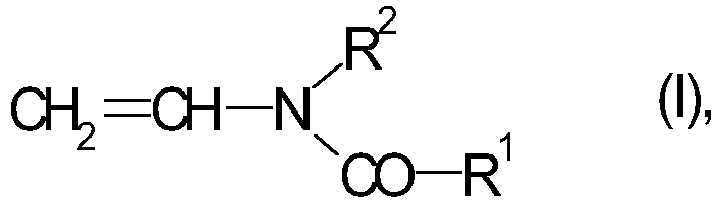
- (b) mindestens eines Säuregruppen enthaltenden monoethylenisch ungesättigten Monomeren und/oder deren Alkalimetall-, Erdalkalimetall- oder Ammoniumsalzen und gegebenenfalls
- (c) anderen monoethylenisch ungesättigten Monomeren, und gegebenenfalls
- (d) Verbindungen, die mindestens zwei ethylenisch ungesättigte Doppelbindungen im Molekül aufweisen
- Diese Gruppe von Polymeren, die amphoter sind und die insgesamt mehr kationische als anionische Gruppen aufweisen, enthält beispielsweise bis maximal 35 Mol-%, vorzugsweise bis maximal 10 Mol-% mindestens eines Säuregruppen enthaltenden Monomers der Gruppe (b) einpolymerisiert.
- Als polymere anionische Verbindung kommt erfindungsgemäß Ligninsulfonsäure und/oder ein Ligninsulfonat in Betracht. Nähere Angaben zu diesen Produkten findet man beispielsweise in der obengenannten Literaturstelle Römpp, 9. Auflage, G. Thieme Verlag Stuttgart, 1990, Seite 2511 und in Ullmann's Encyclopedia of Industrial Chemistry, 5. Completely Revised Edition, Volume A15, Seiten 311 bis 314. Ligninsulfonsäure entsteht bei der Celluloseherstellung durch Sulfitaufschluß von Holz, wobei Lignin mit schwefliger Säure reagiert. Es wird hierbei an den C3-Seitenketten der Phenylpropaneinheiten sulfoniert. In Abhängigkeit von den beim Aufschluß des Holzes eingesetzten Chemikalien entstehen dabei Ligninsulfonsäure oder Lingninsulfonate beispielsweise die Natrium-, Kalium-, Ammonium-, Magnesium- oder Calciumsalze der Ligninsulfonsäure. Ligninsulfonsäure sowie die genannten Salze der Ligninsulfonsäure sind in Wasser löslich. Die Molmasse der Ligninsulfonsäure beträgt beispielsweise 10 000 bis 200 000 g/mol. Ligninsulfonate werden z. B. aus den Sulfitablaugen (Schwarzlauge) der Celluloseherstellung gewonnen.
- Bei dem erfindungsgemäßen Verfahren dosiert man z. B. zu einem Papierstoff nacheinander Ligninsulfonsäure und/oder mindestens ein Ligninsulfonat und danach mindestens ein Vinylamineinheiten enthaltendes Polymer. Man kann jedoch auch zunächst ein Vinylamineinheiten enthaltendes Polymer und anschließend Ligninsulfonsäure und/oder ein Ligninsulfonat zu einem Papierstoff geben und ihn dann unter Blattbildung entwässern. Wesentlich ist lediglich, dass man kationisches Polymer und die anionische Komponente getrennt voneinander dosiert. Ligninsulfonsäure und/oder Ligninsulfonat werden beispielsweise in einer Menge von 0,1 bis 10 Gew.-%, vorzugsweise 0,2 bis 5 Gew.-% und insbesondere 0,5 bis 2 Gew.-%, bezogen auf trockenen Papierstoff, eingesetzt.
- Als Ligninsulfonat werden beispielsweise die wasserlöslichen Natrium-, Kalium-, Ammonium-, Calcium-, Magnesiumsalze oder deren Mischungen eingesetzt. Vorzugsweise verwendet man die Natrium-, Ammonium- und Calciumsalze.
- Vinylamineinheiten enthaltendes Polymer und Ligninsulfonsäure und/oder Ligninsulfonat werden bei dem erfindungsgemäßen Verfahren beispielsweise im Gewichtsverhältnis 5 : 1 bis 1 : 5, vorzugsweise im Gewichtsverhältnis 2 : 1 bis 1 : 2 eingesetzt.
- Erfindungsgemäß setzt man Ligninsulfonsäure und/oder Ligninsulfonat zusammen mit einem anionischen Copolymerisat eines N-Vinylcarbonsäureamids ein. Die Dosierung dieser beiden Komponenten kann dabei getrennt oder auch als Mischung erfolgen. Vorzugsweise dosiert man jedoch zunächst Ligninsulfonat und anschließend das anionionische Polymer, man kann die Dosierreihenfolge dieser Verbindungen jedoch auch umkehren. So verwendet man erfindungsgemäß beispielsweise als polymere anionische Verbindung
- (i) Ligninsulfonsäure und/oder ein Ligninsulfonat und
- (ii) mindestens ein Copolymerisat, das erhältlich ist durch Copolymerisation von
- (a) mindestens eines N-Vinylcarbonsäureamids der Formel
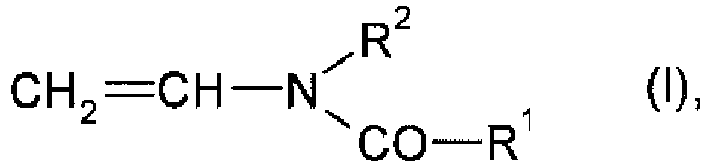
- (b) mindestens eines Säuregruppen enthaltenden monoethylenisch ungesättigten Monomeren und/oder deren Alkalimetall-, Erdalkalimetall- oder Ammoniumsalzen und gegebenenfalls
- (c) anderen monoethylenisch ungesättigten Monomeren, und gegebenenfalls
- (d) Verbindungen, die mindestens zwei ethylenisch ungesättigte Doppelbindungen im Molekül aufweisen.
- (a) mindestens eines N-Vinylcarbonsäureamids der Formel
- Vorzugsweise setzt man als polymere anionische Verbindung (ii) ein Copolymerisat ein, das erhältlich ist durch Copolymerisieren von
- (a) N-Vinylformamid,
- (b) Acrylsäure, Methacrylsäure und/oder deren Alkali- oder Ammoniumsalzen und gegebenenfalls
- (c) anderen monoethylenisch ungesättigten Monomeren.
- Die polymere anionische Verbindung (ii) enthält beispielsweise
- (a) 10 bis 95 Mol-% Einheiten der Formel I
- (b) 5 bis 90 Mol-% Einheiten einer monoethylenisch ungesättigten Carbonsäure mit 3 bis 8 C-Atomen im Molekül und/oder deren Alkalimetall-, Erdalkalimetall- oder Ammoniumsalze und
- (c) 0 bis 30 Mol-% Einheiten mindestens eines anderen monoethylenisch ungesättigten Monomeren.
- Diese Verbindungen können dahingehend modifiziert sein, dass sie zusätzlich noch mindestens eine Verbindung mit mindestens zwei ethylenisch ungesätigten Doppelbindungen im Molekül einpolymerisiert enthalten. Wenn man die Monomeren (a) und (b) oder (a), (b) und (c) in Gegenwart einer solchen Verbindung copolymerisiert, erhält man verzweigte Copolymerisate. Dabei sind die Mengenverhältnisse und Reaktionsbedingungen so zu wählen, dass noch wasserlösliche Polymere erhalten werden. Unter Umständen kann es dazu notwendig sein, Polymerisationsregler einzusetzen. Verwendung finden können alle bekannten Regler wie z.B. Thiole, sec. Alkohole, Sulfite, Phosphite, Hypophosphite, Thiosäuren, Aldehyde usw. (nähere Angaben findet man z.B. in
EP-A 438 744 - (a) 10 bis 95 Mol-% Einheiten der Formel I
- (b) 5 bis 90 Mol-% Einheiten eines Säuregruppen enthaltenden monoethylenisch ungesättigten Monomeren und/oder deren Alkalimetall-, Erdalkalimetall- oder Ammoniumsalzen,
- (c) 0 bis 30 Mol-% Einheiten mindestens eines anderen monoethylenisch ungesättigten Monomeren und
- (d) 0 bis 2 Mol-%, vorzugsweise 0,001 bis 1 Mol-% mindestens einer Verbindung mit mindestens zwei ethylenisch ungesättigten Doppelbindungen
- Beispiele für Monomere der Gruppe (a) sind N-Vinylformamid, N-Vinyl-N-methylformamid, N-Vinylacetamid, N-Vinyl-N-methylacetamid, N-Vinyl-N-ethylacetamid, N-Vinyl-N-methylpropionamid und N-Vinylpropionamid. Die Monomeren der Gruppe (a) können allein oder in Mischung bei der Copolymerisation mit den Monomeren der anderen Gruppen eingesetzt werden.
- Als Monomere der Gruppe (b) kommen insbesondere monoethylenisch ungesättigte Carbonsäuren mit 3 bis 8 C-Atomen sowie die wasserlöslichen Salze dieser Carbonsäuren in Betracht. Zu dieser Gruppe von Monomeren gehören beispielsweise Acrylsäure, Methacrylsäure, Dimethacrylsäure, Ethacrylsäure, Maleinsäure, Fumarsäure, Itaconsäure, Mesaconsäure, Citraconsäure, Methylenmalonsäure, Allylessigsäure, Vinylessigsäure und Crotonsäure. Als Monomere der Gruppe (b) eignen sich außerdem Sulfogruppen enthaltende Monomere wie Vinylsulfonsäure, Acrylamido-2-methylpropansulfonsäure und Styrolsulfonsäure sowie Vinylphosphonsäure. Die Monomeren dieser Gruppe können allein oder in Mischung miteinander, in teilweise oder in vollständig neutralisierter Form bei der Copolymerisation eingesetzt werden. Zur Neutralisation verwendet man beispielsweise Alkalimetall- oder Erdalkalimetallbasen, Ammoniak, Amine und/oder Alkanolamine. Beispiele hierfür sind Natronlauge, Kalilauge, Soda, Pottasche, Natriumhydrogencarbonat, Magnesiumoxid, Calciumhydroxid, Calciumoxid, Triethanolamin, Ethanolamin, Morpholin, Diethylentriamin oder Tetraethylenpentamin. Die Monomeren der Gruppe (b) werden bei der Copolymerisation vorzugsweise in teilweise neutralisierter Form eingesetzt.
- Die Copolymerisate können zur Modifizierung gegebenenfalls Monomere der Gruppe (c) in einpolymerisierter Form enthalten z.B. Ester von ethylensich ungesättigten C3- bis C5-Carbonsäuren wie Methylacrylat, Ethylacrylat, n-Butylacrylat, Isobutylacrylat, Isobutylmethacrylat, Methylmethacrylat, Ethylmethacrylat sowie Vinylester z.B. Vinylacetat oder Vinylpropionat, oder andere Monomere wie N-Vinylpyrrolidon, N-Vinylimidazol, Acrylamid und/oder Methacrylamid.
- Eine weitere Modifizierung der Copolymerisate ist dadurch möglich, dass man bei der Copolymerisation Monomere (d) einsetzt, die mindestens zwei Doppelbindungen im Molekül enthalten, z. B. Methylenbisacrylamid, Glykoldiacrylat, Glykoldimethacrylat, Gylcerintriacrylat, Triallylamin, Pentaerythrittriallylether, mindestens zweifach mit Acrylsäure und/oder Methacrylsäure veresterte Polyalkylenglykole oder Polyole wie Pentaerythrit, Sobit oder Glukose. Falls mindestens ein Monomer der Gruppe (d) bei der Copolymerisation eingesetzt wird, so betragen die angewendeten Mengen bis zu 2 Mol-%, z. B. 0,001 bis 1 Mol-%.
- Die Copolymerisation der Monomeren erfolgt in bekannter Weise in Gegenwart von radikalischen Polymerisationsinitiatoren und gegebenenfalls in Gegenwart von Polymerisationsreglern, vgl.
EP-B 672 212 EP-A 438 744 - Als polymere anionische Verbindung (ii) setzt man vorzugsweise ein Copolymerisat ein, das
- (a) 50 bis 90 Mol-% N-Vinylformamid,
- (b) 10 bis 50 Mol-% Acrylsäure, Methacrylsäure und/oder deren Alkali- oder Am moniumsalze und gegebenenfalls
- (c) 0 bis 30 Mol-% mindestens eines anderen monoethylenisch ungesättigten Monomeren einpolymerisiert enthält.
- Die mittleren Molmassen MW der anionischen Polymeren (ii) betragen beispielsweise 30 000 D bis 10 Millionen D, vorzugsweise 100 000 D bis 1 Million D. Diese Polymeren haben beispielsweise K-Werte (bestimmt nach H. Fikentscher in 5%iger wässriger Kochsalzlösung bei pH 7, einer Polymerkonzentration von 0,5 Gew.-% und einer Temperatur von 25°C) in dem Bereich von 20 bis 250, vorzugsweise 50 bis 150.
- Gegenstand der Erfindung ist außerdem die Verwendung von einer erfindungsgemäßen polymeren anionischen Verbindung als Zusatz zum Papierstoff bei der Herstellung von Papier, Pappe und Karton in Gegenwart mindestens eines Vinylamineinheiten enthaltenden kationischen Polymeren zur Erhöhung der Trockenfestigkeit.
- In einer bevorzugten Ausführungsform der Erfindung dosiert man zunächst Ligninsulfonsäure und/oder Linginsulfonat zum Papierstoff, fügt dann das Vinylamineinheiten enthaltende Polymer zu und entwässert anschließend den Papierstoff. Besonders bevorzugt ist eine Ausführungsform des erfindungsgemäßen Verfahrens, wobei man nach Zusatz von Ligninsulfonsäure und/oder Ligninsulfonat und mindestens eines Vinylamineinheiten enthaltenden Polymeren zum Papierstoff noch ein anionisches Vinylcarbonsäureamideinheiten enthaltendes Copolymerisat zusetzt, das erhältlich ist durch Copolymerisieren von
- (a) mindestens eines N-Vinylcarbonsäureamids der Formel

- (b) mindestens eines Säuregruppen enthaltenden monoethylenisch ungesättigten Monomeren und/oder deren Alkalimetall-, Erdalkalimetall- oder Ammoniumsalzen und gegebenenfalls
- (c) anderen monoethylenisch ungesättigten Monomeren, und gegebenenfalls
- (d) Verbindungen, die mindestens zwei ethylenisch ungesättigte Doppelbindungen im Molekül aufweisen.
- Danach wird der Papierstoff entwässert.
- Als Faserstoffe zur Herstellung der Pulpen kommen sämtliche dafür gebräuchlichen Qualitäten in Betracht, z. B. Holzstoff, gebleichter und ungebleichter Zellstoff sowie Papierstoffe aus allen Einjahrespflanzen. Zu Holzstoff gehören beispielsweise Holzschliff, thermomechanischer Stoff (TMP), chemo-thermomechanischer Stoff (CTMP), Druckschliff, Halbzellstoff, Hochausbeute-Zellstoff und Refiner Mechanical Pulp (RMP). Als Zellstoff kommen beispielsweise Sulfat-, Sulfit- und Natronzellstoffe in Betracht. Vorzugsweise verwendet man ungebleichten Zellstoff, der auch als ungebleichter Kraftzellstoff bezeichnet wird oder einen Papierstoff aus Altpapier. Geeignete Einjahrespflanzen zur Herstellung von Papierstoffen sind beispielsweise Reis, Weizen, Zuckerrohr und Kenaf. Zur Herstellung der Pulpen wird meistens Altpapier verwendet, das entweder allein oder in Mischung mit anderen Faserstoffen eingesetzt wird oder man geht von Fasermischungen aus einem Primärstoff und zurückgeführtem gestrichenem Ausschuß aus, z. B. gebleichtes Kiefernsulfat in Mischung mit zurückgeführtem gestrichenem Ausschuß. Die Entwässerung des Papierstoffs erfolgt üblicherweise auf dem Sieb einer Papiermaschine. Das erfindungsgemäße Verfahren hat insbesondere Bedeutung für die Herstellung von Papier und Pappe aus Altpapier, weil es die Festigkeitseigenschaften der zurückgeführten Fasern deutlich erhöht.
- Der pH-Wert der Stoffsuspension liegt beispielsweise in dem Bereich von 4,5 bis 8, meisten bei 6 bis 7,5. Zur Einstellung des pH-Wertes kann man beispielsweise eine Säure wie Schwefelsäure oder Aluminiumsulfat verwenden.
- Das Vinylamineinheiten enthaltende Polymere, d.h. die kationische Komponente der zum Papierstoff zu dosierenden Polymeren, wird bei dem erfindungsgemäßen Verfahren beispielsweise zum Dickstoff oder vorzugsweise zu einem Dünnstoff zugegeben. Die Zugabestelle liegt vorzugsweise vor den Sieben, kann jedoch auch zwischen einer Scherstufe und einem Screen oder danach liegen. Auch die anionische Komponente wird vorzugsweise zum Dünnstoff dosiert.
- In einer besonders bevorzugten Ausführungsform des erfindungsgemäßen Verfahrens dosiert man zunächst Ligninsulfonsäure bzw. Ligninsulfonat, danach als alleinige kationische Komponente ein Vinylamingruppen enthaltendes Polymer und anschließend ein anionisches Polymerisat von Vinylformamid. Man kann jedoch auch zuerst die kationische Komponente (Vinylamineinheiten enthaltendes Polymer als alleinige kationische Komponente) zum Papierstoff zugeben und die anionische Komponente gleichzeitig, jedoch getrennt von der kationischen Komponente zum Papierstoff dosieren. Das Vinylamineinheiten enthaltende Polymer wird beispielsweise in einer Menge von 0,05 bis 2,0 Gew.-%, vorzugsweise 0,1 bis 1 Gew.-%, bezogen auf trockenen Papierstoff, eingesetzt. Das Verhältnis von kationischer Komponente (Vinylamineinheiten enthaltendem Polymer) zu polymerer anionischer Komponente (Ligninsulfonsäure und/oder Ligninsulfonat bzw. Kombination von Ligninsulfonsäure und/oder Ligninsulfonat mit mindestens einem anionischen Polymerisat von Vinylformamid) beträgt beispielsweise 5 : 1 bis 1 : 5 und liegt vorzugsweise in dem Bereich von 2 : 1 bis 1 : 2.
- Nach dem erfindungsgemäßen Verfahren erhält man Papierprodukte, die gegenüber den Verfahren des Standes der Technik ein höheres Trockenfestigkeitsniveau bei gleichzeitig niedriger Nassfestigkeit aufweisen. Diese Papiere weisen, verglichen mit bekannten Papierprodukten, insbesondere einen hohen CMT-Wert auf.
- Die in den folgenden Beispielen angegebenen Teile sind Gewichtsteile, die Prozentangaben beziehen sich auf das Gewicht der Stoffe. Der K-Wert der Polymerisate wurde nach H. Fikentscher, Cellulose-Chemie, Band 13, 58 - 64 und 71 - 74 (1932) bei einer Temperatur von 20°C in 5 gew.-%igen wässrigen Kochsalzlösungen bei einem pH-Wert von 7 und einer Polymerkonzentration von 0,5% bestimmt. Dabei bedeutet K = k * 1000.
- Für die einzelnen Tests wurden in Laborversuchen Blätter in einem Rapid-Köthen-Laborblattbildner hergestellt. Die Nassreißlänge wurde gemäss DIN 53 112, Blatt 2 bestimmt. Die Ermittlung des CMT-Wertes erfolgte nach DIN 53 143, der Streifenstauchwiderstand (SCT-Wert) wurde nach DIN 54518 und der Trockenberstdruck nach DIN 53 141 gemessen.
- Aus 100% gemischtem Altpapier wurde zunächst eine 4%ige wässrige Stoffsuspension hergestellt, die dann auf eine Stoffdichte von 0,4% verdünnt wurde. Der pH-Wert der Suspension betrug 7,1, der Mahlgrad des Stoffs 40° Schopper-Riegler (°SR). Die Stoffsuspension enthielt 0,27% eines handelsüblichen Entschäumers (Afranil® SLO). Sie wurde dann in 9 gleiche Teile geteilt und gemäß Vergleichsbeispiel 1 bzw. gemäß den Beispielen 1 bis 8 in Gegenwart der in Tabelle 1 angegebenen Polymeren auf einem Rapid-Köthen-Blattbildner zu Blättern einer Flächenmasse von 120 bis 130 g/m2 verarbeitet. Um die Ergebnisse miteinander vergleichen zu können, wurden die einzelnen Messwerte auf Blätter eines Flächengewichts von 120 g/m2 umgerechnet. Die so erhaltenen Ergebnisse sind in Tabelle 1 angegeben.
- Aus der oben beschriebenen Stoffsuspension wurde ohne weitere Zusätze ein Blatt gebildet.
- Folgende Polymere wurden verwendet:
- Als Ligninsulfonat wurde eine handelsübliche 54,69 %ige wässrige Lösung des Calciumsalzes von Ligninsulfonsäure eingesetzt.
- PVAm 1: Als kationisches Polymer wurde ein zu 50% hydrolysiertes Homopolymerisat von N-Vinylformamid in Form einer 13 %igen wässrigen Lösung eingesetzt. Das Polymer hatte eine Molmasse Mw von 400 000.
- Anionisches Polymer 1: Copolymerisat aus 70 % N-Vinylformamid und 30% Natriumacrylat einer Molmasse Mw von 400 000.
- In den Beispielen 1 bis 8 dosierte man in jeweils eine Probe des oben beschriebenen Papierstoffs zunächst die in Tabelle 1 jeweils angegebenen Mengen an Ligninsulfonat, durchmischte die Probe, gab dann nach einer Verweilzeit von 20 Sekunden das kationische Polymer (PVAm 1) zu, durchmischte die Probe wiederum, fügte nach einer Verweilzeit von 20 Sekunden das anionische Polymer 1 zu, durchmischte den so erhaltenen Papierstoff und entwässerte ihn anschließend auf einem Rapid-Köthen-Blattbildner. Die auf Blätter mit einem Flächengewicht von 120 g/m2 umgerechneten Werte für den Trockenberstdruck, den SCT-Wert und den CMT-Wert sind in Tabelle 1 angegeben.
Tabelle 1 Vergleichsbsp. 1 Beispiel 1 2 3 4 5 6 7 8 Ligninsulfonat [%] - 0,5 1,0 1,5 1,0 2,0 3,0 0,5 1,0 PVAm 1 [%] - 0,5 0,5 0,5 1,0 1,0 1,0 0,5 0,5 Anionisches Polymer [%] - - - - - - - 0,5 0,5 Trockenberstdruck [kPa] 318,0 358,8 357,6 357,8 394,2 376,8 388,5 417,7 415,6 Steigerung [%] 0 13 12 13 24 18 22 31 31 SCT-Wert [kN/m] 1,88 2,09 2,11 2,09 2,22 2,36 2,21 2,48 2,42 Steigerung [%] 0 11 12 11 18 26 17 32 29 CMT-Wert [N] 116,5 156,83 158,6 150,24 166,8 171,6 175,2 170,3 182,2 Steigerung [%] 0 35 36 29 43 47 50 46 56
Claims (13)
- Verfahren zur Herstellung von Papier, Pappe und Karton mit hoher Trockenfestigkeit durch getrennte Zugabe eines Vinylamineinheiten enthaltenden kationischen Polymeren und einer polymeren anionischen Verbindung zu einem Papierstoff, Entwässern des Papierstoffs und Trocknen der Papierprodukte, dadurch gekennzeichnet, dass man als polymere anionische Verbindung(i) Ligninsulfonsäure und/oder ein Ligninsulfonat und(ii) mindestens ein Copolymerisat einsetzt, das erhältlich ist durch Copolymerisieren von(a) mindestens eines N-Vinylcarbonsäureamids der Formel
 (b) mindestens eines Säuregruppen enthaltenden monoethylenisch ungesättigten Monomeren und/oder deren Alkalimetall-, Erdalkalimetall- oder Ammoniumsalzen und gegebenenfalls(c) anderen monoethylenisch ungesättigten Monomeren, und gegebenenfalls(d) Verbindungen, die mindestens zwei ethylenisch ungesättigte Doppelbindungen im Molekül aufweiseneinsetzt.
 - Verfahren nach Anspruch 1, dadurch gekennzeichnet, dass man als Vinylamineinheiten enthaltendes kationisches Polymer mindestens eine Verbindung einsetzt, die erhältlich ist durch Polymerisieren mindestens eines Monomeren der Formel

und anschließende teilweise oder vollständige Abspaltung der Gruppen -CO-R1 aus den in das Polymerisat einpolymerisierten Einheiten der Monomeren I unter Bildung von Aminogruppen. - Verfahren nach Anspruch 1 oder 2, dadurch gekennzeichnet, dass man als Vinylamineinheiten enthaltendes kationisches Polymer ein zu mindestens 1 Mol-% hydrolysiertes Homopolymerisat von N-Vinylformamid einsetzt.
- Verfahren nach einem der Ansprüche 1 bis 3, dadurch gekennzeichnet, dass man als Vinylamineinheiten enthaltendes kationisches Polymer ein Copolymerisat einsetzt, das erhältlich ist durch Copolymerisation(a) mindestens eines N-Vinylcarbonsäureamids der Formel
 (b) mindestens eines Säuregruppen enthaltenden monoethylenisch ungesättigten Monomeren und/oder deren Alkalimetall-, Erdalkalimetall- oder Ammoniumsalalzen und gegebenenfalls(c) anderen monoethylenisch ungesättigten Monomeren, und gegebenenfalls(d) Verbindungen, die mindestens zwei ethylenisch ungesättigte Doppelbindungen im Molekül aufweisenund anschließende teilweise oder vollständige Abspaltung der Gruppen -CO-R1 aus den in das Polymerisat einpolymerisierten Einheiten der Monomeren I unter Bildung von Aminogruppen, wobei der Anteil der Aminogruppen im Copolymerisat um mindestens 10 Mol-% größer ist als der Anteil der Einheiten an Säuregruppen enthaltenden monoethylenisch ungesättigten Monomeren.
 - Verfahren nach einem der Ansprüche 1 bis 4, dadurch gekennzeichnet, dass man als Vinylaminheiten enthaltendes kationisches Polymer Polyvinylamin und/oder ein zu mindestens 50 Mol-% hydrolysiertes Homopolymerisat des N-Vinylformamids einsetzt.
- Verfahren nach einem der Ansprüche 1 bis 5, dadurch gekennzeichnet, dass man als Ligninsulfonat die wasserlöslichen Natrium-, Kalium-, Ammonium-, Calcium-, Magnesiumsalze oder deren Mischungen einsetzt.
- Verfahren nach einem der Ansprüche 1 bis 6, dadurch gekennzeichnet, dass man das Vinylamineinheiten enthaltende kationische Polymer in einer Menge von 0,05 bis 2,0 Gew.-%, bezogen auf trockenen Papierstoff, einsetzt.
- Verfahren nach einem der Ansprüche 1 bis 7, dadurch gekennzeichnet, dass man das Vinylamineinheiten enthaltende kationische Polymer und Ligninsulfonsäure und/oder Ligninsulfonat im Gewichtsverhältnis 5 : 1 bis 1 : 5 einsetzt.
- Verfahren nach einem der Ansprüche 1 bis 8, dadurch gekennzeichnet, dass man das Vinylamineinheiten enthaltende kationische Polymer und Ligninsulfonsäure und/oder Ligninsulfonat im Gewichtsverhältnis 2 : 1 bis 1 : 2 einsetzt.
- Verfahren nach einem der Ansprüche 1 bis 9, dadurch gekennzeichnet, dass man zunächst Ligninsulfonsäure und/oder Linginsulfonat zum Papierstoff dosiert, dann das Vinylamineinheiten enthaltende kationische Polymer zufügt und anschließend den Papierstoff entwässert.
- Verfahren nach einem der Ansprüche 1 bis 9, dadurch gekennzeichnet, dass man zunächst das Vinylamineinheiten enthaltende kationische Polymer zum Papierstoff dosiert, dann Ligninsulfonsäure und/oder Ligninsulfonat zufügt und danach den Papierstoff entwässert.
- Verfahren nach Anspruch 10, dadurch gekennzeichnet, dass man nach Zusatz von Ligninsulfonsäure und/oder Ligninsulfonat und mindestens eines Vinylamineinheiten enthaltenden kationischen Polymeren zum Papierstoff noch ein anionisches Vinylcarbonsäureamideinheiten enthaltendes Copolymerisat zusetzt, das erhältlich ist durch Copolymerisieren von(a) mindestens eines N-Vinylcarbonsäureamids der Formel
 (b) mindestens eines Säuregruppen enthaltenden monoethylenisch ungesättigten Monomeren und/oder deren Alkalimetall-, Erdalkalimetall- oder Ammoniumsalzen und gegebenenfalls(c) anderen monoethylenisch ungesättigten Monomeren, und gegebenenfalls(d) Verbindungen, die mindestens zwei ethylenisch ungesättigte Doppelbindungen im Molekül aufweisen.
 - Verwendung einer polymeren anionischen Verbindung nach Anspruch 1 als Zusatz zum Papierstoff bei der Herstellung von Papier, Pappe und Karton in Gegenwart mindestens eines Vinylamineinheiten enthaltenden kationischen Polymeren zur Erhöhung der Trockenfestigkeit.
Priority Applications (1)
| Application Number | Priority Date | Filing Date | Title |
|---|---|---|---|
| EP07712497.2A EP1999314B1 (de) | 2006-03-16 | 2007-03-09 | Verfahren zur herstellung von papier, pappe und karton mit hoher trockenfestigkeit |
Applications Claiming Priority (3)
| Application Number | Priority Date | Filing Date | Title |
|---|---|---|---|
| EP06111267 | 2006-03-16 | ||
| PCT/EP2007/052238 WO2007104716A1 (de) | 2006-03-16 | 2007-03-09 | Verfahren zur herstellung von papier, pappe und karton mit hoher trockenfestigkeit |
| EP07712497.2A EP1999314B1 (de) | 2006-03-16 | 2007-03-09 | Verfahren zur herstellung von papier, pappe und karton mit hoher trockenfestigkeit |
Publications (2)
| Publication Number | Publication Date |
|---|---|
| EP1999314A1 EP1999314A1 (de) | 2008-12-10 |
| EP1999314B1 true EP1999314B1 (de) | 2017-02-22 |
Family
ID=38325364
Family Applications (1)
| Application Number | Title | Priority Date | Filing Date |
|---|---|---|---|
| EP07712497.2A Not-in-force EP1999314B1 (de) | 2006-03-16 | 2007-03-09 | Verfahren zur herstellung von papier, pappe und karton mit hoher trockenfestigkeit |
Country Status (8)
| Country | Link |
|---|---|
| US (1) | US7922867B2 (de) |
| EP (1) | EP1999314B1 (de) |
| JP (1) | JP5156650B2 (de) |
| CN (1) | CN101405457B (de) |
| CA (1) | CA2644348C (de) |
| ES (1) | ES2625622T3 (de) |
| PT (1) | PT1999314T (de) |
| WO (1) | WO2007104716A1 (de) |
Families Citing this family (17)
| Publication number | Priority date | Publication date | Assignee | Title |
|---|---|---|---|---|
| DE102004056551A1 (de) * | 2004-11-23 | 2006-05-24 | Basf Ag | Verfahren zur Herstellung von Papier, Pappe und Karton mit hoher Trockenfestigkeit |
| EP2288750B1 (de) * | 2008-05-15 | 2012-09-05 | Basf Se | Verfahren zur herstellung von papier, pappe und karton mit hoher trockenfestigkeit |
| CN104532674A (zh) * | 2009-06-16 | 2015-04-22 | 巴斯夫欧洲公司 | 提高纸张、纸板和卡纸板干强度的方法 |
| JP5571014B2 (ja) * | 2011-02-21 | 2014-08-13 | Kj特殊紙株式会社 | 電磁波抑制シート |
| TWI511999B (zh) * | 2011-07-11 | 2015-12-11 | Ind Tech Res Inst | 電子元件、導電高分子組合物以及其製備方法 |
| AU2012299794B2 (en) | 2011-08-25 | 2017-03-02 | Solenis Technologies Cayman, L.P. | Method for increasing the advantages of strength aids in the production of paper and paperboard |
| US9908680B2 (en) | 2012-09-28 | 2018-03-06 | Kimberly-Clark Worldwide, Inc. | Tree-free fiber compositions and uses in containerboard packaging |
| US9816233B2 (en) | 2012-09-28 | 2017-11-14 | Kimberly-Clark Worldwide, Inc. | Hybrid fiber compositions and uses in containerboard packaging |
| US9562326B2 (en) * | 2013-03-14 | 2017-02-07 | Kemira Oyj | Compositions and methods of making paper products |
| CN104452455B (zh) | 2013-09-12 | 2019-04-05 | 艺康美国股份有限公司 | 造纸助剂组合物以及增加成纸灰分保留的方法 |
| CN104452463B (zh) | 2013-09-12 | 2017-01-04 | 艺康美国股份有限公司 | 造纸方法以及组合物 |
| KR102485733B1 (ko) * | 2014-03-28 | 2023-01-05 | 바스프 에스이 | 골판지의 제조 방법 |
| CN106930142B (zh) * | 2015-12-31 | 2020-03-24 | 艺康美国股份有限公司 | 干强剂组合物以及提高纸张干强度的方法 |
| JP6999162B2 (ja) * | 2017-12-22 | 2022-02-10 | 国立研究開発法人産業技術総合研究所 | リグニンスルホン酸とカチオン性高分子を成分とするイオン複合材料 |
| US12553189B2 (en) | 2019-05-03 | 2026-02-17 | First Quality Tissue, Llc | Absorbent structures with high strength and low MD stretch |
| JP7563724B2 (ja) * | 2019-06-04 | 2024-10-08 | 国立研究開発法人産業技術総合研究所 | リグニンスルホン酸、カチオン性高分子およびアルデヒド基を有する化合物を成分とするイオン複合材料 |
| WO2023031667A1 (en) * | 2021-08-30 | 2023-03-09 | Ecolab Usa Inc. | Use of modified lignin as a wet end strength additive |
Family Cites Families (19)
| Publication number | Priority date | Publication date | Assignee | Title |
|---|---|---|---|---|
| US2721140A (en) * | 1952-09-19 | 1955-10-18 | Hercules Powder Co Ltd | Paper of high wet strength and process therefor |
| US3448005A (en) * | 1965-01-04 | 1969-06-03 | Weyerhaeuser Co | Process of forming wet strength paper containing a cationic resin and fumarated unsaturated oil |
| SE443818B (sv) | 1978-04-24 | 1986-03-10 | Mitsubishi Chem Ind | Forfarande for framstellning av papper med forbettrad torrstyrka |
| JPS57191394A (en) * | 1981-05-19 | 1982-11-25 | Rei Tech Inc | Papermaking method using lignin like substance and cationic polymer |
| DE3506832A1 (de) * | 1985-02-27 | 1986-08-28 | Basf Ag, 6700 Ludwigshafen | Verfahren zur herstellung von papier mit hoher trockenfestigkeit |
| DE3534273A1 (de) * | 1985-09-26 | 1987-04-02 | Basf Ag | Verfahren zur herstellung von vinylamin-einheiten enthaltenden wasserloeslichen copolymerisaten und deren verwendung als nass- und trockenverfestigungsmittel fuer papier |
| JPH01183598A (ja) * | 1988-01-18 | 1989-07-21 | Showa Denko Kk | 紙・板紙の抄造方法 |
| KR0159921B1 (ko) * | 1988-10-03 | 1999-01-15 | 마이클 비. 키한 | 양이온성 및 음이온성 중합체의 혼합물, 그 제법 및 종이용 건조강도 개선 첨가제로서의 용도 |
| DE4001808A1 (de) | 1990-01-23 | 1991-07-25 | Basf Ag | Verwendung von wasserloeslichen copolymerisaten aus monoethylenisch ungesaettigten carbonsaeuren und n-vinylamiden als wasserbehandlungsmittel |
| US5630907A (en) * | 1992-12-07 | 1997-05-20 | Basf Aktiengesellschaft | Use of hydrolyzed copolymers of N-vinylcarboxamides and monoethylenically unsaturated carboxylic acids in papermaking |
| DE4241117A1 (de) * | 1992-12-07 | 1994-06-09 | Basf Ag | Verwendung von hydrolysierten Copolymerisaten aus N-Vinylcarbonsäureamiden und monoethylenisch ungesättigten Carbonsäuren bei der Papierherstellung |
| JPH06184983A (ja) * | 1992-12-21 | 1994-07-05 | Sumitomo Chem Co Ltd | 紙および板紙の製造方法 |
| US6228217B1 (en) * | 1995-01-13 | 2001-05-08 | Hercules Incorporated | Strength of paper made from pulp containing surface active, carboxyl compounds |
| DE19537088A1 (de) | 1995-10-05 | 1997-04-10 | Basf Ag | Verfahren zur Herstellung von trockenfest und naßfest ausgerüstetem Papier |
| US6315824B1 (en) * | 1996-02-02 | 2001-11-13 | Rodrigue V. Lauzon | Coacervate stabilizer system |
| JP3151427B2 (ja) | 1997-11-06 | 2001-04-03 | 株式会社トキワ | 段ボール原紙の製造方法 |
| US6824650B2 (en) | 2001-12-18 | 2004-11-30 | Kimberly-Clark Worldwide, Inc. | Fibrous materials treated with a polyvinylamine polymer |
| US20040118540A1 (en) | 2002-12-20 | 2004-06-24 | Kimberly-Clark Worlwide, Inc. | Bicomponent strengtheninig system for paper |
| DE102004056551A1 (de) | 2004-11-23 | 2006-05-24 | Basf Ag | Verfahren zur Herstellung von Papier, Pappe und Karton mit hoher Trockenfestigkeit |
-
2007
- 2007-03-09 PT PT77124972T patent/PT1999314T/pt unknown
- 2007-03-09 ES ES07712497.2T patent/ES2625622T3/es active Active
- 2007-03-09 CA CA2644348A patent/CA2644348C/en not_active Expired - Fee Related
- 2007-03-09 EP EP07712497.2A patent/EP1999314B1/de not_active Not-in-force
- 2007-03-09 WO PCT/EP2007/052238 patent/WO2007104716A1/de not_active Ceased
- 2007-03-09 CN CN2007800092355A patent/CN101405457B/zh not_active Expired - Fee Related
- 2007-03-09 JP JP2008558792A patent/JP5156650B2/ja not_active Expired - Fee Related
- 2007-03-09 US US12/282,358 patent/US7922867B2/en not_active Expired - Fee Related
Non-Patent Citations (1)
| Title |
|---|
| None * |
Also Published As
| Publication number | Publication date |
|---|---|
| JP5156650B2 (ja) | 2013-03-06 |
| PT1999314T (pt) | 2017-05-26 |
| US20100108279A1 (en) | 2010-05-06 |
| JP2009530504A (ja) | 2009-08-27 |
| ES2625622T3 (es) | 2017-07-20 |
| WO2007104716A1 (de) | 2007-09-20 |
| US7922867B2 (en) | 2011-04-12 |
| CN101405457B (zh) | 2011-08-17 |
| CA2644348C (en) | 2014-06-10 |
| EP1999314A1 (de) | 2008-12-10 |
| CA2644348A1 (en) | 2007-09-20 |
| CN101405457A (zh) | 2009-04-08 |
Similar Documents
| Publication | Publication Date | Title |
|---|---|---|
| EP1819877B1 (de) | Verfahren zur herstellung von papier, pappe und karton mit hoher trockenfestigkeit | |
| EP1999314A1 (de) | Verfahren zur herstellung von papier, pappe und karton mit hoher trockenfestigkeit | |
| EP2443284B1 (de) | Verfahren zur erhöhung der trockenfestigkeit von papier, pappe und karton | |
| EP2315875B1 (de) | Verfahren zur erhöhung der trockenfestigkeit von papier, pappe und karton | |
| EP2304106B1 (de) | Herstellung von papier | |
| EP2288750B1 (de) | Verfahren zur herstellung von papier, pappe und karton mit hoher trockenfestigkeit | |
| DE69224063T2 (de) | Verfahren zur herstellung von papier | |
| WO2011048000A1 (de) | Verfahren zur herstellung von papier, pappe und karton mit hoher trockenfestigkeit | |
| EP2393982A1 (de) | Verfahren zur herstellung von papier, pappe und karton mit hoher trockenfestigkeit | |
| DE3506832A1 (de) | Verfahren zur herstellung von papier mit hoher trockenfestigkeit | |
| EP2443282A1 (de) | Verfahren zur reduktion von ablagerungen in der trockenpartie bei der herstellung von papier, pappe und karton | |
| EP3122937B1 (de) | Verfahren zur herstellung von wellpappenkarton | |
| EP2723943B1 (de) | Verfahren zur herstellung von papier, pappe und karton | |
| EP1727938B1 (de) | Verfahren zur herstellung von papier, pappe und karton | |
| EP3207178A1 (de) | Verfestigungszusammensetzung für papier und karton | |
| DE69515016T2 (de) | Verfahren zur Herstellung von Tissuepapier, Zeitungsdruckpapier, Papier oder Karton | |
| WO2006136556A2 (de) | Verfahren zur herstellung von papier, pappe und karton | |
| DE3613651A1 (de) | Verfahren zur herstellung von papier mit hoher trockenfestigkeit | |
| DE2117682A1 (en) | Alpha-olefin/acrylic copolymers - used in soln as a paper size |
Legal Events
| Date | Code | Title | Description |
|---|---|---|---|
| PUAI | Public reference made under article 153(3) epc to a published international application that has entered the european phase |
Free format text: ORIGINAL CODE: 0009012 |
|
| 17P | Request for examination filed |
Effective date: 20081016 |
|
| AK | Designated contracting states |
Kind code of ref document: A1 Designated state(s): AT BE BG CH CY CZ DE DK EE ES FI FR GB GR HU IE IS IT LI LT LU LV MC MT NL PL PT RO SE SI SK TR |
|
| 17Q | First examination report despatched |
Effective date: 20090116 |
|
| DAX | Request for extension of the european patent (deleted) | ||
| REG | Reference to a national code |
Ref country code: DE Ref legal event code: R079 Ref document number: 502007015455 Country of ref document: DE Free format text: PREVIOUS MAIN CLASS: D21H0021180000 Ipc: D21H0017430000 |
|
| GRAP | Despatch of communication of intention to grant a patent |
Free format text: ORIGINAL CODE: EPIDOSNIGR1 |
|
| RIC1 | Information provided on ipc code assigned before grant |
Ipc: D21H 21/18 20060101ALI20160406BHEP Ipc: D21H 17/43 20060101AFI20160406BHEP Ipc: D21H 17/23 20060101ALI20160406BHEP Ipc: D21H 17/42 20060101ALI20160406BHEP |
|
| INTG | Intention to grant announced |
Effective date: 20160420 |
|
| GRAJ | Information related to disapproval of communication of intention to grant by the applicant or resumption of examination proceedings by the epo deleted |
Free format text: ORIGINAL CODE: EPIDOSDIGR1 |
|
| GRAS | Grant fee paid |
Free format text: ORIGINAL CODE: EPIDOSNIGR3 |
|
| GRAP | Despatch of communication of intention to grant a patent |
Free format text: ORIGINAL CODE: EPIDOSNIGR1 |
|
| INTC | Intention to grant announced (deleted) | ||
| INTG | Intention to grant announced |
Effective date: 20160922 |
|
| GRAA | (expected) grant |
Free format text: ORIGINAL CODE: 0009210 |
|
| AK | Designated contracting states |
Kind code of ref document: B1 Designated state(s): AT BE BG CH CY CZ DE DK EE ES FI FR GB GR HU IE IS IT LI LT LU LV MC MT NL PL PT RO SE SI SK TR |
|
| REG | Reference to a national code |
Ref country code: GB Ref legal event code: FG4D Free format text: NOT ENGLISH |
|
| REG | Reference to a national code |
Ref country code: CH Ref legal event code: EP |
|
| REG | Reference to a national code |
Ref country code: AT Ref legal event code: REF Ref document number: 869387 Country of ref document: AT Kind code of ref document: T Effective date: 20170315 |
|
| REG | Reference to a national code |
Ref country code: IE Ref legal event code: FG4D Free format text: LANGUAGE OF EP DOCUMENT: GERMAN |
|
| REG | Reference to a national code |
Ref country code: FR Ref legal event code: PLFP Year of fee payment: 11 |
|
| REG | Reference to a national code |
Ref country code: DE Ref legal event code: R096 Ref document number: 502007015455 Country of ref document: DE |
|
| PGFP | Annual fee paid to national office [announced via postgrant information from national office to epo] |
Ref country code: FR Payment date: 20170327 Year of fee payment: 11 Ref country code: NL Payment date: 20170327 Year of fee payment: 11 Ref country code: FI Payment date: 20170322 Year of fee payment: 11 Ref country code: CH Payment date: 20170327 Year of fee payment: 11 |
|
| REG | Reference to a national code |
Ref country code: NL Ref legal event code: FP |
|
| REG | Reference to a national code |
Ref country code: PT Ref legal event code: SC4A Ref document number: 1999314 Country of ref document: PT Date of ref document: 20170526 Kind code of ref document: T Free format text: AVAILABILITY OF NATIONAL TRANSLATION Effective date: 20170516 |
|
| REG | Reference to a national code |
Ref country code: SE Ref legal event code: TRGR |
|
| PGFP | Annual fee paid to national office [announced via postgrant information from national office to epo] |
Ref country code: BE Payment date: 20170328 Year of fee payment: 11 Ref country code: AT Payment date: 20170328 Year of fee payment: 11 Ref country code: GB Payment date: 20170330 Year of fee payment: 11 |
|
| REG | Reference to a national code |
Ref country code: LT Ref legal event code: MG4D |
|
| REG | Reference to a national code |
Ref country code: ES Ref legal event code: FG2A Ref document number: 2625622 Country of ref document: ES Kind code of ref document: T3 Effective date: 20170720 |
|
| PG25 | Lapsed in a contracting state [announced via postgrant information from national office to epo] |
Ref country code: GR Free format text: LAPSE BECAUSE OF FAILURE TO SUBMIT A TRANSLATION OF THE DESCRIPTION OR TO PAY THE FEE WITHIN THE PRESCRIBED TIME-LIMIT Effective date: 20170523 Ref country code: LT Free format text: LAPSE BECAUSE OF FAILURE TO SUBMIT A TRANSLATION OF THE DESCRIPTION OR TO PAY THE FEE WITHIN THE PRESCRIBED TIME-LIMIT Effective date: 20170222 |
|
| PGFP | Annual fee paid to national office [announced via postgrant information from national office to epo] |
Ref country code: DE Payment date: 20170531 Year of fee payment: 11 Ref country code: CZ Payment date: 20170308 Year of fee payment: 11 |
|
| PG25 | Lapsed in a contracting state [announced via postgrant information from national office to epo] |
Ref country code: BG Free format text: LAPSE BECAUSE OF FAILURE TO SUBMIT A TRANSLATION OF THE DESCRIPTION OR TO PAY THE FEE WITHIN THE PRESCRIBED TIME-LIMIT Effective date: 20170522 Ref country code: LV Free format text: LAPSE BECAUSE OF FAILURE TO SUBMIT A TRANSLATION OF THE DESCRIPTION OR TO PAY THE FEE WITHIN THE PRESCRIBED TIME-LIMIT Effective date: 20170222 |
|
| PGFP | Annual fee paid to national office [announced via postgrant information from national office to epo] |
Ref country code: ES Payment date: 20170425 Year of fee payment: 11 Ref country code: IT Payment date: 20170322 Year of fee payment: 11 Ref country code: PT Payment date: 20170601 Year of fee payment: 11 |
|
| PG25 | Lapsed in a contracting state [announced via postgrant information from national office to epo] |
Ref country code: RO Free format text: LAPSE BECAUSE OF FAILURE TO SUBMIT A TRANSLATION OF THE DESCRIPTION OR TO PAY THE FEE WITHIN THE PRESCRIBED TIME-LIMIT Effective date: 20170222 Ref country code: SK Free format text: LAPSE BECAUSE OF FAILURE TO SUBMIT A TRANSLATION OF THE DESCRIPTION OR TO PAY THE FEE WITHIN THE PRESCRIBED TIME-LIMIT Effective date: 20170222 Ref country code: EE Free format text: LAPSE BECAUSE OF FAILURE TO SUBMIT A TRANSLATION OF THE DESCRIPTION OR TO PAY THE FEE WITHIN THE PRESCRIBED TIME-LIMIT Effective date: 20170222 |
|
| REG | Reference to a national code |
Ref country code: DE Ref legal event code: R097 Ref document number: 502007015455 Country of ref document: DE |
|
| PG25 | Lapsed in a contracting state [announced via postgrant information from national office to epo] |
Ref country code: PL Free format text: LAPSE BECAUSE OF FAILURE TO SUBMIT A TRANSLATION OF THE DESCRIPTION OR TO PAY THE FEE WITHIN THE PRESCRIBED TIME-LIMIT Effective date: 20170222 Ref country code: DK Free format text: LAPSE BECAUSE OF FAILURE TO SUBMIT A TRANSLATION OF THE DESCRIPTION OR TO PAY THE FEE WITHIN THE PRESCRIBED TIME-LIMIT Effective date: 20170222 Ref country code: MC Free format text: LAPSE BECAUSE OF FAILURE TO SUBMIT A TRANSLATION OF THE DESCRIPTION OR TO PAY THE FEE WITHIN THE PRESCRIBED TIME-LIMIT Effective date: 20170222 |
|
| PGFP | Annual fee paid to national office [announced via postgrant information from national office to epo] |
Ref country code: SE Payment date: 20170324 Year of fee payment: 11 |
|
| REG | Reference to a national code |
Ref country code: IE Ref legal event code: MM4A |
|
| PLBE | No opposition filed within time limit |
Free format text: ORIGINAL CODE: 0009261 |
|
| STAA | Information on the status of an ep patent application or granted ep patent |
Free format text: STATUS: NO OPPOSITION FILED WITHIN TIME LIMIT |
|
| 26N | No opposition filed |
Effective date: 20171123 |
|
| PG25 | Lapsed in a contracting state [announced via postgrant information from national office to epo] |
Ref country code: LU Free format text: LAPSE BECAUSE OF NON-PAYMENT OF DUE FEES Effective date: 20170309 |
|
| PG25 | Lapsed in a contracting state [announced via postgrant information from national office to epo] |
Ref country code: SI Free format text: LAPSE BECAUSE OF FAILURE TO SUBMIT A TRANSLATION OF THE DESCRIPTION OR TO PAY THE FEE WITHIN THE PRESCRIBED TIME-LIMIT Effective date: 20170222 Ref country code: IE Free format text: LAPSE BECAUSE OF NON-PAYMENT OF DUE FEES Effective date: 20170309 |
|
| PG25 | Lapsed in a contracting state [announced via postgrant information from national office to epo] |
Ref country code: MT Free format text: LAPSE BECAUSE OF FAILURE TO SUBMIT A TRANSLATION OF THE DESCRIPTION OR TO PAY THE FEE WITHIN THE PRESCRIBED TIME-LIMIT Effective date: 20170222 |
|
| REG | Reference to a national code |
Ref country code: DE Ref legal event code: R119 Ref document number: 502007015455 Country of ref document: DE |
|
| PG25 | Lapsed in a contracting state [announced via postgrant information from national office to epo] |
Ref country code: SE Free format text: LAPSE BECAUSE OF NON-PAYMENT OF DUE FEES Effective date: 20180310 Ref country code: FI Free format text: LAPSE BECAUSE OF NON-PAYMENT OF DUE FEES Effective date: 20180309 |
|
| REG | Reference to a national code |
Ref country code: CH Ref legal event code: PL |
|
| REG | Reference to a national code |
Ref country code: NL Ref legal event code: MM Effective date: 20180401 |
|
| REG | Reference to a national code |
Ref country code: AT Ref legal event code: MM01 Ref document number: 869387 Country of ref document: AT Kind code of ref document: T Effective date: 20180309 |
|
| GBPC | Gb: european patent ceased through non-payment of renewal fee |
Effective date: 20180309 |
|
| PG25 | Lapsed in a contracting state [announced via postgrant information from national office to epo] |
Ref country code: CZ Free format text: LAPSE BECAUSE OF NON-PAYMENT OF DUE FEES Effective date: 20180309 |
|
| REG | Reference to a national code |
Ref country code: BE Ref legal event code: MM Effective date: 20180331 |
|
| PG25 | Lapsed in a contracting state [announced via postgrant information from national office to epo] |
Ref country code: NL Free format text: LAPSE BECAUSE OF NON-PAYMENT OF DUE FEES Effective date: 20180401 |
|
| PG25 | Lapsed in a contracting state [announced via postgrant information from national office to epo] |
Ref country code: DE Free format text: LAPSE BECAUSE OF NON-PAYMENT OF DUE FEES Effective date: 20181002 Ref country code: PT Free format text: LAPSE BECAUSE OF NON-PAYMENT OF DUE FEES Effective date: 20181211 Ref country code: AT Free format text: LAPSE BECAUSE OF NON-PAYMENT OF DUE FEES Effective date: 20180309 |
|
| PG25 | Lapsed in a contracting state [announced via postgrant information from national office to epo] |
Ref country code: BE Free format text: LAPSE BECAUSE OF NON-PAYMENT OF DUE FEES Effective date: 20180331 Ref country code: GB Free format text: LAPSE BECAUSE OF NON-PAYMENT OF DUE FEES Effective date: 20180309 Ref country code: LI Free format text: LAPSE BECAUSE OF NON-PAYMENT OF DUE FEES Effective date: 20180331 Ref country code: CH Free format text: LAPSE BECAUSE OF NON-PAYMENT OF DUE FEES Effective date: 20180331 Ref country code: IT Free format text: LAPSE BECAUSE OF NON-PAYMENT OF DUE FEES Effective date: 20180309 |
|
| PG25 | Lapsed in a contracting state [announced via postgrant information from national office to epo] |
Ref country code: FR Free format text: LAPSE BECAUSE OF NON-PAYMENT OF DUE FEES Effective date: 20180331 |
|
| PG25 | Lapsed in a contracting state [announced via postgrant information from national office to epo] |
Ref country code: HU Free format text: LAPSE BECAUSE OF FAILURE TO SUBMIT A TRANSLATION OF THE DESCRIPTION OR TO PAY THE FEE WITHIN THE PRESCRIBED TIME-LIMIT; INVALID AB INITIO Effective date: 20070309 |
|
| REG | Reference to a national code |
Ref country code: ES Ref legal event code: FD2A Effective date: 20190904 |
|
| PG25 | Lapsed in a contracting state [announced via postgrant information from national office to epo] |
Ref country code: ES Free format text: LAPSE BECAUSE OF NON-PAYMENT OF DUE FEES Effective date: 20180310 Ref country code: CY Free format text: LAPSE BECAUSE OF NON-PAYMENT OF DUE FEES Effective date: 20170222 |
|
| PG25 | Lapsed in a contracting state [announced via postgrant information from national office to epo] |
Ref country code: TR Free format text: LAPSE BECAUSE OF FAILURE TO SUBMIT A TRANSLATION OF THE DESCRIPTION OR TO PAY THE FEE WITHIN THE PRESCRIBED TIME-LIMIT Effective date: 20170222 |
|
| PG25 | Lapsed in a contracting state [announced via postgrant information from national office to epo] |
Ref country code: IS Free format text: LAPSE BECAUSE OF FAILURE TO SUBMIT A TRANSLATION OF THE DESCRIPTION OR TO PAY THE FEE WITHIN THE PRESCRIBED TIME-LIMIT Effective date: 20170622 |