EP2000033B1 - Starter microbien, comprenant des souches de Saccharomyces cerevisiae, pour la panification - Google Patents
Starter microbien, comprenant des souches de Saccharomyces cerevisiae, pour la panification Download PDFInfo
- Publication number
- EP2000033B1 EP2000033B1 EP08425189A EP08425189A EP2000033B1 EP 2000033 B1 EP2000033 B1 EP 2000033B1 EP 08425189 A EP08425189 A EP 08425189A EP 08425189 A EP08425189 A EP 08425189A EP 2000033 B1 EP2000033 B1 EP 2000033B1
- Authority
- EP
- European Patent Office
- Prior art keywords
- wheat flour
- saccharomyces cerevisiae
- cerevisiae
- dsm
- semola
- Prior art date
- Legal status (The legal status is an assumption and is not a legal conclusion. Google has not performed a legal analysis and makes no representation as to the accuracy of the status listed.)
- Not-in-force
Links
Images




Classifications
-
- A—HUMAN NECESSITIES
- A21—BAKING; EDIBLE DOUGHS
- A21D—TREATMENT OF FLOUR OR DOUGH FOR BAKING, e.g. BY ADDITION OF MATERIALS; BAKING; BAKERY PRODUCTS
- A21D8/00—Methods for preparing or baking dough
- A21D8/02—Methods for preparing dough; Treating dough prior to baking
- A21D8/04—Methods for preparing dough; Treating dough prior to baking treating dough with microorganisms or enzymes
- A21D8/047—Methods for preparing dough; Treating dough prior to baking treating dough with microorganisms or enzymes with yeasts
-
- C—CHEMISTRY; METALLURGY
- C12—BIOCHEMISTRY; BEER; SPIRITS; WINE; VINEGAR; MICROBIOLOGY; ENZYMOLOGY; MUTATION OR GENETIC ENGINEERING
- C12N—MICROORGANISMS OR ENZYMES; COMPOSITIONS THEREOF; PROPAGATING, PRESERVING, OR MAINTAINING MICROORGANISMS; MUTATION OR GENETIC ENGINEERING; CULTURE MEDIA
- C12N1/00—Microorganisms; Compositions thereof; Processes of propagating, maintaining or preserving microorganisms or compositions thereof; Processes of preparing or isolating a composition containing a microorganism; Culture media therefor
- C12N1/14—Fungi; Culture media therefor
- C12N1/16—Yeasts; Culture media therefor
- C12N1/18—Baker's yeast; Brewer's yeast
- C12N1/185—Saccharomyces isolates
-
- C—CHEMISTRY; METALLURGY
- C12—BIOCHEMISTRY; BEER; SPIRITS; WINE; VINEGAR; MICROBIOLOGY; ENZYMOLOGY; MUTATION OR GENETIC ENGINEERING
- C12R—INDEXING SCHEME ASSOCIATED WITH SUBCLASSES C12C - C12Q, RELATING TO MICROORGANISMS
- C12R2001/00—Microorganisms ; Processes using microorganisms
- C12R2001/645—Fungi ; Processes using fungi
- C12R2001/85—Saccharomyces
- C12R2001/865—Saccharomyces cerevisiae
Definitions
- the present invention concerns a microbial starter based on selected yeasts for the production of bakery products, preferably bread.
- the invention concerns the use of "natural yeast” as yeasting agent for the bread production:
- the use of selected yeasts allows an improvement of yeasting power and organoleptic and nutritional characteristics of bakery products compared to those resulting from baker's yeast to be obtained.
- yeasts There are essentially three types of yeasts:
- Yeast both "commercial” or “natural”, consists of one or more species of microscopic fungi able to use wheat flour for living and reproducing, resulting in the production of various waste products in addition to gas. These waste compounds together with accompanying gas are responsible of the bread yeasting and resulting aroma.
- Saccharomyces cerevisiae belonging to Ascomycetes class, is very important due to the functions which it carries out, in that it is able to ferment monosaccharides and di-saccharides resulting in the production of ethanol and carbon dioxide.
- the production of this gas is exploited in many industrial processes like bread yeasting.
- yeast usually used for the production of pastries and salty cakes, but it can be used also for the bread production. It is mainly constituted of sodium or ammonium bicarbonate, alkaline substances (that is suitable for acid neutralization) associated with acid substances (usually potassium tartrate or tartaric acid), resulting in a neutral compound. These compounds co-react producing carbon dioxide, resulting in kneaded wheat flour yeasting.
- Acid dough used at handmade level for typical bread production, consists of a complex biological system, wherein yeasts (Saccharomyces cerevisiae, Candida krusei, Hansenula anomalous, etc.) are present, the activity of which affects the yeasting process, and omo- and hetero-yeasting lactic bacteria (Lactobacillus sanfranciscensis, Lactobacillus brevis, Lactobacillus fermentum, Lactobacillus pontis, Lactobacillus panis, Lactobacillus mindensis, Lactobacillus plantarum, etc.) which, together with the products of their metabolism, positively affect the structural and organoleptic characteristics of finished products, in addition to shelf-life thereof. Therefore various species and strains of yeasts, naturally occurring in the environment, are present. They are viable at temperature conditions more variable than commercial yeast, can survive in more acid environments and provide bread with typical peculiar aromas of each yeast.
- Wild because they are not selected by humans, differently than shop marketed small bar yeasts, but atmosphere naturally occurring ones.
- Acid because these yeasts confer to the bread a more or less acid taste, according to yeast type. Based on the used technology production, acid dough are classified according to three different typologies:
- the authors of the present invention have isolated and selected three yeast strains to be used alone or in combination displaying surprising functional characteristics in terms of yeasting power during the first 2 hours (greater volumetric increment to by 20 % compared to commercial yeast obtained dough) whose use as microbial starter in processes for bakery products production allows yeasting times to be remarkably reduced and correspondingly hourly production to be increased
- a microbial starter for bakery products based on Saccharomyces cerevisiae yeast strains comprising or consisting of at least one of yeast strains selected from the group consisting of Saccharomyces cerevisiae DSM 18864, Saccharomyces cerevisiae DSM18865 and Saccharomyces cerevisiae DSM 18866 (all strains deposited on 14th December 2006 at DSMZ) or a combination thereof.
- said microbial starter comprises or consists of using individual yeast strain or combination of Saccharomyces cerevisiae DSM 18864 and Saccharomyces cerevisiae DSM 18865 or Saccharomyces cerevisiae DSM 18865 and Saccharomyces cerevisiae DSM 18866, respectively.
- the strains are at 1:1 ratio at a cell density of 1x10 10 cfu/g at fermentation start.
- the strains can be freeze-dried, frozen, dried or stored in liquid form. In this latter case it is not necessary their re-hydration before the use.
- the wheat flours are selected from the group consisting of hard wheat semola wheat flour, soft wheat flour 0 and 00 and mixtures thereof.
- the starter use dose is equal to 1 % (w/w) also at concentrations lower than usual for commercially available starters (7x10 10 cfu/g).
- the present invention further refers to a process for the preparation of microbial starter for bakery products as above defined comprising the following steps of:
- the process for the preparation of the microbial starter for bakery products further comprises a d) step for drying, freeze-drying, drying or emulsion in liquid phase of the starter obtained in a) step.
- a further object of the present invention is a process for the preparation of bakery products, preferably bread, comprising the following steps of:
- Table 1 Strains Source N° Isolates VG Giarre (CT) 13 TS Ispica (RG) 17 LS Ispica (RG) 14 GP Pachino (SR) 10 CAB Belpasso (CT) 10 LZ e DLS Belpasso (CT) 28
- the storage at -20°C has been then carried out using glycerolate nutrient broth with 20 % glycerol.
- Physiological and biochemistry characterisation allow to identify yeast from a species-specific point of view and evaluate qualitatively and quantitatively advantageous features for the fermenting and bread-making process. Following features have been examined:
- the production of hydrogen sulphide is estimated by staining degree of the cells when they are replicated and grown in BIGGY-Agar medium containing bismuth ion.
- the hydrogen sulphide production from the medium leads to the generation of bismuth sulphide resulting in brown stained cells.
- Test tubes containing 10 ml of YNB broth have been inoculated using 100 ⁇ l pre-culture from 24 hour over-night yeast culture carried out in YPD broth so as to obtain the same cell concentration (10 6 ufc/ml) in all test-tubes.
- Each test-tube contains 6 % maltose as unique carbon source and the fermentation is estimated by CO 2 development (inverted Durham bellflower).
- the tests-tube are incubated at 28°C for 48 hours.
- the test is carried out by adding to 100 ml YPD broth, 2.5 % of 80 % lactic acid after cold 0,2 ⁇ m filter sterilization thereof.
- the over-night culture in sterile eppendorf tubes is prepared and the growth was allowed at 28°C for 24 hours. After 24 hours eppendorf tubes are centrifuged so as the pellet is settled out and the supernatant is removed. After over-night culture replacement it is inoculated in sterile eppendorf tubes containing 2.5 ml YPD broth containing filtered lactic acid, a yeast loop of each collected strain and finally it is incubated at 28°C for 48 hours.
- the molecular characterisation has been carried out using the so-called A.R.D.R.A. (amplified ribosomal DNA restriction analysis) technique. It is a species-specific identification technique using ribosomal DNA, as important genetic marker, being ribosome in all the organisms. rDNA molecules show highly conserved stretches, with high homology degree among all the organisms, alternated to inner spacing regions showing elevated polymorphism degree among different species. The technique is based on the amplification of ITS regions by PCR, using primers specific for two highly conserved regions located at 3' and 5' ends of 18 S and 25 S genes, respectively.
- the amplification of the whole region comprising two inner spacers ITS1 and ITS4 and 5.8S gene produces characteristic DNA fragments.
- the length of amplified DNA fragments is different for different yeast species.
- the amplification product is approximately 850 bp for Saccharomyces cerevisiae, S. pastorianus and S.bayanus meanwhile for other Saccharomyces species it is variable from 660 to 760 bp.
- amplified DNA fragments then are cut using endonuclease and restriction profiles are compared.
- yeast strains all belonging to S. cerevisiae species, representing various geographic areas and with interesting technological properties have been identified.
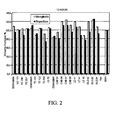
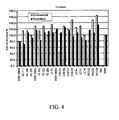
- FIG. 1-4 show yeasting power of bread-making yeast strains after 4 and 12 hours respectively in Mongibello hard wheat semola or commercial type.
- chopin alveographe kneader has been used for the preparation. Kneading time was 5 minutes.
- Previously selected microorganisms have been added to dough after broth culture centrifugation, supernatant elimination and 0,5 g pellet sampling; added amounts have been calculated as cell wet weight/g of yeast.
- Each test has been carried out by preparation of 10 small bars containing selected strains, one containing baker's yeast and one containing only physiological solution with 0.85 % NaCl and semola (control).
- yeast strains interesting with respect to yeasting quickness and appreciable aromatic modification induced in the dough after 24 hours to be identified. Then the yeast strains have been compared among them employing commercial hard wheat semola and using in each test a bread-making yeast as comparison and a control (dough without yeast) as shown in the following Table 3 and Figure 5 .
- Selected wine yeast strains have been compared, form point of view of their yeasting power, with two commercial starters; i.e. a national market available baker's yeast and a bread-making starter produced in China and sold in Asia and Europe.
- the tests have been carried out using experimental dough with the following composition: 500 g hard wheat semola, 250 ml water, 15 g sea salt, 3 g sugar added to 7.5 ml yeast paste at concentration of 1,0x10 10 cell/ml.
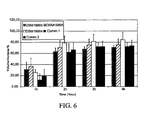
- Table 4 % Volumetric increase induced by yeast strains after 1 hour of incubation DSM 18866 DSM 18865 DSM 18864 CS 117 ZP1 21.81 37.78 26.09 6.52 2.13 34.04 15.22 21.74 36.17 13.73 57.39 52.36 24.44 13.04 19.57 36.75 51.06 36.52 25.12 20.44 28.82 35.87 29.31 11.74 23.38 21.74 26.12 21.74 7.93 36.96 median 31.43 36.82 25.27 12.39 20.00 S. d.
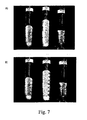
- the isolated yeast strains display interesting industrial characteristics. Particularly, during the first yeasting hour the yeasting power differences between DSM 18865 strain (TS60) and two commercial starters are particularly significant. In fact the dough obtained using DSM 18865 (TS60) strain has 20 % higher volume than those obtained using commercial yeasts ( Figure 7 ). Moreover during the second and until the fourth hour DSM 18864 (LS 250) named strain has shown a yeasting power higher than others with meaningful differences at the second hour.
Landscapes
- Life Sciences & Earth Sciences (AREA)
- Mycology (AREA)
- Engineering & Computer Science (AREA)
- Health & Medical Sciences (AREA)
- Chemical & Material Sciences (AREA)
- Bioinformatics & Cheminformatics (AREA)
- Microbiology (AREA)
- Organic Chemistry (AREA)
- Biotechnology (AREA)
- Zoology (AREA)
- Wood Science & Technology (AREA)
- Genetics & Genomics (AREA)
- Tropical Medicine & Parasitology (AREA)
- Biomedical Technology (AREA)
- Virology (AREA)
- Botany (AREA)
- Medicinal Chemistry (AREA)
- Biochemistry (AREA)
- General Engineering & Computer Science (AREA)
- General Health & Medical Sciences (AREA)
- Food Science & Technology (AREA)
- Micro-Organisms Or Cultivation Processes Thereof (AREA)
- Bakery Products And Manufacturing Methods Therefor (AREA)
- Meat, Egg Or Seafood Products (AREA)
- Jellies, Jams, And Syrups (AREA)
Claims (16)
- Levain (« starter ») microbien pour produits de boulangerie à base de souches de levure Saccharomyces cerevisiae, comprenant ou se composant d'au moins une des souches de levure sélectionnées dans le groupe composé de Saccharomyces cerevisiae DSM 18864, de Saccharomyces cerevisiae DSM 18865 et de Saccharomyces cerevisiae DSM 18866, ou d'une combinaison de celles-ci.
- Levain microbien selon la revendication 1, comprenant ou se composant d'une combinaison de Saccharomyces cerevisiae DSM 18864 et de Saccharomyces cerevisiae DSM 18865, ou de Saccharomyces cerevisiae DSM 18865 et de Saccharomyces cerevisiae DSM 18866.
- Levain microbien selon la revendication 1 ou 2, dans lequel les souches sont présentes selon un rapport de 1:1, avec une densité cellulaire de 1 x 10¹⁰ ufc/g au point de départ de la fermentation.
- Levain microbien selon l'une quelconque des revendications 1 à 3, dans lequel les souches se présentent sous une forme liquide, lyophilisée, congelée ou séchée.
- Utilisation du levain microbien selon l'une quelconque des revendications précédentes pour l'ensemencement de farine de blé et la production de produits de boulangerie, de préférence de pain.
- Utilisation selon la revendication 5, dans laquelle les farines de blé sont sélectionnées dans le groupe composé de la farine de semoule de blé dur, de la farine de blé tendre 0 et 00, ou de leurs mélanges.
- Utilisation selon la revendication 5 ou 6, dans laquelle la dose d'utilisation est égale à 1 % (en poids).
- Procédé de préparation du levain microbien pour produits de boulangerie tel que défini dans les revendications 1 à 4, comprenant les étapes suivantes consistant à :a) propager par culture au moins une des souches de levure sélectionnées dans le groupe composé de Saccharomyces cerevisiae DSM 18864, de Saccharomyces cerevisiae DSM 18865 et de Saccharomyces cerevisiae DSM 18866, ou d'une combinaison de celles-ci ;b) pétrir la farine de blé contenant la culture de souches bactériennes de l'étape a) selon une densité cellulaire de 1x10¹⁰ufc/g, avec un rapport des souches de 1:1 ;c) laisser la fermentation s'opérer pendant 1h15 à 1h30 heures entre 35 et 40 °C.
- Procédé selon la revendication 8, dans lequel la farine de blé est à 100 % de la farine de semoule de blé ou à 100 % de la farine de blé 00, ou à 80 % de la farine de semoule de blé et à 20 % de la farine de blé 0 ou 00, ou à 50 % de la farine de semoule de blé et à 50 % de la farine de blé 0 ou 00.
- Procédé selon la revendication 8 ou 9, dans lequel le % en poids d'eau dans la pâte de l'étape b) est compris entre 50 % et 60 %.
- Procédé selon l'une quelconque des revendications 8 à 10, comprenant en outre une étape d) pour sécher, lyophiliser, sécher ou émulsionner en phase liquide le levain obtenu à l'étape a).
- Composition de levain microbien pouvant être obtenue par le procédé tel que défini dans l'une quelconque des revendications 8 à 11.
- Procédé de préparation de produits de boulangerie, comprenant les étapes suivantes consistant à :a) pétrir la farine de blé avec de l'eau contenant l'inoculum de levain microbien pouvant être obtenu en utilisant le procédé tel que défini selon chacune des revendications 8 à 11;b) laisser la fermentation s'opérer pendant environ 1h15 à 1h30 entre 35 et 40°C;c) cuire pendant 40 à 50 minutes entre 220 et 240°C.
- Procédé selon la revendication 13, dans lequel la farine de blé est à 100 % de la farine de semoule de blé ou à 100 % de la farine de blé 00, ou à 80 % de la farine de semoule de blé et à 20 % de la farine de blé 0 ou 00, ou à 50 % de la farine de semoule de blé et à 50 % de la farine de blé 0 ou 00.
- Procédé selon la revendication 13 ou 14, dans lequel le pourcentage en poids d'eau dans la pâte de l'étape a) est compris entre 50 %et60%.
- Procédé selon l'une quelconque des revendications 13 à 15, dans lequel le produit de boulangerie est du pain.
Applications Claiming Priority (1)
| Application Number | Priority Date | Filing Date | Title |
|---|---|---|---|
| IT000317A ITRM20070317A1 (it) | 2007-06-06 | 2007-06-06 | Starter microbico per la panificazione. |
Publications (3)
| Publication Number | Publication Date |
|---|---|
| EP2000033A2 EP2000033A2 (fr) | 2008-12-10 |
| EP2000033A3 EP2000033A3 (fr) | 2009-09-30 |
| EP2000033B1 true EP2000033B1 (fr) | 2011-01-12 |
Family
ID=39789554
Family Applications (1)
| Application Number | Title | Priority Date | Filing Date |
|---|---|---|---|
| EP08425189A Not-in-force EP2000033B1 (fr) | 2007-06-06 | 2008-03-21 | Starter microbien, comprenant des souches de Saccharomyces cerevisiae, pour la panification |
Country Status (4)
| Country | Link |
|---|---|
| EP (1) | EP2000033B1 (fr) |
| AT (1) | ATE494786T1 (fr) |
| DE (1) | DE602008004381D1 (fr) |
| IT (1) | ITRM20070317A1 (fr) |
Cited By (1)
| Publication number | Priority date | Publication date | Assignee | Title |
|---|---|---|---|---|
| US10959439B2 (en) | 2015-05-22 | 2021-03-30 | Spc Co., Ltd | Natural yeast and lactic acid bacteria isolated from Korean traditional nuruk to be used for bakery |
Families Citing this family (2)
| Publication number | Priority date | Publication date | Assignee | Title |
|---|---|---|---|---|
| RU2463791C2 (ru) * | 2010-02-05 | 2012-10-20 | Татьяна Витальевна Кириева | Способ приготовления теста с использованием вторичного сырья |
| CN114644988B (zh) * | 2020-12-17 | 2023-05-12 | 中粮面业(海宁)有限公司 | 酿酒酵母、发酵剂及其制备方法和它们在制备发酵食品中的应用、发酵食品及其制备方法 |
-
2007
- 2007-06-06 IT IT000317A patent/ITRM20070317A1/it unknown
-
2008
- 2008-03-21 DE DE602008004381T patent/DE602008004381D1/de active Active
- 2008-03-21 EP EP08425189A patent/EP2000033B1/fr not_active Not-in-force
- 2008-03-21 AT AT08425189T patent/ATE494786T1/de not_active IP Right Cessation
Cited By (1)
| Publication number | Priority date | Publication date | Assignee | Title |
|---|---|---|---|---|
| US10959439B2 (en) | 2015-05-22 | 2021-03-30 | Spc Co., Ltd | Natural yeast and lactic acid bacteria isolated from Korean traditional nuruk to be used for bakery |
Also Published As
| Publication number | Publication date |
|---|---|
| EP2000033A2 (fr) | 2008-12-10 |
| DE602008004381D1 (de) | 2011-02-24 |
| ITRM20070317A1 (it) | 2008-12-07 |
| EP2000033A3 (fr) | 2009-09-30 |
| ATE494786T1 (de) | 2011-01-15 |
Similar Documents
| Publication | Publication Date | Title |
|---|---|---|
| Gül et al. | Sourdough bread production with lactobacilli and S. cerevisiae isolated from sourdoughs | |
| Plessas et al. | Bread making using kefir grains as baker’s yeast | |
| Coda et al. | Antifungal activity of Meyerozyma guilliermondii: identification of active compounds synthesized during dough fermentation and their effect on long-term storage of wheat bread | |
| Katina | Sourdough: a tool for the improved flavour, texture and shelf-life of wheat bread | |
| Corona et al. | Industrial application of selected lactic acid bacteria isolated from local semolinas for typical sourdough bread production | |
| Oshiro et al. | Impact of pH on succession of sourdough lactic acid bacteria communities and their fermentation properties | |
| KR101551839B1 (ko) | 한국 전통 누룩으로부터 분리한 제빵용 신규의 토종 천연 효모 및 토종 천연 유산균 | |
| KR101074340B1 (ko) | 신규 효모 및 그를 이용한 빵의 제조방법 | |
| KR101551836B1 (ko) | 한국 전통 누룩으로부터 분리한 제빵용 신규의 토종 천연 유산균 | |
| EP3443127B1 (fr) | Levures résistant au froid et leurs utilisations | |
| Parakhina et al. | Evaluation of selected lactic acid bacteria as starter cultures for gluten-free sourdough bread production | |
| KR101551837B1 (ko) | 한국 전통 누룩으로부터 분리한 제빵용 신규의 토종 천연 유산균 | |
| Jenson | Bread and baker’s yeast | |
| CN114644988B (zh) | 酿酒酵母、发酵剂及其制备方法和它们在制备发酵食品中的应用、发酵食品及其制备方法 | |
| EP2000033A2 (fr) | Starter microbien, comprenant des souches de Saccharomyces cerevisiae, pour la panification | |
| EP3301189B1 (fr) | Procédé moléculaire pour l'authentification de pains traditionnels / typiques au levain, amorces utilisées dans ledit procédé et kit contenant ces amorces | |
| Al-Khamaiseh et al. | Physicochemical and microbiological properties of Arabic flatbread produced from wild natural sour starters | |
| JP6462173B1 (ja) | 乳酸菌、パン類の製造方法、パン類生地及びパン類 | |
| KR101565541B1 (ko) | 한국 전통 누룩으로부터 분리한 제빵용 신규의 토종 천연 유산균 | |
| TWI674847B (zh) | 發酵麵糰、發酵麵糰的製造方法及麵包的製造方法 | |
| US20260026513A1 (en) | Stable liquid sourdough | |
| KR102383112B1 (ko) | 이취가 감소된 신규 사카로마이세스 세레비지에 le pain2021-1 균주 | |
| EP4403043A1 (fr) | Composition levante pour la production industrielle de produits cuits au four présentant d'excellentes propriétés organoleptiques | |
| Ivannikova et al. | The use of starter cultures of fermented products-kombucha tea mushroom and pickled cabbage brine in bread production | |
| Saikia et al. | Effect of using sourdough and frozen dough for preparation of breads on quality, shelf life and staling |
Legal Events
| Date | Code | Title | Description |
|---|---|---|---|
| PUAI | Public reference made under article 153(3) epc to a published international application that has entered the european phase |
Free format text: ORIGINAL CODE: 0009012 |
|
| AK | Designated contracting states |
Kind code of ref document: A2 Designated state(s): AT BE BG CH CY CZ DE DK EE ES FI FR GB GR HR HU IE IS IT LI LT LU LV MC MT NL NO PL PT RO SE SI SK TR |
|
| AX | Request for extension of the european patent |
Extension state: AL BA MK RS |
|
| PUAL | Search report despatched |
Free format text: ORIGINAL CODE: 0009013 |
|
| AK | Designated contracting states |
Kind code of ref document: A3 Designated state(s): AT BE BG CH CY CZ DE DK EE ES FI FR GB GR HR HU IE IS IT LI LT LU LV MC MT NL NO PL PT RO SE SI SK TR |
|
| AX | Request for extension of the european patent |
Extension state: AL BA MK RS |
|
| RIC1 | Information provided on ipc code assigned before grant |
Ipc: A21D 8/04 20060101AFI20081006BHEP Ipc: C12R 1/865 20060101ALI20090824BHEP |
|
| 17P | Request for examination filed |
Effective date: 20100301 |
|
| 17Q | First examination report despatched |
Effective date: 20100406 |
|
| AKX | Designation fees paid |
Designated state(s): AT BE BG CH CY CZ DE DK EE ES FI FR GB GR HR HU IE IS IT LI LT LU LV MC MT NL NO PL PT RO SE SI SK TR |
|
| GRAP | Despatch of communication of intention to grant a patent |
Free format text: ORIGINAL CODE: EPIDOSNIGR1 |
|
| GRAS | Grant fee paid |
Free format text: ORIGINAL CODE: EPIDOSNIGR3 |
|
| GRAA | (expected) grant |
Free format text: ORIGINAL CODE: 0009210 |
|
| AK | Designated contracting states |
Kind code of ref document: B1 Designated state(s): AT BE BG CH CY CZ DE DK EE ES FI FR GB GR HR HU IE IS IT LI LT LU LV MC MT NL NO PL PT RO SE SI SK TR |
|
| REG | Reference to a national code |
Ref country code: GB Ref legal event code: FG4D |
|
| REG | Reference to a national code |
Ref country code: CH Ref legal event code: EP |
|
| REG | Reference to a national code |
Ref country code: IE Ref legal event code: FG4D |
|
| REF | Corresponds to: |
Ref document number: 602008004381 Country of ref document: DE Date of ref document: 20110224 Kind code of ref document: P |
|
| REG | Reference to a national code |
Ref country code: DE Ref legal event code: R096 Ref document number: 602008004381 Country of ref document: DE Effective date: 20110224 |
|
| REG | Reference to a national code |
Ref country code: NL Ref legal event code: VDEP Effective date: 20110112 |
|
| LTIE | Lt: invalidation of european patent or patent extension |
Effective date: 20110112 |
|
| PG25 | Lapsed in a contracting state [announced via postgrant information from national office to epo] |
Ref country code: LT Free format text: LAPSE BECAUSE OF FAILURE TO SUBMIT A TRANSLATION OF THE DESCRIPTION OR TO PAY THE FEE WITHIN THE PRESCRIBED TIME-LIMIT Effective date: 20110112 Ref country code: HR Free format text: LAPSE BECAUSE OF FAILURE TO SUBMIT A TRANSLATION OF THE DESCRIPTION OR TO PAY THE FEE WITHIN THE PRESCRIBED TIME-LIMIT Effective date: 20110112 Ref country code: ES Free format text: LAPSE BECAUSE OF FAILURE TO SUBMIT A TRANSLATION OF THE DESCRIPTION OR TO PAY THE FEE WITHIN THE PRESCRIBED TIME-LIMIT Effective date: 20110423 Ref country code: NO Free format text: LAPSE BECAUSE OF FAILURE TO SUBMIT A TRANSLATION OF THE DESCRIPTION OR TO PAY THE FEE WITHIN THE PRESCRIBED TIME-LIMIT Effective date: 20110412 Ref country code: PT Free format text: LAPSE BECAUSE OF FAILURE TO SUBMIT A TRANSLATION OF THE DESCRIPTION OR TO PAY THE FEE WITHIN THE PRESCRIBED TIME-LIMIT Effective date: 20110512 Ref country code: GR Free format text: LAPSE BECAUSE OF FAILURE TO SUBMIT A TRANSLATION OF THE DESCRIPTION OR TO PAY THE FEE WITHIN THE PRESCRIBED TIME-LIMIT Effective date: 20110413 Ref country code: LV Free format text: LAPSE BECAUSE OF FAILURE TO SUBMIT A TRANSLATION OF THE DESCRIPTION OR TO PAY THE FEE WITHIN THE PRESCRIBED TIME-LIMIT Effective date: 20110112 Ref country code: SE Free format text: LAPSE BECAUSE OF FAILURE TO SUBMIT A TRANSLATION OF THE DESCRIPTION OR TO PAY THE FEE WITHIN THE PRESCRIBED TIME-LIMIT Effective date: 20110112 Ref country code: IS Free format text: LAPSE BECAUSE OF FAILURE TO SUBMIT A TRANSLATION OF THE DESCRIPTION OR TO PAY THE FEE WITHIN THE PRESCRIBED TIME-LIMIT Effective date: 20110512 |
|
| PG25 | Lapsed in a contracting state [announced via postgrant information from national office to epo] |
Ref country code: BE Free format text: LAPSE BECAUSE OF FAILURE TO SUBMIT A TRANSLATION OF THE DESCRIPTION OR TO PAY THE FEE WITHIN THE PRESCRIBED TIME-LIMIT Effective date: 20110112 Ref country code: SI Free format text: LAPSE BECAUSE OF FAILURE TO SUBMIT A TRANSLATION OF THE DESCRIPTION OR TO PAY THE FEE WITHIN THE PRESCRIBED TIME-LIMIT Effective date: 20110112 Ref country code: BG Free format text: LAPSE BECAUSE OF FAILURE TO SUBMIT A TRANSLATION OF THE DESCRIPTION OR TO PAY THE FEE WITHIN THE PRESCRIBED TIME-LIMIT Effective date: 20110412 Ref country code: PL Free format text: LAPSE BECAUSE OF FAILURE TO SUBMIT A TRANSLATION OF THE DESCRIPTION OR TO PAY THE FEE WITHIN THE PRESCRIBED TIME-LIMIT Effective date: 20110112 Ref country code: NL Free format text: LAPSE BECAUSE OF FAILURE TO SUBMIT A TRANSLATION OF THE DESCRIPTION OR TO PAY THE FEE WITHIN THE PRESCRIBED TIME-LIMIT Effective date: 20110112 Ref country code: FI Free format text: LAPSE BECAUSE OF FAILURE TO SUBMIT A TRANSLATION OF THE DESCRIPTION OR TO PAY THE FEE WITHIN THE PRESCRIBED TIME-LIMIT Effective date: 20110112 Ref country code: AT Free format text: LAPSE BECAUSE OF FAILURE TO SUBMIT A TRANSLATION OF THE DESCRIPTION OR TO PAY THE FEE WITHIN THE PRESCRIBED TIME-LIMIT Effective date: 20110112 Ref country code: CY Free format text: LAPSE BECAUSE OF FAILURE TO SUBMIT A TRANSLATION OF THE DESCRIPTION OR TO PAY THE FEE WITHIN THE PRESCRIBED TIME-LIMIT Effective date: 20110112 |
|
| PG25 | Lapsed in a contracting state [announced via postgrant information from national office to epo] |
Ref country code: MC Free format text: LAPSE BECAUSE OF NON-PAYMENT OF DUE FEES Effective date: 20110331 Ref country code: DK Free format text: LAPSE BECAUSE OF FAILURE TO SUBMIT A TRANSLATION OF THE DESCRIPTION OR TO PAY THE FEE WITHIN THE PRESCRIBED TIME-LIMIT Effective date: 20110112 Ref country code: EE Free format text: LAPSE BECAUSE OF FAILURE TO SUBMIT A TRANSLATION OF THE DESCRIPTION OR TO PAY THE FEE WITHIN THE PRESCRIBED TIME-LIMIT Effective date: 20110112 |
|
| PLBE | No opposition filed within time limit |
Free format text: ORIGINAL CODE: 0009261 |
|
| STAA | Information on the status of an ep patent application or granted ep patent |
Free format text: STATUS: NO OPPOSITION FILED WITHIN TIME LIMIT |
|
| PG25 | Lapsed in a contracting state [announced via postgrant information from national office to epo] |
Ref country code: CZ Free format text: LAPSE BECAUSE OF FAILURE TO SUBMIT A TRANSLATION OF THE DESCRIPTION OR TO PAY THE FEE WITHIN THE PRESCRIBED TIME-LIMIT Effective date: 20110112 Ref country code: RO Free format text: LAPSE BECAUSE OF FAILURE TO SUBMIT A TRANSLATION OF THE DESCRIPTION OR TO PAY THE FEE WITHIN THE PRESCRIBED TIME-LIMIT Effective date: 20110112 Ref country code: SK Free format text: LAPSE BECAUSE OF FAILURE TO SUBMIT A TRANSLATION OF THE DESCRIPTION OR TO PAY THE FEE WITHIN THE PRESCRIBED TIME-LIMIT Effective date: 20110112 |
|
| 26N | No opposition filed |
Effective date: 20111013 |
|
| PG25 | Lapsed in a contracting state [announced via postgrant information from national office to epo] |
Ref country code: MT Free format text: LAPSE BECAUSE OF FAILURE TO SUBMIT A TRANSLATION OF THE DESCRIPTION OR TO PAY THE FEE WITHIN THE PRESCRIBED TIME-LIMIT Effective date: 20110112 Ref country code: IT Free format text: LAPSE BECAUSE OF FAILURE TO SUBMIT A TRANSLATION OF THE DESCRIPTION OR TO PAY THE FEE WITHIN THE PRESCRIBED TIME-LIMIT Effective date: 20110112 |
|
| REG | Reference to a national code |
Ref country code: IE Ref legal event code: MM4A |
|
| PG25 | Lapsed in a contracting state [announced via postgrant information from national office to epo] |
Ref country code: IE Free format text: LAPSE BECAUSE OF NON-PAYMENT OF DUE FEES Effective date: 20110321 |
|
| REG | Reference to a national code |
Ref country code: DE Ref legal event code: R097 Ref document number: 602008004381 Country of ref document: DE Effective date: 20111013 |
|
| REG | Reference to a national code |
Ref country code: CH Ref legal event code: PL |
|
| GBPC | Gb: european patent ceased through non-payment of renewal fee |
Effective date: 20120321 |
|
| PG25 | Lapsed in a contracting state [announced via postgrant information from national office to epo] |
Ref country code: CH Free format text: LAPSE BECAUSE OF NON-PAYMENT OF DUE FEES Effective date: 20120331 Ref country code: GB Free format text: LAPSE BECAUSE OF NON-PAYMENT OF DUE FEES Effective date: 20120321 Ref country code: LI Free format text: LAPSE BECAUSE OF NON-PAYMENT OF DUE FEES Effective date: 20120331 |
|
| PG25 | Lapsed in a contracting state [announced via postgrant information from national office to epo] |
Ref country code: LU Free format text: LAPSE BECAUSE OF NON-PAYMENT OF DUE FEES Effective date: 20110321 |
|
| PG25 | Lapsed in a contracting state [announced via postgrant information from national office to epo] |
Ref country code: TR Free format text: LAPSE BECAUSE OF FAILURE TO SUBMIT A TRANSLATION OF THE DESCRIPTION OR TO PAY THE FEE WITHIN THE PRESCRIBED TIME-LIMIT Effective date: 20110112 |
|
| PG25 | Lapsed in a contracting state [announced via postgrant information from national office to epo] |
Ref country code: HU Free format text: LAPSE BECAUSE OF FAILURE TO SUBMIT A TRANSLATION OF THE DESCRIPTION OR TO PAY THE FEE WITHIN THE PRESCRIBED TIME-LIMIT Effective date: 20110112 |
|
| REG | Reference to a national code |
Ref country code: FR Ref legal event code: PLFP Year of fee payment: 8 |
|
| PGFP | Annual fee paid to national office [announced via postgrant information from national office to epo] |
Ref country code: DE Payment date: 20150324 Year of fee payment: 8 |
|
| PGFP | Annual fee paid to national office [announced via postgrant information from national office to epo] |
Ref country code: FR Payment date: 20150323 Year of fee payment: 8 |
|
| REG | Reference to a national code |
Ref country code: DE Ref legal event code: R119 Ref document number: 602008004381 Country of ref document: DE |
|
| REG | Reference to a national code |
Ref country code: FR Ref legal event code: ST Effective date: 20161130 |
|
| PG25 | Lapsed in a contracting state [announced via postgrant information from national office to epo] |
Ref country code: DE Free format text: LAPSE BECAUSE OF NON-PAYMENT OF DUE FEES Effective date: 20161001 Ref country code: FR Free format text: LAPSE BECAUSE OF NON-PAYMENT OF DUE FEES Effective date: 20160331 |