EP2000233A1 - Verfahren, Werkzeug und Vorrichtung zur Herstellung von Gussstücken - Google Patents
Verfahren, Werkzeug und Vorrichtung zur Herstellung von Gussstücken Download PDFInfo
- Publication number
- EP2000233A1 EP2000233A1 EP08157806A EP08157806A EP2000233A1 EP 2000233 A1 EP2000233 A1 EP 2000233A1 EP 08157806 A EP08157806 A EP 08157806A EP 08157806 A EP08157806 A EP 08157806A EP 2000233 A1 EP2000233 A1 EP 2000233A1
- Authority
- EP
- European Patent Office
- Prior art keywords
- core
- expendable
- expendable core
- orienting
- previous
- Prior art date
- Legal status (The legal status is an assumption and is not a legal conclusion. Google has not performed a legal analysis and makes no representation as to the accuracy of the status listed.)
- Withdrawn
Links
Images




Classifications
-
- B—PERFORMING OPERATIONS; TRANSPORTING
- B22—CASTING; POWDER METALLURGY
- B22C—FOUNDRY MOULDING
- B22C9/00—Moulds or cores; Moulding processes
- B22C9/10—Cores; Manufacture or installation of cores
- B22C9/108—Installation of cores
-
- B—PERFORMING OPERATIONS; TRANSPORTING
- B25—HAND TOOLS; PORTABLE POWER-DRIVEN TOOLS; MANIPULATORS
- B25J—MANIPULATORS; CHAMBERS PROVIDED WITH MANIPULATION DEVICES
- B25J15/00—Gripping heads and other end effectors
- B25J15/08—Gripping heads and other end effectors having finger members
- B25J15/10—Gripping heads and other end effectors having finger members with three or more finger members
Definitions
- the present invention relates to the field of chill casting of articles, such as for instance light alloy pistons for internal combustion engines.
- the present invention concerns a method, a tool and an apparatus for loading expendable cores into a chill mould.
- expendable cores may be in particular, but not necessarily, ring-shaped salt cores.
- a currently known method of manufacturing pistons for internal combustion engines is making such pistons of aluminium or other light alloys by means of chill casting, thereby obtaining the so-called "cast pistons".
- Such pistons require a considerable cooling, and thus it is known to form cooling channels on or within them, by introducing one or more rings of a salt (e.g. sodium chloride suitably compacted and prepared) into the chill mould.
- a salt e.g. sodium chloride suitably compacted and prepared
- Such salt rings form expendable cores that, after casting, are dissolved thereby leaving hollow channels inside the cast piston.
- a method currently used for preventing the casting of fluid metal under pressure from displacing the salt core within the mould provides for making salt rings like ring 1 shown in accompanying Figures 1 to 3 , i.e. a ring having two positioning holes 3, and for placing such a ring into the chill mould after having heated the ring up to some hundred degrees. Both holes 3 of the salt ring are fitted onto two positioning pegs (not shown) provided in the mould cavity.
- an operator takes the salt ring from the heating furnace, by using protecting gloves and pincers or other manual tools, and places them into the chill mould through a wholly manual operation.
- Italian Patent Application No. T02006A000217 discloses a method, a tool and an apparatus for automating the loading and positioning of salt cores into the mould.
- Application No. T02006A000217 discloses, among other things, a holding tool having mechanical pincers for seizing and handling ring-shaped salt cores.
- a holding tool can be secured to the wrist of an anthropomorphic robot and can be used by the latter to take ring-shaped salt cores from a heating and orienting station.
- the salt cores, stacked together are heated in tubular heating furnaces.
- a salt core is taken from the tubular furnace by seizing it with one of the mechanical pincers and is correctly oriented with the help of a camera before being introduced into the mould.
- Such a system allows performing orientation and loading into the mould of the salt cores in automatic manner, with a higher degree of process automation and a higher yield than in the wholly manual loading described above, but it has still some drawbacks.
- the above object is achieved by the method of manufacturing castings having the features set forth in claim 1.
- the expendable core is oriented by coupling an orienting portion thereof with a corresponding orienting portion of an orienting support, by mutually engaging the orienting portions in the expendable core and the orienting support through a male-female coupling.
- the method comprises the steps of:
- such a method comprises the step of accumulating a plurality of orienting supports in an area of an orienting and heating station, located upstream the heating area, where salt cores waiting to be heated and/or introduced into the chill mould are loaded onto the orienting supports.
- such a method comprises the steps of:
- the expendable core is transferred from the orienting support to the chill mould while keeping the same orientation as that the expendable core has on the orienting support.
- such a method comprises the step of seizing an expendable core by a holding tool, which has holding elements arranged to seize and hold the expendable core by applying a substantially elastic holding force thereto.
- such holding elements include a resilient element chosen from the following group: a spring, a leaf spring, an element of elastomeric material.
- such a method comprises the steps of:
- such a method comprises the step of seizing the expendable core by means of the holding elements while the expendable core is being introduced in the second retaining seat.
- such a method comprises the step of limiting the deformations of the expendable core by means of the second retaining seat.
- said holding tool is equipped with an ejector and the method comprises the step of removing an expendable core from the second retaining seat by operating the ejector.
- the loading device of said apparatus is equipped with said holding tool.
- said apparatus includes a heating system arranged to heat the expendable core up to a temperature in the range 0°C to about 800°C, or in the range 0°C to about 600°C or in the range 0°C to about 800°C.
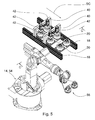
- the apparatus for loading expendable cores depicted in Fig. 4 and generally denoted 10 comprises an orienting and heating station, generally denoted 12, and a loading device, generally denoted 14.
- Loading device 14 takes salt rings 1, previously heated at station 12, and automatically introduces them into a chill mould, which is mounted on the casting plant 26 ( Fig. 4 ).
- orienting and heating station 12 includes a pallet conveyor 16, including in turn sliding guides 18, known per se and obtained from commercially available section bars, and a plurality of pallets 20 ( Fig. 5 ).
- Pallets 20 slide along guides 18 in a sliding direction shown by arrow SC in Figs. 4 and 5 , and move from a so-called orienting area ZOR towards a so-called heating area ZRISC ( Fig. 4 ); when in the latter area, pallets 20 are lowered and are brought back to orienting area ZOR by sliding below guides 18 along further guides, not shown, whereby they run along a closed loop path.
- Each pallet 20 has a base 22, which in the present exemplary embodiment is obtained from a metal plate, and two orienting supports 24, secured to base 22 ( Fig. 6 ).
- Each orienting support 24 comprises a stationary portion 26 and a moving portion 28.
- stationary portion 26 is made as a substantially rigid support that is firmly secured to base 22 and that defines, at its top, a male head 30 on which an expendable core, in particular a substantially ring-shaped salt core 1, can be placed.
- Two reference pegs 31 are provided on male head 30, at such positions that they can fit into positioning holes 3 of expendable core 1.
- Moving portion 28 includes instead a female top plate 32, in the present example in the shape of an annular flange, a bottom plate 34 and a plurality of guide pins 36 that connect female top plate 32 and bottom plate 34 together and, by sliding in suitable seats in stationary portion 26, allow moving portion 28 to slide relative to stationary portion 26.
- Female top plate 32 defines a female seat 33 arranged to fit onto male head 30 and to receive and keep in position an expendable core, in particular a ring-shaped salt core 1.
- Female seat 33 and male head 30 define a hollow seat 35, herein referred to as "retaining seat 35", also arranged to receive and keep in position an expendable core 1.
- moving portion 28 is constantly pushed upwards by a spring 38.
- station 12 is equipped, at heating area ZRISC, with a plurality of portal frames 40 ( fig. 5 ).
- a plurality of actuators 42 in the present example, hydraulic or pneumatic actuators, are secured to frames 40.
- Each said actuator 42 moves a heating element 44 by lowering and raising it, as it will described in more detail below.
- Each heating element has a heating flange 46 and a male portion 48 arranged to penetrate into a corresponding female seat 50 formed on male head 30 of stationary portion 26 of each pallet 20.
- orienting and heating station 12 is equipped with two portal frames 40, arranged after one another.
- Sliding guides 18 extend upstream heating area ZRISC, in particular upstream portal frames 40, by such an extent that they allow accumulating a number of pallets 20, thereby forming said orienting area ZOR.
- sliding guides 18 are arranged at such a height that they form a work plane for an operator, e.g. at the height of a conventional worktable or bench. Jointly with an orienting area ZOR allowing accumulating a sufficient number of pallets 20, this allows an operator to easily manually load expendable cores 1 onto pallets 20, without being rigidly linked to the production cadence of the apparatus.
- such an operator besides loading cores 1, also has sufficient time to check, by operating alone, the operation of both orienting and heating station 12 and loading device 14.
- An operator loads ring-shaped salt cores 1 by manually placing them, at ambient temperature, onto pallets 20 located in orienting area ZOR.
- the operator introduces cores 1 into retaining seats 35, which in this operation phase are formed each by a male head 30 and the corresponding female top plate 32 in raised position, by introducing reference pegs 31 into holes 3 of salt core 1.
- the salt core is placed onto pallet 20 with a precise, predetermined orientation.
- Pallets 20 proceed along guides 18 as long as they reach heating area ZRISC and heating elements 44 of the first, upstream frame 40 are directly above a predetermined pallet. At this point, said heating elements 44 are lowered onto such pallet, so that male portions 48 are inserted into the corresponding female portions 50 in the concerned pallet.
- heating element 44 When a heating element 44 is lowered onto a pallet 20, flange 46 of heating element 44 is in contact with salt core 1 only.
- Suitable force limiting means in actuator 42 stop the stroke thereof when the push of the corresponding heating element 44 attains a predetermined threshold value, so as to prevent the relatively fragile salt core 1 from being damaged.
- actuator 42 continues pushing element 44 against salt core 1 with a suitable force.
- heating element 44 for instance electrical resistors, produce heat thereby heating salt core 1, mainly by thermal conduction or irradiation, up to a first desired target temperature.
- heating elements 44 of upstream portal frame 40 are raised, the concerned pallet moves forward and reaches downstream portal frame 40, where a second heating cycle, similar to that performed in upstream portal frame 40, is performed, so as to bring the temperature of the concerned salt core up to a second predetermined target value, e.g. up to about 350 - 400*C.
- heating element 44 compresses the salt ring perpendicularly to the plane of the ring itself. This ensures a more precise planarity, and more generally a better retention of salt core 1 within its seat 35 in orienting support 24, thereby substantially eliminating or considerably limiting deformations salt core 1 would otherwise undergo during heating. Actually, due to the temperatures of some hundred degrees attained during heating, salt core 1 expands and plasticizes inside retaining seat 35, which however always preserves the shape of core 1. Another important contribution to such a retaining function is given by female seat 33 of top plate 32 in each orienting support 24, provided such seat is sized with sufficiently reduced coupling tolerance with respect to expendable core 1.
- heating elements 44 of downstream portal frame 40 are raised, the concerned pallet is moved forward and it reaches taking position 52 ( Fig. 4 ), where loading device 14 takes the heated salt cores in order to load them into the chill mould, as it will be described in more detail below.
- loading device 14 includes an anthropomorphic robot 54 ( Fig. 5 ), the wrist of which has secured thereto a holding tool 56, shown in more detail in Figs. 8 to 10 .
- holding tool 56 comprises two identical holding heads 60 and a supporting plate 58, which is secured to the wrist of the robot arm and on which both heads 60 are secured.
- Each holding head 60 has a head body 62 housing a sliding ejector 64, the body and the ejector being shown separate and in exploded view of Fig. 10 .
- head body 62 is secured to support plate 58 by means of a plurality of recovery springs 66 and a plurality of guide pins or pegs 68. Thanks to springs 66 and pins or pegs 68, the head body 62 is not rigidly fixed onto support plate 58, but it can be displaced to a certain extent relative to said plate along the sliding direction of ejector 64 (arrow DA in Fig. 9 ) or generally along the predetermined approaching direction of heads 60 to a salt ring 1 to be taken from an orienting support 24 (arrow DA in Fig. 9 ). This allows at least partly compensating for the tolerances of the different chill moulds, when holding heads 60 place the salt rings thereinto.
- Head body 62 has, on its front portion, a holding area that, in the present exemplary embodiment, in turn comprises an annular projection or edge 70 and a plurality of holding elements 72.
- Annular projection or edge 70 is interrupted at intervals, so as to form a plurality of annular sectors extending around the head of ejector 64.
- said head is substantially dish shaped.
- Holding elements 72 which in the present exemplary embodiment are made of leaf springs of music wire, are located at the areas where annular edge 70 is interrupted and thus they substantially form a crown.
- Annular edge 70 and the head of ejector 64 define a concave seat 76, herein also referred to as "second retaining seat 76", arranged to receive an expendable core, in particular a salt ring 1 ( Fig. 9 ).
- ejector 64 has substantially the shape of an axially symmetrical slide or stem and it can slide longitudinally of head body 62 when operated by a suitable actuator 74, comprising a fluid-operated (pneumatic or hydraulic) cylinder.
- anthropomorphic robot 54 is positioned so that holding heads 60 are located above and coaxially with two respective orienting supports 24 in orienting and heating station 12, each said support having loaded thereon a salt core 1 having ended the previously described heating cycle.
- Holding heads 60 are lowered onto orienting supports 24 so that the annular edge of each head 60 lowers female top plate 32 of the respective orienting support 24 and that, at the same time, male head 30 and salt core 1 supported by it are introduced into said concave seat 76 in holding head 60.
- holding springs 72 arranged to slightly interfere with salt ring 1, are fitted into the latter and retain it by adherence.
- annular edge 70 of each head 60 has such tolerances that it suitably accommodates possible deformations of salt ring 1 due to the cooling while the ring is transferred from heating area ZRISC to the chill mould.
- robot 54 places salt cores 1 into the chill mould loaded onto the casting plant 26 ( Fig. 4 ).
- the robot is so programmed that salt cores 1 are introduced into the chill mould with the same orientation as that previously imposed by reference pegs 31 in orienting supports 24 ( Fig. 7 ): thus salt core 1, during the introduction into the mould, is fitted onto a second pair of centring pegs (not shown) provided in the chill mould and preferably having the same orientation as centring pegs 31 in orienting supports 24.
- the precision of the robot displacements allows maintaining the salt core orientation imposed by orienting supports 24.
- actuator 74 In order to release salt core 1 into the chill mould, actuator 74 is operated and it makes ejector 64 leave the remainder of head body 62: in this manner, ejector 64 pushes the salt core and releases it from the hold of springs 72.
- Robot 54 than removes its arm from the chill mould and is available for repeating another loading cycle.
- An advantage of the previously described apparatus is the possibility of loading expendable cores, in particular salt cores, into a chill mould with a predetermined and precise orientation, while keeping relatively low the percentage of broken or damaged cores or generally of cores that are not perfectly loaded into the mould, even in case of relatively fragile ring-shaped salt cores and even if such cores are to be fitted onto reference pegs in the mould with centring tolerances of few tenths of a millimetre.
- an apparatus according to the present invention allows keeping the percentage of ring-shaped salt cores broken or incorrectly loaded into the mould below 5%, whilst the current wholly manual methods result in a percentage of broken or incorrectly loaded ring-shaped salt cores of about 20%.
- the previously described apparatus results in the above loading efficiency notwithstanding the need to preheat the salt cores to some hundred degrees.
- a feature that is believed to assist in limiting the percentage of broken expendable cores is the use, for seizing the salt core, of holding elements 72 in place for instance of relatively rigid mechanical fingers operated by actuators. Actually, it appears for instance that often a ring-shaped salt core grasped by the mechanical fingers of the apparatus disclosed in Italian Patent Application No. T02006A000217 slips out, moves or is deformed or crumbled by the fingers themselves. On the contrary, it appears that holding springs, or other holding elements, 72, better fit to the salt cores when holding them.
- the previously described apparatus is more robust and resistant to the aggressive environment existing in a foundry, is less subjected to apparatus stops and requires a reduced maintenance: Such an apparatus is moreover simpler, more reliable and cheaper.
- loading device 14 can include a Cartesian robot in place of an anthropomorphic one, or still other taking and loading mechanical devices.
- Holding tool 56 can be equipped with a number of holding heads 60 even different from two, and more particularly it may include only one, four or clearly yet another number of holding heads.
- Holding elements 72 need not to be made by leaf springs, but clearly they can be made in different ways, e.g. they may be elements of elastomeric materials, mechanical fingers, hooks, balls or articulated pins contrasted by springs.
- mechanical elements can seize a flattened expendable core not only from the outside while pressing it perpendicularly to the core plane, as shown in the embodiment of Figs.
- one or more than one holding element 72 can be provided in each holding tool 56, or in each holding head 60.
- the coupling of holes 3 in expendable core 1 with pegs 31 in orienting supports 24 can be replaced by other kinds of male-female couplings, for instance projection - indentation.
Landscapes
- Engineering & Computer Science (AREA)
- Mechanical Engineering (AREA)
- Robotics (AREA)
- Organic Low-Molecular-Weight Compounds And Preparation Thereof (AREA)
- Molds, Cores, And Manufacturing Methods Thereof (AREA)
Applications Claiming Priority (1)
| Application Number | Priority Date | Filing Date | Title |
|---|---|---|---|
| ITTO20070406 ITTO20070406A1 (it) | 2007-06-08 | 2007-06-08 | Metodo, attrezzo e impianto per la produzione di getti di fusione |
Publications (1)
| Publication Number | Publication Date |
|---|---|
| EP2000233A1 true EP2000233A1 (de) | 2008-12-10 |
Family
ID=39739459
Family Applications (1)
| Application Number | Title | Priority Date | Filing Date |
|---|---|---|---|
| EP08157806A Withdrawn EP2000233A1 (de) | 2007-06-08 | 2008-06-06 | Verfahren, Werkzeug und Vorrichtung zur Herstellung von Gussstücken |
Country Status (2)
| Country | Link |
|---|---|
| EP (1) | EP2000233A1 (de) |
| IT (1) | ITTO20070406A1 (de) |
Citations (2)
| Publication number | Priority date | Publication date | Assignee | Title |
|---|---|---|---|---|
| US4008748A (en) * | 1974-10-23 | 1977-02-22 | Dansk Industri Syndikat A/S | Method of inserting cores in a sand mold |
| DE4322181A1 (de) * | 1993-06-29 | 1995-01-12 | Hottinger Adolf Masch | Vorrichtung und Verfahren zum Greifen eines Gießereikerns, insbesondere eines Sohlenkerns |
-
2007
- 2007-06-08 IT ITTO20070406 patent/ITTO20070406A1/it unknown
-
2008
- 2008-06-06 EP EP08157806A patent/EP2000233A1/de not_active Withdrawn
Patent Citations (2)
| Publication number | Priority date | Publication date | Assignee | Title |
|---|---|---|---|---|
| US4008748A (en) * | 1974-10-23 | 1977-02-22 | Dansk Industri Syndikat A/S | Method of inserting cores in a sand mold |
| DE4322181A1 (de) * | 1993-06-29 | 1995-01-12 | Hottinger Adolf Masch | Vorrichtung und Verfahren zum Greifen eines Gießereikerns, insbesondere eines Sohlenkerns |
Also Published As
| Publication number | Publication date |
|---|---|
| ITTO20070406A1 (it) | 2008-12-09 |
Similar Documents
| Publication | Publication Date | Title |
|---|---|---|
| US6054075A (en) | Insert molding method and apparatus therefor | |
| CN205148322U (zh) | 一种注塑镶嵌、埋入和取出机械手 | |
| CN111644840B (zh) | 一种变频器端子及卡簧的自动装配装置 | |
| EP3769884A1 (de) | Hand zum auswechseln einer spannfutterklaue, verfahren zum automatischen auswechseln einer spannfutterklaue und system zum automatischen auswechseln einer klaue | |
| US8511136B2 (en) | Gripper assembly for a manipulator and method of use | |
| EP3237130A1 (de) | Form für elemente von bimetallischen heizkörpern und entsprechendes verfahren | |
| JP4950720B2 (ja) | 鋳造装置及び鋳造方法 | |
| EP3950238A1 (de) | Vorrichtung zum öffnen/schliessen | |
| CN214291779U (zh) | 一种机器人组模拆模机构 | |
| CN116786740B (zh) | 一种铝合金锻件自动化生产线 | |
| US9718122B2 (en) | Apparatus for producing a piston | |
| JP3102368U (ja) | 垂直プレス用のダイキャスト装置 | |
| US20080106017A1 (en) | Part holding device | |
| JP2000197936A (ja) | トランスファ装置 | |
| CN205466259U (zh) | 导向销折断防止机构 | |
| CN214163061U (zh) | 一种自动装配线机器人用抓持机构 | |
| EP3950217A1 (de) | Verfahren zum einrichten eines arbeitsplatzes zum bearbeiten von profilstäben, insbesondere aus aluminium, leichtlegierungen, pvc oder dergleichen | |
| WO2022107948A1 (ko) | Pvd 코팅 후 언로딩 장비에서의 웨이브 형상 초경인서트 회수 시스템 | |
| CN217263140U (zh) | 机械手自动夹持机构 | |
| JP4195161B2 (ja) | タイヤ製造用コアの分解組付け方法および装置 | |
| ITTO20070406A1 (it) | Metodo, attrezzo e impianto per la produzione di getti di fusione | |
| JP6354606B2 (ja) | 組付装置 | |
| CN214920158U (zh) | 压力机工件温度精确检测装置 | |
| CN217452071U (zh) | 一种压铸机的自动化取料装置 | |
| JP2020007189A (ja) | 成形型の分解組立装置及び成形装置 |
Legal Events
| Date | Code | Title | Description |
|---|---|---|---|
| PUAI | Public reference made under article 153(3) epc to a published international application that has entered the european phase |
Free format text: ORIGINAL CODE: 0009012 |
|
| AK | Designated contracting states |
Kind code of ref document: A1 Designated state(s): AT BE BG CH CY CZ DE DK EE ES FI FR GB GR HR HU IE IS IT LI LT LU LV MC MT NL NO PL PT RO SE SI SK TR |
|
| AX | Request for extension of the european patent |
Extension state: AL BA MK RS |
|
| AKX | Designation fees paid | ||
| REG | Reference to a national code |
Ref country code: DE Ref legal event code: 8566 |
|
| STAA | Information on the status of an ep patent application or granted ep patent |
Free format text: STATUS: THE APPLICATION IS DEEMED TO BE WITHDRAWN |
|
| 18D | Application deemed to be withdrawn |
Effective date: 20090611 |