EP2004902B1 - Tissu ignifuge - Google Patents
Tissu ignifuge Download PDFInfo
- Publication number
- EP2004902B1 EP2004902B1 EP07758424A EP07758424A EP2004902B1 EP 2004902 B1 EP2004902 B1 EP 2004902B1 EP 07758424 A EP07758424 A EP 07758424A EP 07758424 A EP07758424 A EP 07758424A EP 2004902 B1 EP2004902 B1 EP 2004902B1
- Authority
- EP
- European Patent Office
- Prior art keywords
- fabric
- flame retardant
- filaments
- yarns
- textile product
- Prior art date
- Legal status (The legal status is an assumption and is not a legal conclusion. Google has not performed a legal analysis and makes no representation as to the accuracy of the status listed.)
- Active
Links
Images

Classifications
-
- D—TEXTILES; PAPER
- D06—TREATMENT OF TEXTILES OR THE LIKE; LAUNDERING; FLEXIBLE MATERIALS NOT OTHERWISE PROVIDED FOR
- D06M—TREATMENT, NOT PROVIDED FOR ELSEWHERE IN CLASS D06, OF FIBRES, THREADS, YARNS, FABRICS, FEATHERS OR FIBROUS GOODS MADE FROM SUCH MATERIALS
- D06M15/00—Treating fibres, threads, yarns, fabrics, or fibrous goods made from such materials, with macromolecular compounds; Such treatment combined with mechanical treatment
- D06M15/19—Treating fibres, threads, yarns, fabrics, or fibrous goods made from such materials, with macromolecular compounds; Such treatment combined with mechanical treatment with synthetic macromolecular compounds
- D06M15/37—Macromolecular compounds obtained otherwise than by reactions only involving carbon-to-carbon unsaturated bonds
- D06M15/667—Macromolecular compounds obtained otherwise than by reactions only involving carbon-to-carbon unsaturated bonds containing phosphorus in the main chain
- D06M15/673—Macromolecular compounds obtained otherwise than by reactions only involving carbon-to-carbon unsaturated bonds containing phosphorus in the main chain containing phosphorus and nitrogen in the main chain
-
- A—HUMAN NECESSITIES
- A41—WEARING APPAREL
- A41D—OUTERWEAR; PROTECTIVE GARMENTS; ACCESSORIES
- A41D31/00—Materials specially adapted for outerwear
- A41D31/04—Materials specially adapted for outerwear characterised by special function or use
- A41D31/08—Heat resistant; Fire retardant
-
- D—TEXTILES; PAPER
- D06—TREATMENT OF TEXTILES OR THE LIKE; LAUNDERING; FLEXIBLE MATERIALS NOT OTHERWISE PROVIDED FOR
- D06B—TREATING TEXTILE MATERIALS USING LIQUIDS, GASES OR VAPOURS
- D06B3/00—Passing of textile materials through liquids, gases or vapours to effect treatment, e.g. washing, dyeing, bleaching, sizing, impregnating
- D06B3/10—Passing of textile materials through liquids, gases or vapours to effect treatment, e.g. washing, dyeing, bleaching, sizing, impregnating of fabrics
- D06B3/18—Passing of textile materials through liquids, gases or vapours to effect treatment, e.g. washing, dyeing, bleaching, sizing, impregnating of fabrics combined with squeezing, e.g. in padding machines
- D06B3/185—Passing of textile materials through liquids, gases or vapours to effect treatment, e.g. washing, dyeing, bleaching, sizing, impregnating of fabrics combined with squeezing, e.g. in padding machines below the bath level
-
- D—TEXTILES; PAPER
- D06—TREATMENT OF TEXTILES OR THE LIKE; LAUNDERING; FLEXIBLE MATERIALS NOT OTHERWISE PROVIDED FOR
- D06M—TREATMENT, NOT PROVIDED FOR ELSEWHERE IN CLASS D06, OF FIBRES, THREADS, YARNS, FABRICS, FEATHERS OR FIBROUS GOODS MADE FROM SUCH MATERIALS
- D06M11/00—Treating fibres, threads, yarns, fabrics or fibrous goods made from such materials, with inorganic substances or complexes thereof; Such treatment combined with mechanical treatment, e.g. mercerising
- D06M11/58—Treating fibres, threads, yarns, fabrics or fibrous goods made from such materials, with inorganic substances or complexes thereof; Such treatment combined with mechanical treatment, e.g. mercerising with nitrogen or compounds thereof, e.g. with nitrides
- D06M11/59—Treating fibres, threads, yarns, fabrics or fibrous goods made from such materials, with inorganic substances or complexes thereof; Such treatment combined with mechanical treatment, e.g. mercerising with nitrogen or compounds thereof, e.g. with nitrides with ammonia; with complexes of organic amines with inorganic substances
- D06M11/60—Ammonia as a gas or in solution
-
- D—TEXTILES; PAPER
- D06—TREATMENT OF TEXTILES OR THE LIKE; LAUNDERING; FLEXIBLE MATERIALS NOT OTHERWISE PROVIDED FOR
- D06M—TREATMENT, NOT PROVIDED FOR ELSEWHERE IN CLASS D06, OF FIBRES, THREADS, YARNS, FABRICS, FEATHERS OR FIBROUS GOODS MADE FROM SUCH MATERIALS
- D06M13/00—Treating fibres, threads, yarns, fabrics or fibrous goods made from such materials, with non-macromolecular organic compounds; Such treatment combined with mechanical treatment
- D06M13/244—Treating fibres, threads, yarns, fabrics or fibrous goods made from such materials, with non-macromolecular organic compounds; Such treatment combined with mechanical treatment with compounds containing sulfur or phosphorus
- D06M13/282—Treating fibres, threads, yarns, fabrics or fibrous goods made from such materials, with non-macromolecular organic compounds; Such treatment combined with mechanical treatment with compounds containing sulfur or phosphorus with compounds containing phosphorus
- D06M13/285—Phosphines; Phosphine oxides; Phosphine sulfides; Phosphinic or phosphinous acids or derivatives thereof
-
- D—TEXTILES; PAPER
- D06—TREATMENT OF TEXTILES OR THE LIKE; LAUNDERING; FLEXIBLE MATERIALS NOT OTHERWISE PROVIDED FOR
- D06M—TREATMENT, NOT PROVIDED FOR ELSEWHERE IN CLASS D06, OF FIBRES, THREADS, YARNS, FABRICS, FEATHERS OR FIBROUS GOODS MADE FROM SUCH MATERIALS
- D06M15/00—Treating fibres, threads, yarns, fabrics, or fibrous goods made from such materials, with macromolecular compounds; Such treatment combined with mechanical treatment
- D06M15/19—Treating fibres, threads, yarns, fabrics, or fibrous goods made from such materials, with macromolecular compounds; Such treatment combined with mechanical treatment with synthetic macromolecular compounds
- D06M15/37—Macromolecular compounds obtained otherwise than by reactions only involving carbon-to-carbon unsaturated bonds
- D06M15/667—Macromolecular compounds obtained otherwise than by reactions only involving carbon-to-carbon unsaturated bonds containing phosphorus in the main chain
-
- D—TEXTILES; PAPER
- D06—TREATMENT OF TEXTILES OR THE LIKE; LAUNDERING; FLEXIBLE MATERIALS NOT OTHERWISE PROVIDED FOR
- D06M—TREATMENT, NOT PROVIDED FOR ELSEWHERE IN CLASS D06, OF FIBRES, THREADS, YARNS, FABRICS, FEATHERS OR FIBROUS GOODS MADE FROM SUCH MATERIALS
- D06M2200/00—Functionality of the treatment composition and/or properties imparted to the textile material
- D06M2200/30—Flame or heat resistance, fire retardancy properties
-
- Y—GENERAL TAGGING OF NEW TECHNOLOGICAL DEVELOPMENTS; GENERAL TAGGING OF CROSS-SECTIONAL TECHNOLOGIES SPANNING OVER SEVERAL SECTIONS OF THE IPC; TECHNICAL SUBJECTS COVERED BY FORMER USPC CROSS-REFERENCE ART COLLECTIONS [XRACs] AND DIGESTS
- Y10—TECHNICAL SUBJECTS COVERED BY FORMER USPC
- Y10T—TECHNICAL SUBJECTS COVERED BY FORMER US CLASSIFICATION
- Y10T442/00—Fabric [woven, knitted, or nonwoven textile or cloth, etc.]
- Y10T442/20—Coated or impregnated woven, knit, or nonwoven fabric which is not [a] associated with another preformed layer or fiber layer or, [b] with respect to woven and knit, characterized, respectively, by a particular or differential weave or knit, wherein the coating or impregnation is neither a foamed material nor a free metal or alloy layer
- Y10T442/2631—Coating or impregnation provides heat or fire protection
- Y10T442/2648—Coating or impregnation is specified as an intumescent material
-
- Y—GENERAL TAGGING OF NEW TECHNOLOGICAL DEVELOPMENTS; GENERAL TAGGING OF CROSS-SECTIONAL TECHNOLOGIES SPANNING OVER SEVERAL SECTIONS OF THE IPC; TECHNICAL SUBJECTS COVERED BY FORMER USPC CROSS-REFERENCE ART COLLECTIONS [XRACs] AND DIGESTS
- Y10—TECHNICAL SUBJECTS COVERED BY FORMER USPC
- Y10T—TECHNICAL SUBJECTS COVERED BY FORMER US CLASSIFICATION
- Y10T442/00—Fabric [woven, knitted, or nonwoven textile or cloth, etc.]
- Y10T442/20—Coated or impregnated woven, knit, or nonwoven fabric which is not [a] associated with another preformed layer or fiber layer or, [b] with respect to woven and knit, characterized, respectively, by a particular or differential weave or knit, wherein the coating or impregnation is neither a foamed material nor a free metal or alloy layer
- Y10T442/2631—Coating or impregnation provides heat or fire protection
- Y10T442/2672—Phosphorus containing
-
- Y—GENERAL TAGGING OF NEW TECHNOLOGICAL DEVELOPMENTS; GENERAL TAGGING OF CROSS-SECTIONAL TECHNOLOGIES SPANNING OVER SEVERAL SECTIONS OF THE IPC; TECHNICAL SUBJECTS COVERED BY FORMER USPC CROSS-REFERENCE ART COLLECTIONS [XRACs] AND DIGESTS
- Y10—TECHNICAL SUBJECTS COVERED BY FORMER USPC
- Y10T—TECHNICAL SUBJECTS COVERED BY FORMER US CLASSIFICATION
- Y10T442/00—Fabric [woven, knitted, or nonwoven textile or cloth, etc.]
- Y10T442/20—Coated or impregnated woven, knit, or nonwoven fabric which is not [a] associated with another preformed layer or fiber layer or, [b] with respect to woven and knit, characterized, respectively, by a particular or differential weave or knit, wherein the coating or impregnation is neither a foamed material nor a free metal or alloy layer
- Y10T442/2861—Coated or impregnated synthetic organic fiber fabric
- Y10T442/2869—Coated or impregnated regenerated cellulose fiber fabric
-
- Y—GENERAL TAGGING OF NEW TECHNOLOGICAL DEVELOPMENTS; GENERAL TAGGING OF CROSS-SECTIONAL TECHNOLOGIES SPANNING OVER SEVERAL SECTIONS OF THE IPC; TECHNICAL SUBJECTS COVERED BY FORMER USPC CROSS-REFERENCE ART COLLECTIONS [XRACs] AND DIGESTS
- Y10—TECHNICAL SUBJECTS COVERED BY FORMER USPC
- Y10T—TECHNICAL SUBJECTS COVERED BY FORMER US CLASSIFICATION
- Y10T442/00—Fabric [woven, knitted, or nonwoven textile or cloth, etc.]
- Y10T442/30—Woven fabric [i.e., woven strand or strip material]
- Y10T442/3976—Including strand which is stated to have specific attributes [e.g., heat or fire resistance, chemical or solvent resistance, high absorption for aqueous composition, water solubility, heat shrinkability, etc.]
-
- Y—GENERAL TAGGING OF NEW TECHNOLOGICAL DEVELOPMENTS; GENERAL TAGGING OF CROSS-SECTIONAL TECHNOLOGIES SPANNING OVER SEVERAL SECTIONS OF THE IPC; TECHNICAL SUBJECTS COVERED BY FORMER USPC CROSS-REFERENCE ART COLLECTIONS [XRACs] AND DIGESTS
- Y10—TECHNICAL SUBJECTS COVERED BY FORMER USPC
- Y10T—TECHNICAL SUBJECTS COVERED BY FORMER US CLASSIFICATION
- Y10T442/00—Fabric [woven, knitted, or nonwoven textile or cloth, etc.]
- Y10T442/60—Nonwoven fabric [i.e., nonwoven strand or fiber material]
- Y10T442/696—Including strand or fiber material which is stated to have specific attributes [e.g., heat or fire resistance, chemical or solvent resistance, high absorption for aqueous compositions, water solubility, heat shrinkability, etc.]
Definitions
- the present invention relates to a high performance textile fabric and to garments produced from such a fabric. More particularly, the invention relates to a flame retardant textile fabric suited for use in producing close-fitting garments, such as undergarments, that come into direct contact with the skin of the wearer and provide a protective function.
- the textile fabric is also has applicability for use in various non-apparel applications.
- Garments of this type can be used by the military, police, firefighters, and in sporting applications.
- the garments must be comfortable, breathable and must have good moisture wicking properties so that perspiration is wicked away from the skin.
- the fabric must be capable of being produced either as a white fabric or of being dyed in a variety of bright lightfast colors. Another important criterion is that the garment must be flame retardant.
- Nomex® fiber produced by DuPont is widely used in flame retardant fabrics because of its inherent flame retardant properties.
- fabrics made from this fiber are uncomfortable in hot environments and next to the skin.
- the fiber is available only in a limited number of producer-dyed colors and has an inherent yellow color.
- the requisite moisture wicking properties and skin contact comfort characteristics are achieved with a textile fabric formed of yarns of rayon continuous filaments.
- a fabric formed from continuous filament rayon yarns is superior to one produced from staple fiber rayon yarns in terms of processability, tenacity and most importantly, in low-friction characteristics.
- Fabrics of continuous filament rayon yarns are smooth and slick, with a low friction coefficient so that they do not tend to chafe.
- the fabrics are softer and more supple than fabrics from spun staple fibers, providing better conformability to the body.
- the continuous filament yarns can be produced in much finer sizes than staple fiber yarns, permitting fabrics of lower weights than is practical with staple fiber yarns.
- the present invention is based upon the recognition that a textile fabric formed from yarns of continuous filament rayon behaves differently than a fabric formed from staple fiber rayon when subjected to a flame retardant treatment process using a phosphorus-based flame retardant compound.
- a flame retardant treatment process using a phosphorus-based flame retardant compound.
- flame retardant textile products in accordance with the present invention comprise a fabric formed of yarns of rayon continuous filaments, the yarns having outer filaments along the periphery of the yarn and inner filaments in the interior of the yarn, a cured phosphorus-based flame retardant compound durably affixed to the filaments and imparting flame retardant properties to the fabric, and wherein the outer filaments of the yarns have a phosphorus content at least 25% greater than the inner filaments.
- the outer filaments have a phosphorus content at least 40% greater than the inner filaments.
- the cured phosphorus-based flame retardant compound is a hydroxymethyl phosphonium compound.
- the present invention provides a textile product having flame retardant properties and comprising a woven or knitted fabric formed of yarns of rayon continuous filaments.
- the yarns have outer filaments along the periphery of the yarn and inner filaments in the interior of the yarn, and a cured insoluble hydroxymethyl phosphonium flame retardant compound is present on the fabric at an add-on level of at least 20% by weight of the fabric imparting flame retardant properties to the fabric.
- the outer filaments of the yarns are adhered to one another by the cured insoluble flame retardant compound.
- the outer filaments of the yarns have a phosphorus content at least 25% greater than the inner filaments. It has been observed that certain fabrics treated in accordance with the present invention have a cantilever stiffness pursuant to ASTM D 1388 option A that is at least 25% greater in the filling direction than in the warp direction.
- the present invention also provides a garment for direct contact with the skin of a wearer, the garment having hydrophilic properties for wicking moisture away from the skin of the wearer and having low friction properties to avoid chafing.
- the garment comprises a woven or knitted fabric formed of yarns of rayon continuous filaments, the yarns having outer filaments along the periphery of the yarn and inner filaments in the interior of the yarn.
- a cured phosphorus-based flame retardant compound is durably affixed to the filaments and imparts flame retardant properties to the fabric.
- the outer filaments of the yarns have a phosphorus content at least 25% greater than the inner filaments.
- the present invention provides a method of treating a textile product to impart flame retardant properties, comprising the steps of: providing a fabric formed of yarns of rayon continuous filaments, the yarns having outer filaments along the periphery of the yarn and inner filaments in the interior of the yarn; directing the fabric into and through a pad bath containing a phosphorus-based flame retardant compound; compressing the fabric with a first set of cooperating rolls to force the flame retardant compound into the fabric and to impregnate the yarns of the fabric; subsequently compressing the fabric with a second set of cooperating rolls to effect a second forcing of the flame retardant compound into the fabric and to impart an additional impregnation of the yarns of the fabric by the flame retardant compound so that the outer filaments of the yarns have a phosphorus content at least 25% greater than the inner filaments; and curing the flame retardant compound on the fabric to render it insoluble and durably affixed to the fabric.
- the textile products and fabrics described herein comprise rayon continuous filaments.
- the term "rayon” refers to regenerated cellulose fiber produced by any of a number of available processes which involve chemically converting cellulose into a soluble form, extruding through a spinneret to form filaments, and then solidifying.
- Non-limiting examples include viscose rayon, high wet modulus rayon, cuprammonium rayon and saponified acetate rayon.
- cellulosic textile fibers produced by a solvent process, such as lyocell and Tencel®.
- polynosic rayon which has a very high degree of orientation, achieved as a result of very high stretching (up to 300 %) during processing.
- Polynosic rayon filaments have a unique fibrillar structure, high dry and wet strength, low elongation (8 to 11 %), relatively low water retention and very high wet modulus.
- the textile products of the present invention are produced from yarns formed from continuous filament rayon, as opposed to spun yarns produced from staple fiber rayon.
- the filaments making up a continuous filament rayon yam extend generally parallel to one another along the length of the yam and tend to be packed or bunched closely together.
- Continuous filament rayon yarns used in the present invention preferably have very low twist, typically from 0 to no more than 3 tpi (turns per inch).
- the fabrics are formed from singles yarns, although for some fabric constructions plied yarns may be used.
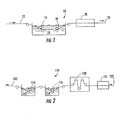
- a flame retardant treatment process 10 in accordance with one embodiment of the present invention is illustrated.
- a fabric 12 formed of yarns of continuous filament rayon is directed from a supply source (not shown), such as a roll of fabric, and is fed around rollers or similar devices and into a pad bath 14 containing a phosphorus-based retardant treatment composition.
- the treatment composition contains a hydroxymethyl phosphonium composition, such as a bath of THP, THPOH, or THPOH-urea precondensate.
- THP hydroxymethyl phosphonium composition
- the fabric remains immersed in the treatment solution after the initial dip-squeeze treatment and again becomes thoroughly saturated with the treatment composition. It then passes through the nip of a second cooperating pair of rolls 18 which again squeeze the fabric and force the treatment composition into the fabric. The fabric then emerges from the pad bath 14 and is directed to a curing operation.
- the rolls 16, 18 may be located above the surface of the treatment solution in the pad bath and the fabric 12 may be directed by one or more immersed guide rolls so as to be dipped repeatedly into the pad bath 14 to undergo the two successive dip-squeeze treatments.
- a first amount of hydroxymethyl phosphonium compound is added onto the rayon continuous filaments based upon the first dip-squeeze treatment, and a second amount of hydroxymethyl phosphonium compound is added onto the rayon continuous filaments based upon the second dip-squeeze treatment.
- the flame retardant treatment process 110 is carried out in two separate, successively arranged pad baths 114 and 114'. While the two pad baths could contain the same treatment composition, this embodiment makes it possible to treat the fabric with two different treatment compositions, differing in concentration, composition, or both.
- the rolls 116 of the first pad bath 114 and the rolls 118 of the second pad bath 114' are submerged in the treatment solution.
- the rolls 116 and 118 may be located above the surface of the treatment solution in the pad bath and the fabric 112 may be dipped into the treatment solution by use of submerged guide rolls.
- FIG. 1 illustrates an oven 20 which cures the treatment composition by exposure to heat.
- the treated fabric 22 may then be subjected to subsequent fabric finishing steps as is conventional.
- FIG. 2 illustrates an ammonia cure process which passes the fabric 112 through an ammonia chamber 120 to expose the uncured composition to gaseous ammonia, bringing about a reaction that cures or polymerizes the treatment composition.
- the fabric 2 additionally illustrates a neutralizing chamber 121 that neutralizes the fabric subsequent to the curing of the add-on of the hydroxymethyl phosphonium solution.
- the fabric may thereafter be directed through one or more additional operations (not shown) such as washing, etc. Subsequently, the fabric is directed through a dryer or tenter frame (not shown) which dries the fabric.
- the cured, dry flame retardant fabric 122 may then be suitably collected for subsequent use.
- a first pad bath is filled with a treatment solution containing 150 pounds of THPOH-urea precondensate (Guardex FR-TP, 75% solids from Guardex, Inc. Thomasville, NC), 9 pounds of wetting agent (Guardex WT-TPS) and 140 pounds of water.
- a second pad bath is filled with a treatment solution of identical composition to the first pad bath.
- Filament rayon warp knit fabric (7.0 ounces per square yard) is padded through the two pad baths in succession attaining 27.4% solids add-on by weight after the second dip-squeeze treatment.
- the impregnated fabric is exposed to gaseous ammonia by passing through two successive gaseous ammonia chambers. Chamber temperatures were maintained at 85 to 130° F.
- the treated fabric is then afterwashed open-width by passing through one or more baths containing peroxide to insolubize the phosphorus-containing flame retardant. Next, the fabric is neutralized. The fabric is then placed on a tenter frame and dried.
- the add-on of 27.4% by weight achieved by this process is considerably higher than the levels attained using the one-step treatment process conventionally used for fabrics formed from cotton yarns.
- the same fabric when subjected to a single dip-squeeze treatment achieved only a 15% add-on.
- Fabrics in accordance with the present invention may suitably contain the cured insoluble phosphorus-containing polymer the add-on levels achieved by the process of the present invention without adverse affects on the properties of the fabric.
- the cured insoluble polymer adheres filaments within the yarn to one another, but does not undesirably affect the softness, suppleness or hydrophilic wicking properties of the fabric.
- Analysis of the fabric treated by this process also reveals that the distribution of the phosphorus-containing compound within the yarns of the fabric is distinctly different from the distribution achieved using a conventional one step treatment process.
- FIG. 3 is a cross-sectional view of a fabric formed of yarns of continuous filament rayon having been subjected to the treatment process of the present invention.
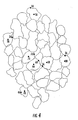
- FIG. 4 is a cross-sectional view at a higher magnification showing the individual filaments of a single yarn.
- the numbers 1 to 7 in FIG. 4 represent the locations of individual filaments where samples were taken for analysis of percent phosphorus content (%P).
- the numbers 1 to 4 identify four filaments located at the outer periphery of the yarn.
- the numbers 5 to 7 identify three filaments located in the interior or core of the yarn. For each of the filament locations 1 to 7, two analyses were made, one at the surface of filament, indicated by "A" and one at the interior or core of the individual filament, indicated by "B". These locations are represented by the dots shown on the respective filaments.
- Table 1 is a chart showing the %P values taken from these analyses.
- Table 1 %P for Rayon Continuous Filament Yarn After Dip-squeeze, Dip-squeeze Process of the Present Invention Outer Filaments Inner Filaments Data Point Skin Core Skin Core 1 3.6 4.6 2 5.2 4.7 3 5.2 6.8 4 6.5 5.9 5 1.9 2.7 6 5.2 4.3 7 2.4 4.6 Avg. 5.1 5.5 3.2 3.9
- Table 7 combines the average for all six tests.
- Table 2 %P for Rayon Continuous Filament Yarn After Single Dip-squeeze Process Outer Filaments Inner Filaments Data Point Skin Core Skin Core 1 1.5 2.5 2 1.2 1.8 3 3.6 1.6 4 1.6 2.1 5 2.2 2.5 Avg. 2.1 2.0 1.9 2.3
- Table 3 %P for Spun Staple Fiber Rayon Yarn After Dip-squeeze, Dip-squeeze Process Outer Fibers Inner Fibers Data Point Skin Core Skin Core 1 5.2 7.7 2 3.5 6.8 3 7.2 7.0 4 6.7 6.3 5 4.2 6.0 Avg.
- the rayon continuous filament yarns have a %P add-on of approximately 2.1 (average of 2.1, 2.0, 1.9, and 2.3) after a single dip-squeeze process and have a %P add-on of approximately 4.4 (average of 5.1, 5.5, 3.2, and 3.9) after the dip-squeeze, dip-squeeze process, an increase of about 113%.
- This increase from 2.1 to 4.4 was unexpected since standard single dip-squeeze processes afford diminished returns as the material becomes increasingly saturated.
- the spun rayon fabric exhibited expected results wherein the additional phosphorus added to the fabric as a result of two successive dip-squeeze treatments was comparatively lower. Analysis of the data in Tables 3 and 4 for the spun rayon yarns reveals that the %P was increased from an average of 4.85 to 6.05, an increase of only 25%.
- test data revealed that the treatment process of the present invention resulted in a markedly different distribution of the phosphorus within the yam of the fabric as compared to the single dip-squeeze process.
- Table 2 reveals that the phosphorus content of the filaments at the surface of the yam was not significantly different from the filaments in the interior of the yarn.
- the continuous filament rayon fabric subjected to the dip-squeeze, dip-squeeze process of the present invention had a significantly greater add-on of phosphorus on the outer filaments of the yam as compared to the inner filaments.
- Table 1 shows that the outer filaments of the yam treated according to process of the present invention had an average %P of 5.3 which was more than 40% greater than the average %P for the inner filaments (%P of 3.55).
- the outer and inner filaments of the yarn did not differ significantly in phosphorus content.
- Continuous filament rayon yarns processed with the flame resistance treatment process of the present invention are characterized by the outer filaments of the yam having a significantly greater phosphorus content than the interior filaments of the yarn.
- the outer filaments along the periphery of the yarn have a phosphorus content at least 25% greater than that of the interior filaments of the yarn, and more preferably at least 40% greater.
- stiffness data was collected to determine the effect on stiffness that the add-on of hydroxymethyl phosphonium provides.
- Table 8 below provides stiffness data for each of the six tested fabrics. The stiffness tests were preformed in accordance with the American Society for Testing and Materials (ASTM) process D 1388 Option A by the Cantilever Drape Method at a 45 degree angle. The ASTM D 1388 test procedure is incorporated by reference herein. The stiffness value is reported in inches with the higher values indicating greater stiffness. The stiffness was measured in both the warp direction and the filling direction and the results listed below are each the average of five data points.
- ASTM American Society for Testing and Materials
- Table 8 Stiffness Data (in Inches) in the Warp Direction and the Filling Direction for Six Fabrics Fiber Warp Filling Dip-squeeze, Dip-squeeze Rayon Filament 0.854 1.3624 Dip-squeeze Rayon Filament 0.702 0.7874 Dip-squeeze, Dip-squeeze Spun Rayon 1.929 1.830 Dip-squeeze Spun Rayon 1.762 1.684 Dip-squeeze, Dip-squeeze Spun Cotton 1.761 1.278 Dip-squeeze Spun Cotton 1.309 0.856
- Table 8 reflects the general expectation that the stiffness in both the warp and filling directions for each of the three types of fabrics would increase from the dip-squeeze process of the prior art to the dip-squeeze, dip-squeeze process of the present invention. However, it was observed that for the particular fabric specimen tested, the stiffness in the filling direction was increased significantly more by the dip-squeeze, dip-squeeze process of the invention as compared to the single dip-squeeze treatment. This difference in stiffness in the warp direction and filling direction was not expected.
- the dip-squeeze, dip-squeeze process of the present invention affords satisfactory flame retardant properties while having an overall stiffness (average of both the warp direction stiffness and filling direction stiffness) that is less than spun rayon fabrics that have undergone a single dip-squeeze process and that is generally comparable to spun cotton that has undergone a single dip-squeeze process.
- Fabrics of continuous filament rayon yarns due to the filamentary nature, are well suited for certain garment layers, such as undergarments or clean room apparel for example. Such garments exhibit hydrophilic and low-friction properties to provide a comfortable "second skin” or other garment that directly contacts the user's skin. It is important for such undergarments to have suitable flame resistance properties, particularly for use in certain applications such as firefighting and the military. Fabrics of rayon continuous filament yam treated by the flame retardant treatment processes of the present invention are well suited for such garments and are significantly more comfortable and affordable than similar flame retardant garments made of KEVLAR ® or NOMEX ® .
- Textile products treated by the flame retardant treatment process of embodiments of the present invention exhibit flame resistant properties that meet or exceed the ASTM F 1506-98 performance specification for flame resistance of textile materials for use in certain applications.
- the disclosure of the ASTM F 1506-98 specification is incorporated by reference herein.
- the textile products of rayon continuous filament yarns treated by the flame retardant treatment process of embodiments of the present invention satisfy the flammability requirements of the ASTM F 1506-98 specification, either initially or after 25 washes or dry cleanings, when tested in accordance with FTMS 191A, Method 5903.1.
- FTMS 191A, Method 5903.1 was adopted into the ASTM D 6413-99 specification (see section 5.4 of ASTM D 6413-99) for a standard test method for flame resistance of textiles (vertical test), the disclosure of which is incorporated by reference herein.
- the flame retardant treatment process of various embodiments of the present invention are used to treat woven fabrics of rayon continuous filament yarns such that the woven fabrics comply with the flammability requirements of Table 1 of ASTM F 1506-98.
- the flame retardant fabric of the present invention can also be used in a variety of non-apparel applications where it is desired to improve the resistance of articles to burning.
- the fabric may be used as a barrier layer on mattresses, box springs, cushions, pillows, comforters and upholstered furniture, either as an outer cover or ticking, or as a protective under-layer beneath an outer upholstery fabric layer.
- the fabrics can be advantageously employed on such products to improve the resistance to flame for meeting governmental regulations on flammability.
- textile products in accordance with some embodiments of the present invention may be used as apparel requiring high-visibility for safety.
- Textile products treated by the flame retardant treatment process of embodiments of the present invention can also include dyes that meet or exceed the performance requirements provided in the American National Standard for High-Visibility Safety Apparel and Headwear standard ANSI/ISEA 107-2004, which is incorporated by reference herein.
- the dye is applied to the textile product to define a chromaticity, luminance, colorfastness, and/or minimum coefficient of retroreflection (for Level 1 retroreflective or combined-performance material) that comply with the respective requirements of ANSI/ISEA 107-2004.
Landscapes
- Engineering & Computer Science (AREA)
- Textile Engineering (AREA)
- Chemical & Material Sciences (AREA)
- Chemical Kinetics & Catalysis (AREA)
- Inorganic Chemistry (AREA)
- Woven Fabrics (AREA)
- Treatments For Attaching Organic Compounds To Fibrous Goods (AREA)
- Chemical Or Physical Treatment Of Fibers (AREA)
- Fireproofing Substances (AREA)
- Yarns And Mechanical Finishing Of Yarns Or Ropes (AREA)
Claims (16)
- Un produit textile ayant des propriétés ignifuges, le produit textile comprenant un tissu formé de fils de filaments continus de rayon, les fils ayant des filaments extérieurs le long de la périphérie du fil et des filaments intérieurs à l'intérieur du fil, un composé ignifuge durci et à base de phosphore, fixé durablement aux filaments et donnant des propriétés ignifuges au tissu, et dans quel cas les filaments extérieurs des fils ont une teneur en phosphore qui est au moins 25 % plus élevée que dans les filaments intérieurs.
- Produit textile selon la revendication 1, les filaments extérieurs ayant une teneur en phosphore qui est au moins 40 % plus élevée que dans les filaments intérieurs.
- Produit textile selon la revendication 1 ou 2, les filaments continus de rayon sont du viscosereyon.
- Produit textile selon l'une des revendications 1 à 3, le composé ignifuge durci et à base de phosphore est un composé de hydroxyméthylphosphonate.
- Produit textile selon la revendication 4, le composé durci de hydroxyméthylphosphonate étant durci à l'ammoniac.
- Produit textile selon la revendication 4, le composé de hydroxyméthylphosphonate durci étant durci au chaud.
- Produit textile selon la revendication 4, le composé de hydroxyméthylphosphonate durci étant un polymère insoluble, dérivé de THPOH et se trouve sur le tissu à une teneur d'au moins 20 %-en poids par rapport au poids du tissu (add-on level).
- Produit textile selon l'une des revendications 1 à 7, dans quel cas les filaments extérieurs des fils adhèrent les uns aux autres grâce au composé ignifuge durci et insoluble.
- Produit textile selon l'une des revendications 1 à 8, le tissu étant un tissu tissé ou tricoté fabriqué en forme d'un habit.
- Produit textile selon l'une des revendications 1 à 8, le tissu étant un tissu tissé, formé de chaînes de liage entrecroisées et de fils de fourrure, et le tissu ayant une raideur mesurée d'après le principe de torsion qui se présente lors d'un serrage unilatéral du tissu sous son poids propre (cantilever stiffness) selon ASTM D 1388, option A qui est au moins 25 % plus élevée en direction de fourrure qu'en direction de chaîne de liage.
- Produit textile selon l'une des revendications 1 à 10 qui a été coloré avec un colorant qui donne au tissu une chromaticité et une luminance qui satisfont aux conditions standard de fidélité de ANSI/ISEA 107-2004.
- Produit textile selon l'une des revendications 1 à 11 en forme d'un tissu couvrant un matelas pour être utilisé pour un matelas.
- Procédé de traitement d'un produit textile pour lui conférer des propriétés ignifuges, le procédé comprenant les étapes suivantes :Mettre à disposition un tissu formé de fils de filaments continus de rayon, les fils ayant des filaments extérieurs le long de la périphérie du fil et des filaments intérieurs à l'intérieur du fil,diriger le tissu dans et à travers un bain pad (pat bath), contenant un composé ignifuge à base de phosphore,comprimer le tissu avec un premier set de cylindres coopérants pour forcer le composé ignifuge dans le tissu et pour imprégner les fils du tissu,comprimer ensuite le tissu avec un deuxième set de cylindres coopérants, afin de forcer une deuxième fois le composé ignifuge dans le tissu et de soumettre les fils du tissu à une deuxième imprégnation par le composé ignifuge, de sorte que les filaments extérieurs aient une teneur en phosphore au moins 25 % plus élevée que les filaments intérieurs ; etdurcir le composé ignifuge sur le tissu pour le rendre insoluble et pour le fixer durablement au tissu.
- Procédé selon la revendication 13, le composé ignifuge à base de phosphore étant un composé de phosphonium hydroxyméthylé et l'étape de durcissement produisant un polymère insoluble qui est présent dans le tissu en une teneur d'au moins 20 % en poids, par rapport au poids du tissu (add-on level).
- Procédé selon les revendications 13 ou 14, l'étape de durcissement comprenant le passage du tissu à travers une chambre d'ammoniac gazeux et exposant le tissu imprégné à l'ammoniac gazeux.
- Procédé selon la revendication 13 ou 14, l'étape de durcissement comprenant le chauffage du tissu.
Applications Claiming Priority (2)
| Application Number | Priority Date | Filing Date | Title |
|---|---|---|---|
| US11/389,783 US7915185B2 (en) | 2006-03-27 | 2006-03-27 | Flame retardant textile fabric |
| PCT/US2007/063872 WO2007117837A1 (fr) | 2006-03-27 | 2007-03-13 | Tissu ignifuge |
Publications (2)
| Publication Number | Publication Date |
|---|---|
| EP2004902A1 EP2004902A1 (fr) | 2008-12-24 |
| EP2004902B1 true EP2004902B1 (fr) | 2009-07-22 |
Family
ID=38420512
Family Applications (1)
| Application Number | Title | Priority Date | Filing Date |
|---|---|---|---|
| EP07758424A Active EP2004902B1 (fr) | 2006-03-27 | 2007-03-13 | Tissu ignifuge |
Country Status (15)
| Country | Link |
|---|---|
| US (3) | US7915185B2 (fr) |
| EP (1) | EP2004902B1 (fr) |
| CN (1) | CN101454501B (fr) |
| AT (1) | ATE437263T1 (fr) |
| AU (1) | AU2007235099B2 (fr) |
| BR (1) | BRPI0709685A2 (fr) |
| CA (1) | CA2646827C (fr) |
| DE (1) | DE602007001691D1 (fr) |
| DK (1) | DK2004902T3 (fr) |
| ES (1) | ES2330590T3 (fr) |
| IL (1) | IL194437A (fr) |
| MX (1) | MX2008012586A (fr) |
| PT (1) | PT2004902E (fr) |
| TW (1) | TWI318250B (fr) |
| WO (1) | WO2007117837A1 (fr) |
Families Citing this family (10)
| Publication number | Priority date | Publication date | Assignee | Title |
|---|---|---|---|---|
| GB0813401D0 (en) * | 2008-07-22 | 2008-08-27 | Waxman Fibres Ltd | Flame resistant fibre blends |
| US9499936B2 (en) | 2009-09-16 | 2016-11-22 | Mount Vernon Mills, Inc. | Flame retardant, cotton/thermoset fabrics |
| AT510909B1 (de) * | 2010-12-20 | 2013-04-15 | Chemiefaser Lenzing Ag | Flammgehemmte cellulosische man-made-fasern |
| US20120198670A1 (en) * | 2011-02-07 | 2012-08-09 | Han-Soon Park | Method of flame-retardant treating blend fabric |
| US9386816B2 (en) * | 2012-02-14 | 2016-07-12 | International Textile Group, Inc. | Fire resistant garments containing a high lubricity thermal liner |
| CN103290593B (zh) * | 2013-05-13 | 2015-02-04 | 上海特安纶纤维有限公司 | 一种含有短纤维共混物的耐磨阻燃舒适型织物及其应用 |
| US10405594B2 (en) | 2015-05-21 | 2019-09-10 | International Textile Group, Inc. | Inner lining fabric |
| CN110725041B (zh) * | 2018-07-16 | 2021-03-16 | 北京赛欧兰阻燃纤维有限公司 | 一种焊接防飞溅面料及其制备方法 |
| CN108950942A (zh) * | 2018-08-29 | 2018-12-07 | 江苏百护纺织科技有限公司 | 一种纯棉阻燃防护服的制备方法 |
| CA3131032A1 (fr) | 2019-02-22 | 2020-08-27 | Jess Black Inc. | Tissu double face de structure tricotee resistant au feu |
Family Cites Families (28)
| Publication number | Priority date | Publication date | Assignee | Title |
|---|---|---|---|---|
| GB934066A (en) | 1961-03-08 | 1963-08-14 | Linen Ind Res Ass | Improvements in making fabrics non-flammable |
| US3607356A (en) | 1968-10-04 | 1971-09-21 | Us Agriculture | Imparting flame resistance to fibrous textiles from an alkaline medium |
| US3846155A (en) | 1972-04-17 | 1974-11-05 | Hooker Chemical Corp | Flame retardant process for cellulosics |
| US4137346A (en) | 1972-04-17 | 1979-01-30 | Hooker Chemicals & Plastics Corp. | Flame retarding process for proteinaceous material |
| US3936585A (en) | 1973-12-05 | 1976-02-03 | Robert Bruce Leblanc | Fire retarding textile materials |
| US4000551A (en) * | 1975-01-15 | 1977-01-04 | Crimpfil Limited | Production of bulky yarns |
| US4045173A (en) | 1975-11-18 | 1977-08-30 | The United States Of America As Represented By The Secretary Of Agriculture | Textiles flame retarded with hydroxymethylphosphorus compounds in combination with poly(ethyleneureas) and poly(N-methylolethyleneureas) |
| US4095945A (en) * | 1976-07-23 | 1978-06-20 | Toyo Boseki Kabushiki Kaisha | Process for treating textile articles |
| US4154878A (en) * | 1977-09-23 | 1979-05-15 | Cotton Incorporated | No-dry process of applying phosphonium salt precondensates to textiles |
| US5135541A (en) | 1986-10-13 | 1992-08-04 | Albright & Wilson Limited | Flame retardant treatment of cellulose fabric with crease recovery: tetra-kis-hydroxy-methyl phosphonium and methylolamide |
| GB8713224D0 (en) * | 1987-06-05 | 1987-07-08 | Albright & Wilson | Textile treatment |
| GB9309617D0 (en) | 1993-05-11 | 1993-06-23 | Courtaulds Fibres Ltd | Fibre production process |
| GB9416616D0 (en) | 1994-08-17 | 1994-10-12 | Courtaulds Fibres Holdings Ltd | Cellulosic textile materials |
| FR2770232B1 (fr) * | 1997-10-27 | 2000-01-14 | Rhodia Ag Rhone Poulenc | Procede de preparation d'une fibre ou d'un fil de cellulose regeneree |
| US6789228B1 (en) * | 1998-05-07 | 2004-09-07 | Medical Consumer Media | Method and system for the storage and retrieval of web-based education materials |
| US6488718B1 (en) | 1998-11-13 | 2002-12-03 | Cotton Incorporated | Methods for reducing the flammability of cellulosic substrates |
| US6146759A (en) | 1999-09-28 | 2000-11-14 | Land Fabric Corporation | Fire resistant corespun yarn and fabric comprising same |
| US6735789B2 (en) | 2000-07-31 | 2004-05-18 | Southern Mills, Inc. | Reflective printing on flame resistant fabrics |
| US6706650B2 (en) * | 2001-05-09 | 2004-03-16 | Glen Raven, Inc. | Flame-resistant and high visibility fabric and apparel formed therefrom |
| US6787228B2 (en) | 2001-05-09 | 2004-09-07 | Glen Raven, Inc. | Flame-resistant and high visibility fabric and apparel formed therefrom |
| US7011724B2 (en) | 2001-11-15 | 2006-03-14 | Interface, Inc. | Textile products having flame retardant properties and methods of manufacture |
| US6859941B2 (en) | 2002-02-13 | 2005-03-01 | Safe Reflections, Inc. | High visibility safety apparel and graphic transfer therefor |
| US7393800B2 (en) | 2002-06-07 | 2008-07-01 | Southern Mills, Inc. | Flame resistant fabrics having increased strength and abrasion resistance |
| US7589036B2 (en) | 2002-06-07 | 2009-09-15 | Southern Mills, Inc. | Flame resistant fabrics having increased strength |
| MXPA05005782A (es) | 2002-11-29 | 2006-02-10 | Neworld Fibers Llc | Metodos, sistemas y composiciones para sustratos retardantes de fuego. |
| US7018946B2 (en) | 2003-02-14 | 2006-03-28 | Invista North America S.A.R.L. | Fabric including polymer filaments having profiled cross-section |
| US20040242107A1 (en) | 2003-05-30 | 2004-12-02 | Collins Loren M. | Non-woven flame blocking fabric and method |
| JPWO2006093279A1 (ja) | 2005-03-04 | 2008-08-07 | 株式会社カネカ | 難燃性寝具製品 |
-
2006
- 2006-03-27 US US11/389,783 patent/US7915185B2/en not_active Expired - Lifetime
-
2007
- 2007-03-13 CN CN2007800192974A patent/CN101454501B/zh not_active Expired - Fee Related
- 2007-03-13 DK DK07758424T patent/DK2004902T3/da active
- 2007-03-13 PT PT07758424T patent/PT2004902E/pt unknown
- 2007-03-13 EP EP07758424A patent/EP2004902B1/fr active Active
- 2007-03-13 DE DE200760001691 patent/DE602007001691D1/de active Active
- 2007-03-13 ES ES07758424T patent/ES2330590T3/es active Active
- 2007-03-13 MX MX2008012586A patent/MX2008012586A/es active IP Right Grant
- 2007-03-13 BR BRPI0709685-2A patent/BRPI0709685A2/pt not_active IP Right Cessation
- 2007-03-13 AU AU2007235099A patent/AU2007235099B2/en not_active Ceased
- 2007-03-13 WO PCT/US2007/063872 patent/WO2007117837A1/fr not_active Ceased
- 2007-03-13 CA CA 2646827 patent/CA2646827C/fr active Active
- 2007-03-13 AT AT07758424T patent/ATE437263T1/de active
- 2007-03-15 TW TW96109011A patent/TWI318250B/zh not_active IP Right Cessation
-
2008
- 2008-02-11 US US12/028,951 patent/US7575783B2/en not_active Ceased
- 2008-09-28 IL IL194437A patent/IL194437A/en active IP Right Grant
-
2011
- 2011-08-18 US US13/212,743 patent/USRE44108E1/en not_active Expired - Lifetime
Also Published As
| Publication number | Publication date |
|---|---|
| ES2330590T3 (es) | 2009-12-11 |
| WO2007117837A1 (fr) | 2007-10-18 |
| PT2004902E (pt) | 2009-10-28 |
| CN101454501B (zh) | 2011-12-28 |
| TW200741048A (en) | 2007-11-01 |
| DE602007001691D1 (de) | 2009-09-03 |
| CN101454501A (zh) | 2009-06-10 |
| BRPI0709685A2 (pt) | 2011-07-26 |
| CA2646827A1 (fr) | 2007-10-18 |
| MX2008012586A (es) | 2009-02-19 |
| US20080145543A1 (en) | 2008-06-19 |
| AU2007235099A1 (en) | 2007-10-18 |
| AU2007235099B2 (en) | 2010-08-12 |
| DK2004902T3 (da) | 2009-11-30 |
| CA2646827C (fr) | 2011-06-21 |
| USRE44108E1 (en) | 2013-03-26 |
| IL194437A (en) | 2012-03-29 |
| US20070224902A1 (en) | 2007-09-27 |
| US7915185B2 (en) | 2011-03-29 |
| ATE437263T1 (de) | 2009-08-15 |
| IL194437A0 (en) | 2009-08-03 |
| TWI318250B (en) | 2009-12-11 |
| EP2004902A1 (fr) | 2008-12-24 |
| US7575783B2 (en) | 2009-08-18 |
Similar Documents
| Publication | Publication Date | Title |
|---|---|---|
| USRE44108E1 (en) | Method of producing flame retardant textile fabric | |
| WO2016035638A1 (fr) | Tissu et produit en fibres | |
| CN1177097C (zh) | 芯吸水分的芳族聚酰胺织物及其制造方法 | |
| JP2025096576A (ja) | 紡績糸及びそれを用いた速乾性生地並びに速乾性衣料 | |
| DE112019007920T5 (de) | Dreidimensionale elastische Rundstrickware | |
| EP1921187B1 (fr) | Tissu réversible perméable à l'air et son procédé de production | |
| JP2024524145A (ja) | 綿代替物を含む難燃性布帛 | |
| KR100820870B1 (ko) | 한지피복사의 제조방법 | |
| JP2013221236A (ja) | ビニロン混紡糸布帛及びその製造方法 | |
| KR102411625B1 (ko) | 물세탁이 가능한 양모직물을 포함하는 복합직물 | |
| US3738902A (en) | Knit fabrics possessing improved durable press and comfort properties | |
| JPWO2004041011A1 (ja) | 繊維製手袋 | |
| JP2021017675A (ja) | 嵩高アクリル織物および嵩高アクリル織物の製造方法 | |
| BRPI0709685B1 (pt) | A textile product having flame retardant properties and a method of treating a textile product to provide the foregoing | |
| JPH1136165A (ja) | パイル起毛編物の製造方法 | |
| JPS59187673A (ja) | 通気性防水編物の製造方法 | |
| JPS6112958A (ja) | 通気性防水編物の製造方法 | |
| JP2019085676A (ja) | ポリエステル複合仮撚糸 | |
| JPS59187674A (ja) | 通気性防水編物の製造方法 |
Legal Events
| Date | Code | Title | Description |
|---|---|---|---|
| PUAI | Public reference made under article 153(3) epc to a published international application that has entered the european phase |
Free format text: ORIGINAL CODE: 0009012 |
|
| 17P | Request for examination filed |
Effective date: 20081024 |
|
| AK | Designated contracting states |
Kind code of ref document: A1 Designated state(s): AT BE BG CH CY CZ DE DK EE ES FI FR GB GR HU IE IS IT LI LT LU LV MC MT NL PL PT RO SE SI SK TR |
|
| GRAP | Despatch of communication of intention to grant a patent |
Free format text: ORIGINAL CODE: EPIDOSNIGR1 |
|
| DAX | Request for extension of the european patent (deleted) | ||
| GRAS | Grant fee paid |
Free format text: ORIGINAL CODE: EPIDOSNIGR3 |
|
| GRAA | (expected) grant |
Free format text: ORIGINAL CODE: 0009210 |
|
| AK | Designated contracting states |
Kind code of ref document: B1 Designated state(s): AT BE BG CH CY CZ DE DK EE ES FI FR GB GR HU IE IS IT LI LT LU LV MC MT NL PL PT RO SE SI SK TR |
|
| REG | Reference to a national code |
Ref country code: GB Ref legal event code: FG4D |
|
| REG | Reference to a national code |
Ref country code: CH Ref legal event code: EP |
|
| REG | Reference to a national code |
Ref country code: IE Ref legal event code: FG4D |
|
| REF | Corresponds to: |
Ref document number: 602007001691 Country of ref document: DE Date of ref document: 20090903 Kind code of ref document: P |
|
| REG | Reference to a national code |
Ref country code: DE Ref legal event code: R096 Ref document number: 602007001691 Country of ref document: DE Effective date: 20090903 |
|
| REG | Reference to a national code |
Ref country code: PT Ref legal event code: SC4A Free format text: AVAILABILITY OF NATIONAL TRANSLATION Effective date: 20091021 |
|
| REG | Reference to a national code |
Ref country code: SE Ref legal event code: TRGR |
|
| REG | Reference to a national code |
Ref country code: DK Ref legal event code: T3 |
|
| REG | Reference to a national code |
Ref country code: ES Ref legal event code: FG2A Ref document number: 2330590 Country of ref document: ES Kind code of ref document: T3 |
|
| PG25 | Lapsed in a contracting state [announced via postgrant information from national office to epo] |
Ref country code: IS Free format text: LAPSE BECAUSE OF FAILURE TO SUBMIT A TRANSLATION OF THE DESCRIPTION OR TO PAY THE FEE WITHIN THE PRESCRIBED TIME-LIMIT Effective date: 20091122 Ref country code: LT Free format text: LAPSE BECAUSE OF FAILURE TO SUBMIT A TRANSLATION OF THE DESCRIPTION OR TO PAY THE FEE WITHIN THE PRESCRIBED TIME-LIMIT Effective date: 20090722 |
|
| PG25 | Lapsed in a contracting state [announced via postgrant information from national office to epo] |
Ref country code: PL Free format text: LAPSE BECAUSE OF FAILURE TO SUBMIT A TRANSLATION OF THE DESCRIPTION OR TO PAY THE FEE WITHIN THE PRESCRIBED TIME-LIMIT Effective date: 20090722 Ref country code: LV Free format text: LAPSE BECAUSE OF FAILURE TO SUBMIT A TRANSLATION OF THE DESCRIPTION OR TO PAY THE FEE WITHIN THE PRESCRIBED TIME-LIMIT Effective date: 20090722 Ref country code: SI Free format text: LAPSE BECAUSE OF FAILURE TO SUBMIT A TRANSLATION OF THE DESCRIPTION OR TO PAY THE FEE WITHIN THE PRESCRIBED TIME-LIMIT Effective date: 20090722 |
|
| PG25 | Lapsed in a contracting state [announced via postgrant information from national office to epo] |
Ref country code: BG Free format text: LAPSE BECAUSE OF FAILURE TO SUBMIT A TRANSLATION OF THE DESCRIPTION OR TO PAY THE FEE WITHIN THE PRESCRIBED TIME-LIMIT Effective date: 20091022 |
|
| PG25 | Lapsed in a contracting state [announced via postgrant information from national office to epo] |
Ref country code: RO Free format text: LAPSE BECAUSE OF FAILURE TO SUBMIT A TRANSLATION OF THE DESCRIPTION OR TO PAY THE FEE WITHIN THE PRESCRIBED TIME-LIMIT Effective date: 20090722 Ref country code: EE Free format text: LAPSE BECAUSE OF FAILURE TO SUBMIT A TRANSLATION OF THE DESCRIPTION OR TO PAY THE FEE WITHIN THE PRESCRIBED TIME-LIMIT Effective date: 20090722 |
|
| PLBE | No opposition filed within time limit |
Free format text: ORIGINAL CODE: 0009261 |
|
| STAA | Information on the status of an ep patent application or granted ep patent |
Free format text: STATUS: NO OPPOSITION FILED WITHIN TIME LIMIT |
|
| PG25 | Lapsed in a contracting state [announced via postgrant information from national office to epo] |
Ref country code: SK Free format text: LAPSE BECAUSE OF FAILURE TO SUBMIT A TRANSLATION OF THE DESCRIPTION OR TO PAY THE FEE WITHIN THE PRESCRIBED TIME-LIMIT Effective date: 20090722 |
|
| 26N | No opposition filed |
Effective date: 20100423 |
|
| REG | Reference to a national code |
Ref country code: DE Ref legal event code: R097 Ref document number: 602007001691 Country of ref document: DE Effective date: 20100423 |
|
| PG25 | Lapsed in a contracting state [announced via postgrant information from national office to epo] |
Ref country code: GR Free format text: LAPSE BECAUSE OF FAILURE TO SUBMIT A TRANSLATION OF THE DESCRIPTION OR TO PAY THE FEE WITHIN THE PRESCRIBED TIME-LIMIT Effective date: 20091023 Ref country code: MC Free format text: LAPSE BECAUSE OF NON-PAYMENT OF DUE FEES Effective date: 20100331 |
|
| PG25 | Lapsed in a contracting state [announced via postgrant information from national office to epo] |
Ref country code: MT Free format text: LAPSE BECAUSE OF FAILURE TO SUBMIT A TRANSLATION OF THE DESCRIPTION OR TO PAY THE FEE WITHIN THE PRESCRIBED TIME-LIMIT Effective date: 20090722 |
|
| PGRI | Patent reinstated in contracting state [announced from national office to epo] |
Ref country code: IT Effective date: 20110501 |
|
| PGRI | Patent reinstated in contracting state [announced from national office to epo] |
Ref country code: IT Effective date: 20110501 |
|
| PG25 | Lapsed in a contracting state [announced via postgrant information from national office to epo] |
Ref country code: CY Free format text: LAPSE BECAUSE OF FAILURE TO SUBMIT A TRANSLATION OF THE DESCRIPTION OR TO PAY THE FEE WITHIN THE PRESCRIBED TIME-LIMIT Effective date: 20090722 |
|
| PG25 | Lapsed in a contracting state [announced via postgrant information from national office to epo] |
Ref country code: HU Free format text: LAPSE BECAUSE OF FAILURE TO SUBMIT A TRANSLATION OF THE DESCRIPTION OR TO PAY THE FEE WITHIN THE PRESCRIBED TIME-LIMIT Effective date: 20100123 |
|
| PGFP | Annual fee paid to national office [announced via postgrant information from national office to epo] |
Ref country code: FI Payment date: 20140311 Year of fee payment: 8 Ref country code: CZ Payment date: 20140310 Year of fee payment: 8 Ref country code: LU Payment date: 20140313 Year of fee payment: 8 Ref country code: CH Payment date: 20140312 Year of fee payment: 8 Ref country code: NL Payment date: 20140308 Year of fee payment: 8 Ref country code: DK Payment date: 20140311 Year of fee payment: 8 Ref country code: SE Payment date: 20140311 Year of fee payment: 8 Ref country code: IE Payment date: 20140311 Year of fee payment: 8 |
|
| PGFP | Annual fee paid to national office [announced via postgrant information from national office to epo] |
Ref country code: IT Payment date: 20140319 Year of fee payment: 8 Ref country code: ES Payment date: 20140211 Year of fee payment: 8 Ref country code: AT Payment date: 20140226 Year of fee payment: 8 Ref country code: TR Payment date: 20140225 Year of fee payment: 8 |
|
| PGFP | Annual fee paid to national office [announced via postgrant information from national office to epo] |
Ref country code: PT Payment date: 20140306 Year of fee payment: 8 |
|
| PGFP | Annual fee paid to national office [announced via postgrant information from national office to epo] |
Ref country code: BE Payment date: 20140312 Year of fee payment: 8 |
|
| REG | Reference to a national code |
Ref country code: PT Ref legal event code: MM4A Free format text: LAPSE DUE TO NON-PAYMENT OF FEES Effective date: 20150914 |
|
| REG | Reference to a national code |
Ref country code: DK Ref legal event code: EBP Effective date: 20150331 |
|
| PG25 | Lapsed in a contracting state [announced via postgrant information from national office to epo] |
Ref country code: PT Free format text: LAPSE BECAUSE OF NON-PAYMENT OF DUE FEES Effective date: 20150914 Ref country code: FI Free format text: LAPSE BECAUSE OF NON-PAYMENT OF DUE FEES Effective date: 20150313 Ref country code: CZ Free format text: LAPSE BECAUSE OF NON-PAYMENT OF DUE FEES Effective date: 20150313 Ref country code: LU Free format text: LAPSE BECAUSE OF NON-PAYMENT OF DUE FEES Effective date: 20150313 |
|
| REG | Reference to a national code |
Ref country code: CH Ref legal event code: PL |
|
| REG | Reference to a national code |
Ref country code: AT Ref legal event code: MM01 Ref document number: 437263 Country of ref document: AT Kind code of ref document: T Effective date: 20150313 |
|
| PG25 | Lapsed in a contracting state [announced via postgrant information from national office to epo] |
Ref country code: SE Free format text: LAPSE BECAUSE OF NON-PAYMENT OF DUE FEES Effective date: 20150314 |
|
| REG | Reference to a national code |
Ref country code: SE Ref legal event code: EUG |
|
| REG | Reference to a national code |
Ref country code: NL Ref legal event code: MM Effective date: 20150401 |
|
| PG25 | Lapsed in a contracting state [announced via postgrant information from national office to epo] |
Ref country code: IT Free format text: LAPSE BECAUSE OF NON-PAYMENT OF DUE FEES Effective date: 20150313 |
|
| REG | Reference to a national code |
Ref country code: IE Ref legal event code: MM4A |
|
| PG25 | Lapsed in a contracting state [announced via postgrant information from national office to epo] |
Ref country code: LI Free format text: LAPSE BECAUSE OF NON-PAYMENT OF DUE FEES Effective date: 20150331 Ref country code: CH Free format text: LAPSE BECAUSE OF NON-PAYMENT OF DUE FEES Effective date: 20150331 Ref country code: IE Free format text: LAPSE BECAUSE OF NON-PAYMENT OF DUE FEES Effective date: 20150313 |
|
| REG | Reference to a national code |
Ref country code: FR Ref legal event code: PLFP Year of fee payment: 10 |
|
| PG25 | Lapsed in a contracting state [announced via postgrant information from national office to epo] |
Ref country code: AT Free format text: LAPSE BECAUSE OF NON-PAYMENT OF DUE FEES Effective date: 20150313 |
|
| PG25 | Lapsed in a contracting state [announced via postgrant information from national office to epo] |
Ref country code: DK Free format text: LAPSE BECAUSE OF NON-PAYMENT OF DUE FEES Effective date: 20150331 |
|
| REG | Reference to a national code |
Ref country code: ES Ref legal event code: FD2A Effective date: 20161128 |
|
| REG | Reference to a national code |
Ref country code: FR Ref legal event code: PLFP Year of fee payment: 11 |
|
| PG25 | Lapsed in a contracting state [announced via postgrant information from national office to epo] |
Ref country code: ES Free format text: LAPSE BECAUSE OF NON-PAYMENT OF DUE FEES Effective date: 20150314 |
|
| PG25 | Lapsed in a contracting state [announced via postgrant information from national office to epo] |
Ref country code: NL Free format text: LAPSE BECAUSE OF NON-PAYMENT OF DUE FEES Effective date: 20150401 |
|
| PG25 | Lapsed in a contracting state [announced via postgrant information from national office to epo] |
Ref country code: BE Free format text: LAPSE BECAUSE OF NON-PAYMENT OF DUE FEES Effective date: 20150331 |
|
| PG25 | Lapsed in a contracting state [announced via postgrant information from national office to epo] |
Ref country code: TR Free format text: LAPSE BECAUSE OF NON-PAYMENT OF DUE FEES Effective date: 20150313 |
|
| REG | Reference to a national code |
Ref country code: FR Ref legal event code: PLFP Year of fee payment: 12 |
|
| P01 | Opt-out of the competence of the unified patent court (upc) registered |
Effective date: 20230516 |
|
| PGFP | Annual fee paid to national office [announced via postgrant information from national office to epo] |
Ref country code: FR Payment date: 20241231 Year of fee payment: 19 |
|
| PGFP | Annual fee paid to national office [announced via postgrant information from national office to epo] |
Ref country code: DE Payment date: 20241231 Year of fee payment: 19 |
|
| PGFP | Annual fee paid to national office [announced via postgrant information from national office to epo] |
Ref country code: GB Payment date: 20250102 Year of fee payment: 19 |