EP2005433B1 - Films de polyester à orientation biaxiale pour processus de moulage - Google Patents
Films de polyester à orientation biaxiale pour processus de moulage Download PDFInfo
- Publication number
- EP2005433B1 EP2005433B1 EP07750511.3A EP07750511A EP2005433B1 EP 2005433 B1 EP2005433 B1 EP 2005433B1 EP 07750511 A EP07750511 A EP 07750511A EP 2005433 B1 EP2005433 B1 EP 2005433B1
- Authority
- EP
- European Patent Office
- Prior art keywords
- layer
- particles
- film
- thickness
- biaxially oriented
- Prior art date
- Legal status (The legal status is an assumption and is not a legal conclusion. Google has not performed a legal analysis and makes no representation as to the accuracy of the status listed.)
- Ceased
Links
Images
Classifications
-
- B—PERFORMING OPERATIONS; TRANSPORTING
- B32—LAYERED PRODUCTS
- B32B—LAYERED PRODUCTS, i.e. PRODUCTS BUILT-UP OF STRATA OF FLAT OR NON-FLAT, e.g. CELLULAR OR HONEYCOMB, FORM
- B32B27/00—Layered products comprising a layer of synthetic resin
- B32B27/18—Layered products comprising a layer of synthetic resin characterised by the use of special additives
- B32B27/20—Layered products comprising a layer of synthetic resin characterised by the use of special additives using fillers, pigments, thixotroping agents
-
- B—PERFORMING OPERATIONS; TRANSPORTING
- B32—LAYERED PRODUCTS
- B32B—LAYERED PRODUCTS, i.e. PRODUCTS BUILT-UP OF STRATA OF FLAT OR NON-FLAT, e.g. CELLULAR OR HONEYCOMB, FORM
- B32B27/00—Layered products comprising a layer of synthetic resin
- B32B27/36—Layered products comprising a layer of synthetic resin comprising polyesters
-
- B—PERFORMING OPERATIONS; TRANSPORTING
- B32—LAYERED PRODUCTS
- B32B—LAYERED PRODUCTS, i.e. PRODUCTS BUILT-UP OF STRATA OF FLAT OR NON-FLAT, e.g. CELLULAR OR HONEYCOMB, FORM
- B32B7/00—Layered products characterised by the relation between layers; Layered products characterised by the relative orientation of features between layers, or by the relative values of a measurable parameter between layers, i.e. products comprising layers having different physical, chemical or physicochemical properties; Layered products characterised by the interconnection of layers
- B32B7/02—Physical, chemical or physicochemical properties
- B32B7/022—Mechanical properties
-
- B—PERFORMING OPERATIONS; TRANSPORTING
- B29—WORKING OF PLASTICS; WORKING OF SUBSTANCES IN A PLASTIC STATE IN GENERAL
- B29C—SHAPING OR JOINING OF PLASTICS; SHAPING OF MATERIAL IN A PLASTIC STATE, NOT OTHERWISE PROVIDED FOR; AFTER-TREATMENT OF THE SHAPED PRODUCTS, e.g. REPAIRING
- B29C48/00—Extrusion moulding, i.e. expressing the moulding material through a die or nozzle which imparts the desired form; Apparatus therefor
- B29C48/03—Extrusion moulding, i.e. expressing the moulding material through a die or nozzle which imparts the desired form; Apparatus therefor characterised by the shape of the extruded material at extrusion
- B29C48/07—Flat, e.g. panels
- B29C48/08—Flat, e.g. panels flexible, e.g. films
-
- B—PERFORMING OPERATIONS; TRANSPORTING
- B29—WORKING OF PLASTICS; WORKING OF SUBSTANCES IN A PLASTIC STATE IN GENERAL
- B29C—SHAPING OR JOINING OF PLASTICS; SHAPING OF MATERIAL IN A PLASTIC STATE, NOT OTHERWISE PROVIDED FOR; AFTER-TREATMENT OF THE SHAPED PRODUCTS, e.g. REPAIRING
- B29C48/00—Extrusion moulding, i.e. expressing the moulding material through a die or nozzle which imparts the desired form; Apparatus therefor
- B29C48/16—Articles comprising two or more components, e.g. co-extruded layers
- B29C48/18—Articles comprising two or more components, e.g. co-extruded layers the components being layers
- B29C48/21—Articles comprising two or more components, e.g. co-extruded layers the components being layers the layers being joined at their surfaces
-
- B—PERFORMING OPERATIONS; TRANSPORTING
- B29—WORKING OF PLASTICS; WORKING OF SUBSTANCES IN A PLASTIC STATE IN GENERAL
- B29C—SHAPING OR JOINING OF PLASTICS; SHAPING OF MATERIAL IN A PLASTIC STATE, NOT OTHERWISE PROVIDED FOR; AFTER-TREATMENT OF THE SHAPED PRODUCTS, e.g. REPAIRING
- B29C55/00—Shaping by stretching, e.g. drawing through a die; Apparatus therefor
- B29C55/02—Shaping by stretching, e.g. drawing through a die; Apparatus therefor of plates or sheets
- B29C55/10—Shaping by stretching, e.g. drawing through a die; Apparatus therefor of plates or sheets multiaxial
- B29C55/12—Shaping by stretching, e.g. drawing through a die; Apparatus therefor of plates or sheets multiaxial biaxial
-
- B—PERFORMING OPERATIONS; TRANSPORTING
- B29—WORKING OF PLASTICS; WORKING OF SUBSTANCES IN A PLASTIC STATE IN GENERAL
- B29K—INDEXING SCHEME ASSOCIATED WITH SUBCLASSES B29B, B29C OR B29D, RELATING TO MOULDING MATERIALS OR TO MATERIALS FOR MOULDS, REINFORCEMENTS, FILLERS OR PREFORMED PARTS, e.g. INSERTS
- B29K2067/00—Use of polyesters or derivatives thereof, as moulding material
-
- B—PERFORMING OPERATIONS; TRANSPORTING
- B32—LAYERED PRODUCTS
- B32B—LAYERED PRODUCTS, i.e. PRODUCTS BUILT-UP OF STRATA OF FLAT OR NON-FLAT, e.g. CELLULAR OR HONEYCOMB, FORM
- B32B2264/00—Composition or properties of particles which form a particulate layer or are present as additives
- B32B2264/02—Synthetic macromolecular particles
- B32B2264/0214—Particles made of materials belonging to B32B27/00
-
- B—PERFORMING OPERATIONS; TRANSPORTING
- B32—LAYERED PRODUCTS
- B32B—LAYERED PRODUCTS, i.e. PRODUCTS BUILT-UP OF STRATA OF FLAT OR NON-FLAT, e.g. CELLULAR OR HONEYCOMB, FORM
- B32B2264/00—Composition or properties of particles which form a particulate layer or are present as additives
- B32B2264/02—Synthetic macromolecular particles
- B32B2264/0214—Particles made of materials belonging to B32B27/00
- B32B2264/0228—Vinyl resin particles, e.g. polyvinyl acetate, polyvinyl alcohol polymers or ethylene-vinyl acetate copolymers
- B32B2264/0235—Aromatic vinyl resin, e.g. styrenic (co)polymers
-
- B—PERFORMING OPERATIONS; TRANSPORTING
- B32—LAYERED PRODUCTS
- B32B—LAYERED PRODUCTS, i.e. PRODUCTS BUILT-UP OF STRATA OF FLAT OR NON-FLAT, e.g. CELLULAR OR HONEYCOMB, FORM
- B32B2264/00—Composition or properties of particles which form a particulate layer or are present as additives
- B32B2264/02—Synthetic macromolecular particles
- B32B2264/0214—Particles made of materials belonging to B32B27/00
- B32B2264/025—Acrylic resin particles, e.g. polymethyl methacrylate or ethylene-acrylate copolymers
-
- B—PERFORMING OPERATIONS; TRANSPORTING
- B32—LAYERED PRODUCTS
- B32B—LAYERED PRODUCTS, i.e. PRODUCTS BUILT-UP OF STRATA OF FLAT OR NON-FLAT, e.g. CELLULAR OR HONEYCOMB, FORM
- B32B2264/00—Composition or properties of particles which form a particulate layer or are present as additives
- B32B2264/10—Inorganic particles
-
- B—PERFORMING OPERATIONS; TRANSPORTING
- B32—LAYERED PRODUCTS
- B32B—LAYERED PRODUCTS, i.e. PRODUCTS BUILT-UP OF STRATA OF FLAT OR NON-FLAT, e.g. CELLULAR OR HONEYCOMB, FORM
- B32B2264/00—Composition or properties of particles which form a particulate layer or are present as additives
- B32B2264/10—Inorganic particles
- B32B2264/102—Oxide or hydroxide
-
- B—PERFORMING OPERATIONS; TRANSPORTING
- B32—LAYERED PRODUCTS
- B32B—LAYERED PRODUCTS, i.e. PRODUCTS BUILT-UP OF STRATA OF FLAT OR NON-FLAT, e.g. CELLULAR OR HONEYCOMB, FORM
- B32B2264/00—Composition or properties of particles which form a particulate layer or are present as additives
- B32B2264/10—Inorganic particles
- B32B2264/104—Oxysalt, e.g. carbonate, sulfate, phosphate or nitrate particles
-
- B—PERFORMING OPERATIONS; TRANSPORTING
- B32—LAYERED PRODUCTS
- B32B—LAYERED PRODUCTS, i.e. PRODUCTS BUILT-UP OF STRATA OF FLAT OR NON-FLAT, e.g. CELLULAR OR HONEYCOMB, FORM
- B32B2307/00—Properties of the layers or laminate
- B32B2307/50—Properties of the layers or laminate having particular mechanical properties
- B32B2307/514—Oriented
- B32B2307/518—Oriented bi-axially
-
- Y—GENERAL TAGGING OF NEW TECHNOLOGICAL DEVELOPMENTS; GENERAL TAGGING OF CROSS-SECTIONAL TECHNOLOGIES SPANNING OVER SEVERAL SECTIONS OF THE IPC; TECHNICAL SUBJECTS COVERED BY FORMER USPC CROSS-REFERENCE ART COLLECTIONS [XRACs] AND DIGESTS
- Y10—TECHNICAL SUBJECTS COVERED BY FORMER USPC
- Y10S—TECHNICAL SUBJECTS COVERED BY FORMER USPC CROSS-REFERENCE ART COLLECTIONS [XRACs] AND DIGESTS
- Y10S428/00—Stock material or miscellaneous articles
- Y10S428/91—Product with molecular orientation
-
- Y—GENERAL TAGGING OF NEW TECHNOLOGICAL DEVELOPMENTS; GENERAL TAGGING OF CROSS-SECTIONAL TECHNOLOGIES SPANNING OVER SEVERAL SECTIONS OF THE IPC; TECHNICAL SUBJECTS COVERED BY FORMER USPC CROSS-REFERENCE ART COLLECTIONS [XRACs] AND DIGESTS
- Y10—TECHNICAL SUBJECTS COVERED BY FORMER USPC
- Y10T—TECHNICAL SUBJECTS COVERED BY FORMER US CLASSIFICATION
- Y10T428/00—Stock material or miscellaneous articles
- Y10T428/24—Structurally defined web or sheet [e.g., overall dimension, etc.]
- Y10T428/24355—Continuous and nonuniform or irregular surface on layer or component [e.g., roofing, etc.]
-
- Y—GENERAL TAGGING OF NEW TECHNOLOGICAL DEVELOPMENTS; GENERAL TAGGING OF CROSS-SECTIONAL TECHNOLOGIES SPANNING OVER SEVERAL SECTIONS OF THE IPC; TECHNICAL SUBJECTS COVERED BY FORMER USPC CROSS-REFERENCE ART COLLECTIONS [XRACs] AND DIGESTS
- Y10—TECHNICAL SUBJECTS COVERED BY FORMER USPC
- Y10T—TECHNICAL SUBJECTS COVERED BY FORMER US CLASSIFICATION
- Y10T428/00—Stock material or miscellaneous articles
- Y10T428/24—Structurally defined web or sheet [e.g., overall dimension, etc.]
- Y10T428/24942—Structurally defined web or sheet [e.g., overall dimension, etc.] including components having same physical characteristic in differing degree
-
- Y—GENERAL TAGGING OF NEW TECHNOLOGICAL DEVELOPMENTS; GENERAL TAGGING OF CROSS-SECTIONAL TECHNOLOGIES SPANNING OVER SEVERAL SECTIONS OF THE IPC; TECHNICAL SUBJECTS COVERED BY FORMER USPC CROSS-REFERENCE ART COLLECTIONS [XRACs] AND DIGESTS
- Y10—TECHNICAL SUBJECTS COVERED BY FORMER USPC
- Y10T—TECHNICAL SUBJECTS COVERED BY FORMER US CLASSIFICATION
- Y10T428/00—Stock material or miscellaneous articles
- Y10T428/24—Structurally defined web or sheet [e.g., overall dimension, etc.]
- Y10T428/24942—Structurally defined web or sheet [e.g., overall dimension, etc.] including components having same physical characteristic in differing degree
- Y10T428/2495—Thickness [relative or absolute]
-
- Y—GENERAL TAGGING OF NEW TECHNOLOGICAL DEVELOPMENTS; GENERAL TAGGING OF CROSS-SECTIONAL TECHNOLOGIES SPANNING OVER SEVERAL SECTIONS OF THE IPC; TECHNICAL SUBJECTS COVERED BY FORMER USPC CROSS-REFERENCE ART COLLECTIONS [XRACs] AND DIGESTS
- Y10—TECHNICAL SUBJECTS COVERED BY FORMER USPC
- Y10T—TECHNICAL SUBJECTS COVERED BY FORMER US CLASSIFICATION
- Y10T428/00—Stock material or miscellaneous articles
- Y10T428/24—Structurally defined web or sheet [e.g., overall dimension, etc.]
- Y10T428/24942—Structurally defined web or sheet [e.g., overall dimension, etc.] including components having same physical characteristic in differing degree
- Y10T428/2495—Thickness [relative or absolute]
- Y10T428/24967—Absolute thicknesses specified
-
- Y—GENERAL TAGGING OF NEW TECHNOLOGICAL DEVELOPMENTS; GENERAL TAGGING OF CROSS-SECTIONAL TECHNOLOGIES SPANNING OVER SEVERAL SECTIONS OF THE IPC; TECHNICAL SUBJECTS COVERED BY FORMER USPC CROSS-REFERENCE ART COLLECTIONS [XRACs] AND DIGESTS
- Y10—TECHNICAL SUBJECTS COVERED BY FORMER USPC
- Y10T—TECHNICAL SUBJECTS COVERED BY FORMER US CLASSIFICATION
- Y10T428/00—Stock material or miscellaneous articles
- Y10T428/24—Structurally defined web or sheet [e.g., overall dimension, etc.]
- Y10T428/24942—Structurally defined web or sheet [e.g., overall dimension, etc.] including components having same physical characteristic in differing degree
- Y10T428/2495—Thickness [relative or absolute]
- Y10T428/24967—Absolute thicknesses specified
- Y10T428/24975—No layer or component greater than 5 mils thick
-
- Y—GENERAL TAGGING OF NEW TECHNOLOGICAL DEVELOPMENTS; GENERAL TAGGING OF CROSS-SECTIONAL TECHNOLOGIES SPANNING OVER SEVERAL SECTIONS OF THE IPC; TECHNICAL SUBJECTS COVERED BY FORMER USPC CROSS-REFERENCE ART COLLECTIONS [XRACs] AND DIGESTS
- Y10—TECHNICAL SUBJECTS COVERED BY FORMER USPC
- Y10T—TECHNICAL SUBJECTS COVERED BY FORMER US CLASSIFICATION
- Y10T428/00—Stock material or miscellaneous articles
- Y10T428/25—Web or sheet containing structurally defined element or component and including a second component containing structurally defined particles
-
- Y—GENERAL TAGGING OF NEW TECHNOLOGICAL DEVELOPMENTS; GENERAL TAGGING OF CROSS-SECTIONAL TECHNOLOGIES SPANNING OVER SEVERAL SECTIONS OF THE IPC; TECHNICAL SUBJECTS COVERED BY FORMER USPC CROSS-REFERENCE ART COLLECTIONS [XRACs] AND DIGESTS
- Y10—TECHNICAL SUBJECTS COVERED BY FORMER USPC
- Y10T—TECHNICAL SUBJECTS COVERED BY FORMER US CLASSIFICATION
- Y10T428/00—Stock material or miscellaneous articles
- Y10T428/26—Web or sheet containing structurally defined element or component, the element or component having a specified physical dimension
-
- Y—GENERAL TAGGING OF NEW TECHNOLOGICAL DEVELOPMENTS; GENERAL TAGGING OF CROSS-SECTIONAL TECHNOLOGIES SPANNING OVER SEVERAL SECTIONS OF THE IPC; TECHNICAL SUBJECTS COVERED BY FORMER USPC CROSS-REFERENCE ART COLLECTIONS [XRACs] AND DIGESTS
- Y10—TECHNICAL SUBJECTS COVERED BY FORMER USPC
- Y10T—TECHNICAL SUBJECTS COVERED BY FORMER US CLASSIFICATION
- Y10T428/00—Stock material or miscellaneous articles
- Y10T428/26—Web or sheet containing structurally defined element or component, the element or component having a specified physical dimension
- Y10T428/263—Coating layer not in excess of 5 mils thick or equivalent
- Y10T428/264—Up to 3 mils
-
- Y—GENERAL TAGGING OF NEW TECHNOLOGICAL DEVELOPMENTS; GENERAL TAGGING OF CROSS-SECTIONAL TECHNOLOGIES SPANNING OVER SEVERAL SECTIONS OF THE IPC; TECHNICAL SUBJECTS COVERED BY FORMER USPC CROSS-REFERENCE ART COLLECTIONS [XRACs] AND DIGESTS
- Y10—TECHNICAL SUBJECTS COVERED BY FORMER USPC
- Y10T—TECHNICAL SUBJECTS COVERED BY FORMER US CLASSIFICATION
- Y10T428/00—Stock material or miscellaneous articles
- Y10T428/26—Web or sheet containing structurally defined element or component, the element or component having a specified physical dimension
- Y10T428/269—Web or sheet containing structurally defined element or component, the element or component having a specified physical dimension including synthetic resin or polymer layer or component
-
- Y—GENERAL TAGGING OF NEW TECHNOLOGICAL DEVELOPMENTS; GENERAL TAGGING OF CROSS-SECTIONAL TECHNOLOGIES SPANNING OVER SEVERAL SECTIONS OF THE IPC; TECHNICAL SUBJECTS COVERED BY FORMER USPC CROSS-REFERENCE ART COLLECTIONS [XRACs] AND DIGESTS
- Y10—TECHNICAL SUBJECTS COVERED BY FORMER USPC
- Y10T—TECHNICAL SUBJECTS COVERED BY FORMER US CLASSIFICATION
- Y10T428/00—Stock material or miscellaneous articles
- Y10T428/31504—Composite [nonstructural laminate]
- Y10T428/31786—Of polyester [e.g., alkyd, etc.]
Definitions
- the present disclosure relates to smooth films and methods of making smooth films with easy handling characteristics. More particularly the disclosure is related to biaxially oriented films for molding processes.
- Biaxially oriented polyester films are often used in printing, coating and metallizing applications such as magnetic tapes, thermal transfer ribbons, packaging, optical applications and in many other web converted products because of their favorable properties. These properties include thermal stability, dimensional stability, and chemical resistance. Biaxially oriented polyester films are particularly frequently used for carrier films in transfer processes such as in-mold stamping, hot stamping and similar procedures.
- the desire for high gloss and precision stamping of an image on the surface of the transferred parts has increased.
- molded parts used in electronic display applications such as cellular phones or PDAs (personal digital assistants)
- PDAs personal digital assistants
- the surface of the carrier biaxially oriented polyester film is preferably smooth.
- the smoother the surface the higher the friction of the film, which makes the films more difficult to handle.
- a very smooth converting layer such as a release layer, and a hard coating layer on the surface of the carrier biaxially oriented polyester film.
- These smooth converting layers can cancel the slippery effect of the biaxially oriented polyester film, and can make the carrier difficult to handle, which causes winding issues, blocking issues and other commercially important yield related issues.
- Japanese Patent Application Number 2003289990 describes a mold release film constructed by laminating a mold release layer to at least one side of a biaxially oriented polyester film including a polyester based on 1,4-cyclohexanedicarboxylic acid and 1,4-cyclohexanedimethanol moities.
- Japanese Patent Application Number 2004223800 describes a polyester film for stamping having an anti-static layer on the surface of the mold contact layer in order to improve productivity and converter's yield.
- Japanese Patent Application Number 200582785 describes a polyester film for transfer materials having an anti-static layer on the surface of the die contact layer in order to improve productivity and converter's yield, and having a smooth surface onto the parts in order to transfer a clear image on the parts.
- the example 4 of the art discloses a polyester film including A/B/C 3-layer structure of which surface onto the parts has the smoothness of 3nm SRa and 200nm Rmax (SRt), of which surface onto the die has the rougnness of 13nm SRa.
- SRt 200nm Rmax
- the disclosure relates generally to smooth film with easy handling and more particularly to biaxially oriented films for molding process.
- One embodiment is a biaxially oriented polyester film for a molding process.
- the film includes an outer film layer A, and an outer film layer B that includes particles.
- Layer A has a SRa roughness of from 1 nm to 5 nm, a SRz roughness of from 10 nm to 100 nm, and a thickness of greater than 10 ⁇ m.
- Layer B has a SRa roughness of from 5 nm to 50 nm and a SRz roughness of from 10 nm to 200 nm.
- the SRa and SRz of layer B is larger than the SRa and SRz of layer A.
- the volume average particle diameter of the largest particle in layer B is greater than a thickness of layer B.
- the film satisfies the following formula: 0.3 ⁇ tB / dB ⁇ 2.0 , wherein tB is the thickness of layer B and dB is the volume average particle diameter of the largest particle in layer B.
- Layer A in some embodiments may not include any particles.
- the volume average particle diameter of the particles in layer A is less than 0.5 micrometers.
- the particles in layer B have a volume average particle diameter of 0.3 to 1.5 micrometers.
- film layer A has a thickness of 10 to 50 micrometers and film layer B has a thickness of 0.6 to 3 micrometers.
- Layer A and layer B may include polyester.
- the film may further include one or more additional layers such as adhesion promotion layers, anti-static layers, release layers, oligomeric protective layers, and combinations thereof.
- Layer A may include the same particles as layer B or different particles.
- the particles include non-agglomerated particles.
- the particles may include one or more of the following particles: polymer particles, cross-linked polystyrene resin particles, cross-linked acrylic resin particles, cross-linked styrene particles, acrylic resin particles, polyimide particles, silica particles, calcium carbonate particles, alumina particles, titanium dioxide particles, clay particles, and talc particles.
- Layer A further include a selected functionalization such as adhesion promotion, release, hard coating, abrasion protection, antibacterial properties, embossability, or a combination thereof.
- An embodiment of a method for preparing a biaxially oriented polyester film for a molding process includes co-extruding a film comprising an outer film layer A, and an outer film layer B comprising particles.
- Layer A has a SRa roughness of from 1 nm to 5 nm and a SRz roughness of from 10 nm to 100nm.
- Layer B has a SRa roughness of from 5 nm to 50 nm and a SRz roughness of from 10 nm to 200 nm.
- the SRa and SRz of layer B is larger than the SRa and SRz of layer A.
- tB and dB are selected such that tB and dB of the largest particle in layer (B) are 0.3 ⁇ tB/dB ⁇ 2.0, preferably 0.5 ⁇ tB/dB ⁇ 1.5, more preferably 0.5 ⁇ tB/dB ⁇ 1.0, the particles in layer (A) are selected such that they have a major dimension dA of greater than about 0 to about 0.5 micrometers; the particles in layer (B) selected to have a major dimension dB of about 0.3 to about 1.5 micrometers; the particles in layer (B) are selected to have a major dimension dB of about 0.3 to about 1.5 micrometers; film layer (A) selected to have a film thickness of about 10 to about 50 micrometers; film layer (B) selected to have a film thickness of about 0.6 to about 3 micrometers; preferably, layer (A) is particle free; particles selected for layers (A) and (B) include a single particle
- a biaxially oriented polyester film for use with a molding process.
- the biaxially oriented polyester film can be inserted as a carrier or a protector between the die and the part and then separated from the part.
- a process for producing a biaxially oriented polyester film includes co-extruding at least two outer layers, a layer (A) and a layer (B). Each of these outer layers possessing different properties from one another.
- An A/B structure is the simplest film including both of these layers and can be produced by extrusion and then laminated through a feed-block.
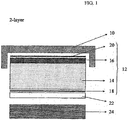
- FIG. 1 illustrates a representative two layer biaxially oriented polyester film shown in relation to a die 10.
- Film 12 includes layers 14 (layer (A)) layer 16 (layer (B)), optional additional layer 18 (additional layer (A)'), optional additional layer 20 (additional layer (B)'), and converting layer or layers 22.
- Converting layer 22 is disposed adjacent to the part 24, which is to be molded by die 10.
- Multilayer structures are also contemplated.
- An architecture including more than a 3-layer structure such as, for example, A/C/B, is also contemplated.
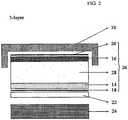
- FIG. 2 a representative 3 layer biaxially oriented polyester film 26 is shown in relation to die 10 for molding part 24.
- Film 26 includes layer 14 (layer (A)), layer 16 (layer (B)), optional additional layer 18 (additional layer (A)'), optional additional layer 20 (additional layer (B)'), inner layer 28 (inner layer C), and converting layer or layers 22.
- the inner layer, for example (C) is preferably selected to make no or minimal inimical influence on the surface properties of layers (A) and (B).
- additional layers (A') and/or (B') situated on layers (A) and/or (B) are also contemplated.
- additional layers such as adhesion promotion layers, anti-static layers, release layers, oligomeric protective layers, etc. may be provided on layers (A) and/or (B).
- additional layers are preferably selected so as to impart little or no adverse effect to the surface properties of layers (A) and (B).
- outer layer (A) is configured to face or be disposed adjacent to the part 24 in the mold process and is selected to have an ultra smooth surface.
- the rougher surface of layer (B) is configured to face or be disposed adjacent to die 10.
- the film is modified to impart selected characteristics to the film.
- the process may further include modifying the surface of layer (A) to effect a selected functionalization, for example, including but not limited to, adhesion promotion, improved release characteristics, hard coating, abrasion protection, antibacterial properties, embossability, or a combination thereof.
- the 3-D central plane average roughness (SRa) of layer (A) is preferably from about 1 nm to about 5 nm, more preferably from about 1 nm to about 4 nm.
- the 3-D ten-point average roughness (SRz) of layer (A) is preferably about 10 nm to about 100 nm, more preferably from about 10 nm to about 50 nm.
- additional layers such as (A') are provided, preferably these layers include the same surface roughness properties. Protrusions greater than about 100 nm on layer (A) will make holes on the parts after transfer. The presence of holes of this size can be detected visually as a hazy image.
- the surface roughness of outer layer (B), which faces the die in the transfer process is controlled.
- layer (B) has a SRa of from about 5 nm to about 50 nm or from about 8 nm to about 50 nm.
- layer (B) has a SRz of from about 10 nm to about 200 nm, more preferably from about 10 nm to about 150 nm.
- the surface property of additional layers such as layer (B'), for example an anti-static layer, is selected to have similar properties.
- the surface properties of layer (B) are valuable to the handling properties of the film. Accordingly, preferably the surface of this layer is rougher than the surface of layer (A).
- the SRz of layer (B) is less than about 200 nm, more preferably less than about 150 nm.
- layer (A) has particles with a particle diameter dA and a thickness tA.
- layer (B) has particles with a diameter dB and a thickness tB.
- the particle diameters dA and dB are the volume average diameters of the particles.
- the thickness of layer (B) is much greater than the particle size dB of the particles in layer (B), the particles agglomerate, etc. This can produce an irregular surface on the surface of layer (B), which could impart an adverse effect to the surface of the parts through layer (A) when the biaxially oriented polyester film is processed such as during exposure to high temperature and pressure conditions in molding processes.
- the diameter dB of particles in layer (B) and the thickness of layer (B) tB are selected so as to control the surface characteristics of layer (B), for example, selected so that the particles in layer (B) align.
- the thickness tB of layer (B) is selected to be thinner than the diameter dB of the largest particle in layer (B).
- the relationship of particle size to film layer thickness is selected wherein the upper limit of the thickness tB of layer (B) is two times the particle diameter dB of the largest particle in layer (B).
- tB and dB are preferably comply to formulas (1) -(3) below: 0.3 ⁇ tB / dB ⁇ 0.8 0.3 ⁇ tB / dB ⁇ 2.0 0.5 ⁇ tB / dB ⁇ 1.0
- the particle size dB is two times the thickness of layer (B) so that the particles protrude through layer (B). In a further selected embodiment, the particles in layer (B) are selected such that they align.
- the surface roughness of layer (A) is controlled by the selection of not only the particle size of layer (A) but also the thickness of layer (A) and particle size of layer (B).
- the relationship between the diameter dB of the particles in layer (B) and the thickness tA of layer (A) are controlled to affect the surface properties of the various layers.
- the diameter (dA) of the particles in layer (A) is preferably less than about 0.5 micrometers, more preferably less than about 0.3 micrometers. If desired, layer (A) may be particle free so as to achieve an ultra smooth surface.
- the thickness of layer (A) is selected in embodiments in relation to the diameter of particles in layer (B).
- the thickness (tA) of layer (A) is greater than about 10 micrometers.
- layer (A) has a thickness of from about 10 micrometers to about 50 micrometers. If the thickness of layer (A) is less than about 10 micrometers, the polyester film could be too thin and flexible to support. In addition, at such a reduced thickness, particles in layer (B) could have an adverse effect on the surface properties of layer (A) by migrating through or protruding through layer (A).
- the film layers (A) and (B) include polyester and the polyester is preferably a polymer including an aromatic dicarboxylic acid as a main acid component and an aliphatic glycol as a main glycol component.
- aromatic dicarboxylic acids include terephthalic acid, naphthalenedicarboxylic acid, isophthalic acid and the like.
- aliphatic glycol include ethylene glycol, trimethylene glycol, cyclohexane dimethanol and the like.
- the polyester is prepared by solid phase polymerization in order to reduce the oligomer content which may cause contamination issues in the molding process due to the accumulation of oligomer on the die under high temperature conditions.
- the particles in layers (A) and (B) are the same or different and are selected from organic particles, inorganic particles, or a mixture or combination thereof.
- the particles selected for layers (A) and (B) can be a single particle type or a mixture or combination of particles.
- suitable organic particles include polymer particles such as cross-linked polystyrene resin particles, cross-linked acrylic resin particles, cross-linked styrene and acrylic resin particles, polyimide particles and the like.
- suitable inorganic particles include silica, calcium carbonate, alumina, titanium dioxide, clay, talc and the like.
- the particles are preferably non-agglomerated particles because agglomerated particles having wide distribution in size may make it difficult to control the protrusion and properties of the surface of the biaxially oriented polyester film.
- the biaxially oriented polyester films illustrated herein can be produced by any method as known in the art. For example, a process can be selected wherein pellets of polyester for layer (A), layer (B) and the additional layers are dried and then extruded separately and laminated through a feed block. The polyester can be filtered using high accuracy filters to reduce defects in the polymer. The polymer of layer (B) can be extruded using a vent type two screw extruder to control the output, thereby controlling the variation of the thickness of layer (B). The resulting melt curtain is quenched on a casting drum, and then biaxially oriented. In embodiments, the film is oriented biaxially using a simultaneous method to reduce the scratches on the film.
- this biaxially oriented polyester film may have additional coating layers (A') and/or (B') on the surface of layer (A) and/or (B).
- the coating layers include an adhesion promoting layer, an anti-static layer, a release layer, an oligomer blocking layer, a hard coating layer and the like. Any known method may be used to coat these layers, such as an in-line method or an off-line method, using a gravure coater, a bar coater, a spin coater, a kiss coater and the like. If desired, the additional layers may be coated by an in-line method using a gravure coater to achieve reasonable process efficiency and quality of the coating layer.
- the total thickness of the biaxially oriented polyester films was measured using a micro gauge meter and the thickness of each co-extruded layer was determined based upon a ratio of extruder output. Thickness was also measured using a secondary ion mass spectrograph (SIMS). This method is described in U. S. Patent 5,919,550 .
- the particles were placed on the object stage of an electron microscope without overlapping them as much as possible and observed at a magnification of 10,000 to 100,000 times using a scanning electron microscope or transmission electron microscope.
- a scanning electron microscope a platinum film of about 200 angstroms was vapor deposited onto the surface of a sample using a sputtering apparatus beforehand. From the screen or photographed image, the areas of at least 200 particles were measured to calculate the equivalent diameters, and from the area equivalent diameters, the volumes of the individual particles were calculated. Based on the volumes, the volume average particle diameter was calculated. This method is described in U. S. Patent 5,912,074 .
- a sample slurry was added to a solvent (methanol) such that the concentration of the slurry/solvent was adequate to show adequate light transmission.
- This solution was pipetted into a Honeywell Microtrac X100 machine. The average particle size and distribution was then measured via this machine.
- SRa, SRq, SRz and SRt of the biaxially oriented polyester films were measured by a non-contact 3-D roughness meter "WYCO NT2000".
- the polyester films were cut to specific sizes and stretched tight to make the film flat.
- the prepared film was put on the stage of the roughness meter and measured and calculated under the condition of "PSI mode", “Threshold modulation 12%", “Size 736 ⁇ 480", “Sampling 1.61 micronmeter” and "Filter 0.25 1/mm” for the surface of layer (A), wherein, SRa, SRq, SRz and SRt represent 3-D central plane average roughness, 3-D root-mean-square roughness, 3-D ten-point average roughness and 3-D maximum height, respectively.
- SRz is selected over SRt because SRt counts the only maximum protrusion and will show an uneven number if there is an unexpectedly contaminated protrusion such as a dust or a defect, while SRz averages 10 maximum protrusions to reduce unevenness.
- Friction of the biaxially oriented polyester films was measured with the use of a Testing Machine, Inc. slip tester (TMI-Model #32-06) using ASTM D1894-95.
- the polyester films were cut to specified sizes.
- One sheet of polyester was clamped, the one surface (in the table 3, (X)) of the sample up, onto an 18" MD (machine direction) and 6" TD (transverse direction) glass plate.
- Another piece of polyester film was mounted using double-sided tape to a 2.5" and 2.5" 200g sled, with another surface (in table 3, (Y)') of the sample down.
- the sled was placed on top of the glass plate and attached to the load sensing device.
- the sled was then placed over the film on the glass plate at 6in/min.
- the only contact during the testing was the polyester film surface (X) rubbing against thepolyester film surface (Y)'.
- the measuring distance used to calculate the value of static was 1" and 4" for of dynamic.
- the films have a static coefficient of friction ( ⁇ static ) measured front to back of ⁇ 0.55, more preferably ⁇ 0.45, most preferably ⁇ 0.40.
- the film has a dynamic coefficient of friction ( ⁇ dynamic ) measured front to back of ⁇ 0.55, more preferably ⁇ 0.45, most preferably ⁇ 0.40.
- Biaxially oriented polyester films were cut into sheets of 4"x 4" in size and one sheet was applied onto the surface of the die with adhesive tape. The sheet was inserted with the direction shown in table 4. Then, molten polypropylene resin ("PRIME POLYPRO F122G" of PRIME POLYMER) was injected onto the sheet and molded using an injection molding machine (TOSHIBA IS80 EPN-2A) and a flat circle disk shaped die with a 150 mm diameter mirrored surface, under the condition described below. After molding, the polyester film peeled off from the molded part easily. The size of the molded parts was approximately 150 mm in diameter and had a thickness of 3 mm. Furthermore, molded parts without using a biaxially oriented polyester film were prepared as a control sample using the same machine, same resin and under the same conditions.
- PRIME POLYPRO F122G of PRIME POLYMER
- the molded part was placed on a plane table with matted black surface and a gloss meter was pushed onto the molded part.
- Gloss was measured with 60 degree mode using ""mirror-TRI-gloss" of BYK-Gardner GmbH, taking the average number of five data points.
- the surface images of the molded parts were observed looking at reflected light shone by a flashlight in a dark room.
- the surface resistivity of the biaxially oriented polyester films coated by anti-static agents was measured with "The Trek Model 152 Resistance Meter" having concentric ring electrodes of TREK, INC.
- Polyethyleneterephthalate polyester pellets as listed in Table 1 were mixed according to the blend ratio shown in table 2, extruded using a vent-type two-screw extruder and filtered tor the outer layer (B).
- Pellets listed in Table 1 were mixed according to the blend ratio shown in Table 2, dried, then extruded via extruder and filtered for the outer layer (A).
- These melt streams were fed through a rectangular joining zone and laminated into a two layer co-extruded (A)/(B) structure.
- the resulting melt curtain was quenched on a casting drum, oriented in the machine direction with a roller stretcher, subsequently oriented in the traverse direction and heat-set and relaxed using a chain driven stretcher under the conditions listed in Table 2, and finally wound up.
- the biaxially oriented polyester film had the thickness shown in table 2.
- the biaxially oriented polyester film had extremely preferable surface properties including an ultra smooth surface of layer (A), well controlled protrusions on the surface of layer (B), and adequately low friction, as listed in Table 3. During making film, there were no processing issues and the film could be wound easily without any defect.
- Mold 1 had a glossy and flat surface, which was preferable in the molded samples, while Mold 1' had a hazy surface.
- a biaxially oriented polyester film having an anti-static coating layer on the surface of layer (B) was produced in the same manner as described in Example 1 according to the blend and the conditions listed in table 2.
- This anti-static coating layer consists of thiophene conductive polymers, as described in WO03047853 , and is coated by a traditional in-line coating method before traverse direction stretching under the conditions shown in table 2.
- the coated biaxially oriented polyester film had the thickness shown in table 2 and had preferable surface properties, ultra smooth surface of layer (A), well controlled protrusions on the surface of layer (B), adequately low friction, and very low surface resistivity, as listed in Table 3.
- Mold 1A had a glossy and flat surface, which was preferable in the molded samples, while Mold 1A' had a hazy surface.
- a biaxially oriented polyester film was produced in the same manner as described in Example 1 according to the blend and the conditions listed in table 2.
- the film had the thickness shown in table 2 and had preferable surface properties including an ultra smooth surface of layer (A), controlled protrusions on the surface of layer (B), and adequately low friction, as listed in table 3.
- A ultra smooth surface of layer
- B controlled protrusions on the surface of layer
- B adequately low friction
- Table 4 Two types of molded parts were prepared using this film as shown in Table 4. Mold 2 had a very shiny gloss surface, and was the preferable sample. Mold 2' had hazy surface.
- Plain biaxially oriented polyester film (Example 3) and coated biaxially oriented polyester film (Example 3A) were produced in the same manner as described in Examples 1 and 1A according to the blend and the conditions listed in table 2.
- the films had the thickness shown in table 2 and had preferable surface properties, super smooth surface of layer (A), super controlled protrusions on the surface of layer (B), adequately low friction, and the coated film had very low surface resistivity, as listed in table 3.
- the film there were no processing issues and the film could be wound easily without any defect.
- Mold 3A had an ultra shiny, gloss surface, and was the most preferable sample.
- Biaxially oriented polyester film was produced in the same manner as described in Example 1 according to the blend and conditions listed in Table 2.
- the film had a thickness shown in Table 2 and had preferable surface properties including an ultra smooth surface of layer (A), and adequately low friction.
- protrusions on the surface of layer (B) were not controlled and, accordingly, there were many big protrusions on the surface of layer (B) as listed in Table 3.
- Two types of molded parts were prepared using this film as shown in Table 4.
- the surface of Mold Comp. 1 was shiny and glossy, but somewhat wavy like an orange peel. Mold Comp 1' had a hazy surface.
- Pellets listed in Table 1 were mixed according to the blend ratio shown in Table 2, extruded using a vent-type two-screw extruder and filtered for the outer layer (D). Pellets listed in Table 1 were mixed according to the blend ratio shown in Table 2, dried, then extruded via extruder and filtered for the inner layer (C). These melt streams were fed through a rectangular joining zone and laminated into a three layer co-extruded (D)/(C)/(D) structure. The resulting curtain was quenched on a casting drum, and oriented in the machine direction with a roller stretcher, subsequently oriented in the traverse direction and heat-set and relaxed using chain driven stretcher under the conditions listed in Table 2, and finally wound up.
- the biaxially oriented polyester film had a thickness shown in Table 2 and had commonplace surfaces of layers (D) and had commonplace friction as listed in table 3. During film making, there were no processing issues and the film could be wound moderately. Mold Comp. 2, the molded part prepared using this film as shown in Table 4, had a hazy surface and was the moderate sample.
- a film was produced in the same manner as described in Comparative Example 2 according to the blend and conditions listed in Table 2.
- the biaxially oriented polyester film had the thickness shown in Table 2, and had commonplace surfaces of layers (D) although it had adequately low friction as listed in Table 3. During production of the film, there were no processing issues and the film could be wound easily. Mold Comp. 3, the molded part prepared by using this film as shown in Table 4, had a very hazy surface, and was the worst sample except for the Control.
- a film was produced in the same manner as described in Comparative Example 2 according to the blend conditions listed in Table 2.
- the biaxially oriented polyester film had the thickness shown in Table 2 and had a fairly smooth surface of layers (D) but had commonplace friction, which was higher than the others as listed in Table 3.
- a special core having a larger diameter was used in order to avoid winding issues.
- Mold Comp. 4 the molded part prepared by using this film as shown in Table 4, had a very shiny, gloss surface.
Landscapes
- Engineering & Computer Science (AREA)
- Mechanical Engineering (AREA)
- Laminated Bodies (AREA)
- Manufacture Of Macromolecular Shaped Articles (AREA)
Claims (8)
- Utilisation d'un film polyester à orientation biaxiale dans un procédé de moulage, ledit film polyester à orientation biaxiale comprenant :une couche de film externe A et une couche de film externe B comprenant des particules, la couche A ayant une rugosité SRa comprise entre 1 nm à 5 nm, une rugosité SRz comprise entre 10 nm et 100 nm et une épaisseur supérieure à 10 µm ; la couche B ayant une rugosité SRa comprise entre 5 nm et 50 nm et une rugosité SRz comprise entre 10 nm et 200 nm, et les rugosités SRa et SRz de la couche B étant plus élevées que les rugosités SRa et SRz de la couche A.
- Utilisation selon la revendication 1, dans laquelle le diamètre moyen par volume de la particule la plus grosse de la couche B est supérieur à l'épaisseur de la couche B et/ou la formule suivante est vérifiée : 0,3 < tB/dB ≤ 2,0, dans laquelle tB est l'épaisseur de la couche B et dB est le diamètre moyen par volume de la particule la plus grosse de la couche B.
- Utilisation selon la revendication 1, dans laquelle la couche A comprend des particules et le diamètre moyen par volume des particules de la couche A est inférieur à 0,5 µm et/ou les particules de la couche B ont un diamètre moyen par volume compris entre 0,3 et 1,5 µm.
- Utilisation selon la revendication 1, dans laquelle la couche de film A a une épaisseur comprise entre 10 et 50 µm et/ou la couche de film B a une épaisseur comprise entre 0,6 et 3 µm.
- Utilisation selon la revendication 1, dans laquelle la couche A comprend des particules différentes de celles de la couche B ou est exempte de particule.
- Utilisation selon la revendication 1, dans laquelle la couche A et la couche B comprennent du polyester et/ou au moins une couche supplémentaire choisie dans le groupe constitué par les couches promotrices d'adhérence, les couches antistatiques, les couches antiadhésives, les couches oligomères protectrices et leurs combinaisons.
- Utilisation selon la revendication 1, dans laquelle les particules comprennent des particules non agglomérées et/ou les particules sont choisies dans le groupe constitué par des particules de polymère, des particules de résine polystyrène réticulée, des particules de résine acrylique réticulée, des particules de styrène réticulé, des particules de résine acrylique, des particules de polyimide, des particules de silice, des particules de carbonate de calcium, des particules d'alumine, des particules de dioxyde de titane, des particules d'argile, des particules de talc et leurs combinaisons.
- Utilisation selon la revendication 1, dans laquelle la couche A comprend en outre une fonctionnalisation choisie, la fonctionnalisation choisie comprenant de préférence la promotion de l'adhérence, l'anti-adhérence, l'enduction dure, la protection contre l'abrasion, des propriétés antibactériennes, la capacité de gaufrage, ou une combinaison de ces fonctionnalités.
Applications Claiming Priority (2)
| Application Number | Priority Date | Filing Date | Title |
|---|---|---|---|
| US77312906P | 2006-02-14 | 2006-02-14 | |
| PCT/US2007/003680 WO2007095176A2 (fr) | 2006-02-14 | 2007-02-14 | Films de polyester à orientation biaxiale pour processus de moulage |
Publications (3)
| Publication Number | Publication Date |
|---|---|
| EP2005433A2 EP2005433A2 (fr) | 2008-12-24 |
| EP2005433A4 EP2005433A4 (fr) | 2015-04-08 |
| EP2005433B1 true EP2005433B1 (fr) | 2017-01-25 |
Family
ID=38372056
Family Applications (1)
| Application Number | Title | Priority Date | Filing Date |
|---|---|---|---|
| EP07750511.3A Ceased EP2005433B1 (fr) | 2006-02-14 | 2007-02-14 | Films de polyester à orientation biaxiale pour processus de moulage |
Country Status (3)
| Country | Link |
|---|---|
| US (1) | US7544408B2 (fr) |
| EP (1) | EP2005433B1 (fr) |
| WO (1) | WO2007095176A2 (fr) |
Families Citing this family (6)
| Publication number | Priority date | Publication date | Assignee | Title |
|---|---|---|---|---|
| US20080015108A1 (en) * | 2006-07-17 | 2008-01-17 | Toray Plastics (America), Inc. | Biaxially oriented laminated polyester film for transfer applications |
| US20130295218A1 (en) * | 2012-05-07 | 2013-11-07 | Toray Plastics (America), Inc. | Multilayer oriented polyester film with anti-static property for molding processes |
| US9221286B2 (en) | 2013-04-09 | 2015-12-29 | Toray Plastics (America), Inc. | Polyester film with smooth surface properties for winding and printing |
| KR101960477B1 (ko) * | 2016-09-20 | 2019-03-20 | 주식회사 엘지화학 | 슬립성 및 자외선 차단 기능이 우수한 광학 필름, 및 이를 포함하는 편광판 |
| JP6852598B2 (ja) * | 2017-07-05 | 2021-03-31 | 東レ株式会社 | 積層フィルム |
| KR20250173486A (ko) * | 2023-04-06 | 2025-12-10 | 도요보 가부시키가이샤 | 적층 폴리에스테르 필름, 수지 시트 형성용 이형 필름 |
Family Cites Families (38)
| Publication number | Priority date | Publication date | Assignee | Title |
|---|---|---|---|---|
| FR2548958B1 (fr) * | 1983-07-13 | 1986-03-21 | Rhone Poulenc Films | Films polyesters composites |
| EP0203604B1 (fr) * | 1985-05-29 | 1990-08-22 | Teijin Limited | Film de polyester pour milieux d'enregistrement magnétique |
| US4732814A (en) | 1985-10-03 | 1988-03-22 | Toray Industries, Inc. | Polyester film with smooth and highly adhesive surface and method of making same |
| JPS62196121A (ja) * | 1986-01-24 | 1987-08-29 | Toyobo Co Ltd | 配向ポリエステルフイルム |
| DE3610167A1 (de) * | 1986-03-26 | 1987-10-01 | Hoechst Ag | Mehrschichtige polyesterfolie fuer magnetische informationstraeger |
| JPH0444554Y2 (fr) | 1987-09-11 | 1992-10-20 | ||
| US4952449A (en) * | 1987-10-09 | 1990-08-28 | Toray Industries, Inc. | Biaxially oriented polyester film |
| DE68929128T2 (de) | 1988-06-08 | 2000-05-31 | Toray Industries, Inc. | Biaxial orientierte Verbundfolie |
| FR2640983B1 (fr) * | 1988-12-28 | 1992-09-25 | Rhone Poulenc Films | |
| JPH0352935A (ja) * | 1989-07-20 | 1991-03-07 | Asahi Chem Ind Co Ltd | 合成樹脂延伸フィルム |
| US5294474A (en) * | 1989-07-27 | 1994-03-15 | Rhone-Poulenc Films | Composite polyester films and their use as protective layers for photopolymer plates, and photopolymer plates comprising said films |
| JPH0778133B2 (ja) * | 1989-12-14 | 1995-08-23 | ダイアホイルヘキスト株式会社 | 二軸配向ポリエステルフィルム |
| JPH03253317A (ja) | 1990-03-05 | 1991-11-12 | Toppan Printing Co Ltd | 同時絵付け成形方法並びにその方法に使用する金型及びその方法に使用する転写箔 |
| JP2990818B2 (ja) * | 1991-03-08 | 1999-12-13 | 三菱化学ポリエステルフィルム株式会社 | 磁気テープ用ポリエステルフィルム |
| JPH05154972A (ja) * | 1991-07-02 | 1993-06-22 | Unitika Ltd | 粗面化フィルムおよびその製造方法 |
| US5626942A (en) * | 1993-05-05 | 1997-05-06 | Toray Industries, Inc. | Polyester film and process for producing the same |
| US5529832A (en) * | 1994-11-10 | 1996-06-25 | Teijin Limited | Biaxially oriented laminated polyester film |
| US5976668A (en) * | 1995-02-28 | 1999-11-02 | Sony Corporation | Base film for magnetic recording medium and magnetic recording medium using same |
| TW412567B (en) * | 1995-07-27 | 2000-11-21 | Toray Industries | Polyester composition and its film |
| JP3345247B2 (ja) * | 1996-01-26 | 2002-11-18 | 帝人株式会社 | 積層二軸配向ポリエステルフイルム |
| US6162527A (en) * | 1996-05-17 | 2000-12-19 | Teijin Limited | Biaxially oriented polyester film |
| JPH1134262A (ja) * | 1997-07-22 | 1999-02-09 | Teijin Ltd | 積層二軸配向ポリエステルフィルム |
| KR20000069251A (ko) * | 1997-10-03 | 2000-11-25 | 히라이 가쯔히꼬 | 이축 배향 폴리에스테르 필름 |
| JPH11147377A (ja) * | 1997-11-18 | 1999-06-02 | Teijin Ltd | 感熱転写リボン用二軸配向ポリエステルフィルム |
| DE19814710A1 (de) * | 1998-04-01 | 1999-10-07 | Hoechst Diafoil Gmbh | Mehrschichtige, biaxial orientierte Polyesterfolie, Verfahren zu ihrer Herstellung und ihre Verwendung als Magnetbandfolie |
| DE19839848A1 (de) * | 1998-09-02 | 2000-04-13 | Hoechst Diafoil Gmbh | Mehrschichtige, biaxial orientierte Polyesterfolie, Verfahren zu ihrer Herstellung und ihre Verwendung als Magnetbandfolie mit optimierten elektromagnetischen Eigenschaften |
| EP0987686B1 (fr) * | 1998-09-17 | 2004-11-03 | Toray Industries, Inc. | Procédé de stockage d'un film de polyester pour milieu d'enregistrement magnétique et procédé de fabrication d'un milieu d'enregistrement magnétique |
| US20010055674A1 (en) * | 1999-07-05 | 2001-12-27 | Joerg Hellman | Multilayer, biaxially oriented polyester film, process for its production and its use as a magnetic tape film without a backing coating |
| JP2001243616A (ja) * | 1999-12-24 | 2001-09-07 | Toray Ind Inc | 磁気記録媒体用ポリエステルフィルムおよび磁気記録テープ |
| CN1212227C (zh) * | 2000-03-07 | 2005-07-27 | 东丽株式会社 | 聚酯薄膜及其制备方法 |
| JP2002133642A (ja) * | 2000-10-30 | 2002-05-10 | Teijin Ltd | 磁気記録媒体用ポリエステルフィルム |
| US6761968B2 (en) * | 2000-12-01 | 2004-07-13 | Teijin Limited | Biaxially oriented polyester film |
| TWI269709B (en) | 2001-12-06 | 2007-01-01 | Toray Industries | Laminated film and process for producing laminated film |
| JP2003289990A (ja) | 2002-03-29 | 2003-10-14 | Panatekku:Kk | 睡眠環境改善装置 |
| JP4052021B2 (ja) * | 2002-06-04 | 2008-02-27 | 帝人デュポンフィルム株式会社 | 配向ポリエステルフィルムおよびそれを用いた積層フィルム |
| JP2004223800A (ja) | 2003-01-21 | 2004-08-12 | Mitsubishi Polyester Film Copp | 転写材用ポリエステルフィルム |
| JP2005082785A (ja) | 2003-09-11 | 2005-03-31 | Mitsubishi Polyester Film Copp | ポリエステルフィルム |
| JP2005205825A (ja) * | 2004-01-26 | 2005-08-04 | Toray Ind Inc | 積層ポリエステルフィルム及び磁気記録テープ |
-
2007
- 2007-02-14 EP EP07750511.3A patent/EP2005433B1/fr not_active Ceased
- 2007-02-14 US US11/705,825 patent/US7544408B2/en active Active
- 2007-02-14 WO PCT/US2007/003680 patent/WO2007095176A2/fr not_active Ceased
Non-Patent Citations (1)
| Title |
|---|
| None * |
Also Published As
| Publication number | Publication date |
|---|---|
| WO2007095176A3 (fr) | 2007-12-06 |
| WO2007095176A2 (fr) | 2007-08-23 |
| EP2005433A4 (fr) | 2015-04-08 |
| US7544408B2 (en) | 2009-06-09 |
| EP2005433A2 (fr) | 2008-12-24 |
| US20070243371A1 (en) | 2007-10-18 |
Similar Documents
| Publication | Publication Date | Title |
|---|---|---|
| KR101492306B1 (ko) | 적층 필름 및 성형체, 반사체 | |
| KR100919440B1 (ko) | 이형 필름 | |
| EP2942180B1 (fr) | Film pour moulage | |
| EP2005433B1 (fr) | Films de polyester à orientation biaxiale pour processus de moulage | |
| EP3040198B1 (fr) | Film de transfert de métal à brillant élevé et polyester retirable | |
| KR19990030173A (ko) | 이축 배향된 다층 폴리에스테르 필름, 이의 용도 및 이의 제조방법 | |
| EP2111978A1 (fr) | Film stratifié et objet moulé | |
| KR20020009432A (ko) | 다층 투명 이축배향 폴리에스테르 필름 | |
| WO1999017931A1 (fr) | Film de polyester a orientation biaxiale | |
| JP2000141568A (ja) | 離型フィルム | |
| KR20190111902A (ko) | 2축 배향 폴리프로필렌 필름 | |
| EP3263335B1 (fr) | Film de polyester stratifié | |
| US20080015108A1 (en) | Biaxially oriented laminated polyester film for transfer applications | |
| JP2546222B2 (ja) | シンジオタクティックポリスチレン系フィルム | |
| EP0893249B1 (fr) | Film de polyester stratifié orienté biaxialement | |
| KR101794629B1 (ko) | 성형용 필름 | |
| JP2004142179A (ja) | 離型用二軸配向ポリエステルフィルム | |
| JP7144715B2 (ja) | セラミックグリーンシート製造用離型フィルムロール | |
| CA2534948A1 (fr) | Procede pour realiser des pieces moulees en matiere plastique presentant des surfaces fonctionnelles | |
| JP3962161B2 (ja) | セラミックコンデンサー製造用キャリヤーシート | |
| JP4313614B2 (ja) | 離形フィルム | |
| KR100633230B1 (ko) | 세라믹시트 부착 이형 필름 | |
| JP2010284947A (ja) | 離型フィルム、該離型フィルムを用いた偏光板用保護フィルム、および該偏光板用保護フィルムを用いた偏光板 | |
| KR20010015159A (ko) | 이축 연신 다층 폴리에스테르 필름, 이의 제조방법 및배면 피막을 갖지 않는 자기 테이프 필름으로서의 이의 용도 | |
| JP3202585B2 (ja) | 離型フイルム |
Legal Events
| Date | Code | Title | Description |
|---|---|---|---|
| PUAI | Public reference made under article 153(3) epc to a published international application that has entered the european phase |
Free format text: ORIGINAL CODE: 0009012 |
|
| 17P | Request for examination filed |
Effective date: 20080818 |
|
| AK | Designated contracting states |
Kind code of ref document: A2 Designated state(s): DE |
|
| RIN1 | Information on inventor provided before grant (corrected) |
Inventor name: TAKAYAMA, TERUFUMI Inventor name: CARROLL, ARRON Inventor name: SARGEANT, STEVEN Inventor name: YANASE, HIDEO Inventor name: YOKOTA, NAO Inventor name: FURUYA, HIROSHI |
|
| DAX | Request for extension of the european patent (deleted) | ||
| RBV | Designated contracting states (corrected) |
Designated state(s): DE |
|
| A4 | Supplementary search report drawn up and despatched |
Effective date: 20150306 |
|
| RIC1 | Information provided on ipc code assigned before grant |
Ipc: G11B 23/00 20060101AFI20150227BHEP |
|
| 17Q | First examination report despatched |
Effective date: 20151102 |
|
| GRAP | Despatch of communication of intention to grant a patent |
Free format text: ORIGINAL CODE: EPIDOSNIGR1 |
|
| RAP1 | Party data changed (applicant data changed or rights of an application transferred) |
Owner name: TORAY PLASTICS (AMERICA), INC. |
|
| INTG | Intention to grant announced |
Effective date: 20160809 |
|
| GRAS | Grant fee paid |
Free format text: ORIGINAL CODE: EPIDOSNIGR3 |
|
| STAA | Information on the status of an ep patent application or granted ep patent |
Free format text: STATUS: GRANT OF PATENT IS INTENDED |
|
| GRAA | (expected) grant |
Free format text: ORIGINAL CODE: 0009210 |
|
| STAA | Information on the status of an ep patent application or granted ep patent |
Free format text: STATUS: THE PATENT HAS BEEN GRANTED |
|
| AK | Designated contracting states |
Kind code of ref document: B1 Designated state(s): DE |
|
| REG | Reference to a national code |
Ref country code: DE Ref legal event code: R096 Ref document number: 602007049647 Country of ref document: DE |
|
| REG | Reference to a national code |
Ref country code: DE Ref legal event code: R097 Ref document number: 602007049647 Country of ref document: DE |
|
| PLBE | No opposition filed within time limit |
Free format text: ORIGINAL CODE: 0009261 |
|
| STAA | Information on the status of an ep patent application or granted ep patent |
Free format text: STATUS: NO OPPOSITION FILED WITHIN TIME LIMIT |
|
| 26N | No opposition filed |
Effective date: 20171026 |
|
| PGFP | Annual fee paid to national office [announced via postgrant information from national office to epo] |
Ref country code: DE Payment date: 20230216 Year of fee payment: 17 |
|
| P01 | Opt-out of the competence of the unified patent court (upc) registered |
Effective date: 20230526 |
|
| REG | Reference to a national code |
Ref country code: DE Ref legal event code: R119 Ref document number: 602007049647 Country of ref document: DE |
|
| PG25 | Lapsed in a contracting state [announced via postgrant information from national office to epo] |
Ref country code: DE Free format text: LAPSE BECAUSE OF NON-PAYMENT OF DUE FEES Effective date: 20240903 |
|
| PG25 | Lapsed in a contracting state [announced via postgrant information from national office to epo] |
Ref country code: DE Free format text: LAPSE BECAUSE OF NON-PAYMENT OF DUE FEES Effective date: 20240903 |