EP2006531A2 - Démarreur pour micro-véhicules aériens - Google Patents
Démarreur pour micro-véhicules aériens Download PDFInfo
- Publication number
- EP2006531A2 EP2006531A2 EP08102640A EP08102640A EP2006531A2 EP 2006531 A2 EP2006531 A2 EP 2006531A2 EP 08102640 A EP08102640 A EP 08102640A EP 08102640 A EP08102640 A EP 08102640A EP 2006531 A2 EP2006531 A2 EP 2006531A2
- Authority
- EP
- European Patent Office
- Prior art keywords
- spring
- output shaft
- engine
- housing
- disposed
- Prior art date
- Legal status (The legal status is an assumption and is not a legal conclusion. Google has not performed a legal analysis and makes no representation as to the accuracy of the status listed.)
- Withdrawn
Links
- 239000007858 starting material Substances 0.000 title claims abstract description 75
- 238000012546 transfer Methods 0.000 claims description 7
- 230000006835 compression Effects 0.000 description 6
- 238000007906 compression Methods 0.000 description 6
- 238000000034 method Methods 0.000 description 4
- 230000008569 process Effects 0.000 description 4
- 230000004913 activation Effects 0.000 description 2
- 238000002485 combustion reaction Methods 0.000 description 2
- 230000013011 mating Effects 0.000 description 2
- 238000011160 research Methods 0.000 description 2
- 238000000926 separation method Methods 0.000 description 2
- 229920004943 Delrin® Polymers 0.000 description 1
- DHKHKXVYLBGOIT-UHFFFAOYSA-N acetaldehyde Diethyl Acetal Natural products CCOC(C)OCC DHKHKXVYLBGOIT-UHFFFAOYSA-N 0.000 description 1
- 125000002777 acetyl group Chemical class [H]C([H])([H])C(*)=O 0.000 description 1
- XAGFODPZIPBFFR-UHFFFAOYSA-N aluminium Chemical compound [Al] XAGFODPZIPBFFR-UHFFFAOYSA-N 0.000 description 1
- 229910052782 aluminium Inorganic materials 0.000 description 1
- 230000008878 coupling Effects 0.000 description 1
- 238000010168 coupling process Methods 0.000 description 1
- 238000005859 coupling reaction Methods 0.000 description 1
- 230000007123 defense Effects 0.000 description 1
- 238000013461 design Methods 0.000 description 1
- 238000011161 development Methods 0.000 description 1
- 230000001939 inductive effect Effects 0.000 description 1
- 239000000463 material Substances 0.000 description 1
- 230000007246 mechanism Effects 0.000 description 1
- 238000012986 modification Methods 0.000 description 1
- 230000004048 modification Effects 0.000 description 1
Images



Classifications
-
- F—MECHANICAL ENGINEERING; LIGHTING; HEATING; WEAPONS; BLASTING
- F02—COMBUSTION ENGINES; HOT-GAS OR COMBUSTION-PRODUCT ENGINE PLANTS
- F02N—STARTING OF COMBUSTION ENGINES; STARTING AIDS FOR SUCH ENGINES, NOT OTHERWISE PROVIDED FOR
- F02N3/00—Other muscle-operated starting apparatus
- F02N3/02—Other muscle-operated starting apparatus having pull-cords
-
- F—MECHANICAL ENGINEERING; LIGHTING; HEATING; WEAPONS; BLASTING
- F02—COMBUSTION ENGINES; HOT-GAS OR COMBUSTION-PRODUCT ENGINE PLANTS
- F02B—INTERNAL-COMBUSTION PISTON ENGINES; COMBUSTION ENGINES IN GENERAL
- F02B75/00—Other engines
- F02B75/34—Ultra-small engines, e.g. for driving models
-
- F—MECHANICAL ENGINEERING; LIGHTING; HEATING; WEAPONS; BLASTING
- F02—COMBUSTION ENGINES; HOT-GAS OR COMBUSTION-PRODUCT ENGINE PLANTS
- F02D—CONTROLLING COMBUSTION ENGINES
- F02D2400/00—Control systems adapted for specific engine types; Special features of engine control systems not otherwise provided for; Power supply, connectors or cabling for engine control systems
- F02D2400/06—Small engines with electronic control, e.g. for hand held tools
-
- F—MECHANICAL ENGINEERING; LIGHTING; HEATING; WEAPONS; BLASTING
- F02—COMBUSTION ENGINES; HOT-GAS OR COMBUSTION-PRODUCT ENGINE PLANTS
- F02N—STARTING OF COMBUSTION ENGINES; STARTING AIDS FOR SUCH ENGINES, NOT OTHERWISE PROVIDED FOR
- F02N5/00—Starting apparatus having mechanical power storage
- F02N5/02—Starting apparatus having mechanical power storage of spring type
-
- Y—GENERAL TAGGING OF NEW TECHNOLOGICAL DEVELOPMENTS; GENERAL TAGGING OF CROSS-SECTIONAL TECHNOLOGIES SPANNING OVER SEVERAL SECTIONS OF THE IPC; TECHNICAL SUBJECTS COVERED BY FORMER USPC CROSS-REFERENCE ART COLLECTIONS [XRACs] AND DIGESTS
- Y10—TECHNICAL SUBJECTS COVERED BY FORMER USPC
- Y10T—TECHNICAL SUBJECTS COVERED BY FORMER US CLASSIFICATION
- Y10T74/00—Machine element or mechanism
- Y10T74/13—Machine starters
Definitions
- the present invention relates to micro air vehicles, and, more particularly, to an improved starter for micro air vehicles.
- Micro air vehicles and other unmanned aerial vehicles are of emerging importance today, particularly for military applications. For example, micro air vehicles can be valuable in providing reconnaissance without the need for human pilots.
- Micro air vehicles often include engines that are started using a manual starter assembly similar to those commonly used with commercial lawn mowers. However, in certain situations, the activation of such a starter assembly may require significant pull force, which may in turn result in unwanted movement of certain micro air vehicle components (e.g. a guidance system), and/or may result in wear on one or more components of the micro air vehicle.
- a manual starter assembly similar to those commonly used with commercial lawn mowers.
- the activation of such a starter assembly may require significant pull force, which may in turn result in unwanted movement of certain micro air vehicle components (e.g. a guidance system), and/or may result in wear on one or more components of the micro air vehicle.
- the manual starter comprises a main housing, an output shaft, a spring housing, a spring, and an attachment unit.
- the output shaft is disposed at least partially inside the main housing, and is configured to supply a starting torque to the engine.
- the spring housing is disposed in the main housing. This spring is disposed in the spring housing, and is configured to receive an initial force from a starter cord and to supply the starting torque to the output shaft.
- the attachment unit is configured to selectively couple the spring to the output shaft before the engine has started and decouple the spring from the output shaft after the engine has started.
- the manual starter comprises a main housing, a starter cord, a spring housing, a drive assembly, a spring, an output shaft, and an attachment unit.
- the starter cord is disposed at least partially outside the main housing, and is configured to receive an initial force.
- the spring housing is disposed in the main housing.
- the drive assembly is disposed at least partially within the main housing, and is configured to transfer the initial force from the starter cord to the spring housing.
- the spring is disposed in the spring housing, and is configured to receive the initial force from the spring housing and to supply a starting torque for the engine.
- the output shaft is disposed at least partially inside the main housing, and is configured to receive the starting torque from the spring and to supply the starting torque to the engine.
- the attachment unit is configured to selectively couple the spring to the output shaft before the engine has started and to decouple the spring from the output shaft after the engine has started.
- the attachment unit comprises a pawl and a coupler.
- the pawl is coupled to the output shaft.
- the coupler is coupled to the spring, and is configured to be selectively engaged and disengaged to the pawl.
- the micro air vehicle comprises a main body, a plurality of electronic pods, an engine, and a manual starter system.
- the plurality of electronic pods are coupled to the main body.
- the engine is disposed in the main body, and is coupled to the plurality of electronic pods.
- the manual starter system comprises a main housing, a starter cord, a spring housing, a drive assembly, a spring, an output shaft, and an attachment unit.
- the starter cord is disposed at least partially outside the main housing, and is configured to receive an initial force.
- the spring housing is disposed in the main housing.
- the drive assembly is disposed at least partially within the main housing, and is configured to transfer the initial force from the starter cord to the spring housing.
- the spring is disposed in the spring housing, and is configured to receive the initial force from the spring housing and to supply a starting torque for the engine.
- the output shaft is disposed at least partially inside the main housing, and is configured to receive the starting torque from the spring and to supply the starting torque to the engine.
- the attachment unit is configured to selectively couple the spring to the output shaft before the engine has started and to decouple the spring from the output shaft after the engine has started.
- the attachment unit comprises a pawl and a coupler.
- the pawl is coupled to the output shaft.
- the coupler is coupled to the spring, and is configured to be selectively engaged and disengaged to the pawl.
- FIG. 1 is a plan view of an exemplary micro air vehicle
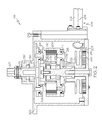
- FIG. 2 is a simplified cross section view of an exemplary manual starter assembly that can be used in connection with the micro air vehicle of FIG. 1 ;
- FIG. 3 is an exploded perspective view of the manual starter assembly of FIG. 2 ;
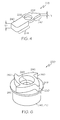
- FIG. 4 is a close-up view of an exemplary release pawl that can be used in the manual starter assembly of FIGs. 2 and 3 ;
- FIG. 5 is a section view of a portion of the manual starter assembly of FIGs. 2 and 3 , shown disassembled, and featuring release pawls that can be used therein;
- FIG. 6 is a close-up view of an exemplary coupler that can be used in the manual starter assembly of FIGs. 2 and 3 , and used to mate with the release pawl of FIG. 4 ;
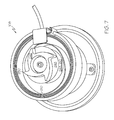
- FIG. 7 is a section view of another portion of the manual starter assembly of FIGs. 2 and 3 , shown disassembled, and featuring a coupler that can be used therein.
- the described embodiment is not limited to use in conjunction with a particular type of device.
- the present embodiment of the manual starter assembly is, for convenience of explanation, depicted and described as being implemented in a micro air vehicle, it will be appreciated that it can be implemented in various other types of vehicles, and in various other devices that implement an internal combustion engine.
- FIG. 1 depicts an exemplary embodiment of a micro air vehicle 100.
- the micro air vehicle 100 includes a main body 102, a plurality of electronic pods 104, an internal combustion engine 106, a fan 109, and a manual starter assembly 108.
- the electronic pods 104 are coupled to the main body 102. It will be appreciated that the electronic pods 104 may take any one of a number of different embodiments.
- the engine 106 is disposed in the main body 102, and is coupled to the electronic pods 104.
- the engine 106 once started, stimulates the flight of the micro air vehicle 100, for example through the activation of the fan 109 coupled thereto.
- the engine 106 is started by the manual starter assembly 108, which will be discussed in greater detail now below in connection with FIGs. 2 and 3 .
- the engine 106 is preferably a two stroke gasoline engine, but this may vary.
- the micro air vehicle 100 and various other components thereof may take any one of a number of different forms and configurations, each including a manual starter assembly 108.
- FIGs. 2 and 3 provide a simplified cross section view and an exploded perspective view, respectively, of an exemplary embodiment of the manual starter assembly 108 of the micro air vehicle 100.
- the manual starter assembly 108 includes a main housing 202, a starter cord 204, a power spring housing 206, a drive assembly 208, a power spring 210, and an output shaft 212.
- the manual starter assembly 108 can be held together by a base plate 205 and various fasteners 207, and may also include a handle 209.
- the drive assembly 208 and various other components of the manual starter assembly 108 are made of aluminum and delrin, an acetal plastic.
- the starter cord 204 is disposed at least partially outside the main housing 202, and preferably inside a tube 216 that is coupled to the main housing 202.
- the power cord 204 is configured to receive an initial force from an individual or device (not depicted) for starting the engine 106, while the individual or device simultaneously holds onto at least a portion of the main body 102.
- the power spring housing 206 is disposed in the main housing 202, and houses the power spring 210.
- the drive assembly 208 is also disposed at least partially within the main housing 202, and is configured to transfer the initial force from the starter cord 204 to the power spring 210.
- the drive assembly 208 includes a pulley 222, an input shaft 224, one or more input pawls 226, an output shaft end 227, and one or more release pawls 228.
- the drive assembly may be considered to also include one or more of the starter cord 204, the power spring housing 206, the power spring 210, and the output shaft 212.
- the pulley 222 is coupled to the retraction spring 220, and to the power spring housing 206 via the input pawls 226, which are coupled to both the pulley 222 and the power spring housing 206.
- the input pawls 226 preferably each include a spring 213 (depicted in FIGs. 2 and 3 ) and a pin 215 (also depicted in FIG. 3 ) configured to hold the input pawls 226 against the pulley 222.
- the power spring housing 206 is configured to rotate around the input shaft 224 upon receiving the initial force from the pulley 222 via the input pawls 226, and to thereby energize the power spring 210. This rotation of the power spring housing 206 is stabilized at least in part by a plurality of bearings 232, and a shim 221 helps to keep the power spring 210 from causing wear on the power spring housing 206 (see FIG. 3 ).
- the power spring 210 is disposed in the power spring housing 206, and is configured to receive the initial force therefrom, once the starting torque is transferred from the starter cord 204 to the power spring housing 206 via the drive assembly 208.
- the power spring housing 206 rotates around the input shaft 224 following the pull of the starter cord 204, the power spring 210 is wound, and thereby energized. Additionally, as depicted in FIGs. 2 and 3 , the bearings 232 form a high speed bearing interface to the output shaft 212, and also help to stabilize rotation of the output shaft 212.
- the output shaft 212 is disposed at least partially inside the main housing 202, and includes an output shaft end 227 and one or more stops 234 for the release pawls 228 (see FIG. 3 ).
- the output shaft end 227 is configured to receive a holding force, for example from engine compression, during the initial stage of starting the engine 106.
- a holding force for example from engine compression
- the power spring 210 unwinds and transfers a starting torque to the output shaft 212.
- the output shaft 212 then rotates, and supplies the starting torque to the engine 106 via the output shaft end 227, thereby starting the engine.
- the stops 234 on the output shaft 212 are configured to prevent release pawls 228 from rotating more than a predetermined angle following disengagement from the power spring 210, as will be shown in greater detail further below in FIG. 6 .
- the stops 234 prevent the release pawls 228 from rotating more than thirty degrees after the release pawls 228 disengage from the coupler 230.
- the attachment unit 214 includes a plurality of release pawls 228 and a coupler 230, and is configured to selectively couple the power spring 210 to the output shaft 212 before the engine 106 has started, and to decouple the power spring 210 from the output shaft 212 after the engine 106 has started.
- the release pawls 228 are each coupled to the output shaft 212, and selectively engage and disengage the coupler 230. Specifically, the release pawls 228 disengage the coupler 230 after the engine 106 has started, due to an increase in centrifugal force from the rotational speed of the engine 106, as will be described in greater detail further below in connection with FIGs. 4 and 5 .
- the coupler 230 is coupled to, and configured to interface with, each of the release pawls 228 and the power spring 210.
- the coupler 230 is configured to at least facilitate the selective coupling and separation of the power spring 210 and the power spring housing 206 from the output shaft 212.
- the coupler 230 is further configured to interface with the release pawls 228 to transfer torque, and to release the release pawls 228 at high rotational speeds, as will be described in greater detail further below in connection with FIGs. 4 and 5 .
- FIGs. 4-7 close-up views are shown for an exemplary embodiment of the release pawls 228 and the coupler 230 as used in the attachment unit 214 of the depicted manual starter assembly 108.
- FIG. 4 is a close-up view of an exemplary release pawl 228,
- FIG. 5 is a section view of a portion of the manual starter assembly 108 depicting the release pawls 228,
- FIG. 6 is a close-up view of an exemplary coupler 230, and
- FIG. 7 is a section view of another portion of the manual starter assembly 108 depicting the coupler 230 and the power spring 210 partially wound therearound.
- each release pawl 228 preferably includes a first portion 238, a second portion 240, and an opening 236 disposed at least partially therebetween.
- the opening 236 is configured to have a spring 213 (depicted in FIG. 5 ) held therein by a pin 215 (also depicted in FIG. 5 ).
- the first portion 238 is disposed on a first side 242 of the opening 236.
- the first portion 238 has a thickness T1, and a weight W1.
- the second portion 240 is disposed on a second side 244 of the opening 236, opposite the first side 242.
- the second portion 240 has a thickness T2 that is greater than T1, and has a resulting weight W2 that is greater than W1.
- this asymmetrical distribution of weight facilitates the separation of the release pawls 228 (and thereby the output shaft 212) from the coupler 230 (and thereby the power spring 210) after the engine 106 has started by enabling the inertia of mass of the release pawls 228 once the engine 106 is rotating at a sufficient speed.
- the first portion 23 8 initially rests against a first stop 234A on the output shaft 212 prior to rotation of the output shaft 212.
- the release pawl 228 rotates up to thirty degrees, at which point the second portion 240 rests against a second stop 234B.
- the coupler 230 includes a top portion 246 and a bottom portion 248.
- the top portion 246 mates with the release pawls 228.
- the top portion 246 resembles a star shape with four protruding edges 250.
- Each protruding edge 250 at least partially defines a mating region whereby the coupler 230 mates with a respective release pawl 228.
- the number of protruding edges 250, and the shape and configuration thereof may vary, as may other features of the top portion 246.
- the top portion 246 may take any one of a number of different shapes and configurations, and may include any one or more of a number of different mechanisms or parts for mating with the release pawls 228.
- the bottom portion 248 is configured to mate with the power spring 210, preferably at least in part by having the power spring 210 wrap around the bottom portion 248 (see FIG. 7 ), preferably with a slot that captures an internal spring leg (not depicted in FIG. 7 ).
- the bottom portion 248 is at least partially cylindrical in shape; however, the bottom portion 248 may also take any one of a number of different shapes.
- the operation of the manual starter assembly 108 feels similar to pulling the cord on a commercial lawn mower, but with a relatively lower pull force.
- the compression of the engine 106 thereby applies the above-mentioned holding force, thereby preventing rotation of the output shaft 212.
- the initial force is transferred to the power spring housing 206 via the drive assembly 208.
- the starter cord 204 is pulled, the retraction spring 220 is wound, and the starter cord 204 is at least partially unwound from the pulley 222.
- the pulley 222 rotates around the input shaft 224, thereby causing the input pawls 226 to rotate, and thereby causing the power spring housing 206 to rotate, around the input shaft 224.
- the starting torque is thus transferred from the pulley 222 to the power spring housing 206 via the input pawls 226.
- the drive assembly 208 works similar to that of a commercial lawn mower.
- the power spring housing 206 then rotates and winds the power spring 210. Meanwhile, the coupler 230, the release pawls 228, and the output shaft 212 are not yet rotating, due to the holding force exerted by the compression of the engine 106 interfacing with the output shaft end 227. During this time, the power spring 210 is energized in a direction opposing the holding force supplied by the engine compression through the interface with the output shaft end 227. The power spring 210 subsequently unwinds, or releases, once the power spring 210 is energized sufficiently to overcome the holding force applied by the engine compression.
- the power spring 210 unwinds, it releases the starting torque, which turns the output shaft 212 and thereby starts the engine 106. Specifically, because the power spring 210 is coupled to the coupler 230, the coupler 230 rotates as the power spring 210 unwinds. The release pawls 228 at this point are engaged with the coupler 230, and similarly rotate. This in turn causes the output shaft 212 to spin, thereby starting the engine 106.
- the power spring 210 and the power spring housing 206 are then disconnected from the output shaft 212, as the release pawls 228 disengage from the coupler 230.
- the high rotational speed of the engine 106 after it is started causes the release pawls 228 to disengage from the coupler 230, utilizing the inertia of the mass of the release pawls 228.
- the stops 234 prevent the release pawls 228 from rotating more than thirty degrees following this disengagement, to minimize unnecessary movement and wear.
- the output shaft 212 continues to spin while the engine 106 is running, but is now disconnected from the coupler 230, the power spring 210, and the power spring housing 206.
- the input pawls 226 also disengage from the pulley 222, which in turn allows for the starter cord 204 to rewind onto the pulley 222.
- the release pawls 228 re-engage with the coupler 230, thereby reconnecting the output shaft 212 to the power spring 210 and the power spring housing 206.
- the manual starter assembly 108 is then ready for the next time that the engine 106 is to be started, at which point in time the process repeats.
- the manual starter assembly 108 can be potentially advantageous in a number of different manners.
- the disengagement feature of the release pawl 228 design potentially reduces wear on the drive assembly 208 and/or other components of the power spring housing 206, potentially reduces unwanted movement of micro air vehicle 100 components during the start-up process, and also reduces induced inertia loads on the engine 106.
- the starter hub can be easily removed from the engine interface regardless of whether the engine 106 is running or stopped, thereby allowing the micro air vehicle to be placed on the ground for launching or for storage and transporting.
- the manual starter assembly 108 is relatively light in weight, and does not rely on any external electrical power sources.
- the starting process for the engine 106 is also made easier by inducing a force exerted by the power spring 210 on the output shaft 212 that assists in overcoming the engine compression force. While a particular micro air vehicle 100 is depicted in FIG. 1 , it will be appreciated that the manual starter assembly 108 can be used in connection with any one of a number of different micro air vehicles, any one of a number of other different types of vehicles, other vehicles, and/or any one of a number of other types of devices.
Landscapes
- Engineering & Computer Science (AREA)
- Chemical & Material Sciences (AREA)
- Combustion & Propulsion (AREA)
- Mechanical Engineering (AREA)
- General Engineering & Computer Science (AREA)
- Harvester Elements (AREA)
- One-Way And Automatic Clutches, And Combinations Of Different Clutches (AREA)
- Connection Of Motors, Electrical Generators, Mechanical Devices, And The Like (AREA)
- Actuator (AREA)
Applications Claiming Priority (1)
| Application Number | Priority Date | Filing Date | Title |
|---|---|---|---|
| US11/765,169 US7637456B2 (en) | 2007-06-19 | 2007-06-19 | Power starter for micro air vehicles |
Publications (2)
| Publication Number | Publication Date |
|---|---|
| EP2006531A2 true EP2006531A2 (fr) | 2008-12-24 |
| EP2006531A3 EP2006531A3 (fr) | 2015-03-18 |
Family
ID=39766900
Family Applications (1)
| Application Number | Title | Priority Date | Filing Date |
|---|---|---|---|
| EP08102640.3A Withdrawn EP2006531A3 (fr) | 2007-06-19 | 2008-03-15 | Démarreur pour micro-véhicules aériens |
Country Status (3)
| Country | Link |
|---|---|
| US (1) | US7637456B2 (fr) |
| EP (1) | EP2006531A3 (fr) |
| JP (4) | JP2009030592A (fr) |
Cited By (1)
| Publication number | Priority date | Publication date | Assignee | Title |
|---|---|---|---|---|
| CN102913360A (zh) * | 2012-11-12 | 2013-02-06 | 白文广 | 风冷柴油机起动器 |
Families Citing this family (1)
| Publication number | Priority date | Publication date | Assignee | Title |
|---|---|---|---|---|
| CN116517744B (zh) * | 2023-04-17 | 2025-11-25 | 北京航空航天大学 | 一种无人机用便携式弹簧储能起动机及其起动方法 |
Citations (3)
| Publication number | Priority date | Publication date | Assignee | Title |
|---|---|---|---|---|
| JPH0323659U (fr) * | 1989-07-19 | 1991-03-12 | ||
| JPH04208185A (ja) * | 1990-11-30 | 1992-07-29 | Takao Tsuzuki | 模型玩具のリコイルスタータ |
| JP2003013827A (ja) * | 2001-06-27 | 2003-01-15 | Mitsubishi Heavy Ind Ltd | エンジンのリコイルスタータ |
Family Cites Families (8)
| Publication number | Priority date | Publication date | Assignee | Title |
|---|---|---|---|---|
| US2946327A (en) * | 1957-05-08 | 1960-07-26 | Wen Mac Corp | Toy engine starting device |
| US2855070A (en) * | 1957-06-24 | 1958-10-07 | Republic Tool & Die Corp | Starting device for toy engines |
| DE4135405C2 (de) * | 1991-10-26 | 2000-08-17 | Stihl Maschf Andreas | Startvorrichtung für Brennkraftmotoren |
| FR2802893B1 (fr) * | 1999-12-22 | 2002-05-03 | Inst Rech Developpement Ird | Appareil volant radiocommande de taille reduite |
| JP2002235638A (ja) * | 2000-12-07 | 2002-08-23 | Kioritz Corp | リコイルスタータ装置 |
| JP4098537B2 (ja) * | 2002-03-13 | 2008-06-11 | スターテング工業株式会社 | リコイルスタータ |
| US6981482B2 (en) * | 2002-08-29 | 2006-01-03 | Starting Industrial Co., Ltd | Recoil starter |
| US6782863B2 (en) * | 2002-10-08 | 2004-08-31 | Mtd Products Inc. | Spring release starter |
-
2007
- 2007-06-19 US US11/765,169 patent/US7637456B2/en not_active Expired - Fee Related
-
2008
- 2008-03-15 EP EP08102640.3A patent/EP2006531A3/fr not_active Withdrawn
- 2008-03-19 JP JP2008071559A patent/JP2009030592A/ja active Pending
-
2014
- 2014-03-05 JP JP2014042548A patent/JP2014141968A/ja active Pending
-
2016
- 2016-03-25 JP JP2016061590A patent/JP2016145579A/ja active Pending
-
2017
- 2017-07-20 JP JP2017140781A patent/JP2017214931A/ja active Pending
Patent Citations (3)
| Publication number | Priority date | Publication date | Assignee | Title |
|---|---|---|---|---|
| JPH0323659U (fr) * | 1989-07-19 | 1991-03-12 | ||
| JPH04208185A (ja) * | 1990-11-30 | 1992-07-29 | Takao Tsuzuki | 模型玩具のリコイルスタータ |
| JP2003013827A (ja) * | 2001-06-27 | 2003-01-15 | Mitsubishi Heavy Ind Ltd | エンジンのリコイルスタータ |
Cited By (2)
| Publication number | Priority date | Publication date | Assignee | Title |
|---|---|---|---|---|
| CN102913360A (zh) * | 2012-11-12 | 2013-02-06 | 白文广 | 风冷柴油机起动器 |
| CN102913360B (zh) * | 2012-11-12 | 2015-04-29 | 白文广 | 风冷柴油机起动器 |
Also Published As
| Publication number | Publication date |
|---|---|
| EP2006531A3 (fr) | 2015-03-18 |
| JP2014141968A (ja) | 2014-08-07 |
| JP2016145579A (ja) | 2016-08-12 |
| JP2009030592A (ja) | 2009-02-12 |
| US20080315041A1 (en) | 2008-12-25 |
| JP2017214931A (ja) | 2017-12-07 |
| US7637456B2 (en) | 2009-12-29 |
Similar Documents
| Publication | Publication Date | Title |
|---|---|---|
| US10745108B2 (en) | Quick disconnect coupling for a propeller | |
| US8500590B2 (en) | Electromagnetic clutch disconnect for accessory drive | |
| US7338010B2 (en) | Air-launchable aircraft and method of use | |
| US10633085B2 (en) | Multicopter-assisted system and method for launching and retrieving a fixed-wing aircraft | |
| CN103180574B (zh) | 动力输出装置联接器 | |
| US10378620B2 (en) | Decoupler with overrunning and belt-start capability | |
| US20170158340A1 (en) | Multicopter-assisted system and method for launching and retrieving a fixed-wing aircraft | |
| ITMI20001910A1 (it) | Dispositivo di avviamento | |
| CN108216593A (zh) | 起落架及具有此起落架的无人飞行器 | |
| US20150096410A1 (en) | Aircraft starter motor assembly | |
| US11008994B2 (en) | Engine starter attachments for drill/driver gun | |
| US7637456B2 (en) | Power starter for micro air vehicles | |
| US9382019B2 (en) | Despin device | |
| GB2211895A (en) | Electric and manual engine starter combination | |
| US6438962B1 (en) | System and method for starting an engine | |
| US9273659B2 (en) | Starting device for an internal combustion engine | |
| US10604248B2 (en) | Rotating apparatus | |
| US12404911B1 (en) | Turboshaft engine powered quadrotor drone | |
| EP1884463A1 (fr) | Conteneur de transport de véhicule micro-aérien et lanceur | |
| US3094109A (en) | Reversal inhibiting engine starter with centrifugal brake | |
| US3103604A (en) | Combination clutch | |
| CN114194380A (zh) | 螺旋桨与发动机空中配合起动方法及装置 | |
| CN108725774A (zh) | 桨叶、螺旋桨、动力装置及多旋翼飞行器 | |
| CN120096799A (zh) | 桨毂结构、旋翼及飞行设备 | |
| CN206456544U (zh) | 一种无人机 |
Legal Events
| Date | Code | Title | Description |
|---|---|---|---|
| PUAI | Public reference made under article 153(3) epc to a published international application that has entered the european phase |
Free format text: ORIGINAL CODE: 0009012 |
|
| 17P | Request for examination filed |
Effective date: 20080315 |
|
| AK | Designated contracting states |
Kind code of ref document: A2 Designated state(s): AT BE BG CH CY CZ DE DK EE ES FI FR GB GR HR HU IE IS IT LI LT LU LV MC MT NL NO PL PT RO SE SI SK TR |
|
| AX | Request for extension of the european patent |
Extension state: AL BA MK RS |
|
| PUAL | Search report despatched |
Free format text: ORIGINAL CODE: 0009013 |
|
| AK | Designated contracting states |
Kind code of ref document: A3 Designated state(s): AT BE BG CH CY CZ DE DK EE ES FI FR GB GR HR HU IE IS IT LI LT LU LV MC MT NL NO PL PT RO SE SI SK TR |
|
| AX | Request for extension of the european patent |
Extension state: AL BA MK RS |
|
| RIC1 | Information provided on ipc code assigned before grant |
Ipc: F02N 5/02 20060101ALN20150209BHEP Ipc: F02N 3/02 20060101AFI20150209BHEP |
|
| 17Q | First examination report despatched |
Effective date: 20150330 |
|
| 17Q | First examination report despatched |
Effective date: 20150930 |
|
| AKX | Designation fees paid |
Designated state(s): DE FR GB |
|
| AXX | Extension fees paid |
Extension state: BA Extension state: RS Extension state: AL Extension state: MK |
|
| RAP1 | Party data changed (applicant data changed or rights of an application transferred) |
Owner name: HONEYWELL INTERNATIONAL INC. |
|
| STAA | Information on the status of an ep patent application or granted ep patent |
Free format text: STATUS: THE APPLICATION IS DEEMED TO BE WITHDRAWN |
|
| 18D | Application deemed to be withdrawn |
Effective date: 20180116 |