EP2007014A1 - Verfahren zur codierung und decodierung von informationen - Google Patents
Verfahren zur codierung und decodierung von informationen Download PDFInfo
- Publication number
- EP2007014A1 EP2007014A1 EP06799628A EP06799628A EP2007014A1 EP 2007014 A1 EP2007014 A1 EP 2007014A1 EP 06799628 A EP06799628 A EP 06799628A EP 06799628 A EP06799628 A EP 06799628A EP 2007014 A1 EP2007014 A1 EP 2007014A1
- Authority
- EP
- European Patent Office
- Prior art keywords
- encoding
- data
- unit
- fragments
- code
- Prior art date
- Legal status (The legal status is an assumption and is not a legal conclusion. Google has not performed a legal analysis and makes no representation as to the accuracy of the status listed.)
- Withdrawn
Links
- 238000000034 method Methods 0.000 title claims abstract description 50
- 239000012634 fragment Substances 0.000 claims abstract description 69
- 239000011159 matrix material Substances 0.000 claims abstract description 67
- 238000006243 chemical reaction Methods 0.000 claims abstract description 35
- 239000003086 colorant Substances 0.000 claims abstract description 25
- 238000003672 processing method Methods 0.000 claims abstract description 4
- 230000000007 visual effect Effects 0.000 claims description 4
- 238000009825 accumulation Methods 0.000 claims description 3
- 238000004458 analytical method Methods 0.000 claims description 3
- 238000013500 data storage Methods 0.000 claims description 2
- 238000007493 shaping process Methods 0.000 claims description 2
- 238000010586 diagram Methods 0.000 description 4
- 238000012856 packing Methods 0.000 description 2
- 239000000975 dye Substances 0.000 description 1
- 230000001939 inductive effect Effects 0.000 description 1
- 238000010606 normalization Methods 0.000 description 1
- 230000003287 optical effect Effects 0.000 description 1
- 230000000306 recurrent effect Effects 0.000 description 1
- 238000000926 separation method Methods 0.000 description 1
- 238000012800 visualization Methods 0.000 description 1
Images



Classifications
-
- H—ELECTRICITY
- H04—ELECTRIC COMMUNICATION TECHNIQUE
- H04N—PICTORIAL COMMUNICATION, e.g. TELEVISION
- H04N19/00—Methods or arrangements for coding, decoding, compressing or decompressing digital video signals
- H04N19/90—Methods or arrangements for coding, decoding, compressing or decompressing digital video signals using coding techniques not provided for in groups H04N19/10-H04N19/85, e.g. fractals
- H04N19/94—Vector quantisation
-
- H—ELECTRICITY
- H04—ELECTRIC COMMUNICATION TECHNIQUE
- H04N—PICTORIAL COMMUNICATION, e.g. TELEVISION
- H04N19/00—Methods or arrangements for coding, decoding, compressing or decompressing digital video signals
- H04N19/90—Methods or arrangements for coding, decoding, compressing or decompressing digital video signals using coding techniques not provided for in groups H04N19/10-H04N19/85, e.g. fractals
- H04N19/96—Tree coding, e.g. quad-tree coding
Definitions
- the present invention relates to the field of protection of products and security papers against forgery and more particularly concerns the information encoding and decoding method and devices to implement thereof.
- patent RU 2251734 C2 of 10.05.2005 disclosed is a method of encoding information by building a two-dimensional matrix structure, comprising setting a code conversion table, wherein different colours, nuances, shapes or configurations or combinations thereof corresponding to recognizable characters, including figures and symbols, are determined, setting required data items used for encoding, encoding the required data items by using the code conversion table and forming data areas provided with a code image figured in the form of a sequence of colours, nuances, shapes or configurations or combinations thereof and obtaining the image in the form of a physical or electronic code.
- the present invention is based on an object to set up a method of encoding (decoding) information allowing to obtain a compacted visual code image capable of holding the essentially more information volume compared to the similar known code images allowing encoding graphical, video, audio information and the executable files, as well as producing an encoding apparatus to implement this method.
- the assigned object is accomplished by that in the information encoding method consists in setting a code conversion table, wherein different colours, nuances, geometrical shapes or configurations or combinations thereof corresponding to recognizable characters, including figures and symbols, are determined, in setting data items used for encoding, in encoding these data items by using the code conversion table and forming data areas provided with a code image, and in obtaining the image in the form of a physical or electronic code built on the basis of the code image in the data areas, according to the invention, during the code conversion table setting a three-dimensional matrix is used, said matrix is divided throughout the height into fragments, each of which comprises a combination of empty and filled cells corresponding to one unit of data items used for encoding, in assigning to each fragment the colour or nuance, or graphical symbol or the combination thereof belonging thereto, in obtaining the code image by sequentially projecting the fragments on the plane and in overlapping said fragments along two mutually perpendicular parameters.
- a single recognizable character or the combination of several characters may be used.
- graphical, video, audio information is encoded, it is pre-converted by the executable files with the aid of a MIME processing (Base 64), UUEcode, XXEncode or with the aid of the own additional encode vocabulary.
- the visual code image is presented in the form of a lattice comprising m x n fields, wherein m and n are the numbers of lines and columns of the three-dimensional base matrix, each filled field comprising as many different colours or nuances or shapes and orientations as the filled cells projected on this field comprise fragments of the matrix.
- At least one of the matrix fragments is appropriate for at least one of the matrix fragments to generate a combination representing the reference data items and by using said combination to find the control areas used to determine if the image formed in the data areas is suitable for using as required data items.
- a fragment of the three-dimensional matrix may have a two-dimensional structure or a three-dimensional, at least bi-level structure.
- each unit of data items used for encoding prefferably to create an additional duplicating combination of empty and filled cells.
- At least a part of the data items used for encoding may be pre-encrypted.
- the assigned object is also accomplished by that the method of decoding the code image presented as a lattice comprising m x n fields, wherein m and n are the numbers of lines and columns of the three-dimensional base matrix consists in acquiring the code image, in determining the data areas in which the required data items are encoded and presented as images in colours, nuances, shapes or configurations or the combinations thereof and the reference area comprising basic colours, nuances, shapes or configurations, or the combinations thereof, in recognizing correct colours, nuances, shapes or configurations or the combinations thereof in the images presented in the data areas, in normalizing the colours, nuances, shapes or configurations or the combinations thereof in the acquired image by comparing with the image in the reference area, in restoring the structure of the three-dimensional matrix and in separating the fragments thereof comprising combinations of empty and filled cells representing encoded required data items, in decoding the encoded required data items consisting of recognizable characters, including figures and symbols, determined in the code conversion table used during encoding.
- decoded required data items comprising graphical, audio, video information are inverted by the executable files with the aid of a MIME processing method (BASE 64), UUEncode, XXEncode or with the aid of the own additional encode vocabulary
- the information encoding apparatus comprises an accumulation unit capable of implementing a frequency analysis of text information, forming and recording the code conversion table on the basis of accordance of the combinations of filled cells in the fragments of the three-dimensional matrix to the recognizable characters of the text information, including symbols, figures and the combinations thereof, a data areas forming unit capable of acquiring and encoding the required data items by using the code conversion table and forming the structure of the three-dimensional matrix assigning unique colour, tonal and shape-generating features to the fragments thereof, a reference areas forming unit capable of determining during decoding if the image shaped in the data area is a code image, a code image generating unit capable of shaping a physical or electronic code image in the form of a projection on the plane of the three-dimensional matrix provided with encoded data items and a unit for outputting the shaped code image in the physical or electronic form.
- the encoding apparatus additionally comprises an encryption unit capable of pre-encrypting at least a part of the data items used for encoding.
- the encoding apparatus may additionally comprise a unit for converting data presented in the electronic form with the aid of the MIME methods (Base 64), UUEncode, XXEncode or the with the aid of the own additional encode vocabulary.
- the decoding apparatus additionally comprises a decryption unit capable of obtaining the required data items encrypted before encoding.
- the decoding apparatus additionally comprises a unit for data inverse conversion by using the MIME methods (Base 64), UUEncode, XXEncode or with the aid of the own additional encode vocabulary.
- the information encoding method is characterized in that for data encoding a three-dimensional matrix is used, in the space structure of said matrix the data area is shaped.
- a two-dimensional matrix only one character may be encoded in one separated therefor data cell, said cell is encoded and expressed by using different colours, in using a three-dimensional matrix this restriction is lifted by adding one more dimension.
- the minimum size of a fragment of such a matrix for encoding one character may be not less than 2x1x1 ( fig.1 ).
- the number of the combinations in such a fragment allows encoding four characters.
- 2x2x2 in size ( fig.2 ) the number of combinations of "empty" and "filled” cells already allows encoding 256 characters covering all the Russian and English alphabets, figures and punctuation marks.
- the clusterization thereof is carried out, that is the division of the matrix throughout the height into single-, bi-, three-level or more fragments, each of which may comprise a unique combination of filled and unfilled cells determining which of the recognizable characters is encoded with this combination (fig. 3, 4 ).
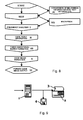
- step I in fig.8 the information being encoded pass through a frequency analyzer (step I in fig.8 ) to determine all the characters and the most commonly occurring combinations of characters of "iy”, “ni", “ko”-type and the like, on the basis of these results in step II setting a code table is carried out, said code table consists of a series of non-recurrent combinations of "empty" and “filled” cells corresponding to the recognizable alphabetic characters, figures, punctuation marks, the combination thereof or common abbreviations present in the volume of information to be encoded.
- the code conversion table setting the correspondence of colours, nuances, geometrical shapes and the like to recognizable characters is set in the preferred embodiment by using a random number generator.
- step III With the aid of the generated table to be encoded (the required) information (in step III) is encoded in the structure of the three-dimensional matrix.
- An example of such a matrix consisting of five bi-level fragments is presented in fig.5 .
- the text information is directly encoded with the aid of a code table therewith, wherein all the necessary alphabetic characters, figures and punctuation marks are already present.
- Graphical, multimedia information (video, audio) and other data items which may be presented in the electronic form is pre-converted (in step IV, fig.8 ) into the text form by using the MIME methods (Base 64), UUEncode, XXEncode or with the aid of the own additional encode vocabulary.
- a code image is shaped, said image being the representation of a three-dimensional matrix provided with encoded information on the two-dimensional surface by sequentially projecting the matrix fragments on the plane and overlapping said fragments along two mutually perpendicular parameters.
- a visual code image is obtained in the form of a planar lattice comprising m x n fields, wherein m and n are the numbers of lines and columns, respectively, of the three-dimensional base matrix. For this visualization to each fragment the colour, shape, configuration or combinations thereof belonging thereto are assigned.
- the preferred embodiment is illustrated in fig. 5 and 6 .
- each matrix fragment the own colour is assigned (Black, Blue, Green, Yellow, Red), and the nuances of this colour are assigned to the corresponding levels of fragments having a space structure.
- the following algorithm is used: on plane XY of the first fragment one of the cells is chosen and the presence of "filled” cells along the vertical Z is checked. If all the fragments of the matrix along the vertical Z within the chosen cell on plane XY are "empty", when representing on the plane, this field remains empty or is filled with a random colour not participating in encoding. If one "filled” cell occurs, this field when representing on the plane takes the colour of the corresponding fragment or the nuance assigned to the corresponding level of the given space fragment.
- this field during representing on the plane is divided into two parts vertically and horizontally, each of which takes the colour of the corresponding fragment or nuance of the corresponding level of the given fragment.
- the first that is, left (in vertical division of the field) or top (in horizontal division) goes the colour of that fragment wherein the first "filled” cell was detected.
- the given field when representing on the plane is divided into three parts vertically or horizontally, each of which takes the colour of the corresponding fragment or nuance of the corresponding level of the present fragment. This process proceeds until all the "filled” cells along the vertical Z within the selected field on plane XY are found.
- the code image may represent the structure of the three-dimensional matrix through not only colour or nuances thereof, but through a shape, graphical images and/or the combinations thereof.
- An example of the code image that is obtained by using a colour and shape (a circle and triangle) is presented in fig. 7 .
- the obtained code image representing the three-dimensional matrix structure projected on the plane may be stored in the electronic form or may be reproduced in a hard medium by using printing equipment.
- the code image becomes more convenient in processing, if it additionally comprises reference areas, wherein references colours, nuances or shapes used for designating the matrix fragments are represented.
- the number and sequence thereof designate the number and sequence of the fragments, respectively, in the three-dimensional matrix used for encoding.
- the reference area is shaped by creating a combination representing the reference data items for at least one matrix fragment.
- the reference area substantially functions as the control area facilitating recognizing and decoding the code image introduced into the decoding apparatus with the aid of a scanner or digital still camera.
- One of the variants is using several levels of the matrix fragment in encoding, wherein the second level or the second or third levels comprise an additional duplicating combination of empty and filled cells. Thus, a possibility to restore the lost part of information appears.
- step VII information pre-encryption may be carried out.
- a bi- or multi-level data acquisition system is contemplated. That is, some part of information is not encrypted at all and is open, and some part is encrypted and may be extracted only by the producer or inspecting person.
- the information may be divided both throughout the area (one piece is open, another is encrypted) and throughout the levels of a fragment (the 1-st - into the open part, the second one - into the closed part), or both the methods may be used in combination.
- optical, magnet inductive or chiseled sensors may be applied, given that dyes having the appropriate characteristics are used.
- the data encoding apparatus according to the above described method is presented in fig. 9 in general form.
- the apparatus contains a personal computer 1 provided with appropriate software and a printer 2 to output the code image on a paper medium 3.
- the obtained code image may be stored in the electronic form in a diskette 4.
- the encoding apparatus is presented in the form of a block diagram in fig. 10 .
- the encoding apparatus contains a data input node 5, a unit 6 for converting data presented in the electronic form by using the MIME methods (Base 64), UUEncode, XXEncode or with the aid of the own additional encode vocabulary, an encryption unit 7 for pre-encrypting all or some part of data items, an accumulation unit 8 used for frequency analysis, forming and recoding the code conversion table, wherein the correspondences of the combinations of filled cells in the three-dimensional matrix fragments to the recognizable characters, including symbols, figures and combinations thereof are determined, data areas forming unit 9 used for acquiring and encoding required data items by using the code conversion table to shape the structure of the three-dimensional matrix provided with colour, tonal and shape-generating characteristics of the fragments thereof, a reference area forming unit 10 to determine during decoding, if the image shaped in the data areas a code image, a code image generator 11 used for forming a physical or electronic code image based
- the decoding method consists in that with the aid of information input equipment in step VIII the acquisition of the code image (reading a code pattern) is carried out, the data areas are determined, wherein required data are encoded and presented as images in colours, shapes and configurations or combinations thereof and a reference area that contains the basic colours, nuances, shapes or configurations or combinations thereof, according to the reference marks the location of the vertical and horizontal code image is corrected and the colour normalization is effected (step IX).
- step X the recognition of the acquired code image is carried out and further according to the corresponding colour reference marks the matrix structure is determined, that is, the number of fragments and the attributes of colour, shape or combinations thereof assigned thereto.
- step XI the recognition of the field and restoration in fragments of the three-dimensional matrix structure take place.
- step XII the separation of fragments comprising combinations of empty and filled cells representing the required encoded data is carried out.
- step XIII decoding the data consisting of recognizable characters, including figures and symbols, determined in the code conversion table used for encoding is carried out, in step XIV the data are recorded in file, to which the attributes corresponding to the information they contain (text, image, video, audio, etc.) are assigned.
- the data decryption is carried out by inverse conversion with the aid of the corresponding used encryption method.
- the decoded data comprising graphical, audio, video information in step XVI are inverted by the executable files with the aid of the MIME methods (Base 64), UUEncode XXEncode or with the aid of the own additional encode vocabulary.
- the resulting text and/or multimedia information (required data) is then transferred to the data output step XVII.
- the data decoding apparatus according to the above described method is presented in the general form in fig. 12 and comprises an input node 13, as the input node a scanner or digital still camera may be used, for reading the code image 14 a personal computer 15 provided with the appropriate software, to the outlet of which a data output unit 16 is connected.
- the block diagram of the decoding apparatus presented in fig. 13 comprises an input unit 17 used for acquiring the code image that comprises the structure of the three-dimensional matrix, a unit 18 for normalizing colours, nuances, shapes or combinations thereof in the acquired image on the basis of the reference area image, a reference area recognizer 19 to determine during decoding, if the image shaped in the data area is a code image, a unit 20 for structure restoring the three-dimensional matrix and dividing thereof into fragments comprising the data areas, wherein the required data are encoded and presented in the form of these fragments in accordance with colour, tonal or shape-generating characteristics, a storage unit 21 of the code conversion table data, a data area forming unit 22 used for decoding the required data by using the code conversion table based on the three-dimensional matrix structure provided with colour, tonal or shape-generating characteristics of the fragments thereof, a decryption unit 23 for obtaining data pre-encrypted before encoding, a unit 24 for data inverse conversion by using the MIME methods (Base
- the present invention is intended for applying a safety bar-code to label packing products and security papers for the purpose of protection of packed goods and security papers against forgery.
- the present invention is intended for protection and identification of printed products.
Landscapes
- Engineering & Computer Science (AREA)
- Multimedia (AREA)
- Signal Processing (AREA)
- Image Processing (AREA)
Applications Claiming Priority (1)
| Application Number | Priority Date | Filing Date | Title |
|---|---|---|---|
| PCT/RU2006/000143 WO2007013835A1 (fr) | 2006-03-24 | 2006-03-24 | Procede et dispositif de codage et de decodage d'informations |
Publications (1)
| Publication Number | Publication Date |
|---|---|
| EP2007014A1 true EP2007014A1 (de) | 2008-12-24 |
Family
ID=37683642
Family Applications (1)
| Application Number | Title | Priority Date | Filing Date |
|---|---|---|---|
| EP06799628A Withdrawn EP2007014A1 (de) | 2006-03-24 | 2006-03-24 | Verfahren zur codierung und decodierung von informationen |
Country Status (3)
| Country | Link |
|---|---|
| US (1) | US20100051693A1 (de) |
| EP (1) | EP2007014A1 (de) |
| WO (1) | WO2007013835A1 (de) |
Families Citing this family (10)
| Publication number | Priority date | Publication date | Assignee | Title |
|---|---|---|---|---|
| US20120193424A1 (en) * | 2011-01-31 | 2012-08-02 | King Abdul Aziz City For Science And Technology | Method of encoding and decoding data on a matrix code symbol |
| CN103903300A (zh) * | 2012-12-31 | 2014-07-02 | 博世汽车部件(苏州)有限公司 | 物体表面高度重建方法及系统、光学字符提取方法及系统 |
| US9400910B2 (en) * | 2014-02-18 | 2016-07-26 | Adobe Systems Incorporated | Method and apparatus for storing and retrieving data embedded into the surface of a 3D printed object |
| CN113112993B (zh) | 2020-01-10 | 2024-04-02 | 阿里巴巴集团控股有限公司 | 一种音频信息处理方法、装置、电子设备以及存储介质 |
| WO2022164453A1 (en) * | 2021-01-29 | 2022-08-04 | Hewlett-Packard Development Company, L.P. | 3d part digital models with digital tiles |
| CN113343324B (zh) * | 2021-06-09 | 2023-03-28 | 东莞市友杰电子有限公司 | 液压式机械产品外形分析系统 |
| CN113610202B (zh) * | 2021-08-10 | 2023-08-08 | 上海应用技术大学 | 一种应用于商品外包装的图形编解码方法及装置 |
| CN115134475B (zh) * | 2022-08-31 | 2022-11-08 | 智联信通科技股份有限公司 | 一种衡器鉴重智能管理系统 |
| CN116776909B (zh) * | 2023-08-28 | 2023-11-03 | 四川星点网络技术有限公司 | 一种瓶盖二维码溯源系统 |
| CN120298513A (zh) * | 2023-11-23 | 2025-07-11 | 拉萨市嘉晖科技有限公司 | 一种文件转可识别彩色数据矩阵图像的方法 |
Family Cites Families (13)
| Publication number | Priority date | Publication date | Assignee | Title |
|---|---|---|---|---|
| NZ240172A (en) * | 1991-10-09 | 1996-05-28 | Kiwisoft Programs Ltd | Computerised detection and identification of multiple labels in a field of view |
| US5726435A (en) * | 1994-03-14 | 1998-03-10 | Nippondenso Co., Ltd. | Optically readable two-dimensional code and method and apparatus using the same |
| US5576528A (en) * | 1994-12-23 | 1996-11-19 | Symbol Technologies, Inc. | Color processing for bar code symbol compaction |
| US5869828A (en) * | 1996-04-02 | 1999-02-09 | Braginsky; Philip Yale | Color and shape system for encoding and decoding data |
| JP3676887B2 (ja) * | 1996-08-08 | 2005-07-27 | 理想科学工業株式会社 | カラー2次元コード及びカラー2次元コードの作成装置 |
| US6038374A (en) * | 1997-06-04 | 2000-03-14 | Hewlett-Packard Company | System and method for constructing calibrated color tables in color image reproduction systems using stochastic supersampling |
| RU2170927C1 (ru) * | 1999-11-22 | 2001-07-20 | Кузнецов Геннадий Михайлович | Способ оценки экологической чистоты пищевой продукции |
| CA2408454C (en) | 2000-05-09 | 2007-12-04 | Colorzip Media, Inc. | Machine readable code and method and device of encoding and decoding the same |
| US7669212B2 (en) * | 2001-02-02 | 2010-02-23 | Opentv, Inc. | Service platform suite management system |
| RU2237283C2 (ru) * | 2001-11-27 | 2004-09-27 | Самсунг Электроникс Ко., Лтд. | Устройство и способ представления трехмерного объекта на основе изображений с глубиной |
| US7158983B2 (en) * | 2002-09-23 | 2007-01-02 | Battelle Memorial Institute | Text analysis technique |
| US7028902B2 (en) * | 2002-10-03 | 2006-04-18 | Hewlett-Packard Development Company, L.P. | Barcode having enhanced visual quality and systems and methods thereof |
| US6902113B2 (en) * | 2003-08-07 | 2005-06-07 | Imageid Ltd. | Selection of colors for color bar codes |
-
2006
- 2006-03-24 EP EP06799628A patent/EP2007014A1/de not_active Withdrawn
- 2006-03-24 WO PCT/RU2006/000143 patent/WO2007013835A1/ru not_active Ceased
- 2006-03-24 US US12/294,108 patent/US20100051693A1/en not_active Abandoned
Non-Patent Citations (1)
| Title |
|---|
| See references of WO2007013835A1 * |
Also Published As
| Publication number | Publication date |
|---|---|
| WO2007013835A1 (fr) | 2007-02-01 |
| US20100051693A1 (en) | 2010-03-04 |
Similar Documents
| Publication | Publication Date | Title |
|---|---|---|
| KR101016712B1 (ko) | 워터마크 정보검출 방법 | |
| US8320607B2 (en) | Image processing method and image processing device for embedding invisible sub information into main images | |
| KR100770963B1 (ko) | 영상들 및 비디오에 대한 계층 인증 시스템 | |
| EP3311336B1 (de) | Authentifizierungsmerkmal bei einem barcode | |
| EP0877998B1 (de) | Software für den digitalen fälschungs-schutz von dokumenten | |
| EP2921989A1 (de) | Verfahren zur Erkennung und/oder Echtheitsprüfung von Gegenständen mittels mobiler Geräte | |
| US20100051693A1 (en) | Information encoding and decoding method | |
| US20100157318A1 (en) | Creation and placement of two-dimensional barcode stamps on printed documents for storing authentication information | |
| US20100155479A1 (en) | Creation and placement of two-dimensional barcode stamps on printed documents for storing authentication information | |
| US20060255141A1 (en) | Machine readable data | |
| US6886863B1 (en) | Secure document with self-authenticating, encryptable font | |
| EP2984814B1 (de) | Erzeugung und erkennung von fälschungssicher druckbaren bildinformationsdaten | |
| WO2020001695A4 (de) | Verfahren zur herstellung für das menschliche auge nicht sichtbarer und nicht kopierbarer sicherheitselemente in einer abbildung sowie gedruckte abbildung | |
| CN101022499A (zh) | 一种利用半色调图像挂网隐藏及提取图文信息的方法 | |
| Joshi et al. | Source printer classification using printer specific local texture descriptor | |
| EP1287483A1 (de) | Maschinenlesbarer code und verfahren und einrichtung zur codierung und decodierung des codes | |
| WO2022131965A1 (ru) | Способ кодирования и декодирования цифровой информации в виде многомерного нанобар-кода | |
| CN108734247A (zh) | 具有复制保护的安全标记 | |
| JP3956419B2 (ja) | Idカード作成方法、idカードおよびidカードの情報読取方法 | |
| US11042792B2 (en) | Methods for encoding a source color illustration, for authenticating an illustration, and related computer media | |
| JP3881733B2 (ja) | 機密情報記録方法 | |
| CN109671011B (zh) | 版权信息的嵌入方法、提取方法及电子设备 | |
| Inglis | Lossless document image compression | |
| CN108898544A (zh) | 一种基于双通道的光栅防伪方法 | |
| JP4260076B2 (ja) | 文書作成装置、文書検証装置、文書作成方法、文書検証方法、文書作成プログラム、文書検証プログラム、文書作成プログラムを格納した記録媒体、および文書検証プログラムを格納した記録媒体 |
Legal Events
| Date | Code | Title | Description |
|---|---|---|---|
| PUAI | Public reference made under article 153(3) epc to a published international application that has entered the european phase |
Free format text: ORIGINAL CODE: 0009012 |
|
| 17P | Request for examination filed |
Effective date: 20081023 |
|
| AK | Designated contracting states |
Kind code of ref document: A1 Designated state(s): AT BE BG CH CY CZ DE DK EE ES FI FR GB GR HU IE IS IT LI LT LU LV MC NL PL PT RO SE SI SK TR |
|
| RAP1 | Party data changed (applicant data changed or rights of an application transferred) |
Owner name: MILIMAREX LIMITED |
|
| STAA | Information on the status of an ep patent application or granted ep patent |
Free format text: STATUS: THE APPLICATION IS DEEMED TO BE WITHDRAWN |
|
| 18D | Application deemed to be withdrawn |
Effective date: 20101001 |