EP2008971A1 - Kern-schale-siliciumdioxid und herstellungsverfahren dafür - Google Patents
Kern-schale-siliciumdioxid und herstellungsverfahren dafür Download PDFInfo
- Publication number
- EP2008971A1 EP2008971A1 EP07738887A EP07738887A EP2008971A1 EP 2008971 A1 EP2008971 A1 EP 2008971A1 EP 07738887 A EP07738887 A EP 07738887A EP 07738887 A EP07738887 A EP 07738887A EP 2008971 A1 EP2008971 A1 EP 2008971A1
- Authority
- EP
- European Patent Office
- Prior art keywords
- silica
- shell
- core
- surfactant
- porous
- Prior art date
- Legal status (The legal status is an assumption and is not a legal conclusion. Google has not performed a legal analysis and makes no representation as to the accuracy of the status listed.)
- Withdrawn
Links
Images


Classifications
-
- C—CHEMISTRY; METALLURGY
- C01—INORGANIC CHEMISTRY
- C01B—NON-METALLIC ELEMENTS; COMPOUNDS THEREOF; METALLOIDS OR COMPOUNDS THEREOF NOT COVERED BY SUBCLASS C01C
- C01B33/00—Silicon; Compounds thereof
- C01B33/113—Silicon oxides; Hydrates thereof
- C01B33/12—Silica; Hydrates thereof, e.g. lepidoic silicic acid
- C01B33/14—Colloidal silica, e.g. dispersions, gels, sols
- C01B33/146—After-treatment of sols
- C01B33/149—Coating
-
- C—CHEMISTRY; METALLURGY
- C01—INORGANIC CHEMISTRY
- C01B—NON-METALLIC ELEMENTS; COMPOUNDS THEREOF; METALLOIDS OR COMPOUNDS THEREOF NOT COVERED BY SUBCLASS C01C
- C01B33/00—Silicon; Compounds thereof
- C01B33/113—Silicon oxides; Hydrates thereof
- C01B33/12—Silica; Hydrates thereof, e.g. lepidoic silicic acid
- C01B33/18—Preparation of finely divided silica neither in sol nor in gel form; After-treatment thereof
-
- B—PERFORMING OPERATIONS; TRANSPORTING
- B01—PHYSICAL OR CHEMICAL PROCESSES OR APPARATUS IN GENERAL
- B01J—CHEMICAL OR PHYSICAL PROCESSES, e.g. CATALYSIS OR COLLOID CHEMISTRY; THEIR RELEVANT APPARATUS
- B01J20/00—Solid sorbent compositions or filter aid compositions; Sorbents for chromatography; Processes for preparing, regenerating or reactivating thereof
- B01J20/02—Solid sorbent compositions or filter aid compositions; Sorbents for chromatography; Processes for preparing, regenerating or reactivating thereof comprising inorganic material
- B01J20/10—Solid sorbent compositions or filter aid compositions; Sorbents for chromatography; Processes for preparing, regenerating or reactivating thereof comprising inorganic material comprising silica or silicate
- B01J20/103—Solid sorbent compositions or filter aid compositions; Sorbents for chromatography; Processes for preparing, regenerating or reactivating thereof comprising inorganic material comprising silica or silicate comprising silica
-
- B—PERFORMING OPERATIONS; TRANSPORTING
- B01—PHYSICAL OR CHEMICAL PROCESSES OR APPARATUS IN GENERAL
- B01J—CHEMICAL OR PHYSICAL PROCESSES, e.g. CATALYSIS OR COLLOID CHEMISTRY; THEIR RELEVANT APPARATUS
- B01J20/00—Solid sorbent compositions or filter aid compositions; Sorbents for chromatography; Processes for preparing, regenerating or reactivating thereof
- B01J20/28—Solid sorbent compositions or filter aid compositions; Sorbents for chromatography; Processes for preparing, regenerating or reactivating thereof characterised by their form or physical properties
- B01J20/28002—Solid sorbent compositions or filter aid compositions; Sorbents for chromatography; Processes for preparing, regenerating or reactivating thereof characterised by their form or physical properties characterised by their physical properties
- B01J20/28004—Sorbent size or size distribution, e.g. particle size
-
- B—PERFORMING OPERATIONS; TRANSPORTING
- B01—PHYSICAL OR CHEMICAL PROCESSES OR APPARATUS IN GENERAL
- B01J—CHEMICAL OR PHYSICAL PROCESSES, e.g. CATALYSIS OR COLLOID CHEMISTRY; THEIR RELEVANT APPARATUS
- B01J20/00—Solid sorbent compositions or filter aid compositions; Sorbents for chromatography; Processes for preparing, regenerating or reactivating thereof
- B01J20/28—Solid sorbent compositions or filter aid compositions; Sorbents for chromatography; Processes for preparing, regenerating or reactivating thereof characterised by their form or physical properties
- B01J20/28014—Solid sorbent compositions or filter aid compositions; Sorbents for chromatography; Processes for preparing, regenerating or reactivating thereof characterised by their form or physical properties characterised by their form
- B01J20/28016—Particle form
- B01J20/28019—Spherical, ellipsoidal or cylindrical
-
- B—PERFORMING OPERATIONS; TRANSPORTING
- B01—PHYSICAL OR CHEMICAL PROCESSES OR APPARATUS IN GENERAL
- B01J—CHEMICAL OR PHYSICAL PROCESSES, e.g. CATALYSIS OR COLLOID CHEMISTRY; THEIR RELEVANT APPARATUS
- B01J20/00—Solid sorbent compositions or filter aid compositions; Sorbents for chromatography; Processes for preparing, regenerating or reactivating thereof
- B01J20/281—Sorbents specially adapted for preparative, analytical or investigative chromatography
- B01J20/282—Porous sorbents
- B01J20/283—Porous sorbents based on silica
-
- B—PERFORMING OPERATIONS; TRANSPORTING
- B01—PHYSICAL OR CHEMICAL PROCESSES OR APPARATUS IN GENERAL
- B01J—CHEMICAL OR PHYSICAL PROCESSES, e.g. CATALYSIS OR COLLOID CHEMISTRY; THEIR RELEVANT APPARATUS
- B01J20/00—Solid sorbent compositions or filter aid compositions; Sorbents for chromatography; Processes for preparing, regenerating or reactivating thereof
- B01J20/30—Processes for preparing, regenerating, or reactivating
- B01J20/32—Impregnating or coating ; Solid sorbent compositions obtained from processes involving impregnating or coating
- B01J20/3291—Characterised by the shape of the carrier, the coating or the obtained coated product
- B01J20/3293—Coatings on a core, the core being particle or fiber shaped, e.g. encapsulated particles, coated fibers
-
- C—CHEMISTRY; METALLURGY
- C09—DYES; PAINTS; POLISHES; NATURAL RESINS; ADHESIVES; COMPOSITIONS NOT OTHERWISE PROVIDED FOR; APPLICATIONS OF MATERIALS NOT OTHERWISE PROVIDED FOR
- C09C—TREATMENT OF INORGANIC MATERIALS, OTHER THAN FIBROUS FILLERS, TO ENHANCE THEIR PIGMENTING OR FILLING PROPERTIES ; PREPARATION OF CARBON BLACK ; PREPARATION OF INORGANIC MATERIALS WHICH ARE NO SINGLE CHEMICAL COMPOUNDS AND WHICH ARE MAINLY USED AS PIGMENTS OR FILLERS
- C09C1/00—Treatment of specific inorganic materials other than fibrous fillers; Preparation of carbon black
- C09C1/28—Compounds of silicon
- C09C1/30—Silicic acid
- C09C1/3045—Treatment with inorganic compounds
- C09C1/3054—Coating
-
- C—CHEMISTRY; METALLURGY
- C09—DYES; PAINTS; POLISHES; NATURAL RESINS; ADHESIVES; COMPOSITIONS NOT OTHERWISE PROVIDED FOR; APPLICATIONS OF MATERIALS NOT OTHERWISE PROVIDED FOR
- C09C—TREATMENT OF INORGANIC MATERIALS, OTHER THAN FIBROUS FILLERS, TO ENHANCE THEIR PIGMENTING OR FILLING PROPERTIES ; PREPARATION OF CARBON BLACK ; PREPARATION OF INORGANIC MATERIALS WHICH ARE NO SINGLE CHEMICAL COMPOUNDS AND WHICH ARE MAINLY USED AS PIGMENTS OR FILLERS
- C09C1/00—Treatment of specific inorganic materials other than fibrous fillers; Preparation of carbon black
- C09C1/28—Compounds of silicon
- C09C1/30—Silicic acid
- C09C1/3063—Treatment with low-molecular organic compounds
-
- C—CHEMISTRY; METALLURGY
- C09—DYES; PAINTS; POLISHES; NATURAL RESINS; ADHESIVES; COMPOSITIONS NOT OTHERWISE PROVIDED FOR; APPLICATIONS OF MATERIALS NOT OTHERWISE PROVIDED FOR
- C09C—TREATMENT OF INORGANIC MATERIALS, OTHER THAN FIBROUS FILLERS, TO ENHANCE THEIR PIGMENTING OR FILLING PROPERTIES ; PREPARATION OF CARBON BLACK ; PREPARATION OF INORGANIC MATERIALS WHICH ARE NO SINGLE CHEMICAL COMPOUNDS AND WHICH ARE MAINLY USED AS PIGMENTS OR FILLERS
- C09C1/00—Treatment of specific inorganic materials other than fibrous fillers; Preparation of carbon black
- C09C1/28—Compounds of silicon
- C09C1/30—Silicic acid
- C09C1/309—Combinations of treatments provided for in groups C09C1/3009 - C09C1/3081
-
- G—PHYSICS
- G01—MEASURING; TESTING
- G01N—INVESTIGATING OR ANALYSING MATERIALS BY DETERMINING THEIR CHEMICAL OR PHYSICAL PROPERTIES
- G01N30/00—Investigating or analysing materials by separation into components using adsorption, absorption or similar phenomena or using ion-exchange, e.g. chromatography or field flow fractionation
- G01N30/02—Column chromatography
- G01N30/88—Integrated analysis systems specially adapted therefor, not covered by a single one of the groups G01N30/04 - G01N30/86
-
- C—CHEMISTRY; METALLURGY
- C01—INORGANIC CHEMISTRY
- C01P—INDEXING SCHEME RELATING TO STRUCTURAL AND PHYSICAL ASPECTS OF SOLID INORGANIC COMPOUNDS
- C01P2004/00—Particle morphology
- C01P2004/01—Particle morphology depicted by an image
- C01P2004/03—Particle morphology depicted by an image obtained by SEM
-
- C—CHEMISTRY; METALLURGY
- C01—INORGANIC CHEMISTRY
- C01P—INDEXING SCHEME RELATING TO STRUCTURAL AND PHYSICAL ASPECTS OF SOLID INORGANIC COMPOUNDS
- C01P2004/00—Particle morphology
- C01P2004/01—Particle morphology depicted by an image
- C01P2004/04—Particle morphology depicted by an image obtained by TEM, STEM, STM or AFM
-
- C—CHEMISTRY; METALLURGY
- C01—INORGANIC CHEMISTRY
- C01P—INDEXING SCHEME RELATING TO STRUCTURAL AND PHYSICAL ASPECTS OF SOLID INORGANIC COMPOUNDS
- C01P2004/00—Particle morphology
- C01P2004/30—Particle morphology extending in three dimensions
- C01P2004/32—Spheres
-
- C—CHEMISTRY; METALLURGY
- C01—INORGANIC CHEMISTRY
- C01P—INDEXING SCHEME RELATING TO STRUCTURAL AND PHYSICAL ASPECTS OF SOLID INORGANIC COMPOUNDS
- C01P2004/00—Particle morphology
- C01P2004/60—Particles characterised by their size
- C01P2004/61—Micrometer sized, i.e. from 1-100 micrometer
-
- C—CHEMISTRY; METALLURGY
- C01—INORGANIC CHEMISTRY
- C01P—INDEXING SCHEME RELATING TO STRUCTURAL AND PHYSICAL ASPECTS OF SOLID INORGANIC COMPOUNDS
- C01P2004/00—Particle morphology
- C01P2004/60—Particles characterised by their size
- C01P2004/62—Submicrometer sized, i.e. from 0.1-1 micrometer
-
- C—CHEMISTRY; METALLURGY
- C01—INORGANIC CHEMISTRY
- C01P—INDEXING SCHEME RELATING TO STRUCTURAL AND PHYSICAL ASPECTS OF SOLID INORGANIC COMPOUNDS
- C01P2004/00—Particle morphology
- C01P2004/80—Particles consisting of a mixture of two or more inorganic phases
- C01P2004/82—Particles consisting of a mixture of two or more inorganic phases two phases having the same anion, e.g. both oxidic phases
- C01P2004/84—Particles consisting of a mixture of two or more inorganic phases two phases having the same anion, e.g. both oxidic phases one phase coated with the other
-
- C—CHEMISTRY; METALLURGY
- C01—INORGANIC CHEMISTRY
- C01P—INDEXING SCHEME RELATING TO STRUCTURAL AND PHYSICAL ASPECTS OF SOLID INORGANIC COMPOUNDS
- C01P2004/00—Particle morphology
- C01P2004/80—Particles consisting of a mixture of two or more inorganic phases
- C01P2004/82—Particles consisting of a mixture of two or more inorganic phases two phases having the same anion, e.g. both oxidic phases
- C01P2004/84—Particles consisting of a mixture of two or more inorganic phases two phases having the same anion, e.g. both oxidic phases one phase coated with the other
- C01P2004/88—Thick layer coatings
-
- C—CHEMISTRY; METALLURGY
- C01—INORGANIC CHEMISTRY
- C01P—INDEXING SCHEME RELATING TO STRUCTURAL AND PHYSICAL ASPECTS OF SOLID INORGANIC COMPOUNDS
- C01P2006/00—Physical properties of inorganic compounds
- C01P2006/12—Surface area
-
- C—CHEMISTRY; METALLURGY
- C01—INORGANIC CHEMISTRY
- C01P—INDEXING SCHEME RELATING TO STRUCTURAL AND PHYSICAL ASPECTS OF SOLID INORGANIC COMPOUNDS
- C01P2006/00—Physical properties of inorganic compounds
- C01P2006/14—Pore volume
-
- Y—GENERAL TAGGING OF NEW TECHNOLOGICAL DEVELOPMENTS; GENERAL TAGGING OF CROSS-SECTIONAL TECHNOLOGIES SPANNING OVER SEVERAL SECTIONS OF THE IPC; TECHNICAL SUBJECTS COVERED BY FORMER USPC CROSS-REFERENCE ART COLLECTIONS [XRACs] AND DIGESTS
- Y10—TECHNICAL SUBJECTS COVERED BY FORMER USPC
- Y10T—TECHNICAL SUBJECTS COVERED BY FORMER US CLASSIFICATION
- Y10T428/00—Stock material or miscellaneous articles
- Y10T428/29—Coated or structually defined flake, particle, cell, strand, strand portion, rod, filament, macroscopic fiber or mass thereof
- Y10T428/2982—Particulate matter [e.g., sphere, flake, etc.]
- Y10T428/2991—Coated
-
- Y—GENERAL TAGGING OF NEW TECHNOLOGICAL DEVELOPMENTS; GENERAL TAGGING OF CROSS-SECTIONAL TECHNOLOGIES SPANNING OVER SEVERAL SECTIONS OF THE IPC; TECHNICAL SUBJECTS COVERED BY FORMER USPC CROSS-REFERENCE ART COLLECTIONS [XRACs] AND DIGESTS
- Y10—TECHNICAL SUBJECTS COVERED BY FORMER USPC
- Y10T—TECHNICAL SUBJECTS COVERED BY FORMER US CLASSIFICATION
- Y10T428/00—Stock material or miscellaneous articles
- Y10T428/29—Coated or structually defined flake, particle, cell, strand, strand portion, rod, filament, macroscopic fiber or mass thereof
- Y10T428/2982—Particulate matter [e.g., sphere, flake, etc.]
- Y10T428/2991—Coated
- Y10T428/2993—Silicic or refractory material containing [e.g., tungsten oxide, glass, cement, etc.]
Definitions
- the present invention relates to a core-shell silica and a method for producing it.
- Porous silica is used as a filler for liquid chromatography, a shape selective catalyst, adsorption/separation material for various ions, a flatting agent for paints, etc.
- the porous silica is required to have a low liquid supply resistance and a high separation efficiency.
- the liquid supply resistance can be reduced by increasing the particle size of a porous silica.
- the particle size of the porous silica is increased, it takes time until substances to be separated are absorbed by the porous silica, then reach a central part of the porous silica and then are released from the porous silica, whereby the separation efficiency deteriorates.
- the particle size of the porous silica is decreased in order to improve the separation efficiency, the liquid supply resistance becomes high.
- a core-shell silica wherein a surface of non-porous silica particle is covered with a shell made of porous silica.
- the core-shell silica has the non-porous silica core particle at the central part, whereby substances to be separated which are adsorbed on the core-shell silica remain on the shell in the vicinity of the surface. Accordingly, the time until the substances to be separated are adsorbed and then released, is short, and the separation efficiency is high. Further, if the silica-core particle is made to be large, while the thickness of the shell is maintained to be thin, the particle size of the core-shell silica can be large, whereby without decreasing the separation efficiency, the liquid supply resistance can be low.
- core-shell silica As the core-shell silica, a core-shell silica obtained by the following method has been known:
- the wet pulverized gel method amorphous silica particles are not spherical but non-specific form particles, and the particle size distribution is broad. Accordingly, the core-shell silica obtained by precipitating sedimentation method amorphous silica particles on the surface of the gel method amorphous silica particles has a low sphericity and a broad particle size distribution. Further, there is a problem that if such a core-shell silica is used as a packing material for liquid chromatography, its packing property to a column for liquid chromatography is poor due to low sphericity.
- the uniformity in thickness is low, and if it is used as a packing material for liquid chromatography, there is a problem of low separation efficiency.
- PATENT DOCUMENT 1 JP3500305
- the present invention is to provide a core-shell silica having a high sphericity and a narrow particle size distribution, and a method for easily producing the core-shell silica.
- the present invention provides the followings:
- the core-shell silica of the present invention has a high sphericity and a narrow particle size distribution.
- a core-shell silica having a high sphericity and a narrow particle size distribution can be easily produced.
- the method of the present invention for producing the core-shell silica comprises the following steps:
- a dispersion is prepared by dispersing silica core particles in a dispersion medium containing an alcohol and water.
- the silica core particles are substantially non-porous silica having a sphericity of at least 0.8 and a coefficient of variation of at most 0.2.
- Substantially non-porous means that the specific surface area of the silica core particles measured by a nitrogen gas adsorption method is at most 50 m 2 /g. If the specific surface area of the silica core particles is at most 50 m 2 /g, when the core-shell silica is used as a packing material for liquid chromatography, substances to be separated which are adsorbed by the shell will not be adsorbed by the silica core particles, and the separation efficiency becomes high.
- the specific surface area of the silica core particles is preferably at most 30 m 2 /g.
- the sphericity of the silica core particles is at least 0.8, preferably at least 0.9. If the sphericity of the silica core particles is at least 0.8, a core-shell silica having a sphericity of at least 0.8 can be obtained.
- the sphericity is a value obtained by measuring silica core particles by a scanning electron microscope (SEM), by selecting 100 particles at random, measuring the major axis and the minor axis of each silica core particle to obtain a sphericity (minor axis/major axis) and calculating an average of the sphericity of 100 silica core particles.
- SEM scanning electron microscope
- the coefficient of variation of the silica core particles is at most 0.2, preferably at most 0.15. If the coefficient of variation of the silica core particles is at most 0.2, the coefficient of variation of the core-shell silica is at most 0.2, namely, a core-shell silica having a narrow particle distribution can be obtained.
- the coefficient of variation can be obtained by the following method.
- the standard deviation of a particle size distribution and the number average particle size are obtained by observing silica core particles by a scanning electron microscope (SEM), by selecting 100 particles at random, and measuring the particle size of each silica core particle, and the coefficient of variation is obtained by the following formula.
- the number average particle size of the silica core particles is preferably from 1 to 100 ⁇ m, more preferably from 0.3 to 50 ⁇ m. If the number average particle size of the silica core particles is at least 0.1 ⁇ m, a shell having a thickness of at least 0.1 ⁇ m can be easily formed. Further, a core-shell silica having a large particle size can be obtained. If the number average particle size of the silica core particles is at most 100 ⁇ m, a porous silica having a substantially effective pore volume to silica core particles can be formed.
- the number average particle size of the silica core particles is a value obtained by measuring silica core particles by a scanning electron microscope (SEM), by selecting 100 particles at random, measuring the particle size of each silica core particle and calculating an average of the particle sizes of 100 silica core particles.
- SEM scanning electron microscope
- the silica core particles are preferably a silica produced by a sol-gel reaction of a metal silicon alkoxide as a starting material, and a silica produced by stober method is particularly preferred.
- the concentration of the silica core particles in 1L of a dispersion is preferably from 20 to 500 m 2 /L, more preferably from 30 to 300 m 2 /L as calculated by the surface area. If the concentration of the silica core particles is at least 20 m 2 /L (calculated by the surface area), in a case where a silica material is reacted at a pH of from 8 to 13, almost all amount of the silica material is consumed to form a shell, whereby production of new porous silica particles can be suppressed. Namely, if the concentration of the silica core particles (calculated by the surface area) is too low, fine porous silica particles may sometimes be formed, as shown in the SEM photograph of Fig. 1 . If the concentration of the silica core particles (calculated by the surface area) is preferably at most 500 m 2 /L, a porous silica can be formed on a surface of the silica core particles efficiently.
- the alcohol is at least one selected from the group consisting of methanol, ethanol, isopropanol, n-propanol, ethylene glycol and glycerol. From the viewpoint of solubility of a silica material, methanol or ethanol is preferred.
- the concentration of the alcohol is preferably from 20 to 90 mass%, more preferably from 30 to 85 mass%, based on the total 100 mass% of an alcohol and water.
- concentration of the alcohol is at least 20 mass%, the rate of hydrolysis of the alkoxysilane can be appropriately controlled, and a porous silica can be uniformly formed on the surface of the silica core particle. Further, if the concentration of the alcohol exceeds 90 mass%, hydrolysis of the alkoxysilane is slow, and it is impossible to form a porous silica efficiently.
- the surfactant has a role as a template for forming pores in a shell.
- the type and concentration of the surfactant substantially influence on the shape of pores of the shell.
- One type of the surfactant may be used alone, or two or more types may be used in combination. In order to form a shell having uniform pores, it is preferred to use one type of the surfactant.
- the surfactant may, for example, be a surfactant which has a role as a template for forming pores in a shell, and an alkylammonium halide or an alkylamine is preferred.
- the alkylammonium halide may, for example, be a tetradecyl trimethylammonium halide, a hexadecyl trimethylammonium halide, an octadecyl trimethylammonium halide, an eicosyl trimethylammonium halide or a docosyl trimethylammonium halide.
- the alkylamine may, for example, be a C 8-20 linear alkylamine, and from the viewpoint of forming uniform pores, dodecyl amine is preferred.
- the concentration of the surfactant is preferably from 0.001 to 0.2 mol/L, more preferably from 0.01 to 0.1 mol/L, per 1 L of the dispersion. If the concentration of the surfactant is at least 0.001 mol/L, the effect as a template can be sufficiently obtained. If the concentration of the surfactant is at most 0.2 mol/L, uniform pores can be formed.
- silica material is reacted under a condition of a pH of from 8 to 13, silica having an almost uniform thickness precipitates on the surface of silica core particles. At this time, micelle of the surfactant is incorporated into the inside of the silica, whereby a shell precursor containing the silica and the surfactant can be formed.
- any material can be used so long as it can form silicon oxide by reaction, and from the viewpoint of reaction efficiency and handling efficiency, an alkoxy silane, sodium silicate or a mixture thereof is preferred, and the alkoxy silane is more preferred.
- alkoxy silane from the viewpoint of universality, trimethyl methoxysilane, trimethylethoxy silane, tetraethoxy silane or tetra methoxy silane is particularly preferred.
- the concentration of the silica material is preferably from 0.001 to 0.5 mol/L, more preferably from 0.005 to 0.3 mol/L, per 1 L of the total reaction solution containing the dispersion and the silica material. If the concentration of the silica material is at least 0.001 mol/L, silica core particle can be sufficiently covered with the silica precursor. If the concentration of the silica material is at most 0.5 mol/L, almost all amount of the silica material is consumed to form a shell, whereby production of new porous silica particles can be suppressed.
- the reaction of the silica material is carried out at a pH of from 8 to 13 from initiation to termination of the reaction. If the pH is lower than 8, the rate of hydrolysis of the alkoxy silane is slow. If the pH exceeds 13, it is impossible to control the rate of hydrolysis.
- the pH is more preferably from 9 to 12.5.
- a method to adjust the pH of a reaction solution containing the dispersion and the silica material to 8 to 13 a method of adding a basic compound, or a method of using a basic surfactant such as an alkyl amine may be mentioned.
- the reaction temperature of the silica material is preferably from 10 to 50°C, and the reaction time is preferably from 1 to 24 hours.
- the method for removing the surfactant from the shell precursor may, for example, be (i) a method wherein particles having a shell precursor formed on silica core particles (hereinafter referred to as core-shell silica precursor) are added in a solvent in which a surfactant is dissolved, and the surfactant thereby contained in the shell precursor is eluted or (ii) a method wherein a core-shell silica precursor is fired to burn off the surfactant contained on the shell precursor. Since the surfactant can be completely removed, the method employing (i) and (ii) in combination is preferred.
- the firing temperature is preferably from 400 to 600°C, and the firing time is preferably from 1 to 10 hours.
- the core-shell silica thus obtained has a sphericity of at least 0.8 and a coefficient of variation of at most 0.2.
- the sphericity of the core-shell silica is at least 0.8, preferably 0.9. If the core shell-silica has a sphericity of at least 0.8, since the sphericity is high, it has an advantage of an excellent packing property to a column for liquid chromatography.
- the sphericity can be obtained in the same manner as in the case of the sphericity of the silica core particles.
- the coefficient of variation of the core-shell silica is at most 0.2, preferably at most 0.15. If the coefficient of variation of the core-shell silica is at most 0.2, since the sphericity is high, a packing property to a column for liquid chromatography is excellent, and since uniformity is high, the separation efficiency is high.
- the coefficient of variation can be obtained in the same manner as in the case of the coefficient of variation of the silica core particles.
- the number average particle size of the core-shell silica is preferably from 0.2 to 110 ⁇ m, more preferably from 1 to 90 ⁇ m. If the number average particle size of the core-shell silica is at least 0.2 ⁇ m, it is possible to form a porous shell on the surface of silica core particles. If the number average particle size of the core-shell silica is at most 110 ⁇ m, the core-shell silica can be appropriately used as a packing material for liquid chromatography.
- the number average particle size can be obtained in the same manner as in the case of the number average particle size of the silica core particles.
- the shell is a porous silica.
- the porous means that physical values of pores of the core shell silica measured by a nitrogen gas adsorption method are within the following ranges, in a case where it is assumed that silica core particles do not exist (0 m 2 /g).
- Pore volume 0.05 to 2 mL/g
- the shell works as an adsorbing layer. If the average pore size of the shell is at most 50 nm, it can be used for separating a large molecule such as a protein.
- the shell can work substantially as a porous layer. If the specific surface area of the shell is at most 1,000 m 2 /g, pores of the shell layer can have an appropriate size, and the porosity of the shell layer can have an appropriate value, whereby the strength of the shell layer can be maintained.
- the thickness of the shell is preferably from 0.1 to 10 ⁇ m, more preferably from 0.2 to 5 ⁇ m. If the thickness of the shell is at least 0.1 ⁇ m, the shell can substantially work as a shell layer. If the thickness of the shell is at most 10 ⁇ m, the desired separation efficiency can be obtained.
- the thickness of the shell can be obtained by the following formula.
- Thickness of the shell (the number average particle size of the core-shell silica - the number average particle size of the silica core particles)/2
- Whether a core-shell silica having a substantially uniform shell is obtained or not can be confirmed by variation of the thickness obtained by the following method being at most 0.2. If the variation of the thickness of the shell is at most 0.2, the thickness of the shell layer is substantially uniform, whereby in a case where the core-shell silica is used as a packing material for liquid chromatography, the period of time from substances to be separated are adsorbed to they are released is small, and the separation efficiency is high.
- the variation of the thickness of the shell is obtained by observing the cross-section of a core-shell silica by a transmission electron microscope (TEM), and by measuring the maximum thickness of the shell and the minimum thickness of the shell of randomly selected one particle and calculating it by the following formula.
- TEM transmission electron microscope
- silica core particles having a sphericity of at least 0.8 and a coefficient of variation of at most 0.2 are used, and a porous shell of which thickness is almost uniform is formed on the surface of each silica core particle by the above steps (a) to (c), whereby a core-shell silica having a sphericity of at least 0.8 and a coefficient of variation of at most 0.2, namely a core-shell silica having a high sphericity and a narrow particle distribution can be formed.
- a silica material is added to a dispersion containing silica core particles, the silica material is reacted under a condition of a pH of from 8 to 13 to form a shell precursor, and a surfactant is removed from the shell precursor, whereby a core-shell silica can be easily produced.
- the pore physical values (specific surface area, average pore size and pore volume) of silica core particles and a core-shell silica were measured by using a pore physical properties-measuring apparatus (AUTOSORB, manufactured by Quantachrome Instruments) by a nitrogen gas adsorption method.
- AUTOSORB pore physical properties-measuring apparatus
- silica core particles HPS-1000 (number average particle size: 1.0 ⁇ m, specific surface area: 3.5 m 2 /g, sphericity: 0.95, coefficient of variation: 0.07), manufactured by SHIIMA ELECTRONICS INC. was prepared.
- Fig. 2 is a SEM photograph of the silica core particles.
- the core-shell silica precursor was recovered by filtrating the reaction solution with a membrane filter having a pore size of 0.1 ⁇ m.
- the core-shell silica precursor was dispersed in 50 mL of ethanol, the dispersion was stirred at 70°C for one hour, and a part of dodecyl amine was decomposed and removed.
- the core-shell silica precursor was recovered by filtrating the dispersion with a membrane filter having a pore size of 0.1 ⁇ m.
- the core-shell silica precursor was fired at 550°C for 3 hours, dodecyl amine was completely removed, and a core-shell silica was obtained.
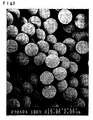
- Fig. 3 is a SEM photograph of the obtained core-shell silica
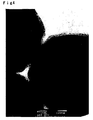
- Fig. 4 is a TEM photograph of the cross-section of the core-shell silica.
- a black part is the core
- a partially transparent part around the core is the shell.
- the number average particle size of the core-shell silica (100 particles) was 1.3 ⁇ m. Further, the sphericity was 0.92, and the coefficient of variation was 0.10.
- the average pore size was 2.5 nm
- the specific surface area was 146 m 2 /g
- the pore volume was 0.09 ml/g
- the shell was porous.
- the thickness of the shell was 0.15 ⁇ m.
- the variation of the thickness of the shell was substantially 0, and a core-shell having a uniform shell was confirmed.
- a core-shell silica was produced in the same manner except that 0.5 g of aqueous ammonia was used instead of dodecyl amine.
- the number average particle size of the obtained core-shell silica was 1.05 ⁇ m.
- the pore physical property values were measured by the nitrogen gas adsorption method, and the shell was substantially non-porous.
- the core-shell silica of the present invention is useful as a packing material for liquid chromatography, a shape selective catalyst, a material for adsorbing and separating ions, a flatting agent for paint, etc. Particularly, in a case where the core-shell silica of the present invention is used as a packing material for liquid chromatography, both low liquid supply resistance (pressure loss suppression) and high separation efficiency can be satisfied.
Landscapes
- Chemical & Material Sciences (AREA)
- Organic Chemistry (AREA)
- Analytical Chemistry (AREA)
- Chemical Kinetics & Catalysis (AREA)
- Inorganic Chemistry (AREA)
- Dispersion Chemistry (AREA)
- General Health & Medical Sciences (AREA)
- General Physics & Mathematics (AREA)
- Immunology (AREA)
- Pathology (AREA)
- Physics & Mathematics (AREA)
- Biochemistry (AREA)
- Life Sciences & Earth Sciences (AREA)
- Health & Medical Sciences (AREA)
- Silicon Compounds (AREA)
Applications Claiming Priority (2)
| Application Number | Priority Date | Filing Date | Title |
|---|---|---|---|
| JP2006116595 | 2006-04-20 | ||
| PCT/JP2007/055442 WO2007122930A1 (ja) | 2006-04-20 | 2007-03-16 | コアシェル型シリカおよびその製造方法 |
Publications (2)
| Publication Number | Publication Date |
|---|---|
| EP2008971A1 true EP2008971A1 (de) | 2008-12-31 |
| EP2008971A4 EP2008971A4 (de) | 2010-08-04 |
Family
ID=38624840
Family Applications (1)
| Application Number | Title | Priority Date | Filing Date |
|---|---|---|---|
| EP07738887A Withdrawn EP2008971A4 (de) | 2006-04-20 | 2007-03-16 | Kern-schale-siliciumdioxid und herstellungsverfahren dafür |
Country Status (6)
| Country | Link |
|---|---|
| US (1) | US7976812B2 (de) |
| EP (1) | EP2008971A4 (de) |
| JP (1) | JPWO2007122930A1 (de) |
| KR (1) | KR20080111032A (de) |
| CN (1) | CN101426725B (de) |
| WO (1) | WO2007122930A1 (de) |
Cited By (6)
| Publication number | Priority date | Publication date | Assignee | Title |
|---|---|---|---|---|
| EP2218500A3 (de) * | 2009-02-17 | 2012-02-08 | Agilent Technologies, Inc. | Oberflächlich poröse Partikel und Verfahren zu deren Herstellung und Verwendung |
| US8685283B2 (en) | 2008-08-29 | 2014-04-01 | Agilent Technologies, Inc. | Superficially porous metal oxide particles, methods for making them, and separation devices using them |
| EP2228344A4 (de) * | 2007-12-07 | 2016-02-24 | Jgc Catalysts & Chemicals Ltd | Poröses siliciumdioxidteilchen mit oberflächenglätte, verfahren zur herstellung des porösen siliciumdioxidteilchens und kosmetikum, umfassend das poröse siliciumdioxidteilchen |
| US9284456B2 (en) | 2008-08-29 | 2016-03-15 | Agilent Technologies, Inc. | Superficially porous metal oxide particles, methods for making them, and separation devices using them |
| EP2262576A4 (de) * | 2008-04-08 | 2016-08-10 | Waters Technologies Corp | Verbundwerkstoffe mit nanopartikeln und ihre verwendung in der chromatographie |
| JP2022151525A (ja) * | 2021-03-25 | 2022-10-07 | 富士フイルムビジネスイノベーション株式会社 | シリカ粒子及びその製造方法 |
Families Citing this family (37)
| Publication number | Priority date | Publication date | Assignee | Title |
|---|---|---|---|---|
| KR100934237B1 (ko) * | 2008-04-21 | 2009-12-24 | 금호타이어 주식회사 | 코어/쉘 형태의 나노실리카를 포함하는 타이어 트레드고무조성물 |
| KR20110100230A (ko) | 2008-11-26 | 2011-09-09 | 유니버시티 컬리지 코르크-내셔날 유니버시티 오브 아일랜드, 코르크 | 실리카 극미립자를 제조하는 방법 |
| US11439977B2 (en) | 2009-06-01 | 2022-09-13 | Waters Technologies Corporation | Hybrid material for chromatographic separations comprising a superficially porous core and a surrounding material |
| US8609068B2 (en) | 2010-02-24 | 2013-12-17 | J.M. Huber Corporation | Continuous silica production process and silica product prepared from same |
| US20130112605A1 (en) | 2010-07-26 | 2013-05-09 | Waters Technologies Corporation | Superficially porous materials comprising a substantially nonporous core having narrow particle size distribution; process for the preparation thereof; and use thereof for chromatographic separations |
| KR20140005209A (ko) * | 2011-01-21 | 2014-01-14 | 디아이씨 가부시끼가이샤 | 다공질 실리카 입자의 제조 방법, 반사 방지막용 수지 조성물, 반사 방지막을 갖는 물품 및 반사 방지 필름 |
| WO2012110995A1 (en) | 2011-02-16 | 2012-08-23 | Glantreo Limited | Silica core-shell microparticles |
| US9028605B2 (en) | 2011-02-25 | 2015-05-12 | J.M. Huber Corporation | Coating compositions comprising spheroid silica or silicate |
| CN102167336B (zh) * | 2011-03-21 | 2012-08-15 | 厦门大学 | 一种介孔二氧化硅空心球的制备方法 |
| US9233355B2 (en) * | 2012-05-23 | 2016-01-12 | Daicel Corporation | Separating agent |
| CZ2013314A3 (cs) * | 2013-04-26 | 2014-07-16 | Univerzita Tomáše Bati ve Zlíně | Etalon k hodnocení topografie materiálů |
| US9994714B2 (en) | 2013-05-16 | 2018-06-12 | Thomas E. Kane | Silica protected pigments for use in artist media |
| WO2014201033A1 (en) | 2013-06-11 | 2014-12-18 | Waters Technologies Corporation | Chromatographic columns and separation devices comprising a superficially porous material; and use thereof for supercritical fluid chromatography and other chromatography |
| WO2015115184A1 (ja) * | 2014-01-31 | 2015-08-06 | サンノプコ株式会社 | 疎水性微粒湿式シリカ、その製造方法及び消泡剤 |
| CN103920496B (zh) * | 2014-04-22 | 2015-11-18 | 武汉凯迪工程技术研究总院有限公司 | 介孔材料包覆式钴基费托合成催化剂及其制备方法 |
| JP5791771B2 (ja) * | 2014-08-28 | 2015-10-07 | 日揮触媒化成株式会社 | 表面平滑性に優れた多孔質シリカ系粒子および該多孔質シリカ系粒子を配合してなる化粧料 |
| CN104645950A (zh) * | 2015-03-16 | 2015-05-27 | 上海通微分析技术有限公司 | 一种用于色谱填充的核壳颗粒及其制备方法 |
| CN104893363A (zh) * | 2015-06-05 | 2015-09-09 | 确成硅化学股份有限公司 | 一种沉淀法白炭黑的改性方法 |
| CN105236415B (zh) * | 2015-09-02 | 2016-05-25 | 广州市飞雪材料科技有限公司 | 一种核壳型沉淀二氧化硅及其制备方法 |
| WO2017141821A1 (ja) | 2016-02-19 | 2017-08-24 | 国立大学法人東北大学 | コアシェル型多孔質シリカ粒子の製造方法 |
| WO2017150423A1 (ja) * | 2016-02-29 | 2017-09-08 | 積水化成品工業株式会社 | シリカ内包マイクロカプセル樹脂粒子、その製造方法及びその用途 |
| US20190015815A1 (en) * | 2016-03-06 | 2019-01-17 | Waters Technologies Corporation | Superficially porous materials comprising a coated core having narrow particle size distribution; process for the preparation thereof; and use thereof for chromatographic separations |
| US10434496B2 (en) | 2016-03-29 | 2019-10-08 | Agilent Technologies, Inc. | Superficially porous particles with dual pore structure and methods for making the same |
| CN107321313B (zh) * | 2016-09-22 | 2019-10-25 | 武汉大学 | 一种表面多孔型核壳结构硅胶微球及其制备方法和应用 |
| JP6889621B2 (ja) * | 2017-06-15 | 2021-06-18 | 旭化成株式会社 | 重合触媒担体用コアシェル型メソポーラスシリカ、及びオレフィン重合体の製造方法 |
| CN107673361B (zh) * | 2017-11-03 | 2020-02-14 | 吉林大学 | 一种多壳层的空心二氧化硅粒子的制备方法 |
| EP3808703A4 (de) | 2018-06-15 | 2021-06-23 | Tohoku University | Herstellungsverfahren für poröse kern-schale-kieselsäurepartikel |
| JP7320231B2 (ja) * | 2018-08-28 | 2023-08-03 | 国立大学法人東北大学 | コアシェル型多孔質シリカ粒子の製造方法 |
| CN111215023A (zh) * | 2018-11-26 | 2020-06-02 | 中国科学院大连化学物理研究所 | 一种壳层为硅碳复合材料的核壳型色谱填料的制备方法 |
| JPWO2021153502A1 (de) * | 2020-01-28 | 2021-08-05 | ||
| US11964874B2 (en) * | 2020-06-09 | 2024-04-23 | Agilent Technologies, Inc. | Etched non-porous particles and method of producing thereof |
| JP7645053B2 (ja) * | 2020-07-17 | 2025-03-13 | 宇部エクシモ株式会社 | 中空無機粒子および該中空無機粒子の製造方法 |
| EP4292983A4 (de) * | 2021-02-12 | 2025-04-30 | Tohoku University | Verfahren zur herstellung von porösen kern-schale-kieselsäureteilchen und poröse kern-schale-kieselsäureteilchen |
| US12540291B2 (en) | 2021-09-23 | 2026-02-03 | The George Washington University | Microencapsulation of friction modifier additives and other additives for performance enhancement in automotive and industrial applications |
| CN116282050B (zh) * | 2023-03-16 | 2024-06-14 | 中国科学院兰州化学物理研究所 | 一种表面介孔二氧化硅单分散微球的制备方法 |
| CN118324150A (zh) * | 2024-04-01 | 2024-07-12 | 江西师范大学 | 一种超大比表面积单分散二氧化硅微球及其制备方法 |
| WO2025249504A1 (ja) * | 2024-05-30 | 2025-12-04 | 株式会社ダイセル | 分離剤 |
Family Cites Families (18)
| Publication number | Priority date | Publication date | Assignee | Title |
|---|---|---|---|---|
| US2883347A (en) * | 1955-09-13 | 1959-04-21 | Bell Telephone Labor Inc | Formation of expanded silica spheres |
| US4010242A (en) * | 1972-04-07 | 1977-03-01 | E. I. Dupont De Nemours And Company | Uniform oxide microspheres and a process for their manufacture |
| US4070283A (en) * | 1976-12-08 | 1978-01-24 | E. I. Du Pont De Nemours And Company | Controlled surface porosity particles and a method for their production |
| US4131542A (en) * | 1977-07-19 | 1978-12-26 | E. I. Dupont De Nemours And Company | Spray dried silica for chromatography |
| US4600646A (en) * | 1984-08-15 | 1986-07-15 | E. I. Du Pont De Nemours And Company | Metal oxide stabilized chromatography packings |
| US4770286A (en) * | 1986-11-17 | 1988-09-13 | Automated Systems, Inc. | Workpiece elevator |
| JPH084260B2 (ja) | 1987-12-17 | 1996-01-17 | 富士通株式会社 | クロック選択回路 |
| AU610429B2 (en) | 1988-07-08 | 1991-05-16 | Famcy Steel Corporation | High damping capacity, two-phase fe-mn-al-c alloy |
| JPH0643515B2 (ja) * | 1989-10-25 | 1994-06-08 | 水澤化学工業株式会社 | 新規充填剤及びその製法 |
| IT1263807B (it) * | 1992-01-24 | 1996-09-03 | Mizusawa Industrial Chem | Granuli sferici di silice porosa oppure di silicato poroso, procedimento per la loro produzione e loro impiego |
| FR2747668B1 (fr) * | 1996-04-22 | 1998-05-22 | Rhone Poulenc Chimie | Procede de preparation de silice comprenant une ecorce de silice et un coeur en un materiau autre |
| JP3500305B2 (ja) * | 1997-06-13 | 2004-02-23 | 水澤化学工業株式会社 | 二重構造を有する非晶質シリカ粒子、その製法及び用途 |
| MY117802A (en) * | 1997-06-13 | 2004-08-30 | Mizusawa Industrial Chem | Amorphous silica particles having a double structure, process for producing the same and use |
| JP3139537B2 (ja) | 1997-08-28 | 2001-03-05 | 東興建設株式会社 | 法面緑化工法 |
| JP4764558B2 (ja) * | 2001-03-21 | 2011-09-07 | 水澤化学工業株式会社 | 吸油量の増大した非晶質シリカ粒子、その製法及び用途 |
| WO2003078159A1 (en) * | 2002-03-13 | 2003-09-25 | Regents Of The University Of Minnesota | Silica-based materials and methods |
| CN1193818C (zh) * | 2002-03-13 | 2005-03-23 | 华东理工大学 | 一种二氧化硅磁性微球及其制备方法 |
| JP4577560B2 (ja) | 2004-09-21 | 2010-11-10 | 日産自動車株式会社 | 液圧成形装置及び液圧成形方法 |
-
2007
- 2007-03-16 WO PCT/JP2007/055442 patent/WO2007122930A1/ja not_active Ceased
- 2007-03-16 JP JP2008512027A patent/JPWO2007122930A1/ja active Pending
- 2007-03-16 KR KR1020087024245A patent/KR20080111032A/ko not_active Ceased
- 2007-03-16 EP EP07738887A patent/EP2008971A4/de not_active Withdrawn
- 2007-03-16 CN CN2007800137869A patent/CN101426725B/zh not_active Expired - Fee Related
-
2008
- 2008-10-14 US US12/250,745 patent/US7976812B2/en not_active Expired - Fee Related
Non-Patent Citations (3)
| Title |
|---|
| GUNTER BÜCHEL ET AL: "A Novel Pathway for Synthesis of Submicrometer-Size Solid Core/Mesoporous Shell Silica Spheres" ADVANCED MATERIALS,, vol. 10, no. 13, 1 January 1998 (1998-01-01), pages 1036-1038, XP002584779 * |
| See also references of WO2007122930A1 * |
| SUK BON YOON ET AL: "Synthesis of monodisperse spherical silica particles with solid core and mesoporous shell: mesopore channels perpendicular to the surface" JOURNAL OF MATERILAS CHEMYISTRY, vol. 17, 20 February 2007 (2007-02-20), pages 1758-1761, XP002587340 DOI: 10.1039/b617471j * |
Cited By (9)
| Publication number | Priority date | Publication date | Assignee | Title |
|---|---|---|---|---|
| EP2228344A4 (de) * | 2007-12-07 | 2016-02-24 | Jgc Catalysts & Chemicals Ltd | Poröses siliciumdioxidteilchen mit oberflächenglätte, verfahren zur herstellung des porösen siliciumdioxidteilchens und kosmetikum, umfassend das poröse siliciumdioxidteilchen |
| EP2228344B1 (de) * | 2007-12-07 | 2019-02-20 | JGC Catalysts and Chemicals Ltd. | Poröses siliciumdioxidteilchen mit oberflächenglätte, verfahren zur herstellung des porösen siliciumdioxidteilchens und kosmetikum, umfassend das poröse siliciumdioxidteilchen |
| EP2262576A4 (de) * | 2008-04-08 | 2016-08-10 | Waters Technologies Corp | Verbundwerkstoffe mit nanopartikeln und ihre verwendung in der chromatographie |
| US11426707B2 (en) | 2008-04-08 | 2022-08-30 | Waters Technologies Corporation | Composite materials containing nanoparticles and their use in chromatography |
| US8685283B2 (en) | 2008-08-29 | 2014-04-01 | Agilent Technologies, Inc. | Superficially porous metal oxide particles, methods for making them, and separation devices using them |
| US9284456B2 (en) | 2008-08-29 | 2016-03-15 | Agilent Technologies, Inc. | Superficially porous metal oxide particles, methods for making them, and separation devices using them |
| EP2218500A3 (de) * | 2009-02-17 | 2012-02-08 | Agilent Technologies, Inc. | Oberflächlich poröse Partikel und Verfahren zu deren Herstellung und Verwendung |
| US8864988B2 (en) | 2009-02-17 | 2014-10-21 | Agilent Technologies, Inc. | Superficially porous particles and methods of making and using same |
| JP2022151525A (ja) * | 2021-03-25 | 2022-10-07 | 富士フイルムビジネスイノベーション株式会社 | シリカ粒子及びその製造方法 |
Also Published As
| Publication number | Publication date |
|---|---|
| WO2007122930A1 (ja) | 2007-11-01 |
| EP2008971A4 (de) | 2010-08-04 |
| JPWO2007122930A1 (ja) | 2009-09-03 |
| CN101426725A (zh) | 2009-05-06 |
| US7976812B2 (en) | 2011-07-12 |
| KR20080111032A (ko) | 2008-12-22 |
| US20090053524A1 (en) | 2009-02-26 |
| CN101426725B (zh) | 2011-04-13 |
Similar Documents
| Publication | Publication Date | Title |
|---|---|---|
| US7976812B2 (en) | Method for producing non-porous core-porous shell silica | |
| EP3081531B1 (de) | Kieselsäurepartikel, herstellungsverfahren dafür und kieselsäuresol | |
| JP5334385B2 (ja) | ポリシリケート粒子状材料の製造および使用 | |
| KR20090069187A (ko) | 영구적 소수성을 갖는 에어로겔의 제조 방법 및 이로부터 제조된 영구적 소수성을 갖는 에어로겔 | |
| CN108602681B (zh) | 二氧化硅气凝胶的制备方法以及由其制备的二氧化硅气凝胶 | |
| CN111183113A (zh) | 疏水性二氧化硅气凝胶颗粒的制造方法 | |
| Lazareva et al. | Synthesis of high-purity silica nanoparticles by sol-gel method | |
| KR20170111351A (ko) | 구형 실리카 에어로겔 과립의 제조방법 및 이에 의해 제조되는 구형 실리카 에어로겔 과립 | |
| CN107666954A (zh) | 金属氧化物‑二氧化硅复合气凝胶的制备方法以及制备的金属氧化物‑二氧化硅复合气凝胶 | |
| JP2013166667A (ja) | 粉体用流動化剤及びその製造方法 | |
| EP3385225B1 (de) | Verfahren zur herstellung von silica-aerogel | |
| JP7007541B2 (ja) | コアシェル型多孔質シリカ粒子の製造方法 | |
| CN102355946A (zh) | 基于硅胶的催化剂载体 | |
| CN112585089B (zh) | 核壳型多孔质二氧化硅粒子的制造方法 | |
| JP2005314197A (ja) | 高純度疎水性有機溶媒分散シリカゾル及びその製造方法 | |
| JP4488191B2 (ja) | 球状シリカ系メソ多孔体の製造方法 | |
| JP7290289B2 (ja) | コアシェル型多孔質シリカ粒子の製造方法 | |
| KR100894795B1 (ko) | 금속 규소로부터 직접산화법에 의한 콜로이달 실리카의제조방법 | |
| JPH0280317A (ja) | 表面がアルコキシ化された多孔質シリカ粒子 |
Legal Events
| Date | Code | Title | Description |
|---|---|---|---|
| PUAI | Public reference made under article 153(3) epc to a published international application that has entered the european phase |
Free format text: ORIGINAL CODE: 0009012 |
|
| 17P | Request for examination filed |
Effective date: 20081023 |
|
| AK | Designated contracting states |
Kind code of ref document: A1 Designated state(s): AT BE BG CH CY CZ DE DK EE ES FI FR GB GR HU IE IS IT LI LT LU LV MC MT NL PL PT RO SE SI SK TR |
|
| AX | Request for extension of the european patent |
Extension state: AL BA HR MK RS |
|
| DAX | Request for extension of the european patent (deleted) | ||
| RBV | Designated contracting states (corrected) |
Designated state(s): DE GB |
|
| RIC1 | Information provided on ipc code assigned before grant |
Ipc: C09C 1/30 20060101ALI20100618BHEP Ipc: G01N 30/88 20060101ALI20100618BHEP Ipc: C01B 33/18 20060101AFI20081107BHEP |
|
| A4 | Supplementary search report drawn up and despatched |
Effective date: 20100705 |
|
| RIC1 | Information provided on ipc code assigned before grant |
Ipc: C09C 1/30 20060101ALI20110630BHEP Ipc: G01N 30/88 20060101ALI20110630BHEP Ipc: C01B 33/18 20060101AFI20110630BHEP |
|
| RTI1 | Title (correction) |
Free format text: METHOD FOR PRODUCING CORE-SHELL SILICA |
|
| GRAP | Despatch of communication of intention to grant a patent |
Free format text: ORIGINAL CODE: EPIDOSNIGR1 |
|
| RAP1 | Party data changed (applicant data changed or rights of an application transferred) |
Owner name: ASAHI GLASS COMPANY, LIMITED |
|
| STAA | Information on the status of an ep patent application or granted ep patent |
Free format text: STATUS: THE APPLICATION IS DEEMED TO BE WITHDRAWN |
|
| 18D | Application deemed to be withdrawn |
Effective date: 20120209 |