EP2009001A1 - Verfahren zur Herstellung von Dioxazin-Derivaten - Google Patents
Verfahren zur Herstellung von Dioxazin-Derivaten Download PDFInfo
- Publication number
- EP2009001A1 EP2009001A1 EP07011965A EP07011965A EP2009001A1 EP 2009001 A1 EP2009001 A1 EP 2009001A1 EP 07011965 A EP07011965 A EP 07011965A EP 07011965 A EP07011965 A EP 07011965A EP 2009001 A1 EP2009001 A1 EP 2009001A1
- Authority
- EP
- European Patent Office
- Prior art keywords
- alkyl
- cycloalkyl
- optionally
- substituted
- substituents
- Prior art date
- Legal status (The legal status is an assumption and is not a legal conclusion. Google has not performed a legal analysis and makes no representation as to the accuracy of the status listed.)
- Withdrawn
Links
- 150000005125 dioxazines Chemical class 0.000 title claims abstract description 12
- 238000000034 method Methods 0.000 title claims description 78
- 238000004519 manufacturing process Methods 0.000 title 1
- 125000004432 carbon atom Chemical group C* 0.000 claims abstract description 44
- -1 pyridine compound Chemical class 0.000 claims abstract description 38
- 229910052801 chlorine Inorganic materials 0.000 claims abstract description 31
- 125000003118 aryl group Chemical group 0.000 claims abstract description 30
- 125000000753 cycloalkyl group Chemical group 0.000 claims abstract description 30
- 125000003342 alkenyl group Chemical group 0.000 claims abstract description 29
- 125000000304 alkynyl group Chemical group 0.000 claims abstract description 23
- 229910052794 bromium Inorganic materials 0.000 claims abstract description 20
- 229910052731 fluorine Inorganic materials 0.000 claims abstract description 20
- 125000003545 alkoxy group Chemical group 0.000 claims abstract description 19
- 125000000217 alkyl group Chemical group 0.000 claims abstract description 19
- 125000004644 alkyl sulfinyl group Chemical group 0.000 claims abstract description 18
- 125000004390 alkyl sulfonyl group Chemical group 0.000 claims abstract description 18
- 125000004414 alkyl thio group Chemical group 0.000 claims abstract description 18
- 125000004453 alkoxycarbonyl group Chemical group 0.000 claims abstract description 17
- 125000004457 alkyl amino carbonyl group Chemical group 0.000 claims abstract description 17
- 125000003282 alkyl amino group Chemical group 0.000 claims abstract description 17
- 125000004448 alkyl carbonyl group Chemical group 0.000 claims abstract description 17
- 125000000623 heterocyclic group Chemical group 0.000 claims abstract description 17
- 125000000858 thiocyanato group Chemical group *SC#N 0.000 claims abstract description 17
- 125000002915 carbonyl group Chemical group [*:2]C([*:1])=O 0.000 claims abstract description 14
- 125000002947 alkylene group Chemical group 0.000 claims abstract description 12
- 238000002360 preparation method Methods 0.000 claims abstract description 12
- 125000000449 nitro group Chemical group [O-][N+](*)=O 0.000 claims abstract description 8
- 229910052740 iodine Inorganic materials 0.000 claims abstract description 6
- 150000001875 compounds Chemical class 0.000 claims description 56
- 125000001424 substituent group Chemical group 0.000 claims description 40
- 229910052736 halogen Inorganic materials 0.000 claims description 38
- 150000002367 halogens Chemical class 0.000 claims description 38
- ZAMOUSCENKQFHK-UHFFFAOYSA-N Chlorine atom Chemical compound [Cl] ZAMOUSCENKQFHK-UHFFFAOYSA-N 0.000 claims description 37
- 239000000460 chlorine Substances 0.000 claims description 37
- 125000004093 cyano group Chemical group *C#N 0.000 claims description 32
- 125000005913 (C3-C6) cycloalkyl group Chemical group 0.000 claims description 26
- PXGOKWXKJXAPGV-UHFFFAOYSA-N Fluorine Chemical compound FF PXGOKWXKJXAPGV-UHFFFAOYSA-N 0.000 claims description 23
- 238000006243 chemical reaction Methods 0.000 claims description 20
- WKBOTKDWSSQWDR-UHFFFAOYSA-N Bromine atom Chemical compound [Br] WKBOTKDWSSQWDR-UHFFFAOYSA-N 0.000 claims description 18
- GDTBXPJZTBHREO-UHFFFAOYSA-N bromine Substances BrBr GDTBXPJZTBHREO-UHFFFAOYSA-N 0.000 claims description 18
- 239000011737 fluorine Substances 0.000 claims description 18
- PNDPGZBMCMUPRI-UHFFFAOYSA-N iodine Chemical compound II PNDPGZBMCMUPRI-UHFFFAOYSA-N 0.000 claims description 17
- 125000004767 (C1-C4) haloalkoxy group Chemical group 0.000 claims description 16
- 125000001072 heteroaryl group Chemical group 0.000 claims description 16
- 125000004768 (C1-C4) alkylsulfinyl group Chemical group 0.000 claims description 11
- 125000004769 (C1-C4) alkylsulfonyl group Chemical group 0.000 claims description 11
- FYSNRJHAOHDILO-UHFFFAOYSA-N thionyl chloride Chemical compound ClS(Cl)=O FYSNRJHAOHDILO-UHFFFAOYSA-N 0.000 claims description 11
- UFHFLCQGNIYNRP-UHFFFAOYSA-N Hydrogen Chemical compound [H][H] UFHFLCQGNIYNRP-UHFFFAOYSA-N 0.000 claims description 10
- 229910052739 hydrogen Inorganic materials 0.000 claims description 10
- 239000001257 hydrogen Substances 0.000 claims description 10
- 125000000882 C2-C6 alkenyl group Chemical group 0.000 claims description 6
- 238000005580 one pot reaction Methods 0.000 claims description 6
- CTSLXHKWHWQRSH-UHFFFAOYSA-N oxalyl chloride Chemical compound ClC(=O)C(Cl)=O CTSLXHKWHWQRSH-UHFFFAOYSA-N 0.000 claims description 6
- 238000007363 ring formation reaction Methods 0.000 claims description 6
- ZCYVEMRRCGMTRW-UHFFFAOYSA-N 7553-56-2 Chemical compound [I] ZCYVEMRRCGMTRW-UHFFFAOYSA-N 0.000 claims description 4
- 125000003601 C2-C6 alkynyl group Chemical group 0.000 claims description 4
- 239000012320 chlorinating reagent Substances 0.000 claims description 4
- 238000005660 chlorination reaction Methods 0.000 claims description 4
- 239000011630 iodine Substances 0.000 claims description 4
- XHXFXVLFKHQFAL-UHFFFAOYSA-N phosphoryl trichloride Chemical compound ClP(Cl)(Cl)=O XHXFXVLFKHQFAL-UHFFFAOYSA-N 0.000 claims description 4
- 238000006798 ring closing metathesis reaction Methods 0.000 claims description 4
- 230000009466 transformation Effects 0.000 claims description 4
- YGYAWVDWMABLBF-UHFFFAOYSA-N Phosgene Chemical compound ClC(Cl)=O YGYAWVDWMABLBF-UHFFFAOYSA-N 0.000 claims description 3
- 125000002887 hydroxy group Chemical group [H]O* 0.000 claims description 3
- HCUYBXPSSCRKRF-UHFFFAOYSA-N diphosgene Chemical compound ClC(=O)OC(Cl)(Cl)Cl HCUYBXPSSCRKRF-UHFFFAOYSA-N 0.000 claims description 2
- RLOWWWKZYUNIDI-UHFFFAOYSA-N phosphinic chloride Chemical compound ClP=O RLOWWWKZYUNIDI-UHFFFAOYSA-N 0.000 claims description 2
- 125000001153 fluoro group Chemical group F* 0.000 claims 1
- 238000002955 isolation Methods 0.000 claims 1
- UMJSCPRVCHMLSP-UHFFFAOYSA-N pyridine Natural products COC1=CC=CN=C1 UMJSCPRVCHMLSP-UHFFFAOYSA-N 0.000 abstract 3
- JUJWROOIHBZHMG-UHFFFAOYSA-N pyridine Substances C1=CC=NC=C1 JUJWROOIHBZHMG-UHFFFAOYSA-N 0.000 abstract 3
- 125000005843 halogen group Chemical group 0.000 abstract 2
- 125000004438 haloalkoxy group Chemical group 0.000 abstract 1
- 125000001188 haloalkyl group Chemical group 0.000 abstract 1
- 125000005842 heteroatom Chemical group 0.000 abstract 1
- 125000004665 trialkylsilyl group Chemical group 0.000 abstract 1
- XEKOWRVHYACXOJ-UHFFFAOYSA-N Ethyl acetate Chemical compound CCOC(C)=O XEKOWRVHYACXOJ-UHFFFAOYSA-N 0.000 description 18
- ZMXDDKWLCZADIW-UHFFFAOYSA-N N,N-Dimethylformamide Chemical compound CN(C)C=O ZMXDDKWLCZADIW-UHFFFAOYSA-N 0.000 description 15
- YXFVVABEGXRONW-UHFFFAOYSA-N Toluene Chemical compound CC1=CC=CC=C1 YXFVVABEGXRONW-UHFFFAOYSA-N 0.000 description 12
- 125000004169 (C1-C6) alkyl group Chemical group 0.000 description 10
- YMWUJEATGCHHMB-UHFFFAOYSA-N Dichloromethane Chemical compound ClCCl YMWUJEATGCHHMB-UHFFFAOYSA-N 0.000 description 10
- KWYUFKZDYYNOTN-UHFFFAOYSA-M Potassium hydroxide Chemical compound [OH-].[K+] KWYUFKZDYYNOTN-UHFFFAOYSA-M 0.000 description 10
- 150000003254 radicals Chemical class 0.000 description 10
- HEMHJVSKTPXQMS-UHFFFAOYSA-M Sodium hydroxide Chemical compound [OH-].[Na+] HEMHJVSKTPXQMS-UHFFFAOYSA-M 0.000 description 9
- MVPPADPHJFYWMZ-UHFFFAOYSA-N chlorobenzene Chemical compound ClC1=CC=CC=C1 MVPPADPHJFYWMZ-UHFFFAOYSA-N 0.000 description 8
- 239000002904 solvent Substances 0.000 description 8
- XLYOFNOQVPJJNP-UHFFFAOYSA-N water Substances O XLYOFNOQVPJJNP-UHFFFAOYSA-N 0.000 description 8
- 239000003795 chemical substances by application Substances 0.000 description 7
- 125000000229 (C1-C4)alkoxy group Chemical group 0.000 description 6
- UHOVQNZJYSORNB-UHFFFAOYSA-N Benzene Chemical compound C1=CC=CC=C1 UHOVQNZJYSORNB-UHFFFAOYSA-N 0.000 description 6
- WMFOQBRAJBCJND-UHFFFAOYSA-M Lithium hydroxide Chemical compound [Li+].[OH-] WMFOQBRAJBCJND-UHFFFAOYSA-M 0.000 description 6
- FXHOOIRPVKKKFG-UHFFFAOYSA-N N,N-Dimethylacetamide Chemical compound CN(C)C(C)=O FXHOOIRPVKKKFG-UHFFFAOYSA-N 0.000 description 6
- WYURNTSHIVDZCO-UHFFFAOYSA-N Tetrahydrofuran Chemical compound C1CCOC1 WYURNTSHIVDZCO-UHFFFAOYSA-N 0.000 description 6
- 125000006193 alkinyl group Chemical group 0.000 description 6
- VLKZOEOYAKHREP-UHFFFAOYSA-N n-Hexane Chemical compound CCCCCC VLKZOEOYAKHREP-UHFFFAOYSA-N 0.000 description 6
- SCYULBFZEHDVBN-UHFFFAOYSA-N 1,1-Dichloroethane Chemical compound CC(Cl)Cl SCYULBFZEHDVBN-UHFFFAOYSA-N 0.000 description 5
- 239000000047 product Substances 0.000 description 5
- 125000004178 (C1-C4) alkyl group Chemical group 0.000 description 4
- OCJBOOLMMGQPQU-UHFFFAOYSA-N 1,4-dichlorobenzene Chemical compound ClC1=CC=C(Cl)C=C1 OCJBOOLMMGQPQU-UHFFFAOYSA-N 0.000 description 4
- SKPVGEZMRXKVQI-UHFFFAOYSA-N 2-benzylsulfanyl-n-(2-hydroxyethoxy)pyridine-3-carboxamide Chemical compound OCCONC(=O)C1=CC=CN=C1SCC1=CC=CC=C1 SKPVGEZMRXKVQI-UHFFFAOYSA-N 0.000 description 4
- HEDRZPFGACZZDS-UHFFFAOYSA-N Chloroform Chemical compound ClC(Cl)Cl HEDRZPFGACZZDS-UHFFFAOYSA-N 0.000 description 4
- IMNFDUFMRHMDMM-UHFFFAOYSA-N N-Heptane Chemical compound CCCCCCC IMNFDUFMRHMDMM-UHFFFAOYSA-N 0.000 description 4
- JCXJVPUVTGWSNB-UHFFFAOYSA-N Nitrogen dioxide Chemical class O=[N]=O JCXJVPUVTGWSNB-UHFFFAOYSA-N 0.000 description 4
- CTQNGGLPUBDAKN-UHFFFAOYSA-N O-Xylene Chemical compound CC1=CC=CC=C1C CTQNGGLPUBDAKN-UHFFFAOYSA-N 0.000 description 4
- 125000001931 aliphatic group Chemical group 0.000 description 4
- 230000031709 bromination Effects 0.000 description 4
- 238000005893 bromination reaction Methods 0.000 description 4
- 239000003153 chemical reaction reagent Substances 0.000 description 4
- 229940117389 dichlorobenzene Drugs 0.000 description 4
- 239000003960 organic solvent Substances 0.000 description 4
- VZGDMQKNWNREIO-UHFFFAOYSA-N tetrachloromethane Chemical compound ClC(Cl)(Cl)Cl VZGDMQKNWNREIO-UHFFFAOYSA-N 0.000 description 4
- 239000008096 xylene Substances 0.000 description 4
- APQIUTYORBAGEZ-UHFFFAOYSA-N 1,1-dibromoethane Chemical compound CC(Br)Br APQIUTYORBAGEZ-UHFFFAOYSA-N 0.000 description 3
- RYHBNJHYFVUHQT-UHFFFAOYSA-N 1,4-Dioxane Chemical compound C1COCCO1 RYHBNJHYFVUHQT-UHFFFAOYSA-N 0.000 description 3
- RBPSEHSKFMFQNG-UHFFFAOYSA-N 3-(2-benzylsulfanylpyridin-3-yl)-5,6-dihydro-1,4,2-dioxazine Chemical compound C=1C=CC=CC=1CSC1=NC=CC=C1C1=NOCCO1 RBPSEHSKFMFQNG-UHFFFAOYSA-N 0.000 description 3
- SBUKLPSBNFWJCU-UHFFFAOYSA-N ClIBr Chemical compound ClIBr SBUKLPSBNFWJCU-UHFFFAOYSA-N 0.000 description 3
- RTZKZFJDLAIYFH-UHFFFAOYSA-N Diethyl ether Chemical compound CCOCC RTZKZFJDLAIYFH-UHFFFAOYSA-N 0.000 description 3
- SECXISVLQFMRJM-UHFFFAOYSA-N N-Methylpyrrolidone Chemical compound CN1CCCC1=O SECXISVLQFMRJM-UHFFFAOYSA-N 0.000 description 3
- ZMANZCXQSJIPKH-UHFFFAOYSA-N Triethylamine Chemical compound CCN(CC)CC ZMANZCXQSJIPKH-UHFFFAOYSA-N 0.000 description 3
- 150000001408 amides Chemical class 0.000 description 3
- 150000001733 carboxylic acid esters Chemical class 0.000 description 3
- PPSZHCXTGRHULJ-UHFFFAOYSA-N dioxazine Chemical group O1ON=CC=C1 PPSZHCXTGRHULJ-UHFFFAOYSA-N 0.000 description 3
- 239000012025 fluorinating agent Substances 0.000 description 3
- 150000007529 inorganic bases Chemical class 0.000 description 3
- 239000000543 intermediate Substances 0.000 description 3
- 230000026045 iodination Effects 0.000 description 3
- 238000006192 iodination reaction Methods 0.000 description 3
- 239000002244 precipitate Substances 0.000 description 3
- 239000011541 reaction mixture Substances 0.000 description 3
- WJKHJLXJJJATHN-UHFFFAOYSA-N triflic anhydride Chemical compound FC(F)(F)S(=O)(=O)OS(=O)(=O)C(F)(F)F WJKHJLXJJJATHN-UHFFFAOYSA-N 0.000 description 3
- 125000004191 (C1-C6) alkoxy group Chemical group 0.000 description 2
- APOYTRAZFJURPB-UHFFFAOYSA-N 2-methoxy-n-(2-methoxyethyl)-n-(trifluoro-$l^{4}-sulfanyl)ethanamine Chemical compound COCCN(S(F)(F)F)CCOC APOYTRAZFJURPB-UHFFFAOYSA-N 0.000 description 2
- SZNYYWIUQFZLLT-UHFFFAOYSA-N 2-methyl-1-(2-methylpropoxy)propane Chemical compound CC(C)COCC(C)C SZNYYWIUQFZLLT-UHFFFAOYSA-N 0.000 description 2
- WEVYAHXRMPXWCK-UHFFFAOYSA-N Acetonitrile Chemical compound CC#N WEVYAHXRMPXWCK-UHFFFAOYSA-N 0.000 description 2
- XDTMQSROBMDMFD-UHFFFAOYSA-N Cyclohexane Chemical compound C1CCCCC1 XDTMQSROBMDMFD-UHFFFAOYSA-N 0.000 description 2
- XTHFKEDIFFGKHM-UHFFFAOYSA-N Dimethoxyethane Chemical compound COCCOC XTHFKEDIFFGKHM-UHFFFAOYSA-N 0.000 description 2
- IAZDPXIOMUYVGZ-UHFFFAOYSA-N Dimethylsulphoxide Chemical class CS(C)=O IAZDPXIOMUYVGZ-UHFFFAOYSA-N 0.000 description 2
- LELOWRISYMNNSU-UHFFFAOYSA-N Hydrocyanic acid Natural products N#C LELOWRISYMNNSU-UHFFFAOYSA-N 0.000 description 2
- 239000012359 Methanesulfonyl chloride Substances 0.000 description 2
- BZLVMXJERCGZMT-UHFFFAOYSA-N Methyl tert-butyl ether Chemical compound COC(C)(C)C BZLVMXJERCGZMT-UHFFFAOYSA-N 0.000 description 2
- YNAVUWVOSKDBBP-UHFFFAOYSA-N Morpholine Chemical compound C1COCCN1 YNAVUWVOSKDBBP-UHFFFAOYSA-N 0.000 description 2
- NQRYJNQNLNOLGT-UHFFFAOYSA-N Piperidine Chemical compound C1CCNCC1 NQRYJNQNLNOLGT-UHFFFAOYSA-N 0.000 description 2
- DLGYNVMUCSTYDQ-UHFFFAOYSA-N azane;pyridine Chemical compound N.C1=CC=NC=C1 DLGYNVMUCSTYDQ-UHFFFAOYSA-N 0.000 description 2
- CODNYICXDISAEA-UHFFFAOYSA-N bromine monochloride Chemical compound BrCl CODNYICXDISAEA-UHFFFAOYSA-N 0.000 description 2
- XBXHEDNNWSJZPK-UHFFFAOYSA-N chlorosulfonyloxybenzene Chemical compound ClS(=O)(=O)OC1=CC=CC=C1 XBXHEDNNWSJZPK-UHFFFAOYSA-N 0.000 description 2
- 238000004587 chromatography analysis Methods 0.000 description 2
- 239000012043 crude product Substances 0.000 description 2
- 238000002425 crystallisation Methods 0.000 description 2
- 230000008025 crystallization Effects 0.000 description 2
- CSJLBAMHHLJAAS-UHFFFAOYSA-N diethylaminosulfur trifluoride Chemical compound CCN(CC)S(F)(F)F CSJLBAMHHLJAAS-UHFFFAOYSA-N 0.000 description 2
- SBZXBUIDTXKZTM-UHFFFAOYSA-N diglyme Chemical compound COCCOCCOC SBZXBUIDTXKZTM-UHFFFAOYSA-N 0.000 description 2
- QARBMVPHQWIHKH-UHFFFAOYSA-N methanesulfonyl chloride Chemical compound CS(Cl)(=O)=O QARBMVPHQWIHKH-UHFFFAOYSA-N 0.000 description 2
- 239000000203 mixture Substances 0.000 description 2
- 150000002825 nitriles Chemical class 0.000 description 2
- TVMXDCGIABBOFY-UHFFFAOYSA-N octane Chemical compound CCCCCCCC TVMXDCGIABBOFY-UHFFFAOYSA-N 0.000 description 2
- 150000007530 organic bases Chemical class 0.000 description 2
- 238000011112 process operation Methods 0.000 description 2
- 239000007858 starting material Substances 0.000 description 2
- 239000000725 suspension Substances 0.000 description 2
- ZMZDMBWJUHKJPS-UHFFFAOYSA-N thiocyanic acid Chemical compound SC#N ZMZDMBWJUHKJPS-UHFFFAOYSA-N 0.000 description 2
- 231100000331 toxic Toxicity 0.000 description 2
- 230000002588 toxic effect Effects 0.000 description 2
- 238000010626 work up procedure Methods 0.000 description 2
- DURPTKYDGMDSBL-UHFFFAOYSA-N 1-butoxybutane Chemical compound CCCCOCCCC DURPTKYDGMDSBL-UHFFFAOYSA-N 0.000 description 1
- XSJVWZAETSBXKU-UHFFFAOYSA-N 2-ethoxypropane Chemical compound CCOC(C)C XSJVWZAETSBXKU-UHFFFAOYSA-N 0.000 description 1
- BXVSAYBZSGIURM-UHFFFAOYSA-N 2-phenoxy-4h-1,3,2$l^{5}-benzodioxaphosphinine 2-oxide Chemical compound O1CC2=CC=CC=C2OP1(=O)OC1=CC=CC=C1 BXVSAYBZSGIURM-UHFFFAOYSA-N 0.000 description 1
- AVXURJPOCDRRFD-UHFFFAOYSA-N Hydroxylamine Chemical compound ON AVXURJPOCDRRFD-UHFFFAOYSA-N 0.000 description 1
- PHSPJQZRQAJPPF-UHFFFAOYSA-N N-alpha-Methylhistamine Chemical compound CNCCC1=CN=CN1 PHSPJQZRQAJPPF-UHFFFAOYSA-N 0.000 description 1
- OAICVXFJPJFONN-UHFFFAOYSA-N Phosphorus Chemical compound [P] OAICVXFJPJFONN-UHFFFAOYSA-N 0.000 description 1
- FZNCGRZWXLXZSZ-CIQUZCHMSA-N Voglibose Chemical compound OCC(CO)N[C@H]1C[C@](O)(CO)[C@@H](O)[C@H](O)[C@H]1O FZNCGRZWXLXZSZ-CIQUZCHMSA-N 0.000 description 1
- YKOWBJJOJNGCAD-SHYZEUOFSA-N [(2r,3s,5r)-3-hydroxy-5-[4-(hydroxyamino)-2-oxopyrimidin-1-yl]oxolan-2-yl]methyl dihydrogen phosphate Chemical compound O=C1N=C(NO)C=CN1[C@@H]1O[C@H](COP(O)(O)=O)[C@@H](O)C1 YKOWBJJOJNGCAD-SHYZEUOFSA-N 0.000 description 1
- 239000013543 active substance Substances 0.000 description 1
- 239000003905 agrochemical Substances 0.000 description 1
- 150000001412 amines Chemical class 0.000 description 1
- 230000015572 biosynthetic process Effects 0.000 description 1
- 239000000539 dimer Substances 0.000 description 1
- 150000002170 ethers Chemical class 0.000 description 1
- 238000003682 fluorination reaction Methods 0.000 description 1
- 125000000524 functional group Chemical group 0.000 description 1
- ICIWUVCWSCSTAQ-UHFFFAOYSA-M iodate Chemical compound [O-]I(=O)=O ICIWUVCWSCSTAQ-UHFFFAOYSA-M 0.000 description 1
- AUHZEENZYGFFBQ-UHFFFAOYSA-N mesitylene Substances CC1=CC(C)=CC(C)=C1 AUHZEENZYGFFBQ-UHFFFAOYSA-N 0.000 description 1
- 125000001827 mesitylenyl group Chemical group [H]C1=C(C(*)=C(C([H])=C1C([H])([H])[H])C([H])([H])[H])C([H])([H])[H] 0.000 description 1
- 238000003328 mesylation reaction Methods 0.000 description 1
- ULWOJODHECIZAU-UHFFFAOYSA-N n,n-diethylpropan-2-amine Chemical compound CCN(CC)C(C)C ULWOJODHECIZAU-UHFFFAOYSA-N 0.000 description 1
- 150000005480 nicotinamides Chemical class 0.000 description 1
- 229910052757 nitrogen Inorganic materials 0.000 description 1
- 150000002894 organic compounds Chemical class 0.000 description 1
- 239000012860 organic pigment Substances 0.000 description 1
- UXCDUFKZSUBXGM-UHFFFAOYSA-N phosphoric tribromide Chemical compound BrP(Br)(Br)=O UXCDUFKZSUBXGM-UHFFFAOYSA-N 0.000 description 1
- 229910052698 phosphorus Inorganic materials 0.000 description 1
- 239000011574 phosphorus Substances 0.000 description 1
- 239000003880 polar aprotic solvent Substances 0.000 description 1
- 229940072033 potash Drugs 0.000 description 1
- BWHMMNNQKKPAPP-UHFFFAOYSA-L potassium carbonate Substances [K+].[K+].[O-]C([O-])=O BWHMMNNQKKPAPP-UHFFFAOYSA-L 0.000 description 1
- 235000015320 potassium carbonate Nutrition 0.000 description 1
- 150000003222 pyridines Chemical class 0.000 description 1
- 230000009257 reactivity Effects 0.000 description 1
- 150000003839 salts Chemical class 0.000 description 1
- 239000000126 substance Substances 0.000 description 1
- 238000003786 synthesis reaction Methods 0.000 description 1
- YLQBMQCUIZJEEH-UHFFFAOYSA-N tetrahydrofuran Natural products C=1C=COC=1 YLQBMQCUIZJEEH-UHFFFAOYSA-N 0.000 description 1
Classifications
-
- C—CHEMISTRY; METALLURGY
- C07—ORGANIC CHEMISTRY
- C07D—HETEROCYCLIC COMPOUNDS
- C07D413/00—Heterocyclic compounds containing two or more hetero rings, at least one ring having nitrogen and oxygen atoms as the only ring hetero atoms
- C07D413/02—Heterocyclic compounds containing two or more hetero rings, at least one ring having nitrogen and oxygen atoms as the only ring hetero atoms containing two hetero rings
- C07D413/04—Heterocyclic compounds containing two or more hetero rings, at least one ring having nitrogen and oxygen atoms as the only ring hetero atoms containing two hetero rings directly linked by a ring-member-to-ring-member bond
-
- C—CHEMISTRY; METALLURGY
- C07—ORGANIC CHEMISTRY
- C07D—HETEROCYCLIC COMPOUNDS
- C07D213/00—Heterocyclic compounds containing six-membered rings, not condensed with other rings, with one nitrogen atom as the only ring hetero atom and three or more double bonds between ring members or between ring members and non-ring members
- C07D213/02—Heterocyclic compounds containing six-membered rings, not condensed with other rings, with one nitrogen atom as the only ring hetero atom and three or more double bonds between ring members or between ring members and non-ring members having three double bonds between ring members or between ring members and non-ring members
- C07D213/04—Heterocyclic compounds containing six-membered rings, not condensed with other rings, with one nitrogen atom as the only ring hetero atom and three or more double bonds between ring members or between ring members and non-ring members having three double bonds between ring members or between ring members and non-ring members having no bond between the ring nitrogen atom and a non-ring member or having only hydrogen or carbon atoms directly attached to the ring nitrogen atom
- C07D213/60—Heterocyclic compounds containing six-membered rings, not condensed with other rings, with one nitrogen atom as the only ring hetero atom and three or more double bonds between ring members or between ring members and non-ring members having three double bonds between ring members or between ring members and non-ring members having no bond between the ring nitrogen atom and a non-ring member or having only hydrogen or carbon atoms directly attached to the ring nitrogen atom with hetero atoms or with carbon atoms having three bonds to hetero atoms with at the most one bond to halogen, e.g. ester or nitrile radicals, directly attached to ring carbon atoms
- C07D213/78—Carbon atoms having three bonds to hetero atoms, with at the most one bond to halogen, e.g. ester or nitrile radicals
- C07D213/81—Amides; Imides
- C07D213/82—Amides; Imides in position 3
Definitions
- the invention relates to a process for the preparation of dioxazine derivatives and to intermediates which are obtained during the preparation.
- Dioxazines of the general formula (1) are important functional groups in a variety of organic compounds.
- dioxazine rings occur in agrochemical active substances (cf. DE 10 2005 044 108 A1 ), in particular in dioxazine-pyridinyl-Suflonylhamstoffen (see. US 5,476,936 ) on.
- many organic pigments contain dioxazine rings (cf. DE 10 2005 063 360 A1 ).
- Dioxazinderivaten generally proceeds via the reaction of corresponding carboxylic acid esters with hydroxylamine and subsequent reaction with dibromoethane.
- This reaction cascade is in the following reaction equation, for example, for nicotinic according to US 5,476,936 clarifies: The low yield of 21% for the reaction described above and the application of the highly toxic and environmentally damaging dibromoethane make the realization of such a process unattractive and expensive.
- the object of the present invention is therefore to provide a process for the preparation of dioxazine derivatives which preferably proceeds in good yields and in which preferably the use of highly toxic and environmentally harmful substances, in particular of dibromoethane, can be dispensed with.
- the desired target compounds should preferably be obtained inexpensively and with high purity.
- the radicals are ortho to the pyridine nitrogen, i. the substituents between pyridine nitrogen and amide / dioxazine substituent, not further defined, wherein in the case of dimer structures, the transformation at the hydroxyl group may occur twice.
- the process of the invention is characterized by the process step (1) of ring closure of the compound of general formula (2) to the compound of general formula (1).
- inorganic bases such as LiOH, NaOH, KOH, Ca (OH) 2 , Ba (OH) 2 , Li 2 CO 3 , K 2 CO 3 , Na 2 CO 3 , NaHCO 3 , or organic bases such as amines (for example Triethylamine, diethylisopropylamine), Bu 4 NOH, piperidine, morpholine, pyridines, alkylpyridines and DBU.
- inorganic bases for example LiOH, NaOH, KOH, Ca (OH) 2 , Ba (OH) 2 , Li 2 CO 3 , K 2 CO 3 , Na 2 CO 3 and NaHCO 3 are used.
- Very particular preference is given to using LiOH, NaOH, KOH, K 2 CO 3 , Na 2 CO 3 , NaHCO 3 .
- the amount thereof is preferably 0.6 mol to 4.0 mol equivalents, particularly preferably 1 to 3 mol equivalents, in particular 1.2 to 2.5 mol equivalents, in each case based on the compound of general formula (2).
- the process step (1) is generally carried out in the presence of a solvent.
- the process step (1) can be carried out both in water and in the presence of an inert organic solvent, preferably a polar aprotic solvent.
- organic solvents that can be used in the present invention are aromatic or aliphatic solvents such as benzene, toluene, xylene, mesitylene, hexane, heptane, octane, cyclohexane; aliphatic and aromatic hydrogen halides such as methylene chloride, dichloroethane, chloroform, carbon tetrachloride, chlorobenzene, dichlorobenzene; Ethers, such as diethyl ether, dibutyl ether, diisobutyl ether, methyl tert-butyl ether, isopropyl ethyl ether, tetrahydrofuran and dioxane; further also dimethylsulfoxide and
- the present invention is not limited to the solvents exemplified above.
- the reaction temperature at which the ring closure reaction according to process step (1) can be carried out can vary within wide limits.
- the ring closure reaction may be carried out at a temperature of 20 to 100 ° C, preferably 20 to 70 ° C.
- the process step (1) of the process according to the invention is generally carried out under normal pressure. However, it is also possible under increased pressure or reduced pressure - generally between 0.1 bar and 10 bar - to work.
- the process step (1) of the present invention as starting material for the ring closure reaction a compound obtained by the process step (2), thus for example by a chlorination, bromination, fluorination or mesylation.
- the intermediate - the compound of the general formula (2) - can be used directly as obtained in process step (2).
- the method step (1) in a second embodiment of the method step (1), it is possible to form the method step (1) as a one-pot reaction together with method step (2). In this embodiment, it is possible to dispense with the addition of base in process step (1), whereby, however, the overall yield over both process stages is slightly lowered.
- the product of process step (1) can be purified by means of process operations known to those skilled in the art, such as crystallization or chromatography, but the purity of the crude product is already sufficient for use in subsequent reactions.
- the process step (2) comprises the transformation of the hydroxyl function of the compound of the general formula (3) according to the following reaction equation into a leaving group selected from the group consisting of fluorine, chlorine, bromine, iodine, -OSO 2 -CH 3 , -O- SO 2 CF 3 , -O-SO 2 -Ph and -O-SO 2 -C 6 H 4 -Me:
- the compounds of general formula (2) obtained in this process step (2) can be used as starting material in process step (1) of the process according to the invention, it being possible to work up the compound of general formula (2) according to process step (2), ie in isolated and optionally purified form to use, or to use in non-purified form (so-called one-pot reaction).
- any chlorinating agent can be used for the chlorination of the compound of general formula (3).
- Examples are thionyl chloride (SOCl 2 ), phosphoryl chloride (POCl 3 ), phosgene, diphosgene and oxalyl chloride ((COCl) 2 ). Particularly preferred of these are thionyl chloride (SOCl 2 ), phosgene and oxalyl chloride ((COCl) 2 ).
- the amount of chlorinating agent used can vary widely.
- the amount of chlorinating agent used for process step (2) is 0.8 to 3 molar equivalents, particularly preferably 1 to 2.5 molar equivalents, in particular 1.1 to 1.8 molar equivalents, in each case based on the amount of compounds of the general formula (3 ).
- any brominating agent can be used for the bromination of the compound of general formula (3).
- phosphorus tribromide (PBr 3 ) or phosphoryl bromide (POBr 3 ) are suitable.
- the amount of brominating agent used can vary widely.
- the amount of bromination agent used for process step (2) is from 0.8 to 3 molar equivalents, particularly preferably from 1 to 2.5 molar equivalents, in particular from 1.1 to 1.8 molar equivalents, in each case based on the amount of compounds of the general formula (3 ).
- any fluorinating agent can be used to fluorinate the compound of general formula (3).
- the amount of fluorinating agent used can vary widely.
- the amount of fluorinating agent used for process step (2) is 0.8 to 3 molar equivalents, particularly preferably 1 to 1.5 molar equivalents, in particular 1 to 1.3 molar equivalents, in each case based on the amount of compounds of the general formula (3).
- any iodination agent can be used to iodate the compound of general formula (3).
- the amount of iodination agent used can vary widely.
- the amount of iodination agent used for process step (2) is 0.8 to 2 molar equivalents, particularly preferably 1 to 1.5 molar equivalents, in particular 1 to 1.2 molar equivalents, in each case based on the amount of compounds of the general formula (3).
- the leaving group is -O-SO 2 -CH 3 , -OSO 2 -Ph, -OSO 2 -C 6 H 4 -CH 3 , for the introduction of the leaving group into the compound of general formula (3) methanesulfonyl chloride (CH 3 - SO 2 -Cl), phenylsulfochloride (PhSO 2 Cl) or tolylsulfochloride CH 3 -C 6 H 4 SO 2 -Cl.
- the amount of methanesulfonyl chloride used (CH 3 -SO 2 -Cl), phenylsulfochloride (PhSO 2 Cl) or tolylsulfochloride (CH 3 -C 6 H 4 SO 2 Cl) can vary within wide limits.
- the amount used for process step (2) is Reagents 0.8 to 3 molar equivalents, more preferably 1 to 2.5 molar equivalents, especially 1 to 1.5 molar equivalents, each based on the amount of compounds of general formula (3).
- trifluoromethylsulfonic anhydride (CF 3 -SO 2 ) 2 O may be used to introduce the leaving group into the compound of general formula (3).
- the amount of trifluoromethylsulfonic anhydride used can vary widely.
- the amount of trifluoromethylsulfonic anhydride used for process step (2) is 0.8 to 2.5 molar equivalents, particularly preferably 1 to 2 molar equivalents, in particular 1 to 1.5 molar equivalents, in each case based on the amount of compounds of the general formula (3).
- the process step (2) is generally carried out in the presence of a solvent.
- solvents for example, organic solvents can be used.
- organic solvents are aromatic or aliphatic solvents such as benzene, toluene, xylene, mesytilen, hexane, heptane, octane, cyclohexane; aliphatic and aromatic hydrogen halides such as methylene chloride, dichloroethane, chloroform, carbon tetrachloride, chlorobenzene, dichlorobenzene; Acid amide derivatives such as N, N-dimethylformamide, N, N-dimethylacetamide and N-methyl-2-pyrollidone; as well as carboxylic esters such as ethyl acetate; or else dioxane, diglyme, dimethyl glycol or THF; Nitriles such as methylnitrile, butyl nitrile or phenylnitrile.
- toluene particularly preferred are toluene, xylene, dichlorobenzene, chlorobenzene or ethyl acetate.
- the following solvents are particularly preferred: methylene chloride, dichloroethane, ethyl acetate, N, N-dimethylformamide, N, N-dimethylacetamide and N-methyl-2-pyrollidone.
- the reaction temperature at which the reaction according to process step (2) can be carried out can vary within wide ranges.
- the ring closure reaction may be carried out at a temperature of 10 to 100 ° C, preferably 20 to 80 ° C.
- the reaction temperature depends on the reactivity of the individual compounds.
- the process step (2) of the process according to the invention is generally carried out under normal pressure. However, it is also possible to work under elevated pressure or reduced pressure, generally between 0.1 bar and 10 bar.
- the product of process step (2) can be purified by means of process operations known to those skilled in the art, such as crystallization or chromatography, but the purity of the crude product is already sufficient to be used in the subsequent reaction of process step (1).
- the inventive method provides the desired dioxazine derivatives in high yield and purity.
- the process according to the invention can be carried out simply and in particular without using environmentally harmful reagents. Due to the possibility of a one-pot reaction, the process is inexpensive; corresponding work-up of the intermediate and the target compound can be dispensed with.
Landscapes
- Chemical & Material Sciences (AREA)
- Organic Chemistry (AREA)
- Plural Heterocyclic Compounds (AREA)
- Organic Low-Molecular-Weight Compounds And Preparation Thereof (AREA)
- Nitrogen And Oxygen Or Sulfur-Condensed Heterocyclic Ring Systems (AREA)
- Pharmaceuticals Containing Other Organic And Inorganic Compounds (AREA)
- Pyridine Compounds (AREA)
- Low-Molecular Organic Synthesis Reactions Using Catalysts (AREA)
Abstract
Description
- Die Erfindung betrifft ein Verfahren zur Herstellung von Dioxazin-Derivaten sowie Intermediate, welche während der Herstellung erhalten werden.
- Dioxazine der allgemeinen Formel (1)

DE 10 2005 044 108 A1 ), insbesondere in Dioxazin-Pyridinyl-Suflonylhamstoffen (vgl.US 5,476,936 ) auf. Darüber hinaus enthalten viele organische Pigmente Dioxazinringe (vgl.DE 10 2005 063 360 A1 ). - Die Synthese von Dioxazinderivaten verläuft im Allgemeinen über die Umsetzung von entsprechenden Carbonsäureestern mit Hydroxylamin und anschließender Umsetzung mit Dibromethan. Diese Umsetzungskaskade ist in nachfolgender Reaktionsgleichung beispielsweise für Nicotinsäureester gemäß
US 5,476,936 verdeutlicht:
- Es besteht daher Bedarf nach einem kostengünstigen und umweltschonenden Verfahren zur Herstellung von Dioxazin-Derivaten, welches die gewünschten Verbindungen mit guter Ausbeute und hoher Reinheit liefert.
- Die Aufgabe der vorliegenden Erfindung ist somit, ein Verfahren zur Herstellung von Dioxazin-Derivaten zur Verfügung zu stellen, welches vorzugsweise mit guten Ausbeuten verläuft und in welchem vorzugsweise auf die Verwendung von hochtoxischen und umweltschädigenden Substanzen, insbesondere von Dibromethan, verzichtet werden kann. Die gewünschten Zielverbindungen sollten dabei vorzugsweise kostengünstig und mit hoher Reinheit erhalten werden.
- Die zuvor beschriebene Aufgabe wird erfindungsgemäß gelöst durch ein Verfahren zur Herstellung von Dioxazin-Derivaten der Formel (1)

- X1
- Fluor, Chlor, Brom, Iod, SCN, oder S-R3, wobei
R3 für Wasserstoff; gegebenenfalls substituiertes C1-C6-Alkyl; gegebenenfalls substituiertes C3-C6-Cycloalkyl; -(CH2)r-C6H5 mit r = ganzzahlige Zahl von 0 bis 6, wobei der Alkylrest -(CH2)r- gegebenenfalls substituiert sein kann; oder
- R1
- Halogen; Cyano; Thiocyanato; oder für jeweils gegebenenfalls durch Halogen substituiertes Alkyl, Alkenyl, Alkinyl, Alkoxy, Alkylthio, Alkylsulfinyl, Alkylsulfonyl, Alkylamino, Alkylcarbonyl, Alkoxycarbonyl, Alkylaminocarbonyl, Aryl, Heteroaryl, Cycloalkyl und Heterocyclyl, wobei in den vorgenannten Resten die Alkyl- und Alkylengruppen jeweils 1 bis 6 C-Atome, die Alkenyl-und Alkinylgruppen jeweils 2 bis 6 C-Atome, die Cycloalkylgruppen jeweils 3 bis 6 C-Atome und die Arylgruppen jeweils 6 oder 10 C-Atome enthalten können;
- n
- eine ganzzahlige Zahl von 0 bis 2;
- R2
- unabhängig voneinander jeweils gegebenenfalls einfach oder mehrfach, gleich oder verschieden substituiertes C1-C6-Alkyl, C2-C6-Alkenyl, C2-C6-Alkinyl, C3-C6-Cycloalkyl, wobei die Substituenten unabhängig voneinander ausgewählt sein können aus Halogen, Cyano, Nitro, C1-C4-Alkoxy, C1-C4-Haloalkoxy, C1-C4-Alkylthio, C1-C4-Alkylsulfinyl, C1-C4-Alkylsulfonyl, (C1-C6-Alkoxy)carbonyl, (C1-C6-Alkyl)carbonyl oder C3-C6-Trialkylsilyl; und m eine ganzzahlige Zahl von 0 bis 4.
- Das erfindungsgemäße Verfahren ist dadurch gekennzeichnet, dass die Dioxazin-Derivate der allgemeinen Formel (1) durch einen Ringschluss ausgehend von einer Verbindung der allgemeinen Formel (2) hergestellt werden (Verfahrensschritt (1)):


- Verbindungen der allgemeinen Formel (2) mit G = Cl sind ausgehend von Verbindungen der allgemeinen Formel (3) durch Chlorierung, zum Beispiel mit Thionylchlorid, erhältlich (Verfahrensschritt (2a)):

- Verbindungen der allgemeinen Formel (2) mit G = Br sind ausgehend von Verbindungen der allgemeinen Formel (3) durch Bromierung erhältlich (Verfahrensschritt (2b)):

- Verbindungen der allgemeinen Formel (2) mit G = -O-SO2CH3, G = -O-SO2-Ph oder G = -O-SO2-C6H4-CH3 sind ausgehend von Verbindungen der allgemeinen Formel (3) durch Umsetzung mit CH3SO2Cl bzw. PhSO2Cl erhältlich (Verfahrensschritt (2c)):

- Verbindungen der allgemeinen Formel (2) mit G = -O-SO2CF3 sind ausgehend von Verbindungen der allgemeinen Formel (3) durch Umsetzung mit (CF3SO2)2O erhältlich (Verfahrensschritt (2d)):

- Verbindungen der allgemeinen Formel (2) mit G = F sind ausgehend von Verbindungen der allgemeinen Formel (3) durch Umsetzung mit (CH3)2NSF3, Deoxofluor®, Yarovenko- oder Ishikava-Reagenz erhältlich (Verfahrensschritt (2e)):

- Verbindungen der allgemeinen Formel (2) mit G = I sind ausgehend von Verbindungen der allgemeinen Formel (3) durch Umsetzung mit Phosphor/lod (P/I2) oder mit CH3SO2Cl/KI erhältlich (Verfahrensschritt (2f)):

- In den oben beschriebenen Verfahren der Verbindungen (2a) bis (2g) sind die Reste in ortho-Position zum Pyridinstickstoff, d.h. die Substituenten zwischen PyridinStickstoff und Amid/Dioxazin-Substituent, nicht näher definiert, wobei im Falle von Dimerstrukturen die Transformation an der Hydroxylgruppe zweimal auftreten kann.
- Verbindungen der allgemeinen Formel (3) sind aus dem Stand der Technik bekannt; vgl. hierzu die zeitgleich eingereichte europäische Patentanmeldung der Bayer CropScience AG mit dem Titel "Nicotinamid-Derivate und Verfahren zu deren Herstellung".
- In einer Ausführungsform der vorliegenden Erfindung umfasst das erfindungsgemäße Verfahren sowohl die Verfahrensschritte (1) und (2), d.h. das Verfahren wird in dieser Ausführungsform insgesamt durch folgende Reaktionskaskade gekennzeichnet:

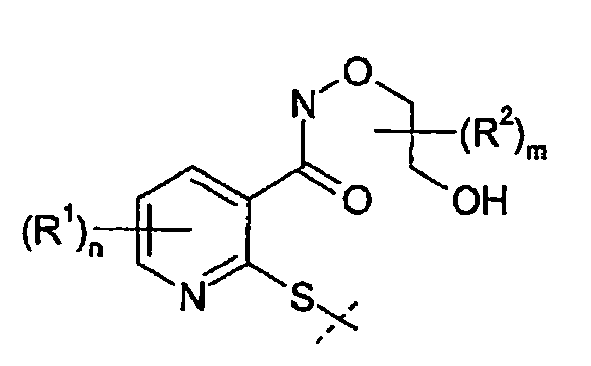
- Im Rahmen der vorliegenden Erfindung weisen die Substituenten der Verbindungen der allgemeinen Formeln (1) bis (3) vorzugsweise folgende Bedeutung auf:
- X1, X2, X3
- Chlor, S-R3, wobei
R3 für gegebenenfalls substituiertes C1-C6-Alkyl; gegebenenfalls substituiertes C3-C6-Cycoalkyl; -(CH2)r-C6H5 mit r = 0 bis 4 steht, wobei der Alkylrest -(CH2)r- gegebenenfalls substituiert sein kann; - R1
- Halogen; Cyano; Thiocyanato; oder für jeweils gegebenenfalls durch Halogen substituiertes Alkyl, Alkenyl, Alkinyl, Alkoxy, Alkylthio, Alkylsulfinyl, Alkylsulfonyl, Alkylamino, Alkylcarbonyl, Alkoxycarbonyl, Alkylaminocarbonyl, Aryl, Heteroaryl, Cycloalkyl und Heterocyclyl, wobei in den vorgenannten Resten die Alkyl- und Alkylengruppen jeweils 1 bis 6 C-Atome, die Alkenyl- und Alkinylgruppen jeweils 2 bis 6 C-Atome, die Cycloalkylgruppen jeweils 3 bis 6 C-Atome und die Arylgruppen jeweils 6 oder 10 C-Atome enthalten können;
- n
- 0 oder 1;
- R2
- jeweils unabhängig voneinander für gegebenenfalls einfach oder mehrfach, gleich oder verschieden substituiertes C1-C4-Alkyl, C3-C6-Cycloalkyl, wobei die Substituenten unabhängig voneinander ausgewählt sein können aus Halogen, Cyano, Nitro, Hydroxy, C1-C4-Alkoxy, C1-C4-Haloalkoxy, C1-C4-Alkylthio, C1-C4-Alkylsulfinyl und C1-C4-Alkylsulfonyl;
- m
- eine ganzzahlige Zahl von 0 bis 2; und
- G
- Fluor, Chlor, Brom und Iod.
- Darüber hinaus sind folgende Bedeutungen der Substituenten der Verbindungen der allgemeinen Formeln (1) bis (3) besonders bevorzugt:
- X1, X2, X3
- Chlor, S-R3, wobei
R3 für gegebenenfalls substituiertes C1-C6-Alkyl; gegebenenfalls substituiertes C3-C6-Cycoalkyl; -(CH2)r-C6H5 mit r = 0 bis 2 steht, wobei der Alkylrest -(CH2)r- gegebenenfalls substituiert sein kann; - R1
- Halogen; Cyano; Thiocyanato; oder für jeweils gegebenenfalls durch Halogen substituiertes Alkyl, Alkenyl, Alkinyl, Alkoxy, Alkylthio, Alkylsulfinyl, Alkylsulfonyl, Alkylamino, Alkylcarbonyl, Alkoxycarbonyl, Alkylaminocarbonyl, Aryl, Heteroaryl, Cycloalkyl und Heterocyclyl, wobei in den vorgenannten Resten die Alkyl- und Alkylengruppen jeweils 1 bis 6 C-Atome, die Alkenyl- und Alkinylgruppen jeweils 2 bis 6 C-Atome, die Cycloalkylgruppen jeweils 3 bis 6 C-Atome und die Arylgruppen jeweils 6 oder 10 C-Atome enthalten können;
- n
- 0 oder 1;
- R2
- gegebenenfalls einfach oder mehrfach, gleich oder verschieden substituiertes C1-C4-Alkyl, wobei die Substituenten unabhängig voneinander ausgewählt sein können aus Halogen, Cyano, Nitro, C1-C4-Alkoxy, C1-C4-Haloalkoxy;
- m
- 0 oder 1; und
- G
- Chlor.
- Darüber hinaus sind folgende Bedeutungen der Substituenten der Verbindungen der allgemeinen Formeln (1) bis (3) insbesondere bevorzugt:
- X1, X2, X3
- S-CH2-C6H5;
- n
- 0;
- m
- 0; und
- G
- Chlor.
- Das erfindungsgemäße Verfahren ist durch den Verfahrensschritt (1) des Ringschlusses der Verbindung der allgemeinen Formel (2) zu der Verbindung der allgemeinen Formel (1) gekennzeichnet.

- Grundsätzlich bestehen mehrere Möglichkeiten, den Verfahrensschritt (1) durchzuführen:
- So ist es in einer ersten Ausgestaltung des Verfahrensschrittes (1) möglich, die Umsetzung unter Ringschluss in Gegenwart von Basen durchzuführen.
- Als Basen können in diesem Fall sowohl organische als auch anorganische Basen verwendet werden. Bevorzugt werden anorganische Basen wie beispielsweise LiOH, NaOH, KOH, Ca(OH)2, Ba(OH)2, Li2CO3, K2CO3, Na2CO3, NaHCO3, oder organische Basen wie Amine (beispielsweise bevorzugt Triethylamin, Diethylisopropylamin), Bu4NOH, Piperidin, Morpholin, Pyridine, Alkylpyridine und DBU verwendet. Besonders bevorzugt werden anorganische Basen wie beispielsweise LiOH, NaOH, KOH, Ca(OH)2, Ba(OH)2, Li2CO3, K2CO3, Na2CO3 und NaHCO3 verwendet. Ganz besonders bevorzugt werden LiOH, NaOH, KOH, K2CO3, Na2CO3, NaHCO3 verwendet.
- Wenn eine Base in dem Verfahrensschritt (1) des erfindungsgemäßen Verfahrens verwendet wird, so beträgt deren Menge vorzugsweise 0,6 mol bis 4,0 Moläquivalente, besonders bevorzugt 1 bis 3 Moläquivalente, insbesondere 1,2 bis 2,5 Moläquivalente, jeweils bezogen auf die Verbindung der allgemeinen Formel (2).
- Der Verfahrensschritt (1) wird im Allgemeinen in Gegenwart eines Lösemittels durchgeführt. Der Verfahrensschritt (1) kann dabei sowohl in Wasser als auch in Gegenwart eines inerten organischen Lösemittels, vorzugsweise eines polaren aprotischen Lösemittels durchgeführt werden. Beispiele organischer Lösemittel, welche im Rahmen der vorliegenden Erfindung verwendet werden können, sind aromatische oder aliphatische Lösemittel wie Benzol, Toluol, Xylol, Mesitylen, Hexan, Heptan, Octan, Cyclohexan; aliphatische und aromatische Halogenwasserstoffe, wie Methylenchlorid, Dichlorethan, Chloroform, Kohlenstofftetrachlorid, Chlorbenzol, Dichlorbenzol; Ether, wie Diethylether, Dibutylether, Diisobutylether, Methyl-tert-butylether, Isopropylethylether, Tetrahydrofuran und Dioxan; weiter auch Dimethylsulfoxid und Säureamidderivate wie N,N-Dimethylformamid, N,N-Dimethylacetamid und N-Methyl-2-pyrollidon; sowie auch Carbonsäureester wie Ethylacetat, oder aber auch Dioxan, Diglym oder Dimethylglycol; Nitrile wie Methylnitril, Butylnitril oder Phenylnitril. Besonders bevorzugt sind Toluol, Xylol, Dichlorbenzol, Chlorbenzol, Ethylacetat, Dichlorethan, N,N-Dimethylformamid, N,N-Dimethylacetamid und Wasser. Insbesondere bevorzugt sind die Lösemittel N,N-Dimethylformamid, N,N-Dimethylacetamid, Ethylacetat, Dichlorethan und Wasser. Allerdings ist die vorliegende Erfindung nicht auf die zuvor beispielhaft genannten Lösemittel beschränkt.
- Die Reaktionstemperatur, bei welcher die Ringschlussreaktion gemäß Verfahrensschritt (1) durchgeführt werden kann, kann in weiten Bereichen variieren. Beispielsweise kann die Ringschlussreaktion bei einer Temperatur von 20 bis 100 °C, vorzugsweise 20 bis 70 °C, durchgeführt werden.
- Der Verfahrensschritt (1) des erfindungsgemäßen Verfahrens wird im Allgemeinen unter Normaldruck durchgeführt. Es ist jedoch auch möglich, unter erhöhtem Druck oder vermindertem Druck - im Allgemeinen zwischen 0,1 bar und 10 bar - zu arbeiten.
- Darüber hinaus ist es möglich, in dem Verfahrensschritt (1) der vorliegenden Erfindung als Edukt für die Ringschlussreaktion eine Verbindung zu verwenden, welche durch die Verfahrensstufe (2), also beispielsweise durch eine Chlorierung, Bromierung, Fluorierung oder Mesylierung, erhalten wurden. Dabei kann das Intermediat - die Verbindung der allgemeinen Formel (2) - unmittelbar so verwendet werden, wie sie in Verfahrensstufe (2) erhalten wird.
- Wenn im Rahmen der vorliegenden Erfindung vorgesehen ist, dass die Verbindung der allgemeinen Formel (2) nicht isoliert wird, so kann die Einführung der Abgangsgruppe G in der Verfahrensstufe (2) sowie die anschließende Ringschlussreaktion der Verfahrensstufe (1) als so genannte Eintopf-Reaktion durchgeführt werden.
- In diesem Fall und somit in einer zweiten Ausgestaltung des Verfahrensschrittes (1) ist es möglich, den Verfahrensschritt (1) als Eintopf-Reaktion zusammen mit Verfahrensschritt (2) auszubilden. In dieser Ausgestaltung ist es möglich, auf den Basenzusatz im Verfahrensschritt (1) zu verzichten, wodurch jedoch die Gesamtausbeute über beide Verfahrensstufen etwas erniedrigt wird.
- Das Produkt des Verfahrensschrittes (1) kann mittels dem Fachmann bekannten Verfahrensoperationen aufgereinigt werden, wie beispielsweise Kristallisation oder Chromatographie, wobei jedoch die Reinheit des Rohprodukts bereits ausreichend ist, um in nachfolgenden Reaktionen eingesetzt zu werden.
- Der Verfahrensschritt (2) umfasst die Transformation der Hydroxylfunktion der Verbindung der allgemeinen Formel (3) gemäß folgender Reaktionsgleichung in eine Abgangsgruppe, ausgewählt aus der Gruppe, bestehend aus Fluor, Chlor, Brom, Iod, -OSO2-CH3, -O-SO2CF3, -O-SO2-Ph und -O-SO2-C6H4-Me:

- Hinsichtlich der einzelnen Reste R1, R2, X2 und X3 sowie den Indizes m und n wird auf die entsprechenden Definitionen verwiesen.
- Die in diesem Verfahrensschritt (2) erhaltenen Verbindungen der allgemeinen Formel (2) können als Edukt in dem Verfahrensschritt (1) des erfindungsgemäßen Verfahrens eingesetzt werden, wobei es möglich ist, die Verbindung der allgemeinen Formel (2) nach Verfahrensschritt (2) aufzuarbeiten, d.h. in isolierter und gegebenenfalls gereinigter Form zu verwenden, oder aber in nicht aufgereinigter Form einzusetzen (so genannte Eintopf-Reaktion).
- Es bestehen in Abhängigkeit der Wahl der Abgangsgruppe mehrere Möglichkeiten, die Transformation gemäß Verfahrensschritt (2) durchzuführen.
- Falls die Abgangsgruppe Chlor darstellt, was im Rahmen der vorliegenden Erfindung auch bevorzugt ist, können zur Chlorierung der Verbindung der allgemeinen Formel (3) beliebige Chlorierungsmittel eingesetzt werden. In Frage kommen beispielsweise Thionylchlorid (SOCl2), Phosphorylchlorid (POCl3), Phosgen, Diphosgen und Oxalylchlorid ((COCl)2). Hiervon besonders bevorzugt sind Thionylchlorid (SOCl2), Phosgen und Oxalylchlorid ((COCl)2).
- Die Menge an verwendetem Chlorierungsmittel kann in weiten Bereichen variieren. Beispielsweise beträgt die für den Verfahrensschritt (2) verwendete Menge an Chlorierungsmittel 0,8 bis 3 Moläquivalente, besonders bevorzugt 1 bis 2,5 Moläquivalente, insbesondere 1,1 bis 1,8 Moläquivalente, jeweils bezogen auf die Menge Verbindungen der allgemeinen Formel (3).
- Falls die Abgangsgruppe Brom darstellt, können zur Bromierung der Verbindung der allgemeinen Formel (3) beliebige Bromierungsmittel eingesetzt werden. In Frage kommen beispielsweise Phosphortribromid (PBr3) oder Phosphorylbromid (POBr3). Die Menge an verwendetem Bromierungsmittel kann in weiten Bereichen variieren. Beispielsweise beträgt die für den Verfahrensschritt (2) verwendete Menge an Bromierungemittel 0,8 bis 3 Moläquivalente, besonders bevorzugt 1 bis 2,5 Moläquivalente, insbesondere 1,1 bis 1,8 Moläquivalente, jeweils bezogen auf die Menge Verbindungen der allgemeinen Formel (3).
- Falls die Abgangsgruppe Fluor darstellt, können zur Fluorierung der Verbindung der allgemeinen Formel (3) beliebige Fluorierungsmittel eingesetzt werden. In Frage kommen beispielsweise (CH3)2NSF3 (DAST), Deoxofluor®, Yarovenko- oder Ishikava Reagenz (ClCFH-CF2-N(C2H5)2).
- Die Menge an verwendetem Fluorierungsmittel kann in weiten Bereichen variieren. Beispielsweise beträgt die für den Verfahrensschritt (2) verwendete Menge an Fluorierungsmittel 0,8 bis 3 Moläquivalente, besonders bevorzugt 1 bis 1,5 Moläquivalente, insbesondere 1 bis 1,3 Moläquivalente, jeweils bezogen auf die Menge Verbindungen der allgemeinen Formel (3).
- Falls die Abgangsgruppe Iod darstellt, können zur lodierung der Verbindung der allgemeinen Formel (3) beliebige Iodierungsmittel eingesetzt werden. In Frage kommen beispielsweise I2/P oder CH3SO2Cl/Kl.
- Die Menge an verwendetem Iodierungsmittel kann in weiten Bereichen variieren. Beispielsweise beträgt die für den Verfahrensschritt (2) verwendete Menge an lodierungemittel 0,8 bis 2 Moläquivalente, besonders bevorzugt 1 bis 1,5 Moläquivalente, insbesondere 1 bis 1,2 Moläquivalente, jeweils bezogen auf die Menge Verbindungen der allgemeinen Formel (3).
- Falls die Abgangsgruppe -O-SO2-CH3, -OSO2-Ph, -OSO2-C6H4-CH3 darstellt, kann zur Einführung der Abgangsgruppe in die Verbindung der allgemeinen Formel (3) Methansulfonylchlorid (CH3-SO2-Cl), Phenylsulfochlorid (PhSO2Cl) oder Tolylsulfochlorid CH3-C6H4SO2-Cl verwendet werden.
- Die Menge an verwendetem Methansulfonylchlorid (CH3-SO2-Cl), Phenylsulfochlorid (PhSO2Cl) oder Tolylsulfochlorid (CH3-C6H4SO2Cl) kann in weiten Bereichen variieren. Beispielsweise beträgt die für den Verfahrensschritt (2) verwendete Menge an Reagenzien 0,8 bis 3 Moläquivalente, besonders bevorzugt 1 bis 2,5 Moläquivalente, insbesondere 1 bis 1,5 Moläquivalente, jeweils bezogen auf die Menge Verbindungen der allgemeinen Formel (3).
- Falls die Abgangsgruppe -O-SO2-CF3 darstellt, kann zur Einführung der Abgangsgruppe in die Verbindung der allgemeinen Formel (3) Trifluormethylsulfonsäureanhydrid (CF3-SO2)2O verwendet werden.
- Die Menge an verwendetem Trifluormethylsulfonsäureanhydrid kann in weiten Bereichen variieren. Beispielsweise beträgt die für den Verfahrensschritt (2) verwendete Menge an Trifluormethylsulfonsäureanhydrid 0,8 bis 2,5 Moläquivalente, besonders bevorzugt 1 bis 2 Moläquivalente, insbesondere 1 bis 1,5 Moläquivalente, jeweils bezogen auf die Menge Verbindungen der allgemeinen Formel (3).
- Der Verfahrensschritt (2) wird im Allgemeinen in Gegenwart eines Lösemittels durchgeführt. Als Lösemittel können beispielsweise organische Lösemittel verwendet werden. Beispiele von organischen Lösungsmitteln sind aromatische oder aliphatische Lösungsmittel wie Benzol, Toluol, Xylol, Mesytilen, Hexan, Heptan, Octan, Cyclohexan; aliphatische und aromatische Halogenwasserstoffe, wie Methylenchlorid, Dichlorethan, Chloroform, Kohlenstofftetrachlorid, Chlorbenzol, Dichlorbenzol; Säureamidderivate wie N,N-Dimethylformamid, N,N-Dimethylacetamid und N-Methyl-2-pyrollidon; sowie auch Carbonsäureester wie Ethylacetat; oder aber auch Dioxan, Diglym, Dimethylglycol oder THF; Nitrile wie Methylnitril, Butylnitril oder Phenylnitril. Besonders bevorzugt sind Toluol, Xylol, Dichlorbenzol, Chlorbenzol oder Ethylacetat. Hiervon sind die folgenden Lösemittel besonders bevorzugt: Methylenchlorid, Dichlorethan, Ethylacetat, N,N-Dimethylformamid, N,N-Dimethylacetamid und N-Methyl-2-pyrollidon.
- Die Reaktionstemperatur, bei welcher die Umsetzung gemäß Verfahrensschritt (2) durchgeführt werden kann, kann in weiten Bereichen variieren. Beispielsweise kann die Ringschlussreaktion bei einer Temperatur von 10 bis 100 °C, vorzugsweise 20 bis 80 °C, durchgeführt werden. Die Reaktionstemperatur hängt dabei von der Reaktivität der einzelnen Verbindungen ab.
- Der Verfahrensschritt (2) des erfindungsgemäßen Verfahrens wird im Allgemeinen unter Normaldruck durchgeführt. Es ist jedoch auch möglich, unter erhöhtem Druck oder vermindertem Druck - im Allgemeinen zwischen 0,1 bar und 10 bar - zu arbeiten.
- Das Produkt des Verfahrensschrittes (2) kann mittels dem Fachmann bekannten Verfahrensoperationen aufgereinigt werden, wie beispielsweise Kristallisation oder Chromatographie, wobei jedoch die Reinheit des Rohprodukts bereits ausreichend ist, um in der nachfolgenden Reaktion des Verfahrensschrittes (1) eingesetzt zu werden.
- Das erfindungsgemäße Verfahren liefert die gewünschten Dioxazinderivate in hoher Ausbeute und Reinheit. Das erfindungsgemäße Verfahren kann einfach und insbesondere ohne Verwendung umweltschädigender Reagenzien durchgeführt werden. Aufgrund der Möglichkeit einer Eintopf-Reaktion ist das Verfahren kostengünstig; auf entsprechende Aufarbeitungen des Intermediats und der Zielverbindung kann verzichtet werden.
- Darüber hinaus sind die Verbindungen der allgemeinen Formel (2) mit G ausgewählt aus der Gruppe, bestehend aus Fluor, Chlor, Brom, Iod, -OSO2-CH3, -O-SO2CF3, -O-SO2-Ph und -O-SO2-C6H4-Me neu.
- Weiterer Gegenstand der vorliegenden Erfindung sind somit Verbindungen der allgemeinen Formel (2)

- G
- Fluor, Chlor, Brom, Iod, -OSO2-CH3, -O-SO2CF3, -O-SO2-Ph und -O-SO2-C6H4-Me;
- X2
- Fluor, Chlor, Brom, Iod, SCN, oder S-R3, wobei R3 für Wasserstoff; gegebenenfalls substituiertes C1-C6-Alkyl; gegebenenfalls substituiertes C3-C6-Cycoalkyl; -(CH2)r-C6H5 mit r = 0 bis 6, wobei der Alkylrest -(CH2)r- gegebenenfalls substituiert sein kann; oder für den Rest

- R1
- Halogen; Cyano; Thiocyanato; oder für jeweils gegebenenfalls durch Halogen substituiertes Alkyl, Alkenyl, Alkinyl, Alkoxy, Alkylthio, Alkylsulfinyl, Alkylsulfonyl, Alkylamino, Alkylcarbonyl, Alkoxycarbonyl, Alkylaminocarbonyl, Aryl, Heteroaryl, Cycloalkyl und Heterocyclyl, wobei in den vorgenannten Resten die Alkyl- und Alkylengruppen jeweils 1 bis 6 C-Atome, die Alkenyl-und Alkinylgruppen jeweils 2 bis 6 C-Atome, die Cycloalkylgruppen jeweils 3 bis 6 C-Atome und die Arylgruppen jeweils 6 oder 10 C-Atome enthalten können;
- n
- eine ganzzahlige Zahl von 0 bis 2;
- R2
- unabhängig voneinander jeweils gegebenenfalls einfach oder mehrfach, gleich oder verschieden substituiertes C1-C6-Alkyl, C2-C6-Alkenyl, C2-C6-Alkinyl, C3-C6-Cycloalkyl, wobei die Substituenten unabhängig voneinander ausgewählt sein können aus Halogen, Cyano, Nitro, C1-C4-Alkoxy, C1-C4-Haloalkoxy, C1-C4-Alkylthio, C1-C4-Alkylsulfinyl, C1-C4-Alkylsulfonyl, (C1-C6-Alkoxy)carbonyl, (C1-C6-Alkyl)carbonyl oder C3-C6-Trialkylsilyl; und m eine ganzzahlige Zahl von 0 bis 4.
- In einer bevorzugten Ausführungsform weisen die Substituenten folgende Bedeutung auf:
- G
- Fluor, Chlor, Brom und Iod.
- X2
- Chlor, S-R3, wobei
R3 für gegebenenfalls substituiertes C1-C6-Alkyl; gegebenenfalls substituiertes C3-C6-Cycoalkyl; -(CH2)rC6H5 mit r = 0 bis 4 steht, wobei der Alkylrest -(CH2)r- gegebenenfalls substituiert sein kann; - R1
- Halogen; Cyano; Thiocyanato; oder für jeweils gegebenenfalls durch Halogen substituiertes Alkyl, Alkenyl, Alkinyl, Alkoxy, Alkylthio, Alkylsulfinyl, Alkylsulfonyl, Alkylamino, Alkylcarbonyl, Alkoxycarbonyl, Alkylaminocarbonyl, Aryl, Heteroaryl, Cycloalkyl und Heterocyclyl, wobei in den vorgenannten Resten die Alkyl- und Alkylengruppen jeweils 1 bis 6 C-Atome, die Alkenyl- und Alkinylgruppen jeweils 2 bis 6 C-Atome, die Cycloalkylgruppen jeweils 3 bis 6 C-Atome und die Arylgruppen jeweils 6 oder 10 C-Atome enthalten können;
- n
- 0 oder 1;
- R2
- jeweils unabhängig voneinander für gegebenenfalls einfach oder mehrfach, gleich oder verschieden substituiertes C1-C4-Alkyl, C3-C6-Cycloalkyl, wobei die Substituenten unabhängig voneinander ausgewählt sein können aus Halogen, Cyano, Nitro, Hydroxy, C1-C4-Alkoxy, C1-C4-Haloalkoxy, C1-C4-Alkylthio, C1-C4-Alkylsulfinyl und C1-C4-Alkylsulfonyl; und
- m
- eine ganzzahlige Zahl von 0 bis 2.
- Darüber hinaus sind folgende Bedeutungen der Substituenten der Verbindungen der allgemeinen Formeln (2) besonders bevorzugt:
- G
- Chlor;
- X2
- Chlor, S-R3, wobei
R3 für gegebenenfalls substituiertes C1-C6-Alkyl; gegebenenfalls substituiertes C3-C6-Cycoalkyl; -(CH2)r-C6H5 mit m = 0 bis 2 steht, wobei der Alkylrest -(CH2)r- gegebenenfalls substituiert sein kann; - R1
- Halogen; Cyano; Thiocyanato; oder für jeweils gegebenenfalls durch Halogen substituiertes Alkyl, Alkenyl, Alkinyl, Alkoxy, Alkylthio, Alkylsulfinyl, Alkylsulfonyl, Alkylamino, Alkylcarbonyl, Alkoxycarbonyl, Alkylaminocarbonyl, Aryl, Heteroaryl, Cycloalkyl und Heterocyclyl, wobei in den vorgenannten Resten die Alkyl- und Alkylengruppen jeweils 1 bis 6 C-Atome, die Alkenyl- und Alkinylgruppen jeweils 2 bis 6 C-Atome, die Cycloalkylgruppen jeweils 3 bis 6 C-Atome und die Arylgruppen jeweils 6 oder 10 C-Atome enthalten können;
- n
- 0 oder 1;
- R2
- gegebenenfalls einfach oder mehrfach, gleich oder verschieden substituiertes C1-C4-Alkyl, wobei die Substituenten unabhängig voneinander ausgewählt sein können aus Halogen, Cyano, Nitro, C1-C4-Alkoxy, C1-C4-Haloalkoxy; und
- m
- 0 oder 1.
- Darüber hinaus sind folgende Bedeutungen der Substituenten der Verbindungen der allgemeinen Formel (2) insbesondere bevorzugt:
- G
- Chlor;
- X
- S-CH2-C6H5;
- n
- 0;
- m
- 0.
- Diese Verbindungen können gemäß den oben beschrieben Verfahren erhalten werden.
- Die Erfindung wird nunmehr anhand des nachfolgenden Ausführungsbeispiels näher erläutert werden, ohne sie jedoch auf dieses zu beschränken.
-

- 11,4 g (2-(Benzylthio)-N-(2-hydroxyethoxy)nicotinamid wurden in 50 ml N,N-Dichlormethan vorgelegt und 6.6 g Thionylchlorid bei 30 °C zugetropft. Das Reaktionsgemisch wurde 1 Stunde bei Raumtemperatur nachgerührt und dann wurde das Gemisch mit 100 ml Wasser verdünnt. Die Suspension wurde 1 Stunde bei 20 °C nachgerührt und der Niederschlag wurde abgesaugt und mit Wasser gewaschen.
- Man erhielt 11,47 g, 95 % d. T. des Produktes (Smp. 122-124 °C).
- 1H NMR (DMSO-d6): 3.81 (m, 2H), 4.15 (m, 2H), 4.4 (s, 2H), 7.2-7.4 (m, 6H), 7.8 (dd, 1 H), 8.5 (dd, 1 H).
-

- 114 g (2-(Benzylthio)-N-(2-hydroxyethoxy)nicotinamid wurden in 500 ml THF vorgelegt und 65.8 g Thionylchlorid wurden bei 10 °C zugetropft. Das Reaktionsgemisch wurde 1 Stunde bei Raumtemperatur nachgerührt und dann wurde der Niederschlag (HCI-Salz des Produktes) abfiltriert und mit Wasser und NaHCO3-Lösung gewaschen und getrocknet.
- Man erhielt ca. 65 g des Produktes mit Smp. 63 - 65 °C.
- 1H NMR (DMSO-d6): 4.2 (d, 2H), 4.4 (s, 2H), 4.45 (d, 2H), 7.2-7.4 (m, 6H), 7.7 (d, 1H), 8.5 (d, 1H).
-
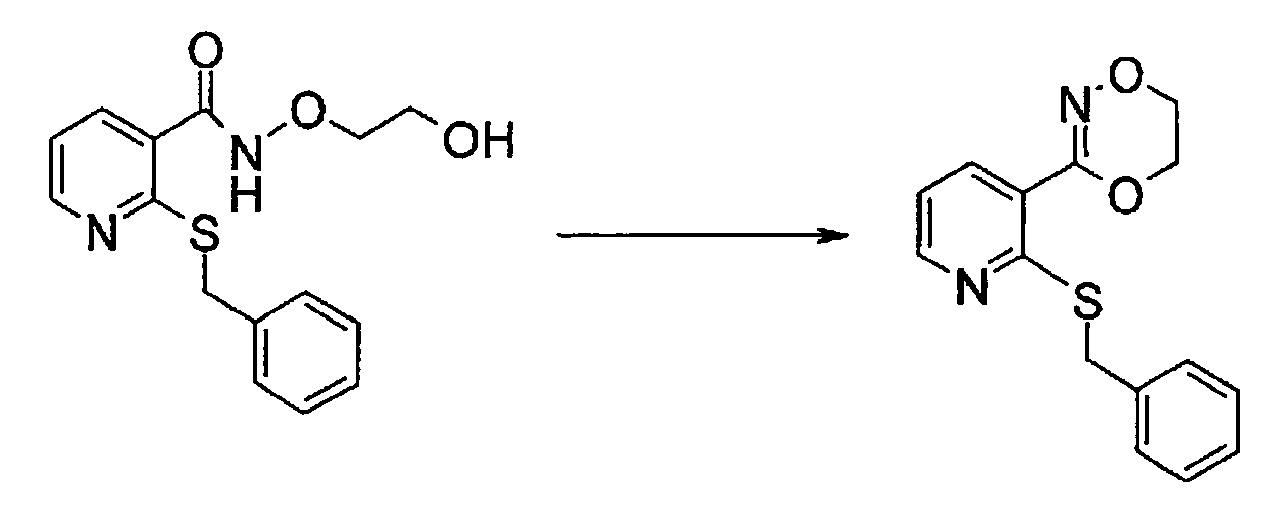
- 114 g (2-(Benzylthio)-N-(2-hydroxyethoxy)nicotinamid wurden in 500 ml N,N-Dimethylacetamid vorgelegt und 65.8 g Thionylchlorid zugetropft. Das Reaktionsgemisch wurde 1 Stunde bei Raumtemperatur nachgerührt und dann wurde 306 g Pottasche-Lösung bei Raumtemperatur zugetropft. Das Gemisch wurde auf 70 °C aufgeheizt und ca. 1 Stunde bei dieser Temperatur nachgerührt. Wasser wurde zugegeben und die Suspension wurde 3 Stunden bei 20 °C nachgerührt. Der Niederschlag wurde abgesaugt und mit Wasser gewaschen.
- Man erhält 103 g, 95 % d. T. (Reinheit 98 %, 100 % LC), Smp. 62 - 64 °C.
Claims (12)
- Verfahren zur Herstellung von Dioxazin-Derivaten der Formel (1)
 X1 Fluor, Chlor, Brom, Iod, SCN, oder S-R3, wobeiR3 für Wasserstoff; gegebenenfalls substituiertes C1-C6-Alkyl; gegebenenfalls substituiertes C3-C6-Cycoalkyl; -(CH2)r-C6H5 mit r = 0 bis 6, wobei der Alkylrest -(CH2)r-gegebenenfalls substituiert sein kann; oder
 R1 Halogen; Cyano; Thiocyanato; oder für jeweils gegebenenfalls durch Halogen substituiertes Alkyl, Alkenyl, Alkinyl, Alkoxy, Alkylthio, Alkylsulfinyl, Alkylsulfonyl, Alkylamino, Alkylcarbonyl, Alkoxycarbonyl, Alkylaminocarbonyl, Aryl, Heteroaryl, Cycloalkyl und Heterocyclyl, wobei in den vorgenannten Resten die Alkyl- und Alkylengruppen jeweils 1 bis 6 C-Atome, die Alkenyl- und Alkinylgruppen jeweils 2 bis 6 C-Atome, die Cycloalkylgruppen jeweils 3 bis 6 C-Atome und die Arylgruppen jeweils 6 oder 10 C-Atome enthalten können;n eine ganzzahlige Zahl von 0 bis 2;R2 unabhängig voneinander jeweils gegebenenfalls einfach oder mehrfach, gleich oder verschieden substituiertes C1-C6-Alkyl, C2-C6-Alkenyl, C2-C6-Alkinyl, C3-C6-Cycloalkyl, wobei die Substituenten unabhängig voneinander ausgewählt sein können aus Halogen, Cyano, Nitro, C1-C4-Alkoxy, C1-C4-Haloalkoxy, C1-C4-Alkylthio, C1-C4-Alkylsulfinyl, C1-C4-Alkylsulfonyl, (C1-C6-Alkoxy)carbonyl, (C1-C6-Alkyl)carbonyl oder C3-C6-Trialkylsilyl; und m eine ganzzahlige Zahl von 0 bis 4,dadurch gekennzeichnet, dass
die Dioxazin-Derivate der allgemeinen Formel (1) durch einen Ringschluss ausgehend von einer Verbindung der allgemeinen Formel (2) hergestellt werden (Verfahrensschritt (1)):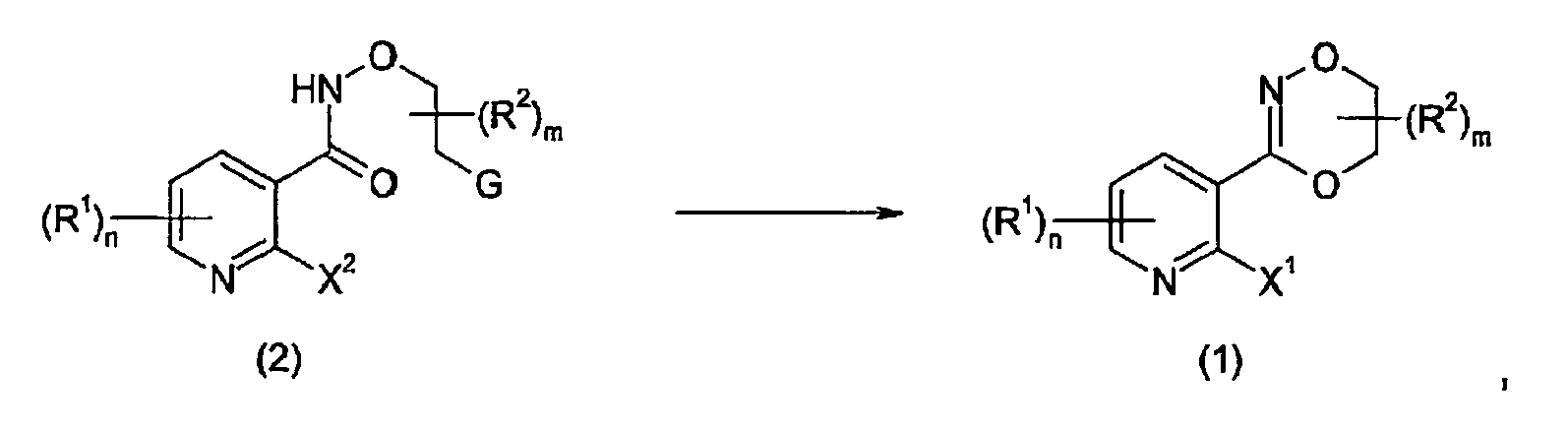 X2 für Fluor, Chlor, Brom, Iod, SCN, oder S-R3 steht, wobeiR3 für Wasserstoff; gegebenenfalls substituiertes C1-C6-Alkyl; gegebenenfalls substituiertes C3-C6-Cycoalkyl; -(CH2)r-C6H5 mit r = 0 bis 6, wobei der Alkylrest -(CH2)r- gegebenenfalls substituiert sein kann; oder für den Rest
- Verfahren nach Anspruch 1, dadurch gekennzeichnet, dass die Verbindung der allgemeinen Formel (2) erhältlich ist durch Transformation der Hydroxylfunktion der Verbindung der allgemeinen Formel (3) in eine Abgangsgruppe, ausgewählt aus der Gruppe, bestehend aus Fluor, Chlor, Brom, Iod, -OSO2-CH3, -O-SO2CF3, -O-SO2-Ph und -O-SO2-C6H4-Me:


- Verfahren nach Anspruch 1 oder 2, dadurch gekennzeichnet, dass die Cyclisierung in Verfahrensschritt (1) in Gegenwart einer Base durchgeführt wird.
- Verfahren nach einem der Ansprüche 1 bis 3, dadurch gekennzeichnet, dass die Umsetzung gemäß Verfahrensschritt (1) bei einer Temperatur von 20 bis 100 °C durchgeführt wird.
- Verfahren nach Anspruch 2 oder 3, dadurch gekennzeichnet, dass die Abgangsgruppe Chlor darstellt und in Verfahrensschritt (2) eine Chlorierung mittels einem Chlorierungsmittel durchgeführt wird, welches ausgewählt ist aus der Gruppe, bestehend aus Thionylchlorid (SOCl2), Phosphorylclorid (POCl3), Phosgen, Diphosgen und Oxalylchlorid ((COCl)2).
- Verfahren nach einem der Ansprüche 2 bis 5, dadurch gekennzeichnet, dass die Umsetzung gemäß Verfahrensschritt (2) bei einer Temperatur von 10 bis 100 °C durchgeführt wird.
- Verfahren nach einem der Ansprüche 2 bis 6, dadurch gekennzeichnet, dass die Verfahrensschritte (1) und (2) als Eintopf-Reaktion ohne Isolierung der Verbindung der allgemeinen Formel (2) durchgeführt wird.
- Verfahren nach Anspruch 7, dadurch gekennzeichnet, dass die Eintopf Reaktion ohne Zugabe einer Base durchgeführt wird.
- Verbindungen der allgemeinen Formel (2)
 G Fluor, Chlor, Brom, Iod, -OSO2-CH3, -O-SO2CF3, -O-SO2-Ph und -O-SO2-C6H4-Me;X2 Fluor, Chlor, Brom, Iod, SCN, oder S-R3, wobeiR3 für Wasserstoff; gegebenenfalls substituiertes C1-C6-Alkyl; gegebenenfalls substituiertes C3-C6-Cycoalkyl; -(CH2)r-C6H5 mit r = 0 bis 6, wobei der Alkylrest -(CH2)r-gegebenenfalls substituiert sein kann; oder für den Rest
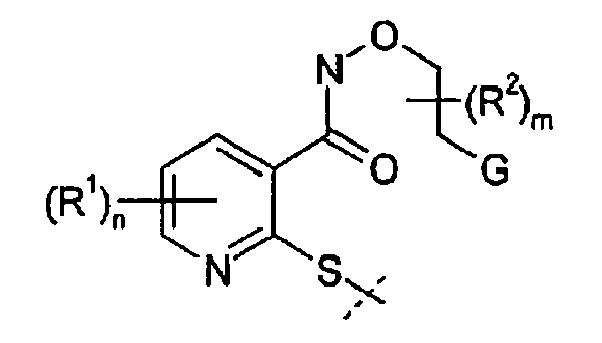 R1 Halogen; Cyano; Thiocyanato; oder für jeweils gegebenenfalls durch Halogen substituiertes Alkyl, Alkenyl, Alkinyl, Alkoxy, Alkylthio, Alkylsulfinyl, Alkylsulfonyl, Alkylamino, Alkylcarbonyl, Alkoxycarbonyl, Alkylaminocarbonyl, Aryl, Heteroaryl, Cycloalkyl und Heterocyclyl, wobei in den vorgenannten Resten die Alkyl- und Alkylengruppen jeweils 1 bis 6 C-Atome, die Alkenyl- und Alkinylgruppen jeweils 2 bis 6 C-Atome, die Cycloalkylgruppen jeweils 3 bis 6 C-Atome und die Arylgruppen jeweils 6 oder 10 C-Atome enthalten können;n eine ganzzahlige Zahl von 0 bis 2;R2 unabhängig voneinander jeweils gegebenenfalls einfach oder mehrfach, gleich oder verschieden substituiertes C1-C6-Alkyl, C2-C6-Alkenyl, C2-C6-Alkinyl, C3-C6-Cycloalkyl, wobei die Substituenten unabhängig voneinander ausgewählt sein können aus Halogen, Cyano, Nitro, C1-C4-Alkoxy, C1-C4-Haloalkoxy, C1-C4-Alkylthio, C1-C4-Alkylsulfinyl, C1-C4-Alkylsulfonyl, (C1-C6-Alkoxy)carbonyl, (C1-C6-Alkyl)carbonyl oder C3-C6-Trialkylsilyl; und m eine ganzzahlige Zahl von 0 bis 4.
 - Verbindung der allgemeinen Formel (2) nach Anspruch 9, wobei die Substituenten die folgende Bedeutung aufweisen:G Fluor, Chlor, Brom und Iod.X2 S-R3, wobeiR3 für gegebenenfalls substituiertes C1-C6-Alkyl; gegebenenfalls substituiertes C3-C6-Cycoalkyl; -(CH2)r-C6H5 mit r = 0 bis 4 steht, wobei der Alkylrest -(CH2)r- gegebenenfalls substituiert sein kann;R1 Halogen; Cyano; Thiocyanato; oder für jeweils gegebenenfalls durch Halogen substituiertes Alkyl, Alkenyl, Alkinyl, Alkoxy, Alkylthio, Alkylsulfinyl, Alkyls ulfonyl, Alkylamino, Alkylcarbonyl, Alkoxycarbonyl, Alkylaminocarbonyl, Aryl, Heteroaryl, Cycloalkyl und Heterocyclyl, wobei in den vorgenannten Resten die Alkyl- und Alkylengruppen jeweils 1 bis 6 C-Atome, die Alkenyl- und Alkinylgruppen jeweils 2 bis 6 C-Atome, die Cycloalkylgruppen jeweils 3 bis 6 C-Atome und die Arylgruppen jeweils 6 oder 10 C-Atome enthalten können;n 0 oder 1;R2 jeweils unabhängig voneinander für gegebenenfalls einfach oder mehrfach, gleich oder verschieden substituiertes C1-C4-Alkyl, C3-C6- Cycloalkyl, wobei die Substituenten unabhängig voneinander ausgewählt sein können aus Halogen, Cyano, Nitro, Hydroxy, C1-C4-Alkoxy, C1-C4-Haloalkoxy, C1-C4-Alkylthio, C1-C4-Alkylsulfinyl und C1-C4-Alkylsulfonyl; undm eine ganzzahlige Zahl von 0 bis 2.
- Verbindung der allgemeinen Formel (2) nach Anspruch 9 oder 10, wobei die Substituenten die folgende Bedeutung aufweisen:G Chlor;X2 S-R3, wobeiR3 für gegebenenfalls substituiertes C1-C6-Alkyl; gegebenenfalls substituiertes C3-C6-Cycloalkyl; -(CH2)r-C6H5 mit r = 0 bis 6 steht, wobei der Alkylrest -(CH2)r- gegebenenfalls substituiert sein kann;R1 Halogen; Cyano; Thiocyanato; oder für jeweils gegebenenfalls durch Halogen substituiertes Alkyl, Alkenyl, Alkinyl, Alkoxy, Alkylthio, Alkylsulfinyl, Alkylsulfonyl, Alkylamino, Alkylcarbonyl, Alkoxycarbonyl, Alkylaminocarbonyl, Aryl, Heteroaryl, Cycloalkyl und Heterocyclyl, wobei in den vorgenannten Resten die Alkyl- und Alkylengruppen jeweils 1 bis 6 C-Atome, die Alkenyl- und Alkinylgruppen jeweils 2 bis 6 C-Atome, die Cycloalkylgruppen jeweils 3 bis 6 C-Atome und die Arylgruppen jeweils 6 oder 10 C-Atome enthalten können;n 0 oder 1;R2 gegebenenfalls einfach oder mehrfach, gleich oder verschieden substituiertes C1-C4-Alkyl, wobei die Substituenten unabhängig voneinander ausgewählt sein können aus Halogen, Cyano, Nitro, C1-C4-Alkoxy, C1-C4-Haloalkoxy; undm 0 oder 1.
- Verbindungen der allgemeinen Formel (2) nach einem der Ansprüche 9 bis 11, wobei die Substituenten die folgende Bedeutung aufweisen:G Chlor;X2 S-CH2C6H5;n 0; undm 0.
Priority Applications (10)
| Application Number | Priority Date | Filing Date | Title |
|---|---|---|---|
| EP07011965A EP2009001A1 (de) | 2007-06-19 | 2007-06-19 | Verfahren zur Herstellung von Dioxazin-Derivaten |
| EP08758800A EP2167467A1 (de) | 2007-06-19 | 2008-05-28 | Verfahren zur herstellung von dioxazin-derivaten |
| MX2009014191A MX2009014191A (es) | 2007-06-19 | 2008-05-28 | Procedimiento para la preparacion de derivados de dioxazina. |
| US12/664,924 US20100184973A1 (en) | 2007-06-19 | 2008-05-28 | Method for producing dioxazine derivatives |
| BRPI0813255-0A2A BRPI0813255A2 (pt) | 2007-06-19 | 2008-05-28 | Processo para a preparação de derivados de dioxazina |
| JP2010512548A JP2010530379A (ja) | 2007-06-19 | 2008-05-28 | ジオキサジン誘導体の製造方法 |
| PCT/EP2008/004215 WO2008155004A1 (de) | 2007-06-19 | 2008-05-28 | Verfahren zur herstellung von dioxazin-derivaten |
| CN200880020768A CN101687804A (zh) | 2007-06-19 | 2008-05-28 | 制备二噁嗪衍生物的方法 |
| TW097122568A TW200916466A (en) | 2007-06-19 | 2008-06-17 | Process for the producting of dioxazine-derivatives |
| IL202756A IL202756A0 (en) | 2007-06-19 | 2009-12-15 | Method for producing dioxazine derivatives |
Applications Claiming Priority (1)
| Application Number | Priority Date | Filing Date | Title |
|---|---|---|---|
| EP07011965A EP2009001A1 (de) | 2007-06-19 | 2007-06-19 | Verfahren zur Herstellung von Dioxazin-Derivaten |
Publications (1)
| Publication Number | Publication Date |
|---|---|
| EP2009001A1 true EP2009001A1 (de) | 2008-12-31 |
Family
ID=38669355
Family Applications (2)
| Application Number | Title | Priority Date | Filing Date |
|---|---|---|---|
| EP07011965A Withdrawn EP2009001A1 (de) | 2007-06-19 | 2007-06-19 | Verfahren zur Herstellung von Dioxazin-Derivaten |
| EP08758800A Withdrawn EP2167467A1 (de) | 2007-06-19 | 2008-05-28 | Verfahren zur herstellung von dioxazin-derivaten |
Family Applications After (1)
| Application Number | Title | Priority Date | Filing Date |
|---|---|---|---|
| EP08758800A Withdrawn EP2167467A1 (de) | 2007-06-19 | 2008-05-28 | Verfahren zur herstellung von dioxazin-derivaten |
Country Status (9)
| Country | Link |
|---|---|
| US (1) | US20100184973A1 (de) |
| EP (2) | EP2009001A1 (de) |
| JP (1) | JP2010530379A (de) |
| CN (1) | CN101687804A (de) |
| BR (1) | BRPI0813255A2 (de) |
| IL (1) | IL202756A0 (de) |
| MX (1) | MX2009014191A (de) |
| TW (1) | TW200916466A (de) |
| WO (1) | WO2008155004A1 (de) |
Families Citing this family (1)
| Publication number | Priority date | Publication date | Assignee | Title |
|---|---|---|---|---|
| CN107987068A (zh) * | 2017-12-08 | 2018-05-04 | 青岛清原化合物有限公司 | 一种二噁嗪衍生物及其制备方法、除草组合物和应用 |
Citations (5)
| Publication number | Priority date | Publication date | Assignee | Title |
|---|---|---|---|---|
| US3420824A (en) * | 1966-07-26 | 1969-01-07 | Du Pont | 5-oxo-1,4,2-dioxazines and preparation from alpha-amidooxy acids |
| US5476936A (en) * | 1993-09-27 | 1995-12-19 | Bayer Aktiengesellschaft | N-azinyl-N'-(het)arylsulphonyl-ureas |
| WO2003016304A1 (en) * | 2001-08-15 | 2003-02-27 | E. I. Du Pont De Nemours And Company | Ortho-heterocyclic substituted aryl amides for controlling invertebrate pests |
| EP1748047A1 (de) * | 2004-04-27 | 2007-01-31 | Nissan Chemical Industries, Ltd. | Pyrazolsulfonylharnstoffverbindung und herbizid |
| DE102005044108A1 (de) * | 2005-09-15 | 2007-03-29 | Bayer Cropscience Ag | Dioxazin- und Oxdiazin-substituierte Arylamide |
Family Cites Families (1)
| Publication number | Priority date | Publication date | Assignee | Title |
|---|---|---|---|---|
| DE102005033581B4 (de) * | 2005-07-19 | 2007-04-26 | Lanxess Deutschland Gmbh | Organische Pigmente für Farbfilter |
-
2007
- 2007-06-19 EP EP07011965A patent/EP2009001A1/de not_active Withdrawn
-
2008
- 2008-05-28 EP EP08758800A patent/EP2167467A1/de not_active Withdrawn
- 2008-05-28 MX MX2009014191A patent/MX2009014191A/es unknown
- 2008-05-28 JP JP2010512548A patent/JP2010530379A/ja not_active Abandoned
- 2008-05-28 CN CN200880020768A patent/CN101687804A/zh active Pending
- 2008-05-28 US US12/664,924 patent/US20100184973A1/en not_active Abandoned
- 2008-05-28 WO PCT/EP2008/004215 patent/WO2008155004A1/de not_active Ceased
- 2008-05-28 BR BRPI0813255-0A2A patent/BRPI0813255A2/pt not_active IP Right Cessation
- 2008-06-17 TW TW097122568A patent/TW200916466A/zh unknown
-
2009
- 2009-12-15 IL IL202756A patent/IL202756A0/en unknown
Patent Citations (5)
| Publication number | Priority date | Publication date | Assignee | Title |
|---|---|---|---|---|
| US3420824A (en) * | 1966-07-26 | 1969-01-07 | Du Pont | 5-oxo-1,4,2-dioxazines and preparation from alpha-amidooxy acids |
| US5476936A (en) * | 1993-09-27 | 1995-12-19 | Bayer Aktiengesellschaft | N-azinyl-N'-(het)arylsulphonyl-ureas |
| WO2003016304A1 (en) * | 2001-08-15 | 2003-02-27 | E. I. Du Pont De Nemours And Company | Ortho-heterocyclic substituted aryl amides for controlling invertebrate pests |
| EP1748047A1 (de) * | 2004-04-27 | 2007-01-31 | Nissan Chemical Industries, Ltd. | Pyrazolsulfonylharnstoffverbindung und herbizid |
| DE102005044108A1 (de) * | 2005-09-15 | 2007-03-29 | Bayer Cropscience Ag | Dioxazin- und Oxdiazin-substituierte Arylamide |
Also Published As
| Publication number | Publication date |
|---|---|
| EP2167467A1 (de) | 2010-03-31 |
| MX2009014191A (es) | 2010-01-28 |
| IL202756A0 (en) | 2010-06-30 |
| BRPI0813255A2 (pt) | 2014-12-30 |
| TW200916466A (en) | 2009-04-16 |
| US20100184973A1 (en) | 2010-07-22 |
| WO2008155004A1 (de) | 2008-12-24 |
| JP2010530379A (ja) | 2010-09-09 |
| CN101687804A (zh) | 2010-03-31 |
Similar Documents
| Publication | Publication Date | Title |
|---|---|---|
| EP2582694B1 (de) | Verfahren zur herstellung von tetrazol-substituierten anthranilsäurediamid-derivaten und neue kristalline modifikation dieser derivate | |
| EP3529233B1 (de) | Verfahren zur herstellung von 3-alkylsulfanyl-2-chlor-n-(1-alkyl-1h-tetrazol-5-yl)-4-trifluoromethyl-benzamiden | |
| EP2560961B1 (de) | Verfahren zum herstellen von 5-fluor-1-alkyl-3-fluoralkyl-1h-pyrazol-4-carbonsäurechloriden und -fluoriden | |
| EP1165496A1 (de) | Substituierte anilinverbindungen | |
| EP2042482A1 (de) | Verfahren zur Herstellung von 2-Dihalogenacyl-3-amino-acrylsäure-Derivaten | |
| EP2325173A1 (de) | Verfahren zum Herstellen von 5-Fluor-1-alkyl-3-fluoralkyl-1H-pyrazol-4-carbonsäurechloriden | |
| DE19544800A1 (de) | Verfahren zur Herstellung von 1,3-Dimethyl-5-fluor-pyrazol-4-carboxaniliden | |
| EP1682515A1 (de) | Verfahren zum herstellen von fluormethyl-substituierten heterocyclen | |
| EP1444205B1 (de) | Verfahren zur herstellung von 2-halogenpyridincarbonsäureamiden | |
| EP1902038A2 (de) | Verfahren zur herstellung von 3-arylmethylthio- und 3-heteroarylmethylthio-4,5- dihydro-isoxazolin-derivaten | |
| WO2013171134A1 (de) | Verfahren zum herstellen von 1-alkyl-3-fluoralkyl-1h-pyrazol-4-carbonsäurechloriden | |
| EP2253610B1 (de) | Verfahren zur Herstellung von Enaminocarbonyl-Verbindungen und deren Verwendung zur Herstellung von 4-Aminobut-2-enoliden | |
| EP2009001A1 (de) | Verfahren zur Herstellung von Dioxazin-Derivaten | |
| EP3481805A1 (de) | Verfahren zur herstellung halogenierter pyridinderivate | |
| EP2160391B1 (de) | Nicotinamid-derivate als synthesebausteine zur herstellung von agrochemischen wirkstoffen und verfahren zu deren herstellung | |
| EP1926717B1 (de) | Verfahren zur Herstellung von 3,4-Dichlor-N-(2-cyano-phenyl)-5-isothiazolcarboxamid | |
| DE4309365C2 (de) | Verfahren zum Herstellen von Halogenphenoxyfettsäurederivaten durch selektive Halogenierung und Halogenphenoxyfettsäurederivate | |
| DE10228732A1 (de) | Verfahren zur Herstellung von 3,4-Dichlor-N-(2-cyano-phenyl)-5-isothiazolcarboxamid | |
| DE4446338A1 (de) | Verfahren zur Herstellung von Chlormethylpyridinen | |
| EP0320750B1 (de) | Verfahren zur Herstellung von 4-substituierten 3-Methyl-1-aryl-5-amino-pyrazolen | |
| DE10005278A1 (de) | Verfahren zur Herstellung von Sulfonyl-imidazol-Derivaten | |
| EP2867208A1 (de) | Verfahren zur herstellung von 2,2-difluorethylamin-derivaten durch alkylierung von 2,2-difluorethylamin | |
| EP1789383A1 (de) | Chirale 3-halophthalsäure-derivate | |
| EP0662474A1 (de) | Chlorpyridiniumchloride und Verfahren zu ihrer Herstellung | |
| DE4032925A1 (de) | Verfahren zur herstellung von 3-arylpyrrolderivaten |
Legal Events
| Date | Code | Title | Description |
|---|---|---|---|
| PUAI | Public reference made under article 153(3) epc to a published international application that has entered the european phase |
Free format text: ORIGINAL CODE: 0009012 |
|
| AK | Designated contracting states |
Kind code of ref document: A1 Designated state(s): AT BE BG CH CY CZ DE DK EE ES FI FR GB GR HU IE IS IT LI LT LU LV MC MT NL PL PT RO SE SI SK TR |
|
| AX | Request for extension of the european patent |
Extension state: AL BA HR MK RS |
|
| AKX | Designation fees paid | ||
| REG | Reference to a national code |
Ref country code: DE Ref legal event code: 8566 |
|
| STAA | Information on the status of an ep patent application or granted ep patent |
Free format text: STATUS: THE APPLICATION IS DEEMED TO BE WITHDRAWN |
|
| 18D | Application deemed to be withdrawn |
Effective date: 20090701 |
|
| REG | Reference to a national code |
Ref country code: NO Ref legal event code: CHAD Owner name: BAYER INTELLECTUAL PROPERTY GMBH, DE |