EP2009620A1 - Ajustement de la longueur de phonème pour la synthèse de la parole - Google Patents
Ajustement de la longueur de phonème pour la synthèse de la parole Download PDFInfo
- Publication number
- EP2009620A1 EP2009620A1 EP08157665A EP08157665A EP2009620A1 EP 2009620 A1 EP2009620 A1 EP 2009620A1 EP 08157665 A EP08157665 A EP 08157665A EP 08157665 A EP08157665 A EP 08157665A EP 2009620 A1 EP2009620 A1 EP 2009620A1
- Authority
- EP
- European Patent Office
- Prior art keywords
- phoneme
- length
- data
- phonemes
- pause
- Prior art date
- Legal status (The legal status is an assumption and is not a legal conclusion. Google has not performed a legal analysis and makes no representation as to the accuracy of the status listed.)
- Granted
Links
Images












Classifications
-
- G—PHYSICS
- G10—MUSICAL INSTRUMENTS; ACOUSTICS
- G10L—SPEECH ANALYSIS TECHNIQUES OR SPEECH SYNTHESIS; SPEECH RECOGNITION; SPEECH OR VOICE PROCESSING TECHNIQUES; SPEECH OR AUDIO CODING OR DECODING
- G10L13/00—Speech synthesis; Text to speech systems
- G10L13/08—Text analysis or generation of parameters for speech synthesis out of text, e.g. grapheme to phoneme translation, prosody generation or stress or intonation determination
- G10L13/10—Prosody rules derived from text; Stress or intonation
-
- G—PHYSICS
- G10—MUSICAL INSTRUMENTS; ACOUSTICS
- G10L—SPEECH ANALYSIS TECHNIQUES OR SPEECH SYNTHESIS; SPEECH RECOGNITION; SPEECH OR VOICE PROCESSING TECHNIQUES; SPEECH OR AUDIO CODING OR DECODING
- G10L13/00—Speech synthesis; Text to speech systems
- G10L13/08—Text analysis or generation of parameters for speech synthesis out of text, e.g. grapheme to phoneme translation, prosody generation or stress or intonation determination
Definitions
- the length of each phoneme is set so as to vary inversely as the speech rate.
- the phoneme length is reduced by half
- the speech rate is reduced by half
- the phoneme length is doubled.
- the phoneme length varies inversely as the speech rate
- a method for converting text data into sound signal comprising the steps of: determining phoneme data corresponding to a plurality of phonemes and pause data corresponding to a plurality of pauses to be inserted among a series of phonemes in the text data to be converted into sound signal; modifying the phoneme data and the pause data by determining lengths of the phonemes, respectively in accordance with a speed of the sound signal and selectively adjusting the length of at least one of the phonemes which is a fricative in the text data so that the at least one of the fricative phonemes is relatively extended timewise as compared to other phonemes; and outputting sound signal on the basis of the adjusted phoneme data and pause data.
- the speech reading apparatus 2 includes a computer.
- the speech reading apparatus 2 includes, for example, a speech synthesizer that converts character data including fricatives and pauses, such as a text (in the case of Japanese, a text including a mixture of Chinese characters and Japanese kana characters), to speech and reads the speech.
- the speech reading apparatus 2 improves the listenability of output speech obtained from character data by controlling the phoneme length of each fricative in the character data in response to the speech rate so as to improve the recognizability of synthesized speech (reading output).
- character data is subjected to speech reading and includes strings of phonetic characters including fricatives and pauses.
- a phonetic character or a string of phonetic characters is interlanguage that includes phonetic transcriptions (readings) with prosodic symbols used in speech synthesis.
- Fricatives are consonants that are sounded when breath passes through a narrow space formed by a voice organ in a mouth cavity and include, for example, "f", "v", "s", and "z”.
- Pauses are silent intervals, such as intervals that are not converted to speech (except breaks just before plosives or Japanese sokuon).
- a Japanese sokuon is called a geminate consonant or double consonant in English.
- the speech reading apparatus 2 includes a language processing unit (linguistic processor) 4, a word dictionary 6, a parameter generating unit (parameter generator) 8, a pitch extracting/overlapping unit (pitch extracting/overlapping unit) 10, and a waveform dictionary 12, as shown in Fig. 1 .
- the language processing unit 4 is language processing means in which a text including a mixture of Chinese characters and Japanese kana characters is input, words in the text are analyzed with reference to the word dictionary 6, readings, accents, and intonations are determined, and a string of phonetic characters (interlanguage) is output.
- the types for example, parts of speech
- readings, positions of accents, and the like of words are stored in the word dictionary 6.
- the language processing unit 4 divides the input text into aforementioned breath groups on the basis of, for example, punctuations and clauses extracted through the word analysis in the input text.
- the parameter generating unit 8 is parameter generating means for setting, for example, the duration of each phoneme, the duration of each pause, and the pitch frequency pattern.
- the parameter generating unit 8 controls the phoneme length in response to the speech rate.
- the parameter generating unit 8 includes a phoneme length setting unit (phoneme-length setter) 14, a phoneme length table 16, the phoneme length control unit (phoneme-length controller) 18, and a pitch pattern generating unit (pitch pattern generator) 20.
- the phoneme length control unit 18 is phoneme length control means for controlling the phoneme length at the normal speech rate set in the phoneme length setting unit 14 in response to the speech rate.
- the speech rate is supplied to the phoneme length control unit 18 as control information from, for example, means (not shown) for adjusting the speech rate (for example, user setting).
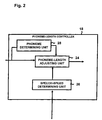
- the phoneme length control unit (phoneme-length controller) 18 includes a phoneme length adjusting unit (phoneme-length adjusting unit) 24, a speech rate determining unit (speech-speed determining unit, speaking rate determining unit) 26, and a phoneme determining unit 28, as shown in Fig. 2 .
- the phoneme length adjusting unit 24 adjusts the length of each phoneme and the length of each pause upon receiving the results of determination from the speech rate determining unit 26 and the phoneme determining unit 28.
- the speech rate determining unit 26 determines which of the normal rate, the high rate, and the low rate the input speech rate is and outputs the result of determination to the phoneme length adjusting unit 24.
- the result of determination output from the speech rate determining unit 26 includes an output that indicates the normal rate, the high rate, or the low rate and an output that indicates the level of the speech rate.
- the phoneme determining unit 28 determines, for example, phonemes and pauses with the phoneme length set in the phoneme length setting unit 14 ( Fig. 1 ) and outputs the result of determination to the phoneme length adjusting unit 24.
- the phoneme length control unit 18 is set so as to vary inversely as the speech rate. Specifically, assuming that the normal speech rate is seven moras per second, when a speech rate of fourteen moras per second is set, the length of each phoneme is reduced by half; and when a speech rate of six moras per second is set, the length of each phoneme is multiplied by 7/6.
- a mora is a unit corresponding to one Kana character that is a phonetic character.
- One Japanese youon such as "kya" corresponds to one mora. In Japanese, the mora of each character is the same.
- a youon is, for example, a syllable in which a consonant with a semivowel [j] is prefixed to each of Japanese vowels [a], [u], and [o], or a syllable in which a sound [w] is inserted between the consonant and vowel of each of "ka", “ga”, "ke”, and "ge”.
- the pitch extracting/overlapping unit 10 is pitch extracting and overlapping means in which the Pitch-Synchronous Overlap-add (PSOLA) method (a pitch conversion method by additive superimposition of waveforms) is used.
- PSOLA Pitch-Synchronous Overlap-add
- Speech waveforms, phoneme labels that indicate which part corresponds to which phoneme, and pitch marks that indicate pitch periods regarding voice are stored in the waveform dictionary 12.
- the pitch extracting/overlapping unit 10 extracts speech waveforms for two periods from the waveform dictionary 12 on the basis of the parameters generated in the parameter generating unit 8, multiplies the speech waveforms by a window function (for example, the Hanning window), multiplies the products by a gain for adjusting the amplitude, as necessary, performs pitch conversion when the pitch frequency in the waveform dictionary 12 is different from a desired pitch frequency, and then adds the extracted waveforms in a state in which the waveforms overlap one another to output a synthesized speech signal.
- a window function for example, the Hanning window
- Fig. 3 is a block diagram showing an exemplary portable terminal 200 in which the speech reading apparatus 2 is incorporated.
- Fig. 4 shows an exemplary configuration of the portable terminal 200.
- Fig. 5 shows an exemplary screen display.
- the storage unit 204 is a recording medium in which the programs executed in the processor 202 and various types of data used in the execution of the programs are stored, and a processing area is formed.
- the storage unit 204 includes a program storage unit 216, a data storage unit 218, and a random access memory (RAM) 220.
- the program storage unit 216 stores the OS and the application programs.
- the data storage unit 218 stores the word dictionary 6, the waveform dictionary 12, and the phoneme length table 16 ( Fig. 1 ), in which the aforementioned pieces of data are stored.
- the RAM 220 constitutes a work area.
- the radio unit 206 is radio communication means for sending and receiving, for example, speech signal waves and packet signal waves to and from a base station by air.
- the radio unit 206 is controlled by the processor 202.
- the speech reading apparatus 2 includes, for example, the processor 202, the storage unit 204, the display unit 210, and the speech output unit 214.
- Japanese sentence "yamanashiken no koukou wo so tsugyoshi te shinyou kin koni haitte 4nenme desu” also means "after he graduated from high school, he has worked at a bank for 4 years" in English.
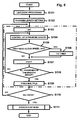
- steps S103 to S110 are performed as processing of phonemes in a breath group.
- steps S104 to S110 the phoneme length is controlled in response to the speech rate.
- the control of the phoneme length is performed for each breath group, and steps S105 to S109 form a loop for processing of phonemes in each breath group.
- the control of the phoneme length includes determination on phonemes subjected to the control and adjustment of the phoneme length in response to the result of the determination.
- fricatives are corrected for each breath group in response to the speech rate, and in speech reading at a high rate, the phoneme length of each of the fricatives is multiplied by, for example, 3/2, as described above.
- the phoneme length of each of the fricatives is multiplied by, for example, 3/2, as described above.
- step S204 the length of a corresponding phoneme is multiplied by a constant factor in response to input information on the speech rate, and then in step S205, it is determined whether the speech rate is a high rate and the corresponding phoneme is a fricative. That is to say, in this determination, the phoneme length of a fricative as an object to be adjusted is determined.
- step S206 the length of the phoneme is further multiplied by a predetermined factor, for example, 3/2. Otherwise, the length of the phoneme is not adjusted.
- the length of the phoneme is further multiplied by a predetermined factor, for example, 3/2. Otherwise, the length of the phoneme is not adjusted.
- step S211 When all the phonemes in the breath group have been processed and when a pause at the end of the breath group is reached, in step S211, the length of the pause is multiplied by a constant factor in response to the speech rate, and then in step S212, termination determination is performed. Until all the data has been processed, steps S203 to S212 are repeated. When it is determined that all the data has been processed, in step S213, speech synthesis is performed to output speech.
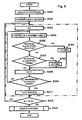
- the phoneme determining unit 28 in order to determine phonemes the length of which needs to be adjusted, it is determined whether a corresponding phoneme is a vowel, and the phoneme length of a vowel is shortened on the basis of the result of the determination.
- step S307 it is determined whether the speech rate is a high rate and the corresponding phoneme is a vowel.
- the length of the phoneme is further multiplied by a predetermined factor, for example, 9/10. Otherwise, the length of the phoneme is not adjusted.
- step S311 the phonemes in the breath group are processed, when a pause at the end of the breath group is reached, in step S311, the length of the pause is multiplied by a constant factor in response to the speech rate, and then in step S312, termination determination is performed.
- steps S303 to S312 are repeated.
- speech synthesis is performed to output speech.
- the phoneme length of fricatives and vowels are corrected for each breath group in response to the speech rate. While the phoneme length of the fricatives is multiplied by, for example, 3/2, the phoneme length of the vowels is multiplied by, for example, 9/10, as described above.
- the shortening of the phoneme length of the vowels compensates for the extension of the phoneme length of the fricatives.
- the procedure is an exemplary program or an exemplary method for speech reading and is performed using the speech reading apparatus 2 ( Fig. 1 ) and the phoneme length control unit 18 ( Fig. 2 ).
- the extension of the phoneme length of the fricatives is cut by allocating the extension proportionally to phonemes in a breath group.
- the listenability is improved.
- the phoneme length control unit 18 ( Fig. 2 ) in the speech reading apparatus 2 ( Fig. 1 ) further includes a breath group length calculating unit (phrase length calculating unit) 30, as shown in Fig. 9 .
- the breath group length calculating unit 30 calculates the total length of a breath group from the output from the phoneme length adjusting unit 24. The result of the calculation is supplied to the phoneme length adjusting unit 24 as control information.
- the phoneme length adjusting unit 24 includes a function of reducing the length of all phonemes by allocating extension of the length of specific phonemes (in this case, fricatives) proportionally to all the phonemes in a breath group so that the length of time necessary to read the breath group is equal to a predetermined length.
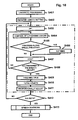
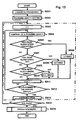
- step S401 and step S402 language processing and phoneme length setting are performed in step S401 and step S402, respectively, as shown in Fig. 10 .
- steps S403 to S412 are performed as processing of phonemes in a breath group.
- steps S404 to S412 the phoneme length is controlled in response to the speech rate. The control of the phoneme length is performed for each breath group, as in the first embodiment.
- step S404 the length of a corresponding phoneme is multiplied by a constant factor in response to input information on the speech rate, and then in step S405, it is determined whether the speech rate is a high rate and the corresponding phoneme is a fricative. That is to say, in this determination, the phoneme length of a fricative as an object to be adjusted is determined.
- step S406 the length of the phoneme is further multiplied by a predetermined factor, for example, 3/2. Otherwise, the length of the phoneme is not adjusted.
- step S410 the total length of the breath group is calculated, and in step S411, the total of the lengths of all the phonemes is allocated proportionally to the phonemes so that the length of the breath group is equal to a predetermined length, for example, a length equal to or substantially equal to the length of the breath group in a case where the phoneme length of fricatives is not extended.
- step S412 termination determination is performed.
- steps S403 to S412 are repeated.
- speech synthesis is performed to output speech.
- the phoneme length of fricatives is corrected for each breath group in response to the speech rate. While the phoneme length of the fricatives is multiplied by, for example, 3/2, the extension of the phoneme length of the fricatives is cut by allocating the extension proportionally to phonemes in the breath group, as described above. Thus, while the length of the breath group is kept, the listenability of synthesized speech is improved, so that the recognizability of a text converted to speech is improved.
- Figs. 11 and 12 are referred to.
- Fig. 11 is a block diagram showing the phoneme length control unit 18 according to the fifth embodiment.
- Fig. 12 is a flowchart showing exemplary procedure for controlling the phoneme length according to the fifth embodiment.
- Fig. 11 the same reference numerals as in Fig. 2 are assigned to corresponding components.
- the procedure is an exemplary program or an exemplary method for speech reading and is performed using the speech reading apparatus 2 ( Fig. 1 ) and the phoneme length control unit 18 ( Fig. 2 ).
- the length of other phonemes is shortened.
- the extension of the phoneme length of the fricatives is cut by allocating the extension proportionally to phonemes in a whole text.
- the listenability is improved.
- the phoneme length control unit 18 ( Fig. 2 ) in the speech reading apparatus 2 ( Fig. 1 ) further includes a total text length calculating unit (entire-sentence-length calculating unit) 32, as shown in Fig. 11 .
- the total text length calculating unit 32 calculates the length of a whole text from the output from the phoneme length adjusting unit 24. The result of the calculation is supplied to the phoneme length adjusting unit 24 as control information.
- the phoneme length adjusting unit 24 includes a function of reducing the length of all phonemes by allocating extension of the length of specific phonemes (in this case, fricatives) proportionally to all the phonemes in a whole text so that the length of time necessary to read the text is equal to a predetermined length.
- step S504 the length of a corresponding phoneme is multiplied by a constant factor in response to input information on the speech rate, and then in step S505, it is determined whether the speech rate is a high rate and the corresponding phoneme is a fricative. That is to say, in this determination, the phoneme length of a fricative as an object to be adjusted is determined.
- step S506 the length of the phoneme is further multiplied by a predetermined factor, for example, 3/2. Otherwise, the length of the phoneme is not adjusted.
- step S511 the length of a whole text is calculated, and in step S512, the total of the lengths of all phonemes in the whole text is allocated proportionally to the phonemes so that the length of the whole text, i.e., the time necessary to reading the text, is a predetermined length, for example, a length equal to or substantially equal to the length of the whole text in a case where the phoneme length of fricatives is not extended.
- step S513 speech synthesis is performed to output speech.
- Fig. 13 is referred to.
- Fig. 13 is a flowchart showing exemplary procedure for controlling the phoneme length according to the sixth embodiment.
- the procedure is an exemplary program or an exemplary method for speech reading and is performed using the speech reading apparatus 2 ( Fig. 1 ) and the phoneme length control unit 18 ( Fig. 2 ).
- the adjustment of the phoneme length in the second embodiment ( Fig. 7 ) and the adjustment of the phoneme length in the third embodiment ( Fig. 8 ) are used in combination. While the phoneme length of a leading phoneme and fricatives is extended, the length of other phonemes, for example, vowels, is shortened. Thus, the listenability is improved without extending the time necessary to convert a text to speech.
- step S601 and step S602 are performed in step S601 and step S602, respectively, as shown in Fig. 13 .
- steps S603 to S613 are performed as processing of phonemes in a breath group.
- steps S604 to S613 the phoneme length is controlled in response to the speech rate.
- the control of the phoneme length is performed for each breath group, as in the second embodiment ( Fig. 7 ).
- step S612 it is determined whether all the phonemes in the breath group have been processed.
- step S613 the length of the pause is multiplied by a constant factor in response to the speech rate.
- step S614 termination determination is performed.
- step S615 speech synthesis is performed.
- the phoneme length of a leading phoneme and fricatives is corrected for each breath group in response to the speech rate. While the phoneme length of the fricatives and the phoneme following a pause is multiplied by, for example, 3/2, the phoneme length of vowels is multiplied by, for example, 9/10 to be shortened, as described above.
- the extension of the playback time due to the extension of the phoneme length of the phoneme following a pause and the fricatives is reduced as much as the shortening of the phoneme length of the vowels.
- the total playback time of output speech is not extended (in some cases, the total playback time is shortened) and is kept substantially constant, the listenability of synthesized speech is improved, so that the recognizability of a text converted to speech is improved.
- Fig. 14 is referred to.
- Fig. 14 is a flowchart showing exemplary procedure for controlling the phoneme length according to the seventh embodiment.
- the phoneme length of a leading phoneme and fricatives is corrected for each breath group in response to the speech rate. While the phoneme length of the fricatives and the phoneme following a pause is multiplied by, for example, 3/2, the extension of the phoneme length of these phonemes is cut by allocating the extension proportionally to phonemes in the breath group. Thus, while the length of the breath group is kept, the listenability of synthesized speech is improved, so that the recognizability of a text converted to speech is improved.
- Fig. 15 is referred to.
- Fig. 15 is a flowchart showing exemplary procedure for controlling the phoneme length according to the eighth embodiment.
- the procedure is an exemplary program or an exemplary method for speech reading and is performed using the speech reading apparatus 2 ( Fig. 1 ) and the phoneme length control unit 18 ( Fig. 2 ).
- the extension of the phoneme length of fricatives and a leading phoneme is cut by allocating the extension proportionally to phonemes in a whole text.
- the listenability is improved.
- step S811 the length of the pause is multiplied by a constant factor in response to the speech rate. Then, in step S812, termination determination is performed.
- the portable terminal 200 ( Figs. 3 and 4 ) is shown as an example.
- the present invention is not limited to the aforementioned embodiments and can be applied to, for example, a Personal Digital Assistant (PDA), electronic equipment that includes a computer and outputs speech, such as a personal computer, and various types of equipment in which an electronic equipment unit is incorporated.
- PDA Personal Digital Assistant
Landscapes
- Engineering & Computer Science (AREA)
- Computational Linguistics (AREA)
- Health & Medical Sciences (AREA)
- Audiology, Speech & Language Pathology (AREA)
- Human Computer Interaction (AREA)
- Physics & Mathematics (AREA)
- Acoustics & Sound (AREA)
- Multimedia (AREA)
- Document Processing Apparatus (AREA)
- Machine Translation (AREA)
Applications Claiming Priority (1)
| Application Number | Priority Date | Filing Date | Title |
|---|---|---|---|
| JP2007167019A JP5029168B2 (ja) | 2007-06-25 | 2007-06-25 | 音声読み上げのための装置、プログラム及び方法 |
Publications (2)
| Publication Number | Publication Date |
|---|---|
| EP2009620A1 true EP2009620A1 (fr) | 2008-12-31 |
| EP2009620B1 EP2009620B1 (fr) | 2012-11-07 |
Family
ID=39683831
Family Applications (1)
| Application Number | Title | Priority Date | Filing Date |
|---|---|---|---|
| EP08157665A Ceased EP2009620B1 (fr) | 2007-06-25 | 2008-06-05 | Ajustement de la longueur de phonème pour la synthèse de la parole |
Country Status (5)
| Country | Link |
|---|---|
| US (1) | US20080319754A1 (fr) |
| EP (1) | EP2009620B1 (fr) |
| JP (1) | JP5029168B2 (fr) |
| KR (1) | KR101019851B1 (fr) |
| CN (1) | CN101334995B (fr) |
Cited By (3)
| Publication number | Priority date | Publication date | Assignee | Title |
|---|---|---|---|---|
| GB2565589A (en) * | 2017-08-18 | 2019-02-20 | Aylett Matthew | Reactive speech synthesis |
| US12375841B2 (en) | 2018-12-21 | 2025-07-29 | Nura Holdings Pty Ltd | Power management of the modular ear-cup and ear-bud |
| US12393717B2 (en) | 2019-03-01 | 2025-08-19 | Nura Holdings Pty Ltd | Headphones with timing capability and enhanced security |
Families Citing this family (11)
| Publication number | Priority date | Publication date | Assignee | Title |
|---|---|---|---|---|
| US8930192B1 (en) * | 2010-07-27 | 2015-01-06 | Colvard Learning Systems, Llc | Computer-based grapheme-to-speech conversion using a pointing device |
| JP5914996B2 (ja) * | 2011-06-07 | 2016-05-11 | ヤマハ株式会社 | 音声合成装置およびプログラム |
| JP6127371B2 (ja) * | 2012-03-28 | 2017-05-17 | ヤマハ株式会社 | 音声合成装置および音声合成方法 |
| JP6121313B2 (ja) * | 2013-11-19 | 2017-04-26 | 日本電信電話株式会社 | ポーズ推定装置、方法、プログラム |
| CN106952656A (zh) * | 2017-03-13 | 2017-07-14 | 中南大学 | 语言感染力远程测评方法及系统 |
| CN108682420B (zh) * | 2018-05-14 | 2023-07-07 | 平安科技(深圳)有限公司 | 一种音视频通话方言识别方法及终端设备 |
| WO2020132576A1 (fr) * | 2018-12-21 | 2020-06-25 | Nura Holdings Pty Ltd | Reconnaissance de la parole au moyen de plusieurs capteurs |
| WO2021102193A1 (fr) * | 2019-11-19 | 2021-05-27 | Apptek, Llc | Procédé et appareil pour une durée imposée dans la synthèse vocale neuronale |
| CN111627422B (zh) * | 2020-05-13 | 2022-07-12 | 广州国音智能科技有限公司 | 语音加速检测方法、装置、设备及可读存储介质 |
| CN115602145A (zh) * | 2021-06-28 | 2023-01-13 | 微软技术许可有限责任公司(Us) | 基于文本的语音生成 |
| CN116386593A (zh) * | 2023-03-08 | 2023-07-04 | 腾讯音乐娱乐科技(深圳)有限公司 | 语音合成方法、预测模型的训练方法、服务器和存储介质 |
Citations (3)
| Publication number | Priority date | Publication date | Assignee | Title |
|---|---|---|---|---|
| JPH06149283A (ja) | 1992-11-09 | 1994-05-27 | Toshiba Corp | 音声合成装置 |
| US6029131A (en) * | 1996-06-28 | 2000-02-22 | Digital Equipment Corporation | Post processing timing of rhythm in synthetic speech |
| US6470316B1 (en) | 1999-04-23 | 2002-10-22 | Oki Electric Industry Co., Ltd. | Speech synthesis apparatus having prosody generator with user-set speech-rate- or adjusted phoneme-duration-dependent selective vowel devoicing |
Family Cites Families (12)
| Publication number | Priority date | Publication date | Assignee | Title |
|---|---|---|---|---|
| JP2628994B2 (ja) * | 1987-04-10 | 1997-07-09 | 富士通株式会社 | 文−音声変換装置 |
| JPH01118200A (ja) * | 1987-10-30 | 1989-05-10 | Fujitsu Ltd | 音声合成方式 |
| JP3284634B2 (ja) * | 1992-12-29 | 2002-05-20 | ソニー株式会社 | 規則音声合成装置 |
| CA2119397C (fr) * | 1993-03-19 | 2007-10-02 | Kim E.A. Silverman | Synthese vocale automatique utilisant un traitement prosodique, une epellation et un debit d'enonciation du texte ameliores |
| JPH0772896A (ja) * | 1993-09-01 | 1995-03-17 | Sanyo Electric Co Ltd | 音声の圧縮伸長装置 |
| JPH07140996A (ja) * | 1993-11-16 | 1995-06-02 | Fujitsu Ltd | 音声規則合成装置 |
| DE4341082A1 (de) * | 1993-12-02 | 1995-06-08 | Teves Gmbh Alfred | Schaltungsanordnung für sicherheitskritische Regelungssysteme |
| JP3563772B2 (ja) * | 1994-06-16 | 2004-09-08 | キヤノン株式会社 | 音声合成方法及び装置並びに音声合成制御方法及び装置 |
| EP1100072A4 (fr) * | 1999-03-25 | 2005-08-03 | Matsushita Electric Industrial Co Ltd | Systeme et procede de synthese de la parole |
| JP4680429B2 (ja) * | 2001-06-26 | 2011-05-11 | Okiセミコンダクタ株式会社 | テキスト音声変換装置における高速読上げ制御方法 |
| JP2005242231A (ja) * | 2004-02-27 | 2005-09-08 | Yamaha Corp | 音声合成装置、音声合成方法、及び音声合成プログラム |
| JP5119700B2 (ja) * | 2007-03-20 | 2013-01-16 | 富士通株式会社 | 韻律修正装置、韻律修正方法、および、韻律修正プログラム |
-
2007
- 2007-06-25 JP JP2007167019A patent/JP5029168B2/ja not_active Expired - Fee Related
-
2008
- 2008-06-05 EP EP08157665A patent/EP2009620B1/fr not_active Ceased
- 2008-06-13 US US12/213,115 patent/US20080319754A1/en not_active Abandoned
- 2008-06-24 KR KR1020080059820A patent/KR101019851B1/ko not_active Expired - Fee Related
- 2008-06-25 CN CN2008101248954A patent/CN101334995B/zh not_active Expired - Fee Related
Patent Citations (3)
| Publication number | Priority date | Publication date | Assignee | Title |
|---|---|---|---|---|
| JPH06149283A (ja) | 1992-11-09 | 1994-05-27 | Toshiba Corp | 音声合成装置 |
| US6029131A (en) * | 1996-06-28 | 2000-02-22 | Digital Equipment Corporation | Post processing timing of rhythm in synthetic speech |
| US6470316B1 (en) | 1999-04-23 | 2002-10-22 | Oki Electric Industry Co., Ltd. | Speech synthesis apparatus having prosody generator with user-set speech-rate- or adjusted phoneme-duration-dependent selective vowel devoicing |
Cited By (3)
| Publication number | Priority date | Publication date | Assignee | Title |
|---|---|---|---|---|
| GB2565589A (en) * | 2017-08-18 | 2019-02-20 | Aylett Matthew | Reactive speech synthesis |
| US12375841B2 (en) | 2018-12-21 | 2025-07-29 | Nura Holdings Pty Ltd | Power management of the modular ear-cup and ear-bud |
| US12393717B2 (en) | 2019-03-01 | 2025-08-19 | Nura Holdings Pty Ltd | Headphones with timing capability and enhanced security |
Also Published As
| Publication number | Publication date |
|---|---|
| CN101334995A (zh) | 2008-12-31 |
| US20080319754A1 (en) | 2008-12-25 |
| JP5029168B2 (ja) | 2012-09-19 |
| CN101334995B (zh) | 2011-08-03 |
| JP2009003395A (ja) | 2009-01-08 |
| KR101019851B1 (ko) | 2011-03-04 |
| KR20080114565A (ko) | 2008-12-31 |
| EP2009620B1 (fr) | 2012-11-07 |
Similar Documents
| Publication | Publication Date | Title |
|---|---|---|
| EP2009620B1 (fr) | Ajustement de la longueur de phonème pour la synthèse de la parole | |
| EP2009622B1 (fr) | Ajustement de la longueur de phonème pour la synthèse de la parole | |
| EP2009621B1 (fr) | Ajustement de la longueur de pause pour la synthèse vocale à partir de texte | |
| US6499014B1 (en) | Speech synthesis apparatus | |
| JP2000305582A (ja) | 音声合成装置 | |
| JP3437064B2 (ja) | 音声合成装置 | |
| JP4953767B2 (ja) | 音声生成装置 | |
| JPH0580791A (ja) | 音声規則合成装置および方法 | |
| JP3685648B2 (ja) | 音声合成方法及び音声合成装置、並びに音声合成装置を備えた電話機 | |
| JP3113101B2 (ja) | 音声合成装置 | |
| JPH1011083A (ja) | テキスト音声変換装置 | |
| JP2004004952A (ja) | 音声合成装置および音声合成方法 | |
| JP3297221B2 (ja) | 音韻継続時間長制御方式 | |
| JP2578876B2 (ja) | 文章読み上げ装置 | |
| JPH0363696A (ja) | テキスト音声合成装置 | |
| JP2001166787A (ja) | 音声合成装置および自然言語処理方法 | |
| JPH08211896A (ja) | 音声合成編集方式および装置 | |
| JPH02285400A (ja) | 音声合成装置 | |
| JPH04281495A (ja) | 音声波形ファイル装置 | |
| JPH08202381A (ja) | 音声合成装置 | |
| JP2002297172A (ja) | 音声合成方法、および音声合成装置 | |
| JPH07219575A (ja) | 音声合成方法 | |
| JPH0473697A (ja) | 音声規則合成装置および方法 | |
| JPH1165593A (ja) | 音声出力装置及び音声出力処理プログラムを記録したコンピュータ読み取り可能な記録媒体 |
Legal Events
| Date | Code | Title | Description |
|---|---|---|---|
| PUAI | Public reference made under article 153(3) epc to a published international application that has entered the european phase |
Free format text: ORIGINAL CODE: 0009012 |
|
| AK | Designated contracting states |
Kind code of ref document: A1 Designated state(s): AT BE BG CH CY CZ DE DK EE ES FI FR GB GR HR HU IE IS IT LI LT LU LV MC MT NL NO PL PT RO SE SI SK TR |
|
| AX | Request for extension of the european patent |
Extension state: AL BA MK RS |
|
| 17P | Request for examination filed |
Effective date: 20090121 |
|
| AKX | Designation fees paid |
Designated state(s): DE FR GB |
|
| 17Q | First examination report despatched |
Effective date: 20111216 |
|
| GRAC | Information related to communication of intention to grant a patent modified |
Free format text: ORIGINAL CODE: EPIDOSCIGR1 |
|
| GRAP | Despatch of communication of intention to grant a patent |
Free format text: ORIGINAL CODE: EPIDOSNIGR1 |
|
| GRAS | Grant fee paid |
Free format text: ORIGINAL CODE: EPIDOSNIGR3 |
|
| GRAA | (expected) grant |
Free format text: ORIGINAL CODE: 0009210 |
|
| AK | Designated contracting states |
Kind code of ref document: B1 Designated state(s): DE FR GB |
|
| REG | Reference to a national code |
Ref country code: GB Ref legal event code: FG4D |
|
| REG | Reference to a national code |
Ref country code: DE Ref legal event code: R096 Ref document number: 602008019923 Country of ref document: DE Effective date: 20130103 |
|
| PLBE | No opposition filed within time limit |
Free format text: ORIGINAL CODE: 0009261 |
|
| STAA | Information on the status of an ep patent application or granted ep patent |
Free format text: STATUS: NO OPPOSITION FILED WITHIN TIME LIMIT |
|
| 26N | No opposition filed |
Effective date: 20130808 |
|
| REG | Reference to a national code |
Ref country code: DE Ref legal event code: R097 Ref document number: 602008019923 Country of ref document: DE Effective date: 20130808 |
|
| REG | Reference to a national code |
Ref country code: FR Ref legal event code: PLFP Year of fee payment: 9 |
|
| REG | Reference to a national code |
Ref country code: FR Ref legal event code: PLFP Year of fee payment: 10 |
|
| REG | Reference to a national code |
Ref country code: FR Ref legal event code: PLFP Year of fee payment: 11 |
|
| PGFP | Annual fee paid to national office [announced via postgrant information from national office to epo] |
Ref country code: DE Payment date: 20190521 Year of fee payment: 12 |
|
| PGFP | Annual fee paid to national office [announced via postgrant information from national office to epo] |
Ref country code: FR Payment date: 20190510 Year of fee payment: 12 |
|
| PGFP | Annual fee paid to national office [announced via postgrant information from national office to epo] |
Ref country code: GB Payment date: 20190605 Year of fee payment: 12 |
|
| REG | Reference to a national code |
Ref country code: DE Ref legal event code: R119 Ref document number: 602008019923 Country of ref document: DE |
|
| GBPC | Gb: european patent ceased through non-payment of renewal fee |
Effective date: 20200605 |
|
| PG25 | Lapsed in a contracting state [announced via postgrant information from national office to epo] |
Ref country code: FR Free format text: LAPSE BECAUSE OF NON-PAYMENT OF DUE FEES Effective date: 20200630 Ref country code: GB Free format text: LAPSE BECAUSE OF NON-PAYMENT OF DUE FEES Effective date: 20200605 |
|
| PG25 | Lapsed in a contracting state [announced via postgrant information from national office to epo] |
Ref country code: DE Free format text: LAPSE BECAUSE OF NON-PAYMENT OF DUE FEES Effective date: 20210101 |