EP2011403A1 - Reiskuchen und herstellungsverfahren dafür - Google Patents
Reiskuchen und herstellungsverfahren dafür Download PDFInfo
- Publication number
- EP2011403A1 EP2011403A1 EP07741334A EP07741334A EP2011403A1 EP 2011403 A1 EP2011403 A1 EP 2011403A1 EP 07741334 A EP07741334 A EP 07741334A EP 07741334 A EP07741334 A EP 07741334A EP 2011403 A1 EP2011403 A1 EP 2011403A1
- Authority
- EP
- European Patent Office
- Prior art keywords
- rice
- diet
- test
- blood sugar
- amylose
- Prior art date
- Legal status (The legal status is an assumption and is not a legal conclusion. Google has not performed a legal analysis and makes no representation as to the accuracy of the status listed.)
- Granted
Links
Images



Classifications
-
- A—HUMAN NECESSITIES
- A23—FOODS OR FOODSTUFFS; TREATMENT THEREOF, NOT COVERED BY OTHER CLASSES
- A23L—FOODS, FOODSTUFFS OR NON-ALCOHOLIC BEVERAGES, NOT OTHERWISE PROVIDED FOR; PREPARATION OR TREATMENT THEREOF
- A23L7/00—Cereal-derived products; Malt products; Preparation or treatment thereof
- A23L7/10—Cereal-derived products
- A23L7/117—Flakes or other shapes of ready-to-eat type; Semi-finished or partly-finished products therefor
- A23L7/135—Individual or non-extruded flakes, granules or shapes having similar size, e.g. breakfast cereals
-
- A—HUMAN NECESSITIES
- A23—FOODS OR FOODSTUFFS; TREATMENT THEREOF, NOT COVERED BY OTHER CLASSES
- A23L—FOODS, FOODSTUFFS OR NON-ALCOHOLIC BEVERAGES, NOT OTHERWISE PROVIDED FOR; PREPARATION OR TREATMENT THEREOF
- A23L7/00—Cereal-derived products; Malt products; Preparation or treatment thereof
- A23L7/10—Cereal-derived products
- A23L7/115—Cereal fibre products, e.g. bran, husk
Definitions
- the present invention relates to a rice snack and a method for producing the same. More particularly, the present invention relates to a rice snack having excellent taste by which drastic increase in blood sugar level will not be caused and from which prophylaxis effect on lifestyle related diseases such as diabetes and obesity can be anticipated, and a method for producing the rice snack.
- rice snacks such as cubic rice crackers ("Arare"), sliced and dried rice cake cubes (“Okaki”) and Japanese rice crackers (“Senbei”) have been produced from a cereal powder having rice as the main starting material.
- Most of the rice varieties which have currently been produced in Japan are short-grain strains of Japonica rice, and the Japonica rice are frequently used also as a starting flour for producing rice snack.
- long-grain strains of Indica rice are produced more abundantly than the Japonica rice.
- Indica rice has a characteristic of containing amylose in a higher amount as compared with Japonica rice while starch matter in a lesser amount.
- rice containing amylose in about 25 % or more is called high-amylose rice, and most of Indica rices are classified into the high-amylose rice.
- the high-amylose rice is rather hard to gelatinize than the Japonica rice, poor in glutinousness and stiff, and tends to be retrograded upon cooling.
- rice snacks produced from such high-amylose rice are very stiff due to their unsatisfactory puffing.
- Patent Reference 1 Japanese Patent Laid-Open Publication No. 191893/1998
- Patent Reference 2 Japanese Patent Laid-Open Publication No. 163297/1995
- Patent Reference 3 Japanese Patent Publication No. 47826/1991 .
- the present invention provides a rice snack having excellent taste by which drastic increase in blood sugar level will not be caused and from which prophylaxis effect on lifestyle related diseases such as diabetes and obesity can be anticipated, and a method for producing the rice snack.
- the rice snack according to the present invention is characterized by being obtained by using a starting flour which contains a combination of a cereal powder comprising high-amylose rice as the main raw material with a dietary fiber.
- Such rice snacks according to the present invention preferably include the one in which the dietary fiber is an indigestible dextrin.
- Such rice snacks according to the present invention preferably include the one in which the high-amylose rice is the Indica rice.
- Such rice snacks according to the present invention preferably include the one in which the starting flour contains the dietary fiber in an amount of 7 to 12 % by weight.
- Such rice snacks according to the present invention preferably include the one in which the glycemic index (GI) is in the range of less than 68.
- GI glycemic index
- the method for producing a rice snack according to the present invention is characterized by comprising the step of roasting a dough prepared by press-molding a starting flour, which contains a combination of a cereal powder having high-amylose rice as the main raw material with a dietary fiber, by the indirect roasting method.
- the rice snack according to the present invention is obtained from a starting flour which contains a combination of a cereal powder having high-amylose rice as the main raw material with a dietary fiber, it does not cause the drastic increase in blood sugar level and has an excellent taste.
- the rice snack according to the present invention is excellent as a functional food intended for preventing lifestyle related diseases such as diabetes and obesity as well as a table luxury for tasting flavor, taste and the like.
- the rice snack according to the present invention is characterized by being obtained by using a starting flour which contains a combination of a cereal powder comprising high-amylose rice as the main raw material and a dietary fiber.
- the rice snack means a snack product produced from a cereal as the main starting material.
- the rice snack according to the present invention includes, for example, Japanese rice crackers, rice crackers, cubic rice crackers, sliced and dried rice snack cubes, sliced and dried rice snacks, salty Japanese rice crackers, the other rice snacks and foods derived therefrom.
- the phraseology "the main raw material" means the component having the highest existence ratio.
- the high-amylose rice means the rice having an amylose content of about 25% or more. Therefore, Japonica rice which is the Japan type rice plant having an amylose content of about 20% does not correspond to the high-amylose rice according to the present invention.
- the existing amount of the high-amylose rice in the starting flour is preferably in the range of 60 to 100 % by weight, particularly preferably 80 to 100 % by weight (based on the starting flour as 100 % by weight).
- rice flour and other components having an amylose content of less than 20 % by weight such as Japonica rice may be contained in the starting flour.
- Such other components include, for example, cornstarch, tapioca starch, potato starch, wheat starch, and the like.
- the particularly preferred specific example of the high-amylose rice of the present invention includes, for example, Indica rice.
- the amylose content can be measured by the colorimetric method.
- the dietary fiber of the present invention is a water soluble dietary fiber, which includes preferably seawood polysaccharides such as indigestible dextrin, pectin and agar, plant gums such as the decomposition products of guar gum, polydextrose, and carboxymethylcellulose (CMC).
- the indigestible dextrin may be obtained by heating starch directly or in the small amount of an acid at a temperature of about 120 to 180 °C to give a roasted dextrin, from which the component undegradable by a digestive enzyme such as amylase is purified.
- the starting flour according to the present invention contains the combination of the high-amylose rice and the dietary fiber.
- the starting flour of the present invention contains the dietary fiber preferably in an amount of 7 to 12 % by weight, particularly preferably in an amount of 9 to 10 % by weight (based on the total amount of the starting flour as 100 % by weight). If the content of the dietary fiber is in the range of less than 7 % by weight, the regulating effect on an increase in the blood sugar level cannot be anticipated, and on the other hand, if the content is in excess of 12 % by weight, the taste is undesirably damaged. In this connection, if the starting cereal powder having high-amylose rice as the main raw material comprises the dietary fiber, it is preferred to adjust the total amount of the dietary fibers containing the amount of dietary fiber derived from the starting flour within the range described above.
- the rice snack according to the present invention is preferably the one having the glycemic index (GI) of less than 68.
- GI glycemic index
- the glycemic index (Glycemic Index) herein means the numerical degree of the increase in the blood sugar level after a meal, which is represented by a relative value of an increase in the blood sugar level based on the value 100 in the standard diet (generally glucose).
- foods having a high GI value are susceptible to drastic increase in the blood sugar level and thus to an increased value of the blood sugar level, and the secreted amount of insulin is increased and fat is apt to be accumulated in the body.
- foods having a low GI value exhibits a slow increase in the blood sugar level, saccharides are continuously consumed in a slow rate, and insulin is also maintained at a low level with the maintenance of good energy metabolism, so that fat is hardly be accumulated in the body.
- the rice snack according to the present invention has a low GI value as described above, and the drastic increase in the blood sugar level is suppressed.
- the method for producing a rice snack according to the present invention is characterized by comprising the step of roasting a dough prepared by press-molding a starting flour, which contains a combination of a cereal powder comprising high-amylose rice as the main raw material with a dietary fiber, by the indirect roasting method.
- a light and soft rice snack having an excellent taste can be easily produced by roasting the dough prepared by press-molding a specific starting flour described above by the indirect roasting method.
- the indirect roasting method refers to a method in which the upper and lower surfaces of a molded dough to be roasted are inserted between heat transfer plates such as steel plates for indirect roasting through these plates.
- the rice grains for producing a rice snack are subjected to (1) cleansing rice, (2) water dipping, (3) grinding, (4) kneading with steam blowing, (5) water cooling,(6) kneading, (7) press-molding, (8) drying, (9) aging, (10) drying, (11) roasting, (12) flavoring, and (13) packaging.
- the rice snack according to the present invention it is possible to produce the rice snack according to the present invention with a starting flour containing a starting cereal powder having high-amylose rice as the main raw material and a dietary fiber by employing a method for roasting a dough prepared by press-molding by the indirect roasting method and, if necessary, conducting the above described respective steps.
- the amount of the dietary fiber is controlled for the purpose of the rice snack of the present invention containing a certain amount of the dietary fiber, it is preferred to adjust the amount of the dietary fiber before practicing the press-molding (7) described above, particularly before the step of grinding (3) or kneading (6).
- the rice snack according to the present invention obtained from Example 1 described above was evaluated according to the following method.
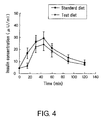
- Trelan G75 a glucose solution, (Shimizu Pharmaceutical Co., Ltd.) was used as the standard diet.
- Trelan G is a colorless viscous solution with sweetness and sourness and is used in the glucose tolerance test for diagnosing diabetes.
- the ingestion amount of the standard diet was adjusted to 150 ml corresponding to 50 g of sugar.
- a rice cracker which was obtained in Example 1, containing indigestible dextrin in an amount of 12.1 g per 100 g was used as the rice snack according to the present invention, referred to hereinafter as the test diet.
- the ingestion amount of the test diet was adjusted to 70.6 g corresponding to 50 g of sugar (7.4 g of protein, 5.3 g of lipid and 70.8 g of sugar per 100 g, calorie: 385 kcal).
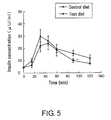
- 60.4 g of a lightly baked Japanese cracker was used as the control diet (commercially available product: 6.3 g of protein, 8.1 g of lipid and 81.9 g of sugar per 100 g, calorie: 423 kcal).
- a 50 ⁇ l portion of blood was collected from the fingertip of a subject onto a cotton having attached thereto EDTA (ethylenediaminetetraacetic acid) at test times of 0, 15, 30, 45, 60, 90 and 120 minutes.
- the cotton was placed into a microtube and centrifuged to collect the supernatant of plasma.
- Subjects were forbidden to take food and drink except water and to keep from administration of drugs from 9:00 p.m. on the previous day of test to the initiation time of test on the test day.
- the blood sugar level and the insulin concentration were measured at the times of 15, 30, 45, 60, 90 and 120 minutes after the initiation of diet ingestion at 0 minute.
- Trelan G 150 ml
- a jelly beverage corresponding to 50 g of sugar
- a Self-Monitoring Blood Glucose System (Medisafe Reader GR-101, Terumo Co.) was used for determining the blood sugar level. An exclusive centesis needle was used, and a small of blood was used for determining the blood sugar level.
- Plasma collected in the above paragraph (3) was used for determining the insulin concentration with a human insulin assay kit (Yanaihara Institute) by the antigen-antibody reaction.
- test was carried out thrice to obtain the areas below the curves of the blood sugar levels, among which the two areas having a coefficient of variation lower than the last one in the range of 25 % or less were selected, and the average of the two areas was provided as the area below the curve of the blood sugar level for the standard diet.
- the area below the blood sugar level curve was calculated according to the method described by Wolever and Jenkins (Reference 1).
- GI was calculated according to the method described by Sugiyama et al. (Reference 2).
- the area below the curve of the blood sugar level obtained on the ingestion of the test diet in each subject was divided by the average area to calculate the percentage as the GI.
- Standard deviation (SD) was calculated from the individual GIs, and the GI which was not within the range of average ⁇ 2SD was rejected. Then, the GIs within the above described range were averaged again to give the GI for each food.
- Insulinaemic Index (II) was calculated for each subject by dividing the area below the insulin concentration curve on ingesting the test diet by the average area below the curve of the standard diet, and thus the percentage of the quotient was provided as II. Standard deviation (SD) was calculated from respective II, and the II which was not within the range of average ⁇ 2SD was rejected. Then, the IIs within the above described range were averaged again to give the II for each food. Subjects having a HOMA-R as a judging criterion of insulin resistance (Reference 3) in excess of 2.0 was judged insulin resistant and excluded from the calculation of II.
- the equation of HOMA-R is represented as follows.
- HOMA - R Fasting blood sugar level mg / dl ⁇ Fasting insulin concentration ⁇ U / ml / 405
- Table 2 Average physical conditions of subject Number of persons Age (year) Height (cm) Weight (kg) BMI Total cholesterol (mg/dl) HDL-Cho (mg/dl) LDL-Cho (mg/dl) Neutral fat (mg/dl) Total 18 28.4 ⁇ 5.8 163.7 ⁇ 6.7 55.4 ⁇ 7.2 20.7 ⁇ 1.7 193 ⁇ 13.6 70.6 ⁇ 10.6 107 ⁇ 14.3 72 ⁇ 44.4 Male 8 31.5 ⁇ 6.1 169.3 ⁇ 4.4 62.8 ⁇ 2.8 22.0 ⁇ 1.7 199 ⁇ 12.9 62.8 ⁇ 9.1 116 ⁇ 9.0 89.3 ⁇ 58.8 Female 10 25.9 ⁇ 4.3 158.7 ⁇ 3.7 49.5 ⁇ 2.5 19.7 ⁇ 0.8 189 ⁇ 13.0 76.9 ⁇ 6.9 100 ⁇ 13.8 58.9 ⁇ 24.2 Average ⁇ Standard deviation
- the GI of the test diet was calculated from the area below the average blood sugar level curve of the standard diet and the area below the blood sugar level curve of the control diet. As a result, the GI of the test diet was 67, and the GI of the control diet was 88 (Table 3).
- the area below the blood sugar level curve of each diet subjected to test and the GIs of the control diet and the test diet were listed in Table 3.
- the changes of the blood sugar level on ingesting the standard diet and the test diet were illustrated in Figure 1 .
- the changes of the blood sugar level on ingesting the control diet and the test diet were illustrated in Figure 2 .
- the high GI food as GI ⁇ 83, the medium GI food as 83>GI>64, and the low GI food as G1 ⁇ 64 on the basis of the cooked rice.
- a food having GI ⁇ 68 was defined as a high GI food
- a food with 68>GI>52 was defined as a medium GI food
- the one with GI ⁇ 52 was defined as a low GI food on the basis of the fact that the cooked rice has a GI value of 82 (Reference 4).
- the test diet subjected to the test has a GI value of 67, and is classified into the medium GI foods.
- the general rice snacks have GI in the range of 85 - 100 and are classified into the high GI foods.
- the test diet of the test is believed to be a rice cracker really having a low GI value.
- the test diet is a rice snack having a low GI value by which drastic increase in blood sugar level will not be caused as compared with the standard diet and the control diet.
- the rice snack having a low II value together with a low GI value was successfully produced.
Landscapes
- Health & Medical Sciences (AREA)
- Nutrition Science (AREA)
- Life Sciences & Earth Sciences (AREA)
- Chemical & Material Sciences (AREA)
- Engineering & Computer Science (AREA)
- Food Science & Technology (AREA)
- Polymers & Plastics (AREA)
- Coloring Foods And Improving Nutritive Qualities (AREA)
- Confectionery (AREA)
Applications Claiming Priority (2)
| Application Number | Priority Date | Filing Date | Title |
|---|---|---|---|
| JP2006107266A JP4990549B2 (ja) | 2006-04-10 | 2006-04-10 | 米菓およびその製造方法 |
| PCT/JP2007/057898 WO2007117012A1 (ja) | 2006-04-10 | 2007-04-10 | 米菓およびその製造方法 |
Publications (3)
| Publication Number | Publication Date |
|---|---|
| EP2011403A1 true EP2011403A1 (de) | 2009-01-07 |
| EP2011403A4 EP2011403A4 (de) | 2011-06-29 |
| EP2011403B1 EP2011403B1 (de) | 2013-05-22 |
Family
ID=38581283
Family Applications (1)
| Application Number | Title | Priority Date | Filing Date |
|---|---|---|---|
| EP07741334.2A Not-in-force EP2011403B1 (de) | 2006-04-10 | 2007-04-10 | Reiskuchen und herstellungsverfahren dafür |
Country Status (8)
| Country | Link |
|---|---|
| US (1) | US20100028519A1 (de) |
| EP (1) | EP2011403B1 (de) |
| JP (1) | JP4990549B2 (de) |
| KR (1) | KR101469289B1 (de) |
| CN (1) | CN101541186A (de) |
| AU (1) | AU2007236579B2 (de) |
| WO (1) | WO2007117012A1 (de) |
| ZA (1) | ZA200809055B (de) |
Families Citing this family (8)
| Publication number | Priority date | Publication date | Assignee | Title |
|---|---|---|---|---|
| JP5885913B2 (ja) * | 2010-08-26 | 2016-03-16 | 株式会社ブルボン | 米穀粒の加工方法、米穀粉の粒径および粒径分布の制御方法、ならびに米穀粉の糊化度および粘度の制御方法 |
| US20130004623A1 (en) * | 2011-06-30 | 2013-01-03 | Republic Of Korea (Management :Rural Development Administration) | Method of producing not-hardened waxy rice cake and waxy rice cake produced by using the same |
| JP5936880B2 (ja) * | 2012-02-29 | 2016-06-22 | 日本食品化工株式会社 | 米菓の品質改良剤及び米菓 |
| KR20140079272A (ko) * | 2012-12-18 | 2014-06-26 | 씨제이제일제당 (주) | 김과 곡물 시트를 이용한 김스낵 및 이의 제조방법 |
| JP2017165696A (ja) * | 2016-03-17 | 2017-09-21 | 亀田製菓株式会社 | 血中インスリン濃度上昇抑制用の米菓組成物、粥又は添加物炊飯物、及びこれらの原料 |
| KR101985655B1 (ko) | 2016-11-07 | 2019-06-04 | 대한민국 | 저항전분을 함유하는 고아밀로스의 도담쌀을 이용한 다이어트 및 혈당 조절용 쌀과자의 제조 방법 |
| KR20200067677A (ko) | 2018-12-04 | 2020-06-12 | 신장섭 | 호각기능을 갖는 과자 |
| KR102699590B1 (ko) * | 2023-05-12 | 2024-08-26 | 우상기 | 당뇨 개선용 건강식의 제조방법 및 이에 의하여 제조된 당뇨 개선용 건강식 |
Family Cites Families (22)
| Publication number | Priority date | Publication date | Assignee | Title |
|---|---|---|---|---|
| US3925567A (en) * | 1974-03-26 | 1975-12-09 | Shunji Abe | Process for preparing snack-foods from starch |
| JP2764454B2 (ja) | 1989-04-12 | 1998-06-11 | 日本化薬株式会社 | 置換フェノール類ノボラック型エポキシ樹脂、その製造法及びエポキシ樹脂組成物 |
| US5505981A (en) * | 1992-08-07 | 1996-04-09 | Matsutani Chemical Industries Co., Ltd. | Method for imparting ability of preventing obesity and impaired glucose tolerance to foods and foods and sugar preparations exhibiting such preventive effects |
| JPH0779603B2 (ja) * | 1993-10-04 | 1995-08-30 | 伸幸 桑名 | 煎餅の製造方法 |
| JP3375402B2 (ja) * | 1993-12-14 | 2003-02-10 | 亀田製菓株式会社 | 米菓の製造方法 |
| AU3207397A (en) * | 1996-05-16 | 1997-12-05 | Hydroblend Ltd | Process and batter for coating vegetable pieces |
| US5871793A (en) * | 1996-11-27 | 1999-02-16 | Mars Incorporated | Puffed cereal cakes |
| JP3235647B2 (ja) | 1997-01-09 | 2001-12-04 | 日の本穀粉株式会社 | 米菓製造用原料粉及び米菓の製造方法 |
| JP4082760B2 (ja) * | 1997-06-18 | 2008-04-30 | 日澱化學株式会社 | 難消化性澱粉及びその製造方法 |
| JP3996679B2 (ja) * | 1997-10-14 | 2007-10-24 | 松谷化学工業株式会社 | 脂質代謝改善剤 |
| JP3751196B2 (ja) * | 2000-09-19 | 2006-03-01 | 東洋米菓株式会社 | 米菓の製造方法 |
| CA2421810C (en) * | 2000-09-21 | 2007-03-27 | Advanced Food Technologies, Inc. | Reticulation-free water-dispersible coating composition for food substrates |
| MXPA06001495A (es) * | 2003-08-06 | 2006-05-15 | Procter & Gamble | Composiciones de harina de arroz. |
| WO2005025327A2 (en) * | 2003-09-08 | 2005-03-24 | Board Of Supervisors Of Louisiana State University And Agricultural And Mechanical College | Resistant starch with cooking properties similar to untreated starch |
| WO2005036971A1 (en) * | 2003-10-16 | 2005-04-28 | Techcom Group, Llc | Reduced digestible carbohydrate food having reduced blood glucose response |
| AU2004284112B2 (en) * | 2003-10-27 | 2010-07-08 | Commonwealth Scientific And Industrial Research Organisation | Rice and products thereof having starch with an increased proportion of amylose |
| JP2005287454A (ja) * | 2004-04-02 | 2005-10-20 | Matsutani Chem Ind Ltd | 保健機能付与飲食品及び飲食品へ保健機能を付与する方法 |
| JP2005328776A (ja) * | 2004-05-20 | 2005-12-02 | National Food Research Institute | 血糖値上昇抑制米およびそれを用いた加工食品 |
| US20060088647A1 (en) * | 2004-10-25 | 2006-04-27 | Kadan Ranjit S | Baked products containing rice flour |
| KR100492623B1 (ko) * | 2004-12-22 | 2005-06-03 | 충청북도 | 기능성 쌀스낵 제조방법 |
| US20060150828A1 (en) * | 2005-01-11 | 2006-07-13 | Beech-Nut Nutrition Corporation | Dried infant cereal compositions |
| JP2006217813A (ja) * | 2005-02-08 | 2006-08-24 | National Food Research Institute | 米加工品およびその製造方法 |
-
2006
- 2006-04-10 JP JP2006107266A patent/JP4990549B2/ja not_active Expired - Lifetime
-
2007
- 2007-04-10 US US12/226,143 patent/US20100028519A1/en not_active Abandoned
- 2007-04-10 AU AU2007236579A patent/AU2007236579B2/en not_active Ceased
- 2007-04-10 EP EP07741334.2A patent/EP2011403B1/de not_active Not-in-force
- 2007-04-10 WO PCT/JP2007/057898 patent/WO2007117012A1/ja not_active Ceased
- 2007-04-10 CN CNA2007800216470A patent/CN101541186A/zh active Pending
-
2008
- 2008-10-22 ZA ZA2008/09055A patent/ZA200809055B/en unknown
- 2008-11-06 KR KR1020087027282A patent/KR101469289B1/ko active Active
Also Published As
| Publication number | Publication date |
|---|---|
| EP2011403A4 (de) | 2011-06-29 |
| AU2007236579A1 (en) | 2007-10-18 |
| JP4990549B2 (ja) | 2012-08-01 |
| JP2007274993A (ja) | 2007-10-25 |
| US20100028519A1 (en) | 2010-02-04 |
| AU2007236579B2 (en) | 2013-05-02 |
| KR101469289B1 (ko) | 2014-12-23 |
| CN101541186A (zh) | 2009-09-23 |
| KR20090057939A (ko) | 2009-06-08 |
| WO2007117012A1 (ja) | 2007-10-18 |
| EP2011403B1 (de) | 2013-05-22 |
| ZA200809055B (en) | 2009-12-30 |
Similar Documents
| Publication | Publication Date | Title |
|---|---|---|
| EP2011403B1 (de) | Reiskuchen und herstellungsverfahren dafür | |
| Lestari et al. | The development of low glycemic index cookie bars from foxtail millet (Setaria italica), arrowroot (Maranta arundinacea) flour, and kidney beans (Phaseolus vulgaris) | |
| Silvester et al. | Does digestibility of meat protein help explain large bowel cancer risk? | |
| Jenkins et al. | Wholemeal versus wholegrain breads: proportion of whole or cracked grain and the glycaemic response. | |
| Muir et al. | Validation of an in vitro assay for predicting the amount of starch that escapes digestion in the small intestine of humans | |
| Jenkins et al. | Digestibility of carbohydrate foods in an ileostomate: relationship to dietary fiber, in vitro digestibility, and glycemic response. | |
| Burton et al. | Glycemic impact and health: new horizons in white bread formulations | |
| Radhika et al. | Glycaemic index of Indian flatbreads (rotis) prepared using whole wheat flour and ‘atta mix’-added whole wheat flour | |
| ČEPO–BLAŽENKA et al. | Effects of pseudocereals, legumes and inulin addition on selected nutritional properties and glycemic index of whole grain wheat-based biscuits | |
| Mohebbi et al. | The effects of prebiotic bread containing oat ß-glucan and resistant starch on the glycemic index and glycemic load in healthy individuals | |
| Bornet et al. | Pasta cooking time: influence on starch digestion and plasma glucose and insulin responses in healthy subjects | |
| Heijnen et al. | Replacement of digestible by resistant starch lowers diet-induced thermogenesis in healthy men | |
| Champ et al. | In-vivo and in-vitro methods for resistant starch measurement | |
| Englyst et al. | Resistant starch: measurement in foods and physiological role in man | |
| Yaregal et al. | Compared with fresh injera, stale injera increases satiety in healthy subjects, but does not decrease the glycemic index | |
| Borczak et al. | Comparison of glycemic responses to frozen and non-frozen wheat rolls in human volunteers-a short report | |
| Czekajło et al. | Glycemic load and carbohydrates content in the diets of cancer patients | |
| Beals | The Glycemic Index: Research Meets Reality | |
| Afifah et al. | Effect of processing methods on glycemic index of chocolate crackers made with modified kepok banana (Mussa paradisiaca L.) flour | |
| Hermansen | Research methodologies in the evaluation of intestinal glucose absorption and the concept of glycaemic index | |
| Sa’adah et al. | Nutritional composition, glycemic index, glycemic load, and organoleptical quality of glucomannan-enriched soy milk ice cream | |
| Emmambux et al. | Starch: Nutritional and health aspects | |
| Gajula | Fiber-enriched wheat flour precooked using extrusion processing: rheological, nutritional and sensory properties | |
| Finocchiaro et al. | Resistant starch | |
| Chu et al. | Postprandial glycemic response, sensory, and appetite evaluation of highland barley-multigrain rice versus white rice in healthy Chinese adults: A randomized crossover study |
Legal Events
| Date | Code | Title | Description |
|---|---|---|---|
| PUAI | Public reference made under article 153(3) epc to a published international application that has entered the european phase |
Free format text: ORIGINAL CODE: 0009012 |
|
| 17P | Request for examination filed |
Effective date: 20081105 |
|
| AK | Designated contracting states |
Kind code of ref document: A1 Designated state(s): AT BE BG CH CY CZ DE DK EE ES FI FR GB GR HU IE IS IT LI LT LU LV MC MT NL PL PT RO SE SI SK TR |
|
| AX | Request for extension of the european patent |
Extension state: AL BA HR MK RS |
|
| A4 | Supplementary search report drawn up and despatched |
Effective date: 20110601 |
|
| RIC1 | Information provided on ipc code assigned before grant |
Ipc: A23G 3/48 20060101AFI20071218BHEP Ipc: A23L 1/164 20060101ALI20110524BHEP Ipc: A23G 3/50 20060101ALI20110524BHEP |
|
| DAX | Request for extension of the european patent (deleted) | ||
| GRAP | Despatch of communication of intention to grant a patent |
Free format text: ORIGINAL CODE: EPIDOSNIGR1 |
|
| GRAS | Grant fee paid |
Free format text: ORIGINAL CODE: EPIDOSNIGR3 |
|
| GRAA | (expected) grant |
Free format text: ORIGINAL CODE: 0009210 |
|
| AK | Designated contracting states |
Kind code of ref document: B1 Designated state(s): AT BE BG CH CY CZ DE DK EE ES FI FR GB GR HU IE IS IT LI LT LU LV MC MT NL PL PT RO SE SI SK TR |
|
| REG | Reference to a national code |
Ref country code: GB Ref legal event code: FG4D |
|
| REG | Reference to a national code |
Ref country code: CH Ref legal event code: EP |
|
| REG | Reference to a national code |
Ref country code: AT Ref legal event code: REF Ref document number: 612689 Country of ref document: AT Kind code of ref document: T Effective date: 20130615 |
|
| REG | Reference to a national code |
Ref country code: IE Ref legal event code: FG4D |
|
| REG | Reference to a national code |
Ref country code: DE Ref legal event code: R096 Ref document number: 602007030611 Country of ref document: DE Effective date: 20130718 |
|
| REG | Reference to a national code |
Ref country code: AT Ref legal event code: MK05 Ref document number: 612689 Country of ref document: AT Kind code of ref document: T Effective date: 20130522 |
|
| REG | Reference to a national code |
Ref country code: LT Ref legal event code: MG4D |
|
| PG25 | Lapsed in a contracting state [announced via postgrant information from national office to epo] |
Ref country code: LT Free format text: LAPSE BECAUSE OF FAILURE TO SUBMIT A TRANSLATION OF THE DESCRIPTION OR TO PAY THE FEE WITHIN THE PRESCRIBED TIME-LIMIT Effective date: 20130522 Ref country code: SI Free format text: LAPSE BECAUSE OF FAILURE TO SUBMIT A TRANSLATION OF THE DESCRIPTION OR TO PAY THE FEE WITHIN THE PRESCRIBED TIME-LIMIT Effective date: 20130522 Ref country code: AT Free format text: LAPSE BECAUSE OF FAILURE TO SUBMIT A TRANSLATION OF THE DESCRIPTION OR TO PAY THE FEE WITHIN THE PRESCRIBED TIME-LIMIT Effective date: 20130522 Ref country code: IS Free format text: LAPSE BECAUSE OF FAILURE TO SUBMIT A TRANSLATION OF THE DESCRIPTION OR TO PAY THE FEE WITHIN THE PRESCRIBED TIME-LIMIT Effective date: 20130922 Ref country code: GR Free format text: LAPSE BECAUSE OF FAILURE TO SUBMIT A TRANSLATION OF THE DESCRIPTION OR TO PAY THE FEE WITHIN THE PRESCRIBED TIME-LIMIT Effective date: 20130823 Ref country code: ES Free format text: LAPSE BECAUSE OF FAILURE TO SUBMIT A TRANSLATION OF THE DESCRIPTION OR TO PAY THE FEE WITHIN THE PRESCRIBED TIME-LIMIT Effective date: 20130902 Ref country code: FI Free format text: LAPSE BECAUSE OF FAILURE TO SUBMIT A TRANSLATION OF THE DESCRIPTION OR TO PAY THE FEE WITHIN THE PRESCRIBED TIME-LIMIT Effective date: 20130522 Ref country code: PT Free format text: LAPSE BECAUSE OF FAILURE TO SUBMIT A TRANSLATION OF THE DESCRIPTION OR TO PAY THE FEE WITHIN THE PRESCRIBED TIME-LIMIT Effective date: 20130923 Ref country code: SE Free format text: LAPSE BECAUSE OF FAILURE TO SUBMIT A TRANSLATION OF THE DESCRIPTION OR TO PAY THE FEE WITHIN THE PRESCRIBED TIME-LIMIT Effective date: 20130522 |
|
| REG | Reference to a national code |
Ref country code: NL Ref legal event code: VDEP Effective date: 20130522 |
|
| PG25 | Lapsed in a contracting state [announced via postgrant information from national office to epo] |
Ref country code: BG Free format text: LAPSE BECAUSE OF FAILURE TO SUBMIT A TRANSLATION OF THE DESCRIPTION OR TO PAY THE FEE WITHIN THE PRESCRIBED TIME-LIMIT Effective date: 20130822 Ref country code: PL Free format text: LAPSE BECAUSE OF FAILURE TO SUBMIT A TRANSLATION OF THE DESCRIPTION OR TO PAY THE FEE WITHIN THE PRESCRIBED TIME-LIMIT Effective date: 20130522 |
|
| PG25 | Lapsed in a contracting state [announced via postgrant information from national office to epo] |
Ref country code: LV Free format text: LAPSE BECAUSE OF FAILURE TO SUBMIT A TRANSLATION OF THE DESCRIPTION OR TO PAY THE FEE WITHIN THE PRESCRIBED TIME-LIMIT Effective date: 20130522 |
|
| PG25 | Lapsed in a contracting state [announced via postgrant information from national office to epo] |
Ref country code: BE Free format text: LAPSE BECAUSE OF FAILURE TO SUBMIT A TRANSLATION OF THE DESCRIPTION OR TO PAY THE FEE WITHIN THE PRESCRIBED TIME-LIMIT Effective date: 20130522 Ref country code: SK Free format text: LAPSE BECAUSE OF FAILURE TO SUBMIT A TRANSLATION OF THE DESCRIPTION OR TO PAY THE FEE WITHIN THE PRESCRIBED TIME-LIMIT Effective date: 20130522 Ref country code: EE Free format text: LAPSE BECAUSE OF FAILURE TO SUBMIT A TRANSLATION OF THE DESCRIPTION OR TO PAY THE FEE WITHIN THE PRESCRIBED TIME-LIMIT Effective date: 20130522 Ref country code: DK Free format text: LAPSE BECAUSE OF FAILURE TO SUBMIT A TRANSLATION OF THE DESCRIPTION OR TO PAY THE FEE WITHIN THE PRESCRIBED TIME-LIMIT Effective date: 20130522 Ref country code: CZ Free format text: LAPSE BECAUSE OF FAILURE TO SUBMIT A TRANSLATION OF THE DESCRIPTION OR TO PAY THE FEE WITHIN THE PRESCRIBED TIME-LIMIT Effective date: 20130522 |
|
| PG25 | Lapsed in a contracting state [announced via postgrant information from national office to epo] |
Ref country code: RO Free format text: LAPSE BECAUSE OF FAILURE TO SUBMIT A TRANSLATION OF THE DESCRIPTION OR TO PAY THE FEE WITHIN THE PRESCRIBED TIME-LIMIT Effective date: 20130522 Ref country code: IT Free format text: LAPSE BECAUSE OF FAILURE TO SUBMIT A TRANSLATION OF THE DESCRIPTION OR TO PAY THE FEE WITHIN THE PRESCRIBED TIME-LIMIT Effective date: 20130522 Ref country code: NL Free format text: LAPSE BECAUSE OF FAILURE TO SUBMIT A TRANSLATION OF THE DESCRIPTION OR TO PAY THE FEE WITHIN THE PRESCRIBED TIME-LIMIT Effective date: 20130522 |
|
| PLBE | No opposition filed within time limit |
Free format text: ORIGINAL CODE: 0009261 |
|
| STAA | Information on the status of an ep patent application or granted ep patent |
Free format text: STATUS: NO OPPOSITION FILED WITHIN TIME LIMIT |
|
| 26N | No opposition filed |
Effective date: 20140225 |
|
| REG | Reference to a national code |
Ref country code: DE Ref legal event code: R097 Ref document number: 602007030611 Country of ref document: DE Effective date: 20140225 |
|
| PG25 | Lapsed in a contracting state [announced via postgrant information from national office to epo] |
Ref country code: LU Free format text: LAPSE BECAUSE OF FAILURE TO SUBMIT A TRANSLATION OF THE DESCRIPTION OR TO PAY THE FEE WITHIN THE PRESCRIBED TIME-LIMIT Effective date: 20140410 Ref country code: MC Free format text: LAPSE BECAUSE OF FAILURE TO SUBMIT A TRANSLATION OF THE DESCRIPTION OR TO PAY THE FEE WITHIN THE PRESCRIBED TIME-LIMIT Effective date: 20130522 |
|
| REG | Reference to a national code |
Ref country code: CH Ref legal event code: PL |
|
| REG | Reference to a national code |
Ref country code: IE Ref legal event code: MM4A |
|
| PG25 | Lapsed in a contracting state [announced via postgrant information from national office to epo] |
Ref country code: LI Free format text: LAPSE BECAUSE OF NON-PAYMENT OF DUE FEES Effective date: 20140430 Ref country code: CH Free format text: LAPSE BECAUSE OF NON-PAYMENT OF DUE FEES Effective date: 20140430 |
|
| PG25 | Lapsed in a contracting state [announced via postgrant information from national office to epo] |
Ref country code: IE Free format text: LAPSE BECAUSE OF NON-PAYMENT OF DUE FEES Effective date: 20140410 |
|
| PG25 | Lapsed in a contracting state [announced via postgrant information from national office to epo] |
Ref country code: MT Free format text: LAPSE BECAUSE OF FAILURE TO SUBMIT A TRANSLATION OF THE DESCRIPTION OR TO PAY THE FEE WITHIN THE PRESCRIBED TIME-LIMIT Effective date: 20130522 |
|
| REG | Reference to a national code |
Ref country code: FR Ref legal event code: PLFP Year of fee payment: 10 |
|
| PG25 | Lapsed in a contracting state [announced via postgrant information from national office to epo] |
Ref country code: CY Free format text: LAPSE BECAUSE OF FAILURE TO SUBMIT A TRANSLATION OF THE DESCRIPTION OR TO PAY THE FEE WITHIN THE PRESCRIBED TIME-LIMIT Effective date: 20130522 |
|
| PG25 | Lapsed in a contracting state [announced via postgrant information from national office to epo] |
Ref country code: TR Free format text: LAPSE BECAUSE OF FAILURE TO SUBMIT A TRANSLATION OF THE DESCRIPTION OR TO PAY THE FEE WITHIN THE PRESCRIBED TIME-LIMIT Effective date: 20130522 Ref country code: HU Free format text: LAPSE BECAUSE OF FAILURE TO SUBMIT A TRANSLATION OF THE DESCRIPTION OR TO PAY THE FEE WITHIN THE PRESCRIBED TIME-LIMIT; INVALID AB INITIO Effective date: 20070410 |
|
| REG | Reference to a national code |
Ref country code: FR Ref legal event code: PLFP Year of fee payment: 11 |
|
| REG | Reference to a national code |
Ref country code: FR Ref legal event code: PLFP Year of fee payment: 12 |
|
| PGFP | Annual fee paid to national office [announced via postgrant information from national office to epo] |
Ref country code: GB Payment date: 20240229 Year of fee payment: 18 |
|
| PGFP | Annual fee paid to national office [announced via postgrant information from national office to epo] |
Ref country code: FR Payment date: 20240315 Year of fee payment: 18 |
|
| PGFP | Annual fee paid to national office [announced via postgrant information from national office to epo] |
Ref country code: DE Payment date: 20240425 Year of fee payment: 18 |
|
| REG | Reference to a national code |
Ref country code: DE Ref legal event code: R119 Ref document number: 602007030611 Country of ref document: DE |
|
| GBPC | Gb: european patent ceased through non-payment of renewal fee |
Effective date: 20250410 |
|
| PG25 | Lapsed in a contracting state [announced via postgrant information from national office to epo] |
Ref country code: DE Free format text: LAPSE BECAUSE OF NON-PAYMENT OF DUE FEES Effective date: 20251104 |
|
| PG25 | Lapsed in a contracting state [announced via postgrant information from national office to epo] |
Ref country code: GB Free format text: LAPSE BECAUSE OF NON-PAYMENT OF DUE FEES Effective date: 20250410 |
|
| PG25 | Lapsed in a contracting state [announced via postgrant information from national office to epo] |
Ref country code: FR Free format text: LAPSE BECAUSE OF NON-PAYMENT OF DUE FEES Effective date: 20250430 |