EP2014702B1 - Dispositif DEL contenant du polyborosiloxane - Google Patents
Dispositif DEL contenant du polyborosiloxane Download PDFInfo
- Publication number
- EP2014702B1 EP2014702B1 EP08012126A EP08012126A EP2014702B1 EP 2014702 B1 EP2014702 B1 EP 2014702B1 EP 08012126 A EP08012126 A EP 08012126A EP 08012126 A EP08012126 A EP 08012126A EP 2014702 B1 EP2014702 B1 EP 2014702B1
- Authority
- EP
- European Patent Office
- Prior art keywords
- group
- resin
- polyborosiloxane
- silicon compound
- independently represent
- Prior art date
- Legal status (The legal status is an assumption and is not a legal conclusion. Google has not performed a legal analysis and makes no representation as to the accuracy of the status listed.)
- Ceased
Links
Images
Classifications
-
- C—CHEMISTRY; METALLURGY
- C08—ORGANIC MACROMOLECULAR COMPOUNDS; THEIR PREPARATION OR CHEMICAL WORKING-UP; COMPOSITIONS BASED THEREON
- C08G—MACROMOLECULAR COMPOUNDS OBTAINED OTHERWISE THAN BY REACTIONS ONLY INVOLVING UNSATURATED CARBON-TO-CARBON BONDS
- C08G77/00—Macromolecular compounds obtained by reactions forming a linkage containing silicon with or without sulfur, nitrogen, oxygen or carbon in the main chain of the macromolecule
- C08G77/48—Macromolecular compounds obtained by reactions forming a linkage containing silicon with or without sulfur, nitrogen, oxygen or carbon in the main chain of the macromolecule in which at least two but not all the silicon atoms are connected by linkages other than oxygen atoms
- C08G77/56—Boron-containing linkages
-
- H—ELECTRICITY
- H10—SEMICONDUCTOR DEVICES; ELECTRIC SOLID-STATE DEVICES NOT OTHERWISE PROVIDED FOR
- H10W—GENERIC PACKAGES, INTERCONNECTIONS, CONNECTORS OR OTHER CONSTRUCTIONAL DETAILS OF DEVICES COVERED BY CLASS H10
- H10W74/00—Encapsulations, e.g. protective coatings
- H10W74/40—Encapsulations, e.g. protective coatings characterised by their materials
- H10W74/47—Encapsulations, e.g. protective coatings characterised by their materials comprising organic materials, e.g. plastics or resins
- H10W74/476—Organic materials comprising silicon
-
- H—ELECTRICITY
- H10—SEMICONDUCTOR DEVICES; ELECTRIC SOLID-STATE DEVICES NOT OTHERWISE PROVIDED FOR
- H10H—INORGANIC LIGHT-EMITTING SEMICONDUCTOR DEVICES HAVING POTENTIAL BARRIERS
- H10H20/00—Individual inorganic light-emitting semiconductor devices having potential barriers, e.g. light-emitting diodes [LED]
- H10H20/80—Constructional details
- H10H20/85—Packages
- H10H20/852—Encapsulations
- H10H20/854—Encapsulations characterised by their material, e.g. epoxy or silicone resins
Definitions
- the present invention relates to a light-emitting diode device comprising an optical semiconductor element encapsulated with a resin for optical semiconductor element encapsulation.
- LED light-emitting diode
- an encapsulating material plays a role of sealing and protecting LED so that the performance of LED does not deteriorate.
- epoxy resins have been widely used as an encapsulating material and JP-A-2006-274249 reports that an epoxy resin composition containing a specific component is excellent in resistance against photodeterioration.
- a silicone resin there has been known a polyborosiloxane resin having a chemical structure where a part of silicon atoms in the silicone are replaced by boron atoms. Since the polyborosiloxane resin is excellent in heat resistance, it is used as an insulating coating film for electric wires which require heat resistance. JP-A-10-152561 reports that a polyborosiloxane having both of heat resistance and humidity resistance is obtained by a two-stage reaction of specific silicon compounds.
- an epoxy resin as an encapsulating material is not sufficient in heat resistance, there arises a problem of deterioration of the resin with the increasing use of larger electric current due to the increase in light-emitting efficiency and luminous flux of LED.
- the epoxy resin is changed into yellow due to heat generated in the LED chip, so that there arises a problem of decrease in emission luminance.
- blue or white LED is encapsulated, there arises a problem that exposure to short-wavelength light (e.g., light having a wavelength of 350 to 500 nm) having a large energy causes photodegradation and thus yellowing occurs more severely.
- a silicone resin is excellent in heat resistance but the synthesis is cumbersome and complicated and the raw materials themselves cost high, so that there arises a problem that a product cannot be supplied at a low cost.
- JP-A-08-268735 discloses a heat-resistant laminated glass comprising an intermediate adhesive layer of a polymetallosiloxane such as polyborosiloxane.
- the polymetallosiloxane is produced by mixing a silicone oil with a silane compound and a boric acid compound and heating the mixture in order to effect a condensation polymerization.
- JP-A-58-210976 discloses a resin composition for use in bonding metallic members, said composition being prepared by mixing a polyborosiloxane resin with a silicone resin and an inorganic filler in specific amounts.
- JP-A-09-134614 discloses a heat-resistant insulated wire comprising a conductor coated with a coating layer, said layer being made from a polyborosiloxane resin.
- JP-A-09-013278 discloses the use of a coating material comprising a polyborosiloxane resin for the preparation of heat-resistant fibers and heat-resistant insulated wires.
- the object of the present invention is to provide a light-emitting diode device comprising an optical semiconductor element encapsulated with a resin for optical semiconductor element encapsulation, said resin containing a polyborosiloxane excellent in all of heat resistance, transparency, and light resistance.
- a light-emitting diode device comprising an optical semiconductor element encapsulated with a resin for optical semiconductor element encapsulation, wherein the resin comprises a polyborosiloxane obtained by reacting a silicon compound with a boron compound, wherein the silicon compound is at least one of a bifunctional silicon compound represented by the following formula (I):
- the resin for optical semiconductor element encapsulation used in the invention exhibits an excellent advantage that it is excellent in all of heat resistance, transparency, and light resistance. Therefore, the optical semiconductor device encapsulated using the resin can achieve a longer operating life.
- the resin containing a polyborosiloxane used in the invention is suitably used as a material for encapsulating an optical semiconductor element in a backlight for a liquid crystal screen, a traffic signal, an outdoor large display, an advertising signboard, and the like.
- the resin for optical semiconductor element encapsulation contains a polyborosiloxane obtained by reacting a silicon compound with a boron compound.
- silicon compound at least one of specific bifunctional or trifunctional silicon compounds is used.
- the bifunctional silicon compound is a compound represented by the following formula (I):
- bifunctional silicon compound represented by the formula (I) there may be mentioned diphenyldimethoxysilane, dimethyldimethoxysilane, diphenyldihydroxysilane, dimethyldiethoxysilane, diphenyldiethoxysilane, diethyldimethoxysilane, diethyldiethoxysilane, diisopropyldimethoxysilane, diisopropyldiethoxysilane, methylphenyldimethoxysilane, methylphenyldiethoxysilane, dimethyldichlorosilane, diphenyldichlorosilane, diethyldichlorosilane, diisopropyldichlorosilane or, methylphenyldichlorosilane, and they may be used singly or as a combination of two or more thereof.
- dimethyldimethoxysilane in which R 1 and R 2 each are a methyl group and X 1 and X 2 each are a methoxy group
- diphenyldimethoxysilane in which R 1 and R 2 each are a phenyl group and X 1 and X 2 each are a methoxy group.
- the trifunctional silicon compound is a compound represented by the following formula (II):
- the trifunctional silicon compound represented by the formula (II) there may be mentioned phenyltrimethoxysilane, methyltrimethoxysilane, methyltrichlorosilane, phenyltrichlorosilane, phenyltriethoxysilane, methyltriethoxysilane, ethyltrimethoxysilane, ethyltrichlorosilane, isopropyltrimethoxysilane, or isopropyltrichlorosilane, and they may be used singly or as a combination of two or more thereof.
- methyltrimethoxysilane in which R 3 is a methyl group and X 3 , X 4 , and X 5 each are a methoxy group
- phenyltrimethoxysilane in which R 3 is a phenyl group and X 3 , X 4 , and X 5 each are a methoxy group
- the resin for encapsulation may contain a silicon compound other than the bifunctional silicon compound represented by the formula (I) and the trifunctional silicon compound represented by the formula (II) within a range where the advantage of the invention is not impaired.
- the total content of the bifunctional silicon compound represented by the formula (I) and the trifunctional silicon compound represented by the formula (II) in the silicon compounds subjected to the reaction is preferably 30% by weight or more, more preferably 50% by weight or more, and further preferably 60 to 100% by weight or more.
- the weight ratio (bifunctional silicon compound /trifunctional silicon compound) of the bifunctional silicon compound represented by the formula (I) to the trifunctional silicon compound represented by the formula (II) is preferably 20/1 to 1/10, and more preferably 5/1 to 1/2.
- the functional groups of R 1 and R 2 in the formula (I) and R 3 in the formula (II) preferably satisfies such a relationship that the molar ratio (alkyl group/aryl group) of the alkyl group to the aryl group is 100/0 to 5/95, and more preferably 100/0 to 15/85.
- the boron compound is a boric acid compound or a boric acid ester compound represented by the following formula (III): wherein Y 1 , Y 2 , and Y 3 each independently represent a hydrogen atom or an alkyl group.
- the carbon number of the alkyl group in the formula (III) is preferably 1 to 12, more preferably 1 to 6, and further preferably 1 to 3. Specific examples thereof include a methyl group, an ethyl group, a propyl group, and an isopropyl group. Of these, preferred are an ethyl group and an isopropyl group, and more preferred is an ethyl group.
- boric acid As the compound represented by the formula (III), there may be mentioned boric acid, methyl borate, ethyl borate, or isopropyl borate, and they may be used singly or as a combination of two or more thereof. Of these, preferred are boric acid, ethyl borate, and isopropyl borate, and more preferred are boric acid and ethyl borate.
- the polycondensation of the silicon compound with the boron compound can be carried out, for example, at a temperature of 60 to 200°C under an inert gas atmosphere and in the absence of a solvent.
- a plurality of the silicon compounds although the compounds may be subjected to the reaction at a time, since the reactivity varies depending on the functional groups of the compounds, each of the compounds can be separately subjected to the reaction.
- the total weight ratio (silicon compound/boron compound) of the silicon compound to the boron compound is preferably 500/1 to 1/1, more preferably 100/1 to 2/1, further preferably 20/1 to 2/1, and still further preferably 5/1 to 2/1.
- by-products may be removed by evaporation, for example, by heat treatment at 100 to 200°C for 1 to 12 hours and then at 200 to 300°C for 1 to 24 hours.
- the softening point of the resin used in the invention is preferably 50 to 300°C, more preferably 80 to 250°C from the viewpoint of moldability and processability.
- the softening point is measured in acccordance with the method described in the following Examples.
- the transparency (transmittance at 450 nm) of the resin used in the invention is preferably 90% or more and more preferably 95% or more from the viewpoint of improving light resistance.
- the transparency (transmittance at 450 nm) is measured in accordance with the method described in the following Examples.
- the thus obtained resin containing the polyborosiloxane is not only excellent in heat resistance but also excellent in transparency and light resistance, it can be suitably used as a resin for optical semiconductor element encapsulation in a backlight for a liquid crystal screen, a traffic signal, an outdoor large display, an advertising signboard, and the like.
- the optical semiconductor device of the invention includes the resin containing the polyborosiloxane excellent in heat resistance, transparency, and light resistance as a resin for optical semiconductor element encapsulation, it becomes possible to maintain the emission luminance in a high state for a long period of time without deterioration of the encapsulating resin and thus the device can be suitably used.
- the resin was measured in accordance with the direct ATR method using an FTIR apparatus (FTIR-470, manufactured by JASCO Corporation).
- the resin was slowly heated to 250°C on a hot plate, the state was visually observed, and a temperature where the resin was softened so as to show slight flowability was determined as a softening point.
- the resin was dissolved in methyl ethyl ketone and the solution was applied on a glass plate and dried at 150°C for 1 hour to form a film (film thickness: 50 ⁇ m).
- the resultant sample was subjected to the measurement of transmittance using a spectrophotometer (U-4100, manufactured by Hitachi High-Technologies Corporation).
- the solution was applied on a biaxially oriented polyester film (50 ⁇ m, manufactured by Mitsubishi Chemical Polyester) so as to achieve a thickness of 100 ⁇ m, and the whole was dried at 130°C for 2 minutes to obtain a sheet containing an epoxy resin. Thereafter, three pieces of sheets obtained in the same manner were thermally laminated at 100°C to obtain an epoxy sheet (epoxy resin A) having a thickness of 300 ⁇ m.
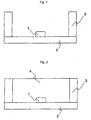
- FIG. 1 shows a substrate of the LED device before encapsulation processing
- FIG. 2 shows a substrate of the LED device after encapsulation processing.
- Each of LED devices of Examples 6 to 10 was produced by LED encapsulation in which a substrate mounted with a blue LED element having a size of 1 mm square and a reflector having a height of 400 ⁇ m sited around the LED element and 5 mm distant therefrom was heated to the encapsulating temperature shown in Table 1 and then 120 mg of the resin shown in Table 1 was put on the LED element and melted.
- An LED device of Comparative Example 1 was produced by LED encapsulation in which a substrate mounted with a blue LED element having a size of 1 mm square and a reflector having a height of 400 ⁇ m sited around the LED element and 5 mm distant therefrom was heated to the encapsulating temperature shown in Table 1 and then the resin shown in Table 1 was put on the LED element and subjected to encapsulation processing with a pressure of 0.5 MPa.
- Luminance retention was calculated according to the following equation to evaluate light resistance. In this connection, those having a luminance retention of 70% or more were judged to be good.
- Luminance Retention % Luminance after passage of 300 hours / Luminance immediately after start of test ⁇ 100 Table 1
- Example 6 Example 7
- Example 8 Example 9
- Example 10 Comparative Example 2 Resin Polyborosiloxane A (Example 1) Polyborosiloxane B (Example 2) Polyborosiloxane C (Example 3) Polyborosiloxane D (Example 4) Polyborosiloxane E (Example 5) Epoxy resin A (Comparative Example 1) Alkyl group/aryl group 1) 0/100 14/86 86/14 100/0 100/0 - Resin Softening point (°C) 80 100 200 250 250 impossible to measure 2) Transparency (%) 97 98 100 100 95 Heat resistance good good good good good good poor Encapsulation processing temperature 100 100 250 250 250 150 Device Luminance retention (%) 97 98 98 99 100 40 1) It shows a molar ratio (alkyl group/aryl group) of the alkyl group to the ary
- the LED devices of Examples have high luminance retention as compared with the LED device of Comparative Example and thus excellent in light resistance.
- the LED devices of Examples 8 to 10 have a molar ratio (alkyl group/aryl group) of the alkyl group to the aryl group of 86/14 or 100/0 with regard to the functional groups of the silicone compounds which are raw materials of the encapsulating resins, transparency and light resistance are more excellent.
Landscapes
- Chemical & Material Sciences (AREA)
- Health & Medical Sciences (AREA)
- Chemical Kinetics & Catalysis (AREA)
- Medicinal Chemistry (AREA)
- Polymers & Plastics (AREA)
- Organic Chemistry (AREA)
- Led Device Packages (AREA)
- Structures Or Materials For Encapsulating Or Coating Semiconductor Devices Or Solid State Devices (AREA)
- Polymers With Sulfur, Phosphorus Or Metals In The Main Chain (AREA)
- Silicon Polymers (AREA)
Claims (1)
- Dispositif de diode électroluminescente comprenant un élément optique semi-conducteur encapsulé dans une résine d'encapsulation d'élément optique semi-conducteur, où ladite résine comprend un polyborosiloxane obtenu par réaction d'un composé du silicium avec un composé du bore,
le composé du silicium étant au moins l'un
d'un composé bifonctionnel du silicium représenté par la formule (I) ci-après : où R1 et R2 représentent chacun, indépendamment l'un de l'autre, un groupe alkyle, un groupe cycloalkyle, un groupe alcényle, un groupe alcynyle ou un groupe aryle, et X1 et X2 représentent chacun, indépendamment l'un de l'autre, un groupe alcoxy, un groupe hydroxyle ou un atome d'halogène ; etd'un composé trifonctionnel du silicium représenté par la formule (II) ci-après :
 où R3 représente un groupe alkyle, un groupe cycloalkyle, un groupe alcényle, un groupe alcynyle ou un groupe aryle, et X3, X4 et X5 représentent chacun, indépendamment les uns des autres, un groupe alcoxy, un groupe hydroxyle ou un atome d'halogène, etle composé du bore étant un composé acide borique ou un composé ester d'acide borique représenté par la formule (III) ci-après :
 où Y1, Y2 et Y3 représentent chacun, indépendamment les uns des autres, un atome d'hydrogène ou un groupe alkyle.
Applications Claiming Priority (1)
| Application Number | Priority Date | Filing Date | Title |
|---|---|---|---|
| JP2007182486A JP5024873B2 (ja) | 2007-07-11 | 2007-07-11 | ポリボロシロキサンからなる光半導体素子封止用樹脂 |
Publications (2)
| Publication Number | Publication Date |
|---|---|
| EP2014702A1 EP2014702A1 (fr) | 2009-01-14 |
| EP2014702B1 true EP2014702B1 (fr) | 2010-01-06 |
Family
ID=39708347
Family Applications (1)
| Application Number | Title | Priority Date | Filing Date |
|---|---|---|---|
| EP08012126A Ceased EP2014702B1 (fr) | 2007-07-11 | 2008-07-04 | Dispositif DEL contenant du polyborosiloxane |
Country Status (6)
| Country | Link |
|---|---|
| US (1) | US20090014750A1 (fr) |
| EP (1) | EP2014702B1 (fr) |
| JP (1) | JP5024873B2 (fr) |
| KR (1) | KR101153652B1 (fr) |
| CN (1) | CN101343367B (fr) |
| DE (1) | DE602008000500D1 (fr) |
Families Citing this family (19)
| Publication number | Priority date | Publication date | Assignee | Title |
|---|---|---|---|---|
| CN101501139B (zh) * | 2006-08-04 | 2011-08-17 | 陶氏康宁公司 | 硅氧烷树脂和硅氧烷组合物 |
| JP5024878B2 (ja) * | 2007-11-28 | 2012-09-12 | 日東電工株式会社 | ポリボロシロキサンを含む光半導体素子封止用樹脂、およびそれを用いて得られる光半導体装置 |
| JP5084524B2 (ja) * | 2008-01-21 | 2012-11-28 | 日東電工株式会社 | 光半導体素子封止用樹脂組成物の製造方法 |
| US20110147722A1 (en) * | 2009-10-16 | 2011-06-23 | Hawker Craig J | Semiconductor light emitting device comprising high performance resins |
| TWI549727B (zh) | 2010-08-11 | 2016-09-21 | 極風有限責任公司 | 緩衝墊 |
| JP5655518B2 (ja) * | 2010-11-16 | 2015-01-21 | Jnc株式会社 | 新規物質及び熱硬化性組成物 |
| JP2012122002A (ja) * | 2010-12-09 | 2012-06-28 | Daicel Corp | 付加硬化性メタロシロキサン化合物 |
| WO2013023174A1 (fr) | 2011-08-10 | 2013-02-14 | University Of Virginia Patent Foundation | Compositions de caoutchouc silicone viscoélastiques |
| US9615611B2 (en) | 2011-08-11 | 2017-04-11 | G-Form, LLC | Breathable impact absorbing cushioning and constructions |
| CN103275325B (zh) * | 2013-06-09 | 2015-06-17 | 上海爱世博有机硅材料有限公司 | 硼硅氧烷及其制备方法 |
| CN106519242B (zh) * | 2016-11-23 | 2018-03-30 | 常州工程职业技术学院 | 一种紫外光固化钛掺杂含硼硅氧烷及其制备方法和在3d打印材料中的应用 |
| CN107312175A (zh) * | 2017-05-14 | 2017-11-03 | 杭州师范大学 | 一种线型聚硼硅氧烷的制备方法 |
| CN108913091A (zh) * | 2018-07-28 | 2018-11-30 | 南昌正业科技有限公司 | 一种柔性覆铜板用粘结剂及其制备方法 |
| CN109593509B (zh) * | 2018-12-06 | 2021-05-04 | 烟台德邦科技股份有限公司 | 一种硼酸改性有机硅热熔胶的制备方法 |
| CN111154453B (zh) * | 2020-01-19 | 2022-01-28 | 厦门艾贝森电子有限公司 | 一种耐热单组份加成型有机硅胶黏剂及其制备方法 |
| CN111394054A (zh) * | 2020-03-24 | 2020-07-10 | 新安天玉有机硅有限公司 | 一种自粘胶带用硅橡胶及其制备方法 |
| CN115044084B (zh) * | 2021-03-08 | 2023-10-03 | 四川大学 | 聚硼硅氧烷弹性体在显示屏保护中的应用 |
| KR20230041109A (ko) * | 2021-09-15 | 2023-03-24 | 삼성디스플레이 주식회사 | 고분자층 및 이를 포함하는 표시 장치 |
| CN119350622B (zh) * | 2024-11-06 | 2025-08-29 | 广东派乐玛新材料技术有限公司 | 一种含硼有机硅、光学胶黏剂、有机硅oca及其制备方法和应用 |
Family Cites Families (17)
| Publication number | Priority date | Publication date | Assignee | Title |
|---|---|---|---|---|
| US4152509A (en) * | 1976-09-30 | 1979-05-01 | The Foundation: The Research Institute For Special Inorganic Materials | Borosiloxane polymers and a method for producing the same |
| JPS53147798A (en) * | 1977-05-30 | 1978-12-22 | Shin Etsu Chem Co Ltd | Curable composition |
| JPS5483100A (en) * | 1977-12-14 | 1979-07-02 | Asahi Chem Ind Co Ltd | Borosiloxane polymer and its preparation |
| DK152779A (da) * | 1978-04-14 | 1979-10-15 | Castrol Ltd | Bor-siliciumforbindelser der er egnede til anvendelse i hydrauliske vaesker og fremgangsmaade til fremstilling deraf |
| JPS58210976A (ja) | 1982-06-02 | 1983-12-08 | Showa Electric Wire & Cable Co Ltd | 接着用樹脂組成物 |
| JPH04125929A (ja) * | 1990-09-17 | 1992-04-27 | Fujitsu Ltd | 半導体装置の絶縁膜形成方法および半導体装置 |
| JP3175124B2 (ja) * | 1991-11-14 | 2001-06-11 | 東亞合成株式会社 | シリカ系被覆材及び被覆体 |
| JPH08268735A (ja) | 1995-03-30 | 1996-10-15 | Central Glass Co Ltd | 耐熱性合せガラス |
| JPH0913278A (ja) | 1995-06-23 | 1997-01-14 | Showa Electric Wire & Cable Co Ltd | 耐熱繊維およびこれを用いた耐熱絶縁電線 |
| JPH09134614A (ja) | 1995-11-09 | 1997-05-20 | Showa Electric Wire & Cable Co Ltd | 耐熱性絶縁電線 |
| JPH10152561A (ja) * | 1996-11-26 | 1998-06-09 | Showa Electric Wire & Cable Co Ltd | ポリボロシロキサンの製造方法、ポリボロシロキサン塗膜及び該塗膜を有する無機絶縁電線 |
| JP4499907B2 (ja) * | 2000-12-07 | 2010-07-14 | 富士化学株式会社 | 無機高分子化合物の製造方法、無機高分子化合物、および無機高分子化合物膜 |
| JP4611617B2 (ja) * | 2002-04-26 | 2011-01-12 | 株式会社カネカ | 発光ダイオード |
| JP4634810B2 (ja) * | 2005-01-20 | 2011-02-16 | 信越化学工業株式会社 | シリコーン封止型led |
| DE602006008259D1 (de) * | 2005-12-22 | 2009-09-17 | Rohm & Haas | Siloxaneinkapselungen |
| CN101501139B (zh) * | 2006-08-04 | 2011-08-17 | 陶氏康宁公司 | 硅氧烷树脂和硅氧烷组合物 |
| JP2008231400A (ja) * | 2007-02-20 | 2008-10-02 | Suzuka Fuji Xerox Co Ltd | 光学素子用樹脂組成物及び硬化性樹脂組成物 |
-
2007
- 2007-07-11 JP JP2007182486A patent/JP5024873B2/ja not_active Expired - Fee Related
-
2008
- 2008-07-04 EP EP08012126A patent/EP2014702B1/fr not_active Ceased
- 2008-07-04 DE DE602008000500T patent/DE602008000500D1/de active Active
- 2008-07-11 CN CN200810135771.6A patent/CN101343367B/zh not_active Expired - Fee Related
- 2008-07-11 KR KR1020080067792A patent/KR101153652B1/ko not_active Expired - Fee Related
- 2008-07-11 US US12/171,028 patent/US20090014750A1/en not_active Abandoned
Also Published As
| Publication number | Publication date |
|---|---|
| EP2014702A1 (fr) | 2009-01-14 |
| JP2009019104A (ja) | 2009-01-29 |
| KR101153652B1 (ko) | 2012-06-18 |
| KR20090006804A (ko) | 2009-01-15 |
| US20090014750A1 (en) | 2009-01-15 |
| JP5024873B2 (ja) | 2012-09-12 |
| CN101343367A (zh) | 2009-01-14 |
| CN101343367B (zh) | 2012-04-11 |
| DE602008000500D1 (de) | 2010-02-25 |
Similar Documents
| Publication | Publication Date | Title |
|---|---|---|
| EP2014702A1 (fr) | Résine pour encapsulation d'élément de semi-conducteur optique contenant du polyborosiloxane | |
| KR101836962B1 (ko) | 신규 유기 규소 화합물, 상기 유기 규소 화합물을 포함하는 열경화성 수지 조성물, 경화 수지 및 광 반도체용 봉지 재료 | |
| US8198380B2 (en) | Composition for thermosetting silicone resin | |
| JP4734832B2 (ja) | 光素子用封止材 | |
| CN101445605B (zh) | 光学半导体元件封装用树脂以及用该树脂获得的光学半导体器件 | |
| JP5793824B2 (ja) | 有機ケイ素化合物、該有機ケイ素化合物を含む熱硬化性組成物、および光半導体用封止材料 | |
| US20090146323A1 (en) | Resin for optical-semiconductor-element encapsulation containing polyaluminosiloxane and optical semiconductor device obtained with the same | |
| US7985807B2 (en) | Thermosetting composition | |
| JP2007177243A (ja) | シロキサンカプセル材料 | |
| KR101472829B1 (ko) | 경화성 조성물, 경화물, 광반도체 장치 및 폴리실록산 | |
| KR20160035581A (ko) | 발광다이오드를 위한 봉지재 | |
| CN100379794C (zh) | 硅氧烷基聚合物及其组合物、发光装置以及硅氧烷基聚合物用于发光二极管的方法 | |
| Liu et al. | Self‐adhesive epoxy modified silicone materials for light emitting diode encapsulation | |
| KR20140068780A (ko) | 발광 다이오드 | |
| KR20120078614A (ko) | 봉지재용 투광성 수지, 상기 투광성 수지를 포함하는 봉지재 및 전자 소자 | |
| WO2019163686A1 (fr) | Composé silicium organique liquide, et composition de résine thermodurcissable à laquelle celui-ci est mélangé | |
| Yang et al. | Synthesis, characterization, and properties of silicone–epoxy resins | |
| EP2163568A1 (fr) | Composition thermodurcissable | |
| JP7605844B2 (ja) | プレポリマー、該プレポリマーを含有する封止樹脂、及び封止樹脂の使用 | |
| KR101464271B1 (ko) | 열경화성 실리콘 수지 조성물 및 이를 이용한 전자장치 | |
| JP2020158692A (ja) | フッ素含有縮合型オルガノポリシロキサンプレポリマーおよびその硬化体 | |
| JP6766334B2 (ja) | 有機ケイ素化合物、該有機ケイ素化合物を含む熱硬化性組成物、および光半導体用封止材料 |
Legal Events
| Date | Code | Title | Description |
|---|---|---|---|
| PUAI | Public reference made under article 153(3) epc to a published international application that has entered the european phase |
Free format text: ORIGINAL CODE: 0009012 |
|
| AK | Designated contracting states |
Kind code of ref document: A1 Designated state(s): AT BE BG CH CY CZ DE DK EE ES FI FR GB GR HR HU IE IS IT LI LT LU LV MC MT NL NO PL PT RO SE SI SK TR |
|
| AX | Request for extension of the european patent |
Extension state: AL BA MK RS |
|
| 17P | Request for examination filed |
Effective date: 20090217 |
|
| 17Q | First examination report despatched |
Effective date: 20090316 |
|
| GRAP | Despatch of communication of intention to grant a patent |
Free format text: ORIGINAL CODE: EPIDOSNIGR1 |
|
| RTI1 | Title (correction) |
Free format text: LED DEVICE COMPRISING A POLYBOROSILOXANE |
|
| AKX | Designation fees paid |
Designated state(s): DE NL |
|
| GRAS | Grant fee paid |
Free format text: ORIGINAL CODE: EPIDOSNIGR3 |
|
| GRAA | (expected) grant |
Free format text: ORIGINAL CODE: 0009210 |
|
| AK | Designated contracting states |
Kind code of ref document: B1 Designated state(s): DE NL |
|
| REF | Corresponds to: |
Ref document number: 602008000500 Country of ref document: DE Date of ref document: 20100225 Kind code of ref document: P |
|
| REG | Reference to a national code |
Ref country code: NL Ref legal event code: T3 |
|
| PLBE | No opposition filed within time limit |
Free format text: ORIGINAL CODE: 0009261 |
|
| STAA | Information on the status of an ep patent application or granted ep patent |
Free format text: STATUS: NO OPPOSITION FILED WITHIN TIME LIMIT |
|
| 26N | No opposition filed |
Effective date: 20101007 |
|
| PGFP | Annual fee paid to national office [announced via postgrant information from national office to epo] |
Ref country code: DE Payment date: 20140702 Year of fee payment: 7 Ref country code: NL Payment date: 20140610 Year of fee payment: 7 |
|
| REG | Reference to a national code |
Ref country code: DE Ref legal event code: R119 Ref document number: 602008000500 Country of ref document: DE |
|
| REG | Reference to a national code |
Ref country code: NL Ref legal event code: MM Effective date: 20150801 |
|
| PG25 | Lapsed in a contracting state [announced via postgrant information from national office to epo] |
Ref country code: DE Free format text: LAPSE BECAUSE OF NON-PAYMENT OF DUE FEES Effective date: 20160202 |
|
| PG25 | Lapsed in a contracting state [announced via postgrant information from national office to epo] |
Ref country code: NL Free format text: LAPSE BECAUSE OF NON-PAYMENT OF DUE FEES Effective date: 20150801 |