EP2014812A1 - Fibre de dioxyde de titane et procédé servant à produire une fibre de dioxyde de titane - Google Patents
Fibre de dioxyde de titane et procédé servant à produire une fibre de dioxyde de titane Download PDFInfo
- Publication number
- EP2014812A1 EP2014812A1 EP07741767A EP07741767A EP2014812A1 EP 2014812 A1 EP2014812 A1 EP 2014812A1 EP 07741767 A EP07741767 A EP 07741767A EP 07741767 A EP07741767 A EP 07741767A EP 2014812 A1 EP2014812 A1 EP 2014812A1
- Authority
- EP
- European Patent Office
- Prior art keywords
- fiber
- titania
- titania fiber
- forming composition
- alkyl titanate
- Prior art date
- Legal status (The legal status is an assumption and is not a legal conclusion. Google has not performed a legal analysis and makes no representation as to the accuracy of the status listed.)
- Withdrawn
Links
Images


Classifications
-
- D—TEXTILES; PAPER
- D01—NATURAL OR MAN-MADE THREADS OR FIBRES; SPINNING
- D01F—CHEMICAL FEATURES IN THE MANUFACTURE OF ARTIFICIAL FILAMENTS, THREADS, FIBRES, BRISTLES OR RIBBONS; APPARATUS SPECIALLY ADAPTED FOR THE MANUFACTURE OF CARBON FILAMENTS
- D01F6/00—Monocomponent artificial filaments or the like of synthetic polymers; Manufacture thereof
- D01F6/58—Monocomponent artificial filaments or the like of synthetic polymers; Manufacture thereof from homopolycondensation products
- D01F6/66—Monocomponent artificial filaments or the like of synthetic polymers; Manufacture thereof from homopolycondensation products from polyethers
-
- D—TEXTILES; PAPER
- D01—NATURAL OR MAN-MADE THREADS OR FIBRES; SPINNING
- D01F—CHEMICAL FEATURES IN THE MANUFACTURE OF ARTIFICIAL FILAMENTS, THREADS, FIBRES, BRISTLES OR RIBBONS; APPARATUS SPECIALLY ADAPTED FOR THE MANUFACTURE OF CARBON FILAMENTS
- D01F9/00—Artificial filaments or the like of other substances; Manufacture thereof; Apparatus specially adapted for the manufacture of carbon filaments
- D01F9/08—Artificial filaments or the like of other substances; Manufacture thereof; Apparatus specially adapted for the manufacture of carbon filaments of inorganic material
-
- B—PERFORMING OPERATIONS; TRANSPORTING
- B82—NANOTECHNOLOGY
- B82Y—SPECIFIC USES OR APPLICATIONS OF NANOSTRUCTURES; MEASUREMENT OR ANALYSIS OF NANOSTRUCTURES; MANUFACTURE OR TREATMENT OF NANOSTRUCTURES
- B82Y30/00—Nanotechnology for materials or surface science, e.g. nanocomposites
-
- C—CHEMISTRY; METALLURGY
- C04—CEMENTS; CONCRETE; ARTIFICIAL STONE; CERAMICS; REFRACTORIES
- C04B—LIME, MAGNESIA; SLAG; CEMENTS; COMPOSITIONS THEREOF, e.g. MORTARS, CONCRETE OR LIKE BUILDING MATERIALS; ARTIFICIAL STONE; CERAMICS; REFRACTORIES; TREATMENT OF NATURAL STONE
- C04B35/00—Shaped ceramic products characterised by their composition; Ceramics compositions; Processing powders of inorganic compounds preparatory to the manufacturing of ceramic products
- C04B35/622—Forming processes; Processing powders of inorganic compounds preparatory to the manufacturing of ceramic products
- C04B35/62227—Forming processes; Processing powders of inorganic compounds preparatory to the manufacturing of ceramic products obtaining fibres
- C04B35/62231—Forming processes; Processing powders of inorganic compounds preparatory to the manufacturing of ceramic products obtaining fibres based on oxide ceramics
- C04B35/62259—Fibres based on titanium oxide
-
- C—CHEMISTRY; METALLURGY
- C04—CEMENTS; CONCRETE; ARTIFICIAL STONE; CERAMICS; REFRACTORIES
- C04B—LIME, MAGNESIA; SLAG; CEMENTS; COMPOSITIONS THEREOF, e.g. MORTARS, CONCRETE OR LIKE BUILDING MATERIALS; ARTIFICIAL STONE; CERAMICS; REFRACTORIES; TREATMENT OF NATURAL STONE
- C04B35/00—Shaped ceramic products characterised by their composition; Ceramics compositions; Processing powders of inorganic compounds preparatory to the manufacturing of ceramic products
- C04B35/622—Forming processes; Processing powders of inorganic compounds preparatory to the manufacturing of ceramic products
- C04B35/626—Preparing or treating the powders individually or as batches ; preparing or treating macroscopic reinforcing agents for ceramic products, e.g. fibres; mechanical aspects section B
- C04B35/63—Preparing or treating the powders individually or as batches ; preparing or treating macroscopic reinforcing agents for ceramic products, e.g. fibres; mechanical aspects section B using additives specially adapted for forming the products, e.g.. binder binders
- C04B35/632—Organic additives
- C04B35/634—Polymers
- C04B35/63448—Polymers obtained otherwise than by reactions only involving carbon-to-carbon unsaturated bonds
- C04B35/63488—Polyethers, e.g. alkylphenol polyglycolether, polyethylene glycol [PEG], polyethylene oxide [PEO]
-
- D—TEXTILES; PAPER
- D01—NATURAL OR MAN-MADE THREADS OR FIBRES; SPINNING
- D01D—MECHANICAL METHODS OR APPARATUS IN THE MANUFACTURE OF ARTIFICIAL FILAMENTS, THREADS, FIBRES, BRISTLES OR RIBBONS
- D01D5/00—Formation of filaments, threads, or the like
- D01D5/0007—Electro-spinning
- D01D5/0015—Electro-spinning characterised by the initial state of the material
- D01D5/003—Electro-spinning characterised by the initial state of the material the material being a polymer solution or dispersion
- D01D5/0038—Electro-spinning characterised by the initial state of the material the material being a polymer solution or dispersion the fibre formed by solvent evaporation, i.e. dry electro-spinning
-
- D—TEXTILES; PAPER
- D01—NATURAL OR MAN-MADE THREADS OR FIBRES; SPINNING
- D01F—CHEMICAL FEATURES IN THE MANUFACTURE OF ARTIFICIAL FILAMENTS, THREADS, FIBRES, BRISTLES OR RIBBONS; APPARATUS SPECIALLY ADAPTED FOR THE MANUFACTURE OF CARBON FILAMENTS
- D01F1/00—General methods for the manufacture of artificial filaments or the like
- D01F1/02—Addition of substances to the spinning solution or to the melt
- D01F1/10—Other agents for modifying properties
-
- D—TEXTILES; PAPER
- D04—BRAIDING; LACE-MAKING; KNITTING; TRIMMINGS; NON-WOVEN FABRICS
- D04H—MAKING TEXTILE FABRICS, e.g. FROM FIBRES OR FILAMENTARY MATERIAL; FABRICS MADE BY SUCH PROCESSES OR APPARATUS, e.g. FELTS, NON-WOVEN FABRICS; COTTON-WOOL; WADDING ; NON-WOVEN FABRICS FROM STAPLE FIBRES, FILAMENTS OR YARNS, BONDED WITH AT LEAST ONE WEB-LIKE MATERIAL DURING THEIR CONSOLIDATION
- D04H1/00—Non-woven fabrics formed wholly or mainly of staple fibres or like relatively short fibres
- D04H1/40—Non-woven fabrics formed wholly or mainly of staple fibres or like relatively short fibres from fleeces or layers composed of fibres without existing or potential cohesive properties
- D04H1/42—Non-woven fabrics formed wholly or mainly of staple fibres or like relatively short fibres from fleeces or layers composed of fibres without existing or potential cohesive properties characterised by the use of certain kinds of fibres insofar as this use has no preponderant influence on the consolidation of the fleece
- D04H1/4209—Inorganic fibres
-
- D—TEXTILES; PAPER
- D04—BRAIDING; LACE-MAKING; KNITTING; TRIMMINGS; NON-WOVEN FABRICS
- D04H—MAKING TEXTILE FABRICS, e.g. FROM FIBRES OR FILAMENTARY MATERIAL; FABRICS MADE BY SUCH PROCESSES OR APPARATUS, e.g. FELTS, NON-WOVEN FABRICS; COTTON-WOOL; WADDING ; NON-WOVEN FABRICS FROM STAPLE FIBRES, FILAMENTS OR YARNS, BONDED WITH AT LEAST ONE WEB-LIKE MATERIAL DURING THEIR CONSOLIDATION
- D04H1/00—Non-woven fabrics formed wholly or mainly of staple fibres or like relatively short fibres
- D04H1/40—Non-woven fabrics formed wholly or mainly of staple fibres or like relatively short fibres from fleeces or layers composed of fibres without existing or potential cohesive properties
- D04H1/42—Non-woven fabrics formed wholly or mainly of staple fibres or like relatively short fibres from fleeces or layers composed of fibres without existing or potential cohesive properties characterised by the use of certain kinds of fibres insofar as this use has no preponderant influence on the consolidation of the fleece
- D04H1/4209—Inorganic fibres
- D04H1/4234—Metal fibres
-
- D—TEXTILES; PAPER
- D04—BRAIDING; LACE-MAKING; KNITTING; TRIMMINGS; NON-WOVEN FABRICS
- D04H—MAKING TEXTILE FABRICS, e.g. FROM FIBRES OR FILAMENTARY MATERIAL; FABRICS MADE BY SUCH PROCESSES OR APPARATUS, e.g. FELTS, NON-WOVEN FABRICS; COTTON-WOOL; WADDING ; NON-WOVEN FABRICS FROM STAPLE FIBRES, FILAMENTS OR YARNS, BONDED WITH AT LEAST ONE WEB-LIKE MATERIAL DURING THEIR CONSOLIDATION
- D04H1/00—Non-woven fabrics formed wholly or mainly of staple fibres or like relatively short fibres
- D04H1/70—Non-woven fabrics formed wholly or mainly of staple fibres or like relatively short fibres characterised by the method of forming fleeces or layers, e.g. reorientation of fibres
- D04H1/72—Non-woven fabrics formed wholly or mainly of staple fibres or like relatively short fibres characterised by the method of forming fleeces or layers, e.g. reorientation of fibres the fibres being randomly arranged
- D04H1/724—Non-woven fabrics formed wholly or mainly of staple fibres or like relatively short fibres characterised by the method of forming fleeces or layers, e.g. reorientation of fibres the fibres being randomly arranged forming webs during fibre formation, e.g. flash-spinning
-
- C—CHEMISTRY; METALLURGY
- C04—CEMENTS; CONCRETE; ARTIFICIAL STONE; CERAMICS; REFRACTORIES
- C04B—LIME, MAGNESIA; SLAG; CEMENTS; COMPOSITIONS THEREOF, e.g. MORTARS, CONCRETE OR LIKE BUILDING MATERIALS; ARTIFICIAL STONE; CERAMICS; REFRACTORIES; TREATMENT OF NATURAL STONE
- C04B2235/00—Aspects relating to ceramic starting mixtures or sintered ceramic products
- C04B2235/02—Composition of constituents of the starting material or of secondary phases of the final product
- C04B2235/30—Constituents and secondary phases not being of a fibrous nature
- C04B2235/44—Metal salt constituents or additives chosen for the nature of the anions, e.g. hydrides or acetylacetonate
- C04B2235/441—Alkoxides, e.g. methoxide, tert-butoxide
-
- C—CHEMISTRY; METALLURGY
- C04—CEMENTS; CONCRETE; ARTIFICIAL STONE; CERAMICS; REFRACTORIES
- C04B—LIME, MAGNESIA; SLAG; CEMENTS; COMPOSITIONS THEREOF, e.g. MORTARS, CONCRETE OR LIKE BUILDING MATERIALS; ARTIFICIAL STONE; CERAMICS; REFRACTORIES; TREATMENT OF NATURAL STONE
- C04B2235/00—Aspects relating to ceramic starting mixtures or sintered ceramic products
- C04B2235/02—Composition of constituents of the starting material or of secondary phases of the final product
- C04B2235/30—Constituents and secondary phases not being of a fibrous nature
- C04B2235/44—Metal salt constituents or additives chosen for the nature of the anions, e.g. hydrides or acetylacetonate
- C04B2235/449—Organic acids, e.g. EDTA, citrate, acetate, oxalate
-
- C—CHEMISTRY; METALLURGY
- C04—CEMENTS; CONCRETE; ARTIFICIAL STONE; CERAMICS; REFRACTORIES
- C04B—LIME, MAGNESIA; SLAG; CEMENTS; COMPOSITIONS THEREOF, e.g. MORTARS, CONCRETE OR LIKE BUILDING MATERIALS; ARTIFICIAL STONE; CERAMICS; REFRACTORIES; TREATMENT OF NATURAL STONE
- C04B2235/00—Aspects relating to ceramic starting mixtures or sintered ceramic products
- C04B2235/02—Composition of constituents of the starting material or of secondary phases of the final product
- C04B2235/50—Constituents or additives of the starting mixture chosen for their shape or used because of their shape or their physical appearance
- C04B2235/52—Constituents or additives characterised by their shapes
- C04B2235/5208—Fibers
- C04B2235/526—Fibers characterised by the length of the fibers
-
- C—CHEMISTRY; METALLURGY
- C04—CEMENTS; CONCRETE; ARTIFICIAL STONE; CERAMICS; REFRACTORIES
- C04B—LIME, MAGNESIA; SLAG; CEMENTS; COMPOSITIONS THEREOF, e.g. MORTARS, CONCRETE OR LIKE BUILDING MATERIALS; ARTIFICIAL STONE; CERAMICS; REFRACTORIES; TREATMENT OF NATURAL STONE
- C04B2235/00—Aspects relating to ceramic starting mixtures or sintered ceramic products
- C04B2235/02—Composition of constituents of the starting material or of secondary phases of the final product
- C04B2235/50—Constituents or additives of the starting mixture chosen for their shape or used because of their shape or their physical appearance
- C04B2235/52—Constituents or additives characterised by their shapes
- C04B2235/5208—Fibers
- C04B2235/5264—Fibers characterised by the diameter of the fibers
-
- C—CHEMISTRY; METALLURGY
- C04—CEMENTS; CONCRETE; ARTIFICIAL STONE; CERAMICS; REFRACTORIES
- C04B—LIME, MAGNESIA; SLAG; CEMENTS; COMPOSITIONS THEREOF, e.g. MORTARS, CONCRETE OR LIKE BUILDING MATERIALS; ARTIFICIAL STONE; CERAMICS; REFRACTORIES; TREATMENT OF NATURAL STONE
- C04B2235/00—Aspects relating to ceramic starting mixtures or sintered ceramic products
- C04B2235/02—Composition of constituents of the starting material or of secondary phases of the final product
- C04B2235/50—Constituents or additives of the starting mixture chosen for their shape or used because of their shape or their physical appearance
- C04B2235/54—Particle size related information
- C04B2235/5409—Particle size related information expressed by specific surface values
-
- C—CHEMISTRY; METALLURGY
- C04—CEMENTS; CONCRETE; ARTIFICIAL STONE; CERAMICS; REFRACTORIES
- C04B—LIME, MAGNESIA; SLAG; CEMENTS; COMPOSITIONS THEREOF, e.g. MORTARS, CONCRETE OR LIKE BUILDING MATERIALS; ARTIFICIAL STONE; CERAMICS; REFRACTORIES; TREATMENT OF NATURAL STONE
- C04B2235/00—Aspects relating to ceramic starting mixtures or sintered ceramic products
- C04B2235/02—Composition of constituents of the starting material or of secondary phases of the final product
- C04B2235/50—Constituents or additives of the starting mixture chosen for their shape or used because of their shape or their physical appearance
- C04B2235/54—Particle size related information
- C04B2235/5418—Particle size related information expressed by the size of the particles or aggregates thereof
- C04B2235/5445—Particle size related information expressed by the size of the particles or aggregates thereof submicron sized, i.e. from 0,1 to 1 micron
-
- C—CHEMISTRY; METALLURGY
- C04—CEMENTS; CONCRETE; ARTIFICIAL STONE; CERAMICS; REFRACTORIES
- C04B—LIME, MAGNESIA; SLAG; CEMENTS; COMPOSITIONS THEREOF, e.g. MORTARS, CONCRETE OR LIKE BUILDING MATERIALS; ARTIFICIAL STONE; CERAMICS; REFRACTORIES; TREATMENT OF NATURAL STONE
- C04B2235/00—Aspects relating to ceramic starting mixtures or sintered ceramic products
- C04B2235/02—Composition of constituents of the starting material or of secondary phases of the final product
- C04B2235/50—Constituents or additives of the starting mixture chosen for their shape or used because of their shape or their physical appearance
- C04B2235/54—Particle size related information
- C04B2235/5418—Particle size related information expressed by the size of the particles or aggregates thereof
- C04B2235/5454—Particle size related information expressed by the size of the particles or aggregates thereof nanometer sized, i.e. below 100 nm
-
- C—CHEMISTRY; METALLURGY
- C04—CEMENTS; CONCRETE; ARTIFICIAL STONE; CERAMICS; REFRACTORIES
- C04B—LIME, MAGNESIA; SLAG; CEMENTS; COMPOSITIONS THEREOF, e.g. MORTARS, CONCRETE OR LIKE BUILDING MATERIALS; ARTIFICIAL STONE; CERAMICS; REFRACTORIES; TREATMENT OF NATURAL STONE
- C04B2235/00—Aspects relating to ceramic starting mixtures or sintered ceramic products
- C04B2235/02—Composition of constituents of the starting material or of secondary phases of the final product
- C04B2235/50—Constituents or additives of the starting mixture chosen for their shape or used because of their shape or their physical appearance
- C04B2235/54—Particle size related information
- C04B2235/549—Particle size related information the particle size being expressed by crystallite size or primary particle size
-
- C—CHEMISTRY; METALLURGY
- C04—CEMENTS; CONCRETE; ARTIFICIAL STONE; CERAMICS; REFRACTORIES
- C04B—LIME, MAGNESIA; SLAG; CEMENTS; COMPOSITIONS THEREOF, e.g. MORTARS, CONCRETE OR LIKE BUILDING MATERIALS; ARTIFICIAL STONE; CERAMICS; REFRACTORIES; TREATMENT OF NATURAL STONE
- C04B2235/00—Aspects relating to ceramic starting mixtures or sintered ceramic products
- C04B2235/70—Aspects relating to sintered or melt-casted ceramic products
- C04B2235/72—Products characterised by the absence or the low content of specific components, e.g. alkali metal free alumina ceramics
-
- Y—GENERAL TAGGING OF NEW TECHNOLOGICAL DEVELOPMENTS; GENERAL TAGGING OF CROSS-SECTIONAL TECHNOLOGIES SPANNING OVER SEVERAL SECTIONS OF THE IPC; TECHNICAL SUBJECTS COVERED BY FORMER USPC CROSS-REFERENCE ART COLLECTIONS [XRACs] AND DIGESTS
- Y10—TECHNICAL SUBJECTS COVERED BY FORMER USPC
- Y10T—TECHNICAL SUBJECTS COVERED BY FORMER US CLASSIFICATION
- Y10T428/00—Stock material or miscellaneous articles
- Y10T428/29—Coated or structually defined flake, particle, cell, strand, strand portion, rod, filament, macroscopic fiber or mass thereof
- Y10T428/2913—Rod, strand, filament or fiber
- Y10T428/298—Physical dimension
Definitions
- the present invention relates to a titania fiber and to a method for manufacturing the subject titania fiber.
- the invention relates to a titania fiber which is excellent in a balance between a BET specific surface area and a crystallite size so that it is able to reveal sufficient photocatalytic activity while having mechanical strength and which is therefore useful as a photocatalyst filter or a semiconductor material and to a method for manufacturing the subject titania fiber.
- Ceramic fibers are a useful material capable of being used in various fields of an electrical insulating material, a heat insulating material, a filler, a filter, etc. while making good use of properties such as electrical insulation properties, low heat conductivity or high elasticity.
- Such ceramic fibers are usually prepared by a melting method, a spindle method, a blowing method, etc., and a fiber diameter thereof is generally several ⁇ m (see Patent Document 1).
- the electrospinning method centering on materials composed of an organic polymer.
- the electrospinning method is a method capable of obtaining simply and easily an extremely fine fiber structure (see Patent Document 2).
- titania fibers there is also already known a method for preparing a fiber by such an electrospinning method (see Non-Patent Documents 1 to 2).
- the organic polymer must be added even in an amount of from 0.1 to 0.5 times the titania raw material. For that reason, it is expected that the titania fibers obtained in the methods described in the foregoing Non-Patent Documents are of a porous structure.
- the titania fiber of a porous structure is thought to have a relatively large surface area, it is considered that the titania fiber is suitable for applications as a carrier material such as metal catalysts, etc.
- the titania fiber of a porous structure is thought to be low in mechanical strength, it is considered that the titania fiber is difficultly used for applications where strength is required.
- the titania fiber of a porous structure is small in crystallite size, it is considered to be a crystalline fiber containing a large number of lattice defects. Recombination of an electron and a hole frequently occurs due to the matter that lattice defects are contained. As a result, the electrical resistance in the interior of titania becomes large so that it is thought that sufficient photocatalytic activity cannot be revealed.
- the addition amount of the organic polymer to the titania raw compound is low, the crystallite size of the obtained titania fiber can be made large. However, the BET specific surface area of the fiber becomes small. For that reason, it was difficult to reveal photocatalytic activity.
- the invention has been made, and its object is to provide a titania fiber which is excellent in a balance between a BET specific surface area and a crystallite size so that it is able to reveal sufficient photocatalytic activity while having mechanical strength and a method for manufacturing the subject titania fiber.
- the present inventors made extensive and intensive investigations. As a result, it has been found that by using a titanium oxide particle-containing composition as a fiber forming composition for forming a titania fiber, manufacturing a fiber aggregate from the subject composition by an electrospinning method and baking it, a titania fiber which is excellent in a balance between a BET specific surface area and a crystallite size can be obtained, leading to accomplishment of the invention.
- the invention is concerned with a titania fiber which has an average fiber diameter of 50 nm or more and not more than 1,000 nm; when a reflection method by a goniometer is employed, has a crystallite size of 50 nm or more and not more than 200 nm; and has a BET specific surface area of 3 m 2 /g or more and not more than 100 m 2 /g.
- the invention is concerned with a titania fiber which has an average fiber diameter of 50 nm or more and not more than 1,000 nm; when a transmission method by an imaging plate is employed, has a crystallite size of 15 nm or more and not more than 50 nm; and has a BET specific surface area of 3 m 2 /g or more and not more than 100 m 2 /g.
- the invention is concerned with a method for manufacturing of a titania fiber which includes a fiber forming composition preparation step of preparing a fiber forming composition containing a mixture of an alkyl titanate and a complex forming compound with an alkyl titanate, water, a titanium oxide particle and a fiber forming solute; a spinning step of jetting the fiber forming composition by an electrospinning method to obtain a fiber; an accumulation step of accumulating the fiber to obtain a fiber aggregate; and a baking step of baking the fiber aggregate to obtain a fiber structure.
- the titania fiber of the invention is provided with a BET specific surface area and a crystallite size in a good balance, it is able to reveal sufficient photocatalytic activity while having mechanical strength. Therefore, the titania fiber of the invention is useful as a photocatalyst filter, a catalyst-supporting substrate or a semiconductor material.
- titania fiber of the invention can be formed into various structures upon being processed by weaving or the like.
- titania fiber of the invention can be used through a combination with other ceramic fibers than the titania fiber of the invention.
- the titania fiber of the invention is a titania fiber having an average fiber diameter, a crystallite size and a BET specific surface area each falling within a specified range. That is, the titania fiber of the invention is a titania fiber which has an average fiber diameter of 50 nm or more and not more than 1,000 nm; when a reflection method by a goniometer is employed, has a crystallite size of 50 nm or more and not more than 200 nm; and has a BET specific surface area of 3 m 2 /g or more and not more than 100 m 2 /g.
- the titania fiber of the invention is a titania fiber which has an average fiber diameter of 50 nm or more and not more than 1,000 nm; when a transmission method by an imaging plate is employed, has a crystallite size of 15 nm or more and not more than 50 nm; and has a BET specific surface area of 3 m 2 /g or more and not more than 100 m 2 /g.
- the "titania fiber” as referred to herein refers to a fiber structure composed of an oxide based ceramic containing titanium oxide as a major component and may contain, as a subsidiary component, an oxide based ceramic, for example, Al 2 O 3 , SiO 2 , Li 2 O, Na 2 O, MgO, CaO, SrO, BaO, B 2 O 3 , P 2 O 5 , SnO 2 , ZrO 2 , K 2 O, Cs 2 O, ZnO, Sb 2 O 3 , As 2 O 3 , CeO 2 , V 2 O 5 , Cr 2 O 3 , MnO, Fe 2 O 3 , CoO, NiO, Y 2 O 3 , Lu 2 O 3 , Nb 2 O 3 , Er 2 O 3 , Yb 2 O 3 , HfO 2 , etc.
- an oxide based ceramic for example, Al 2 O 3 , SiO 2 , Li 2 O, Na 2 O, MgO, CaO, SrO, Ba
- an abundance ratio of the oxide based ceramic (subsidiary component) other than titanium oxide in the titania fiber of the invention is preferably not more than 5 % by mass relative to the mass of the titania fiber.
- the abundance ratio is more preferably not more than 1 % by mass, and especially preferably not more than 0.1 % by mass.
- the average fiber diameter of the titania fiber of the invention is 50 nm or more and not more than 1,000 nm.
- the average fiber diameter of the titania fiber is more preferably in the range of 100 nm or more and not more than 500 nm.
- the case where the average fiber diameter of the titania fiber exceeds 1,000 nm is not preferable because flexibility of the titania fiber is poor.
- the fiber length of the titania fiber of the invention is preferably 100 ⁇ m or more.
- the fiber length of the titania fiber is more preferably 150 ⁇ m or more, and especially preferably 1 mm or more.
- the mechanical strength of a titania fiber structure obtained by aggregation of fibers is insufficient.
- the crystallite size of the titania fiber is described.
- the crystalline size of the titania fiber of the invention is from 50 nm or more and not more than 200 nm.
- the crystalline size of the titania fiber is more preferably in the range of 60 nm or more and not more than 150 nm.
- the crystallite size of the titania fiber is an index of the content of lattice defects, and the case where the crystallite size is smaller than 50 nm shows that the titania fiber is a fiber containing a large number of lattice defects and having low crystallinity.
- the crystallite size is large, a small number of lattice defects are contained, and therefore, recombination of an electron and a hole hardly occurs, and the electrical resistance in the interior of titania becomes small.
- the crystalline size of the titania fiber of the invention is from 15 nm or more and not more than 50 nm.
- the crystalline size of the titania fiber is more preferably in the range of 20 nm or more and not more than 50 nm.
- the crystallite size of the obtained titania fiber can be controlled by controlling the crystallite size of a titanium oxide particle and/or the content of a titanium oxide particle to be contained in the titania fiber as described later.
- the crystallite size of the titania fiber can also be controlled by controlling the temperature of a baking step of the titania fiber as described later.
- the BET specific surface area of the titania fiber of the invention is 3 m 2 /g or more and not more than 100 m 2 /g.
- the BET specific surface area of the titania fiber is preferably 5 m 2 /g or more and not more than 100 m 2 /g, and more preferably 10 m 2 /g or more and not more than 100 m 2 /g.
- the BET specific surface area of the titania fiber is smaller than 3 m 2 /g is not preferable because when the titania fiber is used as a photocatalyst, the photocatalytic activity is lowered, or when the titania fiber is used as catalyst-supporting substrate, the amount of the catalyst to be supported is lowered.
- the case where BET specific surface area of the titania fiber is larger than 100 m 2 /g is not preferable because the strength of the titania fiber is lowered.
- the BET specific surface area of the titania fiber can be controlled by controlling the specific surface area and/or average particle size of a titanium oxide particle as described later.
- the crystal form of titanium oxide includes an anatase type, a rutile type and a brookite type. Of these, it is preferable that the titania fiber of the invention is constituted of an anatase type. When other crystal form than the anatase type is present, the strength of the titania fiber is lowered, or the photocatalytic activity of the titania fiber is lowered.
- a peak intensity at 27 to 28° exhibiting the rutile type crystal is preferably from 0 to 30, and especially preferably from 0 to 10 relative to 100 of a peak intensity at 25 to 26° exhibiting the anatase type crystal.
- any method from which a titania fiber which meets the foregoing requirements at the same time can be employed.
- the fiber forming composition which is used in a preferred embodiment of the manufacturing method for the purpose of obtaining the titania fiber of the invention is described.
- the fiber forming composition to be used as a preferred embodiment is a composition containing a mixture of an alkyl titanate and a complex forming compound with an alkyl titanate, water, a titanium oxide particle and a fiber forming solute.
- the constitution of the fiber forming composition is hereunder described.
- the complex forming compound with an alkyl titanate is described.
- Examples of the complex forming compound with an alkyl titanate include coordination compounds, for example, carboxylic acids, amides, esters, ketones, phosphines, ethers, alcohols, thiols, etc.
- a mixture containing an alkyl titanate and a complex forming compound with an alkyl titanate is mixed with water.
- a compound which forms a firm complex to an extent that it does not exhibit reactivity with water at normal temperature is used as the complex forming compound with an alkyl titanate.
- a carboxylic acid is used as the complex forming compound with an alkyl titanate.
- the complex forming compound with an alkyl titanate is more preferably an aliphatic carboxylic acid, further preferably a hydroxyl group-free aliphatic carboxylic acid, and especially preferably acetic acid.
- the addition amount of the complex forming compound with an alkyl titanate is not particularly limited so far as it is an amount in which the fiber forming composition for preparing the titania fiber of the invention can be prepared.
- the addition amount of the complex forming compound with an alkyl titanate is preferably 5 equivalents or more, and more preferably 7 equivalents or more and not more than 10 equivalents to the alkyl titanate.
- Water which is used in a preferred embodiment of the manufacturing method is not particularly limited. However, the case where a metal ion is contained as an impurity is not preferable because the foregoing metal remains in the prepared titania fiber. For that reason, water to be used in the present manufacturing method is preferably distilled water or ion exchanged water.
- the amount of water to be added is not particularly limited so far as it is an amount in which the titania fiber can be prepared from the fiber forming composition.
- the amount of water to be added is preferably 0.5 times or more and not more than 10 times the mass of the alkyl titanate.
- the amount of water to be added is more preferably 0.5 times or more and not more than 3 times, and especially preferably 0.5 times or more and not more than 1.5 times the mass of the alkyl titanate.
- the titanium oxide particle which is used in a preferred embodiment of the manufacturing method is not particularly limited so far as the titania fiber of the invention can be prepared. However, in view of the influence against the specific surface area of the obtained titania fiber, it is preferable to use a titanium oxide particle having a large specific surface area.
- a BET specific surface area is preferably 10 m 2 /g or more and not more than 100 m 2 /g, and more preferably 20 m 2 /g or more and not more than 100 m 2 /g.
- an average particle size of the titanium oxide particle is preferably 0.01 ⁇ m or more and not more than 10 ⁇ m.
- the case where the average particle size is smaller than 0.01 ⁇ m is not preferable because a proportion of the titanium oxide particle exposing on the surface of the obtained titania fiber is low, and the specific surface area of the titania fiber is small.
- the case where the average particle size is larger than 10 ⁇ m is not preferable because the dispersibility in the fiber forming composition is lowered.
- a crystallite size of the titanium oxide particle influences the crystallite size of the obtained titania fiber.
- the crystallite size of the titanium oxide particle to be used in the invention is preferably 5 nm or more and not more than 50 nm, and more preferably 10 nm or more and not more than 30 nm.
- the content of the titanium oxide particle influences the crystallite size of the obtained titania fiber.
- the content of the titanium oxide particle is preferably in the range of 10 % by mass or more and not more than 50 % by mass, and more preferably in the range of 20 % by mass or more and not more than 40 % by mass relative to the whole of the obtained titania fiber.
- the case where the content of the titanium oxide particle is less than 10 % by mass is not preferable because the surface area is small, and on the other hand, the case where the content of the titanium oxide particle exceeds 50 % by mass is not preferable because the strength of the titania fiber is lowered.
- the crystal structure of the titanium oxide particle can be properly chosen and used from an anatase type and a rutile type depending upon the need.
- a fiber forming solution In a preferred embodiment of the manufacturing method for the purpose of obtaining the titania fiber of the invention, a fiber forming solution must be dissolved in the fiber forming composition for the purpose of bringing the fiber forming composition with spinnability.
- the fiber forming solute to be used is not particularly limited so far as the titania fiber of the invention can be prepared. However, from the viewpoint of easiness of handling and in view of the matter that fiber forming solute must be removed in a baking step, it is preferable to use an organic polymer.
- organic polymer to be used examples include polyethylene glycol, polyvinyl alcohol, polyvinyl esters, polyvinyl ethers, polyvinylpyridine, polyacrylamide, ether cellulose, pectin, starch, polyvinyl chloride, polyacrylonitrile, polylactic acid, polyglycolic acid, a polylactic acid-polyglycolic acid copolymer, polycaprolactone, polybutylene succinate, polyethylene succinate, polystyrene, polycarbonate, polyhexamethylene carbonate, polyarylate, polyvinyl isocyanate, polybutyl isocyanate, polybutyl isocyanate, polymethyl methacrylate, polyethyl methacrylate, poly-n-propyl methacrylate, poly-n-butyl methacrylate, polymethyl acrylate, polyethyl acrylate, polybutyl acrylate, polyethylene terephthalate, polytetramethylene terephthalate, polyethylene
- polyethylene glycol polyvinyl alcohol, polyvinyl esters, polyvinyl ethers, polyvinylpyridine, polyacrylamide, ethyl cellulose, pectin and starch are preferable; and polyethylene glycol is especially preferable.
- a number average molecular weight of the organic polymer to be used is not particularly limited so far as the titania fiber of the invention can be prepared.
- the case where the number average molecular weight is low is not preferable because in view of the matter that the addition amount of the organic polymer must be made high, a gas generated in the baking step increases; and a possibility of the generation of a defect in the structure of the obtained titania fiber becomes high.
- the case where the number average molecular weight is high is not preferable because the solution viscosity is high so that spinning becomes difficult.
- the number average molecular weight of the organic polymer to be used is preferably in the range of 100, 000 or more and not more than 8, 000, 000, and more preferably in the range of 100,000 or more and not more than 6,000,000.
- the addition amount of the fiber forming solute is low as far as possible within a concentration range where the fiber can be formed.
- the addition amount of the fiber forming solute is preferably in the range of 0.01 % by mass or more and not more than 2 % by mass, and more preferably in the range of 0.01 % by mass or more and not more than 1 % by mass relative to the whole of the fiber forming composition.
- components other than the foregoing essential components may be contained as components of the fiber forming composition within the range where the fiber can be formed from the fiber forming composition, and the gist of the invention is not deviated.
- water is used as an essential component. This water also plays a role as a solvent.
- a solvent other than water for example, an alcohol, etc.
- a salt for example, ammonium chloride, etc.
- a fiber forming composition containing a mixture containing an alkyl titanate and a complex forming compound with an alkyl titanate, water, a titanium oxide particle and a fiber forming solute is prepared.
- a mixture containing an alkyl titanate and a complex forming compound with an alkyl titanate is obtained.
- the mixture obtained by mixing an alkyl titanate and a complex forming compound with an alkyl titanate is a uniform solution.
- a mixing method is not particularly limited, and a well-known method such as stirring, etc. can be employed. Also, the addition order is not particularly limited. A form in which one is used as a base while adding the other, or a form in which equal amounts of the both are simultaneously added may be employed.
- the mixture containing an alkyl titanate and a complex forming compound with an alkyl titanate is mixed with water. By mixing them, a gel is formed.
- a transparent titanium-containing solution is prepared.
- the gel in dissociating the formed gel, can be dissociated by further continuing the stirring.
- a transparent titanium-containing solution can be obtained.
- a titanium oxide particle and a fiber forming solute are added in the above-obtained titanium-containing solution, thereby ultimately obtaining a fiber forming composition.
- a method for adding a titanium oxide particle and a fiber forming solute to the titanium-containing solution is not particularly limited so far as the titanium-containing solution and the titanium oxide and the fiber forming solute can be substantially uniformly mixed. Also, the addition order of the titanium oxide and the fiber forming solute is not particularly limited, and the addition method may be sequential addition or may be simultaneous addition.
- the fiber forming solute may be added at the time of preparation of a titanium-containing solution.
- the fiber forming solute may be added at the time of obtaining a mixture containing an alkyl titanate and a complex forming compound with an alkyl titanate or may be added at the time of mixing the subject mixture and water.
- the fiber forming solute and water are simultaneously added, for example, it is possible to previously mixing water and a fiber forming solute and gradually adding the mixture in a mixture containing an alkyl titanate and a complex forming compound with an alkyl titanate.
- the addition can be made at any of the time of obtaining the mixture containing an alkyl titanate and a complex forming compound with an alkyl titanate, the time of mixing the subject mixture with water or the time of further adding a titanium oxide particle.
- a fiber is prepared.
- a spinning method and a spinning apparatus in the spinning step are hereunder described.
- a fiber is prepared by an electrospinning method.
- the "electrospinning method" as referred to herein is a method in which a solution or dispersion containing a fiber forming substrate, etc. is discharged into an electrostatic field to be formed between electrodes, and the solution or dispersion is spun toward the electrodes, thereby forming a fibrous substance.
- the fibrous substance obtained by spinning is laminated on the electrode as a collecting substrate in an accumulation step as described later.
- the formed fibrous substance includes not only a state that the fiber forming solute, the solvent and the like to be contained in the fiber forming composition are completely distilled but a state that these remain while being contained in the fibrous substance.
- the usual electrospinning is carried out at room temperature.
- volatilization of the solvent, etc. is insufficient or other case, it is possible to control the temperature of the spinning circumstance, or it is possible to control the temperature of the collecting substrate to be used in an accumulation step as described later as the need arises.
- any material including a metal, an inorganic material, an organic material, etc. may be used so far as it exhibits conductivity.
- a material prepared by providing a thin film made of a metal, an inorganic material, an organic material, etc., all of which exhibit conductivity, on an insulating material may be used.
- the electrostatic field to be used in the electrospinning method is formed between a pair of electrodes or among plural electrodes, and a high voltage may be applied to any of the electrodes which form an electrostatic field.
- a high voltage may be applied to any of the electrodes which form an electrostatic field. This includes, for example, the case of using three electrodes in total including two high-voltage electrodes having a different voltage value (for example, 15 kV and 10 kV) and one electrode connected to the ground and the case of using electrodes in the number exceeding three.
- a method for discharging the fiber forming composition into electrostatic field an arbitrary method can be employed, and examples thereof include a method in which the fiber forming composition is placed in an appropriate position in the electrostatic field and fed into a nozzle, and the fiber forming composition is spun from the subject nozzle by an electrical field to form a fiber.
- the electrospinning method is more specifically described below with reference to Fig. 1 .
- Fig. 1 is a drawing showing an embodiment of the apparatus to be used in the electrospinning method.
- a fiber forming composition jetting nozzle 1 in an injection needle form having a voltage applied thereto by a high-voltage generating unit 5 is set up in a tip of a fiber forming composition storage tank 3, and a fiber forming composition 2 is guided into the tip of the fiber forming composition jetting nozzle 1.
- the high-voltage generating unit 5 is used, it is possible to use an appropriate measure.
- the tip of the fiber forming composition jetting nozzle 1 is disposed at an appropriate distance from an electrode 4.
- the fiber forming composition 2 is jetted from the tip of the fiber forming composition jetting nozzle 1 to form a fiber between the tip of the fiber forming composition jetting nozzle 1 and the electrode 4.
- the shape of the nozzle for jetting the fiber forming composition it is preferable that its tip makes an acute angle.
- the tip of the jetting nozzle makes an acute angle, it is easy to control the formation of a droplet in the tip of the nozzle.
- the production rate or production stability of a fiber can also be enhanced by using plural nozzle disposed in parallel.
- a distance of from 5 to 20 cm is favorable at the time of about 10 kV.
- An electrostatic potential to be applied is in general in the range of from 3 to 100 kV, preferably from 5 to 50 kV, and more preferably from 5 to 30 kV.
- a desired potential can be made by a conventionally known arbitrary appropriate method.
- the fiber obtained in the foregoing spinning step is accumulated to obtain a fiber aggregate.
- the fibrous substance formed in the foregoing spinning step is accumulated (laminated) on an electrode as the collecting substrate, thereby obtaining a fiber aggregate.
- a planar fiber aggregate when a plane surface is used as an electrode which becomes the collecting substrate, a planar fiber aggregate can be obtained.
- a fiber aggregate having a desired shape can also be prepared.
- the uniformity is low, for example, the case where the fiber aggregate is accumulated (laminated) while being concentrated into a place on the collecting substrate, etc., it is possible to vibrate or rotate the substrate.
- the fiber aggregate includes not only a state that the solvent and the like to be contained in the fiber forming composition are completely distilled to form an aggregate but a state that the solvent and the like remain while being contained in the fibrous substance.
- the fiber aggregate obtained in the foregoing accumulation step is baked to obtain a fiber structure of the titania fiber of the invention.
- the baking temperature is preferably in the range of 300°C or higher and not higher than 900°C, and more preferably in the range of 500°C or higher and not higher than 800°C.
- the crystallite size of the obtained titania fiber can be controlled. Specifically, by making the temperature rise rate slow, it is possible to grow the crystal so as to have a large crystallite size.
- the temperature rise rate is preferably in the range of from 0.5°C/min to 5°C/min.
- the measurement of a specific surface area of the obtained titania fiber was carried out by the BET method using a nitrogen gas, thereby obtaining a BET specific surface area.
- An X-ray diffraction profile was obtained by using an X-ray diffraction apparatus (a trade name: ROTA FLEX RU200b, manufactured by Rigaku Corporation) as the X-ray diffraction apparatus and employing a reflection method by a goniometer with a radius of 185 nm.
- the X-rays were monochromatized to Cu K ⁇ -rays by a monochromator; and a measurement sample prepared by adding a high-purity silicon powder for X-ray diffraction standard as an internal standard to the obtained ceramic fiber was used.
- the above-obtained X-ray diffraction profile was subjected to intensity correction, and a diffraction angle 2 ⁇ was corrected by a 111 diffraction peak of silicon of the internal standard.
- a half band width of the 111 diffraction peak of silicon was not more than 0.15°.
- the crystallite size was calculated according to the following Scherrer's expression by using a diffraction peak appearing in the vicinity of 25.3°. Diffraction peaks of titanium oxide and silicon in the range of 2 ⁇ of from 24 to 30° were not separated due to Cu K ⁇ 1 and K ⁇ 2 rays and all treated as Cu K ⁇ .
- an X-ray diffraction apparatus (a trade name: ROTA FLEX RU200B, manufactured by Rigaku Corporation) and using K ⁇ rays of Cu as an X-ray source, the X-rays were monochromatized by a multilayer confocal mirror, and an X-ray diffraction pattern of the obtained titania fiber was obtained by a transmission method using an imaging plate.
- the diffraction peak at 25.4° was used, and the crystallite size was calculated according to the following Scherrer's expression by using a diffraction peak at 25.4°.
- D K ⁇ ⁇ / ⁇ cos ⁇
- D Crystallite size
- ⁇ Measurement X-ray wavelength
- ⁇ Spreading of diffraction line by crystallite size
- ⁇ Bragg angle of diffraction peak
- K Shape factor (Scherrer's constant)
- the evaluation of photocatalytic activity of the obtained titania fiber was carried out by using a fading reaction of Methylene Blue. Specifically, 5 mL of a 10 ppm Methylene Blue aqueous solution was poured into a Petri dish having a diameter of 37 mm, and 10 mg of the titania fiber was dipped in this solution. Subsequently, the solution having the titania fiber dipped therein was irradiated with ultraviolet rays with an intensity of 13 mW/cm 2 , and an absorbance at 665 nm at the point of ultraviolet ray irradiation time of 18 minutes was measured, thereby evaluating the photocatalytic activity. An absorbance before the ultraviolet ray irradiation was 2.536 A.
- acetic acid (a special grade, manufactured by Wako Pure Chemical Industries, Ltd.) was added to 1 part by mass of titanium tetra-n-butoxide (a first grade, manufactured by Wako Pure Chemical Industries, Ltd.) and stirred to obtain a uniform solution.
- titanium tetra-n-butoxide a first grade, manufactured by Wako Pure Chemical Industries, Ltd.
- the above-obtained titanium-containing solution was mixed with 0.1 parts by mass of a titanium oxide particle (manufactured by Wako Pure Chemical Industries, Ltd., crystal form: anatase type, BET specific surface area: 41 m 2 /g, crystallite size in the case of employing a reflection method by a goniometer: 36 nm, particle size: not more than 5 ⁇ m, average particle size: 0.5 ⁇ m, content (by purity analysis): 99.9 %) to obtain a white solution.
- a titanium oxide particle manufactured by Wako Pure Chemical Industries, Ltd., crystal form: anatase type, BET specific surface area: 41 m 2 /g, crystallite size in the case of employing a reflection method by a goniometer: 36 nm, particle size: not more than 5 ⁇ m, average particle size: 0.5 ⁇ m, content (by purity analysis): 99.9 %) to obtain a white solution.
- the obtained white solution was mixed with 0.016 parts by mass of polyethylene glycol (a first grade, manufactured by Wako Pure Chemical Industries, Ltd., average molecular weight: 300,000 to 500,000) to prepare a fiber forming composition (spinning solution).
- polyethylene glycol a first grade, manufactured by Wako Pure Chemical Industries, Ltd., average molecular weight: 300,000 to 500,000
- the above-obtained fiber forming composition (spinning solution) was jetted and continuously spun by using the electrospinning apparatus as illustrated in Fig. 1 to accumulate the fiber, thereby preparing a fiber aggregate.
- the inner diameter of the jetting nozzle 1 was 0.2 mm
- the voltage was 15 kV
- the distance from the jetting nozzle 1 to the electrode 4 was 15 cm.
- the above-obtained fiber aggregate was subjected to temperature rise to 600°C over 10 hours using an electrical furnace and thereafter, kept at 600°C for 2 hours, thereby obtaining a fiber structure of a titania fiber.
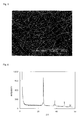
- the obtained titania fiber was subj ected to the foregoing various measurements and evaluations. As a result, it had an average fiber diameter of 460 nm and a BET specific surface area of 11.1 m 2 /g. Also, in the X-ray diffraction results of the obtained titania fiber, a sharp peak was found at 2 ⁇ of 25.4°, and therefore, it was confirmed that an anatase type crystal was formed.
- the crystallite size in the case of employing a transmission method by an imaging plate was 31 nm. Furthermore, the crystallite size in the case of employing a reflection method by a goniometer was 105 nm.
- a scanning electron microscopic photograph of the surface of the titania fiber is shown in Fig. 2 ; and an X-ray diffraction pattern in the case of employing a transmission method by an imaging plate is shown in Fig. 3 .
- a transparent titanium-containing solution was prepared in the same operations as in Example 1.
- the above-obtained titanium-containing solution was mixed with 0.2 parts by mass of a titanium oxide particle (manufactured by Wako Pure Chemical Industries, Ltd., crystal form: anatase type, BET specific surface area: 41 m 2 /g, crystallite size in the case of employing a reflection method by a goniometer: 36 nm, particle size: not more than 5 ⁇ m, average particle size: 0.5 ⁇ m, content (by purity analysis) : 99.9 %) to obtain a white solution.
- a titanium oxide particle manufactured by Wako Pure Chemical Industries, Ltd., crystal form: anatase type, BET specific surface area: 41 m 2 /g, crystallite size in the case of employing a reflection method by a goniometer: 36 nm, particle size: not more than 5 ⁇ m, average particle size: 0.5 ⁇ m, content (by purity analysis) : 99.9 %) to obtain a white solution.
- the obtained white solution was mixed with 0.016 parts by mass of polyethylene glycol (a first grade, manufactured by Wako Pure Chemical Industries, Ltd., average molecular weight: 300,000 to 500,000) to prepare a fiber forming composition (spinning solution).
- polyethylene glycol a first grade, manufactured by Wako Pure Chemical Industries, Ltd., average molecular weight: 300,000 to 500,000
- the above-obtained fiber forming composition (spinning solution) was spun into a fiber in the same manner as in Example 1, from which was subsequently prepared a fiber aggregate.
- the apparatus and condition for spinning were the same as in Example 1.
- the above-obtained fiber aggregate was subjected to baking in the same operations as in Example 1, thereby obtaining a fiber structure of a titania fiber.
- the obtained titania fiber was subjected to the foregoing various measurements and evaluations. As a result, it had an average fiber diameter of 340 nm and a BET specific surface area of 16.4 m 2 /g. Also, in the X-ray diffraction results of the obtained titania fiber, a sharp peak was found at 2 ⁇ of 25.4°, and therefore, it was confirmed that an anatase type crystal was formed. The crystallite size in the case of employing a reflection method by a goniometer was 65 nm. A scanning electron microscopic photograph of the surface of the titania fiber is shown in Fig. 4 .
- a transparent titanium-containing solution was prepared in the same operations as in Example 1.
- the above-obtained titanium-containing solution was mixed with 0.016 parts by mass of polyethylene glycol (a first grade, manufactured by Wako Pure Chemical Industries, Ltd., average molecular weight: 300,000 to 500,000) without adding a titanium oxide particle, thereby preparing a fiber forming composition (spinning solution).
- polyethylene glycol a first grade, manufactured by Wako Pure Chemical Industries, Ltd., average molecular weight: 300,000 to 500,000
- the above-obtained fiber forming composition (spinning solution) was spun into a fiber in the same manner as in Example 1, from which was subsequently prepared a fiber aggregate.
- the apparatus and condition for spinning were the same as in Example 1.
- the above-obtained fiber aggregate was subjected to baking in the same operations as in Example 1, thereby obtaining a fiber structure of a titania fiber.
- the obtained titania fiber was subjected to the foregoing various measurements and evaluations in the same manner as in Example 1. As a result, it had an average fiber diameter of 260 nm and a BET specific surface area of 0.4 m 2 /g. Also, in the X-ray diffraction results of the obtained titania fiber, a sharp peak was found at 2 ⁇ of 25.4°, and therefore, it was confirmed that an anatase type crystal was formed.
- the crystallite size in the case of employing a transmission method by an imaging plate was 49 nm. Furthermore, the crystallite size in the case of employing a reflection method by a goniometer was 169 nm.
- a scanning electron microscopic photograph of the surface of the titania fiber is shown in Fig. 5 ; and an X-ray diffraction pattern in the case of employing a transmission method by an imaging plate is shown in Fig. 6 .
- an absorbance at 665 nm as the photocatalyst was 0.325 A. Accordingly, since the titania fibers of Example 1 and Example 2 are smaller in the absorbance than the titania fiber of Comparative Example 1, it is exhibited that the fading reaction of Methylene Blue is more advanced, and it is understood that the photocatalytic activity is high.
Landscapes
- Engineering & Computer Science (AREA)
- Chemical & Material Sciences (AREA)
- Textile Engineering (AREA)
- Manufacturing & Machinery (AREA)
- Ceramic Engineering (AREA)
- Chemical Kinetics & Catalysis (AREA)
- Inorganic Chemistry (AREA)
- Materials Engineering (AREA)
- General Chemical & Material Sciences (AREA)
- Nanotechnology (AREA)
- Organic Chemistry (AREA)
- Structural Engineering (AREA)
- Mechanical Engineering (AREA)
- Crystallography & Structural Chemistry (AREA)
- General Physics & Mathematics (AREA)
- Condensed Matter Physics & Semiconductors (AREA)
- Composite Materials (AREA)
- Physics & Mathematics (AREA)
- Dispersion Chemistry (AREA)
- Inorganic Compounds Of Heavy Metals (AREA)
- Catalysts (AREA)
- Inorganic Fibers (AREA)
- Spinning Methods And Devices For Manufacturing Artificial Fibers (AREA)
- Nonwoven Fabrics (AREA)
Applications Claiming Priority (3)
| Application Number | Priority Date | Filing Date | Title |
|---|---|---|---|
| JP2006114776 | 2006-04-18 | ||
| JP2006197931 | 2006-07-20 | ||
| PCT/JP2007/058331 WO2007123114A1 (fr) | 2006-04-18 | 2007-04-17 | Fibre de dioxyde de titane et procédé servant à produire une fibre de dioxyde de titane |
Publications (2)
| Publication Number | Publication Date |
|---|---|
| EP2014812A1 true EP2014812A1 (fr) | 2009-01-14 |
| EP2014812A4 EP2014812A4 (fr) | 2010-09-01 |
Family
ID=38625014
Family Applications (1)
| Application Number | Title | Priority Date | Filing Date |
|---|---|---|---|
| EP07741767A Withdrawn EP2014812A4 (fr) | 2006-04-18 | 2007-04-17 | Fibre de dioxyde de titane et procédé servant à produire une fibre de dioxyde de titane |
Country Status (7)
| Country | Link |
|---|---|
| US (1) | US20090068466A1 (fr) |
| EP (1) | EP2014812A4 (fr) |
| JP (1) | JPWO2007123114A1 (fr) |
| KR (1) | KR20080111072A (fr) |
| CN (1) | CN101421454B (fr) |
| TW (1) | TW200745401A (fr) |
| WO (1) | WO2007123114A1 (fr) |
Families Citing this family (9)
| Publication number | Priority date | Publication date | Assignee | Title |
|---|---|---|---|---|
| CA2716144A1 (fr) | 2009-10-02 | 2011-04-02 | University Of Windsor | Pointe de dissection et introducteur pour instrument chirurgical |
| CN102527440B (zh) * | 2011-08-23 | 2014-06-11 | 安徽工程大学 | 一种纤维负载纳米二氧化钛紫外-可见光催化剂及其制备方法 |
| JP5822389B2 (ja) * | 2011-12-14 | 2015-11-24 | 花王株式会社 | ナノファイバ及びその製造方法 |
| TWI559561B (zh) * | 2011-12-28 | 2016-11-21 | 國立台北科技大學 | 陣列式靜電紡絲技術應用於染料敏化太陽能電池 |
| JP5946180B2 (ja) * | 2012-09-12 | 2016-07-05 | 花王株式会社 | ナノファイバの製造方法 |
| CN106929949B (zh) * | 2015-12-31 | 2019-05-03 | 山东德艾普节能材料有限公司 | 一步法合成聚醋酸氧钛前驱体、其溶胶纺丝液以及氧化钛晶体长纤维的制备方法 |
| JP6841638B2 (ja) * | 2016-11-24 | 2021-03-10 | 花王株式会社 | セラミックナノファイバの製造方法 |
| CN112010656B (zh) * | 2020-08-25 | 2021-10-08 | 华中科技大学 | 一种氧化铪纤维及其制备方法与在抗氧化涂层中的应用 |
| JP2024051672A (ja) * | 2022-09-30 | 2024-04-11 | Jnc株式会社 | 金属酸化物多孔質繊維 |
Family Cites Families (14)
| Publication number | Priority date | Publication date | Assignee | Title |
|---|---|---|---|---|
| JPH10325021A (ja) * | 1996-12-26 | 1998-12-08 | Sumitomo Chem Co Ltd | チタニア繊維およびその製造方法 |
| US6086844A (en) * | 1996-12-26 | 2000-07-11 | Sumitomo Chemical Company, Ltd. | Titania fiber, method for producing the fiber and method for using the fiber |
| JPH115036A (ja) * | 1997-04-25 | 1999-01-12 | Sumitomo Chem Co Ltd | 触媒成分担持チタニア繊維およびその製造方法 |
| JP2002113311A (ja) * | 2000-10-04 | 2002-04-16 | Mitsubishi Heavy Ind Ltd | 触媒バグフィルター、その製造方法、それに用いる不織布及び排ガスの処理方法 |
| TW591147B (en) * | 2001-07-23 | 2004-06-11 | Mitsubishi Kagaku Sanshi Corp | Alumina fiber aggregate and its production method |
| WO2003050331A1 (fr) * | 2001-12-13 | 2003-06-19 | Hag-Yong Kim | Fibre inorganique ultrafine et leur procede de preparation |
| JP2004298728A (ja) * | 2003-03-31 | 2004-10-28 | Sumitomo Chem Co Ltd | 触媒繊維およびその製造方法 |
| JP2005254173A (ja) * | 2004-03-12 | 2005-09-22 | Toho Titanium Co Ltd | チタニア繊維光触媒およびその製造方法 |
| CN1234928C (zh) * | 2004-06-11 | 2006-01-04 | 山东大学 | 二氧化钛纤维的制备方法 |
| JP3747260B1 (ja) * | 2005-03-07 | 2006-02-22 | 国立大学法人京都大学 | 酸化チタン系ナノ生成物およびその製造方法 |
| KR100988751B1 (ko) * | 2005-05-31 | 2010-10-20 | 데이진 가부시키가이샤 | 세라믹 섬유 및 그 제조 방법 |
| KR100666477B1 (ko) * | 2005-06-16 | 2007-01-11 | 한국과학기술연구원 | 산화티타늄 나노로드 및 그의 제조방법 |
| JP4854066B2 (ja) * | 2005-08-29 | 2012-01-11 | 兵庫県 | 静電噴霧法を用いるチタニア−シリカ複合繊維不織布の製造方法 |
| JP2007217826A (ja) * | 2006-02-16 | 2007-08-30 | Teijin Ltd | 綿状体および綿状体の製造方法 |
-
2007
- 2007-04-17 JP JP2008512115A patent/JPWO2007123114A1/ja not_active Ceased
- 2007-04-17 US US12/296,499 patent/US20090068466A1/en not_active Abandoned
- 2007-04-17 EP EP07741767A patent/EP2014812A4/fr not_active Withdrawn
- 2007-04-17 CN CN2007800137750A patent/CN101421454B/zh not_active Expired - Fee Related
- 2007-04-17 WO PCT/JP2007/058331 patent/WO2007123114A1/fr not_active Ceased
- 2007-04-17 KR KR1020087025385A patent/KR20080111072A/ko not_active Withdrawn
- 2007-04-18 TW TW096113639A patent/TW200745401A/zh unknown
Also Published As
| Publication number | Publication date |
|---|---|
| TW200745401A (en) | 2007-12-16 |
| CN101421454B (zh) | 2011-03-02 |
| CN101421454A (zh) | 2009-04-29 |
| EP2014812A4 (fr) | 2010-09-01 |
| US20090068466A1 (en) | 2009-03-12 |
| WO2007123114A1 (fr) | 2007-11-01 |
| JPWO2007123114A1 (ja) | 2009-09-03 |
| KR20080111072A (ko) | 2008-12-22 |
Similar Documents
| Publication | Publication Date | Title |
|---|---|---|
| EP2014812A1 (fr) | Fibre de dioxyde de titane et procédé servant à produire une fibre de dioxyde de titane | |
| JP4575444B2 (ja) | セラミック繊維及びその製造方法 | |
| CN101622195B (zh) | 金属氧化物纤维和纳米纤维、其制备方法和其用途 | |
| Dai et al. | Ceramic nanofibers fabricated by electrospinning and their applications in catalysis, environmental science, and energy technology | |
| CN100582330C (zh) | 无机类纤维、纤维结构体及其制造方法 | |
| US20100167078A1 (en) | Nano powder, nano ink and micro rod, and the fabrication methods thereof | |
| JP2018104878A (ja) | 金属およびセラミックのナノファイバー | |
| DE10040897A1 (de) | Herstellung von Polymerfasern mit nanoskaligen Morphologien | |
| Zagho et al. | Recent trends in electrospinning of polymer nanofibers and their applications as templates for metal oxide nanofibers preparation | |
| KR102078379B1 (ko) | 고전도성 밸브 금속산화물을 포함하는 나노섬유 복합체의 제조방법 및 이에 따라 제조된 나노섬유 복합체 | |
| KR20150028529A (ko) | Nb-TiO2 촉매 담체 및 전기방사법을 이용한 이것의 제조방법 | |
| EP2103722A1 (fr) | Fibre céramique et procédé de production de fibre céramique | |
| KR20120091792A (ko) | 금속 산화물 나노섬유 네트워크의 제조 방법 및 그에 의한 금속 산화물 나노섬유 네트워크를 포함하는 화학 센서 | |
| JP2008038314A (ja) | チタニア繊維およびチタニア繊維の製造方法 | |
| Choi et al. | Growth kinetics of nanograins in Co3O4 fibers | |
| KR100630864B1 (ko) | 이산화티탄을 함유하는 나노섬유의 제조 방법 및 그에의하여 제조된 나노섬유 | |
| Wang et al. | A review on the electrospun oxide nanofibers for anode electrodes in lithium-ion batteries | |
| US20230278931A1 (en) | Method for preparing particulate metal oxide materials | |
| KR102843796B1 (ko) | 이산화티탄 나노섬유 및 그 제조방법 | |
| KR20140042311A (ko) | 염료감응형 태양전지 전극용 고 다공성 이산화티타늄 나노섬유 및 그 제조방법 | |
| Bell et al. | Surface engineering of electrospun fibers to optimize ion and electron transport in Li% 2B battery cathodes. | |
| Zhi et al. | Nanofiber scaffold for solid oxide fuel cell cathode | |
| JP2007217826A (ja) | 綿状体および綿状体の製造方法 | |
| Dai | Calcium Phosphate Scaffolds from Electrospun PVA/inorganic Sol Precursors |
Legal Events
| Date | Code | Title | Description |
|---|---|---|---|
| PUAI | Public reference made under article 153(3) epc to a published international application that has entered the european phase |
Free format text: ORIGINAL CODE: 0009012 |
|
| 17P | Request for examination filed |
Effective date: 20081111 |
|
| AK | Designated contracting states |
Kind code of ref document: A1 Designated state(s): AT BE BG CH CY CZ DE DK EE ES FI FR GB GR HU IE IS IT LI LT LU LV MC MT NL PL PT RO SE SI SK TR |
|
| AX | Request for extension of the european patent |
Extension state: AL BA HR MK RS |
|
| A4 | Supplementary search report drawn up and despatched |
Effective date: 20100730 |
|
| DAX | Request for extension of the european patent (deleted) | ||
| STAA | Information on the status of an ep patent application or granted ep patent |
Free format text: STATUS: THE APPLICATION HAS BEEN WITHDRAWN |
|
| 18W | Application withdrawn |
Effective date: 20121025 |