EP2014990A1 - Hausgerätebedienvorrichtung - Google Patents
Hausgerätebedienvorrichtung Download PDFInfo
- Publication number
- EP2014990A1 EP2014990A1 EP08104516A EP08104516A EP2014990A1 EP 2014990 A1 EP2014990 A1 EP 2014990A1 EP 08104516 A EP08104516 A EP 08104516A EP 08104516 A EP08104516 A EP 08104516A EP 2014990 A1 EP2014990 A1 EP 2014990A1
- Authority
- EP
- European Patent Office
- Prior art keywords
- control panel
- operating device
- domestic appliance
- appliance operating
- control
- Prior art date
- Legal status (The legal status is an assumption and is not a legal conclusion. Google has not performed a legal analysis and makes no representation as to the accuracy of the status listed.)
- Granted
Links
Images


Classifications
-
- F—MECHANICAL ENGINEERING; LIGHTING; HEATING; WEAPONS; BLASTING
- F24—HEATING; RANGES; VENTILATING
- F24C—DOMESTIC STOVES OR RANGES ; DETAILS OF DOMESTIC STOVES OR RANGES, OF GENERAL APPLICATION
- F24C7/00—Stoves or ranges heated by electric energy
- F24C7/08—Arrangement or mounting of control or safety devices
- F24C7/082—Arrangement or mounting of control or safety devices on ranges, e.g. control panels, illumination
-
- A—HUMAN NECESSITIES
- A47—FURNITURE; DOMESTIC ARTICLES OR APPLIANCES; COFFEE MILLS; SPICE MILLS; SUCTION CLEANERS IN GENERAL
- A47L—DOMESTIC WASHING OR CLEANING; SUCTION CLEANERS IN GENERAL
- A47L15/00—Washing or rinsing machines for crockery or tableware
- A47L15/42—Details
- A47L15/4293—Arrangements for programme selection, e.g. control panels; Indication of the selected programme, programme progress or other parameters of the programme, e.g. by using display panels
-
- D—TEXTILES; PAPER
- D06—TREATMENT OF TEXTILES OR THE LIKE; LAUNDERING; FLEXIBLE MATERIALS NOT OTHERWISE PROVIDED FOR
- D06F—LAUNDERING, DRYING, IRONING, PRESSING OR FOLDING TEXTILE ARTICLES
- D06F34/00—Details of control systems for washing machines, washer-dryers or laundry dryers
- D06F34/28—Arrangements for program selection, e.g. control panels therefor; Arrangements for indicating program parameters, e.g. the selected program or its progress
Definitions
- the invention relates to a household appliance operating device according to the preamble of claim 1.
- the object of the invention is, in particular, to provide a generic device which is advantageously operable.
- the object is achieved by the features of the independent claims, while advantageous embodiments and modifications of the invention can be taken from the dependent claims.
- the invention is based on a domestic appliance operating device with a control panel and a control panel.
- control panel terminate in at least one area at least substantially with an upper and / or a lower outer edge of the control panel.
- a “control panel” is to be understood as a cover and / or in particular a front part of a domestic appliance in which a control panel is integrated with control elements and in particular has one or more recesses for control elements of a control panel.
- a “control element” can be formed by various elements that appear appropriate to a person skilled in the art, such as, in particular, a control knob or particularly advantageously an operator control key, etc.
- a “control panel” is to be understood as meaning, in particular, a field with associated control elements, the togetherness being understood can result from an operating logic and / or a spatial arrangement.
- a maximum distance between directly adjacent control elements is less than 5 cm and particularly advantageously less than 2 cm.
- an "outer edge” should also be understood to mean an edge limiting the control panel to the outside, in particular laterally next to it the control panel is arranged, and it is to be excluded an edge of a fully enclosed by the control panel recess.
- "essentially” in this context should be understood in particular to mean that the control panel has a distance to an upper and / or lower outer edge of less than 5% and advantageously less than 1% of a height of the control panel in this area and particularly advantageously none Distance has.
- the individual controls can be advantageously carried out large despite a clear overall structure, and in particular when the control panel has at least two successively arranged one above the other or in the direction of a vertical extent, substantially immediately adjoining controls.
- substantially immediately adjacent to one another is to be understood in particular that the operating elements in the direction of the vertical extent have a distance of less than 10 mm, advantageously less than 5 mm and particularly advantageously less than 2 mm.
- control panel in at least one area has a height less than 100 mm and advantageously less than 80 mm and particularly advantageously has a height between 70 mm and 50 mm.
- a "height" is to be understood as meaning, in particular, a front surface height formed by the control panel, which extends in particular in the vertical direction.
- the household appliance operating device has a one-piece user interface means, which forms at least part of a user interface of a first operating element and a second operating element.
- the user interface means may be formed by various means that appear appropriate to those skilled in the art, but particularly advantageous from a control film that can be simple, inexpensive and robust.
- the household appliance operating device has at least one control element arranged in the control panel with a symbol whose width extends at least over 80% of a control element width of the control element and / or its height at least over 80% of a control element height of the control element , whereby the clarity can be further improved and the operation can be further simplified, in particular if at least a large part of the controls has corresponding symbols.
- the domestic appliance operating device has a display arranged above the control panel, an operation can advantageously be supported by the display, and a concealment of the display by an operator even during an operation can be avoided.
- the display may have a length which is less than or equal to a length of the control panel or particularly advantageous, which is longer than a length of the control panel.
- control panel has at least two, preferably at least three and more preferably at least four control elements arranged one behind the other in a reading direction, which are to be actuated successively according to their arrangement in the reading direction in at least one operating logic.
- a "reading direction” is thereby to be understood in a basic operating position, as understood in particular in a position with a viewing direction substantially perpendicular to a front side from the front, from left to right.
- an "operating logic” is to be understood as meaning, in particular, a sensible and, in particular, recommended sequence of an actuation of operating elements.
- main switch preferably one end of the control panel is formed by a main switch, preferably a left end viewed in a basic operating position.
- a “main switch” should be understood in particular a switch for switching on and / or off.
- the operation can be simplified if the domestic appliance operating device has at least one signal means, which leads to an acknowledgment of an actuation of a control element is provided, and particularly preferably when the signal means is arranged in a surface region of an associated control element.
- the signal means has a slot-shaped configuration and / or if the signal means forms at least part of a frame of a control element, this can be positioned particularly advantageously in a space-saving and easily visible manner.
- a slot-shaped configuration should be understood in particular to mean that the signal means has a width at least three times and preferably at least five times greater than the width.
- a "frame” should be understood to mean, in particular, that the signal means limits the operating element laterally, and particularly preferably over at least 30% of its projected circumference. If the signal means forms a guide of a control element, additional components, installation space, installation effort and costs can be saved.
- the signal means is at least partially formed integrally with a sensor means, whereby further additional components, space, assembly costs and costs can be saved.
- a "side frame” should be understood to mean, in particular, a frame that laterally delimits the appliance door in a horizontal direction parallel to a front side.
- main program operating elements in cooking device operating devices is understood to mean heating element operating elements for selecting different heating elements, such as top heat, bottom heat, circulating air, grill and combinations thereof, in particular dishwashing program operating elements for selecting different washing programs and washing machine operating devices for selecting different washing programs.
- Fig. 1 shows a front view of a cooking appliance shown schematically with a cooking appliance operating device.
- the cooking appliance operating device comprises an H-shaped control panel 10a made of stainless steel with a transverse leg 50a with an integrated control panel 14a and two vertically extending legs 52a, 54a, which form a side frame of a household appliance door 48a of the cooking appliance or limit the appliance door 48a laterally.
- the transverse leg 50a of the control panel 10a has a height 12a of about 60 mm.
- the control panel 14a has the same height as the transverse leg 50a and closes over its entire length with a lower outer edge 16a and an upper outer edge 18a of the transverse leg 50a, whereby controls 20a - 28a are particularly large and easily optically and tactile detectable by an operator can be.
- the control panel 14a has the horizontal direction in a reading direction 44a from left to right successively arranged controls 20a - 28a, which are to operate according to the arrangement from left to right in a recommended operating logic sequentially.
- a left end of the control panel 14a is formed by the operating element 20a designed as an operating button, which extends over the entire height 12a of the control panel 10a and forms a main switch for switching the cooking appliance on and off.
- the operating element 20a is followed directly in the reading direction 44a by a functional block with the four operating elements 22a in the form of operating keys, which are arranged directly adjacent to one another in two rows and which are arranged next to one another immediately adjacent to one another in two rows.
- the operating elements 22a of the functional block form main program operating elements which are intended to select different types of heating, in the present case the type of heating combined with lower heat and upper heat, combined circulating air, grill and grill with circulating air.
- the operating block is followed by the operating element 24a formed by a rotary knob, which is provided in particular for setting a temperature.
- the operating element 24a is followed, in the reading direction 44a, by an operating block with the four operating elements 26a designed as operating keys, by means of which an alarm time or a time can be set up to an alarm, a time, an oven duration and an end time.
- the operating elements 26a are arranged adjacent to one another and directly adjacent to one another in two rows corresponding to the operating elements 22a in two rows.
- the operator control element 26a is adjoined by the operating element 28a in the reading direction 44a, which is intended to start a selected process and which extends in accordance with the operating element 20a over the entire height 12a of the control panel 10a.
- the operating element 28a forms the right end of the control panel 14a.
- the cooking appliance is first switched on at the control element 20a, then a corresponding type of heating is selected via the control elements 22a of the function block. Subsequently, a corresponding temperature is set on the operating element 24a, a baking time is set by means of the operating elements 26a of the operating block, and then the selected process is started by means of the operating element 28a.
- a strip-shaped display 42a is arranged, which has the same length as the transverse leg 50a and laterally extends beyond the control panel 14a due to its greater length relative to the control panel 14a.
- the display 42a is particularly intended to display selected types of heating by means of a text and by means of a symbol.
- the cooking appliance operating device comprises signaling means 46a, which are provided for acknowledging an actuation of the operating elements 20a, 22a, 26a, 28a ( FIG. 2 ).
- Each signal means 46a is arranged in a surface area of an associated control element 20a-28a.
- the signal means 46a are slit-shaped and integrally formed with sensor means, in that they are intended to transmit a sensor radiation, namely by being made permeable to sensor beams formed by infrared radiation. In the operated controls 20a, 22a, 26a, 28a visible light is emitted via the signal means 46a to the outside.
- the operating elements 20a, 22a, 26a, 28a each have symbols 32a, 34a, 38a, 40a which each extend over approximately 90% of a control element width 70a.
- the signal means 46a is arranged within the symbol 32a, while in the operating elements 22a, 26a, 28a the signal means 46a are respectively arranged in the area of the operating elements 22a, 26a, 28a immediately below the symbols 34a, 38a, 40a.
- FIGS. 2 to 7 Alternative embodiments are shown. Substantially identical components, features and functions are basically numbered by the same reference numerals. To distinguish the embodiments, however, the reference numerals of the embodiments, the letters a to e are added. The following description is essentially limited to the differences from the embodiment in FIG. 1 , wherein with respect to the same components, features and functions on the description of the embodiment in FIG. 1 can be referenced.
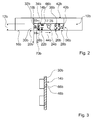
- FIG. 2 an alternative cooking appliance operating device is shown with a U-shaped control panel 10b.
- a control panel 14b is integrated, which has the same length as the transverse leg 56b.
- the transverse leg 56b of the control panel 10b has approximately a height 12b of 60 mm.
- a display 42b Above of the control panel 14b is arranged a display 42b, which has the same length as the transverse leg 56b or as the control panel 14b.
- the control panel 14b has a one-piece control surface means 30b which, except for a control element 24b formed by a rotary knob, forms a control surface 66b for all control elements 20b, 22b, 26b, 28b, on which symbols 32b, 34b, 38b, 40b are arranged.
- the user interface means 30b is formed by a control film ( FIG. 3 ).
- a control element width 70b is thereby formed by a respective symbol width and a control element height of a respective symbol height itself.
- the visible surface means 30b has transparent, slit-shaped portions for visible light and for a sensor beam, namely for infrared rays, which form signaling means 46b for acknowledging an actuation of the operating elements 20b, 22b, 26b, 28b, in surface areas of the respective operating elements 20b, 22b. 26b, 28b are arranged and formed integrally with sensor means of the cooking appliance operating device.
- the user interface means could alternatively and / or additionally be formed by a touch-sensitive means and / or also by a control panel itself.
- control elements 20b, 22b and the control elements 26b, 28b connect directly, seamlessly to each other, whereby an advantageous clarity and an advantageous cleaning option can be achieved.
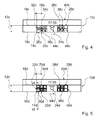
- FIG. 4 an alternative cooking appliance operating device is shown with a strip-shaped control panel 10c.
- a display 42c arranged above the control panel 10c has the same length as the control panel 10c.
- FIG. 5 an alternative Garellabedienvorraum is shown with a strip-shaped control panel 10d and a display 42d, which except for specially trained signal means 46d substantially the cooking appliance operating device FIG. 4 equivalent.
- the signal means 46d provided for acknowledging an actuation of operating elements 20d, 22d, 26d, 28d respectively form a frame and a guide for the operating elements 20d, 22d, 26d, 28d of the cooking appliance operating device ( FIG. 6 ).
- the signal means 46b extend laterally under the control panel 10d and in the present embodiment in particular an L-shaped frame profile.
- the Signaling means 46d are light-emitting means 58d, namely light-emitting diodes, arranged.
- the signal means 46d are designed as light guides, so that light emitted by the light sources 58d can be forwarded within the signal means 46d by a deflection angle 60d, in the present case by a deflection angle of 90 °.
- the operating elements 20d, 22d, 26d, 28d comprise lifting keys 68d, which have the same material on their front side as the operating panel 10d, namely, the lifting keys 68d are provided on their front side with a material layer 64d.
- the material layer 64d and the control panel 10d are made of stainless steel.
- FIG. 7 a cooking appliance with an alternative cooking appliance operating device is shown, which has a U-shaped control panel 10e and a substantially U-shaped control panel 14e.
- the control panel 10e has a total height 12e of about 60 mm and in the region of its transverse leg 56e a height 12e 'of about 30 mm. Above the transverse leg 56e, a display 42e is arranged.
- the control panel 14e has control elements 26e, 24e arranged directly next to one another on the left and right next to the display 42e, and control elements 26e arranged side by side in a row next to one another as control buttons underneath the display 42e.
- the operating elements 24e for setting a temperature are also embodied as operating keys with symbols 36e, and a functional block has, in comparison with the exemplary embodiments in FIGS FIGS. 1 to 6 six main program controls forming controls 22e, which are intended to select types of heating, in the present case, the types of heating bottom heat combined with top heat, thawing, convection, grill and grill combined with circulating air and self-cleaning.
- the operating elements 20e, 26e, 28e terminate in each case with an upper and with a lower outer edge 16e, 18e, 18e 'of the operating panel 10e, while the operating elements 22e, 24e, 26e' respectively with the upper or the lower outer edge 16e, 18e of the control panel Complete 10e.
Landscapes
- Engineering & Computer Science (AREA)
- Chemical & Material Sciences (AREA)
- Combustion & Propulsion (AREA)
- Mechanical Engineering (AREA)
- General Engineering & Computer Science (AREA)
- Push-Button Switches (AREA)
- Electric Stoves And Ranges (AREA)
- Cookers (AREA)
Abstract
Description
- Die Erfindung geht aus von einer Hausgerätebedienvorrichtung nach dem Oberbegriff des Anspruchs 1.
- Es sind bereits Hausgerätebedienvorrichtungen mit einer Bedienblende und einem Bedienfeld bekannt, wobei das Bedienfeld in von der Bedienblende vollständig umschlossene Ausnehmungen der Bedienblende angeordnet ist.
- Die Aufgabe der Erfindung besteht insbesondere darin, eine gattungsgemäße Vorrichtung bereitzustellen, die vorteilhaft bedienbar ist. Die Aufgabe wird erfindungsgemäß durch die Merkmale der unabhängigen Patentansprüche gelöst, während vorteilhafte Ausgestaltungen und Weiterbildungen der Erfindung den Unteransprüchen entnommen werden können.
- Die Erfindung geht aus von einer Hausgerätebedienvorrichtung mit einer Bedienblende und einem Bedienfeld.
- Es wird vorgeschlagen, dass das Bedienfeld in zumindest einem Bereich zumindest im Wesentlichen mit einem oberen und/oder einem unteren Außenrand der Bedienblende abschließt. Unter einer "Bedienblende" soll dabei ein Deck- und/oder insbesondere ein Frontteil eines Hausgeräts verstanden werden, in dem ein Bedienfeld mit Bedienelementen integriert ist und das insbesondere eine oder mehrere Ausnehmungen für Bedienelemente eines Bedienfelds aufweist. Ein "Bedienelement" kann dabei von verschiedenen, dem Fachmann als sinnvoll erscheinenden Elementen gebildet sein, wie insbesondere von einem Bedienknebel oder besonders vorteilhaft von einer Bedientaste usw. Unter einem "Bedienfeld" soll insbesondere ein Feld mit zusammengehörigen Bedienelementen verstanden werden, wobei sich die Zusammengehörigkeit durch eine Bedienlogik und/oder einer räumlichen Anordnung ergeben kann. Insbesondere ist dabei ein maximaler Abstand zwischen unmittelbar benachbarten Bedienelementen kleiner als 5 cm und besonders vorteilhaft kleiner als 2 cm. Unter einem "Außenrand" soll dabei ferner ein die Bedienblende nach außen begrenzender Rand verstanden, der insbesondere seitlich neben dem Bedienfeld angeordnet ist, und es soll ein Rand einer von der Bedienblende vollständig umschlossenen Ausnehmung ausgeschlossen werden. Ferner soll unter "im Wesentlichen" in diesem Zusammenhang insbesondere verstanden werden, dass das Bedienfeld einen Abstand zu einem oberen und/oder einem unteren Außenrand von kleiner als 5% und vorteilhaft kleiner als 1 % einer Höhe des Bedienfelds in diesem Bereich und besonders vorteilhaft keinen Abstand aufweist.
- Durch eine entsprechende Ausgestaltung können die einzelnen Bedienelemente trotz einer übersichtlichen Gesamtstruktur vorteilhaft groß ausgeführt werden, und zwar insbesondere, wenn das Bedienfeld zumindest zwei übereinander bzw. in Richtung einer Höhenerstreckung nacheinander angeordnete, im Wesentlichen unmittelbar aneinander anschließende Bedienelemente aufweist. Unter "im Wesentlichen unmittelbar aneinander anschließend" soll dabei insbesondere verstanden werden, dass die Bedienelemente in Richtung der Höhenerstreckung einen Abstand kleiner als 10 mm, vorteilhaft kleiner als 5 mm und besonders vorteilhaft kleiner als 2 mm aufweisen.
- In einer weiteren Ausgestaltung der Erfindung wird vorgeschlagen, dass die Bedienblende in zumindest einem Bereich eine Höhe kleiner als 100 mm und vorteilhaft kleiner als 80 mm aufweist und besonders vorteilhaft eine Höhe zwischen 70 mm und 50 mm aufweist. Unter einer "Höhe" soll in diesem Zusammenhang insbesondere eine von der Bedienblende gebildete Frontflächenhöhe verstanden werden, die insbesondere in vertikaler Richtung verläuft.
- Durch eine entsprechende Ausgestaltung kann eine besonders übersichtliche und damit besonders vorteilhaft bedienbare Hausgerätebedienvorrichtung erreicht werden.
- Ferner wird vorgeschlagen, dass die Hausgerätebedienvorrichtung ein einstückiges Bedienoberflächenmittel aufweist, das zumindest einen Teil einer Bedienoberfläche eines ersten Bedienelements und eines zweiten Bedienelements bildet. Durch eine entsprechende Ausgestaltung kann vorteilhaft eine zumindest im Wesentlichen fugenlose Struktur erzielt und in einem passiven Zustand kann vorteilhaft erreicht werden, dass auf den Bedienelementen aufgebrachte Symbole besonders vorteilhaft erkannt und ein störendes Bedienelementenprofil bzw. Tastenprofil vermieden wird.
- Das Bedienoberflächenmittel kann dabei von verschiedenen, dem Fachmann als sinnvoll erscheinenden Mitteln gebildet sein, jedoch besonders vorteilhaft von einer Bedienfolie, die einfach, kostengünstig und robust ausgeführt werden kann.
- In einer weiteren Ausgestaltung der Erfindung wird vorgeschlagen, dass die Hausgerätebedienvorrichtung wenigstens ein in dem Bedienfeld angeordnetes Bedienelement mit einem Symbol aufweist, dessen Breite sich zumindest über 80% einer Bedienelementenbreite des Bedienelements und/oder dessen Höhe sich zumindest über 80% einer Bedienelementenhöhe des Bedienelements erstreckt, wodurch die Übersichtlichkeit weiter verbessert und die Bedienung weiter vereinfacht werden kann, und zwar insbesondere, wenn zumindest ein Großteil der Bedienelemente entsprechende Symbole aufweist.
- Weist die Hausgerätebedienvorrichtung ein oberhalb des Bedienfelds angeordnetes Display auf, kann eine Bedienung vorteilhaft durch das Display unterstützt und ein Verdecken des Displays durch einen Bediener selbst bei einer Bedienung kann vermieden werden. Das Display kann dabei eine Länge aufweisen, die kleiner oder gleich einer Länge des Bedienfelds ist oder besonders vorteilhaft, die länger als eine Länge des Bedienfelds ist.
- Ferner wird vorgeschlagen, dass das Bedienfeld zumindest zwei, vorzugsweise zumindest drei und besonders bevorzugt zumindest vier in einer Leserichtung hintereinander angeordnete Bedienelemente aufweist, die entsprechend ihrer Anordnung in Leserichtung bei wenigstens einer Bedienlogik nacheinander zu betätigen sind. Unter einer "Leserichtung" soll dabei in einer grundlegenden Bedienstellung betrachtet, wie insbesondere in einer Stellung mit einer Blickrichtung im Wesentlichen senkrecht auf eine Frontseite von vorne, von links nach rechts, verstanden werden. Ferner soll unter einer "Bedienlogik" insbesondere eine sinnvolle und insbesondere empfohlene Abfolge einer Betätigung von Bedienelementen verstanden werden. Durch eine entsprechende Anordnung kann eine vorteilhaft selbsterklärende Bedienung erreicht werden. Dabei wird vorzugsweise ein Ende des Bedienfelds von einem Hauptschalter gebildet, und zwar vorzugsweise ein in einer grundlegenden Bedienstellung betrachtet linkes Ende. Unter einem "Hauptschalter" soll dabei insbesondere ein Schalter zum Ein- und/oder Ausschalten verstanden werden.
- Ferner kann die Bedienung vereinfacht werden, wenn die Hausgerätebedienvorrichtung wenigstens ein Signalmittel aufweist, das zu einer Quittierung einer Betätigung eines Bedienelements vorgesehen ist, und zwar besonders vorzugsweise, wenn das Signalmittel in einem Flächenbereich eines ihm zugeordneten Bedienelements angeordnet ist.
- Weist das Signalmittel eine schlitzförmige Ausgestaltung auf und/oder bildet das Signalmittel zumindest einen Teil eines Rahmens eines Bedienelements, kann dieses besonders vorteilhaft Platz sparend und gut sichtbar positioniert werden. Unter einer "schlitzförmigen Ausgestaltung" soll in diesem Zusammenhang insbesondere verstanden werden, dass das Signalmittel eine mindestens dreimal und vorzugsweise mindestens fünfmal größere Länge als Breite aufweist. Unter einem "Rahmen" soll in diesem Zusammenhang insbesondere verstanden werden, dass das Signalmittel das Bedienelement seitlich begrenzt, und zwar besonders vorzugsweise über mindestens 30% seines projizierten Umfangs. Bildet das Signalmittel eine Führung eines Bedienelements, können zusätzliche Bauteile, Bauraum, Montageaufwand und Kosten eingespart werden.
- In einer weiteren Ausgestaltung wird vorgeschlagen, dass das Signalmittel zumindest teilweise einstückig mit einem Sensormittel ausgebildet ist, wodurch ferner zusätzliche Bauteile, Bauraum, Montageaufwand und Kosten eingespart werden können.
- Ferner können zusätzliche Bauteile, Montageaufwand und Kosten eingespart und ein übersichtliches Design erreicht werden, wenn die Bedienblende zumindest einen Teil eines Seitenrahmens einer Hausgerätetür bildet. Dabei soll unter einem "Seitenrahmen" insbesondere ein Rahmen verstanden werden, der die Hausgerätetür in einer horizontalen Richtung betrachtet parallel zu einer Frontseite seitlich begrenzt.
- Weist die Hausgerätebedienvorrichtung maximal sechs und vorzugsweise maximal vier Hauptprogrammbedienelemente auf, kann die Übersichtlichkeit weiter gesteigert und die Bedienung weiter vereinfacht werden. Dabei sollen unter "Hauptprogrammbedienelementen" bei Gargerätebedienvorrichtungen insbesondere Heizartenbedienelemente zum Auswählen verschiedener Heizelemente verstanden werden, wie Oberhitze, Unterhitze, Umluft, Grill und Kombinationen davon, bei Spülerbedienvorrichtungen insbesondere Spülprogrammbedienelemente zum Auswählen von verschiedenen Spülprogrammen und bei Waschmaschinenbedienvorrichtungen insbesondere Waschprogrammbedienelemente zum Auswählen von verschiedenen Waschprogrammen.
- Weitere Vorteile ergeben sich aus der folgenden Zeichnungsbeschreibung. In der Zeichnung sind Ausführungsbeispiele der Erfindung dargestellt. Die Zeichnung, die Beschreibung und die Ansprüche enthalten zahlreiche Merkmale in Kombination. Der Fachmann wird die Merkmale zweckmäßigerweise auch einzeln betrachten und zu sinnvollen weiteren Kombinationen zusammenfassen.
- Es zeigen:
- Fig. 1
- eine Frontansicht eines schematisch dargestellten Gargeräts mit einer Gargerätebedienvorrichtung, die eine H-förmige Bedienblende aufweist,
- Fig. 2
- eine alternative Gargerätebedienvorrichtung mit einer U-förmigen Bedienblende,
- Fig. 3
- einen schematisch dargestellten Schnitt entlang der Linie III-III in
Figur 2 , - Fig. 4
- eine alternative Gargerätebedienvorrichtung mit einer leistenförmigen Bedienblende,
- Fig. 5
- eine alternative Gargerätebedienvorrichtung mit rahmenförmigen Signalmitteln,
- Fig. 6
- einen schematisch dargestellten Schnitt entlang der Linie VI-VI in
Figur 6 und - Fig. 7
- eine Frontansicht eines alternativen Gargeräts mit einer Gargerätebedienvorrichtung, die ein U-förmiges Bedienfeld aufweist.
-
Fig. 1 zeigt eine Frontansicht eines schematisch dargestellten Gargeräts mit einer Gargerätebedienvorrichtung. Die Gargerätebedienvorrichtung umfasst eine H-förmige Bedienblende 10a aus Edelstahl mit einem Querschenkel 50a mit einem darin integrierten Bedienfeld 14a und zwei vertikal verlaufenden Schenkeln 52a, 54a, die einen Seitenrahmen einer Hausgerätetür 48a des Gargeräts bilden bzw. die Hausgerätetür 48a seitlich begrenzen. Der Querschenkel 50a der Bedienblende 10a weist eine Höhe 12a von ca. 60 mm auf. Das Bedienfeld 14a weist die gleiche Höhe auf wie der Querschenkel 50a und schließt über seine gesamte Länge mit einem unteren Außenrand 16a und einem oberen Außenrand 18a des Querschenkels 50a ab, wodurch Bedienelemente 20a - 28a besonders groß und von einem Bediener leicht optisch und taktil erfassbar ausgeführt werden können. - Das Bedienfeld 14a weist die in horizontaler Richtung in einer Leserichtung 44a von links nach rechts hintereinander angeordneten Bedienelemente 20a - 28a auf, die entsprechend der Anordnung von links nach rechts bei einer empfohlenen Bedienlogik nacheinander zu betätigen sind. Ein linkes Ende des Bedienfelds 14a wird von dem als Bedientaste ausgebildeten Bedienelement 20a gebildet, das sich über die gesamte Höhe 12a der Bedienblende 10a erstreckt und einen Hauptschalter zum Ein- und Ausschalten des Gargeräts bildet. An das Bedienelement 20a schließt sich in Leserichtung 44a unmittelbar ein Funktionsblock mit den als Bedientasten ausgebildeten vier Bedienelementen 22a an, die in zwei Reihen übereinander unmittelbar aneinander anschließend und die in zwei Reihen nebeneinander unmittelbar aneinander anschließend angeordnet sind. Die Bedienelemente 22a des Funktionsblocks bilden Hauptprogrammbedienelemente, die dazu vorgesehen sind, verschiedene Heizarten auszuwählen, und zwar im vorliegenden Fall die Heizart Unterhitze mit Oberhitze kombiniert, Umluft, Grill und Grill mit Umluft kombiniert.
- In Leserichtung 44a schließt sich an den Funktionsblock das von einem Drehknebel gebildete Bedienelement 24a an, das insbesondere zu einer Einstellung einer Temperatur vorgesehen ist. An das Bedienelement 24a schließt sich in Leserichtung 44a ein Bedienblock mit den als Bedientasten ausgebildeten vier Bedienelementen 26a an, mittels derer eine Weckzeit bzw. eine Zeit bis zu einem Alarm, eine Uhrzeit, eine Backofen-Dauer und eine Endzeit eingestellt werden kann. Die Bedienelemente 26a sind entsprechend den Bedienelementen 22a in zwei Reihen nebeneinander und in zwei Reihen übereinander unmittelbar aneinander anschließend angeordnet.
- An den Bedienblock mit den Bedienelementen 26a schließt sich in Leserichtung 44a das Bedienelement 28a an, das dazu vorgesehen ist, einen ausgewählten Vorgang zu starten und das sich entsprechend dem Bedienelement 20a über die gesamte Höhe 12a der Bedienblende 10a erstreckt. Das Bedienelement 28a bildet das rechte Ende des Bedienfelds 14a.
- Bei der empfohlenen Bedienlogik wird zuerst das Gargerät am Bedienelement 20a eingeschaltet, anschließend wird über die Bedienelemente 22a des Funktionsblocks eine entsprechende Heizart ausgewählt. Darauf folgend wird an dem Bedienelement 24a eine entsprechende Temperatur eingestellt, mittels der Bedienelemente 26a des Bedienblocks wird eine Backzeit eingestellt und mittels des Bedienelements 28a wird anschließend der ausgewählte Vorgang gestartet.
- Oberhalb des Bedienfelds 14a bzw. oberhalb des Querschenkels 50a ist ein leistenförmiges Display 42a angeordnet, das die gleiche Länge aufweist wie der Querschenkel 50a und sich seitlich aufgrund seiner größeren Länge gegenüber dem Bedienfeld 14a über das Bedienfeld 14a hinaus erstreckt. Das Display 42a ist insbesondere dazu vorgesehen, ausgewählte Heizarten mittels eines Textes und mittels eines Symbols anzuzeigen.
- Die Gargerätebedienvorrichtung umfasst Signalmittel 46a, die zu einer Quittierung einer Betätigung der Bedienelemente 20a, 22a, 26a, 28a vorgesehen sind (
Figur 2 ). Jedes Signalmittel 46a ist in einem Flächenbereich eines ihm zugeordneten Bedienelements 20a - 28a angeordnet. Die Signalmittel 46a sind schlitzförmig und einstückig mit Sensormitteln ausgebildet, indem diese dazu vorgesehen sind, eine Sensorstrahlung zu übertragen, und zwar indem diese für von Infrarotstrahlung gebildete Sensorstrahlen durchlässig ausgebildet sind. Bei den betätigten Bedienelementen 20a, 22a, 26a, 28a wird sichtbares Licht über die Signalmittel 46a nach außen abgestrahlt. - Die Bedienelemente 20a, 22a, 26a, 28a weisen jeweils Symbole 32a, 34a, 38a, 40a auf, die sich jeweils über ca. 90% einer Bedienelementenbreite 70a erstrecken. Bei dem Bedienelement 20a ist das Signalmittel 46a innerhalb des Symbols 32a angeordnet, während bei den Bedienelementen 22a, 26a, 28a die Signalmittel 46a jeweils im Flächenbereich der Bedienelemente 22a, 26a, 28a, unmittelbar unterhalb der Symbole 34a, 38a, 40a angeordnet sind.
- In den
Figuren 2 bis 7 sind alternative Ausführungsbeispiele dargestellt. Im Wesentlichen gleich bleibende Bauteile, Merkmale und Funktionen sind grundsätzlich mit den gleichen Bezugszeichen beziffert. Zur Unterscheidung der Ausführungsbeispiele sind jedoch den Bezugszeichen der Ausführungsbeispiele die Buchstaben a bis e hinzugefügt. Die nachfolgende Beschreibung beschränkt sich im Wesentlichen auf die Unterschiede zu dem Ausführungsbeispiel inFigur 1 , wobei bezüglich gleich bleibender Bauteile, Merkmale und Funktionen auf die Beschreibung des Ausführungsbeispiels inFigur 1 verwiesen werden kann. - In
Figur 2 ist eine alternative Gargerätebedienvorrichtung mit einer U-förmigen Bedienblende 10b dargestellt. In einem unteren Querschenkel 56b der Bedienblende 10b ist ein Bedienfeld 14b integriert, das dieselbe Länge aufweist wie der Querschenkel 56b. Der Querschenkel 56b der Bedienblende 10b weist ca. eine Höhe 12b von 60 mm auf. Oberhalb des Bedienfelds 14b ist ein Display 42b angeordnet, das die gleiche Länge aufweist wie der Querschenkel 56b bzw. wie das Bedienfeld 14b. - Das Bedienfeld 14b weist ein einstückiges Bedienoberflächenmittel 30b auf, das bis auf ein von einem Drehknebel gebildetes Bedienelement 24b für sämtliche Bedienelemente 20b, 22b, 26b, 28b eine Bedienoberfläche 66b bildet, auf der Symbole 32b, 34b, 38b, 40b angeordnet sind. Das Bedienoberflächenmittel 30b wird von einer Bedienfolie gebildet (
Figur 3 ). Eine Bedienelementenbreite 70b wird dabei von einer jeweiligen Symbolbreite und eine Bedienelementenhöhe von einer jeweiligen Symbolhöhe selbst gebildet. - Das Bedienoberflächenmittel 30b weist für sichtbares Licht und für einen Sensorstrahl, und zwar für Infrarotstrahlen, transparente, schlitzförmige Teilbereiche auf, die Signalmittel 46b zur Quittierung einer Betätigung der Bedienelemente 20b, 22b, 26b, 28b bilden, in Flächenbereichen der jeweiligen Bedienelemente 20b, 22b, 26b, 28b angeordnet sind und einstückig mit Sensormitteln der Gargerätebedienvorrichtung ausgebildet sind. Das Bedienoberflächenmittel könnte alternativ und/oder zusätzlich von einem berührempfindlichen Mittel gebildet sein und/oder auch von einer Bedienblende selbst.
- Die Bedienelemente 20b, 22b und die Bedienelemente 26b, 28b schließen unmittelbar, fugenlos aneinander an, wodurch eine vorteilhafte Übersichtlichkeit und eine vorteilhafte Reinigungsmöglichkeit erreicht werden.
- In
Figur 4 ist eine alternative Gargerätebedienvorrichtung mit einer leistenförmigen Bedienblende 10c dargestellt. Ein oberhalb der Bedienblende 10c angeordnetes Display 42c weist dieselbe Länge auf wie die Bedienblende 10c. - In
Figur 5 ist eine alternative Gargerätebedienvorrichtung mit einer leistenförmigen Bedienblende 10d und einem Display 42d dargestellt, die bis auf speziell ausgebildete Signalmittel 46d im Wesentlichen der Gargerätebedienvorrichtung ausFigur 4 entspricht. Die zu einer Quittierung einer Betätigung von Bedienelementen 20d, 22d, 26d, 28d vorgesehenen Signalmittel 46d bilden jeweils einen Rahmen und eine Führung für die Bedienelemente 20d, 22d, 26d, 28d der Gargerätebedienvorrichtung (Figur 6 ). Die Signalmittel 46b erstrecken sich seitlich unter die Bedienblende 10d und weisen im vorliegenden Ausführungsbeispiel im Besonderen ein L-förmiges Rahmenprofil auf. Seitlich neben Ausnehmungen 62d in der Bedienblende 10d für die Bedienelemente 20d, 22d, 26d, 28d und die Signalmittel 46d sind Leuchtmittel 58d, und zwar Leuchtdioden, angeordnet. Die Signalmittel 46d sind als Lichtleiter ausgebildet, so dass von den Leuchtmitteln 58d abgestrahltes Licht innerhalb der Signalmittel 46d um einen Umlenkwinkel 60d weitergeleitet werden kann, und zwar im vorliegenden Fall um einen Umlenkwinkel von 90°. - Die Bedienelemente 20d, 22d, 26d, 28d umfassen Hubtasten 68d, die an ihrer Frontseite dasselbe Material aufweisen wie die Bedienblende 10d, und zwar sind die Hubtasten 68d an ihrer Frontseite mit einer Materialschicht 64d versehen. Im vorliegenden Ausführungsbeispiel sind die Materialschicht 64d und die Bedienblende 10d aus Edelstahl.
- In
Figur 7 ist ein Gargerät mit einer alternativen Gargerätebedienvorrichtung dargestellt, die eine U-förmige Bedienblende 10e und ein im Wesentliches U-förmiges Bedienfeld 14e aufweist. Die Bedienblende 10e weist eine Gesamthöhe 12e von ca. 60 mm und im Bereich ihres Querschenkels 56e eine Höhe 12e' von ca. 30 mm auf. Oberhalb des Querschenkels 56e ist ein Display 42e angeordnet. - Das Bedienfeld 14e weist jeweils links und rechts neben dem Display 42e in zwei Reihen übereinander, unmittelbar aneinander anschließend angeordnete Bedienelemente 22e, 24e und unter dem Display 42e in einer Reihe nebeneinander angeordnete als Bedientasten ausgebildete Bedienelemente 26e auf. Dabei sind auch die Bedienelemente 24e zum Einstellen einer Temperatur als Bedientasten mit Symbolen 36e ausgebildet, und ein Funktionsblock weist gegenüber den Ausführungsbeispielen in den
Figuren 1 bis 6 sechs Hauptprogrammbedienelemente bildende Bedienelemente 22e auf, die dazu vorgesehen sind, Heizarten auszuwählen, und zwar im vorliegenden Fall die Heizarten Unterhitze mit Oberhitze kombiniert, Auftauen, Umluft, Grill und Grill mit Umluft kombiniert und Selbstreinigung. - Die Bedienelemente 20e, 26e, 28e schließen jeweils mit einem oberen und mit einem unteren Außenrand 16e, 18e, 18e' der Bedienblende 10e ab, während die Bedienelemente 22e, 24e, 26e' jeweils mit dem oberen oder dem unteren Außenrand 16e, 18e der Bedienblende 10e abschließen.
-
- 10
- Bedienblende
- 12
- Höhe
- 14
- Bedienfeld
- 16
- Außenrand
- 18
- Außenrand
- 20
- Bedienelement
- 22
- Bedienelement
- 24
- Bedienelement
- 26
- Bedienelement
- 28
- Bedienelement
- 30
- Bedienoberflächenmittel
- 32
- Symbol
- 34
- Symbol
- 36
- Symbol
- 38
- Symbol
- 40
- Symbol
- 42
- Display
- 44
- Leserichtung
- 46
- Signalmittel
- 48
- Hausgerätetür
- 50
- Querschenkel
- 52
- Schenkel
- 54
- Schenkel
- 56
- Querschenkel
- 58
- Leuchtmittel
- 60
- Umlenkwinkel
- 62
- Ausnehmung
- 64
- Materialschicht
- 66
- Bedienoberfläche
- 68
- Hubtaste
- 70
- Bedienelementenbreite
Claims (20)
- Hausgerätebedienvorrichtung mit einer Bedienblende (1 0a - 10e) und einem Bedienfeld (14a - 14e),
dadurch gekennzeichnet, dass
das Bedienfeld (14a- 14e) in zumindest einem Bereich zumindest im Wesentlichen mit einem oberen und/oder mit einem unteren Außenrand (16a - 16e, 18a - 18e) der Bedienblende (10a - 10e) abschließt. - Hausgerätebedienvorrichtung nach Anspruch 1,
dadurch gekennzeichnet, dass
das Bedienfeld (14a - 14e) zumindest zwei übereinander angeordnete im Wesentlichen unmittelbar aneinander anschließende Bedienelemente (22a-22e, 24e, 26a - 26e) aufweist. - Hausgerätebedienvorrichtung nach einem der vorhergehenden Ansprüche,
dadurch gekennzeichnet, dass
die Bedienblende (10a - 10e) in zumindest einem Bereich eine Höhe (12a - 12e) kleiner als 100 mm aufweist. - Hausgerätebedienvorrichtung nach Anspruch 3,
dadurch gekennzeichnet, dass
die Bedienblende (1 0a - 10e) in dem Bereich eine Höhe (12a - 12e) kleiner als 80 mm aufweist. - Hausgerätebedienvorrichtung nach Anspruch 4,
dadurch gekennzeichnet, dass
die Bedienblende (10a - 10e) in dem Bereich eine Höhe (12a - 12e) zwischen 70 mm und 50 mm aufweist. - Hausgerätebedienvorrichtung nach dem Oberbegriff des Patentanspruchs 1 und insbesondere nach einem der vorhergehenden Ansprüche,
gekennzeichnet durch
ein einstückiges Bedienoberflächenmittel (30b), das zumindest einen Teil einer Bedienoberfläche (66b) eines ersten Bedienelements (20b, 22b, 26b, 28b) und eines zweiten Bedienelements (20b, 22b, 26b, 28b) bildet. - Hausgerätebedienvorrichtung nach Anspruch 6,
dadurch gekennzeichnet, dass
das Bedienoberflächenmittel (30b) von einer Bedienfolie gebildet ist. - Hausgerätebedienvorrichtung nach einem der vorhergehenden Ansprüche,
gekennzeichnet durch
wenigstens ein in dem Bedienfeld (14a - 14e) angeordnetes Bedienelement (20a - 20e, 22a - 22e, 24e, 26a - 26e, 28a - 28e) mit einem Symbol (32a - 32e, 34a - 34e, 36e, 38a - 38e, 40a - 40e), dessen Breite sich zumindest über 80% einer Bedienelementenbreite (70a - 70e) des Bedienelements (20a - 20e, 22a - 22e, 24e, 26a - 26e, 28a - 28e) und/oder dessen Höhe sich zumindest über 80% einer Bedienelementenhöhe erstreckt. - Hausgerätebedienvorrichtung nach einem der vorhergehenden Ansprüche,
gekennzeichnet durch
ein oberhalb des Bedienfelds (14a - 14e) angeordnetes Display (42a - 42e). - Hausgerätebedienvorrichtung nach einem der vorhergehenden Ansprüche,
dadurch gekennzeichnet, dass
das Bedienfeld (14a - 14e) zumindest zwei in einer Leserichtung (44a - 44e) hintereinander angeordnete Bedienelemente (20a - 20e, 22a - 22e, 24a - 24e, 26a - 26e, 28a - 28e) aufweist, die entsprechend ihrer Anordnung in Leserichtung (44a - 44e) bei wenigstens einer Bedienlogik nacheinander zu betätigen sind. - Hausgerätebedienvorrichtung nach Anspruch 10,
dadurch gekennzeichnet, dass
ein Ende des Bedienfelds (14a - 14e) von einem Hauptschalter gebildet ist. - Hausgerätebedienvorrichtung nach einem der vorhergehenden Ansprüche,
gekennzeichnet durch
wenigstens ein Signalmittel (46a - 46e), das zu einer Quittierung einer Betätigung eines Bedienelements (20a - 20e, 22a - 22e, 24e, 26a - 26e, 28a - 28e) vorgesehen ist. - Hausgerätebedienvorrichtung nach Anspruch 12,
dadurch gekennzeichnet, dass
das Signalmittel (46a, 46b, 46c, 46e) in einem Flächenbereich eines ihm zugeordneten Bedienelements (20a, 22a, 26a, 28a, 20b, 22b, 26b, 28b, 20c, 22c, 26c, 20e, 22e, 26e) angeordnet ist. - Hausgerätebedienvorrichtung nach Anspruch 12 oder 13,
dadurch gekennzeichnet, dass
das Signalmittel (46a, 46b, 46c, 46e) eine schlitzförmige Ausgestaltung aufweist. - Hausgerätebedienvorrichtung nach einem der Ansprüche 12 bis 14,
dadurch gekennzeichnet, dass
das Signalmittel (46d) zumindest einen Teil eines Rahmens eines Bedienelements (20d, 22d, 26d, 28d) bildet. - Hausgerätebedienvorrichtung nach Anspruch 15,
dadurch gekennzeichnet, dass
das Signalmittel (46d) eine Führung eines Bedienelements (20d, 22d, 26d, 28d) bildet. - Hausgerätebedienvorrichtung nach einem der Ansprüche 12 bis 16,
dadurch gekennzeichnet, dass
das Signalmittel (46a, 46b, 46c, 46e) zumindest teilweise einstückig mit einem Sensormittel ausgebildet ist. - Hausgerätebedienvorrichtung nach einem der vorhergehenden Ansprüche,
dadurch gekennzeichnet, dass
die Bedienblende (10a) zumindest einen Teil eines Seitenrahmens einer Hausgerätetür (48a) bildet. - Hausgerätebedienvorrichtung nach einem der vorhergehenden Ansprüche,
dadurch gekennzeichnet, dass
die Bedienblende (10a) H-förmig ausgebildet ist. - Hausgerätebedienvorrichtung nach einem der vorhergehenden Ansprüche,
gekennzeichnet durch
maximal sechs verschiedene Hauptprogrammbedienelemente.
Priority Applications (1)
| Application Number | Priority Date | Filing Date | Title |
|---|---|---|---|
| PL08104516T PL2014990T3 (pl) | 2007-07-09 | 2008-06-24 | Urządzenie do obróbki termicznej z urządzeniem obsługowym urządzenia do obróbki termicznej |
Applications Claiming Priority (1)
| Application Number | Priority Date | Filing Date | Title |
|---|---|---|---|
| DE102007031885A DE102007031885A1 (de) | 2007-07-09 | 2007-07-09 | Hausgerätebedienvorrichtung |
Publications (2)
| Publication Number | Publication Date |
|---|---|
| EP2014990A1 true EP2014990A1 (de) | 2009-01-14 |
| EP2014990B1 EP2014990B1 (de) | 2020-08-26 |
Family
ID=39917660
Family Applications (1)
| Application Number | Title | Priority Date | Filing Date |
|---|---|---|---|
| EP08104516.3A Active EP2014990B1 (de) | 2007-07-09 | 2008-06-24 | Gargerät mit einer gargerätebedienvorrichtung |
Country Status (4)
| Country | Link |
|---|---|
| EP (1) | EP2014990B1 (de) |
| DE (1) | DE102007031885A1 (de) |
| ES (1) | ES2814248T3 (de) |
| PL (1) | PL2014990T3 (de) |
Cited By (1)
| Publication number | Priority date | Publication date | Assignee | Title |
|---|---|---|---|---|
| WO2010112291A3 (de) * | 2009-03-30 | 2011-02-24 | BSH Bosch und Siemens Hausgeräte GmbH | Bedieneinrichtung für ein hausgerät und verfahren zum betreiben eines hausgeräts mit einer bedieneinrichtung |
Families Citing this family (2)
| Publication number | Priority date | Publication date | Assignee | Title |
|---|---|---|---|---|
| DE102014212396B4 (de) | 2014-06-27 | 2022-09-29 | BSH Hausgeräte GmbH | Haushaltsgerät mit einer perforierten Gerätekomponente |
| DE102021000885A1 (de) | 2021-02-19 | 2022-08-25 | Senay Buruk | Backofen/Herd in Kombination mit KühlfunktionBack-Kühl-KombiKühl-Back-Kombi |
Citations (5)
| Publication number | Priority date | Publication date | Assignee | Title |
|---|---|---|---|---|
| CH678784A5 (en) * | 1989-05-31 | 1991-10-31 | Electrolux Ag | Control panel for electric baking oven - has programme keyboard for accessing and selecting stored cooking programmes |
| DE9405473U1 (de) * | 1994-03-31 | 1994-05-26 | Noth, Winfried, 73525 Schwäbisch Gmünd | Herd |
| EP1569057A2 (de) * | 2004-02-25 | 2005-08-31 | BSH Bosch und Siemens Hausgeräte GmbH | Bedienfeld für programmgesteuerte Haushaltsgeräte |
| DE202007002887U1 (de) * | 2007-02-28 | 2007-04-19 | Störk-Tronic, Störk GmbH & Co KG | Bediensystem |
| DE102005049802A1 (de) | 2005-10-18 | 2007-04-19 | BSH Bosch und Siemens Hausgeräte GmbH | Haushaltsgerätebedienvorrichtung |
Family Cites Families (5)
| Publication number | Priority date | Publication date | Assignee | Title |
|---|---|---|---|---|
| US678784A (en) * | 1900-05-12 | 1901-07-16 | Katherine Magner | Neck-marking machine. |
| FR2622681B1 (fr) * | 1987-10-30 | 1990-10-12 | Europ Equip Menager | Dispositif d'affichage et de commande electronique pour des appareils de cuisson domestiques et procede de mise en oeuvre |
| DE29722024U1 (de) * | 1997-12-13 | 1998-04-02 | Platt, Nils, Dipl.-Ing. (FH), 74374 Zaberfeld | Schaltbare Glastüren von Haushaltsgeräten, wie Backofen, Mikrowelle, Kühlschrank und Waschmaschine |
| DE10349675A1 (de) * | 2003-10-24 | 2005-05-25 | BSH Bosch und Siemens Hausgeräte GmbH | Dunstabzugsvorrichtung mit einem Schirm aus transparentem Material |
| DE102004049691A1 (de) * | 2004-10-12 | 2006-04-13 | BSH Bosch und Siemens Hausgeräte GmbH | Bedieneinrichtung |
-
2007
- 2007-07-09 DE DE102007031885A patent/DE102007031885A1/de not_active Withdrawn
-
2008
- 2008-06-24 ES ES08104516T patent/ES2814248T3/es active Active
- 2008-06-24 EP EP08104516.3A patent/EP2014990B1/de active Active
- 2008-06-24 PL PL08104516T patent/PL2014990T3/pl unknown
Patent Citations (5)
| Publication number | Priority date | Publication date | Assignee | Title |
|---|---|---|---|---|
| CH678784A5 (en) * | 1989-05-31 | 1991-10-31 | Electrolux Ag | Control panel for electric baking oven - has programme keyboard for accessing and selecting stored cooking programmes |
| DE9405473U1 (de) * | 1994-03-31 | 1994-05-26 | Noth, Winfried, 73525 Schwäbisch Gmünd | Herd |
| EP1569057A2 (de) * | 2004-02-25 | 2005-08-31 | BSH Bosch und Siemens Hausgeräte GmbH | Bedienfeld für programmgesteuerte Haushaltsgeräte |
| DE102005049802A1 (de) | 2005-10-18 | 2007-04-19 | BSH Bosch und Siemens Hausgeräte GmbH | Haushaltsgerätebedienvorrichtung |
| DE202007002887U1 (de) * | 2007-02-28 | 2007-04-19 | Störk-Tronic, Störk GmbH & Co KG | Bediensystem |
Cited By (1)
| Publication number | Priority date | Publication date | Assignee | Title |
|---|---|---|---|---|
| WO2010112291A3 (de) * | 2009-03-30 | 2011-02-24 | BSH Bosch und Siemens Hausgeräte GmbH | Bedieneinrichtung für ein hausgerät und verfahren zum betreiben eines hausgeräts mit einer bedieneinrichtung |
Also Published As
| Publication number | Publication date |
|---|---|
| ES2814248T3 (es) | 2021-03-26 |
| PL2014990T3 (pl) | 2021-04-06 |
| EP2014990B1 (de) | 2020-08-26 |
| DE102007031885A1 (de) | 2009-01-15 |
Similar Documents
| Publication | Publication Date | Title |
|---|---|---|
| DE112008002807B4 (de) | Kochfeld und Verfahren zum Betreiben eines Kochfelds | |
| EP2095194A1 (de) | Bedienvorrichtung und verfahren zum bedienen eines programmgesteuerten haushaltsgeräts | |
| DE19918290C1 (de) | Kochgerät mit einfach handhabbarer Bedieneinrichtung | |
| DE102005018298A1 (de) | Verfahren zur Ansteuerung und/oder Auswertung eines länglichen Sensorelements einer Bedieneinrichtung und eine solche Bedieneinrichtung | |
| DE102004024835B3 (de) | Sensoranordnung für eine Pseudokontinuierliche Betätigung | |
| EP3612002B1 (de) | Verfahren zur ansteuerung einer heizeinrichtung eines kochfelds und kochfeld | |
| EP2026010B1 (de) | Haushaltsgerätebedienvorrichtung | |
| DE19749657B4 (de) | Programmgesteuertes Haushaltgerät | |
| EP2014990B1 (de) | Gargerät mit einer gargerätebedienvorrichtung | |
| EP1844265A1 (de) | Hausgeräteeinstelleinheit | |
| WO2009007291A2 (de) | Hausgerätebedienvorrichtung | |
| EP2702922A2 (de) | Verfahren zum Bedienen eines Haushaltsgeräts sowie Haushaltsgerät mit ergonomischer Bedienvorrichtung | |
| EP3330617B1 (de) | Kochfeld und verfahren zum betrieb eines solchen kochfeldes | |
| DE102010063983A1 (de) | Hausgerät mit Individualprogrammen | |
| DE3010715A1 (de) | Bedienungstableau | |
| DE102006048418A1 (de) | Haushaltsgerät mit Drehknebel | |
| DE102004019329B4 (de) | Geschirrspülmaschine mit optischer Betriebsablaufanzeige | |
| DE2723325C2 (de) | Sensorschalter-Einrichtung | |
| DE102005051297A1 (de) | Hausgerät mit einem Bedienelement | |
| DE102019215458A1 (de) | Anzeigevorrichtung für ein Haushaltsgerät, Haushaltsgerät mit Anzeigevorrichtung und Herstellungsverfahren für eine Anzeigevorrichtung | |
| BE1030351B1 (de) | Haushaltsgerät, vorzugsweise Küchengerät, besonders vorzugsweise Kochfeld | |
| DE102005028335A1 (de) | Geschirrspülmaschine | |
| EP3330616B1 (de) | Kochfeld und verfahren zum betrieb eines solchen kochfeldes | |
| DE102023104146A1 (de) | Haushaltsgerät, vorzugsweise Küchengerät, besonders vorzugsweise Kochfeld | |
| DE60117278T2 (de) | Vorrichtung für einen ofen zur verbesserung des einblicks in den ofenraum |
Legal Events
| Date | Code | Title | Description |
|---|---|---|---|
| PUAI | Public reference made under article 153(3) epc to a published international application that has entered the european phase |
Free format text: ORIGINAL CODE: 0009012 |
|
| AK | Designated contracting states |
Kind code of ref document: A1 Designated state(s): AT BE BG CH CY CZ DE DK EE ES FI FR GB GR HR HU IE IS IT LI LT LU LV MC MT NL NO PL PT RO SE SI SK TR |
|
| AX | Request for extension of the european patent |
Extension state: AL BA MK RS |
|
| 17P | Request for examination filed |
Effective date: 20090714 |
|
| 17Q | First examination report despatched |
Effective date: 20090814 |
|
| AKX | Designation fees paid |
Designated state(s): AT BE BG CH CY CZ DE DK EE ES FI FR GB GR HR HU IE IS IT LI LT LU LV MC MT NL NO PL PT RO SE SI SK TR |
|
| RAP1 | Party data changed (applicant data changed or rights of an application transferred) |
Owner name: BSH HAUSGERAETE GMBH |
|
| STAA | Information on the status of an ep patent application or granted ep patent |
Free format text: STATUS: EXAMINATION IS IN PROGRESS |
|
| GRAP | Despatch of communication of intention to grant a patent |
Free format text: ORIGINAL CODE: EPIDOSNIGR1 |
|
| STAA | Information on the status of an ep patent application or granted ep patent |
Free format text: STATUS: GRANT OF PATENT IS INTENDED |
|
| INTG | Intention to grant announced |
Effective date: 20200414 |
|
| RIC1 | Information provided on ipc code assigned before grant |
Ipc: D06F 34/28 20200101ALI20200327BHEP Ipc: A47L 15/42 20060101ALI20200327BHEP Ipc: F24C 7/08 20060101AFI20200327BHEP |
|
| GRAS | Grant fee paid |
Free format text: ORIGINAL CODE: EPIDOSNIGR3 |
|
| GRAA | (expected) grant |
Free format text: ORIGINAL CODE: 0009210 |
|
| STAA | Information on the status of an ep patent application or granted ep patent |
Free format text: STATUS: THE PATENT HAS BEEN GRANTED |
|
| AK | Designated contracting states |
Kind code of ref document: B1 Designated state(s): AT BE BG CH CY CZ DE DK EE ES FI FR GB GR HR HU IE IS IT LI LT LU LV MC MT NL NO PL PT RO SE SI SK TR |
|
| REG | Reference to a national code |
Ref country code: GB Ref legal event code: FG4D Free format text: NOT ENGLISH |
|
| REG | Reference to a national code |
Ref country code: CH Ref legal event code: EP |
|
| REG | Reference to a national code |
Ref country code: DE Ref legal event code: R096 Ref document number: 502008017133 Country of ref document: DE |
|
| REG | Reference to a national code |
Ref country code: AT Ref legal event code: REF Ref document number: 1306741 Country of ref document: AT Kind code of ref document: T Effective date: 20200915 |
|
| REG | Reference to a national code |
Ref country code: IE Ref legal event code: FG4D Free format text: LANGUAGE OF EP DOCUMENT: GERMAN |
|
| REG | Reference to a national code |
Ref country code: LT Ref legal event code: MG4D |
|
| PG25 | Lapsed in a contracting state [announced via postgrant information from national office to epo] |
Ref country code: BG Free format text: LAPSE BECAUSE OF FAILURE TO SUBMIT A TRANSLATION OF THE DESCRIPTION OR TO PAY THE FEE WITHIN THE PRESCRIBED TIME-LIMIT Effective date: 20201126 Ref country code: NO Free format text: LAPSE BECAUSE OF FAILURE TO SUBMIT A TRANSLATION OF THE DESCRIPTION OR TO PAY THE FEE WITHIN THE PRESCRIBED TIME-LIMIT Effective date: 20201126 Ref country code: HR Free format text: LAPSE BECAUSE OF FAILURE TO SUBMIT A TRANSLATION OF THE DESCRIPTION OR TO PAY THE FEE WITHIN THE PRESCRIBED TIME-LIMIT Effective date: 20200826 Ref country code: GR Free format text: LAPSE BECAUSE OF FAILURE TO SUBMIT A TRANSLATION OF THE DESCRIPTION OR TO PAY THE FEE WITHIN THE PRESCRIBED TIME-LIMIT Effective date: 20201127 Ref country code: LT Free format text: LAPSE BECAUSE OF FAILURE TO SUBMIT A TRANSLATION OF THE DESCRIPTION OR TO PAY THE FEE WITHIN THE PRESCRIBED TIME-LIMIT Effective date: 20200826 Ref country code: SE Free format text: LAPSE BECAUSE OF FAILURE TO SUBMIT A TRANSLATION OF THE DESCRIPTION OR TO PAY THE FEE WITHIN THE PRESCRIBED TIME-LIMIT Effective date: 20200826 Ref country code: FI Free format text: LAPSE BECAUSE OF FAILURE TO SUBMIT A TRANSLATION OF THE DESCRIPTION OR TO PAY THE FEE WITHIN THE PRESCRIBED TIME-LIMIT Effective date: 20200826 Ref country code: PT Free format text: LAPSE BECAUSE OF FAILURE TO SUBMIT A TRANSLATION OF THE DESCRIPTION OR TO PAY THE FEE WITHIN THE PRESCRIBED TIME-LIMIT Effective date: 20201228 |
|
| REG | Reference to a national code |
Ref country code: NL Ref legal event code: MP Effective date: 20200826 |
|
| PG25 | Lapsed in a contracting state [announced via postgrant information from national office to epo] |
Ref country code: IS Free format text: LAPSE BECAUSE OF FAILURE TO SUBMIT A TRANSLATION OF THE DESCRIPTION OR TO PAY THE FEE WITHIN THE PRESCRIBED TIME-LIMIT Effective date: 20201226 Ref country code: LV Free format text: LAPSE BECAUSE OF FAILURE TO SUBMIT A TRANSLATION OF THE DESCRIPTION OR TO PAY THE FEE WITHIN THE PRESCRIBED TIME-LIMIT Effective date: 20200826 Ref country code: NL Free format text: LAPSE BECAUSE OF FAILURE TO SUBMIT A TRANSLATION OF THE DESCRIPTION OR TO PAY THE FEE WITHIN THE PRESCRIBED TIME-LIMIT Effective date: 20200826 |
|
| REG | Reference to a national code |
Ref country code: ES Ref legal event code: FG2A Ref document number: 2814248 Country of ref document: ES Kind code of ref document: T3 Effective date: 20210326 |
|
| PG25 | Lapsed in a contracting state [announced via postgrant information from national office to epo] |
Ref country code: CZ Free format text: LAPSE BECAUSE OF FAILURE TO SUBMIT A TRANSLATION OF THE DESCRIPTION OR TO PAY THE FEE WITHIN THE PRESCRIBED TIME-LIMIT Effective date: 20200826 Ref country code: EE Free format text: LAPSE BECAUSE OF FAILURE TO SUBMIT A TRANSLATION OF THE DESCRIPTION OR TO PAY THE FEE WITHIN THE PRESCRIBED TIME-LIMIT Effective date: 20200826 Ref country code: DK Free format text: LAPSE BECAUSE OF FAILURE TO SUBMIT A TRANSLATION OF THE DESCRIPTION OR TO PAY THE FEE WITHIN THE PRESCRIBED TIME-LIMIT Effective date: 20200826 Ref country code: RO Free format text: LAPSE BECAUSE OF FAILURE TO SUBMIT A TRANSLATION OF THE DESCRIPTION OR TO PAY THE FEE WITHIN THE PRESCRIBED TIME-LIMIT Effective date: 20200826 |
|
| REG | Reference to a national code |
Ref country code: DE Ref legal event code: R097 Ref document number: 502008017133 Country of ref document: DE |
|
| PG25 | Lapsed in a contracting state [announced via postgrant information from national office to epo] |
Ref country code: SK Free format text: LAPSE BECAUSE OF FAILURE TO SUBMIT A TRANSLATION OF THE DESCRIPTION OR TO PAY THE FEE WITHIN THE PRESCRIBED TIME-LIMIT Effective date: 20200826 |
|
| PLBE | No opposition filed within time limit |
Free format text: ORIGINAL CODE: 0009261 |
|
| STAA | Information on the status of an ep patent application or granted ep patent |
Free format text: STATUS: NO OPPOSITION FILED WITHIN TIME LIMIT |
|
| 26N | No opposition filed |
Effective date: 20210527 |
|
| PG25 | Lapsed in a contracting state [announced via postgrant information from national office to epo] |
Ref country code: SI Free format text: LAPSE BECAUSE OF FAILURE TO SUBMIT A TRANSLATION OF THE DESCRIPTION OR TO PAY THE FEE WITHIN THE PRESCRIBED TIME-LIMIT Effective date: 20200826 |
|
| PG25 | Lapsed in a contracting state [announced via postgrant information from national office to epo] |
Ref country code: MC Free format text: LAPSE BECAUSE OF FAILURE TO SUBMIT A TRANSLATION OF THE DESCRIPTION OR TO PAY THE FEE WITHIN THE PRESCRIBED TIME-LIMIT Effective date: 20200826 |
|
| REG | Reference to a national code |
Ref country code: CH Ref legal event code: PL |
|
| REG | Reference to a national code |
Ref country code: BE Ref legal event code: MM Effective date: 20210630 |
|
| PG25 | Lapsed in a contracting state [announced via postgrant information from national office to epo] |
Ref country code: LU Free format text: LAPSE BECAUSE OF NON-PAYMENT OF DUE FEES Effective date: 20210624 |
|
| PG25 | Lapsed in a contracting state [announced via postgrant information from national office to epo] |
Ref country code: LI Free format text: LAPSE BECAUSE OF NON-PAYMENT OF DUE FEES Effective date: 20210630 Ref country code: IE Free format text: LAPSE BECAUSE OF NON-PAYMENT OF DUE FEES Effective date: 20210624 Ref country code: CH Free format text: LAPSE BECAUSE OF NON-PAYMENT OF DUE FEES Effective date: 20210630 |
|
| PG25 | Lapsed in a contracting state [announced via postgrant information from national office to epo] |
Ref country code: BE Free format text: LAPSE BECAUSE OF NON-PAYMENT OF DUE FEES Effective date: 20210630 |
|
| REG | Reference to a national code |
Ref country code: AT Ref legal event code: MM01 Ref document number: 1306741 Country of ref document: AT Kind code of ref document: T Effective date: 20210624 |
|
| PG25 | Lapsed in a contracting state [announced via postgrant information from national office to epo] |
Ref country code: AT Free format text: LAPSE BECAUSE OF NON-PAYMENT OF DUE FEES Effective date: 20210624 |
|
| REG | Reference to a national code |
Ref country code: DE Ref legal event code: R084 Ref document number: 502008017133 Country of ref document: DE |
|
| PG25 | Lapsed in a contracting state [announced via postgrant information from national office to epo] |
Ref country code: HU Free format text: LAPSE BECAUSE OF FAILURE TO SUBMIT A TRANSLATION OF THE DESCRIPTION OR TO PAY THE FEE WITHIN THE PRESCRIBED TIME-LIMIT; INVALID AB INITIO Effective date: 20080624 Ref country code: CY Free format text: LAPSE BECAUSE OF FAILURE TO SUBMIT A TRANSLATION OF THE DESCRIPTION OR TO PAY THE FEE WITHIN THE PRESCRIBED TIME-LIMIT Effective date: 20200826 |
|
| REG | Reference to a national code |
Ref country code: ES Ref legal event code: GC2A Effective date: 20240712 |
|
| PG25 | Lapsed in a contracting state [announced via postgrant information from national office to epo] |
Ref country code: MT Free format text: LAPSE BECAUSE OF FAILURE TO SUBMIT A TRANSLATION OF THE DESCRIPTION OR TO PAY THE FEE WITHIN THE PRESCRIBED TIME-LIMIT Effective date: 20200826 |
|
| PGFP | Annual fee paid to national office [announced via postgrant information from national office to epo] |
Ref country code: PL Payment date: 20250612 Year of fee payment: 18 Ref country code: DE Payment date: 20250630 Year of fee payment: 18 |
|
| PGFP | Annual fee paid to national office [announced via postgrant information from national office to epo] |
Ref country code: GB Payment date: 20250620 Year of fee payment: 18 |
|
| PGFP | Annual fee paid to national office [announced via postgrant information from national office to epo] |
Ref country code: FR Payment date: 20250618 Year of fee payment: 18 |
|
| PGFP | Annual fee paid to national office [announced via postgrant information from national office to epo] |
Ref country code: TR Payment date: 20250620 Year of fee payment: 18 |
|
| PGFP | Annual fee paid to national office [announced via postgrant information from national office to epo] |
Ref country code: ES Payment date: 20250718 Year of fee payment: 18 |
|
| PGFP | Annual fee paid to national office [announced via postgrant information from national office to epo] |
Ref country code: IT Payment date: 20250630 Year of fee payment: 18 |