EP2015031A2 - Längenmesseinrichtung - Google Patents
Längenmesseinrichtung Download PDFInfo
- Publication number
- EP2015031A2 EP2015031A2 EP08007082A EP08007082A EP2015031A2 EP 2015031 A2 EP2015031 A2 EP 2015031A2 EP 08007082 A EP08007082 A EP 08007082A EP 08007082 A EP08007082 A EP 08007082A EP 2015031 A2 EP2015031 A2 EP 2015031A2
- Authority
- EP
- European Patent Office
- Prior art keywords
- heat
- driver
- measuring device
- conducting element
- length measuring
- Prior art date
- Legal status (The legal status is an assumption and is not a legal conclusion. Google has not performed a legal analysis and makes no representation as to the accuracy of the status listed.)
- Granted
Links
Images
Classifications
-
- G—PHYSICS
- G01—MEASURING; TESTING
- G01D—MEASURING NOT SPECIALLY ADAPTED FOR A SPECIFIC VARIABLE; ARRANGEMENTS FOR MEASURING TWO OR MORE VARIABLES NOT COVERED IN A SINGLE OTHER SUBCLASS; TARIFF METERING APPARATUS; MEASURING OR TESTING NOT OTHERWISE PROVIDED FOR
- G01D5/00—Mechanical means for transferring the output of a sensing member; Means for converting the output of a sensing member to another variable where the form or nature of the sensing member does not constrain the means for converting; Transducers not specially adapted for a specific variable
- G01D5/26—Mechanical means for transferring the output of a sensing member; Means for converting the output of a sensing member to another variable where the form or nature of the sensing member does not constrain the means for converting; Transducers not specially adapted for a specific variable characterised by optical transfer means, i.e. using infrared, visible, or ultraviolet light
- G01D5/264—Mechanical constructional elements therefor ; Mechanical adjustment thereof
Definitions
- the invention relates to a length measuring device according to the preamble of claim 1.
- Such length measuring devices serve for the measurement of lengths and paths and are used in particular in processing machines for measuring the relative movement of a tool with respect to a workpiece to be machined, in coordinate measuring machines and increasingly in the semiconductor industry.
- a scale is used as a material measure that is protected from environmental influences housed in a housing. Temperature changes within the housing cause a change in length of the scale depending on the scale material. These length changes lead to measurement errors.
- a compact design and a trouble-free measurement value generation and measured value transmission requires the integration of more and more electrical components in the scanning itself.
- sensor chips are increasingly used in which in the smallest space an array of scanning sensors, such as light-sensitive detectors at photoelectric scannable scale, and signal processing means such For example, A / D converters, amplifiers, microprocessors and interfaces are arranged. This results in an increased heat generation in the scanning unit, which due to the required small sampling distance, the scale disproportionately heated. This heating leads to length changes of the scale and measurement inaccuracies.
- the invention has for its object to provide a length measuring device with high accuracy.
- a heat conduction path between the electrical component and the driver is created to transmit the heat generated at the electrical component to the driver.
- the driver leads outside of the housing to a mounting area, so that the heat is guided further along the driver to the outside.
- the components involved in the heat conduction path have a low thermal resistance.
- the heat-conducting element is furthermore designed in such a way that it permits relative movements between the scanning unit and the driver at least transversely to the measuring direction, ie in the directions which the coupling between the scanning unit and the driver permits. The invention thus specifically creates a heat conduction path from the sensor chip in the direction outside the housing.
- the invention is illustrated by the example of an optical length measuring device, with which the relative position of two in the measuring direction X against each other slidable objects 1 and 2 to be measured.
- a transparent scale 20 is scanned by a scanning unit 10 movable relative to the scale 20 in the measuring direction X.
- the scale 20 has a measuring graduation 21, which is scanned by the scanning unit 10 in transmitted light.
- the scanning unit 10 comprises a lighting unit 11 which emits a light beam which collimates through the scale 20 and further passes through a transparent scanning plate 12 and finally strikes light-sensitive scanning sensors 133 of a sensor chip 13.
- the light beam is modulated by the measuring graduation 21 on the scale 20 position-dependent.
- the scale 20 is arranged within a housing 22, which in turn is attached to the object 2 to be measured, for example a machine bed of a machine tool.
- the scale 20 is connected in a known manner with the housing 22, for example by gluing or clamping.
- the housing 22 has in its longitudinal direction in the measuring direction X extending a slot which is closed by roof-shaped inclined sealing lips 23, through which engages a driver 14 with a sword-shaped centerpiece.
- the driver 14 has a mounting portion 141, with which it can be fastened to the object 1, which is displaceable relative to the machine bed 2, for example a slide of the machine tool.
- the scanning unit 10 is guided for exact parallel guidance along the scale 20 on this and / or on the housing 22.
- the scanning unit 10 is guided over rollers on two surfaces of the scale 20 oriented perpendicular to one another, wherein springs serve to generate a pressing force.
- a coupling 15 is arranged, which stiffly couples the scanning unit 10 in the measuring direction X and transversely thereto to the driver 14. By this measure, misalignments of the driver 14 are not transmitted to the scanning unit 10.
- the clutch 15 is shown only schematically. It is in a conventional manner, for example, according to the DE 29 29 989 A1 as in the measuring direction stiff spring wire or according to the EP 0 733 882 B1 designed as a ball coupling.
- the sensor chip 13 has an array of photosensitive scanning sensors 133 which receive the light of the illumination unit 11 modulated in a position-dependent manner from the measuring graduation 21 and generate position-dependent electrical scanning signals SA.
- the sensor chip 13 is an electrical component which contains an integrated circuit which further processes the scanning signals SA.
- the sensor chip 13 has as an integrated means 134 for signal processing, for example, A / D converters, amplifiers, microprocessors and also interface units, which process the scanning signals SA to output signals SD and convert, which are present at an output line 17 and led to the outside. If the measuring graduation 21 is an absolute code, the sensor chip 13 processes the sampling signals SA into an absolute multi-digit digital code word SD, which is bit-serially provided at the output of the sensor chip 13 via a serial interface unit.
- the driver 14 has a connection option.
- This connection option is in the example shown, a connector 16 in the driver 14.
- the output signals SD of the sensor chip 13 are guided via a connecting line 17 to this connector 16.
- As a carrier of the connecting line 17 is a flex conductor 18 which is guided by the scanning unit 10 to the driver 14.
- the flex conductor 18 is designed such that it approved by the clutch 15 Movements between scanning unit 10 and driver 14 allows as possible without interference.
- the sensor chip 13 is connected to the driver 14 via a heat-conducting element 19.
- the heat-conducting element 19 and the contacting of the heat-conducting element 19 on the sensor chip 13 on the one hand and on the driver 14 on the other hand is designed such that a good heat transfer and good heat conduction is ensured in order to transfer the heat generated at the sensor chip 13 to the driver 14.
- the heat-conducting element 19 is designed to allow relative movements between the driver 14 and the scanning unit 10, at least in directions transverse to the measuring direction X, as far as possible without any reaction.
- the heat-conducting element 19 has at least one flexible or bendable section 191. In the example shown, this section 191 is strip-shaped and made of good heat-conducting material, preferably copper.
- a good non-reactive compensation in directions transverse to the measuring direction X is achieved in that the bendable portion 191 has a bend, but in particular a plurality of bends, such that the bendable portion 191 allows or compensates for a change in distance in the Z direction.
- the invention is not limited to the band shape of the portion 191, alternatively stranded wires, in particular a bundle of stranded wires or movable and good heat conducting interconnected chain links, a bellows, a filled with a good heat conducting medium bellows or a good heat conducting elastic plastic part use , although in all versions as Material of the heat conducting element 19 and an electrically insulating material can be used.
- FIG. 3 A good heat-conducting coupling of the heat-conducting element 19 to the sensor chip 13 is in FIG. 3 shown enlarged.
- a sensor chip 13 for example, a housed sensor chip 13 is used, which has a ceramic housing 132, the cover is transparent and acts in a known manner as a scanning 12.
- the sensor chip 13 is electrically contacted on a printed circuit board 30, wherein the flexible conductor 18 is in turn connected to the leading to the connector 16 electrical connection lines 17 on the circuit board 30.
- the sensor chip 13 On one side of the printed circuit board 30, the sensor chip 13 is electrically contacted and on the other side of the printed circuit board 30, the flexible portion 191 of the heat-conducting element 19 is contacted with good thermal conductivity.
- a heat conductor 192 is provided in the form of a plated through hole.
- This through-connection can be a highly heat-conducting material introduced into a bore of the printed circuit board 30 or can consist of a bolt-shaped element or else of several plated-through holes.
- the heat conductor 192 forms a rigid portion of the heat-conducting element 19 and a good heat-conducting connection of the underside of the sensor chip 13 with the flexible portion 191.
- the flexible portion 191 is coupled to the rigid heat-conducting portion 192 as large as possible and good thermal conductivity, preferably by soldering or gluing.
- the good heat-conducting coupling of the michleitides 19 to the sensor chip 13 is carried out alternatively by direct connection of the flexible portion 191 of the shallleitides 19 on the sensor chip 13 or on a sensor chip 13 carrying carrier, for example, by the largest possible soldering.
- This good heat-conducting coupling can be carried out directly on a surface, in particular on the underside of an unhoused sensor chip or on the underside of the housing 132 of the housed sensor chip 13.
- the underside is the area directly opposite the heat-generating chip area.
- a good heat conducting coupling between the sensor chip 13 and the heat-conducting element 19 is achieved when the coupling surface is greater than 5 mm 2 in order to keep the heat transfer resistance small.
- the heat-conducting element 19 is coupled to the driver 14 with good thermal conductivity in order to transmit the heat generated by the sensor chip 13 to this driver 14.
- This coupling can in turn be done by soldering, or as in FIG. 2 represented by extensive contact with a wall of the driver 14 by clamping via a clamping screw.
- the driver 14 a bushing is introduced, through which the flex conductor 18 is guided by the scanning unit 10 to the connector 16.
- the heat-conducting element 19 is coupled. This has the advantage that the heat-conducting element 19 is accommodated in a particularly space-saving and protected manner.
- the heat generated by the sensor chip 13 and transported via the heat-conducting element 19 to the driver 14 is absorbed by the driver 14.
- the driver 14 leads from the interior of the housing 22 to the outside to the mounting portion 141 and consists of a material that is good heat conducting, so that the heat absorbed through the driver 14 is transported outside the housing 22.
- the heat generated by the sensor chip 13 is directed specifically to the massive driver 14.
- the driver 14 is particularly suitable for heat dissipation, since it is designed to be particularly stable to the object to be measured 1 and usually made of metal, e.g. Aluminum, so good heat conducting material is executed.
- the driver 14 is guided from the interior of the housing 22 to the outside, so that the guided over the heat-conducting element 19 to the driver 14 heat in this direction, ie away from the scale 20 is passed.
- the heat-conducting element 19 and possibly the driver 14 in the extending within the housing 22 region relative to the interior of the housing 22 is formed heat-insulating, for example, with a heat-insulating coating is provided, for which, for example, neoprene is suitable, since this is flexible and thus does not hinder the mobility in the area of the flexible portion 191.
- This coating can also be a coating. This ensures that the heat absorbed by the sensor chip 13 is directed specifically outside of the housing 22 and not the interior of the housing 22 is excessively heated. It is deliberately created a heat-insulated from the environment heat conduction path from the sensor chip 13 to the environment outside the housing 22.
- the driver 14 In measuring operation, that is, when the mounting portion 141 of the driver 14 is attached to the object to be measured 1, the driver 14 has thermally conductive contact with the object to be measured 1, so that it can be delivered to this heat.
- the heat dissipation can also be supported by the fact that the driver 14 and that outside of the housing 22 and / or between the mounting portion 141 of the driver 14 and the object to be measured 1 coolant are provided.
- These coolants may be cooling fins or a channel through which cooling medium flows.
- the driver 14 In order to avoid a coupling of electrical interference via the driver 14 to the sensor chip 13, it may be necessary to electrically isolate the heat conducting element 19, in order to prevent in particular electrical contact between the driver 14 and the heat conducting element 19.
- This can be achieved by an intermediate layer which is provided between the driver 14 and the heat-conducting element 19 and consists of a material which on the one hand for coupling the heat-conducting element 19 to the driver 14 has good thermal conductivity and on the other hand is electrically insulating.
- the material is for example a ceramic foil.
- the heat-conducting element 19 is guided parallel and independent of the flex conductor 18.
- a compact construction is obtained alternatively if one integrates the flexible section 191 of the heat-conducting element 19 into the flexible conductor 18 (printed conductors on or in an electrically insulating bendable flexible film).
- This integration may look like this in addition to the electrical connection line 17, the flexible section 191 of the heat-conducting element 19 is provided on the electrically insulating flexible conductor 18 or a multilayered flexible conductor 18 is used, wherein an electrically conductive layer has the connection line 17 and a further electrically insulated layer thereof the flexible section 191 of the heat-conducting element 19, wherein this layer is then contacted on the one hand good thermal conductivity on the sensor chip 13 and on the other hand is contacted with good thermal conductivity of the driver 14.
- the invention can also be used in a length measuring device in which the scale is designed to be reflective and the sensor chip 13 is located on the same side as the illumination unit 11.
- the scale can be magnetically, capacitively or inductively scanned, in which case the sensor chip 13 contains adapted sensor elements in order to generate position-dependent scanning signals.
- the sensor chip 13 may also be designed in several parts in a manner not shown, wherein all or only one of these components is cooled according to the invention, which is why the invention was generally based on the targeted heat dissipation of a heat-generating electrical component of the scanning unit 10.
- the electrical component is a sensor chip 13 which has scanning sensors 133 for scanning the scale 20 and generating scanning signals SA and means 134 for processing these scanning signals SA to a position measured value SD, the position measured value SD from the sensor chip 13 as an output signal in the form of a multi-digit digital code word is bit-serially provided.
- the heat-conducting element 19 is, on the one hand, coupled to the electrical component 13 with good thermal conductivity and, on the other hand, coupled to the driver 14 with good thermal conductivity.
- the driver 14 has a mounted outside the housing 22 mounting portion 141 for attaching the driver 14 to the object to be measured 1, and the driver 14 is made of good heat conducting material to direct the heat received from the heat conducting element 19 to the mounting portion 141.
- the heat-conducting element 19 has at least one flexible bendable section 191, which is in particular band-shaped.
- heat-conducting element 19 As a good heat conducting material for the heat-conducting element 19, for example, copper is suitable.
- the electrical component 13 is arranged on a printed circuit board 30 and the heat-conducting element 19 has a first portion 192, which leads from the electrical component 13 through the printed circuit board 30 and has a second subsequent portion 191, starting from the first portion 192 starting from Carrier 14 leads and allows the relative movements between the driver 14 and the scanning unit 10 transverse to the measuring direction X.
- the heat-conducting element 19 can be part of a flex conductor 18, which is guided by the scanning unit 10 to the driver 14.
- the flex conductor 18 contains electrical connecting lines 17 for transmitting position measured values SD from the sensor chip 13 to a plug-in connection 16 of the mounting region 141 and a line designed as a heat-conducting element 19, which is coupled on the one hand thermally conductive to the sensor chip 13 and on the other hand coupled to the driver 14 thermally conductive.
Landscapes
- Physics & Mathematics (AREA)
- General Physics & Mathematics (AREA)
- Optical Transform (AREA)
- Length Measuring Devices With Unspecified Measuring Means (AREA)
Abstract
Description
- Die Erfindung betrifft eine Längenmesseinrichtung nach dem Oberbegriff des Anspruchs 1.
- Derartige Längenmesseinrichtungen, wie sie beispielsweise in der
DE 29 29 989 A1 beschrieben sind, dienen zur Messung von Längen sowie Wegen und werden insbesondere bei Bearbeitungsmaschinen zur Messung der Relativbewegung eines Werkzeugs bezüglich eines zu bearbeitenden Werkstücks, bei Koordinatenmessmaschinen und vermehrt auch in der Halbleiterindustrie eingesetzt. - Dabei wird als Maßverkörperung ein Maßstab verwendet, der vor Umwelteinflüssen geschützt in einem Gehäuse untergebracht ist. Temperaturänderungen innerhalb des Gehäuses verursachen eine Längenänderung des Maßstabs in Abhängigkeit des Maßstabmaterials. Diese Längenänderungen führen zu Messfehlern.
- Um derartige Temperaturänderungen möglichst gering zu halten, wird gemäß der
DE 101 64 404 A1 vorgeschlagen, den Innenraum der gekapselten Längenmesseinrichtung zu temperieren, indem er durch ein geregeltes Kühlmedium durchflossen wird. - Dadurch soll erreicht werden, dass der Maßstab das Temperaturniveau der Werkzeugmaschine annimmt. Nachteilig dabei ist, dass Temperaturänderungen, die durch elektrische Bauelemente der Längenmesseinrichtung selbst generiert werden, dabei nicht berücksichtigt werden.
- Die Anforderungen an Längenmesseinrichtungen werden immer höher, es wird laufend eine höhere Auflösung sowie eine höhere Genauigkeit und Reproduzierbarkeit der Positionsmessung gefordert. Dabei soll ein kompakter mechanischer Aufbau sowie eine einfache und störungssichere Messwertgenerierung und Messwertübertragung vorhanden sein.
- Diese Anforderungen erfordern eine gekapselte Längenmesseinrichtung mit geschützt untergebrachtem Maßstab. Eine hohe Auflösung bedingt einen immer geringeren und über die gesamte Messlänge konstanten Abtastabstand. Dies wird einerseits durch einen relativ kleinen Abtastabstand von kleiner 100 µm erreicht und andererseits durch Führung der Abtasteinheit am Maßstab und / oder am Gehäuse, wobei zur ungestörten präzisen Führung der Abtasteinheit der Mitnehmer über eine nur in Messrichtung steife Kupplung an der Abtasteinheit angekoppelt ist. Diese Kupplung ermöglicht in allen anderen Richtungen eine Bewegung des Mitnehmers ohne Rückwirkung auf die präzise Führung und Bewegung der Abtasteinheit in Messrichtung.
- Ein kompakter Aufbau und eine störungssichere Messwertgenerierung und Messwertübertragung bedingt die Integration von immer mehr elektrischen Bauelementen in der Abtasteinheit selbst. So werden hierzu vermehrt Sensorchips eingesetzt, in denen auf kleinstem Raum ein Array von Abtastsensoren, beispielsweise lichtempfindliche Detektoren bei lichtelektrisch abtastbarem Maßstab, sowie Signalverarbeitungsmittel wie beispielsweise A/D-Wandler, Verstärker, Mikroprozessoren und Schnittstellen angeordnet sind. Daraus resultiert eine vermehrte Wärmeerzeugung in der Abtasteinheit, die bedingt durch den erforderlichen kleinen Abtastabstand den Maßstab unverhältnismäßig stark erwärmt. Diese Erwärmung führt zu Längenänderungen des Maßstabs und zu Messungenauigkeiten.
- Der Erfindung liegt die Aufgabe zugrunde, eine Längenmesseinrichtung mit hoher Messgenauigkeit zu schaffen.
- Diese Aufgabe wird erfindungsgemäß durch die Merkmale des Anspruchs 1 gelöst.
- Mit der Erfindung wird ein kompakter Aufbau einer Längenmesseinrichtung ermöglicht, wobei auch eine hohe Messgenauigkeit und eine reproduzierbare Positionsmessung erreichbar ist.
- Durch das Vorsehen eines Wärmeleitelementes zwischen dem wärmeerzeugenden elektrischen Bauelement der Abtasteinheit, insbesondere dem Sensorchip und dem Mitnehmer wird ein Wärmeleitpfad zwischen dem elektrischen Bauelement und dem Mitnehmer geschaffen, um die an dem elektrischen Bauelement generierte Wärme an den Mitnehmer zu übertragen. Der Mitnehmer führt außerhalb des Gehäuses zu einem Montagebereich, so dass die Wärme weiter entlang des Mitnehmers nach außen geführt wird. Die am Wärmeleitpfad beteiligten Komponenten weisen einen geringen thermischen Widerstand auf. Das Wärmeleitelement ist darüber hinaus derart ausgelegt, dass es Relativbewegungen zwischen der Abtasteinheit und dem Mitnehmer zumindest quer zur Messrichtung zulässt, also in den Richtungen, welche die zwischen Abtasteinheit und Mitnehmer liegende Kupplung zulässt. Mit der Erfindung wird also gezielt ein Wärmeleitpfad vom Sensorchip in Richtung außerhalb des Gehäuses geschaffen.
- In den abhängigen Ansprüchen sind vorteilhafte Ausgestaltungen der Erfindung angegeben.
- Die Erfindung wird mit Hilfe eines Ausführungsbeispiels näher erläutert.
- Dabei zeigt
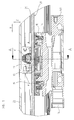
- Figur 1
- einen Längsschnitt einer Längenmesseinrichtung;
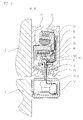
- Figur 2
- einen Querschnitt A-A der Längenmesseinrichtung gemäß
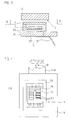
Figur 1 ; - Figur 3
- eine Detailansicht im Querschnitt und
- Figur 4
- eine Draufsicht B-B aus
Figur 3 . - Die Erfindung ist am Beispiel einer optischen Längenmesseinrichtung dargestellt, mit der die Relativlage zweier in Messrichtung X gegeneinander verschiebbarer Objekte 1 und 2 gemessen werden soll. Dabei wird ein transparenter Maßstab 20 von einer relativ zum Maßstab 20 in Messrichtung X bewegbaren Abtasteinheit 10 abgetastet. Der Maßstab 20 weist eine Messteilung 21 auf, die von der Abtasteinheit 10 im Durchlicht abgetastet wird. Dazu umfasst die Abtasteinheit 10 eine Beleuchtungseinheit 11, die ein Lichtbündel aussendet, welches kollimiert durch den Maßstab 20 und weiter durch eine transparente Abtastplatte 12 verläuft und schließlich auf lichtempfindliche Abtastsensoren 133 eines Sensorchips 13 trifft. Das Lichtbündel wird dabei von der Messteilung 21 am Maßstab 20 positionsabhängig moduliert.
- Der Maßstab 20 ist innerhalb eines Gehäuses 22 angeordnet, welches wiederum an dem zu messenden Objekt 2, beispielsweise einem Maschinenbett einer Werkzeugmaschine befestigt ist. Der Maßstab 20 ist dabei in bekannter Weise mit dem Gehäuse 22 verbunden, beispielsweise durch Kleben oder Klemmen. Das Gehäuse 22 weist in seiner Längsrichtung in Messrichtung X verlaufend einen Schlitz auf, der durch dachförmig geneigte Dichtlippen 23 verschlossen ist, durch die ein Mitnehmer 14 mit einem schwertförmigen Mittelstück hindurchgreift. Der Mitnehmer 14 weist einen Montagebereich 141 auf, mit dem er an dem relativ zum Maschinenbett 2 verschiebbaren Objekt 1, beispielsweise einem Schlitten der Werkzeugmaschine befestigbar ist.
- Die Abtasteinheit 10 ist zur exakten Parallelführung längs des Maßstabs 20 an diesem und / oder am Gehäuse 22 geführt. Im dargestellten Ausführungsbeispiel ist die Abtasteinheit 10 über Rollen an zwei senkrecht zueinander ausgerichteten Oberflächen des Maßstabs 20 geführt, wobei Federn dazu dienen, eine Andruckkraft zu generieren.
- Zwischen der Abtasteinheit 10 und dem Mitnehmer 14 ist eine Kupplung 15 angeordnet, die die Abtasteinheit 10 in Messrichtung X steif und quer dazu nachgiebig an den Mitnehmer 14 ankoppelt. Durch diese Maßnahme werden Fehlausrichtungen des Mitnehmers 14 nicht auf die Abtasteinheit 10 übertragen. Die Kupplung 15 ist nur schematisch dargestellt. Sie ist in an sich bekannter Weise beispielsweise gemäß der
DE 29 29 989 A1 als in Messrichtung steifer Federdraht oder gemäß derEP 0 733 882 B1 als Kugelkupplung ausgebildet. - Der Sensorchip 13 weist ein Array von lichtempfindlichen Abtastsensoren 133 auf, welche das von der Messteilung 21 positionsabhängig modulierte Licht der Beleuchtungseinheit 11 empfangen und positionsabhängige elektrische Abtastsignale SA generieren. Der Sensorchip 13 ist ein elektrisches Bauelement, welches einen integrierten Schaltkreis enthält, der die Abtastsignale SA weiterverarbeitet. Der Sensorchip 13 weist als integrierte Mittel 134 zur Signalverarbeitung beispielsweise A/D-Wandler, Verstärker, Mikroprozessoren und auch Schnittstelleneinheiten auf, welche die Abtastsignale SA zu Ausgangssignalen SD aufbereiten und wandeln, die an einer Ausgangsleitung 17 anstehen und nach außen geführt werden. Wenn die Messteilung 21 ein absoluter Code ist, verarbeitet der Sensorchip 13 die Abtastsignale SA zu einem absoluten mehrstelligen digitalen Codewort SD, das über eine serielle Schnittstelleneinheit bitseriell am Ausgang des Sensorchips 13 bereitgestellt wird. Zum elektrischen Anschluss der Längenmesseinrichtung an eine Folgeelektronik weist der Mitnehmer 14 eine Anschlussmöglichkeit auf. Diese Anschlussmöglichkeit ist im dargestellten Beispiel eine Steckverbindung 16 im Mitnehmer 14. Die Ausgangssignale SD des Sensorchips 13 werden über eine Verbindungsleitung 17 zu dieser Steckverbindung 16 geführt. Als Träger der Verbindungsleitung 17 dient ein Flexleiter 18, der von der Abtasteinheit 10 zum Mitnehmer 14 geführt ist. Der Flexleiter 18 ist derart gestaltet, dass er die von der Kupplung 15 zugelassenen Bewegungen zwischen Abtasteinheit 10 und Mitnehmer 14 möglichst rückwirkungsfrei zulässt.
- Durch die im Sensorchip 13 integrierte Signalverarbeitung der Abtastsignale SA zu einem die Position definierenden mehrstelligen Codewort SD ist eine weitgehend störungssichere Messwertgenerierung gewährleistet und es wird eine störungsunempfindliche serielle Übertragung von digitalen Positionsmesswerten SD vom Sensorchip 13 ausgehend ermöglicht. Nachteilig bei einer derartigen integrierten Signalverarbeitung auf kleinstem Raum ist der relativ hohe Energiebedarf und somit die generierte Verlustwärme.
- Der Sensorchip 13 ist über ein Wärmeleitelement 19 mit dem Mitnehmer 14 verbunden. Das Wärmeleitelement 19 sowie die Kontaktierung des Wärmeleitelementes 19 an dem Sensorchip 13 einerseits und an dem Mitnehmer 14 andererseits ist derart ausgestaltet, dass ein guter Wärmeübergang und eine gute Wärmeleitung gewährleistet ist, um die an dem Sensorchip 13 generierte Wärme an den Mitnehmer 14 zu übertragen. Das Wärmeleitelement 19 ist dazu ausgelegt, Relativbewegungen zwischen dem Mitnehmer 14 und der Abtasteinheit 10 zumindest in Richtungen quer zur Messrichtung X möglichst rückwirkungsfrei zuzulassen. Hierzu weist das Wärmeleitelement 19 zumindest einen flexiblen bzw. biegbaren Abschnitt 191 auf. Dieser Abschnitt 191 ist im dargestellten Beispiel bandförmig und aus gut wärmeleitendem Material, vorzugsweise Kupfer. Aufgrund der Bandform ist trotz relativ großem Querschnitt und somit guter Wärmeleitfähigkeit eine noch ausreichende Flexibilität erreichbar. Ein guter rückwirkungsfreier Ausgleich in Richtungen quer zur Messrichtung X wird dadurch erreicht, dass der biegbare Abschnitt 191 eine Biegung, insbesondere aber mehrere Biegungen aufweist, derart dass der biegbare Abschnitt 191 eine Abstandsänderung in Z-Richtung ermöglicht bzw. ausgleicht. Die Erfindung ist aber nicht auf die Bandform des Abschnitts 191 beschränkt, alternativ könnten auch Litzendrähte, insbesondere ein Bündel Litzendrähte oder beweglich und gut wärmeleitend miteinander verbundene Kettenglieder, ein Balg, ein mit einem gut wärmeleitenden Medium gefüllter Balg oder ein gut wärmeleitendes elastisches Kunststoffteil Verwendung finden, wobei bei allen Ausführungen als Material des Wärmeleitelementes 19 auch ein elektrisch isolierendes Material verwendet werden kann.
- Eine gut wärmeleitende Ankopplung des Wärmeleitelementes 19 an den Sensorchip 13 ist in
Figur 3 vergrößert dargestellt. Als Sensorchip 13 ist beispielsweise ein gehäuster Sensorchip 13 verwendet, der ein Keramikgehäuse 132 aufweist, dessen Abdeckung transparent ist und in bekannter Weise als Abtastplatte 12 fungiert. Der Sensorchip 13 ist auf einer Leiterplatte 30 elektrisch kontaktiert, wobei der Flexleiter 18 mit den zum Steckverbinder 16 führenden elektrischen Verbindungsleitungen 17 wiederum an der Leiterplatte 30 angeschlossen ist. Auf einer Seite der Leiterplatte 30 ist der Sensorchip 13 elektrisch kontaktiert und auf der anderen Seite der Leiterplatte 30 ist der flexible Abschnitt 191 des Wärmeleitelementes 19 gut wärmeleitend kontaktiert. Zur Wärmeübertragung zwischen dem Sensorchip 13 und dem flexiblen Abschnitt 191 des Wärmeleitelementes 19 ist ein Wärmeleiter 192 in Form einer Durchkontaktierung vorgesehen. Diese Durchkontaktierung kann ein in eine Bohrung der Leiterplatte 30 eingebrachtes hochwärmeleitendes Material sein oder ein bolzenförmiges Element oder auch aus mehreren Durchkontaktierungen bestehen. Der Wärmeleiter 192 bildet einen starren Abschnitt des Wärmeleitelementes 19 und eine gut wärmeleitende Verbindung der Unterseite des Sensorchips 13 mit dem flexiblen Abschnitt 191. Der flexible Abschnitt 191 ist an dem starren wärmeleitenden Abschnitt 192 möglichst großflächig und gut wärmeleitend angekoppelt, vorzugsweise durch Löten oder Kleben. - Die gut wärmeleitende Ankopplung des Wärmeleitelementes 19 an den Sensorchip 13 erfolgt alternativ durch direkten Anschluss des flexiblen Abschnitts 191 des Wärmeleitelementes 19 am Sensorchip 13 oder an einem den Sensorchip 13 tragenden Träger, beispielsweise durch möglichst großflächiges Anlöten. Diese gut wärmeleitende Ankopplung kann direkt an einer Fläche, insbesondere an der Unterseite eines ungehäusten Sensorchips bzw. an der Unterseite des Gehäuses 132 des gehäusten Sensorchips 13 erfolgen. Die Unterseite ist dabei die dem wärmeerzeugenden Chipbereich direkt gegenüberliegende Fläche. Eine gut wärmeleitende Ankopplung zwischen dem Sensorchip 13 und dem Wärmeleitelement 19 wird erreicht, wenn die Ankoppelfläche größer als 5 mm 2 ist, um den Wärmeübergangswiderstand klein zu halten.
- Das Wärmeleitelement 19 ist an dem Mitnehmer 14 gut wärmeleitend angekoppelt, um die vom Sensorchip 13 generierte Wärme zu diesem Mitnehmer 14 zu übertragen. Diese Ankopplung kann wiederum durch Löten erfolgen, oder wie in
Figur 2 dargestellt, durch großflächiges Kontaktieren an eine Wandung des Mitnehmers 14 durch Klemmen über eine Klemmschraube. - Im Mitnehmer 14 ist eine Durchführung eingebracht, durch die der Flexleiter 18 von der Abtasteinheit 10 zu der Steckverbindung 16 geführt ist. An einer Wandung dieser Durchführung ist das Wärmeleitelement 19 angekoppelt. Dies hat den Vorteil, dass das Wärmeleitelement 19 besonders platzsparend und geschützt untergebracht ist. Die vom Sensorchip 13 erzeugte und über das Wärmeleitelement 19 zum Mitnehmer 14 transportierte Wärme wird vom Mitnehmer 14 aufgenommen. Der Mitnehmer 14 führt vom Innenraum des Gehäuses 22 nach außen zum Montagebereich 141 und besteht aus einem Material, das gut wärmeleitend ist, so dass die aufgenommene Wärme über den Mitnehmer 14 außerhalb des Gehäuses 22 transportiert wird.
- Durch das Wärmeleitelement 19 wird die vom Sensorchip 13 generierte Wärme gezielt zum massiven Mitnehmer 14 geleitet. Der Mitnehmer 14 eignet sich besonders zur Wärmeabfuhr, da er zum Anbau an das zu messende Objekt 1 besonders stabil ausgeführt ist und in der Regel aus Metall, z.B. Aluminium, also gut wärmeleitendem Material ausgeführt ist. Der Mitnehmer 14 ist vom Innenraum des Gehäuses 22 nach außen geführt, so dass auch die über das Wärmeleitelement 19 zum Mitnehmer 14 geführte Wärme in diese Richtung, also weg vom Maßstab 20 geleitet wird.
- In nicht gezeigter Weise kann es von Vorteil sein, wenn das Wärmeleitelement 19 sowie ggf. der Mitnehmer 14 im innerhalb des Gehäuses 22 verlaufenden Bereich gegenüber dem Innenraum des Gehäuses 22 wärmeisolierend ausgebildet ist, beispielsweise mit einem wärmeisolierenden Überzug versehen ist, wozu sich beispielsweise Neopren eignet, da dies flexibel ist und somit im Bereich des flexiblen Abschnittes 191 die Beweglichkeit nicht behindert. Dieser Überzug kann auch eine Beschichtung sein. Dadurch wird erreicht, dass die vom Sensorchip 13 aufgenommene Wärme gezielt außerhalb des Gehäuses 22 geleitet wird und nicht der Innenraum des Gehäuses 22 übermäßig aufgewärmt wird. Es wird gezielt ein gegenüber der Umgebung wärmeisolierter Wärmeleitpfad vom Sensorchip 13 zur Umgebung außerhalb des Gehäuses 22 geschaffen.
- Im Messbetrieb, wenn also der Montagebereich 141 des Mitnehmers 14 an das zu messende Objekt 1 angebaut ist, hat der Mitnehmer 14 wärmeleitenden Kontakt mit dem zu messenden Objekt 1, so dass auch an dieses Wärme abgegeben werden kann. In nicht gezeigter Weise kann die Wärmeabfuhr auch noch dadurch unterstützt werden, dass am Mitnehmer 14 und zwar außerhalb des Gehäuses 22 und / oder zwischen dem Montagebereich 141 des Mitnehmers 14 und dem zu messenden Objekt 1 Kühlmittel vorgesehen werden. Diese Kühlmittel können Kühlrippen oder ein mit Kühlmedium durchflossener Kanal sein.
- Um ein Einkoppeln von elektrischen Störungen über den Mitnehmer 14 zum Sensorchip 13 zu vermeiden, kann es notwendig sein, das Wärmeleitelement 19 elektrisch zu isolieren, um insbesondere einen elektrischen Kontakt zwischen dem Mitnehmer 14 und dem Wärmeleitelement 19 zu verhindern. Dies kann durch eine Zwischenlage erreicht werden, die zwischen dem Mitnehmer 14 und dem Wärmeleitelement 19 vorgesehen ist und aus einem Material besteht, das einerseits zum Ankoppeln des Wärmeleitelementes 19 an den Mitnehmer 14 gut wärmeleitend ist und andererseits elektrisch isolierend ist. Das Material ist beispielsweise eine Keramikfolie.
- Im dargestellten Ausführungsbeispiel ist das Wärmeleitelement 19 parallel und unabhängig von dem Flexleiter 18 geführt. Einen kompakten Aufbau erhält man alternativ, wenn man den flexiblen Abschnitt 191 des Wärmeleitelementes 19 in den Flexleiter 18 (Leiterbahnen auf bzw. in elektrisch isolierender biegbarer flexibler Folie) integriert. Diese Integration kann so aussehen, dass man neben der elektrischen Verbindungsleitung 17 den flexiblen Abschnitt 191 des Wärmeleitelementes 19 auf dem elektrisch isolierenden Flexleiter 18 vorsieht oder einen mehrlagigen Flexleiter 18 verwendet, wobei eine elektrisch leitende Lage die Verbindungsleitung 17 aufweist und eine weitere davon elektrisch isolierte Lage den flexiblen Abschnitt 191 des Wärmeleitelementes 19 bildet, wobei diese Lage dann einerseits gut wärmeleitend an dem Sensorchip 13 kontaktiert ist und andererseits gut wärmeleitend an dem Mitnehmer 14 kontaktiert ist.
- Die Erfindung kann auch bei einer Längenmesseinrichtung eingesetzt werden, bei der der Maßstab reflektierend ausgebildet ist und sich der Sensorchip 13 auf der gleichen Seite wie die Beleuchtungseinheit 11 befindet. Ebenso kann der Maßstab magnetisch, kapazitiv oder induktiv abtastbar ausgeführt sein, wobei dann der Sensorchip 13 angepasste Sensorelemente beinhaltet, um positionsabhängige Abtastsignale zu generieren. Der Sensorchip 13 kann in nicht gezeigter Weise auch mehrteilig ausgeführt sein, wobei alle oder nur eines dieser Bauteile erfindungsgemäß entwärmt wird, weshalb die Erfindung allgemein auf die gezielte Wärmeabfuhr eines wärmeerzeugenden elektrischen Bauelementes der Abtasteinheit 10 bezogen wurde.
- Nochmals zusammengefasst, betrifft die Erfindung eine Längenmesseinrichtung zum Messen der Relativlage zweier Objekte 1, 2, mit
- einem Maßstab 20 in einem Gehäuse 22;
- einer relativ zur Einheit Maßstab 20 und Gehäuse 22 in einer Messrichtung X verschiebbaren Abtasteinheit 10, wobei die Abtasteinheit 10 innerhalb des Gehäuses 22 angeordnet ist und zumindest ein wärmeerzeugendes elektrisches Bauelement 13 aufweist;
- einem Mitnehmer 14, der über eine in Messrichtung X steife und quer dazu nachgiebige Kupplung 15 an der Abtasteinheit 10 befestigt ist und der zu einem außerhalb des Gehäuses 22 angeordneten Montagebereich 141 verläuft, gekennzeichnet durch
- ein Wärmeleitelement 19, das dazu ausgelegt ist, um an dem elektrischen Bauelement 13 generierte Wärme an den Mitnehmer 14 zu übertragen, und das Relativbewegungen zwischen dem Mitnehmer 14 und der Abtasteinheit 10 zumindest quer zur Messrichtung X zulässt.
- In vorteilhafter Weise ist das elektrische Bauelement ein Sensorchip 13, der Abtastsensoren 133 zur Abtastung des Maßstabes 20 und Generierung von Abtastsignalen SA sowie Mittel 134 zur Verarbeitung dieser Abtastsignale SA zu einem Positionsmesswert SD aufweist, wobei der Positionsmesswert SD vom Sensorchip 13 als Ausgangssignal in Form eines mehrstelligen digitalen Codewortes bitseriell bereitgestellt wird.
- Insbesondere ist das Wärmeleitelement 19 einerseits gut wärmeleitend an dem elektrischen Bauelement 13 angekoppelt und andererseits gut wärmeleitend an dem Mitnehmer 14 angekoppelt.
- Der Mitnehmer 14 weist einen außerhalb des Gehäuses 22 angeordneten Montagebereich 141 zum Befestigen des Mitnehmers 14 an dem zu messenden Objekt 1 auf, und der Mitnehmer 14 besteht aus gut wärmeleitendem Material, um die vom Wärmeleitelement 19 aufgenommene Wärme zum Montagebereich 141 zu leiten.
- Vorteilhaft ist, wenn das Wärmeleitelement 19 zumindest einen flexiblen biegbaren Abschnitt 191 aufweist, der insbesondere bandförmig ist.
- Als gut wärmeleitendes Material für das Wärmeleitelement 19 eignet sich beispielsweise Kupfer.
- Vorteilhaft ist, wenn das elektrische Bauelement 13 auf einer Leiterplatte 30 angeordnet ist und das Wärmeleitelement 19 einen ersten Abschnitt 192 aufweist, der von dem elektrischen Bauelement 13 durch die Leiterplatte 30 führt und einen zweiten nachfolgenden Abschnitt 191 aufweist, der vom ersten Abschnitt 192 ausgehend zum Mitnehmer 14 führt und die Relativbewegungen zwischen dem Mitnehmer 14 und der Abtasteinheit 10 quer zur Messrichtung X zulässt.
- Wenn das elektrische Bauelement 13 auf einer Leiterplatte 30 angeordnet ist, kann das Wärmeleitelement 19 Bestandteil eines Flexleiters 18 sein, der von der Abtasteinheit 10 zum Mitnehmer 14 geführt ist. Dabei enthält der Flexleiter 18 elektrische Verbindungsleitungen 17 zum Übertragen von Positionsmesswerten SD vom Sensorchip 13 zu einer Steckverbindung 16 des Montagebereiches 141 sowie eine als Wärmeleitelement 19 ausgebildete Leitung, die einerseits wärmeleitend an den Sensorchip 13 angekoppelt ist und andererseits an den Mitnehmer 14 wärmeleitend angekoppelt ist.
Claims (11)
- Längenmesseinrichtung zum Messen der Relativlage zweier Objekte (1, 2), mit- einem Maßstab (20) in einem Gehäuse (22);- einer relativ zur Einheit Maßstab (20) und Gehäuse (22) in einer Messrichtung X verschiebbaren Abtasteinheit (10), wobei die Abtasteinheit (10) innerhalb des Gehäuses (22) angeordnet ist und zumindest ein wärmeerzeugendes elektrisches Bauelement (13) aufweist;- einem Mitnehmer (14), der über eine in Messrichtung X steife und quer dazu nachgiebige Kupplung (15) an der Abtasteinheit (10) befestigt ist und der zu einem außerhalb des Gehäuses (22) angeordneten Montagebereich (141) verläuft, gekennzeichnet durch- ein Wärmeleitelement (19), das dazu ausgelegt ist, um an dem elektrischen Bauelement (13) generierte Wärme an den Mitnehmer (14) zu übertragen, und das Relativbewegungen zwischen dem Mitnehmer (14) und der Abtasteinheit (10) zumindest quer zur Messrichtung X zulässt.
- Längenmesseinrichtung nach Anspruch 1, dadurch gekennzeichnet, dass das elektrische Bauelement ein Sensorchip (13) ist, der Abtastsensoren (133) zur Abtastung des Maßstabes (20) und Generierung von Abtastsignalen (SA) sowie Mittel (134) zur Verarbeitung dieser Abtastsignale (SA) zu einem Positionsmesswert (SD) aufweist.
- Längenmesseinrichtung nach Anspruch 2, dadurch gekennzeichnet, dass der Positionsmesswert (SD) vom Sensorchip (13) als Ausgangssignal in Form eines mehrstelligen digitalen Codewortes bitseriell bereitgestellt wird.
- Längenmesseinrichtung nach einem der vorhergehenden Ansprüche, dadurch gekennzeichnet, dass das Wärmeleitelement (19) einerseits gut wärmeleitend an dem elektrischen Bauelement (13) angekoppelt ist und andererseits gut wärmeleitend an dem Mitnehmer (14) angekoppelt ist.
- Längenmesseinrichtung nach Anspruch 4, dadurch gekennzeichnet, dass der Mitnehmer (14) einen außerhalb des Gehäuses (22) angeordneten Montagebereich (141) zum Befestigen des Mitnehmers (14) an dem zu messenden Objekt (1) aufweist, und dass der Mitnehmer (14) aus gut wärmeleitendem Material besteht, um die vom Wärmeleitelement (19) aufgenommene Wärme zum Montagebereich (141) zu leiten.
- Längenmesseinrichtung nach einem der vorhergehenden Ansprüche, dadurch gekennzeichnet, dass das Wärmeleitelement (19) zumindest einen flexiblen biegbaren Abschnitt (191) aufweist.
- Längenmesseinrichtung nach Anspruch 6, dadurch gekennzeichnet, dass der flexible Abschnitt (191) bandförmig ist.
- Längenmesseinrichtung nach einem der vorhergehenden Ansprüche, dadurch gekennzeichnet, dass das Wärmeleitelement (19) das Material Kupfer aufweist.
- Längenmesseinrichtung nach einem der vorhergehenden Ansprüche, dadurch gekennzeichnet, dass das elektrische Bauelement (13) auf einer Leiterplatte (30) angeordnet ist und das Wärmeleitelement (19) einen ersten Abschnitt (192) aufweist, der von dem elektrischen Bauelement (13) durch die Leiterplatte (30) führt und einen zweiten nachfolgenden Abschnitt (191) aufweist, der vom ersten Abschnitt (192) ausgehend zum Mitnehmer (14) führt und die Relativbewegungen zwischen dem Mitnehmer (14) und der Abtasteinheit (10) quer zur Messrichtung X zulässt.
- Längenmesseinrichtung nach einem der vorhergehenden Ansprüche 1 bis 8, dadurch gekennzeichnet, dass das elektrische Bauelement (13) auf einer Leiterplatte (30) angeordnet ist und das Wärmeleitelement Bestandteil eines Flexleiters ist, der von der Abtasteinheit (10) zum Mitnehmer (14) geführt ist.
- Längenmesseinrichtung nach Anspruch 10, dadurch gekennzeichnet, dass der Flexleiter (18) elektrische Verbindungsleitungen (17) zum Übertragen von Positionsmesswerten (SD) vom Sensorchip (13) zu einer Steckverbindung (16) des Montagebereiches (141) sowie eine als Wärmeleitelement (19) ausgebildete Leitung enthält, die einerseits wärmeleitend an den Sensorchip (13) angekoppelt ist und andererseits an den Mitnehmer (14) wärmeleitend angekoppelt ist.
Applications Claiming Priority (1)
| Application Number | Priority Date | Filing Date | Title |
|---|---|---|---|
| DE102007031976A DE102007031976A1 (de) | 2007-07-10 | 2007-07-10 | Längenmesseinrichtung |
Publications (3)
| Publication Number | Publication Date |
|---|---|
| EP2015031A2 true EP2015031A2 (de) | 2009-01-14 |
| EP2015031A3 EP2015031A3 (de) | 2010-11-10 |
| EP2015031B1 EP2015031B1 (de) | 2013-06-19 |
Family
ID=39876979
Family Applications (1)
| Application Number | Title | Priority Date | Filing Date |
|---|---|---|---|
| EP08007082.4A Active EP2015031B1 (de) | 2007-07-10 | 2008-04-10 | Längenmesseinrichtung |
Country Status (6)
| Country | Link |
|---|---|
| US (1) | US7788821B2 (de) |
| EP (1) | EP2015031B1 (de) |
| JP (1) | JP5292002B2 (de) |
| CN (1) | CN101344380B (de) |
| DE (1) | DE102007031976A1 (de) |
| ES (1) | ES2417138T3 (de) |
Cited By (1)
| Publication number | Priority date | Publication date | Assignee | Title |
|---|---|---|---|---|
| WO2010149399A3 (de) * | 2009-06-23 | 2011-02-24 | Dr. Johannes Heidenhain Gmbh | Abtastbaueinheit einer positionsmesseinrichtung |
Families Citing this family (12)
| Publication number | Priority date | Publication date | Assignee | Title |
|---|---|---|---|---|
| DE102007058643A1 (de) * | 2007-12-04 | 2009-06-10 | Dr. Johannes Heidenhain Gmbh | Abtastbaueinheit |
| DE102008043353A1 (de) * | 2008-10-31 | 2010-05-06 | Dr. Johannes Heidenhain Gmbh | Längenmesseinrichtung |
| DE102009043293A1 (de) * | 2009-09-29 | 2011-03-31 | Dr. Johannes Heidenhain Gmbh | Längenmesseinrichtung |
| DE102011079464A1 (de) * | 2011-07-20 | 2013-01-24 | Dr. Johannes Heidenhain Gmbh | Längenmesseinrichtung |
| DE102011054231B4 (de) * | 2011-10-06 | 2015-03-26 | Sick Ag | Linearer Wegsensor |
| DE102012203193A1 (de) * | 2012-03-01 | 2013-09-05 | Dr. Johannes Heidenhain Gmbh | Längenmesseinrichtung |
| JP6125898B2 (ja) * | 2013-05-15 | 2017-05-10 | 株式会社ミツトヨ | リニアエンコーダ |
| JP6225078B2 (ja) * | 2014-07-10 | 2017-11-01 | オークマ株式会社 | リニアエンコーダ |
| JP6712827B2 (ja) * | 2016-01-07 | 2020-06-24 | ハイデンハイン株式会社 | リニアエンコーダ |
| EP3293496B1 (de) * | 2016-09-12 | 2018-11-21 | Dr. Johannes Heidenhain GmbH | Längenmesseinrichtung und verfahren zu deren montage |
| US10859363B2 (en) * | 2017-09-27 | 2020-12-08 | Stanley Black & Decker, Inc. | Tape rule assembly with linear optical encoder for sensing human-readable graduations of length |
| CN112611324B (zh) * | 2020-12-02 | 2022-05-24 | 南京尚孚电子电路有限公司 | 一种用于柔性电路板的绝缘薄膜贴敷检测系统及其检测方法 |
Citations (3)
| Publication number | Priority date | Publication date | Assignee | Title |
|---|---|---|---|---|
| DE2929989A1 (de) | 1978-07-31 | 1980-02-14 | Mitutoyo Mfg Co Ltd | Messvorrichtung mit linearskala |
| EP0733882B1 (de) | 1995-03-23 | 1999-10-06 | RSF-Elektronik Gesellschaft m.b.H. | Positionsmesseinrichtung |
| DE10164404A1 (de) | 2000-12-29 | 2002-12-12 | Niles Simmons Industrieanlagen | Einrichtung zum Temperieren von Längenmeßsystemen |
Family Cites Families (14)
| Publication number | Priority date | Publication date | Assignee | Title |
|---|---|---|---|---|
| JPS589007A (ja) * | 1981-07-08 | 1983-01-19 | Nippon Kogaku Kk <Nikon> | 測長装置 |
| JPS62294878A (ja) * | 1986-06-13 | 1987-12-22 | 日本電気株式会社 | 可動部材の冷却機構 |
| DE3918490C1 (de) * | 1989-06-07 | 1990-09-27 | Dr. Johannes Heidenhain Gmbh, 8225 Traunreut, De | |
| JPH0540821U (ja) * | 1991-11-08 | 1993-06-01 | 株式会社ニコン | 光電式エンコーダ |
| JP2557171B2 (ja) * | 1992-11-25 | 1996-11-27 | 株式会社ミツトヨ | 変位検出装置 |
| DE19526518C1 (de) * | 1995-07-20 | 1996-12-12 | Zeiss Carl Jena Gmbh | Anordnung zur formschlüssigen Aufnahme eines Maßstabs |
| JPH09185835A (ja) * | 1996-01-08 | 1997-07-15 | Matsushita Electric Ind Co Ltd | 光ピックアップ装置 |
| DE19914311A1 (de) * | 1999-03-29 | 2000-10-05 | Heidenhain Gmbh Dr Johannes | Verfahren und Vorrichtung zum Anbringen eines Maßstabes |
| DE10111630A1 (de) * | 2001-03-09 | 2002-11-07 | Heidenhain Gmbh Dr Johannes | Verfahren zum Betrieb einer Positionsmesseinrichtung und hierzu geeignete Positionsmesseinrichtung |
| JP4132842B2 (ja) * | 2002-01-31 | 2008-08-13 | 浜松ホトニクス株式会社 | 移動体の放熱装置及び半導体検査装置 |
| DE10229885B4 (de) * | 2002-07-03 | 2010-06-24 | Dr. Johannes Heidenhain Gmbh | Verfahren und Vorrichtung zum Anbringen eines Maßstabs oder Maßstabträgers oder einer Maßstabführung |
| DE10229888B4 (de) * | 2002-07-03 | 2010-09-30 | Dr. Johannes Heidenhain Gmbh | Vorrichtung und Verfahren zum Anbringen eines Maßstabs oder Maßstabträgers oder einer Maßstabführung sowie Maßstab, Maßstabträger oder Maßstabführung oder Schutzband dafür |
| DE10236381A1 (de) * | 2002-08-08 | 2004-02-19 | Dr. Johannes Heidenhain Gmbh | Längenmesseinrichtung |
| DE10244234A1 (de) * | 2002-09-23 | 2004-03-25 | Dr. Johannes Heidenhain Gmbh | Positionsmesseinrichtung |
-
2007
- 2007-07-10 DE DE102007031976A patent/DE102007031976A1/de not_active Withdrawn
-
2008
- 2008-04-10 ES ES08007082T patent/ES2417138T3/es active Active
- 2008-04-10 EP EP08007082.4A patent/EP2015031B1/de active Active
- 2008-06-27 US US12/215,519 patent/US7788821B2/en active Active
- 2008-07-08 JP JP2008177771A patent/JP5292002B2/ja active Active
- 2008-07-10 CN CN2008101361618A patent/CN101344380B/zh not_active Expired - Fee Related
Patent Citations (3)
| Publication number | Priority date | Publication date | Assignee | Title |
|---|---|---|---|---|
| DE2929989A1 (de) | 1978-07-31 | 1980-02-14 | Mitutoyo Mfg Co Ltd | Messvorrichtung mit linearskala |
| EP0733882B1 (de) | 1995-03-23 | 1999-10-06 | RSF-Elektronik Gesellschaft m.b.H. | Positionsmesseinrichtung |
| DE10164404A1 (de) | 2000-12-29 | 2002-12-12 | Niles Simmons Industrieanlagen | Einrichtung zum Temperieren von Längenmeßsystemen |
Cited By (1)
| Publication number | Priority date | Publication date | Assignee | Title |
|---|---|---|---|---|
| WO2010149399A3 (de) * | 2009-06-23 | 2011-02-24 | Dr. Johannes Heidenhain Gmbh | Abtastbaueinheit einer positionsmesseinrichtung |
Also Published As
| Publication number | Publication date |
|---|---|
| US20090013552A1 (en) | 2009-01-15 |
| US7788821B2 (en) | 2010-09-07 |
| CN101344380A (zh) | 2009-01-14 |
| EP2015031A3 (de) | 2010-11-10 |
| EP2015031B1 (de) | 2013-06-19 |
| DE102007031976A1 (de) | 2009-01-15 |
| ES2417138T3 (es) | 2013-08-06 |
| JP2009020104A (ja) | 2009-01-29 |
| CN101344380B (zh) | 2012-02-08 |
| JP5292002B2 (ja) | 2013-09-18 |
Similar Documents
| Publication | Publication Date | Title |
|---|---|---|
| EP2015031B1 (de) | Längenmesseinrichtung | |
| EP2344847B1 (de) | Längenmesseinrichtung | |
| EP2068125B1 (de) | Abtastbaueinheit einer Positionsmesseinrichtung | |
| DE69715554T2 (de) | Optische Einrichtung für Verschiebungsdetektion | |
| EP1239710B1 (de) | Elektronische Baugruppe | |
| DE4340204B4 (de) | Verschiebungssensor | |
| CN105258712A (zh) | 线性编码器 | |
| EP1302755A1 (de) | Sensor | |
| DE10321640B4 (de) | Infrarotsensor mit verbesserter Strahlungsausbeute | |
| DE102006033467B4 (de) | Druckerfassungsvorrichtung | |
| DE19646583A1 (de) | Strömungsüberwachungsgerät | |
| EP2446229B1 (de) | Abtastbaueinheit einer positionsmesseinrichtung | |
| DE102009048940B3 (de) | Heizkostenverteiler | |
| EP3124921B1 (de) | Positionsmesseinrichtung | |
| DE102018115327B4 (de) | Temperatursensor | |
| EP1141662B1 (de) | Dreidimensionales messmodul | |
| DE19820704C2 (de) | Elektrische Einrichtung, insbesondere eine Abstandsregeleinrichtung für ein Kraftfahrzeug | |
| EP1568978B1 (de) | Temperatursensor | |
| DE102022211819B3 (de) | Elektronikbaugruppe und Verfahren zur Herstellung einer Elektronikbaugruppe | |
| DE19715080C1 (de) | Thermometeranordnung mit einem Thermoelement | |
| CN215492139U (zh) | 测温装置 | |
| DE102022211818A1 (de) | Elektronikbaugruppe und Verfahren zur Herstellung einer Elektronikbaugruppe | |
| DE3113698C1 (de) | Gekapselte,digitale elektrische Positionsmesseinrichtung | |
| DE4436299C1 (de) | Drucksensor-Chipstruktur mit einer Klemmeinrichtung zum Kontaktieren und Halten derselben sowie mit einem Fluidverbinderteil | |
| EP0344439A1 (de) | Sensor |
Legal Events
| Date | Code | Title | Description |
|---|---|---|---|
| PUAI | Public reference made under article 153(3) epc to a published international application that has entered the european phase |
Free format text: ORIGINAL CODE: 0009012 |
|
| AK | Designated contracting states |
Kind code of ref document: A2 Designated state(s): AT BE BG CH CY CZ DE DK EE ES FI FR GB GR HR HU IE IS IT LI LT LU LV MC MT NL NO PL PT RO SE SI SK TR |
|
| AX | Request for extension of the european patent |
Extension state: AL BA MK RS |
|
| PUAL | Search report despatched |
Free format text: ORIGINAL CODE: 0009013 |
|
| AK | Designated contracting states |
Kind code of ref document: A3 Designated state(s): AT BE BG CH CY CZ DE DK EE ES FI FR GB GR HR HU IE IS IT LI LT LU LV MC MT NL NO PL PT RO SE SI SK TR |
|
| AX | Request for extension of the european patent |
Extension state: AL BA MK RS |
|
| RIC1 | Information provided on ipc code assigned before grant |
Ipc: G01B 11/04 20060101ALI20101004BHEP Ipc: G01D 5/26 20060101AFI20081104BHEP |
|
| 17P | Request for examination filed |
Effective date: 20110510 |
|
| AKX | Designation fees paid |
Designated state(s): AT BE BG CH CY CZ DE DK EE ES FI FR GB GR HR HU IE IS IT LI LT LU LV MC MT NL NO PL PT RO SE SI SK TR |
|
| GRAP | Despatch of communication of intention to grant a patent |
Free format text: ORIGINAL CODE: EPIDOSNIGR1 |
|
| RIN1 | Information on inventor provided before grant (corrected) |
Inventor name: AFFA, ALFRED Inventor name: HAUNREITER, JOHANNES |
|
| GRAS | Grant fee paid |
Free format text: ORIGINAL CODE: EPIDOSNIGR3 |
|
| GRAA | (expected) grant |
Free format text: ORIGINAL CODE: 0009210 |
|
| AK | Designated contracting states |
Kind code of ref document: B1 Designated state(s): AT BE BG CH CY CZ DE DK EE ES FI FR GB GR HR HU IE IS IT LI LT LU LV MC MT NL NO PL PT RO SE SI SK TR |
|
| REG | Reference to a national code |
Ref country code: GB Ref legal event code: FG4D Free format text: NOT ENGLISH |
|
| REG | Reference to a national code |
Ref country code: CH Ref legal event code: EP Ref country code: CH Ref legal event code: NV Representative=s name: ICB INGENIEURS CONSEILS EN BREVETS SA, CH |
|
| REG | Reference to a national code |
Ref country code: AT Ref legal event code: REF Ref document number: 617898 Country of ref document: AT Kind code of ref document: T Effective date: 20130715 |
|
| REG | Reference to a national code |
Ref country code: IE Ref legal event code: FG4D Free format text: LANGUAGE OF EP DOCUMENT: GERMAN |
|
| REG | Reference to a national code |
Ref country code: ES Ref legal event code: FG2A Ref document number: 2417138 Country of ref document: ES Kind code of ref document: T3 Effective date: 20130806 |
|
| REG | Reference to a national code |
Ref country code: DE Ref legal event code: R096 Ref document number: 502008010130 Country of ref document: DE Effective date: 20130814 |
|
| PG25 | Lapsed in a contracting state [announced via postgrant information from national office to epo] |
Ref country code: SE Free format text: LAPSE BECAUSE OF FAILURE TO SUBMIT A TRANSLATION OF THE DESCRIPTION OR TO PAY THE FEE WITHIN THE PRESCRIBED TIME-LIMIT Effective date: 20130619 Ref country code: GR Free format text: LAPSE BECAUSE OF FAILURE TO SUBMIT A TRANSLATION OF THE DESCRIPTION OR TO PAY THE FEE WITHIN THE PRESCRIBED TIME-LIMIT Effective date: 20130920 Ref country code: SI Free format text: LAPSE BECAUSE OF FAILURE TO SUBMIT A TRANSLATION OF THE DESCRIPTION OR TO PAY THE FEE WITHIN THE PRESCRIBED TIME-LIMIT Effective date: 20130619 Ref country code: FI Free format text: LAPSE BECAUSE OF FAILURE TO SUBMIT A TRANSLATION OF THE DESCRIPTION OR TO PAY THE FEE WITHIN THE PRESCRIBED TIME-LIMIT Effective date: 20130619 Ref country code: LT Free format text: LAPSE BECAUSE OF FAILURE TO SUBMIT A TRANSLATION OF THE DESCRIPTION OR TO PAY THE FEE WITHIN THE PRESCRIBED TIME-LIMIT Effective date: 20130619 Ref country code: NO Free format text: LAPSE BECAUSE OF FAILURE TO SUBMIT A TRANSLATION OF THE DESCRIPTION OR TO PAY THE FEE WITHIN THE PRESCRIBED TIME-LIMIT Effective date: 20130919 |
|
| REG | Reference to a national code |
Ref country code: LT Ref legal event code: MG4D |
|
| PG25 | Lapsed in a contracting state [announced via postgrant information from national office to epo] |
Ref country code: HR Free format text: LAPSE BECAUSE OF FAILURE TO SUBMIT A TRANSLATION OF THE DESCRIPTION OR TO PAY THE FEE WITHIN THE PRESCRIBED TIME-LIMIT Effective date: 20130619 Ref country code: BG Free format text: LAPSE BECAUSE OF FAILURE TO SUBMIT A TRANSLATION OF THE DESCRIPTION OR TO PAY THE FEE WITHIN THE PRESCRIBED TIME-LIMIT Effective date: 20130919 |
|
| REG | Reference to a national code |
Ref country code: NL Ref legal event code: VDEP Effective date: 20130619 |
|
| PG25 | Lapsed in a contracting state [announced via postgrant information from national office to epo] |
Ref country code: LV Free format text: LAPSE BECAUSE OF FAILURE TO SUBMIT A TRANSLATION OF THE DESCRIPTION OR TO PAY THE FEE WITHIN THE PRESCRIBED TIME-LIMIT Effective date: 20130619 |
|
| PG25 | Lapsed in a contracting state [announced via postgrant information from national office to epo] |
Ref country code: SK Free format text: LAPSE BECAUSE OF FAILURE TO SUBMIT A TRANSLATION OF THE DESCRIPTION OR TO PAY THE FEE WITHIN THE PRESCRIBED TIME-LIMIT Effective date: 20130619 Ref country code: IS Free format text: LAPSE BECAUSE OF FAILURE TO SUBMIT A TRANSLATION OF THE DESCRIPTION OR TO PAY THE FEE WITHIN THE PRESCRIBED TIME-LIMIT Effective date: 20131019 Ref country code: PT Free format text: LAPSE BECAUSE OF FAILURE TO SUBMIT A TRANSLATION OF THE DESCRIPTION OR TO PAY THE FEE WITHIN THE PRESCRIBED TIME-LIMIT Effective date: 20131021 Ref country code: CY Free format text: LAPSE BECAUSE OF FAILURE TO SUBMIT A TRANSLATION OF THE DESCRIPTION OR TO PAY THE FEE WITHIN THE PRESCRIBED TIME-LIMIT Effective date: 20130724 Ref country code: EE Free format text: LAPSE BECAUSE OF FAILURE TO SUBMIT A TRANSLATION OF THE DESCRIPTION OR TO PAY THE FEE WITHIN THE PRESCRIBED TIME-LIMIT Effective date: 20130619 Ref country code: CZ Free format text: LAPSE BECAUSE OF FAILURE TO SUBMIT A TRANSLATION OF THE DESCRIPTION OR TO PAY THE FEE WITHIN THE PRESCRIBED TIME-LIMIT Effective date: 20130619 |
|
| PG25 | Lapsed in a contracting state [announced via postgrant information from national office to epo] |
Ref country code: PL Free format text: LAPSE BECAUSE OF FAILURE TO SUBMIT A TRANSLATION OF THE DESCRIPTION OR TO PAY THE FEE WITHIN THE PRESCRIBED TIME-LIMIT Effective date: 20130619 Ref country code: NL Free format text: LAPSE BECAUSE OF FAILURE TO SUBMIT A TRANSLATION OF THE DESCRIPTION OR TO PAY THE FEE WITHIN THE PRESCRIBED TIME-LIMIT Effective date: 20130619 Ref country code: RO Free format text: LAPSE BECAUSE OF FAILURE TO SUBMIT A TRANSLATION OF THE DESCRIPTION OR TO PAY THE FEE WITHIN THE PRESCRIBED TIME-LIMIT Effective date: 20130619 |
|
| PG25 | Lapsed in a contracting state [announced via postgrant information from national office to epo] |
Ref country code: CY Free format text: LAPSE BECAUSE OF FAILURE TO SUBMIT A TRANSLATION OF THE DESCRIPTION OR TO PAY THE FEE WITHIN THE PRESCRIBED TIME-LIMIT Effective date: 20130619 |
|
| PLBE | No opposition filed within time limit |
Free format text: ORIGINAL CODE: 0009261 |
|
| STAA | Information on the status of an ep patent application or granted ep patent |
Free format text: STATUS: NO OPPOSITION FILED WITHIN TIME LIMIT |
|
| PG25 | Lapsed in a contracting state [announced via postgrant information from national office to epo] |
Ref country code: DK Free format text: LAPSE BECAUSE OF FAILURE TO SUBMIT A TRANSLATION OF THE DESCRIPTION OR TO PAY THE FEE WITHIN THE PRESCRIBED TIME-LIMIT Effective date: 20130619 |
|
| 26N | No opposition filed |
Effective date: 20140320 |
|
| REG | Reference to a national code |
Ref country code: DE Ref legal event code: R097 Ref document number: 502008010130 Country of ref document: DE Effective date: 20140320 |
|
| PG25 | Lapsed in a contracting state [announced via postgrant information from national office to epo] |
Ref country code: MC Free format text: LAPSE BECAUSE OF FAILURE TO SUBMIT A TRANSLATION OF THE DESCRIPTION OR TO PAY THE FEE WITHIN THE PRESCRIBED TIME-LIMIT Effective date: 20130619 Ref country code: LU Free format text: LAPSE BECAUSE OF FAILURE TO SUBMIT A TRANSLATION OF THE DESCRIPTION OR TO PAY THE FEE WITHIN THE PRESCRIBED TIME-LIMIT Effective date: 20140410 |
|
| REG | Reference to a national code |
Ref country code: FR Ref legal event code: ST Effective date: 20141231 |
|
| REG | Reference to a national code |
Ref country code: IE Ref legal event code: MM4A |
|
| PG25 | Lapsed in a contracting state [announced via postgrant information from national office to epo] |
Ref country code: FR Free format text: LAPSE BECAUSE OF NON-PAYMENT OF DUE FEES Effective date: 20140430 |
|
| PG25 | Lapsed in a contracting state [announced via postgrant information from national office to epo] |
Ref country code: IE Free format text: LAPSE BECAUSE OF NON-PAYMENT OF DUE FEES Effective date: 20140410 |
|
| REG | Reference to a national code |
Ref country code: AT Ref legal event code: MM01 Ref document number: 617898 Country of ref document: AT Kind code of ref document: T Effective date: 20140410 |
|
| PG25 | Lapsed in a contracting state [announced via postgrant information from national office to epo] |
Ref country code: AT Free format text: LAPSE BECAUSE OF NON-PAYMENT OF DUE FEES Effective date: 20140410 |
|
| PG25 | Lapsed in a contracting state [announced via postgrant information from national office to epo] |
Ref country code: MT Free format text: LAPSE BECAUSE OF FAILURE TO SUBMIT A TRANSLATION OF THE DESCRIPTION OR TO PAY THE FEE WITHIN THE PRESCRIBED TIME-LIMIT Effective date: 20130619 |
|
| PG25 | Lapsed in a contracting state [announced via postgrant information from national office to epo] |
Ref country code: HU Free format text: LAPSE BECAUSE OF FAILURE TO SUBMIT A TRANSLATION OF THE DESCRIPTION OR TO PAY THE FEE WITHIN THE PRESCRIBED TIME-LIMIT; INVALID AB INITIO Effective date: 20080410 Ref country code: BE Free format text: LAPSE BECAUSE OF FAILURE TO SUBMIT A TRANSLATION OF THE DESCRIPTION OR TO PAY THE FEE WITHIN THE PRESCRIBED TIME-LIMIT Effective date: 20140430 Ref country code: TR Free format text: LAPSE BECAUSE OF FAILURE TO SUBMIT A TRANSLATION OF THE DESCRIPTION OR TO PAY THE FEE WITHIN THE PRESCRIBED TIME-LIMIT Effective date: 20130619 |
|
| PGFP | Annual fee paid to national office [announced via postgrant information from national office to epo] |
Ref country code: IT Payment date: 20220420 Year of fee payment: 15 Ref country code: GB Payment date: 20220425 Year of fee payment: 15 Ref country code: ES Payment date: 20220629 Year of fee payment: 15 |
|
| PGFP | Annual fee paid to national office [announced via postgrant information from national office to epo] |
Ref country code: CH Payment date: 20220421 Year of fee payment: 15 |
|
| REG | Reference to a national code |
Ref country code: CH Ref legal event code: PL |
|
| GBPC | Gb: european patent ceased through non-payment of renewal fee |
Effective date: 20230410 |
|
| PG25 | Lapsed in a contracting state [announced via postgrant information from national office to epo] |
Ref country code: GB Free format text: LAPSE BECAUSE OF NON-PAYMENT OF DUE FEES Effective date: 20230410 |
|
| PG25 | Lapsed in a contracting state [announced via postgrant information from national office to epo] |
Ref country code: LI Free format text: LAPSE BECAUSE OF NON-PAYMENT OF DUE FEES Effective date: 20230430 Ref country code: GB Free format text: LAPSE BECAUSE OF NON-PAYMENT OF DUE FEES Effective date: 20230410 Ref country code: CH Free format text: LAPSE BECAUSE OF NON-PAYMENT OF DUE FEES Effective date: 20230430 |
|
| PG25 | Lapsed in a contracting state [announced via postgrant information from national office to epo] |
Ref country code: IT Free format text: LAPSE BECAUSE OF NON-PAYMENT OF DUE FEES Effective date: 20230410 |
|
| REG | Reference to a national code |
Ref country code: ES Ref legal event code: FD2A Effective date: 20240528 |
|
| PG25 | Lapsed in a contracting state [announced via postgrant information from national office to epo] |
Ref country code: ES Free format text: LAPSE BECAUSE OF NON-PAYMENT OF DUE FEES Effective date: 20230411 |
|
| PG25 | Lapsed in a contracting state [announced via postgrant information from national office to epo] |
Ref country code: ES Free format text: LAPSE BECAUSE OF NON-PAYMENT OF DUE FEES Effective date: 20230411 |
|
| PGFP | Annual fee paid to national office [announced via postgrant information from national office to epo] |
Ref country code: DE Payment date: 20250422 Year of fee payment: 18 |