EP2015223A2 - Mikrodrucksensor - Google Patents
Mikrodrucksensor Download PDFInfo
- Publication number
- EP2015223A2 EP2015223A2 EP08392009A EP08392009A EP2015223A2 EP 2015223 A2 EP2015223 A2 EP 2015223A2 EP 08392009 A EP08392009 A EP 08392009A EP 08392009 A EP08392009 A EP 08392009A EP 2015223 A2 EP2015223 A2 EP 2015223A2
- Authority
- EP
- European Patent Office
- Prior art keywords
- gate
- pressure
- microsensor
- substrate
- moving
- Prior art date
- Legal status (The legal status is an assumption and is not a legal conclusion. Google has not performed a legal analysis and makes no representation as to the accuracy of the status listed.)
- Ceased
Links
Images



Classifications
-
- G—PHYSICS
- G06—COMPUTING OR CALCULATING; COUNTING
- G06F—ELECTRIC DIGITAL DATA PROCESSING
- G06F3/00—Input arrangements for transferring data to be processed into a form capable of being handled by the computer; Output arrangements for transferring data from processing unit to output unit, e.g. interface arrangements
- G06F3/01—Input arrangements or combined input and output arrangements for interaction between user and computer
- G06F3/03—Arrangements for converting the position or the displacement of a member into a coded form
- G06F3/041—Digitisers, e.g. for touch screens or touch pads, characterised by the transducing means
- G06F3/0412—Digitisers structurally integrated in a display
-
- G—PHYSICS
- G06—COMPUTING OR CALCULATING; COUNTING
- G06V—IMAGE OR VIDEO RECOGNITION OR UNDERSTANDING
- G06V40/00—Recognition of biometric, human-related or animal-related patterns in image or video data
- G06V40/10—Human or animal bodies, e.g. vehicle occupants or pedestrians; Body parts, e.g. hands
- G06V40/12—Fingerprints or palmprints
- G06V40/13—Sensors therefor
- G06V40/1306—Sensors therefor non-optical, e.g. ultrasonic or capacitive sensing
Definitions
- the present invention relates to a pressure microsensor which makes it possible in particular to measure the profile of a surface when this surface is applied to the microsensor.
- the present invention applies in particular to the recognition of fingerprints.
- the realization of a detector of a fingerprint is based on a capacitive measurement.
- the finger is applied to a substantially flat surface having a large number of first electrodes of different capacities.
- the finger, electrical conductor, is a second electrode common to these capabilities.
- the flat surface is covered with an electrical insulator.
- the distance between the second electrode finger of the capacitors and the first electrodes is not constant and varies according to the roughness of the finger.
- the measured values of the different capacities are then representative of the relief of the finger, that is to say of the fingerprint.
- the measurement of a capacitance is a delicate measure in that it requires a complex measuring circuit. It is also sensitive to the electrostatic environment since the associated electronic circuits measure very small currents in high impedance branches.
- the Finger conductivity or surface pollution of the detector can influence the measurement of the ability associated with the roughness of the finger.
- MOS FET transistors with a moving gate.
- Patent applications WO 03/078299 and EP 1 637 498 describe two embodiments of such a transistor.
- a MOS FET transistor is produced using a conventional method.
- a gate oxide sacrificial layer is substituted between the gate of the MOS transistor and the substrate.
- the elimination of this sacrificial layer and any layers deposited above the grid makes it possible to produce a gate that is movable relative to the underlying substrate.
- Patent applications WO 03/078299 and EP 1 637 498 propose a suspended grid and a deformable grid which are special cases of a mobile grid. These production methods can be made compatible with conventional MOS methods.
- the mobile gate transistors can then be made in an integrated circuit comprising functions performed with non-mobile gate MOS transistors.
- mobile grids are extremely fragile and small elements that are never mechanically interacted with elements external to the integrated circuit. Such interactions would irremediably destroy the grid or create chemical pollution at the MOS FET transistors.
- the present invention provides a pressure microsensor capable of measuring the roughness of a surface.
- the measurement is not sensitive to the electrical conductivity of the surface. It is insensitive to electrostatic charges and chemical pollution caused by the surface to be measured.
- the microsensor can acquire the profile of the surface in a noisy environment by electrostatic charges or by electromagnetic pollution.
- the speed of acquisition of the profile of the surface and the spatial resolution of this acquisition is adjustable according to the number and the dimension of the measuring points of the microsensor.
- the microsensor is able to measure the roughness of a cutaneous surface and in particular able to acquire and recognize a fingerprint of a finger.
- the present invention provides a pressure microsensor formed on a substrate characterized in that it comprises a movable gate MOS FET transistor, a cavity between the movable gate and the substrate, means for measuring the position of said grid and means for moving said mobile grid under the effect of pressure.
- the means for moving the movable gate consist of a silicone gel in mechanical contact with the latter and able to transform a pressure applied to an outer surface of the gel into a movement of the gate via said mechanical contact.
- the gel has a Young's modulus of less than 400 MPa and is adherent to the moving grid. In addition, the gel rests on the substrate outside said cavity.
- the movable gate moves via a membrane deformable under the effect of pressure and adapted to develop an electrostatic or electromagnetic force acting on the movable gate, the force being variable depending on the distance between said membrane and said mobile grid.
- the microsensor is placed in a cavity of a support closed at its upper part by said elastic membrane, tensioned, conductive and polarized relative to said mobile grids.
- the invention also provides a method of measuring the relief of a surface of a body characterized in that said surface of the body is applied to the surface of a silicone gel or to the surface of a membrane.
- the gel or the membrane is able to acquire the relief of the surface of the body and to restore it at the level of the moving grids of the MOSFET transistors by means of the pressure exerted locally on the said surface of the silicone gel or of the membrane by the body surface applied.
- the method is applied to the treatment of the relief of a finger so as to achieve a method of acquiring a fingerprint.
- the invention also provides a flat display system based on a matrix organized in rows and columns comprising at each intersection a display pixel, characterized in that it further comprises an arrangement of pressure microsensors, the microsensors being based on a movable gate MOS FET transistor separated from the substrate by a cavity and having means for measuring the position of said gate and means for moving said moving gate under the effect of a pressure.
- the display system is LCD (Liquid Crystal Display) or LED or OLED.
- the figure 1 represents a MOS FET transistor N channel with a moving gate.
- This transistor is formed on a P-type silicon substrate 1.
- a gate 2 made of conductive material is placed close to the surface of the silicon and is electrically isolated from the substrate 1.
- N-type source and drain junctions 3 and 4 are strongly doped are placed in the silicon at the edge of the grid.
- the substrate assembly 1, gate 2, source and drain 3 and 4 forms a MOS FET transistor of type N. Any other type of semiconductor substrate (silicon, germanium, etc.) and any type of doping (N or P) capable of producing a control gate MOS FET is usable.
- the gate 2 of the transistor is separated from the surface of the substrate by a gap 6 consisting of an insulator that is a gas or vacuum.
- the gate of this transistor is fixed at one of its ends to the substrate such that the thickness of the gap 6 between the gate 2 and the surface of the substrate 1 can vary during a movement of the grid consequently to the forces applied to the grid and the flexibility of the grid structure.
- the position 2a represents the grid 2 close to the surface of the substrate; the position 2b represents the grid 2 remote from the surface of the substrate.
- the shape of the grid is a rectangle of sides L and Z.
- L is the distance between the source and the drain.
- L is the length of the transistor,
- Z is the width of the rectangular transistor.
- a square transistor whose L Z side is between 5 and 500 microns, preferably between 10 and 100 microns is suitable for the present invention.
- the distance between the conductive gate and the surface of the substrate is preferably between 50 nm and 200 nm. When a force is applied on the gate 2 this distance can decrease to 5 nm or increase beyond 400 nm.
- the gate or the substrate may be covered with an insulator 50, for example silicon oxide whose thickness is greater than 4 nm.
- the operation of the N-gate type MOS FET transistor with a moving gate is conventional.
- the gate 2 When the gate 2 is brought to a positive potential with respect to the substrate, an electric field perpendicular to the surface of the silicon and directed from top to bottom results.
- this electric field is sufficiently high, there is an inversion of the type of silicon on the surface which becomes in the case of our example of N-type silicon: there is on the surface of the substrate P creation of a channel of inversion of N-type silicon having a high electron density.
- This electron density in the channel thus formed on the surface increases with the electric field.
- This electron density increases with the potential applied to the gate and increases as the distance between the gate and the silicon surface decreases.
- sources and drain 3 and 4 placed on either side of this channel respectively inject electrons in the N channel thus formed and collect the electrons of the channel.
- the Figure 2 represents electrical characteristics of such a MOS FET mobile gate transistor.
- the source and the substrate are at zero potential.
- the gate is at a positive potential V g , for example +2 volts, in order to form a channel and make the transistor conductive.
- the drain potential V d varies from 0 to 3 volts and is represented on the abscissa axis.
- the drain current I d is plotted on the ordinate axis.
- the two curves I da and I db plotted are representative of the drain current respectively corresponding to the low and high positions 2a and 2b of the gate 2 of the MOS FET mobile gate transistor.
- I d according to V d are conventional for a MOS FET transistor.
- the operating regime is said ohmic: the drain current increases linearly with the drain voltage (region A1 of the figure 2 ).
- the operating speed is said to be saturated: the drain saturation current is substantially constant as a function of the drain voltage applied. (Region A2 of the figure 2 ).
- the saturation current measured in the region A2 increases as the gate approaches the substrate (position 2a). If a voltage V d0 is applied to the drain, this results in a drain current I da0 or I db0 representative of the position 2a or 2b of the gate 2. All the intermediate positions between the positions 2a and 2b are thus measurable. In other words, the measurement of the drain current makes it possible to know the distance between the gate and the substrate.
- the slope of the line representing the drain current as a function of the drain voltage increases as the gate approaches the substrate (position 2a). If a current I d0 is forced into the drain, this results in a drain voltage V da0 or V db0 representative of the position 2a or 2b of the gate 2. All the intermediate positions between the positions 2a and 2b are thus measurable. In other words, the measurement of the drain voltage makes it possible to know the distance between the gate and the substrate.
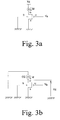
- the Figures 3a and 3b are electrical diagrams to perform the measurements described above.
- the Figures 3a represents an N-gate MOS FET transistor with a moving gate.
- the transistor is biased in the saturation region A2.
- the source S and the substrate B are connected to the ground and to a potential V s and Vb zero.
- the drain D and gate G are at positive potentials respectively V d and V g .
- the measurement of the current in the drain by an ammeter A gives the value of the drain current I d and consequently the distance from the gate to the surface of the substrate.
- the Figure 3b represents an N-gate MOS FET transistor with a moving gate.
- the transistor is biased in the ohmic region A1.
- the source S and the substrate B are connected to ground at a zero potential V s and V b .
- the drain D is connected to a current generator CG which imposes a current I d in the drain of the MOS transistor FET.
- the gate G is at a positive potential V g .
- the drain potential measurement V d makes it possible to know the distance from the gate to the surface of the substrate.
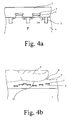
- the figure 4a illustrates a pressure microsensor according to an embodiment of the present invention.
- a P-type silicon substrate 1 On a P-type silicon substrate 1 are formed several moving gate transistors 2. The length of the gates are between 5 and 500 microns. These grids are spaced from the substrate by 50 to 200 nm.
- the source and drain regions 3 and 4 of N + type are formed in the substrate on either side of the movable gate 2.
- the transistors with moving grids are covered with a silicone gel 7 of thickness between 10 and 300 microns.
- Dow Corning proposes gels referenced WL-3010 WL-5150 WL-5350 and WL5351. These gels are either in the form of paste or in liquid form.
- the viscosity of the liquid is adjustable and will be chosen in such a way that the gel does not fill the gap 6 between the movable grid 2 and the substrate 1.
- the viscosity of the liquid will be chosen such that the gel 7 rests on the insulating regions 5 or on the source and drain 3-4.
- the Young's modulus of the silicone gels used is low, typically less than 400 MPa.
- the figure 4b illustrates the operation of the pressure microsensor represented in figure 4a .
- Movable grids are made and are separated from the substrate by the gap 6.
- the silicone gel 7 covers all the movable grids and has an upper surface 8 on which is applied a body in relief, such as, for example, a finger 9.
- the interface 10 between the finger 9 and the surface of the silicone gel reproduces the asperities of the finger.
- the low Young's modulus of the silicone gel allows a local and elastic deformation of the gel under a low pressure exerted by the asperities of the finger. This deformation is then transmitted to mobile grids which, in turn, reproduce the roughness of the finger.
- the mechanical strength of the assembly is ensured by an adhesion of the gel 7 on the grids 2 and by the preferential filling of the gap between the movable grids 2. This filling can also impinge on the periphery of the gap 6 between the grid and substrate.
- the elasticity of the movements of the grid 2 is provided by the silicone gel elasticity which effectively traps the movable grids 2.
- the resistance to this deformation is low and adjustable by the Young's modulus of the silicone gel. Measuring the distance of these grids to the substrate allows the acquisition of skin roughness and fingerprint. When the finger is removed from the surface, the grids 2 return to their initial position and a new profile acquisition can be made.
- the figure 5 illustrates another embodiment of a pressure microsensor according to the present invention.
- a P-type silicon substrate 1 On a P-type silicon substrate 1 are formed several moving gate transistors 2.
- the length of the gate is between 5 and 500 microns. At rest, these grids are spaced from the substrate 50 to 200 nm and separated from the substrate by a gap 6.
- the substrate supporting the moving gate transistors 2 is placed in a cavity 12 delimited at its bottom and on its sides by a material 13.
- the upper part of the cavity is bounded by a membrane 11 substantially flat and parallel to the substrate.
- the surface of the membrane is approximately 1 cm 2 .
- the distance of this membrane to the grids 2 is between 50 and 5000 microns and preferably between 200 and 500 microns.
- This membrane is for example of synthetic polymer type material.
- the cavity is filled with a gas maintained at atmospheric pressure to prevent deformation of the membrane as a function of atmospheric pressure.
- a finger 9 On a portion 14 of the outer surface of the membrane closing the cavity is applied a finger 9. The pressure exerted by the finger elastically deforms and locally the membrane which then reproduces the asperities of the finger.
- the properties of the membrane that is to say its elasticity and its tension are such that there is no permanent deformation of the membrane and that it does not come into physical contact with the grids 2 mobiles.
- the movable grids are brought to a positive voltage, for example 3 volts, and the membrane is brought to a zero voltage.
- the potential difference between the membrane and the gate 2 creates an electrostatic force that attracts the gate to the membrane. This results in a displacement of the gate 2 towards the membrane. This displacement is limited by the restoring forces of the fixing of the grid 2 on the substrate 1.
- the local deformation of the membrane is thus transmitted to the mobile gates by an electrostatic force.
- These mobile grids reproduce the roughness of the finger. The measurement of the distance of these mobile grids to the substrate allows the acquisition of the fingerprint.
- any other type of force applying at a distance can be used.
- the electromagnetic forces or the magnetic forces can be generated and used.
- a current traversing moving gates or a region located in the membrane creates an electromagnetic field capable, in the presence of a magnetic field, of generating a force applied to the mobile gates 2.
- Ferromagnetic materials may be included in the membrane and in the grids to create magnetic fields.
- the figure 6 represents a circuit diagram of a matrix M nm of mobile gate transistors capable of acquiring and recognizing an imprint digital, that is to say to recognize the pattern formed by the lines of the skin or fingers.
- the moving gate transistors shown in the Figures 4a and 4b and 5 are arranged in a matrix M nm of transistors of n lines I i (i varying from 1 to n) and m columns C j (j ranging from 1 to m).
- the surface area of the matrix M nm is less than 1 cm 2 and comprises about 200 moving gate transistors.
- the number of transistors can be much higher but this is not useful for the recognition of a fingerprint.
- the repeat pitch of the transistors is 0.7 mm which is sufficient to detect the roughness of a finger. 200 measurements of cutaneous roughness on a finger allow a good recognition of a fingerprint.
- all the transistors of the M nm matrix are moving gate N-channel MOS FET transistors.
- the drains of all the transistors are electrically connected and biased at a positive voltage V d .
- a conductive connection line I if connects all the sources of the transistors T (i, j) of the same line i.
- a conductive connection column C gj connects all the gates of the transistors T (i, j) of the same column j.
- the figure 7 represents a housing 19 of an electronic chip 20.
- This electronic chip 20 comprises two main regions R1 and R2.
- the pressure microsensor is made in the first region R1.
- all the electrical functions that are usually achievable in an integrated circuit are produced.
- these functions may include the addressing and decoding of the information of the microsensor.
- these functions can include the acquisition, recognition and exploitation of the fingerprint.
- Information transfer modules are also provided for dialogue between this chip 20 and the outside of the box.
- this chip 20 which constitutes an integrated system "SOC" (or system on chip in the English literature.)
- the chip 20 is connected to contact pads 24 located on an outer face of the housing 19 by means of conducting tracks 23 of the electric current, the housing 19 comprises a cavity 25 situated above the region R 1 and opening onto the mobile grids of the pressure microsensor of the region R 1.
- the chosen embodiment in relation to the Figures 4b and 5 is filled by a silicone gel 7 or closed at its upper part by a membrane 11 substantially parallel to the plane of the electronic chip 20. The surface whose profile must be measured is applied to the housing to the right of the cavity 25.
- any flat display system comprising electrodes organized in line and in column following a matrix. At the intersection of each line and each column is located an elementary display cell producing a pixel, as illustrated in FIG. figure 8 .
- each pixel by means of a thin film transistor TFT (Thin Film Transistor), the latter then acting as a switch.
- TFT Thin Film Transistor
- a substrate having the microsensors which have been described so as to produce a tactile plane display can be placed above the display structure.
- any display technique based on a matrix of cells organized in rows and columns may be combined with the microsensors of the present invention according to particular needs.
- an LCD liquid crystal cell Liquid Crystal Display
- LCD liquid crystal cell Liquid Crystal Display
- organic molecules directing the light along an axis as a function of an electric field, the cells being located between two polarizing filters having perpendicular axes.
- OLED organic light-emitting diode
- OLED Organic Lilght Emitting Diods
- LED Light Emitting Display
- the invention is compatible with the most recent techniques, such as MEMS techniques (Micro Electro Mechanical System) such as DMD ( Digital Mirror Device ) mirrors and combine with the pressure microsensor to achieve a touch screen.
- MEMS techniques Micro Electro Mechanical System
- DMD Digital Mirror Device
Landscapes
- Engineering & Computer Science (AREA)
- Theoretical Computer Science (AREA)
- General Engineering & Computer Science (AREA)
- Human Computer Interaction (AREA)
- Physics & Mathematics (AREA)
- General Physics & Mathematics (AREA)
- Multimedia (AREA)
- Pressure Sensors (AREA)
- Measurement Of Length, Angles, Or The Like Using Electric Or Magnetic Means (AREA)
- Image Input (AREA)
- Measuring Fluid Pressure (AREA)
Applications Claiming Priority (1)
| Application Number | Priority Date | Filing Date | Title |
|---|---|---|---|
| FR0705068A FR2918747A1 (fr) | 2007-07-12 | 2007-07-12 | Microcapteur de pression |
Publications (2)
| Publication Number | Publication Date |
|---|---|
| EP2015223A2 true EP2015223A2 (de) | 2009-01-14 |
| EP2015223A3 EP2015223A3 (de) | 2009-03-04 |
Family
ID=39093007
Family Applications (1)
| Application Number | Title | Priority Date | Filing Date |
|---|---|---|---|
| EP08392009A Ceased EP2015223A3 (de) | 2007-07-12 | 2008-07-09 | Mikrodrucksensor |
Country Status (3)
| Country | Link |
|---|---|
| US (1) | US8878790B2 (de) |
| EP (1) | EP2015223A3 (de) |
| FR (1) | FR2918747A1 (de) |
Cited By (4)
| Publication number | Priority date | Publication date | Assignee | Title |
|---|---|---|---|---|
| US20150295062A1 (en) * | 2012-10-12 | 2015-10-15 | Texas State University-San Marcos | Vertically movable gate field effect transistor (vmgfet) on a silicon-on-insulator (soi) wafer and method of forming a vmgfet |
| CN107292215A (zh) * | 2016-03-31 | 2017-10-24 | 上海箩箕技术有限公司 | 光学指纹传感器模组 |
| CN109997021A (zh) * | 2016-11-22 | 2019-07-09 | Nissha株式会社 | 压力传感器 |
| US10620064B2 (en) | 2016-09-16 | 2020-04-14 | Nissha Co., Ltd. | Pressure sensor |
Families Citing this family (30)
| Publication number | Priority date | Publication date | Assignee | Title |
|---|---|---|---|---|
| JP5329668B2 (ja) * | 2009-08-27 | 2013-10-30 | シャープ株式会社 | 表示装置 |
| CN102629052B (zh) * | 2011-05-23 | 2014-08-06 | 北京京东方光电科技有限公司 | 一种液晶显示面板及其驱动方法、液晶显示器件 |
| WO2013192539A1 (en) | 2012-06-21 | 2013-12-27 | Nextinput, Inc. | Wafer level mems force dies |
| EP2870445A1 (de) | 2012-07-05 | 2015-05-13 | Ian Campbell | Mikroelektromechanischer lastsensor und verfahren zur herstellung davon |
| TWI509335B (zh) * | 2012-10-05 | 2015-11-21 | Innocom Tech Shenzhen Co Ltd | 薄膜電晶體觸控顯示面板裝置及其驅動方法 |
| US8618865B1 (en) * | 2012-11-02 | 2013-12-31 | Palo Alto Research Center Incorporated | Capacitive imaging device with active pixels |
| US9013014B2 (en) * | 2013-04-29 | 2015-04-21 | Infineon Technologies Ag | Chip package and a method of manufacturing the same |
| US9606606B2 (en) | 2013-06-03 | 2017-03-28 | Qualcomm Incorporated | Multifunctional pixel and display |
| JP5928420B2 (ja) * | 2013-08-22 | 2016-06-01 | 株式会社デンソー | 縦型トランジスタを用いた荷重センサ |
| CN105934661B (zh) | 2014-01-13 | 2019-11-05 | 触控解决方案股份有限公司 | 微型强化圆片级mems力传感器 |
| US9752944B2 (en) * | 2014-03-12 | 2017-09-05 | Stmicroelectronics S.R.L. | Microelectromechanical sensing structure for a pressure sensor including a deformable test structure |
| US10101373B2 (en) | 2014-04-21 | 2018-10-16 | Palo Alto Research Center Incorporated | Capacitive imaging device with active pixels and method |
| JP6206604B2 (ja) * | 2014-12-17 | 2017-10-04 | 株式会社村田製作所 | 押圧検知装置 |
| USD776664S1 (en) * | 2015-05-20 | 2017-01-17 | Chaya Coleena Hendrick | Smart card |
| EP3307671B1 (de) | 2015-06-10 | 2022-06-15 | Nextinput, Inc. | Widerstandsfähiger mems-kraftsensor auf waferebene mit einem toleranzgraben |
| KR101767726B1 (ko) * | 2015-06-25 | 2017-08-23 | 한양대학교 산학협력단 | 디랙 물질을 구비한 압력 감지 소자 및 이의 동작 방법 |
| CN107292216A (zh) * | 2016-03-31 | 2017-10-24 | 上海箩箕技术有限公司 | 光学指纹传感器模组 |
| US10192091B2 (en) * | 2016-04-25 | 2019-01-29 | Novatek Microelectronics Corp. | Fingerprint sensor apparatus and a method for controlling the fingerprint sensor apparatus |
| CN110494724B (zh) | 2017-02-09 | 2023-08-01 | 触控解决方案股份有限公司 | 集成数字力传感器和相关制造方法 |
| WO2018148510A1 (en) | 2017-02-09 | 2018-08-16 | Nextinput, Inc. | Integrated piezoresistive and piezoelectric fusion force sensor |
| WO2019018641A1 (en) | 2017-07-19 | 2019-01-24 | Nextinput, Inc. | STACK OF STRAIN TRANSFER IN A MEMS FORCE SENSOR |
| US11423686B2 (en) | 2017-07-25 | 2022-08-23 | Qorvo Us, Inc. | Integrated fingerprint and force sensor |
| WO2019023552A1 (en) | 2017-07-27 | 2019-01-31 | Nextinput, Inc. | PIEZORESISTIVE AND PIEZOELECTRIC FORCE SENSOR ON WAFER AND METHODS OF MANUFACTURING THE SAME |
| US11579028B2 (en) | 2017-10-17 | 2023-02-14 | Nextinput, Inc. | Temperature coefficient of offset compensation for force sensor and strain gauge |
| WO2019090057A1 (en) | 2017-11-02 | 2019-05-09 | Nextinput, Inc. | Sealed force sensor with etch stop layer |
| WO2019099821A1 (en) | 2017-11-16 | 2019-05-23 | Nextinput, Inc. | Force attenuator for force sensor |
| CN108594981B (zh) * | 2018-01-02 | 2020-04-03 | 京东方科技集团股份有限公司 | 一种触控面板及其制备方法、指纹识别装置和方法 |
| US10962427B2 (en) | 2019-01-10 | 2021-03-30 | Nextinput, Inc. | Slotted MEMS force sensor |
| CN110458105B (zh) * | 2019-08-12 | 2021-07-23 | Oppo广东移动通信有限公司 | 指纹识别装置及电子设备 |
| TWI821079B (zh) * | 2022-12-21 | 2023-11-01 | 友達光電股份有限公司 | 壓力感測器 |
Citations (10)
| Publication number | Priority date | Publication date | Assignee | Title |
|---|---|---|---|---|
| US5400662A (en) | 1992-04-17 | 1995-03-28 | Enix Corporation | Matrix type surface pressure distribution detecting element |
| EP0919947A2 (de) | 1997-11-27 | 1999-06-02 | Nec Corporation | Gerät zur Fingerabdruckdetektion |
| US6122394A (en) | 1996-05-01 | 2000-09-19 | Xros, Inc. | Compact, simple, 2D raster, image-building fingerprint scanner |
| US6154580A (en) | 1997-07-28 | 2000-11-28 | Nec Corporation | Tactile sensor and fingerprint sensor using same |
| EP1187207A2 (de) | 2000-09-07 | 2002-03-13 | STMicroelectronics, Inc. | Oberflächenmontiertes Gehäuse mit integriertem elektrostatische Ladung ableitendem Ring, das einen Leiterrahmen als ESD-Schutz Bauelement benutzt |
| WO2003078299A1 (en) | 2002-03-20 | 2003-09-25 | Ecole Polytechnique Federale De Lausanne (Epfl) | Process for manufacturing mems |
| US20040049363A1 (en) | 2002-05-31 | 2004-03-11 | Sanyo Electric Co., Ltd., Moriguchi-City, Japan | Surface pressure distribution sensor and manufacturing method for the same |
| GB2407387A (en) | 2003-10-20 | 2005-04-27 | Agilent Technologies Inc | Fingerprint cursor control |
| EP1637498A1 (de) | 2004-09-16 | 2006-03-22 | St Microelectronics S.A. | MOS Transistor mit verformbaren Gate |
| US20070153258A1 (en) | 2005-12-30 | 2007-07-05 | Sergio Hernandez | Optical fingerprint imaging system and method with protective film |
Family Cites Families (8)
| Publication number | Priority date | Publication date | Assignee | Title |
|---|---|---|---|---|
| US4488162A (en) * | 1980-07-08 | 1984-12-11 | International Business Machines Corporation | Self-aligned metal field effect transistor integrated circuits using polycrystalline silicon gate electrodes |
| US4429413A (en) * | 1981-07-30 | 1984-01-31 | Siemens Corporation | Fingerprint sensor |
| DE3635462A1 (de) * | 1985-10-21 | 1987-04-23 | Sharp Kk | Feldeffekt-drucksensor |
| US5600459A (en) * | 1993-12-20 | 1997-02-04 | Roy; Howard S. | Multiple-shutter flat-panel display having individually controlled pixels and method for making same |
| US6317508B1 (en) | 1998-01-13 | 2001-11-13 | Stmicroelectronics, Inc. | Scanning capacitive semiconductor fingerprint detector |
| JPH11295172A (ja) * | 1998-04-06 | 1999-10-29 | Denso Corp | 半導体圧力センサ |
| US6388299B1 (en) * | 1998-12-10 | 2002-05-14 | Honeywell Inc. | Sensor assembly and method |
| US6548848B2 (en) * | 2001-03-15 | 2003-04-15 | Kabushiki Kaisha Toshiba | Semiconductor memory device |
-
2007
- 2007-07-12 FR FR0705068A patent/FR2918747A1/fr active Pending
-
2008
- 2008-07-09 EP EP08392009A patent/EP2015223A3/de not_active Ceased
- 2008-07-10 US US12/170,849 patent/US8878790B2/en active Active
Patent Citations (10)
| Publication number | Priority date | Publication date | Assignee | Title |
|---|---|---|---|---|
| US5400662A (en) | 1992-04-17 | 1995-03-28 | Enix Corporation | Matrix type surface pressure distribution detecting element |
| US6122394A (en) | 1996-05-01 | 2000-09-19 | Xros, Inc. | Compact, simple, 2D raster, image-building fingerprint scanner |
| US6154580A (en) | 1997-07-28 | 2000-11-28 | Nec Corporation | Tactile sensor and fingerprint sensor using same |
| EP0919947A2 (de) | 1997-11-27 | 1999-06-02 | Nec Corporation | Gerät zur Fingerabdruckdetektion |
| EP1187207A2 (de) | 2000-09-07 | 2002-03-13 | STMicroelectronics, Inc. | Oberflächenmontiertes Gehäuse mit integriertem elektrostatische Ladung ableitendem Ring, das einen Leiterrahmen als ESD-Schutz Bauelement benutzt |
| WO2003078299A1 (en) | 2002-03-20 | 2003-09-25 | Ecole Polytechnique Federale De Lausanne (Epfl) | Process for manufacturing mems |
| US20040049363A1 (en) | 2002-05-31 | 2004-03-11 | Sanyo Electric Co., Ltd., Moriguchi-City, Japan | Surface pressure distribution sensor and manufacturing method for the same |
| GB2407387A (en) | 2003-10-20 | 2005-04-27 | Agilent Technologies Inc | Fingerprint cursor control |
| EP1637498A1 (de) | 2004-09-16 | 2006-03-22 | St Microelectronics S.A. | MOS Transistor mit verformbaren Gate |
| US20070153258A1 (en) | 2005-12-30 | 2007-07-05 | Sergio Hernandez | Optical fingerprint imaging system and method with protective film |
Cited By (6)
| Publication number | Priority date | Publication date | Assignee | Title |
|---|---|---|---|---|
| US20150295062A1 (en) * | 2012-10-12 | 2015-10-15 | Texas State University-San Marcos | Vertically movable gate field effect transistor (vmgfet) on a silicon-on-insulator (soi) wafer and method of forming a vmgfet |
| US9450066B2 (en) * | 2012-10-12 | 2016-09-20 | Texas State University | Vertically movable gate field effect transistor (VMGFET) on a silicon-on-insulator (SOI) wafer and method of forming a VMGFET |
| CN107292215A (zh) * | 2016-03-31 | 2017-10-24 | 上海箩箕技术有限公司 | 光学指纹传感器模组 |
| US10620064B2 (en) | 2016-09-16 | 2020-04-14 | Nissha Co., Ltd. | Pressure sensor |
| CN109997021A (zh) * | 2016-11-22 | 2019-07-09 | Nissha株式会社 | 压力传感器 |
| CN109997021B (zh) * | 2016-11-22 | 2021-08-03 | Nissha株式会社 | 压力传感器 |
Also Published As
| Publication number | Publication date |
|---|---|
| US8878790B2 (en) | 2014-11-04 |
| EP2015223A3 (de) | 2009-03-04 |
| US20090027352A1 (en) | 2009-01-29 |
| FR2918747A1 (fr) | 2009-01-16 |
Similar Documents
| Publication | Publication Date | Title |
|---|---|---|
| FR2918747A1 (fr) | Microcapteur de pression | |
| Wu et al. | Taxel-addressable matrix of vertical-nanowire piezotronic transistors for active and adaptive tactile imaging | |
| EP2018571B1 (de) | Bewegungsempfindliche anordnung mit mindestens einem transistor | |
| EP0938131B1 (de) | Schutz gegen elektrostatische Entladung für integrierte Sensorschaltungen mit Passivierung | |
| US6304666B1 (en) | Apparatus for sensing patterns of electrical field variations across a surface | |
| EP0605303B1 (de) | Integrierter Beschleunigungsmesser mit zum Substrat paralleler Messachse | |
| EP2142980A1 (de) | Transparenter multitaktiler sensor | |
| FR2979991A1 (fr) | Capteur de pression piezoelectrique | |
| FR2903207A1 (fr) | Capteur tactile multipoint a matrice active | |
| JPH11155837A (ja) | 指紋検出装置 | |
| TW201230161A (en) | Fabrication of touch, handwriting and fingerprint sensor | |
| FR2981172A1 (fr) | Dispositif d'affichage comprenant une surface multifonctionnelle et communicante | |
| TW201523394A (zh) | 光導性光學觸控 | |
| FR2542453A1 (fr) | Dispositif miniature sensible au champ magnetique et appareil de mesure du champ magnetique incorporant un tel dispositif | |
| WO2018202609A1 (fr) | Procede et dispositif de generation de motifs tactiles | |
| FR2925713A1 (fr) | Capteur tactile multicontacts a mode veille | |
| EP2638457A1 (de) | Verfahren zur erkennung eines bestimmten objekts in einer unterbrochenen umgebung und gestenschnittstelle zur durchführung des verfahrens | |
| EP4047453B1 (de) | Flexible haptische schnittstelle | |
| EP3076896A1 (de) | System zur bestimmung von mindestens eines teils der form eines dreidimensionalen objekts und zugehöriges verfahren | |
| EP3455637A1 (de) | Vorgespannter vibrierender beschleunigungsmesser | |
| WO2014072595A1 (fr) | Surface photovoltaïque polarisante | |
| EP4481380A1 (de) | Bildgebungselement, bildgebungsvorrichtung, bildgebungssystem, analyseverfahren und herstellungsverfahren dafür | |
| WO2016027028A1 (fr) | Dispositif d'acquisition d'empreintes digitales | |
| FR3157618A1 (fr) | Système de classification et procédé correspondant | |
| FR3135525A1 (fr) | Procédé de caractérisation ferroélectrique d’un échantillon piézoélectrique |
Legal Events
| Date | Code | Title | Description |
|---|---|---|---|
| PUAI | Public reference made under article 153(3) epc to a published international application that has entered the european phase |
Free format text: ORIGINAL CODE: 0009012 |
|
| AK | Designated contracting states |
Kind code of ref document: A2 Designated state(s): AT BE BG CH CY CZ DE DK EE ES FI FR GB GR HR HU IE IS IT LI LT LU LV MC MT NL NO PL PT RO SE SI SK TR |
|
| AX | Request for extension of the european patent |
Extension state: AL BA MK RS |
|
| PUAL | Search report despatched |
Free format text: ORIGINAL CODE: 0009013 |
|
| AK | Designated contracting states |
Kind code of ref document: A3 Designated state(s): AT BE BG CH CY CZ DE DK EE ES FI FR GB GR HR HU IE IS IT LI LT LU LV MC MT NL NO PL PT RO SE SI SK TR |
|
| AX | Request for extension of the european patent |
Extension state: AL BA MK RS |
|
| 17P | Request for examination filed |
Effective date: 20090904 |
|
| 17Q | First examination report despatched |
Effective date: 20091002 |
|
| AKX | Designation fees paid |
Designated state(s): DE FR GB IT |
|
| STAA | Information on the status of an ep patent application or granted ep patent |
Free format text: STATUS: THE APPLICATION HAS BEEN REFUSED |
|
| 18R | Application refused |
Effective date: 20110512 |