EP2015406A2 - Ensemble de connecteur électrique et connecteur mâle - Google Patents
Ensemble de connecteur électrique et connecteur mâle Download PDFInfo
- Publication number
- EP2015406A2 EP2015406A2 EP08104706A EP08104706A EP2015406A2 EP 2015406 A2 EP2015406 A2 EP 2015406A2 EP 08104706 A EP08104706 A EP 08104706A EP 08104706 A EP08104706 A EP 08104706A EP 2015406 A2 EP2015406 A2 EP 2015406A2
- Authority
- EP
- European Patent Office
- Prior art keywords
- retainer
- male
- female
- housing
- connector
- Prior art date
- Legal status (The legal status is an assumption and is not a legal conclusion. Google has not performed a legal analysis and makes no representation as to the accuracy of the status listed.)
- Withdrawn
Links
- 238000003780 insertion Methods 0.000 claims abstract description 29
- 230000037431 insertion Effects 0.000 claims abstract description 29
- 230000013011 mating Effects 0.000 claims description 56
- 238000005192 partition Methods 0.000 claims description 13
- 210000000078 claw Anatomy 0.000 abstract description 34
- 230000002093 peripheral effect Effects 0.000 description 8
- 230000007423 decrease Effects 0.000 description 3
- 230000003247 decreasing effect Effects 0.000 description 3
- 239000011347 resin Substances 0.000 description 3
- 229920005989 resin Polymers 0.000 description 3
- 230000000149 penetrating effect Effects 0.000 description 2
- 238000010276 construction Methods 0.000 description 1
- 238000000034 method Methods 0.000 description 1
- 238000000465 moulding Methods 0.000 description 1
- 230000002265 prevention Effects 0.000 description 1
Images



Classifications
-
- H—ELECTRICITY
- H01—ELECTRIC ELEMENTS
- H01R—ELECTRICALLY-CONDUCTIVE CONNECTIONS; STRUCTURAL ASSOCIATIONS OF A PLURALITY OF MUTUALLY-INSULATED ELECTRICAL CONNECTING ELEMENTS; COUPLING DEVICES; CURRENT COLLECTORS
- H01R13/00—Details of coupling devices of the kinds covered by groups H01R12/70 or H01R24/00 - H01R33/00
- H01R13/40—Securing contact members in or to a base or case; Insulating of contact members
- H01R13/42—Securing in a demountable manner
- H01R13/436—Securing a plurality of contact members by one locking piece or operation
- H01R13/4361—Insertion of locking piece perpendicular to direction of contact insertion
- H01R13/4362—Insertion of locking piece perpendicular to direction of contact insertion comprising a temporary and a final locking position
-
- H—ELECTRICITY
- H01—ELECTRIC ELEMENTS
- H01R—ELECTRICALLY-CONDUCTIVE CONNECTIONS; STRUCTURAL ASSOCIATIONS OF A PLURALITY OF MUTUALLY-INSULATED ELECTRICAL CONNECTING ELEMENTS; COUPLING DEVICES; CURRENT COLLECTORS
- H01R13/00—Details of coupling devices of the kinds covered by groups H01R12/70 or H01R24/00 - H01R33/00
- H01R13/62—Means for facilitating engagement or disengagement of coupling parts or for holding them in engagement
- H01R13/627—Snap or like fastening
-
- H—ELECTRICITY
- H01—ELECTRIC ELEMENTS
- H01R—ELECTRICALLY-CONDUCTIVE CONNECTIONS; STRUCTURAL ASSOCIATIONS OF A PLURALITY OF MUTUALLY-INSULATED ELECTRICAL CONNECTING ELEMENTS; COUPLING DEVICES; CURRENT COLLECTORS
- H01R13/00—Details of coupling devices of the kinds covered by groups H01R12/70 or H01R24/00 - H01R33/00
- H01R13/64—Means for preventing incorrect coupling
-
- H—ELECTRICITY
- H01—ELECTRIC ELEMENTS
- H01R—ELECTRICALLY-CONDUCTIVE CONNECTIONS; STRUCTURAL ASSOCIATIONS OF A PLURALITY OF MUTUALLY-INSULATED ELECTRICAL CONNECTING ELEMENTS; COUPLING DEVICES; CURRENT COLLECTORS
- H01R12/00—Structural associations of a plurality of mutually-insulated electrical connecting elements, specially adapted for printed circuits, e.g. printed circuit boards [PCB], flat or ribbon cables, or like generally planar structures, e.g. terminal strips, terminal blocks; Coupling devices specially adapted for printed circuits, flat or ribbon cables, or like generally planar structures; Terminals specially adapted for contact with, or insertion into, printed circuits, flat or ribbon cables, or like generally planar structures
- H01R12/70—Coupling devices
- H01R12/7005—Guiding, mounting, polarizing or locking means; Extractors
- H01R12/7011—Locking or fixing a connector to a PCB
Definitions
- the present invention relates to an electrical connector assembly comprising a female connector having a female housing and a male connector that mates with the female connector and has a male housing accommodated in the female housing.
- an electrical connector assembly comprising a female connector and a male connector that mates with the female connector has been used to electrically connect a circuit board in an electronic device for a vehicle to electric wires.
- the female connector generally includes a female housing and a plurality of male contacts that are installed in the female housing and are connected to the circuit board.
- the male connector generally includes a male housing accommodated in the female housing and female contacts that are installed in the male housing and each connected to the electric wire, and come into contact with the male contacts.
- a lance is provided in the male connector housing or the female contact.
- the male connector must naturally be downsized.
- the density of internal structure thereof is increased, so that the female contact is downsized.
- the size of the lance is also decreased. If the size of the lance is decreased, a force capable of holding the female contact decreases, so that the function of preventing the female contacts from coming off also decreases. Also, if the size of the lance is decreased, there arises a problem in that it is difficult to mold the lance by using molding dies.
- a male connector 5 includes a lance block 3 for pre-latching a female contact 1 in a male housing 2 and a retainer 4 for latching the female contact 1, which has been pre-latched by the lance block 3, to the male housing 2 as shown in FIG. 9
- Japanese Patent Application No. 2006-155018 Japanese Patent Application No. 2006-155018
- the lance block 3 is first installed in the male housing 2.
- the female contact 1 is then inserted into a contact slot 6 formed in the male housing 2.
- the female contact 1 in the contact slot 6 is pre-latched by the lance block 3.
- the retainer 4 is installed in the female housing 2, and the female contact 1 is latched.
- the female contact 1 is latched to the male housing 2 by the lance block 3 and the retainer 4 in a state of being inserted into the contact slot 6.
- the lance block 3 and the retainer 4 are not pushed completely into the male housing 2 in some cases. In such a case, the lance block 3 and the retainer 4 project from the male housing 2, so that usually, the male connector 5 cannot be inserted into the female connector 7.
- the male connector 5 can sometimes be inserted into the female connector 7 if the lance block 3 and the retainer 4 are pushed in forcedly because the female housing 8 of the female connector 7 is made of a resin and therefore has elasticity.
- the female contact 1 is not fixed in the male housing 2 reliably, so that the engagement of the female contact 1 with a male contact 9 on the female connector 7 side may be incomplete.
- the male connector 5 is formed by the three parts, that is, the male housing 2, the lance block 3, and the retainer 4, the assembling manpower increases.
- the present art still has room for improvement in terms of the increase in work efficiency and the increase in the reliability due to complete engagement of the male contact with the female contact.
- the present invention has been made to solve the above technical problems, and accordingly an object thereof is to provide an electrical connector assembly in which a male contact is reliably engaged with a female contact to increase the reliability and work efficiency and to provide a male connector used in such an electrical connector assembly.
- the electrical connector assembly in accordance with the present invention that has been made to achieve the above object includes a female connector and a male connector mating with the female connector.
- the female connector includes a female housing having a mating recess that accommodates the male connector and a plurality of male contacts held by the female housing.
- the male connector includes a male housing inserted into the mating recess, a plurality of female contacts capable of being electrically connected to the male contacts, and a retainer that is mounted in the male housing to hold the female contacts.
- the male housing there is formed a slot into which the retainer is inserted in the direction perpendicular to the direction in which the male housing is inserted into the mating recess.
- the retainer can be locked in the slot at a first position at which the retainer does not project from the male housing and can be into the mating recess in the female housing and a second position at which a part of the retainer projects from the male housing by 1/2 times of an arrangement pitch p of the female contacts held by the retainer and interferes with the female housing when the retainer is inserted into the mating recess.
- the female contacts are installed to the retainer in the state in which the retainer is locked at the second position.
- a part of the retainer having been inserted into the slot projects from the male housing.
- the projecting direction is perpendicular to the direction in which the male housing is inserted into the mating recess. If the worker makes an attempt to mistakenly insert the male connectors into the mating recess in the female connector in this state, the projecting retainer interferes with the female connector. Therefore, in this state, the male connector cannot mate with the female connector.
- the retainer If the retainer is locked in the slot at the first position, the retainer does not project from the male housing. If the male connector is inserted into the mating recess in the female connector in this state, the male connector can mate with the female connector without interference of the retainer with the female housing. Therefore, the female connector and the male connector can be electrically connected to each other.
- the female contacts held by the retainer are misaligned with the female contacts at the first position. Even if the worker makes an attempt to insert the male connector into the mating recess in the female connector in this state, the female contacts and the male contacts cannot be connected to each other because the female contacts of the male connector and the male contacts of the female connector are misaligned with each other. Therefore, when the retainer lies at the second position, the female contacts and the male contacts cannot physically be connected to each other. Therefore, even if the worker makes an attempt to forcedly mate the male housing with the female housing, wrong contact between the female contacts and the male contacts can be prevented.
- the retainer is configured so as to be inserted along the arrangement direction of the female contacts held by the retainer.
- the mating recess in the female connector generally has a rectangular shape that is long in the arrangement direction of the female contacts. If the retainer is inserted along the arrangement direction of the female contacts, at the second position, a part of the retainer interferes with the short side of the mating recess in the female connector.
- the short side of the female housing has a higher rigidity and therefore is less liable to be deformed than the long side thereof, so that if the retainer is in a projected state, the retainer surely interferes with the female contacts.
- the tip end surface of the male housing there are formed a plurality of insertion holes into which the male contacts are inserted one by one when the male housing is inserted into the mating recess.
- the retainer is formed with a plurality of contact slots for holding the female contacts one by one, and partitions are formed between the adjacent contact slots.
- the male contacts of the female connector are guided to correct positions by the insertion holes.
- the retainer is at the second position, even if the worker makes an attempt to insert the male connector into the mating recess in the female connector, the female contacts of the male connector and the male contacts of the female connector are misaligned with each other. Even if the worker makes an attempt to insert the male connector into the mating recess in the female connector in the state in which the female contacts and the male contacts are misaligned with each other, since the male contacts are positioned by the insertion holes in the male housing, the male contacts can be prevented from being deformed inadvertently.
- the insertion holes in the male housing are closed by the partitions of the retainer. Therefore, the male connector positioned by the insertion holes in the male housing interferes with the interpole walls, so that the insertion of the male contacts into the contact slot in the retainer is blocked. Therefore, even if the worker makes an attempt to mate the male connector with the female connector when the retainer is at the second position, wrong contact between the female contacts and the male contacts can be prevented.
- the retainer In the state in which the retainer is locked at the second position, even if the worker makes an attempt to insert the male connector into the mating recess in the female connector, the retainer projecting from the male housing interferes with the female housing. If the worker makes an attempt to insert the male connector into the mating recess in the female connector in this state, the worker gets to know the interference of the retainer with the female housing, and therefore can recognize that the retainer is in a state of being locked at the second position.
- the retainer interferes with the female housing immediately after the male connector has begun to be inserted into the mating recess in the female connector. Therefore, the worker can early recognize that the retainer is in a state of being locked at the second position.
- the present invention can be applied to only the male connector mated with the mating recess in the female connector.
- This male connector includes a male housing inserted into the mating recess, a plurality of female contacts capable of being electrically connected to male contacts of the female connector, and a retainer that is mounted in the male housing to hold the female contacts.
- the male housing there is formed a slot in which the retainer is inserted in the direction perpendicular to the direction in which the male housing is inserted into the mating recess, and in the tip end surface of the male housing, there are formed a plurality of insertion holes in which the plurality of male contacts are inserted one by one when the male housing is inserted into the mating recess.
- the retainer can be locked in the slot at a first position at which the retainer does not project from the male housing and can be inserted into the mating recess in the female housing and a second position at which a part of the retainer projects from the male housing by 1/2 times of an arrangement pitch p of the female contacts held by the retainer and interferes with the female housing when the retainer is inserted into the mating recess, and also the retainer is provided with a plurality of contact slots for holding the female contacts one by one, and partitions are formed between the adjacent contact slots.
- the retainer in the state in which the retainer is locked at the second position, since a part of the retainer inserted into the slot projects from a convex part, even if the worker makes an attempt to insert the male connector into the mating recess in the female connector in this state, the projecting retainer interferes with the female housing. Therefore, in this state, the male connector cannot mate with the female connector. As a result, the male connector can be prevented from being mistakenly mated with the female connector in the state in which the retainer is locked at the second position, and therefore the reliability of work can be enhanced.
- the female contacts held by the retainer are misaligned with the female contacts at the first position.
- the retainer lies at the second position, even if the worker makes an attempt to mistakenly mate the male connector with the female connector, wrong contact between the female contacts and the male contacts can be prevented because the female contacts and the male contacts are misaligned with each other. In this respect as well, the reliability of work can be enhanced.
- the male contacts of the female connector can be positioned at the correct positions. This also contributes to the prevention of wrong contact between the female contacts and the male contacts.
- the male contacts are caused to interfere with the partitions even if the worker makes an attempt to mate the male connector with the female connector when the retainer lies at the second position. As a result, wrong contact between the female contacts and the male contacts can be prevented.
- the retainer In the state in which the retainer is locked at the second position, even if the worker makes an attempt to insert the male connectors into the mating recess in the female connector, the projecting retainer interferes with the female housing. If the worker makes an attempt to insert the male connector into the mating recess in the female connector in this state, the worker gets to know the interference of the retainer with the female housing, and therefore can recognize that the retainer is in a state of being locked at the second position.
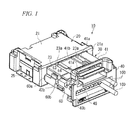
- an electrical connector assembly 10 comprises a female connector 20 and a male connector 30.
- the female connector 20 includes a female housing 21 formed of an insulative resin and a plurality of male contacts 22 provided in the female housing 21.
- the female housing 21 is formed with a mating recess 23 for accommodating a male housing 40 in one surface 21a side thereof.
- ridges 23a extending in the insertion/removal direction of the male housing 40 are formed.
- a plurality of contact slots 24 penetrating from the other surface 21b side of the female housing 21 to the mating recess 23 are formed at a predetermined interval.
- the male contacts 22 are held by the female housing 21 by being fitted in the contact slots 24.
- a peg 25 for fixing the female housing 21 to a printed wiring board (not shown) is provided.
- the male connector 30 includes the male housing 40 that is formed of an insulative resin and is inserted into the mating recess 23 formed in the female housing 21, a plurality of female contacts 50 capable of being electrically connected to the male contacts 22, and a retainer 60 for securing the female contacts 50 to the female housing 40.
- the male housing 40 has a convex part 41 having a cross-sectional shape corresponding to the cross-sectional shape of the mating recess 23 of the female housing 21.
- guide grooves 41a that are continuous in the insertion/removal direction of the male housing 40 with respect to the mating recess 23 are formed.
- the guide grooves 41a engage with the ridges 23a in the mating recess 23, by which the male housing 40 is guided in the insertion/removal direction of the male housing 40 with respect to the mating recess 23.
- the guide grooves 41a and the ridges 23a have a function as a key for preventing wrong engagement so that the male housing 40 and the female housing 21 are engaged with each other in a correct combination.
- a locking claw 41b that engages with a locking recess (not shown) formed in the inner peripheral surface of the mating recess 23 is provided.
- the convex part 41 is inserted into the mating recess 23, and the locking claw 41b is locked to the locking concave part in the mating recess 23, by which the female housing 21 and the male housing 40 that have been engaged with each other are locked.
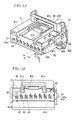
- a retainer slot (slot) 42 extending in the direction perpendicular to the insertion/removal direction of the male housing 40 with respect to the female housing 21 is formed.
- the retainer slot 42 is formed so as to be open to a side surface 41c of the convex part 41.
- An end part 42a of the retainer slot 42 is located in the vicinity of a tip end part 41d of the convex part 41.
- a ridge 42b extending in the same direction as that of the retainer slot 42 is formed.
- a plurality of insertion holes 43 in which the male contacts 22 are inserted are formed at the same interval as that of the male contacts 22 held in the female housing 21 of the female connector 20.
- an opening 45 penetrating from the other surface 40b to the retainer slot 42 is formed.
- the opening 45 electric wires 100 to be connected to the female contacts 50 are inserted.
- the opening 45 is formed into a slit shape extending in the slide direction of the retainer 60 so that the retainer 60 can be slid in the state in which the female contacts 50 connected to the tip end parts of the electric wires 100 are held by the retainer 60.
- the retainer 60 has a cross-sectional shape corresponding to the cross-sectional shape of the retainer slot 42 in the male housing 40 so as to be capable of being inserted into the retainer slot 42.
- a plurality of contact slots 61 for holding the female contacts 50 are formed at a predetermined interval.
- a lance 65 that locks the female contact 50 is formed, so that in the contact slot 61, the tip end part of the female contact 50 is held so as to be located in almost the same plane as a side surface 60a of the retainer 60.
- the contact slots 61 are partitioned from each other by partitions 62.
- Each of the partitions 62 is formed so as to have a cross section capable of closing the insertion hole 43 on the side surface 60a of the retainer 60.
- a part 60b facing to the ridge 42b of the retainer slot 42 is open.
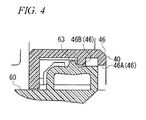
- a locking convex part 63 for locking the retainer 60 having been inserted into the retainer slot 42 and a lock claw 64 for preventing the retainer 60 from coming off the retainer slot 42 are provided.
- locking claws 46 and 47 are formed at positions corresponding to the locking convex part 63 and the lock claw 64, respectively.
- a first locking claw 46A and a second locking claw 46B are provided at two locations spaced along the insertion/removal direction of the retainer 60 with respect to the retainer slot 42.
- the first locking claw 46A is formed at a position at which the retainer 60 projects from the side surface 41c of the convex part 41 of the male housing 40 as shown in FIG. 5 (a second position) in a state of being engaged with the locking convex part 63 of the retainer 60 inserted into the retainer slot 42 (this state is referred to as a pre-latched state).
- the first locking claw 46A is formed so that the projection dimension from the side surface 41c of the retainer 60 is 1/2 times of an arrangement pitch p of the adjacent contact slots 61 (hereinafter, this dimension is referred to as a half pitch).
- the second locking claw 46B is formed at a position at which the retainer 60 does not project from the side surface 41c of the convex part 41 of the male housing 40 (a first position) in a state of being engaged with the locking convex part 63 of the retainer 60 inserted into the retainer slot 42 (this state is referred to as a latched state).
- the locking claw 47 is formed at a position at which it engages with the lock claw 64 in the pre-latched state in which the first locking claw 46A engages with the locking convex part 63.
- the locking claw 47 and the lock claw 64 are formed so as to engage with each other more deeply than the engagement state of the first locking claw 46A with the locking convex part 63.
- the reason for this is that the retainer 60 that is in the pre-latched state in which the first locking claw 46A engages with the locking convex part 63 is prevented from coming off the retainer slot 42.
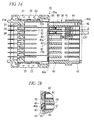
- FIG. 7A is a cross-section showing a positional relationship between the lock claw 64 and the locking claw 47 in the pre-latched state
- FIG. 7B is a cross-section showing a positional relationship between the lock claw 64 and the locking claw 47 in the latched state.
- the retainer 60 is inserted into the retainer slot 42, and the first locking claw 46A is engaged with the locking convex part 63, by which the pre-latched state is formed.
- the retainer 60 projects by the half pitch from the side surface 41c of the convex part 41 of the male housing 40.
- the contact slots 61 in the retainer 60 and the insertion holes 43 in the male housing 40 also are misaligned with each other by the half pitch, and the partitions 62 are located at the positions facing to the insertion holes 43.
- the female contacts 50 installed to the end parts of the electric wires 100 are inserted into the contact slots 61 in the retainer 60 through the opening 45 in the male housing 40, and the female contacts 50 are pre-latched by the lances 65 formed in the contact slots 61 in the retainer 60.
- the retainer 60 is pushed in completely, and the locking convex part 63 is engaged with the second locking claw 46B, by which the latched state is formed.
- the retainer 60 does not project from the side surface 41c of the convex part 41 of the male housing 40, and is located so as to be approximately flush with the side surface 41c or in an inner part of the convex part 41 beyond the side surface 41c.
- the contact slot 61 in the retainer 60 and the insertion hole 43 in the male housing 40 continue on one straight line. As a result, the female contact 50 held in the contact slot 61 faces to the insertion hole 43 in the male housing 40.
- the assembled male connector 30 mates with the female connector 20 that has been assembled separately.
- the convex part 41 of the male housing 40 is inserted into the mating recess 23 in the female housing 21.
- the male contacts 22 of the female connector 20 are inserted into the female contacts 50 in the retainer 60 through the insertion holes 43 in the male housing 40.
- the retainer 60 projects from the side surface 41c of the convex part 41 of the male housing 40.
- the side surface 60a of the projecting retainer 60 collides with the female housing 21 of the female connector 20, and the retainer 60 cannot be pushed further into the mating recess 23. Therefore, the worker can surely get to know that the retainer 60 is in the pre-latched state.
- the contact slots 61 in the retainer 60 and the insertion holes 43 in the male housing 40 are misaligned with each other by the half pitch, and the partitions 62 of the retainer 60 are located so as to face to the insertion holes 43. Therefore, the male contacts 22 collide with the partitions 62 through the insertion holes 43, and are not connected to the female contacts 50. Thereby, incomplete engagement of the female contacts 22 with the female contacts 50 can be prevented.
- the configuration is made such that there is provided the retainer 60 that is inserted into the direction perpendicular to the insertion/removal direction of the male connector 30 with respect to the female connector 20, and further the retainer 60 can be locked at two stages of the pre-latched state and the latched state with respect to the male housing 40 by the first locking claw 46A and the second locking claw 46B.
- the male contacts 22 and the female contacts 50 can reliably be connected electrically to each other.
- the retainer 60 is in the pre-latched state, wrong contact between the male contacts 22 and the female contacts 50 is prevented, and also if the worker makes an attempt to mate the male connector 30 with the female connector 20 mistakenly, the worker can early get to know this fact. Therefore, an inadvertent work loss can be avoided, and the work efficiency can be improved.
Landscapes
- Connector Housings Or Holding Contact Members (AREA)
- Details Of Connecting Devices For Male And Female Coupling (AREA)
Applications Claiming Priority (1)
| Application Number | Priority Date | Filing Date | Title |
|---|---|---|---|
| JP2007184179A JP2009021159A (ja) | 2007-07-13 | 2007-07-13 | 電気コネクタ組立体、雄型コネクタ |
Publications (2)
| Publication Number | Publication Date |
|---|---|
| EP2015406A2 true EP2015406A2 (fr) | 2009-01-14 |
| EP2015406A3 EP2015406A3 (fr) | 2010-07-14 |
Family
ID=39884735
Family Applications (1)
| Application Number | Title | Priority Date | Filing Date |
|---|---|---|---|
| EP08104706A Withdrawn EP2015406A3 (fr) | 2007-07-13 | 2008-07-10 | Ensemble de connecteur électrique et connecteur mâle |
Country Status (4)
| Country | Link |
|---|---|
| US (1) | US20090017690A1 (fr) |
| EP (1) | EP2015406A3 (fr) |
| JP (1) | JP2009021159A (fr) |
| CN (1) | CN101345369A (fr) |
Families Citing this family (3)
| Publication number | Priority date | Publication date | Assignee | Title |
|---|---|---|---|---|
| JP5317860B2 (ja) * | 2009-07-01 | 2013-10-16 | 矢崎総業株式会社 | コネクタ |
| JP5827082B2 (ja) * | 2011-09-08 | 2015-12-02 | タイコエレクトロニクスジャパン合同会社 | 電気コネクタ |
| CN107658632B (zh) * | 2017-09-08 | 2019-10-01 | 番禺得意精密电子工业有限公司 | 电连接器组合 |
Citations (1)
| Publication number | Priority date | Publication date | Assignee | Title |
|---|---|---|---|---|
| JP2006155018A (ja) | 2004-11-26 | 2006-06-15 | Canon Inc | 画像形成装置 |
Family Cites Families (26)
| Publication number | Priority date | Publication date | Assignee | Title |
|---|---|---|---|---|
| JP2700063B2 (ja) * | 1989-06-27 | 1998-01-19 | 矢崎総業株式会社 | 電気コネクタ |
| JPH07114132B2 (ja) * | 1990-05-16 | 1995-12-06 | 矢崎総業株式会社 | コネクタ |
| EP0511649B1 (fr) * | 1991-04-30 | 1996-11-13 | Yazaki Corporation | Connecteur |
| JP2541164Y2 (ja) * | 1991-05-13 | 1997-07-09 | 住友電装株式会社 | コネクタ |
| JP2581476Y2 (ja) * | 1993-04-13 | 1998-09-21 | 住友電装株式会社 | コネクタ |
| FR2717316B1 (fr) * | 1994-03-14 | 1996-05-31 | Cinch Connecteurs Sa | Elément de boîtier de connecteur électrique. |
| JP3125846B2 (ja) * | 1995-06-09 | 2001-01-22 | 矢崎総業株式会社 | 端子係止具を備えたコネクタ |
| JP3322803B2 (ja) * | 1996-09-09 | 2002-09-09 | 矢崎総業株式会社 | スペーサの係止構造 |
| JPH10106665A (ja) * | 1996-10-01 | 1998-04-24 | Sumitomo Wiring Syst Ltd | コネクタ |
| JP3632811B2 (ja) * | 1997-09-17 | 2005-03-23 | 住友電装株式会社 | リテーナ付きコネクタ |
| US5997364A (en) * | 1998-01-09 | 1999-12-07 | Sumitomo Wiring Systems, Ltd. | Electrical connector |
| JP3436113B2 (ja) * | 1998-01-27 | 2003-08-11 | 住友電装株式会社 | コネクタ |
| US5928038A (en) * | 1998-04-24 | 1999-07-27 | Molex Incorporated | Electrical connector position assurance system |
| JP4021580B2 (ja) * | 1999-03-03 | 2007-12-12 | 住友電装株式会社 | コネクタ |
| US6478632B2 (en) * | 2000-04-28 | 2002-11-12 | Sumitomo Wiring Systems, Ltd. | Shake preventing construction for a terminal fitting and a connector |
| JP4096512B2 (ja) * | 2000-12-19 | 2008-06-04 | 住友電装株式会社 | コネクタ |
| JP4058903B2 (ja) * | 2000-12-19 | 2008-03-12 | 住友電装株式会社 | コネクタ |
| JP3674948B2 (ja) * | 2001-04-13 | 2005-07-27 | 住友電装株式会社 | コネクタ |
| JP3753019B2 (ja) * | 2001-06-15 | 2006-03-08 | 住友電装株式会社 | コネクタ |
| JP3755432B2 (ja) * | 2001-06-25 | 2006-03-15 | 住友電装株式会社 | コネクタ |
| US6878018B2 (en) * | 2003-01-02 | 2005-04-12 | Yazaki Corporation | Electrical connector |
| JP2004220945A (ja) * | 2003-01-16 | 2004-08-05 | Sumitomo Wiring Syst Ltd | コネクタ |
| US6976858B1 (en) * | 2004-05-26 | 2005-12-20 | Ddk Ltd. | Electric connector |
| JP4820270B2 (ja) * | 2005-11-22 | 2011-11-24 | 矢崎総業株式会社 | コネクタ |
| US7278890B1 (en) * | 2006-07-26 | 2007-10-09 | Delphi Technologies, Inc. | Electrical connector with secondary lock |
| JP2008047476A (ja) * | 2006-08-21 | 2008-02-28 | Fci Connectors Singapore Pte Ltd | コネクタ |
-
2007
- 2007-07-13 JP JP2007184179A patent/JP2009021159A/ja active Pending
-
2008
- 2008-07-10 EP EP08104706A patent/EP2015406A3/fr not_active Withdrawn
- 2008-07-11 CN CNA2008101379293A patent/CN101345369A/zh active Pending
- 2008-07-11 US US12/171,493 patent/US20090017690A1/en not_active Abandoned
Patent Citations (1)
| Publication number | Priority date | Publication date | Assignee | Title |
|---|---|---|---|---|
| JP2006155018A (ja) | 2004-11-26 | 2006-06-15 | Canon Inc | 画像形成装置 |
Also Published As
| Publication number | Publication date |
|---|---|
| US20090017690A1 (en) | 2009-01-15 |
| EP2015406A3 (fr) | 2010-07-14 |
| CN101345369A (zh) | 2009-01-14 |
| JP2009021159A (ja) | 2009-01-29 |
Similar Documents
| Publication | Publication Date | Title |
|---|---|---|
| EP3208893B1 (fr) | Connecteur avec assurance de position de borne | |
| EP2610974A2 (fr) | Connecteur électrique | |
| JP4926836B2 (ja) | コネクタ | |
| US6716069B2 (en) | Connector with a housing and a retainer held securely on the housing | |
| CN101218714B (zh) | 带有接线端位置保证装置的连接器组件 | |
| JP5900684B1 (ja) | 電気コネクタ | |
| EP1524730A1 (fr) | Connecteur électrique | |
| JP6500112B2 (ja) | Cpa受容部材を含む中間ハウジングおよびそのようなハウジングを備えるプラグ型コネクタシステム | |
| JP2001230021A (ja) | コネクタ | |
| EP1816709A1 (fr) | Connecteur, assemblage de connecteur et sa méthode d'assemblage | |
| CN108832427B (zh) | 用于安全系统的连接器组件 | |
| JPWO2009148027A1 (ja) | 電気コネクタ | |
| US7195522B2 (en) | Electrical connector | |
| EP0963009B1 (fr) | Dipositif de protection contre erreurs d'assemblage d'un bôitièr et un covercle et connecteur le comprenant | |
| US7182652B2 (en) | Connector | |
| JP3311228B2 (ja) | 端子係止具付きコネクタ | |
| EP2015406A2 (fr) | Ensemble de connecteur électrique et connecteur mâle | |
| EP2051335B1 (fr) | Connecteur | |
| JP3634111B2 (ja) | 雌型コネクタ | |
| EP1801925A1 (fr) | Connecteur et ensemble de connecteurs | |
| JP4544065B2 (ja) | コネクタ | |
| JP2003197312A (ja) | ロック付き電気コネクタ | |
| JP4434147B2 (ja) | コネクタ | |
| EP1916746A2 (fr) | Connecteur | |
| JP7460293B2 (ja) | コネクタハウジング、cpa付きコネクタ、及びワイヤーハーネス |
Legal Events
| Date | Code | Title | Description |
|---|---|---|---|
| PUAI | Public reference made under article 153(3) epc to a published international application that has entered the european phase |
Free format text: ORIGINAL CODE: 0009012 |
|
| AK | Designated contracting states |
Kind code of ref document: A2 Designated state(s): AT BE BG CH CY CZ DE DK EE ES FI FR GB GR HR HU IE IS IT LI LT LU LV MC MT NL NO PL PT RO SE SI SK TR |
|
| AX | Request for extension of the european patent |
Extension state: AL BA MK RS |
|
| RAP1 | Party data changed (applicant data changed or rights of an application transferred) |
Owner name: TYCO ELECTRONICS JAPAN G.K. |
|
| PUAL | Search report despatched |
Free format text: ORIGINAL CODE: 0009013 |
|
| AK | Designated contracting states |
Kind code of ref document: A3 Designated state(s): AT BE BG CH CY CZ DE DK EE ES FI FR GB GR HR HU IE IS IT LI LT LU LV MC MT NL NO PL PT RO SE SI SK TR |
|
| AX | Request for extension of the european patent |
Extension state: AL BA MK RS |
|
| AKY | No designation fees paid | ||
| REG | Reference to a national code |
Ref country code: DE Ref legal event code: R108 Effective date: 20110222 Ref country code: DE Ref legal event code: 8566 |
|
| STAA | Information on the status of an ep patent application or granted ep patent |
Free format text: STATUS: THE APPLICATION IS DEEMED TO BE WITHDRAWN |
|
| 18D | Application deemed to be withdrawn |
Effective date: 20110115 |