EP2016395B1 - Analysesystem für schüttgut - Google Patents
Analysesystem für schüttgut Download PDFInfo
- Publication number
- EP2016395B1 EP2016395B1 EP07728947.8A EP07728947A EP2016395B1 EP 2016395 B1 EP2016395 B1 EP 2016395B1 EP 07728947 A EP07728947 A EP 07728947A EP 2016395 B1 EP2016395 B1 EP 2016395B1
- Authority
- EP
- European Patent Office
- Prior art keywords
- bulk material
- conveyor belt
- spectral
- bulk
- real
- Prior art date
- Legal status (The legal status is an assumption and is not a legal conclusion. Google has not performed a legal analysis and makes no representation as to the accuracy of the status listed.)
- Active
Links
Images

Classifications
-
- G—PHYSICS
- G01—MEASURING; TESTING
- G01J—MEASUREMENT OF INTENSITY, VELOCITY, SPECTRAL CONTENT, POLARISATION, PHASE OR PULSE CHARACTERISTICS OF INFRARED, VISIBLE OR ULTRAVIOLET LIGHT; COLORIMETRY; RADIATION PYROMETRY
- G01J3/00—Spectrometry; Spectrophotometry; Monochromators; Measuring colours
- G01J3/28—Investigating the spectrum
- G01J3/2823—Imaging spectrometer
-
- G—PHYSICS
- G01—MEASURING; TESTING
- G01J—MEASUREMENT OF INTENSITY, VELOCITY, SPECTRAL CONTENT, POLARISATION, PHASE OR PULSE CHARACTERISTICS OF INFRARED, VISIBLE OR ULTRAVIOLET LIGHT; COLORIMETRY; RADIATION PYROMETRY
- G01J3/00—Spectrometry; Spectrophotometry; Monochromators; Measuring colours
- G01J3/02—Details
-
- G—PHYSICS
- G01—MEASURING; TESTING
- G01J—MEASUREMENT OF INTENSITY, VELOCITY, SPECTRAL CONTENT, POLARISATION, PHASE OR PULSE CHARACTERISTICS OF INFRARED, VISIBLE OR ULTRAVIOLET LIGHT; COLORIMETRY; RADIATION PYROMETRY
- G01J3/00—Spectrometry; Spectrophotometry; Monochromators; Measuring colours
- G01J3/02—Details
- G01J3/0264—Electrical interface; User interface
-
- G—PHYSICS
- G01—MEASURING; TESTING
- G01J—MEASUREMENT OF INTENSITY, VELOCITY, SPECTRAL CONTENT, POLARISATION, PHASE OR PULSE CHARACTERISTICS OF INFRARED, VISIBLE OR ULTRAVIOLET LIGHT; COLORIMETRY; RADIATION PYROMETRY
- G01J3/00—Spectrometry; Spectrophotometry; Monochromators; Measuring colours
- G01J3/12—Generating the spectrum; Monochromators
-
- G—PHYSICS
- G01—MEASURING; TESTING
- G01N—INVESTIGATING OR ANALYSING MATERIALS BY DETERMINING THEIR CHEMICAL OR PHYSICAL PROPERTIES
- G01N21/00—Investigating or analysing materials by the use of optical means, i.e. using sub-millimetre waves, infrared, visible or ultraviolet light
- G01N21/17—Systems in which incident light is modified in accordance with the properties of the material investigated
- G01N21/25—Colour; Spectral properties, i.e. comparison of effect of material on the light at two or more different wavelengths or wavelength bands
- G01N21/31—Investigating relative effect of material at wavelengths characteristic of specific elements or molecules, e.g. atomic absorption spectrometry
-
- G—PHYSICS
- G01—MEASURING; TESTING
- G01N—INVESTIGATING OR ANALYSING MATERIALS BY DETERMINING THEIR CHEMICAL OR PHYSICAL PROPERTIES
- G01N21/00—Investigating or analysing materials by the use of optical means, i.e. using sub-millimetre waves, infrared, visible or ultraviolet light
- G01N21/84—Systems specially adapted for particular applications
- G01N21/85—Investigating moving fluids or granular solids
-
- G—PHYSICS
- G01—MEASURING; TESTING
- G01N—INVESTIGATING OR ANALYSING MATERIALS BY DETERMINING THEIR CHEMICAL OR PHYSICAL PROPERTIES
- G01N21/00—Investigating or analysing materials by the use of optical means, i.e. using sub-millimetre waves, infrared, visible or ultraviolet light
- G01N21/17—Systems in which incident light is modified in accordance with the properties of the material investigated
- G01N21/25—Colour; Spectral properties, i.e. comparison of effect of material on the light at two or more different wavelengths or wavelength bands
- G01N21/31—Investigating relative effect of material at wavelengths characteristic of specific elements or molecules, e.g. atomic absorption spectrometry
- G01N21/35—Investigating relative effect of material at wavelengths characteristic of specific elements or molecules, e.g. atomic absorption spectrometry using infrared light
- G01N21/3563—Investigating relative effect of material at wavelengths characteristic of specific elements or molecules, e.g. atomic absorption spectrometry using infrared light for analysing solids; Preparation of samples therefor
Definitions
- the present invention relates to a real-time bulk material analyzing system for analyzing the elemental characteristics of bulk material being transported on a conveyor belt.
- Conveyor belts are extensively used to transport bulk materials such as Limestone, Bauxite, Copper ore, Zinc ore, Lead ore, Iron ore, Silica, Phosphate rock, Potash, Clay, Rare earths, Scrap materials, Chalk, Coal and coke, Alumina, Marl, Pyrite, Fly ash, etc.
- a conveyor belt consists of two end pulleys, with a continuous belt that rotates about them in a continuous unending loop. The pulleys are powered, moving the belt and the loaded bulk material on the belt forward at fixed or variable speeds. Certain industrial applications require analyzing the exact or averaged composition of the bulk material which is transported on conveyor belts from one process point to another.
- Bulk Materials are normally characterized in their raw material (pre-blended) states or following a blending (physical mixture of component raw materials) procedure via a system of proportioning feeders from bins or silos containing relatively homogeneous compositional characteristics.
- the basic solution sought by the bulk material processing industry is to analyze the materials as they pass through, or are exposed in some manner, to analytical systems while the materials remain both physically and chemically unchanged and pass uninterruptedly on their bed located on the moving conveyor belt. No attempt to stop or otherwise slow the speed of the conveyor belt merely to accommodate analysis is normally desired nor permitted as a necessary restriction on allowing production and processing in such production environments.
- US 2003/0123056 discloses a hyperspectral imaging instruments array for exploiting detailed multispectral, hyperspectral and ultraspectral imaging and non-imaging signature information. This is accomplished in real-time in order to identify the unique spectral characteristics of the target.
- the instruments array contains at least one mechanically integrated hyperspectral sensor installed on a fixed or moveable hardware frame and co-boresighted with a similarly mounted digital camera, calibrated visible light source, calibrated thermal source and calibrated fluorescence source on a small spot on the target. The target is moved across the array, allowing the array to effect collection of absolute radiometrically corrected spectral data against the target at high spatial and spectral resolutions.
- US2004/232339 discloses a hyperspectral imaging workstation that includes both UV and VNIR sensors together in a single enclosure. Each sensor captures an image of a target or specimen, resulting in respective UV and VNIR data sets which are then merged into a single hyperspectral data set that includes a highly correlated contiguous spectral band throughout a range of from 200 to 1000 nanometers
- WO2006/054154 discloses an apparatus for and a method of identifying and sorting target particles using reflectance spectroscopy in the visible (VIS) to the near infrared (NIR) spectral range, are disclosed.
- a hyperspectral imaging apparatus is used to identify and sort target particles within a batch of particles, the apparatus comprising a tray for supporting the batch of particles, leveling means for leveling the batch of particles into substantially a monolayer, a hyperspectral scanning system for scanning the batch of particles, to produce a hyperspectral image of the batch of particles, a classifier for determining the pixel coordinates of target particles in the hyperspectral image, converter means for converting the pixel coordinates to world coordinates of the target particles on the tray, and target particle extraction means for picking the target particles based on the calculated world coordinates and for transferring the picked target particles to a storage arrangement.
- WO2004/106874 discloses an apparatus and a method for photo-electric measurement.
- the apparatus comprises a single or a plurality of photo-electric conversion devices, preferably array sensor(s) such as CCD, CMOS, CID and the like, an optical system which is modularly expandable in one axis or a plurality of axes in order to acquire electromagnetic radiation from a line or area of any desired size on an object, with any desired resolution, wherein the said optical system preferably separates the said electromagnetic radiation modularly into a plurality of smaller segments, and projects electromagnetic radiation corresponding to the said smaller segments onto said single or a plurality of individual photo-electric conversion devices and sensor electronics related to said photo-electric conversion device(s) which enable the operating mode and functionality of said photo-electric conversion device(s) to be defined and changed in real-time, whereby functions such as the readout sequence of pixels and unlimited flexibility of pixel binning in two dimensions are fully programmable, and said photo-electric conversion device(s) may operate and/or be controlled independently and/or simultaneously.
- FELDHOFF R ET AL "ON-LINE POST CONSUMER PACKAGE IDENTIFICATION BY NIR SPECTROSCOPY COMBINEDWITH A FUZZYARTMAP CLASSIFIER IN AN INDUSTRIAL ENVIRONMENT", APPLIED SPECTROSCOPY, THE SOCIETY FOR APPLIED SPECTROSCOPY. BALTIMORE, US, vol. 51, no. 3, 1 March 1997, pages 362-368 , XP000698673 describes a system and method for on-line post consumer package identification.
- GB 2111 193 discloses the preamble of claim 1.
- hyperspectral imaging spectrometers cannot penetrate to depth hyperspectral imaging has not been considered a practical means for real-time elemental bulk material analysis.
- the real-time bulk material analyzing system comprises a consistent white light emitting source of illumination for exciting the bulk material and a hyperspectral imaging spectrometer for capturing spectral reflectance from the bulk material exposed to the white light.
- the bulk material is excited by being illuminated by light directed onto the bulk material from a light source that can be set to different frequencies so as to further enhance imaging of the bulk material by causing the bulk material to reflect or absorb the light at characteristic and identifiable wavelengths.
- the output of the secondary crusher is normally approximately homogeneous. Therefore, with the real-time bulk material analyzing system, bulk material can be analyzed without exposing the material or the environment to hazardous radiation as would be the case with deep or fully penetrating systems.
- the bulk material analyzing system comprises a hyperspectral imaging spectrometer 20 which is installed above a moving conveyor belt 10 which will carry the bulk material 30 to be analyzed.
- An illumination source emitting white light is installed somewhere in the vicinity of the sensor, preferably aiming a thin but wide beam of light on the bulk material across the conveyor belt.
- the illumination source may comprise several light emitters arranged above the conveyor belt.
- the hyperspectral imaging spectrometer comprises several optical components.
- the front lens 21 is installed at a predefined height above the conveyor belt. It focuses on a small stripe on the conveyor belt which is illuminated by the light emitted by the illumination source 50.
- a small entrance slit 26 which is arranged on a plate behind the front lens acts as a field-stop to determine the field of view in spatial direction across the conveyor belt which will be scanned by the hyperspectral imaging spectrometer.
- Fig. 3 shows a close-up of the entrance slit 26 and schematically shows the covered area 31 t of the bulk material 30. Behind the entrance slit and a collimating lens 22, the optical components used for separating the directions of propagation of radiations of different wavelengths are arranged.
- a CCD (charge-coupled device) array is an sensor for recording images, consisting of an integrated circuit containing an array of linked, or coupled, capacitors.
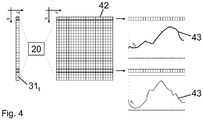
- the output signal 42 of a CCD-array can be processed in a control unit 60 which is connected to the hyperspectral imaging spectrometer 20.
- the control unit 60 preferably comprises a computer having at least one processor and memory.
- the output signals of the CCD-array can be transmitted via a fiber optic or a high bandwidth cable or radio frequency link.
- Fig. 2 shows a top-view of the conveyor belt 10 moving left to right and carrying bulk material 30. Marked with doted rectangles are the scanned areas on the conveyor belt. As the bulk material passes by the hyperspectral imaging spectrometer, snapshot scans are taken either continuously, in regular periods or on demand.
- a two dimensional output array is generated by the hyperspectral imaging spectrometer and forwarded to the control unit for further processing.
- the two dimensional output array comprises values representing the amount of energy of a certain wavelength reflected from the bulk materiel across the conveyor belt.
- One dimension of the array corresponds to the spherical distribution across the conveyor belt (x-axis) and on the other dimension corresponds to the range of wavelength of the reflected energy (z-axis).
- Each captured spot of bulk material across the conveyor belt has its own spectral signature 43 representing the energy reflected by the bulk material in that particular spot distributed according to the wavelength.
- the two dimensional output array of several timely separated scans can be stacked defining a three dimensional cube.
- the resolution of the two-dimensional output array can be reduced across the x-axis.
- the resolution of the output array across the x-axis is reduced to one pixel so that for the entire width of the conveyor belt there is only one spectral signature forwarded to the control unit.
- This single spectral signature is then analyzed and compared to a set of previously recorded and stored spectral signatures of possible material composition.
- the distribution of different materials across the conveyor belt is not of importance as only the composition of the bulk material, i.e. the existence of specific ingredients in the right quantity, matters.
- This application with a reduced resolution of the spectrometer is most preferably used in applications with only a small number of possible ingredients to be observed.
- Infra-red including NIR (near infra-red), VNIR (Visual near infra-red), SWIR (Short-Wave Infra-red), and TIR (Thermal Infra-red), spans a wavelength range of 750 to 2500 nanometers (nm) for the purposes of elemental characterization of materials.
- Oxides can be reported via built-in calculations of standard conversions from elements to their oxide forms.
- aluminum, Al can be converted to aluminum-oxide, Al 2 O 3 by an automatic conversion factor of 1.8895 times the reported quantity of the element Al.
- Similar conversion factors are readily made for reporting purposes for any detected element of interest. These conversion factors are standard for reporting results based on known chemical properties of all elements in their atomic or molecular forms and can be provided as reported results of analyses using simple calculations built into the device software.
- each of the spectral sensors can be co-boresighted so that an imaginary straight line extends from the center of each sensor to a common point on the bulk material to be analyzed.
- overlapping spectral reports can be made by precise angling of the spectrometers used to provide a scanned strip-step across the width of the conveyor belt.
- the process of analyzing bulk material with the bulk material analyzing system comprises the following steps: In a first step, a two dimensional spherical/ spectral picture is captured by the CCD Array.
- the radiation from the entrance slit 26 is collimated by a lens 22 and then dispersed by a dispersing element 23, in the exemplary embodiment a prism-grating-prism element, so that the direction of propagation of the radiation depends on its wavelength. It is then focused by a focusing lens 24 on an image plane, where the image is captured by the two-dimensional detector, the CCD Array 25.
- the CCD Array produces an output signal of reflected energy at specific wavelength 42. Every point along the spherical axis (see Fig.
- points 0 and n on the x-axis across the conveyor belt is represented on the two dimensional image plane by a series of monochromatic images forming a continuous spectrum in the direction of the spectral axis, which is later converted into the spectral signature 43.
- the spectral signatures are created from the two dimensional spherical/ spectral picture captured by the CCD Array. Each spot across the spherical x-axis on the conveyor belt has its own one-dimensional spectral signature.
- the spectral signature of each spot is compared to a set of stored calibrations representing expected concentrations of previously characterized standards. This is done in real time with the help of computer software. As a result, the materialistic characteristic of each spot on the bulk material distributed across the conveyor belt is identified.
- the information of all single spots is gathered to get the overall distribution of material within the scanned bulk material.
- Specific elements or their oxides can thereby be identified as to presence and characterized as to concentrations via intensities of detected and recognized spectral signatures.
- chemometric techniques may be used to provide for fitting spectra thus obtained to the stored library of spectra.
- spectra are stored of expected bulk materials to cover all possible ranges of concentrations and mixtures (blends) of elemental contributors to the recovered and resolved spectra.
- Such acquired spectra are "compared" to the stored spectra to define how the acquired spectra compare to a predicted oxide array.
- the accuracy of the fit of the acquired spectra and its height difference relative to the standard spectral library stored in the device determines both content and quantity of the elements/ oxides based on spectral peaks.
- the spectrometers and their contained gratings, beam splitters, detectors, and optical fiber connections, as well as light sources are preferably packaged in a scanning housing fixed at a predetermined height above the moving conveyor belt.
- the housing thus described is arranged so as to be located normal to the forward directional movement of the belt and its material load.
- the bulk material analyzing system is used in the process of blending of bulk materials used in the manufacture of cement:
- Bulk materials are fed to a series of conveyor belts from feeders containing more or less homogeneous crushed rock matter. These materials are generally referred to as cementitious and fusion minerals, which, are to be physically mixed (blended) in a specific proportion prior to being calcined (reduced, in chemical terms) via heating, and then transported, according to the type of cement to be created from said materials.
- the proportion of each of the contributing material sources is to be monitored by the bulk material analyzing system so as to correct for more or less richer or poorer grades of components (according to the contained mineral chemistry) by additions of each material as demanded by a control algorithm that obtains real-time chemistry of the bulk materials independently and collectively from results reported by the inventive bulk material analyzing system.
- CaO normally from high-grade limestone SiO2, from sand, sandstone in various silicate forms
- Al2O3 normally from bauxite or materials high in alumina Fe2O3 from mill scale, iron ore, or pyrites
- Typical ranges encountered for materials are: Dry Basis Oxide Composition Range (typical value) CaO 25...30...55 % SiO2 5...20...25 % Al2O3 0...8 % Fe2O3 0... 8 % MgO 0...6 % K2O 0...3 % Na2O 0...3 % SO3 0...3 %
- Accuracies expected for dynamic performance with the invention are Dry Basis Oxide Accuracy (RMSD, 1 hour) (%) SiO2 0.33 Al2O3 0.30 Fe2O3 0.08 CaO 0.32 MgO 0.29 K2O 0.21 Na2O 0.11 SO3 0.20
- the calibration range needs to be broadened to cover low- as well as high-grade limestone, because the presence of MgCO3 in impure limestones is important when blending with higher grades, as too much MgO (exceeding 2.5%, for example) is a genuine quality problem. Usually 5 calibration standards are sufficient.
- dilutions may be used to prepare a calibration. This can be accomplished by using a neutral diluent matrix, such as pure limestone of known concentrations of CaO, for example, to make the factoring simple.
- a neutral diluent matrix such as pure limestone of known concentrations of CaO, for example, to make the factoring simple.
- the moisture content which is what would be expected on conveyor belts, could exceed 5-8% (liter weight %). This is normalized in practice by using a moisture meter (usually a phase-shift microwave device) associated with the monitoring analyzer. Where ambient moisture, including precipitation, is taken into account in atmospherically exposed belt loads, this is a requirement. If moisture can be guaranteed to not exceed 4-5%, then a moisture meter is not necessary, and a mathematical calculation can be made for LOI.
- a range of calibration samples should encompass the typical ranges shows to avoid compromising the analyzer's ability to fit variations into the resultant calibration curve when alternative and (normally) widely varying materials are incorporated into the mix, as one would expect in a typical plant environment.
- the need for analysis increases. If one could expect a narrow bandwidth in concentrations of these key oxides, the need for monitoring would be slight, whereas an analyzer calibrated to capture variations in a broad range (within reasonable limits, of course) becomes more attractive.
- the inventive real-time bulk material analyzing system is best applied to bulk materials in a state of solid particles, powders and slurries.
Landscapes
- Physics & Mathematics (AREA)
- Spectroscopy & Molecular Physics (AREA)
- General Physics & Mathematics (AREA)
- Health & Medical Sciences (AREA)
- Life Sciences & Earth Sciences (AREA)
- Chemical & Material Sciences (AREA)
- Analytical Chemistry (AREA)
- Biochemistry (AREA)
- General Health & Medical Sciences (AREA)
- Immunology (AREA)
- Pathology (AREA)
- Engineering & Computer Science (AREA)
- Human Computer Interaction (AREA)
- Investigating Or Analysing Materials By Optical Means (AREA)
Claims (5)
- Echtzeitanalysesystem für Schüttgut zum Analysieren der elementaren Eigenschaften von Schüttgut (30), das auf einem sich bewegenden Förderband vorbeiläuft, wobei das System Folgendes umfasst:- eine Quelle von Beleuchtung (50) zum Anregen des zu analysierenden Schüttguts (30),- einen Spektralsensor (20) zum Erfassen der spektralen Reflexion des durch die Beleuchtungsquelle angeregten Schüttguts (30), und- eine Steuereinheit (60) zum Vergleichen der erfassten spektralen Reflexion mit einer gespeicherten Kalibrierung,
dadurch gekennzeichnet, dass- die Quelle von Beleuchtung (50) weißes Licht emittiert, und- der Spektralsensor (20) ein hyperspektrales Bildgebungsspektrometer (20) ist, das ein zweidimensionales Bild produziert, wobei eine Dimension die sphärische Breite des Förderbands ist und die andere Dimension die Wellenlänge der Reflexion ist, sodass jeder Punkt des Bildes den Betrag von Energie bei einer spezifischen Wellenlänge darstellt, der von einem bestimmten Punkt über dem Förderband reflektiert wird, wobei die Bilddaten an die Steuereinheit (60) weitergeleitet werden,- wobei die Steuereinheit (60) Mittel zum Vergleichen einer spektralen Signatur (43) für jeden spezifischen Punkt über dem Förderband, der durch das Spektrometer (20) erfasst wurde, mit einer Menge von gespeicherten Kalibrierungen, die erwartete Kalibrierungen von vorher charakterisierten Standards darstellen, umfasst, wobei die spektrale Signatur (43) ein kontinuierliches Spektrum des Betrags von Energie umfasst, der von dem spezifischen Punkt über einen Bereich von Wellenlänge reflektiert wird, wobei das Echtzeit-Schüttgutsystem dazu ausgelegt ist, Informationen zu allen einzelnen Punkten zu sammeln, um die Gesamtverteilung von Schüttgut zu erhalten, dabei spezifische Elemente des Schüttguts oder ihrer Oxide im Hinblick auf Anwesenheit und Konzentration über Intensitäten von detektierten und erkannten spektralen Signaturen identifizierend, undwobei das Echtzeitanalysesystem für Schüttgut dabei dazu ausgelegt wird, jede Schüttgutquelle zu überwachen, um bessere und schlechtere Qualitätsgrade des Schüttguts zu korrigieren durch Hinzufügen von jedem Schüttgut wie durch einen Steueralgorithmus angefordert, der eine Echtzeitchemie des Schüttguts basierend auf dem Mengenvergleich und der Identifizierung erhält. - Analysesystem nach Anspruch 1, wobei das hyperspektrale Bildgebungsspektrometer eine vordere Linse (21) mit einem Eintrittsschlitz (26) umfasst, wobei der Eintrittsschlitz so angeordnet ist, das er normal zur Bewegungsrichtung des Schüttguts (30) ist, das am Spektrometer vorbeiläuft, um der reflektierten Energie lediglich eines dünnen Streifens, der das Schüttgut überspannt, zu ermöglichen, in das hyperspektrale Bildgebungsspektrometer einzutreten.
- Analysesystem nach einem der Ansprüche 1 bis 2, wobei das hyperspektrale Bildgebungsspektrometer eine Prisma-Gitter-Prisma-Optik umfasst.
- Analysesystem nach einem der Ansprüche 1 bis 3, wobei das System ferner ein Förderband (10) zum Fördern von darauf positioniertem Schüttgut (30) vorbei an der Beleuchtungsquelle (50) und dem Spektralsensor (20) umfasst.
- Verfahren für eine Echtzeitelementaranalyse von Schüttgut (30), das auf einem Förderband gefördert wird, wobei das Verfahren die Folgenden Schritte umfasst:- Beleuchten des Schüttguts mit weißem Licht,- Erfassen der spektralen Reflexion von dem durch das weiße Licht angeregten Schüttgut mit einem hyperspektralen Bildgebungsspektrometer (20), das ein zweidimensionales Bild produziert, wobei eine Dimension die sphärische Breite des Förderbands ist und die andere Dimension die Wellenlänge der Reflexion ist, sodass jeder Punkt des Bildes den Betrag von Energie bei einer spezifischen Wellenlänge darstellt, der von einem bestimmten Punkt über dem Förderband reflektiert wird,- Vergleichen einer spektralen Signatur für jeden spezifischen Punkt über dem Förderband, der durch das Spektrometer erfasst wurde, mit einer Menge von gespeicherten Kalibrierungen, die die erwarteten Konzentrationen von vorher charakterisierten Standards darstellen, wobei die spektrale Signatur ein kontinuierliches Spektrum des Betrags von Energie umfasst, die von dem spezifischen Punkt über einem Wellenlängenbereich reflektiert wird,- Sammeln von Informationen aller einzelnen Punkte zum Erhalten der Gesamtverteilung von Schüttgut, dabei die spezifischen Elemente des Schüttguts oder ihrer Oxide im Hinblick auf Anwesenheit und Konzentration über Intensitäten von detektierten und erkannten spektralen Signaturen identifizierend,dabei jede Schüttgutquelle überwachend, um bessere und schlechtere Qualitätsgrade des Schüttguts zu korrigieren durch Hinzufügen von jedem Schüttgut, wie durch einen Steueralgorithmus angefordert, der eine Echtzeitchemie des Schüttguts basierend auf dem Mengenvergleich und der Identifizierung erhält.
Priority Applications (1)
| Application Number | Priority Date | Filing Date | Title |
|---|---|---|---|
| EP07728947.8A EP2016395B1 (de) | 2006-05-10 | 2007-05-09 | Analysesystem für schüttgut |
Applications Claiming Priority (3)
| Application Number | Priority Date | Filing Date | Title |
|---|---|---|---|
| EP06405196A EP1862795A1 (de) | 2006-05-10 | 2006-05-10 | Analysesystem für Schüttgut |
| PCT/EP2007/054495 WO2007128832A1 (en) | 2006-05-10 | 2007-05-09 | Bulk material analyzer system |
| EP07728947.8A EP2016395B1 (de) | 2006-05-10 | 2007-05-09 | Analysesystem für schüttgut |
Publications (2)
| Publication Number | Publication Date |
|---|---|
| EP2016395A1 EP2016395A1 (de) | 2009-01-21 |
| EP2016395B1 true EP2016395B1 (de) | 2019-12-04 |
Family
ID=37037046
Family Applications (2)
| Application Number | Title | Priority Date | Filing Date |
|---|---|---|---|
| EP06405196A Withdrawn EP1862795A1 (de) | 2006-05-10 | 2006-05-10 | Analysesystem für Schüttgut |
| EP07728947.8A Active EP2016395B1 (de) | 2006-05-10 | 2007-05-09 | Analysesystem für schüttgut |
Family Applications Before (1)
| Application Number | Title | Priority Date | Filing Date |
|---|---|---|---|
| EP06405196A Withdrawn EP1862795A1 (de) | 2006-05-10 | 2006-05-10 | Analysesystem für Schüttgut |
Country Status (6)
| Country | Link |
|---|---|
| US (1) | US7310581B2 (de) |
| EP (2) | EP1862795A1 (de) |
| CN (2) | CN101443648B (de) |
| BR (1) | BRPI0711390B1 (de) |
| ES (1) | ES2769252T3 (de) |
| WO (1) | WO2007128832A1 (de) |
Families Citing this family (56)
| Publication number | Priority date | Publication date | Assignee | Title |
|---|---|---|---|---|
| US7583419B2 (en) * | 2003-01-09 | 2009-09-01 | Larry Kleiman | System for capturing graphical images using hyperspectral illumination |
| US7440097B2 (en) * | 2006-06-27 | 2008-10-21 | General Electric Company | Laser plasma spectroscopy apparatus and method for in situ depth profiling |
| US7663108B2 (en) * | 2008-01-23 | 2010-02-16 | Abb Schweiz Ag | Pulverized bulk material planetary and double helix analyzer system |
| GB0809252D0 (en) | 2008-05-21 | 2008-06-25 | Ntnu Technology Transfer As | Underwater hyperspectral imaging |
| EP2141414A1 (de) * | 2008-07-04 | 2010-01-06 | ABB Research LTD | Stapelkontrolle für eine Halde |
| CN101750241B (zh) * | 2009-12-18 | 2012-02-01 | 中国铝业股份有限公司 | 一种用于扫描电镜及能谱研究的铝土矿制样方法 |
| WO2011094818A1 (en) | 2010-02-05 | 2011-08-11 | The University Of Sydney | Determination of rock types by spectral scanning |
| US9067824B1 (en) * | 2010-02-17 | 2015-06-30 | Roman Cement, Llc | Modification of pozzolanic chemistry through blending |
| US9272953B2 (en) | 2010-11-30 | 2016-03-01 | Roman Cement, Llc | High early strength cement-SCM blends |
| KR20130143102A (ko) * | 2011-01-03 | 2013-12-30 | 푼다시오 인스티튜트 데 레세르카 데 레네르기아 데 카탈루냐 | 주변광 스펙트럼을 얻고 발광을 수정하기 위한 광전자 디바이스,시스템 및 방법 |
| WO2012128943A2 (en) | 2011-03-23 | 2012-09-27 | Halliburton Energy Services, Inc. | Monitoring and detection of materials using hyperspectral imaging |
| US9016399B2 (en) | 2011-03-23 | 2015-04-28 | Halliburton Energy Services, Inc. | Apparatus and methods for lithology and mineralogy determinations |
| MX373413B (es) | 2011-10-20 | 2020-05-26 | Roman Cement Llc | Mezclas de cemento-scm de particulas empacadas. |
| EP2669659A1 (de) | 2012-06-01 | 2013-12-04 | ABB Schweiz AG | Verfahren zur Kalibrierung eines Rohmaterialanalysesystems |
| US9952100B2 (en) | 2013-01-21 | 2018-04-24 | Sciaps, Inc. | Handheld LIBS spectrometer |
| US9243956B2 (en) | 2013-01-21 | 2016-01-26 | Sciaps, Inc. | Automated multiple location sampling analysis system |
| US9435742B2 (en) | 2013-01-21 | 2016-09-06 | Sciaps, Inc. | Automated plasma cleaning system |
| US9036146B2 (en) | 2013-01-21 | 2015-05-19 | Sciaps, Inc. | Micro purge of plasma region |
| US9267842B2 (en) | 2013-01-21 | 2016-02-23 | Sciaps, Inc. | Automated focusing, cleaning, and multiple location sampling spectrometer system |
| WO2014113824A2 (en) * | 2013-01-21 | 2014-07-24 | Sciaps, Inc. | Handheld libs spectrometer |
| US9625376B2 (en) | 2013-03-22 | 2017-04-18 | Foss Analytical A/S | System for and method of combined LIBS and IR absorption spectroscopy investigations |
| US9237279B2 (en) * | 2013-05-06 | 2016-01-12 | Bergen Teknologioverfoering As | Method of investigating a solid sample |
| GB2535063B (en) * | 2013-10-22 | 2020-03-25 | Cgg Services Sa | Desktop hyperspectral spectra collection of geological material |
| DK3140636T3 (en) * | 2014-05-08 | 2019-04-15 | Univ Danmarks Tekniske | SURFACE BROKING INDEX IMAGE SURVEYING SYSTEM AND PROCEDURE |
| DE102014111550A1 (de) | 2014-08-13 | 2016-02-18 | Inntal systemEnergie GmbH | System zur Bestimmung des Füllstandes eines Schüttgutlagers |
| US9664565B2 (en) | 2015-02-26 | 2017-05-30 | Sciaps, Inc. | LIBS analyzer sample presence detection system and method |
| US9651424B2 (en) | 2015-02-26 | 2017-05-16 | Sciaps, Inc. | LIBS analyzer sample presence detection system and method |
| KR102093005B1 (ko) * | 2015-05-11 | 2020-03-25 | 아르셀러미탈 | 슬래그 부분의 화학적 조성을 결정하는 방법 |
| CN105092623B (zh) * | 2015-08-28 | 2019-02-26 | 南京航空航天大学 | 一种基于瞬发伽马射线中子活化分析技术的水泥样品谱库配方设计方法 |
| WO2017055895A1 (en) | 2015-09-30 | 2017-04-06 | Arcelormittal | Method of online characterization of a layer of oxides on a steel substrate |
| US10209196B2 (en) | 2015-10-05 | 2019-02-19 | Sciaps, Inc. | LIBS analysis system and method for liquids |
| US10018560B2 (en) * | 2016-02-02 | 2018-07-10 | Kla-Tencor Corporation | System and method for hyperspectral imaging metrology |
| US9939383B2 (en) | 2016-02-05 | 2018-04-10 | Sciaps, Inc. | Analyzer alignment, sample detection, localization, and focusing method and system |
| US10232473B2 (en) * | 2016-02-26 | 2019-03-19 | General Electric Company | System and method for performing laser induced breakdown spectroscopy during laser ablation coating removal |
| JP6779284B2 (ja) * | 2016-05-02 | 2020-11-04 | 吉野石膏株式会社 | 粉体の飛散性評価方法及び粉体の飛散性評価装置 |
| US10197504B2 (en) * | 2016-10-10 | 2019-02-05 | Altria Client Services Llc | Method and system of detecting foreign materials within an agricultural product stream |
| CN106645145A (zh) * | 2016-10-11 | 2017-05-10 | 山东为华智能设备制造有限公司 | 一种用表面结构和纹理对煤和煤矸石及铁块识别的技术 |
| US10131575B2 (en) | 2017-01-10 | 2018-11-20 | Roman Cement, Llc | Use of quarry fines and/or limestone powder to reduce clinker content of cementitious compositions |
| US12151974B2 (en) | 2017-01-10 | 2024-11-26 | Roman Cement, Llc | Use of mineral fines to reduce clinker content of cementitious compositions |
| US11168029B2 (en) | 2017-01-10 | 2021-11-09 | Roman Cement, Llc | Use of mineral fines to reduce clinker content of cementitious compositions |
| US10737980B2 (en) | 2017-01-10 | 2020-08-11 | Roman Cement, Llc | Use of mineral fines to reduce clinker content of cementitious compositions |
| US10730805B2 (en) | 2017-01-10 | 2020-08-04 | Roman Cement, Llc | Use of quarry fines and/or limestone powder to reduce clinker content of cementitious compositions |
| CN107589094B (zh) * | 2017-09-20 | 2020-02-21 | 鞍钢集团矿业有限公司 | 基于光谱特征的鞍山式铁矿石类型确定方法 |
| MX2021005060A (es) | 2018-11-02 | 2021-06-15 | Gcp Applied Tech Inc | Produccion de cemento. |
| WO2020152609A2 (en) * | 2019-01-24 | 2020-07-30 | Blue Cube Technology (Pty) Ltd | Obtaining data from a moving particulate product |
| EP4196777A1 (de) * | 2020-08-14 | 2023-06-21 | Comex Polska Sp. z o.o. | Stoffanalyse- und trennsystem zur bestimmung ihrer chemischen zusammensetzung sowie stoffanalyse- und trennverfahren zur bestimmung ihrer chemischen zusammensetzung |
| RU2753253C1 (ru) * | 2020-09-25 | 2021-08-12 | Дмитрий Михайлович Плущевский | Способ оценки и хранения изделий из драгоценных металлов и аппарат для его реализации |
| DE102020127964B4 (de) | 2020-10-23 | 2022-10-27 | Technische Hochschule Lübeck | Verfahren und Vorrichtung zum schnellen Erfassen eines hyperspektralen Kubus eines Objekts oder einer Szene |
| CA3201132A1 (en) | 2020-12-21 | 2022-06-30 | Dean John ACKERMAN | Detection and recovery of metals from ore |
| IT202100003347A1 (it) * | 2021-02-15 | 2022-08-15 | Danieli Off Mecc | Impianto e metodo per la classificazione del rottame |
| CN113567356A (zh) * | 2021-07-21 | 2021-10-29 | 浙江大学 | 一种用于道地药材鉴别的高光谱图谱仪及应用 |
| PE20241930A1 (es) * | 2021-11-22 | 2024-09-20 | Minesense Tech Ltd | Sistemas de imagenes multiespectrales e hiperespectrales composicionales para palas mineras y metodos asociados |
| EP4273957A1 (de) * | 2022-05-06 | 2023-11-08 | Siemens Aktiengesellschaft | Bestimmung von inhomogenitäten bei der elektrodenfertigung für batteriezellen |
| GB202209021D0 (en) * | 2022-06-20 | 2022-08-10 | Anglo American Technical & Sustainability Services Ltd | Method and system for analysing ore |
| EP4710335A1 (de) | 2023-05-08 | 2026-03-18 | Sixone Labs Ltd. | Verfahren und systeme zur behandlung einer heterogenen mischung aus materialien |
| CN116871177B (zh) * | 2023-09-05 | 2023-11-17 | 国擎(山东)信息科技有限公司 | 一种基于多光谱技术的高岭土原矿分选方法及系统 |
Citations (1)
| Publication number | Priority date | Publication date | Assignee | Title |
|---|---|---|---|---|
| WO2005106438A1 (en) * | 2004-04-30 | 2005-11-10 | Titech Visionsort As | Apparatus and method for inspecting a stream of matter by light scattering inside the matter |
Family Cites Families (25)
| Publication number | Priority date | Publication date | Assignee | Title |
|---|---|---|---|---|
| GB2111193B (en) * | 1981-11-27 | 1985-08-21 | Blue Circle Ind Ltd | Method and apparatus for assessing the quality of cement clinker |
| US4508573A (en) | 1981-12-02 | 1985-04-02 | Texas Industries, Inc. | Co-production of cementitious products |
| US4799880A (en) | 1987-08-19 | 1989-01-24 | Mccoy Charles | Method and apparatus for analyzing product flow |
| JPH0748065B2 (ja) * | 1988-05-27 | 1995-05-24 | 信越化学工業株式会社 | 白色系粉体中の着色異物検査方法および装置 |
| FR2663739B1 (fr) * | 1990-06-26 | 1993-06-25 | Devaure Etienne | Analyseur de couleur. |
| DE19518958A1 (de) | 1995-05-23 | 1996-11-28 | Krupp Polysius Ag | Verfahren und Anlage zur Aufbereitung einer Materialmischung |
| US6160618A (en) * | 1998-06-19 | 2000-12-12 | Board Of Regents, The University Of Texas System | Hyperspectral slide reader |
| US6491751B1 (en) | 1998-09-18 | 2002-12-10 | Texas Industries, Inc. | Method for manufacturing cement using a raw material mix including finely ground steel slag |
| CN1097724C (zh) * | 1999-04-28 | 2003-01-01 | 中国科学院长春光学精密机械研究所 | 光栅与棱镜组合式超光谱图像测量方法 |
| US7227148B2 (en) * | 1999-06-08 | 2007-06-05 | Japan Tobacco Inc. | Apparatus for detecting impurities in material and detecting method therefor |
| AU2001237053A1 (en) * | 2000-02-17 | 2001-08-27 | Bintech. Lllp | Bulk materials management apparatus and method |
| US20030123056A1 (en) * | 2001-01-08 | 2003-07-03 | Barnes Donald Michael | Apparatus having precision hyperspectral imaging array with active photonic excitation targeting capabilities and associated methods |
| US6765212B2 (en) | 2001-02-12 | 2004-07-20 | Analytical Spectral Devices, Inc. | System and method for combining reflectance data |
| US6894772B2 (en) | 2001-02-12 | 2005-05-17 | Analytical Spectral Devices | System and method for grouping reflectance data |
| US6853447B2 (en) | 2001-02-12 | 2005-02-08 | Analytical Spectral Devices, Inc. | System and method for the collection of spectral image data |
| US6667802B2 (en) | 2001-02-12 | 2003-12-23 | Analytical Spectral Devices, Inc. | System and method for self-referencing calibration |
| US20020159709A1 (en) | 2001-04-27 | 2002-10-31 | Faus Robert J. | Fiber optic bundle matching connector |
| US20050077471A1 (en) | 2001-12-28 | 2005-04-14 | Scantech Intrnational Pty Ltd. | Bulk material analyser and method of assembly |
| US6771369B2 (en) | 2002-03-12 | 2004-08-03 | Analytical Spectral Devices, Inc. | System and method for pharmacy validation and inspection |
| US6709510B1 (en) | 2002-11-19 | 2004-03-23 | Texas Industries, Inc. | Process for using mill scale in cement clinker production |
| US6998614B2 (en) * | 2003-05-23 | 2006-02-14 | Institute For Technology Development | Hyperspectral imaging workstation having visible/near-infrared and ultraviolet image sensors |
| US7633616B2 (en) * | 2003-06-02 | 2009-12-15 | Sensovation Ag | Apparatus and method for photo-electric measurement |
| CN1546986A (zh) * | 2003-12-05 | 2004-11-17 | 清华大学 | 一种新型的颗粒堆积状态检测方法及装置 |
| FI20040315A7 (fi) * | 2004-02-27 | 2005-08-28 | Tameye Ky | Materiaalin vianilmaisu spektrikameran avulla |
| AP2096A (en) * | 2004-11-17 | 2010-01-29 | De Beers Cons Mines Ltd | An apparatus for and method of sorting objects using reflectance spectroscopy |
-
2006
- 2006-05-10 EP EP06405196A patent/EP1862795A1/de not_active Withdrawn
- 2006-06-26 US US11/474,477 patent/US7310581B2/en active Active
-
2007
- 2007-05-09 EP EP07728947.8A patent/EP2016395B1/de active Active
- 2007-05-09 BR BRPI0711390-0A patent/BRPI0711390B1/pt active IP Right Grant
- 2007-05-09 WO PCT/EP2007/054495 patent/WO2007128832A1/en not_active Ceased
- 2007-05-09 CN CN2007800167972A patent/CN101443648B/zh active Active
- 2007-05-09 CN CN2007800169592A patent/CN101529231B/zh active Active
- 2007-05-09 ES ES07728947T patent/ES2769252T3/es active Active
Patent Citations (1)
| Publication number | Priority date | Publication date | Assignee | Title |
|---|---|---|---|---|
| WO2005106438A1 (en) * | 2004-04-30 | 2005-11-10 | Titech Visionsort As | Apparatus and method for inspecting a stream of matter by light scattering inside the matter |
Non-Patent Citations (1)
| Title |
|---|
| FELDHOFF R ET AL: "ON-LINE POST CONSUMER PACKAGE IDENTIFICATION BY NIR SPECTROSCOPY COMBINED WITH A FUZZYARTMAP CLASSIFIER IN AN INDUSTRIAL ENVIRONMENT", APPLIED SPECTROSCOPY, THE SOCIETY FOR APPLIED SPECTROSCOPY. BALTIMORE, US, vol. 51, no. 3, 1 March 1997 (1997-03-01), pages 362 - 368, XP000698673, ISSN: 0003-7028, DOI: 10.1366/0003702971940215 * |
Also Published As
| Publication number | Publication date |
|---|---|
| EP1862795A1 (de) | 2007-12-05 |
| CN101443648B (zh) | 2012-05-09 |
| BRPI0711390B1 (pt) | 2022-09-27 |
| US7310581B2 (en) | 2007-12-18 |
| ES2769252T3 (es) | 2020-06-25 |
| WO2007128832A1 (en) | 2007-11-15 |
| EP2016395A1 (de) | 2009-01-21 |
| BRPI0711390A2 (pt) | 2011-11-01 |
| CN101529231B (zh) | 2012-08-08 |
| CN101443648A (zh) | 2009-05-27 |
| US20070265783A1 (en) | 2007-11-15 |
| CN101529231A (zh) | 2009-09-09 |
Similar Documents
| Publication | Publication Date | Title |
|---|---|---|
| EP2016395B1 (de) | Analysesystem für schüttgut | |
| US7924414B2 (en) | Non-hazardous bulk material analyzer system | |
| JP7106503B2 (ja) | 識別ユニット、識別装置および選別システム | |
| Body et al. | Simultaneous elemental analysis system using laser induced breakdown spectroscopy | |
| Gaft et al. | Industrial online raw materials analyzer based on laser-induced breakdown spectroscopy | |
| Giuntini et al. | Detectors and cultural heritage: the INFN-CHNet experience | |
| WO2019111785A1 (ja) | 識別装置、選別システム | |
| Koerting et al. | A solar optical hyperspectral library of rare-earth-bearing minerals, rare-earth oxide powders, copper-bearing minerals and Apliki mine surface samples | |
| Chen et al. | Sensor-based sorting | |
| US7663108B2 (en) | Pulverized bulk material planetary and double helix analyzer system | |
| CN112763453A (zh) | 矿石散料在连续输送中多要素实时在线检测装置及方法 | |
| WO2009129299A2 (en) | High-throughput spectral imaging and spectroscopy apparatus and methods | |
| Bonifazi et al. | Hyperspectral imaging based procedures applied to bottom ash characterization | |
| JPS58143254A (ja) | 物質同定装置 | |
| WO2025196515A1 (en) | Method of and apparatus for continuous analysis of samples from a continuous material stream, and method of and arrangement for mixing cement implementing or using the analysis method and apparatus, respectively | |
| Körting et al. | A solar optical hyperspectral library of rare earth-bearing minerals, rare earth oxides, copper-bearing minerals and Apliki mine surface samples | |
| WO2020032905A2 (en) | An experiment assembly for evaluating equipment performance | |
| Desta | Evaluation of sensor technologies for on-line raw material characterization in “Reiche Zeche” underground mine-outcomes of RTM implementation | |
| Cordero et al. | Sampling and sample preparation for chemical analysis of plants by wavelength dispersive X‐Ray fluorescence | |
| JPH1038806A (ja) | レーザを用いた固体粒子成分解析装置 | |
| Iyakwari et al. | Validation of Near InfraRed preconcentration strategies for ore sorting | |
| Barone et al. | A Novel Calibration Method for the Quantification of Respirable Particles in Mining Scenarios Using Fourier Transform Infrared Spectroscopy | |
| CN114252581A (zh) | 矿石在线检测系统 | |
| Krezhova et al. | Spectral reflectance of magmatic and metamorphic rocks in the visible and near infrared ranges | |
| Otani et al. | Terahertz Sensing, Imaging and Applications |
Legal Events
| Date | Code | Title | Description |
|---|---|---|---|
| PUAI | Public reference made under article 153(3) epc to a published international application that has entered the european phase |
Free format text: ORIGINAL CODE: 0009012 |
|
| 17P | Request for examination filed |
Effective date: 20081020 |
|
| AK | Designated contracting states |
Kind code of ref document: A1 Designated state(s): AT BE BG CH CY CZ DE DK EE ES FI FR GB GR HU IE IS IT LI LT LU LV MC MT NL PL PT RO SE SI SK TR |
|
| AX | Request for extension of the european patent |
Extension state: AL BA HR MK RS |
|
| DAX | Request for extension of the european patent (deleted) | ||
| STAA | Information on the status of an ep patent application or granted ep patent |
Free format text: STATUS: EXAMINATION IS IN PROGRESS |
|
| 17Q | First examination report despatched |
Effective date: 20170113 |
|
| GRAP | Despatch of communication of intention to grant a patent |
Free format text: ORIGINAL CODE: EPIDOSNIGR1 |
|
| STAA | Information on the status of an ep patent application or granted ep patent |
Free format text: STATUS: GRANT OF PATENT IS INTENDED |
|
| INTG | Intention to grant announced |
Effective date: 20190712 |
|
| GRAS | Grant fee paid |
Free format text: ORIGINAL CODE: EPIDOSNIGR3 |
|
| GRAA | (expected) grant |
Free format text: ORIGINAL CODE: 0009210 |
|
| STAA | Information on the status of an ep patent application or granted ep patent |
Free format text: STATUS: THE PATENT HAS BEEN GRANTED |
|
| AK | Designated contracting states |
Kind code of ref document: B1 Designated state(s): AT BE BG CH CY CZ DE DK EE ES FI FR GB GR HU IE IS IT LI LT LU LV MC MT NL PL PT RO SE SI SK TR |
|
| REG | Reference to a national code |
Ref country code: GB Ref legal event code: FG4D |
|
| REG | Reference to a national code |
Ref country code: CH Ref legal event code: EP |
|
| REG | Reference to a national code |
Ref country code: AT Ref legal event code: REF Ref document number: 1210003 Country of ref document: AT Kind code of ref document: T Effective date: 20191215 |
|
| REG | Reference to a national code |
Ref country code: DE Ref legal event code: R096 Ref document number: 602007059566 Country of ref document: DE |
|
| REG | Reference to a national code |
Ref country code: IE Ref legal event code: FG4D |
|
| REG | Reference to a national code |
Ref country code: SE Ref legal event code: TRGR |
|
| REG | Reference to a national code |
Ref country code: FI Ref legal event code: FGE |
|
| REG | Reference to a national code |
Ref country code: NL Ref legal event code: MP Effective date: 20191204 |
|
| REG | Reference to a national code |
Ref country code: LT Ref legal event code: MG4D |
|
| PG25 | Lapsed in a contracting state [announced via postgrant information from national office to epo] |
Ref country code: LV Free format text: LAPSE BECAUSE OF FAILURE TO SUBMIT A TRANSLATION OF THE DESCRIPTION OR TO PAY THE FEE WITHIN THE PRESCRIBED TIME-LIMIT Effective date: 20191204 Ref country code: LT Free format text: LAPSE BECAUSE OF FAILURE TO SUBMIT A TRANSLATION OF THE DESCRIPTION OR TO PAY THE FEE WITHIN THE PRESCRIBED TIME-LIMIT Effective date: 20191204 Ref country code: BG Free format text: LAPSE BECAUSE OF FAILURE TO SUBMIT A TRANSLATION OF THE DESCRIPTION OR TO PAY THE FEE WITHIN THE PRESCRIBED TIME-LIMIT Effective date: 20200304 |
|
| REG | Reference to a national code |
Ref country code: GR Ref legal event code: EP Ref document number: 20200400598 Country of ref document: GR Effective date: 20200511 |
|
| REG | Reference to a national code |
Ref country code: ES Ref legal event code: FG2A Ref document number: 2769252 Country of ref document: ES Kind code of ref document: T3 Effective date: 20200625 |
|
| PG25 | Lapsed in a contracting state [announced via postgrant information from national office to epo] |
Ref country code: EE Free format text: LAPSE BECAUSE OF FAILURE TO SUBMIT A TRANSLATION OF THE DESCRIPTION OR TO PAY THE FEE WITHIN THE PRESCRIBED TIME-LIMIT Effective date: 20191204 Ref country code: CZ Free format text: LAPSE BECAUSE OF FAILURE TO SUBMIT A TRANSLATION OF THE DESCRIPTION OR TO PAY THE FEE WITHIN THE PRESCRIBED TIME-LIMIT Effective date: 20191204 Ref country code: NL Free format text: LAPSE BECAUSE OF FAILURE TO SUBMIT A TRANSLATION OF THE DESCRIPTION OR TO PAY THE FEE WITHIN THE PRESCRIBED TIME-LIMIT Effective date: 20191204 Ref country code: RO Free format text: LAPSE BECAUSE OF FAILURE TO SUBMIT A TRANSLATION OF THE DESCRIPTION OR TO PAY THE FEE WITHIN THE PRESCRIBED TIME-LIMIT Effective date: 20191204 Ref country code: PT Free format text: LAPSE BECAUSE OF FAILURE TO SUBMIT A TRANSLATION OF THE DESCRIPTION OR TO PAY THE FEE WITHIN THE PRESCRIBED TIME-LIMIT Effective date: 20200429 |
|
| REG | Reference to a national code |
Ref country code: AT Ref legal event code: UEP Ref document number: 1210003 Country of ref document: AT Kind code of ref document: T Effective date: 20191204 |
|
| PG25 | Lapsed in a contracting state [announced via postgrant information from national office to epo] |
Ref country code: IS Free format text: LAPSE BECAUSE OF FAILURE TO SUBMIT A TRANSLATION OF THE DESCRIPTION OR TO PAY THE FEE WITHIN THE PRESCRIBED TIME-LIMIT Effective date: 20200404 Ref country code: SK Free format text: LAPSE BECAUSE OF FAILURE TO SUBMIT A TRANSLATION OF THE DESCRIPTION OR TO PAY THE FEE WITHIN THE PRESCRIBED TIME-LIMIT Effective date: 20191204 |
|
| REG | Reference to a national code |
Ref country code: DE Ref legal event code: R097 Ref document number: 602007059566 Country of ref document: DE |
|
| PLBE | No opposition filed within time limit |
Free format text: ORIGINAL CODE: 0009261 |
|
| STAA | Information on the status of an ep patent application or granted ep patent |
Free format text: STATUS: NO OPPOSITION FILED WITHIN TIME LIMIT |
|
| PG25 | Lapsed in a contracting state [announced via postgrant information from national office to epo] |
Ref country code: DK Free format text: LAPSE BECAUSE OF FAILURE TO SUBMIT A TRANSLATION OF THE DESCRIPTION OR TO PAY THE FEE WITHIN THE PRESCRIBED TIME-LIMIT Effective date: 20191204 |
|
| 26N | No opposition filed |
Effective date: 20200907 |
|
| PG25 | Lapsed in a contracting state [announced via postgrant information from national office to epo] |
Ref country code: SI Free format text: LAPSE BECAUSE OF FAILURE TO SUBMIT A TRANSLATION OF THE DESCRIPTION OR TO PAY THE FEE WITHIN THE PRESCRIBED TIME-LIMIT Effective date: 20191204 Ref country code: PL Free format text: LAPSE BECAUSE OF FAILURE TO SUBMIT A TRANSLATION OF THE DESCRIPTION OR TO PAY THE FEE WITHIN THE PRESCRIBED TIME-LIMIT Effective date: 20191204 |
|
| PG25 | Lapsed in a contracting state [announced via postgrant information from national office to epo] |
Ref country code: LI Free format text: LAPSE BECAUSE OF NON-PAYMENT OF DUE FEES Effective date: 20200531 Ref country code: CH Free format text: LAPSE BECAUSE OF NON-PAYMENT OF DUE FEES Effective date: 20200531 Ref country code: MC Free format text: LAPSE BECAUSE OF FAILURE TO SUBMIT A TRANSLATION OF THE DESCRIPTION OR TO PAY THE FEE WITHIN THE PRESCRIBED TIME-LIMIT Effective date: 20191204 |
|
| REG | Reference to a national code |
Ref country code: BE Ref legal event code: MM Effective date: 20200531 |
|
| GBPC | Gb: european patent ceased through non-payment of renewal fee |
Effective date: 20200509 |
|
| PG25 | Lapsed in a contracting state [announced via postgrant information from national office to epo] |
Ref country code: LU Free format text: LAPSE BECAUSE OF NON-PAYMENT OF DUE FEES Effective date: 20200509 |
|
| PG25 | Lapsed in a contracting state [announced via postgrant information from national office to epo] |
Ref country code: IE Free format text: LAPSE BECAUSE OF NON-PAYMENT OF DUE FEES Effective date: 20200509 Ref country code: GB Free format text: LAPSE BECAUSE OF NON-PAYMENT OF DUE FEES Effective date: 20200509 |
|
| PG25 | Lapsed in a contracting state [announced via postgrant information from national office to epo] |
Ref country code: BE Free format text: LAPSE BECAUSE OF NON-PAYMENT OF DUE FEES Effective date: 20200531 |
|
| PG25 | Lapsed in a contracting state [announced via postgrant information from national office to epo] |
Ref country code: MT Free format text: LAPSE BECAUSE OF FAILURE TO SUBMIT A TRANSLATION OF THE DESCRIPTION OR TO PAY THE FEE WITHIN THE PRESCRIBED TIME-LIMIT Effective date: 20191204 Ref country code: CY Free format text: LAPSE BECAUSE OF FAILURE TO SUBMIT A TRANSLATION OF THE DESCRIPTION OR TO PAY THE FEE WITHIN THE PRESCRIBED TIME-LIMIT Effective date: 20191204 |
|
| PGFP | Annual fee paid to national office [announced via postgrant information from national office to epo] |
Ref country code: FI Payment date: 20250526 Year of fee payment: 19 |
|
| PGFP | Annual fee paid to national office [announced via postgrant information from national office to epo] |
Ref country code: DE Payment date: 20250521 Year of fee payment: 19 |
|
| PGFP | Annual fee paid to national office [announced via postgrant information from national office to epo] |
Ref country code: ES Payment date: 20250627 Year of fee payment: 19 |
|
| PGFP | Annual fee paid to national office [announced via postgrant information from national office to epo] |
Ref country code: IT Payment date: 20250527 Year of fee payment: 19 |
|
| PGFP | Annual fee paid to national office [announced via postgrant information from national office to epo] |
Ref country code: FR Payment date: 20250528 Year of fee payment: 19 |
|
| PGFP | Annual fee paid to national office [announced via postgrant information from national office to epo] |
Ref country code: GR Payment date: 20250523 Year of fee payment: 19 |
|
| PGFP | Annual fee paid to national office [announced via postgrant information from national office to epo] |
Ref country code: AT Payment date: 20250522 Year of fee payment: 19 |
|
| PGFP | Annual fee paid to national office [announced via postgrant information from national office to epo] |
Ref country code: TR Payment date: 20250505 Year of fee payment: 19 |
|
| PGFP | Annual fee paid to national office [announced via postgrant information from national office to epo] |
Ref country code: SE Payment date: 20250521 Year of fee payment: 19 |