EP2017093B1 - Pneu - Google Patents
Pneu Download PDFInfo
- Publication number
- EP2017093B1 EP2017093B1 EP08011505A EP08011505A EP2017093B1 EP 2017093 B1 EP2017093 B1 EP 2017093B1 EP 08011505 A EP08011505 A EP 08011505A EP 08011505 A EP08011505 A EP 08011505A EP 2017093 B1 EP2017093 B1 EP 2017093B1
- Authority
- EP
- European Patent Office
- Prior art keywords
- cord
- bunches
- filaments
- band
- bunch
- Prior art date
- Legal status (The legal status is an assumption and is not a legal conclusion. Google has not performed a legal analysis and makes no representation as to the accuracy of the status listed.)
- Ceased
Links
- 238000000034 method Methods 0.000 claims description 18
- 239000004760 aramid Substances 0.000 claims description 13
- 229920003235 aromatic polyamide Polymers 0.000 claims description 13
- 239000011324 bead Substances 0.000 claims description 10
- 229920000728 polyester Polymers 0.000 claims description 9
- 229920000297 Rayon Polymers 0.000 claims description 8
- 125000003118 aryl group Chemical group 0.000 claims description 8
- 239000002964 rayon Substances 0.000 claims description 8
- 230000003247 decreasing effect Effects 0.000 claims description 7
- 239000000835 fiber Substances 0.000 claims description 7
- 239000004372 Polyvinyl alcohol Substances 0.000 claims description 4
- 238000010438 heat treatment Methods 0.000 claims description 4
- 229920002451 polyvinyl alcohol Polymers 0.000 claims description 4
- OKTJSMMVPCPJKN-UHFFFAOYSA-N Carbon Chemical compound [C] OKTJSMMVPCPJKN-UHFFFAOYSA-N 0.000 claims description 3
- 229910052799 carbon Inorganic materials 0.000 claims description 3
- 238000001035 drying Methods 0.000 claims description 3
- 229920001470 polyketone Polymers 0.000 claims description 3
- 238000007598 dipping method Methods 0.000 claims description 2
- 238000001816 cooling Methods 0.000 claims 1
- 239000002356 single layer Substances 0.000 claims 1
- 238000004073 vulcanization Methods 0.000 description 10
- 229920001778 nylon Polymers 0.000 description 8
- 229920000139 polyethylene terephthalate Polymers 0.000 description 7
- 239000005020 polyethylene terephthalate Substances 0.000 description 7
- -1 polyethylene terephthalate Polymers 0.000 description 6
- 239000004677 Nylon Substances 0.000 description 5
- 229910000831 Steel Inorganic materials 0.000 description 4
- 229920001971 elastomer Polymers 0.000 description 4
- 238000004519 manufacturing process Methods 0.000 description 4
- 238000000465 moulding Methods 0.000 description 4
- 239000010959 steel Substances 0.000 description 4
- 238000004804 winding Methods 0.000 description 4
- 239000004698 Polyethylene Substances 0.000 description 3
- 230000007547 defect Effects 0.000 description 3
- 239000000463 material Substances 0.000 description 3
- 229920000573 polyethylene Polymers 0.000 description 3
- 230000003014 reinforcing effect Effects 0.000 description 3
- 208000016261 weight loss Diseases 0.000 description 3
- 239000004953 Aliphatic polyamide Substances 0.000 description 2
- CURLTUGMZLYLDI-UHFFFAOYSA-N Carbon dioxide Chemical compound O=C=O CURLTUGMZLYLDI-UHFFFAOYSA-N 0.000 description 2
- 229920000508 Vectran Polymers 0.000 description 2
- 239000004979 Vectran Substances 0.000 description 2
- 229920002978 Vinylon Polymers 0.000 description 2
- 239000000654 additive Substances 0.000 description 2
- 230000000996 additive effect Effects 0.000 description 2
- 229920003231 aliphatic polyamide Polymers 0.000 description 2
- 230000000694 effects Effects 0.000 description 2
- 229920005989 resin Polymers 0.000 description 2
- 239000011347 resin Substances 0.000 description 2
- 239000013585 weight reducing agent Substances 0.000 description 2
- 229920001875 Ebonite Polymers 0.000 description 1
- 239000004593 Epoxy Substances 0.000 description 1
- KVBYPTUGEKVEIJ-UHFFFAOYSA-N benzene-1,3-diol;formaldehyde Chemical compound O=C.OC1=CC=CC(O)=C1 KVBYPTUGEKVEIJ-UHFFFAOYSA-N 0.000 description 1
- 229910002092 carbon dioxide Inorganic materials 0.000 description 1
- 239000001569 carbon dioxide Substances 0.000 description 1
- 150000001875 compounds Chemical class 0.000 description 1
- 239000012141 concentrate Substances 0.000 description 1
- 230000006866 deterioration Effects 0.000 description 1
- 238000010586 diagram Methods 0.000 description 1
- 239000000839 emulsion Substances 0.000 description 1
- 239000000446 fuel Substances 0.000 description 1
- 239000012948 isocyanate Substances 0.000 description 1
- 239000004816 latex Substances 0.000 description 1
- 229920000126 latex Polymers 0.000 description 1
- 150000003672 ureas Chemical class 0.000 description 1
Images
Classifications
-
- B—PERFORMING OPERATIONS; TRANSPORTING
- B60—VEHICLES IN GENERAL
- B60C—VEHICLE TYRES; TYRE INFLATION; TYRE CHANGING; CONNECTING VALVES TO INFLATABLE ELASTIC BODIES IN GENERAL; DEVICES OR ARRANGEMENTS RELATED TO TYRES
- B60C9/00—Reinforcements or ply arrangement of pneumatic tyres
- B60C9/18—Structure or arrangement of belts or breakers, crown-reinforcing or cushioning layers
- B60C9/20—Structure or arrangement of belts or breakers, crown-reinforcing or cushioning layers built-up from rubberised plies each having all cords arranged substantially parallel
- B60C9/22—Structure or arrangement of belts or breakers, crown-reinforcing or cushioning layers built-up from rubberised plies each having all cords arranged substantially parallel the plies being arranged with all cords disposed along the circumference of the tyre
- B60C9/2204—Structure or arrangement of belts or breakers, crown-reinforcing or cushioning layers built-up from rubberised plies each having all cords arranged substantially parallel the plies being arranged with all cords disposed along the circumference of the tyre obtained by circumferentially narrow strip winding
-
- B—PERFORMING OPERATIONS; TRANSPORTING
- B60—VEHICLES IN GENERAL
- B60C—VEHICLE TYRES; TYRE INFLATION; TYRE CHANGING; CONNECTING VALVES TO INFLATABLE ELASTIC BODIES IN GENERAL; DEVICES OR ARRANGEMENTS RELATED TO TYRES
- B60C9/00—Reinforcements or ply arrangement of pneumatic tyres
- B60C9/0042—Reinforcements made of synthetic materials
-
- B—PERFORMING OPERATIONS; TRANSPORTING
- B60—VEHICLES IN GENERAL
- B60C—VEHICLE TYRES; TYRE INFLATION; TYRE CHANGING; CONNECTING VALVES TO INFLATABLE ELASTIC BODIES IN GENERAL; DEVICES OR ARRANGEMENTS RELATED TO TYRES
- B60C9/00—Reinforcements or ply arrangement of pneumatic tyres
- B60C9/005—Reinforcements made of different materials, e.g. hybrid or composite cords
-
- D—TEXTILES; PAPER
- D02—YARNS; MECHANICAL FINISHING OF YARNS OR ROPES; WARPING OR BEAMING
- D02G—CRIMPING OR CURLING FIBRES, FILAMENTS, THREADS, OR YARNS; YARNS OR THREADS
- D02G3/00—Yarns or threads, e.g. fancy yarns; Processes or apparatus for the production thereof, not otherwise provided for
- D02G3/44—Yarns or threads characterised by the purpose for which they are designed
- D02G3/48—Tyre cords
-
- Y—GENERAL TAGGING OF NEW TECHNOLOGICAL DEVELOPMENTS; GENERAL TAGGING OF CROSS-SECTIONAL TECHNOLOGIES SPANNING OVER SEVERAL SECTIONS OF THE IPC; TECHNICAL SUBJECTS COVERED BY FORMER USPC CROSS-REFERENCE ART COLLECTIONS [XRACs] AND DIGESTS
- Y10—TECHNICAL SUBJECTS COVERED BY FORMER USPC
- Y10T—TECHNICAL SUBJECTS COVERED BY FORMER US CLASSIFICATION
- Y10T152/00—Resilient tires and wheels
- Y10T152/10—Tires, resilient
- Y10T152/10495—Pneumatic tire or inner tube
- Y10T152/10765—Characterized by belt or breaker structure
-
- Y—GENERAL TAGGING OF NEW TECHNOLOGICAL DEVELOPMENTS; GENERAL TAGGING OF CROSS-SECTIONAL TECHNOLOGIES SPANNING OVER SEVERAL SECTIONS OF THE IPC; TECHNICAL SUBJECTS COVERED BY FORMER USPC CROSS-REFERENCE ART COLLECTIONS [XRACs] AND DIGESTS
- Y10—TECHNICAL SUBJECTS COVERED BY FORMER USPC
- Y10T—TECHNICAL SUBJECTS COVERED BY FORMER US CLASSIFICATION
- Y10T152/00—Resilient tires and wheels
- Y10T152/10—Tires, resilient
- Y10T152/10495—Pneumatic tire or inner tube
- Y10T152/10765—Characterized by belt or breaker structure
- Y10T152/10783—Reinforcing plies made up from wound narrow ribbons
Definitions
- the present invention relates to a pneumatic tire, more particularly to a tread-reinforcing band formed by spirally winding a specially treated organic fiber cord.
- a tread reinforcing band made of a spirally wound cord is widely used in the tread portion alone or in combination with a breaker.
- nylon fiber cords are used as the cords of such a tread reinforcing band because of the following reason.
- the inside of the green tire is pressurized by the use of an inflatable bladder to press the outer surface of the green tire onto the inner surface of the mold. Therefore, if the band is not stretched or the amount of stretch is insufficient, the tread rubber is not fully pressed against the inner surface of the mold. As a result, the tire uniformity is deteriorated and vibrations are liable to occur during running especially high speed running. Further, in the worst case, molding defects occur in the tread portion. Accordingly, in order to secure a sufficient stretch during vulcanization, nylon fiber cords which are relatively low in the modulus and thus stretchable during vulcanization are widely used.
- high-strength cords such as aromatic polyamide fiber cords
- the weight of the band can be reduced, but the above-mentioned problems arise since the conventional high-strength cords such as aromatic polyamide fiber cords have very high moduli and are hard to stretch during vulcanization as well as during use in the vulcanized tire.
- an object of the present invention to provide a pneumatic tire, in which the tread-reinforcing band is formed by spirally winding a specially treated organic fiber cord to enable a weight reduction of the band.
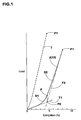
- the nominal elastic modulus EL of the low-modulus zone S1 is defined by the slope of a line drawn between the origin O and the boundary point P.
- the nominal elastic modulus EH of the high-modulus zone S2 is defined by the slope of a line drawn between the boundary point P and breaking point P1.
- the above-mentioned high-strength high-modulus organic filaments are, for example, aromatic polyamide filaments, fully aromatic polyester filaments, polyvinyl alcohol filaments whose strength is not less than 15 g/dtex, carbon filaments, polyketone filaments, rayon filaments and the like.
- the band cord is formed by first twisting each of the filament bunches, and subjecting the first-twisted bunches to a dip-and-stretch treatment, and then second twisting the treated bunches together.
- the cord is provided with an elongation characteristic having a low-modulus zone and a high-modulus zone as shown in Fig.1 in full line.
- the load-elongation curve j becomes almost linear from the original point to the breaking point P1 as shown in Fig.1 in broken line and the cord is provided with a completely different elongation characteristic.
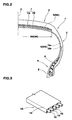
- pneumatic tire 1 comprises a tread portion 2, a pair of sidewall portions 3, a pair of bead portions 4 each with a bead core 5 therein, a carcass 6 extended between the bead portions 4 through the tread portion 2 and sidewall portions 3, and a band 9 disposed radially outside the crown portion of the carcass 6 in the tread portion 2.
- the tire 1 is a radial tire for passenger cars provided in the tread portion 2 with a breaker 7, and the band 9 is disposed on the radially outside of the breaker 7 as shown in Fig. 2 .
- the carcass 6 is composed of at least one ply 6A of cords arranged radially at an angle of 75 to 90 degrees with respect to the tire equator.
- organic fiber cords such as polyester (polyethylene terephthalate, polyethylene naphtarete, fully aromatic polyester), nylon (aliphatic polyamide), rayon and the like are suitably used in the case of passenger car tires. But, steel cords can be used too, depending on the tire size, usage and the like.
- the carcass is composed of a single ply 6A of PET cords arranged radially at 90 degrees, and the cord count is set in a range of from 40 to 60 ends/5 cm.
- the carcass ply 6A extends between the bead portions 4 through the tread portion 2 and sidewall portions 3, and is turned up around the bead core 5 in each of the bead portions from the inside to the outside of the tire to form a pair of carcass ply turnup portions 6b and a carcass ply main portion 6a therebetween. Between each of the carcass ply turnup portions 6b and the ply main portion 6a, there is disposed a bead apex 8 made of a hard rubber extending radially outwardly from the bead core 5 while tapering towards its radially outer end.
- the breaker 7 is disposed radially outside the crown portion of the carcass 6, and composed of at least two plies 7A and 7B each made of parallel cords laid at an angle of 15 to 40 degrees with respect to the tire equator.
- high-strength cords such as steel cords, high modulus organic fiber cords such as polyethylene naphtarete(PEN), polyethylene terephthalate(PET) and aromatic polyamide and the like can be used.
- the cords in the radially inner ply 7A are inclined towards one direction, and the cords in the radially outer ply 7B are inclined towards the opposite direction to the above-mentioned one direction.
- the radially inner ply 7A is the widest ply of which width defines the width WB of the breaker 7.
- the radially outer ply 7B is smaller in width than the inner ply 7A.
- the breaker 7 is composed of the two cross plies 7A and 7B of steel cords, and extends all over the width of the tread portion.
- the band 9 is composed of at least one ply 9A of at least one cord 10 wound spirally at an angle of not more than 5 degrees with respect to the tire circumferential direction.
- the ply 9A can be a full-width ply covering the substantially entire width of the breaker 7, namely, not less than 95 % of the breaker width WB, or a pair of axially spaced edge plies each covering one of the axial edge portions of the breaker 7.
- the band 9 can be the full-width ply(s) only, or the axially spaced edge plies only, or a combination of the full-width ply(s) and the edge plies.
- the band 9 is made up of a single full-width ply, and the width W of the band 9 is almost same as the width WB of the breaker 7.
- the band ply 9A is formed by spiral winding a tape 13 of unvulcanized rubber 12 in which a plurality of parallel cords 10 are embedded along the length thereof as shown in Fig. 3 . of course it is possible to wind a single cord 10 alone or a tape of unvulcanized rubber 12 in which a single cord 10 is embedded along the length thereof. In the case of the tape 13, the number of the cords embedded therein is at most 10, usually 4 to 6.
- angles of the windings of the band cord(s) are not more than 5 degrees with respect to the tire circumferential direction in order to improve the tire uniformity and to provide a strong hoop effect for the tread portion 2.
- the tire 1 is manufactured by first making the green tire by assembling raw tire components including the band, and then vulcanizing the green tire in a mold as usual.
- a bladder put inside the green tire is inflated to press the outer surface of the green tire onto the inner surface of the mold. Therefore, although it is desirable that the band is hard to stretch in the finished tire, the raw band has to be stretched during vulcanization in order that the outer surface of the tread portion is fully pressed onto the tread molding face of the mold.
- the cord modulus should be relatively low in a cord elongation range between 0 % and about 2 %.
- the load-elongation curve J of the band cord 10 has to be provided with a low-modulus zone S1 and a high-modulus zone S2 of which boundary point P is in an elongation range of from 1.0 to 7.0 %, and the nominal modulus ratio EH/EL is not less than 2.0 but not more than 10.0.
- the load of the band cord 10 at 1% elongation is more than 60 N, the stretch during vulcanization becomes insufficient. If the load at 1 % elongation is less than 20 N, although a sufficient stretch can be obtained, in the finished tire the hoop effect of the band is decreased and the high speed durability tends to deteriorate. Therefore, the load at 1% elongation is preferably set in a range of from 20 to 60 N.
- the load of the band cord 10 at 3% elongation is less than 225 N, there is a tendency that the rigidity of the tread portion becomes insufficient and as a result the steering stability is deteriorated. If the load at 3 % elongation is more than 431 N, the rigidity becomes excessively increased and the ride comfort is decreased. Therefore, the load at 3% elongation is preferably set in a range of from 225 to 431 N.
- the band cord 10 is made up of a plurality of materially identical high-strength high-modulus organic filaments (f).
- high-strength high-modulus organic filaments (f) for example, aromatic polyamide filaments, fully aromatic polyester filaments, polyvinyl alcohol filaments whose strength is not less than 15 g/dtex, carbon filaments, polyketone filaments, rayon filaments and the like can be used. Among them, aromatic polyamide filaments are especially preferred.
- the band cord 10 is made up of a plurality of dip-and-stretch treated strands 22 (hereinafter dipped strands 22).
- dipped strands 22 dip-and-stretch treated strands 22
- the band cord 10 is made up of two dipped strands 22.
- the cord 10 is made up of four dipped strands 22.
- the number of the dipped strands 22 is at least two, preferably at most 8, more preferably 6 or less.
- each of the strands 22 is formed by first-twisting a bunch 21 of a plurality of the organic filaments (f).
- the first-twisted filament bunch 21 is subjected to a dip-and-stretch treatment K.
- the dip-and-stretch treatment K comprises a dip process Ka, a drying process Kb, a stretch process Kc, and a relax process Kd.
- the dip process Ka is such that the first-twisted filament bunch 21 is dipped into a solution of a resin to coat the surfaces of the organic filaments.
- a resin for example, resorcinol formalin latex can be used as the solution.
- an additive to improve the adhesion such as epoxy compounds, isocyanate compounds, urea compounds and the like is added into the solution.
- bunch 21 it is preferred to subject the bunch 21 to a two-bath dipping process, where first dipped into a solution or emulsion of the above-mentioned additive to improve the adhesion and then dipped into the above-mentioned solution of the resin.
- the drying process Kb is such that the dipped filament bunch 21 is dried by heating it to a specific temperature controlled within a range of from 100 to 160 degrees c. for 60 to 300 seconds until completely or almost completely dried, while applying a tension of 0.1 to 1.5 g/dtex.
- the stretch process Kc is such that the filament bunch 21 is stretched by applying a specific tension in a range of 0.1 to 1.5 d/dtex for example 0.2 g/dtex, while heating it to a specific temperature controlled within a range of from 215 to 255 degrees c. for 30 to 120 seconds.
- the relax process Kd is such that the filament bunch 21 is gradually cooled to room temperature, while gradually decreasing the above-mentioned applied tension.
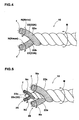
- the process (1) is utilized to make the example cord shown in Fig. 4 .
- the two or more strands 22 are second twisted together into the final cord 10.
- the second twist is the last twist.
- All of the strands 22 have the same first twist directions which are opposite to the second twist direction.
- the dipped strands 22 include at least two types of strands: one is a low-twist strand 22A whose first twist number N is a minimum value Nmin, and another is a high-twist strand 22B whose first twist number N is a maximum value Nmax, wherein the ratio Nmin /Nmax is preferably not more than 0.9, more preferably not more than 0.8, but, preferably not less than 0.5.
- the second twist number M of the cord 10 is preferably not less than the minimum value Nmin and not more than the maximum value Nmax. It is especially preferable that the second twist number M is equal to the minimum value Nmin.
- the cord is composed of at least one thicker strand 22a and at least one thinner strand 22b.
- the first twist number of the thinnest dipped strand 22b is set at the maximum value Nmax
- the first twist number of the thickest dipped strand 22a is set at the minimum value Nmin. This also facilities the increase of the ratio EH/EL.
- the process (2) is utilized to make another example cord 10 which is, as shown in Fig. 5 , made up of at least one dipped strand 22c (in Fig. 5 two dipped strands 22c) forming a core 25, and at least one dipped strand 22s (in Fig. 5 two dipped strands 22s) forming a sheathe 26 around the core 25.
- the ratio Ds/Dc of the total dtex number Ds of the strand 22s forming the sheathe to the total dtex number Dc of the strand 22c forming the core is not less than 2.3; and the first twist number Ns of the sheath strand 22s is less than the first twist number Nc of the core strand 22c, and the ratio Ns/Nc is in a range of from 0.07 to 0.11.
- the core 25 is made up of a single strand 22c, a plurality of strands 22s are second twisted around the core 25.
- the core 25 is made up of a plurality of strands 22c
- these strands 22c are second twisted into the core 25. And then at least one strand 22s is second twisted around the core 25 in the same direction as the second twist direction of the core.
- the second twist number M of the sheath strand 22s is less than the first twist number Nc of the core strand 22c and in a range of from 0.5 to 1.2 times the first twist number Ns of the sheath strand 22s.
- the second twist of the core strands 22c may be omitted substantially because the sheathe 26 can prevent the core strands 22c from loosing.
- the position of the boundary point P and the value of EH/EL can be adjusted by changing the thickness, first twist number and second twist number of the strands 22.
- the tire inflated to 300 kPa was run under a tire load of 3.90 kN by the use of a tire drum tester, and the running speed was increased every 20 minutes at a constant step of 10 km/h in order to obtain the running speed at which any damage was caused on the tire resulting from the band.
- the test results are indicate in Tables 1 and 2 by an index based on Ref.1 tire being 100 wherein the larger the value, the better the durability.
- the tire inflated to 200 kPa was run at a speed of 120 km/h under a tire load of 4.00 kN by the use of a tire drum tester, and vibrations generated by the rotating tire were measured on the axle.
- the results are indicated in Tables 1 and 2 by an index based on Ref. 1 being 100, wherein the larger the value, the better the vibration characteristic.
- the weight is indicate by an index based on Ref.1 being 100.
- the abbreviations used in Table 1 and 2 are as follows. In the "Material" item,
- the present invention can be applied to various tires as well, for example, motorcycle tires, SUV tires and the like.
- the band 9 is directly disposed on the radially outside of the crown portion of the carcass 6.
Landscapes
- Engineering & Computer Science (AREA)
- Mechanical Engineering (AREA)
- Textile Engineering (AREA)
- Tires In General (AREA)
- Yarns And Mechanical Finishing Of Yarns Or Ropes (AREA)
Claims (7)
- Bandage pneumatique (1) comprenant
une carcasse (6) s'étendant entre une paire de portions de talon (4) via une portion de bande de roulement (2) et une paire de portions de paroi latérale (3), et
une bande (9) réalisée d'au moins un câblé enroulé en spirale (10) disposé radialement à l'extérieur de la carcasse (6) dans la portion de bande de roulement (2),
dans lequel
le câblé (10) en bande est constitué de filaments organiques (f) à haute résistance et à module élevé, et le câblé en bande (10) est formé par le procédé suivant :les filaments organiques à module élevé (f) sont divisés en une pluralité de brins (21), les brins (21) sont torsadés en premier lieu chacun séparément des autres, les brins torsadés en premier lieu (21) sont soumis chacun à un traitement par trempage-étirage (K), et(A) les brins traités (21) sont torsadés en second lieu ensemble ; ou(B) certains des brins traités (21) sont torsadés en second lieu ensemble pour former une âme (25), et au moins un brin traité restant (21) est enroulé en spirale autour de l'âme (25) ; ou(C) certains des brins traités (21) sous forme d'âme (25) ne sont sensiblement pas torsadés ensemble, et au moins un brin traité restant (21) est enroulé en spirale autour de l'âme (25) ; ou(D) en prenant l'un des brins traités (21) à titre d'âme (25), les brins traités restants (21) sont torsadés second lieu en étant enroulés en spirale autour de l'âme (25),dans lequel le traitement par trempage-étirage (K) comprend un processus de trempage (Ka) par trempage des brins de filaments torsadés en premier lieu (21) dans une solution, un processus de séchage (Kb) en chauffant le brin de filaments trempé (21), un processus d'étirage (Kc) en appliquant une tension au brin (21) tout en le chauffant à une température spécifique, et un processus de relaxation (Kd) en faisant refroidir le brin (21) tout en diminuant la tension appliquée, grâce à quoile câblé en bande (10) présente une courbe charge/élongation comprenant une zone à faible module (S1) entre l'origine et un point frontière (P), et une zone à module élevé (S2) entre le point frontière (P) et le point de rupture (P1), et le point frontière (P), qui est défini comme étant un point sur la courbe charge/élongation (J) auquel le pourcentage d'élongation est le même que celui du point d'intersection (P0) entre une ligne tangentielle (T1) à la courbe charge/élongation (J) à l'origine (O), et une ligne tangentielle (T2) à la courbe charge/élongation (J) au point de rupture (P1) du câblé (10), se trouve à une certaine élongation dans une plage de 1 à 7 %, etle rapport EH/EL d'un module d'élasticité nominal EH de la zone à module élevé, qui est défini par la pente d'une ligne tirée entre le point frontière (P) et le point de rupture (P1), sur un module d'élasticité nominal EL de la zone à faible module, qui est défini par une pente d'une ligne tirée entre l'origine (O) et le point frontière (P), est dans une plage de 2,0 à 10,0. - Bandage pneumatique selon la revendication 1, dans lequel
les filaments organiques (f) sont des filaments en polyamide aromatique, des filaments en polyester entièrement aromatique, des filaments d'alcool de polyvinyle ayant une résistance qui n'est pas inférieure à 15 g/dtex, des filaments en carbone, des filaments en polycétone ou des filaments en rayonne. - Bandage pneumatique selon la revendication 1, dans lequel
la charge du câblé en bande (10) à 1 % d'élongation est dans une plage de 20 à 60 N, et
la charge du câblé en bande (10) à 3 % d'élongation est dans une plage de 225 à 431 N. - Bandage pneumatique selon la revendication 1, dans lequel
ledit au moins un câblé enroulé en spirale (10) de la bande (9) forme une couche unique s'étendant à travers presque la totalité de la largeur de la bande de roulement (2), et
la carcasse (6) est composée d'une nappe unique de câblés en fibres organiques (10) agencés radialement sensiblement à 90° par rapport à l'équateur du pneumatique. - Bandage pneumatique selon la revendication 1, dans lequel
les brins (21) torsadés en premier lieu incluent un brin faiblement torsadé dont un premier nombre de torsades est égal à une valeur minimum Nmin, et un brin hautement torsadé dont un premier nombre de torsades est égal à une valeur maximum Nmax, et
le rapport Nmin/Nmax n'est pas supérieur à 0,9. - Bandage pneumatique selon la revendication 5, dans lequel
dans le cas des alternatives (A), (B) ou (D) le second nombre de torsades M des brins traités (21) n'est pas inférieur à la valeur minimum Nmin et n'est pas supérieur à la valeur maximum Nmax. - Bandage pneumatique selon la revendication 1, dans lequel
tous les brins (21) torsadés en premier lieu présentent le même premier nombre de torsades.
Applications Claiming Priority (1)
| Application Number | Priority Date | Filing Date | Title |
|---|---|---|---|
| JP2007188992 | 2007-07-20 |
Publications (3)
| Publication Number | Publication Date |
|---|---|
| EP2017093A2 EP2017093A2 (fr) | 2009-01-21 |
| EP2017093A3 EP2017093A3 (fr) | 2009-10-14 |
| EP2017093B1 true EP2017093B1 (fr) | 2010-12-15 |
Family
ID=39735112
Family Applications (1)
| Application Number | Title | Priority Date | Filing Date |
|---|---|---|---|
| EP08011505A Ceased EP2017093B1 (fr) | 2007-07-20 | 2008-06-25 | Pneu |
Country Status (4)
| Country | Link |
|---|---|
| US (2) | US8104525B2 (fr) |
| EP (1) | EP2017093B1 (fr) |
| JP (1) | JP4847987B2 (fr) |
| DE (1) | DE602008003956D1 (fr) |
Families Citing this family (19)
| Publication number | Priority date | Publication date | Assignee | Title |
|---|---|---|---|---|
| DE102009025793A1 (de) * | 2009-02-19 | 2010-08-26 | Continental Reifen Deutschland Gmbh | Fahrzeugluftreifen |
| JP4814979B2 (ja) * | 2009-06-12 | 2011-11-16 | 住友ゴム工業株式会社 | タイヤ用コード及びそれを用いた空気入りタイヤ |
| KR101102562B1 (ko) | 2009-12-18 | 2012-01-04 | 한국타이어 주식회사 | 내구성능을 강화한 승용차용 래디얼 타이어 |
| DE102010000014A1 (de) * | 2010-01-07 | 2011-07-14 | Continental Reifen Deutschland GmbH, 30165 | Fahrzeugluftreifen |
| JP2011225085A (ja) * | 2010-04-19 | 2011-11-10 | Sumitomo Rubber Ind Ltd | 空気入りタイヤ |
| FR2974583B1 (fr) * | 2011-04-28 | 2013-06-14 | Michelin Soc Tech | Cable textile composite aramide-polycetone |
| JP5395882B2 (ja) * | 2011-12-01 | 2014-01-22 | 住友ゴム工業株式会社 | 空気入りタイヤ |
| JP5917989B2 (ja) * | 2012-04-11 | 2016-05-18 | 住友ゴム工業株式会社 | 空気入りタイヤ |
| US20130340907A1 (en) * | 2012-06-21 | 2013-12-26 | Matthieu Pingenat | Tire with a segmented overlay layer |
| KR101307936B1 (ko) | 2012-08-20 | 2013-09-12 | 주식회사 효성 | 고강도의 방향족 폴리아미드 모노필라멘트 및 이의 제조방법 |
| US9353466B2 (en) * | 2012-09-12 | 2016-05-31 | Timken Smo Llc | Hybrid power transmission cord |
| US20150246580A1 (en) * | 2012-12-25 | 2015-09-03 | Kordsa Global Endustriyel Iplik Ve Kord Bezi Sanayi Ve Ticaret Anonim Sirketi | Tire reinforcement material |
| EP2948491B1 (fr) * | 2013-01-22 | 2019-12-25 | Sika Technology AG | Membrane d'imperméabilisation à application de liquide comprenant de l'aldimine et de l'oxazolidine |
| JP6019219B2 (ja) * | 2013-04-11 | 2016-11-02 | 住友ゴム工業株式会社 | 空気入りタイヤ |
| JP6062820B2 (ja) * | 2013-07-30 | 2017-01-18 | 東洋ゴム工業株式会社 | 空気入りタイヤ |
| EP3312023B1 (fr) * | 2016-08-30 | 2019-10-09 | Sumitomo Rubber Industries, Ltd. | Pneu de moto |
| WO2020066906A1 (fr) | 2018-09-25 | 2020-04-02 | 住友ゴム工業株式会社 | Pneumatique |
| JP7119879B2 (ja) * | 2018-10-12 | 2022-08-17 | 住友ゴム工業株式会社 | 複合コード及びそれを用いたタイヤ |
| JP7372857B2 (ja) * | 2020-03-11 | 2023-11-01 | 株式会社ブリヂストン | 空気入りタイヤ |
Family Cites Families (14)
| Publication number | Priority date | Publication date | Assignee | Title |
|---|---|---|---|---|
| US2500523A (en) * | 1943-03-08 | 1950-03-14 | Dayton Rubber Company | Method of manufacturing wire cord |
| US2842932A (en) * | 1954-07-29 | 1958-07-15 | Robert S Owens | Apparatus and method for making twisted fiber products |
| US2842934A (en) * | 1954-07-29 | 1958-07-15 | Owens Robert Stuart | Stabilized multi-ply yarns |
| US3029590A (en) * | 1958-12-30 | 1962-04-17 | Owens Corning Fiberglass Corp | Extensible fibrous glass textile strand structure and method of making same |
| US4832102A (en) * | 1987-06-15 | 1989-05-23 | The Goodyear Tire & Rubber Company | Pneumatic tires |
| US4877073A (en) * | 1988-02-17 | 1989-10-31 | The Goodyear Tire & Rubber Company | Cables and tires reinforced by said cables |
| JP2757940B2 (ja) | 1988-03-28 | 1998-05-25 | 住友ゴム工業株式会社 | 空気入りタイヤ |
| JPH06210761A (ja) * | 1993-01-14 | 1994-08-02 | Bridgestone Corp | 空気入りバイアスタイヤ |
| DE10206051C1 (de) * | 2002-02-14 | 2003-07-17 | Continental Ag | Verfahren zur Herstellung von Festigkeitsträgercorden für Gummiprodukte |
| AU2002303269A1 (en) * | 2002-04-08 | 2003-10-27 | Michelin Recherche Et Technique S.A. | Pneumatic tire crown reinforcement |
| US7299843B2 (en) * | 2002-04-08 | 2007-11-27 | Michelin Recherche Et Technique S.A. | Pneumatic tire crown reinforcement |
| JP2005161998A (ja) * | 2003-12-02 | 2005-06-23 | Bridgestone Corp | 空気入りタイヤ |
| JP2005239069A (ja) * | 2004-02-27 | 2005-09-08 | Sumitomo Rubber Ind Ltd | 乗用車用ラジアルタイヤ。 |
| JP4956311B2 (ja) * | 2007-07-20 | 2012-06-20 | 住友ゴム工業株式会社 | 空気入りタイヤ |
-
2008
- 2008-06-25 EP EP08011505A patent/EP2017093B1/fr not_active Ceased
- 2008-06-25 DE DE602008003956T patent/DE602008003956D1/de active Active
- 2008-07-03 US US12/216,454 patent/US8104525B2/en not_active Expired - Fee Related
- 2008-07-10 JP JP2008180419A patent/JP4847987B2/ja not_active Expired - Fee Related
-
2011
- 2011-12-21 US US13/333,512 patent/US8622105B2/en not_active Expired - Fee Related
Also Published As
| Publication number | Publication date |
|---|---|
| EP2017093A3 (fr) | 2009-10-14 |
| JP2009046116A (ja) | 2009-03-05 |
| US20090020208A1 (en) | 2009-01-22 |
| US8104525B2 (en) | 2012-01-31 |
| JP4847987B2 (ja) | 2011-12-28 |
| EP2017093A2 (fr) | 2009-01-21 |
| US20120097308A1 (en) | 2012-04-26 |
| DE602008003956D1 (de) | 2011-01-27 |
| US8622105B2 (en) | 2014-01-07 |
Similar Documents
| Publication | Publication Date | Title |
|---|---|---|
| US8104525B2 (en) | Pneumatic tire | |
| EP2261059B1 (fr) | Pneu avec renfort de recouvrement | |
| EP2098385B1 (fr) | Pneu | |
| US6926053B2 (en) | Pneumatic tire variable elasticity modules metallic band cord | |
| US20190184749A1 (en) | Pneumatic tire | |
| CN101031440B (zh) | 充气轮胎及其制造方法 | |
| CN101448654A (zh) | 充气轮胎及其制造方法 | |
| EP3135465B1 (fr) | Pneumatique et procédé de production de pneumatique | |
| US20170246913A1 (en) | Pneumatic Vehicle Tires Comprising a Belt Bandage | |
| JP2011156887A (ja) | 空気入りラジアルタイヤ及びその製造方法 | |
| JP2004224074A (ja) | 空気入りタイヤ | |
| US5906693A (en) | Pneumatic radial tire with specified organic fiber carcass cords | |
| EP2987657A1 (fr) | Pneumatique | |
| EP1338440B1 (fr) | Bandage pneumatique | |
| JP5104047B2 (ja) | 空気入りラジアルタイヤ | |
| JP5384255B2 (ja) | 空気入りタイヤ | |
| JP2004168118A (ja) | 空気入りタイヤ | |
| JP5305389B2 (ja) | 空気入りラジアルタイヤ | |
| JP2005343301A (ja) | 空気入りラジアルタイヤ | |
| JP2004276840A (ja) | 空気入りラジアルタイヤ | |
| JP6988865B2 (ja) | 空気入りタイヤ | |
| JP5890114B2 (ja) | 空気入りタイヤ | |
| JPH1178409A (ja) | ラジアルタイヤ | |
| JP2006240498A (ja) | 空気入りラジアルタイヤおよびその製造方法 | |
| JP2009040207A (ja) | 空気入りタイヤ |
Legal Events
| Date | Code | Title | Description |
|---|---|---|---|
| PUAI | Public reference made under article 153(3) epc to a published international application that has entered the european phase |
Free format text: ORIGINAL CODE: 0009012 |
|
| AK | Designated contracting states |
Kind code of ref document: A2 Designated state(s): AT BE BG CH CY CZ DE DK EE ES FI FR GB GR HR HU IE IS IT LI LT LU LV MC MT NL NO PL PT RO SE SI SK TR |
|
| AX | Request for extension of the european patent |
Extension state: AL BA MK RS |
|
| PUAL | Search report despatched |
Free format text: ORIGINAL CODE: 0009013 |
|
| AK | Designated contracting states |
Kind code of ref document: A3 Designated state(s): AT BE BG CH CY CZ DE DK EE ES FI FR GB GR HR HU IE IS IT LI LT LU LV MC MT NL NO PL PT RO SE SI SK TR |
|
| AX | Request for extension of the european patent |
Extension state: AL BA MK RS |
|
| 17P | Request for examination filed |
Effective date: 20100325 |
|
| GRAP | Despatch of communication of intention to grant a patent |
Free format text: ORIGINAL CODE: EPIDOSNIGR1 |
|
| AKX | Designation fees paid |
Designated state(s): DE FR IT |
|
| GRAS | Grant fee paid |
Free format text: ORIGINAL CODE: EPIDOSNIGR3 |
|
| GRAA | (expected) grant |
Free format text: ORIGINAL CODE: 0009210 |
|
| AK | Designated contracting states |
Kind code of ref document: B1 Designated state(s): DE FR IT |
|
| REF | Corresponds to: |
Ref document number: 602008003956 Country of ref document: DE Date of ref document: 20110127 Kind code of ref document: P |
|
| PLBE | No opposition filed within time limit |
Free format text: ORIGINAL CODE: 0009261 |
|
| STAA | Information on the status of an ep patent application or granted ep patent |
Free format text: STATUS: NO OPPOSITION FILED WITHIN TIME LIMIT |
|
| 26N | No opposition filed |
Effective date: 20110916 |
|
| REG | Reference to a national code |
Ref country code: DE Ref legal event code: R097 Ref document number: 602008003956 Country of ref document: DE Effective date: 20110916 |
|
| PGFP | Annual fee paid to national office [announced via postgrant information from national office to epo] |
Ref country code: IT Payment date: 20140616 Year of fee payment: 7 |
|
| PG25 | Lapsed in a contracting state [announced via postgrant information from national office to epo] |
Ref country code: IT Free format text: LAPSE BECAUSE OF NON-PAYMENT OF DUE FEES Effective date: 20150625 |
|
| REG | Reference to a national code |
Ref country code: FR Ref legal event code: PLFP Year of fee payment: 9 |
|
| REG | Reference to a national code |
Ref country code: FR Ref legal event code: PLFP Year of fee payment: 10 |
|
| REG | Reference to a national code |
Ref country code: FR Ref legal event code: PLFP Year of fee payment: 11 |
|
| PGFP | Annual fee paid to national office [announced via postgrant information from national office to epo] |
Ref country code: DE Payment date: 20190612 Year of fee payment: 12 |
|
| PGFP | Annual fee paid to national office [announced via postgrant information from national office to epo] |
Ref country code: FR Payment date: 20190510 Year of fee payment: 12 |
|
| REG | Reference to a national code |
Ref country code: DE Ref legal event code: R119 Ref document number: 602008003956 Country of ref document: DE |
|
| PG25 | Lapsed in a contracting state [announced via postgrant information from national office to epo] |
Ref country code: FR Free format text: LAPSE BECAUSE OF NON-PAYMENT OF DUE FEES Effective date: 20200630 |
|
| PG25 | Lapsed in a contracting state [announced via postgrant information from national office to epo] |
Ref country code: DE Free format text: LAPSE BECAUSE OF NON-PAYMENT OF DUE FEES Effective date: 20210101 |