EP2017405A2 - Applikator mit Zahnspachtel und Kleberzusammensetzung zur Parkettverlegung - Google Patents
Applikator mit Zahnspachtel und Kleberzusammensetzung zur Parkettverlegung Download PDFInfo
- Publication number
- EP2017405A2 EP2017405A2 EP08290689A EP08290689A EP2017405A2 EP 2017405 A2 EP2017405 A2 EP 2017405A2 EP 08290689 A EP08290689 A EP 08290689A EP 08290689 A EP08290689 A EP 08290689A EP 2017405 A2 EP2017405 A2 EP 2017405A2
- Authority
- EP
- European Patent Office
- Prior art keywords
- spatula
- applicator
- notches
- adhesive composition
- notched
- Prior art date
- Legal status (The legal status is an assumption and is not a legal conclusion. Google has not performed a legal analysis and makes no representation as to the accuracy of the status listed.)
- Withdrawn
Links
- 239000000203 mixture Substances 0.000 title claims abstract description 52
- 239000000853 adhesive Substances 0.000 title claims abstract description 49
- 230000001070 adhesive effect Effects 0.000 title claims abstract description 49
- 238000009408 flooring Methods 0.000 title description 3
- 238000000034 method Methods 0.000 claims abstract description 43
- 229920000642 polymer Polymers 0.000 claims description 28
- 239000011230 binding agent Substances 0.000 claims description 11
- 239000000463 material Substances 0.000 claims description 10
- 239000012798 spherical particle Substances 0.000 claims description 9
- 238000009826 distribution Methods 0.000 claims description 7
- 238000004026 adhesive bonding Methods 0.000 claims description 5
- 239000002245 particle Substances 0.000 claims description 5
- 229920001577 copolymer Polymers 0.000 claims description 3
- 229910001220 stainless steel Inorganic materials 0.000 claims description 3
- 239000010935 stainless steel Substances 0.000 claims description 3
- 238000000576 coating method Methods 0.000 abstract description 10
- 239000011248 coating agent Substances 0.000 abstract description 6
- 239000002689 soil Substances 0.000 abstract 1
- -1 tiling Substances 0.000 description 14
- 239000011324 bead Substances 0.000 description 12
- 239000004743 Polypropylene Substances 0.000 description 10
- 229920001155 polypropylene Polymers 0.000 description 10
- 229920002943 EPDM rubber Polymers 0.000 description 8
- 239000003292 glue Substances 0.000 description 8
- 238000009413 insulation Methods 0.000 description 7
- 229910052751 metal Inorganic materials 0.000 description 6
- 239000002184 metal Substances 0.000 description 6
- JOYRKODLDBILNP-UHFFFAOYSA-N Ethyl urethane Chemical compound CCOC(N)=O JOYRKODLDBILNP-UHFFFAOYSA-N 0.000 description 4
- LYCAIKOWRPUZTN-UHFFFAOYSA-N Ethylene glycol Chemical compound OCCO LYCAIKOWRPUZTN-UHFFFAOYSA-N 0.000 description 4
- 238000004132 cross linking Methods 0.000 description 4
- 238000009434 installation Methods 0.000 description 4
- 125000001181 organosilyl group Chemical group [SiH3]* 0.000 description 4
- 239000004814 polyurethane Substances 0.000 description 4
- 230000035939 shock Effects 0.000 description 4
- 241001080024 Telles Species 0.000 description 3
- 238000001125 extrusion Methods 0.000 description 3
- 229920002635 polyurethane Polymers 0.000 description 3
- 239000000126 substance Substances 0.000 description 3
- 239000002023 wood Substances 0.000 description 3
- VTYYLEPIZMXCLO-UHFFFAOYSA-L Calcium carbonate Chemical compound [Ca+2].[O-]C([O-])=O VTYYLEPIZMXCLO-UHFFFAOYSA-L 0.000 description 2
- 239000004721 Polyphenylene oxide Substances 0.000 description 2
- VYPSYNLAJGMNEJ-UHFFFAOYSA-N Silicium dioxide Chemical compound O=[Si]=O VYPSYNLAJGMNEJ-UHFFFAOYSA-N 0.000 description 2
- XSQUKJJJFZCRTK-UHFFFAOYSA-N Urea Chemical compound NC(N)=O XSQUKJJJFZCRTK-UHFFFAOYSA-N 0.000 description 2
- 239000002253 acid Substances 0.000 description 2
- WNLRTRBMVRJNCN-UHFFFAOYSA-N adipic acid Chemical compound OC(=O)CCCCC(O)=O WNLRTRBMVRJNCN-UHFFFAOYSA-N 0.000 description 2
- 239000003570 air Substances 0.000 description 2
- 238000001035 drying Methods 0.000 description 2
- 230000000694 effects Effects 0.000 description 2
- 229940082150 encore Drugs 0.000 description 2
- WGCNASOHLSPBMP-UHFFFAOYSA-N hydroxyacetaldehyde Natural products OCC=O WGCNASOHLSPBMP-UHFFFAOYSA-N 0.000 description 2
- IQPQWNKOIGAROB-UHFFFAOYSA-N isocyanate group Chemical group [N-]=C=O IQPQWNKOIGAROB-UHFFFAOYSA-N 0.000 description 2
- 210000003127 knee Anatomy 0.000 description 2
- XNGIFLGASWRNHJ-UHFFFAOYSA-N phthalic acid Chemical compound OC(=O)C1=CC=CC=C1C(O)=O XNGIFLGASWRNHJ-UHFFFAOYSA-N 0.000 description 2
- 229920000570 polyether Polymers 0.000 description 2
- 229920001228 polyisocyanate Polymers 0.000 description 2
- 239000005056 polyisocyanate Substances 0.000 description 2
- 229920005862 polyol Polymers 0.000 description 2
- 150000003077 polyols Chemical class 0.000 description 2
- 229920001451 polypropylene glycol Polymers 0.000 description 2
- 239000007787 solid Substances 0.000 description 2
- WRIDQFICGBMAFQ-UHFFFAOYSA-N (E)-8-Octadecenoic acid Natural products CCCCCCCCCC=CCCCCCCC(O)=O WRIDQFICGBMAFQ-UHFFFAOYSA-N 0.000 description 1
- DNIAPMSPPWPWGF-GSVOUGTGSA-N (R)-(-)-Propylene glycol Chemical compound C[C@@H](O)CO DNIAPMSPPWPWGF-GSVOUGTGSA-N 0.000 description 1
- LQJBNNIYVWPHFW-UHFFFAOYSA-N 20:1omega9c fatty acid Natural products CCCCCCCCCCC=CCCCCCCCC(O)=O LQJBNNIYVWPHFW-UHFFFAOYSA-N 0.000 description 1
- QSBYPNXLFMSGKH-UHFFFAOYSA-N 9-Heptadecensaeure Natural products CCCCCCCC=CCCCCCCCC(O)=O QSBYPNXLFMSGKH-UHFFFAOYSA-N 0.000 description 1
- 239000005995 Aluminium silicate Substances 0.000 description 1
- 239000004215 Carbon black (E152) Substances 0.000 description 1
- 239000005642 Oleic acid Substances 0.000 description 1
- ZQPPMHVWECSIRJ-UHFFFAOYSA-N Oleic acid Natural products CCCCCCCCC=CCCCCCCCC(O)=O ZQPPMHVWECSIRJ-UHFFFAOYSA-N 0.000 description 1
- OFOBLEOULBTSOW-UHFFFAOYSA-N Propanedioic acid Natural products OC(=O)CC(O)=O OFOBLEOULBTSOW-UHFFFAOYSA-N 0.000 description 1
- 229920000297 Rayon Polymers 0.000 description 1
- 229910000831 Steel Inorganic materials 0.000 description 1
- 241000826860 Trapezium Species 0.000 description 1
- 150000007513 acids Chemical class 0.000 description 1
- 239000000654 additive Substances 0.000 description 1
- 230000000996 additive effect Effects 0.000 description 1
- 235000011037 adipic acid Nutrition 0.000 description 1
- 239000001361 adipic acid Substances 0.000 description 1
- 235000012211 aluminium silicate Nutrition 0.000 description 1
- 239000012080 ambient air Substances 0.000 description 1
- 125000004429 atom Chemical group 0.000 description 1
- 230000005540 biological transmission Effects 0.000 description 1
- 230000015572 biosynthetic process Effects 0.000 description 1
- 229910000019 calcium carbonate Inorganic materials 0.000 description 1
- 239000004202 carbamide Substances 0.000 description 1
- 125000004432 carbon atom Chemical group C* 0.000 description 1
- 230000001413 cellular effect Effects 0.000 description 1
- 238000013016 damping Methods 0.000 description 1
- 230000007547 defect Effects 0.000 description 1
- 238000000151 deposition Methods 0.000 description 1
- 238000005137 deposition process Methods 0.000 description 1
- 230000010339 dilation Effects 0.000 description 1
- 229920001971 elastomer Polymers 0.000 description 1
- 229920006335 epoxy glue Polymers 0.000 description 1
- 150000002148 esters Chemical class 0.000 description 1
- 239000000945 filler Substances 0.000 description 1
- 239000006260 foam Substances 0.000 description 1
- 125000003827 glycol group Chemical group 0.000 description 1
- 238000009499 grossing Methods 0.000 description 1
- 238000000265 homogenisation Methods 0.000 description 1
- 229930195733 hydrocarbon Natural products 0.000 description 1
- 239000004615 ingredient Substances 0.000 description 1
- 238000002347 injection Methods 0.000 description 1
- 239000007924 injection Substances 0.000 description 1
- 239000012948 isocyanate Substances 0.000 description 1
- QXJSBBXBKPUZAA-UHFFFAOYSA-N isooleic acid Natural products CCCCCCCC=CCCCCCCCCC(O)=O QXJSBBXBKPUZAA-UHFFFAOYSA-N 0.000 description 1
- NLYAJNPCOHFWQQ-UHFFFAOYSA-N kaolin Chemical compound O.O.O=[Al]O[Si](=O)O[Si](=O)O[Al]=O NLYAJNPCOHFWQQ-UHFFFAOYSA-N 0.000 description 1
- VZCYOOQTPOCHFL-UPHRSURJSA-N maleic acid Chemical compound OC(=O)\C=C/C(O)=O VZCYOOQTPOCHFL-UPHRSURJSA-N 0.000 description 1
- 239000011976 maleic acid Substances 0.000 description 1
- HZVOZRGWRWCICA-UHFFFAOYSA-N methanediyl Chemical compound [CH2] HZVOZRGWRWCICA-UHFFFAOYSA-N 0.000 description 1
- 125000000956 methoxy group Chemical group [H]C([H])([H])O* 0.000 description 1
- 238000000465 moulding Methods 0.000 description 1
- 150000002888 oleic acid derivatives Chemical class 0.000 description 1
- 239000004014 plasticizer Substances 0.000 description 1
- 238000003825 pressing Methods 0.000 description 1
- 238000011112 process operation Methods 0.000 description 1
- 239000002964 rayon Substances 0.000 description 1
- 238000009418 renovation Methods 0.000 description 1
- 238000000926 separation method Methods 0.000 description 1
- 230000011664 signaling Effects 0.000 description 1
- 239000004526 silane-modified polyether Substances 0.000 description 1
- 239000000377 silicon dioxide Substances 0.000 description 1
- 239000010959 steel Substances 0.000 description 1
- 239000000454 talc Substances 0.000 description 1
- 229910052623 talc Inorganic materials 0.000 description 1
- 238000009864 tensile test Methods 0.000 description 1
- VZCYOOQTPOCHFL-UHFFFAOYSA-N trans-butenedioic acid Natural products OC(=O)C=CC(O)=O VZCYOOQTPOCHFL-UHFFFAOYSA-N 0.000 description 1
Images



Classifications
-
- E—FIXED CONSTRUCTIONS
- E04—BUILDING
- E04F—FINISHING WORK ON BUILDINGS, e.g. STAIRS, FLOORS
- E04F21/00—Implements for finishing work on buildings
- E04F21/02—Implements for finishing work on buildings for applying plasticised masses to surfaces, e.g. plastering walls
-
- E—FIXED CONSTRUCTIONS
- E04—BUILDING
- E04F—FINISHING WORK ON BUILDINGS, e.g. STAIRS, FLOORS
- E04F21/00—Implements for finishing work on buildings
- E04F21/02—Implements for finishing work on buildings for applying plasticised masses to surfaces, e.g. plastering walls
- E04F21/16—Implements for after-treatment of plaster or the like before it has hardened or dried, e.g. smoothing-tools, profile trowels
- E04F21/161—Trowels
- E04F21/162—Trowels with a blade having a notched or toothed edge
-
- E—FIXED CONSTRUCTIONS
- E04—BUILDING
- E04F—FINISHING WORK ON BUILDINGS, e.g. STAIRS, FLOORS
- E04F21/00—Implements for finishing work on buildings
- E04F21/20—Implements for finishing work on buildings for laying flooring
Definitions
- the present invention relates to a notched spatula applicator allowing the implementation of a method of laying, by gluing, rigid floor coverings, in particular parquet floors, by means of an adhesive composition which is also an object of the invention.
- the invention finally relates to said laying method, which gives the floor thus coated acoustic insulation properties.
- noise nuisance in homes is a widespread concern, and calm appears as the first criterion of choice in the search for housing.
- noise is the first reason for dissatisfaction when apartment occupants talk about their home.
- shock of the shoes on the floor of a floor of a house when walking, the fall of an object or the moving of a piece of furniture are some examples of activities that are a source of noise for the occupants of the house. 'inferior stage. These different impact noises cause the vibration of the floor, which is transmitted throughout the structure and especially in the ceiling of the lower floor, and which then radiates in the ambient air of the latter.
- Rigid coatings especially parquet or tiling, contribute as part of the floor to the transmission of impact noises, and thus to the acoustic comfort of the occupants of dwellings.
- the quality of sound insulation to shock noise required for floors is measured by the value of the expression ⁇ Lw (expressed in decibels or dB) according to EN ISO 717-2.
- Parquet is a wood-based floor covering whose rectangular elements (referred to as boards, laths or panels) can be laid in different ways on the surface of the underlying support.
- the latter is most often a slab of concrete, raw or coated with a smoothing coating.
- the support can also be, in the case of the renovation of an existing dwelling, another material such as tiling, metal or a wood-based floor.
- glued parquet are often used because of advantageous mechanical and dimensional stability, in the face of the variations of temperature and hygrometry of the surrounding atmosphere. These variations can lead over time to a dilation of the elements of the floor which may lead - in extreme situations - detachment and / or lifting of laths.
- This mechanical stability is often evaluated by measuring the resistance to tearing of the floorboards in a direction perpendicular to the surface of the support.
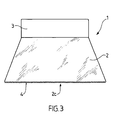
- the "spatula No. 4" 1 comprises a spatula 2 which is in the strict sense of the term a wide and flexible blade of rectangular or trapezoidal shape, generally metallic and often made of stainless steel, and which is provided over the entire length of its working edge 2c of a fine toothing.
- the spatula 2 is directly integral with a handle 3, for example made of wood.
- the fine toothing of the spatula 2, shown schematically on the figure 3 resulting from the juxtaposition of notches (or recesses) 4 which each have the shape of a triangle of height 3.8 mm and base 4.2 mm, and which are spaced 4.8 mm.
- the spatula n ° 4 is held in hand by the operator (or installer) for its implementation.
- the latter works by taking support on the support by means of his knees and possibly one hand.
- a container for example a pot
- glue that it deposits on the support.
- the floorboards are, after a waiting time of a few tens of minutes, applied to the support thus coated.
- Spatula applicators have been developed in order to overcome this disadvantage. These applicators are devices in which the notched spatula is indirectly connected, in particular via a rod, to gripping means, which allows its handling by the operator in the standing position. Such applicators are for example described in the international application WO 02/100555 and in US patents US 3611470 , US 3803662 and US 4982470 . These devices are used for the application of the adhesive according to the solid bonding method.
- the method of solid bonding is very widely used by professionals in the laying of parquet, because of the mechanical and dimensional stability particularly advantage of the parquet flooring it provides, as well as for its convenience and speed of implementation.
- the quality of sound insulation to shock noise provided by parquet glued according to this method is very inadequate.
- the adhesive is contained in a closed container (or cartridge) disposed in a gun, and is deposited on the surface of the support to be extrusion coated through a cannula (or nozzle), in the form of a cord of which the diameter is defined by the diameter of the nozzle, generally between 3 and 15 mm.
- a cannula or nozzle
- These cords are arranged by the installer substantially parallel to the surface of the support and regularly spaced about 10 to 20 cm. This method is used in particular to compensate for the presence of flatness defects of the support to be coated.
- the French patent application 2710675 discloses a method of arranging between the adhesive beads (separated by 5 to 20 cm) joints limiting the crushing of said cords during the laying of the floor, so as to arrange between said floor and the support an air space making acoustic and thermal insulation.
- the installation of these joints complicates and extends the duration of the installation.
- the French patent application 2751357 describes a method comprising the application on the support of an insulating underlayer having a plurality of recesses for receiving the beads of the parquet fixing glue.
- an underlayer however implies a very significant additional cost.
- the French patent application 2787116 describes a binder material deposition process consisting of a binder and comprising less than 5% of polymer or rubber grains having a size of the order of 1 to 6 mm as a setting additive.
- the cords bonding method which requires a cartridge placed in a gun, and which is implemented in these 3 patent applications, has in relation to the bonding process in full several disadvantages.
- the dimensional stability of the laid down parquet is lower, with less resistance to tearing off.
- the time required for the extrusion of the cords by the cannula of the cartridge it is longer to implement; it is also more expensive.
- the invention therefore firstly relates to a notched spatula applicator comprising gripping means connected to a spatula whose rectilinear working edge is provided with a plurality of identical notches and regularly spaced, characterized in that the width said notches are between 9 and 18 mm, their height is between 8 and 20 mm, and in that they are evenly spaced at a distance of between 35 and 50 mm.
- the spatula included in the applicator spatula notched according to the invention is a wide and flexible blade that can have the shape of an isosceles rectangle or trapezium. It is generally made of a metal, often steel, and preferably stainless steel.
- the number of notches is variable depending on the length of the working edge of the spatula.
- the width and height of the notches range from 10 to 16 mm.
- the notches are evenly spaced at a distance of between 35 and 45 mm, a distance of about 4 cm being even more particularly preferred.
- the notches of the spatula are notches 4b in the form of a rounded U-shaped rectangle whose height varies from 10 to 12 mm and the width varies from 10 to 15 mm.
- the spatula is connected directly to the gripping means, which then consist of a handle (or handle).
- the gripping means which then consist of a handle (or handle).
- This embodiment makes it possible to obtain a notched spatula tool that can be held in the hand and easily handled by its handle by the operator, who must then work kneeling and bent on the support to be glued.
- the working edge of such a tool generally has a length of between 15 and 40 cm, preferably between 20 and 30 cm, and is even more preferably close to 25 cm.
- the number of notches located on the working edge can then vary from 3 to 8, and advantageously from 4 to 6. A number of notches equal to 4 is particularly advantageous.
- the figure 1 schematically illustrates a front view of a first variant of this first embodiment, according to which the notched spatula tool 1 comprises a blade (or spatula) 2 isosceles trapezium-shaped, engaged and fixed, according to the edge opposite the edge of work 2c, in a rectangular wooden handle 3.
- the spatula 2 is provided with two straight side edges 2a and 2b of the same length and a front edge (or working edge) substantially rectilinear 2c of 25 cm in length.
- This front edge 2c is provided with 4 identical notches (or recesses) 4 of square shape with rounded corners of 10 mm side. These notches are regularly spaced about 4 cm.
- Such a toothed spatula tool is hereinafter described by the term "10-10", with reference to the width and height of its notches.
- Two other variants of this first embodiment relate to two notched trowel tools identical to that of the first variant, with the exception of the shape of the notches which is respectively a square of 12 mm side, and a rectangle of width 15 mm and height 10 mm. These 2 notched spatula tools are qualified in the rest of this text by the respective names of "12-12" and "15-10".
- the spatula is connected indirectly to the gripping means via a rod having a length allowing the operator to work in a standing position.
- the corresponding device then comprises the spatula, the gripping means and the rod in combination with one or more of the elements known from the documents of the prior art cited above.
- the spatula is provided on its rectilinear working edge, outside the notches, a thin toothing.
- this fine toothing is located along the entire length of the working edge 2c of the spatula 2 between the notches 4 described above and up to the two ends of said edge.
- This fine toothing advantageously consists of a juxtaposition of recesses 5 in the form of identical isosceles triangles regularly spaced at a distance ranging from 1 to 2 mm, whose base can range from 1.5 to 2.5 mm, and the height of 1 at 2 mm.
- the present invention also relates to a process for adhesive bonding rigid floor coverings, characterized in that it comprises a step of distribution on the substantially flat surface of a support, by means of the notched spatula applicator described previously, an adhesive composition comprising from 0.2 to 5% by weight of substantially spherical particles of a material whose substantially identical diameter can range from 1 to 7 mm.
- Said adhesive composition is also an object of the present invention, as are the embodiments described below.
- the substantially spherical particles included in said composition constitute a substantially monodisperse population whose ratio of 90% and 10% of the diametric distribution curve, D90 / D10, is between 0.9 and 1.1, preferably between 0.95 and 1.05.
- the adhesive composition contributes to obtaining the advantageous properties of acoustic insulation and mechanical stability of the process according to the invention, while ensuring perfect flatness and horizontality of the parquet after installation.
- the material used is a polymer.
- the particles included in the adhesive composition are for example particles of polypropylene or EPDM (Ethylene Propylene Diene Monomer) produced by injection, molding or extrusion processes.
- EPDM Ethylene Propylene Diene Monomer
- the corresponding products are available commercially, for example from the Belgian company Saluc.
- the diameter of the substantially spherical particles may range from 3 to 7 mm and even more preferably from 4 to 6 mm.
- the amount by weight of the material particles included in the adhesive composition is in the range of 0.5 to 4%.
- the adhesive compositions according to the invention are obtained by incorporating the spherical particles of material in a mixture consisting of the other ingredients and homogenization of the assembly made for example by means of a Rayneri ® blade mixer.
- the latter type of bonding binder includes low molecular weight polymers (or prepolymers) which have terminal groups capable of reacting with the moisture of the air during a so-called crosslinking reaction.
- This crosslinking reaction occurs during the drying which immediately follows the implementation of the adhesive composition during the laying of the parquet, and leads to the establishment of chemical bonds between the prepolymer chains, and consequently to the formation of a three-dimensional polymeric network.
- This network constitutes the seal ensuring the adhesion of the floor on the support.
- the adhesive composition according to the invention may comprise one or more polymers of the type which has just been defined.
- the polymers of type (i) and (ii) are commercially available, the polymers (ii) being for example marketed by Kaneka.
- the polymers of type (iii) can be prepared by methods known per se, for example by the patents US 2005/0119421 or US 2004/0181025 .
- the chemical bond established during the crosslinking is a siloxane bond.
- the polymers described above are generally used in the adhesive composition used in the process according to the invention in combination with one or more fillers such as calcium carbonate, kaolin, talc, silica, and / or one or more plasticizers which are often an ester of a polycarboxylic acid and a linear or branched aliphatic alcohol.
- fillers such as calcium carbonate, kaolin, talc, silica, and / or one or more plasticizers which are often an ester of a polycarboxylic acid and a linear or branched aliphatic alcohol.
- the polycarboxylic acids are especially useful phthalic acid, adipic acid, oleic or maleic acid.
- the substantially spherical particles included in the adhesive composition have a diameter which is less than or equal to about half the width of the notches of the spatula included in the applicator. This results in easier process operation, and improved degree of homogeneity for the composition when applied.
- the adhesive bonding method according to the invention is suitable for laying any rigid coating on the ground such as: wooden coating in the form of tiles, boards or panels, tiles, synthetic coatings in the form of slabs or rigid blades.
- These cylinders are spaced on the surface of the support a distance corresponding to the spacing between the notches along the rectilinear working edge of the spatula.
- the amount of adhesive composition applied to the surface of the support is variable according to the nature of said composition, especially the binder and its density.
- a dosage of 1 to 3.5 kg per m 2 , and preferably 1 to 2.5 kg per m 2 is generally suitable.
- the method according to the invention further comprises the step of distributing the adhesive composition on the surface of the support, a drying step at room temperature for a time of 1 to 40 minutes.
- the rigid coating to be laid is parquet
- the blades of said parquet are advantageously laid perpendicularly to the rolls of adhesive composition.
- Adhesive composition :
- the support used is a square concrete slab of 50 cm square and 5 cm thick.
- the adhesive composition a) is manually distributed on the surface of this slab by a setter by means of the toothed spatula tool 15-10, so as to deposit on said surface 8 parallel beads spaced about 4 cm, corresponding to a total quantity (or dose), reduced to the unit area, of 1.9 kg / m 2 .
- the floorboards used are oak strips 5.5 cm wide, 25 cm long and 10 mm thick.
- the slab with glued parquet is then stored at room temperature for 7 days, then subjected to the following 2 tests:
- the previous slab is embedded in a square recessed housing designed for this purpose in the center of the square upper face of an acoustic metal box 70 cm high and 1 m side. This box is isolated from the outside noises by walls lined with cellular foam.
- a shock machine a source of impact noises, is placed on the glued parquet floor.
- the impact machine used consists of 5 hammers arranged in line, the mass of a hammer being 500 grams falling in free fall perpendicular to the surface of the floor, a height of 40 mm at 10 shots per second.
- the sound level of the noise emitted by the impact machine on the glued floor is measured inside the acoustic box by a microphone placed in the center of the box at 10 cm below the tested floor. This sound level is measured for different frequency bands between 100 and 5000 Hz.
- the sound insulation is calculated by reference to the sound level measured for the uncoated raw concrete slab, and is expressed in decibel by a single value called ⁇ Lw, according to EN ISO 717-2.
- the strength of resistance to separation (or tearing) between a floorboard and the concrete support is measured on the bonded parquet floorboard obtained previously, under the effect of a traction force exerted in a direction perpendicular to the floor plan.
- the tensile force is generated by means of a dynamometer and is transmitted to the floorboard via a metal rod whose base substantially covers the blade and which is shaped T-shaped.
- This metal rod is secured to the parquet board by bonding its base by means of an epoxy glue, the glue joint obtained having a cohesion much greater than that of the connection between the blade and the concrete surface.
- the vertical part of the metal rod (corresponding to the vertical bar of the T) is secured to the axis of the dynamometer by a pin.
- a value of 0.153 N / mm 2 is measured.
- Example 1 is repeated incorporating 2% by weight of beads into the adhesive composition.
- Example 1 is repeated incorporating 3% by weight of beads into the adhesive composition.
- Example 1 is repeated using the notched spatula tool 12-12.
- Example 1 is repeated using 0.7% polypropylene beads 4 mm in diameter and applying the adhesive composition by means of the serrated spatula tool 10-10.
- Example 5 is repeated using 1% polypropylene beads.
- Example 5 is repeated using 5.5 mm diameter beads.
- Example 8 is repeated using 0.7% polypropylene beads in the adhesive composition.
- Example 9 is repeated using as bonding binder (hereinafter referred to as Polymer C) an isocyanate-terminated polyurethane.
- the adhesive composition used is TARBICOL ® PU MONO marketed by Bostik.
- Example 10 is repeated using 4 mm diameter beads and applying the adhesive composition by means of the serrated spatula tool 10-10.
- Example Adhesive composition Tool with notched spatula Quantity applied (kg / m 2 ) ⁇ Lw (dB) Resistance to tearing (N / mm 2 ) Binder Material of the balls Diameter of the balls (mm) Ball content (% by weight) 1 Polymer A EPDM 6 1 15-10 1.9 17.4 0.153 2 Polymer A EPDM 6 2 15-10 1.9 15.6 0.153 3 Polymer A EPDM 6 3 15-10 1.9 15.8 0.142 4 Polymer A EPDM 6 1 12-12 2.3 15.8 0.174 5 Polymer A polypropylene 4 0.7 10-10 1.3 14.4 0.131 6 Polymer A polypropylene 4 1 10-10 1.3 14.6 0.131 7 Polymer A polypropylene 5.5 0.7 10-10 1.3 15 0.091 8 Polymer B EPDM 6 1 12-12 2.3 15.4 0.214 9 Polymer B polypropylene 6 0.7 12-12 2.3
Landscapes
- Engineering & Computer Science (AREA)
- Architecture (AREA)
- Civil Engineering (AREA)
- Structural Engineering (AREA)
- Coating Apparatus (AREA)
- Floor Finish (AREA)
Applications Claiming Priority (2)
| Application Number | Priority Date | Filing Date | Title |
|---|---|---|---|
| FR0705246A FR2919007A1 (fr) | 2007-07-20 | 2007-07-20 | Applicateur a spatule crantee et composition adhesive pour pose parquet |
| FR0707694A FR2919008B1 (fr) | 2007-07-20 | 2007-11-02 | Applicateur a spatule crantee et composition adhesive pour pose de parquet |
Publications (2)
| Publication Number | Publication Date |
|---|---|
| EP2017405A2 true EP2017405A2 (de) | 2009-01-21 |
| EP2017405A3 EP2017405A3 (de) | 2009-02-18 |
Family
ID=39832285
Family Applications (1)
| Application Number | Title | Priority Date | Filing Date |
|---|---|---|---|
| EP08290689A Withdrawn EP2017405A3 (de) | 2007-07-20 | 2008-07-15 | Applikator mit Zahnspachtel und Kleberzusammensetzung zur Parkettverlegung |
Country Status (1)
| Country | Link |
|---|---|
| EP (1) | EP2017405A3 (de) |
Cited By (2)
| Publication number | Priority date | Publication date | Assignee | Title |
|---|---|---|---|---|
| GB2516238A (en) * | 2013-07-15 | 2015-01-21 | Focus Dgi Ltd | Improvements in or relating to cladding of structures |
| CN118455026A (zh) * | 2024-05-29 | 2024-08-09 | 浙江联洋新材料股份有限公司 | 人工刮胶板 |
Citations (9)
| Publication number | Priority date | Publication date | Assignee | Title |
|---|---|---|---|---|
| US3611470A (en) | 1970-06-08 | 1971-10-12 | Armstrong Cork Co | Adhesive spreader |
| US3803662A (en) | 1972-12-07 | 1974-04-16 | Kinkead Industries | Carpet adhesive spreader |
| US4982470A (en) | 1989-09-26 | 1991-01-08 | S. Szabo Ag | Apparatus for applying of an adhesive for floor coverings |
| FR2710675A1 (fr) | 1993-09-30 | 1995-04-07 | Guttaterna Sa | Procédé de pose d'un revêtement sur le sol. |
| FR2751357A1 (fr) | 1996-07-18 | 1998-01-23 | Guttaterna | Sous-couche pour l'isolation et le collage de revetements sur une surface et procede de pose dudit revetement |
| FR2787116A1 (fr) | 1998-12-10 | 2000-06-16 | Guttaterna | Matiere de collage d'un revetement sur une surface sensiblement plane et procede de pose d'un tel revetement |
| WO2002100555A1 (en) | 2001-06-13 | 2002-12-19 | Dana Lim A/S | Apparatus for the spreading of adhesive material |
| US20040181025A1 (en) | 2001-08-09 | 2004-09-16 | Wolfram Schindler | Alcoxy cross-linking, single-component, moisture-hardening materials |
| US20050119421A1 (en) | 2002-01-17 | 2005-06-02 | Consortium Fur Elektrochemische Industrie Gmbh | Cross-linkable polymer blends containing alkoxysilane-terminated polymers |
Family Cites Families (3)
| Publication number | Priority date | Publication date | Assignee | Title |
|---|---|---|---|---|
| FR1051074A (fr) * | 1952-02-26 | 1954-01-13 | Truelle | |
| AUPO717697A0 (en) * | 1997-06-04 | 1997-07-03 | Westthorp, Lee Anthony | Adhesive trowel |
| FR2823519B1 (fr) * | 2001-04-12 | 2005-08-19 | Patrick Navarro | Truelle pour la pose de carrelages colles |
-
2008
- 2008-07-15 EP EP08290689A patent/EP2017405A3/de not_active Withdrawn
Patent Citations (9)
| Publication number | Priority date | Publication date | Assignee | Title |
|---|---|---|---|---|
| US3611470A (en) | 1970-06-08 | 1971-10-12 | Armstrong Cork Co | Adhesive spreader |
| US3803662A (en) | 1972-12-07 | 1974-04-16 | Kinkead Industries | Carpet adhesive spreader |
| US4982470A (en) | 1989-09-26 | 1991-01-08 | S. Szabo Ag | Apparatus for applying of an adhesive for floor coverings |
| FR2710675A1 (fr) | 1993-09-30 | 1995-04-07 | Guttaterna Sa | Procédé de pose d'un revêtement sur le sol. |
| FR2751357A1 (fr) | 1996-07-18 | 1998-01-23 | Guttaterna | Sous-couche pour l'isolation et le collage de revetements sur une surface et procede de pose dudit revetement |
| FR2787116A1 (fr) | 1998-12-10 | 2000-06-16 | Guttaterna | Matiere de collage d'un revetement sur une surface sensiblement plane et procede de pose d'un tel revetement |
| WO2002100555A1 (en) | 2001-06-13 | 2002-12-19 | Dana Lim A/S | Apparatus for the spreading of adhesive material |
| US20040181025A1 (en) | 2001-08-09 | 2004-09-16 | Wolfram Schindler | Alcoxy cross-linking, single-component, moisture-hardening materials |
| US20050119421A1 (en) | 2002-01-17 | 2005-06-02 | Consortium Fur Elektrochemische Industrie Gmbh | Cross-linkable polymer blends containing alkoxysilane-terminated polymers |
Cited By (3)
| Publication number | Priority date | Publication date | Assignee | Title |
|---|---|---|---|---|
| GB2516238A (en) * | 2013-07-15 | 2015-01-21 | Focus Dgi Ltd | Improvements in or relating to cladding of structures |
| CN118455026A (zh) * | 2024-05-29 | 2024-08-09 | 浙江联洋新材料股份有限公司 | 人工刮胶板 |
| CN118455026B (zh) * | 2024-05-29 | 2025-04-25 | 浙江联洋新材料股份有限公司 | 人工刮胶板 |
Also Published As
| Publication number | Publication date |
|---|---|
| EP2017405A3 (de) | 2009-02-18 |
Similar Documents
| Publication | Publication Date | Title |
|---|---|---|
| FR2919008A1 (fr) | Applicateur a spatule crantee et composition adhesive pour pose de parquet | |
| EP2154313A1 (de) | Vorrichtung zur akustischen Verbesserung für Unterschicht einer Verkleidung | |
| JP5324002B1 (ja) | 床構造用接着剤及び床構造 | |
| EP2199343B1 (de) | Klebezusammensetzung, die nach Vernetzung abziehbar ist | |
| EP2094788B1 (de) | Selbstverlaufende, wasserfreie beschichtungsmassen für fussbodenuntergründe | |
| EP2655476B1 (de) | Verfahren zum verlegen von parkettböden mit verbesserter dimensionsstabilität | |
| JP5507778B1 (ja) | 床構造用接着剤 | |
| FR3082859A1 (fr) | Panneau acoustique pour la realisation d'un revetement de sol | |
| EP1350900A1 (de) | Verfahren zu der Isolierung und der Abdichtung von flachen Dächern und Beschichtungsmaterial dafür | |
| EP0296976A1 (de) | Dekorativer, gefärbter und verschleissbeständiger Überzug auf Basis von Epoxidharzen für Böden und Paneele und Herstellungsverfahren | |
| CN1177623A (zh) | 硅烷接枝的无定形聚α-烯烃作为湿潮交联的粘性材料或胶粘剂的用途 | |
| EP3926006B1 (de) | Klebstoffzusammensetzung, die leichtfüllstoffe enthält | |
| CH618668A5 (en) | Hydraulic mortar composition | |
| JP6162448B2 (ja) | 床構造用接着剤及び床構造 | |
| FR2710675A1 (fr) | Procédé de pose d'un revêtement sur le sol. | |
| FR2787116A1 (fr) | Matiere de collage d'un revetement sur une surface sensiblement plane et procede de pose d'un tel revetement | |
| EP4414520A1 (de) | Verfahren zum anbringen einer polymerplatte auf einer wand zur herstellung einer wandbekleidung | |
| JP2022178279A (ja) | 接着剤の塗工方法 | |
| CA2282530A1 (fr) | Adhesif acoustique pour plancher | |
| EP2011772A1 (de) | Verbundmaterial, das Kautschukgranulat enthält, seine Anwendungen und entsprechende Schallschutzeigenschaften | |
| EP3034574B1 (de) | Klebezusammensetzung zur befestigung auf wasserbasis, die eine verbesserte kriechfestigkeit aufweist | |
| EP1898027A2 (de) | Verfahren zur Herstellung und zur Verlegung eines Bodenbelags | |
| LU80655A1 (fr) | Procede de realisation de dalles de revetement de sol en matieres vinyliques apportant des proprietes d'insonorisation et produits obtenus |
Legal Events
| Date | Code | Title | Description |
|---|---|---|---|
| PUAI | Public reference made under article 153(3) epc to a published international application that has entered the european phase |
Free format text: ORIGINAL CODE: 0009012 |
|
| PUAL | Search report despatched |
Free format text: ORIGINAL CODE: 0009013 |
|
| 17P | Request for examination filed |
Effective date: 20080715 |
|
| AK | Designated contracting states |
Kind code of ref document: A2 Designated state(s): AT BE BG CH CY CZ DE DK EE ES FI FR GB GR HR HU IE IS IT LI LT LU LV MC MT NL NO PL PT RO SE SI SK TR |
|
| AX | Request for extension of the european patent |
Extension state: AL BA MK RS |
|
| AK | Designated contracting states |
Kind code of ref document: A3 Designated state(s): AT BE BG CH CY CZ DE DK EE ES FI FR GB GR HR HU IE IS IT LI LT LU LV MC MT NL NO PL PT RO SE SI SK TR |
|
| AX | Request for extension of the european patent |
Extension state: AL BA MK RS |
|
| 17Q | First examination report despatched |
Effective date: 20090915 |
|
| AKX | Designation fees paid |
Designated state(s): AT BE BG CH CY CZ DE DK EE ES FI FR GB GR HR HU IE IS IT LI LT LU LV MC MT NL NO PL PT RO SE SI SK TR |
|
| RAP1 | Party data changed (applicant data changed or rights of an application transferred) |
Owner name: BOSTIK SA |
|
| RAP1 | Party data changed (applicant data changed or rights of an application transferred) |
Owner name: BOSTIK SA |
|
| STAA | Information on the status of an ep patent application or granted ep patent |
Free format text: STATUS: THE APPLICATION IS DEEMED TO BE WITHDRAWN |
|
| 18D | Application deemed to be withdrawn |
Effective date: 20151208 |