EP2017894A2 - Appareil et procédé pour diode de dérivation intégrale dans des cellules solaires - Google Patents
Appareil et procédé pour diode de dérivation intégrale dans des cellules solaires Download PDFInfo
- Publication number
- EP2017894A2 EP2017894A2 EP08017554A EP08017554A EP2017894A2 EP 2017894 A2 EP2017894 A2 EP 2017894A2 EP 08017554 A EP08017554 A EP 08017554A EP 08017554 A EP08017554 A EP 08017554A EP 2017894 A2 EP2017894 A2 EP 2017894A2
- Authority
- EP
- European Patent Office
- Prior art keywords
- layer
- solar cell
- bypass diode
- cell
- gaas
- Prior art date
- Legal status (The legal status is an assumption and is not a legal conclusion. Google has not performed a legal analysis and makes no representation as to the accuracy of the status listed.)
- Ceased
Links
Images







Classifications
-
- H—ELECTRICITY
- H10—SEMICONDUCTOR DEVICES; ELECTRIC SOLID-STATE DEVICES NOT OTHERWISE PROVIDED FOR
- H10F—INORGANIC SEMICONDUCTOR DEVICES SENSITIVE TO INFRARED RADIATION, LIGHT, ELECTROMAGNETIC RADIATION OF SHORTER WAVELENGTH OR CORPUSCULAR RADIATION
- H10F10/00—Individual photovoltaic cells, e.g. solar cells
- H10F10/10—Individual photovoltaic cells, e.g. solar cells having potential barriers
- H10F10/16—Photovoltaic cells having only PN heterojunction potential barriers
- H10F10/161—Photovoltaic cells having only PN heterojunction potential barriers comprising multiple PN heterojunctions, e.g. tandem cells
-
- H—ELECTRICITY
- H10—SEMICONDUCTOR DEVICES; ELECTRIC SOLID-STATE DEVICES NOT OTHERWISE PROVIDED FOR
- H10F—INORGANIC SEMICONDUCTOR DEVICES SENSITIVE TO INFRARED RADIATION, LIGHT, ELECTROMAGNETIC RADIATION OF SHORTER WAVELENGTH OR CORPUSCULAR RADIATION
- H10F10/00—Individual photovoltaic cells, e.g. solar cells
- H10F10/10—Individual photovoltaic cells, e.g. solar cells having potential barriers
- H10F10/14—Photovoltaic cells having only PN homojunction potential barriers
- H10F10/142—Photovoltaic cells having only PN homojunction potential barriers comprising multiple PN homojunctions, e.g. tandem cells
-
- H—ELECTRICITY
- H10—SEMICONDUCTOR DEVICES; ELECTRIC SOLID-STATE DEVICES NOT OTHERWISE PROVIDED FOR
- H10F—INORGANIC SEMICONDUCTOR DEVICES SENSITIVE TO INFRARED RADIATION, LIGHT, ELECTROMAGNETIC RADIATION OF SHORTER WAVELENGTH OR CORPUSCULAR RADIATION
- H10F10/00—Individual photovoltaic cells, e.g. solar cells
- H10F10/10—Individual photovoltaic cells, e.g. solar cells having potential barriers
- H10F10/16—Photovoltaic cells having only PN heterojunction potential barriers
- H10F10/163—Photovoltaic cells having only PN heterojunction potential barriers comprising only Group III-V materials, e.g. GaAs/AlGaAs or InP/GaInAs photovoltaic cells
-
- H—ELECTRICITY
- H10—SEMICONDUCTOR DEVICES; ELECTRIC SOLID-STATE DEVICES NOT OTHERWISE PROVIDED FOR
- H10F—INORGANIC SEMICONDUCTOR DEVICES SENSITIVE TO INFRARED RADIATION, LIGHT, ELECTROMAGNETIC RADIATION OF SHORTER WAVELENGTH OR CORPUSCULAR RADIATION
- H10F19/00—Integrated devices, or assemblies of multiple devices, comprising at least one photovoltaic cell covered by group H10F10/00, e.g. photovoltaic modules
- H10F19/70—Integrated devices, or assemblies of multiple devices, comprising at least one photovoltaic cell covered by group H10F10/00, e.g. photovoltaic modules comprising bypass diodes
- H10F19/75—Integrated devices, or assemblies of multiple devices, comprising at least one photovoltaic cell covered by group H10F10/00, e.g. photovoltaic modules comprising bypass diodes the bypass diodes being integrated or directly associated with the photovoltaic cells, e.g. formed in or on the same substrate
-
- H—ELECTRICITY
- H10—SEMICONDUCTOR DEVICES; ELECTRIC SOLID-STATE DEVICES NOT OTHERWISE PROVIDED FOR
- H10F—INORGANIC SEMICONDUCTOR DEVICES SENSITIVE TO INFRARED RADIATION, LIGHT, ELECTROMAGNETIC RADIATION OF SHORTER WAVELENGTH OR CORPUSCULAR RADIATION
- H10F71/00—Manufacture or treatment of devices covered by this subclass
- H10F71/127—The active layers comprising only Group III-V materials, e.g. GaAs or InP
-
- H—ELECTRICITY
- H10—SEMICONDUCTOR DEVICES; ELECTRIC SOLID-STATE DEVICES NOT OTHERWISE PROVIDED FOR
- H10F—INORGANIC SEMICONDUCTOR DEVICES SENSITIVE TO INFRARED RADIATION, LIGHT, ELECTROMAGNETIC RADIATION OF SHORTER WAVELENGTH OR CORPUSCULAR RADIATION
- H10F71/00—Manufacture or treatment of devices covered by this subclass
- H10F71/127—The active layers comprising only Group III-V materials, e.g. GaAs or InP
- H10F71/1276—The active layers comprising only Group III-V materials, e.g. GaAs or InP comprising growth substrates not made of Group III-V materials
-
- H—ELECTRICITY
- H10—SEMICONDUCTOR DEVICES; ELECTRIC SOLID-STATE DEVICES NOT OTHERWISE PROVIDED FOR
- H10F—INORGANIC SEMICONDUCTOR DEVICES SENSITIVE TO INFRARED RADIATION, LIGHT, ELECTROMAGNETIC RADIATION OF SHORTER WAVELENGTH OR CORPUSCULAR RADIATION
- H10F77/00—Constructional details of devices covered by this subclass
- H10F77/10—Semiconductor bodies
- H10F77/12—Active materials
- H10F77/124—Active materials comprising only Group III-V materials, e.g. GaAs
- H10F77/1248—Active materials comprising only Group III-V materials, e.g. GaAs having three or more elements, e.g. GaAlAs, InGaAs or InGaAsP
-
- Y—GENERAL TAGGING OF NEW TECHNOLOGICAL DEVELOPMENTS; GENERAL TAGGING OF CROSS-SECTIONAL TECHNOLOGIES SPANNING OVER SEVERAL SECTIONS OF THE IPC; TECHNICAL SUBJECTS COVERED BY FORMER USPC CROSS-REFERENCE ART COLLECTIONS [XRACs] AND DIGESTS
- Y02—TECHNOLOGIES OR APPLICATIONS FOR MITIGATION OR ADAPTATION AGAINST CLIMATE CHANGE
- Y02E—REDUCTION OF GREENHOUSE GAS [GHG] EMISSIONS, RELATED TO ENERGY GENERATION, TRANSMISSION OR DISTRIBUTION
- Y02E10/00—Energy generation through renewable energy sources
- Y02E10/50—Photovoltaic [PV] energy
- Y02E10/544—Solar cells from Group III-V materials
-
- Y—GENERAL TAGGING OF NEW TECHNOLOGICAL DEVELOPMENTS; GENERAL TAGGING OF CROSS-SECTIONAL TECHNOLOGIES SPANNING OVER SEVERAL SECTIONS OF THE IPC; TECHNICAL SUBJECTS COVERED BY FORMER USPC CROSS-REFERENCE ART COLLECTIONS [XRACs] AND DIGESTS
- Y02—TECHNOLOGIES OR APPLICATIONS FOR MITIGATION OR ADAPTATION AGAINST CLIMATE CHANGE
- Y02E—REDUCTION OF GREENHOUSE GAS [GHG] EMISSIONS, RELATED TO ENERGY GENERATION, TRANSMISSION OR DISTRIBUTION
- Y02E10/00—Energy generation through renewable energy sources
- Y02E10/50—Photovoltaic [PV] energy
- Y02E10/547—Monocrystalline silicon PV cells
-
- Y—GENERAL TAGGING OF NEW TECHNOLOGICAL DEVELOPMENTS; GENERAL TAGGING OF CROSS-SECTIONAL TECHNOLOGIES SPANNING OVER SEVERAL SECTIONS OF THE IPC; TECHNICAL SUBJECTS COVERED BY FORMER USPC CROSS-REFERENCE ART COLLECTIONS [XRACs] AND DIGESTS
- Y02—TECHNOLOGIES OR APPLICATIONS FOR MITIGATION OR ADAPTATION AGAINST CLIMATE CHANGE
- Y02P—CLIMATE CHANGE MITIGATION TECHNOLOGIES IN THE PRODUCTION OR PROCESSING OF GOODS
- Y02P70/00—Climate change mitigation technologies in the production process for final industrial or consumer products
- Y02P70/50—Manufacturing or production processes characterised by the final manufactured product
-
- Y—GENERAL TAGGING OF NEW TECHNOLOGICAL DEVELOPMENTS; GENERAL TAGGING OF CROSS-SECTIONAL TECHNOLOGIES SPANNING OVER SEVERAL SECTIONS OF THE IPC; TECHNICAL SUBJECTS COVERED BY FORMER USPC CROSS-REFERENCE ART COLLECTIONS [XRACs] AND DIGESTS
- Y10—TECHNICAL SUBJECTS COVERED BY FORMER USPC
- Y10S—TECHNICAL SUBJECTS COVERED BY FORMER USPC CROSS-REFERENCE ART COLLECTIONS [XRACs] AND DIGESTS
- Y10S136/00—Batteries: thermoelectric and photoelectric
- Y10S136/291—Applications
- Y10S136/293—Circuits
Definitions
- the present invention relates to the field of semiconductor devices. More specifically, the present invention relates to the photovoltaic solar cells.
- Photovoltaic cells also called solar cells
- solar cells are one of the most important new energy sources that have become available in the past several years. Considerable effort has gone into solar cell development. As a result, solar cells are currently being used in a number of commercial and consumer-oriented applications. While significant progress has been made in this area, the requirement for solar cells to meet the needs of more sophisticated applications has not kept pace with demand. Applications such as satellites used in mobile and telephone communications have dramatically increased the demand for solar cells with improved power and energy conversion characteristics.
- the size, mass, and cost of a satellite power system are dependent on the power and energy conversion efficiency of the solar cells used. Putting it another way, the size of the payload and the availability of on-board services are proportional to the amount of power provided.
- solar cells which act as the power conversion devices for the on-board power systems, become increasingly more important.
- Solar cells are often used in arrays, an assembly of solar cells connected together in a series.
- the shape and structure of an array, as well as the number of cells it contains, are determined in part by the desired output voltage and current.
- each cell When solar cells in an array are receiving sunlight or are illuminated, each cell will be forward biased. However, if any of the cells are not illuminated, because of shadowing or damage, those shadowed cells may be forced to become reversed biased in order to carry the current generated by the illuminated cells. This reverse biasing can degrade the cells and can ultimately render the cells inoperable. In order to prevent reverse biasing, a diode structure is often implemented.
- bypass diode The purpose of the bypass diode is to draw the current away from the shadowed or damaged cell.
- the bypass becomes forward biased when the shadowed cell becomes reverse biased. Rather than forcing current through the shadowed cell, the diode draws the current away from the shadowed cell and maintains the connection to the next cell.
- a conventional bypass diode is typically connected to the exterior of a solar cell array.
- a problem associated with this type of bypass diode is that it is difficult to manufacture and also less reliable because the exterior assembly is performed by the array assemblers rather than the cell manufacturer.
- Another conventional method for protecting the solar cell is to place a bypass diode between adjacent cells wherein the anode of the bypass diode is connected to one cell and the cathode of the diode is connected to an adjoining cell.
- a problem associated with this technique is that it complicates the manufacturing process and is more difficult to assemble the solar cell array.
- a third technique for protecting the solar cell involves forming a recess on the solar cell structure and placing a bypass diode in the recess. Because of the fragility of the cells this technique is difficult to implement in a manufacturing line. In addition, the adjoining cells need to be connected to the diode by the array assembler.
- a solar device having a multijunction solar cell structure with a bypass diode is disclosed.
- the bypass diode provides a reverse bias protection for the multijunction solar cell structure.
- the multijunction solar cell structure includes a substrate, a bottom cell, a middle cell, a top cell, a bypass diode, a lateral conduction layer, and a shunt.
- the lateral conduction layer is deposited over the top cell.
- the bypass diode is deposited over the lateral conduction layer.
- One side of the shunt is connected to the substrate and another side of the shunt is connected to the lateral conduction layer.
- the bypass diode contains an i-layer to enhance the diode performance.
- a method and an apparatus of solar cell with multijunction solar cell structure having a bypass diode with an i-layer are described.
- the present invention may contain transistor circuits that are readily manufacturable using well-known CMOS ("complementary metal-oxide semiconductor) technology, or other semiconductor manufacturing processes.
- CMOS complementary metal-oxide semiconductor
- the present invention may be implemented with other manufacturing processes for making digital devices.
- the present invention relates to a multijunction solar cell with at least one integral monolithic bypass diode.
- the layers comprising the solar cell are particularly chosen for their combination of efficiency and manufacturability.
- one embodiment consists of a multijunction structure with at least three junctions, with a unique modified buffer structure.
- the process of manufacturing the solar cell with an integral monolithic bypass diode is comprised of five distinct steps, which are described below.
- FIG. 1 is an illustration of an embodiment of the invention, a monolithic solar cell with an integral bypass diode.
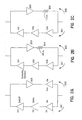
- FIG. 2 is a series of schematic drawings of the two possible current paths through the cell.
- FIG. 1 shows a multijunction solar cell 100 with a cell of Indium Gallium Phosphorus (InGaP) 101 and a cell of Gallium Arsenide (GaAs) 102 over a GaAs buffer 103 on top of a Germanium (Ge) substrate 104.
- InGaP Indium Gallium Phosphorus
- GaAs Gallium Arsenide
- FIG. 2A represents the solar cell as seen in FIG. 4 , without the metalization 107 and lateral conduction layer 113 described below. If the solar cell is illuminated, there will be no barrier to the current following the cell path 201 through the layers of the solar cell: the Ge junction 104, the GaAs junction 102, and the InGaP junction 101.
- the cell contains a diode, however, the current can be offered an alternate, parallel path 202, and the shaded cells will be preserved.
- the problem with this concept has been the difficulty in creating a diode that is relatively easy to manufacture and which uses a very low level of voltage to turn on and operate.
- the invention described herein solves these problems.
- the turn on voltage for the diode path 202 must be less than the breakdown voltage along the cell path 201.
- the breakdown voltage along the cell path will typically be at least five volts, if not more.
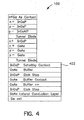
- the Schottky contact 403 requires a relatively small amount of voltage to "turn on" - 600 milivolts.
- the bias of the Ge junction 104 must be reversed, requiring a large voltage. Reversing the bias of the Ge junction 104 requires approximately 9.4 volts, so nearly ten volts are needed for the current to follow the diode path 202 in FIG. 2A . Ten volts used to reverse the bias of the Ge junction is ten volts less than otherwise would be available for other applications.
- the device illustrated by FIG. 4 is therefore a functioning bypass diode, but an inefficient one from a power utilization perspective.
- Titanium Gold (TiAu) contacts 109, 110 are added to the solar cell, an additional layer of metal 107 is added as well.
- the metal is TiAu, although practitioners in the art will be well aware that other metals can also be used.
- the effect of the metal 107 is to "short" the Ge junction 104 to the base of the Ge cell 104. Because of the short, a minimal voltage is required to pass current between the layer 113 and the Ge substrate. No longer is a high voltage required to force the current through the Ge junction 104. The current flows easily through the "short path" 107.
- FIG. 2B provides a schematic representation. If the solar cell is shaded, no longer is the cell forced into reverse bias to pass the current of the array string. There is a much less resistive path, requiring a much lower voltage drop, for the current to pass through the bypass diode 202. With the addition of the metalization 107, the Ge cell 104 is shorted. As a result, rather than a reverse biased diode with a 9.4 turn-on voltage, the current instead encounters an ohmic resistance path represented by the resistor 204.
- the layer is doped to about 7 to 8 times 10 17 cm 3 to do two things. First, it reduces the contact resistance of the metal layer 107 and second, it provides a low resistance path for the lateral conduction layer. Without the lateral conduction layer, the resistance at the resistor 204 is approximately 20 ohms. 20 ohms represents a significant drain on the current of the solar cell. To reduce this resistance, a lateral conduction layer 113 is added to the solar cell.
- FIG. 2C represents the current paths in the solar cell as depicted in FIG. 1 . When the solar cell is shaded, the current will flow to the resistor 204. Because of the presence of the lateral conduction layer 113, the resistance at the resistor can be as low as 0.4 ohms.
- FIG. 3 shows a multijunction solar cell 100 and the component parts: the multijunction structure 301 and the buffer structure 302.
- a top cell comprised of an n-on-p InGaP 2 101 is grown over a cell of n-on-p GaAs 102.
- a third diffused Ge junction 104 is formed due to diffusion of As during the growth of buffer layers 103.
- Ge is a group IV element, so it has different lattice parameters than group III-V elements.
- Lattice matching is generally accepted among those skilled in the art as a way to increase the efficiency of a solar cell, and it follows that lattice mismatching decreases a cell's overall efficiency.
- the buffer layer is inserted in the manufacture process; normally it is a thick layer of GaAs grown over the Ge substrate.
- An InGaP layer lattice matches with a GaAs layer much better than with a Ge layer.
- the buffer structure 302 is comprised of the following: an InGaP Schottky contact 303 as the top layer of the buffer structure 302. This will later form the Schottky diode.
- the buffer structure 302 is also comprised of an additional etch stop 304.
- the etch stop 304 enables the device to be more easily manufactured. Upon “wet etching" the etch stop creates barriers during processing which facilitate formation of the bypass diode.
- the lateral conduction layer 113 exists in this buffer layer, to more efficiently guide the current out of the diode, as discussed above.
- the first step in the manufacturing process is to make a "wet etch" that comes down into the cell 100 and terminates at the InGaP layer 403.
- a TiAu contact 110 is formed upon the InGaP layer 403.
- a TiAu contact 109 is formed at the top of the cell to make an ohmic contact with the n + -GaAs layer 112.
- the TiAu contact 110 on the InGaP layer 403 makes a Schottky contact, which is non-ohmic. In other words, instead of looking like a resistor, such contact 403 and the TiAu contact 110 forms a diode.
- FIG. 5 shows a "mesa etch" 501 down to the level of the Ge cell 104.
- the primary purpose of this step is to create a true diode 106, electrically isolating the junctions 105 within the solar cell from the diode 106.
- the cell 105 and the diode 106 will be parallel, yet electrically separate.
- the third step is a "shunt etch" 502, which provides a "shelf” on which the metal 107 in the next step will be laid.
- a "shunt etch” 502 which provides a "shelf” on which the metal 107 in the next step will be laid.
- the etch stop 304 allows the solar cell to be manufactured more efficiently.
- the fourth step is the metalization process.
- the TiAu contacts 109, 110 are added, and the metal layer 107 is added.
- the metal comprising the layer is TiAu. Where the TiAu contact 110 meets the InGaP layer 403, a Schottky contact is created.
- the TiAu makes an ohmic contact to n-type GaAs 112. That is an ordinary cell conduction for this type of cell to persons skilled in the art.
- n-type GaAs 112. that is an ordinary cell conduction for this type of cell to persons skilled in the art.
- a Schottky contact is created.
- the contact was made to the highly doped n+-GaAs cell 113.
- Layer 113 is also a lateral conduction layer.
- a resistor is created. The resistance at the resistor 204 was approximately 20 ohms, as illustrated in FIG. 2A . 20 ohms of power dissipation can make the cell too inefficient from a power utilization perspective.
- the etch stop at the GaAs buffer contact 304 alleviates this problem.
- the GaAs buffer contact 113 is n+ doped at the same level as the GaAs buffer contact 112 at the top of the cell. This creates a cell with the same quality of contact between the TiAu contact 109 and the GaAs contact layer 112 at the top of the cell as the metal contact 107 with the GaAs layer 113.
- Modifying the thicknesses of the various layers in the diode 106 is another way to decrease resistance in the diode 106.
- the lateral conduction layer 113 also alleviates the resistance through the diode 106, from 20 ohms to as low as 0.4 ohms.
- the current path passes through the diode 106, and the thickness of the diode would ordinarily cause some resistance, but the lateral conduction layer 113 helps the current move to the metal more efficiently.
- the lateral conduction layer is made of highly doped n + -GaAs.
- the shunt layer 107 can also be made to partially or completely surround the contact 110, further lowering the series resistance.
- the lateral conduction layer 113 and the metalization 107 are the two most important means to lessen the amount of voltage needed to "turn on” the diode and bypass the shaded cell.
- the series resistance By reducing the series resistance, the amount of localized I 2 R heating is also reduced.
- the process is also unique because the amount of processing steps are reduced, as the bypass diode layers are grown internally to the buffer layers of the cell, rather than as additional layers that have to be grown on top of the cell.
- the current device provides for a low bypass diode turn on, as well as a low series resistance bypass diode. Completion of the bypass diode circuit requires a soldered or welded interconnect made between contacts 109 and 110. This can be done as part of the usual interconnect weld.
- the fifth step in the manufacturing process is to apply the anti-reflective coating and include etches where external contacts will be attached.
- the process by which the diode is manufactured is integral to the manufacture of the cell, and does not require additional manufacturing steps or additional layers to be grown on the cell.
- bypass diode is epitaxially disposed over a multijunction solar cell with an i-layer.
- FIG. 6 is a block diagram 600 illustrating a schematic sectional view showing a multijunction solar cell structure 640 having a bypass diode 620 in accordance with one embodiment of the present invention.
- Diagram 600 includes a substrate 602, a multijunction solar cell structure 640, a bypass diode 620, a well 650, and a shunt 630.
- the substrate 602 is a germanium substrate.
- the multijunction solar cell structure 640 further includes a top, middle, and bottom subcells. It should be noted that terms solar cells, cells, and subcells will be used interchangeably herein.
- the multijunction solar cell structure is divided into two portions 642-644, wherein portion 642 includes solar cell(s) for converting solar power to electrical power and portion 644 contains a bypass diode 620.
- the multijunction solar cell structure 640 is a multijunction solar cell structure wherein a bottom solar cell 604 is deposited over the substrate and a middle solar cell 606 is deposited over the bottom solar cell 604.
- the top solar cell 608 of the multijunction solar cell structure is deposited over the middle solar cell 606.
- Each solar cell within the multijunction solar cell structure is designed to convert the solar energy within a range of wavelength ⁇ of the solar spectrum.
- the top solar cell 608 of the multijunction solar cell structure is designed to convert the high frequency portion of the solar spectrum into electrical energy.
- the high frequency portion may include ultraviolet, X-rays, and/or Gamma rays of the solar spectrum.
- the high frequency portion covers ⁇ in a range of approximately 700 nm to 100 nm.
- the middle solar cell 606 is responsible for converting the solar energy in a range of ultraviolet, visible light, and/or portions of infrared of the solar spectrum, which may be approximately between 90 nm to 1000 nm.
- the bottom solar cell 604 is responsible for converting the.solar energy in a range of infrared, microwaves, and/or radio waves, which may be approximately between 700 nm and/or greater.
- the solar spectrum could be divided into more than three regions and each region has an associated solar cell for capturing photons within the respected region. It should be further noted that the underlying concept of the present invention applies to multijunction solar cell structure 640 containing more or less than three subcells.
- Diagram 600 further includes a lateral conduction layer 610 and a stop etch layer 612.
- the lateral conduction layer 610 is heavily doped so that it has the property of high electrical conductivity.
- the stop etch layer 612 in one aspect, is needed to create a shunt contact pad 652 during the etching process.
- the bypass diode 620 includes an n-type layer 626, i-type layer 624, and p-type layer 622.
- n-type layer 626 could be an n-doped gallium arsenic ("GaAs") layer and a p-type layer 622 could be a p-doped GaAs layer.
- GaAs gallium arsenic
- a bypass diode with p-on-n polarity is formed when a p-type compound layer is deposited over an n-type compound layer.
- a bypass diode with n-on-p polarity may be formed when an n-type compound layer is deposited over a p-type compound layer.
- the i-type layer 624 is also referred to as an intrinsic layer, lightly doped layer, i-layer and/or non-doping layer. It should be noted that terms i-type layer, intrinsic layer, lightly doped layer, i-layer and undoped layer are interchangeable herein.
- a function of i-layer 624 is to reduce defect breakdown such as microplasma breakdown. In other words, i-layer 624 reduces leakage current when the bypass diode 620 is in reverse bias mode. As discussed above, the bypass diode 620 preserves the integrity of the solar cell by preventing the solar cell from entering the reverse bias mode.
- the bypass diode 620 is epitaxially formed over the multijunction solar cell structure 640 so that the bypass diode 620 becomes an integral part of the solar cell structure.
- the bypass diode 620 is part of the monolithic solar cell structure.
- an i-type layer 624 is deposited over the n-type layer 626.
- a bypass diode is completed after a p-type layer 622 is deposited over the i-type layer 624.
- Well 650 in one embodiment, is created by an etch process, such as a mesa etch. This generates a physical space or gap between the solar cell and the bypass diode 620. In other words, well 650 provides an electrical separation between the active portion of the solar cell and the bypass diode 620. Well 650 also provides a path allowing a shunt 630 to access the substrate. In one embodiment, once shunt 630 is deposited, well 650 may be filled with non-conductive materials, such as anti-reflective materials. It should be noted that the width of the gap or space created by the well 650 between the active portion of the solar cell and bypass diode depends on the semiconductor technology.
- Shunt 630 is deposited via well 650 wherein one side of the shunt 630 is in contact with the substrate and another side of the shunt 630 is in contact with the lateral conduction layer 610. In one embodiment, one side of the shunt 630 is also in contact with a portion of the multijunction solar cell structure 640, which contains the bypass diode 620. In other words, the shunt 630, in this embodiment, shorts a portion of the multijunction solar cell structure that is underneath the bypass diode 620. In this embodiment, the shunt 630 is made of metal to enable it to pass electric current from the substrate to the bypass diode 620 with minimal current loss. An advantage of using shunt 630 is that it reduces the need for external welding jumpers or shorts, which affect the reliability of the solar cell.
- FIG. 7 is a logic diagram 700 illustrating a triple junction solar cell structure and a bypass diode 620 in accordance with one embodiment of the present invention.
- the logic diagram 700 includes a top cell 608, a middle cell 606, a bottom cell 604, a bypass diode 620, a resistance block 702, and four paths 710-716.
- the resistance block 702 includes resistance from the shorted portion of the multijunction solar cell structure that is situated underneath of the bypass diode 620 and the resistance from the shunt 630.
- solar cells 604-608 are in forward biased. They converts solar energy to electrical energy and pass electric current between the neighboring solar cells connected in series.
- sunlight, solar light, light, radiation, and/or photons may be used interchangeable herein:
- solar cells are organized in a series. While solar cells 604-608 are in forward biased, bypass diode 620 is reverse biased because bypass diode 620 has an opposite polarity from solar cells. Thus, when bypass diode 620 is in reverse bias mode, no electric current passes through the bypass diode 620.
- solar cells 604-608 pass total electrical current, which includes the current converted by solar cells 604-608 and the current arriving from neighboring solar cells through path 710, to path 716 via path 712.
- Path 716 may be connected to another solar cell and/or other electrical devices.
- bypass diode 620 becomes forward biased. In this situation, bypass diode 620 becomes active and passes the current from neighboring solar cells via path 710 to path 716 through path 714. In other words, when the solar cells 604-608 are in reverse bias mode, the bypass diode 620 becomes forward biased and uses path 714 to pass the current from path 710 to path 716.
- FIG. 8 is a block diagram 800 illustrating a detailed schematic sectional view showing a triple junction solar cell structure 640 having a bypass diode 620 in accordance with one embodiment of the present invention.
- the block diagram 800 includes a substrate 602, a triple junction solar cell structure 640, a bypass diode 620, a well 650, and a shunt 630.
- the triple junction solar cell structure 640 further includes a bottom, middle, and top subcells 604-608.
- the block diagram 800 also includes contact pads 802-806, wherein contact pad 806 is deposited over a lateral conduction layer 610 and contact pad 804 is deposited over the bypass diode 620.
- the substrate is a p-type germanium (“Ge”) substrate 602, which is formed over a metal contact pad 802.
- the bottom cell 604 contains a p-type Ge base layer 810, a n-type Ge emitter layer 812, and a n-type GaAs nucleation layer 814.
- the base layer 810 is deposited over the substrate 602.
- the nucleation layer 814 is deposited over the base layer 810, which in one embodiment can be formed through diffusion from an emitter layer 812.
- a p-type and n-type tunneling junction layers 816 which are also known form a structure sometimes referred to as tunneling diode, are deposited.
- the middle cell 606 further includes a back surface field (“BSF") layer 820, a p-type GaAs base layer 822, an n-type GaAs emitter layer 824, and an n-type gallium indium phosphide 2 (“GaInP 2 ") window layer 826.
- the base layer 822 is deposited over the BSF layer 820 once the BSF layer 820 is deposited over the tunneling junction layers 816.
- the window layer 826 is subsequently deposited on the emitter layer 824 after the emitter layer 824 is deposited on the base layer 822.
- the BSF layer 820 is used to reduce the recombination loss in the middle cell 606.
- the BSF layer 820 drives minority carriers from a highly doped region near the back surface to minimize the effect of recombination loss. In other words, a BSF layer 820 reduces recombination loss at the backside of the solar cell and thereby reduces the recombination at the emitter region.
- the window layer 826 used in the middle cell 606 also operates to reduce the recombination loss.
- the window layer 826 also improves the passivation of the cell surface of the underlying junctions. It should be apparent to one skilled in the art that additional layer(s) may be added or deleted in block diagram 800 without departing from the scope of the present invention.
- p-type and n-type tunneling junction layers 830 are deposited over the middle cell 606.
- the top cell 608, includes a p-type indium gallium aluminum phosphide 2 ("InGaAlP 2 ") BSF layer 840, a p-type GaInP 2 base layer 842, an n-type GaInP 2 emitter layer 844, and an n-type aluminum indium phosphide 2 (“AlInP 2 ") window layer 846.
- the base layer 842 is deposited on the BSF layer 840 once the BSF layer 840 is deposited over the tunneling junction layers 830.
- the window layer 846 is subsequently deposited on the emitter layer 844 after the emitter layer 844 is deposited on the base layer 842.
- an n-type GaAs cap layer 850 is employed for enhancing better contact with metal materials.
- the cap layer 850 is deposited over the top cell 608.
- the lateral conduction layer 610 formed of n-type GaAs, is deposited over the cap layer 850.
- An n-type GaInP 2 stop etch layer is deposited over the lateral conduction layer 610. After the stop etch layer is deposited, the bypass diode is epitaxially deposited.
- the bypass diode 620 includes an n-type GaAs layer 860, an i-type GaAs layer 862 layer, and a p-type GaAs layer 864.
- the n-type layer 860 is deposited over the stop etch layer 612.
- the i-type layer 862 is deposited over the n-type layer 860.
- the p-type layer 864 is deposited over the i-type layer 862.
- a contact pad 804 is deposited over the bypass diode 620. Once the contact pad 804 is formed, a pi-n bypass diode with p-on-n polarity is formed over the solar cell.
- an n-i-p bypass with n-on-p polarity bypass diode can be also formed over a solar cell structure using similar process described above. It should be apparent to one skilled in the art that the additional layer(s) may be added or deleted in the bypass diode 620 without departing from the scope of the present invention.
- a metal shunt 630 is deposited via well 650. One side of the shunt 630 is connected to the substrate 602 and another side of the shunt 630 is connected to the lateral conduction layer 610 and a portion of the triple junction cell 644. An antireflection coating may be deposited over certain parts of the solar cell to enhance solar cell performance.
- the multijunction solar cell structure could be formed by any combination of group III to V elements listed in the periodic table, wherein the group III includes boron (B), Aluminum (Al), Gallium (Ga), Indium (In), and thallium (Tl).
- the group IV includes carbon (C), Silicon (Si), Ge, and Tin (Sn).
- the group V includes nitrogen (N), phosphorus (P), Arsenic (As), antimony (Sb), and bismuth (Bi).
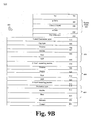
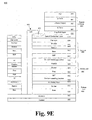
- FIG. 9A-9E are block diagrams illustrating a process of manufacturing a multijunction solar cell structure 640 with a bypass diode 620 and a shunt 630 in accordance with one embodiment of the present invention.
- FIG. 9A illustrates a triple junction solar cell structure 900 with an integral bypass diode 602 epitaxially formed on the triple junction solar cell structure 900.
- the triple junction solar cell 900 includes a bottom, middle, and top cell 604-608.
- FIG. 9B illustrates that a portion 922 of bypass diode 602 has been etched away.
- FIG. 9C illustrates that a well 932 is created through an etching process, such as a mesa etch method.
- FIG. 9D illustrates that a second portion 942 of the bypass diode 620 is etched away.
- the stop etch layer 612 is, in one embodiment, used to control the etching process to remove the portion 942 of the bypass diode 620 to create a shunt contact pad 652.
- FIG. 9E illustrates the next step of formation of the shunt 952. It should be apparent to one skilled in the art that additional layers and steps may be added or deleted without departing from the scope of the present invention.
- FIG. 10 is a flow chart 1000 illustrating a method of manufacturing a multijunction solar cell structure with a bypass diode in accordance with one embodiment of the present invention.
- the process deposits a germanium substrate.
- the germanium substrate is deposited over a contact layer. Once the substrate is formed, the process moves to block 1012.
- the process deposits a solar cell.
- the solar cell is a triple junction solar cell, which includes a bottom, middle, and top subcells.
- the bottom subcell may be a germanium solar subcell and the middle subcell may be a GaAs solar subcell.
- the top subcell may be a GaInP2 solar subcell. It should be noted that it does not depart from the scope of the present invention if the homojunction subcells are replaced with heterojunction subcells.
- the process proceeds to block 1014.
- the process deposits a lateral conduction layer over the solar cell.
- the lateral conduction layer is a n-doped GaAs layer, which is used as the shunt contact pad.
- the process deposits a bypass diode over the lateral conduction layer.
- an n-type GaAs layer is deposited over the stop etch layer.
- a p-type GaAs layer is deposited over the i-type layer.
- the concentration of n dopant in the n-type GaAs layer is between 10 17 to 10 18 .
- the concentration of p dopant in the p-type GaAs layer is between 10 17 to 10 18 .
- the concentration of dopant for i-tape GaAs layer is less than 10 16 .
- a well or gap or space is created to provide electrical separation between the bypass diode and the solar cell. Well also allows the shunt to access the substrate. After the creation of well, the process proceeds to block 1020.
- a shunt is deposited along a portion of the multijunction solar cell structure wherein one side of the shunt is connected to the substrate and another side of the shunt is connected to the shunt contact pad.
Landscapes
- Photovoltaic Devices (AREA)
Applications Claiming Priority (2)
| Application Number | Priority Date | Filing Date | Title |
|---|---|---|---|
| US09/999,598 US6680432B2 (en) | 2001-10-24 | 2001-10-24 | Apparatus and method for optimizing the efficiency of a bypass diode in multijunction solar cells |
| EP02805514A EP1440480B1 (fr) | 2001-10-24 | 2002-10-24 | Appareil et procede d'integration d'une diode en parallele dans des cellules solaires |
Related Parent Applications (1)
| Application Number | Title | Priority Date | Filing Date |
|---|---|---|---|
| EP02805514A Division EP1440480B1 (fr) | 2001-10-24 | 2002-10-24 | Appareil et procede d'integration d'une diode en parallele dans des cellules solaires |
Publications (2)
| Publication Number | Publication Date |
|---|---|
| EP2017894A2 true EP2017894A2 (fr) | 2009-01-21 |
| EP2017894A3 EP2017894A3 (fr) | 2014-08-13 |
Family
ID=25546513
Family Applications (2)
| Application Number | Title | Priority Date | Filing Date |
|---|---|---|---|
| EP08017554.0A Ceased EP2017894A3 (fr) | 2001-10-24 | 2002-10-24 | Appareil et procédé pour diode de dérivation intégrale dans des cellules solaires |
| EP02805514A Expired - Lifetime EP1440480B1 (fr) | 2001-10-24 | 2002-10-24 | Appareil et procede d'integration d'une diode en parallele dans des cellules solaires |
Family Applications After (1)
| Application Number | Title | Priority Date | Filing Date |
|---|---|---|---|
| EP02805514A Expired - Lifetime EP1440480B1 (fr) | 2001-10-24 | 2002-10-24 | Appareil et procede d'integration d'une diode en parallele dans des cellules solaires |
Country Status (6)
| Country | Link |
|---|---|
| US (3) | US6680432B2 (fr) |
| EP (2) | EP2017894A3 (fr) |
| JP (1) | JP4119844B2 (fr) |
| AT (1) | ATE410789T1 (fr) |
| AU (1) | AU2002365270A1 (fr) |
| DE (2) | DE60229279D1 (fr) |
Families Citing this family (76)
| Publication number | Priority date | Publication date | Assignee | Title |
|---|---|---|---|---|
| US6278054B1 (en) * | 1998-05-28 | 2001-08-21 | Tecstar Power Systems, Inc. | Solar cell having an integral monolithically grown bypass diode |
| US6680432B2 (en) * | 2001-10-24 | 2004-01-20 | Emcore Corporation | Apparatus and method for optimizing the efficiency of a bypass diode in multijunction solar cells |
| US6864414B2 (en) * | 2001-10-24 | 2005-03-08 | Emcore Corporation | Apparatus and method for integral bypass diode in solar cells |
| US8173891B2 (en) * | 2002-05-21 | 2012-05-08 | Alliance For Sustainable Energy, Llc | Monolithic, multi-bandgap, tandem, ultra-thin, strain-counterbalanced, photovoltaic energy converters with optimal subcell bandgaps |
| US8067687B2 (en) | 2002-05-21 | 2011-11-29 | Alliance For Sustainable Energy, Llc | High-efficiency, monolithic, multi-bandgap, tandem photovoltaic energy converters |
| US20060162768A1 (en) * | 2002-05-21 | 2006-07-27 | Wanlass Mark W | Low bandgap, monolithic, multi-bandgap, optoelectronic devices |
| US7071407B2 (en) * | 2002-10-31 | 2006-07-04 | Emcore Corporation | Method and apparatus of multiplejunction solar cell structure with high band gap heterojunction middle cell |
| US6784358B2 (en) * | 2002-11-08 | 2004-08-31 | The Boeing Co. | Solar cell structure utilizing an amorphous silicon discrete by-pass diode |
| DE102004023856B4 (de) * | 2004-05-12 | 2006-07-13 | Rwe Space Solar Power Gmbh | Solarzelle mit integrierter Schutzdiode und zusätzlich auf dieser angeordneten Tunneldiode |
| JP4849786B2 (ja) * | 2004-08-30 | 2012-01-11 | シャープ株式会社 | 多接合型化合物太陽電池およびその製造方法 |
| US8772628B2 (en) | 2004-12-30 | 2014-07-08 | Alliance For Sustainable Energy, Llc | High performance, high bandgap, lattice-mismatched, GaInP solar cells |
| US10374120B2 (en) * | 2005-02-18 | 2019-08-06 | Koninklijke Philips N.V. | High efficiency solar cells utilizing wafer bonding and layer transfer to integrate non-lattice matched materials |
| US20060231130A1 (en) * | 2005-04-19 | 2006-10-19 | Sharps Paul R | Solar cell with feedthrough via |
| US7659474B2 (en) * | 2005-05-04 | 2010-02-09 | The Boeing Company | Solar cell array with isotype-heterojunction diode |
| EP1920468B1 (fr) * | 2005-09-01 | 2014-02-26 | Merck Patent GmbH | Cellules photovoltaiques integrees a une diode en parallele |
| US7687707B2 (en) * | 2005-11-16 | 2010-03-30 | Emcore Solar Power, Inc. | Via structures in solar cells with bypass diode |
| JP5266205B2 (ja) * | 2006-04-13 | 2013-08-21 | シェル・エルノイエルバーレ・エネルギエン・ゲーエムベーハー | 太陽電池モジュール |
| US8536445B2 (en) | 2006-06-02 | 2013-09-17 | Emcore Solar Power, Inc. | Inverted metamorphic multijunction solar cells |
| US8686282B2 (en) | 2006-08-07 | 2014-04-01 | Emcore Solar Power, Inc. | Solar power system for space vehicles or satellites using inverted metamorphic multijunction solar cells |
| US20080029151A1 (en) * | 2006-08-07 | 2008-02-07 | Mcglynn Daniel | Terrestrial solar power system using III-V semiconductor solar cells |
| US7842881B2 (en) * | 2006-10-19 | 2010-11-30 | Emcore Solar Power, Inc. | Solar cell structure with localized doping in cap layer |
| US20080110489A1 (en) * | 2006-11-14 | 2008-05-15 | Fareed Sepehry-Fard | Very High Efficiency Multi-Junction Solar Spectrum Integrator Cells, and the Corresponding System and Method |
| WO2008076879A1 (fr) * | 2006-12-15 | 2008-06-26 | Evergreen Solar, Inc. | Modules photovoltaïques enfichables ensemble |
| US20080149173A1 (en) * | 2006-12-21 | 2008-06-26 | Sharps Paul R | Inverted metamorphic solar cell with bypass diode |
| US20080245409A1 (en) * | 2006-12-27 | 2008-10-09 | Emcore Corporation | Inverted Metamorphic Solar Cell Mounted on Flexible Film |
| US20100093127A1 (en) * | 2006-12-27 | 2010-04-15 | Emcore Solar Power, Inc. | Inverted Metamorphic Multijunction Solar Cell Mounted on Metallized Flexible Film |
| US7687870B2 (en) * | 2006-12-29 | 2010-03-30 | Panasonic Corporation | Laterally configured electrooptical devices |
| US20080185038A1 (en) * | 2007-02-02 | 2008-08-07 | Emcore Corporation | Inverted metamorphic solar cell with via for backside contacts |
| US20090032090A1 (en) * | 2007-07-30 | 2009-02-05 | Emcore Corporation | Method for assembling a terrestrial solar array including a rigid support frame |
| US7381886B1 (en) * | 2007-07-30 | 2008-06-03 | Emcore Corporation | Terrestrial solar array |
| US20090038679A1 (en) * | 2007-08-09 | 2009-02-12 | Emcore Corporation | Thin Multijunction Solar Cells With Plated Metal OHMIC Contact and Support |
| US10381505B2 (en) | 2007-09-24 | 2019-08-13 | Solaero Technologies Corp. | Inverted metamorphic multijunction solar cells including metamorphic layers |
| US8895342B2 (en) | 2007-09-24 | 2014-11-25 | Emcore Solar Power, Inc. | Heterojunction subcells in inverted metamorphic multijunction solar cells |
| US20100233838A1 (en) * | 2009-03-10 | 2010-09-16 | Emcore Solar Power, Inc. | Mounting of Solar Cells on a Flexible Substrate |
| US20090188561A1 (en) * | 2008-01-25 | 2009-07-30 | Emcore Corporation | High concentration terrestrial solar array with III-V compound semiconductor cell |
| US8513514B2 (en) * | 2008-10-24 | 2013-08-20 | Suncore Photovoltaics, Inc. | Solar tracking for terrestrial solar arrays with variable start and stop positions |
| US9331228B2 (en) * | 2008-02-11 | 2016-05-03 | Suncore Photovoltaics, Inc. | Concentrated photovoltaic system modules using III-V semiconductor solar cells |
| US8093492B2 (en) * | 2008-02-11 | 2012-01-10 | Emcore Solar Power, Inc. | Solar cell receiver for concentrated photovoltaic system for III-V semiconductor solar cell |
| US8759138B2 (en) | 2008-02-11 | 2014-06-24 | Suncore Photovoltaics, Inc. | Concentrated photovoltaic system modules using III-V semiconductor solar cells |
| US20100012175A1 (en) * | 2008-07-16 | 2010-01-21 | Emcore Solar Power, Inc. | Ohmic n-contact formed at low temperature in inverted metamorphic multijunction solar cells |
| US8507837B2 (en) | 2008-10-24 | 2013-08-13 | Suncore Photovoltaics, Inc. | Techniques for monitoring solar array performance and applications thereof |
| US8283558B2 (en) * | 2009-03-27 | 2012-10-09 | The Boeing Company | Solar cell assembly with combined handle substrate and bypass diode and method |
| CA2763065A1 (fr) * | 2009-05-25 | 2010-12-02 | Day4 Energy Inc. | Agencement de chaines de modules photovoltaiques et protection contre l'ombre |
| US20110017285A1 (en) * | 2009-07-23 | 2011-01-27 | Emcore Solar Power, Inc. | Solar Cell with Textured Coverglass |
| US9012771B1 (en) | 2009-09-03 | 2015-04-21 | Suncore Photovoltaics, Inc. | Solar cell receiver subassembly with a heat shield for use in a concentrating solar system |
| US9806215B2 (en) * | 2009-09-03 | 2017-10-31 | Suncore Photovoltaics, Inc. | Encapsulated concentrated photovoltaic system subassembly for III-V semiconductor solar cells |
| US20110073887A1 (en) * | 2009-09-25 | 2011-03-31 | Alliance For Sustainable Energy, Llc | Optoelectronic devices having a direct-band-gap base and an indirect-band-gap emitter |
| US9356218B1 (en) * | 2009-11-13 | 2016-05-31 | The Boeing Company | Internally heated concentrated solar power (CSP) thermal absorber |
| RU2411607C1 (ru) * | 2009-11-26 | 2011-02-10 | Открытое акционерное общество "Российская корпорация ракетно-космического приборостроения и информационных систем" (ОАО "Российские космические системы") | Способ изготовления шунтирующего диода для солнечных батарей космических аппаратов |
| US9543468B2 (en) | 2010-10-12 | 2017-01-10 | Alliance For Sustainable Energy, Llc | High bandgap III-V alloys for high efficiency optoelectronics |
| US20120291836A1 (en) | 2010-11-17 | 2012-11-22 | E.I. Du Pont De Nemours And Company | Array of thin-film photovoltaic cells having an etchant-resistant electrode an an integrated bypass diode associated with a plurality of cells and a panel incorporating the same |
| DE102011000521A1 (de) * | 2011-02-04 | 2012-08-23 | Azur Space Solar Power Gmbh | Mehrfachsolarzelle sowie Verfahren zur Herstellung einer solchen |
| US9070810B2 (en) * | 2011-02-04 | 2015-06-30 | Azur Space Solar Power Gmbh | Multiple solar cell and method for manufacturing the same |
| US11121272B2 (en) | 2011-02-09 | 2021-09-14 | Utica Leaseco, Llc | Self-bypass diode function for gallium arsenide photovoltaic devices |
| US20120199177A1 (en) * | 2011-02-09 | 2012-08-09 | Atomic Energy Council-Institute Of Nuclear Energy Research | Multijunction Solar Cell Device |
| US9716196B2 (en) | 2011-02-09 | 2017-07-25 | Alta Devices, Inc. | Self-bypass diode function for gallium arsenide photovoltaic devices |
| US20120285519A1 (en) | 2011-05-10 | 2012-11-15 | Emcore Solar Power, Inc. | Grid design for iii-v compound semiconductor cell |
| DE102011115340A1 (de) * | 2011-10-07 | 2013-04-11 | Fraunhofer-Gesellschaft zur Förderung der angewandten Forschung e.V. | Halbleiterbauelement im Mehrschichtaufbau und hieraus gebildetes Modul |
| US10181541B2 (en) | 2011-11-20 | 2019-01-15 | Tesla, Inc. | Smart photovoltaic cells and modules |
| EP2780952A4 (fr) | 2011-11-20 | 2015-08-12 | Solexel Inc | Cellules photovoltaïques intelligentes et modules associés |
| RU2515420C2 (ru) * | 2012-08-16 | 2014-05-10 | Открытое акционерное общество "Сатурн" | Способ изготовления фотопреобразователя со встроенным диодом |
| RU2515210C1 (ru) * | 2012-10-01 | 2014-05-10 | Российская Федерация, от имени которой выступает Министерство промышленности и торговли Российской Федерации (Минпромторг России) | Концентраторный каскадный фотопреобразователь |
| JP6063577B2 (ja) | 2012-10-16 | 2017-01-18 | ソレクセル、インコーポレイテッド | 光起電力太陽電池及びモジュールにおけるモノリシック集積バイパススイッチのためのシステム及び方法 |
| US10153388B1 (en) | 2013-03-15 | 2018-12-11 | Solaero Technologies Corp. | Emissivity coating for space solar cell arrays |
| US9590131B2 (en) | 2013-03-27 | 2017-03-07 | Alliance For Sustainable Energy, Llc | Systems and methods for advanced ultra-high-performance InP solar cells |
| US20150349708A1 (en) * | 2013-04-13 | 2015-12-03 | Solexel, Inc. | Solar photovoltaic module power control and status monitoring system utilizing laminate-embedded remote access module switch |
| US10784815B2 (en) | 2013-04-13 | 2020-09-22 | Sigmagen, Inc. | Solar photovoltaic module remote access module switch and real-time temperature monitoring |
| DE202014002666U1 (de) | 2014-03-26 | 2014-07-03 | Emcore Solar Power, Inc. | Solarzellenanordnung |
| DE102014004390A1 (de) | 2014-03-26 | 2015-10-01 | Solaero Technologies Corp. | Solarzellenanordnung mit Bypass-Dioden |
| DE102015002513A1 (de) * | 2015-03-02 | 2016-09-08 | Azur Space Solar Power Gmbh | Solarzellenvorrichtung |
| US9935209B2 (en) * | 2016-01-28 | 2018-04-03 | Solaero Technologies Corp. | Multijunction metamorphic solar cell for space applications |
| CN105489700B (zh) * | 2015-12-03 | 2017-06-27 | 中国电子科技集团公司第十八研究所 | 一种带集成二极管的太阳电池的制备方法 |
| US11316053B2 (en) * | 2016-08-26 | 2022-04-26 | Sol Aero Technologies Corp. | Multijunction solar cell assembly |
| US10038051B2 (en) * | 2016-02-19 | 2018-07-31 | Infineon Technologies Austria Ag | Vertical potential short in the periphery region of a III-nitride stack for preventing lateral leakage |
| US12336305B1 (en) | 2023-10-13 | 2025-06-17 | Tandem PV | Photovoltaic cells with bypass diodes |
| CN117878150B (zh) * | 2024-01-12 | 2024-09-10 | 西安电子科技大学 | 一种集成GaN二极管温度传感器的HEMT及制备方法 |
Family Cites Families (25)
| Publication number | Priority date | Publication date | Assignee | Title |
|---|---|---|---|---|
| DE2827049A1 (de) * | 1978-06-20 | 1980-01-10 | Siemens Ag | Solarzellenbatterie und verfahren zu ihrer herstellung |
| JPS57204180A (en) | 1981-06-09 | 1982-12-14 | Mitsubishi Electric Corp | Gaas solar battery element |
| US4598164A (en) * | 1983-10-06 | 1986-07-01 | Exxon Research And Engineering Co. | Solar cell made from amorphous superlattice material |
| US4759803A (en) | 1987-08-07 | 1988-07-26 | Applied Solar Energy Corporation | Monolithic solar cell and bypass diode system |
| US5155565A (en) * | 1988-02-05 | 1992-10-13 | Minnesota Mining And Manufacturing Company | Method for manufacturing an amorphous silicon thin film solar cell and Schottky diode on a common substrate |
| MY104396A (en) | 1988-02-05 | 1994-03-31 | Minnesota Mining & Mfg | Method for manufacturing an amorphous silicon thin film solar cell and schottky barrier diode on a common substrate. |
| EP0369666B1 (fr) | 1988-11-16 | 1995-06-14 | Mitsubishi Denki Kabushiki Kaisha | Cellule solaire |
| JPH0377382A (ja) | 1989-08-19 | 1991-04-02 | Mitsubishi Electric Corp | 太陽電池セル |
| US5138403A (en) | 1989-10-27 | 1992-08-11 | Kopin Corporation | High temperature Schottky barrier bypass diodes |
| JPH0548134A (ja) | 1991-08-07 | 1993-02-26 | Mitsubishi Electric Corp | 太陽電池とその製造方法 |
| JPH0964397A (ja) * | 1995-08-29 | 1997-03-07 | Canon Inc | 太陽電池および太陽電池モジュール |
| US5853497A (en) * | 1996-12-12 | 1998-12-29 | Hughes Electronics Corporation | High efficiency multi-junction solar cells |
| US6248948B1 (en) * | 1998-05-15 | 2001-06-19 | Canon Kabushiki Kaisha | Solar cell module and method of producing the same |
| US6278054B1 (en) * | 1998-05-28 | 2001-08-21 | Tecstar Power Systems, Inc. | Solar cell having an integral monolithically grown bypass diode |
| WO1999062125A1 (fr) | 1998-05-28 | 1999-12-02 | Tecstar Power Systems, Inc. | Cellule solaire comportant une diode integrale en parallele a croissance monolithique |
| JP2002517098A (ja) | 1998-05-28 | 2002-06-11 | テクスター パワー システムズ インコーポレイテッド | バイパスダイオードを有する太陽電池 |
| JP3754841B2 (ja) * | 1998-06-11 | 2006-03-15 | キヤノン株式会社 | 光起電力素子およびその製造方法 |
| US6103970A (en) | 1998-08-20 | 2000-08-15 | Tecstar Power Systems, Inc. | Solar cell having a front-mounted bypass diode |
| GB9901513D0 (en) * | 1999-01-25 | 1999-03-17 | Eev Ltd | Solar cell arrangements |
| JP3657143B2 (ja) * | 1999-04-27 | 2005-06-08 | シャープ株式会社 | 太陽電池及びその製造方法 |
| DE19921545A1 (de) * | 1999-05-11 | 2000-11-23 | Angew Solarenergie Ase Gmbh | Solarzelle sowie Verfahren zur Herstellung einer solchen |
| US6635507B1 (en) * | 1999-07-14 | 2003-10-21 | Hughes Electronics Corporation | Monolithic bypass-diode and solar-cell string assembly |
| US7339109B2 (en) * | 2000-06-20 | 2008-03-04 | Emcore Corporation | Apparatus and method for optimizing the efficiency of germanium junctions in multi-junction solar cells |
| US6864414B2 (en) * | 2001-10-24 | 2005-03-08 | Emcore Corporation | Apparatus and method for integral bypass diode in solar cells |
| US6680432B2 (en) * | 2001-10-24 | 2004-01-20 | Emcore Corporation | Apparatus and method for optimizing the efficiency of a bypass diode in multijunction solar cells |
-
2001
- 2001-10-24 US US09/999,598 patent/US6680432B2/en not_active Expired - Lifetime
-
2002
- 2002-10-24 DE DE60229279T patent/DE60229279D1/de not_active Expired - Lifetime
- 2002-10-24 JP JP2003555555A patent/JP4119844B2/ja not_active Expired - Lifetime
- 2002-10-24 EP EP08017554.0A patent/EP2017894A3/fr not_active Ceased
- 2002-10-24 EP EP02805514A patent/EP1440480B1/fr not_active Expired - Lifetime
- 2002-10-24 AT AT02805514T patent/ATE410789T1/de not_active IP Right Cessation
- 2002-10-24 DE DE10297371T patent/DE10297371T5/de not_active Ceased
- 2002-10-24 AU AU2002365270A patent/AU2002365270A1/en not_active Abandoned
-
2003
- 2003-11-26 US US10/723,456 patent/US20040149331A1/en not_active Abandoned
-
2010
- 2010-05-07 US US12/776,120 patent/US8263855B2/en not_active Expired - Fee Related
Also Published As
| Publication number | Publication date |
|---|---|
| US6680432B2 (en) | 2004-01-20 |
| AU2002365270A8 (en) | 2003-07-09 |
| EP1440480B1 (fr) | 2008-10-08 |
| DE60229279D1 (de) | 2008-11-20 |
| EP1440480A2 (fr) | 2004-07-28 |
| JP4119844B2 (ja) | 2008-07-16 |
| US20030075215A1 (en) | 2003-04-24 |
| US20040149331A1 (en) | 2004-08-05 |
| DE10297371T5 (de) | 2005-05-19 |
| AU2002365270A1 (en) | 2003-07-09 |
| JP2005514763A (ja) | 2005-05-19 |
| ATE410789T1 (de) | 2008-10-15 |
| EP2017894A3 (fr) | 2014-08-13 |
| US8263855B2 (en) | 2012-09-11 |
| US20100224239A1 (en) | 2010-09-09 |
Similar Documents
| Publication | Publication Date | Title |
|---|---|---|
| US6864414B2 (en) | Apparatus and method for integral bypass diode in solar cells | |
| EP1440480B1 (fr) | Appareil et procede d'integration d'une diode en parallele dans des cellules solaires | |
| JP5390069B2 (ja) | バイパスダイオードを有するソーラーセルのビア構造 | |
| EP1775778B1 (fr) | Interconnexion fiable entre cellules solaires qui comprenent une diode de protection intégrée | |
| JP4822137B2 (ja) | キャップ層の局在化ドーピングを有する太陽電池構造体 | |
| US6617508B2 (en) | Solar cell having a front-mounted bypass diode | |
| CN101207078B (zh) | 具有旁路二极管的反向变质太阳能电池 | |
| JP5198854B2 (ja) | 組み込まれた保護ダイオードを有するソーラーセル | |
| EP1878054B1 (fr) | Batterie solaire possédant une diode à hétérojonction isotype | |
| WO2003054926A2 (fr) | Appareil et procede d'integration d'une diode en parallele dans des cellules solaires | |
| US20250255010A1 (en) | Multi-junction photovoltaic solar cell with an integrated, monolithic blocking diode |
Legal Events
| Date | Code | Title | Description |
|---|---|---|---|
| PUAI | Public reference made under article 153(3) epc to a published international application that has entered the european phase |
Free format text: ORIGINAL CODE: 0009012 |
|
| 17P | Request for examination filed |
Effective date: 20081007 |
|
| AC | Divisional application: reference to earlier application |
Ref document number: 1440480 Country of ref document: EP Kind code of ref document: P |
|
| AK | Designated contracting states |
Kind code of ref document: A2 Designated state(s): AT BE BG CH CY CZ DE DK EE ES FI FR GB GR IE IT LI LU MC NL PT SE SK TR |
|
| RIN1 | Information on inventor provided before grant (corrected) |
Inventor name: COLLINS, DOUG,C/O EMCORE CORPORATION Inventor name: SHARPS, PAUL R. Inventor name: AIKEN, DANIEL J. Inventor name: STAN, MARK A. |
|
| PUAL | Search report despatched |
Free format text: ORIGINAL CODE: 0009013 |
|
| AK | Designated contracting states |
Kind code of ref document: A3 Designated state(s): AT BE BG CH CY CZ DE DK EE ES FI FR GB GR IE IT LI LU MC NL PT SE SK TR |
|
| RIC1 | Information provided on ipc code assigned before grant |
Ipc: H01L 31/068 20120101AFI20140710BHEP Ipc: H01L 31/18 20060101ALI20140710BHEP Ipc: H01L 27/142 20140101ALI20140710BHEP |
|
| 17Q | First examination report despatched |
Effective date: 20141008 |
|
| AKX | Designation fees paid |
Designated state(s): AT BE BG CH CY CZ DE DK EE ES FI FR GB GR IE IT LI LU MC NL PT SE SK TR |
|
| RAP1 | Party data changed (applicant data changed or rights of an application transferred) |
Owner name: SOLAERO TECHNOLOGIES CORP. |
|
| STAA | Information on the status of an ep patent application or granted ep patent |
Free format text: STATUS: THE APPLICATION HAS BEEN REFUSED |
|
| 18R | Application refused |
Effective date: 20160905 |