EP2019367A1 - Verfahren zum Verbessern der Leistung eines verteilten Schedulers - Google Patents
Verfahren zum Verbessern der Leistung eines verteilten Schedulers Download PDFInfo
- Publication number
- EP2019367A1 EP2019367A1 EP07012686A EP07012686A EP2019367A1 EP 2019367 A1 EP2019367 A1 EP 2019367A1 EP 07012686 A EP07012686 A EP 07012686A EP 07012686 A EP07012686 A EP 07012686A EP 2019367 A1 EP2019367 A1 EP 2019367A1
- Authority
- EP
- European Patent Office
- Prior art keywords
- decision
- production
- prediction function
- detailed
- scheduling
- Prior art date
- Legal status (The legal status is an assumption and is not a legal conclusion. Google has not performed a legal analysis and makes no representation as to the accuracy of the status listed.)
- Withdrawn
Links
Images



Classifications
-
- G—PHYSICS
- G06—COMPUTING OR CALCULATING; COUNTING
- G06Q—INFORMATION AND COMMUNICATION TECHNOLOGY [ICT] SPECIALLY ADAPTED FOR ADMINISTRATIVE, COMMERCIAL, FINANCIAL, MANAGERIAL OR SUPERVISORY PURPOSES; SYSTEMS OR METHODS SPECIALLY ADAPTED FOR ADMINISTRATIVE, COMMERCIAL, FINANCIAL, MANAGERIAL OR SUPERVISORY PURPOSES, NOT OTHERWISE PROVIDED FOR
- G06Q10/00—Administration; Management
- G06Q10/08—Logistics, e.g. warehousing, loading or distribution; Inventory or stock management
Definitions
- the present invention relates to a method to improve the performance of a distributed scheduler according to the preamble of claim 1.
- the Manufacturing Execution System MES is generally known as the IT layer that integrates the business systems (e.g. ERP) and production control systems.
- the MES system is a dynamic information system that drives effective execution of manufacturing operations», by managing «production operations from point of order release into manufacturing to point of product delivery into finished goods» and by providing «mission critical information about production activities to others across the organization and supply chain via bi-directional communication».
- MES system usually includes resource allocation and status, dispatching production orders, data collection/acquisition, quality management, maintenance management, performance analysis, operations/detail scheduling, document control, labour management, process management and product tracking.
- the goal of MES systems is to provide manufacturing companies with tools for measuring and controlling production activities with the aim of boosting profitability, increasing productivity, improving quality and process performance to manufacturing plants.
- the international version is know as ISO/IEC 62246-1 Enterprise - Control System Integration - Part 1 etc.
- SIMATIC IT is the MES system provided by Siemens. In the following context the explanation are based on SIMATIC IT but they easily can be transferred to other MES Systems.
- the basic idea to solve this problem is that the PM-ADS takes the results or data deriving from the decision and prediction function into account while making the actual detailed schedule.
- the unit Sigmalyzer a new product component to be in SIMATIC IT, models this variability by learning from historical data collected in SIMATIC IT. It can also predict future problems by combining the stochastic models of variability with the future schedules from the scheduler.
- the unit Sigmalyzer is able to make decisions, which are based on data collected in SIMATIC IT. In other words the unit Sigmalyzer also may predict future problems and possible blockings during a production process due to lack of capacity or material. In the context of this paper the unit Sigmalyzer is called decision and prediction function.
- PM-ADS Production Modeller Agent Based Detailed Scheduler
- the agent-based architecture of the PM-ADS makes it possible to dynamically set priorities of work orders and entities as well as by varying scheduling rules defined on the various equipment levels.
- thresholds for triggering reruns of either the PM-ADS or the decision and prediction function should be defined.
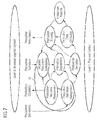
- Fig 7 shows the S95 functionalities in an overview. This overview corresponds to the definitions given in ISA-dS95.00.03-2000 Enterprise - Control System Integration Part 3 «Activity Models of Manufacturing Operations Management»; [3], on p. 10, Figure 1 as well as on p. 16 Figure 4 . This standard is subsequently cited as ISA-dS95.00.03-2000 [3]. Over the basic activities - see Fig 7 where the terms were derived from ISA-dS95.00.03-2000 [3]) -
- overlay function 10 is a decision and prediction function 10 covering S95 - functionalities.
- Priorities of the work orders are handled by a decision and prediction function.
- Resource Reservations deriving from a resource agent can reserve some capacity for uncertain operations. These reservations are handled by the decision and prediction function.
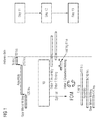
- another PM-ADS 30 rules or another branch of a PM-ADS rule is activated within the SIMATIC IT Framework (Production Modeller).
- step does not always mean steps of an individual procedure or method.
- Step nn is sometimes just used, for explaining some properties of the involved components.
- the input data from POM is adjusted by the Decision and prediction function based on the results of an analysis run which is executed by the Decision and prediction function just before PM-ADS 30 makes its schedule.
- step 11 comprises:
- Priorities are defined for the work orders and/or entries to influence the scheduling process. This can be a constant priority value or a function of time: P(t). If it is a function of time, the priority value changes for different time slots. This can be useful, since the chances of late delivery of orders increases over time. E.g. For day 0, the remaining slack time is still 2 days, thus the priority is, say, 5. For day 1, the remaining slack time is only 1 day, thus the priority is, say, 10, etc. Also other stochastic profiles, like the resource loads or the material arrival distributions, vary over time.
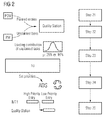
- Fig. 2 discloses the following steps:
- Constant values of priorities can be defined in the SIMATIC IT Framework as variables in the rules and send to the PM-ADS when calling the scheduling methods. For priorities that are defined as a function of time, it is possible to store the function in a script or xml file, store this script or file as a variable in the SIMATIC IT Framework rules, send it to the PM-ADS in its method call and have the PM-ADS convert the script or file into a function again. In this way, no direct interaction between PM-ADS and the Decision and prediction function is necessary and all communication can go through the SIMATIC IT Framework.
- a resource agent can reserve some capacity for uncertain operations, identified by the decision and prediction function Sigmalyzer, which can come from e.g. quotation orders, forecast orders, potential maintenance activities or other activities characterized by uncertainty in execution.
- the easiest way to implement this behaviour is by including 'resource reservation entries', instantiated by the Decision and prediction function, which the PM-ADS schedules in the same way as regular work order entries.
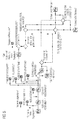
- the method is disclosed in Fig. 3 :
- This solution can solve problems related to predicted late delivery of work orders. In can only be used on a work order level. It requires some flexibility in the work order to adjust delivery dates, release dates or lot sizes.
- This solution can be used for dealing with critical work orders and entries.
- the critical path analysis algorithms of the Decision and prediction function calculate chances of violating due dates of entries and work orders.
- the results of this analysis can be transformed into priority settings for work orders and entries in PM-ADS
- This solution creates the capability to select different behaviours for resource agents based on the analysis of the Decision and prediction function. For example, this is useful for selection of alternative machine tools.
- the goal of integrating the Decision and prediction function and PM-ADS is to improve the performance of the PM-ADS by making it more robust against variability in the manufacturing processes.
- Figure 5 illustrates the prototype Production Modeller rule we have designed for this solution showing the flow for an assembly process (the flow-elements are numbered by 1 to 11):
Landscapes
- Business, Economics & Management (AREA)
- Engineering & Computer Science (AREA)
- Economics (AREA)
- Quality & Reliability (AREA)
- Tourism & Hospitality (AREA)
- Human Resources & Organizations (AREA)
- Marketing (AREA)
- Operations Research (AREA)
- Development Economics (AREA)
- Strategic Management (AREA)
- Entrepreneurship & Innovation (AREA)
- Physics & Mathematics (AREA)
- General Business, Economics & Management (AREA)
- General Physics & Mathematics (AREA)
- Theoretical Computer Science (AREA)
- Management, Administration, Business Operations System, And Electronic Commerce (AREA)
- General Factory Administration (AREA)
Priority Applications (2)
| Application Number | Priority Date | Filing Date | Title |
|---|---|---|---|
| EP07012686A EP2019367A1 (de) | 2007-06-28 | 2007-06-28 | Verfahren zum Verbessern der Leistung eines verteilten Schedulers |
| US12/214,961 US20090005895A1 (en) | 2007-06-28 | 2008-06-24 | Method to imporove the performance of a distrubuted scheduler |
Applications Claiming Priority (1)
| Application Number | Priority Date | Filing Date | Title |
|---|---|---|---|
| EP07012686A EP2019367A1 (de) | 2007-06-28 | 2007-06-28 | Verfahren zum Verbessern der Leistung eines verteilten Schedulers |
Publications (1)
| Publication Number | Publication Date |
|---|---|
| EP2019367A1 true EP2019367A1 (de) | 2009-01-28 |
Family
ID=39494689
Family Applications (1)
| Application Number | Title | Priority Date | Filing Date |
|---|---|---|---|
| EP07012686A Withdrawn EP2019367A1 (de) | 2007-06-28 | 2007-06-28 | Verfahren zum Verbessern der Leistung eines verteilten Schedulers |
Country Status (2)
| Country | Link |
|---|---|
| US (1) | US20090005895A1 (de) |
| EP (1) | EP2019367A1 (de) |
Families Citing this family (1)
| Publication number | Priority date | Publication date | Assignee | Title |
|---|---|---|---|---|
| CN103927628B (zh) * | 2011-08-16 | 2017-10-17 | 上海交通大学 | 面向客户承诺的订单管理系统和订单管理方法 |
Family Cites Families (24)
| Publication number | Priority date | Publication date | Assignee | Title |
|---|---|---|---|---|
| US5093794A (en) * | 1989-08-22 | 1992-03-03 | United Technologies Corporation | Job scheduling system |
| US5586021A (en) * | 1992-03-24 | 1996-12-17 | Texas Instruments Incorporated | Method and system for production planning |
| US5623404A (en) * | 1994-03-18 | 1997-04-22 | Minnesota Mining And Manufacturing Company | System and method for producing schedules of resource requests having uncertain durations |
| US6321133B1 (en) * | 1998-12-04 | 2001-11-20 | Impresse Corporation | Method and apparatus for order promising |
| KR100311077B1 (ko) * | 1999-10-23 | 2001-11-02 | 윤종용 | 선행공정의 결과에 따라 최적의 후행공정장비 및/또는 후행공정조건을 가변적으로 적용하는 로트 디스패칭방법 및 이를 위한 시스템 |
| US7219068B2 (en) * | 2001-03-13 | 2007-05-15 | Ford Motor Company | Method and system for product optimization |
| US6909930B2 (en) * | 2001-07-19 | 2005-06-21 | Hitachi, Ltd. | Method and system for monitoring a semiconductor device manufacturing process |
| US6738682B1 (en) * | 2001-09-13 | 2004-05-18 | Advances Micro Devices, Inc. | Method and apparatus for scheduling based on state estimation uncertainties |
| US7072808B2 (en) * | 2002-02-04 | 2006-07-04 | Tuszynski Steve W | Manufacturing design and process analysis system |
| CN1653598B (zh) * | 2002-05-16 | 2010-05-05 | 东京毅力科创株式会社 | 处理装置状态或处理结果的预测方法 |
| JP4467880B2 (ja) * | 2002-12-09 | 2010-05-26 | 株式会社日立製作所 | プロジェクトの評価システムおよび方法 |
| US20040148212A1 (en) * | 2003-01-28 | 2004-07-29 | Taiwan Semiconductor Manufacturing Company | Method and apparatus for measuring optimality for master production schedules |
| JP4317701B2 (ja) * | 2003-03-12 | 2009-08-19 | 東京エレクトロン株式会社 | 処理結果の予測方法及び予測装置 |
| US6934594B2 (en) * | 2003-07-18 | 2005-08-23 | Dell Products L.P. | System for determining carrier service using logistics considerations |
| US20050015167A1 (en) * | 2003-07-18 | 2005-01-20 | Searcy Allison Fay | Synchronized production with dynamic logistics routing |
| WO2005013070A2 (en) * | 2003-07-30 | 2005-02-10 | Tuszynski Steve W | Manufacturing design and process analysis and simulation system |
| US6876894B1 (en) * | 2003-11-05 | 2005-04-05 | Taiwan Semiconductor Maufacturing Company, Ltd. | Forecast test-out of probed fabrication by using dispatching simulation method |
| US7848836B2 (en) * | 2004-11-19 | 2010-12-07 | Siemens Aktiengesellschaft | Scheduling system and work order scheduling protocol for such a system |
| US7289859B2 (en) * | 2005-09-30 | 2007-10-30 | Hitachi, Ltd. | Method for determining parameter of product design and its supporting system |
| US7660642B1 (en) * | 2005-11-04 | 2010-02-09 | Tuszynski Steve W | Dynamic control system for manufacturing processes |
| US7558638B2 (en) * | 2006-02-22 | 2009-07-07 | Gm Global Technology Operations, Inc. | Applying real-time control to a production system |
| US7672745B1 (en) * | 2006-03-20 | 2010-03-02 | Tuszynski Steve W | Manufacturing process analysis and optimization system |
| US8000946B2 (en) * | 2006-09-20 | 2011-08-16 | The Boeing Company | Discrete event simulation with constraint based scheduling analysis |
| US7702411B2 (en) * | 2007-05-31 | 2010-04-20 | International Business Machines Corporation | Integration of job shop scheduling with discreet event simulation for manufacturing facilities |
-
2007
- 2007-06-28 EP EP07012686A patent/EP2019367A1/de not_active Withdrawn
-
2008
- 2008-06-24 US US12/214,961 patent/US20090005895A1/en not_active Abandoned
Non-Patent Citations (1)
| Title |
|---|
| The technical aspects identified in the present application (Art. 92 EPC) are considered part of common general knowledge. Due to their notoriety no documentary evidence is found to be required. For further details see the accompanying Opinion and the reference below. * |
Also Published As
| Publication number | Publication date |
|---|---|
| US20090005895A1 (en) | 2009-01-01 |
Similar Documents
| Publication | Publication Date | Title |
|---|---|---|
| Sadeh | Micro-opportunistic scheduling: The micro-boss factory scheduler | |
| Aytug et al. | Executing production schedules in the face of uncertainties: A review and some future directions | |
| US6999829B2 (en) | Real time asset optimization | |
| US7848836B2 (en) | Scheduling system and work order scheduling protocol for such a system | |
| US9031681B2 (en) | System and method for controlling the operations of a manufacturing facility | |
| EP1489506A1 (de) | Dezentralisiertes verarbeitungssystem, job-dezentralisiertes verarbeitungsverfahren und programm | |
| Yoon et al. | A multiagent-based decision-making system for semiconductor wafer fabrication with hard temporal constraints | |
| Paschko et al. | Material flow control in Remanufacturing Systems with random failures and variable processing times | |
| Neumann et al. | Resource-constrained project scheduling with time windows: Recent developments and new applications | |
| Al‐Sultan et al. | Maintenance control via mathematical programming | |
| US20090005895A1 (en) | Method to imporove the performance of a distrubuted scheduler | |
| Lee et al. | Production planning in semiconductor wafer fab considering variable cycle times | |
| Olumolade | Reactive scheduling system for cellular manufacturing with failure-prone machines | |
| Chen et al. | A software product line process simulator | |
| US7474998B2 (en) | Simulation of production processes by means of continuous fluid models | |
| Harikrishnakumar | A practical approach to project scheduling: Considering multiple critical path scenarios in project network | |
| Du et al. | An integrated scheduling strategy in dynamic scheduling of manufacturing execution system | |
| Benyahia et al. | A framework architecture for information management in dynamic vehicle dispatching | |
| Kasper | Orchestrating the manufacturing symphony: designs, decisions, and dynamics of production planning and control | |
| Trentesaux et al. | DPACS: a self-adaptative production activity control structure | |
| Coumans | Using advance demand information in Océ’s spare parts inventory control | |
| Lucht et al. | Integrated Repair Shop Scheduling and Spare Parts Pooling for Robust Product Regeneration | |
| Ahola | Experimental analysis and simulation of a dynamic aggregate production planning system in Make-to-Order manufacturing | |
| Nishioka et al. | A Booking Type Production System as a Collaboration Method for Virtual Enterprises | |
| Haberlandt | ERP-Planning Garbage: Realizing and Preventing |
Legal Events
| Date | Code | Title | Description |
|---|---|---|---|
| PUAI | Public reference made under article 153(3) epc to a published international application that has entered the european phase |
Free format text: ORIGINAL CODE: 0009012 |
|
| AK | Designated contracting states |
Kind code of ref document: A1 Designated state(s): AT BE BG CH CY CZ DE DK EE ES FI FR GB GR HU IE IS IT LI LT LU LV MC MT NL PL PT RO SE SI SK TR |
|
| AX | Request for extension of the european patent |
Extension state: AL BA HR MK RS |
|
| 17P | Request for examination filed |
Effective date: 20090608 |
|
| 17Q | First examination report despatched |
Effective date: 20090707 |
|
| AKX | Designation fees paid |
Designated state(s): AT BE BG CH CY CZ DE DK EE ES FI FR GB GR HU IE IS IT LI LT LU LV MC MT NL PL PT RO SE SI SK TR |
|
| STAA | Information on the status of an ep patent application or granted ep patent |
Free format text: STATUS: THE APPLICATION IS DEEMED TO BE WITHDRAWN |
|
| 18D | Application deemed to be withdrawn |
Effective date: 20091118 |