EP2019438A2 - Thermoelektrisches Mittel und stoffartige Struktur, die ein solches Mittel umfasst - Google Patents
Thermoelektrisches Mittel und stoffartige Struktur, die ein solches Mittel umfasst Download PDFInfo
- Publication number
- EP2019438A2 EP2019438A2 EP08290702A EP08290702A EP2019438A2 EP 2019438 A2 EP2019438 A2 EP 2019438A2 EP 08290702 A EP08290702 A EP 08290702A EP 08290702 A EP08290702 A EP 08290702A EP 2019438 A2 EP2019438 A2 EP 2019438A2
- Authority
- EP
- European Patent Office
- Prior art keywords
- thermoelectric
- converter
- medium according
- conductors
- electrical
- Prior art date
- Legal status (The legal status is an assumption and is not a legal conclusion. Google has not performed a legal analysis and makes no representation as to the accuracy of the status listed.)
- Withdrawn
Links
Images

Classifications
-
- H—ELECTRICITY
- H10—SEMICONDUCTOR DEVICES; ELECTRIC SOLID-STATE DEVICES NOT OTHERWISE PROVIDED FOR
- H10N—ELECTRIC SOLID-STATE DEVICES NOT OTHERWISE PROVIDED FOR
- H10N10/00—Thermoelectric devices comprising a junction of dissimilar materials, i.e. devices exhibiting Seebeck or Peltier effects
- H10N10/10—Thermoelectric devices comprising a junction of dissimilar materials, i.e. devices exhibiting Seebeck or Peltier effects operating with only the Peltier or Seebeck effects
- H10N10/17—Thermoelectric devices comprising a junction of dissimilar materials, i.e. devices exhibiting Seebeck or Peltier effects operating with only the Peltier or Seebeck effects characterised by the structure or configuration of the cell or thermocouple forming the device
Definitions
- the invention is in the field of energy recovery systems applied to fabrics.
- It relates to a tissue-type structure for converting a difference in temperature into electricity.
- thermoelectric converters in the form of son, into a textile structure.
- thermoelectric converter makes it possible to convert a thermal energy into electrical energy, by using the "Seebeck” effect.
- This principle is that, in a closed circuit consisting of two conductors of different nature, it circulates a current when maintaining between the two junctions a temperature difference.
- thermoelectric converter consists of a plurality of pairs of two conductors of different nature.
- the two conductors of a couple are electrically connected in series and all the couples of conductors are connected in series electrically and in parallel thermally. This arrangement optimizes the heat flow through the converter and its electrical resistance.
- thermoelectric structure will be understood to mean a structure for converting a difference in temperature into electricity.
- Thermoelectric structures are already known in which two conductors of different nature are integrated. These conductors can be woven or knitted. Weaving or knitting makes it possible to create connections between two conductors of different nature and thus to make pairs of conductors or thermocouples.
- These conductors are generally in the form of son made of metals and / or alloys which have sufficient ductility to allow their weaving or knitting.
- Some structures plan to incorporate an epoxy resin substrate to ensure electrical insulation between the conductors.
- thermocouples are electrically connected in series.
- thermoelectric performance of the structure is limited by the characteristics of looms or knitting, these trades imposing the diameter of the son, the thickness of the structure and also the spacing of the son or still the mesh size.
- the structure obtained is relatively rigid. It does not have the characteristics of a fabric and can not be used directly to make a particular garment.
- thermoelectric energy generators that also use the Seebeck effect and which consist of two plates or sheets between which a thermopile is placed can be mentioned.
- the plates or sheets may be rigid or flexible.
- the thermopile may be constituted by a polyimide sheet on which thermocouples are connected in series, this sheet being then shaped to take an undulating shape.
- thermogenerator can not be woven or knitted, it is necessarily reported in the structure that incorporates electronic functions. In the case of a garment, this changes its design and its final appearance, insofar as the thickness of such a thermogenerator is relatively large, of the order of 3 mm.
- the invention aims to overcome the disadvantages presented by the solutions of the state of the art.
- the invention relates to a thermoelectric structure that can be directly used to produce a textile surface, advantageously a garment and whose thermoelectric performance is optimized.
- the subject of the invention is therefore a structure for converting into electricity a difference in temperature according to the thickness of said structure or between its two faces, said structure consisting of an assembly by interlacing textile fibers, thermoelectric means. , capable of converting thermal energy into electricity independently of their position in said structure, and electrical connection means.
- the textile fibers are dielectric.
- thermoelectric means are advantageously connected in parallel by said connection means.
- thermoelectric means which, prior to their assembly in the structure, have a thermoelectric functionality. This makes it possible to easily optimize the thermoelectric performance of the structure according to the characteristics required by the electronic means that require a power supply.
- thermoelectric means are therefore made beforehand, then integrated using looms within the structure of the invention.
- thermoelectric means adapted to be woven or knitted, being in the form of an elongated body and having on its surface at least one thermal energy converter into electrical energy.
- said at least one converter comprises electrical conductors of different nature so as to define at least two electrical junctions located at opposite ends of said conductors and electrically connecting in series said conductors, said at least two junctions being disposed of and other said body in the direction in which said body extends.
- the body may comprise a thermal and flexible insulating support on which is fixed and folded said at least one converter.
- This support may have a ribbon shape with a substantially rectangular section, said converter being substantially U-shaped.
- said at least one converter comprises a plurality of thermocouples placed in series electrically and in parallel thermally, these thermocouples being disposed on an electrical insulating substrate, which is folded transversely to the thermocouples.
- the substrate may be in the form of a polymeric sheet, preferably polyimide, polyethylene, polyamide, or polyester.
- thermocouples are in the form of thin layers of thermoelectric materials such as Bi, Sb, Bi 2 Te 3 , alloys based on Bi and Te, Sb and Te, or Bi and Se, or Si / SiGe super networks.
- the support may be in the form of a ribbon made of a material chosen from textile fibers and / or polymeric materials such as polyimide, polyethylene, polyamide or polyester.
- the converter may comprise electrical junctions on each of the two faces of the substrate.
- thermoelectric converter consisting here of three couples 1 of electrically connected conductors. Each pair comprises two electrical conductors 10, 11 of different nature.
- the two conductors 10, 11 of the same pair 1 are electrically connected in series, the pairs 1 being moreover also electrically connected in series.
- the current flowing inside the converter is shown schematically by I.
- pairs of conductors are connected in parallel thermally.
- the efficiency of such a converter is directly proportional to a temperature difference applied between the two faces of the converter.
- thermoelectric means 3 which illustrates the first step of manufacturing a thermoelectric means 3 according to the invention.
- the figure 2 illustrates a flexible substrate, substantially flat and elongated 30 on which were deposited the couples 4 of conductors or thermocouples, each consisting of two conductors 40, 41 of different nature. They extend substantially perpendicular to the longitudinal direction of the substrate.
- the conductors 40, 41 of each pair, as well as all the couples 4 are connected in series electrically, by means of junctions 33, 34 located along each longitudinal face 31, 32 of the substrate.
- junctions 33, 34 located along each longitudinal face 31, 32 of the substrate.
- the conductors can be made using mechanical masks or photolithography and etching techniques.
- pairs of conductors made in the form of thin films are connected in parallel thermally.
- thermoelectric means If a heat flow passes through the thermoelectric means from the face 31, towards the face 32, so that a temperature difference appears between its two faces, the face 31 will be called face hot and the face 32 cold face. Similarly, the junctions 33 will be called hot junctions and the junctions 34, cold junctions.
- thermocouples For a given temperature difference, only the number and the nature of the connected thermocouples will make it possible to define the desired voltage.
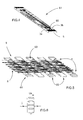
- the figure 3 represents, in perspective, the thermogenerating sheet illustrated in FIG. Figure 2 ( Figure 3A ) and this same sheet 3, after folding and gluing around a support 5, to obtain a thermoelectric means 60 according to the invention.
- the support 5 takes the form of a woven ribbon or a laminate. This support could also be in the form of a wire. It is also obvious that the support could be removed; it suffices for the substrate to be sufficiently rigid that the U-shaped structure holds by itself.
- laminate is well known in the textile field and can be defined as a continuous and narrow strip, of small thickness relative to its width, obtained by film cutting or direct spinning.
- the support is insulating and flexible and is elongated.
- thermoelectric means according to the invention, wherein two thermogenerating sheets 3 are folded and fixed on the same insulating support 5.
- thermoelectric means 61 illustrated in FIG. figure 4 can be realized from the means 60 illustrated in FIG. figure 3 . To do this, it suffices to bend and glue around the support 5, another sheet 3, symmetrically along a longitudinal median axis of the support 5, relative to the first thermogenerating sheet.
- thermoelectric means 61 thus comprises two heat-generating sheets 3a and 3b, arranged upside down or symmetrically with respect to a median longitudinal axis of the support 5, a metal deposit 50 that can be provided on the support 5 in order to ensure an electrical connection. between the two sheets 3a and 3b.
- Another way to optimize the surface is to superimpose on the same side several electrical means connected in series or in parallel, the insulation between them being provided by the substrate.
- thermoelectric means on each of the faces of the substrate.
- an optimization of the useful surface is obtained by increasing the number of pairs of conductors.
- thermoelectric generator or a thermoelectric cooler depends directly on a dimensionless coefficient ZT.
- This coefficient called the merit factor, is equal to S 2 ⁇ T / K where S is the Seebeck coefficient, ⁇ the electrical conductivity, K the thermal conductivity and T the absolute temperature.
- High efficiency requires materials with a high ZT coefficient and therefore high electrical conductivity, to minimize Joule heating when electric current passes in the material; a low thermal conductivity, in order to reduce the thermal bridge phenomenon between the hot part and the cold part of the generator or cooler and a high Seebeck coefficient, for an optimal conversion of heat into electric current.
- the choice of the deposited materials, as well as the chosen structure (thin films or super network), will define the merit factor ZT, thus the electrical performances.
- thermoelectric materials have a ZT value of about 1, for a given temperature range.
- thermoelectric materials that can be deposited on a flexible substrate is extremely broad: metals, metal alloys but also thermoelectric materials with the best performance such as Bi, Sb, Bi 2 Te 3 , or even super- Si / SiGe networks.
- the choice of materials will be made according to the cost, the toxicological criterion required and the desired electrical performance.
- thermoelectric materials such as Bi x Te type alloys are, Sb and Bi x Te y x If there thermoelectric materials with the best performance at 300K or SiGe, biocompatible material, or skutterudites rare earths.
- the term “super-network” covers a stack of very thin successive layers (the thickness of which is less than at 10 nm) and the term “quantum dot” refers to an inclusion of nanoscale aggregates in another material.
- Nanoparticles of semiconductors having a band structure similar to that of the thermoelectric material, can be integrated in the deposit. They have the effect of increasing the merit factor ZT and therefore the performance of the thermogenerator.
- inclusions of Si or SiGe may be incorporated (or conversely Ge nanoparticles may be incorporated in a silicon matrix).
- the matrix and the inclusion material may be doped n-type or p-type. Generally, the concentration of the dopants will be optimized for the different combinations of materials envisaged.
- the thin films will be deposited by deposition techniques such as sputtering, evaporation, PECVD or screen printing or printing techniques (inkjet, heliography, flexography).
- the substrate 30 is substantially planar and flexible. It is also preferable that it is thin and of low thermal and electrical conductivity.
- the most suitable substrate is made of polymer, for example a polyimide sheet (sold for example under the trade name Kapton®), since this material has a unique combination of all the properties necessary for a wide range of applications.
- polymer for example a polyimide sheet (sold for example under the trade name Kapton®)
- Kapton® polyimide sheet
- other materials such as polyester, polyethylene, polyamide, polystyrene, polypropylene, polycarbonate can be considered as a substrate, but also paper.
- the material used to make the electrical junctions between the conductors has a high electrical conductivity, in order to minimize the contact resistances and also a high thermal conductivity, to ensure a good thermal coupling.
- thermoelectric means the choice of its thickness and its nature will ensure the thermal gradient between the two faces of the thermoelectric means obtained.
- the support is preferably a laminette or a ribbon of rectangular section.
- the length of the ribbon or yarn will be defined by the size of the desired fabric.
- the entire length of the wire / laminate can be used to assemble a large number of thermoelements and therefore allow to obtain the desired voltage.
- thermoelectric means it is also possible to envisage a stack of some thermogenerating leaves as illustrated in FIG. figure 4 , in order to increase the number of thermoelements in series and therefore the voltage, and consequently, to increase the useful power density.
- thermoelectric structure according to the invention.
- thermoelectric means such as the means 60 illustrated in FIG. figure 3B , of son conductors 7 and insulating son 8.
- this structure consists of an assembly by interlacing these different elements.
- this assembly is carried out directly by means of a weaving or knitting tool. All the constituent elements of the structure are thus woven and knitted simultaneously.
- thermoelectric means 60 make it possible to connect the thermoelectric means 60 in parallel.
- the contacts between the conductive wires 7 and the thermoelectric means 60 are alternately between the two faces of the structure 9.
- the Seebeck voltage of the structure according to the invention is set by the number of thermocouples connected in series on a thermoelectric means 60.
- the electrical resistance of the structure according to the invention can be optimized by the paralleling of the thermoelectric means. 60.
- thermoelectric means having a resistance r, connected in parallel
- x Services / U S
- U S is the Seebeck voltage of the structure.
- connection wires 7 which provide the mechanical support of the structure according to the invention.
- the wires 8 additionally provide the insulation between the thermoelectric means 60.
- thermoelectric structure An exemplary embodiment of a thermoelectric structure according to the invention is given below.
- thermoelectric alloys based on Bi 2 Te 3 n-type and p-type to make thermocouples on a substrate.
- ⁇ 1.5 W / mK
- ⁇ 2.5 m ⁇ cm
- S 400 ⁇ m V / K.
- thermoelectric means that convert heat energy into electricity, even before they are assembled in the final structure.
- thermoelectric structure can be obtained by simultaneous weaving or knitting of both textile fibers, thermoelectric means and connector fibers.
- the resulting structure exploits the difference in temperature between its two faces.
- the active surface of the structure obtained is of the same order of magnitude as the surface of the garment made with it.
- the electrical energy supplied can be significant, all the heat emitted by the human body can be used.
- the electrical connection is carried out in a simple way, by means of conducting wires. It makes it easy to optimize the thermoelectric characteristics of the structure, depending on the application.
- the overall efficiency of the structure according to the invention can be increased by using high-performance thermoelectric materials.
- the structure according to the invention retains a textile appearance, flexible, breathable, conformable (moldable, injectable) and confectionable and its thickness may be low, because it will be offset by the large area and appropriate choice of electrical materials.
- This structure can also be used as a coating for any device hotter than the ambient air (boiler, piping, ...) in order to recover energy.
- thermoelectric properties can also be associated with another curable material (for example a resin) in order to obtain a composite having thermoelectric properties, easily adaptable to the desired shape (for example in aircraft wing).
- a curable material for example a resin
Landscapes
- Measuring Temperature Or Quantity Of Heat (AREA)
- Hybrid Cells (AREA)
- Woven Fabrics (AREA)
Applications Claiming Priority (1)
| Application Number | Priority Date | Filing Date | Title |
|---|---|---|---|
| FR0705331A FR2919431B1 (fr) | 2007-07-23 | 2007-07-23 | Moyen thermoelectrique et structure de type tissu integrant un tel moyen. |
Publications (2)
| Publication Number | Publication Date |
|---|---|
| EP2019438A2 true EP2019438A2 (de) | 2009-01-28 |
| EP2019438A3 EP2019438A3 (de) | 2009-04-08 |
Family
ID=39092296
Family Applications (1)
| Application Number | Title | Priority Date | Filing Date |
|---|---|---|---|
| EP08290702A Withdrawn EP2019438A3 (de) | 2007-07-23 | 2008-07-18 | Thermoelektrisches Mittel und stoffartige Struktur, die ein solches Mittel umfasst |
Country Status (5)
| Country | Link |
|---|---|
| US (1) | US20090025774A1 (de) |
| EP (1) | EP2019438A3 (de) |
| JP (1) | JP2009100643A (de) |
| CA (1) | CA2637645A1 (de) |
| FR (1) | FR2919431B1 (de) |
Cited By (1)
| Publication number | Priority date | Publication date | Assignee | Title |
|---|---|---|---|---|
| DE102012105743A1 (de) | 2012-06-29 | 2014-01-02 | Elringklinger Ag | Wärmeabschirmvorrichtung mit thermoelektrischer Energienutzung |
Families Citing this family (31)
| Publication number | Priority date | Publication date | Assignee | Title |
|---|---|---|---|---|
| US9758907B2 (en) * | 2008-09-22 | 2017-09-12 | Intel Corporation | Method and apparatus for attaching chip to a textile |
| FR2946798B1 (fr) * | 2009-06-12 | 2011-10-28 | Commissariat Energie Atomique | Micro-structure pour generateur thermoelectrique a effet seebeck et procede de fabrication d'une telle micro- structure. |
| KR101216425B1 (ko) | 2010-04-02 | 2012-12-28 | 연세대학교 산학협력단 | 인체-환경간 온도차를 이용한 에너지 하베스팅 시스템 |
| BR112013005978A2 (pt) * | 2010-09-13 | 2016-06-07 | Tempronics Inc | cordão termelétrico distribuído e painel de isolamento aplicações para aquecimento local, refrigeração local, e geração de energia a partir de calor |
| US8969703B2 (en) * | 2010-09-13 | 2015-03-03 | Tempronics, Inc. | Distributed thermoelectric string and insulating panel |
| KR101776957B1 (ko) | 2010-12-27 | 2017-09-12 | 한양대학교 산학협력단 | 3차원 직접 회로를 이용한 마이크로 시스템 |
| WO2012135428A1 (en) * | 2011-03-29 | 2012-10-04 | The Government Of The United States Of America, As Represented By The Secretary Of The Navy | Thermoelectric materials |
| JP6341856B2 (ja) | 2011-07-06 | 2018-06-13 | テンプロニクス,インコーポレイテッド | 分散型熱電加熱及び冷却の統合 |
| DE102011115172B4 (de) * | 2011-09-23 | 2017-02-16 | Werner Neumann | Verfahren zur Herstellung eines textilen thermoelektrischen Bauelements, textile thermoelektrische Bauelemente und Verwendungen eines textilen thermoelektrischen Bauelements |
| DE102012105496A1 (de) * | 2012-06-25 | 2014-01-02 | Emitec Gesellschaft Für Emissionstechnologie Mbh | Faden mit einem thermoelektrischen Werkstoff und Verfahren zur Herstellung eines Bauelements für ein thermoelektrisches Modul |
| CN103545441B (zh) * | 2012-07-12 | 2016-06-15 | 中国科学院理化技术研究所 | 热量捕获器及其制作方法 |
| US9638442B2 (en) | 2012-08-07 | 2017-05-02 | Tempronics, Inc. | Medical, topper, pet wireless, and automated manufacturing of distributed thermoelectric heating and cooling |
| DE102012018387B4 (de) | 2012-09-18 | 2023-12-28 | Evonik Operations Gmbh | Verfahren zum Herstellen eines textilen thermoelektrischen Generators |
| CN104736387B (zh) | 2012-09-25 | 2018-01-02 | 佛吉亚汽车座椅有限责任公司 | 带有热装置的车辆座椅 |
| WO2015066518A1 (en) | 2013-11-04 | 2015-05-07 | Tempronics, Inc. | Design of thermoelectric string, panel, and covers for function and durability |
| CN103638616A (zh) * | 2013-12-05 | 2014-03-19 | 吴江市社翊纺织有限公司 | 一种多功能消防服装 |
| JP6529097B2 (ja) * | 2015-03-25 | 2019-06-12 | 国立大学法人 奈良先端科学技術大学院大学 | π型熱電変換素子のセル直列構造を有する機能性素子及びその作製方法 |
| US10910543B2 (en) * | 2015-05-21 | 2021-02-02 | Karl Joseph Steutermann | Thermo-electric device to provide electrical power |
| DE102015110445A1 (de) * | 2015-06-29 | 2016-12-29 | Elringklinger Ag | Mechanisch belastbares Bauteil aus einem polymerbasierten Material |
| JP6665464B2 (ja) * | 2015-09-25 | 2020-03-13 | Tdk株式会社 | 薄膜熱電素子 |
| US20180240956A1 (en) * | 2015-09-30 | 2018-08-23 | Purdue Research Foundation | Flexible thermoelectric generator |
| DK3196951T3 (en) | 2016-01-21 | 2019-01-21 | Evonik Degussa Gmbh | RATIONAL PROCEDURE FOR POWDER METAL SURGICAL MANUFACTURING THERMOELECTRIC COMPONENTS |
| EP3621568A4 (de) * | 2017-03-28 | 2021-08-04 | Hitech Cryotherm (M) SDN BHD | Heiz- und kühlvorrichtung und verfahren unter verwendung eines peltier-effekt-halbleiters |
| CN107039576B (zh) * | 2017-04-05 | 2019-05-24 | 上海应用技术大学 | 一种柔性织物复合热电材料的制备方法 |
| DE102017207914A1 (de) * | 2017-05-10 | 2018-11-15 | Mahle International Gmbh | Thermoelektrisches Modul |
| US11152556B2 (en) | 2017-07-29 | 2021-10-19 | Nanohmics, Inc. | Flexible and conformable thermoelectric compositions |
| WO2019173553A1 (en) * | 2018-03-08 | 2019-09-12 | Northwestern University | Flexible woven thermoelectric fabrics for thermal management |
| WO2019186314A1 (en) * | 2018-03-28 | 2019-10-03 | 3M Innovative Properties Company | Flexible thermoelectric devices |
| AU2019384823A1 (en) * | 2018-11-21 | 2021-06-03 | Mark DERZON | Radiation powered high dose rate and high dose radiation sensor |
| US11588090B2 (en) * | 2019-09-03 | 2023-02-21 | Purdue Research Foundation | Integrated thermoelectric film based woven power generator |
| US11832518B2 (en) * | 2021-02-04 | 2023-11-28 | Purdue Research Foundation | Woven thermoelectric ribbon |
Family Cites Families (10)
| Publication number | Priority date | Publication date | Assignee | Title |
|---|---|---|---|---|
| CH413018A (de) * | 1963-04-30 | 1966-05-15 | Du Pont | Thermoelektrischer Generator |
| US4006038A (en) * | 1966-06-02 | 1977-02-01 | Arco Medical Products Company | Heat reflecting tape for thermoelectric converter |
| US3767470A (en) * | 1968-02-19 | 1973-10-23 | F Hines | Thermally compensated heat flow sensors |
| DE29723309U1 (de) * | 1997-03-06 | 1998-09-10 | D.T.S. Gesellschaft zur Fertigung von Dünnschicht-Thermogenerator-Systemen mbH, 06118 Halle | Kompakter Niederleistungs-Thermogenerator |
| DE10045419B4 (de) * | 2000-09-14 | 2007-12-20 | Fraunhofer-Gesellschaft zur Förderung der angewandten Forschung e.V. | Verfahren zur Herstellung eines thermoelektrischen Bauelements, thermoelektrisches Bauelement sowie Vorrichtung zur Durchführung des Verfahrens |
| FR2817617A1 (fr) * | 2000-12-01 | 2002-06-07 | Edouard Serras | Procede de fabrication de convertisseurs thermo-electriques |
| DE10122679A1 (de) * | 2001-05-10 | 2002-12-12 | Infineon Technologies Ag | Thermoelement, Thermoelement-Anordnung, Elektronisches Gerät und Textilelement |
| US6700052B2 (en) * | 2001-11-05 | 2004-03-02 | Amerigon Incorporated | Flexible thermoelectric circuit |
| WO2004105146A1 (en) * | 2003-05-23 | 2004-12-02 | Koninklijke Philips Electronics N.V. | Method of manufacturing a thermoelectric device and thermoelectric device obtained by means of such a method |
| US8455751B2 (en) * | 2003-12-02 | 2013-06-04 | Battelle Memorial Institute | Thermoelectric devices and applications for the same |
-
2007
- 2007-07-23 FR FR0705331A patent/FR2919431B1/fr not_active Expired - Fee Related
-
2008
- 2008-07-18 EP EP08290702A patent/EP2019438A3/de not_active Withdrawn
- 2008-07-22 JP JP2008188320A patent/JP2009100643A/ja active Pending
- 2008-07-22 CA CA002637645A patent/CA2637645A1/fr not_active Abandoned
- 2008-07-22 US US12/177,347 patent/US20090025774A1/en not_active Abandoned
Cited By (2)
| Publication number | Priority date | Publication date | Assignee | Title |
|---|---|---|---|---|
| DE102012105743A1 (de) | 2012-06-29 | 2014-01-02 | Elringklinger Ag | Wärmeabschirmvorrichtung mit thermoelektrischer Energienutzung |
| WO2014001337A1 (de) | 2012-06-29 | 2014-01-03 | Elringklinger Ag | Wärmeabschirmvorrichtung mit thermoelektrischer energienutzung |
Also Published As
| Publication number | Publication date |
|---|---|
| US20090025774A1 (en) | 2009-01-29 |
| JP2009100643A (ja) | 2009-05-07 |
| FR2919431A1 (fr) | 2009-01-30 |
| EP2019438A3 (de) | 2009-04-08 |
| CA2637645A1 (fr) | 2009-01-23 |
| FR2919431B1 (fr) | 2010-08-27 |
Similar Documents
| Publication | Publication Date | Title |
|---|---|---|
| EP2019438A2 (de) | Thermoelektrisches Mittel und stoffartige Struktur, die ein solches Mittel umfasst | |
| CN101356657B (zh) | 使用热发电元件的发电方法、热发电元件及其制造方法、热发电器件 | |
| EP2063240B1 (de) | Detektor mit Nanofadenthermometer für elektromagnetische Strahlung und Umsetzungsverfahren | |
| EP2441099B1 (de) | Mikrostruktur für einen thermoelektrischen generator mit seebeck-effekt und verfahren zur herstellung einer solchen mikrostruktur | |
| AU702453B2 (en) | Fabrication of thermoelectric modules and solder for such fabrication | |
| JP3896323B2 (ja) | 熱電冷却器およびその製造方法 | |
| JP2007518252A5 (de) | ||
| MXPA05012477A (es) | Generador termoelectrico de baja energia. | |
| CA2650855A1 (en) | Low dimensional thermoelectrics fabricated by semiconductor wafer etching | |
| WO2003063257A1 (fr) | Convertisseur thermoelectrique miniature a haute integration | |
| CN101335324A (zh) | 热电元件、热电发生器和热电冷却器 | |
| CA1033393A (en) | Thermoelectric heat pump | |
| Wredh et al. | Sb2Te3–Bi2Te3 direct photo–thermoelectric mid‐infrared detection | |
| WO2010142623A1 (fr) | Materiau de stockage d'energie thermique et source d'energie thermoelectrique | |
| FR2974245A1 (fr) | Composant thermoélectrique a puits quantiques destine a être utilise dans un dispositif thermoélectrique | |
| FR2620573A1 (fr) | Panneau transducteur chaleur/electricite a nombreux thermocouples en forme de film mince plie en accordeon | |
| EP3985745B1 (de) | Verfahren zur herstellung einer thermoelektrischen vorrichtung durch additive fertigung von kämmen, die sich gegenseitig berühren | |
| JP6781982B2 (ja) | 熱電変換モジュールとその製造方法 | |
| FR2977976A1 (fr) | Procede de generation d'energie electrique au sein d'une structure integree tridimensionnelle, et dispositif de liaison correspondant | |
| KR20170098564A (ko) | 열전 소자 | |
| EP3506358B1 (de) | Thermoelektrische vorrichtung mit thermoelektrischem übergang, der in der dicke eines substrats ausgebildet ist, und herstellungsverfahren dieser thermoelektrischen vorrichtung | |
| FR2955708A1 (fr) | Microgenerateur de tension utilisant la chaleur latente de changement de phase d'un liquide | |
| WO2011135254A1 (fr) | Micro-actionneur et micro-pince | |
| Yuan et al. | Vertical Self-Defined Thin-Film Thermoelectric Thermocouples by Angled Co-Evaporation for Use in μTEGs | |
| JP5176607B2 (ja) | 熱発電デバイス素子 |
Legal Events
| Date | Code | Title | Description |
|---|---|---|---|
| PUAI | Public reference made under article 153(3) epc to a published international application that has entered the european phase |
Free format text: ORIGINAL CODE: 0009012 |
|
| AK | Designated contracting states |
Kind code of ref document: A2 Designated state(s): AT BE BG CH CY CZ DE DK EE ES FI FR GB GR HR HU IE IS IT LI LT LU LV MC MT NL NO PL PT RO SE SI SK TR |
|
| AX | Request for extension of the european patent |
Extension state: AL BA MK RS |
|
| PUAL | Search report despatched |
Free format text: ORIGINAL CODE: 0009013 |
|
| AK | Designated contracting states |
Kind code of ref document: A3 Designated state(s): AT BE BG CH CY CZ DE DK EE ES FI FR GB GR HR HU IE IS IT LI LT LU LV MC MT NL NO PL PT RO SE SI SK TR |
|
| AX | Request for extension of the european patent |
Extension state: AL BA MK RS |
|
| 17P | Request for examination filed |
Effective date: 20091006 |
|
| 17Q | First examination report despatched |
Effective date: 20091119 |
|
| AKX | Designation fees paid |
Designated state(s): AT BE BG CH CY CZ DE DK EE ES FI FR GB GR HR HU IE IS IT LI LT LU LV MC MT NL NO PL PT RO SE SI SK TR |
|
| RAP1 | Party data changed (applicant data changed or rights of an application transferred) |
Owner name: COMMISSARIAT A L'ENERGIE ATOMIQUE ET AUX ENERGIES |
|
| STAA | Information on the status of an ep patent application or granted ep patent |
Free format text: STATUS: THE APPLICATION IS DEEMED TO BE WITHDRAWN |
|
| 18D | Application deemed to be withdrawn |
Effective date: 20130201 |