EP2020449A1 - Procédé de détection et de quantification multiple et simultanée de pathogènes par réaction en chaîne par polymérase en temps réel - Google Patents
Procédé de détection et de quantification multiple et simultanée de pathogènes par réaction en chaîne par polymérase en temps réel Download PDFInfo
- Publication number
- EP2020449A1 EP2020449A1 EP07747198A EP07747198A EP2020449A1 EP 2020449 A1 EP2020449 A1 EP 2020449A1 EP 07747198 A EP07747198 A EP 07747198A EP 07747198 A EP07747198 A EP 07747198A EP 2020449 A1 EP2020449 A1 EP 2020449A1
- Authority
- EP
- European Patent Office
- Prior art keywords
- seq
- probe
- identified
- marked
- oligonucleotide
- Prior art date
- Legal status (The legal status is an assumption and is not a legal conclusion. Google has not performed a legal analysis and makes no representation as to the accuracy of the status listed.)
- Granted
Links
Images



Classifications
-
- C—CHEMISTRY; METALLURGY
- C12—BIOCHEMISTRY; BEER; SPIRITS; WINE; VINEGAR; MICROBIOLOGY; ENZYMOLOGY; MUTATION OR GENETIC ENGINEERING
- C12Q—MEASURING OR TESTING PROCESSES INVOLVING ENZYMES, NUCLEIC ACIDS OR MICROORGANISMS; COMPOSITIONS OR TEST PAPERS THEREFOR; PROCESSES OF PREPARING SUCH COMPOSITIONS; CONDITION-RESPONSIVE CONTROL IN MICROBIOLOGICAL OR ENZYMOLOGICAL PROCESSES
- C12Q1/00—Measuring or testing processes involving enzymes, nucleic acids or microorganisms; Compositions therefor; Processes of preparing such compositions
- C12Q1/68—Measuring or testing processes involving enzymes, nucleic acids or microorganisms; Compositions therefor; Processes of preparing such compositions involving nucleic acids
- C12Q1/6876—Nucleic acid products used in the analysis of nucleic acids, e.g. primers or probes
- C12Q1/6888—Nucleic acid products used in the analysis of nucleic acids, e.g. primers or probes for detection or identification of organisms
- C12Q1/689—Nucleic acid products used in the analysis of nucleic acids, e.g. primers or probes for detection or identification of organisms for bacteria
-
- C—CHEMISTRY; METALLURGY
- C12—BIOCHEMISTRY; BEER; SPIRITS; WINE; VINEGAR; MICROBIOLOGY; ENZYMOLOGY; MUTATION OR GENETIC ENGINEERING
- C12Q—MEASURING OR TESTING PROCESSES INVOLVING ENZYMES, NUCLEIC ACIDS OR MICROORGANISMS; COMPOSITIONS OR TEST PAPERS THEREFOR; PROCESSES OF PREPARING SUCH COMPOSITIONS; CONDITION-RESPONSIVE CONTROL IN MICROBIOLOGICAL OR ENZYMOLOGICAL PROCESSES
- C12Q2600/00—Oligonucleotides characterized by their use
- C12Q2600/16—Primer sets for multiplex assays
-
- Y—GENERAL TAGGING OF NEW TECHNOLOGICAL DEVELOPMENTS; GENERAL TAGGING OF CROSS-SECTIONAL TECHNOLOGIES SPANNING OVER SEVERAL SECTIONS OF THE IPC; TECHNICAL SUBJECTS COVERED BY FORMER USPC CROSS-REFERENCE ART COLLECTIONS [XRACs] AND DIGESTS
- Y02—TECHNOLOGIES OR APPLICATIONS FOR MITIGATION OR ADAPTATION AGAINST CLIMATE CHANGE
- Y02A—TECHNOLOGIES FOR ADAPTATION TO CLIMATE CHANGE
- Y02A50/00—TECHNOLOGIES FOR ADAPTATION TO CLIMATE CHANGE in human health protection, e.g. against extreme weather
- Y02A50/30—Against vector-borne diseases, e.g. mosquito-borne, fly-borne, tick-borne or waterborne diseases whose impact is exacerbated by climate change
Definitions
- the present invention is related, in general, to the detection, identification, and quantification of pathogenic bacteria, and particularly to a method for the detection and multiple, simultaneous quantification of any combination of pathogens, such as Listeria sp, Staphylococcus aureus, Campylobacter jejuni and/or Escherichia coli O157:H7, by means of multiplex amplification reaction, using real-time polymerase chain reaction.
- pathogens such as Listeria sp, Staphylococcus aureus, Campylobacter jejuni and/or Escherichia coli O157:H7
- PCR polymerase chain reaction
- each pair of primers include a first nucleotide sequence complementary to a sequence that borders on the extreme 5' of a sequence of a nucleic acid target and a second nucleotide sequence complementary to a sequence that borders the 3' end of the sequence of nucleic acid target.
- Nucleotide sequences should have every pair of oligonucleotide primers which are specific to the pathogen to be detected, so that they do not react or are crossed with other pathogens.
- PCR technique is a sensitive and quick method to detect pathogens on an individual basis, this can also be used to simultaneously detect multiple pathogens present in a sample.
- the PCR methodology used for simultaneous detection of multiple pathogens in a sample is problematic, since its main obstacle lies in the cross reaction that may be present due to the use of multiple nucleotide sequences in order to have the preferential amplification of certain target sequences, present in the sample at the expense of other target sequences, also present.
- the publication of international patent application WO-0314704 describes a method to detect specific and simultaneously pathogen species of Campylobacter in a complex test sample.
- the pathogen species of Campylobacter to be detected may be Campylobacter jejuni or Campylobacter coli.
- the complex test sample can be a sample of food, water or a rich array of food.
- the method uses the PCR amplification with or without an internal positive control and appropriate pairs of primers. Multiple species can be detected in said reaction.
- the object of the invention to offer a method for the detection and multiple, simultaneous quantification of any combination of pathogens, selected from a group consisting of Listeria spp, Staphylococcus aureus, Campylobacter jejuni and Escherichia coli O157:H7, in one or more test samples, by multiplex amplification reaction, using real-time polymerase chain reaction (PCR), the steps of the method are: (a) extracting DNA from the test sample or samples; (b) preparing a reaction mixture specific for the pathogens to be detected and quantified, such that the reaction mixture contains the necessary reagents for enzymatic amplification of the extracted DNA and identification of the pathogens to be detected and quantified; (c) amplifying the reaction mixture by means of multiplex amplification reaction using PCR; and (d) simultaneously determining the presence or absence of and quantification of the pathogens in the test sample or samples; the method is particular in that (i)
- Another object of this invention is to provide an oligonucleotide that has a nucleotide sequence selected from a group consisting of sequences identified as SEQ ID NO: 1, SEQ ID NO: 2 and SEQ ID NO: 3.
- oligonucleotide that has a nucleotide sequence selected from a group consisting of sequences identified as SEQ ID NO: 4, SEQ ID NO: 5 and SEQ ID NO: 6.
- Another object of the invention is an oligonucleotide that has a nucleotide sequence selected from a group consisting of sequences identified as SEQ ID NO: 7, SEQ ID NO: 8 and SEQ ID NO: 9.
- oligonucleotide that has a nucleotide sequence selected from a group consisting of sequences identified as SEQ ID NO: 10, SEQ ID NO: 11 and SEQ ID NO: 12.
- a marked probe which includes an oligonucleotide identified as SEQ ID NO: 3, and at least one marker.
- Another object of the invention is to provide a marked probe which includes an oligonucleotide identified as SEQ ID NO: 6, and at least one marker.
- a marked probe which includes an oligonucleotide identified as SEQ ID NO: 9, and at least one marker.
- Another object of the invention is to provide a marked probe which includes an oligonucleotide identified as SEQ ID NO: 12; and at least one marker.
- the diagnostic kit for the detection and multiple, simultaneous quantification of any combination of pathogens, selected from a group consisting of Listeria spp, Staphylococcus aureus, Campylobacter jejuni and Escherichia coli O157:H7, in one or more test samples, by multiplex amplification reaction, using real-time polymerase chain reaction (PCR), the diagnostic kit has (a) one or more oligonucleotides as any group of sequences identified as SEQ ID NO: 1, SEQ ID NO: 2 and SEQ ID NO: 3; SEQ ID NO: 4, SEQ ID NO: 5 and SEQ ID NO: 6; SEQ ID NO: 7, SEQ ID NO: 8 and SEQ ID NO: 9; and/or SEQ ID NO: 10, SEQ ID NO: 11 and SEQ ID NO: 12; (b) one or more marked probes that contain any of the oligonucleotides with its sequences identified as SEQ ID NO: 3, SEQ ID NO: 6, SEQ ID NO:
- Figure 1 illustrates a calibration curve for Listeria sp according to the invention, where A1: is a reference to increased concentration; A4: is a reference of a lesser concentration. The reading of a sample is interpolated in the readings of the references to know the CFU/ml.
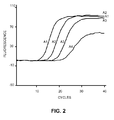
- Figure 2 illustrates a calibration curve for Staphylococcus aureus according to the invention, where A1: is a reference to increased concentration; A4: is a reference of a lesser concentration. The reading of a sample is interpolated in the readings of the references to know the CFU/ml.
- Figure 3 illustrates a calibration curve for Campylobacter jejuni according to the invention, where A1: is a reference to increased concentration; A2: is a reference of a lesser concentration. The reading of a sample is interpolated in the readings of the references to know the CFU/ml.
- Figure 4 illustrates a calibration curve for Escherichia coli O157:H7 according to the invention, where A1: is a reference to increased concentration; A3: is a reference of a lesser concentration. The reading of a sample is interpolated in the readings of the references to know the CFU/ml.
- enzyme amplification of DNA means the use of polymerase chain reaction (PCR) to increase the concentration of a particular DNA sequence within a combination of DNA sequences.
- PCR polymerase chain reaction
- target sequence The particular sequence of DNA that is amplified is referred to as a "target sequence.”
- pair of primers is employed under the meaning of a pair of oligonucleotide that are complementary to the sequences bordering the target sequence.
- the pair of primers is an "upstream” primer which has a nucleic acid sequence that is complementary to a sequence "upstream” of the target sequence, and a “downstream” primer which has a nucleic acid sequence that is a sequence complementary to "downstream” of the target sequence.
- multiple amplification reaction means, in the context of this description, amplified by PCR procedure, multiple target sequences of DNA in a test sample in particular.
- the method provided by this invention allows detecting, identifying and quantifying multiple pathogens simultaneously transmissible via food, contaminated surfaces or environments, such as Listeria sp, Staphylococcus aureus, Campylobacter jejuni and/or Escherichia coli O157:H7, in one or more test samples, through multiplex amplification reaction using polymerase chain reaction in real time.
- the test sample can be any sample that contains DNA and you want to know the possible contamination of by said pathogens.
- said test sample is a sample of a food product, for example, meat and milk products, or a sample of contaminated surfaces or environments.
- the oligonucleotides of the invention have been designed in order to identify specifically, Listeria sp, Staphylococcus aureus, Campylobacter jejuni and Escherichia coli O157:H7 that may be present in a sample test without giving false positives because of the presence of other pathogens it may contain.
- each pair of primers comprises a first synthetic nucleotide "upstream” sequence complementary to a nucleotide "upstream” sequence which borders the extreme 5' of a nucleic acid sequence target, and a second synthetic nucleotide "downstream” sequence, complementary to a "downstream” sequence which borders the extreme 3' of the nucleic acid sequence target.
- Nucleotide sequences should have every pair of oligonucleotide primers which are specific to the pathogen to be detected, so that they do not react or are crossed with other pathogens. Also, for each of the pathogens to be identified, a synthetic sequence of a probe test is developed. Oligonucleotides developed are shown in Table 1.
- sequences SEQ ID NO: 3, SEQ ID NO: 6, SEQ ID NO: 9 and SEQ ID NO: 12, used as test probes are marked in their 5' extreme with a fluorophoro or a dye capable of emitting energy, and at its 3' end with an extinguisher or a dye capable of capturing the energy emitted by the fluorophoro excitation.
- the fluorophores and dyes, used as markers to detect and identify Listeria sp, Staphylococcus aureus, Campylobacter jejuni and Escherichia coli O157:H7 without producing cross-reactions between them and other components are shown in Table 2.
- the sediment of the sample is obtained, it is incubated with lysozyme to break down the cell wall of the bacteria present in the sample, then proceed with an incubation with proteinase K to cause the hydrolysis of proteins and the lysozyme previously added.
- the extraction of proteins and other fat-soluble compounds present is performed through the application of phenol-chloroform-alcohol, so that once extracted, through a precipitation with ethanol, a selective precipitation of the DNA present is performed, forming a concentration of DNA that is dried.
- Example 1 Preparation of a DNA sample starting from a sample of food of cheese or meat products.
- Example 2 Preparation of a DNA sample starting from an environmental or a surface sample.
- the multiplex amplification reaction using PCR in real-time provides many advantages over the conventional PCR method to detect a single target.
- the multiplex amplification reaction using multiplex PCR requires the development of oligonucleotide primers and probes, specific for the target sequence of the pathogen to be detected, so that said oligonucleotide primers and probes be compatible with one another within the same optimum temperature of 40 °C to 65 °C and submitted to the same conditions of chemical reaction in order to allow the crossing or tying by hybridization of two segments of complementary nucleic acid.
- the sets of oligonucleotide primers and probes should not react crossedly or be tied during the amplification to other nucleic acid sequences for which they were not designed.
- pairs of oligonucleotide primers are used to amplify each of the target nucleic acid sequences of each pathogen to be detected.
- a pair of oligonucleotide primers of Listeria sp identified as SEQ ID NO: 1 and SEQ ID NO: 2, which are crossed or tied to a target sequence of the genome of Listeria sp.
- a pair of oligonucleotide primers of Staphylococcus aureus identified as SEQ ID NO: 4 and SEQ ID NO: 5 that are crossed or tied to a target sequence of the genome of Staphylococcus aureus.
- a pair of oligonucleotide primers of Campylobacter jejuni identified as SEQ ID NO: 7 and SEQ ID NO: 8 which are crossed or tied to a target sequence of the genome of Campylobacter jejuni.
- a pair of oligonucleotide primers of Escherichia coli O157:H7 identified as SEQ ID NO: 10 and SEQ ID NO: 11, which are crossed or tied to a target sequence of the genome of Escherichia coli O157:H7.
- Each of the probes is marked on its 5' end with a fluorophore or a dye capable of emitting energy, and on its 3' end with an extinguisher or a dye, capable of capturing the energy emitted by the excitation of said fluorophore, as described by Nazarenko et al. in the U.S. patent 5,866,336 which mentions fluorophores that transfer energy and how these are applied in the oligonucleotide primers in the methods of nucleic amplification.
- the fluorophores used are TET, TxR, Cy5, FAM, while the dyes are BHQ-1, BHQ-2 and BHQ-3. So that the oligonucleotide sequences used as probes (SEQ ID NO: 3, SEQ ID NO: 6, SEQ ID NO: 9 and SEQ ID NO: 12) are marked on their 5' and 3' ends according to the combination shown in Table 2 above.
- the DNA sample is prepared for its amplification under the following conditions:
- the multiplex amplification reaction using PCR is performed on an apparatus for the simultaneous control of multiple nucleic acid amplifications, as the device described by Russell G. Higuchi and Robert M. Watson in the publication of the European Patent EP-640,828 , which usually consists of a thermal cycler with a plurality of holes where tubes are introduced containing the reaction mixture for the enzymatic amplification of DNA from pathogens to be detected and identified; a light source coupled to the thermal cycler and adapted to distribute the light on the plurality of holes, and a sensor or fluorescence detector adapted to simultaneously detect the emitted light.
- calibration curves are produced, preparing suspensions of each of the pathogens to be detected ( Listeria sp, Staphylococcus aureus, Campylobacter jejuni and Escherichia coli O157:H7 ), adjusting the turbidity in the Mc Farland tube of 0.5 to prepare dilutions to 10 -1 , 10 -2 , 10 -3 , 10 4 , 10 5 , 10 6 , 10 7 and 10 8 and then contaminate 25 grams of food with each of these suspensions (one food for each dilution).
- the pathogens to be detected Listeria sp, Staphylococcus aureus, Campylobacter jejuni and Escherichia coli O157:H7
- adjusting the turbidity in the Mc Farland tube of 0.5 to prepare dilutions to 10 -1 , 10 -2 , 10 -3 , 10 4 , 10 5 , 10 6 , 10 7 and 10 8 and then contaminate 25 grams of food
- the apparatus used comprises a fast thermal cycler in real-time coupled to a fluorescence detection system, allowing real-time monitoring of the process of amplification after each cycle.
- a fast thermal cycler in real-time coupled to a fluorescence detection system, allowing real-time monitoring of the process of amplification after each cycle.
- An example of the thermal cycler used in the method of the invention is the cycler SMART CYCLE® II of CEPHEID®.
- Table 5 presents the conditions in which the multiplex amplification reaction was carried out
- Table 6 presents the detection limits
- Table 7 shows the readings of concentrations that were obtained as a result of detection and quantification of the four pathogens ( Listeria sp, Staphylococcus aureus, Campylobacter jejuni and/or Escherichia coli O157:H7) simultaneously in samples of cold meats, dairy and atmosphere, using only one device with a single mixture of reagents and four specific oligonucleotides for different pathogens to a single condition of temperatures and mixing for their amplification.
- the Figures 1 , 2 , 3 , and 4 graphically show their identification and quantification.
- the method of the present invention does not require a pre-enrichment, therefore, the process time is much shorter, approximately 2.5 hours, and has the capacity to detect and quantify possible pathogens cultivable, apart from possible pathogens non-cultivable in a simultaneous manner.
- the diagnostics sets of the invention contain each of the pairs of oligonucleotide primers corresponding to each of the pathogens to be detected ( Listeria sp , Staphylococcus aureus, Campylobacter jejuni and/or Escherichia coli O157:H7), just as each of the probes marked for each of said pathogens, in order to be able to make a choice between performing the detection of a single pathogen (using only the pair of oligonucleotide primers and its probe marked), or for the simultaneous or combined detection of the four pathogens mentioned, depending on the necessities.
- the pathogens to be detected Listeria sp , Staphylococcus aureus, Campylobacter jejuni and/or Escherichia coli O157:H7
- the diagnostics kits provided by this invention may be presented in the form of a box containing, in addition to some containers with the pairs of oligonucleotide primers and/or marked probes mentioned previously, some containers with the totality or part of the rest of the reagents needed to perform said method, for example, ultrapure water, dNTPs (dATP, dCTP, dGTP, and dTTP), an appropriate buffer for the enzymatic amplification reaction, a thermostable DNA polymerase (e.g., Taq DNA polymerase), a magnesium salts (for example, MgCl 2 ), among others.
- dNTPs dATP, dCTP, dGTP, and dTTP
- an appropriate buffer for the enzymatic amplification reaction for example, a thermostable DNA polymerase (e.g., Taq DNA polymerase), a magnesium salts (for example, MgCl 2 ), among others.
- the diagnostics sets provided by this invention may include some containers with DNA from Listeria sp, Staphylococcus aureus, Campylobacter jejuni and/or Escherichia coli O157:H7 for their use as positive controls.
Landscapes
- Chemical & Material Sciences (AREA)
- Life Sciences & Earth Sciences (AREA)
- Analytical Chemistry (AREA)
- Proteomics, Peptides & Aminoacids (AREA)
- Organic Chemistry (AREA)
- Zoology (AREA)
- Wood Science & Technology (AREA)
- Health & Medical Sciences (AREA)
- Engineering & Computer Science (AREA)
- Microbiology (AREA)
- Immunology (AREA)
- Molecular Biology (AREA)
- Biotechnology (AREA)
- Biophysics (AREA)
- Physics & Mathematics (AREA)
- Biochemistry (AREA)
- Bioinformatics & Cheminformatics (AREA)
- General Engineering & Computer Science (AREA)
- General Health & Medical Sciences (AREA)
- Genetics & Genomics (AREA)
- Measuring Or Testing Involving Enzymes Or Micro-Organisms (AREA)
Applications Claiming Priority (2)
| Application Number | Priority Date | Filing Date | Title |
|---|---|---|---|
| MXNL/A/2006/000028A MXNL06000028A (en) | 2006-04-24 | Method for the multiple and simultaneous detection and quantification of pathogens by means of an in real-time polymerase chain reaction | |
| PCT/MX2007/000052 WO2007123386A1 (fr) | 2006-04-24 | 2007-04-19 | Procédé de détection et de quantification multiple et simultanée de pathogènes par réaction en chaîne par polymérase en temps réel |
Publications (3)
| Publication Number | Publication Date |
|---|---|
| EP2020449A1 true EP2020449A1 (fr) | 2009-02-04 |
| EP2020449A4 EP2020449A4 (fr) | 2009-12-30 |
| EP2020449B1 EP2020449B1 (fr) | 2012-09-26 |
Family
ID=38625236
Family Applications (1)
| Application Number | Title | Priority Date | Filing Date |
|---|---|---|---|
| EP07747198A Not-in-force EP2020449B1 (fr) | 2006-04-24 | 2007-04-19 | Procédé de détection et de quantification multiple et simultanée de pathogènes par réaction en chaîne par polymérase en temps réel |
Country Status (7)
| Country | Link |
|---|---|
| US (1) | US8206923B2 (fr) |
| EP (1) | EP2020449B1 (fr) |
| CN (1) | CN101432440B (fr) |
| BR (1) | BRPI0710889A2 (fr) |
| DK (1) | DK2020449T3 (fr) |
| ES (1) | ES2396453T3 (fr) |
| WO (1) | WO2007123386A1 (fr) |
Cited By (3)
| Publication number | Priority date | Publication date | Assignee | Title |
|---|---|---|---|---|
| WO2015044472A1 (fr) * | 2013-09-27 | 2015-04-02 | Universidad De Oviedo | Procédé de détection simultanée de micro-organismes pathogènes |
| WO2015114296A1 (fr) * | 2014-01-29 | 2015-08-06 | Bg Research Ltd | Appareil et procédé permettant d'effectuer des réactions biochimiques par thermocycleur |
| EP3825422A4 (fr) * | 2018-07-16 | 2022-04-20 | Sigma Alimentos, S. A. De C. V. | Méthode et kit de diagnostic pour détecter de manière multiple et simultanée une combinaison de bactéries à gram positif et/ou de bactéries à gram négatif |
Families Citing this family (19)
| Publication number | Priority date | Publication date | Assignee | Title |
|---|---|---|---|---|
| BRPI0923225A2 (pt) | 2008-12-02 | 2016-10-04 | Chiralgen Ltd | metodo para sintese de acidos nucleicos modificados no atomo de fosforo |
| EP2451461A4 (fr) | 2009-07-06 | 2013-05-29 | Ontorii Inc | Nouveaux précurseurs d'acide nucléique et leurs méthodes d'utilisation |
| US12065698B2 (en) | 2009-10-02 | 2024-08-20 | Thermo Fisher Scientific Baltics Uab | Sample processing apparatus and method |
| FI20096013A7 (fi) | 2009-10-02 | 2011-04-03 | Finnzymes Oy | Menetelmä reaktioseoksen valmistelemiseksi ja tähän liittyvät tuotteet |
| CN101886120A (zh) * | 2010-03-05 | 2010-11-17 | 江苏出入境检验检疫局动植物与食品检测中心 | 一种空肠弯曲菌荧光定量pcr检测试剂盒及其检测方法 |
| DK2620428T3 (da) | 2010-09-24 | 2019-07-01 | Wave Life Sciences Ltd | Asymmetrisk hjælpegruppe |
| CN107365339A (zh) | 2011-07-19 | 2017-11-21 | 波涛生命科学有限公司 | 合成官能化核酸的方法 |
| WO2014010250A1 (fr) | 2012-07-13 | 2014-01-16 | Chiralgen, Ltd. | Groupe auxiliaire asymétrique |
| SG11201500243WA (en) | 2012-07-13 | 2015-04-29 | Shin Nippon Biomedical Lab Ltd | Chiral nucleic acid adjuvant |
| DK2872147T3 (da) | 2012-07-13 | 2023-02-20 | Wave Life Sciences Ltd | Fremgangsmåde til fremstilling af kirale oligonukleotider |
| EP3095459A4 (fr) | 2014-01-15 | 2017-08-23 | Shin Nippon Biomedical Laboratories, Ltd. | Adjuvant d'acide nucléique chiral ayant un effet antitumoral et agent antitumoral |
| WO2015108046A1 (fr) | 2014-01-15 | 2015-07-23 | 株式会社新日本科学 | Adjuvant d'acide nucléique chiral ayant une activité anti-allergique, et agent anti-allergique |
| EP3095461A4 (fr) | 2014-01-15 | 2017-08-23 | Shin Nippon Biomedical Laboratories, Ltd. | Adjuvant d'acide nucléique chiral possédant une activité d'induction d'immunité, et activateur d'induction d'immunité |
| EP3094728B1 (fr) | 2014-01-16 | 2022-03-09 | Wave Life Sciences Ltd. | Conception chirale |
| EP3280821B1 (fr) | 2015-04-07 | 2023-12-06 | Polyskope Labs | Détection d'un ou de plusieurs agents pathogènes |
| EP3601616A1 (fr) * | 2017-03-27 | 2020-02-05 | Imicroq, S.L. | Procédé de pcr rapide pour la détection de micro-organismes pathogènes |
| CN114350831A (zh) * | 2020-10-12 | 2022-04-15 | 谱尼测试集团上海有限公司 | 用于可可粉中可可源性成分检测的引物探针及方法 |
| CN112538544B (zh) * | 2020-12-30 | 2022-06-14 | 广东省微生物研究所(广东省微生物分析检测中心) | 具有特异性分子靶标的食源性致病菌标准菌株活菌的检测方法及应用 |
| CN116287330B (zh) * | 2022-12-30 | 2023-12-05 | 中国科学院生态环境研究中心 | 一种可检测多种毒力基因的高通量实时荧光定量pcr芯片及其检测方法 |
Family Cites Families (38)
| Publication number | Priority date | Publication date | Assignee | Title |
|---|---|---|---|---|
| US5038852A (en) | 1986-02-25 | 1991-08-13 | Cetus Corporation | Apparatus and method for performing automated amplification of nucleic acid sequences and assays using heating and cooling steps |
| US4683202A (en) | 1985-03-28 | 1987-07-28 | Cetus Corporation | Process for amplifying nucleic acid sequences |
| US5333675C1 (en) | 1986-02-25 | 2001-05-01 | Perkin Elmer Corp | Apparatus and method for performing automated amplification of nucleic acid sequences and assays using heating and cooling steps |
| US4965188A (en) | 1986-08-22 | 1990-10-23 | Cetus Corporation | Process for amplifying, detecting, and/or cloning nucleic acid sequences using a thermostable enzyme |
| US5008182A (en) | 1986-01-10 | 1991-04-16 | Cetus Corporation | Detection of AIDS associated virus by polymerase chain reaction |
| US5386022A (en) | 1985-03-28 | 1995-01-31 | Hoffman-La Roche Inc. | Primes and probes for the amplification and detection of aids associated nucleic acids |
| US4683195A (en) | 1986-01-30 | 1987-07-28 | Cetus Corporation | Process for amplifying, detecting, and/or-cloning nucleic acid sequences |
| US5176995A (en) | 1985-03-28 | 1993-01-05 | Hoffmann-La Roche Inc. | Detection of viruses by amplification and hybridization |
| US4800159A (en) | 1986-02-07 | 1989-01-24 | Cetus Corporation | Process for amplifying, detecting, and/or cloning nucleic acid sequences |
| US5310893A (en) | 1986-03-31 | 1994-05-10 | Hoffmann-La Roche Inc. | Method for HLA DP typing |
| US5352600A (en) | 1986-08-22 | 1994-10-04 | Hoffmann-La Roche Inc. | Purified thermostable enzyme |
| US5079352A (en) | 1986-08-22 | 1992-01-07 | Cetus Corporation | Purified thermostable enzyme |
| US5322770A (en) | 1989-12-22 | 1994-06-21 | Hoffman-Laroche Inc. | Reverse transcription with thermostable DNA polymerases - high temperature reverse transcription |
| US4889818A (en) | 1986-08-22 | 1989-12-26 | Cetus Corporation | Purified thermostable enzyme |
| US5405774A (en) | 1986-08-22 | 1995-04-11 | Hoffmann-La Roche Inc. | DNA encoding a mutated thermostable nucleic acid polymerase enzyme from thermus species sps17 |
| US5374553A (en) | 1986-08-22 | 1994-12-20 | Hoffmann-La Roche Inc. | DNA encoding a thermostable nucleic acid polymerase enzyme from thermotoga maritima |
| US5310652A (en) | 1986-08-22 | 1994-05-10 | Hoffman-La Roche Inc. | Reverse transcription with thermostable DNA polymerase-high temperature reverse transcription |
| US5407800A (en) | 1986-08-22 | 1995-04-18 | Hoffmann-La Roche Inc. | Reverse transcription with Thermus thermophilus polymerase |
| EP0431149B1 (fr) * | 1989-05-31 | 1995-09-06 | Amoco Corporation | Sondes d'acides nucleiques eubacteriennes universelles et procede |
| EP0540693B1 (fr) | 1990-07-24 | 1999-01-20 | F. Hoffmann-La Roche Ag | REDUCTION D'AMPLIFICATION NON-SPECIFIQUE AU COURS D'UNE AMPLIFICATION $i(IN VITRO) D'ACIDE NUCLEIQUE UTILISANT DES BASES D'ACIDE NUCLEIQUE MODIFIEES |
| US6372424B1 (en) * | 1995-08-30 | 2002-04-16 | Third Wave Technologies, Inc | Rapid detection and identification of pathogens |
| CA2129787A1 (fr) | 1993-08-27 | 1995-02-28 | Russell G. Higuchi | Surveillance de plusieurs reactions d'amplification simultanement et analyse de ces reactions simultanement |
| US5654417A (en) * | 1995-04-14 | 1997-08-05 | Children's Hospital And Medical Center | Nucleic acid probes for detecting E. coli O157:H7 |
| US6737248B2 (en) * | 1996-01-05 | 2004-05-18 | Human Genome Sciences, Inc. | Staphylococcus aureus polynucleotides and sequences |
| US5612473A (en) | 1996-01-16 | 1997-03-18 | Gull Laboratories | Methods, kits and solutions for preparing sample material for nucleic acid amplification |
| US5866336A (en) | 1996-07-16 | 1999-02-02 | Oncor, Inc. | Nucleic acid amplification oligonucleotides with molecular energy transfer labels and methods based thereon |
| EP0925074A4 (fr) | 1996-09-06 | 2002-04-17 | Univ Columbia | Inversion du phenotype cancereux par inhibition de l'expression du gene induisant la tumeur de la prostate |
| JP3847481B2 (ja) * | 1998-08-17 | 2006-11-22 | 富士写真フイルム株式会社 | データ転送方法および装置並びに記録媒体 |
| EP1238071B1 (fr) * | 1999-11-29 | 2008-04-23 | Avi Biopharma, Inc. | Oligonucleotides antisens non-charges diriges contre des arn ribosomiques 16s et 23s bacteriens et leurs utilisations |
| FR2814754B1 (fr) * | 2000-10-04 | 2005-09-09 | Pasteur Institut | Listeria innocua, genome et applications |
| US20030113757A1 (en) | 2001-08-08 | 2003-06-19 | Czajka John W. | Rapid and specific detection of campylobacter |
| FR2844523B1 (fr) * | 2002-09-13 | 2011-01-14 | Genesystems | Procede et sequences nucleotidiques pour la detection et l'identification de microorganismes dans un melange complexe ou dans de l'eau |
| FR2844522A1 (fr) * | 2002-09-13 | 2004-03-19 | Genesystems | Procede et sequences nucleotidiques pour la detection et l'identification de microorganismes dans un melange complexe |
| US20040248148A1 (en) | 2002-11-26 | 2004-12-09 | Horgen Paul A. | Ultrasensitive detection of pathogenic microbes |
| AU2004263824A1 (en) | 2003-06-05 | 2005-02-17 | Wyeth | Nucleic acid arrays for detecting multiple strains of a non-viral species |
| CN105087777A (zh) * | 2004-04-07 | 2015-11-25 | 安克塞斯生物公司 | 核酸检测系统 |
| US7323308B2 (en) | 2004-09-03 | 2008-01-29 | Affymetrix, Inc. | Methods of genetic analysis of E. coli |
| ES2730275T3 (es) * | 2004-09-22 | 2019-11-11 | Glaxosmithkline Biologicals Sa | Composición inmunógena para uso en vacunación contra estafilococos |
-
2007
- 2007-04-19 DK DK07747198.5T patent/DK2020449T3/da active
- 2007-04-19 EP EP07747198A patent/EP2020449B1/fr not_active Not-in-force
- 2007-04-19 WO PCT/MX2007/000052 patent/WO2007123386A1/fr not_active Ceased
- 2007-04-19 CN CN2007800147625A patent/CN101432440B/zh not_active Expired - Fee Related
- 2007-04-19 BR BRPI0710889-3A patent/BRPI0710889A2/pt not_active IP Right Cessation
- 2007-04-19 US US12/298,298 patent/US8206923B2/en not_active Expired - Fee Related
- 2007-04-19 ES ES07747198T patent/ES2396453T3/es active Active
Cited By (4)
| Publication number | Priority date | Publication date | Assignee | Title |
|---|---|---|---|---|
| WO2015044472A1 (fr) * | 2013-09-27 | 2015-04-02 | Universidad De Oviedo | Procédé de détection simultanée de micro-organismes pathogènes |
| ES2540158A1 (es) * | 2013-09-27 | 2015-07-08 | Universidad De Oviedo | Método para la detección simultánea de microorganismos patógenos |
| WO2015114296A1 (fr) * | 2014-01-29 | 2015-08-06 | Bg Research Ltd | Appareil et procédé permettant d'effectuer des réactions biochimiques par thermocycleur |
| EP3825422A4 (fr) * | 2018-07-16 | 2022-04-20 | Sigma Alimentos, S. A. De C. V. | Méthode et kit de diagnostic pour détecter de manière multiple et simultanée une combinaison de bactéries à gram positif et/ou de bactéries à gram négatif |
Also Published As
| Publication number | Publication date |
|---|---|
| US20100159448A1 (en) | 2010-06-24 |
| CN101432440B (zh) | 2013-08-21 |
| EP2020449A4 (fr) | 2009-12-30 |
| DK2020449T3 (da) | 2013-01-14 |
| US8206923B2 (en) | 2012-06-26 |
| ES2396453T3 (es) | 2013-02-21 |
| WO2007123386A1 (fr) | 2007-11-01 |
| BRPI0710889A2 (pt) | 2011-08-16 |
| CN101432440A (zh) | 2009-05-13 |
| EP2020449B1 (fr) | 2012-09-26 |
Similar Documents
| Publication | Publication Date | Title |
|---|---|---|
| US8206923B2 (en) | Method for detection and multiple, simultaneous quantification of pathogens by means of real-time polymerase chain reaction | |
| Jaroenram et al. | Xylenol orange-based loop-mediated DNA isothermal amplification for sensitive naked-eye detection of Escherichia coli | |
| Rijpens et al. | Molecular methods for identification and detection of bacterial food pathogens | |
| Mckillip et al. | Real-time nucleic acid–based detection methods for pathogenic bacteria in food | |
| Wang et al. | Loop-mediated isothermal amplification using self-avoiding molecular recognition systems and antarctic thermal sensitive uracil-DNA-glycosylase for detection of nucleic acid with prevention of carryover contamination | |
| WO2002052043A1 (fr) | Procede de detection d'un micro-organisme pathogene | |
| CA2692633A1 (fr) | Procede de detection simultanee de multiples sequences d'acides nucleiques dans un echantillon | |
| CN102286612A (zh) | 一种致病微生物快速检测试剂盒 | |
| JP2015039320A (ja) | 複数細菌の同時検出及び/又は定量方法 | |
| CN105358711A (zh) | 基于链侵入的dna扩增方法 | |
| AU2018236838B2 (en) | Compositions and methods for detecting gastrointestinal pathogen nucleic acid | |
| CN103476945A (zh) | 使用基于分子核酸的技术确定细胞活性的改进方法 | |
| JP6979409B2 (ja) | 細胞溶解及び核酸増幅のためのプロセス | |
| KR101925768B1 (ko) | 장내 기생충 검출용 키트 및 이를 이용한 검출 방법 | |
| KR20200059761A (ko) | ssrA 타겟 유전자를 통해 리스테리아 모노사이토제네스를 신속 검출할 수 있는 Singleplex Real-Time PCR 키트의 개발 | |
| Rodríguez-Lázaro et al. | Molecular methodology in food microbiology diagnostics: trends and current challenges | |
| Rusul et al. | Molecular Methods for the Detection and Characterization of Food‐Borne Pathogens | |
| JP5243814B2 (ja) | 細菌属特異的プライマーおよび該プライマーを用いた細菌の検出方法 | |
| JP6996075B2 (ja) | 食中毒原因菌の迅速検出方法 | |
| WO2004083822A2 (fr) | Cibles cpn60 pour la quantification d'especes microbiennes | |
| JP6873903B2 (ja) | 強毒型クロストリジウムディフィシル株の存在を検出するための方法 | |
| Bajinka et al. | The validity of singleplex and multiplex real time PCR detection and quantification of waterborne pathogens from domestic to industrial water | |
| EP3825422A2 (fr) | Méthode et kit de diagnostic pour détecter de manière multiple et simultanée une combinaison de bactéries à gram positif et/ou de bactéries à gram négatif | |
| JP5089220B2 (ja) | プローブセット、プローブ固定担体及び検査方法 | |
| CN103917665B (zh) | 用于沙门氏菌检测的序列和它们的用法 |
Legal Events
| Date | Code | Title | Description |
|---|---|---|---|
| PUAI | Public reference made under article 153(3) epc to a published international application that has entered the european phase |
Free format text: ORIGINAL CODE: 0009012 |
|
| 17P | Request for examination filed |
Effective date: 20081121 |
|
| AK | Designated contracting states |
Kind code of ref document: A1 Designated state(s): AT BE BG CH CY CZ DE DK EE ES FI FR GB GR HU IE IS IT LI LT LU LV MC MT NL PL PT RO SE SI SK TR |
|
| AX | Request for extension of the european patent |
Extension state: AL BA HR MK RS |
|
| A4 | Supplementary search report drawn up and despatched |
Effective date: 20091202 |
|
| 17Q | First examination report despatched |
Effective date: 20100208 |
|
| GRAP | Despatch of communication of intention to grant a patent |
Free format text: ORIGINAL CODE: EPIDOSNIGR1 |
|
| DAX | Request for extension of the european patent (deleted) | ||
| GRAS | Grant fee paid |
Free format text: ORIGINAL CODE: EPIDOSNIGR3 |
|
| GRAA | (expected) grant |
Free format text: ORIGINAL CODE: 0009210 |
|
| RAP1 | Party data changed (applicant data changed or rights of an application transferred) |
Owner name: SIGMA ALIMENTOS, S.A. DE C.V. |
|
| AK | Designated contracting states |
Kind code of ref document: B1 Designated state(s): AT BE BG CH CY CZ DE DK EE ES FI FR GB GR HU IE IS IT LI LT LU LV MC MT NL PL PT RO SE SI SK TR |
|
| REG | Reference to a national code |
Ref country code: GB Ref legal event code: FG4D |
|
| REG | Reference to a national code |
Ref country code: CH Ref legal event code: EP |
|
| REG | Reference to a national code |
Ref country code: AT Ref legal event code: REF Ref document number: 577104 Country of ref document: AT Kind code of ref document: T Effective date: 20121015 |
|
| REG | Reference to a national code |
Ref country code: IE Ref legal event code: FG4D |
|
| REG | Reference to a national code |
Ref country code: DE Ref legal event code: R096 Ref document number: 602007025725 Country of ref document: DE Effective date: 20121115 |
|
| REG | Reference to a national code |
Ref country code: DK Ref legal event code: T3 |
|
| PG25 | Lapsed in a contracting state [announced via postgrant information from national office to epo] |
Ref country code: FI Free format text: LAPSE BECAUSE OF FAILURE TO SUBMIT A TRANSLATION OF THE DESCRIPTION OR TO PAY THE FEE WITHIN THE PRESCRIBED TIME-LIMIT Effective date: 20120926 Ref country code: LT Free format text: LAPSE BECAUSE OF FAILURE TO SUBMIT A TRANSLATION OF THE DESCRIPTION OR TO PAY THE FEE WITHIN THE PRESCRIBED TIME-LIMIT Effective date: 20120926 |
|
| REG | Reference to a national code |
Ref country code: NL Ref legal event code: T3 |
|
| REG | Reference to a national code |
Ref country code: AT Ref legal event code: MK05 Ref document number: 577104 Country of ref document: AT Kind code of ref document: T Effective date: 20120926 |
|
| REG | Reference to a national code |
Ref country code: NL Ref legal event code: T3 |
|
| REG | Reference to a national code |
Ref country code: ES Ref legal event code: FG2A Ref document number: 2396453 Country of ref document: ES Kind code of ref document: T3 Effective date: 20130221 |
|
| REG | Reference to a national code |
Ref country code: LT Ref legal event code: MG4D Effective date: 20120926 |
|
| PG25 | Lapsed in a contracting state [announced via postgrant information from national office to epo] |
Ref country code: GR Free format text: LAPSE BECAUSE OF FAILURE TO SUBMIT A TRANSLATION OF THE DESCRIPTION OR TO PAY THE FEE WITHIN THE PRESCRIBED TIME-LIMIT Effective date: 20121227 Ref country code: SI Free format text: LAPSE BECAUSE OF FAILURE TO SUBMIT A TRANSLATION OF THE DESCRIPTION OR TO PAY THE FEE WITHIN THE PRESCRIBED TIME-LIMIT Effective date: 20120926 Ref country code: LV Free format text: LAPSE BECAUSE OF FAILURE TO SUBMIT A TRANSLATION OF THE DESCRIPTION OR TO PAY THE FEE WITHIN THE PRESCRIBED TIME-LIMIT Effective date: 20120926 Ref country code: SE Free format text: LAPSE BECAUSE OF FAILURE TO SUBMIT A TRANSLATION OF THE DESCRIPTION OR TO PAY THE FEE WITHIN THE PRESCRIBED TIME-LIMIT Effective date: 20120926 |
|
| PG25 | Lapsed in a contracting state [announced via postgrant information from national office to epo] |
Ref country code: RO Free format text: LAPSE BECAUSE OF FAILURE TO SUBMIT A TRANSLATION OF THE DESCRIPTION OR TO PAY THE FEE WITHIN THE PRESCRIBED TIME-LIMIT Effective date: 20120926 Ref country code: EE Free format text: LAPSE BECAUSE OF FAILURE TO SUBMIT A TRANSLATION OF THE DESCRIPTION OR TO PAY THE FEE WITHIN THE PRESCRIBED TIME-LIMIT Effective date: 20120926 Ref country code: BE Free format text: LAPSE BECAUSE OF FAILURE TO SUBMIT A TRANSLATION OF THE DESCRIPTION OR TO PAY THE FEE WITHIN THE PRESCRIBED TIME-LIMIT Effective date: 20120926 Ref country code: CZ Free format text: LAPSE BECAUSE OF FAILURE TO SUBMIT A TRANSLATION OF THE DESCRIPTION OR TO PAY THE FEE WITHIN THE PRESCRIBED TIME-LIMIT Effective date: 20120926 Ref country code: IS Free format text: LAPSE BECAUSE OF FAILURE TO SUBMIT A TRANSLATION OF THE DESCRIPTION OR TO PAY THE FEE WITHIN THE PRESCRIBED TIME-LIMIT Effective date: 20130126 |
|
| PG25 | Lapsed in a contracting state [announced via postgrant information from national office to epo] |
Ref country code: PL Free format text: LAPSE BECAUSE OF FAILURE TO SUBMIT A TRANSLATION OF THE DESCRIPTION OR TO PAY THE FEE WITHIN THE PRESCRIBED TIME-LIMIT Effective date: 20120926 Ref country code: SK Free format text: LAPSE BECAUSE OF FAILURE TO SUBMIT A TRANSLATION OF THE DESCRIPTION OR TO PAY THE FEE WITHIN THE PRESCRIBED TIME-LIMIT Effective date: 20120926 Ref country code: PT Free format text: LAPSE BECAUSE OF FAILURE TO SUBMIT A TRANSLATION OF THE DESCRIPTION OR TO PAY THE FEE WITHIN THE PRESCRIBED TIME-LIMIT Effective date: 20130128 |
|
| PG25 | Lapsed in a contracting state [announced via postgrant information from national office to epo] |
Ref country code: AT Free format text: LAPSE BECAUSE OF FAILURE TO SUBMIT A TRANSLATION OF THE DESCRIPTION OR TO PAY THE FEE WITHIN THE PRESCRIBED TIME-LIMIT Effective date: 20120926 |
|
| PLBE | No opposition filed within time limit |
Free format text: ORIGINAL CODE: 0009261 |
|
| STAA | Information on the status of an ep patent application or granted ep patent |
Free format text: STATUS: NO OPPOSITION FILED WITHIN TIME LIMIT |
|
| 26N | No opposition filed |
Effective date: 20130627 |
|
| REG | Reference to a national code |
Ref country code: DE Ref legal event code: R097 Ref document number: 602007025725 Country of ref document: DE Effective date: 20130627 |
|
| PG25 | Lapsed in a contracting state [announced via postgrant information from national office to epo] |
Ref country code: MC Free format text: LAPSE BECAUSE OF FAILURE TO SUBMIT A TRANSLATION OF THE DESCRIPTION OR TO PAY THE FEE WITHIN THE PRESCRIBED TIME-LIMIT Effective date: 20120926 Ref country code: CY Free format text: LAPSE BECAUSE OF FAILURE TO SUBMIT A TRANSLATION OF THE DESCRIPTION OR TO PAY THE FEE WITHIN THE PRESCRIBED TIME-LIMIT Effective date: 20120926 |
|
| PG25 | Lapsed in a contracting state [announced via postgrant information from national office to epo] |
Ref country code: MT Free format text: LAPSE BECAUSE OF FAILURE TO SUBMIT A TRANSLATION OF THE DESCRIPTION OR TO PAY THE FEE WITHIN THE PRESCRIBED TIME-LIMIT Effective date: 20120926 |
|
| PG25 | Lapsed in a contracting state [announced via postgrant information from national office to epo] |
Ref country code: TR Free format text: LAPSE BECAUSE OF FAILURE TO SUBMIT A TRANSLATION OF THE DESCRIPTION OR TO PAY THE FEE WITHIN THE PRESCRIBED TIME-LIMIT Effective date: 20120926 |
|
| PG25 | Lapsed in a contracting state [announced via postgrant information from national office to epo] |
Ref country code: HU Free format text: LAPSE BECAUSE OF FAILURE TO SUBMIT A TRANSLATION OF THE DESCRIPTION OR TO PAY THE FEE WITHIN THE PRESCRIBED TIME-LIMIT; INVALID AB INITIO Effective date: 20070419 Ref country code: LU Free format text: LAPSE BECAUSE OF NON-PAYMENT OF DUE FEES Effective date: 20130419 |
|
| REG | Reference to a national code |
Ref country code: FR Ref legal event code: PLFP Year of fee payment: 10 |
|
| REG | Reference to a national code |
Ref country code: FR Ref legal event code: PLFP Year of fee payment: 11 |
|
| PGFP | Annual fee paid to national office [announced via postgrant information from national office to epo] |
Ref country code: NL Payment date: 20170419 Year of fee payment: 11 |
|
| REG | Reference to a national code |
Ref country code: FR Ref legal event code: PLFP Year of fee payment: 12 |
|
| PGFP | Annual fee paid to national office [announced via postgrant information from national office to epo] |
Ref country code: DK Payment date: 20180426 Year of fee payment: 12 Ref country code: DE Payment date: 20180420 Year of fee payment: 12 Ref country code: IE Payment date: 20180426 Year of fee payment: 12 Ref country code: ES Payment date: 20180503 Year of fee payment: 12 Ref country code: CH Payment date: 20180419 Year of fee payment: 12 |
|
| PGFP | Annual fee paid to national office [announced via postgrant information from national office to epo] |
Ref country code: IT Payment date: 20180427 Year of fee payment: 12 Ref country code: FR Payment date: 20180420 Year of fee payment: 12 Ref country code: BG Payment date: 20180420 Year of fee payment: 12 |
|
| PGFP | Annual fee paid to national office [announced via postgrant information from national office to epo] |
Ref country code: GB Payment date: 20180418 Year of fee payment: 12 |
|
| REG | Reference to a national code |
Ref country code: NL Ref legal event code: MM Effective date: 20180501 |
|
| PG25 | Lapsed in a contracting state [announced via postgrant information from national office to epo] |
Ref country code: NL Free format text: LAPSE BECAUSE OF NON-PAYMENT OF DUE FEES Effective date: 20180501 |
|
| REG | Reference to a national code |
Ref country code: DE Ref legal event code: R119 Ref document number: 602007025725 Country of ref document: DE |
|
| REG | Reference to a national code |
Ref country code: CH Ref legal event code: PL |
|
| REG | Reference to a national code |
Ref country code: DK Ref legal event code: EBP Effective date: 20190430 |
|
| GBPC | Gb: european patent ceased through non-payment of renewal fee |
Effective date: 20190419 |
|
| PG25 | Lapsed in a contracting state [announced via postgrant information from national office to epo] |
Ref country code: LI Free format text: LAPSE BECAUSE OF NON-PAYMENT OF DUE FEES Effective date: 20190430 Ref country code: CH Free format text: LAPSE BECAUSE OF NON-PAYMENT OF DUE FEES Effective date: 20190430 Ref country code: GB Free format text: LAPSE BECAUSE OF NON-PAYMENT OF DUE FEES Effective date: 20190419 Ref country code: BG Free format text: LAPSE BECAUSE OF NON-PAYMENT OF DUE FEES Effective date: 20191031 Ref country code: DE Free format text: LAPSE BECAUSE OF NON-PAYMENT OF DUE FEES Effective date: 20191101 |
|
| PG25 | Lapsed in a contracting state [announced via postgrant information from national office to epo] |
Ref country code: FR Free format text: LAPSE BECAUSE OF NON-PAYMENT OF DUE FEES Effective date: 20190430 |
|
| PG25 | Lapsed in a contracting state [announced via postgrant information from national office to epo] |
Ref country code: IE Free format text: LAPSE BECAUSE OF NON-PAYMENT OF DUE FEES Effective date: 20190419 Ref country code: DK Free format text: LAPSE BECAUSE OF NON-PAYMENT OF DUE FEES Effective date: 20190430 Ref country code: IT Free format text: LAPSE BECAUSE OF NON-PAYMENT OF DUE FEES Effective date: 20190419 |
|
| REG | Reference to a national code |
Ref country code: ES Ref legal event code: FD2A Effective date: 20200831 |
|
| PG25 | Lapsed in a contracting state [announced via postgrant information from national office to epo] |
Ref country code: ES Free format text: LAPSE BECAUSE OF NON-PAYMENT OF DUE FEES Effective date: 20190420 |