EP2020785A2 - Procédé et système de communication radio bidirectionnelle - Google Patents
Procédé et système de communication radio bidirectionnelle Download PDFInfo
- Publication number
- EP2020785A2 EP2020785A2 EP08008221A EP08008221A EP2020785A2 EP 2020785 A2 EP2020785 A2 EP 2020785A2 EP 08008221 A EP08008221 A EP 08008221A EP 08008221 A EP08008221 A EP 08008221A EP 2020785 A2 EP2020785 A2 EP 2020785A2
- Authority
- EP
- European Patent Office
- Prior art keywords
- communication
- channel
- quality measure
- receiving
- channels
- Prior art date
- Legal status (The legal status is an assumption and is not a legal conclusion. Google has not performed a legal analysis and makes no representation as to the accuracy of the status listed.)
- Granted
Links
Images

Classifications
-
- H—ELECTRICITY
- H04—ELECTRIC COMMUNICATION TECHNIQUE
- H04W—WIRELESS COMMUNICATION NETWORKS
- H04W74/00—Wireless channel access
- H04W74/04—Scheduled access
-
- H—ELECTRICITY
- H04—ELECTRIC COMMUNICATION TECHNIQUE
- H04W—WIRELESS COMMUNICATION NETWORKS
- H04W72/00—Local resource management
- H04W72/50—Allocation or scheduling criteria for wireless resources
- H04W72/54—Allocation or scheduling criteria for wireless resources based on quality criteria
-
- H—ELECTRICITY
- H04—ELECTRIC COMMUNICATION TECHNIQUE
- H04W—WIRELESS COMMUNICATION NETWORKS
- H04W84/00—Network topologies
- H04W84/18—Self-organising networks, e.g. ad-hoc networks or sensor networks
Definitions
- the invention relates to a method for bidirectional radio communication between two communication participants, in which a communication user sends out a communication-initiating synchronization telegram which is received by the other communication user, according to which the synchronization telegram sending communication subscriber opens at least one time receiving window to a response of the synchronization telegram receiving communication subscriber receive, after receiving an answer at least one unidirectional communication between the communication participants takes place.
- the invention further relates to a system for carrying out such a method according to the preamble of claim 14
- communication users communicate with each other wirelessly, which may be both unidirectional and bi-directional.
- the communication participants can be any devices that can communicate with each other, especially devices of home and property engineering, which usually communicate with each other to exchange data at least unidirectionally, if necessary, even bidirectional.
- such communication participants can be used as network nodes of a sensor network, for example, to measure energy consumption or determine dangers and transmit data on this to other network nodes or a central network node.
- a sensor network In addition to an organization as a sensor network, it is also known to use a plurality of such named communication subscribers as radio sensors in a property which are not networked with each other, but each with a central data collection device Communicate communication to transmit the collected data to this communication participants.
- Such a trained as a data collection device communication participants can eg non-stationary operated and carried for the purpose of reading the collected data through a property.
- Such as networked or uncrosslinked radio sensors or trained as data collection devices communication participants are preferably used in the invention, but do not limit the invention to this application.
- Communication subscribers of this type usually comprise their own energy source, e.g. Battery or rechargeable battery to perform the sending and receiving activities as well as an internal clock, preferably the clocks of all communication participants are synchronized with each other or are synchronized again and again in the communication of two communication parties each other.
- energy source e.g. Battery or rechargeable battery to perform the sending and receiving activities as well as an internal clock, preferably the clocks of all communication participants are synchronized with each other or are synchronized again and again in the communication of two communication parties each other.
- the individual communication participants eg those named radio sensors in a property, at predetermined times, in particular resulting from the internal clocks of each communication subscriber, open a receive window to determine within this limited period, whether this particular communication participants through another communication participant for the purpose of establishing contact by means of a so-called synchronization telegram is angefunkt.
- a synchronization telegram in the sense of the invention is a radio transmission limited to the most necessary information without comprising the actual data to be transmitted and acts as a means of initiating communication for a subsequent data communication in the sense that both communication subscribers determine their necessary synchronicity by transmitting and receiving such a synchronization telegram at least in this way, in order to be able to exchange the data on the basis of a defined send and receive protocol.
- a communication user sends out such a synchronization telegram initiating the communication.
- Such a synchronization telegram can be received and answered by at least one other communication user within the aforesaid reception window.
- a synchronization telegram By sending and receiving such a synchronization telegram can thus be found out whether two communication participants are sufficiently synchronized with each other or then to achieve after receiving a synchronization to initiate further communication.
- the communication subscriber who has sent out the communication-initiating synchronization telegram immediately thereafter opens a time-receiving window, that is an internally provided receiving unit for a predetermined time switches to receive to listen within this time receiving window in turn, if he has a Receives response from another communication party who could receive the synchronization telegram.
- the two communication users can synchronize with each other and make another bidirectional data exchange.
- internal so-called “state-machines” can be adapted to one another or synchronized, by means of which the further data exchange is carried out on the basis of a defined protocol. So can the internal clocks of the communication participants are synchronized to each other to prepare the respective communication participants for future communications.
- Sensor networks or non-networked radio sensors of the generic type mentioned in the introduction may comprise a wide variety of types of communication participants.
- Sensor networks in the field of building services are known, especially in the application areas where consumption values of consumers in real estate are recorded and transmitted to a service provider for billing consumption.
- heating costs can be detected by such communication participants of a sensor network, which are also referred to as network nodes, or by non-networked radio sensors.
- Such communication participants are for example also referred to as electronic heat cost allocators.
- These electronic heat cost allocators are able to determine the heating energy consumption in real estate and store and, for example, at predetermined deadlines or in between to send to central data collectors that may be stationary in a property or be worn at certain times for the purpose of reading through a property ,
- Such communication subscribers are also known in other fields, such as in the field of hazard detectors, which can also represent communication subscribers according to the invention and communicate with each other in order to forward detected dangers to a reporting center.
- hazard detectors which can also represent communication subscribers according to the invention and communicate with each other in order to forward detected dangers to a reporting center.
- fire or smoke detectors or intruder alarms are known as such communication participants.
- radio sensors as preferred communication participants in the sense of the invention each have a sensor or a System for a data acquisition and transmitting and receiving units and an energy source.
- radio communication subscribers e.g., networked or non-networked radio sensors in real estate
- the conditions of radio communication for example within built-up areas, especially buildings, e.g. through structural changes or even through the operation of other equipment and systems over time can change significantly.
- This can in particular relate to operating conditions within a certain radio frequency range, a so-called radio band or radio channel.
- the object of the invention is to overcome these disadvantages of known systems and to provide a method and a system with which secure radio communication between the communication participants can be performed even under fluctuating radio conditions within one or more radio channels.
- the object is achieved by a generic, initially mentioned method, wherein in the synchronization telegram a Information is transmitted via a receiving channel in which the communication telegram sending the synchronization telegram awaits the response, wherein the receiving channel is determined from a group of possible receiving channels, which are checked for quality measure by the sending communication subscriber.
- the object is further achieved by a system of the aforementioned generic type, in which in the synchronization telegram information is transmitted via a receiving channel in which the synchronization telegram sending communication subscriber expects the answer, wherein the receiving channel can be determined from a group of possible receiving channels, in terms a quality measure by the sending communication participants are verifiable.
- the method according to the invention therefore has the advantage that a radio communication between two communication participants, such as heat cost allocators or hazard alarms, such.
- Fire or smoke detectors with each other or with stationary or mobile data collection devices can not be performed only on a certain fixed frequency or a fixed radio channel, but that here with the inventive method and system, the possibility to perform the communication on several radio channels in particular alternately , wherein it can be decided in each case on the basis of a quality criterion, which radio channel is used for the response of a communication subscriber to a receiving synchronization telegram and in particular also for the subsequent data communication.
- a communication subscriber already transmits a synchronization telegram with information about the radio channel to be used on this radio channel and the communication participants waiting for reception expect (receive) reception of such a synchronization telegram on all possible radio channels only answer on the defined radio channel and continue to communicate.
- information is also transmitted in the response of the communication subscriber who has received the synchronization telegram via a reception channel to be used for the following reply, in particular the data exchange then taking place. It may preferably be a channel from the same group. Overall, it can be provided that a channel to be used is determined in the same manner.
- the checking of a quality measure of the respectively available receiving channels preferably takes place at regular intervals in order to be able to react promptly to changing radio conditions in the individual channels.
- a check takes place at regular intervals by carrying out this check when the transmission of a synchronization telegram is carried out by a communication subscriber or immediately before or afterward.
- a communication subscriber checks a quality measure of a channel before the transmission of a synchronization telegram (eg by merely listening in the radio channel) or the quality measure after a transmission of a synchronization telegram and / or received response from a network node and / or after a total performed data communication between two communication participants determined, in particular wherein the quality measure determined in this way is used to Channel for later, in particular the next subsequent communication to determine.
- the quality measure can result directly from the past data communication.
- a measured value is used as the quality measure, which can be detected by a communication user as mentioned before, during or after a communication.
- a measurement may be one that represents the measured field strength or power on a channel.
- a quality measure may be designated as high if the measured value indicates a low power or a low field strength.
- the measured value can preferably be measured in a receiving window of a communication subscriber if no message of the other communication subscriber is received within this receiving window.
- This message can be the answer, reply or the following answers.
- a quality measure overall for each of the receiving channels can be determined, which are provided for the reception of a response and / or response and / or following replies of a communication participant. This can be done successively, in each case in conjunction with a transmission of a synchronization telegram or the implementation of a communication.
- the channels are also those receiving channels via which the following data communication would then also be carried out after a reply from a network node, if not during the Communication the change to another channel - as mentioned - is set.
- the quality measure which is given for each of the possible channels, ie a total of a group of predetermined channels, is checked, and for the following communication or at least parts of the total communication that channel is set for the highest quality measure given is. This ensures that, in particular after the determination of a quality measure, the subsequent communication is carried out in the channel which proves to be the best on the basis of the previous measurement of the quality measure.
- a channel is switched between the sending of consecutive packets, in particular according to the aforementioned criteria.
- both communication users use different reception channels, in particular that they have each communicated in a previous radio transmission. It may also be that each of the communication participants from a separate group of possible channels selects, so there are in particular at least two groups of channels.
- the following communication relates to that communication which is carried out after the transmission and the confirmation of the reception of a synchronization telegram in order to send the data between the two relevant network nodes.
- the following communication that follows may also be that in which, after the selection of the channel with the best quality measure, a synchronization telegram is again transmitted in order to initiate a communication for a data exchange.
- the quality measure may be used in each case for the comparison of the individual channels, which results from the last previous measurement of the measured value mentioned.
- this can do so lead that possibly very short-term fluctuations in the quality of a channel are overstated and lead to unsatisfactory reception conditions in the then performed communication, so that it may be provided in a preferred embodiment according to the invention that a quality measure for a channel not only from the current Measured value is formed, but from several previous measured values.
- a current measured value is included in the formation of a quality measure or only the previous measured values are taken into account.
- this can be done by the application of a filter, in particular a low-pass filter.
- a quality measure is designated as high if the measured value or the filter value formed from the preceding measured values indicates a low power or field strength.
- this can be done, for example, such that received measured values of a channel are respectively inserted into a stack memory, so that the history of measured values, at least a specific number of past measured values, is present within this stack.
- an averaged measured value is formed from a predetermined number of past measured values stored in particular in such a stack memory.
- the depth of the stack may correspond to the number of historically past measured values to be considered.
- At least one quality measure is stored for each receiving channel.
- a register may be provided separately, in which a numerical value is stored, which represents the quality measure of the respective radio channel.
- the quality measure which is taken into account for the storage it may be either the quality measure corresponding to a measured value of the last measurement or else a quality measure formed taking into account a plurality of historical past measured values by using a filter as mentioned in the introduction has been.
- each register there is then system-internally with each register a memory for each channel, which can be considered or queried for the determination of the next channel.
- the numerical value in a register reproduces a high quality measure if the numerical value is high.
- the quality measure and numerical value can reciprocally relate to each other, or so one value can be formed from the other.
- the channel to be determined can thus be determined are directly derived from a comparison of the respective stored numerical values of the register assigned to each channel.
- Such a method may be disadvantageous insofar as, for example, a particular channel is always preferred if it appears that this channel has a high quality measure in a previous check and thus reflects the currently highest numerical value in the register. An exclusive consideration of the highest register level can therefore lead to a singular preference of this channel, without the remaining channels would be considered for subsequent communications.
- the quality measure is updated by detecting the aforementioned measured value in the option described at the beginning, if necessary also with the application of the filter.
- an increase in the quality measure not only takes place in the other channels, but also in the currently reviewed in terms of quality measure channel.
- Such an artificial increase in the quality measure can be carried out, for example, whenever a quality measure has been determined for one of the channels from the group of all channels immediately before. This results in the possibility that through the artificial increase of a stored quality measure and thus a register number even previously unrecognized channels receive a register number value, if necessary, only after several increases, which means that not always the same channel with the highest quality measure stored remains, but also the other channels can receive a better quality measure by the artificial increase.
- the increase of the quality measure can e.g. by incrementing the numerical value in the register, or alternatively by any kind of operation leading to an increase.
- the dimension of an increase in the quality measure for all channels is the same or different, depending on which other criteria for the inventive method and system are relevant.
- the dimension of the increase of the quality measure for different channels is different, which can lead to the frequency of use of the channels being controllable.
- the dimension of the increase in the quality measure of all channels depends on the frequency of the change of the channel assignment in order to avoid a frequent channel change.
- an inverse method variant can be carried out, wherein the aforementioned signs or judgments are negated. This leads to an equivalent process implementation.
- a synchronization telegram is sent out by a network node and it is ascertained that the quality measure, which is determined directly in connection with the transmission of a synchronization telegram, is below a predetermined threshold, then it turns out that this particular channel is responsible for the Implementation of the communication is inappropriate. It can then be provided that the next best channel is selected on the basis of the stored quality measures in the registers for the transmission of a following synchronization telegram, in particular without first updating the register.
- the transmission of synchronization telegrams can be aborted after n attempts, where n represents a natural number , preferably within a range of n greater than 1 and n less than 1000.
- a decision logic or a decision algorithm in particular a program loop, can be used within a software for carrying out the method.
- Such software may be integrated within each of the communication participants and be executable, for which such a communication participant may have corresponding microprocessor logic.
- each of the communication devices has a plurality of registers for storing the qualities of the possible channels, in particular one register for each of the other communication devices, with which the relevant communication device can perform a data exchange.
- a register may be present in a communication device for each possible pair of communication devices, in which the qualities to n possible channels are stored.
- the method according to the invention has the particular advantage that communication does not always take place, for example, in the case of the known sensor networks or uncrosslinked radio sensors with one and the same radio channel, whereby, if necessary, considerable disturbances can occur, but that as described in the procedural described the quality of several, at least one group of predetermined channels is determined and thus from this at least one group of channels based on several possible decision criteria of the best for the following communication channel is determined.
- the method according to the invention proves to be more flexible than the methods known in the prior art and less susceptible to external disturbances, in particular those disturbances which may result from changed radio conditions.
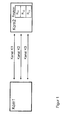
- FIG. 1 shows an example of the communication between two communication devices Kom1 and Kom2 to explain the system and the method. A system will actually have more communication devices, but these are not shown here for the sake of clarity.
- the device Kom2 has a register in which the qualities of the 3 possible channels K1, K2, K3 are stored, which can be used for the communication between Kom1 and Kom2.
- a register in device Kom1 is not shown, but may be present.
- the FIG. 2 shows progressively the implementation of the procedure and the development of the register status.
- the channel K1 is selected for the communication in step 3 and communicated in the synchronization telegram to the other communication device. Determining the quality then shows that this used channel K1 has only an actual quality of 2, so that the register value is reset to this number.
- step 4 channel K2 is then selected again after the previous incrementation, and so on.
- channel K3 obtains the highest register level and is selected.
- the channel K2 is objectively the one with the best quality over the period of the 10 steps, it is avoided by the increment that only this channel K2 is preferred and at least at intervals, the other channels are checked, as they reach by the increment a register level, which leads to a selection.
Landscapes
- Engineering & Computer Science (AREA)
- Computer Networks & Wireless Communication (AREA)
- Signal Processing (AREA)
- Mobile Radio Communication Systems (AREA)
- Synchronisation In Digital Transmission Systems (AREA)
Priority Applications (1)
| Application Number | Priority Date | Filing Date | Title |
|---|---|---|---|
| PL08008221T PL2020785T3 (pl) | 2007-08-03 | 2008-04-30 | Sposób oraz system do dwukierunkowej komunikacji radiowej |
Applications Claiming Priority (1)
| Application Number | Priority Date | Filing Date | Title |
|---|---|---|---|
| DE102007036751A DE102007036751A1 (de) | 2007-08-03 | 2007-08-03 | Verfahren und System zur bidirektionalen Funkkommunikation |
Publications (3)
| Publication Number | Publication Date |
|---|---|
| EP2020785A2 true EP2020785A2 (fr) | 2009-02-04 |
| EP2020785A3 EP2020785A3 (fr) | 2016-04-27 |
| EP2020785B1 EP2020785B1 (fr) | 2018-10-31 |
Family
ID=40032753
Family Applications (1)
| Application Number | Title | Priority Date | Filing Date |
|---|---|---|---|
| EP08008221.7A Active EP2020785B1 (fr) | 2007-08-03 | 2008-04-30 | Procédé et système de communication radio bidirectionnelle |
Country Status (4)
| Country | Link |
|---|---|
| EP (1) | EP2020785B1 (fr) |
| DE (1) | DE102007036751A1 (fr) |
| DK (1) | DK2020785T3 (fr) |
| PL (1) | PL2020785T3 (fr) |
Cited By (1)
| Publication number | Priority date | Publication date | Assignee | Title |
|---|---|---|---|---|
| EP2437226A3 (fr) * | 2010-10-01 | 2014-05-21 | Matthias Dietsch | Système d'alarme de détecteur de fumée et procédé de fonctionnement d'un système d'alarme de détecteur de fumée |
Family Cites Families (8)
| Publication number | Priority date | Publication date | Assignee | Title |
|---|---|---|---|---|
| US4337212A (en) * | 1980-04-29 | 1982-06-29 | International Flavors & Fragrances Inc. | Substituted tricyclodecane derivatives, processes for producing same and organoleptic uses thereof |
| DE3415032C2 (de) * | 1983-04-27 | 1985-06-20 | Siemens AG, 1000 Berlin und 8000 München | Verfahren zur störresistenten Funkübertragung |
| DE59810391D1 (de) * | 1997-09-30 | 2004-01-22 | Siemens Ag | Verfahren zur Funkübertragung in einem Gefahrenmeldesystem |
| US6624750B1 (en) * | 1998-10-06 | 2003-09-23 | Interlogix, Inc. | Wireless home fire and security alarm system |
| DE10138229B4 (de) * | 2001-08-03 | 2009-10-01 | Siemens Gebäudesicherheit GmbH & Co. oHG | Verfahren zur Funkübertragung in einem Gefahrenmeldesystem |
| DE10238692B4 (de) * | 2002-08-20 | 2007-11-15 | Ziegler, Horst, Prof. Dr. | Verfahren zum unidirektionalen Übertragen von Meßdaten |
| US8155105B2 (en) * | 2005-09-22 | 2012-04-10 | Rsi Video Technologies, Inc. | Spread spectrum wireless communication and monitoring arrangement and method |
| US7426190B2 (en) * | 2005-09-30 | 2008-09-16 | Robert Bosch Gmbh | System and method for a communication protocol for wireless sensor systems including systems with high priority asynchronous message and low priority synchronous message |
-
2007
- 2007-08-03 DE DE102007036751A patent/DE102007036751A1/de not_active Withdrawn
-
2008
- 2008-04-30 EP EP08008221.7A patent/EP2020785B1/fr active Active
- 2008-04-30 DK DK08008221.7T patent/DK2020785T3/da active
- 2008-04-30 PL PL08008221T patent/PL2020785T3/pl unknown
Cited By (1)
| Publication number | Priority date | Publication date | Assignee | Title |
|---|---|---|---|---|
| EP2437226A3 (fr) * | 2010-10-01 | 2014-05-21 | Matthias Dietsch | Système d'alarme de détecteur de fumée et procédé de fonctionnement d'un système d'alarme de détecteur de fumée |
Also Published As
| Publication number | Publication date |
|---|---|
| EP2020785B1 (fr) | 2018-10-31 |
| EP2020785A3 (fr) | 2016-04-27 |
| DE102007036751A1 (de) | 2009-02-05 |
| DK2020785T3 (da) | 2019-02-25 |
| PL2020785T3 (pl) | 2019-05-31 |
Similar Documents
| Publication | Publication Date | Title |
|---|---|---|
| EP2149204B1 (fr) | Brosse à dents et procédé de transmission de données unidirectionnelle sans fil | |
| DE3685935T2 (de) | Kommunikationssystem zur uebertragung kleiner digitaler nachrichtenbloecke und grosser digitaler nachrichtenbloecke. | |
| EP3474563B1 (fr) | Procédé de transmission de données | |
| DE102009003724A1 (de) | Verfahren zur Optimierung von Netzwerkstrukturen in Funknetzwerken | |
| EP3178203A1 (fr) | Poste d'abonné pour système de bus et procédé de communication can à large bande | |
| EP2365711A1 (fr) | Réseau sans fil, notamment pour applications d'automatisation, en temps réel et/ou industrielles | |
| DE69733598T2 (de) | Verfahren und Einrichtung für Datenübertragung und -empfang mittels Übertragungspause zum Empfangs-Timing | |
| EP2020785B1 (fr) | Procédé et système de communication radio bidirectionnelle | |
| EP0996259A2 (fr) | Configuration automatique d'un terminal-pont pour la transmission de données entre plusieurs sous réseaux dans un réseau local | |
| WO2008034676A1 (fr) | Procédé de radiotransmission dans un système avertisseur de danger | |
| EP1924119B2 (fr) | Procédé destiné à l'échange de données sans fil | |
| DE19824471B4 (de) | Verfahren zur Übertragung von Daten | |
| EP3632048A1 (fr) | Procédé de transmission d'informations | |
| EP3107219A1 (fr) | Système et procédé pour la liaison redondante à un réseau d'ossature ainsi qu'un noeud de liaison montante pouvant ëtre inséré dans ce système | |
| EP2018743B1 (fr) | Transmission énergétiquement efficace de données dans un réseau radio | |
| DE102005036255B4 (de) | Datenübertragungssystem und Verfahren zum Betreiben eines Datenübertragungssystems | |
| EP4149017B1 (fr) | Procédé de transmission sans fil d'au moins un message d'un répéteur à un récepteur par l'intermédiaire d'un canal de transmission sans fil | |
| DE102009044757B4 (de) | Dienst-Übermittlungsverfahren und Dienst-Bereitstellungsvorrichtung | |
| DE102005051563A1 (de) | Verfahren zur Kommunikation mehrerer Sensorknoten in einem Sensornetzwerk | |
| EP2235837A2 (fr) | Procédé de transmission de jeux de données | |
| DE102015220422A1 (de) | System und Verfahren zur redundanten Anbindung an ein Backbone-Netzwerk sowie ein in diesem System einsetzbarer Uplink-Knoten | |
| WO2013097962A1 (fr) | Système de communication avec gestion de l'accès à un moyen de communication commun | |
| DE102018131560B4 (de) | Selbstorganisiertes Datensammlernetzwerk | |
| DE102010047946A1 (de) | Verfahren zur Konfiguration eines Netzwerks von Netzknoten sowie Verfahren und Vorrichtungsanordnung zur Übermittlung von Verbrauchsdaten dezentral angeordneter Datenerfassungsgeräte | |
| DE102015105873A1 (de) | Vorrichtung und Verfahren zur Übertragung von Verbrauchsdaten eines Verbraucherzählers in einem Funkkommunikationssystem |
Legal Events
| Date | Code | Title | Description |
|---|---|---|---|
| PUAI | Public reference made under article 153(3) epc to a published international application that has entered the european phase |
Free format text: ORIGINAL CODE: 0009012 |
|
| AK | Designated contracting states |
Kind code of ref document: A2 Designated state(s): AT BE BG CH CY CZ DE DK EE ES FI FR GB GR HR HU IE IS IT LI LT LU LV MC MT NL NO PL PT RO SE SI SK TR |
|
| AX | Request for extension of the european patent |
Extension state: AL BA MK RS |
|
| PUAL | Search report despatched |
Free format text: ORIGINAL CODE: 0009013 |
|
| AK | Designated contracting states |
Kind code of ref document: A3 Designated state(s): AT BE BG CH CY CZ DE DK EE ES FI FR GB GR HR HU IE IS IT LI LT LU LV MC MT NL NO PL PT RO SE SI SK TR |
|
| AX | Request for extension of the european patent |
Extension state: AL BA MK RS |
|
| RIC1 | Information provided on ipc code assigned before grant |
Ipc: H04W 84/18 20090101ALN20160321BHEP Ipc: H04W 72/08 20090101ALN20160321BHEP Ipc: H04W 74/04 20090101AFI20160321BHEP |
|
| STAA | Information on the status of an ep patent application or granted ep patent |
Free format text: STATUS: REQUEST FOR EXAMINATION WAS MADE |
|
| 17P | Request for examination filed |
Effective date: 20161027 |
|
| RBV | Designated contracting states (corrected) |
Designated state(s): AT BE BG CH CY CZ DE DK EE ES FI FR GB GR HR HU IE IS IT LI LT LU LV MC MT NL NO PL PT RO SE SI SK TR |
|
| RBV | Designated contracting states (corrected) |
Designated state(s): AT BE BG CH CY CZ DE DK EE ES FI FR GB GR HR HU IE IS IT LI LT LU LV MC MT NL NO PL PT RO SE SI SK TR |
|
| AKX | Designation fees paid |
Designated state(s): AT BE BG CH CY CZ DE DK EE ES FI FR GB GR HR HU IE IS IT LI LT LU LV MC MT NL NO PL PT RO SE SI SK TR |
|
| AXX | Extension fees paid |
Extension state: BA Extension state: AL Extension state: MK Extension state: RS |
|
| STAA | Information on the status of an ep patent application or granted ep patent |
Free format text: STATUS: EXAMINATION IS IN PROGRESS |
|
| 17Q | First examination report despatched |
Effective date: 20170704 |
|
| REG | Reference to a national code |
Ref country code: DE Ref legal event code: R079 Ref document number: 502008016421 Country of ref document: DE Free format text: PREVIOUS MAIN CLASS: H04L0012560000 Ipc: H04W0074040000 |
|
| GRAP | Despatch of communication of intention to grant a patent |
Free format text: ORIGINAL CODE: EPIDOSNIGR1 |
|
| STAA | Information on the status of an ep patent application or granted ep patent |
Free format text: STATUS: GRANT OF PATENT IS INTENDED |
|
| RIC1 | Information provided on ipc code assigned before grant |
Ipc: H04W 84/18 20090101ALN20180502BHEP Ipc: H04W 72/08 20090101ALN20180502BHEP Ipc: H04W 74/04 20090101AFI20180502BHEP |
|
| RIC1 | Information provided on ipc code assigned before grant |
Ipc: H04W 74/04 20090101AFI20180504BHEP Ipc: H04W 84/18 20090101ALN20180504BHEP Ipc: H04W 72/08 20090101ALN20180504BHEP |
|
| INTG | Intention to grant announced |
Effective date: 20180531 |
|
| RIN1 | Information on inventor provided before grant (corrected) |
Inventor name: NIEDERFELD, GERHARD, DIPL.-ING. Inventor name: BLEY, BERT, DIPL.-ING. |
|
| RAP1 | Party data changed (applicant data changed or rights of an application transferred) |
Owner name: ISTA INTERNATIONAL GMBH |
|
| GRAS | Grant fee paid |
Free format text: ORIGINAL CODE: EPIDOSNIGR3 |
|
| GRAA | (expected) grant |
Free format text: ORIGINAL CODE: 0009210 |
|
| STAA | Information on the status of an ep patent application or granted ep patent |
Free format text: STATUS: THE PATENT HAS BEEN GRANTED |
|
| AK | Designated contracting states |
Kind code of ref document: B1 Designated state(s): AT BE BG CH CY CZ DE DK EE ES FI FR GB GR HR HU IE IS IT LI LT LU LV MC MT NL NO PL PT RO SE SI SK TR |
|
| REG | Reference to a national code |
Ref country code: CH Ref legal event code: EP Ref country code: GB Ref legal event code: FG4D Free format text: NOT ENGLISH |
|
| REG | Reference to a national code |
Ref country code: AT Ref legal event code: REF Ref document number: 1060938 Country of ref document: AT Kind code of ref document: T Effective date: 20181115 |
|
| REG | Reference to a national code |
Ref country code: DE Ref legal event code: R096 Ref document number: 502008016421 Country of ref document: DE |
|
| REG | Reference to a national code |
Ref country code: IE Ref legal event code: FG4D Free format text: LANGUAGE OF EP DOCUMENT: GERMAN |
|
| REG | Reference to a national code |
Ref country code: DK Ref legal event code: T3 Effective date: 20190219 |
|
| REG | Reference to a national code |
Ref country code: NL Ref legal event code: FP |
|
| REG | Reference to a national code |
Ref country code: LT Ref legal event code: MG4D |
|
| PG25 | Lapsed in a contracting state [announced via postgrant information from national office to epo] |
Ref country code: IS Free format text: LAPSE BECAUSE OF FAILURE TO SUBMIT A TRANSLATION OF THE DESCRIPTION OR TO PAY THE FEE WITHIN THE PRESCRIBED TIME-LIMIT Effective date: 20190228 Ref country code: LV Free format text: LAPSE BECAUSE OF FAILURE TO SUBMIT A TRANSLATION OF THE DESCRIPTION OR TO PAY THE FEE WITHIN THE PRESCRIBED TIME-LIMIT Effective date: 20181031 Ref country code: ES Free format text: LAPSE BECAUSE OF FAILURE TO SUBMIT A TRANSLATION OF THE DESCRIPTION OR TO PAY THE FEE WITHIN THE PRESCRIBED TIME-LIMIT Effective date: 20181031 Ref country code: NO Free format text: LAPSE BECAUSE OF FAILURE TO SUBMIT A TRANSLATION OF THE DESCRIPTION OR TO PAY THE FEE WITHIN THE PRESCRIBED TIME-LIMIT Effective date: 20190131 Ref country code: FI Free format text: LAPSE BECAUSE OF FAILURE TO SUBMIT A TRANSLATION OF THE DESCRIPTION OR TO PAY THE FEE WITHIN THE PRESCRIBED TIME-LIMIT Effective date: 20181031 Ref country code: LT Free format text: LAPSE BECAUSE OF FAILURE TO SUBMIT A TRANSLATION OF THE DESCRIPTION OR TO PAY THE FEE WITHIN THE PRESCRIBED TIME-LIMIT Effective date: 20181031 Ref country code: BG Free format text: LAPSE BECAUSE OF FAILURE TO SUBMIT A TRANSLATION OF THE DESCRIPTION OR TO PAY THE FEE WITHIN THE PRESCRIBED TIME-LIMIT Effective date: 20190131 Ref country code: HR Free format text: LAPSE BECAUSE OF FAILURE TO SUBMIT A TRANSLATION OF THE DESCRIPTION OR TO PAY THE FEE WITHIN THE PRESCRIBED TIME-LIMIT Effective date: 20181031 |
|
| PG25 | Lapsed in a contracting state [announced via postgrant information from national office to epo] |
Ref country code: GR Free format text: LAPSE BECAUSE OF FAILURE TO SUBMIT A TRANSLATION OF THE DESCRIPTION OR TO PAY THE FEE WITHIN THE PRESCRIBED TIME-LIMIT Effective date: 20190201 Ref country code: SE Free format text: LAPSE BECAUSE OF FAILURE TO SUBMIT A TRANSLATION OF THE DESCRIPTION OR TO PAY THE FEE WITHIN THE PRESCRIBED TIME-LIMIT Effective date: 20181031 Ref country code: PT Free format text: LAPSE BECAUSE OF FAILURE TO SUBMIT A TRANSLATION OF THE DESCRIPTION OR TO PAY THE FEE WITHIN THE PRESCRIBED TIME-LIMIT Effective date: 20190301 |
|
| PG25 | Lapsed in a contracting state [announced via postgrant information from national office to epo] |
Ref country code: IT Free format text: LAPSE BECAUSE OF FAILURE TO SUBMIT A TRANSLATION OF THE DESCRIPTION OR TO PAY THE FEE WITHIN THE PRESCRIBED TIME-LIMIT Effective date: 20181031 Ref country code: CZ Free format text: LAPSE BECAUSE OF FAILURE TO SUBMIT A TRANSLATION OF THE DESCRIPTION OR TO PAY THE FEE WITHIN THE PRESCRIBED TIME-LIMIT Effective date: 20181031 |
|
| REG | Reference to a national code |
Ref country code: DE Ref legal event code: R097 Ref document number: 502008016421 Country of ref document: DE |
|
| PG25 | Lapsed in a contracting state [announced via postgrant information from national office to epo] |
Ref country code: RO Free format text: LAPSE BECAUSE OF FAILURE TO SUBMIT A TRANSLATION OF THE DESCRIPTION OR TO PAY THE FEE WITHIN THE PRESCRIBED TIME-LIMIT Effective date: 20181031 Ref country code: EE Free format text: LAPSE BECAUSE OF FAILURE TO SUBMIT A TRANSLATION OF THE DESCRIPTION OR TO PAY THE FEE WITHIN THE PRESCRIBED TIME-LIMIT Effective date: 20181031 Ref country code: SK Free format text: LAPSE BECAUSE OF FAILURE TO SUBMIT A TRANSLATION OF THE DESCRIPTION OR TO PAY THE FEE WITHIN THE PRESCRIBED TIME-LIMIT Effective date: 20181031 |
|
| PLBE | No opposition filed within time limit |
Free format text: ORIGINAL CODE: 0009261 |
|
| STAA | Information on the status of an ep patent application or granted ep patent |
Free format text: STATUS: NO OPPOSITION FILED WITHIN TIME LIMIT |
|
| 26N | No opposition filed |
Effective date: 20190801 |
|
| PG25 | Lapsed in a contracting state [announced via postgrant information from national office to epo] |
Ref country code: SI Free format text: LAPSE BECAUSE OF FAILURE TO SUBMIT A TRANSLATION OF THE DESCRIPTION OR TO PAY THE FEE WITHIN THE PRESCRIBED TIME-LIMIT Effective date: 20181031 |
|
| REG | Reference to a national code |
Ref country code: CH Ref legal event code: PL |
|
| REG | Reference to a national code |
Ref country code: BE Ref legal event code: MM Effective date: 20190430 |
|
| GBPC | Gb: european patent ceased through non-payment of renewal fee |
Effective date: 20190430 |
|
| PG25 | Lapsed in a contracting state [announced via postgrant information from national office to epo] |
Ref country code: LU Free format text: LAPSE BECAUSE OF NON-PAYMENT OF DUE FEES Effective date: 20190430 Ref country code: MC Free format text: LAPSE BECAUSE OF FAILURE TO SUBMIT A TRANSLATION OF THE DESCRIPTION OR TO PAY THE FEE WITHIN THE PRESCRIBED TIME-LIMIT Effective date: 20181031 |
|
| PG25 | Lapsed in a contracting state [announced via postgrant information from national office to epo] |
Ref country code: GB Free format text: LAPSE BECAUSE OF NON-PAYMENT OF DUE FEES Effective date: 20190430 Ref country code: LI Free format text: LAPSE BECAUSE OF NON-PAYMENT OF DUE FEES Effective date: 20190430 Ref country code: CH Free format text: LAPSE BECAUSE OF NON-PAYMENT OF DUE FEES Effective date: 20190430 |
|
| PG25 | Lapsed in a contracting state [announced via postgrant information from national office to epo] |
Ref country code: BE Free format text: LAPSE BECAUSE OF NON-PAYMENT OF DUE FEES Effective date: 20190430 |
|
| PG25 | Lapsed in a contracting state [announced via postgrant information from national office to epo] |
Ref country code: TR Free format text: LAPSE BECAUSE OF FAILURE TO SUBMIT A TRANSLATION OF THE DESCRIPTION OR TO PAY THE FEE WITHIN THE PRESCRIBED TIME-LIMIT Effective date: 20181031 |
|
| PG25 | Lapsed in a contracting state [announced via postgrant information from national office to epo] |
Ref country code: IE Free format text: LAPSE BECAUSE OF NON-PAYMENT OF DUE FEES Effective date: 20190430 |
|
| PG25 | Lapsed in a contracting state [announced via postgrant information from national office to epo] |
Ref country code: CY Free format text: LAPSE BECAUSE OF FAILURE TO SUBMIT A TRANSLATION OF THE DESCRIPTION OR TO PAY THE FEE WITHIN THE PRESCRIBED TIME-LIMIT Effective date: 20181031 |
|
| PG25 | Lapsed in a contracting state [announced via postgrant information from national office to epo] |
Ref country code: HU Free format text: LAPSE BECAUSE OF FAILURE TO SUBMIT A TRANSLATION OF THE DESCRIPTION OR TO PAY THE FEE WITHIN THE PRESCRIBED TIME-LIMIT; INVALID AB INITIO Effective date: 20080430 Ref country code: MT Free format text: LAPSE BECAUSE OF FAILURE TO SUBMIT A TRANSLATION OF THE DESCRIPTION OR TO PAY THE FEE WITHIN THE PRESCRIBED TIME-LIMIT Effective date: 20181031 |
|
| PGFP | Annual fee paid to national office [announced via postgrant information from national office to epo] |
Ref country code: NL Payment date: 20250422 Year of fee payment: 18 |
|
| PGFP | Annual fee paid to national office [announced via postgrant information from national office to epo] |
Ref country code: DE Payment date: 20250417 Year of fee payment: 18 Ref country code: PL Payment date: 20250418 Year of fee payment: 18 |
|
| PGFP | Annual fee paid to national office [announced via postgrant information from national office to epo] |
Ref country code: DK Payment date: 20250423 Year of fee payment: 18 |
|
| PGFP | Annual fee paid to national office [announced via postgrant information from national office to epo] |
Ref country code: FR Payment date: 20250422 Year of fee payment: 18 |
|
| PGFP | Annual fee paid to national office [announced via postgrant information from national office to epo] |
Ref country code: AT Payment date: 20250416 Year of fee payment: 18 |