EP2022802B1 - Nanopartikel aus geringfügig oxidierter Cellulose - Google Patents
Nanopartikel aus geringfügig oxidierter Cellulose Download PDFInfo
- Publication number
- EP2022802B1 EP2022802B1 EP07015803.5A EP07015803A EP2022802B1 EP 2022802 B1 EP2022802 B1 EP 2022802B1 EP 07015803 A EP07015803 A EP 07015803A EP 2022802 B1 EP2022802 B1 EP 2022802B1
- Authority
- EP
- European Patent Office
- Prior art keywords
- slightly oxidized
- oxidized cellulose
- cellulose
- process according
- dispersion
- Prior art date
- Legal status (The legal status is an assumption and is not a legal conclusion. Google has not performed a legal analysis and makes no representation as to the accuracy of the status listed.)
- Not-in-force
Links
- 229920002678 cellulose Polymers 0.000 title claims description 35
- 239000001913 cellulose Substances 0.000 title claims description 34
- 239000002105 nanoparticle Substances 0.000 title description 4
- 235000010980 cellulose Nutrition 0.000 claims description 34
- 229920002201 Oxidized cellulose Polymers 0.000 claims description 32
- 238000000034 method Methods 0.000 claims description 27
- 229940107304 oxidized cellulose Drugs 0.000 claims description 27
- 239000002245 particle Substances 0.000 claims description 27
- 239000006185 dispersion Substances 0.000 claims description 18
- 230000003647 oxidation Effects 0.000 claims description 16
- 238000007254 oxidation reaction Methods 0.000 claims description 16
- 238000002356 laser light scattering Methods 0.000 claims description 12
- 125000003178 carboxy group Chemical group [H]OC(*)=O 0.000 claims description 10
- NBIIXXVUZAFLBC-UHFFFAOYSA-N Phosphoric acid Chemical compound OP(O)(O)=O NBIIXXVUZAFLBC-UHFFFAOYSA-N 0.000 claims description 8
- LPXPTNMVRIOKMN-UHFFFAOYSA-M sodium nitrite Chemical compound [Na+].[O-]N=O LPXPTNMVRIOKMN-UHFFFAOYSA-M 0.000 claims description 8
- 239000005708 Sodium hypochlorite Substances 0.000 claims description 6
- SUKJFIGYRHOWBL-UHFFFAOYSA-N sodium hypochlorite Chemical compound [Na+].Cl[O-] SUKJFIGYRHOWBL-UHFFFAOYSA-N 0.000 claims description 6
- -1 paper-grade pulp Polymers 0.000 claims description 5
- 238000006116 polymerization reaction Methods 0.000 claims description 5
- 229920001131 Pulp (paper) Polymers 0.000 claims description 4
- 229910000147 aluminium phosphate Inorganic materials 0.000 claims description 4
- 125000002915 carbonyl group Chemical group [*:2]C([*:1])=O 0.000 claims description 4
- KHIWWQKSHDUIBK-UHFFFAOYSA-N periodic acid Chemical compound OI(=O)(=O)=O KHIWWQKSHDUIBK-UHFFFAOYSA-N 0.000 claims description 4
- 235000010288 sodium nitrite Nutrition 0.000 claims description 4
- 239000007787 solid Substances 0.000 claims description 4
- 229920000168 Microcrystalline cellulose Polymers 0.000 claims description 3
- 230000002378 acidificating effect Effects 0.000 claims description 3
- 235000014113 dietary fatty acids Nutrition 0.000 claims description 3
- 239000002270 dispersing agent Substances 0.000 claims description 3
- 239000000194 fatty acid Substances 0.000 claims description 3
- 229930195729 fatty acid Natural products 0.000 claims description 3
- 235000019813 microcrystalline cellulose Nutrition 0.000 claims description 3
- 239000008108 microcrystalline cellulose Substances 0.000 claims description 3
- 229940016286 microcrystalline cellulose Drugs 0.000 claims description 3
- 238000004519 manufacturing process Methods 0.000 description 6
- 238000005259 measurement Methods 0.000 description 6
- XLYOFNOQVPJJNP-UHFFFAOYSA-N water Substances O XLYOFNOQVPJJNP-UHFFFAOYSA-N 0.000 description 5
- 230000015556 catabolic process Effects 0.000 description 4
- 239000003995 emulsifying agent Substances 0.000 description 4
- GDOPTJXRTPNYNR-UHFFFAOYSA-N methyl-cyclopentane Natural products CC1CCCC1 GDOPTJXRTPNYNR-UHFFFAOYSA-N 0.000 description 4
- 239000000725 suspension Substances 0.000 description 4
- HEMHJVSKTPXQMS-UHFFFAOYSA-M Sodium hydroxide Chemical compound [OH-].[Na+] HEMHJVSKTPXQMS-UHFFFAOYSA-M 0.000 description 3
- 238000006731 degradation reaction Methods 0.000 description 3
- 229920002521 macromolecule Polymers 0.000 description 3
- 239000000463 material Substances 0.000 description 3
- 239000002609 medium Substances 0.000 description 3
- 239000000126 substance Substances 0.000 description 3
- 238000005903 acid hydrolysis reaction Methods 0.000 description 2
- 238000006243 chemical reaction Methods 0.000 description 2
- 238000005516 engineering process Methods 0.000 description 2
- 230000007613 environmental effect Effects 0.000 description 2
- 239000000835 fiber Substances 0.000 description 2
- 239000000499 gel Substances 0.000 description 2
- 125000002887 hydroxy group Chemical group [H]O* 0.000 description 2
- 230000003993 interaction Effects 0.000 description 2
- 238000010525 oxidative degradation reaction Methods 0.000 description 2
- JHJLBTNAGRQEKS-UHFFFAOYSA-M sodium bromide Chemical compound [Na+].[Br-] JHJLBTNAGRQEKS-UHFFFAOYSA-M 0.000 description 2
- KZBUYRJDOAKODT-UHFFFAOYSA-N Chlorine Chemical compound ClCl KZBUYRJDOAKODT-UHFFFAOYSA-N 0.000 description 1
- 238000003917 TEM image Methods 0.000 description 1
- 238000005054 agglomeration Methods 0.000 description 1
- 230000002776 aggregation Effects 0.000 description 1
- 125000003172 aldehyde group Chemical group 0.000 description 1
- 238000013459 approach Methods 0.000 description 1
- 239000012736 aqueous medium Substances 0.000 description 1
- 229920001222 biopolymer Polymers 0.000 description 1
- 230000015572 biosynthetic process Effects 0.000 description 1
- 239000000969 carrier Substances 0.000 description 1
- 238000006555 catalytic reaction Methods 0.000 description 1
- 238000001311 chemical methods and process Methods 0.000 description 1
- 239000003795 chemical substances by application Substances 0.000 description 1
- BXZCTOIDCRWONQ-UHFFFAOYSA-N copper;ethane-1,2-diamine Chemical compound [Cu+2].NCCN BXZCTOIDCRWONQ-UHFFFAOYSA-N 0.000 description 1
- 239000002537 cosmetic Substances 0.000 description 1
- 230000001419 dependent effect Effects 0.000 description 1
- 238000011161 development Methods 0.000 description 1
- 238000009792 diffusion process Methods 0.000 description 1
- 230000029087 digestion Effects 0.000 description 1
- 238000009826 distribution Methods 0.000 description 1
- 230000000694 effects Effects 0.000 description 1
- 230000001804 emulsifying effect Effects 0.000 description 1
- 238000005265 energy consumption Methods 0.000 description 1
- 239000010408 film Substances 0.000 description 1
- 230000009969 flowable effect Effects 0.000 description 1
- 125000002791 glucosyl group Chemical group C1([C@H](O)[C@@H](O)[C@H](O)[C@H](O1)CO)* 0.000 description 1
- 238000000265 homogenisation Methods 0.000 description 1
- 230000002427 irreversible effect Effects 0.000 description 1
- TWNIBLMWSKIRAT-VFUOTHLCSA-N levoglucosan Chemical group O[C@@H]1[C@@H](O)[C@H](O)[C@H]2CO[C@@H]1O2 TWNIBLMWSKIRAT-VFUOTHLCSA-N 0.000 description 1
- 238000010297 mechanical methods and process Methods 0.000 description 1
- 230000001404 mediated effect Effects 0.000 description 1
- 210000001724 microfibril Anatomy 0.000 description 1
- 239000000203 mixture Substances 0.000 description 1
- 238000009896 oxidative bleaching Methods 0.000 description 1
- 230000001590 oxidative effect Effects 0.000 description 1
- 239000000825 pharmaceutical preparation Substances 0.000 description 1
- 229920000642 polymer Polymers 0.000 description 1
- 238000002360 preparation method Methods 0.000 description 1
- 238000011160 research Methods 0.000 description 1
- 238000003385 ring cleavage reaction Methods 0.000 description 1
- 238000004062 sedimentation Methods 0.000 description 1
- 239000002904 solvent Substances 0.000 description 1
- 230000006641 stabilisation Effects 0.000 description 1
- 238000011105 stabilization Methods 0.000 description 1
- 239000003381 stabilizer Substances 0.000 description 1
- 230000000087 stabilizing effect Effects 0.000 description 1
- 238000003756 stirring Methods 0.000 description 1
- 238000009210 therapy by ultrasound Methods 0.000 description 1
- 238000001132 ultrasonic dispersion Methods 0.000 description 1
- 235000013311 vegetables Nutrition 0.000 description 1
Images


Classifications
-
- C—CHEMISTRY; METALLURGY
- C08—ORGANIC MACROMOLECULAR COMPOUNDS; THEIR PREPARATION OR CHEMICAL WORKING-UP; COMPOSITIONS BASED THEREON
- C08J—WORKING-UP; GENERAL PROCESSES OF COMPOUNDING; AFTER-TREATMENT NOT COVERED BY SUBCLASSES C08B, C08C, C08F, C08G or C08H
- C08J3/00—Processes of treating or compounding macromolecular substances
- C08J3/02—Making solutions, dispersions, lattices or gels by other methods than by solution, emulsion or suspension polymerisation techniques
- C08J3/03—Making solutions, dispersions, lattices or gels by other methods than by solution, emulsion or suspension polymerisation techniques in aqueous media
- C08J3/05—Making solutions, dispersions, lattices or gels by other methods than by solution, emulsion or suspension polymerisation techniques in aqueous media from solid polymers
-
- C—CHEMISTRY; METALLURGY
- C08—ORGANIC MACROMOLECULAR COMPOUNDS; THEIR PREPARATION OR CHEMICAL WORKING-UP; COMPOSITIONS BASED THEREON
- C08J—WORKING-UP; GENERAL PROCESSES OF COMPOUNDING; AFTER-TREATMENT NOT COVERED BY SUBCLASSES C08B, C08C, C08F, C08G or C08H
- C08J2301/00—Characterised by the use of cellulose, modified cellulose or cellulose derivatives
- C08J2301/04—Oxycellulose; Hydrocellulose
-
- Y—GENERAL TAGGING OF NEW TECHNOLOGICAL DEVELOPMENTS; GENERAL TAGGING OF CROSS-SECTIONAL TECHNOLOGIES SPANNING OVER SEVERAL SECTIONS OF THE IPC; TECHNICAL SUBJECTS COVERED BY FORMER USPC CROSS-REFERENCE ART COLLECTIONS [XRACs] AND DIGESTS
- Y10—TECHNICAL SUBJECTS COVERED BY FORMER USPC
- Y10T—TECHNICAL SUBJECTS COVERED BY FORMER US CLASSIFICATION
- Y10T428/00—Stock material or miscellaneous articles
- Y10T428/29—Coated or structually defined flake, particle, cell, strand, strand portion, rod, filament, macroscopic fiber or mass thereof
- Y10T428/2982—Particulate matter [e.g., sphere, flake, etc.]
Definitions
- the present invention relates to novel nanoscale cellulose particles and a process for their preparation and use.
- Nanotechnology along with information and biotechnology, is considered to be the great technological development of our time. More generally, nanotechnology deals with the structure, properties, and effects of structures in the hundreds of nanometers (nm) and below. Applications arise almost in all areas of daily life, such as: B. in energy and environmental technology, in information technology and in the pharmaceutical and medical fields.
- Cellulose is the most abundant biopolymer on earth, making it the most important renewable resource in the world.
- cellulose As the main component of the vegetable builder substance, cellulose has excellent molecular properties. Even in the native state, ordered regions (crystallites) with the typical dimensions of nanoparticles (3-10 nm wide and up to 100 nm long) are present. However, these areas are connected by noncrystalline macromolecules as well as by secondary valence bonds (H-bridges).
- CN 1470552 the production of cellulose particles in the order of 50 to 200 nm is known, wherein the cellulose is first dissolved in a suitable solvent and then dispersed by intensive stirring in a sedimentation solution. To stabilize the resulting particles, the addition of external emulsifiers such as fatty acid salts or alkylbenzenesulfonates is necessary. Only extremely dilute dispersions having a cellulose content below 0.5% by weight are obtainable by this process.
- To CN 1749278 A can be obtained starting from plant fibers after alkaline digestion, oxidative bleaching and degradation with sodium hydroxide solution and chlorine gas, followed by intensive ultrasound treatment, a gel containing spherical cellulose particles in a size of 10 - 20 nm. Significant polymer chain degradation is expected by this method. The extent of this chain degradation and the nature and extent of any oxidation of the cellulose are not determined by this method.
- Oxidized cellulose with varying degrees of oxidation are of Montanari et al. (Macromolecules 38 (2005) 1665 ) used for the production of carboxylated cellulose microfibrils.
- the oxidation is usually carried out by reaction with sodium hypochlorite, sodium bromide and 2,2,6,6-tetramethyl-1-piperidinyloxy radical (TEMPO) largely at C6 position of the anhydroglucose unit (AGU).
- TEMPO 2,2,6,6-tetramethyl-1-piperidinyloxy radical
- AGU anhydroglucose unit
- the oxidized celluloses are treated by acidic hydrolysis and then mechanically dispersed. As a result, stable suspensions are obtained.
- the TEM images show that in all samples, the fibrillar structure of the cellulose is still to be detected, with the fibril lengths well above 200 nm.
- oxidized celluloses include oxidation with periodate (oxidation predominantly in the 2,3-position of the AGU), with phosphoric acid and sodium nitrite (oxidation predominantly in the 6-position of the AGU) ( Klemm, Philipp, T. Heinze, U. Heinze, Wagenknecht in "Comprehensive Cellulose Chemistry", Wiley-VCH Weinheim 1998, Vol. 2, pp. 304-309 ).
- US 5780618 discloses a method for producing oxidized cellulose products from a cellulosic material.
- the oxidized cellulose products can be used to form films, dispersions, gels or as carriers for pharmaceutical, cosmetic or other products.
- the object of the present invention was therefore to provide novel, primarily particle-dispersible nanoparticles based on cellulose, which can be prepared by a comparatively technically easy to implement process without the additional process step of acidolytic degradation of cellulose and particle formation are not necessarily dependent on external emulsifiers.
- the invention therefore relates to particles of slightly oxidized cellulose having volume-averaged particle sizes (D50 value) of less than 300 nm, preferably less than 200 nm, particularly preferably less than 100 nm, measured by means of dynamic laser light scattering measurement.
- D50 value volume-averaged particle sizes
- the D90 value, and preferably also the D95 value, of the amorphous cellulose particles is less than 300 nm, preferably less than 200 nm, particularly preferably less than 100 nm, the particles preferably being agglomerate-free, d. H. primary particulate disperse, present.
- step a) The provision of the slightly oxidized, non-nanoscale cellulose suitable in the sense of step a) can start from all commercial pulps (eg chemical and paper pulp), microcrystalline cellulose or linter cellulose.
- commercial pulps eg chemical and paper pulp
- microcrystalline cellulose e.g., microcrystalline cellulose or linter cellulose.
- non-nanoscale cellulose is meant cellulose which has a volume-average particle size (D50 value) of at least 300 nm, preferably at least 200 nm, particularly preferably at least 100 nm, determined by means of dynamic laser light scattering measurement.
- D50 value volume-average particle size
- the required minor oxidation is carried out by literature methods, by oxidation by means of periodate, phosphoric acid / sodium nitrite, or sodium hypochlorite under TEMPO catalysis, with TEMPO-catalyzed Sodium hypochlorite oxidation is preferred.
- oxidation by means of periodate an oxidizing ring cleavage between the C2 and the C3 position of the glucose units takes place with priority, in each case two OH groups being oxidized to form two aldehyde groups.
- oxidation by phosphoric acid / sodium nitrite or by TEMPO-catalyzed sodium hypochlorite leads primarily to the oxidation of the primary OH group at the C6 position to a carboxyl group.
- the slightly oxidized celluloses typically have average polymerisation degrees (DP) of from 100 to 3000, preferably from 200 to 2500, more preferably from 250 to 2000, most preferably from 300 to 1500.
- DP polymerisation degrees
- the content of carboxyl or carbonyl groups in the slightly oxidized cellulose used in step a) is in the range 200 to 1500 mmol / kg, preferably in the range 300 to 1200 mmol / kg, particularly preferably 400 to 900 mmol / kg.
- the medium for dispersing the particles water is preferably used.
- the pH of the non-strongly acidic aqueous medium is preferably in the range above 5, more preferably above 6, more preferably in the range of 6 to 10, and particularly preferably 6.5 to 8.
- the energy consumption for the dispersion is at least 2000 kWh / t, preferably at least 5000 kWh / t, more preferably at least 10000 kWh / t.
- step b all devices and techniques known to the person skilled in the art for this purpose are suitable for introducing energy in step b).
- Ultra-Turrax devices are dispersing devices for emulsifying, homogenizing and suspending flowable media.
- the effective frequency is adjustable and can be adapted to the substance or mixture to be processed.
- the principle of a microfluidizer can be described as follows.
- the material to be processed is passed under high pressure through an interaction chamber.
- the sample flows through one or two narrow channels and reaches linear speeds of up to 1000 m / s, depending on the device type. This creates enormous shear forces. There are no moving parts in the chamber, which ensures a narrow particle and droplet distribution.
- the energy input in stage b) can basically be carried out in one or more stages but also continuously with variable energy input.
- the dispersion obtained in step b) has a solids concentration of slightly oxidized cellulose of preferably 0.1 to 10 wt .-%, particularly preferably 0.5 to 3.5 wt .-%, most preferably 0.75 to 2.5 Wt .-%, on.
- the dispersion taking place in step b), in particular by the introduction of energy, may reduce the degree of polymerization of the amorphous cellulose.
- a degree of polymerization of 5 to 50% is possible.
- the amorphous cellulose obtained in step b) may have an average degree of polymerization of 50 to 2900, preferably 100 to 2400.
- dispersants or emulsifiers to stabilize the Celluslosedispersion is not necessary by the method according to the invention.
- no dispersant or emulsifier preferably no fatty acid salt or alkylbenzenesulfonate, is added before, during or after the dispersing step b). Nevertheless, further stabilization can be achieved by adding such agents.
- step b is preferably carried out at temperatures of from 10 to 100.degree. C., more preferably from 20 to 80.degree.
- the oxidized celluloses used in the examples were prepared by reaction with sodium hypochlorite and TEMPO ( Montanari et al., Macromolecules 38 (2005) 1665 ).
- TEMPO Montanari et al., Macromolecules 38 (2005) 1665 .
- a high-speed stirrer was used according to the rotor-stator principle (Ultra Turrax T25 basic, IKA, rotational speed 20 000 min -1 ).
- a type 110F microfluidizer Microfluidics, Newton MA USA
- two series-connected interaction chambers H210Z 200 ⁇ m and JR20Z 50 ⁇ m
- the content of carboxyl groups was determined according to the TAPPI T 237 cm-98 standard (carboxyl content of pulp).
- the dynamic laser light scattering measurement was carried out with the device Horiba LB 550 (USA) with a measuring range of 1 nm to 6 ⁇ m.
- the diffusion rates of the suspended particles are measured via the Doppler shift in the frequency of the laser light scattered on them.
- the frequency shifts are detected as intensity fluctuations of the scattered light at a detector.
- Both the D50 values (50% of the particles are smaller than the specified dimension) and the D90 values (90% of the particles are smaller than the specified dimension) are determined.
- a 1 wt% (w / w) suspension of oxidized cellulose having a carboxyl group content of 600 mmol / kg and a DP Cu (copper (II) ethylenediamine solution) 858 in water was first treated with an Ultra-Turrax for 1 hour and then homogenized with a microfluidizer for 1 hour at 600 bar and a further 2 hours at 1100 bar.
- illustration 1 shows the dynamic laser light scattering of the nano-carboxy cellulose dispersion (1 wt .-%) prepared according to Example 1.
- the dynamic laser light scattering measurement of this sample shows a D50 value of 76 nm and a D90 value of 107 nm.
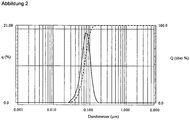
- Figure 2 shows the dynamic laser light scattering of the nano-carboxy cellulose dispersion (1 wt .-%) prepared according to Example 2.
- the dynamic laser light scattering measurement of this sample shows a D50 value of 72 nm and a D90 value of 100 nm.
- Figure 3 shows the dynamic laser light scattering of the nano-carboxy cellulose dispersion (1 wt .-%) prepared according to Example 3.
- the dynamic laser light scattering measurement of this sample shows a D50 value of 34 nm and a D90 value of 47 nm.
Landscapes
- Chemical & Material Sciences (AREA)
- Dispersion Chemistry (AREA)
- Health & Medical Sciences (AREA)
- Chemical Kinetics & Catalysis (AREA)
- Medicinal Chemistry (AREA)
- Polymers & Plastics (AREA)
- Organic Chemistry (AREA)
- Polysaccharides And Polysaccharide Derivatives (AREA)
- Processes Of Treating Macromolecular Substances (AREA)
Description
- Die vorliegende Erfindung betrifft neuartige nanoskalige Cellulosepartikel sowie ein Verfahren zu deren Herstellung und die Verwendung.
- Die Nanotechnologie wird neben der Informations- und Biotechnologie als die große technische Entwicklung unserer Gegenwart angesehen. Ganz allgemein befasst sich die Nanotechnologie mit dem Aufbau, den Eigenschaften und der Wirkung von Strukturen im Bereich von einigen hundert Nanometern (nm) und darunter. Anwendungen entstehen nahezu in allen Bereichen des täglichen Lebens, wie z. B. in der Energie- und Umwelttechnik, in der Informationstechnik sowie im pharmazeutischen und medizinischen Bereich.
- Cellulose ist das am häufigsten vorkommende Biopolymer auf der Erde und damit der global bedeutendste nachwachsende Rohstoff. Als Hauptbestandteil der pflanzlichen Gerüstsubstanz weist Cellulose hervorragende molekulare Eigenschaften auf. Bereits im nativen Zustand liegen geordnete Bereiche (Kristallite) mit den typischen Abmessungen von Nanopartikeln (3-10 nm breit und bis zu 100 nm lang) vor. Diese Bereiche sind allerdings verbunden durch nichtkristalline Makromoleküle sowie durch Nebenvalenzbindungen (H-Brücken).
- Zur Herstellung von cellulosebasierten Nanopartikeln, welche weitestgehend frei von Überstrukturen sind, sind verschiedene Ansätze bisher verfolgt worden. Allen ist die Überlegung gemein, einzelne Cellulosepartikel voneinander zu separieren und zu stabilisieren, um zu primärpartikulär vorliegende Teilchen zu gelangen, welche nicht durch harte irreversible Agglomeration miteinander verbunden sind.
- Üblicherweise werden dazu mechanische und/oder chemische Verfahrensschritte durchlaufen (De Souza Lima, Borsali, Macromol. Rapid Commun. 25 (2004) 771, Ono, Shimaya, Hongo, Yamane, Transactions of the Materials Research Society of Japan 26 (2001) 569, loelovich, Leykin, Cellulose Chem. Technol. 40 (2006) 313, Zhang, Elder, Pu, Ragauskas, Carbohydr. Polym. 69 (2007) 607,
US-A 2005 0239744 ,WO 2006/034837 A2 ,EP 1582551 A1 ,DE 3047351 C2 ). - Aus
CN 1470552 ist die Herstellung von Cellulosepartikeln in einer Größenordnung von 50 bis 200 nm bekannt, wobei die Cellulose zunächst in einem geeigneten Lösungsmittel gelöst und anschließend durch intensives Rühren in eine Sedimentationslösung dispergiert wird. Zur Stabilisierung der dabei sich bildenden Partikel ist der Zusatz von externen Emulgatoren wie Fettsäuresalzen oder Alkylbenzolsulfonaten notwendig. Nach diesem Verfahren sind nur extrem verdünnte Dispersionen mit einem Cellulosegehalt von unterhalb 0,5 Gew.-% erhältlich. - Nach
CN 1749278 A lässt sich ausgehend von Pflanzenfasern nach alkalischem Aufschluß, oxidativer Bleiche und Abbau mit Natronlauge und Chlorgas sowie anschließender intensiver Ultraschallbehandlung ein Gel erhalten, das sphärische Cellulosepartikel in einer Größe von 10 - 20 nm enthält. Nach diesem Verfahren ist ein erheblicher Polymerkettenabbau zu erwarten. Der Umfang dieses Kettenabbaus sowie Art und Umfang einer eventuellen Oxidation der Cellulose werden nach diesem Verfahren nicht bestimmt. - Oxidierte Cellulose mit unterschiedlich eingestelltem Oxidationsgrad werden von Montanari et al. (Macromolecules 38 (2005) 1665) zur Herstellung von carboxylierten Cellulose-Mikrofibrillen eingesetzt. Die Oxidation erfolgt in der Regel durch Umsetzung mit Natriumhypochlorit, Natriumbromid und 2,2,6,6-Tetramethyl-1-piperidinyloxyradikal (TEMPO) weitestgehend an C6-Position der Anhydroglucoseinheit (AGU). Die oxidierten Cellulosen werden säurehydrolytisch behandelt und anschließend mechanisch dispergiert. Im Ergebnis werden stabile Suspensionen erhalten. Die TEM-Aufnahmen zeigen, dass bei allen Proben noch die fibrilläre Struktur der Cellulose nachzuweisen ist, wobei die Fibrillenlängen deutlich über 200 nm liegen.
- Weitere Möglichkeiten zur Bereitstellung oxidierter Cellulosen bestehen u. a. in der Oxidation mit Periodat (Oxidation vorwiegend in 2,3-Position der AGU), mit Phosphorsäure und Natriumnitrit (Oxidation vorwiegend in 6-Position der AGU) (Klemm, Philipp, T. Heinze, U. Heinze, Wagenknecht in "Comprehensive Cellulose Chemistry", Wiley-VCH Weinheim 1998, Vol. 2, S. 304-309).
- Die Ergebnisse dieser Methoden sind jedoch hinsichtlich Feinteiligkeit und Verfahrensaufwand nicht befriedigend. Viele der in der Literatur beschriebenen Verfahren führen nämlich zu fibrillären Partikeln, die nur im Querschnitt nanoskalig sind und Faserlängen deutlich über 200 nm besitzen. Zur Herstellung nanopartikulärer Cellulose unter oxidativen Abbaubedingungen ist bisher nur ein Verfahren mit erheblichem Aufwand und hoher Umweltbelastung bekannt, nämlich das in
CN1749278 beschriebene Verfahren. Weiterhin ist der Zusatz externer, nicht kovalent mit den Partikeln verbundener Stabilisatoren unerwünscht, da sie ausgewaschen werden können oder in vielen Anwendungen, z. B. im Bereich pharmazeutischer Zubereitungen stören. -
US 5780618 offenbart eine Methode zur Herstellung von oxidierten Celluloseprodukten ausgehend von einem Cellulosematerial. Die oxidierten Celluloseprodukte können dazu genutzt werden um Filme, Dispersionen, Gele zu bilden oder als Träger für pharmazeutische, kosmetische oder andere Produkte. - Saito et all. (Cellulose 2005, 12:305-315) beschreibt TEMPO-vermittelte Oxidation von Cellulose.
- Aufgabe der vorliegenden Erfindung war es daher, neuartige primärpartikulär dispergierbare Nanopartikel auf Cellulose-Basis bereitzustellen, welche sich durch ein vergleichsweise technisch einfach zu realisierendes Verfahren ohne den zusätzlichen Verfahrensschritt des säurehydrolytischen Abbaus der Cellulose herstellen lassen und zur Partikelbildung nicht notwendigerweise auf externe Emulgatoren angewiesen sind.
- Es wurde nun gefunden, dass die zugrunde liegende Aufgabe durch Scher- oder Ultraschalldispergierung spezieller geringfügig oxidierter Cellulose gelöst werden kann.
- Gegenstand der Erfindung sind daher Partikel aus geringfügig oxidierter Cellulose mit volumengemittelten Partikelgrößen (D50-Wert) von weniger als 300 nm, bevorzugt weniger als 200 nm, besonders bevorzugt weniger als 100 nm, gemessen mittels dynamischer Laserlichtstreumessung.
- Ferner ist ein Gegenstand der vorliegenden Erfindung ein Verfahren zur Herstellung von Dispersionen enthaltend Partikel geringfügig oxidierter Cellulose mit volumengemittelten Partikelgrößen (D50-Wert) von weniger als 300 nm, bevorzugt weniger als 200 nm, besonders bevorzugt weniger als 100 nm, gemessen mittels dynamischer Laserlichtstreuung, bei dem
- a) geringfügig oxidierte, nicht nanoskalige Cellulosen in ein wäsariges, vorzugsweise nicht stark acides, Medium eingebracht und
- b) gleichzeitig oder anschließend durch Eintrag von Energie darin dispergiert werden.
- Der D90-Wert, und bevorzugt auch der D95-Wert, der amorphen Cellulosepartikel weniger als 300 nm, bevorzugt weniger als 200 nm, besonders bevorzugt weniger als 100 nm beträgt, wobei die Partikel dabei vorzugsweise agglomeratfrei, d. h. primärpartikulär dispers, vorliegen.
- Die Bereitstellung der im Sinne von Schritt a) geeigneten geringfügig oxidierten, nicht nanoskaligen Cellulose kann von allen kommerziellen Zellstoffen (z. B. Chemie- und Papierzellstoffe), mikrokristalliner Cellulose oder Linterscellulose ausgehen.
- Unter "nicht nanoskaliger Cellulose" wird dabei Cellulose verstanden, die eine volumengemittelte Partikelgröße (D50-Wert) von mindestens 300 nm, bevorzugt mindestens 200 nm, besonders bevorzugt mindestens 100 nm, bestimmt mittels dynamischer Laserlichtstreumessung aufweist.
- Die erforderliche geringfügige Oxidation erfolgt dabei durch literaturbekannte Verfahren, durch Oxidation mittels Periodat, Phosphorsäure/Natriumnitrit, oder Natriumhypochlorit unter TEMPO-Katalyse, wobei TEMPO-katalysierte Natriumhypochlorit-Oxidation bevorzugt ist. Bei der Oxidation mittels Periodat erfolgt vorrangig eine oxidierende Ringspaltung zwischen der C2- und der C3-Position der Glucoseeinheiten, wobei jeweils zwei OH-Gruppen zu zwei AldehydGruppen oxidiert werden. Hingegen führt die Oxidation durch Phosphorsäure/Natriumnitrit oder durch TEMPO-katalysiertes Natriumhypochlorit vorrangig zur Oxidation der primären OH-Gruppe an der C6-Position zu einer Carboxylgruppe.
- Die geringfügig oxidierten Cellulosen besitzen typischerweise Durchschnittspolymerisationsgrade (DP) von 100 bis 3000, bevorzugt von 200 bis 2500, bevorzugter 250 bis 2000, besonders bevorzugt von 300 bis 1500. Der Einsatz besonders kurzkettiger geringfügig oxidierter Cellulosen, z. B. durch vorhergehende Säurehydrolyse, ist nicht notwendig.
- Der Gehalt an Carboxyl- oder Carbonylgruppen in den in Schritt a) eingesetzten geringfügig oxidierten Cellulose liegt im Bereich 200 bis 1500 mmol/kg, bevorzugt im Bereich 300 bis 1200 mmol/kg, besonders bevorzugt 400 bis 900 mmol/kg.
- Als Medium zur Dispergierung der Partikel wird vorzugsweise Wasser verwendet. Der pH-Wert des nicht stark aciden wässrigen Mediums liegt vorzugsweise im Bereich oberhalb von 5, bevorzugter oberhalb von 6, weiter bevorzugter im Bereich von 6 bis 10, und besonders bevorzugt von 6,5 bis 8.
- Der Energieverbrauch für die Dispergierung beträgt mindestens 2000 kWh/t, bevorzugt mindestens 5000 kWh/t, besonders bevorzugt mindestens 10000 kWh/t.
- Zum Eintrag von Energie in Schritt b) eignen sich grundsätzlich sämtliche dem Fachmann bekannte Vorrichtungen und Techniken zu diesem Zweck. Bevorzugt ist der Einsatz von Ultraschallgeräten, Hochgeschwindigkeitsrührer, Dispergiereinrichtungen basierend auf dem Rotor-Stator-Prinzip (z.B. Ultra-Turrax-Geräte), Strahldispergatoren und Mikrofluidizer.
- Ultra-Turrax-Geräte sind Dispergiereinrichtungen zum Emulgieren, Homogenisieren und Suspendieren fließfähiger Medien. Die wirksame Frequenz ist einstellbar und kann dem zu bearbeitenden Stoff oder Stoffgemisch angepasst werden.
- Das Prinzip eines Mikrofluidizer lässt sich wie folgt beschreiben. Das zu verarbeitende Material wird unter hohem Druck durch eine Interaktionskammer geführt. Die Probe strömt durch eine oder zwei schmale Kanäle und erreicht lineare Geschwindigkeiten in Abhängigkeit vom Gerätetyp bis 1000 m/s. So entstehen enorme Scherkräfte. In der Kammer gibt es keine beweglichen Teile, wodurch eine enge Partikel- und Tröpfchenverteilung gewährleistet wird.
- Der Energieeintrag in Stufe b) kann grundsätzlich ein- oder mehrstufig aber auch kontinuierlich mit variablem Energieeintrag erfolgen.
- Die in Schritt b) erhaltene Dispersion weist eine Feststoffkonzentration an geringfügig oxidierter Cellulose von bevorzugt 0,1 bis 10 Gew.-%, besonders bevorzugt 0,5 bis 3,5 Gew.-%, ganz besonders bevorzugt 0,75 bis 2,5 Gew.-%, auf.
- Durch die in Schritt b) erfolgende Dispergierung, insbesondere durch den Energieeintrag, kann sich der Polymerisationsgrad der amorphen Cellulose verringern. Dabei ist ein Polymerisationsgradabbau von 5 bis 50% möglich. Infolgedessen kann die in Schritt b) erhaltene amorphe Cellulose einen durchschnittlichen Polymerisationsgrad von 50 bis 2900, bevorzugt 100 bis 2400 aufweisen.
- Der Zusatz von Dispersionsmitteln oder Emulgatoren zur Stabilisierung der Celluslosedispersion ist nach dem erfindungsgemäßen Verfahren nicht notwendig. In einer bevorzugten Ausführungsform der Erfindung wird daher vor, während oder nach dem Dispergierschritt b) kein Dispersionsmittel bzw. Emulgator, vorzugsweise kein Fettsäuresalz oder Alkylbenzolsulfonat, zugesetzt. Gleichwohl kann durch Zusatz solcher Mittel eine weitere Stabilisierung erreicht werden.
- Bevorzugt wird das erfindungsgemäße Verfahren, insbesondere Schritt b), bei Temperaturen 10 bis 100 °C, besonders bevorzugt 20 bis 80 °C durchgeführt.
- Die in den Beispielen eingesetzten oxidierten Cellulosen wurden durch Umsetzung mit Natriumhypochlorit und TEMPO hergestellt (Montanari et al., Macromolecules 38 (2005) 1665). Zur Dispergierung der Cellulosederivate in Wasser wurde ein Hochgeschwindigkeitsrührer nach dem Rotor-Stator-Prinzip eingesetzt (Ultra Turrax T25 basic, IKA, Umdrehungsgeschwindigkeit 20 000 min-1). Zur weiteren Homogenisierung wurde ein Mikrofluidizer vom Typ 110F (Microfluidics, Newton MA USA) mit zwei in Reihe geschalteten Interaktionskammern (H210Z 200 µm und JR20Z 50 µm) verwendet.
- Die Bestimmung des Gehalts an Carboxylgruppen erfolgte gemäß der Norm TAPPI T 237 cm-98 (Carboxyl content of pulp).
- Die dynamische Laserlichtstreumessung erfolgte mit dem Gerät Horiba LB 550 (USA) mit einem Messbereich von 1 nm bis 6 µm. Dazu werden die Diffusionsgeschwindigkeiten der suspendierten Partikel über die Doppler-Verschiebung in der Frequenz des an ihnen gestreuten Laserlichts gemessen. Die Frequenzverschiebungen werden als Intensitätsschwankungen des Streulichtes an einem Detektor erfasst. Es werden sowohl die D50-Werte (50% der Teilchen sind kleiner als die angegebene Dimension) als auch die D90-Werte (90% der Teilchen sind kleiner als die angegebene Dimension) bestimmt.
- Eine 1 Gew.-%ige (w/w) Suspension von oxidierter Cellulose mit einem Gehalt an Carboxylgruppen von 600 mmol/kg und einem DPCuen(Kupfer(II)ethylendiaminlösung) = 858 in Wasser wurde zunächst 1 Stunde mit einem Ultra-Turrax aufgeschlagen und anschließend mit einem Mikrofluidizer für 1 Stunde bei 600 bar und weitere 2 Stunden bei 1100 bar homogenisiert.
-
Abbildung 1 zeigt die dynamische Laserlichtstreumessung der Nano-Carboxycellulose-Dispersion (1 Gew.-%) hergestellt nach Beispiel 1. - Die Dynamische Laserlichtstreumessung dieser Probe zeigt einen D50-Wert von 76 nm sowie einen D90-Wert von 107 nm.
- Eine 1 Gew.-%ige (w/w) Suspension von oxidierter Cellulose mit einem Gehalt an Carboxylgruppen von 453 mmol/kg und einem DPCuen = 1479 in Wasser wurde zunächst 1 Stunde mit einem Ultra-Turrax aufgeschlagen und anschließend mit einem Mikrofluidizer für 1 Stunde bei 600 bar und weitere 2 Stunden bei 1100 bar homogenisiert.
-
Abbildung 2 zeigt die dynamische Laserlichtstreumessung der Nano-Carboxycellulose-Dispersion (1 Gew.-%) hergestellt nach Beispiel 2. - Die Dynamische Laserlichtstreumessung dieser Probe zeigt einen D50-Wert von 72 nm sowie einen D90-Wert von 100 nm.
- Eine 1 Gew.-%ige (w/w) Suspension von oxidierter Cellulose mit einem Gehalt an Carboxylgruppen von 550 mmol/kg und einem DPCuen = 1322 in Wasser wurde zunächst 1 Stunde mit einem Ultra-Turrax aufgeschlagen und anschließend mit einem Mikrofluidizer für 1 Stunde bei 600 bar und weitere 2 Stunden bei 1100 bar homogenisiert.
-
Abbildung 3 zeigt die dynamische Laserlichtstreumessung der Nano-Carboxycellulose-Dispersion (1 Gew.-%) hergestellt nach Beispiel 3. - Die Dynamische Laserlichtstreumessung dieser Probe zeigt einen D50-Wert von 34 nm sowie einen D90-Wert von 47 nm.
Claims (15)
- Verfahren zur Herstellung einer Dispersion enthaltend Partikel aus geringfügig oxidierter Cellulose bei dema) geringfügig oxidierte, nicht nanoskalige Cellulose in ein wässriges, vorzugsweise nicht acides Medium eingebracht undb) gleichzeitig oder anschließend durch Eintrag von Energie darin dispergiert wird,wobei der D50-Wert und der D90-Wert der volumengemittelten Partikelgröße weniger als 300 nm, bevorzugt weniger als 200 nm, bevorzugter weniger als 100 nm, bestimmt mittels dynamischer Laserlichtstreuung, beträgt und wobei die eingesetzte geringfügig oxidierte Cellulose mittels Periodat-Oxidation, Phosphorsäure/Natriumnitrit-Oxidation oder TEMPO-katalysierter Natriumhypochlorit-Oxidation gewonnen wird, wobei die eingesetzte geringfügig oxidierte Cellulose einen Gehalt an Carboxylgruppen oder Carbonylgruppen von 200 bis 1500 mmol/kg aufweist.
- Verfahren nach Anspruch 1, wobei der D90-Wert, und bevorzugt der D95-Wert, der dispergierten Partikel weniger als 300 nm, bevorzugt weniger als 200 nm, bevorzugter weniger als 100 nm, beträgt.
- Verfahren nach Anspruch 1 oder 2, wobei die eingesetzte geringfügig oxidierte Cellulose aus Chemiezellstoff, Papierzellstoff, mikrokristalliner Cellulose, oder Linterscellulose gewonnen wird.
- Verfahren nach einem der vorherigen Ansprüche, wobei die eingesetzte geringfügig oxidierte Cellulose einen durchschnittlichen Polymerisationsgrad von 100 bis 3000, bevorzugt 200 bis 2500, bevorzugter 250 bis 2000, besonders bevorzugt 300 bis 1500, aufweist.
- Verfahren nach einem der vorherigen Ansprüche, wobei die eingesetzte geringfügig oxidierte Cellulose einen Gehalt an Carboxylgruppen oder Carbonylgruppen von 300 bis 1200 mmol/kg aufweist.
- Verfahren nach einem der vorherigen Ansprüche, wobei in Schritt b) mindestens 2000 kWh/t, bevorzugt mindestens 5000 kWh/t, besonders bevorzugt mindestens 10000 kWh/t, Energie eingetragen wird.
- Verfahren nach einem der vorherigen Ansprüche, wobei der Eintrag von Energie in Schritt b) durch Ultraschallgeräte, Hochgeschwindigkeitsrührer, Dispergiereinrichtungen basierend auf dem Rotor-Stator-Prinzip, Strahldispergatoren oder Mikrofluidizern erfolgt.
- Verfahren nach einem der vorherigen Ansprüche, wobei die in Schritt b) erhaltene Dispersion eine Feststoffkonzentration an geringfügig oxidierter Cellulose von 0,1 bis 10 Gew.-%, bevorzugt 0,5 bis 3,5 Gew.-%, ganz besonders bevorzugt 0,75 bis 2,5 Gew.-%, aufweist.
- Verfahren nach einem der vorherigen Ansprüche, wobei vor, während oder nach dem Dispergierschritt b) kein Dispersionsmittel, vorzugsweise kein Fettsäuresalz oder Alkylbenzolsulfonat, zugesetzt wird.
- Verfahren nach einem der vorherigen Ansprüche, wobei Schritt b), bei Temperaturen 10 bis 100 °C, bevorzugt bei 20 bis 80 °C durchgeführt wird.
- Dispersion enthaltend Partikel aus geringfügig oxidierter Cellulose, wobei der D50-Wert, und der D90-Wert, der volumengemittelten Partikelgröße weniger als 300 nm, bevorzugt weniger als 200 nm, bevorzugter weniger als 100 nm, bestimmt mittels dynamischer Laserlichtstreuung, beträgt und wobei in der Dispersion die Feststoffkonzentration der geringfügig oxidierten Cellulose 0,1 bis 10 Gew.-% beträgt und die geringfügig oxidierte Cellulose einen durchschnittlichen Polymerisationsgrad von 100 bis 3000, bevorzugt 100 bis 2400 aufweist, wobei die eingesetzte geringfügig oxidierte Cellulose einen Gehalt an Carboxylgruppen oder Carbonylgruppen von 200 bis 1500 mmol/kg aufweist.
- Dispersion nach Anspruch 11, wobei die geringfügig oxidierte Cellulose aus Chemiezellstoff, Papierzellstoff, mikrokristalliner Cellulose, oder Linterscellulose gewonnen wird.
- Dispersion nach einem der Ansprüche 11 bis 12, wobei in der Dispersion die Feststoffkonzentration der geringfügig oxidierten Cellulose 0,5 bis 3,5 Gew.-% beträgt.
- Dispersion erhältlich durch ein Verfahren nach einem der Ansprüche 1 bis 10.
- Partikel aus geringfügig oxidierter Cellulose wie sie in der Dispersion nach einem der Ansprüche 11 bis 14 enthalten sind.
Priority Applications (6)
| Application Number | Priority Date | Filing Date | Title |
|---|---|---|---|
| EP07015803.5A EP2022802B1 (de) | 2007-08-10 | 2007-08-10 | Nanopartikel aus geringfügig oxidierter Cellulose |
| PCT/EP2008/006548 WO2009021688A1 (en) | 2007-08-10 | 2008-08-08 | Nanoparticles of slightly oxidized cellulose |
| CN200880101817.0A CN101772517B (zh) | 2007-08-10 | 2008-08-08 | 轻度氧化的纤维素的纳米粒子 |
| US12/672,799 US8338494B2 (en) | 2007-08-10 | 2008-08-08 | Nanoparticles from slightly oxidised cellulose |
| BRPI0812621A BRPI0812621B1 (pt) | 2007-08-10 | 2008-08-08 | processo para produzir uma dispersão contendo partículas de celulose ligeiramente oxidada |
| JP2010519386A JP2010535869A (ja) | 2007-08-10 | 2008-08-08 | 微酸化セルロースのナノ粒子 |
Applications Claiming Priority (1)
| Application Number | Priority Date | Filing Date | Title |
|---|---|---|---|
| EP07015803.5A EP2022802B1 (de) | 2007-08-10 | 2007-08-10 | Nanopartikel aus geringfügig oxidierter Cellulose |
Publications (2)
| Publication Number | Publication Date |
|---|---|
| EP2022802A1 EP2022802A1 (de) | 2009-02-11 |
| EP2022802B1 true EP2022802B1 (de) | 2017-03-22 |
Family
ID=38616254
Family Applications (1)
| Application Number | Title | Priority Date | Filing Date |
|---|---|---|---|
| EP07015803.5A Not-in-force EP2022802B1 (de) | 2007-08-10 | 2007-08-10 | Nanopartikel aus geringfügig oxidierter Cellulose |
Country Status (6)
| Country | Link |
|---|---|
| US (1) | US8338494B2 (de) |
| EP (1) | EP2022802B1 (de) |
| JP (1) | JP2010535869A (de) |
| CN (1) | CN101772517B (de) |
| BR (1) | BRPI0812621B1 (de) |
| WO (1) | WO2009021688A1 (de) |
Families Citing this family (39)
| Publication number | Priority date | Publication date | Assignee | Title |
|---|---|---|---|---|
| JP5330882B2 (ja) * | 2009-03-30 | 2013-10-30 | 日本製紙株式会社 | セルロースゲル分散液の製造方法 |
| WO2011088889A1 (en) * | 2010-01-19 | 2011-07-28 | Södra Skogsägarna Ekonomisk Förening | Process for production of oxidised cellulose pulp |
| JP5440276B2 (ja) * | 2010-03-09 | 2014-03-12 | 凸版印刷株式会社 | セルロースナノファイバーの製造方法、セルロースナノファイバー、及びセルロースナノファイバー分散液 |
| US9534091B2 (en) | 2010-03-09 | 2017-01-03 | Toppan Printing Co., Ltd. | Fine cellulose fiber dispersion liquid and manufacturing method thereof, cellulose film and laminate body |
| WO2011114987A1 (ja) * | 2010-03-18 | 2011-09-22 | 凸版印刷株式会社 | セルロース分散液およびその製造方法ならびにそれを用いた成形体 |
| FI125707B (fi) | 2011-06-09 | 2016-01-15 | Upm Kymmene Corp | Menetelmä selluloosan katalyyttiseen hapetukseen ja menetelmä selluloosatuotteen valmistamiseksi |
| EP2726512B1 (de) | 2011-06-29 | 2017-10-11 | Covidien LP | Auflösung von oxydierter zellulose |
| US9138489B2 (en) | 2012-05-31 | 2015-09-22 | Covidien Lp | Oxidized cellulose miczrospheres including visualization agents |
| US9168227B2 (en) | 2012-05-31 | 2015-10-27 | Covidien Lp | Multi-encapsulated microspheres made with oxidized cellulose for in-situ reactions |
| US9271937B2 (en) | 2012-05-31 | 2016-03-01 | Covidien Lp | Oxidized cellulose microspheres |
| PL2861799T3 (pl) * | 2012-06-13 | 2020-01-31 | University Of Maine System Board Of Trustees | Wydajny energetycznie sposób wytwarzania włókien nanocelulozowych |
| US9447197B2 (en) | 2012-06-28 | 2016-09-20 | Covidien Lp | Dissolution of oxidized cellulose and particle preparation by dispersion and neutralization |
| US10040871B2 (en) | 2012-06-28 | 2018-08-07 | Covidien Lp | Medical devices based on oxidized cellulose |
| US9447196B2 (en) | 2012-06-28 | 2016-09-20 | Covidien Lp | Dissolution of oxidized cellulose and particle preparation by solvent and non-solvent precipitation |
| US9499636B2 (en) | 2012-06-28 | 2016-11-22 | Covidien Lp | Dissolution of oxidized cellulose and particle preparation by cross-linking with multivalent cations |
| FI127526B (en) | 2012-11-03 | 2018-08-15 | Upm Kymmene Corp | Method for producing nanofibrillar cellulose |
| WO2014077854A1 (en) * | 2012-11-19 | 2014-05-22 | Washington State University Research Foundation | Nanocrystalline cellulose materials and methods for their preparation |
| FI126847B (en) | 2012-12-13 | 2017-06-15 | Upm Kymmene Corp | A process for the catalytic oxidation of cellulose and a process for preparing a cellulose product |
| CN104047198B (zh) * | 2013-03-14 | 2016-11-23 | 金东纸业(江苏)股份有限公司 | 制备纳米纤维素的方法 |
| US10413566B2 (en) | 2013-03-15 | 2019-09-17 | Covidien Lp | Thixotropic oxidized cellulose solutions and medical applications thereof |
| US9782430B2 (en) | 2013-03-15 | 2017-10-10 | Covidien Lp | Resorbable oxidized cellulose embolization solution |
| US10328095B2 (en) | 2013-03-15 | 2019-06-25 | Covidien Lp | Resorbable oxidized cellulose embolization microspheres |
| CN104099803A (zh) * | 2013-04-15 | 2014-10-15 | 金东纸业(江苏)股份有限公司 | 造纸工艺 |
| CN104099802A (zh) * | 2013-04-15 | 2014-10-15 | 金东纸业(江苏)股份有限公司 | 造纸工艺 |
| FI128835B (en) | 2013-05-14 | 2021-01-15 | Upm Kymmene Corp | Method and apparatus for producing nanofibrillar cellulose |
| FI127002B (en) | 2013-07-29 | 2017-09-15 | Upm Kymmene Corp | A process for the catalytic oxidation of cellulose and a process for preparing a cellulose product |
| FI127246B (en) | 2013-09-02 | 2018-02-15 | Upm Kymmene Corp | Process for the catalytic oxidation of cellulose and process for the manufacture of a cellulose product |
| JP6253925B2 (ja) * | 2013-09-04 | 2017-12-27 | 国立大学法人北陸先端科学技術大学院大学 | 多糖類の分解方法、細胞培養用担体、マイクロ粒子 |
| CN105764810B (zh) * | 2013-09-06 | 2021-04-09 | 比勒鲁迪克斯那斯公司 | 由自交联性原纤化纤维素制得的具有低湿度敏感性的氧和水蒸气阻隔膜 |
| US10449152B2 (en) | 2014-09-26 | 2019-10-22 | Covidien Lp | Drug loaded microspheres for post-operative chronic pain |
| CN104452436B (zh) * | 2014-10-16 | 2018-10-19 | 南京林业大学 | 一种纳米纤维素分散剂及其制备方法和应用 |
| KR101715085B1 (ko) * | 2014-11-28 | 2017-03-22 | 한국화학연구원 | 셀룰로오스 나노 결정체의 제조방법 및 이에 따라 제조되는 셀룰로오스 나노 결정체 |
| NO343188B1 (en) * | 2015-05-29 | 2018-11-26 | Elkem Materials | A fluid for use in enhanced oil recovery, containing nanofibrillated cellulose as viscosity modifier |
| CN105568730A (zh) * | 2015-12-21 | 2016-05-11 | 同济大学 | 一种可再生纳米纤维素的制备方法 |
| KR101776572B1 (ko) * | 2016-07-04 | 2017-09-26 | 한국화학연구원 | 음이온성 나노셀룰로오스 응집제의 제조방법 |
| CN106894279A (zh) * | 2017-02-20 | 2017-06-27 | 于银强 | 混合浆造纸工艺 |
| US20220081538A1 (en) | 2018-09-24 | 2022-03-17 | Fraunhfer-Gesellschaft Zur Förderung Der Angewandten Forschung E.V. | Tailored layers of cellulose dispersions for detecting analytes |
| EP3738982A1 (de) * | 2019-05-17 | 2020-11-18 | BillerudKorsnäs AB | Herstellung von folien mit fibrillierter cellulose |
| KR20250157211A (ko) | 2024-04-26 | 2025-11-04 | 주식회사 앤앤피건설 | 친환경 콘크리트 조성물 및 이의 제조방법 |
Citations (1)
| Publication number | Priority date | Publication date | Assignee | Title |
|---|---|---|---|---|
| US20110259537A1 (en) * | 2009-05-15 | 2011-10-27 | Imerys Minerals Limited | Paper filler composition |
Family Cites Families (10)
| Publication number | Priority date | Publication date | Assignee | Title |
|---|---|---|---|---|
| US4483743A (en) | 1981-10-22 | 1984-11-20 | International Telephone And Telegraph Corporation | Microfibrillated cellulose |
| US5414079A (en) * | 1993-08-03 | 1995-05-09 | Biocontrol Incorporated | Oxidized cellulose |
| JP3262917B2 (ja) * | 1993-09-30 | 2002-03-04 | 旭化成株式会社 | 微細セルロース及びその製法 |
| CN1164617C (zh) * | 2002-05-27 | 2004-09-01 | 中国科学院广州化学研究所 | 一种表面改性的纳米纤维素晶体及其制法 |
| CN1267486C (zh) | 2003-06-16 | 2006-08-02 | 东华大学 | 一种纳米级纤维素颗粒的制备方法 |
| JP2005270891A (ja) | 2004-03-26 | 2005-10-06 | Tetsuo Kondo | 多糖類の湿式粉砕方法 |
| US20050239744A1 (en) | 2004-04-22 | 2005-10-27 | Michael Ioelovich | Method of producing microcrystalline cellulose-containing compositions |
| WO2006034837A2 (de) | 2004-09-27 | 2006-04-06 | J. Rettenmaier & Söhne GmbH & Co. KG | Verfahren zum herstellen eines stoffes auf cellulosebasis sowie hiermit hergestellter stoff |
| CN1321135C (zh) * | 2005-10-20 | 2007-06-13 | 中山大学 | 用氯气氧化降解制备纳米微晶纤维素的方法 |
| JP4998981B2 (ja) * | 2006-06-20 | 2012-08-15 | 国立大学法人 東京大学 | 微細セルロース繊維 |
-
2007
- 2007-08-10 EP EP07015803.5A patent/EP2022802B1/de not_active Not-in-force
-
2008
- 2008-08-08 WO PCT/EP2008/006548 patent/WO2009021688A1/en not_active Ceased
- 2008-08-08 CN CN200880101817.0A patent/CN101772517B/zh not_active Expired - Fee Related
- 2008-08-08 BR BRPI0812621A patent/BRPI0812621B1/pt not_active IP Right Cessation
- 2008-08-08 US US12/672,799 patent/US8338494B2/en not_active Expired - Fee Related
- 2008-08-08 JP JP2010519386A patent/JP2010535869A/ja active Pending
Patent Citations (1)
| Publication number | Priority date | Publication date | Assignee | Title |
|---|---|---|---|---|
| US20110259537A1 (en) * | 2009-05-15 | 2011-10-27 | Imerys Minerals Limited | Paper filler composition |
Non-Patent Citations (2)
| Title |
|---|
| "A GUIDEBOOK TO PARTICLE SIZE ANALYSIS", HORIBA, 1 January 2014 (2014-01-01), XP055240722, Retrieved from the Internet <URL:https://www.horiba.com/fileadmin/uploads/Scientific/eMag/PSA/Guidebook/pdf/PSA_Guidebook.pdf> [retrieved on 20160113] * |
| Römpp: Kolloidchemie * |
Also Published As
| Publication number | Publication date |
|---|---|
| BRPI0812621A2 (pt) | 2015-03-17 |
| CN101772517B (zh) | 2012-06-27 |
| BRPI0812621B1 (pt) | 2019-01-15 |
| US20110198533A1 (en) | 2011-08-18 |
| EP2022802A1 (de) | 2009-02-11 |
| CN101772517A (zh) | 2010-07-07 |
| JP2010535869A (ja) | 2010-11-25 |
| WO2009021688A1 (en) | 2009-02-19 |
| US8338494B2 (en) | 2012-12-25 |
Similar Documents
| Publication | Publication Date | Title |
|---|---|---|
| EP2022802A1 (de) | Nanopartikel aus geringfügig oxidierter Cellulose | |
| EP2022801B1 (de) | Nanopartikel aus amorpher Cellulose | |
| AT521393B1 (de) | Verfahren zur Herstellung von Ligninpartikel im Rahmen eines kontinuierlichen Verfahrens | |
| Pan et al. | Cellulose Nanowhiskers Isolation and Properties from Acid Hydrolysis Combined with High Pressure Homogenization. | |
| EP3024976B1 (de) | Verfahren zur modifizierung von einer nanofibrillär cellulose zusammensetzung | |
| DE19500483B4 (de) | Redispergierbare mikroklassifizierte Cellulose und Verfahren zu ihrer Herstellung | |
| EP2190917B1 (de) | Cellulosesuspension und verfahren zu deren herstellung | |
| US8710213B2 (en) | Methods for integrating the production of cellulose nanofibrils with the production of cellulose nanocrystals | |
| EP2167568B1 (de) | Herstellung von cellulosenanopartikeln | |
| DE69218129T2 (de) | Modifiziertes Xanthangummi und Verfahren zur Modifizierung von Xanthangummi | |
| DE19742165A1 (de) | Verfahren zur Herstellung von Cellulosepartikeln | |
| WO2022042842A1 (en) | An efficient green process for the preparation of nanocelluloses, novel modified nanocelluloses and their application | |
| CN112638951A (zh) | 氧化纤维素纳米纤维和氧化纤维素纳米纤维分散液 | |
| EP3808780B1 (de) | Celluloseacetat, celluloseacetatfasern, celluloseacetatzusammensetzung, verfahren zur herstellung von celluloseacetat und verfahren zur herstellung von celluloseacetatzusammensetzung | |
| WO2022003252A1 (en) | A polysaccharide product and a process for treating raw material comprising non-wood cellulose | |
| Xie et al. | Preparation of amphoteric cellulose nanofibers via betaine-oxalic acid pretreatment and high-pressure homogenization | |
| EP3102614B1 (de) | Herstellung einer für derivatisierungsreaktionen geeigneten alkalicellulose | |
| AT237633B (de) | Verfahren zur Herstellung neuer Zellulosederivate | |
| WO2025058020A1 (ja) | 変性セルロース | |
| JP2023072245A (ja) | アシル化キチンナノファイバーの製造方法 | |
| DE102020103195A1 (de) | Herstellen von regenerierten Polysacchariden | |
| Genest | Einfluss variierender Substitutionsgrade amphiphiler Polysaccharide auf ihre physikochemischen Eigenschaften und deren potentielle Anwendung bei der Sticky-Kontrolle | |
| DE1910100A1 (de) | Verfahren zur Aufbereitung von Asbest |
Legal Events
| Date | Code | Title | Description |
|---|---|---|---|
| PUAI | Public reference made under article 153(3) epc to a published international application that has entered the european phase |
Free format text: ORIGINAL CODE: 0009012 |
|
| AK | Designated contracting states |
Kind code of ref document: A1 Designated state(s): AT BE BG CH CY CZ DE DK EE ES FI FR GB GR HU IE IS IT LI LT LU LV MC MT NL PL PT RO SE SI SK TR |
|
| AX | Request for extension of the european patent |
Extension state: AL BA HR MK RS |
|
| 17P | Request for examination filed |
Effective date: 20090312 |
|
| 17Q | First examination report despatched |
Effective date: 20090414 |
|
| RAP1 | Party data changed (applicant data changed or rights of an application transferred) |
Owner name: DOW GLOBAL TECHNOLOGIES INC. |
|
| AKX | Designation fees paid |
Designated state(s): AT BE BG CH CY CZ DE DK EE ES FI FR GB GR HU IE IS IT LI LT LU LV MC MT NL PL PT RO SE SI SK TR |
|
| RAP1 | Party data changed (applicant data changed or rights of an application transferred) |
Owner name: DOW GLOBAL TECHNOLOGIES LLC |
|
| GRAP | Despatch of communication of intention to grant a patent |
Free format text: ORIGINAL CODE: EPIDOSNIGR1 |
|
| INTG | Intention to grant announced |
Effective date: 20161018 |
|
| GRAS | Grant fee paid |
Free format text: ORIGINAL CODE: EPIDOSNIGR3 |
|
| STAA | Information on the status of an ep patent application or granted ep patent |
Free format text: STATUS: GRANT OF PATENT IS INTENDED |
|
| GRAA | (expected) grant |
Free format text: ORIGINAL CODE: 0009210 |
|
| STAA | Information on the status of an ep patent application or granted ep patent |
Free format text: STATUS: THE PATENT HAS BEEN GRANTED |
|
| AK | Designated contracting states |
Kind code of ref document: B1 Designated state(s): AT BE BG CH CY CZ DE DK EE ES FI FR GB GR HU IE IS IT LI LT LU LV MC MT NL PL PT RO SE SI SK TR |
|
| REG | Reference to a national code |
Ref country code: GB Ref legal event code: FG4D Free format text: NOT ENGLISH |
|
| REG | Reference to a national code |
Ref country code: CH Ref legal event code: EP |
|
| REG | Reference to a national code |
Ref country code: AT Ref legal event code: REF Ref document number: 877662 Country of ref document: AT Kind code of ref document: T Effective date: 20170415 |
|
| REG | Reference to a national code |
Ref country code: IE Ref legal event code: FG4D Free format text: LANGUAGE OF EP DOCUMENT: GERMAN |
|
| REG | Reference to a national code |
Ref country code: DE Ref legal event code: R096 Ref document number: 502007015524 Country of ref document: DE |
|
| REG | Reference to a national code |
Ref country code: NL Ref legal event code: FP |
|
| REG | Reference to a national code |
Ref country code: FR Ref legal event code: PLFP Year of fee payment: 11 |
|
| PG25 | Lapsed in a contracting state [announced via postgrant information from national office to epo] |
Ref country code: LT Free format text: LAPSE BECAUSE OF FAILURE TO SUBMIT A TRANSLATION OF THE DESCRIPTION OR TO PAY THE FEE WITHIN THE PRESCRIBED TIME-LIMIT Effective date: 20170322 Ref country code: GR Free format text: LAPSE BECAUSE OF FAILURE TO SUBMIT A TRANSLATION OF THE DESCRIPTION OR TO PAY THE FEE WITHIN THE PRESCRIBED TIME-LIMIT Effective date: 20170623 Ref country code: FI Free format text: LAPSE BECAUSE OF FAILURE TO SUBMIT A TRANSLATION OF THE DESCRIPTION OR TO PAY THE FEE WITHIN THE PRESCRIBED TIME-LIMIT Effective date: 20170322 |
|
| REG | Reference to a national code |
Ref country code: LT Ref legal event code: MG4D |
|
| PG25 | Lapsed in a contracting state [announced via postgrant information from national office to epo] |
Ref country code: LV Free format text: LAPSE BECAUSE OF FAILURE TO SUBMIT A TRANSLATION OF THE DESCRIPTION OR TO PAY THE FEE WITHIN THE PRESCRIBED TIME-LIMIT Effective date: 20170322 Ref country code: SE Free format text: LAPSE BECAUSE OF FAILURE TO SUBMIT A TRANSLATION OF THE DESCRIPTION OR TO PAY THE FEE WITHIN THE PRESCRIBED TIME-LIMIT Effective date: 20170322 Ref country code: BG Free format text: LAPSE BECAUSE OF FAILURE TO SUBMIT A TRANSLATION OF THE DESCRIPTION OR TO PAY THE FEE WITHIN THE PRESCRIBED TIME-LIMIT Effective date: 20170622 |
|
| PG25 | Lapsed in a contracting state [announced via postgrant information from national office to epo] |
Ref country code: EE Free format text: LAPSE BECAUSE OF FAILURE TO SUBMIT A TRANSLATION OF THE DESCRIPTION OR TO PAY THE FEE WITHIN THE PRESCRIBED TIME-LIMIT Effective date: 20170322 Ref country code: RO Free format text: LAPSE BECAUSE OF FAILURE TO SUBMIT A TRANSLATION OF THE DESCRIPTION OR TO PAY THE FEE WITHIN THE PRESCRIBED TIME-LIMIT Effective date: 20170322 Ref country code: IT Free format text: LAPSE BECAUSE OF FAILURE TO SUBMIT A TRANSLATION OF THE DESCRIPTION OR TO PAY THE FEE WITHIN THE PRESCRIBED TIME-LIMIT Effective date: 20170322 Ref country code: SK Free format text: LAPSE BECAUSE OF FAILURE TO SUBMIT A TRANSLATION OF THE DESCRIPTION OR TO PAY THE FEE WITHIN THE PRESCRIBED TIME-LIMIT Effective date: 20170322 Ref country code: ES Free format text: LAPSE BECAUSE OF FAILURE TO SUBMIT A TRANSLATION OF THE DESCRIPTION OR TO PAY THE FEE WITHIN THE PRESCRIBED TIME-LIMIT Effective date: 20170322 Ref country code: CZ Free format text: LAPSE BECAUSE OF FAILURE TO SUBMIT A TRANSLATION OF THE DESCRIPTION OR TO PAY THE FEE WITHIN THE PRESCRIBED TIME-LIMIT Effective date: 20170322 |
|
| PG25 | Lapsed in a contracting state [announced via postgrant information from national office to epo] |
Ref country code: IS Free format text: LAPSE BECAUSE OF FAILURE TO SUBMIT A TRANSLATION OF THE DESCRIPTION OR TO PAY THE FEE WITHIN THE PRESCRIBED TIME-LIMIT Effective date: 20170722 Ref country code: PL Free format text: LAPSE BECAUSE OF FAILURE TO SUBMIT A TRANSLATION OF THE DESCRIPTION OR TO PAY THE FEE WITHIN THE PRESCRIBED TIME-LIMIT Effective date: 20170322 Ref country code: PT Free format text: LAPSE BECAUSE OF FAILURE TO SUBMIT A TRANSLATION OF THE DESCRIPTION OR TO PAY THE FEE WITHIN THE PRESCRIBED TIME-LIMIT Effective date: 20170724 |
|
| REG | Reference to a national code |
Ref country code: DE Ref legal event code: R097 Ref document number: 502007015524 Country of ref document: DE |
|
| PLBE | No opposition filed within time limit |
Free format text: ORIGINAL CODE: 0009261 |
|
| STAA | Information on the status of an ep patent application or granted ep patent |
Free format text: STATUS: NO OPPOSITION FILED WITHIN TIME LIMIT |
|
| PG25 | Lapsed in a contracting state [announced via postgrant information from national office to epo] |
Ref country code: DK Free format text: LAPSE BECAUSE OF FAILURE TO SUBMIT A TRANSLATION OF THE DESCRIPTION OR TO PAY THE FEE WITHIN THE PRESCRIBED TIME-LIMIT Effective date: 20170322 |
|
| 26N | No opposition filed |
Effective date: 20180102 |
|
| PG25 | Lapsed in a contracting state [announced via postgrant information from national office to epo] |
Ref country code: SI Free format text: LAPSE BECAUSE OF FAILURE TO SUBMIT A TRANSLATION OF THE DESCRIPTION OR TO PAY THE FEE WITHIN THE PRESCRIBED TIME-LIMIT Effective date: 20170322 |
|
| REG | Reference to a national code |
Ref country code: CH Ref legal event code: PL |
|
| PG25 | Lapsed in a contracting state [announced via postgrant information from national office to epo] |
Ref country code: MC Free format text: LAPSE BECAUSE OF FAILURE TO SUBMIT A TRANSLATION OF THE DESCRIPTION OR TO PAY THE FEE WITHIN THE PRESCRIBED TIME-LIMIT Effective date: 20170322 |
|
| PG25 | Lapsed in a contracting state [announced via postgrant information from national office to epo] |
Ref country code: LI Free format text: LAPSE BECAUSE OF NON-PAYMENT OF DUE FEES Effective date: 20170831 Ref country code: CH Free format text: LAPSE BECAUSE OF NON-PAYMENT OF DUE FEES Effective date: 20170831 |
|
| REG | Reference to a national code |
Ref country code: IE Ref legal event code: MM4A |
|
| PG25 | Lapsed in a contracting state [announced via postgrant information from national office to epo] |
Ref country code: LU Free format text: LAPSE BECAUSE OF NON-PAYMENT OF DUE FEES Effective date: 20170810 |
|
| REG | Reference to a national code |
Ref country code: FR Ref legal event code: PLFP Year of fee payment: 12 |
|
| PG25 | Lapsed in a contracting state [announced via postgrant information from national office to epo] |
Ref country code: IE Free format text: LAPSE BECAUSE OF NON-PAYMENT OF DUE FEES Effective date: 20170810 |
|
| PG25 | Lapsed in a contracting state [announced via postgrant information from national office to epo] |
Ref country code: MT Free format text: LAPSE BECAUSE OF FAILURE TO SUBMIT A TRANSLATION OF THE DESCRIPTION OR TO PAY THE FEE WITHIN THE PRESCRIBED TIME-LIMIT Effective date: 20170322 |
|
| REG | Reference to a national code |
Ref country code: AT Ref legal event code: MM01 Ref document number: 877662 Country of ref document: AT Kind code of ref document: T Effective date: 20170810 |
|
| PG25 | Lapsed in a contracting state [announced via postgrant information from national office to epo] |
Ref country code: AT Free format text: LAPSE BECAUSE OF NON-PAYMENT OF DUE FEES Effective date: 20170810 |
|
| PG25 | Lapsed in a contracting state [announced via postgrant information from national office to epo] |
Ref country code: HU Free format text: LAPSE BECAUSE OF FAILURE TO SUBMIT A TRANSLATION OF THE DESCRIPTION OR TO PAY THE FEE WITHIN THE PRESCRIBED TIME-LIMIT; INVALID AB INITIO Effective date: 20070810 |
|
| PG25 | Lapsed in a contracting state [announced via postgrant information from national office to epo] |
Ref country code: CY Free format text: LAPSE BECAUSE OF NON-PAYMENT OF DUE FEES Effective date: 20170322 |
|
| PG25 | Lapsed in a contracting state [announced via postgrant information from national office to epo] |
Ref country code: TR Free format text: LAPSE BECAUSE OF FAILURE TO SUBMIT A TRANSLATION OF THE DESCRIPTION OR TO PAY THE FEE WITHIN THE PRESCRIBED TIME-LIMIT Effective date: 20170322 |
|
| PGFP | Annual fee paid to national office [announced via postgrant information from national office to epo] |
Ref country code: NL Payment date: 20200814 Year of fee payment: 14 |
|
| PGFP | Annual fee paid to national office [announced via postgrant information from national office to epo] |
Ref country code: FR Payment date: 20200715 Year of fee payment: 14 Ref country code: GB Payment date: 20200729 Year of fee payment: 14 Ref country code: DE Payment date: 20200729 Year of fee payment: 14 |
|
| PGFP | Annual fee paid to national office [announced via postgrant information from national office to epo] |
Ref country code: BE Payment date: 20200715 Year of fee payment: 14 |
|
| REG | Reference to a national code |
Ref country code: DE Ref legal event code: R082 Ref document number: 502007015524 Country of ref document: DE Representative=s name: FLEISCHER, ENGELS & PARTNER MBB, PATENTANWAELT, DE |
|
| REG | Reference to a national code |
Ref country code: DE Ref legal event code: R119 Ref document number: 502007015524 Country of ref document: DE |
|
| REG | Reference to a national code |
Ref country code: NL Ref legal event code: MM Effective date: 20210901 |
|
| REG | Reference to a national code |
Ref country code: BE Ref legal event code: MM Effective date: 20210831 |
|
| GBPC | Gb: european patent ceased through non-payment of renewal fee |
Effective date: 20210810 |
|
| PG25 | Lapsed in a contracting state [announced via postgrant information from national office to epo] |
Ref country code: NL Free format text: LAPSE BECAUSE OF NON-PAYMENT OF DUE FEES Effective date: 20210901 |
|
| PG25 | Lapsed in a contracting state [announced via postgrant information from national office to epo] |
Ref country code: GB Free format text: LAPSE BECAUSE OF NON-PAYMENT OF DUE FEES Effective date: 20210810 Ref country code: FR Free format text: LAPSE BECAUSE OF NON-PAYMENT OF DUE FEES Effective date: 20210831 Ref country code: DE Free format text: LAPSE BECAUSE OF NON-PAYMENT OF DUE FEES Effective date: 20220301 Ref country code: BE Free format text: LAPSE BECAUSE OF NON-PAYMENT OF DUE FEES Effective date: 20210831 |