EP2022934A2 - Methode zur Evaluierung eines Produktionsschemas von unterirdischen Quellvorkommen unter Berücksichtigung von Unsicherheitsfaktoren - Google Patents
Methode zur Evaluierung eines Produktionsschemas von unterirdischen Quellvorkommen unter Berücksichtigung von Unsicherheitsfaktoren Download PDFInfo
- Publication number
- EP2022934A2 EP2022934A2 EP08290725A EP08290725A EP2022934A2 EP 2022934 A2 EP2022934 A2 EP 2022934A2 EP 08290725 A EP08290725 A EP 08290725A EP 08290725 A EP08290725 A EP 08290725A EP 2022934 A2 EP2022934 A2 EP 2022934A2
- Authority
- EP
- European Patent Office
- Prior art keywords
- responses
- model
- deposit
- simulator
- production
- Prior art date
- Legal status (The legal status is an assumption and is not a legal conclusion. Google has not performed a legal analysis and makes no representation as to the accuracy of the status listed.)
- Ceased
Links
Images

Classifications
-
- E—FIXED CONSTRUCTIONS
- E21—EARTH OR ROCK DRILLING; MINING
- E21B—EARTH OR ROCK DRILLING; OBTAINING OIL, GAS, WATER, SOLUBLE OR MELTABLE MATERIALS OR A SLURRY OF MINERALS FROM WELLS
- E21B43/00—Methods or apparatus for obtaining oil, gas, water, soluble or meltable materials or a slurry of minerals from wells
Definitions
- the present invention relates to the field of exploration and exploitation of oil deposits. More particularly, the invention relates to the evaluation of such deposits, by studying and optimizing production patterns of such oil deposits.
- a production scheme is an option for developing a deposit. It groups all the parameters necessary for the production of a deposit. These parameters can be the position of a well, the level of completion, the drilling technique ...
- the study of a deposit has two main phases: a reservoir characterization phase and a production forecasting phase.
- the characterization phase of the reservoir consists of constructing a reservoir model.
- a reservoir model is a model describing the spatial structure of the deposit, in the form of a discretization of space. This discretization is materialized by a set of meshes. At each of these meshes, we associate values of properties characterizing the deposit: porosity, permeability, lithology, pressure, nature of the fluids, ...
- the engineers have access only to a small part of the deposit they study ( measurements on cores, logs, well tests, ). They need to extrapolate these point data across the entire oil field to build a reliable reservoir model. Consequently, the notion of uncertainty must be constantly taken into account.
- a flow simulator is a software allowing, among other things, to model the production of a deposit as a function of time, from measurements describing the deposit, that is to say, from the reservoir model.
- a flow simulator works by accepting input parameters, and solving physical fluid mechanics equations in porous media, to deliver information called responses.
- the set of input parameters is contained in the reservoir model.
- the properties associated with the meshes of this model are then called settings. These parameters are associated with the geology of the deposit, the petro-physical properties, the development of the deposit and the numerical options of the simulator.
- the responses (outputs) provided by the simulator are, for example, the production of oil, water or gas tank and each well for different times.
- the flow simulator returns a single value for each response (output). The flow simulator is then qualified as deterministic.
- the majority of input parameters are uncertain. These uncertainties result in the fact that one can not assign a single value, which is sure of value, to a parameter of the reservoir model. For example, we can not ensure that the porosity at one point of the deposit is 20%. It can best be considered that the porosity is between 15% and 25% at this point. This is because the input parameters are determined using a limited number of measurements and information. The possible responses of the flow simulator are therefore multiple, given the inherent uncertainty of the reservoir model. In our example, there will be a response from the simulator if the porosity is 15%, a different response if the porosity is 20.5% ... It is thus essential to be able to quantify the uncertainty on the outputs of the simulator. Similarly, a correct characterization of the uncertainty of the input parameters is essential. It is also important to determine input parameters that have a significant effect on interest responses.
- any response surface makes a more or less important prediction error, depending on the response it tries to approximate.
- the addition of information i.e. simulations allows the construction of an increasingly predictive response surface.
- the object of the invention is an alternative method for evaluating underground deposit production patterns by estimating the production of such deposits using an approximate model, and iteratively adjusted to reproduce at better simulator responses, while controlling the number of simulations required for its construction.
- the input parameters may be uncertain, that is, the values of these input parameters are uncertain.
- the deposit responses predicted by the approximate analytical model, can be analyzed by quantifying an influence of each of the input parameters on each of the responses, using an overall sensitivity analysis, in which sensitivity using the analytical model.
- an overall sensitivity analysis in which sensitivity using the analytical model.
- the input parameters comprise at least one stochastic field
- this stochastic field it is possible to decompose this stochastic field into a number n of components via a Karhunen-Loeve decomposition.
- the components of the stochastic field that have an impact on the responses are then selected using the global sensitivity analysis.
- Any flow simulator makes it possible to calculate the production of hydrocarbons or water as a function of time, based on physical parameters characteristic of the oil reservoir, such as the number of layers of the reservoir, the permeability of the layers, the force of the the aquifer, the position of the oil wells, etc.
- the physical parameters characteristic of the oil field it is preferable to select input parameters having an influence on the profiles of production of hydrocarbons or water by the deposit.
- the selection of the parameters can be done either with respect to the physical knowledge of the oil field, or by a sensitivity study. For example, it is possible to implement a Student or Fischer statistical test.
- Parameters may be intrinsic to the oil reservoir. For example, the following parameters may be considered: permeability of certain layers of the reservoir, aquifer strength, residual oil saturation after sweeping with water ...
- Parameters may correspond to deposit development options. These parameters can be the position of a well, the level of completion, the drilling technique.
- the uncertainties associated with these parameters are characterized. For example, a value of a parameter can be replaced by a variation interval of this parameter.
- Step 2 Construction of an approximate analytical model of the simulator
- This approximate model reflects the behavior of given responses, for example the cumulative oil produced at 10 years, according to some input parameters.
- a plan indicates different sets of values for the uncertain parameters.
- Each set of uncertain parameter values is used to perform a flow simulation.
- each simulation represents a point.
- Each point corresponds to values for the uncertain parameters and therefore to a possible reservoir model.
- the choice of these points can involve many types of criteria, such as orthogonality or space-filling.
- first or second order polynomials neural networks, vector support machines or possibly higher order polynomials than two .
- Numerous other techniques are known to those skilled in the art, such as wavelet, SVM, self reproducing Hilbert methods, or non-parametric regression based on a Gaussian or kriging process ( Kennedy M., O'Hagan A .: “Bayesian calibration of computer models (with discussion)”. J. Statist. Soc. Ser. B Stat. METHODOL. 68, 425-464, 2001 ).
- the choice of the method depends on the one hand on the number of simulations that can be envisaged by the user, and on the other hand, on the initial experimental design used.
- the method comprises a measurement of the prediction accuracy of this model so as to define an evaluation criterion associated with the precision of the constructed approximate model.
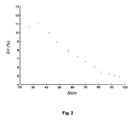
- the figure 2 illustrates an example of the evolution of the estimated prediction error ( Err ) by a response surface (approximate model), as a function of the number of simulations ( Nsim ) used to construct the response surface.
- the response surface approximates the output of the flow simulator corresponding to the oil flow of the tank after 10 years of production.
- This criterion allows a user to decide whether to add simulations to improve the predictive reliability of the model.
- the number p of simulations carried out at each iteration can be controlled by the user, depending on the number of machines available to perform simulations for example.
- step e) The addition of simulations in step e) is repeated, automatically, to satisfy a stopping criterion which is related to the degree of prediction desired by the user, defined in step a), by example average prediction of 5% of the response studied.
- a stopping criterion which is related to the degree of prediction desired by the user, defined in step a)
- An example of estimation of the prediction is obtained from the average of the cross-validation errors in each zone.
- the principle of optimization of the production scheme consists of defining different production scenarios, and for each of them, predicting production. This technique also makes it possible, in the same way, to economically evaluate a petroleum deposit.
- the approximate model is used because it is simple and analytical and, therefore, every estimate obtained by this model is immediate. This saves a lot of time.
- the use of this model allows the reservoir engineer to test as many scenarios as he wants, without worrying about the time required to perform a numerical flow simulation, and above all it allows him to take into account the uncertainties by testing different values of input parameters.
- the approximate analytical model is used with Monte Carlo or Quasi Monte Carlo direct sampling techniques (MCMC, Hypercube Latin, 3) in order to propagate the uncertainties of the input parameters on the selected simulator response (s).
- MCMC Monte Carlo or Quasi Monte Carlo direct sampling techniques
- the approximate model is used to perform an overall sensitivity analysis, so as to select the parameters influencing the production of the deposit, in order to carry out the measurements necessary for a better evaluation of the deposit.
- f 0 ⁇ ⁇ p ⁇ f x ⁇ dx and if ( he , ..., is ) ⁇ ( j1 , ..., jl ), then f ⁇ p ⁇ f i ⁇ 1 , ... , isf j ⁇ 1 , ... , jl ⁇ dx
- S i is called the first order sensitivity index for the factor x i . This index measures the part of the variance of the response explained by the effect of x i .
- S i, j for i ⁇ j, is called the second order sensitivity index. This index measures the proportion of response variance due to interactions between the effects of x i and x j .
- the total sensitivity index, S Ti for a particular parameter x i can also be very useful for measure the part of the variance of the response explained by all the effects in which x i plays a role.
- the global sensitivity analysis makes it possible to explain the variability of the responses as a function of the input parameters, through the definition of total or partial sensitivity indices. These indices can be estimated by Monte Carlo or Quasi Monte Carlo techniques to approximate the different multidimensional integrals, requiring a large sampling.
- the overall sensitivity analysis can not be used directly using a flow simulator.
- the sensitivity index calculations are performed using analytical models for each response. These analytical models are constructed as previously described.
- the Global Sensitivity Analysis (ASG) used in the invention does not have the usual limitations related to the hypotheses that other methods can be used that allow the calculation of standard sensitivity indices Spearman, Pearson, SRC, rank index, ...
- the only hypothesis is that the uncertain parameters are independent, which greatly expands the use of ASG using Sobol decomposition. This assumption is generally respected in reservoir engineering problems, since the links between parameters are known a priori.
- the Global Sensitivity Analysis (ASG) of the uncertain parameters on the simulator responses also makes it possible to evaluate the average effect of a parameter on a given response.
- This average effect can be used for example for controllable parameters, eg position a well, injection flow etc ... and is therefore a simple tool of behavior parameters.
- the use of the approximate model to make the ASG allows to determine the influential parameters, and how they are influential. It is thus possible to know the total impact of a parameter, as well as its combined impact with one or more other parameters on the production or economic response of the deposit.
- the ASG clearly allows a better understanding of the deposit's behavior.
- the determination of the average effects of the parameters is also a tool to characterize the average influence of a parameter, given the uncertainty of the other parameters on the responses in production or economic reservoir.
- the input parameters comprise stochastic fields, eg permeability, porosity, facies, etc.
- stochastic fields eg permeability, porosity, facies, etc.
- the uncertainty coming from the geostatistical maps is often neglected in the methods of uncertainty analysis based on plans. experience.
- the stochastic field is decomposed into a number n of components via the Karhunen-Loeve decomposition (M. Loève Probability Theory, Princeton University Press, 1955).
- the geostatistical techniques used in reservoir engineering to model the permeability and porosity quantities of rocks are mostly based on random Gaussian functions, discretized on a mesh covering the physical space of the reservoir.
- the Karhunen-Loève decomposition of a geostatistical model consists of representing it in the base formed of the eigenvectors of its covariance operator. This gives a functional representation of the random field.
- the method according to the invention is a tool for the analysis of the uncertainties of a flow simulator, and to help an engineer to reduce this uncertainty, focusing on the characterization of the parameters whose uncertainty contributes mainly to the poor characterization of the outputs.
- This method provides a robust and cost-effective tool (in terms of the number of simulations) for the global sensitivity analysis and the propagation of uncertainties. It allows the engineer to control the degree of approximation of his results by analyzing in real time the advantages in terms of prediction compared to the number of simulations carried out.
- the method allows the uncertainties of the geostatistical model (permeability, porosity, facies, etc.) to be taken into account by using surface response techniques and global sensitivity analysis.
Landscapes
- Life Sciences & Earth Sciences (AREA)
- Engineering & Computer Science (AREA)
- Geology (AREA)
- Mining & Mineral Resources (AREA)
- Physics & Mathematics (AREA)
- Environmental & Geological Engineering (AREA)
- Fluid Mechanics (AREA)
- General Life Sciences & Earth Sciences (AREA)
- Geochemistry & Mineralogy (AREA)
- Management, Administration, Business Operations System, And Electronic Commerce (AREA)
Applications Claiming Priority (1)
| Application Number | Priority Date | Filing Date | Title |
|---|---|---|---|
| FR0705740A FR2919932B1 (fr) | 2007-08-06 | 2007-08-06 | Methode pour evaluer un schema de production d'un gissement souterrain en tenant compte des incertitudes |
Publications (2)
| Publication Number | Publication Date |
|---|---|
| EP2022934A2 true EP2022934A2 (de) | 2009-02-11 |
| EP2022934A3 EP2022934A3 (de) | 2011-06-15 |
Family
ID=39156699
Family Applications (1)
| Application Number | Title | Priority Date | Filing Date |
|---|---|---|---|
| EP08290725A Ceased EP2022934A3 (de) | 2007-08-06 | 2008-07-25 | Methode zur Evaluierung eines Produktionsschemas von unterirdischen Quellvorkommen unter Berücksichtigung von Unsicherheitsfaktoren |
Country Status (4)
| Country | Link |
|---|---|
| US (1) | US8392164B2 (de) |
| EP (1) | EP2022934A3 (de) |
| CA (1) | CA2638227C (de) |
| FR (1) | FR2919932B1 (de) |
Cited By (2)
| Publication number | Priority date | Publication date | Assignee | Title |
|---|---|---|---|---|
| CN107018672A (zh) * | 2014-12-03 | 2017-08-04 | 贝克休斯公司 | 能源行业作业特征化和/或优化 |
| CN116305593A (zh) * | 2023-05-23 | 2023-06-23 | 西安交通大学 | 一种具有强可移植性的全局敏度分析方法 |
Families Citing this family (39)
| Publication number | Priority date | Publication date | Assignee | Title |
|---|---|---|---|---|
| WO2009075945A1 (en) | 2007-12-13 | 2009-06-18 | Exxonmobil Upstream Research Company | Parallel adaptive data partitioning on a reservoir simulation using an unstructured grid |
| US8061444B2 (en) * | 2008-05-22 | 2011-11-22 | Schlumberger Technology Corporation | Methods and apparatus to form a well |
| AU2010245112B2 (en) * | 2009-04-27 | 2013-03-14 | Schlumberger Technology B.V. | Method for uncertainty quantification in the performance and risk assessment of a carbon dioxide storage site |
| GB2474275B (en) * | 2009-10-09 | 2015-04-01 | Senergy Holdings Ltd | Well simulation |
| US8775142B2 (en) | 2010-05-14 | 2014-07-08 | Conocophillips Company | Stochastic downscaling algorithm and applications to geological model downscaling |
| US9665836B2 (en) | 2010-08-10 | 2017-05-30 | X Systems, Llc | System and method for analyzing data |
| US9652726B2 (en) | 2010-08-10 | 2017-05-16 | X Systems, Llc | System and method for analyzing data |
| US9665916B2 (en) | 2010-08-10 | 2017-05-30 | X Systems, Llc | System and method for analyzing data |
| US9176979B2 (en) | 2010-08-10 | 2015-11-03 | X Systems, Llc | System and method for analyzing data |
| US8849638B2 (en) | 2010-08-10 | 2014-09-30 | X Systems, Llc | System and method for analyzing data |
| US8805659B2 (en) * | 2011-02-17 | 2014-08-12 | Chevron U.S.A. Inc. | System and method for uncertainty quantification in reservoir simulation |
| EP2707827B1 (de) * | 2011-05-10 | 2020-03-11 | Chevron U.S.A., Inc. | System und verfahren zur kennzeichnung von unsicherheiten bei der bewertung einer reservoirformierung |
| US20130110483A1 (en) * | 2011-10-31 | 2013-05-02 | Nikita V. Chugunov | Method for measurement screening under reservoir uncertainty |
| US9201164B2 (en) * | 2011-11-15 | 2015-12-01 | Chevron U.S.A. Inc. | System and method of using spatially independent subsets of data to calculate property distribution uncertainty of spatially correlated reservoir data |
| US20150285950A1 (en) * | 2012-02-10 | 2015-10-08 | Landmark Graphics Corporation | Systems and Methods for Selecting Facies Model Realizations |
| WO2013191693A1 (en) | 2012-06-21 | 2013-12-27 | Halliburton Energy Services, Inc. | Method and apparatus for formation tester data interpretation with diverse flow models |
| FR2993310B1 (fr) * | 2012-07-13 | 2014-08-29 | IFP Energies Nouvelles | Procede d'exploitation d'un reservoir geologique a partir d'un modele de reservoir cale par le calcul d'une loi analytique de distribution conditionnelle de parametres incertains du modele |
| WO2014116896A1 (en) | 2013-01-25 | 2014-07-31 | Services Petroliers Schlumberger | Pressure transient testing with sensitivity analysis |
| US20140278110A1 (en) * | 2013-03-15 | 2014-09-18 | Schlumberger Technology Corporation | Targeted survey design under uncertainty |
| US9726001B2 (en) * | 2013-08-28 | 2017-08-08 | Schlumberger Technology Corporation | Method for adaptive optimizing of heterogeneous proppant placement under uncertainty |
| WO2015156792A1 (en) * | 2014-04-09 | 2015-10-15 | Landmark Graphics Corporation | Parameter measurement refinement in oil exploration operations |
| WO2015175216A1 (en) * | 2014-05-16 | 2015-11-19 | Apache Corporation | Methods for statistical of well production and reserves |
| US11598185B2 (en) * | 2014-11-24 | 2023-03-07 | Schlumberger Technology Corporation | Methods for adaptive optimization of enhanced oil recovery performance under uncertainty |
| MX2017004831A (es) * | 2014-11-26 | 2017-07-20 | Halliburton Energy Services Inc | Determinacion de la profundidad de las zonas de perdida en las formaciones subterraneas. |
| US10690801B2 (en) | 2015-07-10 | 2020-06-23 | Halliburton Energy Services, Inc. | Skin effect correction for focused electrode devices based on analytical model |
| CN106855863A (zh) * | 2015-12-09 | 2017-06-16 | 上海渤元信息科技有限公司 | 一种新的大数据分析算法 |
| WO2017206182A1 (en) * | 2016-06-03 | 2017-12-07 | Schlumberger Technology Corporation | Detecting events in well reports |
| GB2590260B (en) * | 2018-08-30 | 2022-08-31 | Landmark Graphics Corp | Automated production history matching using Bayesian optimization |
| US11914671B2 (en) | 2018-10-01 | 2024-02-27 | International Business Machines Corporation | Performing uncertainty quantification analysis with efficient two dimensional random fields |
| CN110348137B (zh) * | 2019-07-15 | 2022-04-22 | 西南石油大学 | 一种基于向量自回归模型的水驱油藏渗流场评价方法 |
| CN110851957B (zh) * | 2019-10-15 | 2024-05-28 | 南京航空航天大学 | 一种基于深度学习的大气数据传感系统解算方法 |
| CN111173507B (zh) * | 2020-03-17 | 2023-04-07 | 中国石油化工股份有限公司 | 高含水油田剩余油预测方法 |
| CN111739579B (zh) * | 2020-05-26 | 2022-06-14 | 浙江省农业科学院 | 一种肉鸡产业链沙门氏菌的定量风险评估方法 |
| WO2022099311A1 (en) * | 2020-11-06 | 2022-05-12 | Schlumberger Technology Corporation | Agent guided drilling assessment |
| CN112818471A (zh) * | 2021-02-18 | 2021-05-18 | 西北工业大学 | 一种坦克行进间发射的不确定性分析方法 |
| CN112983406B (zh) * | 2021-03-15 | 2022-03-25 | 西南石油大学 | 一种天然气水合物储层参数指标评价方法 |
| CN113656900B (zh) * | 2021-07-06 | 2023-06-20 | 扬州大学 | 基于灵敏度修正的收割机结构强度影响因素分析方法 |
| CN116498385B (zh) * | 2022-12-26 | 2026-04-14 | 中国石油化工股份有限公司 | 一种盐穴储库扩槽方法 |
| CN116090914B (zh) * | 2023-02-01 | 2023-09-05 | 中国水利水电科学研究院 | 微咸水用于农业灌溉的矿化度安全阈值识别方法及系统 |
Citations (2)
| Publication number | Priority date | Publication date | Assignee | Title |
|---|---|---|---|---|
| EP1484704A1 (de) | 2003-06-02 | 2004-12-08 | Institut Francais Du Petrole | Verfahren zur Entscheidungshilfe für die Verwaltung von Erdölvorkommen bei Vorliegen unsicherer technischer und ökonomischer Parameter |
| FR2874706A1 (fr) | 2004-08-30 | 2006-03-03 | Inst Francais Du Petrole | Methode de modelisation de la production d'un gisement petrolier |
Family Cites Families (22)
| Publication number | Priority date | Publication date | Assignee | Title |
|---|---|---|---|---|
| US4969130A (en) * | 1989-09-29 | 1990-11-06 | Scientific Software Intercomp, Inc. | System for monitoring the changes in fluid content of a petroleum reservoir |
| US5992519A (en) * | 1997-09-29 | 1999-11-30 | Schlumberger Technology Corporation | Real time monitoring and control of downhole reservoirs |
| US6980940B1 (en) * | 2000-02-22 | 2005-12-27 | Schlumberger Technology Corp. | Intergrated reservoir optimization |
| US7136787B2 (en) * | 2001-12-19 | 2006-11-14 | Archimedes, Inc. | Generation of continuous mathematical model for common features of a subject group |
| FR2837947B1 (fr) * | 2002-04-02 | 2004-05-28 | Inst Francais Du Petrole | Methode pour quantifier les incertitudes liees a des parametres continus et discrets descriptifs d'un milieu par construction de plans d'experiences et analyse statistique |
| US7512543B2 (en) * | 2002-05-29 | 2009-03-31 | Schlumberger Technology Corporation | Tools for decision-making in reservoir risk management |
| US7899657B2 (en) * | 2003-01-24 | 2011-03-01 | Rockwell Automoation Technologies, Inc. | Modeling in-situ reservoirs with derivative constraints |
| GB2413871A (en) * | 2003-02-27 | 2005-11-09 | Schlumberger Holdings | Estimation of formation characteristics in wells |
| FR2852710B1 (fr) * | 2003-03-18 | 2005-04-29 | Inst Francais Du Petrole | Methode pour former rapidement un modele stochastique representatif de la distribution d'une grandeur physique dans un milieu heterogene par une selection appropriee de realisations geostatistiques |
| FR2855631A1 (fr) * | 2003-06-02 | 2004-12-03 | Inst Francais Du Petrole | Methode pour optimiser la production d'un gisement petrolier en presence d'incertitudes |
| US20050004833A1 (en) * | 2003-07-03 | 2005-01-06 | Reaction Design, Llc | Method and system for integrated uncertainty analysis |
| US7725302B2 (en) * | 2003-12-02 | 2010-05-25 | Schlumberger Technology Corporation | Method and system and program storage device for generating an SWPM-MDT workflow in response to a user objective and executing the workflow to produce a reservoir response model |
| CN1973110A (zh) * | 2004-06-25 | 2007-05-30 | 国际壳牌研究有限公司 | 从地下地层控制生产碳氢化合物流体用的闭环控制系统 |
| US7590518B2 (en) * | 2004-09-02 | 2009-09-15 | Cadence Design Systems, Inc. | Circuit analysis utilizing rank revealing factorization |
| US7809538B2 (en) * | 2006-01-13 | 2010-10-05 | Halliburton Energy Services, Inc. | Real time monitoring and control of thermal recovery operations for heavy oil reservoirs |
| CN101379271B (zh) * | 2006-01-31 | 2012-11-07 | 兰德马克绘图公司 | 使用代理仿真器的用于实时油气田生产优化的方法、系统和计算机可读介质 |
| CN101379498B (zh) * | 2006-01-31 | 2012-05-30 | 兰德马克绘图公司 | 使用物理和代理仿真器的用于快速更新油气田生产模型的方法和系统 |
| US7877246B2 (en) * | 2006-09-22 | 2011-01-25 | Schlumberger Technology Corporation | System and method for performing oilfield simulation operations |
| EP2118738A4 (de) * | 2006-12-28 | 2014-07-02 | Chevron Usa Inc | Verfahren, system und programmspeichereinrichtung zur vorgeschichteabstimmung und vorhersage von kohlenwasserstoff führenden reservoirs unter verwendung von proxi für wahrscheinlichkeitsfunktionen |
| US8046314B2 (en) * | 2007-07-20 | 2011-10-25 | Schlumberger Technology Corporation | Apparatus, method and system for stochastic workflow in oilfield operations |
| US20090164186A1 (en) * | 2007-12-20 | 2009-06-25 | Bhp Billiton Innovation Pty Ltd. | Method for determining improved estimates of properties of a model |
| US7894991B2 (en) * | 2008-02-01 | 2011-02-22 | Schlumberger Technology Corp. | Statistical determination of historical oilfield data |
-
2007
- 2007-08-06 FR FR0705740A patent/FR2919932B1/fr not_active Expired - Fee Related
-
2008
- 2008-07-25 EP EP08290725A patent/EP2022934A3/de not_active Ceased
- 2008-08-01 CA CA2638227A patent/CA2638227C/fr not_active Expired - Fee Related
- 2008-08-04 US US12/185,161 patent/US8392164B2/en not_active Expired - Fee Related
Patent Citations (2)
| Publication number | Priority date | Publication date | Assignee | Title |
|---|---|---|---|---|
| EP1484704A1 (de) | 2003-06-02 | 2004-12-08 | Institut Francais Du Petrole | Verfahren zur Entscheidungshilfe für die Verwaltung von Erdölvorkommen bei Vorliegen unsicherer technischer und ökonomischer Parameter |
| FR2874706A1 (fr) | 2004-08-30 | 2006-03-03 | Inst Francais Du Petrole | Methode de modelisation de la production d'un gisement petrolier |
Non-Patent Citations (10)
| Title |
|---|
| A. SALTELLI; K. CHAN; M. SCOTT: "Sensitivity Analysis", 2000, WILEY |
| BUSBY D.; FARMER C.L.; ISKE A.: "Hierarchical Nonlinear Approximation for Experimental Design and Statistical Data Fitting", SIAM J. SCI. COMPUT., vol. 29, no. 1, 2007, pages 49 - 69 |
| DROESBEKE J.J ET AL.: "Plans d'expériences, Applications à l'entreprise", 1997 |
| JAFARPOUR: "'Efficient Permeability Parameterization with the Discrete Cosine Transform'", SPE 106543, 28 February 2007 (2007-02-28), pages 2 - 5-7, XP055118076, Retrieved from the Internet <URL:http://web.mit.edu/dennism/www/Publications/M48_2008_SPEJ_submitted.pdf> [retrieved on 20140515], DOI: 10.2118/106453-MS * |
| KENNEDY M.; O'HAGAN A.: "Bayesian calibration of computer models (with discussion", J R. STATIST. SOC. SER. B STAT. METHODOL., vol. 68, 2001, pages 425 - 464 |
| LM SOBOL: "Sensitivity estimates for nonlinear mathematical models", MATHEMATICAL MODELLING AND COMPUTATIONAL EXPERIMENTS, vol. 1, 1993, pages 407 - 414 |
| M.M. LOÈVE.: "Probability Theory. Princeton", 1955, UNIVERSITY PRESS |
| OAKLEY; A. O'HAGAN: "Probabilistic sensitivity analysis of complex models: A Bayesian approach", J. ROY. STATIST. SOC. SER. B, vol. 16, 2004, pages 751 - 769 |
| SALTELLI, K. CHAN; M. SCOTT: "Sensitivity Analysis", 2000, WILEY |
| SCHEIDT C. ET AL.: "Adaptive Evolutive Experimental Designs for Uncertainty Assessment - An innovative exploitation of geostatistical techniques", IAMG, TORONTO, 21 August 2005 (2005-08-21) |
Cited By (3)
| Publication number | Priority date | Publication date | Assignee | Title |
|---|---|---|---|---|
| CN107018672A (zh) * | 2014-12-03 | 2017-08-04 | 贝克休斯公司 | 能源行业作业特征化和/或优化 |
| EP3227530A4 (de) * | 2014-12-03 | 2018-08-08 | Baker Hughes Incorporated | Energiebranchenoperationscharakterisierung und/oder -optimierung |
| CN116305593A (zh) * | 2023-05-23 | 2023-06-23 | 西安交通大学 | 一种具有强可移植性的全局敏度分析方法 |
Also Published As
| Publication number | Publication date |
|---|---|
| FR2919932A1 (fr) | 2009-02-13 |
| EP2022934A3 (de) | 2011-06-15 |
| US8392164B2 (en) | 2013-03-05 |
| FR2919932B1 (fr) | 2009-12-04 |
| CA2638227C (fr) | 2016-09-27 |
| US20090043555A1 (en) | 2009-02-12 |
| CA2638227A1 (fr) | 2009-02-06 |
Similar Documents
| Publication | Publication Date | Title |
|---|---|---|
| CA2638227C (fr) | Methode pour evaluer un schema de production d'un gisement souterrain en tenant compte des incertitudes | |
| Williams et al. | Top-down reservoir modelling | |
| EP1760492B1 (de) | Verfahren zum Aktualisieren eines geologischen Modells eines Reservoirs mittels dynamischer Daten | |
| CA2821099C (fr) | Procede d'exploitation d'un reservoir geologique a partir d'un modele de reservoir cale par le calcul d'une loi analytique de distribution conditionnelle de parametres incertains du modele | |
| EP2343576B1 (de) | Methode zur Ausbeutung eines Ölreservoirs unter Verwendung einer Facieskarte, welche representativ für das Reservoir ist | |
| Finsterle | Practical notes on local data‐worth analysis | |
| US20130282286A1 (en) | System and method for calibrating permeability for use in reservoir modeling | |
| EP2400320B1 (de) | Verfahren zur Ausbeutung eines Erdöllagers mit Hilfe eines Reservoir-Modells, das schrittweise durch Co-Simulationen verformt wird | |
| WO2009034253A1 (fr) | Procede, programme et systeme informatique de mise a l'echelle de donnees de modele de reservoir d'hydrocarbure | |
| EP2770162B1 (de) | Verfahren zur Ausbeutung eines geologischen Speichers mit Hilfe eines intelligenten und kohärenten Speichermodells in Bezug auf die Ablaufeigenschaften | |
| EP2628893A1 (de) | Ausbeutungsverfahren eines Erdöllagers mit Hilfe einer Auswahltechnik der Stellen für Bohrlöcher | |
| CN103282908A (zh) | 用于表征储藏层评估不确定性的系统和方法 | |
| FR3032222A1 (fr) | Architecture de parametre d'incertitude a priori integree en creation de modele de simulation | |
| EP4252044B1 (de) | Verfahren zur bestimmung von unsicherheiten im zusammenhang mit einem modell eines sedimentbeckens | |
| Eidsvik et al. | Simulation–regression approximations for value of information analysis of geophysical data | |
| Verga et al. | Improved application of assisted history matching techniques | |
| Santos et al. | Comparison of risk analysis methodologies in a geostatistical context: Monte Carlo with joint proxy models and discretized latin hypercube | |
| Yang et al. | Predict Reservoir Fluid Properties from Advanced Mud Gas Data | |
| Chewaroungroaj et al. | An Evaluation of Procedures to Estimate Uncertainty in Hydrocarbon Recovery Predictions | |
| Schulze-Riegert et al. | Data Analysis Used in Multiple-Realization Workflows for History Matching-A North Sea Case Study | |
| CN111580179A (zh) | 一种有机碳含量确定方法、装置及系统 | |
| Komlosi et al. | Application of the Monte Carlo Simulation in Calculating HC-Reserves | |
| Gaillot et al. | Uncertainty analysis in formation evaluation: Rationale, methods and examples | |
| Spikes et al. | A bayesian approach to inclusion based rock physics modeling with multiple statistical ensembles | |
| Feraille et al. | Uncertainty management on a reservoir workflow |
Legal Events
| Date | Code | Title | Description |
|---|---|---|---|
| PUAI | Public reference made under article 153(3) epc to a published international application that has entered the european phase |
Free format text: ORIGINAL CODE: 0009012 |
|
| AK | Designated contracting states |
Kind code of ref document: A2 Designated state(s): AT BE BG CH CY CZ DE DK EE ES FI FR GB GR HR HU IE IS IT LI LT LU LV MC MT NL NO PL PT RO SE SI SK TR |
|
| AX | Request for extension of the european patent |
Extension state: AL BA MK RS |
|
| RAP1 | Party data changed (applicant data changed or rights of an application transferred) |
Owner name: IFP ENERGIES NOUVELLES |
|
| REG | Reference to a national code |
Ref country code: DE Ref legal event code: R079 Free format text: PREVIOUS MAIN CLASS: E21B0041000000 Ipc: E21B0043000000 |
|
| PUAL | Search report despatched |
Free format text: ORIGINAL CODE: 0009013 |
|
| AK | Designated contracting states |
Kind code of ref document: A3 Designated state(s): AT BE BG CH CY CZ DE DK EE ES FI FR GB GR HR HU IE IS IT LI LT LU LV MC MT NL NO PL PT RO SE SI SK TR |
|
| AX | Request for extension of the european patent |
Extension state: AL BA MK RS |
|
| RIC1 | Information provided on ipc code assigned before grant |
Ipc: E21B 43/00 20060101AFI20110512BHEP |
|
| 17P | Request for examination filed |
Effective date: 20111215 |
|
| AKX | Designation fees paid |
Designated state(s): GB NO |
|
| REG | Reference to a national code |
Ref country code: DE Ref legal event code: R108 Effective date: 20120222 |
|
| RAP1 | Party data changed (applicant data changed or rights of an application transferred) |
Owner name: IFP ENERGIES NOUVELLES |
|
| STAA | Information on the status of an ep patent application or granted ep patent |
Free format text: STATUS: EXAMINATION IS IN PROGRESS |
|
| 17Q | First examination report despatched |
Effective date: 20180425 |
|
| STAA | Information on the status of an ep patent application or granted ep patent |
Free format text: STATUS: THE APPLICATION HAS BEEN REFUSED |
|
| 18R | Application refused |
Effective date: 20211008 |