EP2023367A2 - Verfahren zur Einstellung der Auslösungsempfindlichkeit durch eine Überhitzungsschutzvorrichtung - Google Patents
Verfahren zur Einstellung der Auslösungsempfindlichkeit durch eine Überhitzungsschutzvorrichtung Download PDFInfo
- Publication number
- EP2023367A2 EP2023367A2 EP20080013332 EP08013332A EP2023367A2 EP 2023367 A2 EP2023367 A2 EP 2023367A2 EP 20080013332 EP20080013332 EP 20080013332 EP 08013332 A EP08013332 A EP 08013332A EP 2023367 A2 EP2023367 A2 EP 2023367A2
- Authority
- EP
- European Patent Office
- Prior art keywords
- trip
- rotation angle
- adjusting
- graduation
- calculating
- Prior art date
- Legal status (The legal status is an assumption and is not a legal conclusion. Google has not performed a legal analysis and makes no representation as to the accuracy of the status listed.)
- Granted
Links
Images



Classifications
-
- H—ELECTRICITY
- H01—ELECTRIC ELEMENTS
- H01H—ELECTRIC SWITCHES; RELAYS; SELECTORS; EMERGENCY PROTECTIVE DEVICES
- H01H71/00—Details of the protective switches or relays covered by groups H01H73/00 - H01H83/00
- H01H71/74—Means for adjusting the conditions under which the device will function to provide protection
- H01H71/7427—Adjusting only the electrothermal mechanism
- H01H71/7445—Poly-phase adjustment
-
- H—ELECTRICITY
- H01—ELECTRIC ELEMENTS
- H01H—ELECTRIC SWITCHES; RELAYS; SELECTORS; EMERGENCY PROTECTIVE DEVICES
- H01H71/00—Details of the protective switches or relays covered by groups H01H73/00 - H01H83/00
- H01H71/10—Operating or release mechanisms
- H01H71/12—Automatic release mechanisms with or without manual release
- H01H71/14—Electrothermal mechanisms
- H01H71/16—Electrothermal mechanisms with bimetal element
-
- H—ELECTRICITY
- H01—ELECTRIC ELEMENTS
- H01H—ELECTRIC SWITCHES; RELAYS; SELECTORS; EMERGENCY PROTECTIVE DEVICES
- H01H69/00—Apparatus or processes for the manufacture of emergency protective devices
- H01H69/01—Apparatus or processes for the manufacture of emergency protective devices for calibrating or setting of devices to function under predetermined conditions
-
- H—ELECTRICITY
- H01—ELECTRIC ELEMENTS
- H01H—ELECTRIC SWITCHES; RELAYS; SELECTORS; EMERGENCY PROTECTIVE DEVICES
- H01H71/00—Details of the protective switches or relays covered by groups H01H73/00 - H01H83/00
- H01H71/10—Operating or release mechanisms
- H01H71/12—Automatic release mechanisms with or without manual release
- H01H71/14—Electrothermal mechanisms
- H01H71/16—Electrothermal mechanisms with bimetal element
- H01H2071/167—Multiple bimetals working in parallel together, e.g. laminated together
-
- H—ELECTRICITY
- H01—ELECTRIC ELEMENTS
- H01H—ELECTRIC SWITCHES; RELAYS; SELECTORS; EMERGENCY PROTECTIVE DEVICES
- H01H71/00—Details of the protective switches or relays covered by groups H01H73/00 - H01H83/00
- H01H71/10—Operating or release mechanisms
- H01H71/12—Automatic release mechanisms with or without manual release
- H01H71/14—Electrothermal mechanisms
- H01H71/16—Electrothermal mechanisms with bimetal element
- H01H71/162—Electrothermal mechanisms with bimetal element with compensation for ambient temperature
Definitions
- the present invention relates to an apparatus for protecting a motor from an overload (overcurrent), more particularly, to a method for setting and adjusting a sensitivity of a trip current in a thermal overload protection apparatus.
- An overload protecting function a basic function of a thermal overload trip apparatus, is implemented by performing a trip operation when an overload or overcurrent within a current range satisfying a pre-set condition for the trip operation is generated on an electric circuit.
- the current range may refer to a current range for the trip operation according to an IEC (International Electrotechnical Commission) standard specified as an international electrical standard.
- IEC International Electrotechnical Commission
- a condition for the trip operation is that the trip operation should be performed within two hours when a current corresponding to 1.2times of a rated current is conducted on a circuit and the trip operation should be performed more than two hours and within several hours when a current corresponding to 1.05times of the rated current is conducted.
- the thermal overload (overcurrent) trip apparatus generally includes a heater coil generating heat when an overcurrent is generated by being connected onto the circuit and a bimetal winding the heater coil so as to provide a driving force for a trip operation by being bent when the heater coil generates heat, as a driving actuator.
- a heater coil generating heat when an overcurrent is generated by being connected onto the circuit
- a bimetal winding the heater coil so as to provide a driving force for a trip operation by being bent when the heater coil generates heat, as a driving actuator.
- FIG. 1 is a diagram showing a configuration of a thermal overload trip apparatus in accordance with the related art
- FIG. 2 is a diagram showing a relation between an adjusting cam and a trip sensitivity adjusting range in the thermal overload trip apparatus in accordance with the related art.
- a reference numeral 1 denotes bimetals.
- three bimetals are provided so as to be connected onto each circuit of three-phase AC.
- the bimetals are bent by heat from a heater coil (not shown) generating heat when an overcurrent is generated, and accordingly provide a driving force for a trip operation.
- a reference numeral 2 denotes a shifter mechanism.
- the shifter mechanism 2 is a means for transferring the driving force for the trip operation from the bimetals 1 and is movable in a horizontal direction on the drawing by contacting the bimetals 1 in right and left directions so as to receive the driving force provided from the bent bimetals 1.
- a reference numeral 3 denotes a trip mechanism.
- a reference numeral 4 denotes a latch mechanism for releasing the trip mechanism 3 to be rotated in the direction of the trip operation or restricting the trip mechanism 3 not to be rotated in the direction of the trip operation.
- the latch mechanism 4 has one end portion installed to face a driving force transfer portion of the shifter mechanism 2 with each other so as to receive the driving force from the shifter mechanism 2, another end portion disposed on a rotation trace of the trip mechanism 3 so as to restrict or release the trip mechanism 3, and a middle portion therebetween supported by a rotation shaft (reference numeral not given) to be rotatable.
- a reference numeral 6 denotes a contact point between the trip mechanism 3 and the latch mechanism 4 at the restriction position.
- an adjusting knob mechanism 5 is disposed to be rotatable so as to displace the latch mechanism 4 to be closer or to be distant to/from the shifter mechanism 2 resulting from variation of a contact pressure while contacting the latch mechanism 4.
- the adjusting knob mechanism 5 includes a cam portion 9 having a radius varying according to a displacement angle of an outer circumference thereof, and an adjusting knob 10 coupled to the cam portion 9 or integrally extended from the cam portion 9 so as to rotate the cam portion 9.
- a reference character y indicates a predetermined displacement amount (distance) of the bending bimetals 1 when a pre determined over current is conducted on the circuit.
- a reference numeral ⁇ y indicates a predetermined gap between the shifter mechanism 2 and the latch mechanism 4 when the shifter mechanism 2 is displaced by the pre-set bending amount y of the bimetals 1 caused by generation of the predetermined overcurrent.
- the allowance for trip operation is adjustable by the adjusting knob mechanism 5.
- a reference character a indicates a cam adjustable range covering angles between a maximum trip operation insensitive adjusting position 12 and a maximum trip operation sensitive adjusting position 13.
- a manufacturer of the thermal overload trip apparatus in the related art has adjusted an initial position of the cam portion 9 such as an initially-set position 11 for the cam portion 9 by rotating the adjusting knob 10 of FIG. 1 during manufacturing, a range allowing a user to substantially adjust the rotation angle of the cam portion 9 is a substantially-adjustable range b for the cam portion 9.
- a reference character c indicates an initially-set adjusting range for the cam.
- the trip operation will be described.
- the heater coil (not shown) generates heat by the overcurrent on the circuit
- the bimetals 1 are bent and moved rightward on the drawing.
- the shifter mechanism 2 is moved rightward on FIG. 1 , that is in a shifter mechanism operating direction 7 applied when the overcurrent is generated by a value obtained by adding the allowance for trip operation ⁇ y to the bending amount y by the driving force of the bimetals 1 bent more than the value adding the allowance for trip operation ⁇ y to the bending amount y, accordingly the latch mechanism 4 is pressed rightward and then rotated in a counterclockwise direction on the drawing.
- the trip mechanism 3 being restricted by the latch mechanism 4 is released and then rotated in the tripping direction, that is in the counterclockwise direction by an elastic force of a spring (reference numeral not given), and accordingly a succeeding switching mechanism (not shown) is operated into a trip (circuit-opening) position and then the circuit is tripped (broken), thereby protecting the circuit and a load device.
- the distance for adjusting a sensitivity of trip current that is bending amount y
- a adjusting that reduces the remaining distance that is the trip operation allowance ⁇ y only to 0(zero)
- an accurate distance that is accurate bending amount y can be set, if only the manual rotating manipulation by a user is stopped at the exact instant when the trip apparatus operates to trip.
- the stop in the manual rotating manipulation has actually a very small velocity not zero, so there is a drawback that the sensitivity adjustment by the manual rotating manipulation by a user can not be adjusted accurately.
- the present invention is directed to providing a method for adjusting a trip sensitivity of a thermal overload protection apparatus which is capable of precisely and effectively adjusting a trip operation sensitivity at a time of an overload (overcurrent) occurrence.
- a method for adjusting a trip sensitivity of a thermal overload protection apparatus in the adjusting method of the thermal overload protection apparatus comprising bimetals for providing a driving force for trip operation by being bent when an overcurrent is conducted on a circuit, a shifter mechanism for transferring the driving force from the bimetals by contacting the same, a trip mechanism rotatable to a trip position at which the circuit is broken at a time of release, a trip latch mechanism movable to a position for releasing the trip mechanism from a position for restricting the trip mechanism by the driving force from the shifter mechanism, and an adjusting knob for adjusting a gap between the shifter mechanism and the trip latch mechanism, the method comprising, measuring a position of the bimetals and a moving distance at the time of trip operation of the trip latch mechanism so as to decide a gap between the shifter mechanism and the trip latch mechanism; deciding an installing position for the shifter mechanism
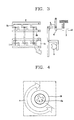
- FIG. 3 is a diagram schematically showing a configuration of a thermal overload protection apparatus in accordance with the present invention
- FIG. 4 is a diagram showing a relation between an adjusting knob and an adjusting area in the thermal overload protection apparatus in accordance with the present invention
- FIG. 5 is a state view showing a moment that the thermal overload protection apparatus in accordance with the present invention performs a trip operation.
- FIGS. 3 to 5 a configuration of the thermal overload protection apparatus in accordance with the present invention and operation thereof will be described.
- the thermal overload protection apparatus in accordance with the present invention includes bimetals 1 for providing a driving force for trip operation by being bent when an overcurrent is conducted on a circuit, a shifter mechanism 2 for transferring the driving force from the bimetals 1 by contacting the same, a trip mechanism 3 rotatable to a trip position at which the circuit is broken at a time of release, a trip latch mechanism 4 movable to a position for releasing the trip mechanism 3 from a position for restricting the trip mechanism 3 by the driving force from the shifter mechanism 2, and an adjusting knob (see a reference numeral 10 in FIG. 4 , a cam portion 9 formed at a lower portion of the adjusting knob is illustrated in FIG. 3 ) for adjusting a gap between the shifter mechanism 2 and the trip latch mechanism 4.
- bimetals 1 for providing a driving force for trip operation by being bent when an overcurrent is conducted on a circuit
- a shifter mechanism 2 for transferring the driving force from the bimetals 1 by contacting the same
- a trip mechanism 3
- Three bimetals 1 may be disposed to correspond to each phase of three-phase Alternating Current.
- the bimetals 1 provide the driving force for trip operation by being bent by heat from a heater coil (not shown) generating heat at the time of an overcurrent occurrence.
- the shifter mechanism 2 may be configured by cutting an integrated type horizontal move shifter to be separated into two shifter mechanisms, an upper horizontal move shifter 2a and a lower horizontal move shifter 2b so as to fit the three bimetals 1 for the three-phase thereinto based on measured position information of the bimetals 1.
- the shifter mechanism 2 may include a rotating shifter 2c rotatable depending on a horizontal move of the upper horizontal move shifter 2a and the lower horizontal move shifter 2b by connecting an upper portion and a lower portion thereof to the upper horizontal move shifter 2a and the lower horizontal move shifter 2b, respectively.
- a reference numeral 3 denotes a trip mechanism.
- the trip mechanism 3 is biased to be rotated in a direction of the trip operation by a spring (reference numeral not given).
- the trip latch mechanism 4 serves to release the trip mechanism 3 to rotate in a direction of trip operation or restrict the trip mechanism 3 not to be rotated in the direction of trip operation.
- the trip latch mechanism 4 has one end portion installed to face a driving force transfer portion of the shifter mechanism 2 with each other so as to receive the driving force from the shifter mechanism 2, another end portion disposed on a rotation trace(locus) of the trip mechanism 3 so as to restrict or release the trip mechanism 3, and a middle portion therebetween supported by a rotation shaft (reference numeral not given) to be rotatable.
- a reference numeral 6 denotes a contact point between the trip mechanism 3 and the trip latch mechanism 4 at the restriction position.
- an adjusting knob mechanism 5 is disposed to be rotatable so as to displace the trip latch mechanism 4 to be closer or to be distant to/from the shifter mechanism 2 resulting from changes of a contact pressure while contacting the trip latch mechanism 4.
- the adjusting knob mechanism 5 includes a cam portion 9 having a radius varying according to a displacement angle at a lower portion thereof, and an adjusting knob 10 coupled to the cam portion 9 or integrally extended from the cam portion 9 at an upper portion thereof so as to rotate the cam portion 9.
- a set indication arrow for indicating a set value of a trip current is marked at a middle portion of an upper surface of the adjusting knob 10.
- a reference character "a" indicates a trip operation current adjustable range.
- the range covers angles between a maximum trip operation insensitive adjusting position and a maximum trip operation sensitive adjusting position same as the related art.
- FIGS. 6 to 10 operation for adjusting a sensitivity at the time of trip operation in accordance with a method for adjusting a trip sensitivity of the thermal overload protection apparatus in accordance with the present invention will be described with reference to FIGS. 6 to 10 .
- the configuration of the thermal overload protection apparatus can be referred to by FIGS. 3 to 5 .
- FIG. 6 is a planar view showing an adjusting knob (arrow), an adjusting reference point (arrow) and a graduation member for a set trip current assembled according to the present invention
- FIG. 7 is a flow chart showing a configuration of a method for adjusting a trip sensitivity of the thermal overload protection apparatus in accordance with the present invention
- FIG. 8 is a flow chart showing a step that can be added to the method of FIG. 7
- FIG. 9 is a flow chart showing a detailed configuration of a step 8 in the method of FIG. 7
- FIG. 10 is a flow chart showing a detailed configuration of a step 9 in the method of FIG. 7 .
- the method for adjusting the trip sensitivity of the thermal overload protection apparatus in accordance with the present invention can be applied to the thermal overload protection apparatus including the bimetals 1 for providing a driving force for trip operation by being bent when an overcurrent is conducted on a circuit, the shifter mechanism 2 for transferring the driving force from the bimetals 1 by contacting the same, the trip mechanism 3 rotatable to a trip position at which the circuit is broken at a time of release, the trip latch mechanism 4 movable to a position for releasing the trip mechanism 3 from a position for restricting the trip mechanism 3 by the driving force from the shifter mechanism 2, and the adjusting knob 10 for adjusting a gap between the shifter mechanism 2 and the trip latch mechanism 4.
- the method for adjusting the trip sensitivity (hereafter, referred to as an adjusting method) of the thermal overload protection apparatus in accordance with the present invention, as shown in FIG. 7 may include measuring a position of the bimetals 1 and a moving distance at the time of trip operation of the trip latch mechanism 4 so as to decide a gap between the shifter mechanism 2 and the trip latch mechanism 4 (see reference numerals ST2 and ST3 in FIG. 7 ); deciding an installing position (assembling position) for the shifter mechanism 2 based on the position information and distance information obtained by the measuring step (ST2 and ST 3 in FIG.
- the steps ST2 and ST3 may consist of measuring a position of the bimetals 1 when a normal current is conducted on the circuit (ST2); and measuring the moving distance of the trip latch mechanism 4 by arbitrarily moving the same in the direction of trip operation (ST3).
- the adjusting method in accordance with the present invention may include setting a position of an adjusting reference point for the adjusting knob 10 (ST1).
- the setting step ST1 is implemented by manually rotating the adjusting knob 10 by an initially-set angle so as for a set indication arrow 10a shown in FIGS. 4 and 6 to indicate any angle within the cam adjustable range, that is the trip operation current adjustable range a shown in FIG. 4 .
- the measuring step ST2 is implemented by measuring the position information of the bimetals 1 when the normal current is conducted on the circuit using various length measurement devices.
- the measuring step ST3 may be implemented by arbitrarily moving the trip latch mechanism 4 in the trip operation direction (rightward on FIGS. 3 and 5 ) and then measuring the distance from the initial position of the trip latch mechanism 4 to a position at a moment of the trip occurrence, using various length measurement devices same as the abovementioned step.
- the deciding step ST4 is implemented based on the position information and distance information obtained by the measuring step (see ST2 and ST3 in FIG. 7 ) and the predetermined trip distance information.
- the predetermined trip distance information indicates a bending amount (bending distance, see the reference numeral y in FIG. 1 ) of the bimetals 1 that can be previously calculated according to a conducting allowable time for the overcurrent corresponding to a specified magnification of a rated current (105%, 120%, etc. of the rated current) specified in an international electrical standard, an international electrical safety standard, etc.
- the processing step (ST4-1 in FIG. 8 ) may be implemented by cutting the integrated type shifter mechanism 2 to be separated into the upper and lower shifter mechanisms so as to receive the three bimetals 1 for the three-phase by fitting the same thereinto based on the position information of the bimetals obtained by the step ST2.
- the installing (assembling) step ST5 is implemented by installing (assembling) the processed shifter mechanism 2 at the installing position (assembling position) decided in the step ST4.
- the deciding step may include conducting the predetermined over current to the thermal overload protection apparatus (ST6); measuring an overcurrent conducting time until the trip occurrence (ST7); and calculating the rotation angle by converting the difference between the conducting time measured in the measuring step ST7 and the predetermined trip time into the rotation angle of the adjusting knob 10 (ST8).
- the calculating step ST8 may be implemented by converting into the rotation angle of the adjusting knob 10 by an operation formula predefined considering the measured conducting time, the distance between the installed shifter mechanism 2 and the trip latch mechanism 4 and the trip time predetermined by the standard.
- the calculating step ST8, as shown in FIG. 9 may be subdivided into calculating the difference between the measured conducting time and the predetermined trip time (ST8-1); and calculating the rotation angle by converting the difference of time calculated in the calculating step ST8-1 into the rotation angle of the adjusting knob 10 (ST8-2).
- the adjusting method in accordance with the present invention may further include marking a graduation(ST9) of the trip operation current from the position of the adjusting reference point initially set in the setting step ST1 to a position adjusted by the rotation angle calculated in the calculating step ST8.
- the adjusting method in accordance with the present invention may be interchanged with installing a graduation member in which the graduation of the trip operation current is previously marked at the position adjusted by the rotation angle calculated in the calculating step ST8.
- the marking step ST9 may include installing a graduation member 10b at a periphery of the adjusting knob 10 by the rotation angle calculated in the calculating step ST8 (ST9-1); and marking the graduation at the graduation member (ST9-2).
- the marketing step ST9 may include marking the graduation at the graduation member by previously defining the trip operation current to be operated according to the rated current, and installing the graduation member at the position adjusted by the rotation angle calculated in the calculating step ST8.
- the marking step ST9 may include marking the graduation at the periphery of the adjusting knob 10 of the position adjusted by the rotation angle calculated in the calculating step ST8 from the position of initially-set adjusting reference point (ST9); adjusting the adjusting knob 10 by rotating to a temporary adjusting position so as to mark a graduation for an additional trip operation set current for selectively setting another trip operation current (ST9-2a); performing the steps such as the conducting step ST6, the measuring step ST7 and the calculating step ST8 with respect to the another trip operation current once again (ST9-2b); and marking a graduation for an additional trip operation current at a rotation position at the periphery of the adjusting knob that has been adjusted by the rotation angle calculated in the calculating step ST9-2b (ST9-2c).
- the present invention is capable of obtaining the method for adjusting the trip sensitivity of the thermal overload protection apparatus which is capable of precisely and effectively adjusting the trip operation sensitivity at the time of overload (overcurrent) occurrence.
Landscapes
- Engineering & Computer Science (AREA)
- Manufacturing & Machinery (AREA)
- Breakers (AREA)
- Emergency Protection Circuit Devices (AREA)
Applications Claiming Priority (1)
| Application Number | Priority Date | Filing Date | Title |
|---|---|---|---|
| KR1020070079235A KR100881365B1 (ko) | 2007-08-07 | 2007-08-07 | 열동형 과부하 보호장치의 트립 감도 조정 방법 |
Publications (3)
| Publication Number | Publication Date |
|---|---|
| EP2023367A2 true EP2023367A2 (de) | 2009-02-11 |
| EP2023367A3 EP2023367A3 (de) | 2009-12-02 |
| EP2023367B1 EP2023367B1 (de) | 2015-07-22 |
Family
ID=39769237
Family Applications (1)
| Application Number | Title | Priority Date | Filing Date |
|---|---|---|---|
| EP08013332.5A Active EP2023367B1 (de) | 2007-08-07 | 2008-07-24 | Verfahren zur Einstellung der Auslösungsempfindlichkeit durch eine Überhitzungsschutzvorrichtung |
Country Status (6)
| Country | Link |
|---|---|
| US (1) | US7821376B2 (de) |
| EP (1) | EP2023367B1 (de) |
| JP (1) | JP4648434B2 (de) |
| KR (1) | KR100881365B1 (de) |
| CN (1) | CN101364509B (de) |
| ES (1) | ES2550226T3 (de) |
Cited By (2)
| Publication number | Priority date | Publication date | Assignee | Title |
|---|---|---|---|---|
| CN102969206A (zh) * | 2012-11-13 | 2013-03-13 | 德力西电气有限公司 | 一种电动机保护器脱扣动作一致性调试方法及调试装置 |
| FR3126059A1 (fr) * | 2021-08-06 | 2023-02-10 | Schneider Electric Industries Sas | Dispositif de protection électrique à déclencheur thermique, tableau électrique comprenant un tel dispositif et procédé de réglage d’un tel dispositif |
Families Citing this family (9)
| Publication number | Priority date | Publication date | Assignee | Title |
|---|---|---|---|---|
| KR100881365B1 (ko) * | 2007-08-07 | 2009-02-02 | 엘에스산전 주식회사 | 열동형 과부하 보호장치의 트립 감도 조정 방법 |
| KR100905021B1 (ko) * | 2007-08-07 | 2009-06-30 | 엘에스산전 주식회사 | 열동형 과부하 트립 장치 및 그의 트립 감도 조정 방법 |
| JP4706772B2 (ja) * | 2009-03-27 | 2011-06-22 | 富士電機機器制御株式会社 | 熱動形過負荷継電器 |
| JP4906881B2 (ja) * | 2009-03-27 | 2012-03-28 | 富士電機機器制御株式会社 | 熱動形過負荷継電器 |
| JP4978681B2 (ja) * | 2009-10-23 | 2012-07-18 | 富士電機機器制御株式会社 | 熱動形過負荷継電器 |
| EP2823500B1 (de) * | 2012-03-05 | 2016-09-28 | Siemens Aktiengesellschaft | Verfahren und vorrichtung für eine selektive, mit einem magnetischen anker versehene, auslösevorrichtung eines schutzschalters |
| KR101771467B1 (ko) | 2013-10-17 | 2017-08-25 | 엘에스산전 주식회사 | 배선용 차단기의 검출기구부 간격 조절방법 |
| US9705310B2 (en) | 2013-11-26 | 2017-07-11 | Thomas & Betts International Llc | Adaptive fault clearing based on power transistor temperature |
| CN205789807U (zh) * | 2016-06-27 | 2016-12-07 | 施耐德电器工业公司 | 一种热脱扣补偿结构 |
Citations (1)
| Publication number | Priority date | Publication date | Assignee | Title |
|---|---|---|---|---|
| EP1229565A2 (de) | 2001-02-03 | 2002-08-07 | ABB PATENT GmbH | Verfahren zum Justieren des thermischen Auslösesystems eines elektrischen Schaltgerätes, insbesondere eines Motorschutzschalters |
Family Cites Families (56)
| Publication number | Priority date | Publication date | Assignee | Title |
|---|---|---|---|---|
| US3038051A (en) * | 1959-08-07 | 1962-06-05 | Gen Electric Canada | Thermal device |
| US3015007A (en) * | 1959-11-19 | 1961-12-26 | Gen Electric Canada | Thermal device |
| US3162739A (en) * | 1962-06-25 | 1964-12-22 | Gen Electric | Electric circuit breaker with improved trip means |
| US3214535A (en) * | 1963-02-27 | 1965-10-26 | Cutler Hammer Inc | Electric circuit breaker with positive tripping means |
| US3183328A (en) * | 1963-04-08 | 1965-05-11 | Gen Electric | Electric switch with contact weld check means |
| US3251966A (en) * | 1963-08-29 | 1966-05-17 | Ite Circuit Breaker Ltd | Shock-proof overload relay with reversing link |
| GB1083650A (en) * | 1965-05-15 | 1967-09-20 | Gen Electric Canada | Thermal protective device |
| DE1614675B2 (de) | 1967-12-09 | 1973-03-22 | Siemens AG, 1000 Berlin u. 8000 München | Ausloeseeinrichtung fuer bimetallrelais |
| US3588761A (en) * | 1970-02-26 | 1971-06-28 | Gen Electric | Electric circuit interrupter with magnetic trip level adjusting means |
| JPS5341724Y1 (de) * | 1972-04-29 | 1978-10-07 | ||
| JPS51117161U (de) * | 1975-03-17 | 1976-09-22 | ||
| US4313098A (en) | 1980-01-16 | 1982-01-26 | Westinghouse Electric Corp. | Circuit interrupter trip unit |
| EP0164690B1 (de) * | 1984-06-06 | 1989-10-18 | Mitsubishi Denki Kabushiki Kaisha | Thermisch wirkendes Uberstromrelais |
| US4630019A (en) | 1984-09-28 | 1986-12-16 | Westinghouse Electric Corp. | Molded case circuit breaker with calibration adjusting means for a bimetal |
| US4603312A (en) * | 1985-03-21 | 1986-07-29 | Westinghouse Electric Corp. | Circuit breaker with adjustable trip unit |
| JPH0347242Y2 (de) * | 1985-03-26 | 1991-10-08 | ||
| DE3544989A1 (de) * | 1985-12-19 | 1987-07-02 | Daimler Benz Ag | Modulator zur beaufschlagung mindestens eines ueber- oder unterdruckbetaetigten verstellelementes |
| FR2602910A1 (fr) * | 1986-08-14 | 1988-02-19 | Telemecanique Electrique | Dispositif de reglage du courant thermique d'un declencheur thermique a bilame et interrupteur de protection comportant un tel dispositif |
| JPS6365938U (de) * | 1986-10-17 | 1988-04-30 | ||
| JPH069432Y2 (ja) * | 1986-10-17 | 1994-03-09 | 三菱電機株式会社 | 熱動式過電流継電器 |
| JPH071665B2 (ja) * | 1988-09-20 | 1995-01-11 | 富士電機株式会社 | 熱形過負荷継電器の反転ばね機構 |
| US4922220A (en) * | 1989-03-22 | 1990-05-01 | Westinghouse Electric Corp. | Adjustable circuit breaker thermal trip unit |
| US4983939A (en) * | 1989-10-05 | 1991-01-08 | Westinghouse Electric Corp. | Circuit breaker with adjustable low magnetic trip |
| FR2667979B1 (fr) | 1990-10-11 | 1994-04-01 | Telemecanique | Declencheur thermique differentiel a bilames. |
| GB2285886A (en) * | 1994-01-21 | 1995-07-26 | Square D Co | Circuit breaker |
| JPH0963449A (ja) * | 1995-08-21 | 1997-03-07 | Fuji Electric Co Ltd | 熱形過負荷継電器およびその組立方法 |
| DE19619295C2 (de) * | 1996-05-13 | 2003-10-23 | Siemens Ag | Justierverfahren für thermische Überlastauslöser |
| CN1071050C (zh) * | 1996-09-30 | 2001-09-12 | 西门子公司 | 热过载断路器的调节方法和装置 |
| US5877670A (en) * | 1997-02-07 | 1999-03-02 | Sehlhorst; Scott B. | Heat motor operated load regulating switch assembly and knob attachment therefor |
| US5793026A (en) * | 1997-04-14 | 1998-08-11 | Eaton Corporation | Magnetic trip assembly and circuit breaker incorporating same |
| US5831501A (en) * | 1997-04-14 | 1998-11-03 | Eaton Corporation | Adjustable trip unit and circuit breaker incorporating same |
| US5894259A (en) * | 1997-04-14 | 1999-04-13 | Eaton Corporation | Thermal trip unit with magnetic shield and circuit breaker incorporating same |
| US5831509A (en) * | 1997-10-22 | 1998-11-03 | Eaton Corporation | Circuit breaker with sense bar to sense current from voltage drop across bimetal |
| DE19819242B4 (de) * | 1998-04-29 | 2005-11-10 | Ge Power Controls Polska Sp.Z.O.O. | Thermomagnetischer Leistungsschalter |
| FR2785717B1 (fr) * | 1998-11-05 | 2000-12-08 | Schneider Electric Sa | Relais thermique dote d'un mecanisme a lame-ressort |
| US6104273A (en) * | 1999-06-09 | 2000-08-15 | General Electric Company | Calibration assembly and process for use in a circuit protective device |
| JP3937655B2 (ja) * | 1999-06-28 | 2007-06-27 | 富士電機機器制御株式会社 | 回路しゃ断器の熱動形過負荷・欠相引外し装置の製造方法 |
| US6496097B2 (en) * | 1999-09-21 | 2002-12-17 | General Electric Company | Dual circuit temperature controlled switch |
| JP3899754B2 (ja) * | 1999-12-01 | 2007-03-28 | 富士電機機器制御株式会社 | 熱動形過負荷継電器 |
| US6445274B1 (en) * | 2000-11-10 | 2002-09-03 | Eaton Corporation | Circuit interrupter with thermal trip adjustability |
| JP4186415B2 (ja) * | 2000-11-30 | 2008-11-26 | 富士電機機器制御株式会社 | 回路しゃ断器の過負荷引外し装置 |
| KR200226336Y1 (ko) * | 2000-12-29 | 2001-06-15 | 엘지산전주식회사 | 열동형 과부하 계전기의 트립장치 |
| ATE368935T1 (de) * | 2001-01-31 | 2007-08-15 | Siemens Ag | Justiervorrichtung für einen thermischen auslöser |
| ES2266548T3 (es) * | 2001-07-02 | 2007-03-01 | Siemens Aktiengesellschaft | Dispositivo de ajuste para un interruptor termico. |
| US6661329B1 (en) * | 2002-06-13 | 2003-12-09 | Eaton Corporation | Adjustable thermal trip assembly for a circuit breaker |
| JP4085728B2 (ja) * | 2002-07-23 | 2008-05-14 | 三菱電機株式会社 | 熱動式過電流継電器の電調方法 |
| US6720856B1 (en) * | 2002-12-18 | 2004-04-13 | Texas Instruments Incorporated | Calibration structure for circuit breakers having bimetallic trip member |
| WO2005104160A1 (de) | 2004-04-23 | 2005-11-03 | Siemens Aktiengesellschaft | Überlastauslöser und justierverfahren für denselben |
| KR100574788B1 (ko) * | 2004-10-07 | 2006-04-27 | 엘에스산전 주식회사 | 배선용 차단기의 접촉자 어셈블리 |
| US7248140B2 (en) * | 2005-03-05 | 2007-07-24 | Tsung-Mou Yu | Adjustable safety switch |
| KR100662752B1 (ko) * | 2005-10-04 | 2007-01-02 | 엘에스산전 주식회사 | 다극 배선용 차단기 |
| KR100689324B1 (ko) * | 2005-10-05 | 2007-03-08 | 엘에스산전 주식회사 | 다극 배선용 차단기 |
| US7372356B2 (en) * | 2005-11-01 | 2008-05-13 | Homeease Industrial Co., Ltd. | Concealed adjustable temperature switch |
| KR200411507Y1 (ko) | 2005-12-28 | 2006-03-15 | 엘에스산전 주식회사 | 차단기용 트립 감도 조정 기구 |
| US20080122563A1 (en) * | 2006-08-28 | 2008-05-29 | Ls Industrial Systems Co., Ltd. | Instantaneous trip mechanism for mould cased circuit breaker |
| KR100881365B1 (ko) * | 2007-08-07 | 2009-02-02 | 엘에스산전 주식회사 | 열동형 과부하 보호장치의 트립 감도 조정 방법 |
-
2007
- 2007-08-07 KR KR1020070079235A patent/KR100881365B1/ko active Active
-
2008
- 2008-07-23 US US12/178,141 patent/US7821376B2/en active Active
- 2008-07-24 EP EP08013332.5A patent/EP2023367B1/de active Active
- 2008-07-24 ES ES08013332.5T patent/ES2550226T3/es active Active
- 2008-08-06 CN CN2008101458026A patent/CN101364509B/zh active Active
- 2008-08-06 JP JP2008203528A patent/JP4648434B2/ja active Active
Patent Citations (1)
| Publication number | Priority date | Publication date | Assignee | Title |
|---|---|---|---|---|
| EP1229565A2 (de) | 2001-02-03 | 2002-08-07 | ABB PATENT GmbH | Verfahren zum Justieren des thermischen Auslösesystems eines elektrischen Schaltgerätes, insbesondere eines Motorschutzschalters |
Cited By (4)
| Publication number | Priority date | Publication date | Assignee | Title |
|---|---|---|---|---|
| CN102969206A (zh) * | 2012-11-13 | 2013-03-13 | 德力西电气有限公司 | 一种电动机保护器脱扣动作一致性调试方法及调试装置 |
| CN102969206B (zh) * | 2012-11-13 | 2014-10-29 | 德力西电气有限公司 | 一种电动机保护器脱扣动作一致性调试方法及调试装置 |
| FR3126059A1 (fr) * | 2021-08-06 | 2023-02-10 | Schneider Electric Industries Sas | Dispositif de protection électrique à déclencheur thermique, tableau électrique comprenant un tel dispositif et procédé de réglage d’un tel dispositif |
| EP4138111A1 (de) * | 2021-08-06 | 2023-02-22 | Schneider Electric Industries SAS | Elektrische schutzvorrichtung mit thermoauslöser, elektrische schalttafel mit einer solchen vorrichtung und verfahren zur regulierung einer solchen vorrichtung |
Also Published As
| Publication number | Publication date |
|---|---|
| JP2009043727A (ja) | 2009-02-26 |
| CN101364509B (zh) | 2011-04-20 |
| CN101364509A (zh) | 2009-02-11 |
| EP2023367A3 (de) | 2009-12-02 |
| JP4648434B2 (ja) | 2011-03-09 |
| EP2023367B1 (de) | 2015-07-22 |
| KR100881365B1 (ko) | 2009-02-02 |
| ES2550226T3 (es) | 2015-11-05 |
| US7821376B2 (en) | 2010-10-26 |
| US20090040005A1 (en) | 2009-02-12 |
Similar Documents
| Publication | Publication Date | Title |
|---|---|---|
| EP2023367B1 (de) | Verfahren zur Einstellung der Auslösungsempfindlichkeit durch eine Überhitzungsschutzvorrichtung | |
| EP2023362A2 (de) | Überhitzungs-Auslösungsvorrichtung und Verfahren zur Einstellung der Überhitzungsempfindlichkeit | |
| JPH02284329A (ja) | 回路遮断器用サーマル・トリップ・ユニットの可調式停止装置 | |
| US9425013B2 (en) | Magnetic tripping device and overcurrent tripping device of an electrical switch and electrical switch and method for calibrating the magnetic tripping of a magnetic tripping device | |
| CN104882340B (zh) | 调整装置的电钮元件和滑移元件以及用于对热触发轴的位置进行调整的调整装置和方法 | |
| US7859369B2 (en) | Method of bi-directional thermal calibration of a circuit interrupter frame and circuit interrupter test system including the same | |
| US6466424B1 (en) | Circuit protective device with temperature sensing | |
| WO2017097191A1 (zh) | 过载长延时保护机构 | |
| US20100156576A1 (en) | Circuit breaker having reduced auxiliary trip requirements | |
| CN100419933C (zh) | 断路器的热-磁自动分离装置 | |
| CN104040674B (zh) | 布线用断路器 | |
| CN104488059B (zh) | 电路断路器 | |
| EP3242313B1 (de) | Verstellbarer thermischer auslösungsmechanismus für miniaturschutzschalter | |
| JP2002532843A (ja) | 正の温度係数の抵抗率(ptc)要素を持つ遠隔制御可能な回路遮断器 | |
| CN104867791B (zh) | 具有稳定器元件的热磁断路器的磁脱扣装置 | |
| EP3016126B1 (de) | Magnetisch angetriebener auslösemechanismus für überlastrelais | |
| JP2010176906A (ja) | 回路遮断器 | |
| US20150028991A1 (en) | Bimetal unit, trip unit, circuit breaker, series of circuit breakers, and method for calibrating circuit breaker | |
| JP5656899B2 (ja) | 熱動式引外し装置の製造方法及びその製造方法で製造された熱動式引外し装置を用いた回路遮断器 | |
| CN106062915B (zh) | 用于监视相对于预定电流阈值的主导体的电流的设备以及相关的脱扣组件和切换设备 | |
| JP2013045668A (ja) | 回路遮断器の製造方法 | |
| CN104241055A (zh) | 断路器 | |
| US20020105398A1 (en) | Circuit breaker trip bar with screw locating feature |
Legal Events
| Date | Code | Title | Description |
|---|---|---|---|
| PUAI | Public reference made under article 153(3) epc to a published international application that has entered the european phase |
Free format text: ORIGINAL CODE: 0009012 |
|
| AK | Designated contracting states |
Kind code of ref document: A2 Designated state(s): AT BE BG CH CY CZ DE DK EE ES FI FR GB GR HR HU IE IS IT LI LT LU LV MC MT NL NO PL PT RO SE SI SK TR |
|
| AX | Request for extension of the european patent |
Extension state: AL BA MK RS |
|
| PUAL | Search report despatched |
Free format text: ORIGINAL CODE: 0009013 |
|
| AK | Designated contracting states |
Kind code of ref document: A3 Designated state(s): AT BE BG CH CY CZ DE DK EE ES FI FR GB GR HR HU IE IS IT LI LT LU LV MC MT NL NO PL PT RO SE SI SK TR |
|
| AX | Request for extension of the european patent |
Extension state: AL BA MK RS |
|
| RIC1 | Information provided on ipc code assigned before grant |
Ipc: H01H 71/74 20060101AFI20081003BHEP Ipc: H01H 69/01 20060101ALI20091026BHEP |
|
| 17P | Request for examination filed |
Effective date: 20100317 |
|
| 17Q | First examination report despatched |
Effective date: 20100422 |
|
| AKX | Designation fees paid |
Designated state(s): DE ES FR GB IT |
|
| GRAP | Despatch of communication of intention to grant a patent |
Free format text: ORIGINAL CODE: EPIDOSNIGR1 |
|
| RIC1 | Information provided on ipc code assigned before grant |
Ipc: H01H 71/16 20060101ALN20141127BHEP Ipc: H01H 69/01 20060101ALI20141127BHEP Ipc: H01H 71/74 20060101AFI20141127BHEP |
|
| RIC1 | Information provided on ipc code assigned before grant |
Ipc: H01H 71/16 20060101ALN20141201BHEP Ipc: H01H 69/01 20060101ALI20141201BHEP Ipc: H01H 71/74 20060101AFI20141201BHEP |
|
| INTG | Intention to grant announced |
Effective date: 20141215 |
|
| GRAS | Grant fee paid |
Free format text: ORIGINAL CODE: EPIDOSNIGR3 |
|
| GRAP | Despatch of communication of intention to grant a patent |
Free format text: ORIGINAL CODE: EPIDOSNIGR1 |
|
| RIC1 | Information provided on ipc code assigned before grant |
Ipc: H01H 71/74 20060101AFI20150506BHEP Ipc: H01H 71/16 20060101ALN20150506BHEP Ipc: H01H 69/01 20060101ALI20150506BHEP |
|
| GRAA | (expected) grant |
Free format text: ORIGINAL CODE: 0009210 |
|
| INTG | Intention to grant announced |
Effective date: 20150527 |
|
| AK | Designated contracting states |
Kind code of ref document: B1 Designated state(s): DE ES FR GB IT |
|
| REG | Reference to a national code |
Ref country code: GB Ref legal event code: FG4D |
|
| REG | Reference to a national code |
Ref country code: DE Ref legal event code: R096 Ref document number: 602008039102 Country of ref document: DE |
|
| REG | Reference to a national code |
Ref country code: ES Ref legal event code: FG2A Ref document number: 2550226 Country of ref document: ES Kind code of ref document: T3 Effective date: 20151105 |
|
| REG | Reference to a national code |
Ref country code: DE Ref legal event code: R097 Ref document number: 602008039102 Country of ref document: DE |
|
| PLBE | No opposition filed within time limit |
Free format text: ORIGINAL CODE: 0009261 |
|
| STAA | Information on the status of an ep patent application or granted ep patent |
Free format text: STATUS: NO OPPOSITION FILED WITHIN TIME LIMIT |
|
| REG | Reference to a national code |
Ref country code: FR Ref legal event code: PLFP Year of fee payment: 9 |
|
| 26N | No opposition filed |
Effective date: 20160425 |
|
| REG | Reference to a national code |
Ref country code: FR Ref legal event code: PLFP Year of fee payment: 10 |
|
| REG | Reference to a national code |
Ref country code: FR Ref legal event code: PLFP Year of fee payment: 11 |
|
| PGFP | Annual fee paid to national office [announced via postgrant information from national office to epo] |
Ref country code: GB Payment date: 20200608 Year of fee payment: 13 |
|
| PGFP | Annual fee paid to national office [announced via postgrant information from national office to epo] |
Ref country code: DE Payment date: 20200605 Year of fee payment: 13 Ref country code: ES Payment date: 20200807 Year of fee payment: 13 |
|
| PGFP | Annual fee paid to national office [announced via postgrant information from national office to epo] |
Ref country code: IT Payment date: 20200713 Year of fee payment: 13 |
|
| REG | Reference to a national code |
Ref country code: DE Ref legal event code: R119 Ref document number: 602008039102 Country of ref document: DE |
|
| GBPC | Gb: european patent ceased through non-payment of renewal fee |
Effective date: 20210724 |
|
| PG25 | Lapsed in a contracting state [announced via postgrant information from national office to epo] |
Ref country code: GB Free format text: LAPSE BECAUSE OF NON-PAYMENT OF DUE FEES Effective date: 20210724 Ref country code: DE Free format text: LAPSE BECAUSE OF NON-PAYMENT OF DUE FEES Effective date: 20220201 |
|
| PG25 | Lapsed in a contracting state [announced via postgrant information from national office to epo] |
Ref country code: IT Free format text: LAPSE BECAUSE OF NON-PAYMENT OF DUE FEES Effective date: 20210724 |
|
| REG | Reference to a national code |
Ref country code: ES Ref legal event code: FD2A Effective date: 20220928 |
|
| PG25 | Lapsed in a contracting state [announced via postgrant information from national office to epo] |
Ref country code: ES Free format text: LAPSE BECAUSE OF NON-PAYMENT OF DUE FEES Effective date: 20210725 |
|
| P01 | Opt-out of the competence of the unified patent court (upc) registered |
Effective date: 20230625 |
|
| PGFP | Annual fee paid to national office [announced via postgrant information from national office to epo] |
Ref country code: FR Payment date: 20250611 Year of fee payment: 18 |