EP2025413A2 - Revêtements de poudre et procédé de formation de revêtements de poudre - Google Patents
Revêtements de poudre et procédé de formation de revêtements de poudre Download PDFInfo
- Publication number
- EP2025413A2 EP2025413A2 EP08161110A EP08161110A EP2025413A2 EP 2025413 A2 EP2025413 A2 EP 2025413A2 EP 08161110 A EP08161110 A EP 08161110A EP 08161110 A EP08161110 A EP 08161110A EP 2025413 A2 EP2025413 A2 EP 2025413A2
- Authority
- EP
- European Patent Office
- Prior art keywords
- coating
- release medium
- texture
- powder coating
- powder
- Prior art date
- Legal status (The legal status is an assumption and is not a legal conclusion. Google has not performed a legal analysis and makes no representation as to the accuracy of the status listed.)
- Granted
Links
Images



Classifications
-
- B—PERFORMING OPERATIONS; TRANSPORTING
- B05—SPRAYING OR ATOMISING IN GENERAL; APPLYING FLUENT MATERIALS TO SURFACES, IN GENERAL
- B05D—PROCESSES FOR APPLYING FLUENT MATERIALS TO SURFACES, IN GENERAL
- B05D1/00—Processes for applying liquids or other fluent materials
- B05D1/40—Distributing applied liquids or other fluent materials by members moving relatively to surface
- B05D1/42—Distributing applied liquids or other fluent materials by members moving relatively to surface by non-rotary members
-
- B—PERFORMING OPERATIONS; TRANSPORTING
- B05—SPRAYING OR ATOMISING IN GENERAL; APPLYING FLUENT MATERIALS TO SURFACES, IN GENERAL
- B05D—PROCESSES FOR APPLYING FLUENT MATERIALS TO SURFACES, IN GENERAL
- B05D3/00—Pretreatment of surfaces to which liquids or other fluent materials are to be applied; After-treatment of applied coatings, e.g. intermediate treating of an applied coating preparatory to subsequent applications of liquids or other fluent materials
- B05D3/02—Pretreatment of surfaces to which liquids or other fluent materials are to be applied; After-treatment of applied coatings, e.g. intermediate treating of an applied coating preparatory to subsequent applications of liquids or other fluent materials by baking
- B05D3/0254—After-treatment
-
- B—PERFORMING OPERATIONS; TRANSPORTING
- B05—SPRAYING OR ATOMISING IN GENERAL; APPLYING FLUENT MATERIALS TO SURFACES, IN GENERAL
- B05D—PROCESSES FOR APPLYING FLUENT MATERIALS TO SURFACES, IN GENERAL
- B05D2401/00—Form of the coating product, e.g. solution, water dispersion, powders or the like
- B05D2401/30—Form of the coating product, e.g. solution, water dispersion, powders or the like the coating being applied in other forms than involving eliminable solvent, diluent or dispersant
- B05D2401/32—Form of the coating product, e.g. solution, water dispersion, powders or the like the coating being applied in other forms than involving eliminable solvent, diluent or dispersant applied as powders
-
- B—PERFORMING OPERATIONS; TRANSPORTING
- B05—SPRAYING OR ATOMISING IN GENERAL; APPLYING FLUENT MATERIALS TO SURFACES, IN GENERAL
- B05D—PROCESSES FOR APPLYING FLUENT MATERIALS TO SURFACES, IN GENERAL
- B05D3/00—Pretreatment of surfaces to which liquids or other fluent materials are to be applied; After-treatment of applied coatings, e.g. intermediate treating of an applied coating preparatory to subsequent applications of liquids or other fluent materials
- B05D3/06—Pretreatment of surfaces to which liquids or other fluent materials are to be applied; After-treatment of applied coatings, e.g. intermediate treating of an applied coating preparatory to subsequent applications of liquids or other fluent materials by exposure to radiation
-
- B—PERFORMING OPERATIONS; TRANSPORTING
- B05—SPRAYING OR ATOMISING IN GENERAL; APPLYING FLUENT MATERIALS TO SURFACES, IN GENERAL
- B05D—PROCESSES FOR APPLYING FLUENT MATERIALS TO SURFACES, IN GENERAL
- B05D3/00—Pretreatment of surfaces to which liquids or other fluent materials are to be applied; After-treatment of applied coatings, e.g. intermediate treating of an applied coating preparatory to subsequent applications of liquids or other fluent materials
- B05D3/12—Pretreatment of surfaces to which liquids or other fluent materials are to be applied; After-treatment of applied coatings, e.g. intermediate treating of an applied coating preparatory to subsequent applications of liquids or other fluent materials by mechanical means
-
- B—PERFORMING OPERATIONS; TRANSPORTING
- B05—SPRAYING OR ATOMISING IN GENERAL; APPLYING FLUENT MATERIALS TO SURFACES, IN GENERAL
- B05D—PROCESSES FOR APPLYING FLUENT MATERIALS TO SURFACES, IN GENERAL
- B05D5/00—Processes for applying liquids or other fluent materials to surfaces to obtain special surface effects, finishes or structures
- B05D5/02—Processes for applying liquids or other fluent materials to surfaces to obtain special surface effects, finishes or structures to obtain a matt or rough surface
-
- Y—GENERAL TAGGING OF NEW TECHNOLOGICAL DEVELOPMENTS; GENERAL TAGGING OF CROSS-SECTIONAL TECHNOLOGIES SPANNING OVER SEVERAL SECTIONS OF THE IPC; TECHNICAL SUBJECTS COVERED BY FORMER USPC CROSS-REFERENCE ART COLLECTIONS [XRACs] AND DIGESTS
- Y10—TECHNICAL SUBJECTS COVERED BY FORMER USPC
- Y10T—TECHNICAL SUBJECTS COVERED BY FORMER US CLASSIFICATION
- Y10T428/00—Stock material or miscellaneous articles
- Y10T428/24—Structurally defined web or sheet [e.g., overall dimension, etc.]
- Y10T428/24479—Structurally defined web or sheet [e.g., overall dimension, etc.] including variation in thickness
- Y10T428/24612—Composite web or sheet
Definitions
- This invention relates to processes for forming powder coatings, some of which include surface effects, and to products including such coatings.
- Powder coating technology involves applying a coating of a thermoplastic or thermoset powder, for example a polyamide, polyester, polyolefin, urethane, acrylic, fluoropolymer or epoxy system, to a substrate and forming a continuous film through coalescence of the powder particles at temperatures greater than the powder melting point.
- a thermoplastic or thermoset powder for example a polyamide, polyester, polyolefin, urethane, acrylic, fluoropolymer or epoxy system
- the powder is also cured/polymerized during the coalescence phase.
- curing/polymerization of thermoset powders is initiated thermally or by exposure to radiation, e.g., with ultraviolet (UV) light.
- U.S. Patent 6,238,750 discloses techniques that are said to impart smoothness or texture to a powder coated surface by compressing the surface with a "flexible confining membrane” or "an engraved or etched photolithographic pattern on the pressing surface.” Some commercial processes impart a crude texture to powdered coatings by manipulating the coating formulation, for example by using powders having various particle sizes and melting temperatures in the powder coating formulation.
- Some preferred methods include pressing a textured release medium against the uncured powder coating and then curing the coating to form a thermally stable powder coating surface with the negative image of the texture on the release medium on its surface.
- the present disclosure features methods and systems which allow a surface effect, e.g., a smooth high gloss or low gloss surface or a surface texture to be imparted to a powdered coating with very high fidelity.
- the desired surface effect is replicated in the surface of the powder coating with substantially 100% fidelity.
- Very fine and/or intricate textures may be imparted.
- the terms "texture” and "textured surface” include very fine microtextures, e.g., including textures having a topography below the wavelength of light.
- Surface effects include very high gloss surfaces and low gloss surfaces, which appear smooth to the naked eye but may include a microtexture in order to achieve the desired surface effect.
- the textures discussed herein are predetermined textures, i.e., textures that are intentionally imparted to a surface rather than merely the texture that is inherently present on any surface due to the natural topography of the surface, surface contamination, and the like.
- the present disclosure also features methods of forming functional powder coatings using a release medium, e.g., a release sheet or web, to transfer the powder coating to a substrate.
- a release medium e.g., a release sheet or web
- the resulting cured powder coating may not include any predetermined surface effect, in which case the release sheet is used simply to transfer the powder coating rather than to impart a surface texture.
- the invention features a method of powder coating a substrate comprising: (a) applying an uncured powder coating formulation to a substrate to form an uncured coating layer; (b) imparting a texture to the uncured coating layer using a release medium bearing a replicative surface; (c) curing the coating; and (d) tripping the release medium from the coated surface.
- the texture may be imparted in a press, and in some cases the coating may also be cured in the press.
- the coating may be thermally cured and/or radiation cured.
- the texture may be imparted in a press, the textured coated substrate then removed from the press, and the textured coating cured at a radiation curing station.
- the release medium may be stripped from the textured surface prior to or after curing.
- the release medium may comprise a release film or release paper.
- the method may include providing the release medium by applying a curable release coating to a flexible web, imparting a texture to the coating and curing the coating to form a surface layer.
- the texture may be imparted to the coating on the flexible web using a roll engraved with a replicative pattern.
- the method may further include tip printing the release medium prior to imparting the texture to the uncured powder coating.
- the release medium may be in the form of a sheet or web.
- the invention features a method of powder coating a substrate comprising: (a) applying an uncured powder coating formulation to a release medium; (b) contacting an exposed surface of the uncured powder coating formulation with a substrate to be coated, applying sufficient pressure so that the powder coating adheres to the substrate; (c) curing the coating; and (d) stripping the release medium from the cured powder coating.
- the release medium is used as a transfer medium to apply the powder coating to the substrate.
- the release medium also includes a texture which is imparted to the powder coating.
- Some implementations may include any of the features discussed above.
- the invention also features powder coated products, for example the invention features an intermediate product comprising a substrate, a powder coating on a surface of f the substrate, and a textured release medium disposed on a surface of the powder coating such that the powder coating is interposed between the substrate and the release medium.
- the release medium may comprise a sheet or web.
- the invention features caul plates, for use in manufacturing processes, having a powder coated surface.
- the invention features a caul plate comprising a caul plate body, and, on a surface of the body, a layer of a cured powder coating having a release surface.
- the release surface generally includes a texture to define a replicative surface.
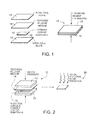
- the powder coated substrate carrying an uncured powder coating
- a low pressure panel press 12 that includes a pair ofsteel caul plates 13.
- the powder Prior to placing the substrate in the press, it is generally desirable to soften/melt the powder to form a film.
- the powder can be in either a completely uncured form when the substrate is pressed or it may be helpful to partially cure the powder prior to pressing.
- an oven be used for the partial curing step.
- any heat source e.g., platen, oven, or infrared (IR) heater
- IR infrared
- the release medium 14 may be, for example, a release paper or release film having a replicative surface. Preferred methods for manufacturing the release medium will be described below.
- release functionality is built into the release medium, it is generally not necessary to modify the powder coating formulation to have release properties, or to use a mold release agent which could transfer to the powder coating surface.
- the press is then closed, and heat and pressure are applied to the "sandwich" of release medium and powder coated substrate to cure the powder coating.
- the temperature applied in the press, and the press dwell time are dependent upon the curing characteristics of the powder coating, but should be sufficient to cure the coating white the release medium 14 is in contact with surface 16. Curing schedules for some conventional powder coating formulations are in the range of 200 to 400"F for 2 to 15 minutes.
- the press pressure is dependent on the powder melt viscosity and is specific to the texture depth. If other factors are kept constant, a shallow texture requires less pressure than a deep texture.
- the pressure is preferably relatively low, e.g., between I and 15,000 psi, more preferably between 5-700 psi.
- the coating is not cured in the press.
- the texture is imparted to the coating in the press, and the coating is cured outside of the press in a separate process step.
- the coating may be radiation curable, and radiation may be applied in a curing station 20.
- the radiation may be, for example, UV or electron beam radiation.
- the texture is again imparted by application of heat and pressure in the press.
- lower temperatures may be used, for example less than 300 "F, e.g., 200 to 280 "F.
- the lower temperatures allow the release medium to be re-used more times.
- temperature-sensitive substrates may be powder coated using this process.
- the coating should generally be cooled or allowed to cool prior to stripping the release medium from the coating.
- the release medium may be stripped prior to curing, or, if the radiation being used can pass through the release medium, may be stripped after curing.
- a lamination nip 52 is used to provided the necessary force to impart texture from a textured surface 54 of a release medium 56 into an uncured powder coating 58 on a powder coated substrate 60.
- the textured release medium is fed into the lamination nip along with the powder coated substrate, which has been previously heated to allow the powder to melt, soften or partially cure.
- Thermally curable powder coatings will be held at an elevated temperature (between 100-400C) for an amount of time specific to the powder coating, in order to partially cure the coating and increase the viscosity prior to feeding the substrate through the nip.
- the powder coating may be heated at a heating station 62 for a certain amount of time specific to the powder coating chemistry to achieve adequate cure/polymerization.
- the release medium is stripped from the cured powder coating, e.g., using a stripping roll 64 and a take-up roll 66 as shown.
- a powder coated substrate 60' will be heated to a temperature that induces melting and then fed through the nip 52 with the release medium 56.
- the nip rolls 51 may be chilled if exposure to radiation 68 (UV or electron beam) does not occur until after the release medium is stripped from the powder coated substrate, as shown in FIG 4 .
- the chilled nip rolls 51 serve to rapidly cool and solidify the powder coating so that the texture imparted from the release medium is maintained after stripping.
- the exposure to radiation can occur before stripping, as shown in FIG 5 .
- the use of chilled nip rolls is optional since the curing of the radiation curable powder coating can occur in the solid or liquid state.
- the release medium consists of a release paper or other material that is opaque to UV radiation, an electron beam should be used to initiate the curing/polymerization of the radiation curable powder coating. If the release medium is transparent, e.g., a transparent release film, the construction can be irradiated with either UV light or an electron beam.
- Powder coatings with inherently low surface energies can provide the cured, powder coated article with release functionality.
- Low surface energy powders including polyolefins, acrylics, silicones, and fluoropolymers can be used as release coatings.
- One application features a caul plate, comprising a caul plate body having a replicative surface on one or both sides of the plate body.
- a textured, powder coated surface with release functionality can be created on the caul plate, to form the replicative surface, by using polyolefin, acrylic, silicone and/or fluoropolymer powder chemistries in the process described in Fig 1 .
- An example of a suitable low surface energy powder coating is as follows:
- Low surface energy powder coatings are commercially available, for example from General Plastics Corp., Bloomfield, NJ, under the tradename GENCOTE® 519-FEP, and from DuPont under the tradename TEFLON® ETFE.
- GENCOTE® 519-FEP coating includes a copolymer of tetrafluoroethylene and hexafluoropropylene that is completely fluorinated.
- suitable powder coatings for use in the above processes include polyamide, polyester, urethane, acrylic, polyolefin, fluoropolymer and epoxy chemistries such as those that are commercially available from Dupont, Sherwin-Williams, Rohm and Haas, Protech, and others.
- Other powder coatings may be used, with the press conditions (time, temperature and pressure) or radiation parameters being adjusted to the curing requirements of the particular powder coating formulation.
- the powder coating may be clear or colored.
- the final powder coating properties, such as chemical resistance and release functionality of the cured coating can be tailored through proper selection of the powder coating chemistry.
- the substrate may be a metal, such as aluminum, steel or other metals, a cellulosic material, such as wood, fiberboard or paper, or any other material that can withstand the pressing process and to which the powder coating will adhere.
- a metal such as aluminum, steel or other metals
- a cellulosic material such as wood, fiberboard or paper, or any other material that can withstand the pressing process and to which the powder coating will adhere.
- the release medium 14 is formed by a method that includes coating a curable liquid onto a substrate, imparting a pattern to the coating, e.g., by a mold roll, curing the coating, and stripping the substrate and cured coating from the pattern-imparting surface.
- the entire process for forming the release medium using an engraved roll is conducted on a continuous web of material which is drawn through a series of processing stations, e.g., as shown diagrammatically in FIG. 7 .
- the process illustrated in FIG. 7 will result in very high fidelity, e.g., substantially 100% fidelity, replication ofthe desired pattern, which will be perpetuated in the products manufactured using the release medium.
- a web 110 e.g., a polymeric film
- a coating station 112 at which a coating head 114 applies a wet coating 116 to a surface 117 of the web.
- the coated web passes through a nip 118 between a backing roll 120 and an engraved roll 122, with the wet coating 116 facing the engraved roll 122.
- the engraved roll carries a pattern on its surface, the inverse of which is imparted to the wet coating.
- Nip pressure is generally relatively low (e.g., "kiss” pressure), with the nip pressure being selected based on the viscosity ofthe coating to prevent the coating from being squeezed offofthe web, while still allowing the engraved texture to be imparted to the coating.
- the nip pressure being selected based on the viscosity ofthe coating to prevent the coating from being squeezed offofthe web, while still allowing the engraved texture to be imparted to the coating.
- higher viscosity coatings and deeper patterns will require relatively higher nip pressures.
- the coated and textured web After leaving the nip, the coated and textured web passes through a curing station 124, e.g., an electron beam or UV curing device. The coating is cured while it is still in contact with the surface of the engraved roll. Electron beam energy or actinic radiation is generally applied from the back surface 126 of the web and passes through the web and cures the coating 116 to form a hardened but flexible textured coating 128 that is firmly adhered to the web 110. The web 110 and cured coating 128 may be stripped off the engraved roll at take-off roll 132 and wound up on a take-up roll 130. If UV curing is used, the web should be transparent or translucent if curing is to be performed from the back surface of the web as shown.
- a curing station 124 e.g., an electron beam or UV curing device.
- the coating is cured while it is still in contact with the surface of the engraved roll. Electron beam energy or actinic radiation is generally applied from the back surface 126
- the coating 116 may be applied using any suitable method. Suitable techniques include offset gravure, direct gravure, kni fe over roll, curtain coating, and other printing and coating techniques.
- the engraved roll is one example of a replicative surface that may be used to impart the pattern to the wet coating.
- Other types of pattern-imparting devices may be used. It is generally preferred, however, that the replicative surface be disposed on a rotating endless surface such as a roll, drum, or other cylindrical surface.
- the coating can be applied directly to the web, before the substrate contacts the roll, as shown in FIG. 3 , or alternatively the coating can be applied directly to the roll, in which case the substrate is pressed against the coated roll.
- the coating may be cured by thermal curing, or preferably by radiation curing (e.g., electron beam radiation or UV radiation).
- Electron beam radiation is preferred in some cases because it can penetrate the thick coatings required for certain desired patterns.
- Electron beam radiation units are readily available and typically consist of a transformer capable of stepping up line voltage and an electron accelerator. Manufacturers of electron beam radiation units include Energy Sciences, Inc., Wilmington, MA, and PCT Engineered Systems, LLC, Davenport, lowa. Suitable UV curing devices are commonly available, e.g., from Fusion, Inc., Gaithersburg, Maryland.
- the curable coatings referred to above preferably include an acrylated oligomer, a monofunctional monomer, and a multifunctional monomer for crosslinking. If ultraviolet radiation is used to cure the acrylic functional coating, the coating will also include a photoinitiator as is well known in the art.
- Preferred acrylated oligomers include acrylated urethanes, epoxies, polyesters, acrylics and silicones. The oligomer contributes substantially to the final properties of the coating. Practitioners skilled in the art are aware of how to select the appropriate oligomer(s) to achieve the desired final properties. Desired final properties for the release webs described herein typically require an oligomer which provides flexibility and durability.
- acrylated oligomers are commercially available from Cytec Surface Specialties Corporation, such as Ebecryl 6700, 4827, 3200, 1701, and 80, and Sartomer Company, Inc., such as CN-120, CN-999 and CN-2920.
- Typical monofunctional monomers include acrylic acid, N-vinylpyrrolidone, (ethoxyethoxy)ethyl acrylate, or isodecyl acrylate.
- the monofunctional monomer is isodecyl acrylate.
- the monofunctional monomer acts as a diluent, i.e., lowers the viscosity of the coating, and increases flexibility of the coating.
- Examples of monofunctional monomers include SR-395 and SR-440, available from Sartomer Company, Inc., and Ebecryl III and ODA-N (octyl/decyl acrylate), available from Cytec Surface Specialties Corporation.
- multifunctional monomers for crosslinking purposes are trimethylolpropane triacrylate (TMPTA), propoxylated glyceryl triacrylate (PGTA), tripropylene glycol diacrylate (TPGDA), and dipropylene glycol diacrylate (DPGDA).
- TMPTA trimethylolpropane triacrylate
- PGTA propoxylated glyceryl triacrylate
- TPGDA tripropylene glycol diacrylate
- DPGDA dipropylene glycol diacrylate
- the multifunctional monomer is selected from a group consisting of TMPTA, TPGDA, and mixtures thereof.
- the preferred multifunctional monomer acts as a crosslinker.
- Examples of multifunctional monomers include SR-9020, SR-351, SR-9003 and SR-9209, manufactured by Sartomer Company, Inc., and TMPTA-N, OTA-480 and DPGDA, manufactured by Cytec Surface Specialties Corporation.
- the coating comprises, before curing, 20-50% of the acrylated oligomer, 15-35% of the monofunctional monomer, and 20-50% of the multifunctional monomer.
- the formulation of the coating will depend on the final targeted viscosity and the desired physical properties ofthe cured coating. In some implementations, the preferred viscosity is 0.2 to 5 Pascal seconds, more preferably 0.3 to 1 Pascal seconds, measured at room temperature (21-24°C).
- the coating composition may also include other ingredients such as opacifying agents, colorants, slip/spread agents and anti-static or anti-abrasive additives.
- opacity of the coating may be varied, for example by the addition of various pigments such as titanium dioxide, barium sulfate and calcium carbonate, addition of hollow or solid glass beads, or addition of an incompatible liquid such as water. The degree of opacity can be adjusted by varying the amount ofthe additive used.
- a photoinitiator or photoinitiator package may be included if the coating is to be UV cured.
- a suitable photoinitiator is available from the Sartomer Company under the tradename KTO-46TM.
- the photoinitiator may be included at a level of, for example, 0.5-2%.
- the substrate for the release medium may be, for example, a polymeric film or a paper or other web material.
- the release medium may be formed using traditional embossing techniques.
- the release medium may be tip printed with an ink or other coating, which will transfer to the surface of the powder coating.
- Tip printing is described in U.S. Serial No. 11/670,627, filed February 2, 2007 , the complete disclosure of which is incorporated by reference herein.
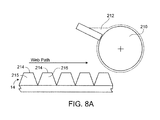
- a printing roll 210 is used to apply a printing ink 212 to the raised surfaces 214 of the "hills" 215 of the release medium 14. Because a tip printing technique is used, only the raised surfaces 14 are coated with ink, with the "valleys" or recessed areas of the embossed pattern remaining free of ink.
- tip printing is accomplished by moving the embossed release medium past the printing roll. Tip printing may be performed using any suitable printing technique, e.g., gravure, flexo, offset, rotary, and other well known printing techniques.
- the uncured powder coating can be applied to the substrate and melted or partially cured and then the coated substrate can be stored or transported to a remote location (e.g., a different processing facility) prior to the texture being imparted to the powder coating.
- the texture can then be imparted in a separate step at a later time and/or different location, and the textured coating can then either be immediately cured or can again be stored and/or shipped prior to curing.
- coating of the substrate, texturing of the coating, and curing of the textured coating may take place at three separate locations.
- the release medium may act as a powder coating carrier which is used to transfer an uncured powder coating from the release medium to a substrate.
- the release medium is textured, so as to impart a surface texture to the powder coating. Referring to FIG. 6 , the release medium first is powder coated and the powder coating formulation is heated to a temperature which melts the powder coating to form a uniform coating without initiating any significant amount of curing. It is important that the temperature stay below the curing temperature for a thermoset powder coating so as to minimize the extent of cure which takes place prior to transferring the powder coating from the release medium. Once the powder coated release medium 70 is cooled, the construction can be freely handled and stored for later use. To transfer the powder coating from the release medium to a substrate 72, the same procedure illustrated in FIG. 1 is followed; however, in this case the release medium 70 has the powder coating on its textured surface and the substrate 72 initially has no powder coating.
- a method of powder coating a substrate comprising:
- the texture may be imparted in a press, e.g. a low pressure panel press.
- the coating may be thermally cured.
- the texture may be imparted and the coating may be cured in a press.
- the coating may be radiation cured.
- the texture is imparted in a press
- the textured coated substrate may be removed from the press, and the textured coating is cured at a radiation curing station, and the release medium optionally may be stripped from the textured surface prior to curing.
- the release medium may comprise a release film or release paper.
- the method may further comprise providing the release medium by applying a curable release coating to a flexible web, imparting a texture to the coating and curing the coating to form a textured surface layer.
- the texture may be imparted to the coating on the flexible web using a roll engraved with a replicative pattern.
- the method of the invention may further comprise tip printing the release medium prior to imparting the texture to the uncured powder coating.
- the release medium may be in the form of a sheet.
- the release medium may be in the form of a web.
- the release medium may include a replicative surface that is imparted to the surface of the powder coating formulation that is in contact with the release medium during curing.
- Curing may be conducted in a press.
- the release medium may be stripped from the textured surface prior to curing.
- the release medium may comprise a release film or release paper.
- the release medium may be in the form of a web.
- the method may further comprise providing the release medium by applying a curable release coating to a flexible web, imparting a texture to the coating and curing the coating to form a surface layer.
- an intermediate product comprising:
- a caul plate comprising:
- the release surface may include a texture to define a replicative surface.
Landscapes
- Application Of Or Painting With Fluid Materials (AREA)
- Laminated Bodies (AREA)
Applications Claiming Priority (1)
| Application Number | Priority Date | Filing Date | Title |
|---|---|---|---|
| US11/839,163 US7771795B2 (en) | 2007-08-15 | 2007-08-15 | Powder coatings and methods of forming powder coatings |
Publications (3)
| Publication Number | Publication Date |
|---|---|
| EP2025413A2 true EP2025413A2 (fr) | 2009-02-18 |
| EP2025413A3 EP2025413A3 (fr) | 2010-03-24 |
| EP2025413B1 EP2025413B1 (fr) | 2014-12-10 |
Family
ID=40089879
Family Applications (1)
| Application Number | Title | Priority Date | Filing Date |
|---|---|---|---|
| EP08161110.5A Not-in-force EP2025413B1 (fr) | 2007-08-15 | 2008-07-24 | Revêtements de poudre et procédé de formation de revêtements de poudre |
Country Status (2)
| Country | Link |
|---|---|
| US (1) | US7771795B2 (fr) |
| EP (1) | EP2025413B1 (fr) |
Cited By (7)
| Publication number | Priority date | Publication date | Assignee | Title |
|---|---|---|---|---|
| WO2011017074A1 (fr) * | 2009-08-03 | 2011-02-10 | S.D. Warren Company | Application dune texture à des revêtements par poudrage durcis |
| US8192830B2 (en) | 2007-04-30 | 2012-06-05 | S.D. Warren Company | Materials having a textured surface and methods for producing same |
| US8286342B2 (en) | 2007-11-26 | 2012-10-16 | S.D. Warren Company | Methods for manufacturing electronic devices |
| EP2810541A4 (fr) * | 2012-01-30 | 2016-01-06 | Stora Enso Oyj | Procédé et agencement de transfert de matériau conducteur à l'état fluide sur un substrat à imprimer |
| EP3766703A1 (fr) * | 2019-07-19 | 2021-01-20 | Achilles veredelt Nord GmbH | Procédé de fabrication d'une structure sur une surface |
| WO2021013679A1 (fr) | 2019-07-19 | 2021-01-28 | Achilles Veredelt Nord Gmbh | Procédé de production d'une structure sur une surface |
| WO2022031930A1 (fr) * | 2020-08-05 | 2022-02-10 | Keyland Polymer Material Sciences, Llc | Panneaux revêtus obtenus par poudrage durci, et procédés et appareil de production associés |
Families Citing this family (17)
| Publication number | Priority date | Publication date | Assignee | Title |
|---|---|---|---|---|
| US8226737B2 (en) * | 2008-07-03 | 2012-07-24 | 3M Innovative Properties Company | Fixed abrasive particles and articles made therefrom |
| CN102458771A (zh) * | 2009-04-17 | 2012-05-16 | 3M创新有限公司 | 采用转移制品制造的平面磨料制品及其制造方法 |
| PL2363299T3 (pl) | 2010-03-05 | 2013-02-28 | Unilin Bvba | Sposób wytwarzania panelu podłogowego |
| FI126151B (en) * | 2012-01-30 | 2016-07-15 | Stora Enso Oyj | A method and arrangement for producing an electrically conductive pattern on a surface |
| US10035358B2 (en) | 2012-07-17 | 2018-07-31 | Ceraloc Innovation Ab | Panels with digital embossed in register surface |
| EP2877349B1 (fr) * | 2012-07-17 | 2019-11-27 | Ceraloc Innovation AB | Surface gaufrée par voie numérique par technique embossed-in-register |
| US9446602B2 (en) | 2012-07-26 | 2016-09-20 | Ceraloc Innovation Ab | Digital binder printing |
| JP5959420B2 (ja) * | 2012-11-26 | 2016-08-02 | 旭サナック株式会社 | 粉体塗装方法 |
| US9528011B2 (en) | 2013-01-11 | 2016-12-27 | Ceraloc Innovation Ab | Digital binder and powder print |
| GB2538492A (en) | 2015-05-11 | 2016-11-23 | Cook Medical Technologies Llc | Aneurysm treatment assembly |
| US10041212B2 (en) | 2013-02-04 | 2018-08-07 | Ceraloc Innovation Ab | Digital overlay |
| US9358580B1 (en) | 2013-03-12 | 2016-06-07 | BTD Wood Powder Coating, Inc. | Method for preparing and top coating a powder coated wood substrate |
| US8721396B1 (en) * | 2013-03-12 | 2014-05-13 | BTD Wood Powder Coating, Inc. | Method for preparing and buffing a powder coated wood substrate |
| US11077639B2 (en) | 2016-08-19 | 2021-08-03 | Wilsonart Llc | Surfacing materials and method of manufacture |
| US10933608B2 (en) * | 2016-08-19 | 2021-03-02 | Wilsonart Llc | Surfacing materials and method of manufacture |
| US11504955B2 (en) | 2016-08-19 | 2022-11-22 | Wilsonart Llc | Decorative laminate with matte finish and method of manufacture |
| US11745475B2 (en) | 2016-08-19 | 2023-09-05 | Wilsonart Llc | Surfacing materials and method of manufacture |
Citations (2)
| Publication number | Priority date | Publication date | Assignee | Title |
|---|---|---|---|---|
| US6238750B1 (en) | 1999-10-12 | 2001-05-29 | Rohm And Haas Company | Powder coating involving compression of the coating during curing |
| US20080185092A1 (en) | 2007-02-02 | 2008-08-07 | S.D. Warren Company | Tip printing embossed surfaces |
Family Cites Families (11)
| Publication number | Priority date | Publication date | Assignee | Title |
|---|---|---|---|---|
| CH315969A (de) * | 1951-12-24 | 1956-09-15 | Holzwerke H Wilhelmi O H G | Verfahren und Vorrichtung zur Veredelung der Oberfläche von Werkstoffen |
| US3682738A (en) * | 1969-09-03 | 1972-08-08 | Johnson & Johnson | Methods and apparatus for depositing powdered materials in patterned areas |
| JPS5539663B2 (fr) * | 1972-05-23 | 1980-10-13 | ||
| US6136882A (en) * | 1998-08-19 | 2000-10-24 | Morton International Inc. | Non-hazing UV curable powder coatings containing crystalline resins |
| WO2000024559A1 (fr) * | 1998-10-23 | 2000-05-04 | Vantico Ag | Procede de remplissage et de renforcement de panneaux en sandwich en nids d'abeilles |
| US6858253B2 (en) * | 2001-05-31 | 2005-02-22 | 3M Innovative Properties Company | Method of making dimensionally stable composite article |
| FI118542B (fi) * | 2002-03-14 | 2007-12-14 | Metso Paper Inc | Pintakäsittelyprosessi |
| FI121123B (fi) * | 2002-03-14 | 2010-07-15 | Metso Paper Inc | Menetelmä jatkuvan rainan pinnan päällystämiseksi kuivapäällystysjauheella |
| FI121039B (fi) | 2002-03-14 | 2010-06-15 | Metso Paper Inc | Maadoituselektrodi ja menetelmä jossa sitä käytetään |
| FI121810B (fi) | 2002-03-14 | 2011-04-29 | Metso Paper Inc | Menetelmä kalvon muodostamiseksi |
| US20040142181A1 (en) * | 2003-01-16 | 2004-07-22 | Derek Marsella | PTFE/polyphenylene sulphide bearing material and method of manufacture |
-
2007
- 2007-08-15 US US11/839,163 patent/US7771795B2/en not_active Expired - Fee Related
-
2008
- 2008-07-24 EP EP08161110.5A patent/EP2025413B1/fr not_active Not-in-force
Patent Citations (2)
| Publication number | Priority date | Publication date | Assignee | Title |
|---|---|---|---|---|
| US6238750B1 (en) | 1999-10-12 | 2001-05-29 | Rohm And Haas Company | Powder coating involving compression of the coating during curing |
| US20080185092A1 (en) | 2007-02-02 | 2008-08-07 | S.D. Warren Company | Tip printing embossed surfaces |
Cited By (11)
| Publication number | Priority date | Publication date | Assignee | Title |
|---|---|---|---|---|
| US8192830B2 (en) | 2007-04-30 | 2012-06-05 | S.D. Warren Company | Materials having a textured surface and methods for producing same |
| US8286342B2 (en) | 2007-11-26 | 2012-10-16 | S.D. Warren Company | Methods for manufacturing electronic devices |
| WO2011017074A1 (fr) * | 2009-08-03 | 2011-02-10 | S.D. Warren Company | Application dune texture à des revêtements par poudrage durcis |
| CN102470393A (zh) * | 2009-08-03 | 2012-05-23 | S·D·沃伦公司 | 给固化粉末涂层赋予纹理 |
| US8551386B2 (en) | 2009-08-03 | 2013-10-08 | S.D. Warren Company | Imparting texture to cured powder coatings |
| CN102470393B (zh) * | 2009-08-03 | 2014-07-16 | S·D·沃伦公司 | 给固化粉末涂层赋予纹理 |
| EP2810541A4 (fr) * | 2012-01-30 | 2016-01-06 | Stora Enso Oyj | Procédé et agencement de transfert de matériau conducteur à l'état fluide sur un substrat à imprimer |
| US10085350B2 (en) | 2012-01-30 | 2018-09-25 | Stora Enso Oyj | Method and arrangement for transferring electrically conductive material in fluid form on a substrate to be printed |
| EP3766703A1 (fr) * | 2019-07-19 | 2021-01-20 | Achilles veredelt Nord GmbH | Procédé de fabrication d'une structure sur une surface |
| WO2021013679A1 (fr) | 2019-07-19 | 2021-01-28 | Achilles Veredelt Nord Gmbh | Procédé de production d'une structure sur une surface |
| WO2022031930A1 (fr) * | 2020-08-05 | 2022-02-10 | Keyland Polymer Material Sciences, Llc | Panneaux revêtus obtenus par poudrage durci, et procédés et appareil de production associés |
Also Published As
| Publication number | Publication date |
|---|---|
| US20090047480A1 (en) | 2009-02-19 |
| US7771795B2 (en) | 2010-08-10 |
| EP2025413B1 (fr) | 2014-12-10 |
| EP2025413A3 (fr) | 2010-03-24 |
Similar Documents
| Publication | Publication Date | Title |
|---|---|---|
| EP2025413B1 (fr) | Revêtements de poudre et procédé de formation de revêtements de poudre | |
| US8551386B2 (en) | Imparting texture to cured powder coatings | |
| US8192830B2 (en) | Materials having a textured surface and methods for producing same | |
| KR100445439B1 (ko) | 복합성분 반응성 우레탄 시스템에서의 이용을 위한 릴리즈시트 및 그 제조 방법 | |
| US9675996B2 (en) | Embossed heat transfer labels | |
| CN108349123B (zh) | 剥离幅材和纹理化产品 | |
| WO2007143527A2 (fr) | Balises et antennes rfid et leurs procédés de fabrication | |
| JPS6059878B2 (ja) | 転写絵付方法 | |
| CN101405152A (zh) | 装饰玻璃的膜及其制造方法 | |
| JP3173168B2 (ja) | 化粧紙の製造方法および製造装置 | |
| JPH0142747B2 (fr) | ||
| HK1167361B (en) | Imparting texture to cured powder coatings | |
| JP2780034B2 (ja) | 凹凸模様の付与方法 | |
| TW201825255A (zh) | 離型模板以及由其賦予紋理的製品 | |
| HK1139357A (en) | Materials having a textured surface and methods for producing same | |
| JPH06158555A (ja) | 離型シートの製造方法 |
Legal Events
| Date | Code | Title | Description |
|---|---|---|---|
| PUAI | Public reference made under article 153(3) epc to a published international application that has entered the european phase |
Free format text: ORIGINAL CODE: 0009012 |
|
| AK | Designated contracting states |
Kind code of ref document: A2 Designated state(s): AT BE BG CH CY CZ DE DK EE ES FI FR GB GR HR HU IE IS IT LI LT LU LV MC MT NL NO PL PT RO SE SI SK TR |
|
| AX | Request for extension of the european patent |
Extension state: AL BA MK RS |
|
| RIC1 | Information provided on ipc code assigned before grant |
Ipc: B05D 3/06 20060101ALI20091124BHEP Ipc: B05D 3/02 20060101ALI20091124BHEP Ipc: B05D 1/42 20060101AFI20091124BHEP Ipc: B05D 3/12 20060101ALI20091124BHEP |
|
| PUAL | Search report despatched |
Free format text: ORIGINAL CODE: 0009013 |
|
| AK | Designated contracting states |
Kind code of ref document: A3 Designated state(s): AT BE BG CH CY CZ DE DK EE ES FI FR GB GR HR HU IE IS IT LI LT LU LV MC MT NL NO PL PT RO SE SI SK TR |
|
| AX | Request for extension of the european patent |
Extension state: AL BA MK RS |
|
| 17P | Request for examination filed |
Effective date: 20100820 |
|
| AKX | Designation fees paid |
Designated state(s): AT BE BG CH CY CZ DE DK EE ES FI FR GB GR HR HU IE IS IT LI LT LU LV MC MT NL NO PL PT RO SE SI SK TR |
|
| 17Q | First examination report despatched |
Effective date: 20101014 |
|
| R17C | First examination report despatched (corrected) |
Effective date: 20101214 |
|
| GRAP | Despatch of communication of intention to grant a patent |
Free format text: ORIGINAL CODE: EPIDOSNIGR1 |
|
| INTG | Intention to grant announced |
Effective date: 20140708 |
|
| GRAS | Grant fee paid |
Free format text: ORIGINAL CODE: EPIDOSNIGR3 |
|
| GRAA | (expected) grant |
Free format text: ORIGINAL CODE: 0009210 |
|
| AK | Designated contracting states |
Kind code of ref document: B1 Designated state(s): AT BE BG CH CY CZ DE DK EE ES FI FR GB GR HR HU IE IS IT LI LT LU LV MC MT NL NO PL PT RO SE SI SK TR |
|
| REG | Reference to a national code |
Ref country code: GB Ref legal event code: FG4D |
|
| REG | Reference to a national code |
Ref country code: CH Ref legal event code: EP |
|
| REG | Reference to a national code |
Ref country code: IE Ref legal event code: FG4D |
|
| REG | Reference to a national code |
Ref country code: AT Ref legal event code: REF Ref document number: 700386 Country of ref document: AT Kind code of ref document: T Effective date: 20150115 |
|
| REG | Reference to a national code |
Ref country code: SE Ref legal event code: TRGR |
|
| REG | Reference to a national code |
Ref country code: DE Ref legal event code: R096 Ref document number: 602008035763 Country of ref document: DE Effective date: 20150122 |
|
| REG | Reference to a national code |
Ref country code: AT Ref legal event code: MK05 Ref document number: 700386 Country of ref document: AT Kind code of ref document: T Effective date: 20141210 Ref country code: NL Ref legal event code: VDEP Effective date: 20141210 |
|
| REG | Reference to a national code |
Ref country code: NL Ref legal event code: VDEP Effective date: 20141210 |
|
| PG25 | Lapsed in a contracting state [announced via postgrant information from national office to epo] |
Ref country code: NO Free format text: LAPSE BECAUSE OF FAILURE TO SUBMIT A TRANSLATION OF THE DESCRIPTION OR TO PAY THE FEE WITHIN THE PRESCRIBED TIME-LIMIT Effective date: 20150310 Ref country code: FI Free format text: LAPSE BECAUSE OF FAILURE TO SUBMIT A TRANSLATION OF THE DESCRIPTION OR TO PAY THE FEE WITHIN THE PRESCRIBED TIME-LIMIT Effective date: 20141210 Ref country code: LT Free format text: LAPSE BECAUSE OF FAILURE TO SUBMIT A TRANSLATION OF THE DESCRIPTION OR TO PAY THE FEE WITHIN THE PRESCRIBED TIME-LIMIT Effective date: 20141210 Ref country code: ES Free format text: LAPSE BECAUSE OF FAILURE TO SUBMIT A TRANSLATION OF THE DESCRIPTION OR TO PAY THE FEE WITHIN THE PRESCRIBED TIME-LIMIT Effective date: 20141210 |
|
| REG | Reference to a national code |
Ref country code: LT Ref legal event code: MG4D |
|
| PG25 | Lapsed in a contracting state [announced via postgrant information from national office to epo] |
Ref country code: GR Free format text: LAPSE BECAUSE OF FAILURE TO SUBMIT A TRANSLATION OF THE DESCRIPTION OR TO PAY THE FEE WITHIN THE PRESCRIBED TIME-LIMIT Effective date: 20150311 Ref country code: HR Free format text: LAPSE BECAUSE OF FAILURE TO SUBMIT A TRANSLATION OF THE DESCRIPTION OR TO PAY THE FEE WITHIN THE PRESCRIBED TIME-LIMIT Effective date: 20141210 Ref country code: LV Free format text: LAPSE BECAUSE OF FAILURE TO SUBMIT A TRANSLATION OF THE DESCRIPTION OR TO PAY THE FEE WITHIN THE PRESCRIBED TIME-LIMIT Effective date: 20141210 Ref country code: AT Free format text: LAPSE BECAUSE OF FAILURE TO SUBMIT A TRANSLATION OF THE DESCRIPTION OR TO PAY THE FEE WITHIN THE PRESCRIBED TIME-LIMIT Effective date: 20141210 |
|
| PG25 | Lapsed in a contracting state [announced via postgrant information from national office to epo] |
Ref country code: NL Free format text: LAPSE BECAUSE OF FAILURE TO SUBMIT A TRANSLATION OF THE DESCRIPTION OR TO PAY THE FEE WITHIN THE PRESCRIBED TIME-LIMIT Effective date: 20141210 |
|
| PG25 | Lapsed in a contracting state [announced via postgrant information from national office to epo] |
Ref country code: RO Free format text: LAPSE BECAUSE OF FAILURE TO SUBMIT A TRANSLATION OF THE DESCRIPTION OR TO PAY THE FEE WITHIN THE PRESCRIBED TIME-LIMIT Effective date: 20141210 Ref country code: CZ Free format text: LAPSE BECAUSE OF FAILURE TO SUBMIT A TRANSLATION OF THE DESCRIPTION OR TO PAY THE FEE WITHIN THE PRESCRIBED TIME-LIMIT Effective date: 20141210 Ref country code: PT Free format text: LAPSE BECAUSE OF FAILURE TO SUBMIT A TRANSLATION OF THE DESCRIPTION OR TO PAY THE FEE WITHIN THE PRESCRIBED TIME-LIMIT Effective date: 20150410 Ref country code: SK Free format text: LAPSE BECAUSE OF FAILURE TO SUBMIT A TRANSLATION OF THE DESCRIPTION OR TO PAY THE FEE WITHIN THE PRESCRIBED TIME-LIMIT Effective date: 20141210 Ref country code: EE Free format text: LAPSE BECAUSE OF FAILURE TO SUBMIT A TRANSLATION OF THE DESCRIPTION OR TO PAY THE FEE WITHIN THE PRESCRIBED TIME-LIMIT Effective date: 20141210 |
|
| PG25 | Lapsed in a contracting state [announced via postgrant information from national office to epo] |
Ref country code: IS Free format text: LAPSE BECAUSE OF FAILURE TO SUBMIT A TRANSLATION OF THE DESCRIPTION OR TO PAY THE FEE WITHIN THE PRESCRIBED TIME-LIMIT Effective date: 20150410 Ref country code: PL Free format text: LAPSE BECAUSE OF FAILURE TO SUBMIT A TRANSLATION OF THE DESCRIPTION OR TO PAY THE FEE WITHIN THE PRESCRIBED TIME-LIMIT Effective date: 20141210 |
|
| REG | Reference to a national code |
Ref country code: DE Ref legal event code: R097 Ref document number: 602008035763 Country of ref document: DE |
|
| PLBE | No opposition filed within time limit |
Free format text: ORIGINAL CODE: 0009261 |
|
| STAA | Information on the status of an ep patent application or granted ep patent |
Free format text: STATUS: NO OPPOSITION FILED WITHIN TIME LIMIT |
|
| PG25 | Lapsed in a contracting state [announced via postgrant information from national office to epo] |
Ref country code: DK Free format text: LAPSE BECAUSE OF FAILURE TO SUBMIT A TRANSLATION OF THE DESCRIPTION OR TO PAY THE FEE WITHIN THE PRESCRIBED TIME-LIMIT Effective date: 20141210 |
|
| 26N | No opposition filed |
Effective date: 20150911 |
|
| REG | Reference to a national code |
Ref country code: DE Ref legal event code: R119 Ref document number: 602008035763 Country of ref document: DE |
|
| PG25 | Lapsed in a contracting state [announced via postgrant information from national office to epo] |
Ref country code: MC Free format text: LAPSE BECAUSE OF FAILURE TO SUBMIT A TRANSLATION OF THE DESCRIPTION OR TO PAY THE FEE WITHIN THE PRESCRIBED TIME-LIMIT Effective date: 20141210 Ref country code: SI Free format text: LAPSE BECAUSE OF FAILURE TO SUBMIT A TRANSLATION OF THE DESCRIPTION OR TO PAY THE FEE WITHIN THE PRESCRIBED TIME-LIMIT Effective date: 20141210 |
|
| REG | Reference to a national code |
Ref country code: CH Ref legal event code: PL |
|
| REG | Reference to a national code |
Ref country code: SE Ref legal event code: EUG |
|
| GBPC | Gb: european patent ceased through non-payment of renewal fee |
Effective date: 20150724 |
|
| PG25 | Lapsed in a contracting state [announced via postgrant information from national office to epo] |
Ref country code: LU Free format text: LAPSE BECAUSE OF FAILURE TO SUBMIT A TRANSLATION OF THE DESCRIPTION OR TO PAY THE FEE WITHIN THE PRESCRIBED TIME-LIMIT Effective date: 20150724 |
|
| REG | Reference to a national code |
Ref country code: IE Ref legal event code: MM4A |
|
| PG25 | Lapsed in a contracting state [announced via postgrant information from national office to epo] |
Ref country code: DE Free format text: LAPSE BECAUSE OF NON-PAYMENT OF DUE FEES Effective date: 20160202 Ref country code: GB Free format text: LAPSE BECAUSE OF NON-PAYMENT OF DUE FEES Effective date: 20150724 Ref country code: LI Free format text: LAPSE BECAUSE OF NON-PAYMENT OF DUE FEES Effective date: 20150731 Ref country code: CH Free format text: LAPSE BECAUSE OF NON-PAYMENT OF DUE FEES Effective date: 20150731 |
|
| REG | Reference to a national code |
Ref country code: FR Ref legal event code: ST Effective date: 20160331 |
|
| PG25 | Lapsed in a contracting state [announced via postgrant information from national office to epo] |
Ref country code: SE Free format text: LAPSE BECAUSE OF NON-PAYMENT OF DUE FEES Effective date: 20150725 Ref country code: FR Free format text: LAPSE BECAUSE OF NON-PAYMENT OF DUE FEES Effective date: 20150731 Ref country code: BE Free format text: LAPSE BECAUSE OF FAILURE TO SUBMIT A TRANSLATION OF THE DESCRIPTION OR TO PAY THE FEE WITHIN THE PRESCRIBED TIME-LIMIT Effective date: 20141210 |
|
| PG25 | Lapsed in a contracting state [announced via postgrant information from national office to epo] |
Ref country code: IT Free format text: LAPSE BECAUSE OF NON-PAYMENT OF DUE FEES Effective date: 20150724 Ref country code: IE Free format text: LAPSE BECAUSE OF NON-PAYMENT OF DUE FEES Effective date: 20150724 |
|
| PG25 | Lapsed in a contracting state [announced via postgrant information from national office to epo] |
Ref country code: MT Free format text: LAPSE BECAUSE OF FAILURE TO SUBMIT A TRANSLATION OF THE DESCRIPTION OR TO PAY THE FEE WITHIN THE PRESCRIBED TIME-LIMIT Effective date: 20141210 |
|
| PG25 | Lapsed in a contracting state [announced via postgrant information from national office to epo] |
Ref country code: HU Free format text: LAPSE BECAUSE OF FAILURE TO SUBMIT A TRANSLATION OF THE DESCRIPTION OR TO PAY THE FEE WITHIN THE PRESCRIBED TIME-LIMIT; INVALID AB INITIO Effective date: 20080724 Ref country code: BG Free format text: LAPSE BECAUSE OF FAILURE TO SUBMIT A TRANSLATION OF THE DESCRIPTION OR TO PAY THE FEE WITHIN THE PRESCRIBED TIME-LIMIT Effective date: 20141210 |
|
| PG25 | Lapsed in a contracting state [announced via postgrant information from national office to epo] |
Ref country code: CY Free format text: LAPSE BECAUSE OF FAILURE TO SUBMIT A TRANSLATION OF THE DESCRIPTION OR TO PAY THE FEE WITHIN THE PRESCRIBED TIME-LIMIT Effective date: 20141210 |
|
| PG25 | Lapsed in a contracting state [announced via postgrant information from national office to epo] |
Ref country code: TR Free format text: LAPSE BECAUSE OF FAILURE TO SUBMIT A TRANSLATION OF THE DESCRIPTION OR TO PAY THE FEE WITHIN THE PRESCRIBED TIME-LIMIT Effective date: 20141210 |